EP0063050A1 - Matériau photosensible pour l'électrophotographie - Google Patents
Matériau photosensible pour l'électrophotographie Download PDFInfo
- Publication number
- EP0063050A1 EP0063050A1 EP82301910A EP82301910A EP0063050A1 EP 0063050 A1 EP0063050 A1 EP 0063050A1 EP 82301910 A EP82301910 A EP 82301910A EP 82301910 A EP82301910 A EP 82301910A EP 0063050 A1 EP0063050 A1 EP 0063050A1
- Authority
- EP
- European Patent Office
- Prior art keywords
- photosensitive material
- pvcz
- phthalocyanine
- vinylcarbazole
- photosensitivity
- Prior art date
- Legal status (The legal status is an assumption and is not a legal conclusion. Google has not performed a legal analysis and makes no representation as to the accuracy of the status listed.)
- Granted
Links
Images

Classifications
-
- G—PHYSICS
- G03—PHOTOGRAPHY; CINEMATOGRAPHY; ANALOGOUS TECHNIQUES USING WAVES OTHER THAN OPTICAL WAVES; ELECTROGRAPHY; HOLOGRAPHY
- G03G—ELECTROGRAPHY; ELECTROPHOTOGRAPHY; MAGNETOGRAPHY
- G03G5/00—Recording-members for original recording by exposure, e.g. to light, to heat or to electrons; Manufacture thereof; Selection of materials therefor
- G03G5/02—Charge-receiving layers
- G03G5/04—Photoconductive layers; Charge-generation layers or charge-transporting layers; Additives therefor; Binders therefor
- G03G5/06—Photoconductive layers; Charge-generation layers or charge-transporting layers; Additives therefor; Binders therefor characterised by the photoconductive material being organic
- G03G5/0664—Dyes
- G03G5/0696—Phthalocyanines
Definitions
- the present invention relates to a photosensitive material for electrophotography. More particularly, it relates to a photosensitive material for electrophotography which has a high photosensitivity to rays having a wavelength included in the oscillation wavelength region of a laser printer, especially a semiconductor laser printer, and also has a high charge potential.
- Phthalocyanine pigment on the other hand, has long been known to have photoconductivity, is cheap, and is very low in toxicity. Researches have consequently been made on application of phthalocyanine pigment in the field of electrophotography to copying machines, laser printers, and the like as the photosensitive material. Phthalocyanine pigment cannot be used for the production of a photosensitive material alone because it has no film-forming property and because vacuum evaporation deposition thereof is very difficult. Accordingly, a photoconductive film is ordinarily formed by dissolving or dispersing the phthalocyanine pigment together with a binder in an organic solvent. The thus formed photoconductive coating solution or dispersion is then coated at a dried thickness of several microns to scores of microns on an electroconductive substrate by means of a doctor blade, a bar coater, a roll coater, or the like.
- the present inventors have already proposed the addition of an oxadiazole derivative and of tetrathiafuivalene as third components to the phthalocyanine photosens'itive material (Japanese Patent Application Nos. 55-120767 and 55-120779, respectively).
- Japanese Patent Application Nos. 55-120767 and 55-120779, respectively Japanese Patent Application Nos. 55-120767 and 55-120779, respectively.
- the photosensitivity and charging property of these proposed photosensitive materials are still insufficient for photosensitive material for semiconductor laser printers.
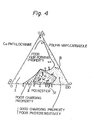
- a photosensitive material for electrophotography which comprises a phthalocyanine pigment, poly--N-vinylcarbazole (PVCz), and an organic resin in which said phthalocyanine pigment and poly-N-vinylcarbazole are dispersed, wherein the weight ratio of phthalocyanine to PVCz is in the range of from 1.2 to 12 and the content of the organic resin is 35% to 70% by weight based on the total amount of the photosensitive material, possesses excellent photosensitivity and a high charge potential.
- PVCz poly--N-vinylcarbazole
- the weight ratio of copper phthalocyanine to PVCz is in the range of from 0.0001 to 0.1, which range is quite different from that in the present invention. This difference is considered to be ascribable to the following reasons.
- copper phthalocyanine which is used as a sensitizer, is used for widening the spectral response of PVCz.
- the above-mentioned range is adopted for the purpose of maintaining the retention of charge, transparency, and self-film-forming property of the photosensitive material at satisfactory levels.
- copper phthalocyanine is mainly used for enhancing the photoconductivity of the photosensitive material.
- PVCz plays only an auxiliary role in the enhancement of the photosensitivity.
- the above-mentioned range is adopted.
- PVCz and the organic resin contribute to the retention of charge of the photosensitive material.
- Japanese Laid-Open Patent Application No. 53-9537 further discloses a styrene-acrylic copolymer as the binder resin.
- the amount of this copolymer used is about 8.7% by weight based on the total amount of the photosensitive material, which amount is also different from the amount of the organic resin used in the present invention.
- Japanese Patent Application Publication No. 56-17657 discloses an electron radiation-sensitive material comprising a phthalocyanine photoconductor and a PVCz photoconductor.
- an X-type metal-free phthalocyanine is used as the phthalocyanine photoconductor.
- the weight ratio of phthalocyanine to PVCz is in the range of from 0.00125 to 0.0625, which range is different from that in the present invention.
- the above-mentioned range disclosed in this patent is selected for obtaining an optional mechanical property of the photosensitive material.
- this patent only exemplifies various organic resins as the binder, and neither discloses nor suggests the amount of these resins used.
- the phthalocyanine pigment usable for the present invention may be selected from metalo-phthalocyanines pigments, and metal-free phthalocyanine pigments. Copper phthalocyanine is particularly preferable.
- the organic resin usable for the present invention may be selected among polymer resins having a good film-forming property and a good adhesion to a substrate.
- various polymer resins such as polyesters, acrylic resins and urethane resins may be used. From the viewpoint of the operation adaptability, polyester resins are particularly preferable. These organic resins serve as a binder in the photosensitive material.
- Preferable polyester resins usable for the present invention are those having a weight average molecular weight of from 5,000 to 400,000, preferably, from 20,000 to 80,000.
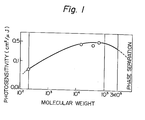
- Fig. 1 there is shown a graph illustrating the influences of the molecular weight of PVCz in the photo- sensitive material on the photosensitivity.
- the abscissa represents the molecular weight of PVCz
- the ordinate represents the photosensitivity of the photosensitive material.
- the amount of the organic resin should occupy 35% to 70% by weight of the total amount of the photosensitive material.
- the resons for this restriction are as follows. If the resin content is less than 35% by weight, the resultant photosensitive film exhibits a poor adhesion to the substrate and a deteriorated mechanical strength. Furthermore, the photosensitive material exhibits a low charge potential due to its poor dark resistance and a low surface charge--retaining ability in the dark. Therefore, such a photo- sensitive material is practically useless. Also, if the resin content is more than 70% by weight, the resultant photosensitive material exhibits an enhanced adhesion and mechanical strength due to the presence of a large amount of the resin.
- the charge potential and the surface charge-retaining ability in the dark of the photosensitive material are enhanced due to the increased dark resistance derived from the high content of the resin.
- the resultant photosensitive material is an insulator rather than a semiconductor. Therefore, even if the photosensitive material is irradiated with rays, no photocurrent is generated. Accordingly, such a photosensitive material is practically useless.
- PVCz effective mainly for enhancing the charge potential of the photosensitive material
- a coating dispersion (A) was prepared by using the above-prepared PVCz-A.
- a coating dispersion (B) containing no PVCz-A and a coating dispersion (C) containing PVCz-B (Luvican M-170 commercially available from BASF Co.) but not a polyester resin were prepared.
- the compositions of these coating dispersions are shown in Table 2.
- Each coating dispersion was prepared by charging the composition shown in Table 2 in a polyethylene wide-mouthed bottle having an inner volume of 1 liter and by milling it for 80 hours by using 600 g of alumina balls. Then, the resulting coating dispersion was coated on an aluminum plate at a dried thickness of 8.0 ⁇ m according to the doctor blade coating method. The coated aluminum plate was then dried.
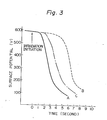
- the photosensitive material of the present invention is dramatically more photosensitive than conventional photosensitive materials. That is, as is shown by curves B (dotted line) and C (one dotted chain line), conventional photosensitive materials exhibited a very small photo-decay, even when irradiated with the rays.
- the half-value exposure quantities of the conventional photosensitive materials (B) and (C) amounted to 12 ⁇ J/cm 2 and 7.4 ⁇ J/cm 2 , respectively.
- curve A solid line
- the induction phenomenon was improved and the half-value exposure quantity was 4.2 ⁇ J/cm 2 .
- Photosensitive materials Five types were prepared by using different propertions of a-type copper phthalocyanine to PVCz (PVCz-A, the same as that described in example 1) while keeping the amount of the polyester constant.
- the compositions shown in Table 3 were charged in a polyethylene wide-mouthed bottle having an inner volume of 2 liters and was milled for 80 hours by using 600 g of alumina balls.
- the resulting coating dispersion were coated on an aluminum plate at a dried thickness of 10.0 ⁇ m according to the doctor blade coating method. The coated aluminum plate were then dried.
- Each of the so-obtained photosensitive materials was charged by a corona discharge device (discharge voltage +7.5 KV), and the surface potential was photo-decayed from 700 V .
- the irradiation wavelength was 760 nm and the irradiation intensity was 10 ⁇ W/cm 2 .
- the half-value exposure quantity was measured and the photosensitivity was determined with respect to each photosensitive material.
- the relation between the weight ratio of 8-type copper phthalocyanine to PVCz (PVCz-A) and the reciprocal number of the half-value exposure quantity (cm 2 /uJ: photosensitivity) is shown in Fig. 2. In Fig.
- the signals A, B, C, D and E correspond to the samples A, B, C, D and E, respectively, shown in Table 3. It is apparent from Fig. 2 that when the weight ratio of copper phthalocyanine to PVCz was in the range of from 1.2 to 12, a good photosensitivity (0.2 cm 2 / ⁇ J or more) was obtained. It is also apparent that particularly when the weight ratio was in the range of from 2 to 7, the photosensitivity depicted an approximately flat curve and the highest photosensitivity was 0.5 cm2/uJ (sample D in Table 3). On the other hand, a weight ratio of copper phthalocyanine to PVCz outside the scope of the present invention, e.g.
- the film-forming property, the charging property, and the photosensitivity were determined for each of the samples shown in Table 4.
- the evaluation of the film-forming property was carried out by wholly observing the presence of orange--peeling on the surface of the photosensitive film and the occurrence of agglomeration of the pigment in the film. Samples exhibiting orange-peeling, agglomeration, or both were considered poor in film-forming property.
- the evaluation of the charging property was carried out by the following method.
Landscapes
- Physics & Mathematics (AREA)
- General Physics & Mathematics (AREA)
- Photoreceptors In Electrophotography (AREA)
Applications Claiming Priority (4)
| Application Number | Priority Date | Filing Date | Title |
|---|---|---|---|
| JP53302/81 | 1981-04-09 | ||
| JP5330281A JPS57185044A (en) | 1981-04-09 | 1981-04-09 | Electrophotographic receptor |
| JP142384/81 | 1981-09-11 | ||
| JP14238481A JPS5844442A (ja) | 1981-09-11 | 1981-09-11 | 電子写真用感光材料 |
Publications (2)
| Publication Number | Publication Date |
|---|---|
| EP0063050A1 true EP0063050A1 (fr) | 1982-10-20 |
| EP0063050B1 EP0063050B1 (fr) | 1985-07-31 |
Family
ID=26394016
Family Applications (1)
| Application Number | Title | Priority Date | Filing Date |
|---|---|---|---|
| EP82301910A Expired EP0063050B1 (fr) | 1981-04-09 | 1982-04-13 | Matériau photosensible pour l'électrophotographie |
Country Status (3)
| Country | Link |
|---|---|
| US (1) | US4454213A (fr) |
| EP (1) | EP0063050B1 (fr) |
| DE (1) | DE3265022D1 (fr) |
Cited By (1)
| Publication number | Priority date | Publication date | Assignee | Title |
|---|---|---|---|---|
| ES2092427A1 (es) * | 1993-05-04 | 1996-11-16 | Univ Pais Vasco | Procedimiento para la obtencion de un polimero antiestatico basado en poli(n-vinilcarbazol) |
Families Citing this family (1)
| Publication number | Priority date | Publication date | Assignee | Title |
|---|---|---|---|---|
| MD4306C1 (ro) * | 2013-02-01 | 2015-04-30 | Государственный Университет Молд0 | Purtător de informaţie electrofotografic |
Family Cites Families (3)
| Publication number | Priority date | Publication date | Assignee | Title |
|---|---|---|---|---|
| US3926629A (en) * | 1970-03-11 | 1975-12-16 | Xerox Corp | Electrophotographic method and plate employing a phthaldcyanine polymer |
| GB1599430A (en) * | 1977-06-27 | 1981-09-30 | Konishiroku Photo Ind | Photoconductive composition for use in the preparation of an electrophotographic material |
| US4214907A (en) * | 1978-01-05 | 1980-07-29 | Mita Industrial Company, Ltd. | Photosensitive material for electrophotography having a polyvinyl carbazole derivative, phthalocyanine, and an electron-acceptor |
-
1982
- 1982-04-07 US US06/366,376 patent/US4454213A/en not_active Expired - Fee Related
- 1982-04-13 EP EP82301910A patent/EP0063050B1/fr not_active Expired
- 1982-04-13 DE DE8282301910T patent/DE3265022D1/de not_active Expired
Non-Patent Citations (2)
| Title |
|---|
| No relevant documents have been disclosed. * |
| None * |
Cited By (1)
| Publication number | Priority date | Publication date | Assignee | Title |
|---|---|---|---|---|
| ES2092427A1 (es) * | 1993-05-04 | 1996-11-16 | Univ Pais Vasco | Procedimiento para la obtencion de un polimero antiestatico basado en poli(n-vinilcarbazol) |
Also Published As
| Publication number | Publication date |
|---|---|
| DE3265022D1 (en) | 1985-09-05 |
| US4454213A (en) | 1984-06-12 |
| EP0063050B1 (fr) | 1985-07-31 |
Similar Documents
| Publication | Publication Date | Title |
|---|---|---|
| US20040018440A1 (en) | Imaging members | |
| EP0100581B1 (fr) | Matériau photosensible pour l'électrophotographie | |
| US3672979A (en) | Method of producing a phthalocyanine photoconductive layer | |
| CA1112934A (fr) | Papier electrophotographique a photoconducteurs organiques sensibilises par nitrate de cellulose | |
| EP0063050B1 (fr) | Matériau photosensible pour l'électrophotographie | |
| US3810759A (en) | Matte photoconductive layers for use in electrophotography | |
| US6489072B2 (en) | Electrophotographic photoconductor and method for manufacturing same | |
| CA1109713A (fr) | Sensibilisation de compositions organiques photoconductrices a l'aide de sensibilisateurs chimiques polymeres portant des radicaux chlorendates monovalents | |
| US4145214A (en) | Co-crystalline organic photoconductors and heterogeneous compositions thereof | |
| EP0536692B1 (fr) | Photoconducteur pour électrophotographie | |
| US6319645B1 (en) | Imaging members | |
| US5376487A (en) | Photosensitive member containing specified arylamine compound and electron-accepting compound | |
| EP0050464B1 (fr) | Matériau photosensible pour électrophotographie | |
| US4082550A (en) | Hexachlorocyclopentene chemical sensitizers for heterogeneous organic photoconductive compositions | |
| US5665503A (en) | Positive charge type organic photoconductive layer | |
| JPS6449050A (ja) | 電子写真用感光体 | |
| AU6614086A (en) | Electrophotographic photoconductor using phthalocyanine compound | |
| US6022657A (en) | Methods of making charge generation layers containing charge transport compound, and photoconductors containing the same | |
| JP2003015334A (ja) | 電子写真用感光体およびその製造方法 | |
| JPH07175233A (ja) | 単層型電子写真感光体 | |
| JPH0456866A (ja) | 電子写真感光体 | |
| JP5795469B2 (ja) | 光衝撃抵抗性オーバーコート層 | |
| JP2002221808A (ja) | 正帯電単層型有機感光体 | |
| JPH0675397A (ja) | 感光体 | |
| JPH04220651A (ja) | 電子写真感光体 |
Legal Events
| Date | Code | Title | Description |
|---|---|---|---|
| PUAI | Public reference made under article 153(3) epc to a published international application that has entered the european phase |
Free format text: ORIGINAL CODE: 0009012 |
|
| AK | Designated contracting states |
Designated state(s): DE FR GB IT |
|
| 17P | Request for examination filed |
Effective date: 19821214 |
|
| ITF | It: translation for a ep patent filed | ||
| GRAA | (expected) grant |
Free format text: ORIGINAL CODE: 0009210 |
|
| AK | Designated contracting states |
Designated state(s): DE FR GB IT |
|
| REF | Corresponds to: |
Ref document number: 3265022 Country of ref document: DE Date of ref document: 19850905 |
|
| ET | Fr: translation filed | ||
| PLBE | No opposition filed within time limit |
Free format text: ORIGINAL CODE: 0009261 |
|
| STAA | Information on the status of an ep patent application or granted ep patent |
Free format text: STATUS: NO OPPOSITION FILED WITHIN TIME LIMIT |
|
| 26N | No opposition filed | ||
| PGFP | Annual fee paid to national office [announced via postgrant information from national office to epo] |
Ref country code: GB Payment date: 19890331 Year of fee payment: 8 |
|
| PGFP | Annual fee paid to national office [announced via postgrant information from national office to epo] |
Ref country code: FR Payment date: 19890427 Year of fee payment: 8 |
|
| ITTA | It: last paid annual fee | ||
| PGFP | Annual fee paid to national office [announced via postgrant information from national office to epo] |
Ref country code: DE Payment date: 19890621 Year of fee payment: 8 |
|
| PG25 | Lapsed in a contracting state [announced via postgrant information from national office to epo] |
Ref country code: GB Effective date: 19900413 |
|
| GBPC | Gb: european patent ceased through non-payment of renewal fee | ||
| PG25 | Lapsed in a contracting state [announced via postgrant information from national office to epo] |
Ref country code: FR Effective date: 19901228 |
|
| PG25 | Lapsed in a contracting state [announced via postgrant information from national office to epo] |
Ref country code: DE Effective date: 19910101 |
|
| REG | Reference to a national code |
Ref country code: FR Ref legal event code: ST |