EP0063224A1 - Procédé pour la fabrication de tissus plats à double-face et tissus plats ainsi fabriqués - Google Patents
Procédé pour la fabrication de tissus plats à double-face et tissus plats ainsi fabriqués Download PDFInfo
- Publication number
- EP0063224A1 EP0063224A1 EP82101573A EP82101573A EP0063224A1 EP 0063224 A1 EP0063224 A1 EP 0063224A1 EP 82101573 A EP82101573 A EP 82101573A EP 82101573 A EP82101573 A EP 82101573A EP 0063224 A1 EP0063224 A1 EP 0063224A1
- Authority
- EP
- European Patent Office
- Prior art keywords
- fabric
- layer
- cloth
- suede
- pile
- Prior art date
- Legal status (The legal status is an assumption and is not a legal conclusion. Google has not performed a legal analysis and makes no representation as to the accuracy of the status listed.)
- Granted
Links
- 239000004744 fabric Substances 0.000 title claims abstract description 96
- 238000000034 method Methods 0.000 title claims abstract description 12
- 238000004519 manufacturing process Methods 0.000 title claims abstract description 10
- 230000002441 reversible effect Effects 0.000 title abstract 2
- 239000002759 woven fabric Substances 0.000 title abstract 2
- 239000004753 textile Substances 0.000 claims description 25
- 239000000463 material Substances 0.000 claims description 12
- 230000001788 irregular Effects 0.000 claims 1
- 241001481789 Rupicapra Species 0.000 abstract 1
- 239000010985 leather Substances 0.000 abstract 1
- 230000003287 optical effect Effects 0.000 abstract 1
- 238000009941 weaving Methods 0.000 description 4
- 238000005520 cutting process Methods 0.000 description 3
- 239000000835 fiber Substances 0.000 description 3
- 230000010354 integration Effects 0.000 description 3
- 239000004952 Polyamide Substances 0.000 description 2
- 239000002131 composite material Substances 0.000 description 2
- 229920002647 polyamide Polymers 0.000 description 2
- 229920000728 polyester Polymers 0.000 description 2
- 238000007788 roughening Methods 0.000 description 2
- 229920003043 Cellulose fiber Polymers 0.000 description 1
- NIXOWILDQLNWCW-UHFFFAOYSA-N acrylic acid group Chemical group C(C=C)(=O)O NIXOWILDQLNWCW-UHFFFAOYSA-N 0.000 description 1
- 230000000844 anti-bacterial effect Effects 0.000 description 1
- 239000011248 coating agent Substances 0.000 description 1
- 238000000576 coating method Methods 0.000 description 1
- 239000011888 foil Substances 0.000 description 1
- 238000003780 insertion Methods 0.000 description 1
- 230000037431 insertion Effects 0.000 description 1
- 238000003475 lamination Methods 0.000 description 1
- 229920002635 polyurethane Polymers 0.000 description 1
- 239000004814 polyurethane Substances 0.000 description 1
- 229920000915 polyvinyl chloride Polymers 0.000 description 1
- 239000004800 polyvinyl chloride Substances 0.000 description 1
- 239000005871 repellent Substances 0.000 description 1
- XLYOFNOQVPJJNP-UHFFFAOYSA-N water Substances O XLYOFNOQVPJJNP-UHFFFAOYSA-N 0.000 description 1
- 210000002268 wool Anatomy 0.000 description 1
Images
Classifications
-
- D—TEXTILES; PAPER
- D03—WEAVING
- D03D—WOVEN FABRICS; METHODS OF WEAVING; LOOMS
- D03D27/00—Woven pile fabrics
- D03D27/02—Woven pile fabrics wherein the pile is formed by warp or weft
- D03D27/10—Fabrics woven face-to-face, e.g. double velvet
Definitions
- the invention relates to a method for producing two-sided textile fabrics, in particular for outer garments with a look of a flat loom product, which comprises all the qualities that have been produced from warp and weft and a plush side.
- the invention relates to a sheet-like two-sided textile fabric produced by this method, which is suitable for outerwear for the manufacture of coats, jackets, capes, anoraks and the like.
- the invention has for its object to be able to manufacture a two-sided textile fabric with a plush side and a cloth or suede-like side, in which the connection points of the Polnop p en are effectively and permanently covered, without losing the polarity or the strength of the goods themselves weaken, while on the other hand the textile handle and the natural fall of textile goods is achieved.
- the textile fabric manufactured according to the invention thus consists of two layers which, unaffected by the other layer, can be designed according to their desired function.
- the layer with the cloth or suede-like appearance can be made of high-quality and possibly very fine material, while the other layer is made of less expensive material, which guarantees a good and firm integration of the studs, but does not necessarily have an attractive appearance got to.
- the connection of the two layers is produced by floating integration of the warp threads of the layer having the cloth or suede-like appearance, no parts or threads of the other layer can be seen on the cloth or suede-like side of the fabric, and neither can the binding points of Polno p pen are visible there.
- a post-treatment such as roughening or coating with the materials that impair the textile handle and fall is not necessary. Rather, the goods can be manufactured on the double plush chair in one step and is after Cutting the pile threads ready for further processing into clothing.
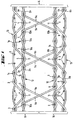
- a fabric web 14 produced on a double plush chair consists of an upper unit 15 and a lower unit 16, which are connected to one another by means of alternatingly integrated pile threads 5 a + 5 b in the upper unit and the lower unit.
- Both the upper unit 15 and the lower unit 16 each consist of two superimposed woven layers 13 and 12, each of which in the usual way consists of warp threads 1 a + 1b, 2a + 2 b or 6 a + 6 b, 7a + 7b and Weft threads 3 + 4 or 8 + 9 is formed.
- the web-like fabric 14 is produced on a two-loom or a double rapier loom with a single-loom weaving technique with one weft for the upper structure and one weft for the lower structure, i.e. four basic fabrics are produced according to the single-loom weaving technique, the inner fabrics 12 being over the pile threads 5a + 5b ver are bound.
- the outer fabrics 13 are a flat fabric separate from the carrier fabrics for the pile threads 5a + 5b, which can be designed independently of the other fabric in terms of weave and color.
- the fabrics 13 and 12 are each held together by changing the warp threads 1a + 1b + 6a + 6b at certain intervals into the associated fabric 12 and binding them there with a weft thread 9 + 4.
- the warp threads can be changed as required.
- a good area-wise connection is obtained between the fabrics 13 and 12 without the fabric 12 or parts thereof being visible on the outside of the fabric 13.
- the warp threads 1a + 1b + 6a + 6b which change from the fabric 13 to the fabric 12 are not visible to the outside because they are covered by the plush side formed by the pile threads 5a + 5b.
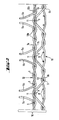
- the pile threads 5a + 5b are W-bound in the fabric 12 in the illustrated embodiment. It can be seen that the warp threads 1a + 1b + 6a + 6b of the outer fabrics 13 change between the binding points 10a + 10b of the pile threads 5a + 5b into the fabric 12, i. H. the binding points 11 of the warp threads 1a + 1b + 6a + 6b of the outer fabric 13 in the inner fabric 12 each lie between .. binding points 10a + 10b of the pile threads 5a + 5b and do not overlap with these.
- the surface image of the outer fabric 13 is determined by the weave, sharpening, color, material in warp and weft such as a normal flat ewebe g designed.
- the outer flat fabric 13 can therefore be designed both as a plain fabric and with strips in any shape and width.
- the weft insertion can also contribute to the design of the surface structure of the fabric 13. Taffet, satin, twill etc. can be used as a binding.
- a weft changer can be used alternately with a thin and a thick weft thread. Accordingly, different materials or threads can be processed in the individual fabric layers 13 and 12. It is also possible to use smooth and flame yarn in a wide variety of orders. All cellulose fiber types, native and regenerated wool, natural silk, polyamide, polyester, acrylic and modacryle, normal and shrink types can be used as the material for the back of the flat weave. The same applies to the pole material. In order to give the surface of the flat fabric 13 a suede-like appearance, yarns made of splitable composite threads are used as the material for the flat fabric back, for example threads consisting of polyamide and polyester single sectors.
- the woven composite threads with their components lying side by side are split in a known manner by treatment with hot water or light sanding of the fabric surface.
- Yarns with extra fine fibers of a single fiber unit from 0.0001 to 0.8 denier are also suitable for the purpose mentioned, as are yarns made from natural silk such as weft or bourette silk.
- the nub length of the cut pile threads 5a + 5b can vary depending on the desired appearance of the plush side be different and fluctuate between short velvet goods up to the great length of a fox fur. Expressed in numbers, this means a free length of the pile threads 5a + 5b between the upper section 15 and lower section 16 of 2 mm to 80 mm and a total height of the pile of the cut goods from 1 mm to 40 mm above the ground.
- the plush side or pile side can be antibacterial and antistatic, while both sides of the fabric can be made water-repellent.
Landscapes
- Engineering & Computer Science (AREA)
- Textile Engineering (AREA)
- Woven Fabrics (AREA)
Applications Claiming Priority (2)
| Application Number | Priority Date | Filing Date | Title |
|---|---|---|---|
| DE3109155A DE3109155A1 (de) | 1981-03-11 | 1981-03-11 | Verfahren zum herstellen zweiseitiger textiler flaechengebilde und danach hergestelltes flaechengebilde |
| DE3109155 | 1981-03-11 |
Publications (2)
| Publication Number | Publication Date |
|---|---|
| EP0063224A1 true EP0063224A1 (fr) | 1982-10-27 |
| EP0063224B1 EP0063224B1 (fr) | 1985-01-09 |
Family
ID=6126867
Family Applications (1)
| Application Number | Title | Priority Date | Filing Date |
|---|---|---|---|
| EP82101573A Expired EP0063224B1 (fr) | 1981-03-11 | 1982-03-02 | Procédé pour la fabrication de tissus plats à double-face et tissus plats ainsi fabriqués |
Country Status (4)
| Country | Link |
|---|---|
| EP (1) | EP0063224B1 (fr) |
| JP (1) | JPS57167435A (fr) |
| DE (2) | DE3109155A1 (fr) |
| ES (1) | ES510293A0 (fr) |
Cited By (1)
| Publication number | Priority date | Publication date | Assignee | Title |
|---|---|---|---|---|
| EP0505788A1 (fr) * | 1991-03-23 | 1992-09-30 | Girmes Gmbh | Revêtement tissé |
Families Citing this family (3)
| Publication number | Priority date | Publication date | Assignee | Title |
|---|---|---|---|---|
| CA1235044A (fr) * | 1983-05-04 | 1988-04-12 | Fumio Shibata | Tissu textile dense a qualites d'impermeabilite |
| JP2621794B2 (ja) * | 1994-04-25 | 1997-06-18 | 井関農機株式会社 | 農作業機 |
| CN102978776B (zh) * | 2012-12-11 | 2016-01-13 | 江苏耀华塑料有限公司 | 一种撑起高度可控的机织模袋布的制备方法 |
Citations (4)
| Publication number | Priority date | Publication date | Assignee | Title |
|---|---|---|---|---|
| GB191228773A (en) * | 1911-12-13 | 1900-01-01 | Ludorf Gustav | Improvements in or relating to Weaving. |
| GB190900887A (en) * | 1909-01-13 | 1909-10-21 | Marcellin Antoine Willot | Improved Multiple Woven Fabric. |
| GB293564A (en) * | 1927-06-27 | 1928-07-12 | Rowland Spencer | Improvements in multiple ply woven fabrics |
| FR2337774A1 (fr) * | 1976-01-08 | 1977-08-05 | Sportiss Ets Jean Laurent | Tissu matelasse extensible |
-
1981
- 1981-03-11 DE DE3109155A patent/DE3109155A1/de not_active Withdrawn
-
1982
- 1982-03-02 EP EP82101573A patent/EP0063224B1/fr not_active Expired
- 1982-03-02 DE DE8282101573T patent/DE3261801D1/de not_active Expired
- 1982-03-10 ES ES510293A patent/ES510293A0/es active Granted
- 1982-03-11 JP JP57039258A patent/JPS57167435A/ja active Pending
Patent Citations (4)
| Publication number | Priority date | Publication date | Assignee | Title |
|---|---|---|---|---|
| GB190900887A (en) * | 1909-01-13 | 1909-10-21 | Marcellin Antoine Willot | Improved Multiple Woven Fabric. |
| GB191228773A (en) * | 1911-12-13 | 1900-01-01 | Ludorf Gustav | Improvements in or relating to Weaving. |
| GB293564A (en) * | 1927-06-27 | 1928-07-12 | Rowland Spencer | Improvements in multiple ply woven fabrics |
| FR2337774A1 (fr) * | 1976-01-08 | 1977-08-05 | Sportiss Ets Jean Laurent | Tissu matelasse extensible |
Cited By (1)
| Publication number | Priority date | Publication date | Assignee | Title |
|---|---|---|---|---|
| EP0505788A1 (fr) * | 1991-03-23 | 1992-09-30 | Girmes Gmbh | Revêtement tissé |
Also Published As
| Publication number | Publication date |
|---|---|
| EP0063224B1 (fr) | 1985-01-09 |
| JPS57167435A (en) | 1982-10-15 |
| DE3261801D1 (en) | 1985-02-21 |
| ES8302809A1 (es) | 1983-02-01 |
| ES510293A0 (es) | 1983-02-01 |
| DE3109155A1 (de) | 1982-09-30 |
Similar Documents
| Publication | Publication Date | Title |
|---|---|---|
| DE69632589T2 (de) | Jalousielamelle aus stoff | |
| DE69114419T2 (de) | Doppelschichtiges gewebe zur herstellung von papier. | |
| WO2006069562A1 (fr) | Tissu gaze et procede et metier mecanique pour sa production | |
| WO2000073559A1 (fr) | Procede de production d'etiquettes avec un code barre invisible sur un metier mecanique et etiquette obtenue selon ce procede | |
| DE202014105090U1 (de) | Funktionsfähiges Oberflächengewebe für Schuhe | |
| DE60015026T2 (de) | Verfahren zum Weben von Doppelstück-falsche Plüschgewebe mit geschnittener Flor und nach diesem Verfahren hergestelltes Gewebe | |
| EP0063224B1 (fr) | Procédé pour la fabrication de tissus plats à double-face et tissus plats ainsi fabriqués | |
| EP0109003B1 (fr) | Tissu contenant des bandes de cuir synthéthique ou naturel et son application | |
| DE202011004697U1 (de) | Textiles Flächengewebe mit Schneidgasse | |
| DE102006003413B3 (de) | Gewebe mit einer durch eingelegte Schussfadenendabschnitte gebildeten Einlegekante und Verwendung desselben | |
| DE2332492A1 (de) | Einlagestoff | |
| DE102005044788B3 (de) | Drehergewebe, insbesondere für Funktionstextilien | |
| EP0012991A1 (fr) | Tissu chenille en fibres synthétiques | |
| DE2161086B2 (de) | Daunen- und federndichtes Gewebe | |
| DE202005014801U1 (de) | Drehergewebe, insbesondere für Funktionstextilien | |
| AT242076B (de) | Stoff | |
| DE2009486A1 (en) | Interlining material - with varying weft zones to give a structured fusible fabric | |
| DE2438465A1 (de) | Textiles gewebe | |
| DE1761196C3 (de) | Naßfilz für Papiermaschinen | |
| EP0982421A1 (fr) | Tapis tissé | |
| DE7539849U (de) | Polstoffbahn | |
| DE2948788A1 (de) | Synthetisches chemiefaser-chenillegewebe | |
| DE7628317U1 (de) | Elastische gewirkestoffbahn | |
| DE2148577A1 (de) | Verfahren zum herstellen von kordgeweben und nach diesem verfahren hergestelltes kordgewebe | |
| DE4012235A1 (de) | Verfahren zur herstellung von doppelflorgeweben, insbesondere doppelteppichen |
Legal Events
| Date | Code | Title | Description |
|---|---|---|---|
| PUAI | Public reference made under article 153(3) epc to a published international application that has entered the european phase |
Free format text: ORIGINAL CODE: 0009012 |
|
| AK | Designated contracting states |
Designated state(s): BE DE FR GB IT |
|
| 17P | Request for examination filed |
Effective date: 19830409 |
|
| ITF | It: translation for a ep patent filed | ||
| GRAA | (expected) grant |
Free format text: ORIGINAL CODE: 0009210 |
|
| AK | Designated contracting states |
Designated state(s): BE DE FR GB IT |
|
| REF | Corresponds to: |
Ref document number: 3261801 Country of ref document: DE Date of ref document: 19850221 |
|
| ET | Fr: translation filed | ||
| PLBE | No opposition filed within time limit |
Free format text: ORIGINAL CODE: 0009261 |
|
| STAA | Information on the status of an ep patent application or granted ep patent |
Free format text: STATUS: NO OPPOSITION FILED WITHIN TIME LIMIT |
|
| 26N | No opposition filed | ||
| PG25 | Lapsed in a contracting state [announced via postgrant information from national office to epo] |
Ref country code: BE Effective date: 19860331 |
|
| BERE | Be: lapsed |
Owner name: GIRMES-WERKE A.G. Effective date: 19860331 |
|
| GBPC | Gb: european patent ceased through non-payment of renewal fee | ||
| PG25 | Lapsed in a contracting state [announced via postgrant information from national office to epo] |
Ref country code: FR Free format text: LAPSE BECAUSE OF NON-PAYMENT OF DUE FEES Effective date: 19861128 |
|
| PG25 | Lapsed in a contracting state [announced via postgrant information from national office to epo] |
Ref country code: DE Effective date: 19870101 |
|
| REG | Reference to a national code |
Ref country code: FR Ref legal event code: ST |
|
| PG25 | Lapsed in a contracting state [announced via postgrant information from national office to epo] |
Ref country code: GB Effective date: 19881121 |