EP0063547B1 - Cuve d'électrolyse - Google Patents
Cuve d'électrolyse Download PDFInfo
- Publication number
- EP0063547B1 EP0063547B1 EP82810159A EP82810159A EP0063547B1 EP 0063547 B1 EP0063547 B1 EP 0063547B1 EP 82810159 A EP82810159 A EP 82810159A EP 82810159 A EP82810159 A EP 82810159A EP 0063547 B1 EP0063547 B1 EP 0063547B1
- Authority
- EP
- European Patent Office
- Prior art keywords
- volcanic ash
- layer
- alumina
- insulation
- electrolytic reduction
- Prior art date
- Legal status (The legal status is an assumption and is not a legal conclusion. Google has not performed a legal analysis and makes no representation as to the accuracy of the status listed.)
- Expired
Links
Images
Classifications
-
- C—CHEMISTRY; METALLURGY
- C25—ELECTROLYTIC OR ELECTROPHORETIC PROCESSES; APPARATUS THEREFOR
- C25C—PROCESSES FOR THE ELECTROLYTIC PRODUCTION, RECOVERY OR REFINING OF METALS; APPARATUS THEREFOR
- C25C3/00—Electrolytic production, recovery or refining of metals by electrolysis of melts
- C25C3/06—Electrolytic production, recovery or refining of metals by electrolysis of melts of aluminium
- C25C3/08—Cell construction, e.g. bottoms, walls, cathodes
- C25C3/085—Cell construction, e.g. bottoms, walls, cathodes characterised by its non electrically conducting heat insulating parts
Definitions
- the present invention relates to an electrolysis pan, in particular for the production of aluminum by melt flow electrolysis, consisting of an outer steel pan, a heat-insulating layer, an inner lining consisting essentially of carbon and a leak barrier between the inner lining and the insulating layer.
- an electrolysis pan in particular for the production of aluminum by melt flow electrolysis, consisting of an outer steel pan, a heat-insulating layer, an inner lining consisting essentially of carbon and a leak barrier between the inner lining and the insulating layer.
- Such a structure is known from FR-A-2 388 901.
- the productive part of the energy consumption is needed to reduce the cations to metallic aluminum. This productive part of energy consumption cannot be reduced.
- the unproductive energy losses can be divided into various losses, all of which affect the environment as heat losses. These heat losses can be controlled and must be kept to a minimum.
- the heat generated during the electrolysis process always flows to colder parts of the tub, from where it escapes into the environment and thus draws energy from the production process.
- a thermal insulation layer has therefore been embedded in the outer steel trough for a long time.
- Shaped bodies made of diatomaceous earth or moler stone are usually used. New moler stones have excellent insulation properties, but they are very sensitive to bath components that penetrate the carbon lining. For this reason, the innermost layer is often made from less sensitive, but also poorly insulating refractory bricks. Stones can be easily stacked on top of each other and in this way both the side walls and the horizontal tub floor can be easily insulated.
- Alumina is inert to bath components penetrating the carbon lining, but the thermal insulation capacity of a new tub floor lined with alumina is relatively low.
- moler stones and alumina as insulation is a considerable cost factor for an aluminum smelter because both materials have to be described as expensive.
- Moler stones also have the disadvantage that they lose their good properties with regard to thermal insulation continuously as soon as they are impregnated by bath components penetrating through the carbon lining.
- an electrolysis bath can lose most of its thermal insulation capacity before a third of its normal lifespan, for example five years. In other words, this means that the electrolytic cell will run for two to three years without effective thermal insulation, and so considerable amounts of energy will be lost to the environment over a long period of time.
- the inventors have set themselves the task of creating a heat insulation layer for an electrolysis bath, which has good insulation properties over the entire service life of the bath, but can be produced with significantly less investment than the previous embodiments.
- the object is achieved according to the invention in that at least the lower 80% of the floor insulation consists of a volcanic ash layer solidified by mechanical means, the remaining floor insulation consists of a leak barrier known per se, which shields the volcanic ash against bath components penetrating the carbon lining.
- Volcanic ash is abundant in many countries as a natural raw material and can be obtained with little effort.
- the volcanic ash obtained as coarse granulate with a natural average grain size of 5 - 30 mm is light and porous. As a rule, it also has the necessary mechanical strength.
- the black Icelandic has proven to be particularly cheap Volcanic ash has been proven, which can be poured unchanged as floor insulation into the tub and mechanically compacted by pounding and / or vibrating.
- the volcanic ash layer is made as thick as possible, so that the remaining leak barrier can still be made sufficiently thick for an optimal age of the tub. Therefore, at least the lower 90% of the floor insulation preferably consists of volcanic ash.
- Powdered alumina which is also used for the electrolysis process for the production of aluminum, is preferably poured onto the compressed insulation layer made of volcanic ash.
- the previous compression of the volcanic ash prevents alumina from seeping in on a larger scale and thus reducing the insulating properties of the volcanic ash.
- a thinly formed, approx. 3 - 6 cm thick layer of clay is sufficient for the function as a leak barrier.
- an impermeable, flexible graphite membrane which is connected with a thin steel foil, can be inserted between volcanic ash and alumina (cf. TMS Paper No. LM 78-19 or DE-OS 2 817 202).
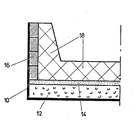
- the single figure shows a schematic vertical partial section through an electrolysis trough, as is used for the production of aluminum by means of melt flow electrolysis.
- a layer of mechanically compressed volcanic ash 12 is filled into a steel trough 10. About 15 cm of clay 14 are poured onto this approximately 25 cm high ash layer. The side wall of the steel tub 10 is insulated with moler or firebricks 16. Finally, the carbon lining 18, which may contain cathode bars, not shown, is used.
Landscapes
- Chemical & Material Sciences (AREA)
- Engineering & Computer Science (AREA)
- Chemical Kinetics & Catalysis (AREA)
- Electrochemistry (AREA)
- Materials Engineering (AREA)
- Metallurgy (AREA)
- Organic Chemistry (AREA)
- Electrolytic Production Of Metals (AREA)
Claims (4)
Priority Applications (1)
| Application Number | Priority Date | Filing Date | Title |
|---|---|---|---|
| AT82810159T ATE12263T1 (de) | 1981-04-22 | 1982-04-14 | Elektrolysewanne. |
Applications Claiming Priority (3)
| Application Number | Priority Date | Filing Date | Title |
|---|---|---|---|
| CH2626/81A CH653711A5 (de) | 1981-04-22 | 1981-04-22 | Elektrolysewanne. |
| CH2626/81 | 1981-04-22 | ||
| DE3116273A DE3116273C2 (de) | 1981-04-22 | 1981-04-24 | Elektrolysewanne |
Publications (2)
| Publication Number | Publication Date |
|---|---|
| EP0063547A1 EP0063547A1 (fr) | 1982-10-27 |
| EP0063547B1 true EP0063547B1 (fr) | 1985-03-20 |
Family
ID=25690974
Family Applications (1)
| Application Number | Title | Priority Date | Filing Date |
|---|---|---|---|
| EP82810159A Expired EP0063547B1 (fr) | 1981-04-22 | 1982-04-14 | Cuve d'électrolyse |
Country Status (7)
| Country | Link |
|---|---|
| US (1) | US4430187A (fr) |
| EP (1) | EP0063547B1 (fr) |
| AU (1) | AU8286082A (fr) |
| CA (1) | CA1190516A (fr) |
| CH (1) | CH653711A5 (fr) |
| DE (1) | DE3116273C2 (fr) |
| ZA (1) | ZA822643B (fr) |
Families Citing this family (11)
| Publication number | Priority date | Publication date | Assignee | Title |
|---|---|---|---|---|
| NO150007C (no) * | 1982-03-05 | 1984-08-01 | Sintef | Sperreskikt for aluminiumelektrolyseovner. |
| FR2546183B1 (fr) * | 1983-05-16 | 1985-07-05 | Pechiney Aluminium | Ecran sous-cathodique comportant des zones deformables, pour les cuves d'electrolyse hall-heroult |
| GB8316058D0 (en) * | 1983-06-13 | 1983-07-20 | Alcan Int Ltd | Aluminium electrolytic reduction cell linings |
| DE3327230A1 (de) * | 1983-07-28 | 1985-02-07 | Sigri Elektrographit Gmbh, 8901 Meitingen | Auskleidung fuer elektrolysewanne zur herstellung von aluminium |
| CH657629A5 (de) * | 1983-08-25 | 1986-09-15 | Alusuisse | Elektrolysewanne. |
| EP0193491A1 (fr) * | 1985-02-15 | 1986-09-03 | Schweizerische Aluminium Ag | Cuve d'électrolyse |
| EP0197003A1 (fr) * | 1985-03-22 | 1986-10-08 | Schweizerische Aluminium Ag | Cuve d'électrolyse pour la production d'aluminium |
| US4822388A (en) * | 1987-02-27 | 1989-04-18 | Gee Kenneth H | Method of operating mineral wool cupolas and using spent electrolytic aluminum pot lining |
| DE4201490A1 (de) * | 1992-01-21 | 1993-07-22 | Otto Feuerfest Gmbh | Feuerfestes material fuer elektrolyseoefen, verfahren zur herstellung und verwendung des feuerfesten materials |
| RU2155305C2 (ru) * | 1999-08-31 | 2000-08-27 | Открытое акционерное общество "Красноярский алюминиевый завод" | Холоднонабивная подовая масса |
| CN101838821A (zh) * | 2010-03-12 | 2010-09-22 | 王国斌 | 铝电解槽新型内衬 |
Family Cites Families (7)
| Publication number | Priority date | Publication date | Assignee | Title |
|---|---|---|---|---|
| US3428545A (en) | 1962-10-22 | 1969-02-18 | Arthur F Johnson | Carbon furnace electrode assembly |
| US3434958A (en) | 1967-01-04 | 1969-03-25 | Arthur F Johnson | Electrolytic cell bottom construction |
| DE2105247C3 (de) | 1971-02-04 | 1980-06-12 | Schweizerische Aluminium Ag, Zuerich (Schweiz) | Ofen für die Schmelzflußelektrolyse von Aluminium |
| US3723286A (en) * | 1971-11-08 | 1973-03-27 | Kaiser Aluminium Chem Corp | Aluminum reduction cell |
| FR2338336A1 (fr) * | 1976-01-13 | 1977-08-12 | Pechiney Aluminium | Nouveau procede de brasquage des cuves pour electrolyse ignee |
| US4175022A (en) | 1977-04-25 | 1979-11-20 | Union Carbide Corporation | Electrolytic cell bottom barrier formed from expanded graphite |
| US4160715A (en) * | 1978-06-28 | 1979-07-10 | Aluminum Company Of America | Electrolytic furnace lining |
-
1981
- 1981-04-22 CH CH2626/81A patent/CH653711A5/de not_active IP Right Cessation
- 1981-04-24 DE DE3116273A patent/DE3116273C2/de not_active Expired
-
1982
- 1982-04-14 EP EP82810159A patent/EP0063547B1/fr not_active Expired
- 1982-04-15 US US06/368,723 patent/US4430187A/en not_active Expired - Fee Related
- 1982-04-19 ZA ZA822643A patent/ZA822643B/xx unknown
- 1982-04-20 AU AU82860/82A patent/AU8286082A/en not_active Abandoned
- 1982-04-21 CA CA000401347A patent/CA1190516A/fr not_active Expired
Also Published As
| Publication number | Publication date |
|---|---|
| ZA822643B (en) | 1983-03-30 |
| CH653711A5 (de) | 1986-01-15 |
| CA1190516A (fr) | 1985-07-16 |
| US4430187A (en) | 1984-02-07 |
| AU8286082A (en) | 1982-10-28 |
| DE3116273C2 (de) | 1983-03-03 |
| DE3116273A1 (de) | 1982-11-18 |
| EP0063547A1 (fr) | 1982-10-27 |
Similar Documents
| Publication | Publication Date | Title |
|---|---|---|
| DE69532052T2 (de) | Mit versenkten Nuten drainierte horizontale Kathodenoberfläche für die Aluminium Elektrogewinnung | |
| EP0063547B1 (fr) | Cuve d'électrolyse | |
| DE3506200A1 (de) | Kathodenwanne fuer eine aluminium-elektrolysezelle und verfahren zur herstellung von deren seitenwand bildenden verbundkoerpern | |
| DE2817202A1 (de) | Aus expandiertem graphit bestehende barriere am boden einer elektrolytischen zelle | |
| DE2105247C3 (de) | Ofen für die Schmelzflußelektrolyse von Aluminium | |
| DE2446668B2 (de) | Verfahren zur schmelzflusselektrolyse, insbesondere von aluminiumoxid, und anode zur ausfuehrung des verfahrens | |
| DE3015244A1 (de) | Kathoden-strom-zufuhr-element fuer zellen zur elektrolytischen reduktion von aluminium | |
| CH643885A5 (de) | Elektrodenanordnung einer schmelzflusselektrolysezelle zur herstellung von aluminium. | |
| DE3880940T2 (fr) | ||
| EP0552402B1 (fr) | Matériau refractaire pour un four électrolytique, procédé pour la production et l'utilisation | |
| CH654335A5 (de) | Zelle zur raffination von aluminium. | |
| DE1533439A1 (de) | Elektrolytische Zelle zur Gewinnung von Aluminium und Verfahren zum Betrieb derselben | |
| EP0193491A1 (fr) | Cuve d'électrolyse | |
| DE69837966T2 (de) | Zelle für aluminium-herstellung mit drainierfähiger kathode | |
| DE1092215B (de) | Kathode und Zelle zur Gewinnung von Aluminium aus Aluminiumoxyd durch Schmelzflusselektrolyse | |
| EP0142459B1 (fr) | Cuve d'électrolyse | |
| DE1092216B (de) | Stromfuehrungselemente und deren Verwendung in elektrolytischen Zellen zur Gewinnung oder Raffination von Aluminium | |
| EP0109358A1 (fr) | Cathode pour cellule d'électrolyse à bain fondu | |
| DE1153538B (de) | Aluminiumelektrolyseofen | |
| EP0099331B1 (fr) | Cuve cathodique pour cellule d'électrolyse d'aluminium | |
| DE3435200A1 (de) | Zelle zur reduktion von aluminiumoxid | |
| DE60200885T2 (de) | Zelle zur elektrogewinnung von aluminium operierend mit auf metall basierenden anoden | |
| DE2008215A1 (en) | Graphite sheathing for aluminium electrolysi | |
| EP0136969A1 (fr) | Cellule pour le raffinage électrolytique de l'aluminium | |
| EP0197003A1 (fr) | Cuve d'électrolyse pour la production d'aluminium |
Legal Events
| Date | Code | Title | Description |
|---|---|---|---|
| PUAI | Public reference made under article 153(3) epc to a published international application that has entered the european phase |
Free format text: ORIGINAL CODE: 0009012 |
|
| AK | Designated contracting states |
Designated state(s): AT CH DE FR GB IT NL SE |
|
| 17P | Request for examination filed |
Effective date: 19830224 |
|
| ITF | It: translation for a ep patent filed | ||
| GRAA | (expected) grant |
Free format text: ORIGINAL CODE: 0009210 |
|
| AK | Designated contracting states |
Designated state(s): AT CH DE FR GB IT LI NL SE |
|
| REF | Corresponds to: |
Ref document number: 12263 Country of ref document: AT Date of ref document: 19850415 Kind code of ref document: T |
|
| PGFP | Annual fee paid to national office [announced via postgrant information from national office to epo] |
Ref country code: AT Payment date: 19850322 Year of fee payment: 4 |
|
| REF | Corresponds to: |
Ref document number: 3262605 Country of ref document: DE Date of ref document: 19850425 |
|
| PGFP | Annual fee paid to national office [announced via postgrant information from national office to epo] |
Ref country code: NL Payment date: 19850430 Year of fee payment: 4 |
|
| ET | Fr: translation filed | ||
| PLBE | No opposition filed within time limit |
Free format text: ORIGINAL CODE: 0009261 |
|
| STAA | Information on the status of an ep patent application or granted ep patent |
Free format text: STATUS: NO OPPOSITION FILED WITHIN TIME LIMIT |
|
| 26N | No opposition filed | ||
| PG25 | Lapsed in a contracting state [announced via postgrant information from national office to epo] |
Ref country code: AT Effective date: 19860414 |
|
| PG25 | Lapsed in a contracting state [announced via postgrant information from national office to epo] |
Ref country code: SE Effective date: 19860415 |
|
| PG25 | Lapsed in a contracting state [announced via postgrant information from national office to epo] |
Ref country code: LI Effective date: 19860430 Ref country code: CH Effective date: 19860430 |
|
| PG25 | Lapsed in a contracting state [announced via postgrant information from national office to epo] |
Ref country code: NL Effective date: 19861101 |
|
| NLV4 | Nl: lapsed or anulled due to non-payment of the annual fee | ||
| GBPC | Gb: european patent ceased through non-payment of renewal fee | ||
| PG25 | Lapsed in a contracting state [announced via postgrant information from national office to epo] |
Ref country code: FR Free format text: LAPSE BECAUSE OF NON-PAYMENT OF DUE FEES Effective date: 19861231 |
|
| REG | Reference to a national code |
Ref country code: CH Ref legal event code: PL |
|
| PG25 | Lapsed in a contracting state [announced via postgrant information from national office to epo] |
Ref country code: DE Effective date: 19870101 |
|
| REG | Reference to a national code |
Ref country code: FR Ref legal event code: ST |
|
| PG25 | Lapsed in a contracting state [announced via postgrant information from national office to epo] |
Ref country code: GB Effective date: 19881121 |
|
| EUG | Se: european patent has lapsed |
Ref document number: 82810159.2 Effective date: 19870224 |