EP0063728B1 - Verfahren zur Herstellung eines aus mikrofibrillarem Milchprotein geformten Nahrungsmittels - Google Patents
Verfahren zur Herstellung eines aus mikrofibrillarem Milchprotein geformten Nahrungsmittels Download PDFInfo
- Publication number
- EP0063728B1 EP0063728B1 EP82103003A EP82103003A EP0063728B1 EP 0063728 B1 EP0063728 B1 EP 0063728B1 EP 82103003 A EP82103003 A EP 82103003A EP 82103003 A EP82103003 A EP 82103003A EP 0063728 B1 EP0063728 B1 EP 0063728B1
- Authority
- EP
- European Patent Office
- Prior art keywords
- milk protein
- aqueous gel
- powder
- dispersant
- weight
- Prior art date
- Legal status (The legal status is an assumption and is not a legal conclusion. Google has not performed a legal analysis and makes no representation as to the accuracy of the status listed.)
- Expired
Links
Classifications
-
- A—HUMAN NECESSITIES
- A23—FOODS OR FOODSTUFFS; TREATMENT THEREOF, NOT COVERED BY OTHER CLASSES
- A23G—COCOA; COCOA PRODUCTS, e.g. CHOCOLATE; SUBSTITUTES FOR COCOA OR COCOA PRODUCTS; CONFECTIONERY; CHEWING GUM; ICE-CREAM; PREPARATION THEREOF
- A23G1/00—Cocoa; Cocoa products, e.g. chocolate; Substitutes therefor
- A23G1/30—Cocoa products, e.g. chocolate; Substitutes therefor
- A23G1/32—Cocoa products, e.g. chocolate; Substitutes therefor characterised by the composition containing organic or inorganic compounds
- A23G1/44—Cocoa products, e.g. chocolate; Substitutes therefor characterised by the composition containing organic or inorganic compounds containing peptides or proteins
-
- A—HUMAN NECESSITIES
- A23—FOODS OR FOODSTUFFS; TREATMENT THEREOF, NOT COVERED BY OTHER CLASSES
- A23C—DAIRY PRODUCTS, e.g. MILK, BUTTER OR CHEESE; MILK OR CHEESE SUBSTITUTES; PREPARATION THEREOF
- A23C20/00—Cheese substitutes
-
- A—HUMAN NECESSITIES
- A23—FOODS OR FOODSTUFFS; TREATMENT THEREOF, NOT COVERED BY OTHER CLASSES
- A23G—COCOA; COCOA PRODUCTS, e.g. CHOCOLATE; SUBSTITUTES FOR COCOA OR COCOA PRODUCTS; CONFECTIONERY; CHEWING GUM; ICE-CREAM; PREPARATION THEREOF
- A23G3/00—Sweetmeats; Confectionery; Marzipan; Coated or filled products
- A23G3/34—Sweetmeats, confectionery or marzipan; Processes for the preparation thereof
- A23G3/36—Sweetmeats, confectionery or marzipan; Processes for the preparation thereof characterised by the composition containing organic or inorganic compounds
- A23G3/44—Sweetmeats, confectionery or marzipan; Processes for the preparation thereof characterised by the composition containing organic or inorganic compounds containing peptides or proteins
-
- A—HUMAN NECESSITIES
- A23—FOODS OR FOODSTUFFS; TREATMENT THEREOF, NOT COVERED BY OTHER CLASSES
- A23J—PROTEIN COMPOSITIONS FOR FOODSTUFFS; WORKING-UP PROTEINS FOR FOODSTUFFS; PHOSPHATIDE COMPOSITIONS FOR FOODSTUFFS
- A23J3/00—Working-up of proteins for foodstuffs
-
- A—HUMAN NECESSITIES
- A23—FOODS OR FOODSTUFFS; TREATMENT THEREOF, NOT COVERED BY OTHER CLASSES
- A23J—PROTEIN COMPOSITIONS FOR FOODSTUFFS; WORKING-UP PROTEINS FOR FOODSTUFFS; PHOSPHATIDE COMPOSITIONS FOR FOODSTUFFS
- A23J3/00—Working-up of proteins for foodstuffs
- A23J3/04—Animal proteins
- A23J3/08—Dairy proteins
- A23J3/10—Casein
-
- Y—GENERAL TAGGING OF NEW TECHNOLOGICAL DEVELOPMENTS; GENERAL TAGGING OF CROSS-SECTIONAL TECHNOLOGIES SPANNING OVER SEVERAL SECTIONS OF THE IPC; TECHNICAL SUBJECTS COVERED BY FORMER USPC CROSS-REFERENCE ART COLLECTIONS [XRACs] AND DIGESTS
- Y10—TECHNICAL SUBJECTS COVERED BY FORMER USPC
- Y10S—TECHNICAL SUBJECTS COVERED BY FORMER USPC CROSS-REFERENCE ART COLLECTIONS [XRACs] AND DIGESTS
- Y10S426/00—Food or edible material: processes, compositions, and products
- Y10S426/802—Simulated animal flesh
Definitions
- the present invention relates to an improved method for the production of a formed food product of a microfibrillar milk protein which can maintain its highly orientated fibrillar bundle for a long period of time by keeping it at room temperature or a temperature of lower than 10°C.
- soy bean protein various seed proteins, wheat protein, etc.
- animal proteins such as casein, skim milk, whey protein, etc.
- other animal proteins such as egg white, blood proteins, etc. which have hitherto been not so much utilized as a food stuff.
- soy bean protein and casein as a foodstuff after forming them into fibrillar structure and being incorporated with various additives such as meat-like seasoning or flavor, fats and oils, emulsifiers, pH regulators, colorants, or the like in order to make them fit to practical use, followed by forming the fibrillar protein composition into the desired various shapes.
- the present inventors also had provided a formed food product of microfibrillar milk protein having excellent stability to hot water cooking and high tensile elongation which is produced by treating an aqueous solution of a milk protein comprising mainly casein, skim milk, etc. with a polyvalent metallic ion, treating the resulting micellar colloid with a milk protein-coagulating enzyme to form a gel composition, orientating and fibrillating the gel composition by drawing, followed by stabilizing by dipping and acid bath and then dipping in a boiling saline bath for a long period of time (cf. Japanese Patent Publication (unexamined) No.
- a formed food product having excellent tolerance to cooking and meat-like texture which is produced by incorporating the fibrillar composition of milk protein obtained above with various additives, followed by forming into the desired shape with heating (cf. Japanese Patent Publication (unexamined) No. 81548/1980).
- the formed food products thus obtained comprise mainly milk protein and hence have excellent balance of amino acids, excellent digestibility, excellent stability to hot water cooking and also excellent texture without soy bean odor like in soy bean protein. Accordingly, these formed food products of microfibrillar milk protein are used as a food stuff material.
- the present inventors have imtensively studied to invent an improved method of the desired formed food product of microfibrillar milk protein without taking such complicated steps as "preparation of an aqueous milk protein gel” - “formation of microfibrillar structure” - “stabilization in an acid bath” ⁇ “neutralization” ⁇ "treatment in a saline bath''' ⁇ "forming into the desired shape with heating”.
- the desired formed food product can be directly produced from the aqueous milk protein gel by forming the gel into the desired shape in the presence of a specific amount of specific dehydrating agent and dispersant without necessity of taking the steps of the stabilization in an acid bath, neutralization and treatment in a saline bath.
- the present inventors have found that when an aqueous milk protein gel is mixed and kneaded together with a specific amount of a compound having a strong dehydrating action such as sodium chloride (a dehydrating agent), the milk protein (mainly calcium caseinate) contained in the aqueous gel composition is converted into three-dimensional net-like microfibrillar structure with release of water, and when the fibril-containing aqueous gel is strongly drawn with hand, the microfibrils are orientated to form a microfibrillar formed product, but the microfibrillar structure is unstable.
- a compound having a strong dehydrating action such as sodium chloride (a dehydrating agent)
- aqueous gel is mixed with a specific amount of a specific dispersant (e.g. dextrin, sodium caseinate) and optionally a fat and oil in addition to the dehydrating agent (e.g. sodium chloride), it can be formed into a stable microfibrillar formed product (e.g. imitation cheese).
- a specific dispersant e.g. dextrin, sodium caseinate
- a fat and oil in addition to the dehydrating agent
- the dehydrating agent e.g. sodium chloride
- an imitation mozzarella cheese is produced by treating a homogeneous mixture of acid casein and fats and oils with calcium chloride, separating the resulting curds, and incorporating the curds with additives such as cheese flavor, pigments for food, and sodium chloride (in one working example, sodium chloride (0.34 x 10- 3 mol per 1 g of protein composition) and starch (0.02 g per 1 g of protein composition) or the like are added as additives (cf. Japanese Patent Publication (unexamined) No. 68349/1981).
- a simulated cheese is produced by mixing and reacting a mixture of an aqueous solution of an acid and powdered casein with calcium hydroxide to form calcium caseinate, and mixing a fat with the product obtained above, optionally together with ungelatinized flour (in the working examples, sodium chloride etc. (0.23 x 10- 3 mol per 1 g of protein composition) and tapioca flour (0.03 g per 1 g of protein composition) or the like are added as additives) (cf. U.S. Patent 3,922,374).
- the additives such as sodium chloride are used in a very small amount and the products produced therein have no microfibrillar structure and are essentially different from the formed food product of microfibrillar milk protein of the present invention.
- the desired formed food product of a microfibrillar milk protein is producd by mixing an aqueous gel comprising mainly calcium caseinate with a specific amount of a dehydrating agent and a specific amount of a dispersant at a specified temperature and forming the mixture at the same temperature range into the desired shape.
- the starting aqueous gel of a milk protein includes all gels of known milk proteins, such as cow milk protein, skim milk protein, caseins including all known caseins obtained, for example, by precipitating from an aqueous skim milk solution with acids, rennet, etc.
- the aqueous gel may contain a small amount of other vegetable proteins as far as a milk protein (calcium caseinate) is mainly contained.
- the aqueous gel of a milk protein can be prepared by all conventional methods, for example by adding a polyvalent metallic ion (e.g. calcium chloride) to an aqueous solution of casein to produce a micellar colloid and treating the micellar colloid with a milk-coagulating enzyme (e.g.
- milkozyme by adding calcium chloride to an aqueous solution of casein having a pH 6.3-6.6 at 45 to 65°C, wherein calcium chloride is used in an amount of 0.8 to 6.0% based on the weight of casein (calculated as Ca++), and stirring the mixture for 5 to 60 minutes; by adding a calcium compound to cow milk, skim milk, process milk, etc. at 0 to 25°C wherein the calcium compound is used in an amount of 5.0 to 9.5% based on the weight of casein, regulating the pH of the mixture in the range of 4.9-5.6, and heating the mixture at 45 to 65°C; and by subjecting an aqueous solution of casein to reduction, and treating the resulting mixture with calcium chloride.
- the aqueous gel of a milk protein may also be prepared by dissolving a rennet casein in water in the presence of a phosphate (e.g. sodium phosphate) or an organic acid salt (e.g. sodium citrate).
- a phosphate e.g. sodium phosphate
- an organic acid salt e.g. sodium citrate
- the aqueous gel of a milk protein contains latently three-dimensional structure or microfibrillar structure owing to mutual coagulation of calcium caseinate micell. Accordingly, when the gel is heated at about 40°C or higher, it shows spinnability (while it does not show any spinnability when heated at lower than 40°C), and when the spinnable gel is subjected to external shear,.for example by rapidly drawing, the latent microfibrillar structure is actualized to form a tape-like formed product (the microfibrillar structure is observed by tearing the product). However, when the microfibrillar formed product is allowed to stand with releasing from drawing even for a short period of time (e.g.
- microfibrillar structure produced by adding an external shear to an aqueous gel of a milk protein is unstable and not practical
- the present inventors have tried to add a dehydrating agent to the aqueous gel, followed by forming into the desired formed product with heating, by which there is obtained a formed product having microfibrillar structure which can be maintained for a long period of time when kept at about 10°C or lower under a condition of preventing evaporation of moisture, which is similar condition usually used in the conventional distribution system of foods.
- the microfibrillar formed product thus obtained can be teared in a direction of orientation and is useful as a new type of food.
- the aqueous gel is dehydrated in an excess degree and peptides having a low molecular weight contained in the gel composition and also sodium chloride are dissolved in the released water, and further, the obtained formed product is too hard and is hardly chewed.
- the present inventors have found that the drawback as above-mentioned can be eliminated by mixing the aqueous gel of a milk protein with a specific amount of a specific dispersant in addition to the dehydrating agent, by which the desired stable formed food product of a microfibrillar milk protein can be obtained without subjecting to stabilization in an acid bath and treatment in a saline bath as in the conventional method.
- the dehydrating agent used in the present invention includes sodium salts, such as sodium chloride, sodium citrate, sodium succinate, sodium chondroitin sulfate, sodium acetate, sodium tartrate, sodium carbonate, saccharin sodium salt, sodium lactate, sodium fumarate, sodium propionate, sodium sulfate, or sodium malate; calcium salts, such as calcium chloride, calcium citrate, calcium glycerophoshate, calcium gluconate, calcium stearyllactate, calcium carbonate, calcium lactate, calcium pantothenate, calcium propionate, or calcium sulfate; magnesium salts, such as magnesium chloride, magnesium carbonate, or magnesium sulfate; potassium salts, such as potassium sorbate, potassium carbonate, or potassium chloride; iron salts, such as ferric chloride, or ferric lactate; saccharides including all monosaccharides, disaccharides and oligosaccharides; sugar alcohols, such as sorbitol, mannitol, or
- particularly preferred compounds in view of the excellent dehydrating effect and fibril-forming ability are sodium chloride, calcium chloride, calcium lactate, magnesium chloride, all monosaccharides, disaccharides and oligosaccharides, all sugar alcohols, all amino acids and their sodium salts, and lecithin.
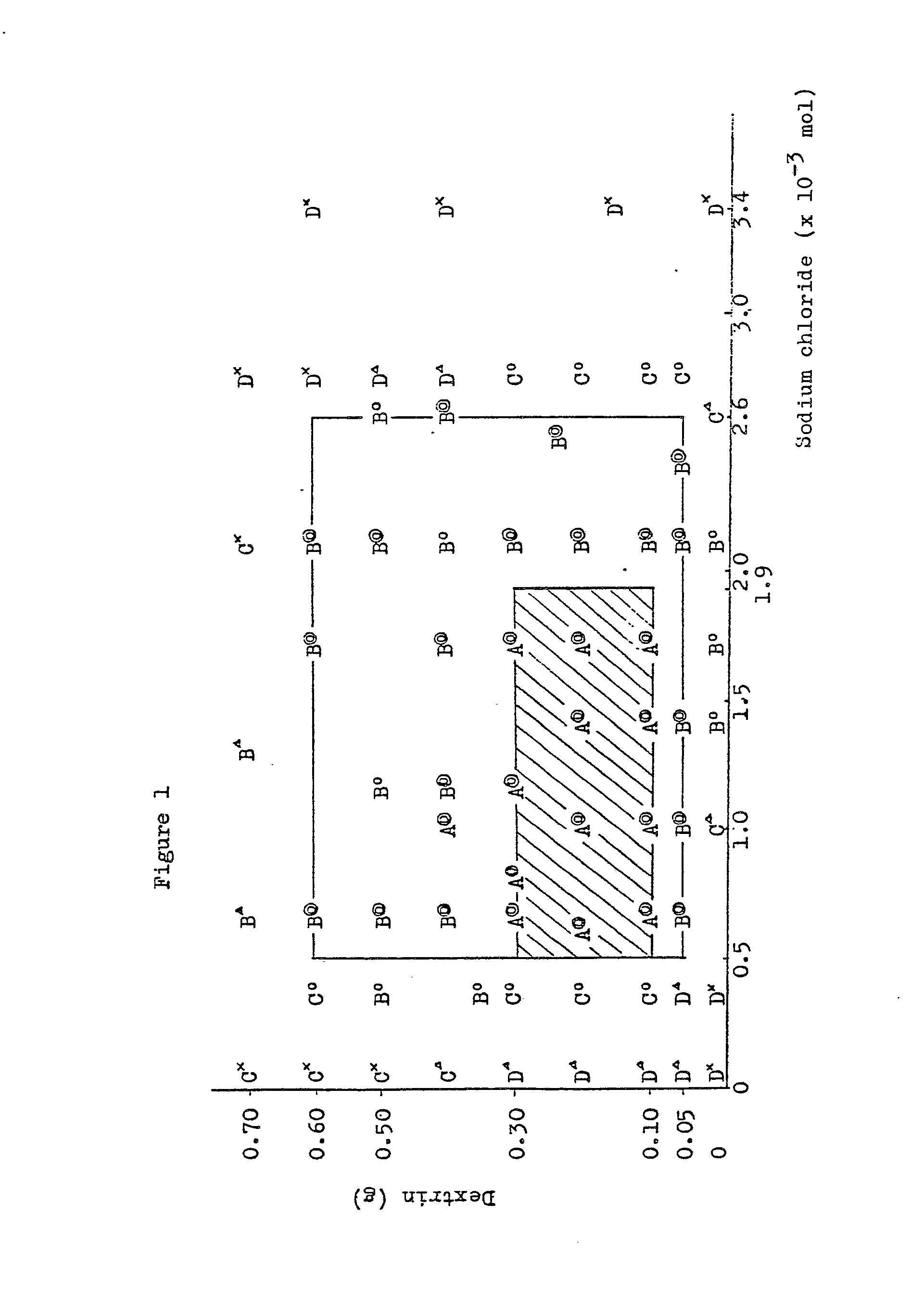
- dehydrating agents are used in a specific amount of 0.5 x 10- 3 to 5.5 x 10- 3 mol, preferably 0.5 x 10- 3 to 4.0 x 10- 3 mol, per 1 g of an aqueous gel of a milk protein (as in a water content of 65% by weight).
- the most suitable amount may vary within this range with the amount and kind of the dispersant to be added together, with the temperature in the mixing and subsequent forming steps, and also with the desired quality and kind of the final product.
- the dehydrating agent When the dehydrating agent is used in an amount of less than 0.5 x 10- 3 mol per 1 g of an aqueous gel of a milk protein, the actualization of fibrillar structure is insufficiently done to give a formed product having inferior microfibrillar structure, and on the other hand, when the amount of the dehydrating agent is over 5.5 x 10- 3 mol, the aqueous gel of a milk protein is dehydrated and coagulated in too excess degree to give a too hard formed product having inferior orientation.
- the dispersant used in the present invention together with the dehydrating agent in order to moderate the hardness of the formed product includes all compounds which do not show any dehydrating action but can absorb water released from the aqueous gel and further can uniformly disperse into the microfibrils which are strongly coagulated due to loosing of combined water to separate the microfibrils each other and thereby can maintain plasticity of the product.
- the dispersant used in the present invention may also be called as "water absorbing agent".
- the dispersant may be in any form, but is preferably in the form of a powder. Suitable examples of the dispersant are dextrin, starches, powdery cellulose, sodium alginate, gums (e.g.
- particularly preferred compounds are dextrin, starches, powdery cellulose, sodium alginate, gums, sodium caseinate, powdery egg white, protein isolated from soy bean, gluten, blood plasma powder, and red blood corpuscle powder.
- dispersants are used in a specific amount of 0.05 to 0.6 g, preferably 0.15 to 0.5 g, per 1 g of an aqueous gel of a milk protein (as in water content of 65% by weight).
- the most suitable amount may vary within this range with the amount and kind of the dehydrating agent to be added together, with the temperature in the mixing and subsequent forming steps, and also with the desired quality and kind of the final product.
- the amount of a dispersant is less than 0.05 g per 1 g of an aqueous gel of a milk protein, it can not show sufficient water absorbing effect, which results in the production of a too hard product like in case of using a dehydrating agent alone.
- the amount of a dispersant is over 0.6 g, the final formed product has undesirably inferior orientation and microfibrillar structure.
- the composition of the present invention may optionally be incorporated with fats and oils in order to improve the chewability of the formed product and also the watery taste thereof, by which there is obtained a food product having good body.
- the fats and oils includes all fats and oils useful as a food additive. Suitable examples of the fats and oils are milk fats, tallow, lard, soy bean oil, cocoa butter, palm oil, palm kernel oil, coconut oil, or hardened oils of these oils. Fish fats, whale fats, cotton seed oil are also usable. These fats and oils may be used in an amount of not more than 0.8 g (i.e. 0 to 0.8 g), preferably 0.1 to 0.5 g, per 1 g of the aqueous gel of a milk protein.
- dehydrating agent, dispersant and also optionally fats and oils may be incorporated separately, but may optionally be used in the state of pre-mixture thereof, which is commercially or naturally available as a food or food additive, wherein the specified amounts of the dehydrating agent and the dispersant and also optionally the fats and oils are contained.
- Suitable examples of the pre-mixture are cheese powder, chocolate powder, cocoa powder, various fruit juice powders, yogurt powder, various meat-like flavoring materials, various fishes and shell fishes flavoring materials, skim milk powder, partially defatted skim milk powder, whole milk powder, whey powder, wheat powder, corn powder, rice powder, powdery caramel, or the like.
- the formed product of a microfibrillar milk protein of the present invention can be prepared in the following steps.
- the dehydrating agent and dispersant and optionally fats and oils are added to an aqueous gel of a milk protein in the specified amount as mentioned hereinbefore.
- fats and oils are added, they may be added together with the dehydrating agent and dispersant, or may added in the step of preparation of the aqueous gel. These may also be added in the form of a pre-mixture as mentioned above.
- the addition and mixing is usually carried out at a temperature of not higher than 120°C, preferably 40 to 120°C, with stirring.
- the resulting mixture thus obtained is then formed into various shapes depending on the desired final products, for example, in the forms of yarn-like, string-like, columnar filmy, sheet-like shapes, by solidifying or pressing in the desired various molds in a conventional manner.
- the forming is usually carried out at the same temperature range as in the above addition and mixing step.
- the temperature in the above addition, mixing and forming steps is in principle depending on the desired qualities (e.g. water content, hardness, etc.) of the final food products. That is, when a soft food product such as imitation cheese (e.g. string cheese) is required, the mixing and forming are carried out at a comparatively lower temperature such as lower than 80°C, but on the other hand, when a comparatively hard food product such as jerked meat (jerky) is required, the mixing and forming are carried out at a comparatively higher temperature such as 80 to 120°C.
- the temperature may also vary with the amount of a dehydrating agent, while it is not essential.
- a dehydrating agent when used in an amount of 0.5 x 10- 3 to 2.6 x 10- 3 mol, preferably 0.5 x 10- 3 to 1.9 x 10- 3 mol, per 1 g of an aqueous gel of a milk protein in order to produce an imitation cheese (e.g. string cheese), the mixing and forming are usually carried out at a temperature of 40 to 80°C.
- a dehydrating agent When a dehydrating agent is used in an amount of 1.9 x 10- 3 to 5.5 x 10- 3 mol, preferably 2.2 x 10- 3 to 4.0 x 10- 3 mol, per 1 g of an aqueous gel of a milk protein in order to produce a hard food product such as jerky, the mixing and forming are usually carried out at a temperature of 80 to 120°C, preferably 85 to 100°C.
- the excellent properties of the formed food product of the present invention were experimentally confirmed by the following experiments, wherein various kinds of dehydrating agents, dispersants and fats and oils were used in various amounts and the mixing and forming steps were carried out at various temperatures.
- aqueous casein solution pH: 7.7, 500 g
- a calcium mixture (as a polyvalent metallic ion) of anhydrous calcium chloride (4 g) and calcium lactate dihydrate (14 g)
- a protease (milkozyme, 0.11 g) was added to and uniformly dispersed in the micelle at the same temperature as above, and the mixture was maintained at the same temperature for 60 minutes to give an aqueous gel of a milk protein (above 270 g, water content: 65% by weight).
- the aqueous gel thus obtained (100 g) was heated to 55°C and thereto was added slowly a mixture of sodium chloride (10 g (0.17 mol), as a dehydrating agent) and dextrin (10 g, as a dispersant) which were previously homogeneously mixed with careful attention so as not to form a mass of the mixture.
- the latent microfibrillar structure was rapidly actualized in the gel and the released water was well absorbed with dextrin to give a product having an excellent elasticity (wherein dextrin was uniformly dispersed within the gaps between microfibrils thus formed).
- the mixed gel containing actualized microfibrillar structure was drawn by hand at 55°C to give a columnar formed product (diameter: about 2 cm, length: about 30 cm) (which is an imitation cheese).
- the products thus obtained was packed with a film in order to prevent evaporation of moisture and kept in a refrigerator at lower than 10°C for 24 hours. Thereafter, the properties of the formed product of a microfibrillar milk protein were evaluated in terms of orientation and microfibrillar properties (degree of the microfibril formation). The reason why the evaluation of properties was carried out after keeping at lower than 10°C is that foods to be refrigerated are usually maintained under the same condition as in the conventional distribution system.
- the desired formed food product of the present invention should comprise a bundle of microfibrillar milk protein and hence the preferred product should be evaluated @ in the orientation property and A or B in the microfibrillar property, more preferably as @ in the orientation property and A in the microfibrillar property.
- the dehydrating agent in an amount of 0.5 x 10- 3 to 2.6 x 10- 3 mol, more preferably 0.5 x 10- 3 to 1.9 x 10- 3 mol, per 1 g of the aqueous gel of a milk protein (water content: 65% by weight) and the dispersant in an amount of 0.05 to 0.6 g, more preferably 0.1 to 0.3 g, per 1 g of the aqueous gel of a milk protein (water content: 65% by weight).
- aqueous gel of a milk protein water content: 65% by weight, 100 g
- a powder 0,42 mm (40 mesh) 50 g of a commercially available chocolate having the components as shown in Table 2) at 55°C, and the mixture was mixed well and then formed into a columnar product (diameter: about 2 cm, length: about 40 cm, 150 g).
- the product thus obtained was packed so as to prevent evaporation of moisture and kept in a refrigerator at lower than 10°C for 24 hours. Thereafter, the product was torn at lower than 10°C. As a result, fine microfibrillar structure was sufficiently observed and it was well orientated, and hence, it could be torn from one end to the other end without breaking. Besides, when the product was chewed, it had a texture different from chocolate. When the product was kept at lower than 10°C for a long period of time, the microfibrillar structure was substantially not changed until it rotted.
- a protease (milkozyme, 0.01 g) was added to and uniformly dispersed in the micelle at the same temperature as above, and the mixture was maintained at the same temperature for 90 minutes to give an aqueous gel of a milk protein (about 380 g, water content: 65% by weight).
- the aqueous gel thus obtained (100 g) was heated to a given temperature as shown in Table 3 and thereto was added slowly a mixture of sodium chloride (as a dehydrating agent) and sodium caseinate (as a dispersant) in an amount as shown in Table 3 which were previously homogeneously mixed.
- a mixture of sodium chloride (as a dehydrating agent) and sodium caseinate (as a dispersant) in an amount as shown in Table 3 which were previously homogeneously mixed.
- the mixture thus obtained was charged into a small size of hopper provided with a steam jacket and also a nozzle (slit width: 5 mm, width: 30 mm, length: 100 mm) at the bottom and heated.
- both orientation property and microfibrillar property of the formed product were improved by raising the temperature in the mixing and forming steps.
- the dehydrating agent was used in a larger amount such as 5.5 x 10- 3 mol per 1 g of an aqueous gel of a milk protein, as is shown in Table 3, even if the temperature was raised from 95°C to 105°C, the mixing could not uniformly be done, or the formed products showed inferior orientation property of ⁇ -x and inferior microfibrillar property of C ⁇ D, even though the mixing was done uniformly.
- the upper limit of the temperature in the mixing and forming steps was 120°C in order to obtain the desired excellent formed product in the amount range of a dehydrating agent suitable for obtaining a comparatively hard product, and when the temperature was 125°C, the obtained products showed bad orientation property of x and bad microfibrillar property of D.
- the desirable product was obtained by treating at 85°C, but when the temperature was 75°C, the additives were hardly dispersed into the aqueous gel and the obtained products showed bad orientation property of A-x.
- the temperature is preferably in the range of 80 to 120°C, more preferably 85 to 100°C.
- the dehydrating agent in an amount of 1.9 x 10- 3 to 5.5 x 10- 3 mol, more preferably 2.2 x 10- 3 to 4.0 x 10- 3 mol, per 1 g of an aqueous gel of a milk protein (water content: 65% by weight) and the dispersant in an amount of 0.05 to 0.6 g, more preferably 0.15 to 0.5 g, per 1 g of an aqueous gel of a milk protein (water content: 65% by weight) and also to select the temperature in the mixing and forming steps in the range of 80 to 120°C, more preferably 85 to 100°C.
- the method of the present invention can give the desired formed food products of microfibrillar milk protein having a wide range of qualities from a comparatively soft food product (e.g. imitation cheese) to a comparatively hard food product (e.g. imitation jerky) by simple steps without any specific operation such as stabilization and neutralization and hence without loss of materials during the treatment like in the known methods.
- the formed food product obtained by the present invention has excellent balance of amino acids and excellent digestibility and also has unique texture owing to the microfibrillar structure.
- the formed product can easily be processed (e.g. seasoning, flavoring, etc.) to give various shaped food products having various tastes, and also, by controlling the water content of the formed product, there can be obtained foods products being from soft to hard qualities.
- the present invention is illustrated by the following Examples, wherein some representative examples of a dehydrating agent, a dispersant and fats and oils are used, but it should not be construed to be limited thereto, that is, other various additives can also give the desired formed product likewise.
- a 20% by weight aqueous casein solution (pH: 7.7, 500 g) was maintained at 55°C and thereto was added a calcium salt mixture (as a polyvalent metallic ion) of anhydrous calcium chloride (4 g) and calcium lactate dihydrate (14 g), and the mixture was stirred at the same temperature to give a micelle of calcium caseinate.
- a protease, milkozyme (0.11 g) was added to and uniformly dispersed into micelle, and the mixture was maintained for 60 minutes to give an aqueous gel of a milk protein (water content: 65% by weight, 270 g).
- the aqueous gel thus obtained (100 g) was mixed with a commercially available cheese powder (35 g) having the components as shown in Table 4 in a small kneader provided with a jacket at 55°C and the mixture was stirred for 30 minutes.
- the resulting uniform mixture of the gel and cheese was extruded at 60°C and under a pressure of 1.96 bar (2 kg/cm 2 ) to form a columnar product having a diameter of about 2cm.
- the formed product thus obtained was packed so as to prevent evaporation of moisture and kept at 10°C for 24 hours.
- the properties of the microfibrillar product were evaluated in the same manner as described in Experiment 1. As a result, it showed an orientation property of@ and a microfibrillar property of A.
- the formed product contained microfibrils of milk protein in the form of a bundle in the longitudinal direction, and when it was torn, it was similar to a dried cuttlefish, and further, it had a texture like pork meat when chewed.
- Example 1 was repeated except that the temperature in the mixing step was changed from 55°C to 90°C. As a result, the microfibrillar structure disappeared significantly due to heating, and the formed product showed an orientation property of A and a microfibrillar property of C.
- Example 2 In the same manner as described in Example 1, the aqueous gel (100 g) was mixed with a commercially available Cheddar cheese powder (35 g) having the components as shown in Table 5, and a formed product was obtained likewise. When the properties of this product were evaluated likewise, it showed an orientation property of A and a microfibrillar property of C.
- aqueous gel of a milk protein (water content: 65% by weight, 100 g) as prepared in Example 1 was mixed with stirring with a pre-mixture (45 g) of additives as shown in Table 6 in a small kneader, and the mixture was stirred at 60°C for 30 minutes to give an approximately homogeneous gel mixture.
- the gel mixture obtained above was extruded at 65°C under a pressure of 2,94 bar (3 kg/cm 2 ) to give a sheet-like formed product (thickness: about 3 mm, width: about 35 mm).
- This product was evaluated likewise. As a result, it showed an orientation property of @ and a microfibrillar property of A.
- the product had an appearance similar to animal meat and had an excellent elasticity owing to the highly orientated microfibrillar structure thereof.
- the properties of the product were evaluated likewise. As a result, it showed an orientation property of and a microfibrillar property of A. When it was chewed, it showed flexible and smooth feeling and further showed mild sweetness owing to lactose, and hence, it is suitable as a milk cake. Besides, when this columnar product was seasoned with a pineapple flavor, the product was similar to a cake made from a pineapple.
- a 20% by weight aqueous casein solution (pH: 7.7, 500 g) was maintained at 55°C and thereto was added a mixture of palm kernel hardened oil and coconut hardened oil (25 g) and the mixture was stirred.
- a calcium salt mixture (as a polyvalent metallic ion) of anhydrous calcium chloride (4.4 g) and calcium lactate pentahydrate (15.6 g) to give a micelle of calcium caseinate.
- a protease, milkozyme (0.01 g) was added to and uniformly dispersed into the micelle, and the mixture was maintained for 90 minutes to give an aqueous gel of a milk protein (water content: 65% by weight, 380 g).
- the aqueous gel thus obtained (100 g) was mixed with a pre-mixture (79.8 g) of additives as shown in Table 7 in a small mixer provided with a stirrer, and the mixture was stirred at 93°C for 5 minutes to give a uniform gel mixture. In this mixture, no release of water was observed.
- the gel mixture thus obtained was charged into a small hopper provided with a steam jacket and a plate-shaped nozzle (thickness: 5 mm, width: 30 mm, length: 100 mm) at the bottom, and maintained for 30 minutes with heating, and then extruded from the nozzle at a liquid temperature of 92°C under an extrusion pressure of 2,45-2,94 bar (2.5-3 kg/cm 2 ) to give a sheet-like formed product (thickness: about 3 mm, width: about 2 mm).
- the properties of the formed product thus obtained were evaluated likewise. As a result, it showed an orientation property of O and a microfibrillar property of B. When it was chewed, it showed excellent texture with high elasticity and showed good taste similar to beef meat. Moreover, when the-sheet-like formed product was dried with air at 40°C for 4 hours, there was obtained a food similar to a jerky (water activity: 0.72 water content: 20%). This dried product could be kept at room temperature for a long period of time without tainting and also without changing of the microfibrillar structure before drying. Besides, when it was chewed, it showed excellent texture and taste and was similar to a jerky beef.
- Example 5 was repeated except that the liquid temperature in the step of mixing of the gel and the additives was changed from 92°C to 75°C. As a result, the mixture became highly viscous on the way of adding the additives, and hence, it was difficult to uniformly disperse all the additives into the gel.
- the mixture thus obtained (while it was insufficiently mixed) was charged into a hopper and heated. When the liquid temperature reached to 75°C, the mixture was forcibly extruded under a pressure of 3,92-4,91 bar (45 kg/cm 2 ) to form a sheet-like formed product in the same manner as in Example 5.
- the resulting formed product showed an orientation property of x and a microfibrillar property of C.
- Example 5 The same aqueous gel (100 g) as used in Example 5 was mixed with stirring with additives as used in Example 5 in a pressure vessel provided with a stirrer at a liquid temperature of 125°C for 5 minutes to give a uniform mixture.
- the mixture thus obtained was charged into a small hopper as used in Example 5, and after 20 minutes, the mixture was extruded at a liquid temperature of 125°C under a pressure of 1,96 bar (2.0 kg/cm 2 ) to give a sheet-like formed product (thickness: about 3 mm, width: about 20 mm).
- the properties of the product were evaluated likewise. As a result, it showed an orientation property of x and a microfibrillar property of D. The product had deep red color. Besides, when it was chewed, it had a unique, undesirable bitter taste.
- Example 5 The same aqueous gel (100 g) as used in Example 5 was mixed with a pre-mixture (76.3 g) of additives as shown in Table 8, and the mixture was extruded under the same conditions as in Example 5 to give a sheet-like formed product (thickness: about 3 mm, width: about 20 mm).
- a pre-mixture 76.3 g of additives as shown in Table 8
- the properties of the formed product were evaluated likwise, it showed an orientation property of @ and a microfibrillar property of B. Besides, when it was chewed, it showed a texture similar to animal meat and also favorable crab-like flavor.
Landscapes
- Life Sciences & Earth Sciences (AREA)
- Chemical & Material Sciences (AREA)
- Food Science & Technology (AREA)
- Polymers & Plastics (AREA)
- Engineering & Computer Science (AREA)
- Inorganic Chemistry (AREA)
- Proteomics, Peptides & Aminoacids (AREA)
- Health & Medical Sciences (AREA)
- Nutrition Science (AREA)
- Biochemistry (AREA)
- Zoology (AREA)
- Dairy Products (AREA)
- Jellies, Jams, And Syrups (AREA)
Claims (13)
Applications Claiming Priority (4)
| Application Number | Priority Date | Filing Date | Title |
|---|---|---|---|
| JP5616681A JPS597415B2 (ja) | 1981-04-13 | 1981-04-13 | 乳蛋白質繊維束成形物の製造法 |
| JP56166/81 | 1981-04-13 | ||
| JP12577781A JPS597416B2 (ja) | 1981-08-10 | 1981-08-10 | 乳蛋白質繊維束成形物の製造法 |
| JP125777/81 | 1981-08-10 |
Publications (3)
| Publication Number | Publication Date |
|---|---|
| EP0063728A2 EP0063728A2 (de) | 1982-11-03 |
| EP0063728A3 EP0063728A3 (en) | 1982-12-29 |
| EP0063728B1 true EP0063728B1 (de) | 1985-02-13 |
Family
ID=26397096
Family Applications (1)
| Application Number | Title | Priority Date | Filing Date |
|---|---|---|---|
| EP82103003A Expired EP0063728B1 (de) | 1981-04-13 | 1982-04-08 | Verfahren zur Herstellung eines aus mikrofibrillarem Milchprotein geformten Nahrungsmittels |
Country Status (5)
| Country | Link |
|---|---|
| US (1) | US4430356A (de) |
| EP (1) | EP0063728B1 (de) |
| DE (1) | DE3262282D1 (de) |
| DK (1) | DK165982A (de) |
| IE (1) | IE52725B1 (de) |
Families Citing this family (27)
| Publication number | Priority date | Publication date | Assignee | Title |
|---|---|---|---|---|
| US4559233A (en) * | 1983-12-30 | 1985-12-17 | Kraft, Inc. | Edible fibrous serum milk protein/xanthan gum complexes |
| US4563360A (en) * | 1983-12-30 | 1986-01-07 | Kraft, Inc. | Edible xanthan gum-protein fibrous complexes |
| EP0174192A3 (de) * | 1984-09-05 | 1987-04-22 | Minaminihion Rakuno Kyodo Kabushiki Kaisha | Verfahren zur Herstellung eines hitzebeständigen Milchproteins mit einer guten Verarbeitungsfähigkeit und/oder Säure- oder Basebeständigkeit, und ein solches Protein enthaltendes Nahrungsmittel |
| JPS61227740A (ja) * | 1985-04-01 | 1986-10-09 | Minaminihon Rakunou Kyodo Kk | 耐酸および耐塩性を有する乳蛋白質の製法 |
| JPS6163249A (ja) * | 1984-09-05 | 1986-04-01 | Minaminihon Rakunou Kyodo Kk | 加工性にすぐれた耐熱性乳蛋白質の製法 |
| US4614489A (en) * | 1985-01-07 | 1986-09-30 | Star-Kist Foods, Inc. | Simultaneous extrusion of multiple streams of a fibrous food product |
| JPS62126937A (ja) * | 1985-11-27 | 1987-06-09 | Minaminihon Rakunou Kyodo Kk | 繊維状食品の製法 |
| US5932271A (en) * | 1990-05-24 | 1999-08-03 | Meiji Milk Products, Co., Ltd. | Fabricated rice |
| US5240734A (en) * | 1991-05-31 | 1993-08-31 | Healthy Foods Solutions | Reduced-fat peanut butter compositions and methods for preparing same |
| US5902625A (en) * | 1992-02-14 | 1999-05-11 | Leprino Foods Company | Process of making a soft or semi-soft fibrous cheese |
| US5853761A (en) * | 1995-02-13 | 1998-12-29 | Fujisawa Pharmaceutical Co., Ltd. | Stabilizing agent for oleaginous, physiologically active substances |
| KR100394034B1 (ko) * | 1995-05-28 | 2003-11-17 | 니시무라 마사히꼬 | 용이흡수성 칼슘을 함유하는 조성물 및 그의 제조방법 |
| US6610348B2 (en) | 1997-02-17 | 2003-08-26 | Fonterra Tech Limited | Gelling agents and gels containing them |
| US6083581A (en) * | 1997-11-12 | 2000-07-04 | Viskase Corporation | Cellulase resistant cellulose casing and process |
| ES2130094B1 (es) * | 1997-11-24 | 1999-11-16 | Lopez Moro M Pilar | Procedimiento de obtencion de un colorante alimentario, asi como este colorante y sucedaneos alimentarios con el obtenidos. |
| JP2000262252A (ja) * | 1999-01-11 | 2000-09-26 | Aoba Kasei Kk | タンパク質変性抑制剤、冷凍変性が抑制された擂潰食肉およびその製造方法ならびに練り製品の製造方法 |
| US7597921B2 (en) * | 1999-06-18 | 2009-10-06 | Utah State University | Textured whey protein product |
| AR039170A1 (es) * | 2002-03-28 | 2005-02-09 | Bio Dar Ltd | Co-granulos de dha y romero y metodos de uso |
| AU2003293761B2 (en) * | 2002-11-29 | 2009-12-03 | Campina B.V. | Method for improving the functional properties of a globular protein, protein thus prepared, use thereof and products containing the protein |
| US7279192B2 (en) * | 2003-04-22 | 2007-10-09 | Kraft Foods Holdings, Inc. | Shelf-stable shredded cheese |
| WO2005012317A2 (en) * | 2003-07-30 | 2005-02-10 | Nickel Gary B | Amylose and amylopectin derivatives |
| US20100003393A1 (en) * | 2006-06-21 | 2010-01-07 | Mars Incorporated | Edible pet chew and method of making the same |
| DE102013000955A1 (de) | 2013-01-21 | 2014-07-24 | Rovita Gmbh | Verfahren zur Herstellung von Fleischersatzprodukten |
| WO2016049591A1 (en) | 2014-09-25 | 2016-03-31 | Aladdin Foods, Llc | Formulations for use in food products |
| US11700865B2 (en) | 2018-02-19 | 2023-07-18 | Land O'lakes, Inc. | Dairy-based meat substitute and methods of producing the same |
| CN110547467B (zh) * | 2019-09-02 | 2023-07-04 | 大连工业大学 | 一种酪蛋白基益生菌递送凝胶及其制备方法和应用 |
| WO2022177440A1 (en) * | 2021-02-22 | 2022-08-25 | Dairy Protein Cooperation Food B.V. | Milk-protein based meat substitute |
Family Cites Families (6)
| Publication number | Priority date | Publication date | Assignee | Title |
|---|---|---|---|---|
| US4197322A (en) | 1974-11-20 | 1980-04-08 | Universal Foods Corporation | Process for producing synthetic cheese |
| FR2333448A1 (fr) | 1975-12-05 | 1977-07-01 | Bel Fromageries | Procede de preparation de produits alimentaires a partir de suspensions aqueuses de caseine, avec texturation et stabilisation des proteines laitieres, et nouveaux produits ainsi obtenus |
| JPS5362861A (en) | 1976-11-12 | 1978-06-05 | Kuraray Co | Production of high protein fibrous food |
| JPS5452749A (en) | 1977-09-30 | 1979-04-25 | Kuraray Co | Production of fibrous high protein food |
| FR2405656A1 (fr) * | 1977-10-17 | 1979-05-11 | Sopharga Lab | Nouvelle substance alimentaire ou dietetique ayant une structure alveolaire, procede de preparation de ladite substance |
| JPS5581548A (en) * | 1978-12-13 | 1980-06-19 | Kuraray Co Ltd | Bundle of fine fiber and their preparation |
-
1982
- 1982-04-05 IE IE802/82A patent/IE52725B1/en unknown
- 1982-04-08 DE DE8282103003T patent/DE3262282D1/de not_active Expired
- 1982-04-08 EP EP82103003A patent/EP0063728B1/de not_active Expired
- 1982-04-08 US US06/366,731 patent/US4430356A/en not_active Expired - Fee Related
- 1982-04-13 DK DK165982A patent/DK165982A/da not_active IP Right Cessation
Also Published As
| Publication number | Publication date |
|---|---|
| IE820802L (en) | 1982-10-13 |
| US4430356A (en) | 1984-02-07 |
| IE52725B1 (en) | 1988-02-03 |
| DE3262282D1 (en) | 1985-03-28 |
| DK165982A (da) | 1983-02-02 |
| EP0063728A3 (en) | 1982-12-29 |
| EP0063728A2 (de) | 1982-11-03 |
Similar Documents
| Publication | Publication Date | Title |
|---|---|---|
| US4430356A (en) | Method for production of formed food product of microfibrillar milk protein | |
| US6777016B2 (en) | Food products comprising pea or lentil flours and the process of making the same | |
| DE2651464A1 (de) | Mikrobielle proteine enthaltende nahrungsmittel | |
| WO1992021252A1 (en) | Protein compositions having reduced-hygroscopic properties and methods for preparing same | |
| DE2757082A1 (de) | Simuliertes fettgewebe, verfahren zu seiner herstellung und dieses enthaltendes fleischprodukt bzw. fleischartiges produkt | |
| EP0045579A1 (de) | Schäumende Proteinzusammensetzung, Verfahren zur Herstellung eines geschäumten Proteinprodukts und Verfahren zur Herstellung einer kontinuierlichen Oberflächenbeschichtung auf einem Substrat | |
| US5194282A (en) | Food products having a reduced fat content | |
| JPH06113748A (ja) | ホエー蛋白質を主原料とするゲル化食品、その製造法及びゲル化食品を有する食肉加工品 | |
| US2714069A (en) | Ice box dessert | |
| EP0225770A2 (de) | Herstellung von faserigen Nahrungsmitteln | |
| JPH0763330B2 (ja) | 繊維質蛋白複合体を含有する貯蔵安定性の食品用酸ドレッシング | |
| US4883683A (en) | Method for preparation of solid foodstuffs | |
| HUT71772A (en) | Greasy food products | |
| JPH1066513A (ja) | 体にやさしく、乳脂肪(クリーム)の消化吸収率が低い乳脂肪(クリーム)含有氷菓とその製造法 | |
| JPS597416B2 (ja) | 乳蛋白質繊維束成形物の製造法 | |
| RU2077223C1 (ru) | Способ получения взбитого пищевого продукта | |
| JP3986443B2 (ja) | 多孔状チョコレート食品の製造方法 | |
| JPH05236898A (ja) | 水中油型乳化物、粉末及びホイップクリーム | |
| JP2782373B2 (ja) | タンパク質凍結ゲルを用いたドレッシングとその製造方法 | |
| JP2660213B2 (ja) | はんぺんの製造法 | |
| JP2000050805A (ja) | 冷凍カスタ−ドクリ−ムの製造法 | |
| JPS597415B2 (ja) | 乳蛋白質繊維束成形物の製造法 | |
| JPH0687749B2 (ja) | 繊維状組織を有する食品の製造法 | |
| JPS59196044A (ja) | 繊維状食品およびその製造方法 | |
| JPS5889145A (ja) | 蛋白含有食品の製造法 |
Legal Events
| Date | Code | Title | Description |
|---|---|---|---|
| PUAI | Public reference made under article 153(3) epc to a published international application that has entered the european phase |
Free format text: ORIGINAL CODE: 0009012 |
|
| PUAL | Search report despatched |
Free format text: ORIGINAL CODE: 0009013 |
|
| AK | Designated contracting states |
Designated state(s): DE FR GB |
|
| AK | Designated contracting states |
Designated state(s): DE FR GB |
|
| 17P | Request for examination filed |
Effective date: 19830615 |
|
| GRAA | (expected) grant |
Free format text: ORIGINAL CODE: 0009210 |
|
| AK | Designated contracting states |
Designated state(s): DE FR GB |
|
| REF | Corresponds to: |
Ref document number: 3262282 Country of ref document: DE Date of ref document: 19850328 |
|
| ET | Fr: translation filed | ||
| PLBE | No opposition filed within time limit |
Free format text: ORIGINAL CODE: 0009261 |
|
| STAA | Information on the status of an ep patent application or granted ep patent |
Free format text: STATUS: NO OPPOSITION FILED WITHIN TIME LIMIT |
|
| 26N | No opposition filed | ||
| PGFP | Annual fee paid to national office [announced via postgrant information from national office to epo] |
Ref country code: FR Payment date: 19890412 Year of fee payment: 8 |
|
| PGFP | Annual fee paid to national office [announced via postgrant information from national office to epo] |
Ref country code: GB Payment date: 19890430 Year of fee payment: 8 |
|
| PGFP | Annual fee paid to national office [announced via postgrant information from national office to epo] |
Ref country code: DE Payment date: 19890502 Year of fee payment: 8 |
|
| PG25 | Lapsed in a contracting state [announced via postgrant information from national office to epo] |
Ref country code: GB Effective date: 19900408 |
|
| GBPC | Gb: european patent ceased through non-payment of renewal fee | ||
| PG25 | Lapsed in a contracting state [announced via postgrant information from national office to epo] |
Ref country code: FR Effective date: 19901228 |
|
| PG25 | Lapsed in a contracting state [announced via postgrant information from national office to epo] |
Ref country code: DE Effective date: 19910101 |
|
| REG | Reference to a national code |
Ref country code: FR Ref legal event code: ST |