EP0065863A2 - Verfahren zur Herstellung von Keramik formendem Metallhydroxid oder -oxid - Google Patents
Verfahren zur Herstellung von Keramik formendem Metallhydroxid oder -oxid Download PDFInfo
- Publication number
- EP0065863A2 EP0065863A2 EP82302486A EP82302486A EP0065863A2 EP 0065863 A2 EP0065863 A2 EP 0065863A2 EP 82302486 A EP82302486 A EP 82302486A EP 82302486 A EP82302486 A EP 82302486A EP 0065863 A2 EP0065863 A2 EP 0065863A2
- Authority
- EP
- European Patent Office
- Prior art keywords
- alkoxide
- water
- hydrolysis
- hydroxide
- oxide
- Prior art date
- Legal status (The legal status is an assumption and is not a legal conclusion. Google has not performed a legal analysis and makes no representation as to the accuracy of the status listed.)
- Granted
Links
Images

Classifications
-
- C—CHEMISTRY; METALLURGY
- C01—INORGANIC CHEMISTRY
- C01G—COMPOUNDS CONTAINING METALS NOT COVERED BY SUBCLASSES C01D OR C01F
- C01G25/00—Compounds of zirconium
- C01G25/02—Oxides
-
- C—CHEMISTRY; METALLURGY
- C01—INORGANIC CHEMISTRY
- C01B—NON-METALLIC ELEMENTS; COMPOUNDS THEREOF; METALLOIDS OR COMPOUNDS THEREOF NOT COVERED BY SUBCLASS C01C
- C01B13/00—Oxygen; Ozone; Oxides or hydroxides in general
- C01B13/14—Methods for preparing oxides or hydroxides in general
- C01B13/32—Methods for preparing oxides or hydroxides in general by oxidation or hydrolysis of elements or compounds in the liquid or solid state or in non-aqueous solution, e.g. sol-gel process
-
- C—CHEMISTRY; METALLURGY
- C01—INORGANIC CHEMISTRY
- C01B—NON-METALLIC ELEMENTS; COMPOUNDS THEREOF; METALLOIDS OR COMPOUNDS THEREOF NOT COVERED BY SUBCLASS C01C
- C01B33/00—Silicon; Compounds thereof
- C01B33/113—Silicon oxides; Hydrates thereof
- C01B33/12—Silica; Hydrates thereof, e.g. lepidoic silicic acid
- C01B33/16—Preparation of silica xerogels
- C01B33/163—Preparation of silica xerogels by hydrolysis of organosilicon compounds, e.g. ethyl orthosilicate
-
- C—CHEMISTRY; METALLURGY
- C01—INORGANIC CHEMISTRY
- C01F—COMPOUNDS OF THE METALS BERYLLIUM, MAGNESIUM, ALUMINIUM, CALCIUM, STRONTIUM, BARIUM, RADIUM, THORIUM, OR OF THE RARE-EARTH METALS
- C01F7/00—Compounds of aluminium
- C01F7/02—Aluminium oxide; Aluminium hydroxide; Aluminates
- C01F7/34—Preparation of aluminium hydroxide by precipitation from solutions containing aluminium salts
- C01F7/36—Preparation of aluminium hydroxide by precipitation from solutions containing aluminium salts from organic aluminium salts
-
- C—CHEMISTRY; METALLURGY
- C01—INORGANIC CHEMISTRY
- C01G—COMPOUNDS CONTAINING METALS NOT COVERED BY SUBCLASSES C01D OR C01F
- C01G23/00—Compounds of titanium
- C01G23/04—Oxides; Hydroxides
- C01G23/047—Titanium dioxide
- C01G23/053—Producing by wet processes, e.g. hydrolysing titanium salts
-
- C—CHEMISTRY; METALLURGY
- C04—CEMENTS; CONCRETE; ARTIFICIAL STONE; CERAMICS; REFRACTORIES
- C04B—LIME, MAGNESIA; SLAG; CEMENTS; COMPOSITIONS THEREOF, e.g. MORTARS, CONCRETE OR LIKE BUILDING MATERIALS; ARTIFICIAL STONE; CERAMICS; REFRACTORIES; TREATMENT OF NATURAL STONE
- C04B35/00—Shaped ceramic products characterised by their composition; Ceramics compositions; Processing powders of inorganic compounds preparatory to the manufacturing of ceramic products
- C04B35/622—Forming processes; Processing powders of inorganic compounds preparatory to the manufacturing of ceramic products
- C04B35/626—Preparing or treating the powders individually or as batches ; preparing or treating macroscopic reinforcing agents for ceramic products, e.g. fibres; mechanical aspects section B
-
- C—CHEMISTRY; METALLURGY
- C04—CEMENTS; CONCRETE; ARTIFICIAL STONE; CERAMICS; REFRACTORIES
- C04B—LIME, MAGNESIA; SLAG; CEMENTS; COMPOSITIONS THEREOF, e.g. MORTARS, CONCRETE OR LIKE BUILDING MATERIALS; ARTIFICIAL STONE; CERAMICS; REFRACTORIES; TREATMENT OF NATURAL STONE
- C04B35/00—Shaped ceramic products characterised by their composition; Ceramics compositions; Processing powders of inorganic compounds preparatory to the manufacturing of ceramic products
- C04B35/622—Forming processes; Processing powders of inorganic compounds preparatory to the manufacturing of ceramic products
- C04B35/626—Preparing or treating the powders individually or as batches ; preparing or treating macroscopic reinforcing agents for ceramic products, e.g. fibres; mechanical aspects section B
- C04B35/63—Preparing or treating the powders individually or as batches ; preparing or treating macroscopic reinforcing agents for ceramic products, e.g. fibres; mechanical aspects section B using additives specially adapted for forming the products, e.g.. binder binders
- C04B35/632—Organic additives
- C04B35/6325—Organic additives based on organo-metallic compounds
-
- C—CHEMISTRY; METALLURGY
- C01—INORGANIC CHEMISTRY
- C01P—INDEXING SCHEME RELATING TO STRUCTURAL AND PHYSICAL ASPECTS OF SOLID INORGANIC COMPOUNDS
- C01P2002/00—Crystal-structural characteristics
- C01P2002/50—Solid solutions
- C01P2002/52—Solid solutions containing elements as dopants
- C01P2002/54—Solid solutions containing elements as dopants one element only
-
- C—CHEMISTRY; METALLURGY
- C01—INORGANIC CHEMISTRY
- C01P—INDEXING SCHEME RELATING TO STRUCTURAL AND PHYSICAL ASPECTS OF SOLID INORGANIC COMPOUNDS
- C01P2006/00—Physical properties of inorganic compounds
- C01P2006/10—Solid density
Definitions
- This invention relates to producing ceramic-forming metal hydroxide and oxide powders.
- Ceramics of various metal oxides are widely used as high temperature containers, as substrates in electronic components, and in a variety of industrial and commercial applications.
- the strength of these ceramics is one of their most important physical properties. The strength is related to the density of the ceramic so that it is desirable to prepare ceramics of high density in order to increase their strength. High density may also be desirable to reduce porosity or permeability to gases and liquids. Also, a ceramic which is electrically conductive or doped to render it conducting will be a better conductor if it is denser.
- Metal oxide ceramics can be prepared from metal alkoxides.
- An alkoxide may be thermally degraded to produce the oxide as in the equation
- Oxides can also be prepared by hydrolysis and degradation of alkoxides as in the equations where M is a metal having a valence n, and R is the alkyl radical C x H 2x+1 .
- the simultaneous degradation and hydrolysis of alkoxides provides molecular level homogeneity in multicomponent materials and may be employed to prepare mixed and doped oxides. These oxides sinter to dense bodies at lower temperatures than do classical oxides due to their smaller particle size.
- the present invention resides in a method of producing ceramic-forming metal hydroxide and oxide powders with variable and predeterminable sintering and densifying characteristics characterized by hydrolyzing several samples of said alkoxide using- different amounts of water, calcining and sintering said hydrolyzed samples to produce samples of said metal oxide powder, and measuring the density of said samples of said metal oxide to obtain the relationship between said density and the water-alkoxide ratio, selecting the sintered density desired, hydrolyzing said alkoxide with the amount of water which corresponds to said desired sintered density to form said metal hydroxide, and drying said metal hydroxide to form said metal hydroxide powder, and if an oxide powder is desired, heating said metal hydroxide powder to form said metal oxide powder.
- the invention also includes a method of obtaining a ceramic-forming metal oxide powder capable of sintering to a high density characterized by hydrolyzing alkoxide which corresponds to said metal oxide with from 5 to 10 moles of water per mole of said alkoxide to produce a corresponding hydroxide or hydrate, collecting said hydroxide or hydrate, and heating said hydroxide or hydrate to produce said metal oxide powder.
- the degree of densification of the metal oxide powder increases with the amount of water used to hydrolyze the alkoxide up to about 5 to 7 moles of water per mole of alkoxide, when additional water does not produce a significant additional degree of densification, and in some systems, e.g., A1 2 0 3 , may even be slightly detrimental.
- This discovery enables one to produce oxide powders with exceptional capability to sinter and densify.
- the present invention enables metal oxide ceramics of remarkably greater densification to be produced or powders which resist densification when such a property is desirable.
- A1 2 0 3 derived from aluminum trihydroxide, Al(OH) 3 densifies at a significantly greater rate than does A1 2 0 3 produced by calcining aluminum monohydroxide.
- Densification during the sintering process involves a lowering of the surface free energy by decreasing the surface area. This decrease in the surface area occurs by various transport mechanisms in which particle shape and size play a fundamental role. In this invention it is shown that the internal or molecular structure of the particles also plays a significant role and alters the sintering behavior of oxides.
- This invention teaches how such variations can be introduced in oxide systems by controlled hydrolysis and polymerization reactions during the formation of oxides from metal alkoxides, in such a way that these structural variations significantly alter the densification behavior, allowing a large degree of "molecular engineered sintering" in oxide materials.
- the relationship between the degree of hydrolysis of a metal alkoxide and the density of the metal oxide which results after sintering is first experimentally determined so that a predetermined density can be obtained by the use of a particular water to alkoxide ratio during hydrolysis.
- the relationship between the amount of water used in the hydrolysis of the alkoxide and the density of the resulting sintered metal oxide is determined by hydrolyzing several samples of the metal alkoxide with various amounts of water in a diluent, heating to convert the resulting hydroxide to the oxide and to sinter it, and measuring the resulting density. For example, the relationship can be determined with sufficient accuracy for most applications by hydrolyzing alkoxide samples with 1, 10, and 20 moles of water per mole of alkoxide. If a metal oxide of maximum sintered density is desired, for most alkoxides this can be accomplished by hydrolyzing with about 5 to about 10 moles of water per mole of alkoxide. If less than 5 moles of water are used, the density will not be as great and if more than 10 moles of water are used, any further increase in density is usually minimal.
- the alkoxides which are useful in this invention may be described by the general formula M(OR) , where M is an alkoxide-forming metal whose oxides form ceramics, such as one or more of the metals magnesium, barium, tantalum, zinc, cerium, tin, calcium, chromium, cobalt, arsenic, antimony, thorium, yttrium, silicon, uranium, aluminum, zirconium, and titanium.
- R is alkyl to C 6
- n is the valence of M.
- Mixtures of alkoxides can be used to produce mixed or doped hydroxides or oxide powders or ceramics.
- the resulting oxides can be MgO, BaO, Ta 2 O 5 , ZnO, CeO, SnO, CaO, Cr 2 O 3 , CoO, As 2 0 3 , Sb 2 O 3 , ThO 2 , Y 2 O 3 , SiO 2 , UO 2 , Al 2 O 3 , ZrO 2 , and Ti0 2 .
- the metal ion is preferably Zr, Al, Ti, Si, Y, or U because these metals form oxides which are widely used in commercial and technological applications.
- the diluent is a neutral liquid in which water and the alkoxide are soluble or miscible.
- the diluent is preferably an alcohol, especially the alcohol which corresponds to the alcohol produced by hydrolysis of the alkoxide to facilitate solubility even though any liquid in which both water and alcohol is soluble is suitable. Liquid alcohols should be used to avoid the necessity of heating the mixture to cause fluidity.
- Other suitable diluents include glycols, ether, and benzene.
- the amount of diluent used is somewhat important in some systems, e.g., zirconia, and can be varied considerably but is preferably from 1/2 to 5 volumes per volume of water and alkoxide.
- Alkoxide and/or water should preferably be separately diluted in the diluent before these two reactants are brought together in order to avoid subjecting the initial interaction of alkoxide to high concentrations of water which would cause nonuniform hydrolysis resulting in inhomogeneous end product.
- the hydroxide may be collected by drying, filtering, decantation, or other appropriate methods. It can be converted to the oxide by heating at from 400 to 500°C. (In the case of zirconium a hydrated oxide instead of a hydroxide forms.) Alternatively, the hydroxide can be heated directly to the sintering temperature of the oxide without producing the oxide as a separate product.. The hydroxide or the oxide can then be sold for use in the manufacture of various ceramic articles by sintering.
- Sintering temperatures typically range from 1000 to 1500°C with greater densities being achieved at the higher temperatures. Pressure may also be used during sintering as is well known in the ceramic art. At whatever temperature and pressure is selected for sintering however, the metal oxide will be denser if it is hydrolyzed with the appropriate amount of water selected according to the method of this invention.
- aluminum alkoxides are somewhat unusual in that aluminum hydroxides exist in two forms, monohydroxide and trihydroxide, and it was found that the aluminum oxide, A1 2 0 3 derived by calcination of these two hydroxides has different sintering properties.
- a crystalline monohydroxide known as boehmite is produced.
- boehmite is produced when the temperature of hydrolysis is less than about 80°C.
- an amorphous form of the same monohydrate is produced which can be converted to the crystalline boehmite form upon heating to temperatures greater than about 80°C.
- this monohydroxide can be converted to trihydroxide.
- This latter reaction is a polymerization reaction which eventually leads to condensation of the hydroxide polymers.
- the rate and nature of these polymerization reactions are determined mainly by the relative molar ratios of alkoxide to water, i.e., H20/M(OR)n, dilution of the species with the diluent, and the hydrolysis time and temperature.
- Hydroxide polymers do indeed differ significantly in their molecular structural make-up as a function of the amount of water used in their formation.
- a hydroxide polymer of the same species e.g., Ti or Si
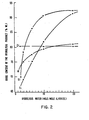
- Figure 2 shows the relationship between the amount of water used in hydrolysis and the oxide content of the resultant hydrolysis products when aluminum butoxide, silicon ethoxide, titanium ethoxide and zirconium butoxide were hydrolyzed and the hydrolysis products were dried at 120°C and calcined to 600°C. It is important to note that the hydroxyl content of these hydroxide polymers is inversely related to the amount of water used during the hydrolysis.
- Hydroxides with high hydroxyl content are formed with low water use, and vice versa. This indicates that.these hydroxyl groups are not merely absorbed species but are part of the structural make-up, in accordance with the polymerization theory presented here.
- the hydrolysis product of zirconium alkoxide contains about 80% Zro 2 by weight, regardless of -the amount of water used during hydrolysis. This corresponds to a composition equivalent to ZrO 2 ⁇ 1.7 H 2 0 for the hydrolysis product.
- the hydrolysis of zirconium alkoxides by atmospheric moisture yields a similar composition. This unique behavior of zirconium is due to the fact that it does not form true hydroxides. Nevertheless, the amount of water has a substantial impact on the nature of the hydrolysis and polymerization, thus affecting the resultant structure and particle size.
- a new polymerized aluminum hydroxide can be produced by the process of this invention. While aluminum monohydroxide has an aluminum oxide content of 85% by weight and aluminum trihydroxide has an aluminum oxide content of 65% by weight, the new polymerized aluminum hydroxides have aluminum oxide contents of from 75 to 81% by weight. (The oxide contents are for dried, unpyrolyzed hydroxides). These hydroxides are produced by controlling the water/alkoxide ratio (see Figure 2), and they sinter to higher densities.
- novel polymerized titanium hydroxides can be produced by the process of this invention which have a titanium dioxide content of from 73 to 92% by weight. These are also produced by controlling the oxide content (see Figure 2), and they also sinter to greater densities.
- the method of this invention allows not only control of structure, but also of the particle size. Therefore double benefit can be obtained by controlling internal structure of particles as well as their size. For example, slow and extended polymerization reactions result in larger particles than fast reactions induced by high water and concentrated species.
- ZrO 2 samples produced via 1 mole H 2 0 hydrolysis showed no coherence and consequently very little shrinkage at 1350°C, whereas the oxides formed via 10 and 15 moles H 2 O hydrolysis shrank dramatically, had a glassy appearance, and were dense and very strong. Vacuum firing did not change this result significantly; there was, however, a slight improvement in coherency for the samples hydrolyzed with the lower amounts of water in vacuum. It was also noted that if the hydrolysis was done at 50 to 80°C, further improvement in densities was achieved over room temperature hydrolysis.
- ZrO 2 powder was produced by hydrolyzing zirconium butoxide with 15 moles of water. However, before the hydrolysis, zirconium butoxide was mixed with yttrium iso-propoxide in an amount such as to give 85% equivalent ZrO 2 and 15% equivalent Y 2 0 3 in the final product. The hydrolysis product was calcined, pressed into discs and fired at 1350°C. A dense, doped and stabilized zirconia resulted.
- This doping and stabilization can also be done by using soluble salts of dopants dissolved in the hydrolysis liquid, such as yttrium acetate dissolved in the hydrolysis water.
- dopants such as CaO can also be used.
- hydroxides were prepared by the hydrolysis of aluminum secondary butoxide.
- the first hydroxide (A) was prepared by a non-liquid hydrolysis by atmospheric moisture.
- the second (B) was prepared in excess hot (better than 80°C) water and the third (C) was prepared in water at room temperature (20°C), followed by aging for 24- hours at room temperature.
- These processes yielded, respectively, an amorphous monohydroxide, a crystalline monohydroxide, and a trihydroxide.
- All three hydroxides were converted to oxides by calcining at 600°C and pressing into 5/8-inch diameter discs at 10,000 psi. The densification behavior of these samples was observed as they were held for two hours at various temperatures. The following table gives the results. The weight loss was from drying at 120°C to calcining at 600°C.
- Figure 1 presents these results in graphic form and shows that at temperatures above about 1650°C aluminum oxide derived from aluminum trihydroxide (C) sinters to a greater density than does aluminum oxide derived from amorphous aluminum monohydroxides (A) and crystalline aluminum monohydroxide (B).
- C aluminum trihydroxide
- A aluminum trihydroxide
- B crystalline aluminum monohydroxide
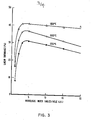
- Aluminum secondary butoxide was hydrolyzed with various amounts of water in secondary butyl alcohol. Water and aluminum secondary butoxide were separately diluted in amounts of alcohol so that the resulting mixture contained 4 weight percent equivalent oxide. Bayerite formation was prevented by performing the hydrolysis at about 50°C and heating the slurries to 100°C immediately after hydrolysis. The appearance of the precipitates in these samples varied considerably as a function of water content. For example, at around 5 moles of water per mole of alkoxide, the volume of precipitate reached a maximum and appeared to be ten times as much as the amount produced by 1 and 20 moles of water hydrolysis. These hydroxides were dried, calcined to oxide at 600°C, pressed into pellets and sintered at various temperatures.
- a hotter hydrolysis appears to contribute to the formation of sharply defined separate particles and enhances the resistance to sintering characteristically exhibited by the oxide produced via less than 2 moles of water hydrolysis. What seems to be individual particles about 2 microns in size actually consist of structural units or polymer regions about 50 ⁇ m in size.
- Figure 3 shows the effect of hydrolysis water on the sintering and shrinkage of these Al 2 O 3 samples.
- the oxide content of the hydrolysis product of titanium--alkoxide is strongly affected by the.amount of hydrolysis water.
- the hydrolysis product contains approximately 67% oxide by weight when 2 moles of water are used and rises to over 91% with the use of 20 moles of water (Figure 2). Hydrolysis by atmospheric moisture gives about 83% equivalent oxide.
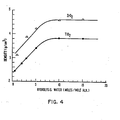
- Titanium oxides densify greatly at 1350°C, when they are produced by high water hydrolysis (see the above table and Figure 4). Electron micrographs of fractured structures of titanium oxides shown a glassy appearance. When titanium alkoxide is hydrolyzed with small amounts of water the resultant hydroxides produce sharp granular oxide particles when calcined. The particles produced by high water hydrolysis, however, have a light fluffy look where the boundaries are not smooth and sharply defined. During sintering, polymers coalesce into 1 to 5 micron sized masses which in turn bunch into separate units having 20 to 50 micron sizes. /
- silica system presents a somewhat unusual situation in that the hydrolysis of silicon alkoxides with water produces soluble polymer species which gel into a clear continuous polymer rather than condensing into a particulate precipitate.
- silicon tetraethoxide was hydrolyzed with various amounts of water in alcohol.
- the hydrolysis product which is a clear solution in this case, was gelled, dried at 120°C, and calcined to the oxide form at 600°C.
- the following table gives the oxide content of the polymers as a function of the amount of water of hydrolysis.
- this system can be polymerized to contain an excess of 92% oxide by weight at room temperature.
- the oxide content falls below 70% by weight when the hydrolysis water falls to 2 moles or less.
- These samples were ground, pressed into discs and sintered at 1350°C.
- the sintering behavior was similar to that of other oxides investigated. However, a fast heating causes entrapment of gases and bloat- ing, which must be prevented.
Landscapes
- Chemical & Material Sciences (AREA)
- Organic Chemistry (AREA)
- Engineering & Computer Science (AREA)
- Inorganic Chemistry (AREA)
- Manufacturing & Machinery (AREA)
- Ceramic Engineering (AREA)
- Geology (AREA)
- Materials Engineering (AREA)
- Structural Engineering (AREA)
- Life Sciences & Earth Sciences (AREA)
- Dispersion Chemistry (AREA)
- Environmental & Geological Engineering (AREA)
- General Life Sciences & Earth Sciences (AREA)
- Compositions Of Oxide Ceramics (AREA)
- Inorganic Compounds Of Heavy Metals (AREA)
- Oxygen, Ozone, And Oxides In General (AREA)
- Silicon Compounds (AREA)
- Compounds Of Alkaline-Earth Elements, Aluminum Or Rare-Earth Metals (AREA)
Applications Claiming Priority (2)
| Application Number | Priority Date | Filing Date | Title |
|---|---|---|---|
| US26432381A | 1981-05-18 | 1981-05-18 | |
| US264323 | 1981-05-18 |
Publications (3)
| Publication Number | Publication Date |
|---|---|
| EP0065863A2 true EP0065863A2 (de) | 1982-12-01 |
| EP0065863A3 EP0065863A3 (en) | 1984-08-08 |
| EP0065863B1 EP0065863B1 (de) | 1988-09-21 |
Family
ID=23005542
Family Applications (1)
| Application Number | Title | Priority Date | Filing Date |
|---|---|---|---|
| EP19820302486 Expired EP0065863B1 (de) | 1981-05-18 | 1982-05-17 | Verfahren zur Herstellung von Keramik formendem Metallhydroxid oder -oxid |
Country Status (4)
| Country | Link |
|---|---|
| EP (1) | EP0065863B1 (de) |
| JP (1) | JPS57196704A (de) |
| CA (1) | CA1261589A (de) |
| DE (1) | DE3279047D1 (de) |
Cited By (12)
| Publication number | Priority date | Publication date | Assignee | Title |
|---|---|---|---|---|
| EP0107700A4 (de) * | 1982-05-03 | 1986-05-16 | Western Electric Co | Herstellungsverfahren für keramische materialien. |
| EP0140067A3 (en) * | 1983-09-09 | 1986-06-25 | Kabushiki Kaisha Toshiba | Circuit substrate and producing method of the same |
| EP0216730A3 (en) * | 1985-08-12 | 1987-07-01 | Battelle Memorial Institute | Porous spherical glass filtrating beads and method for the manufacturing thereof |
| EP0248748A1 (de) * | 1986-05-30 | 1987-12-09 | CENTRE MERIDIONAL D'OENOLOGIE Société Anonyme dite: | Verfahren zur Herstellung mineralischer Membranen und Pulver aus Titan- und Siliziummischoxiden |
| FR2603880A1 (fr) * | 1986-09-15 | 1988-03-18 | Solvay | Procede pour la fabrication d'une poudre pour materiaux ceramiques, contenant au moins un oxyde metallique, et poudre formee d'au moins un oxyde metallique obtenue par ce procede |
| EP0177198A3 (en) * | 1984-09-07 | 1988-11-23 | Agency Ind Science Techn | A method for the preparation of an amorphous metal oxide composite, and amorphous metal oxide composites, including catalysts, prepared thereby |
| EP0255702A3 (de) * | 1986-07-31 | 1989-10-11 | Montedison S.p.A. | Verfahren zur Herstellung von feinen Metalloxidteilchen |
| DE19503522A1 (de) * | 1995-02-03 | 1996-08-08 | Rwe Dea Ag | Herstellung gemischter schichtförmig aufgebauter Metallhydroxide sowie deren Metalloxide |
| US6514473B2 (en) | 1995-02-03 | 2003-02-04 | Sasol Germany Gmbh | Process for producing hydrotalcites and the metal oxides thereof |
| EP1338563A3 (de) * | 2002-02-18 | 2003-10-29 | Creavis Gesellschaft für Technologie und Innovation mbH | Titandioxidpartikel, Verfahren zur Herstellung von Titandioxidpartikeln sowie Verwendung von Titandioxidpartikeln |
| US6914115B2 (en) | 2002-02-11 | 2005-07-05 | Degussa Ag | Low-temperature-curable, solid polyurethane powder coating compositions containing uretdione groups |
| EP2011769A1 (de) * | 2007-07-06 | 2009-01-07 | Evonik Degussa GmbH | Gesintertes, hochreines Siliciumdioxid enthaltendes Granulat |
Families Citing this family (4)
| Publication number | Priority date | Publication date | Assignee | Title |
|---|---|---|---|---|
| JPS59199504A (ja) * | 1983-04-27 | 1984-11-12 | Kurita Water Ind Ltd | 金属酸化物超微粒子の精製方法 |
| JPS60226498A (ja) * | 1984-04-19 | 1985-11-11 | Seiko Epson Corp | 単結晶育成用原料製造法 |
| JPS6186423A (ja) * | 1984-10-04 | 1986-05-01 | Mitsubishi Mining & Cement Co Ltd | ビスマス複酸化物の製造方法 |
| JPS63242917A (ja) * | 1987-03-27 | 1988-10-07 | Agency Of Ind Science & Technol | 耐熱性アルミナ複合酸化物の製造方法 |
Family Cites Families (5)
| Publication number | Priority date | Publication date | Assignee | Title |
|---|---|---|---|---|
| DE883744C (de) * | 1942-05-28 | 1953-07-20 | Steinkohlenbergwerk Rheinpreus | Verfahren zur Herstellung von modifizierten und stabilen Aluminiumhydroxyden |
| DE903691C (de) * | 1943-02-11 | 1954-02-08 | Rheinpreussen Ag | Verfahren zur Herstellung von Aluminiumhydroxyd |
| DE1903066A1 (de) * | 1969-01-22 | 1970-09-10 | Rheinpreussen Ag | Verfahren zur Hydrolyse von Aluminium-Alkoholaten |
| JPS5425520A (en) * | 1977-07-27 | 1979-02-26 | Kankyo Kaihatsu Kk | Method of connecting sewer and so on |
| US4357427A (en) * | 1981-10-19 | 1982-11-02 | Westinghouse Electric Corp. | Economic preparation of alumina suitable for isostatic pressing and sintering |
-
1982
- 1982-04-22 CA CA000401435A patent/CA1261589A/en not_active Expired
- 1982-05-17 EP EP19820302486 patent/EP0065863B1/de not_active Expired
- 1982-05-17 DE DE8282302486T patent/DE3279047D1/de not_active Expired
- 1982-05-18 JP JP57082568A patent/JPS57196704A/ja active Pending
Cited By (19)
| Publication number | Priority date | Publication date | Assignee | Title |
|---|---|---|---|---|
| EP0107700A4 (de) * | 1982-05-03 | 1986-05-16 | Western Electric Co | Herstellungsverfahren für keramische materialien. |
| EP0140067A3 (en) * | 1983-09-09 | 1986-06-25 | Kabushiki Kaisha Toshiba | Circuit substrate and producing method of the same |
| US4916261A (en) * | 1983-09-09 | 1990-04-10 | Kabushiki Kaisha Toshiba | Circuit substrate and producing method of the same |
| EP0177198A3 (en) * | 1984-09-07 | 1988-11-23 | Agency Ind Science Techn | A method for the preparation of an amorphous metal oxide composite, and amorphous metal oxide composites, including catalysts, prepared thereby |
| EP0216730A3 (en) * | 1985-08-12 | 1987-07-01 | Battelle Memorial Institute | Porous spherical glass filtrating beads and method for the manufacturing thereof |
| US4814202A (en) * | 1986-05-30 | 1989-03-21 | Centre Meridional D'oenologie | Processes for manufacturing thin membranes composed of an organic lattice of titanium and silicon oxides and powder composed of submicronic grains of mixed titanium and silicon oxides |
| FR2600550A1 (fr) * | 1986-05-30 | 1987-12-31 | Meridional Oenologie Centre | Procedes de fabrication de membrane minces composees d'un reseau mineral d'oxydes de titane et de silicium et poudre composee de grains submicroniques en oxydes mixtes de titane et de silicium |
| EP0248748A1 (de) * | 1986-05-30 | 1987-12-09 | CENTRE MERIDIONAL D'OENOLOGIE Société Anonyme dite: | Verfahren zur Herstellung mineralischer Membranen und Pulver aus Titan- und Siliziummischoxiden |
| EP0255702A3 (de) * | 1986-07-31 | 1989-10-11 | Montedison S.p.A. | Verfahren zur Herstellung von feinen Metalloxidteilchen |
| EP0263544A1 (de) * | 1986-09-15 | 1988-04-13 | Solvay | Verfahren zur Herstellung eines Pulvers für keramische Materialien, die wenigstens ein Metalloxid enthalten, und Pulver aus zumindest einem Metalloxid, erhalten nach diesem Verfahren |
| FR2603880A1 (fr) * | 1986-09-15 | 1988-03-18 | Solvay | Procede pour la fabrication d'une poudre pour materiaux ceramiques, contenant au moins un oxyde metallique, et poudre formee d'au moins un oxyde metallique obtenue par ce procede |
| US6180764B1 (en) | 1995-02-03 | 2001-01-30 | Rwe-Dea Aktiengesellschaft Fur Mineraloel Und Chemie | Process for producing hydrotalcites by hydrolyzing metal alcoholates |
| DE19503522A1 (de) * | 1995-02-03 | 1996-08-08 | Rwe Dea Ag | Herstellung gemischter schichtförmig aufgebauter Metallhydroxide sowie deren Metalloxide |
| US6514473B2 (en) | 1995-02-03 | 2003-02-04 | Sasol Germany Gmbh | Process for producing hydrotalcites and the metal oxides thereof |
| US6517795B1 (en) | 1995-02-03 | 2003-02-11 | Sasol Germany Gmbh | Process for producing hydrotalcites and the metal oxides thereof |
| US6914115B2 (en) | 2002-02-11 | 2005-07-05 | Degussa Ag | Low-temperature-curable, solid polyurethane powder coating compositions containing uretdione groups |
| EP1338563A3 (de) * | 2002-02-18 | 2003-10-29 | Creavis Gesellschaft für Technologie und Innovation mbH | Titandioxidpartikel, Verfahren zur Herstellung von Titandioxidpartikeln sowie Verwendung von Titandioxidpartikeln |
| EP2011769A1 (de) * | 2007-07-06 | 2009-01-07 | Evonik Degussa GmbH | Gesintertes, hochreines Siliciumdioxid enthaltendes Granulat |
| WO2009007146A1 (en) * | 2007-07-06 | 2009-01-15 | Evonik Degussa Gmbh | Sintered, high-purity granular material containing silicon dioxide |
Also Published As
| Publication number | Publication date |
|---|---|
| EP0065863A3 (en) | 1984-08-08 |
| EP0065863B1 (de) | 1988-09-21 |
| DE3279047D1 (en) | 1988-10-27 |
| CA1261589A (en) | 1989-09-26 |
| JPS57196704A (en) | 1982-12-02 |
Similar Documents
| Publication | Publication Date | Title |
|---|---|---|
| Yoldas | Effect of variations in polymerized oxides on sintering and crystalline transformations | |
| EP0065863B1 (de) | Verfahren zur Herstellung von Keramik formendem Metallhydroxid oder -oxid | |
| Yoldas | Preparation of glasses and ceramics from metal-organic compounds | |
| Segal | Chemical synthesis of advanced ceramic materials | |
| US4065544A (en) | Finely divided metal oxides and sintered objects therefrom | |
| KR910002386B1 (ko) | 바륨티타네이트의 단일입도분말 및 그 제조방법 | |
| Hirano et al. | Chemical processing and microwave characteristics of (Zr, Sn) TiO4 microwave dielectrics | |
| Yoldas | Zirconium oxides formed by hydrolytic condensation of alkoxides and parameters that affect their morphology | |
| Roy et al. | Multi-phasic ceramic composites made by sol-gel technique | |
| US4745092A (en) | Strengthened cordierite having minor amounts of calcia | |
| EP0519521A2 (de) | Verfahren zur Verfestigung eines Grünkörpers | |
| Phule et al. | Low temperature synthesis and dielectric properties of ceramics derived from amorphous barium titanate gels and crystalline powders | |
| Naka et al. | Change from metastable cubic to stable tetragonal form of submicron barium titanate | |
| CN108137342A (zh) | 氧化锆微细粉末及其制造方法 | |
| Kutty et al. | Wet chemical formation of nanoparticles of binary perovskites through isothermal gel to crystallite conversion | |
| US4970182A (en) | Method for producing multi-component ceramics | |
| Budd et al. | Preparation of strontium titanate ceramics and internal boundary layer capacitors by the Pechini method | |
| Hilton et al. | Recent developments in the manufacture of barium titanate powders | |
| Minehan et al. | Titania-silica glasses prepared by sintering alkoxide derived spherical colloids | |
| MXPA02001885A (es) | Metodo y auxiliar de sinterizacion basado en silicato. | |
| EP0107700B1 (de) | Herstellungsverfahren für keramische materialien | |
| CN110862256B (zh) | 一种微波介质烧结粉体材料的制备方法、微波介质陶瓷及其应用 | |
| Mishra et al. | Preparation of tetragonal zirconia powders by a solid state reaction: Kinetics, phases and morphology | |
| WO2003004415A1 (en) | Barium titanate powder and method for production thereof | |
| Schwartz | Chemical processing of lead metatitanate by co-precipitation and sol-gel methods: The role of powder and gel characteristics on crystallization behavior |
Legal Events
| Date | Code | Title | Description |
|---|---|---|---|
| PUAI | Public reference made under article 153(3) epc to a published international application that has entered the european phase |
Free format text: ORIGINAL CODE: 0009012 |
|
| AK | Designated contracting states |
Designated state(s): DE FR GB SE |
|
| PUAL | Search report despatched |
Free format text: ORIGINAL CODE: 0009013 |
|
| AK | Designated contracting states |
Designated state(s): DE FR GB SE |
|
| 17P | Request for examination filed |
Effective date: 19850124 |
|
| GRAA | (expected) grant |
Free format text: ORIGINAL CODE: 0009210 |
|
| AK | Designated contracting states |
Kind code of ref document: B1 Designated state(s): DE FR GB SE |
|
| REF | Corresponds to: |
Ref document number: 3279047 Country of ref document: DE Date of ref document: 19881027 |
|
| ET | Fr: translation filed | ||
| PLBE | No opposition filed within time limit |
Free format text: ORIGINAL CODE: 0009261 |
|
| STAA | Information on the status of an ep patent application or granted ep patent |
Free format text: STATUS: NO OPPOSITION FILED WITHIN TIME LIMIT |
|
| 26N | No opposition filed | ||
| PGFP | Annual fee paid to national office [announced via postgrant information from national office to epo] |
Ref country code: FR Payment date: 19910325 Year of fee payment: 10 |
|
| PGFP | Annual fee paid to national office [announced via postgrant information from national office to epo] |
Ref country code: SE Payment date: 19910402 Year of fee payment: 10 Ref country code: GB Payment date: 19910402 Year of fee payment: 10 |
|
| PGFP | Annual fee paid to national office [announced via postgrant information from national office to epo] |
Ref country code: DE Payment date: 19910628 Year of fee payment: 10 |
|
| PG25 | Lapsed in a contracting state [announced via postgrant information from national office to epo] |
Ref country code: GB Effective date: 19920517 |
|
| PG25 | Lapsed in a contracting state [announced via postgrant information from national office to epo] |
Ref country code: SE Effective date: 19920518 |
|
| GBPC | Gb: european patent ceased through non-payment of renewal fee |
Effective date: 19920517 |
|
| PG25 | Lapsed in a contracting state [announced via postgrant information from national office to epo] |
Ref country code: FR Effective date: 19930129 |
|
| PG25 | Lapsed in a contracting state [announced via postgrant information from national office to epo] |
Ref country code: DE Effective date: 19930202 |
|
| REG | Reference to a national code |
Ref country code: FR Ref legal event code: ST |
|
| EUG | Se: european patent has lapsed |
Ref document number: 82302486.4 Effective date: 19921204 |