EP0069379A2 - Lösliche Leber-Uricase, Verfahren zu ihrer Herstellung und Verwendung - Google Patents
Lösliche Leber-Uricase, Verfahren zu ihrer Herstellung und Verwendung Download PDFInfo
- Publication number
- EP0069379A2 EP0069379A2 EP82105993A EP82105993A EP0069379A2 EP 0069379 A2 EP0069379 A2 EP 0069379A2 EP 82105993 A EP82105993 A EP 82105993A EP 82105993 A EP82105993 A EP 82105993A EP 0069379 A2 EP0069379 A2 EP 0069379A2
- Authority
- EP
- European Patent Office
- Prior art keywords
- uricase
- soluble
- enzyme
- liver
- liver uricase
- Prior art date
- Legal status (The legal status is an assumption and is not a legal conclusion. Google has not performed a legal analysis and makes no representation as to the accuracy of the status listed.)
- Granted
Links
Classifications
-
- C—CHEMISTRY; METALLURGY
- C12—BIOCHEMISTRY; BEER; SPIRITS; WINE; VINEGAR; MICROBIOLOGY; ENZYMOLOGY; MUTATION OR GENETIC ENGINEERING
- C12N—MICROORGANISMS OR ENZYMES; COMPOSITIONS THEREOF; PROPAGATING, PRESERVING, OR MAINTAINING MICROORGANISMS; MUTATION OR GENETIC ENGINEERING; CULTURE MEDIA
- C12N11/00—Carrier-bound or immobilised enzymes; Carrier-bound or immobilised microbial cells; Preparation thereof
- C12N11/02—Enzymes or microbial cells immobilised on or in an organic carrier
- C12N11/10—Enzymes or microbial cells immobilised on or in an organic carrier the carrier being a carbohydrate
-
- C—CHEMISTRY; METALLURGY
- C12—BIOCHEMISTRY; BEER; SPIRITS; WINE; VINEGAR; MICROBIOLOGY; ENZYMOLOGY; MUTATION OR GENETIC ENGINEERING
- C12N—MICROORGANISMS OR ENZYMES; COMPOSITIONS THEREOF; PROPAGATING, PRESERVING, OR MAINTAINING MICROORGANISMS; MUTATION OR GENETIC ENGINEERING; CULTURE MEDIA
- C12N11/00—Carrier-bound or immobilised enzymes; Carrier-bound or immobilised microbial cells; Preparation thereof
- C12N11/02—Enzymes or microbial cells immobilised on or in an organic carrier
- C12N11/08—Enzymes or microbial cells immobilised on or in an organic carrier the carrier being a synthetic polymer
- C12N11/082—Enzymes or microbial cells immobilised on or in an organic carrier the carrier being a synthetic polymer obtained by reactions only involving carbon-to-carbon unsaturated bonds
-
- C—CHEMISTRY; METALLURGY
- C12—BIOCHEMISTRY; BEER; SPIRITS; WINE; VINEGAR; MICROBIOLOGY; ENZYMOLOGY; MUTATION OR GENETIC ENGINEERING
- C12Q—MEASURING OR TESTING PROCESSES INVOLVING ENZYMES, NUCLEIC ACIDS OR MICROORGANISMS; COMPOSITIONS OR TEST PAPERS THEREFOR; PROCESSES OF PREPARING SUCH COMPOSITIONS; CONDITION-RESPONSIVE CONTROL IN MICROBIOLOGICAL OR ENZYMOLOGICAL PROCESSES
- C12Q1/00—Measuring or testing processes involving enzymes, nucleic acids or microorganisms; Compositions therefor; Processes of preparing such compositions
- C12Q1/62—Measuring or testing processes involving enzymes, nucleic acids or microorganisms; Compositions therefor; Processes of preparing such compositions involving uric acid
Definitions
- the invention relates to a liver uricase that is soluble even at low pH values, a process for its production and its use for determining uric acid.
- Uricase is a widely occurring enzyme in the animal kingdom, especially in the liver of animals, which catalyzes the oxidation of uric acid in the presence of oxygen to form allantoin, H 2 0 2 and C 02 according to the following reaction equation:
- liver uricase would be well suited for the determination of uric acid by determining one of the reaction products, in particular H 2 0 2 , by methods customary for this.
- a major disadvantage of liver uricase is that the enzyme is only soluble at relatively high pH values, usually between pH 9 and 11. It is therefore difficult to add further reactions to the reaction catalyzed by liver uricase couple as required, for example, for the enzymatic determination of the H 2 0 2 formed, since this generally requires approximately neutral pH values.
- Uricases are known which are sufficiently soluble even at neutral pH, but these would have to be obtained from microorganisms such as Cancida utilis or Aspergillus flavus and are therefore considerably more expensive, which severely limits their usability for analytical purposes. This also applies to an acidic uricase from Streptomyces known from EU-AS 0012446.
- the invention is therefore based on the object of modifying the easily accessible enzyme from liver, which can be extracted, for example, from pork liver at pH values above 9, in such a way that the disadvantages described above are eliminated and the enzyme is also removed in a neutral or acidic medium can be used.
- liver uricase which is characterized in that it is covalently bound to a water-soluble polysaccharide, polyacid anhydride, polyvinylpyrrolidone or acid anhydride as the carrier substance and is still soluble at pH values below 6.
- the invention is based on the surprising fact that a liver uricase which is bound to a water-soluble carrier substance of the type mentioned is excellently soluble not only at neutral pH values but also in the acidic range without any substantial change in its other properties. Preparations according to the invention are even characterized by solubility at pH values between 1 and 11.
- the enzyme modified according to the invention is not only soluble but also active down to pH 5.0 and, for example at pH 7.0, still has about 40% of the activity measured in the pH optimum of pH 9.5. It is therefore ideally suited for the determination of uric acid even in a neutral medium.
- liver uricase generally only goes into solution at pH values of 9.5 and higher and precipitates out of solution again at pH values below 9.0. In the modified form according to the invention, however, the solubility remains down to pH 1.
- the liver uricase according to the invention can easily be distinguished from all known uricases due to this property. It is also noteworthy that the liver uricase modified according to the invention retains its immunological properties unchanged and therefore can also be recognized immunologically as liver uricase in the carrier-bound form and can be distinguished from uricase of other origin.
- Polysaccharides are preferred as soluble carrier substances in the context of the invention.
- a water-soluble dextran is particularly preferred.
- other soluble polysaccharides such as, in particular, soluble starch, sugars or synthetic sugar polymers.
- sugars saccharides, like sucrose, were again particularly suitable.
- High molecular weight polymers of mono- and disaccharides, such as those obtained, for example, by reaction with epihalohydrin, have also proven to be well suited and are included in the scope of the invention as polysaccharides.
- the suitable carrier substances are, however, not restricted to polysaccharides and acid anhydrides, polyacid anhydrides or polyvinylpyrrolidone are also suitable.
- An example of a suitable acid anhydride is succinic anhydride, for a polyanhydride a copolymer of methyl vinyl ether with maleic anhydride.
- Succinimide derivatives have also been found to be suitable.
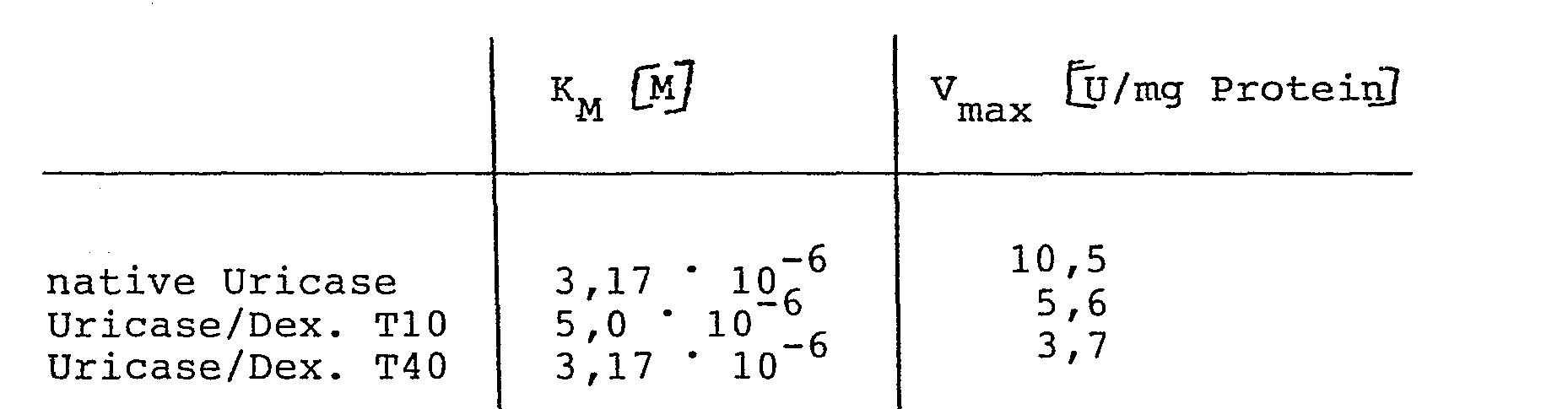
- Michaelis constant K and maximum speed V max are slightly changed in the enzyme modified according to the invention compared to the native liver uricase. It has been shown that this change depends to a certain extent on the molecular weight of the carrier substance. The K M values are hardly influenced, while the V max is reduced in inverse proportion to the molecular weight of the support. In the case of high molecular weight carrier materials such as starch and dextran in particular, however, a molecular weight of at least 1000 should be present.
- the molecular weight of the liver uricase modified according to the invention depends on the molecular weight of the Backing material. For example, a molecular weight between 180,000 and 200,000 daltons was found for enzyme modified with dextran T 10, while the molecular weight for dextran T 40 was between 350,000 and 500,000 daltons. The molecular weight was determined by gel chromatography in citrate buffer pH 5.8. The molecular weight of the native liver uricase cannot be determined under these conditions because of the insolubility of the enzyme.
- the liver uricase modified according to the invention can no longer be precipitated with ammonium sulfate, but is precipitated well with acetone. Acetone precipitation is reversible while maintaining activity. It is therefore particularly suitable for isolating the enzyme according to the invention.
- the temperature stability of the enzyme at higher temperatures is much better than that of the native enzyme. While the latter only has 5% of the initial activity at this temperature after 200 minutes, the activity of the enzyme according to the invention is still 82% at the same time. After 240 minutes at 60 ° C the native enzyme is inactive, the enzyme according to the invention still has 79% of the starting activity.
- the enzyme according to the invention is prepared in a manner known per se by reacting the uricase in aqueous solution with the dissolved carrier material, which contains at least one group which is reactive in aqueous solution with NH 2 groups, at pH values between 9 and 11.
- the coupling is expediently carried out at temperatures between 0 ° C. and room temperature, but higher or lower temperatures can also be used.
- the coupling is preferably carried out at pH values between 10.0 and 11.0.
- the enzyme according to the invention can be precipitated and isolated, for example by adding acetone.
- the solution obtained is preferably lyophilized, appropriately after prior cleaning by dialysis.
- stabilizers are preferably added, as are usually used in the lyophilization of enzymes. Sucrose and mannitol, which can be used alone or together, have proven particularly suitable as stabilizing additives for the lyophilization.
- a suitable reagent according to the invention consists of soluble liver uricase according to the invention, buffer and a system for determining H 2 0 2 , allantoin or C0 2 . It is also possible to measure the decrease in oxygen, for example with an oxygen electrode, as a measure of the amounts of uric acid present.
- Soluble dextrans from Roth, Düsseldorf (average molecular weights 10,000, 20,000, 40,000 and 500,000) are activated with cyanogen bromide (Merck) at pH 10.6.
- the prepared enzyme solution (a) is combined with the activated dextran solution (b) with vigorous stirring. Total volume 3.1 to 3.2 1, pH 10.1 to 10.3. At 4 ° C or room temperature, stir gently for 16 hours.
- the modified uricase is then dialyzed against 0.04 M sodium citrate buffer, pH 5.8 (containing 0.01% sodium acid). Duration about 3 hours. 30 g of sucrose and 45 g of mannitol are then added to the solution, and the mixture is filtered clear. The solution is then lyophilized.
- Example 1 The procedure of Example 1 was repeated, changing the conditions and carriers. The conditions and results are shown in the table below:
- the pH is adjusted to 5.8 using 1 M citric acid.
- the approach remains clear. There is still 60% of the initial activity. Stability: the activity in the solution drops to 33% after 16 hours, to 17% after 2 days and to 12% after 4 days.
- Example 14 is repeated, but with only 6 mg of GANTREZ AN 179. 16 hours after the pH has been reset to 5.8%, 48% of the initial activity is still present after 3 days. The turbidity can be seen after 16 hours.
- the activated dextran is purified by reprecipitation three times with a double volume excess of frozen acetone.
- the acetone precipitate is dissolved with ice water.
- the purified dextran can now be used either as a solution or as a lyophilisate for protein fixation.
- the mixture is then incubated for 16 hours at room temperature.
- Opalescence or turbidity must not occur.
- the clear solution which contains the fixed enzyme, is adjusted to pH 9.0 after adding 6 g of sucrose and 9 g of mannitol, mixed with 750 mg of ammonium carbaminate and lyophilized.
- the activity yield is 75 to 80% based on the activity used. Storage at 35 ° C for 3 weeks resulted in a reduction in activity of approximately 30%.
Landscapes
- Life Sciences & Earth Sciences (AREA)
- Chemical & Material Sciences (AREA)
- Health & Medical Sciences (AREA)
- Organic Chemistry (AREA)
- Zoology (AREA)
- Wood Science & Technology (AREA)
- Engineering & Computer Science (AREA)
- Genetics & Genomics (AREA)
- Bioinformatics & Cheminformatics (AREA)
- Biochemistry (AREA)
- General Engineering & Computer Science (AREA)
- General Health & Medical Sciences (AREA)
- Microbiology (AREA)
- Biotechnology (AREA)
- Molecular Biology (AREA)
- Biomedical Technology (AREA)
- Proteomics, Peptides & Aminoacids (AREA)
- Physics & Mathematics (AREA)
- Immunology (AREA)
- Biophysics (AREA)
- Analytical Chemistry (AREA)
- Enzymes And Modification Thereof (AREA)
- Medicines That Contain Protein Lipid Enzymes And Other Medicines (AREA)
- Measuring Or Testing Involving Enzymes Or Micro-Organisms (AREA)
- Medicines Containing Material From Animals Or Micro-Organisms (AREA)
- Immobilizing And Processing Of Enzymes And Microorganisms (AREA)
- Medicinal Preparation (AREA)
- Bakery Products And Manufacturing Methods Therefor (AREA)
Abstract
Description
- Die Erfindung betrifft eine auch bei niedrigen pH-Werten lösliche Leberuricase, ein Verfahren zu ihrer Herstellung und ihre Verwendung zur Bestimmung der Harnsäure.
- Uricase ist ein weit verbreitet im Tierreich, insbesondere in der Leber von Tieren vorkommendes Enzym, welches die Oxidation von Harnsäure in Gegenwart von Sauerstoff unter Bildung von Allantoin, H202 und C02 katalysiert gemäß nachfolgender Reaktionsgleichung:

- Aufgrund der obigen Reaktion würde sich Leberuricase gut für die Bestimmung der Harnsäure eignen, indem eines der Reaktionsprodukte, insbesondere H202, nach hierfür üblichen Methoden bestimmt wird. Ein wesentlicher Nachteil der Leberuricase liegt jedoch darin, daß das Enzym nur bei relativ hohen pH-Werten, normalerweise zwischen pH 9 und 11, löslich ist. Es ist daher schwierig, die durch die Leberuricase katalysierte Reaktion mit weiteren Reaktionen zu koppeln wie sie beispielsweise für die enzymatische Bestimmung des gebildeten H202 erforderlich sind, da hierfür in der Regel etwa neutrale pH-Werte erforderlich sind.
- Es sind zwar Uricasen bekannt, die auch bei neutralem pH-Wert ausreichend löslich sind, diese müßten jedoch aus Mikroorganismen wie Cancida utilis oder Aspergillus flavus gewonnen werden und sind daher wesentlich teurer was ihre Verwendbarkeit für analytische Zwecke stark beschränkt. Dies gilt auch für eine aus der EU-AS 0012446 bekannten saure Uricase aus Streptomyces.
- Der Erfindung liegt daher die Aufgabe zugrunde, das an sich leicht zugängliche Enzym aus Leber, welches beispielsweise aus Schweineleber bei pH-Werten über 9 herausgelöst werden kann, so zu verändern, da8 die oben beschriebenen Nachteile beseitigt und das Enzym auch in neutralem oder saurem Medium eingesetzt werden kann.
- Gelöst wird diese Aufgabe erfindungsgemäß durch eine Leberuricase, die dadurch gekennzeichnet ist, daß sie kovalent an ein wasserlösliches Polysaccharid, Polysäureanhydrid, Polyvinylpyrrolidon oder Säureanhydrid als Trägersubstanz gebunden vorliegt und noch bei pH-Werten unter 6 löslich ist.
- Der Erfindung liegt die überraschende Tatsache zugrunde, daß eine Leberuricase, die an eine wasserlösliche Trägersubstanz der genannten Art gebunden wird, ohne wesentliche Veränderung ihrer sonstigen Eigenschaften nicht nur bei neutralen pH- Werten sondern auch im sauren Bereich ausgezeichnet löslich ist. So zeichnen sich erfindungsgemäße Präparate sogar durch Löslichkeit bei pH-Werten zwischen 1 und 11 aus.
- Außerdem stellte sich heraus, daß das erfindungsgemäß modifizierte Enzym bis herab zu pH 5,0 nicht nur löslich sondern auch aktiv ist und beispielsweise bei pH 7,0 noch etwa 40 % der im pH-Optimum von pH 9,5 gemessenen Aktivität aufweist. Es eignet sich damit ausgezeichnet zur Bestimmung der Harnsäure auch in neutralem Medium.
- Native Leberuricase geht im allgemeinen erst bei pH-Werten von 9,5 und höher in Lösung und fällt bei pH-Werten unter 9,0 aus der Lösung wieder aus. In der erfindungsgemäßen modifizierten Form bleibt jedoch die Löslichkeit bis herab zu pH 1 bestehen. Die erfindungsgemäße Leberuricase läßt sich aufgrund dieser Eigenschaft leicht von allen bekannten Uricasen unterscheiden. Bemerkenswert ist außerdem, daß die erfindungsgemäß modifizierte Leberuricase ihre immunologischen Eigenschaften unverändert beibehält und daher auch in der trägergebundenen Form immunologisch als Leberuricase erkannt und von Uricase anderen Ursprungs unterschieden werden kann.
- Es ist bekannt, daß die Eigenschaften von Enzymen durch Trägerfixierung verändert werden können. So ist eine Veränderung der Aktivität, Verschiebung des pH-Optimums, Veränderung der Michaelis-Konstante, der spezifischen Aktivität und der Stabilität von Enzymen beschrieben worden. Es war jedoch nicht bekannt, daß durch Bindung an lösliche Träger die Löslichkeitseigenschaften eines Enzyms so drastisch verändert werden können, wie dies beim erfindungsgemäßen Produkt der Fall ist. Aus Enzyme 26, 49-53 (1981) ist es bekannt, eine Hefeuricase (aus Candida utilis) an Polyäthylenglycol zu binden, wobei man ein lösliches Produkt erhält, welches hinsichtlich seiner immunologischen Eigenschaften untersucht wurde. Eine Veränderung der Löslichkeit wurde hierbei nicht berichtet.
- Als lösliche Trägersubstanzen werden im Rahmen der Erfindung Polysaccharide bevorzugt. Besonders bevorzugt wird ein wasserlösliches Dextran. Sehr gute Ergebnisse wurden jedoch auch mit anderen löslichen Polysacchariden wie insbesondere löslicher Stärke, Zuckern oder synthetischen Zuckerpolymeren erzielt. Unter den Zuckern erwiesen sich wiederum die Saccharide wie Saccharose als besonders geeignet. Auch hochmolekulare Polymere von Mono- und Disacchariden, wie sie beispielsweise durch Umsetzung mit Epihalogenhydrin erhalten werden, erwiesen sich als gut geeignet und werden im Rahmen der Erfindung den Polysacchariden zugerechnet.
- Die geeigneten Trägersubstanzen sind jedoch nicht auf Polysaccharide beschränkt und auch Säureanhydride, Polysäureanhydride oder Polyvinylpyrrolidon sind geeignet. Ein Beispiel für ein geeignetes Säureanhydrid ist Bernsteinsäureanhydrid, für ein Polyanhydrid ein Copolymer von Methylvinyläther mit Maleinsäureanhydrid. Auch Succinimidderivate erwiesen sich als geeignet.
- Michaelis-Konstante K, und Maximalgeschwindigkeit Vmax sind bei dem erfindungsgemäß modifizierten Enzym etwas verändert gegenüber der nativen Leberuricase. Es hat sich gezeigt, daß diese Veränderung in gewissem Maße vom Molekulargewicht der Trägersubstanz abhängig ist. Dabei werden die KM-Werte kaum beeinflußt, während die Vmax umgekehrt proportional zum Molekulargewicht des Trägers verringert wird. Insbesondere bei hochmolekularen Trägermaterialien wie Stärke und Dextran sollte jedoch ein Molekulargewicht von mindestens 1000 vorliegen.
- Das Molekulargewicht der erfindungsgemäß modifizierten Leberuricase hängt ab vom Molekulargewicht des Trägermaterials. So wurde für mit Dextran T 10 modifiziertes Enzym ein Molekulargewicht zwischen 180.000 und 200.000 Dalton festgestellt, während bei Dextran T 40 das Molekulargewicht zwischen 350.000 und 500.000 Dalton lag. Die Molekulargewichtsbestimmung wurde durch Gelchromatographie in Citratpuffer pH 5,8 durchgeführt. Das Molekulargewicht der nativen Leberuricase läßt sich unter diesen Bedingungen wegen der Unlöslichkeit des Enzyms nicht bestimmen.
- Michaelis-Konstante K und Maximalgeschwindigkeit V wurden für native Uricase und die beiden vorstemax hend erwähnten Dextrane als Trägermaterialien für das Enzym bestimmt. Die Ergebnisse waren wie folgt:
-
- Die Temperaturstabilität des Enzyms bei höheren Temperaturen (60 °C) ist wesentlich besser als beim nativen Enzym. Während letzteres bei dieser Temperatur nach 200 Minuten nur noch 5 % der Ausgangsaktivität aufweist, beträgt die Aktivität des erfindungsgemäßen Enzyms zum gleichen Zeitpunkt noch 82 %. Nach 240 Minuten bei 60 °C ist das native Enzym inaktiv, das erfindungsgemäße Enzym weist noch 79 % der Ausgangsaktivität auf.
- Die Herstellung des erfindungsgemäßen Enzyms erfolgt in an sich bekannter Weise, indem man die Uricase in wässriger Lösung mit dem gelösten Trägermaterial, welches wenigstens eine in wässriger Lösung mit NH2-Gruppen reaktionsfähige Gruppe enthält, bei pH-Werten zwischen 9 und 11.umsetzt.
- Besonders gute Ergebnisse wurden mit Trägersubstanzen erzielt, welche mit Bromcyan oder Cyanurchlorid aktivierte OH-Gruppen tragen. Die Kupplung erfolgt zweckmäßig bei Temperaturen zwischen 0 °C und Raumtemperatur, jedoch können auch höhere oder niedrigere Temperaturen angewendet werden. Bevorzugt erfolgt die Kupplung bei pH-Werten zwischen 10,0 und 11,0.
- Jedoch können auch die anderen, dem Fachmann bekannten Methoden der Enzymfixierung angewendet werden.
- Um eine möglichst hohe Aktivitätsausbeute zu erzielen, erwies es sich als vorteilhaft, die molaren Verhältnisse von Enzym zu Trägermolekülen so zu wählen, daß nur ein relativ kleiner Teil der NH2-Gruppen des Enzyms . modifiziert wird. Das gilt insbesondere bei niedermolekularen Trägermaterialien. Die jeweils geeigneten Mengenverhältnisse lassen sich durch Vorversuche mit unterschiedlicher Trägermenge anhand der jeweils erzielten Aktivitätsausbeuten leicht feststellen.
- Nach Abschluß der Kupplungsreaktion kann das erfindungsgemäße Enzym beispielsweise durch Zusatz von Aceton ausgefällt und isoliert werden. Vorzugsweise wird die erhaltene Lösung jedoch lyophilisiert, zweckmäßig nach vorheriger Reinigung durch Dialyse. Bei der Gefriertrocknung werden vorzugsweise Stabilisierungsmittel zugesetzt wie sie üblicherweise bei der Lyophilisierung von Enzymen verwendet werden. Besonders geeignet erwiesen sich als stabilisierende Zusätze für die Lyophilisierung Saccharose und Mannit, die allein oder gemeinsam eingesetzt werden können.
- Erfindungsgemäße Enzympräparate eignen sich wie bereits erwähnt ausgezeichnet zur Bestimmung der Harnsäure. Ein hierfür geeignetes Reagenz gemäß der Erfindung besteht dager aus erfindungsgemäßer löslicher Leberuricase, Puffer und einem System zur Bestimmung von H202, von Allantoin oder von C02. Auch ist es möglich, die Sauerstoffabnahme, beispielsweise mit einer Sauerstoffelektrode, als Maß für die vorhandenen Harnsäuremengen zu messen.
- Die folgenden Beispiele erläutern die Erfindung weiter:
- 5 g Uricase (BM 150746, 30 bis 50 U/ml, 9 bis 10 . U/mg Protein) werden bei 4 °C gegen 4 x 2 1 Natriumcarbonat/Natriumbicarbonat-Puffer (0,1 M, pH 10,2) dialysiert. Es wird dabei eine klare Enzymlösung erhalten.
- Lösliche Dextrane der Firma Roth, Karlsruhe (mittlere Molekulargewichte 10.000, 20.000, 40.000 und 500.000) werden mit Bromcyan (Fa. Merck) bei pH 10,6 aktiviert.
- Dazu werden 30 g Dextran in 3 1 Wasser gelöst und mit 2 n Natronlauge auf pH 10,6 eingestellt. Unter Rühren werden insgesamt 9 bis 15 g Bromcyan in 3 g Portionen innerhalb von 40 min. in den Ansatz gegeben. Der pH- Wert wird dabei mit Hilfe eines Autotitrators durch Zugabe von 2 bis 5 n Natronlauge auf pH 10,6 gehalten. Die Aktivierungsreaktion ist beendet, wenn keine Natronlauge mehr verbraucht wird, was nach etwa 1,5 bis 2 Stunden der Fall ist.
- Es liegt dann eine klare Lösung vor, der pH-Wert wird mit 2 n Salzsäure auf 10,0 eingestellt. Das so aktivierte Dextran wird innerhalb von 2 Stunden bei 20 °C ausreichend gegen Wasser dialysiert.
- Die vorbereitete Enzymlösung (a) wird unter kräftigem Rühren mit der aktivierten Dextranlösung (b) vereinigt. Gesamtvolumen 3,1 bis 3,2 1, pH 10,1 bis 10,3. Bei 4 °C oder Raumtemperatur wird 16 Stunden lang leicht gerührt.
- Nach dieser Zeit sind noch etwa 80 % der eingesetzten Aktivität vorhanden. Der Ansatz sieht klar aus.
- Die modifizierte Uricase wird anschließend gegen 0,04 M Natrium-Citratpuffer, pH 5,8 (enthalten 0,01 % Natriumacid) dialysiert. Dauer etwa 3 Stunden. Anschließend werden 30 g Saccharose und 45 g Mannit zur Lösung gegeben, und man filtriert klar. Die Lösung wird dann lyophilisiert.
- 75 % der eingesetzten Aktivität befinden sich im Lyophilisat.
- Das Verfahren von Beispiel 1 wurde wiederholt unter Abänderung der Bedingungen und Trägerstoffe. Die Bedingungen und Resultate zeigt nachstehende Tabelle:


- 5 ml Uricase in Glycerin ≙ 235 mg Enzymprotein werden in 45 ml Wasser gegeben, im Eisbad in Abständen von 15 Minuten 2 x 25 mg Bernsteinsäureanhydrid in fester Form zugegeben. Der pH-Wert wird bei 9,8 durch Zusatz von 0,5 n NaOH mittels Titrator konstant gehalten bis keine NaOH mehr verbraucht wird. Der Ansatz wird dann mit Wasser auf 250 ml verdünnt und weitere 27 mg Bernsteinsäureanhydrid werden zugegeben und bei pH 9,8 wird wie vorstehend weitertitriert bis zum Reaktionsstillstand. Die Aktivität beträgt noch 44 %.
- Verhältnis Enzymprotein : Bernsteinsäureanhydrid = 3 : 1. Der Ansatz wird anschließend mit 1 M Zitronensäure auf pH 5,5 eingestellt; bleibt klar.
- Anschließend erfolgt Dialyse gegen 0,04 M Na-Citrat pH 5,5 enthaltend 0,01 % Na-Azid. Die auftretende leichte Trübung wird abzentrifugiert. Aktivität: 33 %. Lyophilisation nach Zusatz von 1,2 g Saccharose und 1,8 g Mannit. Lyophilisat: Ausbeute 3,7 g, spez. Akt. 0,178 U/mg; kein Aktivitätsverlust. Stabilität: 3 Wo. + 4 °C = 100 der Ausgangsakti- vität. " + 35 °C = 85 %
- 1 ml Uricase in Glycerin ≙ 20 mg Enzymprotein werden in 24 ml Wasser gegeben und im Eisbad unter Rühren mit 25 mg GANTREZ AN 179 (Copolymer aus Methylvinyläther und Maleinsäureanhydrid) versetzt. Der pH-Wert wird mit 0,1 n NaOH am Titrator bei 9,8 gehalten, dann werden nochmals 25 ml Wasser zugegeben.
- Nach Reaktionsstillstand wird mit 1 M Citronensäure auf pH 5,8 eingestellt. Der Ansatz bleibt klar. Es sind noch 60 % der Ausgangsaktivität vorhanden. Stabilität: die Aktivität in der Lösung sinkt nach 16 Std. auf 33 %, nach 2 Tagen auf 17 % und nach 4 Tagen auf 12 % des Ausgangswertes ab.
- Beispiel 14 wird wiederholt, jedoch mit nur 6 mg GANTREZ AN 179. 16 Std. nach pH-Rückstellung auf 5,8 sind noch 48 %, nach 3 Tagen noch 38 % der Ausgangsaktivität vorhanden. Nach 16 Std. ist die Trübung zu erkennen.
- 6g Dextran T 40 werden in 40 ml Wasser gelöst und im Eisbad auf + 0 °C gekühlt. Dann werden 600 mg Cyanurchlorid (2,4,6-Trichlor-1,3,5-triazin) in 10 ml tiefgekühltem Dimethylformamid gelöst und zum Ansatz gegeben. Der pH-Wert wird durch Zusatz von 0,5 n NaOH auf 5,0 eingestellt und gehalten.
- Nach Beendigung der Reaktion (keine pH-Änderung mehr) wird das aktivierte Dextran durch dreimalige Umfällung mit einem jeweils 2fachen Volumenüberschuß an tiefgekühltem Aceton gereinigt. Der Aceton-Niederschlag wird jeweils mit Eiswasser gelöst.
- Das gereinigte Dextran kann nun entweder als Lösung oder als Lyophilisat zur Proteinfixierung eingesetzt werden.
- Zur Fixierung der Uricase werden 1 g Enzymprotein (als Dialysat) in 0,025 M NaHCO3/Na2CO3-Puffer, pH 10,2 und das aktivierte Dextran (wäßrige Lösung) zusammengegeben und mit Wasser auf 300 ml aufgefüllt.
- Anschließend wird unter Rühren 16 Stunden bei Raumtemperatur inkubiert.
- Kontrolle der Fixierung und Lyophilisation:
- Der Ansatz wird mit 1 M Citronensäure auf pH 5,5 bis 5,8 eingestellt und 3 Stunden bei Raumtemperatur stehen gelassen.
- Eine Opaleszenz bzw. Trübung darf dabei nicht auftreten. Die klare Lösung, die das fixierte Enzym enthält, wird nach Zusatz von 6 g Saccharose und 9 g Mannit auf pH 9,0 eingestellt, mit 750 mg Ammoniumcarbaminat versetzt und lyophilisiert. Die Aktivitätsausbeute beträgt 75 bis 80 % bezogen auf die eingesetzte Aktivität. 3 Wochen Lagerung bei 35 °C ergab eine Verringerung der Aktivität um ca. 30 %.
Claims (8)
Priority Applications (1)
| Application Number | Priority Date | Filing Date | Title |
|---|---|---|---|
| AT82105993T ATE27967T1 (de) | 1981-07-07 | 1982-07-05 | Loesliche leber-uricase, verfahren zu ihrer herstellung und verwendung. |
Applications Claiming Priority (2)
| Application Number | Priority Date | Filing Date | Title |
|---|---|---|---|
| DE3126759 | 1981-07-07 | ||
| DE19813126759 DE3126759A1 (de) | 1981-07-07 | 1981-07-07 | Loesliche leber-uricase, verfahren zu ihrer herstellung und verwendung |
Publications (3)
| Publication Number | Publication Date |
|---|---|
| EP0069379A2 true EP0069379A2 (de) | 1983-01-12 |
| EP0069379A3 EP0069379A3 (en) | 1984-10-17 |
| EP0069379B1 EP0069379B1 (de) | 1987-06-24 |
Family
ID=6136304
Family Applications (1)
| Application Number | Title | Priority Date | Filing Date |
|---|---|---|---|
| EP82105993A Expired EP0069379B1 (de) | 1981-07-07 | 1982-07-05 | Lösliche Leber-Uricase, Verfahren zu ihrer Herstellung und Verwendung |
Country Status (7)
| Country | Link |
|---|---|
| US (1) | US4460683A (de) |
| EP (1) | EP0069379B1 (de) |
| JP (1) | JPS5841836B2 (de) |
| AT (1) | ATE27967T1 (de) |
| DE (2) | DE3126759A1 (de) |
| DK (1) | DK159688C (de) |
| IE (1) | IE53578B1 (de) |
Cited By (5)
| Publication number | Priority date | Publication date | Assignee | Title |
|---|---|---|---|---|
| EP0201805A1 (de) * | 1985-04-30 | 1986-11-20 | Roche Diagnostics GmbH | Stabilisiertes Sarcosinoxidase-Präparat |
| EP0223221A3 (en) * | 1985-11-21 | 1989-03-08 | Boehringer Mannheim Gmbh | Water soluble, stabilized peroxidase derivatives, process for their preparation and use in the determination of hydrogen peroxide |
| EP0320483A3 (en) * | 1987-12-11 | 1989-08-09 | Monsanto Company | Encapsulation method |
| EP0263484A3 (en) * | 1986-10-06 | 1990-06-13 | Hitachi, Ltd. | Method for isolation and purification of amylases, and adsorbents used for the same as well as devices for the isolation and purification |
| EP0742013A1 (de) * | 1995-05-11 | 1996-11-13 | Sanofi | Stabile flüssige Zusammensetzung enthaltend Urateoxidase und lyophilizierte Zusammensetzung für seine Herstellung |
Families Citing this family (31)
| Publication number | Priority date | Publication date | Assignee | Title |
|---|---|---|---|---|
| USD299556S (en) | 1986-09-16 | 1989-01-24 | Marshbanks, Inc. | Electric candle |
| JPS6467186A (en) * | 1987-09-04 | 1989-03-13 | Kanebo Ltd | Modified superoxide dismutase |
| JPH0269180A (ja) * | 1988-09-02 | 1990-03-08 | Daicel Chem Ind Ltd | 高分子化酵素及びその製造方法 |
| DE4011084A1 (de) * | 1990-04-05 | 1991-10-10 | Boehringer Mannheim Gmbh | Saccharid-modifizierte, wasserloesliche proteine |
| US6541606B2 (en) | 1997-12-31 | 2003-04-01 | Altus Biologics Inc. | Stabilized protein crystals formulations containing them and methods of making them |
| US6451572B1 (en) * | 1998-06-25 | 2002-09-17 | Cornell Research Foundation, Inc. | Overexpression of phytase genes in yeast systems |
| EP2158923B1 (de) | 1998-08-06 | 2013-02-27 | Mountain View Pharmaceuticals, Inc. | Peg-uricase Konjugate und Verwendung davon |
| US20060188971A1 (en) * | 1998-08-06 | 2006-08-24 | Duke University | Urate oxidase |
| CA2337967C (en) | 1998-08-06 | 2011-11-01 | Duke University | Recombinant uricase protein |
| US6783965B1 (en) | 2000-02-10 | 2004-08-31 | Mountain View Pharmaceuticals, Inc. | Aggregate-free urate oxidase for preparation of non-immunogenic polymer conjugates |
| EP1165806B1 (de) * | 1999-03-31 | 2005-08-03 | Cornell Research Foundation, Inc. | Phospahatasen mit verbesserter phytase-aktivität |
| US6841370B1 (en) | 1999-11-18 | 2005-01-11 | Cornell Research Foundation, Inc. | Site-directed mutagenesis of Escherichia coli phytase |
| US6913915B2 (en) * | 2001-08-02 | 2005-07-05 | Phoenix Pharmacologics, Inc. | PEG-modified uricase |
| PT2335501T (pt) * | 2001-10-31 | 2016-10-28 | Huvepharma Ad | Alimento animal contendo fitase e método |
| DE60335497D1 (de) * | 2002-09-13 | 2011-02-03 | Cornell Res Foundation Inc | Ergillus-phytasen |
| US20080159976A1 (en) * | 2005-04-11 | 2008-07-03 | Jacob Hartman | Methods for lowering elevated uric acid levels using intravenous injections of PEG-uricase |
| CN102807973A (zh) | 2005-04-11 | 2012-12-05 | 萨文特医药公司 | 尿酸氧化酶的变体形式及其用途 |
| WO2008051178A2 (en) * | 2006-04-12 | 2008-05-02 | Savient Pharmaceuticals, Inc. | Purification of proteins with cationic surfactant |
| DK3321359T3 (da) | 2005-04-11 | 2021-03-08 | Horizon Pharma Rheumatology Llc | Variante former af uratoxidase og anvendelse deraf |
| US8148123B2 (en) * | 2005-04-11 | 2012-04-03 | Savient Pharmaceuticals, Inc. | Methods for lowering elevated uric acid levels using intravenous injections of PEG-uricase |
| JP2008545665A (ja) * | 2005-05-23 | 2008-12-18 | ユニベルシテ ドゥ ジュネーブ | 高体温による処置のための注入可能な超常磁性ナノ粒子および高体温インプラントを形成するための使用 |
| US7919297B2 (en) | 2006-02-21 | 2011-04-05 | Cornell Research Foundation, Inc. | Mutants of Aspergillus niger PhyA phytase and Aspergillus fumigatus phytase |
| WO2008017066A2 (en) * | 2006-08-03 | 2008-02-07 | Cornell Research Foundation, Inc. | Phytases with improved thermal stability |
| US8192734B2 (en) | 2007-07-09 | 2012-06-05 | Cornell University | Compositions and methods for bone strengthening |
| WO2009120707A1 (en) * | 2008-03-24 | 2009-10-01 | Altus Pharmaceuticals Inc. | Uricase compositions and methods of use |
| RU2535038C2 (ru) | 2009-06-25 | 2014-12-10 | Криэлта Фармасьютикалз ЭлЭлСи | Способы и наборы для прогнозирования риска инфузионных реакций и опосредованной антителами потери ответа при терапии пэгилированной уриказой с помощью мониторинга содержания мочевой кислоты в сыворотке крови |
| EP3538135A4 (de) | 2016-11-11 | 2020-07-29 | Horizon Pharma Rheumatology LLC | Kombinationstherapien von prednison- und uricase-molekülen und deren verwendung |
| US20200237881A1 (en) | 2019-01-30 | 2020-07-30 | Horizon Pharma Rheumatology Llc | Reducing immunogenicity to pegloticase |
| US12121566B2 (en) | 2019-01-30 | 2024-10-22 | Horizon Therapeutics Usa, Inc. | Methods for treating gout |
| CN115011586B (zh) * | 2022-07-22 | 2024-07-23 | 江苏恰瑞生物科技有限公司 | 一种提高固定化尿酸酶酶活力的方法 |
| US12269875B2 (en) | 2023-08-03 | 2025-04-08 | Jeff R. Peterson | Gout flare prevention methods using IL-1BETA blockers |
Family Cites Families (3)
| Publication number | Priority date | Publication date | Assignee | Title |
|---|---|---|---|---|
| US3625827A (en) * | 1968-09-27 | 1971-12-07 | Monsanto Co | Water-soluble polymer-enzyme products |
| JPS6031472B2 (ja) * | 1978-12-14 | 1985-07-22 | 協和醗酵工業株式会社 | 酸性ウリカ−ゼ |
| JPS55135590A (en) * | 1979-04-05 | 1980-10-22 | Mihama Hisaharu | Modified asparaginase and uricase and their preparation |
-
1981
- 1981-07-07 DE DE19813126759 patent/DE3126759A1/de not_active Withdrawn
-
1982
- 1982-06-24 IE IE1510/82A patent/IE53578B1/en not_active IP Right Cessation
- 1982-07-01 DK DK296682A patent/DK159688C/da active
- 1982-07-02 US US06/394,562 patent/US4460683A/en not_active Expired - Lifetime
- 1982-07-05 AT AT82105993T patent/ATE27967T1/de not_active IP Right Cessation
- 1982-07-05 EP EP82105993A patent/EP0069379B1/de not_active Expired
- 1982-07-05 DE DE8282105993T patent/DE3276637D1/de not_active Expired
- 1982-07-07 JP JP57117076A patent/JPS5841836B2/ja not_active Expired
Cited By (7)
| Publication number | Priority date | Publication date | Assignee | Title |
|---|---|---|---|---|
| EP0201805A1 (de) * | 1985-04-30 | 1986-11-20 | Roche Diagnostics GmbH | Stabilisiertes Sarcosinoxidase-Präparat |
| EP0223221A3 (en) * | 1985-11-21 | 1989-03-08 | Boehringer Mannheim Gmbh | Water soluble, stabilized peroxidase derivatives, process for their preparation and use in the determination of hydrogen peroxide |
| EP0263484A3 (en) * | 1986-10-06 | 1990-06-13 | Hitachi, Ltd. | Method for isolation and purification of amylases, and adsorbents used for the same as well as devices for the isolation and purification |
| EP0320483A3 (en) * | 1987-12-11 | 1989-08-09 | Monsanto Company | Encapsulation method |
| EP0742013A1 (de) * | 1995-05-11 | 1996-11-13 | Sanofi | Stabile flüssige Zusammensetzung enthaltend Urateoxidase und lyophilizierte Zusammensetzung für seine Herstellung |
| FR2733914A1 (fr) * | 1995-05-11 | 1996-11-15 | Sanofi Sa | Composition de liquide stable contenant de l'urate oxydase et composition lyophilisee pour sa preparation |
| US5811096A (en) * | 1995-05-11 | 1998-09-22 | Sanofi | Stable liquid composition containing urate oxidase and lyophilized composition for its preparation |
Also Published As
| Publication number | Publication date |
|---|---|
| IE53578B1 (en) | 1988-12-21 |
| ATE27967T1 (de) | 1987-07-15 |
| DE3276637D1 (en) | 1987-07-30 |
| US4460683A (en) | 1984-07-17 |
| EP0069379B1 (de) | 1987-06-24 |
| DE3126759A1 (de) | 1983-01-27 |
| EP0069379A3 (en) | 1984-10-17 |
| JPS5816680A (ja) | 1983-01-31 |
| IE821510L (en) | 1983-01-07 |
| DK296682A (da) | 1983-01-08 |
| DK159688C (da) | 1991-04-15 |
| JPS5841836B2 (ja) | 1983-09-14 |
| DK159688B (da) | 1990-11-19 |
Similar Documents
| Publication | Publication Date | Title |
|---|---|---|
| EP0069379B1 (de) | Lösliche Leber-Uricase, Verfahren zu ihrer Herstellung und Verwendung | |
| DE69231935T2 (de) | Konjugat enthaltend ein geradkettiges organisches polymer mit gebundenen sulfatierten glukosaminoglukanen wie zum beispiel heparin, seine herstellung, verwendung und ein entsprechendes substrat | |
| EP1944033B1 (de) | Verwendung von Pektinhydrolyseprodukten | |
| EP0201805B1 (de) | Stabilisiertes Sarcosinoxidase-Präparat | |
| DE69027054T2 (de) | Enzymatisches Hydrolysat von einem Cellulosederivat | |
| DE69020276T2 (de) | Amylose-Lysozym-Hybrid, ein Aktivzucker und Verfahren zur Herstellung. | |
| DE3239236C2 (de) | ||
| DE69128196T3 (de) | Enzymstabilisierung | |
| DE2624002A1 (de) | Vrfahren zur verwendung eines enzyms zur umwandlung einer organischen substanz in mindestens eine andere organische substanz durch enzymatische reaktion | |
| DE3422407A1 (de) | Verwendung von heparinderivaten zur selektiven extrakorporalen praezipitation von low-density-lipoproteinen aus vollserum oder plasma | |
| DE60038664T2 (de) | Genträger | |
| DE69831805T2 (de) | Dextranderivate, verfahren zu deren herstellung und verwendungen als arzneimittel mit spezifischer, biologischer wirkung | |
| EP0450628B1 (de) | Saccharid-modifizierte, wasserlösliche Proteine | |
| DE3541186A1 (de) | Wasserloesliche, stabilisierte peroxidasederivate, verfahren zu ihrer herstellung und verwendung zur bestimmung von wasserstoffperoxid | |
| DE2249836C3 (de) | Verfahren zum Herstellen von Pullulan | |
| DE3801053C2 (de) | ||
| DE69030553T2 (de) | Verfahren zur Herstellung modifizierter Superoxid-Dismutase | |
| DE4429018C2 (de) | Verfahren zur Herstellung eines Enzyme immobilisierenden Trägers, Träger aus regeneriertem porösen Chitosan in Teilchenform und Verwendung des Trägers | |
| EP1567558A2 (de) | Aldonsäure-ester, verfahren zu ihrer herstellung und verfahren zur herstellung von mit polysacchariden oder polysaccharid-derivaten an freien aminogruppen gekoppelten pharmazeutischen wirkstoffen | |
| DE69224225T2 (de) | Modifiziertes Enzym | |
| WO2000037505A1 (de) | Stärke-phosphate, verfahren zu deren herstellung sowie deren verwendung | |
| DE10013539A1 (de) | Lipopolysaccharide aus Escherichia coli | |
| EP1587842A1 (de) | Kohlens urediester, verfahren zu ihrer herstellung und verfahren zur herstellung von mit polysacchariden oder polysaccharid-derivaten an freien aminogruppen gekoppelten pharmazeutischen wirkstoffen | |
| DE3033030A1 (de) | Thermostabile derivate der urokinase und verfahren zu deren herstellung | |
| DE69029061T2 (de) | Antihypertonika und Lebensmittel und Getränke, die solche Antihypertonika enthalten |
Legal Events
| Date | Code | Title | Description |
|---|---|---|---|
| PUAI | Public reference made under article 153(3) epc to a published international application that has entered the european phase |
Free format text: ORIGINAL CODE: 0009012 |
|
| AK | Designated contracting states |
Designated state(s): AT BE CH DE FR GB IT LI LU NL SE |
|
| PUAL | Search report despatched |
Free format text: ORIGINAL CODE: 0009013 |
|
| AK | Designated contracting states |
Designated state(s): AT BE CH DE FR GB IT LI LU NL SE |
|
| 17P | Request for examination filed |
Effective date: 19841115 |
|
| 17Q | First examination report despatched |
Effective date: 19860912 |
|
| GRAA | (expected) grant |
Free format text: ORIGINAL CODE: 0009210 |
|
| AK | Designated contracting states |
Kind code of ref document: B1 Designated state(s): AT BE CH DE FR GB IT LI LU NL SE |
|
| REF | Corresponds to: |
Ref document number: 27967 Country of ref document: AT Date of ref document: 19870715 Kind code of ref document: T |
|
| ITF | It: translation for a ep patent filed | ||
| REF | Corresponds to: |
Ref document number: 3276637 Country of ref document: DE Date of ref document: 19870730 |
|
| ET | Fr: translation filed | ||
| PLBE | No opposition filed within time limit |
Free format text: ORIGINAL CODE: 0009261 |
|
| STAA | Information on the status of an ep patent application or granted ep patent |
Free format text: STATUS: NO OPPOSITION FILED WITHIN TIME LIMIT |
|
| 26N | No opposition filed | ||
| ITTA | It: last paid annual fee | ||
| EPTA | Lu: last paid annual fee | ||
| EAL | Se: european patent in force in sweden |
Ref document number: 82105993.8 |
|
| PGFP | Annual fee paid to national office [announced via postgrant information from national office to epo] |
Ref country code: DE Payment date: 20000703 Year of fee payment: 19 |
|
| PGFP | Annual fee paid to national office [announced via postgrant information from national office to epo] |
Ref country code: SE Payment date: 20000705 Year of fee payment: 19 Ref country code: GB Payment date: 20000705 Year of fee payment: 19 |
|
| PGFP | Annual fee paid to national office [announced via postgrant information from national office to epo] |
Ref country code: LU Payment date: 20000710 Year of fee payment: 19 |
|
| PGFP | Annual fee paid to national office [announced via postgrant information from national office to epo] |
Ref country code: FR Payment date: 20000711 Year of fee payment: 19 |
|
| PGFP | Annual fee paid to national office [announced via postgrant information from national office to epo] |
Ref country code: CH Payment date: 20000712 Year of fee payment: 19 Ref country code: AT Payment date: 20000712 Year of fee payment: 19 |
|
| PGFP | Annual fee paid to national office [announced via postgrant information from national office to epo] |
Ref country code: NL Payment date: 20000728 Year of fee payment: 19 |
|
| PGFP | Annual fee paid to national office [announced via postgrant information from national office to epo] |
Ref country code: BE Payment date: 20000918 Year of fee payment: 19 |
|
| PG25 | Lapsed in a contracting state [announced via postgrant information from national office to epo] |
Ref country code: LU Free format text: LAPSE BECAUSE OF NON-PAYMENT OF DUE FEES Effective date: 20010705 Ref country code: GB Free format text: LAPSE BECAUSE OF NON-PAYMENT OF DUE FEES Effective date: 20010705 Ref country code: AT Free format text: LAPSE BECAUSE OF NON-PAYMENT OF DUE FEES Effective date: 20010705 |
|
| PG25 | Lapsed in a contracting state [announced via postgrant information from national office to epo] |
Ref country code: SE Free format text: LAPSE BECAUSE OF NON-PAYMENT OF DUE FEES Effective date: 20010706 |
|
| PG25 | Lapsed in a contracting state [announced via postgrant information from national office to epo] |
Ref country code: LI Free format text: LAPSE BECAUSE OF NON-PAYMENT OF DUE FEES Effective date: 20010731 Ref country code: DE Free format text: LAPSE BECAUSE OF NON-PAYMENT OF DUE FEES Effective date: 20010731 Ref country code: CH Free format text: LAPSE BECAUSE OF NON-PAYMENT OF DUE FEES Effective date: 20010731 Ref country code: BE Free format text: LAPSE BECAUSE OF NON-PAYMENT OF DUE FEES Effective date: 20010731 |
|
| BERE | Be: lapsed |
Owner name: BOEHRINGER MANNHEIM G.M.B.H. Effective date: 20010731 |
|
| PG25 | Lapsed in a contracting state [announced via postgrant information from national office to epo] |
Ref country code: NL Free format text: LAPSE BECAUSE OF NON-PAYMENT OF DUE FEES Effective date: 20020201 |
|
| GBPC | Gb: european patent ceased through non-payment of renewal fee |
Effective date: 20010705 |
|
| EUG | Se: european patent has lapsed |
Ref document number: 82105993.8 |
|
| REG | Reference to a national code |
Ref country code: CH Ref legal event code: PL |
|
| PG25 | Lapsed in a contracting state [announced via postgrant information from national office to epo] |
Ref country code: FR Free format text: LAPSE BECAUSE OF NON-PAYMENT OF DUE FEES Effective date: 20020329 |
|
| NLV4 | Nl: lapsed or anulled due to non-payment of the annual fee |
Effective date: 20020201 |
|
| REG | Reference to a national code |
Ref country code: FR Ref legal event code: ST |