EP0069854A2 - Verfahren zur Herstellung von Löchern in isolierenden Schichten - Google Patents
Verfahren zur Herstellung von Löchern in isolierenden Schichten Download PDFInfo
- Publication number
- EP0069854A2 EP0069854A2 EP82104711A EP82104711A EP0069854A2 EP 0069854 A2 EP0069854 A2 EP 0069854A2 EP 82104711 A EP82104711 A EP 82104711A EP 82104711 A EP82104711 A EP 82104711A EP 0069854 A2 EP0069854 A2 EP 0069854A2
- Authority
- EP
- European Patent Office
- Prior art keywords
- resist
- layer
- minutes
- substrate
- openings
- Prior art date
- Legal status (The legal status is an assumption and is not a legal conclusion. Google has not performed a legal analysis and makes no representation as to the accuracy of the status listed.)
- Granted
Links
- 238000000034 method Methods 0.000 title claims abstract description 51
- VYPSYNLAJGMNEJ-UHFFFAOYSA-N silicon dioxide Inorganic materials O=[Si]=O VYPSYNLAJGMNEJ-UHFFFAOYSA-N 0.000 claims abstract description 28
- 238000011161 development Methods 0.000 claims abstract description 21
- 239000010453 quartz Substances 0.000 claims abstract description 19
- 239000004065 semiconductor Substances 0.000 claims abstract description 7
- 238000010438 heat treatment Methods 0.000 claims abstract description 6
- 229920003986 novolac Polymers 0.000 claims abstract description 6
- 229920002120 photoresistant polymer Polymers 0.000 claims abstract description 5
- BTVLFVKZUYKTCO-UHFFFAOYSA-N (6-diazocyclohexa-2,4-dien-1-yl)-phenylmethanone Chemical compound [N-]=[N+]=C1C=CC=CC1C(=O)C1=CC=CC=C1 BTVLFVKZUYKTCO-UHFFFAOYSA-N 0.000 claims abstract description 3
- 239000000758 substrate Substances 0.000 claims description 24
- 239000011248 coating agent Substances 0.000 claims description 14
- 238000000576 coating method Methods 0.000 claims description 14
- 230000015572 biosynthetic process Effects 0.000 claims description 7
- 239000004642 Polyimide Substances 0.000 claims description 5
- 238000005530 etching Methods 0.000 claims description 5
- 229920001721 polyimide Polymers 0.000 claims description 5
- 239000004020 conductor Substances 0.000 claims description 4
- 238000010894 electron beam technology Methods 0.000 claims description 4
- 239000002318 adhesion promoter Substances 0.000 claims description 3
- 150000002500 ions Chemical class 0.000 claims description 3
- 229940118056 cresol / formaldehyde Drugs 0.000 claims description 2
- 235000012239 silicon dioxide Nutrition 0.000 claims 5
- 239000000377 silicon dioxide Substances 0.000 claims 2
- 238000001514 detection method Methods 0.000 abstract description 4
- 238000000609 electron-beam lithography Methods 0.000 abstract description 3
- 238000001020 plasma etching Methods 0.000 description 21
- 235000012431 wafers Nutrition 0.000 description 9
- 239000010408 film Substances 0.000 description 7
- 238000003384 imaging method Methods 0.000 description 7
- 239000012212 insulator Substances 0.000 description 7
- 238000012360 testing method Methods 0.000 description 7
- 239000011521 glass Substances 0.000 description 6
- 229910052681 coesite Inorganic materials 0.000 description 5
- 229910052906 cristobalite Inorganic materials 0.000 description 5
- 229910052751 metal Inorganic materials 0.000 description 5
- 239000002184 metal Substances 0.000 description 5
- 238000005272 metallurgy Methods 0.000 description 5
- 238000012545 processing Methods 0.000 description 5
- 229910052682 stishovite Inorganic materials 0.000 description 5
- 229910052905 tridymite Inorganic materials 0.000 description 5
- 239000000463 material Substances 0.000 description 4
- 238000001465 metallisation Methods 0.000 description 4
- 230000005855 radiation Effects 0.000 description 4
- 230000000694 effects Effects 0.000 description 3
- 230000003287 optical effect Effects 0.000 description 3
- 238000009987 spinning Methods 0.000 description 3
- GRYLNZFGIOXLOG-UHFFFAOYSA-N Nitric acid Chemical compound O[N+]([O-])=O GRYLNZFGIOXLOG-UHFFFAOYSA-N 0.000 description 2
- 230000003247 decreasing effect Effects 0.000 description 2
- 229920006237 degradable polymer Polymers 0.000 description 2
- 238000000151 deposition Methods 0.000 description 2
- 238000013461 design Methods 0.000 description 2
- AWJWCTOOIBYHON-UHFFFAOYSA-N furo[3,4-b]pyrazine-5,7-dione Chemical compound C1=CN=C2C(=O)OC(=O)C2=N1 AWJWCTOOIBYHON-UHFFFAOYSA-N 0.000 description 2
- 239000012535 impurity Substances 0.000 description 2
- 238000007689 inspection Methods 0.000 description 2
- 239000000203 mixture Substances 0.000 description 2
- 229910017604 nitric acid Inorganic materials 0.000 description 2
- 238000002360 preparation method Methods 0.000 description 2
- 239000010409 thin film Substances 0.000 description 2
- XLYOFNOQVPJJNP-UHFFFAOYSA-N water Substances O XLYOFNOQVPJJNP-UHFFFAOYSA-N 0.000 description 2
- DDBLEAXZJSNIHS-UHFFFAOYSA-N 5-[4-benzoyl-3-(6-diazonio-5-oxidonaphthalen-1-yl)sulfonylphenyl]sulfonyl-2-diazonionaphthalen-1-olate Chemical compound C1=CC=C2C([O-])=C([N+]#N)C=CC2=C1S(=O)(=O)C(C=C1S(=O)(=O)C=2C3=CC=C(C([O-])=C3C=CC=2)[N+]#N)=CC=C1C(=O)C1=CC=CC=C1 DDBLEAXZJSNIHS-UHFFFAOYSA-N 0.000 description 1
- 229910000881 Cu alloy Inorganic materials 0.000 description 1
- CTQNGGLPUBDAKN-UHFFFAOYSA-N O-Xylene Chemical compound CC1=CC=CC=C1C CTQNGGLPUBDAKN-UHFFFAOYSA-N 0.000 description 1
- 229910000676 Si alloy Inorganic materials 0.000 description 1
- XUIMIQQOPSSXEZ-UHFFFAOYSA-N Silicon Chemical compound [Si] XUIMIQQOPSSXEZ-UHFFFAOYSA-N 0.000 description 1
- NIXOWILDQLNWCW-UHFFFAOYSA-N acrylic acid group Chemical group C(C=C)(=O)O NIXOWILDQLNWCW-UHFFFAOYSA-N 0.000 description 1
- 239000000654 additive Substances 0.000 description 1
- 230000000996 additive effect Effects 0.000 description 1
- 229910052782 aluminium Inorganic materials 0.000 description 1
- XAGFODPZIPBFFR-UHFFFAOYSA-N aluminium Chemical compound [Al] XAGFODPZIPBFFR-UHFFFAOYSA-N 0.000 description 1
- WPPDFTBPZNZZRP-UHFFFAOYSA-N aluminum copper Chemical compound [Al].[Cu] WPPDFTBPZNZZRP-UHFFFAOYSA-N 0.000 description 1
- 238000004380 ashing Methods 0.000 description 1
- 238000010923 batch production Methods 0.000 description 1
- 238000012777 commercial manufacturing Methods 0.000 description 1
- 230000000295 complement effect Effects 0.000 description 1
- 238000010276 construction Methods 0.000 description 1
- 230000008021 deposition Effects 0.000 description 1
- 238000011982 device technology Methods 0.000 description 1
- SBZXBUIDTXKZTM-UHFFFAOYSA-N diglyme Chemical compound COCCOCCOC SBZXBUIDTXKZTM-UHFFFAOYSA-N 0.000 description 1
- 238000005516 engineering process Methods 0.000 description 1
- 230000006870 function Effects 0.000 description 1
- 238000001459 lithography Methods 0.000 description 1
- 238000004519 manufacturing process Methods 0.000 description 1
- 230000000873 masking effect Effects 0.000 description 1
- 238000012986 modification Methods 0.000 description 1
- 230000004048 modification Effects 0.000 description 1
- 238000005457 optimization Methods 0.000 description 1
- 229920002492 poly(sulfone) Polymers 0.000 description 1
- 229920000642 polymer Polymers 0.000 description 1
- 238000007639 printing Methods 0.000 description 1
- 230000001737 promoting effect Effects 0.000 description 1
- 229910052710 silicon Inorganic materials 0.000 description 1
- 239000010703 silicon Substances 0.000 description 1
- 238000004544 sputter deposition Methods 0.000 description 1
- 230000003068 static effect Effects 0.000 description 1
- 238000012546 transfer Methods 0.000 description 1
- FVPMNPYROPLVEX-UHFFFAOYSA-N trifluorosilylamine Chemical compound N[Si](F)(F)F FVPMNPYROPLVEX-UHFFFAOYSA-N 0.000 description 1
- 239000008096 xylene Substances 0.000 description 1
Images

Classifications
-
- G—PHYSICS
- G03—PHOTOGRAPHY; CINEMATOGRAPHY; ANALOGOUS TECHNIQUES USING WAVES OTHER THAN OPTICAL WAVES; ELECTROGRAPHY; HOLOGRAPHY
- G03F—PHOTOMECHANICAL PRODUCTION OF TEXTURED OR PATTERNED SURFACES, e.g. FOR PRINTING, FOR PROCESSING OF SEMICONDUCTOR DEVICES; MATERIALS THEREFOR; ORIGINALS THEREFOR; APPARATUS SPECIALLY ADAPTED THEREFOR
- G03F7/00—Photomechanical, e.g. photolithographic, production of textured or patterned surfaces, e.g. printing surfaces; Materials therefor, e.g. comprising photoresists; Apparatus specially adapted therefor
- G03F7/26—Processing photosensitive materials; Apparatus therefor
- G03F7/40—Treatment after imagewise removal, e.g. baking
-
- G—PHYSICS
- G03—PHOTOGRAPHY; CINEMATOGRAPHY; ANALOGOUS TECHNIQUES USING WAVES OTHER THAN OPTICAL WAVES; ELECTROGRAPHY; HOLOGRAPHY
- G03F—PHOTOMECHANICAL PRODUCTION OF TEXTURED OR PATTERNED SURFACES, e.g. FOR PRINTING, FOR PROCESSING OF SEMICONDUCTOR DEVICES; MATERIALS THEREFOR; ORIGINALS THEREFOR; APPARATUS SPECIALLY ADAPTED THEREFOR
- G03F7/00—Photomechanical, e.g. photolithographic, production of textured or patterned surfaces, e.g. printing surfaces; Materials therefor, e.g. comprising photoresists; Apparatus specially adapted therefor
- G03F7/004—Photosensitive materials
- G03F7/09—Photosensitive materials characterised by structural details, e.g. supports, auxiliary layers
- G03F7/094—Multilayer resist systems, e.g. planarising layers
-
- G—PHYSICS
- G03—PHOTOGRAPHY; CINEMATOGRAPHY; ANALOGOUS TECHNIQUES USING WAVES OTHER THAN OPTICAL WAVES; ELECTROGRAPHY; HOLOGRAPHY
- G03F—PHOTOMECHANICAL PRODUCTION OF TEXTURED OR PATTERNED SURFACES, e.g. FOR PRINTING, FOR PROCESSING OF SEMICONDUCTOR DEVICES; MATERIALS THEREFOR; ORIGINALS THEREFOR; APPARATUS SPECIALLY ADAPTED THEREFOR
- G03F7/00—Photomechanical, e.g. photolithographic, production of textured or patterned surfaces, e.g. printing surfaces; Materials therefor, e.g. comprising photoresists; Apparatus specially adapted therefor
- G03F7/26—Processing photosensitive materials; Apparatus therefor
- G03F7/30—Imagewise removal using liquid means
Definitions
- This invention relates to the formation of a pattern of openings in a layer of a positive resist system on semiconductor devices using high energy electron beam radiation, and more particularly to the development of said exposed resist layer with horizontal and vertical control of the hole dimensions. Furthermore, the invention relates to a method of forming via holes.
- impurity regions are conventionally fabricated in a silicon chip approximately 3 to 5 mm square. Such regions form transistors, diodes, resistors and the like which are then connected together by the metallurgical patterns atop the chip to form various circuits and for connection to input-output terminals.
- This interconnection metallurgy system atop the chip is extremely complex and usually employs two or three separate levels of complex thin film conductor patterns, each separated by one or more layers of dielectric, material.
- the first level conductive patterns on the chip surface interconnects the transistors, resistors, diodes, etc. into circuits and also provides for circuit-to-circuit connections. The latter function is usually provided by parallel conductive lines connected to the individual circuits.
- the second level conductive pattern conventionally completes the circuit-to-circuit connection and makes contact to I/O terminals which are connectable to a support such as a module, substrate or card.
- the second level usually consists of parallel lines that are transverse to the aforementioned parallel lines of the underlying first level conductive pattern. In advanced designs third, and even fourth, levels may be required for power and I/O connections.
- the standard process of interconnecting one level of metallurgy to another involves depositing an insulator such as Si0 2 atop a first level metallurgical pattern disposed on a substrate.
- the glass is typically deposited pyroly- tically, although the sputtered glass position process described in US Patent No. 3,983,022.
- a photoresist layer is then deposited, exposed and developed so that the via hole pattern is formed in the photoresist over the glass.
- the exposed glass portions are then etched to form the via holes down to the first level metallurgy.
- a second level metallurgical pattern is then deposited atop the remaining glass layer and into the via holes for connection to the first level pattern.
- the formation of positive resist masks from layers of ra- diat..on degradable polymers is described, for example, by Haller and Hatzakis in US Patent No. 3,535,137.
- a radiation degradable polymer layer is coated on a substrate and is subjected to patternwise exposure by high energy radiation such as, for example, x-rays, nuclear radiation, and electrons.
- the irradiated regions of the polymer suffer a decrease in molecular weight and therefore become more rapidly soluble.
- a developer is then used to preferentially remove the irradiated portions of the layer.
- the substrate is then subjected to an additive or substractive process such as metallization of etching of said substrate with the remaining portions of the resist layer acting to protect the substrate.
- E-beam exposed novolak resist is more complicated and demanding than processing the optically exposed forms. While development times for optical exposure are in the range of 0.5 to 2.0 minutes, E-beam exposure necessitates development times in the neighborhood of 8 to 10 minutes. These longer development times require an extremely good bond between the resist and substrate to avoid adhesion loss in the developer. Even the polysulfone adhesion layer used for optical lithographic processes becomes inadequate at the longer development times. Also, due to long development times the novolak (e.g. HC) resists have a tendency to de-adhere from some substrates, (e.g. quartz and oxide layers) during development.
- some substrates e.g. quartz and oxide layers
- Object of the invention is an improved method of forming a pattern of openings in a layer of a positive resist system and a method of forming via holes.
- the advantages offered by the invention are improved control of hole formation in the resist layer and improved control of the horizontal and vertical dimensions of via hole formation in insulating layers, and particularly the formation of via-holes with improved sidewall taper, especially for small via hole geometrics.
- the invention comprises several critical processing steps, which taken as a whole, constitute the E-beam first via RIE process of this invention.
- the significant value of this invention is that as a whole, it meets its objectives only through the intricate interrelationship between the individual steps.
- the process is complex and each processing step has an effect on the others since the optimization of the process is achieved by designing each step to complement the others, which reproducibly forms vias whose horizontal dimensions are accurately controlled with vias having the proper vertical taper to insure second metal coverage and in turn, adequate reliability.
- a particularly effective adhesion promoter for purposes of this invention is an underlay of about 100 to about 200nm, typically of about 140nm, of Eastman Kodak's KMR resist which is a sensitized partially cyclized poly-cis-isoprene.
- This KMR resist underlay or layer is baked, e.g. about 160°C, to desensitize it during the bake cycle.
- the purpose of the underlay is to increase adhesion of the imaging resists, to quartz and Si0 2 , during the development cycle. This KMR layer remains intact during resist development cycle, but is removed in the vias during the initial stages of the RIE operation.
- the KMR resist is overcoated with a layer of a novolak imaging resist system (e.g. HC resist) which is sufficiently sensitive to an E-beam exposure density of about 5 to about 20 (e.g. 10) u coulomb/cm 2 , and which is not severely degraded during the RIE operation.
- a novolak imaging resist system e.g. HC resist
- the imaging resist can be applied in thicknesses of about 2000 to about 3000nm, which illustratively for the HC resist would be about 2500nm.
- the imaging resist should also have a high ratio of development rate of exposed resist to the development rate of unexposed resist (R/Ro).
- the imaging resist is then controllably E-beam exposed in accordance with the required via pattern. Occasionally images are exposed which are not integral multiples of the E-beam spot size. In such case, proper image size and sidewall taper can be achieved by suitable "graying" of the E-beam exposure. As used herein "graying" is reducing or increasing E-beam exposure times for each nominal via size, depending upon the desired size of that particular via.
- Graying also enables vias with multiple spot overlap to be developed and baked at the same conditions as the non-overlapped vias.
- This invention also comprehends special resist developing parameters, which minimize imaging resist loss in the unexposed regions, and more importantly, to enable proper control of the developed image, both in the horizontal dimensions and sidewall taper.
- the developing is accomplished by utilizing a suitable developer, such as Shipley's commercially available KOH based AZ-1301 diluted with water in a 1:3 proportion, and developing at low temperatures in the range of about 13 to about 15°C, and illustratively of about 14°C.
- the use of the DEPD enables reproducible image size control despite variations in pre-bake temperatures, resist development rates, E-beam exposure density, ambient light conditions, strength of developer and resist thickness. Developing times will vary based on the parameters noted above, and developing for fixed times will result in loss of image size integrity.
- the DEPD technique utilized in this process comprises the use of a suitably designed or dedicated test site with metal line widths and spaces characteristic of the product dimensions. More importantly, the technique utilizes the concept of DEPD "over-develop" which is in actuality a relationship between the time to develop in the test site vs. the time to properly open a via. Thus, the substrates or wafers are developed for a given time past full development of the resist in the test site. This additional time is referred to as At and is a certain percentage of the time to reach end-point in the test site. The determination of the value of At depends on several parameters, namely material properties and tool characteristics.
- the overde- velop time, ⁇ t can be from about 10 to about 100%, and preferably from about 20 to about 40% of the time to reach end-point in the test site.
- the baking cycle must be of such a nature as to controllably flow the resist to achieve a suitable sidewall taper, which will be reproduced in the insulator (e.g. quartz) layer during RIE.
- the baking cycle must also be of such a nature as to maintain proper horizontal dimensional control.
- Such a bake cycle can be achieved by a gradual heating over a time in the range of about 20 to about 60 minutes at a temperature of about 120 to about 160°C.
- One way of arriving at the bake temperature is by use of an oven set at a temperature of about 120 to about 140°C with a thermal rise time of about 2 to about 10°C per minute.
- the same baking effect can also be achieved by a three step bake at temperatures of about 80 to about 90°C, as for example, about 85°C, (e.g. hot plate) for about 10 to about 20 minutes, at about 100 to about 120°C, as for an example, 115°C (e.g. in an oven) for about 10 to about 20 minutes followed by a final bake at about 130 to about 160°C, as example of about 150°C (e.g. in an oven) for about 10 to about 20 minutes.
- a three step bake at temperatures of about 80 to about 90°C, as for example, about 85°C, (e.g. hot plate) for about 10 to about 20 minutes, at about 100 to about 120°C, as for an example, 115°C (e.g. in an oven) for about 10 to about 20 minutes
- a final bake at about 130 to about 160°C, as example of about 150°C (e.g. in an oven) for about 10 to about 20 minutes.
- the wafer or substrate is reactive ion etched to transfer the via of the resist through the desensitized resist underlayer to the insulating layer, e.g. quartz, in a diode or other suitably configured system in a CF 4 + 0 2 gas ambient.
- the insulating layer e.g. quartz
- the process of this invention if used correctly, has the ability to transform an E-beam exposed "square" via into a properly tapered “round” via hole, Fig. 3C.
- This process also enables tight control of horizontal dimensions of all different and varied via sizes exposed and etched on a wafer or substrate. Use of this process has produced dimensional control resulting in a 500 nm tolerance on etched vias.
- Fig. 1 shows a cross-section of thin metallic films 6 and 7 of approximately 1 um in thickness disposed on top of an insulative coating 2 of a substrate 1 and covered by a dielectric layer 4 (e.g. quartz) having a suitable thickness, as for example 2 to 2.5 um.
- Films 6 and 7 comprise a portion of a first level conductive pattern which is generally interconnected through the insulator coating 2 to doped impurity regions within a semiconductor substrate 1 (not shown). Films 6 and 7 are also normally interconnected to other such films in said pattern on the same level to form device-to-device and circuit-to-circuit interconnections, as is well known in the art.
- One method of forming such films, 6 and 7 is by a lift-off method as described in US patent 4,004,044.
- Films 6 and 7 typically comprise aluminum, aluminum-copper alloys, alluminum-copper-silicon alloys as illustrative of other conductive films which can also be used.
- Dielectric layer 4 can be a polyimide, Si0 2 , glass or quartz or other suitable insulating composition employed in the art. Quartz is selected for purposes of this description, and which can be formed by conventional R.F. or D.C. sputtering techniques to cover the thin film pattern atop the substrate. If required, the quartz coating can be planarized by the technique described in US Patent No. 3,983,022. As will be understood, the substrate indicated in the drawings is a portion of an integrated circuit chip which is replicated in large number in a mother sheet or wafer.
- the substrate/wafer In preparation for via hole formation the substrate/wafer, after inspection of the insulator coating 4, is cleaned in a chromic/nitric acid solution for sufficient time, e.g. about 5 minutes at room temperature followed by a D.I.H 2 0 and blown dry, with a subsequent bake in an N 2 ambient oven for 30 minutes at about 160°C+5°.
- a chromic/nitric acid solution for sufficient time, e.g. about 5 minutes at room temperature followed by a D.I.H 2 0 and blown dry, with a subsequent bake in an N 2 ambient oven for 30 minutes at about 160°C+5°.
- the dried wafer was then static flooded with trifluoro-amino-silane followed by spinning at 5500 RPM for 30 seconds. This is followed by the application of the Kodak KMR resist from 1:4 solution in xylene with spinning for 60 seconds at 4000 RPM which results in a coating of about 150 to 180 nm + l5nm, which after baking on a hotplate at 160°C+5° for 30 minutes becomes desensitized to form the adhesion promoting underlayer 10.
- the "HC" image resist layer 11 is applied from a solution of diglyme with spinning at 2200 RPM for 60 seconds to form a coating thickness of 2650+75nm, with a nominal target of 2 to 3 microns.
- the resist is then prebaked suitably, as on a hot plate at 85+3°C for 30 minutes.
- the exposure of the image resist layer 11 is accomplished by a 2500nm square E-beam in the desired pattern of openings 12 at appropriate voltage and dosage levels.
- An exposure of a via 12A corresponding to the E-beam spot is shown in Fig. 3A.
- the exposure can be effected in one pass at an energy of from about 20KV to 30KV at exposure times (e.g. 220 nanoseconds) to provide dosage levels of from about 5 to 20 coulomb/cm 2 , as for example 10 coul/cm normally at a beam current of 3 microamps.
- With lower energy levels the exposure can be effected with a plurality of passes at the via site 12A.
- a plurality of overlapping via targets can be employed, as for example the four exposed via sites 12B, 12C, 12D and 12E as shown in Fig. 3B.
- the image resist layer 11 is developed in an alkaline medium, such as 1:3 mix of the Shipley AZ 2401 with D.I. water, at a low temperatures of 14.5+0.1°C, followed by a DI H 2 0 rinse and a blow dry.
- This operation removes the latent image portions 12 of the image resist layer 11, which were exposed by the E-beam to form the access windows 13 to expose the underlying layer 10 as shown in Fig. 4.
- Generally 5000 x 5000nm latent images require from about 8 to about 10 minutes development time.
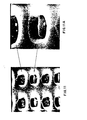
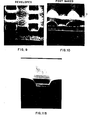
- the rectangular configurations of the vias in a test site is shown in Fig. 9.
- the units are then subjected to a controlled post-bake, which can be effected at l25°C+3° for about 40 minutes in a suitable oven suitably heated to temperature at a thermal rise time of about 2 to about 10°C per minute.
- the units can be post-baked in three steps: for 20 minutes at 85+5°C (hot plate); for 20 minutes at 115+5°C (oven/air ambient); and for 20 minutes at 145+5°C (oven/air).
- This post baking enables controlled flow of the image resist to transform the rectangular image via openings (Fig. 9) to properly tapered and rounded configurations as shown in Fig. 10.
- the portion of the resist underlayer 10 are then RIE etched in a suitable ambient e.g. CF 4 +0 2 forming a via opening 14 (Fig. 5) to expose corresponding portions of the quartz layer 4, which is also RIE etched in a suitable ambient, e.g. CF 4 +0 2 to open the via hole 15 over the conductor stripe 7 as shown in Figs. 6 and 11 to 11B.
- a suitable ambient e.g. CF 4 +0 2
- the remaining portions of the image resist layer 11 and the underlayer 10 are then stripped in any suitable manner, as by RF ashing in 1.333 mbar 5 ccm 0 2/ min flow at 250 watts for 35 minutes.
- the stripped unit is then cleaned in chromic/nitric acid solution for 5 minutes at room temperature, DI-H 2 0 rinsed and N 2 blown dry to provide the structure of Fig. 7.
- a second level of metallization 16 is then deposited with a via connection 17, in the via hole 15, to interconnect with the first level of metallization as presented by the conductor stripe 7.
- the deposition of the second level metallization 16/17 can be accomplished either by lift-off processes or by blanket coating followed by substractive etching.
Landscapes
- Physics & Mathematics (AREA)
- General Physics & Mathematics (AREA)
- Engineering & Computer Science (AREA)
- Architecture (AREA)
- Structural Engineering (AREA)
- Photosensitive Polymer And Photoresist Processing (AREA)
- Electron Beam Exposure (AREA)
- Exposure Of Semiconductors, Excluding Electron Or Ion Beam Exposure (AREA)
- Exposure And Positioning Against Photoresist Photosensitive Materials (AREA)
Applications Claiming Priority (2)
| Application Number | Priority Date | Filing Date | Title |
|---|---|---|---|
| US283695 | 1981-07-15 | ||
| US06/283,695 US4409319A (en) | 1981-07-15 | 1981-07-15 | Electron beam exposed positive resist mask process |
Publications (3)
| Publication Number | Publication Date |
|---|---|
| EP0069854A2 true EP0069854A2 (de) | 1983-01-19 |
| EP0069854A3 EP0069854A3 (en) | 1983-06-22 |
| EP0069854B1 EP0069854B1 (de) | 1985-10-23 |
Family
ID=23087160
Family Applications (1)
| Application Number | Title | Priority Date | Filing Date |
|---|---|---|---|
| EP82104711A Expired EP0069854B1 (de) | 1981-07-15 | 1982-05-28 | Verfahren zur Herstellung von Löchern in isolierenden Schichten |
Country Status (6)
| Country | Link |
|---|---|
| US (1) | US4409319A (de) |
| EP (1) | EP0069854B1 (de) |
| JP (1) | JPS5844720A (de) |
| CA (1) | CA1173689A (de) |
| DE (1) | DE3267000D1 (de) |
| ES (1) | ES8308155A1 (de) |
Cited By (2)
| Publication number | Priority date | Publication date | Assignee | Title |
|---|---|---|---|---|
| EP0134453A3 (en) * | 1983-07-08 | 1985-07-24 | International Business Machines Corporation | Method for exposure dose calculation of photolithography projection printers |
| GB2228582A (en) * | 1989-02-23 | 1990-08-29 | Mitsubishi Electric Corp | Method for producing patterns in silicone ladder type resin |
Families Citing this family (31)
| Publication number | Priority date | Publication date | Assignee | Title |
|---|---|---|---|---|
| GB2137808A (en) * | 1983-04-06 | 1984-10-10 | Plessey Co Plc | Integrated circuit processing method |
| JPS60114575A (ja) * | 1983-11-28 | 1985-06-21 | Tokyo Ohka Kogyo Co Ltd | 乾式パタ−ン形成方法 |
| US4560436A (en) * | 1984-07-02 | 1985-12-24 | Motorola, Inc. | Process for etching tapered polyimide vias |
| JPS6148883A (ja) * | 1984-08-16 | 1986-03-10 | Toppan Printing Co Ltd | フオトレジストを用いたレインボウホログラムの製造方法 |
| US4592132A (en) * | 1984-12-07 | 1986-06-03 | Hughes Aircraft Company | Process for fabricating multi-level-metal integrated circuits at high yields |
| JP2517707B2 (ja) * | 1985-03-04 | 1996-07-24 | ソニー株式会社 | フオトレジストパタ−ンの形成方法 |
| US4671849A (en) * | 1985-05-06 | 1987-06-09 | International Business Machines Corporation | Method for control of etch profile |
| US4827867A (en) * | 1985-11-28 | 1989-05-09 | Daikin Industries, Ltd. | Resist developing apparatus |
| US4762805A (en) * | 1985-12-17 | 1988-08-09 | Advanced Micro Devices, Inc. | Nitride-less process for VLSI circuit device isolation |
| US4863827A (en) * | 1986-10-20 | 1989-09-05 | American Hoechst Corporation | Postive working multi-level photoresist |
| US4822755A (en) * | 1988-04-25 | 1989-04-18 | Xerox Corporation | Method of fabricating large area semiconductor arrays |
| US5103557A (en) * | 1988-05-16 | 1992-04-14 | Leedy Glenn J | Making and testing an integrated circuit using high density probe points |
| US6288561B1 (en) * | 1988-05-16 | 2001-09-11 | Elm Technology Corporation | Method and apparatus for probing, testing, burn-in, repairing and programming of integrated circuits in a closed environment using a single apparatus |
| US5225771A (en) * | 1988-05-16 | 1993-07-06 | Dri Technology Corp. | Making and testing an integrated circuit using high density probe points |
| US5068959A (en) * | 1988-07-11 | 1991-12-03 | Digital Equipment Corporation | Method of manufacturing a thin film head |
| US5483104A (en) * | 1990-01-12 | 1996-01-09 | Paradigm Technology, Inc. | Self-aligning contact and interconnect structure |
| US5166771A (en) * | 1990-01-12 | 1992-11-24 | Paradigm Technology, Inc. | Self-aligning contact and interconnect structure |
| US5174857A (en) * | 1990-10-29 | 1992-12-29 | Gold Star Co., Ltd. | Slope etching process |
| US5296333A (en) * | 1990-11-16 | 1994-03-22 | Raytheon Company | Photoresist adhesion promoter |
| US5935734A (en) * | 1997-03-03 | 1999-08-10 | Micron Technology, Inc. | Method for fabrication of and apparatus for use as a semiconductor photomask |
| JPH11289103A (ja) * | 1998-02-05 | 1999-10-19 | Canon Inc | 半導体装置および太陽電池モジュ―ル及びその解体方法 |
| US6606533B1 (en) | 2000-10-12 | 2003-08-12 | International Business Machines Corporation | Method and arrangement for controlling image size of integrated circuits on wafers through post-exposure bake hotplate-specific dose feedback |
| AUPR451601A0 (en) * | 2001-04-20 | 2001-05-24 | Fawcett, Alan John | Method and apparatus for the hardening of photopolymer plates |
| JP2002353195A (ja) * | 2001-05-23 | 2002-12-06 | Sony Corp | 半導体装置の製造方法 |
| EP1273973A1 (de) * | 2001-07-03 | 2003-01-08 | Infineon Technologies SC300 GmbH & Co. KG | Methode zur Anpassung der Temperatur in einem Photoresistverfahren |
| JP4876341B2 (ja) * | 2001-07-13 | 2012-02-15 | 日本電気株式会社 | アクティブマトリクス基板及びその製造方法 |
| GB2387026A (en) * | 2002-03-28 | 2003-10-01 | Zarlink Semiconductor Ltd | Method of coating contact holes in MEMS and micro-machining applications |
| JP2005196130A (ja) * | 2003-12-12 | 2005-07-21 | Hitachi Cable Ltd | 感光性ポリイミド樹脂組成物、それを用いた絶縁膜、絶縁膜の製造方法および絶縁膜を使用した電子部品 |
| CN100370580C (zh) * | 2004-03-29 | 2008-02-20 | 雅马哈株式会社 | 半导体晶片及其制造方法 |
| DE102004052611A1 (de) * | 2004-10-29 | 2006-05-04 | Infineon Technologies Ag | Verfahren zur Herstellung einer mit einem Füllmaterial mindestens teilweise gefüllten Öffnung, Verfahren zur Herstellung einer Speicherzelle und Speicherzelle |
| US7973413B2 (en) * | 2007-08-24 | 2011-07-05 | Taiwan Semiconductor Manufacturing Company, Ltd. | Through-substrate via for semiconductor device |
Family Cites Families (11)
| Publication number | Priority date | Publication date | Assignee | Title |
|---|---|---|---|---|
| US3549368A (en) * | 1968-07-02 | 1970-12-22 | Ibm | Process for improving photoresist adhesion |
| US3751248A (en) * | 1971-12-27 | 1973-08-07 | Bell Telephone Labor Inc | Method of selective multilayered etching |
| US3852771A (en) * | 1973-02-12 | 1974-12-03 | Rca Corp | Electron beam recording process |
| JPS49116976A (de) * | 1973-03-09 | 1974-11-08 | ||
| US3961101A (en) * | 1974-09-16 | 1976-06-01 | Rca Corporation | Process for improved development of electron-beam-sensitive resist films |
| DE2447225C2 (de) * | 1974-10-03 | 1983-12-22 | Ibm Deutschland Gmbh, 7000 Stuttgart | Verfahren zum Ablösen von positiven Photolack |
| JPS5261482A (en) * | 1975-11-17 | 1977-05-20 | Mitsubishi Electric Corp | Photo etching |
| JPS6026294B2 (ja) * | 1977-09-26 | 1985-06-22 | 株式会社日立製作所 | フオトエツチング方法 |
| US4212935A (en) * | 1978-02-24 | 1980-07-15 | International Business Machines Corporation | Method of modifying the development profile of photoresists |
| US4184909A (en) * | 1978-08-21 | 1980-01-22 | International Business Machines Corporation | Method of forming thin film interconnection systems |
| JPS5626434A (en) * | 1979-08-10 | 1981-03-14 | Oki Electric Ind Co Ltd | Forming method for pattern of semiconductor substrate |
-
1981
- 1981-07-15 US US06/283,695 patent/US4409319A/en not_active Expired - Lifetime
-
1982
- 1982-05-28 CA CA000404032A patent/CA1173689A/en not_active Expired
- 1982-05-28 EP EP82104711A patent/EP0069854B1/de not_active Expired
- 1982-05-28 DE DE8282104711T patent/DE3267000D1/de not_active Expired
- 1982-06-14 ES ES513051A patent/ES8308155A1/es not_active Expired
- 1982-06-18 JP JP57104025A patent/JPS5844720A/ja active Granted
Non-Patent Citations (6)
| Title |
|---|
| IBM JOUNRAL OF RESEARCH AND DEVELOPMENT, vol. 21, no. 3, May 1977, pages 210-218, New York (USA); F.H. DILL et al. "Thermal effects on the photoresist AZ135OJ" * |
| IBM JOURNAL OF RESEARCH AND DEVELOPMENT, vol. 21, no. 3, May 1977, pages 210-218, New York (USA); F.H. DILL et al.: "Thermal effects on the photoresist AZ1350J" * |
| IBM TECHNICAL DISCLOSURE BULLETIN, vol. 16, no. 1, June 1973, page 47, New York (USA); H. G. BICKFORD et al. "Blocking process for photoresist" * |
| IBM TECHNICAL DISCLOSURE BULLETIN, vol. 23, no. 7A, December 1980, page 2767, New York (USA); W.T. BABIE et al. "End-point detection of resist development fiducial dosage adjustment" * |
| J. ELECTROCHEM. SOC.: SOLID-STATE SCIENCE AND TECHNOLOGY, vol. 126, no. 11, November 1979, pages 2026-2031, Princeton N.Y. (USA); J.M. SHAW et al. "Developer temperature effects on E-beam and optically exposed positive photoresist" * |
| PHOTOGRAPHIC SCIENCE AND ENGINEERING, vol. 21, no. 5, September-October 1977, pages 290-292, Washington D.C. (USA); K. JINNO et al. "Baking characteristics of positive photoresist" * |
Cited By (4)
| Publication number | Priority date | Publication date | Assignee | Title |
|---|---|---|---|---|
| EP0134453A3 (en) * | 1983-07-08 | 1985-07-24 | International Business Machines Corporation | Method for exposure dose calculation of photolithography projection printers |
| GB2228582A (en) * | 1989-02-23 | 1990-08-29 | Mitsubishi Electric Corp | Method for producing patterns in silicone ladder type resin |
| US5087553A (en) * | 1989-02-23 | 1992-02-11 | Mitsubishi Denki Kabushiki Kaisha | Method for transferring patterns on silicone ladder type resin and etching solution used in such method |
| GB2228582B (en) * | 1989-02-23 | 1993-06-16 | Mitsubishi Electric Corp | Methods of producing patterns in silicone ladder resins |
Also Published As
| Publication number | Publication date |
|---|---|
| ES513051A0 (es) | 1983-08-01 |
| ES8308155A1 (es) | 1983-08-01 |
| DE3267000D1 (en) | 1985-11-28 |
| JPS6357941B2 (de) | 1988-11-14 |
| EP0069854A3 (en) | 1983-06-22 |
| EP0069854B1 (de) | 1985-10-23 |
| CA1173689A (en) | 1984-09-04 |
| JPS5844720A (ja) | 1983-03-15 |
| US4409319A (en) | 1983-10-11 |
Similar Documents
| Publication | Publication Date | Title |
|---|---|---|
| EP0069854B1 (de) | Verfahren zur Herstellung von Löchern in isolierenden Schichten | |
| US5240878A (en) | Method for forming patterned films on a substrate | |
| US5250375A (en) | Photostructuring process | |
| US4997746A (en) | Method of forming conductive lines and studs | |
| US5334487A (en) | Method for forming a patterned layer on a substrate | |
| US5127989A (en) | Method of forming a thin film pattern with a trapezoidal cross section | |
| EP0072933B1 (de) | Verfahren zur photolithographischen Mustererzeugung in einer Photolackschicht | |
| US4532005A (en) | Device lithography using multi-level resist systems | |
| US6340635B1 (en) | Resist pattern, process for the formation of the same, and process for the formation of wiring pattern | |
| EP0021719B1 (de) | Verfahren zur Herstellung negativer Resistbilder und Resistbilder | |
| US5326670A (en) | Process for forming resist pattern | |
| EP0349411A2 (de) | Gegen Sauerstoffplasma widerstandsfähige Photolacke | |
| JP2901044B2 (ja) | 三層レジスト法によるパターン形成方法 | |
| EP0199303B1 (de) | Photolackbildherstellungsverfahren | |
| US5114827A (en) | Photoresists resistant to oxygen plasmas | |
| US6866988B2 (en) | Methods for measuring photoresist dimensions | |
| JPH0795509B2 (ja) | レジストパタ−ンの形成方法 | |
| JPH06110214A (ja) | レジストパターンの形成方法 | |
| US3669669A (en) | Cyclic polyisoprene photoresist compositions | |
| JPH0580492A (ja) | 位相シフト層を有するフオトマスクの製造方法 | |
| JPS62138843A (ja) | 複合レジスト構造体 | |
| JPH02156244A (ja) | パターン形成方法 | |
| Pavelchek et al. | Processing techniques for improving performance of positive-tone silylation | |
| JPH042183B2 (de) | ||
| Neisius et al. | Properties of a high resolution negative photoresist |
Legal Events
| Date | Code | Title | Description |
|---|---|---|---|
| PUAI | Public reference made under article 153(3) epc to a published international application that has entered the european phase |
Free format text: ORIGINAL CODE: 0009012 |
|
| AK | Designated contracting states |
Designated state(s): BE CH DE FR GB IT LI NL SE |
|
| PUAL | Search report despatched |
Free format text: ORIGINAL CODE: 0009013 |
|
| AK | Designated contracting states |
Designated state(s): BE CH DE FR GB IT LI NL SE |
|
| 17P | Request for examination filed |
Effective date: 19830519 |
|
| GRAA | (expected) grant |
Free format text: ORIGINAL CODE: 0009210 |
|
| AK | Designated contracting states |
Designated state(s): BE CH DE FR GB IT LI NL SE |
|
| PG25 | Lapsed in a contracting state [announced via postgrant information from national office to epo] |
Ref country code: NL Effective date: 19851023 Ref country code: BE Effective date: 19851023 |
|
| PG25 | Lapsed in a contracting state [announced via postgrant information from national office to epo] |
Ref country code: SE Effective date: 19851030 |
|
| REF | Corresponds to: |
Ref document number: 3267000 Country of ref document: DE Date of ref document: 19851128 |
|
| ITF | It: translation for a ep patent filed | ||
| ET | Fr: translation filed | ||
| NLV1 | Nl: lapsed or annulled due to failure to fulfill the requirements of art. 29p and 29m of the patents act | ||
| PG25 | Lapsed in a contracting state [announced via postgrant information from national office to epo] |
Ref country code: LI Effective date: 19860531 Ref country code: CH Effective date: 19860531 |
|
| PLBE | No opposition filed within time limit |
Free format text: ORIGINAL CODE: 0009261 |
|
| STAA | Information on the status of an ep patent application or granted ep patent |
Free format text: STATUS: NO OPPOSITION FILED WITHIN TIME LIMIT |
|
| 26N | No opposition filed | ||
| REG | Reference to a national code |
Ref country code: CH Ref legal event code: PL |
|
| ITTA | It: last paid annual fee | ||
| PGFP | Annual fee paid to national office [announced via postgrant information from national office to epo] |
Ref country code: GB Payment date: 19920409 Year of fee payment: 11 |
|
| PGFP | Annual fee paid to national office [announced via postgrant information from national office to epo] |
Ref country code: FR Payment date: 19920427 Year of fee payment: 11 |
|
| PGFP | Annual fee paid to national office [announced via postgrant information from national office to epo] |
Ref country code: DE Payment date: 19920523 Year of fee payment: 11 |
|
| PG25 | Lapsed in a contracting state [announced via postgrant information from national office to epo] |
Ref country code: GB Effective date: 19930528 |
|
| GBPC | Gb: european patent ceased through non-payment of renewal fee |
Effective date: 19930528 |
|
| PG25 | Lapsed in a contracting state [announced via postgrant information from national office to epo] |
Ref country code: FR Effective date: 19940131 |
|
| PG25 | Lapsed in a contracting state [announced via postgrant information from national office to epo] |
Ref country code: DE Effective date: 19940201 |
|
| REG | Reference to a national code |
Ref country code: FR Ref legal event code: ST |