EP0072263A2 - Verfahren und Vorrichtung zum Behandeln und Konservieren von Produkten wie Pilzen - Google Patents
Verfahren und Vorrichtung zum Behandeln und Konservieren von Produkten wie Pilzen Download PDFInfo
- Publication number
- EP0072263A2 EP0072263A2 EP82401052A EP82401052A EP0072263A2 EP 0072263 A2 EP0072263 A2 EP 0072263A2 EP 82401052 A EP82401052 A EP 82401052A EP 82401052 A EP82401052 A EP 82401052A EP 0072263 A2 EP0072263 A2 EP 0072263A2
- Authority
- EP
- European Patent Office
- Prior art keywords
- mushrooms
- vacuum
- enclosure
- liquid
- impregnation
- Prior art date
- Legal status (The legal status is an assumption and is not a legal conclusion. Google has not performed a legal analysis and makes no representation as to the accuracy of the status listed.)
- Ceased
Links
- 235000001674 Agaricus brunnescens Nutrition 0.000 title claims abstract description 50
- 238000000034 method Methods 0.000 title claims abstract description 27
- 238000004321 preservation Methods 0.000 title claims abstract 4
- 239000007788 liquid Substances 0.000 claims abstract description 52
- 238000005470 impregnation Methods 0.000 claims abstract description 31
- 239000000126 substance Substances 0.000 claims abstract description 6
- 238000011049 filling Methods 0.000 claims abstract description 4
- 206010033546 Pallor Diseases 0.000 claims abstract description 3
- 238000009434 installation Methods 0.000 claims description 12
- 238000013022 venting Methods 0.000 claims description 7
- 230000001112 coagulating effect Effects 0.000 claims description 5
- 230000000694 effects Effects 0.000 claims description 5
- 238000012423 maintenance Methods 0.000 claims description 4
- 239000011148 porous material Substances 0.000 claims description 3
- 235000013305 food Nutrition 0.000 claims description 2
- 238000003860 storage Methods 0.000 claims description 2
- 101100389815 Caenorhabditis elegans eva-1 gene Proteins 0.000 claims 1
- 238000009835 boiling Methods 0.000 description 8
- 238000004061 bleaching Methods 0.000 description 6
- XLYOFNOQVPJJNP-UHFFFAOYSA-N water Substances O XLYOFNOQVPJJNP-UHFFFAOYSA-N 0.000 description 6
- QCVGEOXPDFCNHA-UHFFFAOYSA-N 5,5-dimethyl-2,4-dioxo-1,3-oxazolidine-3-carboxamide Chemical compound CC1(C)OC(=O)N(C(N)=O)C1=O QCVGEOXPDFCNHA-UHFFFAOYSA-N 0.000 description 4
- 102000002322 Egg Proteins Human genes 0.000 description 4
- 108010000912 Egg Proteins Proteins 0.000 description 4
- 235000014103 egg white Nutrition 0.000 description 4
- 210000000969 egg white Anatomy 0.000 description 4
- 102000009027 Albumins Human genes 0.000 description 3
- 108010088751 Albumins Proteins 0.000 description 3
- 241000233866 Fungi Species 0.000 description 3
- 125000004122 cyclic group Chemical group 0.000 description 3
- 238000010438 heat treatment Methods 0.000 description 3
- 238000009928 pasteurization Methods 0.000 description 3
- 239000000047 product Substances 0.000 description 3
- 238000005406 washing Methods 0.000 description 3
- 230000015271 coagulation Effects 0.000 description 2
- 238000005345 coagulation Methods 0.000 description 2
- 238000011161 development Methods 0.000 description 2
- 239000006260 foam Substances 0.000 description 2
- 235000011389 fruit/vegetable juice Nutrition 0.000 description 2
- 239000007789 gas Substances 0.000 description 2
- 238000011068 loading method Methods 0.000 description 2
- 238000002156 mixing Methods 0.000 description 2
- 238000012545 processing Methods 0.000 description 2
- 238000012546 transfer Methods 0.000 description 2
- 230000004584 weight gain Effects 0.000 description 2
- 235000019786 weight gain Nutrition 0.000 description 2
- 241000222519 Agaricus bisporus Species 0.000 description 1
- 102000013142 Amylases Human genes 0.000 description 1
- 108010065511 Amylases Proteins 0.000 description 1
- 241000894006 Bacteria Species 0.000 description 1
- 206010016807 Fluid retention Diseases 0.000 description 1
- 235000019568 aromas Nutrition 0.000 description 1
- 230000033228 biological regulation Effects 0.000 description 1
- 238000009937 brining Methods 0.000 description 1
- 238000009833 condensation Methods 0.000 description 1
- 230000005494 condensation Effects 0.000 description 1
- 239000000470 constituent Substances 0.000 description 1
- 238000001816 cooling Methods 0.000 description 1
- 230000008878 coupling Effects 0.000 description 1
- 238000010168 coupling process Methods 0.000 description 1
- 238000005859 coupling reaction Methods 0.000 description 1
- 230000006378 damage Effects 0.000 description 1
- 230000007423 decrease Effects 0.000 description 1
- 238000010586 diagram Methods 0.000 description 1
- 238000001704 evaporation Methods 0.000 description 1
- 230000008020 evaporation Effects 0.000 description 1
- 239000012467 final product Substances 0.000 description 1
- 235000000396 iron Nutrition 0.000 description 1
- 238000004519 manufacturing process Methods 0.000 description 1
- 239000002184 metal Substances 0.000 description 1
- 239000000203 mixture Substances 0.000 description 1
- 210000000056 organ Anatomy 0.000 description 1
- 230000001590 oxidative effect Effects 0.000 description 1
- 230000000149 penetrating effect Effects 0.000 description 1
- 239000002304 perfume Substances 0.000 description 1
- 238000002360 preparation method Methods 0.000 description 1
- 230000001105 regulatory effect Effects 0.000 description 1
- 230000001954 sterilising effect Effects 0.000 description 1
- 238000004659 sterilization and disinfection Methods 0.000 description 1
Images



Classifications
-
- A—HUMAN NECESSITIES
- A23—FOODS OR FOODSTUFFS; TREATMENT THEREOF, NOT COVERED BY OTHER CLASSES
- A23B—PRESERVATION OF FOODS, FOODSTUFFS OR NON-ALCOHOLIC BEVERAGES; CHEMICAL RIPENING OF FRUIT OR VEGETABLES
- A23B7/00—Preservation of fruit or vegetables; Chemical ripening of fruit or vegetables
- A23B7/14—Preserving or ripening with chemicals not covered by group A23B7/08 or A23B7/10
- A23B7/153—Preserving or ripening with chemicals not covered by group A23B7/08 or A23B7/10 in the form of liquids or solids
- A23B7/158—Apparatus for preserving using liquids
-
- A—HUMAN NECESSITIES
- A23—FOODS OR FOODSTUFFS; TREATMENT THEREOF, NOT COVERED BY OTHER CLASSES
- A23B—PRESERVATION OF FOODS, FOODSTUFFS OR NON-ALCOHOLIC BEVERAGES; CHEMICAL RIPENING OF FRUIT OR VEGETABLES
- A23B2/00—Preservation of foods or foodstuffs, in general
- A23B2/10—Preservation of foods or foodstuffs, in general by treatment with pressure variation, shock, acceleration or shear stress
- A23B2/103—Preservation of foods or foodstuffs, in general by treatment with pressure variation, shock, acceleration or shear stress using sub- or super-atmospheric pressures, or pressure variations transmitted by a liquid or gas
-
- A—HUMAN NECESSITIES
- A23—FOODS OR FOODSTUFFS; TREATMENT THEREOF, NOT COVERED BY OTHER CLASSES
- A23B—PRESERVATION OF FOODS, FOODSTUFFS OR NON-ALCOHOLIC BEVERAGES; CHEMICAL RIPENING OF FRUIT OR VEGETABLES
- A23B7/00—Preservation of fruit or vegetables; Chemical ripening of fruit or vegetables
- A23B7/06—Blanching
-
- A—HUMAN NECESSITIES
- A23—FOODS OR FOODSTUFFS; TREATMENT THEREOF, NOT COVERED BY OTHER CLASSES
- A23B—PRESERVATION OF FOODS, FOODSTUFFS OR NON-ALCOHOLIC BEVERAGES; CHEMICAL RIPENING OF FRUIT OR VEGETABLES
- A23B7/00—Preservation of fruit or vegetables; Chemical ripening of fruit or vegetables
- A23B7/14—Preserving or ripening with chemicals not covered by group A23B7/08 or A23B7/10
- A23B7/153—Preserving or ripening with chemicals not covered by group A23B7/08 or A23B7/10 in the form of liquids or solids
- A23B7/154—Organic compounds; Microorganisms; Enzymes
Definitions
- the present invention relates to methods of treating and preserving perishable foodstuffs having voids or pores, such as mushrooms, especially mushrooms or button mushrooms, of the type consisting in impregnating the mushrooms with a treatment liquid containing a substance food capable of coagulating with heat, with prior or simultaneous vacuuming, then subjecting them to bleaching, then filling with these impregnated and bleached mushrooms a conservation capacity which is closed, and finally to subject them to a conservation treatment, for example thermal.
- the impregnation makes it possible to increase the weight of the mushrooms and above all, under the effect of coagulation due to the heat treatment which follows, to close their pores and to store all the constituents there.
- Vacuuming evacuates at least part of the air or other gas contained in the voids and therefore promotes impregnation with said liquid.
- the coagulating substance used is advantageously egg white, fresh or powdered, -mixed with a carrier liquid such as water or mushroom juice.
- Bleaching destroys oxidative diastases and prevents color changes during storage.
- Heat treatment (sterilization, pasteurization or brining) allows the development or destruction of the ferments or spores to be stopped.
- the coagulation of the coagulating substance first of all to partially eliminate the loss of volume or weight which usually results from bleaching, moreover to preserve the aromas, perfumes and juices contained in the mushrooms, and therefore their taste, and finally to avoid darkening after opening the preserves.
- the weight gain after treatment can be of the order of 15% for these known methods.
- the yield corresponding to the gain in weight of the final product obtained relative to the initial weight, varied from 10 to 15 points at most.
- the point is defined from the gross product which represents 100 points; the hulled product to be treated according to the process corresponds to 80 points and the nested product (drained in the box) obtained by the previous processes without impregnation corresponds to. 55 points approximately, value which is used as reference base for the canners to calculate the yield.
- the impregnation processes mentioned above which make it possible to obtain 60 to 70 points, therefore give a weight gain of 10 to 15% compared to the 55 base points.
- the aim of the present invention is to allow a significantly higher yield to be obtained, and this without this gain being accompanied by unfavorable side effects which no longer justify their interest (which was the case with previous processes for which it was not desirable to exceed a gain of 15%).
- the subject of the invention is a method of the aforementioned type, characterized in that yrimpregnation is carried out with evacuation in a minimum time period consisting of the time just necessary, for the vacuum value used, when placing an impregnation chamber containing the mushrooms under vacuum, increased by the time just necessary, for the value of vacuum used, by introducing the treatment liquid into this chamber and by the time just necessary, for the value of vacuum used, for the evacuation of the liquid which has not impregnated the mushrooms with a short intermediate period of keeping the liquid and the mushrooms in contact between this introduction and this evacuation.
- the vacuum is preferably carried out in a period of 30 to 45 seconds.
- the duration of the intermediate holding period is advantageously from 5 seconds to one minute.
- provision may be made to introduce cooled mushrooms into the impregnation chamber, for example kept cold beforehand or washed in cold water.
- the temperature of the mushrooms and the processing liquid can preferably be about 2 to 4 ° C. This arrangement prevents any further development of bacteria in the coagulating substance. It has also been found that, unexpectedly, the yield also increases notably due to the large vacuum depth used, as a result of the prior cooling of the mushrooms and of the treatment liquid.
- the depth of vacuum to be reached depends on the exact boiling temperature of the mushrooms which itself varies with the conditions of preparation of these mushrooms, or even during the periods of continuous manufacture, this temperature possibly by example vary from 2 to 4 or 5 ° C.
- This vacuum value can for example vary from 6 to 15 torr, but it is clear that if a very powerful vacuum pump is used such as a liquid ring vacuum pump equipped with an ejector, the power of this pump is such that in all cases the boiling is obtained in less than a minute, the evaporation being already clear at 20 or 30 torr and extending exponentially to the boiling point.
- the invention further relates to an installation for implementing the process under consideration, characterized in that it comprises an impregnation enclosure comprising means for introducing mushrooms, a source of treatment liquid connected to this enclosure by means of supply and return pipes, and finally vacuum means and venting means also connected to this enclosure.
- control valves can be interposed respectively on the supply and return pipes and on vacuum and air pipes.
- these valves are pneumatic valves, connected to a cyclic programmer regulating their openings and closings.
- an expansion tank on which, when provided, are also mounted underwater valves. vacuum and venting. Thanks to this expansion vessel, the foam which forms in the enclosure during the introduction of the treatment liquid and which tends to penetrate into the pump, no longer risks reducing the vacuum obtained. In fact, as soon as the enclosure is brought to atmospheric pressure, the foam is pushed back towards the liquid discharge.
- the vacuum and impregnation apparatus 2 comprises two impregnation chambers 9a and 9b, intended to operate alternately, and arranged on either side of a double conveyor 10a-10b for supplying and evacuation of baskets of mushrooms, the assembly being arranged above a tank of treatment liquid 11, which is itself connected by a supply pipe 11a to two tank-mixers 12 of treatment liquid (supplied by a pump and an exchanger which cools the water intended for the mixture), while a vacuum pump 13 provided with its drive motor group 13a is schematically represented connected to the two enclosures 9a and 9b.
- the mixing tanks 12 are intended to contain a treatment liquid consisting of a solution of cooled water and of albumin and more particularly of egg white, in a proportion of 4 to 11% of dry extract, this solution being kept cold, ie at a temperature which can vary for example from 2 to 4 ° C.
- the vacuum and impregnation assembly proper is mounted on an infrastructure 14 at three levels. At the lower level is placed the treatment liquid tank 11, inside which two pairs of pipes, respectively supply 15 and return 16, plunge, each pair of pipes also penetrating into the bottom of the containments. impregnation 9a and 9b. Regulation, supply 15a and return 16a valves respectively are interposed on these same pipes.
- the feed conveyor 10a and the discharge conveyor 10b On the intermediate level of the infrastructure 14, are located in the middle part, and one above the other, the feed conveyor 10a and the discharge conveyor 10b, these conveyors being of the rollers and allowing the transfer of metal baskets 17, intended to contain the dressed mushrooms to be treated (hulled), these baskets being dimensioned so as to be able to be introduced inside the enclosures 9a or 9b.
- enclosures 9a and 9b are arranged at the intermediate level, on either side of the conveyors and they more particularly have a structure which will be described below.
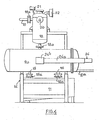
- two expansion vessels 18 are supported, each of which is arranged above one of the chambers 9a and 9b and connected to the latter by flanged couplings 18a.
- each basket 17 can contain ten kilos of trimmed mushrooms and each enclosure 9a, 9b, which has a generally cylindrical shape, is internally provided with slides for receiving these baskets, and is itself dimensioned so as to receive four of these baskets, or forty kilos.
- the total interior volume of an enclosure is large enough so that, when such an enclosure is partially filled with processing liquid ment, the volume of this liquid is for example of the order of two hundred and forty liters. This volume is largely sufficient to allow the envisaged impregnation, since commonly, depending on the operating-envisaged process, the forty kilos of mushrooms contained in an enclosure can absorb twenty to thirty-two liters of treatment liquid.
- the full baskets 17 are brought by the lower conveyor 10a, located exactly at the level of the enclosures 9a and 9b, from the initial washing station 1. These baskets are introduced alternately into one and the other of the enclosures by a single and same operator, and this in a manner which will be described later, the baskets containing the mushrooms treated during the previous phase and which are removed alternately from each enclosure being immediately transported to the bleaching apparatus 3. The baskets thus emptied of their mushrooms at the entrance to this apparatus, are returned using the upper conveyor 10b to the mushroom feed which constitutes the washing station 1.
- each of the expansion vessels 18, the volume of which is for example of the order of magnitude of the seventh of that of an impregnation chamber, is equipped on the one hand with a vacuum piping 19, connected to the vacuum pump 13a, and on the other hand of a venting pipe 20, respectively of the vacuum valves 19a and of the venting 20a being interposed on these pipes. It is also provided for each impregnation enclosure 9a, 9b, a pressure switch 21 and a vacuum meter.
- each impregnation enclosure for example 9a, is constituted by a vacuum-resistant body of cylindrical shape, with a horizontal axis, one of the bottoms of which is closed, while the other is closed by a movable cover 23.
- the latter is carried, by means of an opening-closing cylinder 23a, by the base of a U-shaped support 24, consisting of rigid irons and the two side members 24a of which are provided with counterweights.
- 24b are normally oriented in the horizontal plane containing the axis of the cylinder, by being pivotally mounted about a horizontal axis perpendicular to the axis of the cylinder, on pins 25 fixed on either side of the enclosure.
- a tilting cylinder 26 is also fixed on one of the sides of the enclosure, so as to attack one of the free ends of the wings 24a which extend beyond the bearings 25.
- the actuation of the latter cylinder allows the support 24 and the cover 23 to be raised upwards, in the position shown in phantom in FIG. 5 in which this cover completely clears the entrance to the enclosure 9a.
- the apparatus is completed by a cyclic programmer not shown, to which are connected the valves for supplying treatment liquid 15a, the valves for return of treatment liquid 16a, the vacuum valves 19a, the setting valves. atmosphere 20a and the opening-closing cylinders of the cover 23a and 26.
- vacuum pump 13a is constituted by a liquid ring pump provided with an ejector.
- the cyclic programmer is arranged so as to allow the following continuous and regular operation of the apparatus:
- the programmer first actuates successively the jacks 23a and 26 which release the cover 23 of enclosure 9a, then tilt it upwards (Fig. 5). The operator can then evacuate the baskets 17 contained in the enclosure (9a, for example) and transfer them to the bleaching station 3, then introduce into this same enclosure other baskets 17 brought by the conveyor 10a. All of these unloading and loading operations being carried out after a period of, for example, 30 seconds, the programmer again actuates the jacks 26 and 23a in the opposite direction, causing the enclosure to be closed.
- the programmer then actuates the opening of the vacuum valve 19a associated with the enclosure considered, which allows the pump 13a to very quickly bring the interior volume of the enclosure under a vacuum which descends extremely rapidly at 100 torrs in 5 seconds, then at 6 torrs in 25 to 40 seconds.
- the pressure switch 21 controls the opening of the associated supply valve 15a, which allows, thanks to the vacuum existing in the enclosure, a rise by suction of the liquid of treatment contained in the tank 11, until it covers the mushrooms contained in the baskets, up to a few centimeters above the grids covering the latter.
- the programmer then triggers the closing of the vacuum mi.se valve 19a.
- the vacuum continued to develop inside the enclosure by condensation of the condensable gases.
- the programmer Simultaneously with the closing of the vacuum valve 19a, the programmer also automatically closes the liquid supply valve 15a. After a period of keeping the mushrooms in contact with the liquid of the order of 45 seconds, obtained using the programmer, the latter then causes the opening of the venting valve 20a, which breaks the emptiness of the enclosure. During this period of maintenance, as well as during the period of rise of the liquid which preceded, this liquid permeated the bodies of the mushrooms, its level falling by a few centimeters at the end of the period of maintenance.
- the programmer controls the opening of the associated return valve 16a which then allows the descent of the remaining liquid to the tank 11.
- the duration of all of these automatic operations, from the evacuation to the end of the descent of the liquid, is for example approximately 160 seconds, so that, including loading and unloading, the duration of an entire operating cycle is around 190 seconds.
- the other impregnation enclosure 9b and all of the organs associated with it, are subjected to a similar operating cycle which, by means of the programmer, is shifted by half a cycle so as to allow work alternated by the operator to discharge and charge each of the enclosures.
Landscapes
- Life Sciences & Earth Sciences (AREA)
- Engineering & Computer Science (AREA)
- Chemical & Material Sciences (AREA)
- Wood Science & Technology (AREA)
- Zoology (AREA)
- Food Science & Technology (AREA)
- Polymers & Plastics (AREA)
- Chemical Kinetics & Catalysis (AREA)
- General Chemical & Material Sciences (AREA)
- Microbiology (AREA)
- Preparation Of Fruits And Vegetables (AREA)
- Storage Of Fruits Or Vegetables (AREA)
Applications Claiming Priority (2)
| Application Number | Priority Date | Filing Date | Title |
|---|---|---|---|
| FR8115400 | 1981-08-07 | ||
| FR8115400A FR2510872A1 (fr) | 1981-08-07 | 1981-08-07 | Procede et installation de traitement et de conservation de denrees telles que les champignons |
Publications (2)
| Publication Number | Publication Date |
|---|---|
| EP0072263A2 true EP0072263A2 (de) | 1983-02-16 |
| EP0072263A3 EP0072263A3 (de) | 1985-05-22 |
Family
ID=9261304
Family Applications (1)
| Application Number | Title | Priority Date | Filing Date |
|---|---|---|---|
| EP82401052A Ceased EP0072263A3 (de) | 1981-08-07 | 1982-06-10 | Verfahren und Vorrichtung zum Behandeln und Konservieren von Produkten wie Pilzen |
Country Status (4)
| Country | Link |
|---|---|
| EP (1) | EP0072263A3 (de) |
| AU (1) | AU562241B2 (de) |
| CA (1) | CA1193897A (de) |
| FR (1) | FR2510872A1 (de) |
Cited By (5)
| Publication number | Priority date | Publication date | Assignee | Title |
|---|---|---|---|---|
| FR2578395A1 (fr) * | 1985-03-06 | 1986-09-12 | Sica Val Du Cher | Procede de traitement en vue de leur conservation de denrees perissables presentant des vides ou des pores tels que les champignons |
| US5080918A (en) * | 1989-03-21 | 1992-01-14 | Le Champignon, Inc. | Method of processing mushrooms using starch, gum, protein and water |
| FR2674455A1 (fr) * | 1991-03-28 | 1992-10-02 | Stork Fmn Bv | Procede et dispositif pour soumettre des particules a un traitement sous vide dans un milieu liquide. |
| EP0628253A1 (de) * | 1993-06-11 | 1994-12-14 | Dean Foods Company | Herstellungsverfahren von Pickles ohne Fermentationsstufe |
| FR3093404A1 (fr) * | 2019-03-08 | 2020-09-11 | Jean Marc Tachet Création | Procédé d’enrichissement d’aliments en protéines et/ou en compléments alimentaires |
Families Citing this family (1)
| Publication number | Priority date | Publication date | Assignee | Title |
|---|---|---|---|---|
| USD809329S1 (en) * | 2016-06-01 | 2018-02-06 | Emilio Alatorre Rodriguez | Cooking tenderizer |
Family Cites Families (9)
| Publication number | Priority date | Publication date | Assignee | Title |
|---|---|---|---|---|
| FR2176594A1 (en) * | 1972-03-24 | 1973-11-02 | Beauvais Max | Preserving mushrooms - with reduced weight loss during blanching and sterilizing |
| CA1018819A (en) * | 1973-05-03 | 1977-10-11 | Henry M. Mee | Method of processing mushrooms and product |
| FR2280328A1 (fr) * | 1974-07-29 | 1976-02-27 | Fehmerling Ass | Procede d'elimination de l'air dans les aliments sous des pressions ultra-basses |
| FR2412263A2 (fr) * | 1977-12-21 | 1979-07-20 | Bournier Edgard | Installation pour le traitement des champignons de paris appertises et des champignons ainsi traites |
| FR2421566A1 (fr) * | 1978-04-05 | 1979-11-02 | Rossignol Jean Francois | Procede de traitement de matieres alimentaires |
| FR2449406A2 (fr) * | 1979-02-21 | 1980-09-19 | Bournier Edgard | Installation pour le traitement de champignons de paris appertises et champignons ainsi traites |
| ATE11204T1 (de) * | 1979-06-06 | 1985-02-15 | Andrew M. Ferguson | Verfahren zur behandlung von pilzen. |
| US4331691A (en) * | 1980-07-10 | 1982-05-25 | Washington State University Research Foundation, Inc. | Vacuum pressure infiltration process for fresh produce |
| FR2489097A1 (fr) * | 1980-09-03 | 1982-03-05 | Beauvais Max | Procede de traitement et de conservation de denrees telles que les champignons |
-
1981
- 1981-08-07 FR FR8115400A patent/FR2510872A1/fr not_active Withdrawn
-
1982
- 1982-06-10 EP EP82401052A patent/EP0072263A3/de not_active Ceased
- 1982-07-23 AU AU86348/82A patent/AU562241B2/en not_active Expired - Fee Related
- 1982-08-06 CA CA000408953A patent/CA1193897A/en not_active Expired
Cited By (9)
| Publication number | Priority date | Publication date | Assignee | Title |
|---|---|---|---|---|
| FR2578395A1 (fr) * | 1985-03-06 | 1986-09-12 | Sica Val Du Cher | Procede de traitement en vue de leur conservation de denrees perissables presentant des vides ou des pores tels que les champignons |
| EP0197805A1 (de) * | 1985-03-06 | 1986-10-15 | Sica Val-Du-Cher | Behandlungsverfahren zur Bewahrung von leicht verderblichen Waren mit Poren und Hohlräumen, wie z.B. Pilzen |
| US5080918A (en) * | 1989-03-21 | 1992-01-14 | Le Champignon, Inc. | Method of processing mushrooms using starch, gum, protein and water |
| US5126154A (en) * | 1989-03-21 | 1992-06-30 | Le Champignon, Inc. | Method of processing mushrooms using starch, gum, protein and water |
| FR2674455A1 (fr) * | 1991-03-28 | 1992-10-02 | Stork Fmn Bv | Procede et dispositif pour soumettre des particules a un traitement sous vide dans un milieu liquide. |
| EP0628253A1 (de) * | 1993-06-11 | 1994-12-14 | Dean Foods Company | Herstellungsverfahren von Pickles ohne Fermentationsstufe |
| CN1066616C (zh) * | 1993-06-11 | 2001-06-06 | 迪安食品公司 | 一种用于腌制腌渍原料的方法 |
| FR3093404A1 (fr) * | 2019-03-08 | 2020-09-11 | Jean Marc Tachet Création | Procédé d’enrichissement d’aliments en protéines et/ou en compléments alimentaires |
| WO2020183095A1 (fr) | 2019-03-08 | 2020-09-17 | Jean Marc Tachet Création | Procédé d'enrichissement d'aliments en protéines et/ou en compléments alimentaires |
Also Published As
| Publication number | Publication date |
|---|---|
| CA1193897A (en) | 1985-09-24 |
| EP0072263A3 (de) | 1985-05-22 |
| AU8634882A (en) | 1983-04-14 |
| AU562241B2 (en) | 1987-06-04 |
| FR2510872A1 (fr) | 1983-02-11 |
Similar Documents
| Publication | Publication Date | Title |
|---|---|---|
| JP2847484B2 (ja) | フライ食品の製造装置 | |
| EP0003721A2 (de) | Verfahren und Vorrichtung zum schnellen, kontinuierlichen Blanchieren und Sterilisieren von Nahrungsmitteln in Stückform | |
| FR2512643A1 (fr) | Procede ameliore de blanchiment de champignons et autres legumes | |
| EP0140767B1 (de) | Verfahren zum Blanchieren von Pilzen und anderen Gemüsen | |
| EP3813552B1 (de) | Verfahren zur herstellung eines produkts in form von gas-enthaltendem granulat, partikeln, oder kugeln, und zugehörige anlage | |
| EP0435302A1 (de) | Verfahren und Einrichtung für teilweise oder völlige Deshydratierung von Pflanzenprodukten | |
| FR2510872A1 (fr) | Procede et installation de traitement et de conservation de denrees telles que les champignons | |
| FR2553975A1 (fr) | Preparation de produits alimentaires | |
| EP0359612B1 (de) | Verfahren und Vorrichtung zur Verminderung des Gewichtsverlustes von Gemüse, wie Pilzen, bei Sterilisierung, Gefrieren oder Pökeln | |
| FR2561620A1 (fr) | Produit alimentaire aqueux emballe sous vide profond, un procede d'obtention et un appareil pour la mise en oeuvre de ce dernier | |
| EP0413071A1 (de) | Verfahren für die Zubereitung von Früchten oder Gemüse, ganz oder in Scheiben, mit reduziertem Feuchtigkeitsgehalt | |
| BE1001206A7 (fr) | Procede de traitement de produits comestibles de la mer de type bivalves. | |
| FR2462103A1 (fr) | Procede de cuisson a la vapeur et appareillage pour sa mise en oeuvre | |
| EP0085426A1 (de) | Semi-kontinuierliches Verfahren zur Herstellung eines Nahrungsmittelgemisches und Vorrichtung zur Durchführung des Verfahrens | |
| EP2066187B1 (de) | Verfahren zur verarbeitung von fertignahrungsprodukten | |
| FR2679419A1 (fr) | Procede et installation pour la cuisson et le sechage sous-vide des legumes a branches ou des champignons. | |
| FR2735748A1 (fr) | Procede et installation de conditionnement aseptique de produits alimentaires frais dans des emballages souples ou rigides | |
| FR3048163B1 (fr) | Procede et systeme de degazage et de re-injection de fluides de produits alimentaires | |
| FR2598888A1 (fr) | Procede et dispositif pour le traitement des produits de l'oeuf et leurs composes, pour prolonger la duree de ces memes produits. | |
| EP0786950B1 (de) | Verfahren zur verminderung des gewichtsverlustes von gemüse nach der bleiche und/oder kochen | |
| FR2510873A1 (fr) | Procede de traitement et de conservation de denrees telles que les champignons et installation de mise en oeuvre d'un tel procede | |
| FR2578395A1 (fr) | Procede de traitement en vue de leur conservation de denrees perissables presentant des vides ou des pores tels que les champignons | |
| FR2687127A1 (fr) | Procede et installation de conditionnement de produits alimentaires humides. | |
| CH205513A (fr) | Procédé et appareil pour le traitement thermique de produits alimentaires ou autres, et produit obtenu. | |
| EP3501288A1 (de) | Verpackungsverfahren von rohem fisch für den transport und seine endgültige verpackung |
Legal Events
| Date | Code | Title | Description |
|---|---|---|---|
| PUAI | Public reference made under article 153(3) epc to a published international application that has entered the european phase |
Free format text: ORIGINAL CODE: 0009012 |
|
| AK | Designated contracting states |
Designated state(s): AT BE CH DE GB IT LI LU NL SE |
|
| 17P | Request for examination filed |
Effective date: 19830425 |
|
| PUAL | Search report despatched |
Free format text: ORIGINAL CODE: 0009013 |
|
| AK | Designated contracting states |
Designated state(s): AT BE CH DE GB IT LI LU NL SE |
|
| 17Q | First examination report despatched |
Effective date: 19860516 |
|
| STAA | Information on the status of an ep patent application or granted ep patent |
Free format text: STATUS: THE APPLICATION HAS BEEN REFUSED |
|
| 18R | Application refused |
Effective date: 19871115 |
|
| RIN1 | Information on inventor provided before grant (corrected) |
Inventor name: BLANCHAUD, MAURICE Inventor name: BEAUVAIS, MAX |