EP0073016A1 - Neue 1-Aryloxy-3-alkylamino-2-propanole und Verfahren zu ihrer Herstellung - Google Patents
Neue 1-Aryloxy-3-alkylamino-2-propanole und Verfahren zu ihrer Herstellung Download PDFInfo
- Publication number
- EP0073016A1 EP0073016A1 EP82107536A EP82107536A EP0073016A1 EP 0073016 A1 EP0073016 A1 EP 0073016A1 EP 82107536 A EP82107536 A EP 82107536A EP 82107536 A EP82107536 A EP 82107536A EP 0073016 A1 EP0073016 A1 EP 0073016A1
- Authority
- EP
- European Patent Office
- Prior art keywords
- general formula
- oder
- radical
- acid addition
- alkyl
- Prior art date
- Legal status (The legal status is an assumption and is not a legal conclusion. Google has not performed a legal analysis and makes no representation as to the accuracy of the status listed.)
- Granted
Links
- 238000000034 method Methods 0.000 title claims description 14
- 238000002360 preparation method Methods 0.000 title claims description 10
- 150000003839 salts Chemical class 0.000 claims abstract description 19
- 239000002253 acid Substances 0.000 claims abstract description 16
- 125000000217 alkyl group Chemical group 0.000 claims abstract description 16
- 125000003545 alkoxy group Chemical group 0.000 claims abstract description 13
- 125000005843 halogen group Chemical group 0.000 claims abstract description 11
- 125000002252 acyl group Chemical group 0.000 claims abstract description 10
- 125000003342 alkenyl group Chemical group 0.000 claims abstract description 10
- 125000004432 carbon atom Chemical group C* 0.000 claims abstract description 9
- 125000004423 acyloxy group Chemical group 0.000 claims abstract description 8
- 125000002768 hydroxyalkyl group Chemical group 0.000 claims abstract description 7
- 125000000304 alkynyl group Chemical group 0.000 claims abstract description 6
- 125000005133 alkynyloxy group Chemical group 0.000 claims abstract description 6
- UFHFLCQGNIYNRP-UHFFFAOYSA-N Hydrogen Chemical compound [H][H] UFHFLCQGNIYNRP-UHFFFAOYSA-N 0.000 claims abstract description 5
- 125000004183 alkoxy alkyl group Chemical group 0.000 claims abstract description 5
- 125000004453 alkoxycarbonyl group Chemical group 0.000 claims abstract description 5
- 125000000753 cycloalkyl group Chemical group 0.000 claims abstract description 5
- 229910052739 hydrogen Inorganic materials 0.000 claims abstract description 5
- 239000001257 hydrogen Substances 0.000 claims abstract description 5
- CIUQDSCDWFSTQR-UHFFFAOYSA-N [C]1=CC=CC=C1 Chemical compound [C]1=CC=CC=C1 CIUQDSCDWFSTQR-UHFFFAOYSA-N 0.000 claims abstract description 3
- 150000001875 compounds Chemical class 0.000 claims description 26
- -1 cycloalkyl radical Chemical class 0.000 claims description 18
- 239000000126 substance Substances 0.000 claims description 15
- 239000004480 active ingredient Substances 0.000 claims description 14
- 125000000951 phenoxy group Chemical group [H]C1=C([H])C([H])=C(O*)C([H])=C1[H] 0.000 claims description 13
- KFZMGEQAYNKOFK-UHFFFAOYSA-N 2-propanol Substances CC(C)O KFZMGEQAYNKOFK-UHFFFAOYSA-N 0.000 claims description 8
- 208000001871 Tachycardia Diseases 0.000 claims description 5
- 239000000969 carrier Substances 0.000 claims description 5
- 230000006794 tachycardia Effects 0.000 claims description 5
- 238000011282 treatment Methods 0.000 claims description 5
- 150000001412 amines Chemical class 0.000 claims description 4
- 239000003814 drug Substances 0.000 claims description 4
- 229910052736 halogen Inorganic materials 0.000 claims description 4
- 150000002367 halogens Chemical class 0.000 claims description 4
- ZQQSYPZAPHRXRY-UHFFFAOYSA-N 1-hydroxyazetidine Chemical class ON1CCC1 ZQQSYPZAPHRXRY-UHFFFAOYSA-N 0.000 claims description 3
- 150000007513 acids Chemical class 0.000 claims description 3
- QOBAXXQQFJJPAA-UHFFFAOYSA-N 1-(butylamino)propan-2-ol Chemical compound CCCCNCC(C)O QOBAXXQQFJJPAA-UHFFFAOYSA-N 0.000 claims description 2
- 238000006243 chemical reaction Methods 0.000 claims description 2
- 229940079593 drug Drugs 0.000 claims description 2
- 150000002917 oxazolidines Chemical class 0.000 claims description 2
- 238000011321 prophylaxis Methods 0.000 claims description 2
- 150000003254 radicals Chemical class 0.000 claims description 2
- 239000007858 starting material Substances 0.000 claims description 2
- 239000000825 pharmaceutical preparation Substances 0.000 claims 4
- 206010020772 Hypertension Diseases 0.000 claims 1
- 239000008186 active pharmaceutical agent Substances 0.000 claims 1
- 210000004351 coronary vessel Anatomy 0.000 claims 1
- 201000010099 disease Diseases 0.000 claims 1
- 208000037265 diseases, disorders, signs and symptoms Diseases 0.000 claims 1
- 238000001640 fractional crystallisation Methods 0.000 claims 1
- HRDXJKGNWSUIBT-UHFFFAOYSA-N methoxybenzene Chemical class [CH2]OC1=CC=CC=C1 HRDXJKGNWSUIBT-UHFFFAOYSA-N 0.000 claims 1
- 125000003302 alkenyloxy group Chemical group 0.000 abstract description 4
- 125000006193 alkinyl group Chemical group 0.000 abstract description 4
- XEKOWRVHYACXOJ-UHFFFAOYSA-N Ethyl acetate Chemical compound CCOC(C)=O XEKOWRVHYACXOJ-UHFFFAOYSA-N 0.000 description 40
- LFQSCWFLJHTTHZ-UHFFFAOYSA-N Ethanol Chemical compound CCO LFQSCWFLJHTTHZ-UHFFFAOYSA-N 0.000 description 31
- RTZKZFJDLAIYFH-UHFFFAOYSA-N Diethyl ether Chemical compound CCOCC RTZKZFJDLAIYFH-UHFFFAOYSA-N 0.000 description 14
- XLYOFNOQVPJJNP-UHFFFAOYSA-N water Chemical compound O XLYOFNOQVPJJNP-UHFFFAOYSA-N 0.000 description 14
- JWZZKOKVBUJMES-UHFFFAOYSA-N (+-)-Isoprenaline Chemical compound CC(C)NCC(O)C1=CC=C(O)C(O)=C1 JWZZKOKVBUJMES-UHFFFAOYSA-N 0.000 description 13
- 229960001317 isoprenaline Drugs 0.000 description 12
- 239000000243 solution Substances 0.000 description 12
- WEVYAHXRMPXWCK-UHFFFAOYSA-N Acetonitrile Chemical compound CC#N WEVYAHXRMPXWCK-UHFFFAOYSA-N 0.000 description 9
- VEXZGXHMUGYJMC-UHFFFAOYSA-N Hydrochloric acid Chemical compound Cl VEXZGXHMUGYJMC-UHFFFAOYSA-N 0.000 description 9
- NTYJJOPFIAHURM-UHFFFAOYSA-N Histamine Chemical compound NCCC1=CN=CN1 NTYJJOPFIAHURM-UHFFFAOYSA-N 0.000 description 8
- HQABUPZFAYXKJW-UHFFFAOYSA-N butan-1-amine Chemical compound CCCCN HQABUPZFAYXKJW-UHFFFAOYSA-N 0.000 description 8
- 238000002474 experimental method Methods 0.000 description 8
- HEMHJVSKTPXQMS-UHFFFAOYSA-M sodium hydroxide Inorganic materials [OH-].[Na+] HEMHJVSKTPXQMS-UHFFFAOYSA-M 0.000 description 8
- GUBGYTABKSRVRQ-QKKXKWKRSA-N Lactose Natural products OC[C@H]1O[C@@H](O[C@H]2[C@H](O)[C@@H](O)C(O)O[C@@H]2CO)[C@H](O)[C@@H](O)[C@H]1O GUBGYTABKSRVRQ-QKKXKWKRSA-N 0.000 description 7
- 241001465754 Metazoa Species 0.000 description 7
- 239000013543 active substance Substances 0.000 description 6
- 238000004519 manufacturing process Methods 0.000 description 6
- 239000000203 mixture Substances 0.000 description 6
- 238000010992 reflux Methods 0.000 description 6
- 239000002585 base Substances 0.000 description 5
- 238000009835 boiling Methods 0.000 description 5
- 239000002775 capsule Substances 0.000 description 5
- 230000000694 effects Effects 0.000 description 5
- 241000700198 Cavia Species 0.000 description 4
- 239000008346 aqueous phase Substances 0.000 description 4
- 229960001340 histamine Drugs 0.000 description 4
- 238000002347 injection Methods 0.000 description 4
- 239000007924 injection Substances 0.000 description 4
- HQKMJHAJHXVSDF-UHFFFAOYSA-L magnesium stearate Chemical compound [Mg+2].CCCCCCCCCCCCCCCCCC([O-])=O.CCCCCCCCCCCCCCCCCC([O-])=O HQKMJHAJHXVSDF-UHFFFAOYSA-L 0.000 description 4
- 238000002156 mixing Methods 0.000 description 4
- 239000012074 organic phase Substances 0.000 description 4
- 229920000036 polyvinylpyrrolidone Polymers 0.000 description 4
- QTBSBXVTEAMEQO-UHFFFAOYSA-N Acetic acid Chemical compound CC(O)=O QTBSBXVTEAMEQO-UHFFFAOYSA-N 0.000 description 3
- 229920002134 Carboxymethyl cellulose Polymers 0.000 description 3
- PEDCQBHIVMGVHV-UHFFFAOYSA-N Glycerine Chemical compound OCC(O)CO PEDCQBHIVMGVHV-UHFFFAOYSA-N 0.000 description 3
- OKKJLVBELUTLKV-UHFFFAOYSA-N Methanol Chemical compound OC OKKJLVBELUTLKV-UHFFFAOYSA-N 0.000 description 3
- MUBZPKHOEPUJKR-UHFFFAOYSA-N Oxalic acid Chemical compound OC(=O)C(O)=O MUBZPKHOEPUJKR-UHFFFAOYSA-N 0.000 description 3
- VYPSYNLAJGMNEJ-UHFFFAOYSA-N Silicium dioxide Chemical compound O=[Si]=O VYPSYNLAJGMNEJ-UHFFFAOYSA-N 0.000 description 3
- 235000010948 carboxy methyl cellulose Nutrition 0.000 description 3
- 239000003795 chemical substances by application Substances 0.000 description 3
- 239000008298 dragée Substances 0.000 description 3
- 239000007903 gelatin capsule Substances 0.000 description 3
- 239000008187 granular material Substances 0.000 description 3
- 230000005764 inhibitory process Effects 0.000 description 3
- 125000001449 isopropyl group Chemical group [H]C([H])([H])C([H])(*)C([H])([H])[H] 0.000 description 3
- VLKZOEOYAKHREP-UHFFFAOYSA-N n-Hexane Chemical compound CCCCCC VLKZOEOYAKHREP-UHFFFAOYSA-N 0.000 description 3
- 150000002989 phenols Chemical class 0.000 description 3
- 239000011734 sodium Substances 0.000 description 3
- 239000002904 solvent Substances 0.000 description 3
- 238000007920 subcutaneous administration Methods 0.000 description 3
- 235000000346 sugar Nutrition 0.000 description 3
- 238000012360 testing method Methods 0.000 description 3
- FJKROLUGYXJWQN-UHFFFAOYSA-N 4-hydroxybenzoic acid Chemical class OC(=O)C1=CC=C(O)C=C1 FJKROLUGYXJWQN-UHFFFAOYSA-N 0.000 description 2
- VTYYLEPIZMXCLO-UHFFFAOYSA-L Calcium carbonate Chemical compound [Ca+2].[O-]C([O-])=O VTYYLEPIZMXCLO-UHFFFAOYSA-L 0.000 description 2
- 229920002261 Corn starch Polymers 0.000 description 2
- FEWJPZIEWOKRBE-JCYAYHJZSA-N Dextrotartaric acid Chemical compound OC(=O)[C@H](O)[C@@H](O)C(O)=O FEWJPZIEWOKRBE-JCYAYHJZSA-N 0.000 description 2
- JOYRKODLDBILNP-UHFFFAOYSA-N Ethyl urethane Chemical compound CCOC(N)=O JOYRKODLDBILNP-UHFFFAOYSA-N 0.000 description 2
- AFVFQIVMOAPDHO-UHFFFAOYSA-N Methanesulfonic acid Chemical compound CS(O)(=O)=O AFVFQIVMOAPDHO-UHFFFAOYSA-N 0.000 description 2
- KWYUFKZDYYNOTN-UHFFFAOYSA-M Potassium hydroxide Chemical compound [OH-].[K+] KWYUFKZDYYNOTN-UHFFFAOYSA-M 0.000 description 2
- 229920002472 Starch Polymers 0.000 description 2
- QAOWNCQODCNURD-UHFFFAOYSA-N Sulfuric acid Chemical compound OS(O)(=O)=O QAOWNCQODCNURD-UHFFFAOYSA-N 0.000 description 2
- GWEVSGVZZGPLCZ-UHFFFAOYSA-N Titan oxide Chemical compound O=[Ti]=O GWEVSGVZZGPLCZ-UHFFFAOYSA-N 0.000 description 2
- GOEMGAFJFRBGGG-UHFFFAOYSA-N acebutolol Chemical compound CCCC(=O)NC1=CC=C(OCC(O)CNC(C)C)C(C(C)=O)=C1 GOEMGAFJFRBGGG-UHFFFAOYSA-N 0.000 description 2
- 239000000443 aerosol Substances 0.000 description 2
- 239000007864 aqueous solution Substances 0.000 description 2
- 230000037396 body weight Effects 0.000 description 2
- 239000001768 carboxy methyl cellulose Substances 0.000 description 2
- 230000000747 cardiac effect Effects 0.000 description 2
- 239000008120 corn starch Substances 0.000 description 2
- 235000013305 food Nutrition 0.000 description 2
- 239000012458 free base Substances 0.000 description 2
- JVTAAEKCZFNVCJ-UHFFFAOYSA-N lactic acid Chemical compound CC(O)C(O)=O JVTAAEKCZFNVCJ-UHFFFAOYSA-N 0.000 description 2
- 235000019359 magnesium stearate Nutrition 0.000 description 2
- 239000000463 material Substances 0.000 description 2
- KHQOHTSBGSYYSR-UHFFFAOYSA-N n-[4-[3-(tert-butylamino)-2-hydroxypropoxy]-3-cyanophenyl]cyclobutanecarboxamide Chemical compound C1=C(C#N)C(OCC(O)CNC(C)(C)C)=CC=C1NC(=O)C1CCC1 KHQOHTSBGSYYSR-UHFFFAOYSA-N 0.000 description 2
- 239000001267 polyvinylpyrrolidone Substances 0.000 description 2
- 235000013855 polyvinylpyrrolidone Nutrition 0.000 description 2
- 230000004044 response Effects 0.000 description 2
- 239000000741 silica gel Substances 0.000 description 2
- 229910002027 silica gel Inorganic materials 0.000 description 2
- 239000007787 solid Substances 0.000 description 2
- 239000008107 starch Substances 0.000 description 2
- 235000019698 starch Nutrition 0.000 description 2
- 239000000454 talc Substances 0.000 description 2
- 229910052623 talc Inorganic materials 0.000 description 2
- 230000001225 therapeutic effect Effects 0.000 description 2
- 238000005303 weighing Methods 0.000 description 2
- IZXIZTKNFFYFOF-UHFFFAOYSA-N 2-Oxazolidone Chemical class O=C1NCCO1 IZXIZTKNFFYFOF-UHFFFAOYSA-N 0.000 description 1
- BMYNFMYTOJXKLE-UHFFFAOYSA-N 3-azaniumyl-2-hydroxypropanoate Chemical compound NCC(O)C(O)=O BMYNFMYTOJXKLE-UHFFFAOYSA-N 0.000 description 1
- 244000215068 Acacia senegal Species 0.000 description 1
- NIXOWILDQLNWCW-UHFFFAOYSA-N Acrylic acid Chemical group OC(=O)C=C NIXOWILDQLNWCW-UHFFFAOYSA-N 0.000 description 1
- GUBGYTABKSRVRQ-XLOQQCSPSA-N Alpha-Lactose Chemical compound O[C@@H]1[C@@H](O)[C@@H](O)[C@@H](CO)O[C@H]1O[C@@H]1[C@@H](CO)O[C@H](O)[C@H](O)[C@H]1O GUBGYTABKSRVRQ-XLOQQCSPSA-N 0.000 description 1
- 206010002091 Anaesthesia Diseases 0.000 description 1
- 206010002383 Angina Pectoris Diseases 0.000 description 1
- 208000009079 Bronchial Spasm Diseases 0.000 description 1
- 208000014181 Bronchial disease Diseases 0.000 description 1
- 206010006482 Bronchospasm Diseases 0.000 description 1
- 241000700199 Cavia porcellus Species 0.000 description 1
- 229920000623 Cellulose acetate phthalate Polymers 0.000 description 1
- FBPFZTCFMRRESA-FSIIMWSLSA-N D-Glucitol Natural products OC[C@H](O)[C@H](O)[C@@H](O)[C@H](O)CO FBPFZTCFMRRESA-FSIIMWSLSA-N 0.000 description 1
- FBPFZTCFMRRESA-JGWLITMVSA-N D-glucitol Chemical compound OC[C@H](O)[C@@H](O)[C@H](O)[C@H](O)CO FBPFZTCFMRRESA-JGWLITMVSA-N 0.000 description 1
- KCXVZYZYPLLWCC-UHFFFAOYSA-N EDTA Chemical class OC(=O)CN(CC(O)=O)CCN(CC(O)=O)CC(O)=O KCXVZYZYPLLWCC-UHFFFAOYSA-N 0.000 description 1
- IAYPIBMASNFSPL-UHFFFAOYSA-N Ethylene oxide Chemical compound C1CO1 IAYPIBMASNFSPL-UHFFFAOYSA-N 0.000 description 1
- 108010010803 Gelatin Proteins 0.000 description 1
- 229920000084 Gum arabic Polymers 0.000 description 1
- DGAQECJNVWCQMB-PUAWFVPOSA-M Ilexoside XXIX Chemical compound C[C@@H]1CC[C@@]2(CC[C@@]3(C(=CC[C@H]4[C@]3(CC[C@@H]5[C@@]4(CC[C@@H](C5(C)C)OS(=O)(=O)[O-])C)C)[C@@H]2[C@]1(C)O)C)C(=O)O[C@H]6[C@@H]([C@H]([C@@H]([C@H](O6)CO)O)O)O.[Na+] DGAQECJNVWCQMB-PUAWFVPOSA-M 0.000 description 1
- 239000002202 Polyethylene glycol Substances 0.000 description 1
- OFOBLEOULBTSOW-UHFFFAOYSA-N Propanedioic acid Natural products OC(=O)CC(O)=O OFOBLEOULBTSOW-UHFFFAOYSA-N 0.000 description 1
- 229920001800 Shellac Polymers 0.000 description 1
- 235000021355 Stearic acid Nutrition 0.000 description 1
- FEWJPZIEWOKRBE-UHFFFAOYSA-N Tartaric acid Natural products [H+].[H+].[O-]C(=O)C(O)C(O)C([O-])=O FEWJPZIEWOKRBE-UHFFFAOYSA-N 0.000 description 1
- 241000906446 Theraps Species 0.000 description 1
- 239000000205 acacia gum Substances 0.000 description 1
- 235000010489 acacia gum Nutrition 0.000 description 1
- 229960002122 acebutolol Drugs 0.000 description 1
- 235000011054 acetic acid Nutrition 0.000 description 1
- DPXJVFZANSGRMM-UHFFFAOYSA-N acetic acid;2,3,4,5,6-pentahydroxyhexanal;sodium Chemical compound [Na].CC(O)=O.OCC(O)C(O)C(O)C(O)C=O DPXJVFZANSGRMM-UHFFFAOYSA-N 0.000 description 1
- 230000001800 adrenalinergic effect Effects 0.000 description 1
- 230000001476 alcoholic effect Effects 0.000 description 1
- 239000000783 alginic acid Substances 0.000 description 1
- 235000010443 alginic acid Nutrition 0.000 description 1
- 229920000615 alginic acid Polymers 0.000 description 1
- 229960001126 alginic acid Drugs 0.000 description 1
- 150000004781 alginic acids Chemical class 0.000 description 1
- 239000003513 alkali Substances 0.000 description 1
- 150000003973 alkyl amines Chemical class 0.000 description 1
- 125000003277 amino group Chemical group 0.000 description 1
- 239000003708 ampul Substances 0.000 description 1
- 230000037005 anaesthesia Effects 0.000 description 1
- 230000003042 antagnostic effect Effects 0.000 description 1
- 230000008485 antagonism Effects 0.000 description 1
- 230000003276 anti-hypertensive effect Effects 0.000 description 1
- 206010003119 arrhythmia Diseases 0.000 description 1
- TZCXTZWJZNENPQ-UHFFFAOYSA-L barium sulfate Chemical compound [Ba+2].[O-]S([O-])(=O)=O TZCXTZWJZNENPQ-UHFFFAOYSA-L 0.000 description 1
- 239000002876 beta blocker Substances 0.000 description 1
- 239000011230 binding agent Substances 0.000 description 1
- 230000033228 biological regulation Effects 0.000 description 1
- 230000036772 blood pressure Effects 0.000 description 1
- 230000036760 body temperature Effects 0.000 description 1
- 244000309464 bull Species 0.000 description 1
- 125000006309 butyl amino group Chemical group 0.000 description 1
- 125000000484 butyl group Chemical group [H]C([*])([H])C([H])([H])C([H])([H])C([H])([H])[H] 0.000 description 1
- 229910000019 calcium carbonate Inorganic materials 0.000 description 1
- 239000001506 calcium phosphate Substances 0.000 description 1
- 229910000389 calcium phosphate Inorganic materials 0.000 description 1
- 235000011010 calcium phosphates Nutrition 0.000 description 1
- 230000002213 calciumantagonistic effect Effects 0.000 description 1
- 229910052799 carbon Inorganic materials 0.000 description 1
- 150000001721 carbon Chemical group 0.000 description 1
- 239000008112 carboxymethyl-cellulose Substances 0.000 description 1
- 229940105329 carboxymethylcellulose Drugs 0.000 description 1
- 229940096529 carboxypolymethylene Drugs 0.000 description 1
- 239000002368 cardiac glycoside Substances 0.000 description 1
- 229940097217 cardiac glycoside Drugs 0.000 description 1
- 229940081734 cellulose acetate phthalate Drugs 0.000 description 1
- 239000011248 coating agent Substances 0.000 description 1
- 238000000576 coating method Methods 0.000 description 1
- 239000008119 colloidal silica Substances 0.000 description 1
- 239000013065 commercial product Substances 0.000 description 1
- 239000007859 condensation product Substances 0.000 description 1
- 239000012050 conventional carrier Substances 0.000 description 1
- 238000001816 cooling Methods 0.000 description 1
- 208000029078 coronary artery disease Diseases 0.000 description 1
- 239000003218 coronary vasodilator agent Substances 0.000 description 1
- 238000002425 crystallisation Methods 0.000 description 1
- 230000008025 crystallization Effects 0.000 description 1
- 229940109275 cyclamate Drugs 0.000 description 1
- ZAEBLFKQMDEPDM-UHFFFAOYSA-N cyclobutyl radical Chemical compound [CH]1CCC1 ZAEBLFKQMDEPDM-UHFFFAOYSA-N 0.000 description 1
- HCAJEUSONLESMK-UHFFFAOYSA-N cyclohexylsulfamic acid Chemical compound OS(=O)(=O)NC1CCCCC1 HCAJEUSONLESMK-UHFFFAOYSA-N 0.000 description 1
- 229960001270 d- tartaric acid Drugs 0.000 description 1
- 239000007884 disintegrant Substances 0.000 description 1
- 239000000839 emulsion Substances 0.000 description 1
- RIFGWPKJUGCATF-UHFFFAOYSA-N ethyl chloroformate Chemical compound CCOC(Cl)=O RIFGWPKJUGCATF-UHFFFAOYSA-N 0.000 description 1
- 238000011156 evaluation Methods 0.000 description 1
- 239000003925 fat Substances 0.000 description 1
- 150000002191 fatty alcohols Chemical class 0.000 description 1
- 230000002349 favourable effect Effects 0.000 description 1
- 235000003599 food sweetener Nutrition 0.000 description 1
- 238000009472 formulation Methods 0.000 description 1
- 235000011389 fruit/vegetable juice Nutrition 0.000 description 1
- 239000008273 gelatin Substances 0.000 description 1
- 229920000159 gelatin Polymers 0.000 description 1
- 235000019322 gelatine Nutrition 0.000 description 1
- 235000011852 gelatine desserts Nutrition 0.000 description 1
- 229960005150 glycerol Drugs 0.000 description 1
- 230000007062 hydrolysis Effects 0.000 description 1
- 238000006460 hydrolysis reaction Methods 0.000 description 1
- 238000010348 incorporation Methods 0.000 description 1
- 239000003701 inert diluent Substances 0.000 description 1
- 239000004615 ingredient Substances 0.000 description 1
- 229940102212 intraperitoneal solution Drugs 0.000 description 1
- 238000010253 intravenous injection Methods 0.000 description 1
- JJWLVOIRVHMVIS-UHFFFAOYSA-N isopropylamine Chemical compound CC(C)N JJWLVOIRVHMVIS-UHFFFAOYSA-N 0.000 description 1
- 210000004731 jugular vein Anatomy 0.000 description 1
- 239000004310 lactic acid Substances 0.000 description 1
- 235000014655 lactic acid Nutrition 0.000 description 1
- 239000008101 lactose Substances 0.000 description 1
- 231100000636 lethal dose Toxicity 0.000 description 1
- 230000001665 lethal effect Effects 0.000 description 1
- 231100000225 lethality Toxicity 0.000 description 1
- 239000000314 lubricant Substances 0.000 description 1
- VZCYOOQTPOCHFL-UPHRSURJSA-N maleic acid Chemical compound OC(=O)\C=C/C(O)=O VZCYOOQTPOCHFL-UPHRSURJSA-N 0.000 description 1
- 239000011976 maleic acid Substances 0.000 description 1
- 230000002503 metabolic effect Effects 0.000 description 1
- 229940098779 methanesulfonic acid Drugs 0.000 description 1
- GCUUFJGPPZFQMD-UHFFFAOYSA-N n-[4-(3-chloro-2-hydroxypropoxy)-3-cyanophenyl]cyclobutanecarboxamide Chemical compound C1=C(C#N)C(OCC(CCl)O)=CC=C1NC(=O)C1CCC1 GCUUFJGPPZFQMD-UHFFFAOYSA-N 0.000 description 1
- 230000003533 narcotic effect Effects 0.000 description 1
- 230000007935 neutral effect Effects 0.000 description 1
- QIQXTHQIDYTFRH-UHFFFAOYSA-N octadecanoic acid Chemical compound CCCCCCCCCCCCCCCCCC(O)=O QIQXTHQIDYTFRH-UHFFFAOYSA-N 0.000 description 1
- OQCDKBAXFALNLD-UHFFFAOYSA-N octadecanoic acid Natural products CCCCCCCC(C)CCCCCCCCC(O)=O OQCDKBAXFALNLD-UHFFFAOYSA-N 0.000 description 1
- 230000003287 optical effect Effects 0.000 description 1
- 210000000056 organ Anatomy 0.000 description 1
- 235000006408 oxalic acid Nutrition 0.000 description 1
- 150000002924 oxiranes Chemical class 0.000 description 1
- 239000002245 particle Substances 0.000 description 1
- 239000003208 petroleum Substances 0.000 description 1
- 229920001223 polyethylene glycol Polymers 0.000 description 1
- 229920002689 polyvinyl acetate Polymers 0.000 description 1
- 239000011118 polyvinyl acetate Substances 0.000 description 1
- 229940075065 polyvinyl acetate Drugs 0.000 description 1
- 239000000843 powder Substances 0.000 description 1
- 239000003755 preservative agent Substances 0.000 description 1
- 239000003223 protective agent Substances 0.000 description 1
- 230000029058 respiratory gaseous exchange Effects 0.000 description 1
- 230000000630 rising effect Effects 0.000 description 1
- CVHZOJJKTDOEJC-UHFFFAOYSA-N saccharin Chemical compound C1=CC=C2C(=O)NS(=O)(=O)C2=C1 CVHZOJJKTDOEJC-UHFFFAOYSA-N 0.000 description 1
- 229940081974 saccharin Drugs 0.000 description 1
- 235000019204 saccharin Nutrition 0.000 description 1
- 239000000901 saccharin and its Na,K and Ca salt Substances 0.000 description 1
- 238000000926 separation method Methods 0.000 description 1
- 239000004208 shellac Substances 0.000 description 1
- 235000013874 shellac Nutrition 0.000 description 1
- 229940113147 shellac Drugs 0.000 description 1
- ZLGIYFNHBLSMPS-ATJNOEHPSA-N shellac Chemical compound OCCCCCC(O)C(O)CCCCCCCC(O)=O.C1C23[C@H](C(O)=O)CCC2[C@](C)(CO)[C@@H]1C(C(O)=O)=C[C@@H]3O ZLGIYFNHBLSMPS-ATJNOEHPSA-N 0.000 description 1
- 235000019812 sodium carboxymethyl cellulose Nutrition 0.000 description 1
- 229920001027 sodium carboxymethylcellulose Polymers 0.000 description 1
- 239000000600 sorbitol Substances 0.000 description 1
- 230000002269 spontaneous effect Effects 0.000 description 1
- 239000003381 stabilizer Substances 0.000 description 1
- 239000008117 stearic acid Substances 0.000 description 1
- 229930002534 steroid glycoside Natural products 0.000 description 1
- 150000008143 steroidal glycosides Chemical class 0.000 description 1
- 239000000829 suppository Substances 0.000 description 1
- 239000000375 suspending agent Substances 0.000 description 1
- 239000003765 sweetening agent Substances 0.000 description 1
- 239000003826 tablet Substances 0.000 description 1
- 239000002700 tablet coating Substances 0.000 description 1
- 238000009492 tablet coating Methods 0.000 description 1
- 230000000213 tachycardiac effect Effects 0.000 description 1
- 235000012222 talc Nutrition 0.000 description 1
- 239000011975 tartaric acid Substances 0.000 description 1
- 229960001367 tartaric acid Drugs 0.000 description 1
- 235000002906 tartaric acid Nutrition 0.000 description 1
- 238000010998 test method Methods 0.000 description 1
- 229940124597 therapeutic agent Drugs 0.000 description 1
- 239000002562 thickening agent Substances 0.000 description 1
- 239000004408 titanium dioxide Substances 0.000 description 1
- 235000010215 titanium dioxide Nutrition 0.000 description 1
- 231100000419 toxicity Toxicity 0.000 description 1
- 230000001988 toxicity Effects 0.000 description 1
- 239000003204 tranquilizing agent Substances 0.000 description 1
- 230000002936 tranquilizing effect Effects 0.000 description 1
- VZCYOOQTPOCHFL-UHFFFAOYSA-N trans-butenedioic acid Natural products OC(=O)C=CC(O)=O VZCYOOQTPOCHFL-UHFFFAOYSA-N 0.000 description 1
- QORWJWZARLRLPR-UHFFFAOYSA-H tricalcium bis(phosphate) Chemical compound [Ca+2].[Ca+2].[Ca+2].[O-]P([O-])([O-])=O.[O-]P([O-])([O-])=O QORWJWZARLRLPR-UHFFFAOYSA-H 0.000 description 1
- MWOOGOJBHIARFG-UHFFFAOYSA-N vanillin Chemical compound COC1=CC(C=O)=CC=C1O MWOOGOJBHIARFG-UHFFFAOYSA-N 0.000 description 1
- FGQOOHJZONJGDT-UHFFFAOYSA-N vanillin Natural products COC1=CC(O)=CC(C=O)=C1 FGQOOHJZONJGDT-UHFFFAOYSA-N 0.000 description 1
- 235000012141 vanillin Nutrition 0.000 description 1
- 238000005406 washing Methods 0.000 description 1
- 239000000080 wetting agent Substances 0.000 description 1
Classifications
-
- C—CHEMISTRY; METALLURGY
- C07—ORGANIC CHEMISTRY
- C07C—ACYCLIC OR CARBOCYCLIC COMPOUNDS
- C07C253/00—Preparation of carboxylic acid nitriles
- C07C253/30—Preparation of carboxylic acid nitriles by reactions not involving the formation of cyano groups
-
- C—CHEMISTRY; METALLURGY
- C07—ORGANIC CHEMISTRY
- C07C—ACYCLIC OR CARBOCYCLIC COMPOUNDS
- C07C255/00—Carboxylic acid nitriles
-
- A—HUMAN NECESSITIES
- A61—MEDICAL OR VETERINARY SCIENCE; HYGIENE
- A61P—SPECIFIC THERAPEUTIC ACTIVITY OF CHEMICAL COMPOUNDS OR MEDICINAL PREPARATIONS
- A61P9/00—Drugs for disorders of the cardiovascular system
-
- A—HUMAN NECESSITIES
- A61—MEDICAL OR VETERINARY SCIENCE; HYGIENE
- A61P—SPECIFIC THERAPEUTIC ACTIVITY OF CHEMICAL COMPOUNDS OR MEDICINAL PREPARATIONS
- A61P9/00—Drugs for disorders of the cardiovascular system
- A61P9/08—Vasodilators for multiple indications
-
- A—HUMAN NECESSITIES
- A61—MEDICAL OR VETERINARY SCIENCE; HYGIENE
- A61P—SPECIFIC THERAPEUTIC ACTIVITY OF CHEMICAL COMPOUNDS OR MEDICINAL PREPARATIONS
- A61P9/00—Drugs for disorders of the cardiovascular system
- A61P9/10—Drugs for disorders of the cardiovascular system for treating ischaemic or atherosclerotic diseases, e.g. antianginal drugs, coronary vasodilators, drugs for myocardial infarction, retinopathy, cerebrovascula insufficiency, renal arteriosclerosis
-
- A—HUMAN NECESSITIES
- A61—MEDICAL OR VETERINARY SCIENCE; HYGIENE
- A61P—SPECIFIC THERAPEUTIC ACTIVITY OF CHEMICAL COMPOUNDS OR MEDICINAL PREPARATIONS
- A61P9/00—Drugs for disorders of the cardiovascular system
- A61P9/12—Antihypertensives
Definitions
- the new compounds can be used as cardiac or coronary therapeutic agents or for lowering blood pressure.
- Preferred meanings for R 1 are substituted phenoxymethyl radicals and lower cycloalkyl radicals, in particular the cyclobutyl radical.
- R 2 is hydrogen
- R 3 is an alkyl radical branched in the vicinity of the amino group, in particular the isopropyl or tert. Butyl residue.
- oxazolidinones of the formula IV are, for example, based on the epoxides of the formula III bar by the latter with a urethane of the formula VI (which can be prepared from ethyl chloroformate and an amine of the formula III) in which R 3 has the meaning given above.
- the starting phenols of the general formula V and the azetidinols of the general formula VI can be prepared by methods known from the literature (the latter, for example, Chem. Pharm. Bull. (Japan), vol. 22 (7), 1974, page 1490).
- the compounds according to the invention have an asymmetric carbon atom on the CHOH group and therefore occur as a racemate as well as in the form of the optical antipodes.
- the latter can be obtained not only by racemate separation with customary auxiliary acids such as dibenzoyl- (or di-p-toluyl-) D-tartaric acid or D-3-bromocampher-8-sulfonic acid by using optically active starting material.
- the 1-aryloxy-3-alkylamino-2-propanols of the general formula I according to the invention can be converted into their physiologically tolerated acid addition salts in a conventional manner.
- Suitable acids are, for example, hydrochloric acid, hydrobromic acid, sulfuric acid, methanesulfonic acid, maleic acid, acetic acid, oxalic acid, lactic acid, tartaric acid or 8-chlorothheophylline.
- the compounds of general formula I or their physiologically tolerable acid addition salts have valuable therapeutic properties in animal experiments, in particular ß- a drenolytic properties shown and can therefore be used in human medicine, for example, for the treatment or prophylaxis of coronary heart diseases, especially angina pectoris and for the treatment of cardiac arrhythmias, especially tachycardia.
- the antihypertensive properties and calcium antagonistic effects of the compounds of the formula I are particularly interesting from a therapeutic point of view. In addition, they develop favorable metabolic properties.
- the compounds have compared to known ⁇ -receptor blockers, e.g. the similarly structured commercial product 1- (2-acetyl-4-butyroylaminophenoxy) -3-isopropylamino-2-propanol (acebutolol) the advantage of considerably reduced toxicity, better effect and excellent organ selectivity.
- Animal material guinea pigs of both sexes with body weights of 270 - 350 g, group housing, standard food and water until the start of the experiment ad libitum. 16 hours before the start of the experiment, feed withdrawal.
- Preparation Cannulation of an external jugular vein for intravenous injections: incorporation of a tracheal cannula and artificial respiration; subcutaneous needle electrodes for recording the ECG, usually limb lead II, registration speed 25 mm / sec; Rectal thermometer to control body temperature, which is kept constant with a heat lamp (infrared heater) at 34 to 36 ° C with the help of an electronic automatic device.
- a heat lamp infrared heater
- Test procedure The heart rate is determined by counting the R waves in the ECG, respectively sec from a 3 to 4 long registration time, 30 minutes after preparation is uence measured and averaged at intervals of 2 min 5 times q normal Herzfre.. Then 1 ⁇ g / kg isoprenaline is injected iv as an adrenergic stimulant and the heart rate is then registered again every 30 seconds for 3 minutes. The isoprenaline injections are repeated every 30 minutes throughout the experiment. If the spontaneous frequency remains approximately constant and the tachycarde response to the first 2 to 3 isoprenaline doses is uniform, then the first dose of the test substance is injected iv 15 min after the last and 15 min before the next isoprenaline reaction. Further doses of the test substance rising in a geometric row follow at intervals of 60 min. until a marked inhibition of isoprenaline tachycardia is achieved.
- Animal material guinea pigs of both sexes (6 animals per dose), with 350 to 400 g body weight, group housing. Standard food and water ad libitum until the start of the experiment. 16 hours before the start of the experiment, feed withdrawal.
- the lethality is plotted against the logarithm of the dose and the LD 50 is determined according to J. LITCHFIELD and F. WILCOXON (J. Pharmacol.Exp. Therap. 96, 99-113, 1949).
- a selectivity quotient (LD 50 / ED 50) is formed.
- a substance is considered cardioselective if the quotient is greater than 1.
- the single dose of the substances according to the invention is 1 to 300 mg, preferably 5 to 100 mg (oral) or 1 to 20 mg (parenteral).
- the active compounds according to the invention can be brought into the usual pharmaceutical use forms, such as tablets, dragees, solutions, emulsions, powders, capsules or depot forms, it being possible to use the customary pharmaceutical auxiliaries and the customary production methods for their preparation.
- Corresponding tablets can be obtained, for example, by mixing the active ingredients with known auxiliaries, for example inert diluents such as calcium carbonate, calcium phosphate or lactose, disintegrants such as corn starch or alginic acid, binders such as starch or gelatin, lubricants such as magnesium stearate or talc, and / or agents for achieving them a depot effect, such as carboxypolymethylene, carboxymethyl cellulose, cellulose acetate phthalate, or polyvinyl acetate,
- auxiliaries for example inert diluents such as calcium carbonate, calcium phosphate or lactose, disintegrants such as corn starch or alginic acid, binders such as starch or gelatin, lubricants such as magnesium stearate or talc, and / or agents for achieving them a depot effect, such as carboxypolymethylene, carboxymethyl cellulose, cellulose acetate phthalate, or polyviny
- coated tablets can be prepared by coating cores produced analogously to the tablets with agents commonly used in coated tablet coatings, for example collidone or shellac, gum arabic, talc, titanium dioxide or sugar.
- the core can also consist of several layers to achieve a depot effect or to avoid incompatibilities.
- the coated tablet shell can also consist of several layers in order to achieve a depot effect, it being possible to use the auxiliaries mentioned above for the tablets.
- Juices of the active substances or combinations of active substances according to the invention can additionally contain a sweetener such as saccharin, cyclamate, glycerol or sugar, as well as a taste-improving agent, e.g. Flavorings, such as vanillin or orange extract, contain.
- a sweetener such as saccharin, cyclamate, glycerol or sugar
- a taste-improving agent e.g.
- Flavorings such as vanillin or orange extract
- suspending agents or thickeners such as sodium carboxymethyl cellulose, wetting agents, for example condensation products of fatty alcohols with ethylene oxide, or protective agents, such as p-hydroxybenzoates.
- Injection solutions are made in the usual way, e.g. with the addition of preservatives, such as p-hydroxybenzoates, or stabilizers, such as complexones, produced and filled into injection bottles or ampoules.
- preservatives such as p-hydroxybenzoates, or stabilizers, such as complexones
- the capsules containing the active ingredients or combinations of active ingredients can be produced, for example, by mixing the active ingredients with inert carriers, such as milk sugar or sorbitol, and encapsulating them in gelatin capsules.
- inert carriers such as milk sugar or sorbitol
- Suitable suppositories can be produced, for example, by mixing the active substances or combinations of active substances intended for this purpose with conventional carriers, such as neutral fats or polyethylene glycol or its derivatives.
- the compounds according to the invention are also suitable for combination with other pharmacodynamically active substances such as e.g. Coronary dilators, sympaticomimetics, cardiac glycosides or tranquilizers are suitable.
- the substances 1- [2-cyano-4- (4'-chlorobenzoylamino) phenoxy] -3- (tert-butylamino) -2-propanol and 1- [2- Cyano-4- (4'-methylbenzoylamino) phenoxy] -3- (isopropylamino) -2-propanol hydrochloride can be used in the same amount.
- the content of the capsule is composed as follows: Manufacturing:
- the components of the capsule contents are mixed intensively and 200 mg portions of the mixture are filled into gelatin capsules of a suitable size. Each capsule contains 25 mg of the active ingredient.
- the solution is made up of the following ingredients:
- the substance 1- [2-cyano-4- (3'-methylphenoxyacetylamino) phenoxy] -3- (tert.butylamino) -2-propanol can also be used in the same amount .
Landscapes
- Chemical & Material Sciences (AREA)
- Health & Medical Sciences (AREA)
- Organic Chemistry (AREA)
- Chemical Kinetics & Catalysis (AREA)
- Engineering & Computer Science (AREA)
- Bioinformatics & Cheminformatics (AREA)
- General Health & Medical Sciences (AREA)
- General Chemical & Material Sciences (AREA)
- Medicinal Chemistry (AREA)
- Nuclear Medicine, Radiotherapy & Molecular Imaging (AREA)
- Heart & Thoracic Surgery (AREA)
- Pharmacology & Pharmacy (AREA)
- Life Sciences & Earth Sciences (AREA)
- Animal Behavior & Ethology (AREA)
- Cardiology (AREA)
- Public Health (AREA)
- Veterinary Medicine (AREA)
- Urology & Nephrology (AREA)
- Vascular Medicine (AREA)
- Organic Low-Molecular-Weight Compounds And Preparation Thereof (AREA)
- Pharmaceuticals Containing Other Organic And Inorganic Compounds (AREA)
- Acyclic And Carbocyclic Compounds In Medicinal Compositions (AREA)
- Pyrrole Compounds (AREA)
- Fats And Perfumes (AREA)
- Medicinal Preparation (AREA)
- Seasonings (AREA)
- Saccharide Compounds (AREA)
- Medicines Containing Plant Substances (AREA)
Abstract
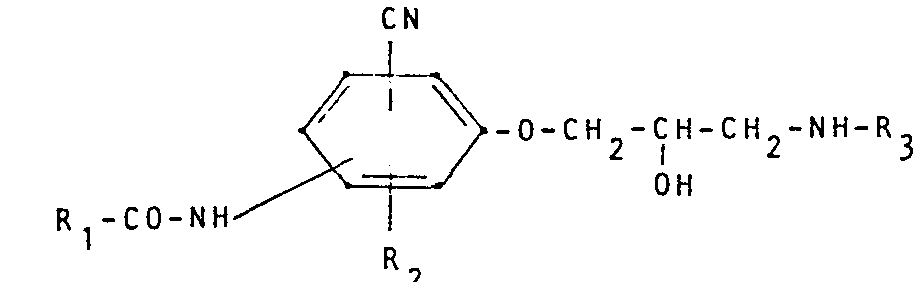
- R, einen Cycloalkylrest mit 3 bis 10 C-Atomen, einen Phenylrest, der ggf. durch ein oder mehrere Halogenatome, niedere Alkyl-, Alkoxy-, Alkenyl-, Alkinyl-, Alkinyloxy-, Cycloalkyl-, Acyl, Acyloxy-, Alkoxycarbonyl-, Hydroxyalkyl- oder Alkoxyalkylreste oder die ringbindenden Gruppen (-CH=CH)2, -O-CH2-O-, mit Bindung der freien Valenzen in o-Stellung zueinander substituiert sein kann, oder einen Aryloxyalkylenrest, der ggf. durch ein oder mehrere Halogenatome, niedere Alkyl-, Alkoxy-, 1 Alkenyl-, Alkinyl-, Alkenyloxy-, Alkinyloxy-, Hydroxyalkyl-, Alkoxyalkyl-, Acyl-, Acyloxy- oder Alkoxycarbonylreste sowie die ringbindende Gruppe -(CH=CH)2- oder -OCH2-O- mit Bindung der freien Valenzen in o-Stellung zueinander substituiert sein kann,
- R2 ein Wasserstoff- oder Halogenatom, eine Alkyl- oder Alkoxygruppe mit 1 bis 4 C-Atomen oder die ringbindenden Gruppen -(CH=CH)2- oder (CH2)n- (n = ganze Zahl von 3 bis 5) mit Bindung der freien Valenzen in o-Stellung zueinander,
- R3 einen geraden oder verzweigten Alkylrest mit 1 bis 10 C-Atomen, bedeutet,
Description
- Die Erfindung betrifft neue Verbindungen der Formel

- Rl einen Cycloalkylrest mit 3 bis 10 C-Atomen, einen Phenylrest, der ggf. durch ein oder mehrere Halogenatome, niedere Alkyl-, Alkoxy-, Alkenyl-, Alkinyl-, Alkinyloxy, Cycloalkyl-, Acyl, Acyloxy-, Alkoxycarbonyl-, Hydroxyalkyl- oder Alkoxyalkylreste oder die ringbindenden Gruppen (-CH=CH)2, -O-CH2-O-, mit Bindung der freien Valenzen in o-Stellung zueinander substituiert sein kann, oder einen Aryloxyalkylenrest, der ggf. durch ein oder mehrere Halogenatome, niedere Alkyl-, Alkoxy-, Alkenyl-, Alkinyl-, Alkenyloxy-, Alkinyloxy, Hydroxyalkyl-, Alkoxyalkyl-, Acyl-, Acyloxy- oder Alkoxycarbonylreste sowie die ringbindende Gruppe -(CH=CH)2- oder -OCH2-O- mit Bindung der freien Valenzen in o-Stellung zueinander substituiert sein kann,
- R2 ein Wasserstoff- oder Halogenatom, eine Alkyl- oder Alkoxygruppe mit 1 bis 4 C-Atomen oder die ringbindenden Gruppen -(CH=CH)2- oder -(CH2)n- (n = ganze Zahl von 3 bis 5) mit Bindung der freien Valenzen in o-Stellung zueinander,
- R3 einen geraden oder verzweigten Alkylrest mit 1 bis 10 C-Atomen,
- Die neuen Verbindungen können z.B. durch Umsetzung von Verbindungen der Formel II


- Die neuen Verbindungen sind als Herz- bzw. Coronartherapeutica oder auch zur Senkung des Blutdrucks verwendbar. Bevorzugte Bedeutungen für R1 sind substituierte Phenoxymethylreste sowie niedere Cycloalkylreste, insbesondere der Cyclobutylrest.
- Bevorzugte Bedeutung für R2 ist Wasserstoff.
- Bevorzugte Bedeutung für R3 ist ein in der Nachbarschaft zur Aminogruppe verzweigter Alkylrest, insbesondere der Isopropyl- oder tert. Butylrest.
- Die neuen Verbindungen können auf folgende Weise hergestellt werden:
- a) Umsetzung einer Verbindung der allgemeinen Formel II


mit einem Amin der allgemeinen Formel III
- b) Hydrolyse eines Oxazolidin-Derivats der allgemeinen Formel IV

- c) Umsetzung einer Verbindung der allgemeinen Formel V


- Die Oxazolidinone der Formel IV (d.h. Verbindungen, bei denen X = -CO- darstellt) sind beispielsweise ausgehend von den Epcxiden der Formel III herstell- bar, indem man letztere mit einem (aus Chlorameisensäure- äthylester und einem Amin der Formel III darstellbaren) Urethan der Formel VI

- Die Ausgangsphenole der allgemeinen Formel V und die Azetidinole der allgemeinen Formel VI können nach literaturbekannten Methoden (letztere s. beispielsweise Chem. pharm. Bull. (Japan), Vol. 22 (7), 1974, Seite 1490) hergestellt werden.
- Die erfindungsgemäßen Verbindungen besitzen ein asymmetrisches C-Atom an der CHOH-Gruppe und kommen daher als Racemat wie auch in Form der optischen Antipoden vor. Letztere können außer durch Racematentrennung mit üblichen Hilfssäuren wie Dibenzoyl- (bzw. Di-p-Toluyl-) D-Weinsäure oder D-3-Bromcampher-8-sulfonsäure auch durch Einsetzen von optisch aktivem Ausgangsmaterial erhalten werden.
- Die erfindungsgemäßen l-Aryloxy-3-alkylamino-2-propanole der allgemeinen Formel I können in üblicher Weise in ihre physiologisch verträglichen Säureadditionssalze überführt werden. Geeignete Säuren sind beispielsweise Salzsäure, Bromwasserstoffsäure, Schwefelsäure, Methansulfonsäure, Maleinsäure, Essigsäure, Oxalsäure, Milchsäure, Weinsäure oder 8-Chlortheophyllin.
- Die Verbindungen der allgemeinen Formel I bzw. deren physiologisch verträgliche Säureadditionssalze haben im Tierversuch wertvolle therapeutische, insbesondere ß-adrenolytische Eigenschaften gezeigt und können daher beispielsweise zur Behandlung oder Prophylaxe koronarer Herzkrankheiten, insbesondere der Angina pectoris und zur Behandlung von Herzarrhythmien, insbesondere von Tachycardien, in der Humanmedizin eingesetzt werden.
- Therapeutisch besonders interessant sind die blutdrucksenkenden Eigenschaften und calciumantagonistischen Effekte der Verbindungen der Formel I. Zudem entfalten sie günstige metabolische Eigenschaften. Die Verbindungen haben gegenüber bekannten β-Rezeptorenblockern, z.B. dem ähnlich strukturierten Handelsprodukt 1-(2-Acetyl-4- butyroylaminophenoxy)-3-isopropylamino-2-propanol (Acebutolol) den Vorteil beträchtlich verminderter Toxizität, besserer Wirkung und hervorragender Organselektivität.
- Die Messung dieser Parameter erfolgte dabei nach den folgenden Vorschriften:
- Methode: Hemmung der tachycarden Reaktion auf eine Standard-Dosis Isoprenalin und Einfluß auf die basale Herzfrequenz durch steigende i.v. Dosen eines ß-Adrenolytikums.
- Tiermaterial: Meerschweinchen beiderlei Geschlechts mit Körpergewichten von 270 - 350 g, Gruppenhaltung, Standard-Kost und Wasser bis zum Versuchsbeginn ad libitum. 16 Stunden vor dem Versuchsanfang Futterentzug.
- Narkose: Äthylurethan 1,75 g/kg als 20 %ige Lösung intraperitoneal, gegebenenfalls wurde nachinjiziert.
- Präparation: Kanülierung einer Vena jugularis exterior für intravenöse Injektionen: Einbinden einer Trachealkanüle und künstliche Beantmung; subcutane Nadelelektroden zur Aufnahme des EKG, in der Regel Extremitätenableitung II, Registriergeschwindigkeit 25 mm/sec; Rektalthermometer zur Kontrolle der Körpertemperatur, die mit einer Wärmelampe (Infrarotstrahler) auf 34 bis 36°C mit Hilfe einer elektronischen Automatikeinrichtung konstant gehalten wird.
- Versuchsablauf: Die Herzfrequenz wird durch Auszählen der R-Zacken im EKG bestimmt, jeweils aus einer 3 bis 4 sec. langen Registrierzeit, Etwa 30 min nach der Präparation wird im Abstand von 2 min 5 mal die normale Herzfrequenz gemessen und gemittelt. Anschließend wird als adrenerges Stimulans 1 µg/kg Isoprenalin i.v. injiziert und danach 3 min lang alle 30 sec die Herzfrequenz erneut registriert. Die Isoprenalininjektionen werden während des ganzen Versuches im Abstand von 30 min wiederholt. Bleibt die Spontanfrecuenz etwa konstant und ist die tachycarde Reaktion auf die ersten 2 bis 3 Isoprenalin-Gaben gleichmäßig, dann wird 15 min nach der letzten und 15 min vor der nächsten Isoprenalin-Reaktion die erste Dosis der Prüfsubstanz i.v. injiziert. Weitere in geometrischer Reihe ansteigende Dosen der Prüfsubstanz folgen in Abständen von 60 min. bis eine markante Hemmung der Isoprenalin-Tachycardie erreicht ist.
- Prinziu: Nach der Methode von D. Dunlop und R.G. Shanks (brit. J.Pharmacol. 32, 201 (1968) werden wache Meerschweinchen einer tödlichen Dosis eines Histaminaerosols ausgesetzt. Durch Vorbehandlung mit Isoprenalin werden die Tiere vor der letalen Wirkung des Histamins geschützt. Ein ß-Adrenolytikum hebt die Isoprenalinwirkung auf, so daß der Schutz vor dem Histaminbronchospasmus verloren geht, falls es sich um eine nicht cardio selektive Substanz handelt. Zeigt eine am Herzen wirksame ß-adrenolytische Substanz in diesem Test keinen Antagonismus gegen Isoprenalin, dann kann Cardioselektivität (für sog. βl-Rezeptoren) angenommen werden.
- Tiermaterial: Meerschweinchen beiderlei Geschlechts (6 Tiere pro Dosis), mit 350 bis 400 g Körpergewicht, Gruppenhaltung. Standard Futter und Wasser bis zum Versuchsbeginn ad libitum. 16 Stunden vor dem Versuchsanfang Futterentzug.
- Versuchsverlauf: Gruppen von je 6 Tieren (3 männliche + 3 weibliche) werden s.c. mit 5 oder mehr verschiedenen Dosen des ß-Adrenolytikums behandelt. Fünfzehn Minuten später erhalten sie 0,1 mg/kg Isoprenalin contralateral s.c. injeziert. Nach weiteren 15 Minuten werden die Tiere in die zylindrische Kammer von 2 Liter Inhalt gesetzt, 45 Sekunden lang einem wäßrigen Histaminaerosol (1,25 %ig) ausgesetzt und anschließend wird die Mortalität ausgewertet.
- Auswertung: Die Letalität wird gegen den Logarithmus der Dosis aufgetragen und die LD50 nach J. LITCHFIELD und F. WILCOXON (J. Pharmacol.Exp. Therap. 96, 99-113, 1949) ermittelt. Mit der LD50 aus diesem Versuch und der cardialen ED50 aus dem Versuch der Hemmung der Isoprenalintachycardie (narkot. Meerschwinchen) wird ein Selektivitätsquotient (LD 50/ED 50) gebildet. Eine Substanz wird als cardioselektiv angesehen, wenn der Quotient größer als 1 ist.
- Als wertvoll haben sich dabei insbesondere solche Verbindungen der allgemeinen Formel I herausgestellt, bei denen R3 einen Isopropyl- oder einen tertiär-Butylaminorest bedeutet (substituierte p-Acylamino-1-Phenoxy-3-isopropyl- bzw. tert. butyl-amino-2-propanole). Besonders wertvoll sind insbesondere das 1-E2-Cyano-4-(3'-methylphenoxyacetylamino)-phenoxy-]-3-tertiärbutyl-amino-2-propanol und das 1-(2-Cyano-4-cyclobutancarbonylamino- phenoxy)-3-tertiärbutylamino-2-propanol und deren Salze.
- Die Einzeldosis der erfindungsgemäßen Substanzen liegt bei 1 bis 300 mg, vorzugsweise 5 bis 100 mg (oral) bzw. 1 bis 20 mg (parenteral).
- Die erfindungsgemäßen Wirkstoffe können in die üblichen galenischen Anwendungsformen, wie Tabletten, Dragees, Lösungen, Emulsionen, Pulver, Kapseln oder Depotformen gebracht werden, wobei zu deren Herstellung die üblichen pharmazeutischen Hilfsstoffe sowie die üblichen Fertigungsmethoden herangezogen werden können. Entsprechende Tabletten können beispielsweise durch Mischen der Wirkstoffe mit bekannten Hilfsstoffen, beispielsweise inerten Verdünnungsmitteln, wie Calciumcarbonat, Calciumphosphat oder Milchzucker, Sprengmitteln, wie Maisstärke oder Alginsäure, Bindemitteln, wie Stärke oder Gelatine, Schmiermitteln, wie Magnesiumstearat oder Talk, und/oder Mitteln zur Erzielung eines Depoteffekts, wie Carboxypolymethylen, Carboxymethylcellulose, Celluloseacetatphthalat, oder Polyvinylacetat erhalten werden,
- Die Tabletten können auch aus mehreren Schichten bestehen. Entsprechend können Dragees durch Überziehen von analog den Tabletten hergestellten Kernen mit üblicherweise in Drageeüberzügen verwendeten Mitteln, beispielsweise Kollidon oder Schellack, Gummi arabicum, Talk, Titandioxid oder Zucker, hergestellt werden. Zur Erzielung eines Depoteffekts oder zur Vermeidung von Inkompatibilitäten kann der Kern auch aus mehreren Schichten bestehen. Desgleichen kann auch die Drageehülle zur Erzielung eines Depoteffekts aus mehreren Schichten bestehen, wobei die oben bei den Tabletten erwähnten Hilfsstoffe verwendet werden können.
- Säfte der erfindungsgemäßen Wirkstoffe bzw. Wirkstoffkombinationen können zusätzlich noch ein Süßungsmittel, wie Saccharin, Cyclamat, Glycerin oder Zucker, sowie ein geschmackverbesserndes Mittel, z.B. Aromastoffe, wie Vanillin oder Orangenextrakt, enthalten.
- Sie können außerdem Suspendierhilfsstoffe oder Dickungsmittel, wie Natriumcarboxymethyl-cellulose, Netzmittel, beispielsweise Kondensationsprodukte von Fettalkoholen mit Äthylenoxid, oder Schutzstoffe, wie p-Hydroxybenzoate, enthalten.
- Injektionslösungen werden in üblicher Weise, z.B. unter Zusatz von Konservierungsmitteln, wie p-Hydroxybenzoaten, oder Stabilisatoren, wie Komplexonen, hergestellt und in Injektionsflaschen oder Ampullen abgefüllt.
- Die Wirkstoffe bzw. Wirkstoffkombinationen enthaltenden Kapseln können beispielsweise hergestellt werden, indem man die Wirkstoffe mit inerten Trägern, wie Milchzucker oder Sorbit, mischt und in Gelatinekapseln einkapselt.
- Geeignete Zäpfchen lassen sich beispielsweise durch Vermischen der dafür vorgesehenen Wirkstoffe bzw. Wirkstoffkombinationen mit üblichen Trägermitteln, wie Neutralfetten oder Polyäthylenglykol bzw. dessen Derivaten, herstellen.
- Die erfindungsgemäßen Verbindungen sind auch für die Kombination mit anderen pharmakodynamisch wirksamen Stoffen wie z.B. Coronardilatatoren, Sympaticomimetica, Herzglykosiden oder Tranquilizern geeignet.
- Die folgenden Beispiele erläutern die Erfindung, ohne sie zu beschränken:
- 7 g (0,021 Mol) 1-[2-Cyano-4-(3'-methylphenoxyacetylamino) -phenoxy]-2,3-epoxypropan werden in 80 ml Äthanol gelöst und nach Zugabe von 2,2 ml (0,021 Mol) tert. Butylamin 90 Minuten unter Rückfluß zum Sieden erhitzt. Nach Abdestillieren des Lösungsmittels wird der verbleibende Rückstand mit Essigester digeriert und der feste Anteil abgesaugt. Die feinkristalline Base wird zweimal aus Essigester unter Zugabe von Hexan umkristallisiert. Ausbeute 2,6 g, Fp.: 130-131°C.
- 7,5 g (0,024 Mol) 1-(2-Cyano-4-cyclobutancarbonylamino- phenoxy)-3-chlor-2-propanol werden nach Lösen in 80 ml Äthanol mit 8,7 g (0,12 Mol) tert. Butylamin vermischt und vier Stunden unter Rückfluß zum Sieden erhitzt. Das Lösungsmittel wird i.V. abdestilliert, der verbleibende Rückstand mit verdünnter Salzsäure unter Zugabe von Äther geschüttelt und die organische Phase abgetrennt. Die wäßrige Phase wird mit Äther gewaschen und mit NH4OH alkalisch gestellt. Die ausfallende Base wird mit Essigester extrahiert und die organische Phase über MgSO4 getrocknet. Der Essigester wird abdestilliert und der kristalline Rückstand zweimal aus Acetonitril umkristallisiert. Ausbeute: 5,7 g, Fp.: 11C-113°C.
- 12 g 1-[2-Cyano-4-(4'-chlorbenzoyl-amino)-phenoxy-3-chlor-2-propanol werden in 100 ml Äthanol gelöst, 15 ml tert. Butylamin zugegeben und drei Stunden unter Rückfluß zum Sieden erhitzt. Nach Abdestillieren des Äthanols wird der Rückstand mit verdünnter Salzsäure angesäuert, die wäßrige Lösung mit Äther ausgeschüttelt und die wäßrige Phase mit NaOH alkalisch gestellt. Die Base wird in Essigester aufgenommen, die organische Phase mit Wasser gewaschen, über Na2SO4 getrocknet und das Lösungsmittel abdestilliert. Der Rückstand wird über eine Kieselgelsäule gereinigt. Die feste Base wird aus Isopropanol umkristallisiert. Ausbeute 4 g, Fp.: 182-183°C.
- 3 g (0,009 Mol) 1-[2-Cyano-4-(4'-methylbenzoylamino)-phen- oxy]-3-chlor-2-propanol werden in 80 ml Äthanol gelöst, 3,8 ml (0,045 Mol) Isopropylamin zugegeben und zwei Stunden unter Rückfluß zum Sieden erhitzt. Nach Abdestillieren des Methanols wird der Rückstand in Salzsäure gelöst, mit Essigester extrahiert und anschließend die wäßrige Phase mit NaCH alkalisch gestellt. Die freie Base wird mit Essigester mehrfach extrahiert und nach Waschen mit Wasser über Na2S04 getrocknet. Durch Abdestillieren des Essigesters erhält man einen Rückstand, der mit Acetonitril digeriert, dann abgesaugt und in Acetonitril aufgeschlämmt wird. Nach Zugabe von alkoholischer HC1 tritt Lösung ein. Die Zugabe von Äther leitet die Kristallisation des Hydrochlorids ein, iie durch Abkühlung beschleunigt wird. Das Hydrochlorid wird durch Lösen in Äthanol und Zugabe von Äther umkristallisiert. Ausbeute: 2 g, Fp.: 193-195°C.
- 14 g 1-[2-Cyano-4-(4'-methoxybenzoylamino)-phenoxy]-3-chlor-2-propanol werden nach Lösen in 100 ml Äthanol und Zugabe von 20 ml tert. Butylamin vier Stunden unter Rückfluß zum Sieden erhitzt. Nach Abdestillieren des Äthanols wird der verbleibende Rückstand in verdünnter Salzsäure gelöst, mit Äther ausgeschüttelt, die wäßrige Phase mit NaOH alkalisch gestellt und die freie Base in Essigester aufgenommen. Die organische Phase wird mit Wasser gewaschen, über Na2SO4 getrocknet, Essigester abdestilliert und der verbleibende Rückstand über eine Kieselgelsäule (Essigester/Isopropanol/NH4OH 70/30/5) gereinigt. Die sodann isolierte Base wird aus Essigester und Zugabe von Petrolätzer (Kp 40°C) umkristallisiert. Ausbeute: 3,2 g, Fp.: 108-110°C.
- Entsprechend der Vorschrift des Beispiels 2 wurden aus dem entsprechenden p-Acylamino-l-phenoxy-2-hydroxy-3- chlorpropan der Formel II sowie dem entsprechenden Alkylamin der Formel II in Äthanol am Rückfluß die folgenden Substanzen der Formel I synthetisiert: (CN in 2-Stellung, Acylaminorest in 4-Stellung der Phenoxygruppe)


-

- Herstellung:
- Die einzelnen Bestandteile werden intensiv miteinander vermischt und die Mischung in üblicher Weise granuliert. Das Granulat wird zu Tabletten von 445 mg Gewicht verpreßt, von denen jede 40 mg Wirkstoff enthält.
- Anstelle des in diesem Beispiel genannten Wirkstoffs können auch die Substanzen 1-[2-Cyano-4-(4'-chlor- benzöylamino)-phenoxy]-3-(tert.-butylamino)-2-propanol und 1-[2-Cyano-4-(4'-methylbenzoylamino)-phen- oxy]-3-(isopropylamino)-2-propanol-hydrochlorid in gleicher Menge verwendet werden.
- Der Inhalt der Kapsel setzt sich wie folgt zusammen:

- Die Bestandteile des Kapselinhalts werden intensiv vermischt und 200 mg-Portionen der Mischung werden in Gelatine-Kapseln geeigneter Größe abgefüllt. Jede Kapsel enthält 25 mg des Wirkstoffs.
- Die Lösung wird aus folgenden Bestandteilen hergestellt:

- Herstellung:
- Der Wirkstoff und das EDTA-Salz werden in genügend Wasser gelöst und mit Wasser auf das gewünschte Volumen aufgefüllt. Die Lösung wird frei von suspendierten Partikeln filtriert und in 1 ccm-Ampullen unter aseptischen Bedingungen abgefüllt. Zuletzt werden die Ampullen sterilisiert und verschlossen. Jede Ampulle enthält 25 mg Wirkstoff.
- Kern:
-

- Herstellung:
- Der Wirkstoff, die CMC und die Stearinsäure werden intensiv gemischt und die Mischung in üblicher Weise granuliert, wobei man eine Lösung des CAP in 200 ml eines Gemisches aus Äthanol/Äthylacetat verwendet. Das Granulat wird dann zu 380 mg-Kernen verpreßt, die in üblicher Weise mit einer zuckerhaltigen 5%igen Lösung von Polyvinylpyrrolidon in Wasser überzogen werden. Jedes Dragee enthält 25 mg Wirkstoff.
-

- Anstelle des in diesem Beispiel genannten ß-adrenolytisch wirksamen Stoffs kann auch die Substanz 1-[2-Cyano-4-(3'-methylphenoxyacetylamino)-phenoxy]-3-(tert.butylamino)-2-propanol in gleicher Menge verwendet werden.
- Herstellung:
- Der Wirkstoff wird zusammen mit dem Milchzucker, der Maisstärke, der kolloidalen Kieselsäure und dem Polyvinylpyrrolidon nach intensiver Durchmischung in üblicher Weise granuliert, wobei man eine wäßrige Lösung der löslichen Stärke verwendet. Das Granulat wird mit dem Magnesiumstearat gemischt und zu 1000 Tabletten von je 500 mg Gewicht verpreßt, die je 35 mg des ersten und 75 mg des zweiten Wirkstoffs enthalten.
Claims (13)

ihre Säureadditionssalze, die Verwendung dieser Verbindungen in Arzneimitteln sowie ihre Herstellung.


Priority Applications (1)
| Application Number | Priority Date | Filing Date | Title |
|---|---|---|---|
| AT82107536T ATE16700T1 (de) | 1981-08-26 | 1982-08-18 | Neue 1-aryloxy-3-alkylamino-2-propanole und verfahren zu ihrer herstellung. |
Applications Claiming Priority (2)
| Application Number | Priority Date | Filing Date | Title |
|---|---|---|---|
| DE19813133678 DE3133678A1 (de) | 1981-08-26 | 1981-08-26 | Neue l-aryloxy-3-alkylamino-2-propanole und verfahren zu ihrer herstellung |
| DE3133678 | 1981-08-26 |
Publications (2)
| Publication Number | Publication Date |
|---|---|
| EP0073016A1 true EP0073016A1 (de) | 1983-03-02 |
| EP0073016B1 EP0073016B1 (de) | 1985-11-27 |
Family
ID=6140122
Family Applications (1)
| Application Number | Title | Priority Date | Filing Date |
|---|---|---|---|
| EP82107536A Expired EP0073016B1 (de) | 1981-08-26 | 1982-08-18 | Neue 1-Aryloxy-3-alkylamino-2-propanole und Verfahren zu ihrer Herstellung |
Country Status (19)
| Country | Link |
|---|---|
| US (1) | US4442120A (de) |
| EP (1) | EP0073016B1 (de) |
| JP (1) | JPS5859957A (de) |
| KR (1) | KR890000620B1 (de) |
| AT (1) | ATE16700T1 (de) |
| AU (1) | AU558338B2 (de) |
| CA (1) | CA1165324A (de) |
| DE (2) | DE3133678A1 (de) |
| DK (1) | DK380482A (de) |
| ES (3) | ES8307723A1 (de) |
| FI (1) | FI75150C (de) |
| GR (1) | GR77606B (de) |
| IE (1) | IE54224B1 (de) |
| IL (1) | IL66633A (de) |
| NO (1) | NO152603C (de) |
| NZ (1) | NZ201716A (de) |
| PH (1) | PH19705A (de) |
| PT (1) | PT75458A (de) |
| ZA (1) | ZA826183B (de) |
Families Citing this family (1)
| Publication number | Priority date | Publication date | Assignee | Title |
|---|---|---|---|---|
| US6343516B1 (en) * | 1998-01-16 | 2002-02-05 | Texaco Inc. | Multiphase flow sampling using an autotraversing sample probe |
Citations (2)
| Publication number | Priority date | Publication date | Assignee | Title |
|---|---|---|---|---|
| DE2503222A1 (de) * | 1975-01-27 | 1976-07-29 | Boehringer Sohn Ingelheim | Verfahren zur herstellung von 1-aryl- oxy-3-n-substituierten aminopropanderivaten |
| EP0038936A1 (de) * | 1980-04-25 | 1981-11-04 | C.H. Boehringer Sohn | Neue 1-Aryloxy-3-alkylamino-2-propanole und Verfahren zu ihrer Herstellung |
Family Cites Families (1)
| Publication number | Priority date | Publication date | Assignee | Title |
|---|---|---|---|---|
| GB1199037A (en) * | 1967-09-27 | 1970-07-15 | Ici Ltd | Alkanolamine Derivatives |
-
1981
- 1981-08-26 DE DE19813133678 patent/DE3133678A1/de not_active Withdrawn
-
1982
- 1982-06-29 NO NO822220A patent/NO152603C/no unknown
- 1982-07-15 US US06/398,577 patent/US4442120A/en not_active Expired - Fee Related
- 1982-07-22 PH PH27614A patent/PH19705A/en unknown
- 1982-07-26 CA CA000408021A patent/CA1165324A/en not_active Expired
- 1982-08-18 AT AT82107536T patent/ATE16700T1/de not_active IP Right Cessation
- 1982-08-18 DE DE8282107536T patent/DE3267692D1/de not_active Expired
- 1982-08-18 EP EP82107536A patent/EP0073016B1/de not_active Expired
- 1982-08-23 FI FI822912A patent/FI75150C/fi not_active IP Right Cessation
- 1982-08-24 PT PT75458A patent/PT75458A/de unknown
- 1982-08-24 IL IL66633A patent/IL66633A/xx unknown
- 1982-08-25 ES ES515245A patent/ES8307723A1/es not_active Expired
- 1982-08-25 ZA ZA826183A patent/ZA826183B/xx unknown
- 1982-08-25 DK DK380482A patent/DK380482A/da not_active Application Discontinuation
- 1982-08-25 GR GR69110A patent/GR77606B/el unknown
- 1982-08-25 IE IE2047/82A patent/IE54224B1/en unknown
- 1982-08-25 AU AU87718/82A patent/AU558338B2/en not_active Ceased
- 1982-08-25 NZ NZ201716A patent/NZ201716A/en unknown
- 1982-08-25 KR KR8203820A patent/KR890000620B1/ko not_active Expired
- 1982-08-25 JP JP57147518A patent/JPS5859957A/ja active Pending
-
1983
- 1983-02-25 ES ES520094A patent/ES8401454A1/es not_active Expired
- 1983-02-25 ES ES520095A patent/ES520095A0/es active Granted
Patent Citations (2)
| Publication number | Priority date | Publication date | Assignee | Title |
|---|---|---|---|---|
| DE2503222A1 (de) * | 1975-01-27 | 1976-07-29 | Boehringer Sohn Ingelheim | Verfahren zur herstellung von 1-aryl- oxy-3-n-substituierten aminopropanderivaten |
| EP0038936A1 (de) * | 1980-04-25 | 1981-11-04 | C.H. Boehringer Sohn | Neue 1-Aryloxy-3-alkylamino-2-propanole und Verfahren zu ihrer Herstellung |
Also Published As
| Publication number | Publication date |
|---|---|
| US4442120A (en) | 1984-04-10 |
| PH19705A (en) | 1986-06-16 |
| EP0073016B1 (de) | 1985-11-27 |
| FI822912L (fi) | 1983-02-27 |
| IL66633A (en) | 1986-02-28 |
| DK380482A (da) | 1983-02-27 |
| NO152603C (no) | 1985-10-23 |
| ES8401455A1 (es) | 1983-12-01 |
| IE822047L (en) | 1983-02-26 |
| GR77606B (de) | 1984-09-25 |
| JPS5859957A (ja) | 1983-04-09 |
| KR890000620B1 (ko) | 1989-03-22 |
| DE3267692D1 (en) | 1986-01-09 |
| ATE16700T1 (de) | 1985-12-15 |
| ES520094A0 (es) | 1983-12-01 |
| ES515245A0 (es) | 1983-08-01 |
| FI75150C (fi) | 1988-05-09 |
| PT75458A (de) | 1982-09-01 |
| IL66633A0 (en) | 1982-12-31 |
| CA1165324A (en) | 1984-04-10 |
| FI75150B (fi) | 1988-01-29 |
| ES8307723A1 (es) | 1983-08-01 |
| AU8771882A (en) | 1983-03-03 |
| NO152603B (no) | 1985-07-15 |
| AU558338B2 (en) | 1987-01-29 |
| IE54224B1 (en) | 1989-07-19 |
| ZA826183B (en) | 1984-04-25 |
| KR840001129A (ko) | 1984-03-28 |
| DE3133678A1 (de) | 1983-03-17 |
| NO822220L (no) | 1983-02-28 |
| ES8401454A1 (es) | 1983-12-01 |
| FI822912A0 (fi) | 1982-08-23 |
| ES520095A0 (es) | 1983-12-01 |
| NZ201716A (en) | 1986-02-21 |
Similar Documents
| Publication | Publication Date | Title |
|---|---|---|
| EP0004532B1 (de) | 1-Aryloxy-3-nitratoalkylamino-2-propanole, Verfahren zu ihrer Herstellung und ihre pharmazeutischen Zubereitungen | |
| DE1643262A1 (de) | Neue 1-Phenoxy-2-hydroxy-3-alkylaminopropane und Verfahren zu ihrer Herstellung | |
| DD201305A5 (de) | Verfahren zur herstellung von in 7-stellung substituierten benzopyranen | |
| CH640227A5 (de) | Aminoalkoxyphenyl-derivate. | |
| EP0038936B1 (de) | Neue 1-Aryloxy-3-alkylamino-2-propanole und Verfahren zu ihrer Herstellung | |
| DD153550A5 (de) | Verfahren zur herstellung von neuer 1,2,4-oxadiazolin-5-on-derivaten | |
| DE1940566A1 (de) | 1-(2-Nitrilophenoxy)-2-hydroxy-3-aethylaminopropan und dessen Salze | |
| EP0035733B1 (de) | Neue 1-(Acylamino-aryloxy-)2-hydroxy-3-alkinyl-aminopropane und Verfahren zu ihrer Herstellung | |
| EP0225543B1 (de) | Basisch substituierte Phenylacetaldehyde, ihre Herstellung und diese enthaltende Arzneimittel | |
| EP0027928B1 (de) | Piperidinderivate von 4,5-Dialkyl-3-hydroxy-pyrrol-2-carbonsäureestern, ihre Herstellung und diese enthaltende pharmazeutische Zubereitungen | |
| EP0073016B1 (de) | Neue 1-Aryloxy-3-alkylamino-2-propanole und Verfahren zu ihrer Herstellung | |
| EP0035734B1 (de) | Neue 1-(Acylamino-aryloxy-)2-hydroxy-3-alkinyl-aminopropane und Verfahren zu ihrer Herstellung | |
| EP0073011B1 (de) | Neue 1-Aryloxy-3-alkinylamino-2-propanole und Verfahren zu ihrer Herstellung | |
| EP0030688B1 (de) | Piperidinderivate von 3-Hydroxy-thiophen-2-carbonsäureestern, ihre Herstellung und diese enthaltende pharmazeutische Zubereitungen | |
| DE2403809C2 (de) | 1-Aryloxy-2-hydroxy-3-alkinylaminopropane und Verfahren zu ihrer Herstellung und pharmazeutische Präparate | |
| DE1618160C3 (de) | l-(2-Äthinylphenoxy)-2-hydroxy-3alkylaminopropane, ihre physiologisch verträglichen Säureadditionssalze, Verfahren zu ihrer Herstellung, sowie diese Verbindungen enthaltende Arzneimittel | |
| EP0086403A2 (de) | Oxazolidin-2-one | |
| DE2309887C2 (de) | 1-Aryloxy-2-hydroxy-3-alkinylaminopropan-Derivate und deren physiologisch verträgliche Säureadditionssalze, pharmazeutische Präparate und Herstellungsverfahren für die Verbindungen | |
| EP0086256B1 (de) | 1-(2,4-Dichlorphenoxy)-3-(3,4-dimethoxy-Beta-phenethylamino)-2-propanol, Verfahren zu seiner Herstellung und dieses enthaltende pharmazeutische Zusammensetzungen | |
| DE3640829A1 (de) | Neue 1-aryloxy-3-amino-2-propanole, ihre herstellung und verwendung | |
| DE1643266C3 (de) | 1 Phenoxy 2 hydroxy 3 sek alkylamino propane, ein Verfahren zu ihrer Herstel lung und diese enthaltende Präparate | |
| DE3046017C2 (de) | Indolizin-Derivate, Verfahren zu deren Herstellung und pharmazeutische Zusammensetzung | |
| DE3632544A1 (de) | Neue aryloxy-aminoalkane, ihre herstellung und verwendung | |
| DE3427309A1 (de) | Neue 1-aryloxypropanolamine, verfahren zu ihrer herstellung und ihre verwendung | |
| DE1793799B1 (de) | 1 phenoxy-2-hydroxy-3-alkylaminopropane, verfahren zu ihrer herstellung und diese verbindungen enthaltende arzneimittel |
Legal Events
| Date | Code | Title | Description |
|---|---|---|---|
| PUAI | Public reference made under article 153(3) epc to a published international application that has entered the european phase |
Free format text: ORIGINAL CODE: 0009012 |
|
| AK | Designated contracting states |
Designated state(s): AT BE CH DE FR GB IT LI LU NL SE |
|
| 17P | Request for examination filed |
Effective date: 19830316 |
|
| ITF | It: translation for a ep patent filed | ||
| GRAA | (expected) grant |
Free format text: ORIGINAL CODE: 0009210 |
|
| AK | Designated contracting states |
Designated state(s): AT BE CH DE FR GB IT LI LU NL SE |
|
| REF | Corresponds to: |
Ref document number: 16700 Country of ref document: AT Date of ref document: 19851215 Kind code of ref document: T |
|
| REF | Corresponds to: |
Ref document number: 3267692 Country of ref document: DE Date of ref document: 19860109 |
|
| ET | Fr: translation filed | ||
| PGFP | Annual fee paid to national office [announced via postgrant information from national office to epo] |
Ref country code: AT Payment date: 19860623 Year of fee payment: 5 |
|
| PG25 | Lapsed in a contracting state [announced via postgrant information from national office to epo] |
Ref country code: LU Free format text: LAPSE BECAUSE OF NON-PAYMENT OF DUE FEES Effective date: 19860831 |
|
| PLBE | No opposition filed within time limit |
Free format text: ORIGINAL CODE: 0009261 |
|
| STAA | Information on the status of an ep patent application or granted ep patent |
Free format text: STATUS: NO OPPOSITION FILED WITHIN TIME LIMIT |
|
| 26N | No opposition filed | ||
| PGFP | Annual fee paid to national office [announced via postgrant information from national office to epo] |
Ref country code: NL Payment date: 19870831 Year of fee payment: 6 |
|
| PG25 | Lapsed in a contracting state [announced via postgrant information from national office to epo] |
Ref country code: GB Effective date: 19890818 Ref country code: AT Effective date: 19890818 |
|
| PG25 | Lapsed in a contracting state [announced via postgrant information from national office to epo] |
Ref country code: SE Effective date: 19890819 |
|
| PG25 | Lapsed in a contracting state [announced via postgrant information from national office to epo] |
Ref country code: LI Effective date: 19890831 Ref country code: CH Effective date: 19890831 Ref country code: BE Effective date: 19890831 |
|
| BERE | Be: lapsed |
Owner name: BOEHRINGER INGELHEIM K.G. Effective date: 19890831 |
|
| PG25 | Lapsed in a contracting state [announced via postgrant information from national office to epo] |
Ref country code: NL Effective date: 19900301 |
|
| NLV4 | Nl: lapsed or anulled due to non-payment of the annual fee | ||
| GBPC | Gb: european patent ceased through non-payment of renewal fee | ||
| PG25 | Lapsed in a contracting state [announced via postgrant information from national office to epo] |
Ref country code: FR Effective date: 19900427 |
|
| REG | Reference to a national code |
Ref country code: CH Ref legal event code: PL |
|
| PG25 | Lapsed in a contracting state [announced via postgrant information from national office to epo] |
Ref country code: DE Effective date: 19900501 |
|
| REG | Reference to a national code |
Ref country code: FR Ref legal event code: ST |
|
| EUG | Se: european patent has lapsed |
Ref document number: 82107536.3 Effective date: 19900418 |