EP0073075A2 - Halbleiteranordnung mit polykristallinem Silizium und Verfahren zu deren Herstellung - Google Patents
Halbleiteranordnung mit polykristallinem Silizium und Verfahren zu deren Herstellung Download PDFInfo
- Publication number
- EP0073075A2 EP0073075A2 EP82200965A EP82200965A EP0073075A2 EP 0073075 A2 EP0073075 A2 EP 0073075A2 EP 82200965 A EP82200965 A EP 82200965A EP 82200965 A EP82200965 A EP 82200965A EP 0073075 A2 EP0073075 A2 EP 0073075A2
- Authority
- EP
- European Patent Office
- Prior art keywords
- polycrystalline silicon
- semiconductor device
- carbon
- doped
- silicon
- Prior art date
- Legal status (The legal status is an assumption and is not a legal conclusion. Google has not performed a legal analysis and makes no representation as to the accuracy of the status listed.)
- Granted
Links
Images
Classifications
-
- H—ELECTRICITY
- H10—SEMICONDUCTOR DEVICES; ELECTRIC SOLID-STATE DEVICES NOT OTHERWISE PROVIDED FOR
- H10D—INORGANIC ELECTRIC SEMICONDUCTOR DEVICES
- H10D64/00—Electrodes of devices having potential barriers
- H10D64/01—Manufacture or treatment
- H10D64/013—Manufacture or treatment of electrodes having a conductor capacitively coupled to a semiconductor by an insulator
- H10D64/01302—Manufacture or treatment of electrodes having a conductor capacitively coupled to a semiconductor by an insulator the insulator being formed after the semiconductor body, the semiconductor being silicon
- H10D64/01304—Manufacture or treatment of electrodes having a conductor capacitively coupled to a semiconductor by an insulator the insulator being formed after the semiconductor body, the semiconductor being silicon characterised by the conductor
- H10D64/01306—Manufacture or treatment of electrodes having a conductor capacitively coupled to a semiconductor by an insulator the insulator being formed after the semiconductor body, the semiconductor being silicon characterised by the conductor the conductor comprising a layer of silicon contacting the insulator, e.g. polysilicon
-
- H—ELECTRICITY
- H10—SEMICONDUCTOR DEVICES; ELECTRIC SOLID-STATE DEVICES NOT OTHERWISE PROVIDED FOR
- H10D—INORGANIC ELECTRIC SEMICONDUCTOR DEVICES
- H10D62/00—Semiconductor bodies, or regions thereof, of devices having potential barriers
- H10D62/40—Crystalline structures
-
- H—ELECTRICITY
- H10—SEMICONDUCTOR DEVICES; ELECTRIC SOLID-STATE DEVICES NOT OTHERWISE PROVIDED FOR
- H10D—INORGANIC ELECTRIC SEMICONDUCTOR DEVICES
- H10D62/00—Semiconductor bodies, or regions thereof, of devices having potential barriers
- H10D62/80—Semiconductor bodies, or regions thereof, of devices having potential barriers characterised by the materials
- H10D62/83—Semiconductor bodies, or regions thereof, of devices having potential barriers characterised by the materials being Group IV materials, e.g. B-doped Si or undoped Ge
- H10D62/834—Semiconductor bodies, or regions thereof, of devices having potential barriers characterised by the materials being Group IV materials, e.g. B-doped Si or undoped Ge further characterised by the dopants
-
- H—ELECTRICITY
- H10—SEMICONDUCTOR DEVICES; ELECTRIC SOLID-STATE DEVICES NOT OTHERWISE PROVIDED FOR
- H10D—INORGANIC ELECTRIC SEMICONDUCTOR DEVICES
- H10D64/00—Electrodes of devices having potential barriers
- H10D64/01—Manufacture or treatment
- H10D64/013—Manufacture or treatment of electrodes having a conductor capacitively coupled to a semiconductor by an insulator
- H10D64/01302—Manufacture or treatment of electrodes having a conductor capacitively coupled to a semiconductor by an insulator the insulator being formed after the semiconductor body, the semiconductor being silicon
- H10D64/01304—Manufacture or treatment of electrodes having a conductor capacitively coupled to a semiconductor by an insulator the insulator being formed after the semiconductor body, the semiconductor being silicon characterised by the conductor
- H10D64/01314—Manufacture or treatment of electrodes having a conductor capacitively coupled to a semiconductor by an insulator the insulator being formed after the semiconductor body, the semiconductor being silicon characterised by the conductor the conductor comprising a layer of Ge, C or of compounds of Si, Ge or C contacting the insulator
-
- H—ELECTRICITY
- H10—SEMICONDUCTOR DEVICES; ELECTRIC SOLID-STATE DEVICES NOT OTHERWISE PROVIDED FOR
- H10P—GENERIC PROCESSES OR APPARATUS FOR THE MANUFACTURE OR TREATMENT OF DEVICES COVERED BY CLASS H10
- H10P14/00—Formation of materials, e.g. in the shape of layers or pillars
- H10P14/20—Formation of materials, e.g. in the shape of layers or pillars of semiconductor materials
- H10P14/34—Deposited materials, e.g. layers
- H10P14/3402—Deposited materials, e.g. layers characterised by the chemical composition
- H10P14/3404—Deposited materials, e.g. layers characterised by the chemical composition being Group IVA materials
- H10P14/3408—Silicon carbide
-
- H—ELECTRICITY
- H10—SEMICONDUCTOR DEVICES; ELECTRIC SOLID-STATE DEVICES NOT OTHERWISE PROVIDED FOR
- H10P—GENERIC PROCESSES OR APPARATUS FOR THE MANUFACTURE OR TREATMENT OF DEVICES COVERED BY CLASS H10
- H10P14/00—Formation of materials, e.g. in the shape of layers or pillars
- H10P14/20—Formation of materials, e.g. in the shape of layers or pillars of semiconductor materials
- H10P14/34—Deposited materials, e.g. layers
- H10P14/3402—Deposited materials, e.g. layers characterised by the chemical composition
- H10P14/3404—Deposited materials, e.g. layers characterised by the chemical composition being Group IVA materials
- H10P14/3411—Silicon, silicon germanium or germanium
-
- H—ELECTRICITY
- H10—SEMICONDUCTOR DEVICES; ELECTRIC SOLID-STATE DEVICES NOT OTHERWISE PROVIDED FOR
- H10P—GENERIC PROCESSES OR APPARATUS FOR THE MANUFACTURE OR TREATMENT OF DEVICES COVERED BY CLASS H10
- H10P14/00—Formation of materials, e.g. in the shape of layers or pillars
- H10P14/20—Formation of materials, e.g. in the shape of layers or pillars of semiconductor materials
- H10P14/34—Deposited materials, e.g. layers
- H10P14/3438—Doping during depositing
- H10P14/3441—Conductivity type
- H10P14/3442—N-type
-
- H—ELECTRICITY
- H10—SEMICONDUCTOR DEVICES; ELECTRIC SOLID-STATE DEVICES NOT OTHERWISE PROVIDED FOR
- H10P—GENERIC PROCESSES OR APPARATUS FOR THE MANUFACTURE OR TREATMENT OF DEVICES COVERED BY CLASS H10
- H10P14/00—Formation of materials, e.g. in the shape of layers or pillars
- H10P14/20—Formation of materials, e.g. in the shape of layers or pillars of semiconductor materials
- H10P14/34—Deposited materials, e.g. layers
- H10P14/3438—Doping during depositing
- H10P14/3441—Conductivity type
- H10P14/3444—P-type
-
- H—ELECTRICITY
- H10—SEMICONDUCTOR DEVICES; ELECTRIC SOLID-STATE DEVICES NOT OTHERWISE PROVIDED FOR
- H10P—GENERIC PROCESSES OR APPARATUS FOR THE MANUFACTURE OR TREATMENT OF DEVICES COVERED BY CLASS H10
- H10P14/00—Formation of materials, e.g. in the shape of layers or pillars
- H10P14/40—Formation of materials, e.g. in the shape of layers or pillars of conductive or resistive materials
- H10P14/416—Formation of materials, e.g. in the shape of layers or pillars of conductive or resistive materials of highly doped semiconductor materials, e.g. polysilicon layers or amorphous silicon layers
-
- Y—GENERAL TAGGING OF NEW TECHNOLOGICAL DEVELOPMENTS; GENERAL TAGGING OF CROSS-SECTIONAL TECHNOLOGIES SPANNING OVER SEVERAL SECTIONS OF THE IPC; TECHNICAL SUBJECTS COVERED BY FORMER USPC CROSS-REFERENCE ART COLLECTIONS [XRACs] AND DIGESTS
- Y10—TECHNICAL SUBJECTS COVERED BY FORMER USPC
- Y10S—TECHNICAL SUBJECTS COVERED BY FORMER USPC CROSS-REFERENCE ART COLLECTIONS [XRACs] AND DIGESTS
- Y10S438/00—Semiconductor device manufacturing: process
- Y10S438/914—Doping
- Y10S438/918—Special or nonstandard dopant
Definitions
- the invention relates to a semiconductor device having a semiconductor body which comprises a circuit element with a part formed from doped polycrystalline silicon.
- semiconductor device includes, for example, diodes, transistors and integrated circuits.
- Polycrystalline silicon is silicon in which crystallites can be demonstrated by X-ray analysis.
- the size of said crystallites is at least approximately 15
- grain limits in polycrystalline silicon means that, electrically, this material is inhomogeneous, while amorphous and monocrystalline silicon - in the absence of grain limits - are homogeneous materials, electrically.
- polycrystalline silicon is used for many purposes, for example, as a diffusion source on a semiconductor body, as a conductive material, for example, for gate electrodes in MOS transistors, and as a resistive material.
- the polycrystalline silicon may comprise a dopant influencing the electric conductivity, which dopant as such determines the electric conductivity in the polycrystalline silicon and/or can be transferred to a semiconductor body.
- a problem with polycrystalline silicon is that treatments at elevated temperatures, as are usual upon tempering and diffusion, for example, may give rise to reduced stability and poorer reproducibility of the semiconductor device.
- crystal growth easily occurs in 1 polycrystalline silicon when the temperature rises.
- crystal size becomes of the order of magnitude of the thickness of a polycrystalline layer, a substrate on which the layer is present can be undesirably attacked upon etching.
- One of the objects of the invention is to avoid the above problems at least to a considerable extent.
- the invention is inter alia based on the recognition of the fact that the properties of polycrystalline silicon can be improved by the-incorporation of certain substances.
- the semiconductor device mentioned in the opening paragraph is characterized in that the polycrystalline silicon is doped with carbon in a concentration which is higher than 1 part per million (ppm.).
- the conductivity of the polycrystalline silicon doped with carbon can further be adjusted particularly suitably if the polycrystalline silicon is further doped with a dopant determining the conductivity type.
- both the electric resistance and the activation azergy of the electric resistance of the polycrystalline silicon decrease when the carbon concentration increases.
- the carbon atoms are probably present at the boundaries of the silicon crystallites and increase the mobility of the charge carriers over the grain limits.
- the influence of small carbon concentrations on the resistance is small.
- both the resistance and the activation energy of the resistance increase at all phosphorus concentrations. This is associated with the presence of silicon carbide and/or carbon as the second phase beside the polycrystalline silicon. In forming polycrystalline silicon with such a carbon content and such properties the grains are generally smaller than at lower carbon content.
- the resistance and the activation energy of the resistance decrease again.
- the comparatively low resistance is possibly associated with conductivity via carbon bridges.
- the silicon in particular when low formation temperatures are used, has then become substantially amorphous.
- the polycrystalline silicon in the semiconductor device according to the invention may form the gate electrode of a MOS transistor or the polycrystalline silicon locally forms a resistor on the semiconductor body.
- the polycrystalline silicon may form a resistance layer for the draining of charge on a p-n junction, for example, in a high-voltage transistor.
- the invention furthermore relates to a method of manufacturing a semiconductor device according to the inven-0 tion.
- carbon may be implanted in a provided polycrystalline silicon layer.
- the voltage upon implantation must continually 85 be varied in the course of the process so as to adjust the desired carbon concentration in any place in the silicon.
- a temperature treatment cannot improve the homogeneity of the carbon distribution, since carbon diffuses very slowly into silicon even at elevated temperatures.
- the doped polycrystalline silicon is preferably formed from a gaseous silicon compound and a gaseous unsaturated carbon compound at a temperature above 700°C.
- Ethyne is very suitable for incorporation of carbon in the polycrystalline silicon.
- the polycrystalline silicon may be used as a diffusion source to obtain a doped region in the semiconductor body.
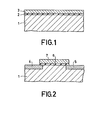
- Figures 1 and 2 of the drawing are diagrammatic sectional views of a part of a semiconductor device in successive stages of the manufacture by means of the method according to the invention.
- a semiconductor body 1 of silicon is provided at a stage of the manufacture in a usual manner with a 0.2 / um thick layer 2 of silicon dioxide on which a 0.5 / um thick layer 3 of polycrystalline silicon is provided.
- the layer 3 is doped with carbon in a concentration above 1 ppm and it is formed from a gaseous silicon compound and a gaseous unsaturated carbon compound at a temperature above 700°C.
- a carbon compound for example, ethyne (C 2 H 2 ).
- ethyne C 2 H 2
- a carbon content in layer 3 is obtained of 1000 ppm ( 5 x 10 19 at/ cm ) with a grain size of the silicon in layer 3 of 0.1 / um.
- This grain size is substantially not varied in later process steps when source and drain regions 4 and 5 of the MOS transistor are obtained.
- the polycrystalline silicon layer 3 may furthermore be doped with a dopant determining the conductivity type.
- the dopant may be present as gaseous PH 3 during the formation of layer 3.
- Said dopant may also be introduced in the already formed polycrystalline silicon by diffusion by means of a POCl 3 source or by ion implantation.
- such a thermal treatment of the polycrystalline layer is carried out in an oxygen atmosphere, in which a silicon oxide layer is formed on the polycrystalline layer.
- the gate electrode 7 is also used as a mask during the introduction of a dopant in the silicon body 1 so as to obtain the source and drain regions 4 and 5.
- An oxide layer formed during said treatments may be removed from the gate electrode by etching.
- the gate electrode has become coarse crystalline, the gate insulation below the gate electrode can also be attacked easily and short-circuit with the silicon body occurs during subsequent metallization of the gate electrode.
- a polycrystalline silicon layer is formed the crystal size of which can be chosen to be sufficiently small. Said grain size remains constant and does not increase in subsequent thermal treatments.
- Carbon-doped polycrystalline silicon layers may also be used as a resistor. They have the advantage over resistors in a monocrystalline semiconductor body that the area required for that purpose may then be used for other circuit elements.
- a polycrystalline resistor is then provided on an insulating layer and, for example via apertures in said layer, contacts an underlying monocrystalline semiconductor body and/or, via apertures in an insulating layer present on the resistor, contacts a wiring pattern present above the resistor.
- resistivities of the polycrystalline silicon between 1 and 10 5 ⁇ cm may be adjusted.
- the desired resistance can be chosen within wide limits.
- Carbon-doped polycrystalline silicon layers may also be used as a passivating layer on a p-n junction.
- a layer of high-ohmic material which also forms a controlled leakage path is often desirable.
- a 0.2 / um thick layer having a crystal size of 0.1 / um which has a resistivity of 10 10 ⁇ / ⁇ and comprises a silicon dioxide layer forms a suitable passivation for p-n junctions operated at high reverse voltage.
- Carbon-doped polycrystalline silicon layers may be used as a diffusion source so as to obtain a doped region in a semiconductor body.
- polycrystalline silicon layers as described above in connection with the manufacture of gate electrodes and resistors, are often provided as conductor tracks on and as a diffusion source in apertures of a masking layer. After the diffusion treatment the diffusion source is maintained as a contact in the apertures on the semiconductor body.
- the crystal size of the diffusion source is chosen to be small and remains constant during the diffusion treatment so that upon removing the oxide layer from the polysilicon an oxide layer, if any, present below the polysilicon is not attacked.
- Suitable temperatures for providing the polycrystalline layer are normally between 700 and 1000 0 C and the pressures used are generally between 65 and 10 D Pa.
- a semiconductor body on which the polysilicon is provided may also consist, for example, of A III B V material.
Landscapes
- Semiconductor Integrated Circuits (AREA)
- Electrodes Of Semiconductors (AREA)
- Internal Circuitry In Semiconductor Integrated Circuit Devices (AREA)
- Metal-Oxide And Bipolar Metal-Oxide Semiconductor Integrated Circuits (AREA)
Applications Claiming Priority (2)
| Application Number | Priority Date | Filing Date | Title |
|---|---|---|---|
| NL8103649 | 1981-08-03 | ||
| NL8103649A NL8103649A (nl) | 1981-08-03 | 1981-08-03 | Halfgeleiderinrichting en werkwijze voor het vervaardigen van de halfgeleiderinrichting. |
Publications (3)
| Publication Number | Publication Date |
|---|---|
| EP0073075A2 true EP0073075A2 (de) | 1983-03-02 |
| EP0073075A3 EP0073075A3 (en) | 1984-08-22 |
| EP0073075B1 EP0073075B1 (de) | 1987-10-14 |
Family
ID=19837888
Family Applications (1)
| Application Number | Title | Priority Date | Filing Date |
|---|---|---|---|
| EP82200965A Expired EP0073075B1 (de) | 1981-08-03 | 1982-07-28 | Halbleiteranordnung mit polykristallinem Silizium und Verfahren zu deren Herstellung |
Country Status (7)
| Country | Link |
|---|---|
| US (1) | US4891332A (de) |
| EP (1) | EP0073075B1 (de) |
| JP (1) | JPS5832471A (de) |
| AU (1) | AU552505B2 (de) |
| CA (1) | CA1217116A (de) |
| DE (1) | DE3277483D1 (de) |
| NL (1) | NL8103649A (de) |
Cited By (3)
| Publication number | Priority date | Publication date | Assignee | Title |
|---|---|---|---|---|
| EP0222215A3 (en) * | 1985-10-23 | 1988-01-07 | Hitachi, Ltd. | Polysilicon mos transistor and method of manufacturing the same |
| EP0646969A3 (de) * | 1993-10-05 | 1995-08-02 | Motorola Inc | Kohlenstoff-Silizium-Halbleiteranordnung mit einem verringerten Bandabstand und Verfahren zur Herstellung. |
| DE19652417A1 (de) * | 1996-12-09 | 1998-06-10 | Inst Halbleiterphysik Gmbh | MOSFET und Verfahren zur Herstellung der Schichten für einen derartigen Transistor |
Families Citing this family (9)
| Publication number | Priority date | Publication date | Assignee | Title |
|---|---|---|---|---|
| US5037766A (en) * | 1988-12-06 | 1991-08-06 | Industrial Technology Research Institute | Method of fabricating a thin film polysilicon thin film transistor or resistor |
| GB8908509D0 (en) * | 1989-04-14 | 1989-06-01 | Secr Defence | Substitutional carbon in silicon |
| US5885861A (en) * | 1997-05-30 | 1999-03-23 | Advanced Micro Devices, Inc. | Reduction of dopant diffusion by the co-implantation of impurities into the transistor gate conductor |
| US6258067B1 (en) * | 1998-12-08 | 2001-07-10 | Smith & Nephew, Inc. | Middle ear fluid aspirator |
| US6576535B2 (en) | 2001-04-11 | 2003-06-10 | Texas Instruments Incorporated | Carbon doped epitaxial layer for high speed CB-CMOS |
| US6774019B2 (en) * | 2002-05-17 | 2004-08-10 | International Business Machines Corporation | Incorporation of an impurity into a thin film |
| CA2419216C (en) | 2003-02-19 | 2005-03-01 | Jan Nyquist | Method and apparatus for joining plastic pipe |
| US7736968B2 (en) * | 2008-10-27 | 2010-06-15 | Taiwan Semiconductor Manufacturing Company, Ltd. | Reducing poly-depletion through co-implanting carbon and nitrogen |
| US20120043600A1 (en) * | 2010-08-18 | 2012-02-23 | Van Der Vegt Henderikus Albert | Floating-Gate Device and Method Therefor |
Family Cites Families (14)
| Publication number | Priority date | Publication date | Assignee | Title |
|---|---|---|---|---|
| BE666629A (de) * | 1964-08-04 | |||
| US3497773A (en) * | 1967-02-20 | 1970-02-24 | Westinghouse Electric Corp | Passive circuit elements |
| CH474863A (de) * | 1968-06-20 | 1969-06-30 | Centre Electron Horloger | Verfahren zur Herstellung eines Zwischenproduktes für integrierte Schaltungen |
| US3750268A (en) * | 1971-09-10 | 1973-08-07 | Motorola Inc | Poly-silicon electrodes for c-igfets |
| FR2257998B1 (de) * | 1974-01-10 | 1976-11-26 | Commissariat Energie Atomique | |
| DE2508802A1 (de) * | 1975-02-28 | 1976-09-09 | Siemens Ag | Verfahren zum abscheiden von elementarem silicium |
| US4189826A (en) * | 1977-03-07 | 1980-02-26 | Eastman Kodak Company | Silicon charge-handling device employing SiC electrodes |
| DE2836911C2 (de) * | 1978-08-23 | 1986-11-06 | Siemens AG, 1000 Berlin und 8000 München | Passivierungsschicht für Halbleiterbauelemente |
| US4329699A (en) * | 1979-03-26 | 1982-05-11 | Matsushita Electric Industrial Co., Ltd. | Semiconductor device and method of manufacturing the same |
| JPS5691458A (en) * | 1979-12-26 | 1981-07-24 | Fujitsu Ltd | Manufacturing of high-resistance element |
| JPS5693375A (en) * | 1979-12-26 | 1981-07-28 | Shunpei Yamazaki | Photoelectric conversion device |
| FR2485810A1 (fr) * | 1980-06-24 | 1981-12-31 | Thomson Csf | Procede de realisation d'une couche contenant du silicium et dispositif de conversion photo-electrique mettant en oeuvre ce procede |
| US4439463A (en) * | 1982-02-18 | 1984-03-27 | Atlantic Richfield Company | Plasma assisted deposition system |
| JPS58171832A (ja) * | 1982-03-31 | 1983-10-08 | Toshiba Corp | 半導体装置の製造方法 |
-
1981
- 1981-08-03 NL NL8103649A patent/NL8103649A/nl not_active Application Discontinuation
-
1982
- 1982-07-28 DE DE8282200965T patent/DE3277483D1/de not_active Expired
- 1982-07-28 EP EP82200965A patent/EP0073075B1/de not_active Expired
- 1982-07-29 CA CA000408391A patent/CA1217116A/en not_active Expired
- 1982-07-30 AU AU86601/82A patent/AU552505B2/en not_active Ceased
- 1982-08-02 JP JP57135063A patent/JPS5832471A/ja active Granted
-
1986
- 1986-04-11 US US06/851,904 patent/US4891332A/en not_active Expired - Fee Related
Cited By (4)
| Publication number | Priority date | Publication date | Assignee | Title |
|---|---|---|---|---|
| EP0222215A3 (en) * | 1985-10-23 | 1988-01-07 | Hitachi, Ltd. | Polysilicon mos transistor and method of manufacturing the same |
| US4772927A (en) * | 1985-10-23 | 1988-09-20 | Hitachi, Ltd. | Thin film FET doped with diffusion inhibitor |
| EP0646969A3 (de) * | 1993-10-05 | 1995-08-02 | Motorola Inc | Kohlenstoff-Silizium-Halbleiteranordnung mit einem verringerten Bandabstand und Verfahren zur Herstellung. |
| DE19652417A1 (de) * | 1996-12-09 | 1998-06-10 | Inst Halbleiterphysik Gmbh | MOSFET und Verfahren zur Herstellung der Schichten für einen derartigen Transistor |
Also Published As
| Publication number | Publication date |
|---|---|
| EP0073075B1 (de) | 1987-10-14 |
| JPS5832471A (ja) | 1983-02-25 |
| JPH0139227B2 (de) | 1989-08-18 |
| CA1217116A (en) | 1987-01-27 |
| AU8660182A (en) | 1983-02-10 |
| DE3277483D1 (en) | 1987-11-19 |
| US4891332A (en) | 1990-01-02 |
| AU552505B2 (en) | 1986-06-05 |
| EP0073075A3 (en) | 1984-08-22 |
| NL8103649A (nl) | 1983-03-01 |
Similar Documents
| Publication | Publication Date | Title |
|---|---|---|
| US4467519A (en) | Process for fabricating polycrystalline silicon film resistors | |
| US5275872A (en) | Polycrystalline silicon thin film transistor | |
| EP0110211B1 (de) | Integrierte Schaltung mit bipolaren Transistoren und Verfahren zu ihrer Herstellung | |
| US4479831A (en) | Method of making low resistance polysilicon gate transistors and low resistance interconnections therefor via gas deposited in-situ doped amorphous layer and heat-treatment | |
| KR910000019B1 (ko) | 다결정 실리콘 저항기 제조방법 | |
| KR100319021B1 (ko) | 반도체장치및그제조방법 | |
| US4317686A (en) | Method of manufacturing field-effect transistors by forming double insulative buried layers by ion-implantation | |
| US4808546A (en) | SOI process for forming a thin film transistor using solid phase epitaxy | |
| EP0167249A2 (de) | Verfahren zur Herstellung von einem Polysiliciumswiderstand mit niedriger thermischer Aktivierungsenergie | |
| US4891332A (en) | Method of manufacturing a semiconductor device comprising a circuit element formed of carbon doped polycrystalline silicon | |
| US4575923A (en) | Method of manufacturing a high resistance layer having a low temperature coefficient of resistance and semiconductor device having such high resistance layer | |
| EP0051500B1 (de) | Halbleiterbauelement | |
| US3943555A (en) | SOS Bipolar transistor | |
| US4502894A (en) | Method of fabricating polycrystalline silicon resistors in integrated circuit structures using outdiffusion | |
| EP0145926B1 (de) | Polykristalline Widerstände aus Silizium kompensiert durch doppelte Ionenimplantation | |
| US3579391A (en) | Method of producing dielectric isolation for monolithic circuit | |
| US5210438A (en) | Semiconductor resistance element and process for fabricating same | |
| US5240511A (en) | Lightly doped polycrystalline silicon resistor having a non-negative temperature coefficient | |
| US4851359A (en) | Method of producing an electrical resistor by implanting a semiconductor material with rare gas | |
| US5382549A (en) | Method of manufacturing polycrystalline silicon having columnar orientation | |
| EP4213193A1 (de) | Bipolartransistorstruktur mit kollektor auf einer polykristallinen isolationsschicht und verfahren zu ihrer herstellung | |
| EP0116702A2 (de) | Verfahren zur Herstellung von Widerständen aus polykristallinem Silizium mit reproduzierbarem und kontrollierbarem Widerstand | |
| US4954454A (en) | Method for fabricating a polycrystalline silicon resistor | |
| EP0550171B1 (de) | Integrierte Schaltung mit Siliziumkontakt zu einem Silizid | |
| RU2170474C2 (ru) | Способ изготовления резисторов в интегральных схемах |
Legal Events
| Date | Code | Title | Description |
|---|---|---|---|
| PUAI | Public reference made under article 153(3) epc to a published international application that has entered the european phase |
Free format text: ORIGINAL CODE: 0009012 |
|
| 17P | Request for examination filed |
Effective date: 19820728 |
|
| AK | Designated contracting states |
Designated state(s): DE FR GB NL SE |
|
| PUAL | Search report despatched |
Free format text: ORIGINAL CODE: 0009013 |
|
| AK | Designated contracting states |
Designated state(s): DE FR GB NL SE |
|
| GRAA | (expected) grant |
Free format text: ORIGINAL CODE: 0009210 |
|
| AK | Designated contracting states |
Kind code of ref document: B1 Designated state(s): DE FR GB NL SE |
|
| REF | Corresponds to: |
Ref document number: 3277483 Country of ref document: DE Date of ref document: 19871119 |
|
| ET | Fr: translation filed | ||
| PLBE | No opposition filed within time limit |
Free format text: ORIGINAL CODE: 0009261 |
|
| STAA | Information on the status of an ep patent application or granted ep patent |
Free format text: STATUS: NO OPPOSITION FILED WITHIN TIME LIMIT |
|
| 26N | No opposition filed | ||
| PGFP | Annual fee paid to national office [announced via postgrant information from national office to epo] |
Ref country code: GB Payment date: 19900702 Year of fee payment: 9 |
|
| PGFP | Annual fee paid to national office [announced via postgrant information from national office to epo] |
Ref country code: FR Payment date: 19900720 Year of fee payment: 9 |
|
| PGFP | Annual fee paid to national office [announced via postgrant information from national office to epo] |
Ref country code: SE Payment date: 19900726 Year of fee payment: 9 |
|
| PGFP | Annual fee paid to national office [announced via postgrant information from national office to epo] |
Ref country code: NL Payment date: 19900731 Year of fee payment: 9 |
|
| PGFP | Annual fee paid to national office [announced via postgrant information from national office to epo] |
Ref country code: DE Payment date: 19900921 Year of fee payment: 9 |
|
| PG25 | Lapsed in a contracting state [announced via postgrant information from national office to epo] |
Ref country code: GB Effective date: 19910728 |
|
| PG25 | Lapsed in a contracting state [announced via postgrant information from national office to epo] |
Ref country code: SE Effective date: 19910729 |
|
| PG25 | Lapsed in a contracting state [announced via postgrant information from national office to epo] |
Ref country code: NL Effective date: 19920201 |
|
| NLV4 | Nl: lapsed or anulled due to non-payment of the annual fee | ||
| GBPC | Gb: european patent ceased through non-payment of renewal fee | ||
| PG25 | Lapsed in a contracting state [announced via postgrant information from national office to epo] |
Ref country code: FR Effective date: 19920331 |
|
| PG25 | Lapsed in a contracting state [announced via postgrant information from national office to epo] |
Ref country code: DE Effective date: 19920401 |
|
| REG | Reference to a national code |
Ref country code: FR Ref legal event code: ST |
|
| EUG | Se: european patent has lapsed |
Ref document number: 82200965.0 Effective date: 19920210 |