EP0073436A2 - Plasmide hybride et sa préparation - Google Patents
Plasmide hybride et sa préparation Download PDFInfo
- Publication number
- EP0073436A2 EP0073436A2 EP82107652A EP82107652A EP0073436A2 EP 0073436 A2 EP0073436 A2 EP 0073436A2 EP 82107652 A EP82107652 A EP 82107652A EP 82107652 A EP82107652 A EP 82107652A EP 0073436 A2 EP0073436 A2 EP 0073436A2
- Authority
- EP
- European Patent Office
- Prior art keywords
- plasmids
- unit
- plasmid
- hybrid plasmid
- cells
- Prior art date
- Legal status (The legal status is an assumption and is not a legal conclusion. Google has not performed a legal analysis and makes no representation as to the accuracy of the status listed.)
- Withdrawn
Links
Images

Classifications
-
- C—CHEMISTRY; METALLURGY
- C12—BIOCHEMISTRY; BEER; SPIRITS; WINE; VINEGAR; MICROBIOLOGY; ENZYMOLOGY; MUTATION OR GENETIC ENGINEERING
- C12N—MICROORGANISMS OR ENZYMES; COMPOSITIONS THEREOF; PROPAGATING, PRESERVING, OR MAINTAINING MICROORGANISMS; MUTATION OR GENETIC ENGINEERING; CULTURE MEDIA
- C12N15/00—Mutation or genetic engineering; DNA or RNA concerning genetic engineering, vectors, e.g. plasmids, or their isolation, preparation or purification; Use of hosts therefor
- C12N15/09—Recombinant DNA-technology
- C12N15/63—Introduction of foreign genetic material using vectors; Vectors; Use of hosts therefor; Regulation of expression
- C12N15/74—Vectors or expression systems specially adapted for prokaryotic hosts other than E. coli, e.g. Lactobacillus, Micromonospora
- C12N15/75—Vectors or expression systems specially adapted for prokaryotic hosts other than E. coli, e.g. Lactobacillus, Micromonospora for Bacillus
-
- C—CHEMISTRY; METALLURGY
- C12—BIOCHEMISTRY; BEER; SPIRITS; WINE; VINEGAR; MICROBIOLOGY; ENZYMOLOGY; MUTATION OR GENETIC ENGINEERING
- C12N—MICROORGANISMS OR ENZYMES; COMPOSITIONS THEREOF; PROPAGATING, PRESERVING, OR MAINTAINING MICROORGANISMS; MUTATION OR GENETIC ENGINEERING; CULTURE MEDIA
- C12N15/00—Mutation or genetic engineering; DNA or RNA concerning genetic engineering, vectors, e.g. plasmids, or their isolation, preparation or purification; Use of hosts therefor
- C12N15/09—Recombinant DNA-technology
- C12N15/63—Introduction of foreign genetic material using vectors; Vectors; Use of hosts therefor; Regulation of expression
-
- C—CHEMISTRY; METALLURGY
- C12—BIOCHEMISTRY; BEER; SPIRITS; WINE; VINEGAR; MICROBIOLOGY; ENZYMOLOGY; MUTATION OR GENETIC ENGINEERING
- C12N—MICROORGANISMS OR ENZYMES; COMPOSITIONS THEREOF; PROPAGATING, PRESERVING, OR MAINTAINING MICROORGANISMS; MUTATION OR GENETIC ENGINEERING; CULTURE MEDIA
- C12N15/00—Mutation or genetic engineering; DNA or RNA concerning genetic engineering, vectors, e.g. plasmids, or their isolation, preparation or purification; Use of hosts therefor
- C12N15/09—Recombinant DNA-technology
- C12N15/63—Introduction of foreign genetic material using vectors; Vectors; Use of hosts therefor; Regulation of expression
- C12N15/67—General methods for enhancing the expression
- C12N15/68—Stabilisation of the vector
-
- C—CHEMISTRY; METALLURGY
- C12—BIOCHEMISTRY; BEER; SPIRITS; WINE; VINEGAR; MICROBIOLOGY; ENZYMOLOGY; MUTATION OR GENETIC ENGINEERING
- C12N—MICROORGANISMS OR ENZYMES; COMPOSITIONS THEREOF; PROPAGATING, PRESERVING, OR MAINTAINING MICROORGANISMS; MUTATION OR GENETIC ENGINEERING; CULTURE MEDIA
- C12N15/00—Mutation or genetic engineering; DNA or RNA concerning genetic engineering, vectors, e.g. plasmids, or their isolation, preparation or purification; Use of hosts therefor
- C12N15/09—Recombinant DNA-technology
- C12N15/63—Introduction of foreign genetic material using vectors; Vectors; Use of hosts therefor; Regulation of expression
- C12N15/74—Vectors or expression systems specially adapted for prokaryotic hosts other than E. coli, e.g. Lactobacillus, Micromonospora
- C12N15/76—Vectors or expression systems specially adapted for prokaryotic hosts other than E. coli, e.g. Lactobacillus, Micromonospora for Actinomyces; for Streptomyces
Definitions
- This invention relates to a novel plasmid. More particularly, the present invention pertains to a hybrid plasmid comprising a plurality of plasmids joined together. The present invention also concerns a process for producing the hybrid plasmid.
- hybrid plasmids comprising a plurality of plasmids joined together are already known in the art, and in fact most of the newly constructed plasmids may be said to be hybrid plasmids.
- Plasmids which are useful as vectors for cloning of foreign DNA in cells of bacteria and for transformation of bacteria, are now becoming of interest in researches of host-vector systems for Gram-positive bacteria such as Bacillus sub tills as host bacteria in place of Gram-negative bacteria such as E. coli.
- Some hybrid plasmids have been proposed for Bacillus subtilis, although fewer than those for E. coli.
- pTA 1245 from pTP4 and pTP5 (Agric. Biol. Chem 44 (1), 2601 (1980)
- pBD12 from pUB110 and pC194 (Proc. Natl. Acad. Sci. U.S.A.
- the present invention is intended for providing a hybrid plasmid for Gram-positive bacteria such as Bacillus subtilis, which has been obtained according to a novel process and is based on the discovery of the formation of a joined body of plural species of plasmids joined together within cells of Bacillus subtilis and also on the recognition of the problem involved in the joined plasmids as well as improvement thereof.
- the hybrid plasmid according to the present invention is a joined body of plural species of unit plasmids, characterized in that the base sequence related to dissociation into the unit plasmids has been removed from its structure and also that it is proliferable in a Gram-positive bacterium.
- the process for producing the hybrid plasmid according to the present invention comprises introducing plural species of unit plasmids proliferable in Bacillus subtilis cells into Bacillus subtilis cells, culturing these cells to form a joined body of the unit plasmids within the cells, recovering the joined body of plasmids, treating the joined body of plasmids with a restriction endonuclease to excise the base sequence related to dissociation into the unit plasmids in the joined body of plasmids and then ligating again the cleaved fragments with each other.
- a new plasmid for Gram-positive bacteria and a new process for production of the plasmid are provided by the present invention, and the plasmid, namely the hybrid plasmid, can be obtained to be conveniently used as a vector by suitable selection of unit plasmids.
- unit plasmids each having at least one kind of selection markers which are designed so that they will be present at the sites which are not removed during excision of the dissociation-related base sequence or the restriction endonuclease cleavage site may be present within the gene to be utilized as the selection marker to form "inactivation by insertion" (such a design can readily be feasible and the hybrid plasmid of the present invention is most commonly so designed), the hybrid plasmid formed can be easily recovered (as described in detail below), and the choice of transformed strains by the hybrid plasmid can easily be made.
- hybrid plasmid It is also easy to design a hybrid plasmid so that it will have a small molecular weight of, for example, 6 megadalton (Md) or less, and therefore the hybrid plasmid can be obtained with a size suitable for its utilization as a vector.
- Md 6 megadalton
- the present invention is based on the discovery of in vivo joining of plasmids.
- the problem has been solved by excising the base sequence related to dissociation of the hybrid plasmid into unit plasmids. It appears that there has been no report on in vivo formation of joined plasmids.
- the joined body of plasmids while it is relatively unstable, can be made stable by elimination of the based sequence related to dissociation to unit plasmids, whereby cloning of different kinds of DNA can be stably performed.
- hybrid plasmid according to the present invention is within the "Guidelines for recombinant DNA researches" in Japan, so far as safety is concerned.
- Hybrid plasmid
- the hybrid plasmid comprises plural kinds of unit plasmids, especially those proliferable in Bacillus subtilis cells, joined together.
- At least one kind of unit plasmids is selected from the group consisting of pUB 110 and pE 194.
- two kinds of unit plasmids are joined together.
- the plural kinds of unit plasmids to be combined are also required to be compatible with each other at the place where joining thereof is to be carried out, namely, within microorganism cells, above all, within Bacillus subtilis cells.
- joinable unit plasmid combinations are those of pUB 110 (Km r ) with pC194 (Cm r ), pTP4 (Cm r ), pTP5 ( T c r (tetracycline resistant)), pT127 (Tc r ) and pE194 (Em r (erythromycin resistant)); and those of p E 194 ( E m r ) with p C 194 (Cm r ), p TP 4 (Cm r ) , p TP 5 (Tc r ) and p T 127 (Tc r ).
- Km r kanamycin resistant
- Cm r chloramphenicol resistant
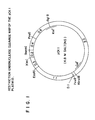
- Restriction endonuclease cleavage maps of pCK 2 and pCK 3 are as shown in FIG. 2 and FIG. 3, respectively.
- the hybrid plasmid according to the present invention is proliferable in the cells of Gram-positive bacteria such as Bacillus subtilis.
- the hybrid plasmid according to the present invention as a plasmid for Gram-positive bacteria, especially for Bacillus subtilis, is useful as vectors for cloning of various genes and for transformation of Gram-positive bacteria.
- the hybrid plasmid according to the present invention may be prepared by a process comprising the steps of (a) joining of unit plasmids, namely, preparing a precursor of the hybrid plasmid of the present invention in microorganism cells and (b) stabilizing the precursor, namely, excising from the precursor the base sequence related to dissociation of the joined plasmid into unit plasmids.
- unit plasmids are introduced into the microorganism cells, which are in turn cultivated to form joined bodies of unit plasmids.
- the host microorganisms to be employed in this case Gram-positive bacteria, especially Bacillus subtilis, are preferred.
- Bacillus subtilis suitable for this purpose are Bacillus subtilis Y12S ("FERM- B P No. 167" on deposit at the Fermentation Research Institute, Agency of Industrial Science and Technology) FERM (genotype: argl5, leuA8, non Al, non Bl) and B. subtilis PS9 (releasable strains stored at Saito's Laboratory, Institute of Applied Microbiology, Tokyo University) genotype: pur B6, leuA8, thr 5, met B5, his Al, lys 21, trp C2, non Al, non Bl). These are mutants of B. subtilis Marburg 168-strain which are strains deficient in restriction endonucleases. Generally speaking, all strains are available which are mutants derived from B. subtilis 168-strain and are deficient in the restriction endonuclease concerned with the unit plasmid to be introduced.
- FERM- B P No. 167 on deposit at the Fermentation Research Institute, Agency of Industrial Science and Technology
- plasmids may be introduced into the cells of Bacillus subtilis by introducing unit plasmids into competent cells cultured on the Spizizen's minimum culture medium, or by reacting the plasmids in the presence of polyethylene glycol with protoplasts formed by treatment of the cells with lysozyme.
- Plural kinds of plasmids may be introduced into the cells either at once or by stepwise additions.
- a preferred process comprises the steps of:
- B. subtilis Y12S into which pCK 1 has been introduced namely B. subtilis Y12S (pCK 1) is on deposit at the "FERM” as "FERM-BP No. 168".
- the joined plasmids constructed as described above in cells can be isolated, but they are instable and tend to be dissociated into the parent unit plasmids in the cells when they are to be used as vectors.
- Stabilization treatment of the joined plasmids comprises excising the base sequence related to dissociation into the unit plasmids comprised in the structure of the joined body.
- the base sequence may also be the association sites to be recognized by the host cells or the unit plasmids.
- an in vitro treatment comprising cleavage by a restriction endonuclease and joining by a ligase may be employed. Since the base sequence is understood to exist at two positions as a minimum as described above, the wording in the present invention "the base sequence related to dissociation has been removed" or "after the base sequence related to dissociation is excised” means that at least one of them is removed or excised.
- the kind of the restriction endonuclease to be used is determined according to the base sequence to be excised. More specifically, for example, when the joined body of plasmids is pCK 1, the base sequence to be excised lies between Eco RI site - Hind III site or between Hind III site - Bgl II site. However, the base sequence to be excised may desirably be at the portion where no selection marker exists between Eco RI site - Hind III site in case of pCK 1.
- Cleavage or ring opening by a restriction endonuclease and subsequent ligation or ring closure may be conducted according to conventional procedures. More specifically, for example, in the case of pCK 1, Eco RI and Hind III are permitted to act thereon to remove the base sequence concerned which is excised and provide a ring-opened plasmid having the Eco RI terminal and the Hind III terminal, which plasmid is then treated with a nuclease (e.g. Sl, BAL - 31) to produce blunt terminals, which step is followed by ligation with the T 4 ligase.
- a nuclease e.g. Sl, BAL - 31
- ligation with the T 4 ligase may be accomplished with addition of various restriction endonuclease linkers such as Eco RI, Bam HI, Pst I, etc.
- the desired hybrid plasmid can be obtained from the thus prepared ring-closed product in a conventional manner.
- the ring-closed product may thus be introduced into Bacillus subtilis according to the protoplast method, etc., to cause transformation thereof, the transformed strains being selected according to the selection markers borne by the hybrid plasmid (Km r or Cm r in the case of pCK 2 and pCK 3) and the desired hybrid plasmid isolated from the selected strains.
- Competent cells of B. subtilis Y12S having plasmid pUB 110 (3.0 Md, Km r ) introduced therein were prepared by the method of Dubnau et al (1) , and 1 ⁇ g of the pC194 plasmid DNA (1.8 Md, Cm r ) was added to 0.5 ml of the competent cells. Incubation was carried out at 37 °C for 30 minutes to cause transformation of the cells and 0.1 ml of the transformed product was spread over a Penassay broth agar plate containing 10 ⁇ g/ml of Cm. Cultivation was conducted at 37 °C for 16 hours to obtain transformed strains of 10 3 / ⁇ g DNA. All of the transformed strains of Cm r were found to be Km r .
- the Cm r , Km r strains were inoculated into Penassay broth medium, and shaking cultivation was carried out at 37 °C for 16 hours and followed by centrifugation, to obtain 2.5 g of wet cells.
- the plasmid was separated from the cells according to the method of Leblanc, L ee (2) to obtain about 150 ⁇ g of plasmid DNA.
- the DNA was divided into aliquots each of half quantity, which were digested with (A) 75 units of the restriction endonuclease Hind III and (B) 75 units of the restriction endonuclease Eco RI, respectively at 37 °C for 3 hours. Each of the digested DNA was then subjected to ethidium bromide-cesium chloride density gradient centrifugation (20 °C/6 hours using a Beckman Vertical Rotor VTi 80, Type L8-80 Ultra-centrifuge).
- B. subtilis Y12S strains were transformed according to the protoplast method of Chang, Cohen et al (4) to obtain transformed strains of Km r , Cm r .
- Two strains of the K m r , Cm transformant from (A) and one strain from (B) were subjected to liquid culture, which was followed by separation of the plasmids.
- Each of the plasmids was cleaved with a restriction endonuclease such as Bgl II, Hind III, Barn HI, Xba I and Eco RI either alone or simultaneously with two or more species, and the respective DNA fragments were analyzed by agarose gel electrophoresis to prepare a restriction endonuclease map.
- a restriction endonuclease such as Bgl II, Hind III, Barn HI, Xba I and Eco RI
- B. subtilis Y12S strain was transformed according to the aforesaid protoplast method, and the transformed strains were spread over protoplast regeneration medium DM3 (5) containing (A) 150 ⁇ g/ml of kanamycin and (B) 10 ⁇ g/ml of chloramphenicol.
- the transformed strains which appeared were replicated onto Penassay broth agar media, containing 10 ⁇ g/ml of Cm for (A) and 10 ⁇ g/ml of Km for (B).
- a strain was formed in each transformed strain of (A) and (B) with a frequency of 0.5 to 5% which became suceptible to one of the reagents.
- the plasmid was separated, cleaved with the restriction endonuclease and examined according to agrose gel electrophoresis, whereby it was found that every plasmid of Km r , Cm s strains was pU B 110 and that of Cm r Km s was pC194.
- pCK 1 hybrid plasmid is dissociated in B. subtilis cells into the parent pUB 110 and pC194, and such a dissociation occurs at specific sites, namely between Hind III site - Eco RI site and between Hind III site - Bgl II site in pCK 1, these sites being considered to be the same as those at which pUB 110 and pC194 are associated to be joined together. It seems likely that the sites are similar to transposon or IS as clarified in Gram-negative bacteria.
- the reaction product was dialyzed in the aforesaid reaction mixture for the T 4 ligase and treated with addition of dithiothreitol, ATP and one unit of the T 4 ligase at 22 °C for 2 hours. With the use of the whole amount of the resultant mixture, B. subtilis Y12S strains were transformed according to the protoplast method.
- Plasmids were separated from five strains of the transformants (Km r , Cm r ) and analyzed according to restriction endonuclease agarose gel electrophoresis. As a result, the plasmids of four strains were found to be pCK 2, while the other one was pCK 3 which was shorter than the pCK 2 by 1.4 Md for some reason.
- the protoplast method with 50 ul of the resultant recombinant DNA solution (about 4 ⁇ g of DNA), and the plasmids were separated for examination from ten transformed strains of Cm r , Km r . Of the ten strains, seven plasmids were found to be the hybrid plasmid of pCK 2 and pSF 588.
- Plasmids were separated from 12 strains of the Cm r , K m s strains, and each after cleavage with Bgl II was subjected to analysis by agarose electrophoresis. As the result, pCK 2 and S. griseus DNA fragments in which pCK 2 had been inserted were detected in each plasmid.
- Bacillus subtilis Y12S used for in vivo joining of unit plasmids is on deposit dated August 20, 1981 at the FERMENTATION RESEARCH INSTITUTE, AGENCY OF INDUSTRIAL SCIENCE AND TECHNOLOGY, 1-3, Higashi 1-chome Yatabe-machi, Tsukuba-gun, Ibaraki-ken, Japan as "FERM P-No. 6110" and FERM BP-No. 167 under the BUDAPEST TREATY ON THE INTERNATIONAL RECOGNITION OF THE DEPOSIT OF MICROORGANISM FOR THE PURPOSES OF PATENT PROCEDURE.
- Bacillus subtilis YS12S (pCK 1), in which the in vivo joined body from pUB 110 and pC194, namely, pCK 1, is incorporated, is on deposit dated August 20, 1981 at the same depository as above as "FERM P-No. 6111" and FERM BP-No. 168 under the same BUDAPEST TREATY.
Landscapes
- Genetics & Genomics (AREA)
- Health & Medical Sciences (AREA)
- Engineering & Computer Science (AREA)
- Life Sciences & Earth Sciences (AREA)
- Chemical & Material Sciences (AREA)
- Wood Science & Technology (AREA)
- Organic Chemistry (AREA)
- Biotechnology (AREA)
- General Engineering & Computer Science (AREA)
- Biomedical Technology (AREA)
- Zoology (AREA)
- Bioinformatics & Cheminformatics (AREA)
- Molecular Biology (AREA)
- Microbiology (AREA)
- Plant Pathology (AREA)
- Physics & Mathematics (AREA)
- Biochemistry (AREA)
- General Health & Medical Sciences (AREA)
- Biophysics (AREA)
- Preparation Of Compounds By Using Micro-Organisms (AREA)
- Saccharide Compounds (AREA)
- Micro-Organisms Or Cultivation Processes Thereof (AREA)
Applications Claiming Priority (2)
| Application Number | Priority Date | Filing Date | Title |
|---|---|---|---|
| JP132328/81 | 1981-08-24 | ||
| JP56132328A JPS5832897A (ja) | 1981-08-24 | 1981-08-24 | 複合プラスミドおよびその製造法 |
Publications (2)
| Publication Number | Publication Date |
|---|---|
| EP0073436A2 true EP0073436A2 (fr) | 1983-03-09 |
| EP0073436A3 EP0073436A3 (fr) | 1984-05-02 |
Family
ID=15078745
Family Applications (1)
| Application Number | Title | Priority Date | Filing Date |
|---|---|---|---|
| EP82107652A Withdrawn EP0073436A3 (fr) | 1981-08-24 | 1982-08-20 | Plasmide hybride et sa préparation |
Country Status (2)
| Country | Link |
|---|---|
| EP (1) | EP0073436A3 (fr) |
| JP (1) | JPS5832897A (fr) |
Cited By (2)
| Publication number | Priority date | Publication date | Assignee | Title |
|---|---|---|---|---|
| FR2532657A1 (fr) * | 1982-09-08 | 1984-03-09 | Eni Ente Naz Idrocarb | Vecteurs plasmides s'exprimant en bacillus subtilis et procede pour leur preparation |
| EP0085548A3 (fr) * | 1982-02-01 | 1985-08-21 | Eli Lilly And Company | Vecteurs de clonage |
Families Citing this family (4)
| Publication number | Priority date | Publication date | Assignee | Title |
|---|---|---|---|---|
| JPS61124031A (ja) * | 1984-11-20 | 1986-06-11 | Matsushita Electric Ind Co Ltd | 画像表示装置の電子銃 |
| JPH01100855A (ja) * | 1987-10-09 | 1989-04-19 | Sony Corp | 螢光表示装置 |
| JPH0233839A (ja) * | 1988-07-25 | 1990-02-05 | Matsushita Electric Ind Co Ltd | 画像表示装置 |
| JP2754546B2 (ja) * | 1987-12-25 | 1998-05-20 | 松下電器産業株式会社 | 画像表示装置 |
Family Cites Families (2)
| Publication number | Priority date | Publication date | Assignee | Title |
|---|---|---|---|---|
| GB2048894A (en) * | 1979-05-11 | 1980-12-17 | Gist Brocades Nv | Plasmid |
| EP0058002A3 (fr) * | 1981-01-26 | 1983-06-29 | The Upjohn Company | Procédé de stabilisation de vecteurs plasmidiques potentiels et vecteurs |
-
1981
- 1981-08-24 JP JP56132328A patent/JPS5832897A/ja active Pending
-
1982
- 1982-08-20 EP EP82107652A patent/EP0073436A3/fr not_active Withdrawn
Cited By (2)
| Publication number | Priority date | Publication date | Assignee | Title |
|---|---|---|---|---|
| EP0085548A3 (fr) * | 1982-02-01 | 1985-08-21 | Eli Lilly And Company | Vecteurs de clonage |
| FR2532657A1 (fr) * | 1982-09-08 | 1984-03-09 | Eni Ente Naz Idrocarb | Vecteurs plasmides s'exprimant en bacillus subtilis et procede pour leur preparation |
Also Published As
| Publication number | Publication date |
|---|---|
| JPS5832897A (ja) | 1983-02-25 |
| EP0073436A3 (fr) | 1984-05-02 |
Similar Documents
| Publication | Publication Date | Title |
|---|---|---|
| US4695546A (en) | Transforming Bacillus stearothermophilus with plasmid vector pTB 19 | |
| ISHIWA et al. | New shuttle vectors for Escherichia coli and Bacillus subtilis. IV. The nucleotide sequence of pHY300PLK and some properties in relation to transformation | |
| CN114908070A (zh) | 一种磷脂酶及其制备甘油磷脂的方法 | |
| EP0317096A2 (fr) | Vecteurs d'expression d'ADN recombinants et composés d'ADN codant pour l'isopénicilline-N-synthétase de streptomyces lipmanii | |
| US5015574A (en) | DNA sequence involved in gene expression and protein secretion, expression-secretion vector including the DNA sequence and the method of producing proteins by using the expression-secretion vector | |
| EP0039743A2 (fr) | Anneaux de plasmides recombinants, à large spectre d'hôte comme vecteur de clonage et leur production | |
| EP0149241A2 (fr) | Séquence de bases d'ADN contenant des régions impliquées dans la production et la sécrétion d'une protéine, ADN recombinant comprenant la totalité ou une partie de la séquence de base d'ADN et méthode pour la production de protéines utilisant cet ADN recombinant | |
| EP0114695A2 (fr) | ADN codant pour une séquence d'acides aminés à fonction signal et vecteurs contenant cette séquence | |
| EP0157253A1 (fr) | Compositions et méthodes pour le clonage d'ADN dans des cyanobactéries | |
| JPH0363357B2 (fr) | ||
| EP0179025B1 (fr) | Méthode de production de protéase neutre | |
| EP0513806B1 (fr) | Gènes de l'esterase, esterase, plasmides recombinants et transformants contenant ces plasmides recombinants, et procédé de préparation d'acides carboxyliques optiquement actifs et leur esters enantiomères en utilisant ces transformants | |
| EP0435725A1 (fr) | ADN avec information génétique pour la phospholipase D et son utilisation | |
| US4418194A (en) | DNA Fragments for forming plasmids | |
| EP0162725B1 (fr) | Vecteur plasmidique chimère | |
| JP2524794B2 (ja) | 複合プラスミドベクタ― | |
| JP2567199B2 (ja) | 枯草菌およびその形成方法 | |
| JP3340164B2 (ja) | 新規なカルシウム調節プロモータpo438 | |
| EP0190252A1 (fr) | Molecule d'adn recombinant, microorganismes transformes et procede de production de penicilline v amidase | |
| EP0576899B1 (fr) | Gène codant pour une protéine ayant une activité lipasique et procédé de production | |
| KR100342448B1 (ko) | 돌연변이체aox2프로모터,이를보유한벡터,형질전환체,및이종단백질의제조방법 | |
| JP2685125B2 (ja) | 新規遺伝子、それを用いた形質転換体及びその利用 | |
| JPH0354551B2 (fr) | ||
| CN120905292A (zh) | 一种用于在杜氏盐藻中表达Pt5-1c活性肽的同源重组表达载体 | |
| JPS5945878A (ja) | ネオマイシン、カナマイシン耐性プラスミドを保有する新規な微生物 |
Legal Events
| Date | Code | Title | Description |
|---|---|---|---|
| PUAI | Public reference made under article 153(3) epc to a published international application that has entered the european phase |
Free format text: ORIGINAL CODE: 0009012 |
|
| AK | Designated contracting states |
Designated state(s): CH DE FR GB LI NL |
|
| PUAL | Search report despatched |
Free format text: ORIGINAL CODE: 0009013 |
|
| AK | Designated contracting states |
Designated state(s): CH DE FR GB LI NL |
|
| 17P | Request for examination filed |
Effective date: 19840606 |
|
| STAA | Information on the status of an ep patent application or granted ep patent |
Free format text: STATUS: THE APPLICATION IS DEEMED TO BE WITHDRAWN |
|
| 18D | Application deemed to be withdrawn |
Effective date: 19860103 |
|
| RIN1 | Information on inventor provided before grant (corrected) |
Inventor name: NOJIRI, CHUHEI Inventor name: KATSUMATA, KAZUKO Inventor name: YAMADA, YUJIRO |