EP0074316A2 - Verfahren zur Herstellung von 3-substituierter Cephalosporinsäure - Google Patents
Verfahren zur Herstellung von 3-substituierter Cephalosporinsäure Download PDFInfo
- Publication number
- EP0074316A2 EP0074316A2 EP82401611A EP82401611A EP0074316A2 EP 0074316 A2 EP0074316 A2 EP 0074316A2 EP 82401611 A EP82401611 A EP 82401611A EP 82401611 A EP82401611 A EP 82401611A EP 0074316 A2 EP0074316 A2 EP 0074316A2
- Authority
- EP
- European Patent Office
- Prior art keywords
- acid
- reaction
- amino
- substituted
- sub
- Prior art date
- Legal status (The legal status is an assumption and is not a legal conclusion. Google has not performed a legal analysis and makes no representation as to the accuracy of the status listed.)
- Granted
Links
Images
Classifications
-
- C—CHEMISTRY; METALLURGY
- C07—ORGANIC CHEMISTRY
- C07D—HETEROCYCLIC COMPOUNDS
- C07D487/00—Heterocyclic compounds containing nitrogen atoms as the only ring hetero atoms in the condensed system, not provided for by groups C07D451/00 - C07D477/00
- C07D487/02—Heterocyclic compounds containing nitrogen atoms as the only ring hetero atoms in the condensed system, not provided for by groups C07D451/00 - C07D477/00 in which the condensed system contains two hetero rings
- C07D487/04—Ortho-condensed systems
-
- C—CHEMISTRY; METALLURGY
- C07—ORGANIC CHEMISTRY
- C07D—HETEROCYCLIC COMPOUNDS
- C07D505/00—Heterocyclic compounds containing 5-oxa-1-azabicyclo [4.2.0] octane ring systems, i.e. compounds containing a ring system of the formula:, e.g. oxacephalosporins; Such ring systems being further condensed, e.g. 2,3-condensed with an oxygen-, nitrogen- or sulfur-containing hetero ring
Definitions
- this process has the drawback of a loss of organic solvent, which product increases the production cost,like those which recite the use of mixtures of water with a high proportion of organic solvent.
- substituent for example in the case of the azido group (N 3 ) and, of course, with the 4 position carboxyl derivatives, which require a later unblocking treatment of such function.
- solubility in the organic solvent There are also difficulties and limitations of solubility in the organic solvent.
- DeMarinis et al. J. Medicinal Chem., 19, 758, 1976
- Nannini et al Arzneim.-Forsch./Drug Res., 27 (I), 2, 343, 1977
- Nannini et al also describe similar reactions, but they do not describe the yields and characteristics of the products described therein.
- reaction mixtures of 7-ACA and thiols give compounds having an earthy appearance and a dark brown colour.
- the high content of various impurities and their difficult elimination cause great losses, with a reduction of the yield. Therefore, the isolated raw products are usually used without subsequent treatment, in the preparation of the N-acyl derivatives, as mentioned in publications and patents.
- the purification is effected on the end product, with a greater level of loss, as the present applicant has observed.
- the Applicant has carried out research with a view to develop a simple method capable of exploitation on an industrial scale and free from the above drawbacks for the substitution of the acetoxy group of 7-ACA and the like, with a high yield and purity.
- the object of the present invention is to provide a process for the production of a 3-substituted 7-amino- cephalosporanic acid, of interest as an intermediate for the preparation of cephalosporins, obtainable with a high yield and purity from a 7-aminocephalosporanic acid using simple technology. Further objects and advantages of the invention will be evident from the following description.
- R 3 is selected from among methyl, butyl, phenyl, benzyl, furyl, thienyl, oxazolyl, thioxazolyl, thiadiazolyl, triazolyl, tetrazolyl, benzoxazolyl, imidazolyl, pyrazolyl, pyridyl, pyrazinyl, pyrimidinyl, quinazoline, quinoline, triatriazolyl, benzimidazolyl, purinyl, pyridine-1-oxido-2-yl, pyridazine-1-oxido-6-yl and tetrazolylpyridizanilyl and the like, which may be substituted as indicated above.
- heterocyclic groups for R 3 the nitrogenated groups containing at least one atom of nitrogen with or without an atom of oxygen and sulphur are preferred.
- the process of the invention may consist in reacting a 7-aminocephalosporanic acid in an aqueous medium with a mercapto compound, as expressed in scheme 1, where X, Y, R 1 and R 3 are as hereinbefore defined, at temperatures lying between 30° and 95°C, at a reaction isoelectric pH lying between 4.2 and 5.9.
- Isoelectric pH values of several 7-amino-cephalosporanic acids, at saturation in water and at different temperatures, are given in Table I. This pH characterises the maximum insolubility of the compound and its maximum stability to the effect of heat. Likewise, under these pH and temperature conditions, the reactants are isolated practically unaltered after 60 min at, for example, 80°C, namely, the 7-amino-cephalosporanic acid and the thiol compound.
- the aqueous medium is constituted by an aggregate of ionic species of the 7 - aminocephalosporanic acid, precursor of the zwitterion.
- the aqueous medium is constituted by an aggregate of ionic species of the 7 - aminocephalosporanic acid, precursor of the zwitterion.
- the acetate ion and a new aggregate is formed, the latter evolves preferably to the zwitterion and precipitates out. Both effects become sensitive to the pH measurements.
- the equilibrium between the zwitterion and the ionic species aggregate is also affected by the concentration.
- r.i. pH values lying between 4.2 and 5.6 at reaction temperatures lying between 30° and 95°C.
- r.i. pH values are attained by the combination of a proportion of a thiol compound, a tertiary base and the 7-aminocephalosporanic acid, for one volume of aqueous solution, at the desired temperature.
- the proportions of the different components of the mixture are determined by pH measurements.
- the pH values of aqueous thiol solutions are also orientative and some are given in Table II.
- the temperature may be set to between 30° and 95°C and the times may range from 30 to 180 minutes. Preferably, relatively short times and temperatures ranging from 40° to 70°C are chosen.
- the chemical process for the conversion of the acetoxy group starting out from 7-aminocephalosporanic acid (known as 7-ACA) or from 7-amino-7-methoxy-cephalosporanic acid (known as 7-AMCA) or 7-amino-7-methylcephalosporanic acid (known as 7-AMECA) with a mercapto compound in an aqueous medium for the formation of the product of formula I is effected, according to the invention, for example, as shown specifically in Scheme 2, for the substitution with 2-mercapto-5-methyl-1,3,4-thiadiazole to obtain the corresponding derivative, known as 7-ACA-TD.
- 7-ACA 7-aminocephalosporanic acid
- 7-AMCA 7-amino-7-methoxy-cephalosporanic acid
- 7-AMECA 7-amino-7-methylcephalosporanic acid
- reaction mixture volume the temperature thereof and optimum pH, for example, between 4.2 and 4.9, are chosen to attain the formation of a solution, with the amounts expressed in Example 4.
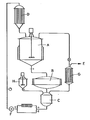
- the mixture A is caused to flow continuously through the solid-liquid B separator, where the 7-AGA-TD, which precipitates out, is retained. In this way, the process is controlled and the 7-AGA-TD is isolated from the solution components and from an extended thermal effect.
- the flow is facilitated by the pump F and a vacuum gradient (E) between A and C.
- the temperature is held constant through the pre - heater D and the steam condensation is controlled with the heat exchanger G.
- a general formula for carrying out the process consists of the preparation of a solution comprising the water, the mercapto. derivative and its organic tertiary base salt. Thereafter a set weight of 7-ACA or 7-AMCA or 7-AMECA is added to obtain a concentration preferably of from 0.4 to 4% at the reaction isoelectric pH.
- a concentration preferably of from 0.4 to 4% at the reaction isoelectric pH.
- boric acid, or the introduction of a current of carbon dioxide, trimethylacetic acid, 2-ethylhexanoic acid and the like are auxiliary components for adjusting the pH to the 7-amino- cephalosporanic acid concentration, which may even be up to 8%.
- the mercapto compound salts are prepared in the aqueous medium with the chosen mercapto compound of formula IV and the chosen tertiary base.
- This may be selected from among the group of the bicyclic amidines, such as DBN and DBU, respectively, 1,5-diazabicycloL[4.3.0]non-ene and 1,5-diazabicyclo [5.4.0]undec-5-ene, and the like,heterocyclic bases such as pyridine, picolines, lutidines and quinoleins, tertiary amines such as tributylamine, tripropylamine and the like.
- the proportion of these salts may vary relative to the stoichiometry, up to four times more.
- the excess may then be recovered from the mother liquors resulting from the reaction and also from the liquors used for washing the 3-substituted 7-aminocephalosporanic acid isolated from the mixture. All those amines are also conveniently used to form combinations to obtain the reaction isoelectric pH.
- the reaction mixture at the r.i. pH need not be a solution initially, it may be constituted by a partial suspension of one of the components. Nevertheless, it is preferable to conduct the conversion, obtaining initially a complete solution and the chemical process is characterised by the following physicochemical parameters :
- reaction temperature need not be the solution temperature.
- the reaction mixture containing a 7-aminocephalosporanic acid or an isostere to be substituted is heated to the temperature at which solution takes place, for example between 75 and 95°C.
- the resulting solution is cooled in a short time to the reaction temperature, for example, selected between 40 and 60°c.
- This temperature is preferably adopted, in accordance with the r.i. pH causing precipitation of the 3-substituted 7-aminocephalosporanic acid.
- the isolation temperature may coincide with the reaction temperature, such as room temperature or close thereto. The remainder of the product formed is isolated from the mother liquors, adjusted to the isolation pH.
- a further alternative of the method consists of preparing the 7-aminocephalosporanic acid solution at one temperature, then adding the acid component until the r.i.pH is reached and then cooling to the reaction temperature which is lower than the solution temperature.
- a convenient proportion of a miscible organic solvent such as the lower alcohols, acetone, ethylene glycol and 1,2-dimethoxyethane may be added to the reaction medium.
- the amount of the latter is adjusted according to the solubility of the thiol in the mixtures with water at the r.i. pH.
- thiophenol Example 12
- the absence of isopropanol causes precipitation of the product in form of a paste ; an excess of alcohol causes a drop in yield.
- 1,2-dimethoxyethane increases the yield. The importance of the r.i.
- Example 1 pH is also reflected in Example 1, at which pH, the 7-ACA-N 3 remains in solution at the reaction temperature. Its r.i. pH, around 4.6, at which precipitation takes place, shows that the conversion must be continued at 50°C, controlling the pH with shorter reaction times. Thus an increase in yield is obtained, particularly with the salt of hydronitric acid and a bicyclic amidine.
- This may comprise, as possible starting products, the 7-aminoce p h a l o-sporanic acids and their isosteres, the 7-aminooxacephalo- sporanic acids and 7-aminoazacephalosporanic acids, all known.
- the parameters are controlled first by infrared spectroscopy and then the corresponding process parameters are adjusted, according to the results of the proton magnetic resonance.
- All the compounds prepared in this way may be used directly for the acylation reactions ; nevertheless, if wished, they may be purified by simple solution in hydrochloric acid, decolouring with activated carbon and precipitation at pH 1.8-2.2 (20°C), with a high yield and virtually analytical purity.
- EXAMPLE 1 7-AMINO-3(AZIDOMETGYL)-3-CEPHEM-4-CARBOXYLIC ACID (7-AC A-N, ). 82.5 g of triethylamine hydrochloride were added to a solution of 40 g of sodium azide in three litres of water. Thereafter there were added 30 g of 7-amino-cephalosporanic acid (90%), causing a change of pH from 7.15 (20°C) to 5.24 at 50°C.
- the mixture was stirred for 60 min at 70°C, the pH progressing from 5.1 to 5.6 6 g of activated carbon were added over the last 30 min, in three portions, one every ten minutes.
- the mixture was filtered and ajusted to pH 4.60 at 40°C, with the addition of acetic acid, the precipitation being initiated.
- the mixture was cooled to 5°C and the pH readjusted to 4.24. After 30 min, the solid, after being filtered, washed with water and acetone, gave 14.0 g of the compound of the title, with a 54% yield.
- Example 2 When the amounts of Example 2 were used and the boric acid was replaced by a carbon dioxide flow in a volume of 9 litres of water for the reaction mixture, the reaction isoelectric pH was about 5.0. Precipitation started about 40 min after start of treatment. On cooling, the precipitate increased and the pH was adjusted to 4.8 at 20°C. After 20 min the solid was isolated as described in Example 2 to give 38.85 g of the compound of the title, with identical properties.
- EXAMPLE 4 Continuous separation process for 3-substituted 7-aminocephalosporanic acids.
- reactor A was charged with :
- the compound had similar properties to the one prepared in the previous Examples.
- EXAMPLE 8 7-amino-3-[(1phenyl-1,2,3,4-tetrazo-5-yl) thiomethyl]-3-cephem-4-carboxylic acid (7-ACA-PhT).
- Example 8 was followed, but the triethylamine was replaced by an equivalent amount of DBU.
- the reaction isoelectric pH values were of the same order and the compound of the title was obtained with a similar yield.
- IR(KBr)» 330(NH 2 ) ; 3120 (thiadiazole) ; 1800(beta-lactam); 1620(band with two peaks at 1635 and 1618) ; 1520 (NH , broad band between 1540 and 150 0 ) cm -1 .
- 1 H-NMR(F 3 CCOOH + D 2 O) ⁇ ppm : 3,51(2H,s,H-2) ; 4,23 (2H,c, CH 2 S ; J 15,0 HZ) ; 5,05(2H,s, H-6,H-7).
- the analytical profile of the process has characteristics substantially identical to those of the previous example.
- EXAMPLE 17 7-amino-3[(3-methoxy-pyridazin-6-yl)-thiomethyl]-3-cephem-4-carboxylic acid.
Landscapes
- Chemical & Material Sciences (AREA)
- Organic Chemistry (AREA)
- Cephalosporin Compounds (AREA)
- Nitrogen Condensed Heterocyclic Rings (AREA)
- Nitrogen And Oxygen Or Sulfur-Condensed Heterocyclic Ring Systems (AREA)
Priority Applications (1)
| Application Number | Priority Date | Filing Date | Title |
|---|---|---|---|
| AT82401611T ATE24514T1 (de) | 1981-09-01 | 1982-08-31 | Verfahren zur herstellung von 3-substituierter cephalosporinsaeure. |
Applications Claiming Priority (2)
| Application Number | Priority Date | Filing Date | Title |
|---|---|---|---|
| ES505092A ES8300334A1 (es) | 1981-09-01 | 1981-09-01 | Procedimiento para la preparacion de un acido 7-aminocefa- losporanido-3-substituido |
| ES505092 | 1981-09-01 |
Publications (3)
| Publication Number | Publication Date |
|---|---|
| EP0074316A2 true EP0074316A2 (de) | 1983-03-16 |
| EP0074316A3 EP0074316A3 (en) | 1983-08-31 |
| EP0074316B1 EP0074316B1 (de) | 1986-12-30 |
Family
ID=8482901
Family Applications (1)
| Application Number | Title | Priority Date | Filing Date |
|---|---|---|---|
| EP82401611A Expired EP0074316B1 (de) | 1981-09-01 | 1982-08-31 | Verfahren zur Herstellung von 3-substituierter Cephalosporinsäure |
Country Status (7)
| Country | Link |
|---|---|
| US (1) | US4481357A (de) |
| EP (1) | EP0074316B1 (de) |
| JP (1) | JPS5874684A (de) |
| AT (1) | ATE24514T1 (de) |
| CA (1) | CA1190543A (de) |
| DE (1) | DE3274862D1 (de) |
| ES (1) | ES8300334A1 (de) |
Families Citing this family (1)
| Publication number | Priority date | Publication date | Assignee | Title |
|---|---|---|---|---|
| CN109422767B (zh) * | 2017-08-30 | 2021-07-02 | 重庆天地药业有限责任公司 | 甲氧头孢中间体、其制备方法和头孢米诺钠的合成方法 |
Family Cites Families (2)
| Publication number | Priority date | Publication date | Assignee | Title |
|---|---|---|---|---|
| CH527215A (de) * | 1967-04-15 | 1972-08-31 | Fujisawa Pharmaceutical Co | Verfahren zur Herstellung von 3,7-disubstituierten Cephalosporinderivaten |
| JPS6027677B2 (ja) * | 1978-07-06 | 1985-06-29 | 富山化学工業株式会社 | 7−置換又は非置換アミノ−3−置換チオメチルセフエムカルボン酸類の新規製造法 |
-
1981
- 1981-09-01 ES ES505092A patent/ES8300334A1/es not_active Expired
-
1982
- 1982-08-19 CA CA000406046A patent/CA1190543A/en not_active Expired
- 1982-08-24 US US06/410,932 patent/US4481357A/en not_active Expired - Fee Related
- 1982-08-31 AT AT82401611T patent/ATE24514T1/de not_active IP Right Cessation
- 1982-08-31 EP EP82401611A patent/EP0074316B1/de not_active Expired
- 1982-08-31 DE DE8282401611T patent/DE3274862D1/de not_active Expired
- 1982-09-01 JP JP57152480A patent/JPS5874684A/ja active Pending
Also Published As
| Publication number | Publication date |
|---|---|
| ATE24514T1 (de) | 1987-01-15 |
| US4481357A (en) | 1984-11-06 |
| EP0074316B1 (de) | 1986-12-30 |
| ES505092A0 (es) | 1982-11-01 |
| ES8300334A1 (es) | 1982-11-01 |
| JPS5874684A (ja) | 1983-05-06 |
| CA1190543A (en) | 1985-07-16 |
| EP0074316A3 (en) | 1983-08-31 |
| DE3274862D1 (en) | 1987-02-05 |
Similar Documents
| Publication | Publication Date | Title |
|---|---|---|
| EP0001133A1 (de) | Verfahren zur Herstellung von 6- D-alpha-amino-(p-hydroxyphenyl)-acetamido penicillansaüre | |
| US3907786A (en) | 7-{8 {60 -(2-aminomethyl-1,4-cyclohexadienyl)acetamido{9 -3-heterocyclic-thiomethyl-3-cephem-4-carboxylic acids and salts | |
| EP0053077B1 (de) | Salze von 7-Amino-cephalosporinsäure, löslich in organischen Lösungsmittel, und ihre Verwendung für die Herstellung von Cephalosporinverbindungen | |
| JPS6337112B2 (de) | ||
| CA1052769A (en) | Process for preparing cefazolin | |
| EP0074316B1 (de) | Verfahren zur Herstellung von 3-substituierter Cephalosporinsäure | |
| FI69309C (fi) | Foerfarande foer framstaellning av 3-tiometylkefalosporansyraderivat | |
| EP0175814A2 (de) | Verfahren zur Herstellung von Cephem-Verbindungen | |
| JPH05202060A (ja) | ベータラクタム製造に関する改良法 | |
| JPH07108896B2 (ja) | アミノ―ベーターラクタム酸塩およびその製造方法 | |
| EP0045717B1 (de) | Cephalosporinderivate, ihre Herstellung und Anwendung | |
| CA1236089A (en) | Ceftazidime | |
| JP2662176B2 (ja) | 3−ビニルセファロスポリンの製造法 | |
| JPH07145173A (ja) | セファロスポリン中間体の製造方法 | |
| US6248881B1 (en) | Intermediates and process for the production of 3-vinyl cephalosporins | |
| US5585485A (en) | Cephalosporin intermediate products | |
| US4058609A (en) | 7-Dithioacetamido cephalosporins | |
| US4237280A (en) | Intermediate for cephalosporin type compound | |
| KR810000759B1 (ko) | 세팔로스포린 유도체의 제조방법 | |
| JP2525013B2 (ja) | 新規結晶性セファロスポリン誘導体 | |
| JPH01258683A (ja) | 7―/D(−)アルフア―アミノ アルフア―(p―ヒドロキシフエニル)アセトアミド/―3―(1,2,3―トリアゾル―4(5)―チオメチル―3―セフエム―4―カルボン酸1,2プロピレングリコレートの製造びその製造のための新規中間体 | |
| GB2183232A (en) | Acetic acid thioesters as starting materials for cephalosporins | |
| US3898221A (en) | Trifluoromethylmercaptoacetamidocephalosporins | |
| CA1099257A (en) | Cephalosporin derivatives | |
| GB2053893A (en) | Process for The Manufacture of 7-(oximinoacetamido)-Cephem Compounds |
Legal Events
| Date | Code | Title | Description |
|---|---|---|---|
| PUAI | Public reference made under article 153(3) epc to a published international application that has entered the european phase |
Free format text: ORIGINAL CODE: 0009012 |
|
| AK | Designated contracting states |
Designated state(s): AT BE CH DE FR GB IT LI NL SE |
|
| PUAL | Search report despatched |
Free format text: ORIGINAL CODE: 0009013 |
|
| AK | Designated contracting states |
Designated state(s): AT BE CH DE FR GB IT LI NL SE |
|
| 17P | Request for examination filed |
Effective date: 19840216 |
|
| GRAA | (expected) grant |
Free format text: ORIGINAL CODE: 0009210 |
|
| ITF | It: translation for a ep patent filed | ||
| AK | Designated contracting states |
Kind code of ref document: B1 Designated state(s): AT BE CH DE FR GB IT LI NL SE |
|
| REF | Corresponds to: |
Ref document number: 24514 Country of ref document: AT Date of ref document: 19870115 Kind code of ref document: T |
|
| REF | Corresponds to: |
Ref document number: 3274862 Country of ref document: DE Date of ref document: 19870205 |
|
| ET | Fr: translation filed | ||
| PLBE | No opposition filed within time limit |
Free format text: ORIGINAL CODE: 0009261 |
|
| STAA | Information on the status of an ep patent application or granted ep patent |
Free format text: STATUS: NO OPPOSITION FILED WITHIN TIME LIMIT |
|
| 26N | No opposition filed | ||
| PGFP | Annual fee paid to national office [announced via postgrant information from national office to epo] |
Ref country code: FR Payment date: 19890724 Year of fee payment: 8 Ref country code: CH Payment date: 19890724 Year of fee payment: 8 |
|
| PGFP | Annual fee paid to national office [announced via postgrant information from national office to epo] |
Ref country code: SE Payment date: 19890725 Year of fee payment: 8 |
|
| PGFP | Annual fee paid to national office [announced via postgrant information from national office to epo] |
Ref country code: GB Payment date: 19890731 Year of fee payment: 8 |
|
| PGFP | Annual fee paid to national office [announced via postgrant information from national office to epo] |
Ref country code: DE Payment date: 19890817 Year of fee payment: 8 |
|
| ITTA | It: last paid annual fee | ||
| PGFP | Annual fee paid to national office [announced via postgrant information from national office to epo] |
Ref country code: NL Payment date: 19890831 Year of fee payment: 8 |
|
| PGFP | Annual fee paid to national office [announced via postgrant information from national office to epo] |
Ref country code: BE Payment date: 19890914 Year of fee payment: 8 |
|
| PG25 | Lapsed in a contracting state [announced via postgrant information from national office to epo] |
Ref country code: LI Effective date: 19900831 Ref country code: GB Effective date: 19900831 Ref country code: CH Effective date: 19900831 Ref country code: BE Effective date: 19900831 |
|
| PG25 | Lapsed in a contracting state [announced via postgrant information from national office to epo] |
Ref country code: SE Effective date: 19900901 |
|
| BERE | Be: lapsed |
Owner name: GEMA S.A. Effective date: 19900831 |
|
| PG25 | Lapsed in a contracting state [announced via postgrant information from national office to epo] |
Ref country code: NL Effective date: 19910301 |
|
| NLV4 | Nl: lapsed or anulled due to non-payment of the annual fee | ||
| PG25 | Lapsed in a contracting state [announced via postgrant information from national office to epo] |
Ref country code: FR Effective date: 19910430 |
|
| REG | Reference to a national code |
Ref country code: CH Ref legal event code: PL |
|
| GBPC | Gb: european patent ceased through non-payment of renewal fee | ||
| PG25 | Lapsed in a contracting state [announced via postgrant information from national office to epo] |
Ref country code: DE Effective date: 19910501 |
|
| REG | Reference to a national code |
Ref country code: FR Ref legal event code: ST |
|
| PGFP | Annual fee paid to national office [announced via postgrant information from national office to epo] |
Ref country code: AT Payment date: 19940810 Year of fee payment: 13 |
|
| EUG | Se: european patent has lapsed |
Ref document number: 82401611.7 Effective date: 19910527 |
|
| PG25 | Lapsed in a contracting state [announced via postgrant information from national office to epo] |
Ref country code: AT Effective date: 19950831 |