EP0074507A2 - Matériau pour contacts électriques et procédé de sa fabrication - Google Patents
Matériau pour contacts électriques et procédé de sa fabrication Download PDFInfo
- Publication number
- EP0074507A2 EP0074507A2 EP82107573A EP82107573A EP0074507A2 EP 0074507 A2 EP0074507 A2 EP 0074507A2 EP 82107573 A EP82107573 A EP 82107573A EP 82107573 A EP82107573 A EP 82107573A EP 0074507 A2 EP0074507 A2 EP 0074507A2
- Authority
- EP
- European Patent Office
- Prior art keywords
- oxide
- glass
- glass frit
- material according
- bar
- Prior art date
- Legal status (The legal status is an assumption and is not a legal conclusion. Google has not performed a legal analysis and makes no representation as to the accuracy of the status listed.)
- Withdrawn
Links
- 239000000463 material Substances 0.000 title claims abstract description 23
- 238000000034 method Methods 0.000 title claims description 6
- 238000004519 manufacturing process Methods 0.000 title claims description 5
- 239000011521 glass Substances 0.000 claims abstract description 23
- 229910000510 noble metal Inorganic materials 0.000 claims abstract description 11
- 230000009466 transformation Effects 0.000 claims abstract description 7
- KDLHZDBZIXYQEI-UHFFFAOYSA-N Palladium Chemical compound [Pd] KDLHZDBZIXYQEI-UHFFFAOYSA-N 0.000 claims description 6
- 239000002245 particle Substances 0.000 claims description 6
- 238000005245 sintering Methods 0.000 claims description 6
- 229910045601 alloy Inorganic materials 0.000 claims description 5
- 239000000956 alloy Substances 0.000 claims description 5
- PCHJSUWPFVWCPO-UHFFFAOYSA-N gold Chemical compound [Au] PCHJSUWPFVWCPO-UHFFFAOYSA-N 0.000 claims description 5
- VYPSYNLAJGMNEJ-UHFFFAOYSA-N Silicium dioxide Chemical compound O=[Si]=O VYPSYNLAJGMNEJ-UHFFFAOYSA-N 0.000 claims description 4
- XLOMVQKBTHCTTD-UHFFFAOYSA-N Zinc monoxide Chemical compound [Zn]=O XLOMVQKBTHCTTD-UHFFFAOYSA-N 0.000 claims description 4
- 229910052737 gold Inorganic materials 0.000 claims description 4
- 239000010931 gold Substances 0.000 claims description 4
- 239000010970 precious metal Substances 0.000 claims description 4
- 238000003825 pressing Methods 0.000 claims description 4
- GWEVSGVZZGPLCZ-UHFFFAOYSA-N Titan oxide Chemical compound O=[Ti]=O GWEVSGVZZGPLCZ-UHFFFAOYSA-N 0.000 claims description 3
- 229910000272 alkali metal oxide Inorganic materials 0.000 claims description 3
- 229910052763 palladium Inorganic materials 0.000 claims description 3
- 229910052709 silver Inorganic materials 0.000 claims description 3
- 239000004332 silver Substances 0.000 claims description 3
- XOLBLPGZBRYERU-UHFFFAOYSA-N tin dioxide Chemical compound O=[Sn]=O XOLBLPGZBRYERU-UHFFFAOYSA-N 0.000 claims description 3
- 229910052810 boron oxide Inorganic materials 0.000 claims description 2
- JKWMSGQKBLHBQQ-UHFFFAOYSA-N diboron trioxide Chemical compound O=BOB=O JKWMSGQKBLHBQQ-UHFFFAOYSA-N 0.000 claims description 2
- 229910000464 lead oxide Inorganic materials 0.000 claims description 2
- 238000002156 mixing Methods 0.000 claims description 2
- TWNQGVIAIRXVLR-UHFFFAOYSA-N oxo(oxoalumanyloxy)alumane Chemical compound O=[Al]O[Al]=O TWNQGVIAIRXVLR-UHFFFAOYSA-N 0.000 claims description 2
- RVTZCBVAJQQJTK-UHFFFAOYSA-N oxygen(2-);zirconium(4+) Chemical compound [O-2].[O-2].[Zr+4] RVTZCBVAJQQJTK-UHFFFAOYSA-N 0.000 claims description 2
- 235000012239 silicon dioxide Nutrition 0.000 claims description 2
- 239000000377 silicon dioxide Substances 0.000 claims description 2
- 238000003856 thermoforming Methods 0.000 claims description 2
- 239000011787 zinc oxide Substances 0.000 claims description 2
- YEXPOXQUZXUXJW-UHFFFAOYSA-N oxolead Chemical compound [Pb]=O YEXPOXQUZXUXJW-UHFFFAOYSA-N 0.000 claims 1
- 229910001887 tin oxide Inorganic materials 0.000 claims 1
- OGIDPMRJRNCKJF-UHFFFAOYSA-N titanium oxide Inorganic materials [Ti]=O OGIDPMRJRNCKJF-UHFFFAOYSA-N 0.000 claims 1
- 229910001928 zirconium oxide Inorganic materials 0.000 claims 1
- 238000005260 corrosion Methods 0.000 abstract description 4
- 230000007797 corrosion Effects 0.000 abstract description 4
- 238000007254 oxidation reaction Methods 0.000 abstract description 3
- 230000003647 oxidation Effects 0.000 abstract description 2
- 239000007769 metal material Substances 0.000 abstract 1
- 239000000843 powder Substances 0.000 description 7
- BQCADISMDOOEFD-UHFFFAOYSA-N Silver Chemical compound [Ag] BQCADISMDOOEFD-UHFFFAOYSA-N 0.000 description 3
- 239000000203 mixture Substances 0.000 description 3
- CSCPPACGZOOCGX-UHFFFAOYSA-N Acetone Chemical compound CC(C)=O CSCPPACGZOOCGX-UHFFFAOYSA-N 0.000 description 2
- PXHVJJICTQNCMI-UHFFFAOYSA-N Nickel Chemical compound [Ni] PXHVJJICTQNCMI-UHFFFAOYSA-N 0.000 description 2
- 238000001125 extrusion Methods 0.000 description 2
- HTUMBQDCCIXGCV-UHFFFAOYSA-N lead oxide Chemical compound [O-2].[Pb+2] HTUMBQDCCIXGCV-UHFFFAOYSA-N 0.000 description 2
- 229910052751 metal Inorganic materials 0.000 description 2
- 239000002184 metal Substances 0.000 description 2
- BASFCYQUMIYNBI-UHFFFAOYSA-N platinum Chemical compound [Pt] BASFCYQUMIYNBI-UHFFFAOYSA-N 0.000 description 2
- 229910018072 Al 2 O 3 Inorganic materials 0.000 description 1
- 229910001020 Au alloy Inorganic materials 0.000 description 1
- RYGMFSIKBFXOCR-UHFFFAOYSA-N Copper Chemical compound [Cu] RYGMFSIKBFXOCR-UHFFFAOYSA-N 0.000 description 1
- MCMNRKCIXSYSNV-UHFFFAOYSA-N ZrO2 Inorganic materials O=[Zr]=O MCMNRKCIXSYSNV-UHFFFAOYSA-N 0.000 description 1
- 238000005299 abrasion Methods 0.000 description 1
- 229910002065 alloy metal Inorganic materials 0.000 description 1
- 238000000137 annealing Methods 0.000 description 1
- 239000010953 base metal Substances 0.000 description 1
- 238000005097 cold rolling Methods 0.000 description 1
- 229910052802 copper Inorganic materials 0.000 description 1
- 239000010949 copper Substances 0.000 description 1
- 230000003247 decreasing effect Effects 0.000 description 1
- 238000010586 diagram Methods 0.000 description 1
- 239000003353 gold alloy Substances 0.000 description 1
- 238000010438 heat treatment Methods 0.000 description 1
- 238000005098 hot rolling Methods 0.000 description 1
- 230000001771 impaired effect Effects 0.000 description 1
- 239000007791 liquid phase Substances 0.000 description 1
- 239000002923 metal particle Substances 0.000 description 1
- 229910052759 nickel Inorganic materials 0.000 description 1
- 229910052697 platinum Inorganic materials 0.000 description 1
- 229910000923 precious metal alloy Inorganic materials 0.000 description 1
- 239000004408 titanium dioxide Substances 0.000 description 1
- 230000007704 transition Effects 0.000 description 1
- 239000002699 waste material Substances 0.000 description 1
Images
Classifications
-
- H—ELECTRICITY
- H01—ELECTRIC ELEMENTS
- H01H—ELECTRIC SWITCHES; RELAYS; SELECTORS; EMERGENCY PROTECTIVE DEVICES
- H01H1/00—Contacts
- H01H1/02—Contacts characterised by the material thereof
- H01H1/021—Composite material
- H01H1/023—Composite material having a noble metal as the basic material
- H01H1/0237—Composite material having a noble metal as the basic material and containing oxides
Definitions
- the invention relates to a material for electrical contacts made of precious metal, in particular for low-voltage contacts, and a method for its production.
- Low-voltage electrical contacts are made of silver, gold, palladium or platinum materials, depending on the application conditions. When choosing the material, the switching voltage and nominal current, the switching frequency and switching reliability, the mechanical load and the corrosive atmosphere must be taken into account in addition to the price.
- a contact material is primarily required to have sufficient abrasion resistance, good electrical conductivity and a low contact resistance.
- the contact materials should neither corrode nor form tarnish layers. For these reasons, precious metals are ideal contact materials in themselves, the only disadvantage is the high price, the hardness and strength that are too low for many applications and thus the insufficient resistance to wear.
- the pure noble metals are therefore mostly alloyed with base metals.
- alloy metals are copper and nickel.
- Precious metal alloys as a contact but materials have a lower electrical conductivity - ability, increased resistance and higher Unedelmetallzel size-oxidation and corrosion susceptibility.
- This object was achieved in that it contains 1 to 50 vol .-% glass.
- a glass frit with a transformation temperature of 40.0 to 750 ° C. and a softening interval of more than 100 ° C. is preferably used as the glass.
- the transformation temperature specifies the transition of the frits from the brittle to the viscous state and is determined by a kink in the temperature-property curves. The temperature corresponding to the point of intersection of the tangents is called the transformation temperature. temperature at which the frits normally have a viscosity of approximately 10 12 Pa ⁇ sec.
- the softening interval is the temperature interval between the start of softening of the frit and its hemisphere temperature, both limit values being determined on cylindrical test specimens under the heating microscope. At the start of softening, an edge rounding is observed, at the hemisphere temperature is the cylindrical test specimen per melted into a hemisphere.
- the softening interval is a measure of the dependence of the viscosity on the temperature.
- Glass frits containing 15 to 75% by weight of lead oxide and / or zinc oxide, 5 to 65% by weight of silicon dioxide, 0 to 25% by weight of boron oxide and 0 to 20% by weight of alkali oxides are preferably used. In addition, up to 10% by weight can be added .
- Aluminum oxide, zirconium dioxide, titanium dioxide and / or tin dioxide can be added to the glass frit.
- glass frits with a low transformation temperature and a wide softening interval means that the glass softens considerably below the usual sintering temperatures of the noble metals or noble metal alloys and that high densities and good deformation properties of the material can be achieved through the process of liquid phase sintering.
- the materials according to the invention preferably contain gold, silver and / or palladium or their alloys as the noble metal component.
- the noble metal content of the material can be considerably reduced without the electrical conductivity decreasing significantly in comparison with corresponding alloys and the corrosion resistance being impaired.
- the wear resistance is also higher than with corresponding alloys, the materials are solderable, galvanizable and easy to process. It is also advantageous to recover the precious metals from waste more easily.
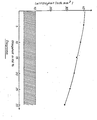
- the diagram shows the dependence of the electrical conductivity of a gold glass material on the glass content.
- the conductivities of the usual gold alloys are in the shaded area.
- the materials according to the invention are produced by mixing the noble metal powder with 1 to 50% by volume, preferably 2 to 30% by volume, of a fine glass frit powder, pressing, sintering and thermoforming.
- the powder mixture is pressed at room temperature and pressures of 500 to 5000 bar, then sintered at 500 to 950 ° C and then thermoformed at 500 to 800 ° C and pressures of 100 to 200 bar, in particular by extrusion. Pressing pressures of 1000 to 3000 bar and sintering temperatures of 550 to 800 ° C are advantageous.
- the glass should have a viscosity of 10 9 to 10 3 Pa ⁇ sec during processing, preferably 10 5 Pa-sec.
- the transformation temperature of the glass frit is 430 ° C, the softening interval is 170 ° C.
- the powder mixture is pressed at room temperature at 1000 bar into bolts with a green compact density of approx. 65% of the theoretical density and then sintered for one hour at 900 ° C, reaching 85% of the theoretical density.
- the sintered body is heated to 750 ° C and extruded at 500 ° C and 150 bar pressure. Further processing into sheet metal is carried out by hot rolling at 800 ° C with a pass reduction of 0.5 mm. Cold rolling with intermediate annealing (550 C, 10 minutes) leads to sheet thicknesses of 0.1 mm.
- Silver powder with an average particle size of 63 ⁇ m is mixed with 25% by volume of the glass frit powder from example 1, pressed at 1000 bar to a green body at room temperature and sintered at 750 ° C. for 1 hour. Extrusion at 700 ° C with 150 bar gives a wire with a diameter of 1.5 mm. The wire diameter can be reduced to 0.4 mm by cold forming (hammering, drawing).
Landscapes
- Chemical & Material Sciences (AREA)
- Engineering & Computer Science (AREA)
- Composite Materials (AREA)
- Materials Engineering (AREA)
- Contacts (AREA)
- Powder Metallurgy (AREA)
- Manufacture Of Switches (AREA)
- Glass Compositions (AREA)
- Conductive Materials (AREA)
- Coupling Device And Connection With Printed Circuit (AREA)
Applications Claiming Priority (2)
| Application Number | Priority Date | Filing Date | Title |
|---|---|---|---|
| DE3135035 | 1981-09-04 | ||
| DE19813135035 DE3135035A1 (de) | 1981-09-04 | 1981-09-04 | Werkstoff fuer elektrische kontakte und verfahren zu seiner herstellung |
Publications (2)
| Publication Number | Publication Date |
|---|---|
| EP0074507A2 true EP0074507A2 (fr) | 1983-03-23 |
| EP0074507A3 EP0074507A3 (fr) | 1983-04-20 |
Family
ID=6140863
Family Applications (1)
| Application Number | Title | Priority Date | Filing Date |
|---|---|---|---|
| EP82107573A Withdrawn EP0074507A3 (fr) | 1981-09-04 | 1982-08-19 | Matériau pour contacts électriques et procédé de sa fabrication |
Country Status (12)
| Country | Link |
|---|---|
| EP (1) | EP0074507A3 (fr) |
| JP (1) | JPS5852452A (fr) |
| AU (1) | AU8710682A (fr) |
| BR (1) | BR8205135A (fr) |
| DE (1) | DE3135035A1 (fr) |
| DK (1) | DK303482A (fr) |
| ES (1) | ES8308445A1 (fr) |
| NO (1) | NO821899L (fr) |
| PL (1) | PL238134A1 (fr) |
| PT (1) | PT75233B (fr) |
| YU (1) | YU149282A (fr) |
| ZA (1) | ZA825763B (fr) |
Cited By (4)
| Publication number | Priority date | Publication date | Assignee | Title |
|---|---|---|---|---|
| EP0123823A1 (fr) * | 1983-04-09 | 1984-11-07 | Lange, Emil | Matériau composite à caractéristique d'extincteur d'arc |
| FR2558640A1 (fr) * | 1984-01-21 | 1985-07-26 | Rau Gmbh G | Materiau composite pour des elements de contact de commandes electriques |
| EP0369282A3 (fr) * | 1988-11-17 | 1991-03-13 | Siemens Aktiengesellschaft | Matériau de contact fritté dans appareillages interrupteurs à basse tension de la technique de l'énergie, spécialement pour des contacteurs |
| DE10038841C1 (de) * | 2000-08-04 | 2001-12-20 | Heraeus Gmbh W C | SiO¶2¶-Glaskolben mit mindestens einer Stromdurchführung, Verfahren zur Herstellung einer gasdichten Verbindung zwischen beiden sowie ihre Verwendung in einer Gasentladungslampe |
Family Cites Families (3)
| Publication number | Priority date | Publication date | Assignee | Title |
|---|---|---|---|---|
| JPS4625848B1 (fr) * | 1966-04-15 | 1971-07-26 | ||
| IT1032907B (it) * | 1974-05-21 | 1979-06-20 | Jenaer Glaswerk Schott & Gen | Materiale composito sinterizzato di vetro e metallo a tenore di rame e procedimento per la sua fabbricazione |
| GB2085481B (en) * | 1980-10-17 | 1985-01-09 | Rca Corp | Improved copper conductor inks |
-
1981
- 1981-09-04 DE DE19813135035 patent/DE3135035A1/de not_active Withdrawn
-
1982
- 1982-06-07 NO NO821899A patent/NO821899L/no unknown
- 1982-06-17 ES ES513200A patent/ES8308445A1/es not_active Expired
- 1982-07-06 DK DK303482A patent/DK303482A/da not_active Application Discontinuation
- 1982-07-08 YU YU01492/82A patent/YU149282A/xx unknown
- 1982-07-12 PT PT75233A patent/PT75233B/pt unknown
- 1982-08-09 ZA ZA825763A patent/ZA825763B/xx unknown
- 1982-08-12 AU AU87106/82A patent/AU8710682A/en not_active Abandoned
- 1982-08-19 EP EP82107573A patent/EP0074507A3/fr not_active Withdrawn
- 1982-09-01 BR BR8205135A patent/BR8205135A/pt unknown
- 1982-09-03 JP JP57152870A patent/JPS5852452A/ja active Pending
- 1982-09-03 PL PL23813482A patent/PL238134A1/xx unknown
Cited By (5)
| Publication number | Priority date | Publication date | Assignee | Title |
|---|---|---|---|---|
| EP0123823A1 (fr) * | 1983-04-09 | 1984-11-07 | Lange, Emil | Matériau composite à caractéristique d'extincteur d'arc |
| FR2558640A1 (fr) * | 1984-01-21 | 1985-07-26 | Rau Gmbh G | Materiau composite pour des elements de contact de commandes electriques |
| EP0369282A3 (fr) * | 1988-11-17 | 1991-03-13 | Siemens Aktiengesellschaft | Matériau de contact fritté dans appareillages interrupteurs à basse tension de la technique de l'énergie, spécialement pour des contacteurs |
| DE10038841C1 (de) * | 2000-08-04 | 2001-12-20 | Heraeus Gmbh W C | SiO¶2¶-Glaskolben mit mindestens einer Stromdurchführung, Verfahren zur Herstellung einer gasdichten Verbindung zwischen beiden sowie ihre Verwendung in einer Gasentladungslampe |
| US6525475B2 (en) | 2000-08-04 | 2003-02-25 | W. C. Heraeus Gmbh & Co. Kg | SiO2-glass bulb with at least one current lead-in, process for producing a gas-tight connection between them, and their use in a gas-discharge lamp |
Also Published As
| Publication number | Publication date |
|---|---|
| DK303482A (da) | 1983-03-05 |
| EP0074507A3 (fr) | 1983-04-20 |
| ES513200A0 (es) | 1983-08-16 |
| ZA825763B (en) | 1983-06-29 |
| ES8308445A1 (es) | 1983-08-16 |
| BR8205135A (pt) | 1983-08-09 |
| NO821899L (no) | 1983-03-07 |
| YU149282A (en) | 1985-03-20 |
| PT75233B (de) | 1984-06-26 |
| AU8710682A (en) | 1983-03-10 |
| JPS5852452A (ja) | 1983-03-28 |
| DE3135035A1 (de) | 1983-03-24 |
| PL238134A1 (en) | 1983-05-09 |
| PT75233A (de) | 1982-08-01 |
Similar Documents
| Publication | Publication Date | Title |
|---|---|---|
| DE69032065T2 (de) | Verbundwerkstoff von Silber und Metalloxyd und Verfahren zur Herstellung desselben | |
| DE68904742T2 (de) | Verfahren zum bereiten eines elektrischen kontaktmaterials und verfahren zum herstellen eines ein solches material enthaltenden kontaktelementes. | |
| DE3523047C2 (de) | Verfahren zur thermomechanischen Behandlung von Kupfer-Berylliumlegierungen | |
| DE3781956T2 (de) | Verfahren zur herstellung eines ag-metalloxid-material fuer elektrische kontakte. | |
| DE2924238C2 (de) | Elektrisches Kontaktmaterial und Verfahren zu seiner Herstellung | |
| DE1935329A1 (de) | Verfahren zur Herstellung dispersionsverstaerkter Metalle oder Metallegierungen und Verwendung der nach diesem Verfahren hergestellten Metalle oder Metallegierungen | |
| EP0080641A1 (fr) | Procédé de fabrication de pièces en matériaux composés d'argent et d'oxyde métallique sans cadmium pour contacts électriques | |
| EP0645049B1 (fr) | Matiere pour contacts electriques a base d'oxyde d'etain et d'argent ou d'oxyde de zinc et d'argent | |
| DE3527341C1 (de) | Kupfer-Chrom-Titan-Silizium-Legierung und ihre Verwendung | |
| DE19503182C1 (de) | Sinterwerkstoff auf der Basis Silber-Zinnoxid für elektrische Kontakte und Verfahren zu dessen Herstellung | |
| EP0586410A1 (fr) | Materiau de contact a base d'argent pour l'utilisation dans des appareils de commutation en technologie des courants forts, ainsi que procede pour la fabrication de pieces de contact en ce materiau. | |
| DE3522341C2 (fr) | ||
| EP0074040B1 (fr) | Matériau à base de métaux précieux et de verre pour objets de parure ou d'utilité courante | |
| CH669211A5 (de) | Kupfer-chrom-titan-silizium-legierung und ihre verwendung. | |
| EP0074507A2 (fr) | Matériau pour contacts électriques et procédé de sa fabrication | |
| DE2948916C2 (de) | Kupfer-Zinn-Legierung, Verfahren zu ihrer Herstellung sowie ihre Verwendung | |
| CH665222A5 (de) | Kupfer-nickel-zinn-titan-legierung, verfahren zu ihrer herstellung sowie ihre verwendung. | |
| DE2303050C3 (de) | Metallegierung für elektrische Kontakte | |
| DE3604861A1 (de) | Verfahren zur pulvermetallurgischen herstellung von feindispersen legierungen | |
| DE2639771A1 (de) | Verfahren zur herstellung von dispersionsverfestigten elektrischen silberkontakten | |
| AT2017U1 (de) | Verwendung einer molybdän-/wolfram-legierung in bauteilen für glasschmelzen | |
| DE2747089C2 (fr) | ||
| DE3224439A1 (de) | Elektrisches kontakmaterial und hestellungsverfahren fuer ein solches | |
| DE3421198C1 (de) | Kupfer-Nickel-Zinn-Titan-Legierung, Verfahren zu ihrer Herstellung sowie ihre Verwendung | |
| EP0876670B1 (fr) | Procede de production d'une piece faconnee a partir d'un materiau de contact a base d'argent |
Legal Events
| Date | Code | Title | Description |
|---|---|---|---|
| PUAI | Public reference made under article 153(3) epc to a published international application that has entered the european phase |
Free format text: ORIGINAL CODE: 0009012 |
|
| PUAL | Search report despatched |
Free format text: ORIGINAL CODE: 0009013 |
|
| 17P | Request for examination filed |
Effective date: 19820819 |
|
| AK | Designated contracting states |
Designated state(s): AT BE CH DE FR GB IT LI NL SE |
|
| AK | Designated contracting states |
Designated state(s): AT BE CH DE FR GB IT LI NL SE |
|
| STAA | Information on the status of an ep patent application or granted ep patent |
Free format text: STATUS: THE APPLICATION HAS BEEN WITHDRAWN |
|
| 18W | Application withdrawn |
Withdrawal date: 19840926 |
|
| RIN1 | Information on inventor provided before grant (corrected) |
Inventor name: JAECKEL, GERNOT Inventor name: HEIDSIEK, HORST, DR. DIPL.-PHYS. |