EP0074903B1 - Dérivés d'amino-2 tétrahydro-1,2,3,4 naphtalène, leur préparation et leur application en thérapeutique - Google Patents
Dérivés d'amino-2 tétrahydro-1,2,3,4 naphtalène, leur préparation et leur application en thérapeutique Download PDFInfo
- Publication number
- EP0074903B1 EP0074903B1 EP82401654A EP82401654A EP0074903B1 EP 0074903 B1 EP0074903 B1 EP 0074903B1 EP 82401654 A EP82401654 A EP 82401654A EP 82401654 A EP82401654 A EP 82401654A EP 0074903 B1 EP0074903 B1 EP 0074903B1
- Authority
- EP
- European Patent Office
- Prior art keywords
- compound
- formula
- group
- dipropylamino
- enantiomers
- Prior art date
- Legal status (The legal status is an assumption and is not a legal conclusion. Google has not performed a legal analysis and makes no representation as to the accuracy of the status listed.)
- Expired
Links
- 238000002360 preparation method Methods 0.000 title claims description 6
- LCGFVWKNXLRFIF-UHFFFAOYSA-N 1,2,3,4-tetrahydronaphthalen-2-amine Chemical class C1=CC=C2CC(N)CCC2=C1 LCGFVWKNXLRFIF-UHFFFAOYSA-N 0.000 title description 3
- 230000001225 therapeutic effect Effects 0.000 title 1
- 150000001875 compounds Chemical class 0.000 claims abstract description 45
- 125000000956 methoxy group Chemical group [H]C([H])([H])O* 0.000 claims abstract 2
- 239000002253 acid Substances 0.000 claims description 15
- HBAQYPYDRFILMT-UHFFFAOYSA-N 8-[3-(1-cyclopropylpyrazol-4-yl)-1H-pyrazolo[4,3-d]pyrimidin-5-yl]-3-methyl-3,8-diazabicyclo[3.2.1]octan-2-one Chemical class C1(CC1)N1N=CC(=C1)C1=NNC2=C1N=C(N=C2)N1C2C(N(CC1CC2)C)=O HBAQYPYDRFILMT-UHFFFAOYSA-N 0.000 claims description 13
- 150000003839 salts Chemical class 0.000 claims description 13
- 238000000034 method Methods 0.000 claims description 8
- WGQKYBSKWIADBV-UHFFFAOYSA-N benzylamine Chemical compound NCC1=CC=CC=C1 WGQKYBSKWIADBV-UHFFFAOYSA-N 0.000 claims description 6
- 150000003141 primary amines Chemical class 0.000 claims description 6
- 238000000926 separation method Methods 0.000 claims description 6
- 230000008569 process Effects 0.000 claims description 5
- WEHWNAOGRSTTBQ-UHFFFAOYSA-N dipropylamine Chemical compound CCCNCCC WEHWNAOGRSTTBQ-UHFFFAOYSA-N 0.000 claims description 4
- 125000002924 primary amino group Chemical group [H]N([H])* 0.000 claims description 4
- 230000017858 demethylation Effects 0.000 claims description 3
- 238000010520 demethylation reaction Methods 0.000 claims description 3
- 125000004914 dipropylamino group Chemical group C(CC)N(CCC)* 0.000 claims description 3
- 238000006170 formylation reaction Methods 0.000 claims description 3
- 238000006396 nitration reaction Methods 0.000 claims description 3
- KMGUEILFFWDGFV-UHFFFAOYSA-N 2-benzoyl-2-benzoyloxy-3-hydroxybutanedioic acid Chemical compound C=1C=CC=CC=1C(=O)C(C(C(O)=O)O)(C(O)=O)OC(=O)C1=CC=CC=C1 KMGUEILFFWDGFV-UHFFFAOYSA-N 0.000 claims description 2
- 239000013543 active substance Substances 0.000 claims description 2
- 238000010531 catalytic reduction reaction Methods 0.000 claims description 2
- 229910052739 hydrogen Inorganic materials 0.000 claims description 2
- 239000001257 hydrogen Substances 0.000 claims description 2
- -1 methoxyl group Chemical group 0.000 claims description 2
- UFHFLCQGNIYNRP-UHFFFAOYSA-N Hydrogen Chemical compound [H][H] UFHFLCQGNIYNRP-UHFFFAOYSA-N 0.000 claims 1
- 239000003814 drug Substances 0.000 claims 1
- 229940079593 drug Drugs 0.000 claims 1
- 125000002887 hydroxy group Chemical group [H]O* 0.000 claims 1
- 239000000543 intermediate Substances 0.000 claims 1
- SYSQUGFVNFXIIT-UHFFFAOYSA-N n-[4-(1,3-benzoxazol-2-yl)phenyl]-4-nitrobenzenesulfonamide Chemical class C1=CC([N+](=O)[O-])=CC=C1S(=O)(=O)NC1=CC=C(C=2OC3=CC=CC=C3N=2)C=C1 SYSQUGFVNFXIIT-UHFFFAOYSA-N 0.000 claims 1
- PPAQJUPXQGRCRH-UHFFFAOYSA-N n-[6-(dipropylamino)-2-hydroxy-5,6,7,8-tetrahydronaphthalen-1-yl]formamide Chemical compound C1=CC(O)=C(NC=O)C2=C1CC(N(CCC)CCC)CC2 PPAQJUPXQGRCRH-UHFFFAOYSA-N 0.000 claims 1
- BTGWQINZGFUYMV-UHFFFAOYSA-N n-[7-(dipropylamino)-3-hydroxy-5,6,7,8-tetrahydronaphthalen-2-yl]formamide Chemical compound OC1=C(NC=O)C=C2CC(N(CCC)CCC)CCC2=C1 BTGWQINZGFUYMV-UHFFFAOYSA-N 0.000 claims 1
- 239000008194 pharmaceutical composition Substances 0.000 claims 1
- 125000004435 hydrogen atom Chemical group [H]* 0.000 abstract description 3
- 208000024172 Cardiovascular disease Diseases 0.000 abstract description 2
- 208000018737 Parkinson disease Diseases 0.000 abstract description 2
- 238000002560 therapeutic procedure Methods 0.000 abstract description 2
- 125000004178 (C1-C4) alkyl group Chemical group 0.000 abstract 1
- 125000002252 acyl group Chemical group 0.000 abstract 1
- 125000004432 carbon atom Chemical group C* 0.000 abstract 1
- 125000004356 hydroxy functional group Chemical group O* 0.000 abstract 1
- LFQSCWFLJHTTHZ-UHFFFAOYSA-N Ethanol Chemical compound CCO LFQSCWFLJHTTHZ-UHFFFAOYSA-N 0.000 description 19
- 239000000203 mixture Substances 0.000 description 19
- WFDIJRYMOXRFFG-UHFFFAOYSA-N Acetic anhydride Chemical compound CC(=O)OC(C)=O WFDIJRYMOXRFFG-UHFFFAOYSA-N 0.000 description 12
- UHOVQNZJYSORNB-UHFFFAOYSA-N Benzene Chemical compound C1=CC=CC=C1 UHOVQNZJYSORNB-UHFFFAOYSA-N 0.000 description 12
- RTZKZFJDLAIYFH-UHFFFAOYSA-N Diethyl ether Chemical compound CCOCC RTZKZFJDLAIYFH-UHFFFAOYSA-N 0.000 description 12
- YXFVVABEGXRONW-UHFFFAOYSA-N Toluene Chemical compound CC1=CC=CC=C1 YXFVVABEGXRONW-UHFFFAOYSA-N 0.000 description 12
- VEXZGXHMUGYJMC-UHFFFAOYSA-N Hydrochloric acid Chemical compound Cl VEXZGXHMUGYJMC-UHFFFAOYSA-N 0.000 description 10
- UFWIBTONFRDIAS-UHFFFAOYSA-N Naphthalene Chemical compound C1=CC=CC2=CC=CC=C21 UFWIBTONFRDIAS-UHFFFAOYSA-N 0.000 description 10
- 239000000155 melt Substances 0.000 description 10
- XLYOFNOQVPJJNP-UHFFFAOYSA-N water Substances O XLYOFNOQVPJJNP-UHFFFAOYSA-N 0.000 description 10
- YMWUJEATGCHHMB-UHFFFAOYSA-N Dichloromethane Chemical compound ClCCl YMWUJEATGCHHMB-UHFFFAOYSA-N 0.000 description 9
- 239000000047 product Substances 0.000 description 9
- LNEPOXFFQSENCJ-UHFFFAOYSA-N haloperidol Chemical compound C1CC(O)(C=2C=CC(Cl)=CC=2)CCN1CCCC(=O)C1=CC=C(F)C=C1 LNEPOXFFQSENCJ-UHFFFAOYSA-N 0.000 description 8
- 238000005984 hydrogenation reaction Methods 0.000 description 8
- 239000002585 base Substances 0.000 description 7
- ILQHFISNNSQESO-UHFFFAOYSA-N naphthalene;hydrobromide Chemical compound Br.C1=CC=CC2=CC=CC=C21 ILQHFISNNSQESO-UHFFFAOYSA-N 0.000 description 7
- KDLHZDBZIXYQEI-UHFFFAOYSA-N palladium Substances [Pd] KDLHZDBZIXYQEI-UHFFFAOYSA-N 0.000 description 7
- KFZMGEQAYNKOFK-UHFFFAOYSA-N Isopropanol Chemical compound CC(C)O KFZMGEQAYNKOFK-UHFFFAOYSA-N 0.000 description 6
- OKKJLVBELUTLKV-UHFFFAOYSA-N Methanol Chemical compound OC OKKJLVBELUTLKV-UHFFFAOYSA-N 0.000 description 6
- BDAGIHXWWSANSR-UHFFFAOYSA-N methanoic acid Natural products OC=O BDAGIHXWWSANSR-UHFFFAOYSA-N 0.000 description 6
- 0 CC*c1ccc(CC(CC2)N*)c2c1 Chemical compound CC*c1ccc(CC(CC2)N*)c2c1 0.000 description 5
- 241001465754 Metazoa Species 0.000 description 5
- 239000003054 catalyst Substances 0.000 description 5
- 238000000354 decomposition reaction Methods 0.000 description 5
- 238000010992 reflux Methods 0.000 description 5
- 239000002904 solvent Substances 0.000 description 5
- IJGRMHOSHXDMSA-UHFFFAOYSA-N Atomic nitrogen Chemical compound N#N IJGRMHOSHXDMSA-UHFFFAOYSA-N 0.000 description 4
- CPELXLSAUQHCOX-UHFFFAOYSA-N Hydrogen bromide Chemical compound Br CPELXLSAUQHCOX-UHFFFAOYSA-N 0.000 description 4
- 241000700159 Rattus Species 0.000 description 4
- 230000009471 action Effects 0.000 description 4
- 230000002903 catalepsic effect Effects 0.000 description 4
- 230000000694 effects Effects 0.000 description 4
- 238000001914 filtration Methods 0.000 description 4
- 229960003878 haloperidol Drugs 0.000 description 4
- 239000012074 organic phase Substances 0.000 description 4
- BWHMMNNQKKPAPP-UHFFFAOYSA-L potassium carbonate Chemical compound [K+].[K+].[O-]C([O-])=O BWHMMNNQKKPAPP-UHFFFAOYSA-L 0.000 description 4
- 238000001953 recrystallisation Methods 0.000 description 4
- OCQAXYHNMWVLRH-UHFFFAOYSA-N 2,3-dibenzoyl-2,3-dihydroxybutanedioic acid Chemical compound C=1C=CC=CC=1C(=O)C(O)(C(O)=O)C(O)(C(=O)O)C(=O)C1=CC=CC=C1 OCQAXYHNMWVLRH-UHFFFAOYSA-N 0.000 description 3
- BMYNFMYTOJXKLE-UHFFFAOYSA-N 3-azaniumyl-2-hydroxypropanoate Chemical compound NCC(O)C(O)=O BMYNFMYTOJXKLE-UHFFFAOYSA-N 0.000 description 3
- OSWFIVFLDKOXQC-UHFFFAOYSA-N 4-(3-methoxyphenyl)aniline Chemical compound COC1=CC=CC(C=2C=CC(N)=CC=2)=C1 OSWFIVFLDKOXQC-UHFFFAOYSA-N 0.000 description 3
- XEKOWRVHYACXOJ-UHFFFAOYSA-N Ethyl acetate Chemical compound CCOC(C)=O XEKOWRVHYACXOJ-UHFFFAOYSA-N 0.000 description 3
- HEMHJVSKTPXQMS-UHFFFAOYSA-M Sodium hydroxide Chemical compound [OH-].[Na+] HEMHJVSKTPXQMS-UHFFFAOYSA-M 0.000 description 3
- 230000029936 alkylation Effects 0.000 description 3
- 238000005804 alkylation reaction Methods 0.000 description 3
- 150000001412 amines Chemical class 0.000 description 3
- 238000001704 evaporation Methods 0.000 description 3
- 235000019253 formic acid Nutrition 0.000 description 3
- 239000007787 solid Substances 0.000 description 3
- 239000000243 solution Substances 0.000 description 3
- JOXIMZWYDAKGHI-UHFFFAOYSA-N toluene-4-sulfonic acid Chemical compound CC1=CC=C(S(O)(=O)=O)C=C1 JOXIMZWYDAKGHI-UHFFFAOYSA-N 0.000 description 3
- QFNABHBYVSJWLO-UHFFFAOYSA-N 3,4,4a,5-tetrahydro-2h-naphthalen-1-one Chemical compound C1C=CC=C2C(=O)CCCC21 QFNABHBYVSJWLO-UHFFFAOYSA-N 0.000 description 2
- 241000282472 Canis lupus familiaris Species 0.000 description 2
- 208000009132 Catalepsy Diseases 0.000 description 2
- DTQVDTLACAAQTR-UHFFFAOYSA-N Trifluoroacetic acid Chemical compound OC(=O)C(F)(F)F DTQVDTLACAAQTR-UHFFFAOYSA-N 0.000 description 2
- 206010047853 Waxy flexibility Diseases 0.000 description 2
- 238000010521 absorption reaction Methods 0.000 description 2
- 150000007513 acids Chemical class 0.000 description 2
- PNEYBMLMFCGWSK-UHFFFAOYSA-N aluminium oxide Inorganic materials [O-2].[O-2].[O-2].[Al+3].[Al+3] PNEYBMLMFCGWSK-UHFFFAOYSA-N 0.000 description 2
- 125000003277 amino group Chemical group 0.000 description 2
- 230000015572 biosynthetic process Effects 0.000 description 2
- ILAHWRKJUDSMFH-UHFFFAOYSA-N boron tribromide Chemical compound BrB(Br)Br ILAHWRKJUDSMFH-UHFFFAOYSA-N 0.000 description 2
- 229910052799 carbon Inorganic materials 0.000 description 2
- 238000009833 condensation Methods 0.000 description 2
- 230000005494 condensation Effects 0.000 description 2
- 230000003291 dopaminomimetic effect Effects 0.000 description 2
- 238000001035 drying Methods 0.000 description 2
- 230000008020 evaporation Effects 0.000 description 2
- 230000022244 formylation Effects 0.000 description 2
- 150000003840 hydrochlorides Chemical class 0.000 description 2
- 238000002347 injection Methods 0.000 description 2
- 239000007924 injection Substances 0.000 description 2
- 238000007912 intraperitoneal administration Methods 0.000 description 2
- 150000002576 ketones Chemical class 0.000 description 2
- 150000004682 monohydrates Chemical class 0.000 description 2
- 230000007935 neutral effect Effects 0.000 description 2
- 150000002828 nitro derivatives Chemical class 0.000 description 2
- 125000000449 nitro group Chemical group [O-][N+](*)=O 0.000 description 2
- 229910052757 nitrogen Inorganic materials 0.000 description 2
- 239000003921 oil Substances 0.000 description 2
- 229910052763 palladium Inorganic materials 0.000 description 2
- 230000000704 physical effect Effects 0.000 description 2
- 229910000027 potassium carbonate Inorganic materials 0.000 description 2
- QBYIENPQHBMVBV-HFEGYEGKSA-N (2R)-2-hydroxy-2-phenylacetic acid Chemical compound O[C@@H](C(O)=O)c1ccccc1.O[C@@H](C(O)=O)c1ccccc1 QBYIENPQHBMVBV-HFEGYEGKSA-N 0.000 description 1
- YONLFQNRGZXBBF-ZIAGYGMSSA-N (2r,3r)-2,3-dibenzoyloxybutanedioic acid Chemical compound O([C@@H](C(=O)O)[C@@H](OC(=O)C=1C=CC=CC=1)C(O)=O)C(=O)C1=CC=CC=C1 YONLFQNRGZXBBF-ZIAGYGMSSA-N 0.000 description 1
- BGRJTUBHPOOWDU-NSHDSACASA-N (S)-(-)-sulpiride Chemical compound CCN1CCC[C@H]1CNC(=O)C1=CC(S(N)(=O)=O)=CC=C1OC BGRJTUBHPOOWDU-NSHDSACASA-N 0.000 description 1
- KWTSXDURSIMDCE-QMMMGPOBSA-N (S)-amphetamine Chemical compound C[C@H](N)CC1=CC=CC=C1 KWTSXDURSIMDCE-QMMMGPOBSA-N 0.000 description 1
- LTVIAYKDVGMQPQ-UHFFFAOYSA-N 1,2,3,4-tetrahydronaphthalene;hydrobromide Chemical compound Br.C1=CC=C2CCCCC2=C1 LTVIAYKDVGMQPQ-UHFFFAOYSA-N 0.000 description 1
- IBRIMMDNSPFZMB-UHFFFAOYSA-N 1-methoxy-1,2,3,4-tetrahydronaphthalene Chemical compound C1=CC=C2C(OC)CCCC2=C1 IBRIMMDNSPFZMB-UHFFFAOYSA-N 0.000 description 1
- RZPFVRFSYMUDJO-UHFFFAOYSA-N 2h-naphthalen-1-one Chemical compound C1=CC=C2C(=O)CC=CC2=C1 RZPFVRFSYMUDJO-UHFFFAOYSA-N 0.000 description 1
- KBOKNLNQMHSWNE-UHFFFAOYSA-N 3-amino-6-(dipropylamino)-5,6,7,8-tetrahydronaphthalen-2-ol;hydrobromide Chemical compound Br.OC1=C(N)C=C2CC(N(CCC)CCC)CCC2=C1 KBOKNLNQMHSWNE-UHFFFAOYSA-N 0.000 description 1
- LMYSNFBROWBKMB-UHFFFAOYSA-N 4-[2-(dipropylamino)ethyl]benzene-1,2-diol Chemical compound CCCN(CCC)CCC1=CC=C(O)C(O)=C1 LMYSNFBROWBKMB-UHFFFAOYSA-N 0.000 description 1
- QXGFZXONNHGLNR-UHFFFAOYSA-N 6-amino-5,6,7,8-tetrahydronaphthalen-2-ol Chemical class OC1=CC=C2CC(N)CCC2=C1 QXGFZXONNHGLNR-UHFFFAOYSA-N 0.000 description 1
- WIZVVUXXJJLRSH-UHFFFAOYSA-N 6-methoxy-3,4-dihydronaphthalen-2-amine Chemical compound NC1=CC2=CC=C(C=C2CC1)OC WIZVVUXXJJLRSH-UHFFFAOYSA-N 0.000 description 1
- AHRILNKKNKMZOM-UHFFFAOYSA-N 6-methoxy-5-nitro-n,n-dipropyl-1,2,3,4-tetrahydronaphthalen-2-amine Chemical compound C1=CC(OC)=C([N+]([O-])=O)C2=C1CC(N(CCC)CCC)CC2 AHRILNKKNKMZOM-UHFFFAOYSA-N 0.000 description 1
- GJPXERSPSLJSIG-UHFFFAOYSA-N 6-methoxy-7-nitro-n,n-dipropyl-1,2,3,4-tetrahydronaphthalen-2-amine Chemical compound COC1=C([N+]([O-])=O)C=C2CC(N(CCC)CCC)CCC2=C1 GJPXERSPSLJSIG-UHFFFAOYSA-N 0.000 description 1
- OKTJSMMVPCPJKN-UHFFFAOYSA-N Carbon Chemical compound [C] OKTJSMMVPCPJKN-UHFFFAOYSA-N 0.000 description 1
- FEWJPZIEWOKRBE-JCYAYHJZSA-N Dextrotartaric acid Chemical compound OC(=O)[C@H](O)[C@@H](O)C(O)=O FEWJPZIEWOKRBE-JCYAYHJZSA-N 0.000 description 1
- 241000400611 Eucalyptus deanei Species 0.000 description 1
- 206010020772 Hypertension Diseases 0.000 description 1
- 241000699670 Mus sp. Species 0.000 description 1
- GRYLNZFGIOXLOG-UHFFFAOYSA-N Nitric acid Chemical compound O[N+]([O-])=O GRYLNZFGIOXLOG-UHFFFAOYSA-N 0.000 description 1
- IWYDHOAUDWTVEP-UHFFFAOYSA-N R-2-phenyl-2-hydroxyacetic acid Natural products OC(=O)C(O)C1=CC=CC=C1 IWYDHOAUDWTVEP-UHFFFAOYSA-N 0.000 description 1
- 239000007868 Raney catalyst Substances 0.000 description 1
- NPXOKRUENSOPAO-UHFFFAOYSA-N Raney nickel Chemical compound [Al].[Ni] NPXOKRUENSOPAO-UHFFFAOYSA-N 0.000 description 1
- 229910000564 Raney nickel Inorganic materials 0.000 description 1
- FEWJPZIEWOKRBE-UHFFFAOYSA-N Tartaric acid Natural products [H+].[H+].[O-]C(=O)C(O)C(O)C([O-])=O FEWJPZIEWOKRBE-UHFFFAOYSA-N 0.000 description 1
- 229940123445 Tricyclic antidepressant Drugs 0.000 description 1
- 125000002777 acetyl group Chemical group [H]C([H])([H])C(*)=O 0.000 description 1
- 230000007059 acute toxicity Effects 0.000 description 1
- 231100000403 acute toxicity Toxicity 0.000 description 1
- 230000010933 acylation Effects 0.000 description 1
- 238000005917 acylation reaction Methods 0.000 description 1
- 239000003513 alkali Substances 0.000 description 1
- 229940025084 amphetamine Drugs 0.000 description 1
- 230000008485 antagonism Effects 0.000 description 1
- 230000003276 anti-hypertensive effect Effects 0.000 description 1
- 230000000648 anti-parkinson Effects 0.000 description 1
- 229940065524 anticholinergics inhalants for obstructive airway diseases Drugs 0.000 description 1
- 239000000939 antiparkinson agent Substances 0.000 description 1
- 229960004046 apomorphine Drugs 0.000 description 1
- VMWNQDUVQKEIOC-CYBMUJFWSA-N apomorphine Chemical compound C([C@H]1N(C)CC2)C3=CC=C(O)C(O)=C3C3=C1C2=CC=C3 VMWNQDUVQKEIOC-CYBMUJFWSA-N 0.000 description 1
- 239000008346 aqueous phase Substances 0.000 description 1
- 239000012298 atmosphere Substances 0.000 description 1
- 230000000903 blocking effect Effects 0.000 description 1
- 230000036772 blood pressure Effects 0.000 description 1
- 230000037396 body weight Effects 0.000 description 1
- 150000001721 carbon Chemical group 0.000 description 1
- 230000001484 cataleptigenic effect Effects 0.000 description 1
- 238000009903 catalytic hydrogenation reaction Methods 0.000 description 1
- 229920001429 chelating resin Polymers 0.000 description 1
- 238000006243 chemical reaction Methods 0.000 description 1
- HRYZWHHZPQKTII-UHFFFAOYSA-N chloroethane Chemical compound CCCl HRYZWHHZPQKTII-UHFFFAOYSA-N 0.000 description 1
- 239000000812 cholinergic antagonist Substances 0.000 description 1
- 238000004587 chromatography analysis Methods 0.000 description 1
- 239000012230 colorless oil Substances 0.000 description 1
- 238000004440 column chromatography Methods 0.000 description 1
- 238000001816 cooling Methods 0.000 description 1
- 230000007423 decrease Effects 0.000 description 1
- 125000005265 dialkylamine group Chemical group 0.000 description 1
- 150000004985 diamines Chemical class 0.000 description 1
- 229940052760 dopamine agonists Drugs 0.000 description 1
- 239000003210 dopamine receptor blocking agent Substances 0.000 description 1
- 239000003136 dopamine receptor stimulating agent Substances 0.000 description 1
- 238000010828 elution Methods 0.000 description 1
- 239000000706 filtrate Substances 0.000 description 1
- 239000012467 final product Substances 0.000 description 1
- 238000001640 fractional crystallisation Methods 0.000 description 1
- XMBWDFGMSWQBCA-UHFFFAOYSA-N hydrogen iodide Chemical compound I XMBWDFGMSWQBCA-UHFFFAOYSA-N 0.000 description 1
- 239000002198 insoluble material Substances 0.000 description 1
- 238000001990 intravenous administration Methods 0.000 description 1
- 229960002510 mandelic acid Drugs 0.000 description 1
- 238000004519 manufacturing process Methods 0.000 description 1
- 238000005259 measurement Methods 0.000 description 1
- 230000004048 modification Effects 0.000 description 1
- 238000012986 modification Methods 0.000 description 1
- PVWOIHVRPOBWPI-UHFFFAOYSA-N n-propyl iodide Chemical compound CCCI PVWOIHVRPOBWPI-UHFFFAOYSA-N 0.000 description 1
- WMDWNYHVFMGYNB-UHFFFAOYSA-N naphthalene;dihydrochloride Chemical compound Cl.Cl.C1=CC=CC2=CC=CC=C21 WMDWNYHVFMGYNB-UHFFFAOYSA-N 0.000 description 1
- DGVVJWXRCWCCOD-UHFFFAOYSA-N naphthalene;hydrate Chemical compound O.C1=CC=CC2=CC=CC=C21 DGVVJWXRCWCCOD-UHFFFAOYSA-N 0.000 description 1
- DMDOTRUOIVBPSF-UHFFFAOYSA-N naphthalene;hydrochloride Chemical compound Cl.C1=CC=CC2=CC=CC=C21 DMDOTRUOIVBPSF-UHFFFAOYSA-N 0.000 description 1
- 150000002790 naphthalenes Chemical class 0.000 description 1
- 210000000826 nictitating membrane Anatomy 0.000 description 1
- 229910017604 nitric acid Inorganic materials 0.000 description 1
- 239000012299 nitrogen atmosphere Substances 0.000 description 1
- 239000012454 non-polar solvent Substances 0.000 description 1
- 229960001412 pentobarbital Drugs 0.000 description 1
- WEXRUCMBJFQVBZ-UHFFFAOYSA-N pentobarbital Chemical compound CCCC(C)C1(CC)C(=O)NC(=O)NC1=O WEXRUCMBJFQVBZ-UHFFFAOYSA-N 0.000 description 1
- 239000003208 petroleum Substances 0.000 description 1
- 230000000144 pharmacologic effect Effects 0.000 description 1
- TYJJADVDDVDEDZ-UHFFFAOYSA-M potassium hydrogencarbonate Chemical class [K+].OC([O-])=O TYJJADVDDVDEDZ-UHFFFAOYSA-M 0.000 description 1
- 239000002244 precipitate Substances 0.000 description 1
- 230000009467 reduction Effects 0.000 description 1
- 238000006722 reduction reaction Methods 0.000 description 1
- 229920005989 resin Polymers 0.000 description 1
- 239000011347 resin Substances 0.000 description 1
- 230000004044 response Effects 0.000 description 1
- 238000001228 spectrum Methods 0.000 description 1
- 230000000638 stimulation Effects 0.000 description 1
- 229960004940 sulpiride Drugs 0.000 description 1
- 239000000725 suspension Substances 0.000 description 1
- 235000002906 tartaric acid Nutrition 0.000 description 1
- 239000011975 tartaric acid Substances 0.000 description 1
- 239000003029 tricyclic antidepressant agent Substances 0.000 description 1
Classifications
-
- C—CHEMISTRY; METALLURGY
- C07—ORGANIC CHEMISTRY
- C07C—ACYCLIC OR CARBOCYCLIC COMPOUNDS
- C07C233/00—Carboxylic acid amides
-
- A—HUMAN NECESSITIES
- A61—MEDICAL OR VETERINARY SCIENCE; HYGIENE
- A61P—SPECIFIC THERAPEUTIC ACTIVITY OF CHEMICAL COMPOUNDS OR MEDICINAL PREPARATIONS
- A61P25/00—Drugs for disorders of the nervous system
-
- A—HUMAN NECESSITIES
- A61—MEDICAL OR VETERINARY SCIENCE; HYGIENE
- A61P—SPECIFIC THERAPEUTIC ACTIVITY OF CHEMICAL COMPOUNDS OR MEDICINAL PREPARATIONS
- A61P9/00—Drugs for disorders of the cardiovascular system
Definitions
- the subject of the present invention is derivatives of 2-amino-1,2,3,4-naphthalene tetrahydro, a process for preparing them, and their application in therapy.
- the compounds of the invention correspond to the general formula (1) in which the group -NH-CHO is ortho to the group -OH.
- the compounds of the invention comprising in their molecule an asymmetric carbon atom (position 2), they can be in the form of racemates or enantiomers.
- the compounds of the invention can be prepared from 6-methoxy-1,2,3,4-naphthalenone-1,2,3,4 naphthalenone, product of the formula (II) which is reacted with benzylamine or with dipropylamine of formula (III) C 3 H 7 -NH-C 3 H 7 (III) to obtain 2-amino-6-methoxy-3,4-dihydro-naphthalene of formula (IV) in which -NR 2 R 3 is the amino or dipropylamino group.
- the compound (V) in the formula of which-NR 2 R 3 denotes the dipropylamino group can also be obtained by alkylation of the corresponding compound (V) in the formula of which -NR 2 R 3 denotes the amino group.
- the alkylation can be carried out in a known manner, for example on a suspension of a salt of the primary amine (V), with an appropriate propyl halide, preferably iodide, in the presence of a base such as potassium carbonate. This method of preparation is to be preferred when it is desired to prepare a single enantiomer of a compound of formula I.
- the condensation of dipropylamine (III) with tetrahydronaphthalenone (11) can be carried out hot, in a non-polar solvent such as benzene, in the presence of an acid such as paratoluenesulfonic acid. Hydrogenation is then carried out in the same reaction vessel in the presence of a hydrogenation catalyst and under pressure.
- the nitration of the 2-amino tetrahydronaphthalene (V) can be carried out in a known manner.
- the two nitrea isomers (VI) are then separated in a known manner, for example by column chromatography.
- the demethylation of the nitro derivative, separated from its isomer, is carried out for example by the action of hydrobromic acid or by the action of boron tribromide followed by salification.
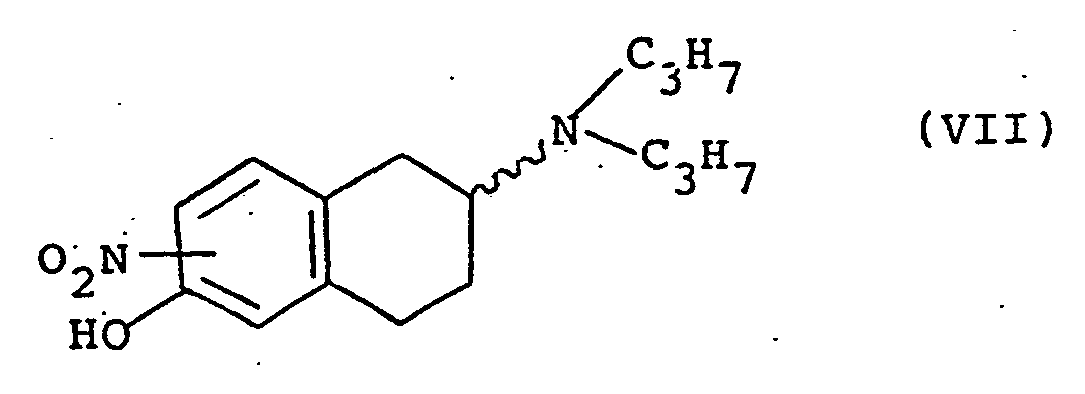
- the nitro group of the compound of formula (VII) is then reduced by hydrogen, in the presence of a catalyst such as palladium on a carbon support, and also under pressure.
- a catalyst such as palladium on a carbon support
- the acylation supplying the final compound (I) can be carried out in a known manner, when cold, with formic acid in the presence of acetic anhydride.
- a step of separation of the enantiomers of the primary amine of formula V is introduced into the process (in this case the final compounds will not be prepared by the action of a dialkylamine on the ketone of formula (II), but by direct alkylation of the enantiomer separated from the primary amine of formula V).
- the resolution can be carried out by means of the formation of diastereoisomeric salts from chiral acids such as tartaric acid, mandelic acid, camphosulfonic acid and, preferably, dibenzoyltartaric acid.
- Salification is carried out using a mixture of enantiomers of the primary amine of formula (V), for example from the racemate obtained from ketone (II), in the form of the base, dissolved without an appropriate solvent, such as an alcohol, preferably ethanol.
- An enantiomer of formula V can also be obtained from a base partially enriched in this enantiomer, for example from the mother liquors of recrystallization from a mixture of diastereoisomeric salts.
- the chiral acid used for the separation of such an enriched mixture is then the antipode of that which made it possible to obtain the enriched mixture.
- the brown gum obtained is subjected to chromatography on a neutral alumina column (800 g), eluting with toluene.
- the least polar compound is the nitrated isomer at 5. Obtained 9 g of each of the isomers.
- the nitrated compound at the bottom at 198-200 ° C, the nitrated compound at the bottom at 158-160 ° C (in the form of hydrochlorides).
- the product obtained above is introduced into 100 ml of 48% hydrobromic acid, the mixture is heated under reflux for 10 hours and then the acid is removed under reduced pressure, then completely eliminated by entrainment with a toluene / ethanol mixture, in a Rotary evaporator. After recrystallization from isopropyl alcohol, the dihydrobromide melts at 205 ° C (with decomposition).
- a mixture of 10 g of 6-methoxy-tetrahydronaphthalenone-2 in 150 ml of benzene and 5.9 ml of benzylamine with 100 mg of paratoluenesulfonic acid is heated under reflux for two hours under nitrogen atmosphere.
- the condensed water is removed by azeotropic entrainment.
- the mixture is concentrated to a volume of 100 ml and subjected to catalytic hydrogenation in the presence of 100 mg of Pt0 2 , under a pressure of 0.3 MPa and at room temperature.
- the catalyst is removed by filtration and 4.7 ml of 12N hydrochloric acid are added to the filtrate.
- a second hydrogenation is then carried out in the presence of 1 g of palladium on carbon, at about 60 ° C., at a pressure of the order of 0.35 MPa.
- the catalyst is removed, the solvents are removed under reduced pressure and the product formed is recrystallized from isopropyl alcohol; it melts at 254 ° C.
- the hydrochloride is placed in the base form in a known manner, for example by evaporating the organic phase from a mixture of methylene chloride, water and sodium hydroxide into which the hydrochloride has been introduced.
- Example 1b The procedure of Example 1b), c), d), and e) is used, using the enantiomer prepared as indicated above, instead of the racemic mixture.
- the hydrochlorides of the intermediate compounds nitrated in 5 and 7 have respective rotary powers of
- the hydrobromide of the final compound, levorotatory enantiomer of the compound prepared according to Example 1 has a rotary power of
- the rotary powers of the dextrorotatory enantiomers are, in absolute value, equal to those of the enantiomers, apart from measurement errors.
- Table II illustrates the structures and physical properties of some intermediate compounds of formula VI and VII.
- the compounds of the invention inhibit the responses to electrical stimulation of the nictitating membrane and of the heart, their activity in this case being approximately 20 times greater than that of a known dopaminergic, N, N-dipropyldopamine.
- the antiparkinsonian activity of the compounds of the invention has been demonstrated by the test of antagonism with respect to catalepsy induced by haloperidol.
- Rats receive haloperidol intraperitoneally at a dose of 1 mg / kg in a volume of 1 ml / 100 g of body weight.
- the products to be studied are administered, to 6 rats per dose, and at the rate of 3 doses per product studied.
- the catalepsy of the animals is evaluated thirty minutes (i.p. route) or 60 minutes (per os) after administration of the product to be studied, then every 30 minutes, for 3 hours (intraperitoneal route) or 4 hours (per os). For this, each animal is placed in a position such that each leg rests on a "plug" 25 mm high and 12 mm in diameter.
- the animal is considered cataleptic if it is kept in this position for at least 10 seconds.
- the average percentage of cataleptic animals is calculated, then the percentage reduction compared to the control animals.
- the DA50 a dose which antagonizes the cataleptic effect of haloperidol by 50%, is determined graphically.
- the DA50 of the compounds of the invention is of the order of 7 mg / kg, both intraperitoneally and orally.
- mice were acute toxicity in mice is around 90 mg / kg intravenously and 150 mg / kg orally.
- the compounds of the invention can be used for the treatment of cardiovascular diseases, in particular for the treatment of hypertension, as well as for the treatment of Parkinson's disease. They can be administered at a daily dose of 1 to 500 mg per dosage unit containing, for example, from 1 to 100 mg of active substance, orally, rectally or parenterally.
Landscapes
- Chemical & Material Sciences (AREA)
- Organic Chemistry (AREA)
- Health & Medical Sciences (AREA)
- Engineering & Computer Science (AREA)
- Bioinformatics & Cheminformatics (AREA)
- Veterinary Medicine (AREA)
- Public Health (AREA)
- Chemical Kinetics & Catalysis (AREA)
- General Chemical & Material Sciences (AREA)
- Medicinal Chemistry (AREA)
- Nuclear Medicine, Radiotherapy & Molecular Imaging (AREA)
- Pharmacology & Pharmacy (AREA)
- Life Sciences & Earth Sciences (AREA)
- Animal Behavior & Ethology (AREA)
- General Health & Medical Sciences (AREA)
- Heart & Thoracic Surgery (AREA)
- Cardiology (AREA)
- Biomedical Technology (AREA)
- Neurology (AREA)
- Neurosurgery (AREA)
- Organic Low-Molecular-Weight Compounds And Preparation Thereof (AREA)
- Acyclic And Carbocyclic Compounds In Medicinal Compositions (AREA)
- Pharmaceuticals Containing Other Organic And Inorganic Compounds (AREA)
- Peptides Or Proteins (AREA)
Description
- La présente invention a pour objet des dérivés d'amino-2 tétrahydro-1,2,3,4 naphthalène, un procédé pour les préparer, et leur application en thérapeutique.
- Des dérivés d'amino-2 tétrahydro-1,2,3,4 naphthalène sont déjà connus selon 1a demande de brevet DE-A-28 03 582.
- Les composés de l'invention répondent à la formule générale (1)

- Leurs sels d'addition à des acides acceptables en pharmacologie font également partie de l'invention.
- Les composés de l'invention comportant dans leur molécule un atome de carbone asymétrique (position 2), ils peuvent se présenter sous forme de racémates ou d'énantiomères.
- Les composés de l'invention peuvent être préparés à partir de méthoxy-6 tétrahydro-1,2,3,4 naphtalénone-2, produit du commerce, répondant à la formule (II)

pour obtenir l'amino-2 méthoxy-6 dihydro-3,4 naphtalène de formule (IV)
- Par hydrogénation sous pression on obtient l'amino-2 tétrahydronaphtalène de formule (V)

- Le composé (V) dans la formule duquel-NR2R3 désigne le groupe dipropylamino peut également être obtenu par alkylation du composé (V) correspondant dans la formule duquel -NR2R3 désigne le groupe amino. L'alkylation peut se faire de manière connue, par exemple sur une suspension d'un sel de l'amine primaire (V), avec un halogénure de propyle approprié, de préférence l'iodure, en présence d'une base telle que le carbonate de potassium. Cette méthode de préparation est à préférer lorsque l'on souhaite préparer un seul énantiomère d'un composé de formule I. Il est en effet plus facile de séparer les énantiomères de l'amine primaire de formule V (-NR2R3=NH2) que les énantiomères du composé final. On soumet ensuite l'amine (V) à une nitration. Celle-ci fournit un mélange de deux isomères nitréa respectivement en 5 et 7 d'après la formule (VI)

- Les dérivés de formule (VI) sont nouveaux et font également partie de l'invention. On procède ensuite à la déméthylation de l'un des dérivés nitrés, après l'avoir séparé de son isomère, obtenant ainsi un sel d'hydroxy-6 amino-2 tétrahydronaphtalène de formule (VII)

- Par réduction catalytique (Pd, Ni Raney) du groupe nitro du composé de formule (VII) on aboutit à la diamine formule (VIII)

- La condensation de la dipropylamine (III) avec la tétrahydronaphtalénone (11) peut se faire à chaud, dans un solvant non polaire tel que le benzène, en présence d'un acide tel que l'acide paratoluènesulfonique. On procède ensuite à une hydrogénation dans le même récipient de réaction en présence d'un catalyseur d'hydrogénation et sous pression.
- La nitration de l'amino-2 tétrahydronaphtalène (V) peut se faire de manière connue. Lorsque le groupe amino n'est pas alkylé (R2 = H), il convient de protéger préalablement l'azote en l'acylant, par exemple au moyen d'anhydride acétique, et en éliminant de nouveau le groupe acétyle à la fin du processus de préparation.
- On sépare ensuite les deux isomères nitréa (VI) de manière connue, par exemple par chromatographie sur colonne.
- La déméthylation du dérivé nitré, séparé de son isomère, s'effectue par exemple par action de l'acide bromhydrique ou par action de tribromure de bore suivi d'une salification.
- Le groupe nitro du composé de formule (VII) est ensuite réduit par l'hydrogène, en présence d'un catalyseur tel que le palladium sur support de carbone, et également sous pression. Enfin l'acylation fournissant le composé final (I) peut s'effectuer de manière connue, à froid, par l'acide formique en présence d'anhydride acétique.
- Lorsque l'on désire préparer un composé de formule 1 sous la forme d'un seul énantiomère, on introduit dans le processus une étape de séparation des énantiomères de l'amine primaire de formule V (dans ce cas les composés finals ne seront pas préparés par action d'une dialkylamine sur la cétone de formule (II), mais par alkylation directe de l'énantiomère séparé de l'amine primaire de formule V).
- La résolution peut s'effectuer au moyen de la formation de sels diastéréoisomères à partir d'acides chiraux tels que l'acide tartrique, l'acide mandélique, l'acide camphosulfonique et, de préférence, l'acide dibenzoyltartrique. La salification se fait à partir d'un mélange d'énantiomères de l'amine primaire de formule (V) par exemple à partir du racémate obtenu à partir de la cétone (II), sous forme de base, dissous sans un solvant approprié, tel qu'un alcool, de préférence l'éthanol.
- Les deux sels diastéréoisomères ainsi obtenus sont ensuite séparés par cristallisation fractionnée.
- Après la séparation, ils peuvent être séparés de l'acide chiral, c'est à dire remis sous forme de base, puis sous forme de sel d'addition à un autre acide.
- Un énantiomère de formule V peut également être obtenu à partir d'une base partiellement enrichie en cet énantiomère, provenant par exemple des eaux mères de recristallisation d'un mélange de sela diastéréoisomères. L'acide chiral utilisé pour la séparation d'un tel mélange enrichi est alors l'antipode de celui qui a permis d'obtenir le mélange enrichi.
- Les exemples suivants illustrent la préparation de quelques composés de l'invention.
- Les analyses et les spectres IR et RHN confirment la structure des composés.
- EXEMPLE 1 Bromhydrate de dipropylamino-2 formylamino-5 hydroxy-6 tétrahydro-1,2,3,4 naphthalène.
- a) Dipropylamino-2 méthoxy-6 tétrahydro-1,2,3,4 naphthalène. Dans 300 ml de benzène, sous atmosphère d'azote, on introduit 20 g de méthoxy-6 tétrahydronaphthalénone-2, 20 ml de dipropylamine et 200 mg d'acide paratoluènesulfonique. On chauffe ensuite le mélange, devenu noir, au reflux pendant 12 heures, l'eau de condensation étant éliminée par entraînement azéotropique. Puis on concentre la solution qui contient le composé (IV), jusqu'à un volume d'environ 100 ml. Pour l'hydrogénation, on lui ajoute 150 ml d'éthanol, 300 mg de Pt02 et on effectue une hydrogénation, sous une pression d'environ 0,3 MPa, jusqu'à cessation de l'absorption. Après élimination du catalyseur, on chasse les solvants sous pression réduite, et on reprend l'huile noire résiduelle par du toluène, pour l'extraire avec de l'acide chlorhydrique normal. Ensuite on neutralise la solution chlorhydrique par un alcali, on l'extrait par du toluène, on sèche la phase organique, on la filtre sur 200 mg d'alumine neutre, et on achève l'élution au moyen de chlorure de méthylène. Par concentration on obtient une huile pratiquement incolore.
- b) Dipropylamino-2 méthoxy-6 nitro-5 et -7 tétrahydro-1,2,3,4 naphthalène.
- Tout en refroidissant le mélange, on ajoute 21 g de dipro-pylamino-2 méthoxy-6 tétrahydronaphthalène à 60 ml d'acide trifluoroacétique. Ensuite, en maintenant la température à environ 0°C, on ajoute goutte à goutte 7 ml d'acide nitrique (d = 2,42). On agite encore 10 minutes, et on verse le tout dans de l'eau et on extrait l'insoluble par du chlrorure de méthylène; on agite la phase organique avec une solution de carbonate de potassium et on lave à l'eau.
- Après séchage et évaporation, on soumet la gomme brune obtenue à une chromatographie sur colonne d'alumine neutre (800 g) en éluant avec du toluène. Le composé le moins polaire est l'isomère nitré en 5. On obtient 9 g de chacun des isomères. Le composé nitré en 5 fond à 198-200° C, le composé nitré en 7 fond à 158-160°C (sous formes de chlorhydrates).
- c) Bromhydrate de dipropylamino-2 hydroxy-6 nitro-5 tétra-hydro-1,2,3,4 naphthalène.
- On introduit 9 g de dipropylamino-2 méthoxy-6 nitro-5 tétrahydronaphthalène dans 100 ml d'acide bromhydrique à 48% et on chauffe au reflux pendant 2 heures. On chasse ensuite l'acide sous pression réduite, et on reprend le résidu trois fois avec de l'eau que l'on évapore pour éliminer toute trace d'acide.
- Le solide obtenu, recristallisé dans l'eau, forme un monohydrate qui fond à 236° C (avec décomposition).
- d) Bromhydrate de dipropylamino-2 amino-5 hydroxy-6 tétra-hydro-1,2,3,4 naphthalène.
- On met en suspension 7 g de bromhydrate de dipropylamino-2 hydroxy-6 nitro-5 tétrahydronaphthalène dans 250 ml d'éthanol, et on effectue une hydrogénation à température ambiante, en présence d'I g de palladium sur charbon à 5%, sous une pression d'environ 0,3 MPa. Ensuite on évapore le solvant et on triture le résidu dans l'éther. Le produit obtenu fond à 215-218°C (avec décomposition).
- e) Bromhydrate de dipropylamino-2 formylamino-5 hydroxy-6 tétrahydro-1,2,3,4 naphthalène.
- A 2 ml d'acide formique à 98%, maintenus à 0°C, on ajoute en une fois 0,42 ml d'anhydride acétique et on laisse à 0°C pendant 15 minutes. Ensuite, toujours au bain de glace, on y introduit, à la spatule, 1,34 g de bromhydrate de dipropyl-amino-2 amino-5 hydroxy-6 tétrahydronaphthalène, et on agite le tout pendant une heure à 0° C.
- Après addition d'éther et filtration du solide, on recristallise ce dernier dans le minimum d'éthanol. On obtient le composé qui fond à 199°C.
- EXEMPLE 2 Bromhydrate de dipropylamino-2 formylamino-7 hydroxy-6 tétrahydro-1,2,3,4 naphthalène.
- a) Dipropylamino-2 amino-7 méthoxy-6 tétrahydro-1,2,3,4 naphthalène.
- On introduit 9 g de dipropylamino-2 méthoxy-6 nitro-7 tétrahydronaphthalène obtenus selon l'exemple 1b) dans 200 ml d'éthanol, ainsi que 1 g de Nickel de Raney. A température ambiante on effectue une hydrogénation sous pression jusqu'à cessation de l'absoprtion. Après évaporation du solvant il reste une huile qui se révèle assez oxydable à l'air.
- b) Dibromhydrate de dipropylamino-2 amino-7 hydroxy-6 tétra-hydro-1,2,3,4 naphthalène.
- On introduit le produit précédemment obtenu dans 100 ml d'acide bromhydrique à 48%, on chauffe au reflux pendant 10 heures puis on chasse l'acide sous pression réduite en l'éliminant ensuite complètement par entrainement avec un mélange toluène/éthanol, dans un évaporateur rotatif. Après recristallisation dans l'alcool isopropylique, le dibromhydrate fond à 205° C (avec décomposition).
- c) Monohydrate de dipropylamino-2 amino-7 hydroxy-6 tétra-hydro-1,2,3,4 naphthalène.
- A 3 g de dibromhydrate dissous dans 50 ml d'eau on ajoute 5 ml de résine Amberlite LA2 en solution dans 50 ml d'éther de pétrole. On agite pendant 15 minutes à température ambiante, on sépare la phase aqueuse et on l'évapore à sec pour isoler le monohydrate brut, sous forme amorphe et colorée, que l'on utilise tel quel pour la formylation.
- d) Bromhydrate de dipropylamino-2 formylamino-7 hydroxy-6 tétrahydro-1,2,3,4 naphthalène.
- A 3 ml d'acide formique à 98% maintenu à 0°C on ajoute 0,7 ml d'anhydride acétique et laisse le tout pendant 15 minutes à 0°C. On y ajoute ensuite 2,2 g de bromhydrate de dipropylamino-2 amino-7 hydroxy-6 tétrahydronaphthalène et on agite encore une heure à 0°C. Après addition de 50 ml d'éther et filtration du solide, on recristallise ce dernier dans un mélange 50/50 de méthanol/acétate d'éthyle. On obtient 1 g du produit final qui fond à 213°C (avec décomposition).
- EXEMPLE 3 Enantiomères de bromhydrate de dipropylamino-2 formylamino-5 hydroxy-6 tétrahydro-1,2,3,4 naphthalène.
- a) Amino-2 méthoxy-6 tétrahydro-1,2,3,4 naphthalène.
- On chauffe au reflux pendant deux heures un mélange de 10 g de méthoxy-6 tétrahydronaphtalénone-2 dans 150 ml de benzène et de 5,9 ml de benzylamine avec 100 mg d'acide paratoluènesulfonique, sous atmosphère d'azote. L'eau de condensation est éliminée par entraînement azéotropique. On concentre le mélange à un volume de 100 ml et on le soumet à une hydrogénation catalytique en présence de 100 mg de Pt02, sous une pression de 0,3 MPa et à température ambiante. On élimine le catalyseur par filtration et on ajoute 4,7 ml d'acide chlorhydrique 12N au filtrat.
- On procède alors à une seconde hydrogénation en présence de 1 g de palladium sur charbon, à environ 60°C, à une pression de l'ordre de 0,35 MPa.
- On élimine le catalyseur, on chasse les solvants sous pression réduite et on recristallise le produit formé dans l'alcool isopropylique; il fond à 254°C.
- On met le chlorhydrate sous forme de base de manière connue, par exemple en évaporant la phase organique d'un mélange de chlorure de méthylène, d'eau et de soude dans lequel on a introduit le chlorhydrate.
- b) Séparation des énantiomères de l'amino-2 méthoxy-6 tétra-hydro-1,2,3,4 naphthalène.
- A 5,5 g de l'amine (base) racémique obtenue comme indiqué ci-dessus, dissous dans 100 ml d'éthanol, on ajoute rapidement 6 g d'acide L(-)-dibenzoyitartrique dissous dans 100 ml d'éthanol. On concentre sous pression réduite le milieu hétérogène ainsi obtenu, on le reprend par de l'éther et, après filtration et séchage, on receuille 11 g de sel contenant 1/2 mole d'acide L(-)-dibenzoyltartrique. On recristallise deux fois ce dernier dans de l'éthanol contenant 30% d'eau. Le produit obtenu fond à 220-221°C. En le mettant sous forme de chlorhydrate, on obtient un sel optiquement actif fondant a 254°C (avec décomposition) et de pouvoir rotatoire

- Pour isoler l'autre énantiomère, on concentre les eaux mères éthanoliques de recristallisation du L(-)-dibenzoyltartrate, on repasse à la forme base de l'amine, après l'avoir extraite, on en précipite le D(+)-dibenzoyltartrate par addition de l'acide correspondant. Après recristallisation, le D(+)-dibenzoyltartrate fond à 220-221 ° C. Par formation du chlorhydrate on obtient un sel optiquement actif de pouvoir rotatoire

- c) Chlorhydrate de (-)-dipropylamino-2 méthoxy-6 tétrahy-dro-1,2,3,4 naphthalène.
- A 1,9 g de chlorhydrate lévogyre obtenu comme indiqué ci-dessus, en suspension dans 20 ml de benzène, on ajoute 15 ml de solution saturée de carbonate de potassium puis 9 ml d'iodopropane. On agite le mélange à la température de reflux pendant 72 heures. Ensuite on dilue la phase organique avec de l'éther, on forme le chlorhydrate par addition d'éther chlorhydrique et on l'isole de manière habituelle. Il fond à 154°C et présente un pouvoir rotatoire

- d) Bromhydrate de (-)-dipropylamino-2 formylamino-5 hydro-xy-6 tétrahydronaphthalène.
- On met en oeuvre le mode opératoire de l'exemple 1b), c), d), et e), en utilisant l'énantiomère préparé comme indiqué ci-dessus, au lieu du mélange racémique.
- Les chlorhydrates des composés intermédiaires nitrés en 5 et 7 ont des pouvoirs rotatoires respectifs de
-

- Le bromhydrate intermédiaire réduit (NH2 en 5) a un pouvoir rotatoire de -32° (c=1,MeOH).
- Le bromhydrate du composé final, énantiomère lévogyre du composé préparé selon l'exemple 1, a un pouvoir rotatoire de

- Les pouvoirs rotstoires des énantiomères dextrogyres sont, en valeur absolue, égaux à ceux des énantiomères, aux erreurs de mesures près.
- Les composés de l'invention sont illustrés dans le tableau 1 ci-après, par l'indication de leur structure et de leurs propriétés physiques.
- Le tableau II illustre les structures et propriétés physiques de quelques composés intermédiaires de formule VI et VII.


- Les composés de formule I ont été soumis à des essais pharmacologiques qui ont mis en évidence leur activité antihypertensive et antiparkinsonnienne.
- On a constaté ainsi que sur le rat ou le chien anesthésié au pentobarbital sodique, la tension atérielle diminue nettement après des injections de 10 à 100 µg/kg par voie intraveineuse.
- Par ailleurs, administrés au chien par voie intraveineuse ou intraduodénale, les composés de l'invention inhibent les réponses aux stimulations électriques de la membrane nictitante et du coeur, leur activité étant dans ce cas environ 20 fois supérieure à celle d'un dopaminergique connu, la N,N-dipropyldopamine.
- Les effets des.composés de l'invention sont bloqués par l'action du sulpiride, un antagoniste connu de la dopamine.
- L'activité antiparkinsonienne des composés de l'invention a été mise en évidence par le test de l'antagonisme vis-à-vis de la catalepsie induite par le halopéridol.
- On sait qu'un certain nombre de neuroleptiques induisent chez le rat un état cataleptique considéré comme le reflet d'un blocage des récepteurs dopaminergiques au niveau du système extrapyramidal: c'est le cas du halopéridol, dont l'effet cataleptigène est antagonisé par les agonistes dopaminergiques tels que l'apomorphine ou l'amphétamine, par les antidépresseurs tricycliques et par les anticholinergiques. La méthode utilisée ici est une modification de celle décrite par Tedeschi et al., Arch. lnt. Pharmacodyn. (1959), 122,129.
- Les rats recoivent le halopéridol par voie intrapéritonéale à la dose de 1 mg/kg sous un volume de 1 ml/IOO g de poids corporel.
- Trente minutes après cette injection, les produits à étudier sont administrés, à 6 rats par dose, et à raison de 3 doses par produit étudié.
- On évalue la catalepsie des animaux trente minutes (voie i.p.) ou 60 minutes (per os) après l'administration du produit à étudier, puis toutes les 30 minutes, pendant 3 heures (voie intrapéritonéale) ou 4 heures (per os). Pour cela on place chaque animal dans une position telle que chaque patte repose sur un "bouchon" de 25 mm de hauteur et 12 mm de diamètre.
- L'animal est considéré comme cataleptique s'il se maintient dans cette position pendant au moins 10 secondes.
- Pour chaque dose et chaque produit on calcule le pourcentage moyen d'animaux cataleptiques, puis le pourcentage de diminution par rapport aux animaux témoins.
- La DA50, dose qui antagonise de 50% l'effet cataleptique du halopéridol, est déterminée graphiquement.
- On a ainsi trouvé que la DA50 des composés de l'invention est de l'ordre de 7 mg/kg, tant par voie intrapéritonéale que par voie orale.
- Enfin leur toxicité aigôe chez la Souris est de l'ordre de 90 mg/kg par voie intraveineuse et de 150 mg/kg par voie orale.
- Compte tenu de leurs propriétés, les composés de l'invention sont utilisables pour le traitement de maladies cardiovasculaires, en particulier pour le traitement de l'hypertension, ainsi que pour le traitement de la maladie de Parkinson. Ils peuvent être administrés à raison de doses journalières de 1 à 500 mg par unités de prise contenant par exemple de 1 à 100 mg de substance active, par voie orale, rectale ou parentérale.
Claims (8)




Priority Applications (1)
| Application Number | Priority Date | Filing Date | Title |
|---|---|---|---|
| AT82401654T ATE23328T1 (de) | 1981-09-16 | 1982-09-10 | 2-amino-1,2,3,4-tetrahydronaphthalen-derivate, ihre herstellung und ihre therapeutische verwendung. |
Applications Claiming Priority (2)
| Application Number | Priority Date | Filing Date | Title |
|---|---|---|---|
| FR8117454 | 1981-09-16 | ||
| FR8117454A FR2512814A1 (fr) | 1981-09-16 | 1981-09-16 | Derives d'amino-2 tetrahydro-1,2,3,4 naphtalene, leur preparation et leur application en therapeutique |
Publications (3)
| Publication Number | Publication Date |
|---|---|
| EP0074903A2 EP0074903A2 (fr) | 1983-03-23 |
| EP0074903A3 EP0074903A3 (en) | 1983-07-27 |
| EP0074903B1 true EP0074903B1 (fr) | 1986-11-05 |
Family
ID=9262178
Family Applications (1)
| Application Number | Title | Priority Date | Filing Date |
|---|---|---|---|
| EP82401654A Expired EP0074903B1 (fr) | 1981-09-16 | 1982-09-10 | Dérivés d'amino-2 tétrahydro-1,2,3,4 naphtalène, leur préparation et leur application en thérapeutique |
Country Status (20)
| Country | Link |
|---|---|
| US (1) | US4442126A (fr) |
| EP (1) | EP0074903B1 (fr) |
| JP (3) | JPS5862141A (fr) |
| AT (1) | ATE23328T1 (fr) |
| AU (1) | AU551898B2 (fr) |
| CA (1) | CA1224491A (fr) |
| DE (1) | DE3274105D1 (fr) |
| DK (1) | DK163055C (fr) |
| ES (2) | ES515744A0 (fr) |
| FI (1) | FI77650C (fr) |
| FR (1) | FR2512814A1 (fr) |
| GR (1) | GR77000B (fr) |
| HU (1) | HU187789B (fr) |
| IE (1) | IE53756B1 (fr) |
| IL (1) | IL66804A (fr) |
| MX (1) | MX158073A (fr) |
| NO (1) | NO154391C (fr) |
| NZ (1) | NZ201919A (fr) |
| PT (1) | PT75567B (fr) |
| ZA (1) | ZA826770B (fr) |
Families Citing this family (9)
| Publication number | Priority date | Publication date | Assignee | Title |
|---|---|---|---|---|
| IL65501A (en) * | 1981-05-08 | 1986-04-29 | Astra Laekemedel Ab | 1-alkyl-2-aminotetralin derivatives,process for their preparation and pharmaceutical compositions containing them |
| JPS5970653A (ja) * | 1982-10-15 | 1984-04-21 | Takeda Chem Ind Ltd | 眼圧低下剤 |
| US4588747A (en) * | 1984-08-27 | 1986-05-13 | Synthelabo | 1,2,3,4-tetrahydronaphthalene derivatives used as antiglaucoma agents |
| DE3832571A1 (de) * | 1988-09-24 | 1990-05-31 | Boehringer Ingelheim Kg | Verwendung von 2,7-diamino-1,2,3,4-tetrahydronaphthalinen als arzneimittel, neue 2,7-diamino-1,2,3,4-tetrahydronaphthaline sowie verfahren zu ihrer herstellung |
| CA1335106C (fr) * | 1989-02-27 | 1995-04-04 | John Mehnert Schaus | 2-amino-1,2,3,4-tetrahydronaphtalenes a substituants sur le cycle |
| DE3919624A1 (de) * | 1989-06-15 | 1990-12-20 | Boehringer Ingelheim Kg | Neue 2,5-diaminotetraline, verfahren zu ihrer herstellung und ihre verwendung als arzneimittel |
| US5071875A (en) * | 1989-09-25 | 1991-12-10 | Northwestern University | Substituted 2-amidotetralins as melatonin agonists and antagonists |
| JPH03113240U (fr) * | 1990-03-08 | 1991-11-19 | ||
| CN1159292C (zh) * | 1996-05-31 | 2004-07-28 | 法玛西雅厄普约翰美国公司 | 用作选择性多巴胺d3配体的芳基取代的环胺类化合物 |
Citations (1)
| Publication number | Priority date | Publication date | Assignee | Title |
|---|---|---|---|---|
| US4035512A (en) * | 1974-06-12 | 1977-07-12 | Takeda Chemical Industries, Ltd. | Aminotetralols |
Family Cites Families (5)
| Publication number | Priority date | Publication date | Assignee | Title |
|---|---|---|---|---|
| US3991207A (en) * | 1971-03-18 | 1976-11-09 | Pfizer Inc. | Combination therapy for Parkinson's disease |
| JPS5346947A (en) * | 1976-10-07 | 1978-04-27 | Takeda Chem Ind Ltd | Tetraol compounds and their preparation |
| JPS545959A (en) * | 1977-06-14 | 1979-01-17 | Funai Yaihin Kogyo | Production of novel cyclic aminoalcohol and salt thereof |
| DE2803582A1 (de) * | 1978-01-27 | 1979-08-02 | Sandoz Ag | Neue tetralinderivate, ihre herstellung und verwendung |
| US4320148A (en) * | 1980-11-24 | 1982-03-16 | Smithkline Corporation | 2-Aminotetralin compounds, pharmaceutical compositions and method of producing central alpha1 agonist activity |
-
1981
- 1981-09-16 FR FR8117454A patent/FR2512814A1/fr active Granted
-
1982
- 1982-09-10 AT AT82401654T patent/ATE23328T1/de not_active IP Right Cessation
- 1982-09-10 DE DE8282401654T patent/DE3274105D1/de not_active Expired
- 1982-09-10 EP EP82401654A patent/EP0074903B1/fr not_active Expired
- 1982-09-14 JP JP57160766A patent/JPS5862141A/ja active Granted
- 1982-09-15 GR GR69284A patent/GR77000B/el unknown
- 1982-09-15 PT PT75567A patent/PT75567B/fr not_active IP Right Cessation
- 1982-09-15 MX MX194427A patent/MX158073A/es unknown
- 1982-09-15 IE IE2249/82A patent/IE53756B1/en not_active IP Right Cessation
- 1982-09-15 DK DK412082A patent/DK163055C/da not_active IP Right Cessation
- 1982-09-15 ES ES515744A patent/ES515744A0/es active Granted
- 1982-09-15 AU AU88430/82A patent/AU551898B2/en not_active Ceased
- 1982-09-15 CA CA000411496A patent/CA1224491A/fr not_active Expired
- 1982-09-15 HU HU822939A patent/HU187789B/hu not_active IP Right Cessation
- 1982-09-15 FI FI823194A patent/FI77650C/fi not_active IP Right Cessation
- 1982-09-15 US US06/418,265 patent/US4442126A/en not_active Expired - Lifetime
- 1982-09-15 ZA ZA826770A patent/ZA826770B/xx unknown
- 1982-09-15 NZ NZ201919A patent/NZ201919A/en unknown
- 1982-09-15 IL IL66804A patent/IL66804A/xx not_active IP Right Cessation
- 1982-09-15 NO NO823125A patent/NO154391C/no unknown
-
1983
- 1983-07-01 ES ES523775A patent/ES8403857A1/es not_active Expired
-
1985
- 1985-12-02 JP JP60272369A patent/JPS61165324A/ja active Pending
- 1985-12-02 JP JP60272370A patent/JPS61165323A/ja active Pending
Patent Citations (1)
| Publication number | Priority date | Publication date | Assignee | Title |
|---|---|---|---|---|
| US4035512A (en) * | 1974-06-12 | 1977-07-12 | Takeda Chemical Industries, Ltd. | Aminotetralols |
Non-Patent Citations (1)
| Title |
|---|
| CHEMICAL ABSTRACTS, vol. 88, no. 15, 10 avril 1978, résumé no. 104974d, page 537 COLUMBUS OHIO (US) & Chem. Pharm. Bull. 1977, 25(12), 3289-300 A. MIYAKE et al.: "The synthesis of N,N'-disubstituted 2,5-diamino-6-hydroxy-1,2,3,4-tetrahydro-1-naphthalenol derivatives" * |
Also Published As
Similar Documents
| Publication | Publication Date | Title |
|---|---|---|
| WO1981003491A1 (fr) | Derive de tetraline d'utilite therapeutique | |
| CH620436A5 (fr) | ||
| FR2613365A1 (fr) | Nouveaux derives de l'amino tetrahydro-5, 6, 7, 8 naphto (2, 3b) furanne, leurs procedes de preparation et les compositions pharmaceutiques qui les contiennent | |
| CZ284256B6 (cs) | Nový způsob výroby formoterolu a příbuzných sloučenin | |
| FR2548666A1 (fr) | Nouveaux derives du nor-tropane et du granatane, leur procede de preparation et leur application en therapeutique | |
| FR2511366A1 (fr) | Nouveaux derives de la pyridazine, leur procede de preparation et les medicaments, actifs sur le systeme nerveux central, qui en contiennent | |
| LU85191A1 (fr) | Nouveaux derives de la benzo(g)quinoleine,leur preparation et leur utilisation comme medicaments | |
| US4224332A (en) | 1-Aza-[2,2,2]-bicyclooctanes and anti-depressant and anti-parkinsonian compositions thereof | |
| FR2663328A1 (fr) | Derives d'hexahydroazepines, un procede pour leur preparation et compositions pharmaceutiques les contenant. | |
| EP0074903A2 (fr) | Dérivés d'amino-2 tétrahydro-1,2,3,4 naphtalène, leur préparation et leur application en thérapeutique | |
| BE1009852A3 (fr) | Derives 1-[2(vinyl-substitues)]-3-4-dihydro-5h-2,3-benzodiazepine. | |
| CH661046A5 (fr) | Derives de benzodioxinopyrrole et procedes de preparation. | |
| FR2643076A1 (fr) | Carboxyalkyl-ethers de la 2-amino-7-hydroxytetraline | |
| FR2763335A1 (fr) | Nouveaux composes heterocycliques substitues, leur procede de preparation et les compositions pharmaceutiques qui les contiennent | |
| FR2643634A1 (fr) | Nouveaux derives benzoxazolinoniques, leurs procedes de preparation et les compositions pharmaceutiques qui les contiennent | |
| EP0063084B1 (fr) | Dérivés de phénéthanolamine, leur préparation et leur application en thérapeutique | |
| CH634311A5 (fr) | Derives du benzo(d)thiazole, leur procede de preparation et leurs applications en therapeutique. | |
| FR2539415A1 (fr) | Derives de la d-2 imidazoline, leur preparation et leur application en therapeutique | |
| NZ244618A (en) | Carbamoyl chroman derivative, preparation and pharmaceutical compositions thereof | |
| EP0427605B1 (fr) | Nouveaux dérivés de la morpholine, leur procédé de préparation et les compositions pharmaceutiques les renfermant | |
| JPH0341459B2 (fr) | ||
| EP1476433B1 (fr) | Nouveaux derives de tricyclo-imidazolines, leur procede de preparation et leur utilisation a titre de medicaments | |
| BE874322R (fr) | Nouveaux composes heterocycliques, leur preparation et leur application comme medicaments | |
| EP0311467B1 (fr) | Utilisation de dérivés de pyrrolo[3,2,1-hi]indole pour obtenir un médicament destiné au traitement du diabète | |
| FR2566775A1 (fr) | Derives de tetrahydro-4,5,6,7 furo ou 1h-pyrrolo(2,3-c)pyridine, leur preparation et leur application en therapeutique |
Legal Events
| Date | Code | Title | Description |
|---|---|---|---|
| PUAI | Public reference made under article 153(3) epc to a published international application that has entered the european phase |
Free format text: ORIGINAL CODE: 0009012 |
|
| AK | Designated contracting states |
Designated state(s): AT BE CH DE FR GB IT LI LU NL SE |
|
| PUAL | Search report despatched |
Free format text: ORIGINAL CODE: 0009013 |
|
| AK | Designated contracting states |
Designated state(s): AT BE CH DE FR GB IT LI LU NL SE |
|
| 17P | Request for examination filed |
Effective date: 19830616 |
|
| GRAA | (expected) grant |
Free format text: ORIGINAL CODE: 0009210 |
|
| AK | Designated contracting states |
Kind code of ref document: B1 Designated state(s): AT BE CH DE FR GB IT LI LU NL SE |
|
| REF | Corresponds to: |
Ref document number: 23328 Country of ref document: AT Date of ref document: 19861115 Kind code of ref document: T |
|
| ITF | It: translation for a ep patent filed | ||
| REF | Corresponds to: |
Ref document number: 3274105 Country of ref document: DE Date of ref document: 19861211 |
|
| PLBE | No opposition filed within time limit |
Free format text: ORIGINAL CODE: 0009261 |
|
| STAA | Information on the status of an ep patent application or granted ep patent |
Free format text: STATUS: NO OPPOSITION FILED WITHIN TIME LIMIT |
|
| 26N | No opposition filed | ||
| ITTA | It: last paid annual fee | ||
| EPTA | Lu: last paid annual fee | ||
| REG | Reference to a national code |
Ref country code: CH Ref legal event code: PFA Free format text: SYNTHELABO |
|
| EAL | Se: european patent in force in sweden |
Ref document number: 82401654.7 |
|
| PGFP | Annual fee paid to national office [announced via postgrant information from national office to epo] |
Ref country code: LU Payment date: 19960801 Year of fee payment: 15 |
|
| PGFP | Annual fee paid to national office [announced via postgrant information from national office to epo] |
Ref country code: SE Payment date: 19960815 Year of fee payment: 15 |
|
| PGFP | Annual fee paid to national office [announced via postgrant information from national office to epo] |
Ref country code: GB Payment date: 19960902 Year of fee payment: 15 |
|
| PGFP | Annual fee paid to national office [announced via postgrant information from national office to epo] |
Ref country code: BE Payment date: 19960904 Year of fee payment: 15 |
|
| PGFP | Annual fee paid to national office [announced via postgrant information from national office to epo] |
Ref country code: CH Payment date: 19960909 Year of fee payment: 15 |
|
| PGFP | Annual fee paid to national office [announced via postgrant information from national office to epo] |
Ref country code: DE Payment date: 19960926 Year of fee payment: 15 |
|
| PGFP | Annual fee paid to national office [announced via postgrant information from national office to epo] |
Ref country code: NL Payment date: 19960930 Year of fee payment: 15 Ref country code: AT Payment date: 19960930 Year of fee payment: 15 |
|
| PG25 | Lapsed in a contracting state [announced via postgrant information from national office to epo] |
Ref country code: LU Free format text: LAPSE BECAUSE OF NON-PAYMENT OF DUE FEES Effective date: 19970910 Ref country code: GB Free format text: LAPSE BECAUSE OF NON-PAYMENT OF DUE FEES Effective date: 19970910 Ref country code: AT Free format text: LAPSE BECAUSE OF NON-PAYMENT OF DUE FEES Effective date: 19970910 |
|
| PG25 | Lapsed in a contracting state [announced via postgrant information from national office to epo] |
Ref country code: SE Free format text: LAPSE BECAUSE OF NON-PAYMENT OF DUE FEES Effective date: 19970911 |
|
| PG25 | Lapsed in a contracting state [announced via postgrant information from national office to epo] |
Ref country code: LI Free format text: LAPSE BECAUSE OF NON-PAYMENT OF DUE FEES Effective date: 19970930 Ref country code: CH Free format text: LAPSE BECAUSE OF NON-PAYMENT OF DUE FEES Effective date: 19970930 Ref country code: BE Free format text: LAPSE BECAUSE OF NON-PAYMENT OF DUE FEES Effective date: 19970930 |
|
| BERE | Be: lapsed |
Owner name: SYNTHELABO Effective date: 19970930 |
|
| PG25 | Lapsed in a contracting state [announced via postgrant information from national office to epo] |
Ref country code: NL Free format text: LAPSE BECAUSE OF NON-PAYMENT OF DUE FEES Effective date: 19980401 |
|
| GBPC | Gb: european patent ceased through non-payment of renewal fee |
Effective date: 19970910 |
|
| REG | Reference to a national code |
Ref country code: CH Ref legal event code: PL |
|
| NLV4 | Nl: lapsed or anulled due to non-payment of the annual fee |
Effective date: 19980401 |
|
| PG25 | Lapsed in a contracting state [announced via postgrant information from national office to epo] |
Ref country code: DE Free format text: LAPSE BECAUSE OF NON-PAYMENT OF DUE FEES Effective date: 19980603 |
|
| EUG | Se: european patent has lapsed |
Ref document number: 82401654.7 |
|
| PGFP | Annual fee paid to national office [announced via postgrant information from national office to epo] |
Ref country code: FR Payment date: 20010924 Year of fee payment: 20 |