EP0076105A2 - Verfahren zur Herstellung eines bipolaren Transistors - Google Patents
Verfahren zur Herstellung eines bipolaren Transistors Download PDFInfo
- Publication number
- EP0076105A2 EP0076105A2 EP82305023A EP82305023A EP0076105A2 EP 0076105 A2 EP0076105 A2 EP 0076105A2 EP 82305023 A EP82305023 A EP 82305023A EP 82305023 A EP82305023 A EP 82305023A EP 0076105 A2 EP0076105 A2 EP 0076105A2
- Authority
- EP
- European Patent Office
- Prior art keywords
- insulating layer
- layer
- region
- base
- base electrode
- Prior art date
- Legal status (The legal status is an assumption and is not a legal conclusion. Google has not performed a legal analysis and makes no representation as to the accuracy of the status listed.)
- Granted
Links
Images



Classifications
-
- H—ELECTRICITY
- H10—SEMICONDUCTOR DEVICES; ELECTRIC SOLID-STATE DEVICES NOT OTHERWISE PROVIDED FOR
- H10D—INORGANIC ELECTRIC SEMICONDUCTOR DEVICES
- H10D48/00—Individual devices not covered by groups H10D1/00 - H10D44/00
- H10D48/30—Devices controlled by electric currents or voltages
- H10D48/32—Devices controlled by only the electric current supplied, or only the electric potential applied, to an electrode which does not carry the current to be rectified, amplified or switched
- H10D48/34—Bipolar devices
- H10D48/345—Bipolar transistors having ohmic electrodes on emitter-like, base-like, and collector-like regions
-
- H—ELECTRICITY
- H10—SEMICONDUCTOR DEVICES; ELECTRIC SOLID-STATE DEVICES NOT OTHERWISE PROVIDED FOR
- H10D—INORGANIC ELECTRIC SEMICONDUCTOR DEVICES
- H10D64/00—Electrodes of devices having potential barriers
- H10D64/01—Manufacture or treatment
- H10D64/011—Manufacture or treatment of electrodes ohmically coupled to a semiconductor
- H10D64/0111—Manufacture or treatment of electrodes ohmically coupled to a semiconductor to Group IV semiconductors
-
- H—ELECTRICITY
- H10—SEMICONDUCTOR DEVICES; ELECTRIC SOLID-STATE DEVICES NOT OTHERWISE PROVIDED FOR
- H10D—INORGANIC ELECTRIC SEMICONDUCTOR DEVICES
- H10D64/00—Electrodes of devices having potential barriers
- H10D64/20—Electrodes characterised by their shapes, relative sizes or dispositions
- H10D64/27—Electrodes not carrying the current to be rectified, amplified, oscillated or switched, e.g. gates
- H10D64/281—Base electrodes for bipolar transistors
-
- H—ELECTRICITY
- H10—SEMICONDUCTOR DEVICES; ELECTRIC SOLID-STATE DEVICES NOT OTHERWISE PROVIDED FOR
- H10P—GENERIC PROCESSES OR APPARATUS FOR THE MANUFACTURE OR TREATMENT OF DEVICES COVERED BY CLASS H10
- H10P76/00—Manufacture or treatment of masks on semiconductor bodies, e.g. by lithography or photolithography
- H10P76/40—Manufacture or treatment of masks on semiconductor bodies, e.g. by lithography or photolithography of masks comprising inorganic materials
-
- Y—GENERAL TAGGING OF NEW TECHNOLOGICAL DEVELOPMENTS; GENERAL TAGGING OF CROSS-SECTIONAL TECHNOLOGIES SPANNING OVER SEVERAL SECTIONS OF THE IPC; TECHNICAL SUBJECTS COVERED BY FORMER USPC CROSS-REFERENCE ART COLLECTIONS [XRACs] AND DIGESTS
- Y10—TECHNICAL SUBJECTS COVERED BY FORMER USPC
- Y10S—TECHNICAL SUBJECTS COVERED BY FORMER USPC CROSS-REFERENCE ART COLLECTIONS [XRACs] AND DIGESTS
- Y10S148/00—Metal treatment
- Y10S148/01—Bipolar transistors-ion implantation
-
- Y—GENERAL TAGGING OF NEW TECHNOLOGICAL DEVELOPMENTS; GENERAL TAGGING OF CROSS-SECTIONAL TECHNOLOGIES SPANNING OVER SEVERAL SECTIONS OF THE IPC; TECHNICAL SUBJECTS COVERED BY FORMER USPC CROSS-REFERENCE ART COLLECTIONS [XRACs] AND DIGESTS
- Y10—TECHNICAL SUBJECTS COVERED BY FORMER USPC
- Y10S—TECHNICAL SUBJECTS COVERED BY FORMER USPC CROSS-REFERENCE ART COLLECTIONS [XRACs] AND DIGESTS
- Y10S148/00—Metal treatment
- Y10S148/04—Dopants, special
Definitions
- the present invention relates to a method of producing semiconductor devices. More particularly, it relates to a method of producing bipolar transistors in an integrated circuit.
- an integrated circuit comprising bipolar transistors, i.e. a bipolar IC, denser.
- a base region and an emitter region of each of the bipolar transistors are decreased to increase the density, the accuracy of alignment of the emitter region in relation to the base region may become a problem.
- openings for a base electrode, an emitter electrode, and a collector electrode are simultaneously formed in an insulating layer, if the position of the openings for the electrodes is shifted from a predetermined position, a short-circuit between the emitter and collector, or a decrease i L the breakdown voltage between the emitter and collector, may occur.
- a P-type single crystalline silicon (Si) substrate i.e. a P-type silicon wafer
- an K-type silicon expit- axial layer 2 is grown, as illustrated in Fig.l.
- An N + -type buried layer 3 (Fig.l) for reducing the resistance of the collector is formed by a well-known process.
- An anti-oxidizing masking layer 4 for example a silicon nitride (Si 3 N 4 ) layer, having a thickness of, for example, 100nm, is formed on the epitaxial layer 2 and then is selectively removed by a photoetching process to leave portions corresponding to an isolation-providing region,a collector-providing region, and a base-providing region.
- the epitaxial layer 2 is selectively thermally oxidized by using the silicon nitride layer 4 as a mask so that a relatively thick silicon dioxide (SiO 2 ) layer (i.e., a so-called field oxide layer or field insulating layer) 5 is formed, as illustrated in Fig. 2.
- SiO 2 silicon dioxide
- P-type impurities e.g., boron
- boron boron
- N-type impurities (donor e.g., phosphorus (P)) are introduced into another portion of the epitaxial layer 2 by an ion-implantation process by using the field oxide layer 5 and another patterned photoresist layer (not shown) as another mask to form an N-type collector contact region 7. Then the obtained semiconductor body is annealed so as to activate the isolation region 6 and the collector contact region 7.
- P phosphorus
- the silicon nitride layer 4 is removed by etching to expose portions of the epitaxial layer 2.
- the exposed portions are thermally oxidized to form a relatively thin silicon dioxide layer 8 having a thickness of, e.g., 100 nm, as illustrated in Fig. 3.
- a photoresist layer 9 is coated, exposed, and developed to form an opening 10 above a base-providing region.
- P-type impurities (acceptor e.g., boron (E)) are introduced into the epitaxial layer 2 through the opening 10 and the silicon dioxide layer 8 by an ion-implantation process to form a base region 11.
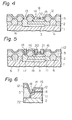
- a silicon oxide layer 12 is formed on the thick field oxide layer 5 and on the thin silicon dioxide layer 8 by a chemical vapor deposition (CVD) process, as illustrated in Fig. 4.
- the oxide layers 12 and 8 are selectively etched by a conventional photoetching process to form a collector electrode opening 13, an emitter electrode opening 14, and a base electrode opening 15, simultaneously.
- a polycrystalline silicon layer 16 (Fig. 5) having a thickness of, e.g., 100 nm is formed or the silicon oxide layer 12 and exposed portions of the epitaxial layer 2 within the openings 13, 14, and 15 by a CVD process.
- N-type impurities e.g., arsenic (As)
- As arsenic
- a conductive layer such as an aluminum (Al) layer
- Al aluminum
- the aluminum layer is selectively etched by a conventional photoetching process to form a collector electrode 19, an emitter electrode 20, a base electrode 21, and conductive lines (not shown).
- the portion of the polycrystalline silicon layer 16 which is not covered with the electrodes 19, 20, and 21 and the conductive lines is etched with a suitable etchant.
- the bipolar transistor shown in Fig. 5 is produced.
- the silicon oxide layers 12 and 8 are selectively etched to form the openings 13, 14, and 15 for the collector electrode 19, the emitter electrode 20, and the base electrode 21, respectively, in the above-mentioned production process, there is the possibility of shifting of the position of the openings 13, 14, and 15 from the predetermined position.
- the emitter electrode opening 14 is shifted to etch a portion of the thick field oxide layer 5, as illustrated in Fig. 6, the emitter region 18 is formed at the end portion of the base region 11, whereby a short-circuit 22 between the collector and emitter is formed.
- the degree of shift of the position of the openings is less than that of the degree of shift shown in Fig.
- An object of the present invention is to provide a bipolar transistor which can increase the density of a bipolar IC.
- a bipolar transistor comprises a base electrode which is made of a high-melting-point metal and is placed on a portion of a base region, an insulating layer which is formed at least on the sides of the base electrode and defines an emitter-providing region, and an emitter region which is formed by introducing impurities into the base region by using the insulating layer as a mask.
- a method of producing a bipolar Transistor comprises the steps of depositing a high-melting-point metal on a base region to form a base electrode, forming a first insulating layer on the base electrode, selectively etching the first insulating layer and the base electrode to form an opening in which a portion of the base region is exposed, forming a second insulating layer on the sides of the base electrode and the first insulating layer within the opening, and introducing impurities into the base region by using the second insulating layer as a mask to form an emitter region.
- the starting material is a semiconductor substrate 31 being, for example, P-type single crystalline silicon.
- An N-type silicon epitaxial layer 32 is grown on the silicon substrate 31.
- An N-type buried layer 33 is formed by a conventional process.
- a silicon nitride layer is formed on the epitaxial layer 32 and then is selectively etched by a conventional photoetching process to leave portions 34A, 34B, and 34C corresponding to an isolation-providing region, a collector-providing region, and a base-providing region, respectively.
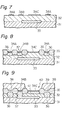
- the epitaxial layer 32 is selectively thermally oxidized to form a thick silicon dioxide layer (i.e., a field oxide layer) 35, as illustrated in Fig. 8.
- P-type impurities e.g., boron (B)
- B-type impurities are selectively introduced into the epitaxial layer 32 through the silicon nitride layer portion 34A by a conventional ion-implantation process to form a P-type isolation region 36.
- N-type impurities e.g., phosphorus (P)
- P phosphorus
- the above--mentioned production steps are the same as those of the prior art mentioned in relation to Figs. 1 and 2.
- the silicor. nitride layer portion 34A is removed by a photoetching process.
- Anannealing treatment is carried out under an oxidizing atmosphere" so that the silicon of the isolation region 36 is thermally oxidized to form an insulating layer 38 of silicon dioxide and, simultaneously, the doped regions 36 and 37 expand to reach the silicon substrate 31 and the buried layer 33, respectively, as illustrated in Fig. 9.
- a photoresist layer 39 is coated, exposed, and developed to form an opening 40 (Fig. 9) above a base-providing region.
- P-type impurities e.g., boron
- a high-melting-point metal layer 42 for a base electrode is formed on the exposed surfaces of the oxide layer 35 (and 38) and the base region 41 (and the collector contact region 37) by a sputtering process or a vacuum evaporation process, as illustrated in Fig. 10.
- the high--melting-point metal is a metal having a melting point higher than the temperature of the heat treatments (e.g., annealing) in the production process.
- Gold (Au), molybdenum. (Mo), or tungsten (w) can be used as the high--melting-point metal.
- an alloy layer of titanium-palladium (Ti-Pd) or titanium-platinum (Ti-Pt) should be formed between the epitaxial layer and the gold layer so as to prevent a reaction between the gold layer and the silicon of the epitaxial layer.
- the high-melting-point metal layer 42 consists of the alloy layer and the gold layer.
- the titanium-platinum layer having a thickness of approximately 50 nm is formed on the exposed surfaces by a sputtering process and the gold layer having a thickness of approximately 400 nm is formed on the titanium-platinum layer by a vacuum evaporation process.
- a first insulating layer 43 having a thickness of, e.g., approximately 1 ⁇ m. is formed by depositing phosphosilicate glass (PSG) or silicon nitride on the high-melting-point m&tal layer 42 by a conventional CVD process, as illustrated in Fig. 10.
- PSG phosphosilicate glass
- silicon nitride silicon nitride
- a photoresist layer 44 having a base electrode pattern is formed on the first insulating layer 43, as illustrated in Fig. 11.
- the first insulating layer 43 is selectively etched by a suitable etching process, e.g., a sputter etching process, by using trifluoromethane (CHF 3 ) gas.
- CHF 3 trifluoromethane
- the high-melting-point metal layer 42 is selectively etched by using the photoresist layer 44 and/or the first insulating layer 43 as a mask to form a base electrode having an opening 45 (Fi g . 11).
- Figure 12 is a plan view of a bipolar transistor in the intermediate stage of production shown in Fig. 11.
- the metal layer 42 is made of molybdenum or tungsten, this layer can be etched by a sputter etching process.
- the metal layer 42 consists of a gold layer and an alloy layer of titanium-palladium or titanium-platinum, the gold layer is etched by an ion-beam etching process by using argon ion-beam bombarding at right angles to the substrate and the alloy layer is etched by a wet etching process by using a suitable etching solution.
- the etch rate of gold is 3 times greater than that of other materials, because of the conditions of the ion--beam etching process: the degree of vacuum of the argon (Ar) ion is up to 2 x 10 -4 Torr, the acceleration voltage is from 0.5 to 1.0 kV, and the ion current density is up to 1 mA/cm 2 .
- the alloy layer is used as a stopper.
- a second insulating layer 46 is formed by depositing phosphosilicate glass or silicon nitride on the exposed surface by a CVD process, as illustrated in Fig. 13.
- the thickness (T) of the second insulating layer 46 should be larger than the total thickness (T ) of the first insulating layer 43 and the base electrode 42.
- the thickness (T 2 ) of a portion of the second insulating layer 46 near the edges of the first insulating layer 43 is approximately 2 times thicker than the thickness (T) of a portion of the second insulating layer 46 on the flat surface and the inclined surface.
- the second insulating layer 46 is anisotropically etched by a reactive sputter etching process by using, e.g., CHF 3 gas, or a reactive ion-beam etching process by using carbon tetrafluoride (CF 4 ) gas to form an opening 47 for defining an emitter-providing region, as illustrated in Fig. 14.
- a reactive sputter etching process by using, e.g., CHF 3 gas
- CF 4 carbon tetrafluoride
- a polycrystalline silicon layer 48 (having a thickness of, e.g., 100 nm) on the exposed surface by a CVD process so as to prevent the reaction between emitter region and electrode metal (e.g., Al). Then a photoresist layer (not shown) serving as a mask during an ion-implantation process is formed on the polycrystalline silicon layer 48. N-type impurities (e.g., arsenic (As)) are introduced (i.e., doped) into the base region 41 through the polycrystalline silicon layer 4e by an ion-implantation process by using the photoresist layer and the first and second insulating layers 43 and 46 as a mask so that an emitter region 49 (Fig. 14) is formed.
- N-type impurities e.g., arsenic (As)
- As arsenic
- an N + -type region 50 (Fig. 15) is preferably formed in the collector contact region 37.
- annealing is carried out, for example, at 900°C for approximately 30 minutes under a dry nitrogen (N 2 ) atmosphere.
- the polycrystalline silicon layer 48 has a good electric conductivity due to the introduction of N-type impurities into it.
- a metal layer is formed by depositing a metal having a good electric conductivity, such as aluùminum on the e x-posed surface by means of a vaccum evaporation process and is selectively etched to form an emitter electrode 51 and a collector electrode 52 by means of a photoetching process, as illustrated in Fig. 15. Then the polycrystalline silicon layer 48 is also selectively etched with a suitable etchant. Thus, a bipolar transistor is produced.
- the opening for defining the emitter-providing region can be formed in approximately the middle of the base region. If the opening is shifted somewhat toward or away from the middle, the undesirable short-circuiting between the collector and emitter does not occur since the thick field oxide layer covered with the metal layer and the first insulating layer is not etched.
- the base electrode and the emitter electrode are formed, respectively, and are arranged in a like multilayer structure, whereby it is possible to reduce the base region area. Therefore, the density of a bipolar IC can be increased as compared with a conventional bipolar IC. Furthermore, it is possible to reduce the external base resistance and the parastic capacity between the collector and base so that the frequency characteristic (f T ) is improved.
- a PNP-type bipolar transistor can be produced instead of the NPN-type bipolar transistor set forth above.
- Another isolation system e.g. , dielectric isolation
- silicide e.g., MoSi 2 , WSi , TiSi 2 , and the like
- SiSi 2 e.g., MoSi 2 , WSi , TiSi 2 , and the like
Landscapes
- Bipolar Transistors (AREA)
- Electrodes Of Semiconductors (AREA)
Applications Claiming Priority (2)
| Application Number | Priority Date | Filing Date | Title |
|---|---|---|---|
| JP56151987A JPS5866359A (ja) | 1981-09-28 | 1981-09-28 | 半導体装置の製造方法 |
| JP151987/81 | 1981-09-28 |
Publications (3)
| Publication Number | Publication Date |
|---|---|
| EP0076105A2 true EP0076105A2 (de) | 1983-04-06 |
| EP0076105A3 EP0076105A3 (en) | 1984-08-01 |
| EP0076105B1 EP0076105B1 (de) | 1986-12-10 |
Family
ID=15530578
Family Applications (1)
| Application Number | Title | Priority Date | Filing Date |
|---|---|---|---|
| EP82305023A Expired EP0076105B1 (de) | 1981-09-28 | 1982-09-23 | Verfahren zur Herstellung eines bipolaren Transistors |
Country Status (4)
| Country | Link |
|---|---|
| US (1) | US4590666A (de) |
| EP (1) | EP0076105B1 (de) |
| JP (1) | JPS5866359A (de) |
| DE (1) | DE3274698D1 (de) |
Cited By (2)
| Publication number | Priority date | Publication date | Assignee | Title |
|---|---|---|---|---|
| FR2549293A1 (fr) * | 1983-07-13 | 1985-01-18 | Silicium Semiconducteur Ssc | Transistor bipolaire haute frequence et son procede de fabrication |
| GB2218565A (en) * | 1988-05-10 | 1989-11-15 | Stc Plc | Varicap diode structure |
Families Citing this family (20)
| Publication number | Priority date | Publication date | Assignee | Title |
|---|---|---|---|---|
| JPS6080267A (ja) * | 1983-10-07 | 1985-05-08 | Toshiba Corp | 半導体集積回路装置の製造方法 |
| JPS6146063A (ja) * | 1984-08-10 | 1986-03-06 | Hitachi Ltd | 半導体装置の製造方法 |
| JPS61268065A (ja) * | 1985-05-23 | 1986-11-27 | Matsushita Electronics Corp | 半導体装置 |
| US4721682A (en) * | 1985-09-25 | 1988-01-26 | Monolithic Memories, Inc. | Isolation and substrate connection for a bipolar integrated circuit |
| JPH0622238B2 (ja) * | 1985-10-02 | 1994-03-23 | 沖電気工業株式会社 | バイポ−ラ型半導体集積回路装置の製造方法 |
| JPS62290173A (ja) * | 1986-06-09 | 1987-12-17 | Oki Electric Ind Co Ltd | 半導体集積回路装置の製造方法 |
| US4782030A (en) * | 1986-07-09 | 1988-11-01 | Kabushiki Kaisha Toshiba | Method of manufacturing bipolar semiconductor device |
| JPS63107167A (ja) * | 1986-10-24 | 1988-05-12 | Oki Electric Ind Co Ltd | 半導体集積回路装置の製造方法 |
| US4837176A (en) * | 1987-01-30 | 1989-06-06 | Motorola Inc. | Integrated circuit structures having polycrystalline electrode contacts and process |
| US5067002A (en) * | 1987-01-30 | 1991-11-19 | Motorola, Inc. | Integrated circuit structures having polycrystalline electrode contacts |
| US4740478A (en) * | 1987-01-30 | 1988-04-26 | Motorola Inc. | Integrated circuit method using double implant doping |
| JPS63134885U (de) * | 1987-02-13 | 1988-09-05 | ||
| US5236851A (en) * | 1988-07-14 | 1993-08-17 | Matsushita Electric Industrial Co., Ltd. | Method for fabricating semiconductor devices |
| JPH0226032A (ja) * | 1988-07-14 | 1990-01-29 | Matsushita Electric Ind Co Ltd | 半導体装置の製造方法 |
| JPH0817180B2 (ja) * | 1989-06-27 | 1996-02-21 | 株式会社東芝 | 半導体装置の製造方法 |
| JP3393544B2 (ja) * | 1997-02-26 | 2003-04-07 | シャープ株式会社 | 半導体装置の製造方法 |
| JP2001217317A (ja) * | 2000-02-07 | 2001-08-10 | Sony Corp | 半導体装置およびその製造方法 |
| DE202010000042U1 (de) | 2010-01-14 | 2010-06-02 | Papiersackfabrik Tenax Gmbh & Co. Kg | Ventilsack mit Entlüftungsvorrichtung |
| DE202013102644U1 (de) | 2013-06-19 | 2013-07-24 | Papiersackfabrik Tenax Gmbh & Co. Kg | Ventilsack mit Entlüftungsvorrichtungen |
| USD848384S1 (en) * | 2017-08-17 | 2019-05-14 | Epistar Corporation | Transistor |
Family Cites Families (13)
| Publication number | Priority date | Publication date | Assignee | Title |
|---|---|---|---|---|
| DE1934820A1 (de) * | 1969-07-09 | 1971-01-14 | Siemens Ag | Verfahren zum Herstellen eines Germanium-Planartransistors |
| US3686080A (en) * | 1971-07-21 | 1972-08-22 | Rca Corp | Method of fabrication of semiconductor devices |
| JPS532129B2 (de) * | 1973-07-23 | 1978-01-25 | ||
| US4054484A (en) * | 1975-10-23 | 1977-10-18 | Bell Telephone Laboratories, Incorporated | Method of forming crossover connections |
| US4157269A (en) * | 1978-06-06 | 1979-06-05 | International Business Machines Corporation | Utilizing polysilicon diffusion sources and special masking techniques |
| NL7900280A (nl) * | 1979-01-15 | 1980-07-17 | Philips Nv | Halfgeleiderinrichting en werkwijze ter vervaardiging daarvan. |
| US4309812A (en) * | 1980-03-03 | 1982-01-12 | International Business Machines Corporation | Process for fabricating improved bipolar transistor utilizing selective etching |
| US4318751A (en) * | 1980-03-13 | 1982-03-09 | International Business Machines Corporation | Self-aligned process for providing an improved high performance bipolar transistor |
| US4319932A (en) * | 1980-03-24 | 1982-03-16 | International Business Machines Corporation | Method of making high performance bipolar transistor with polysilicon base contacts |
| US4381953A (en) * | 1980-03-24 | 1983-05-03 | International Business Machines Corporation | Polysilicon-base self-aligned bipolar transistor process |
| US4322883A (en) * | 1980-07-08 | 1982-04-06 | International Business Machines Corporation | Self-aligned metal process for integrated injection logic integrated circuits |
| FR2508704B1 (fr) * | 1981-06-26 | 1985-06-07 | Thomson Csf | Procede de fabrication de transistors bipolaires integres de tres petites dimensions |
| JPS5946105B2 (ja) * | 1981-10-27 | 1984-11-10 | 日本電信電話株式会社 | バイポ−ラ型トランジスタ装置及びその製法 |
-
1981
- 1981-09-28 JP JP56151987A patent/JPS5866359A/ja active Granted
-
1982
- 1982-09-23 DE DE8282305023T patent/DE3274698D1/de not_active Expired
- 1982-09-23 EP EP82305023A patent/EP0076105B1/de not_active Expired
-
1985
- 1985-01-31 US US06/696,884 patent/US4590666A/en not_active Expired - Lifetime
Cited By (5)
| Publication number | Priority date | Publication date | Assignee | Title |
|---|---|---|---|---|
| FR2549293A1 (fr) * | 1983-07-13 | 1985-01-18 | Silicium Semiconducteur Ssc | Transistor bipolaire haute frequence et son procede de fabrication |
| EP0135408A1 (de) * | 1983-07-13 | 1985-03-27 | Le Silicium Semiconducteur Ssc | Hochfrequenz-Bipolartransistor und Verfahren zu dessen Herstellung |
| US4586968A (en) * | 1983-07-13 | 1986-05-06 | Le Silicium Semiconducteur Ssc | Process of manufacturing a high frequency bipolar transistor utilizing doped silicide with self-aligned masking |
| GB2218565A (en) * | 1988-05-10 | 1989-11-15 | Stc Plc | Varicap diode structure |
| GB2218565B (en) * | 1988-05-10 | 1992-04-01 | Stc Plc | Varicap diode structure |
Also Published As
| Publication number | Publication date |
|---|---|
| US4590666A (en) | 1986-05-27 |
| JPS5866359A (ja) | 1983-04-20 |
| EP0076105B1 (de) | 1986-12-10 |
| JPS6152584B2 (de) | 1986-11-13 |
| EP0076105A3 (en) | 1984-08-01 |
| DE3274698D1 (en) | 1987-01-22 |
Similar Documents
| Publication | Publication Date | Title |
|---|---|---|
| EP0076105B1 (de) | Verfahren zur Herstellung eines bipolaren Transistors | |
| EP0139371B1 (de) | Verfahren zum Herstellen integrierter MOS-Schaltungen unter Verwendung eines Verfahrens zur Bildung von Oberflächenbereichen aus Siliciden hochschmelzender Metalle | |
| EP0110211B1 (de) | Integrierte Schaltung mit bipolaren Transistoren und Verfahren zu ihrer Herstellung | |
| US4141022A (en) | Refractory metal contacts for IGFETS | |
| EP0043942B1 (de) | Verfahren zur Herstellung integrierter Schaltungen mit einem Muster dielektrischer Gebiete mit engen Dimensionen | |
| EP0107416B1 (de) | Verfahren zur Herstellung einer Halbleiteranordnung | |
| US4735680A (en) | Method for the self-aligned silicide formation in IC fabrication | |
| EP0126424B1 (de) | Verfahren zur Herstellung von Polycide-Strukturen | |
| US4425700A (en) | Semiconductor device and method for manufacturing the same | |
| US4486266A (en) | Integrated circuit method | |
| US5793155A (en) | Microelectronic vacuum triode structure and method of fabrication | |
| US5897359A (en) | Method of manufacturing a silicon/silicon germanium heterojunction bipolar transistor | |
| US4425379A (en) | Polycrystalline silicon Schottky diode array | |
| EP0076106A2 (de) | Verfahren zur Herstellung eines bipolaren Transistors | |
| EP0199497A2 (de) | Verfahren zum Herstellen eines selbtsausrichtenden Bipolartransistors | |
| EP0078501B1 (de) | Transistorähnliche Halbleiteranordnung und Verfahren zu deren Herstellung | |
| EP0107437B1 (de) | Verfahren zum Herstellen eines aus einem bipolaren Transistor und einer Schottky-Diode bestehenden Halbleiterbauelementes | |
| JPH0241170B2 (de) | ||
| US4883772A (en) | Process for making a self-aligned silicide shunt | |
| JPH04280456A (ja) | 半導体装置及びその製造方法 | |
| US4464825A (en) | Process for fabrication of high-speed radiation hard bipolar semiconductor devices | |
| EP0037040B1 (de) | Verfahren zur Herstellung einer Halbleitervorrichtung | |
| JPH02153534A (ja) | 半導体装置の製造方法 | |
| EP0264309B1 (de) | Selbstausgerichteter Basis-Nebenschluss für einen Transistor | |
| EP0292042B1 (de) | Verfahren zur Halbleiterherstellung, wobei unter Verwendung einer Hilfsoxidation die Tunnelausbildung bei der Wolframabscheidung reduziert wird |
Legal Events
| Date | Code | Title | Description |
|---|---|---|---|
| PUAI | Public reference made under article 153(3) epc to a published international application that has entered the european phase |
Free format text: ORIGINAL CODE: 0009012 |
|
| AK | Designated contracting states |
Designated state(s): DE FR GB |
|
| PUAL | Search report despatched |
Free format text: ORIGINAL CODE: 0009013 |
|
| AK | Designated contracting states |
Designated state(s): DE FR GB |
|
| 17P | Request for examination filed |
Effective date: 19840828 |
|
| GRAA | (expected) grant |
Free format text: ORIGINAL CODE: 0009210 |
|
| AK | Designated contracting states |
Kind code of ref document: B1 Designated state(s): DE FR GB |
|
| ET | Fr: translation filed | ||
| REF | Corresponds to: |
Ref document number: 3274698 Country of ref document: DE Date of ref document: 19870122 |
|
| PLBE | No opposition filed within time limit |
Free format text: ORIGINAL CODE: 0009261 |
|
| STAA | Information on the status of an ep patent application or granted ep patent |
Free format text: STATUS: NO OPPOSITION FILED WITHIN TIME LIMIT |
|
| 26N | No opposition filed | ||
| PGFP | Annual fee paid to national office [announced via postgrant information from national office to epo] |
Ref country code: FR Payment date: 19990909 Year of fee payment: 18 |
|
| PGFP | Annual fee paid to national office [announced via postgrant information from national office to epo] |
Ref country code: GB Payment date: 19990922 Year of fee payment: 18 |
|
| PGFP | Annual fee paid to national office [announced via postgrant information from national office to epo] |
Ref country code: DE Payment date: 19990927 Year of fee payment: 18 |
|
| PG25 | Lapsed in a contracting state [announced via postgrant information from national office to epo] |
Ref country code: GB Free format text: LAPSE BECAUSE OF NON-PAYMENT OF DUE FEES Effective date: 20000923 |
|
| GBPC | Gb: european patent ceased through non-payment of renewal fee |
Effective date: 20000923 |
|
| PG25 | Lapsed in a contracting state [announced via postgrant information from national office to epo] |
Ref country code: FR Free format text: LAPSE BECAUSE OF NON-PAYMENT OF DUE FEES Effective date: 20010531 |
|
| PG25 | Lapsed in a contracting state [announced via postgrant information from national office to epo] |
Ref country code: DE Free format text: LAPSE BECAUSE OF NON-PAYMENT OF DUE FEES Effective date: 20010601 |
|
| REG | Reference to a national code |
Ref country code: FR Ref legal event code: ST |