EP0077135A1 - Dispositif de stockage d'information comportant un film multicouche de Langmuir-Blodgett - Google Patents
Dispositif de stockage d'information comportant un film multicouche de Langmuir-Blodgett Download PDFInfo
- Publication number
- EP0077135A1 EP0077135A1 EP82304985A EP82304985A EP0077135A1 EP 0077135 A1 EP0077135 A1 EP 0077135A1 EP 82304985 A EP82304985 A EP 82304985A EP 82304985 A EP82304985 A EP 82304985A EP 0077135 A1 EP0077135 A1 EP 0077135A1
- Authority
- EP
- European Patent Office
- Prior art keywords
- film
- memory according
- layer
- dye
- layers
- Prior art date
- Legal status (The legal status is an assumption and is not a legal conclusion. Google has not performed a legal analysis and makes no representation as to the accuracy of the status listed.)
- Granted
Links
- 230000015654 memory Effects 0.000 claims abstract description 30
- 229920000015 polydiacetylene Polymers 0.000 claims abstract description 30
- 239000010410 layer Substances 0.000 claims description 92
- 239000004065 semiconductor Substances 0.000 claims description 20
- 239000002356 single layer Substances 0.000 claims description 15
- 239000000463 material Substances 0.000 claims description 13
- 229910052751 metal Inorganic materials 0.000 claims description 9
- 239000002184 metal Substances 0.000 claims description 9
- 238000012546 transfer Methods 0.000 claims description 8
- 230000033001 locomotion Effects 0.000 claims description 3
- 230000004044 response Effects 0.000 claims 2
- 238000001816 cooling Methods 0.000 claims 1
- 238000000034 method Methods 0.000 abstract description 13
- 230000004069 differentiation Effects 0.000 abstract description 6
- 239000000975 dye Substances 0.000 description 31
- 235000014113 dietary fatty acids Nutrition 0.000 description 12
- 229930195729 fatty acid Natural products 0.000 description 12
- 239000000194 fatty acid Substances 0.000 description 12
- 150000004665 fatty acids Chemical class 0.000 description 12
- 238000009792 diffusion process Methods 0.000 description 9
- 238000002347 injection Methods 0.000 description 7
- 239000007924 injection Substances 0.000 description 7
- 230000006870 function Effects 0.000 description 6
- 238000006116 polymerization reaction Methods 0.000 description 6
- 238000001514 detection method Methods 0.000 description 5
- 230000003287 optical effect Effects 0.000 description 5
- 230000008569 process Effects 0.000 description 5
- 239000000758 substrate Substances 0.000 description 4
- GPXJNWSHGFTCBW-UHFFFAOYSA-N Indium phosphide Chemical compound [In]#P GPXJNWSHGFTCBW-UHFFFAOYSA-N 0.000 description 3
- 230000008859 change Effects 0.000 description 3
- 239000013078 crystal Substances 0.000 description 3
- 238000004519 manufacturing process Methods 0.000 description 3
- 125000002080 perylenyl group Chemical group C1(=CC=C2C=CC=C3C4=CC=CC5=CC=CC(C1=C23)=C45)* 0.000 description 3
- 230000027756 respiratory electron transport chain Effects 0.000 description 3
- 238000000926 separation method Methods 0.000 description 3
- 230000003068 static effect Effects 0.000 description 3
- XLYOFNOQVPJJNP-UHFFFAOYSA-N water Substances O XLYOFNOQVPJJNP-UHFFFAOYSA-N 0.000 description 3
- IJGRMHOSHXDMSA-UHFFFAOYSA-N Atomic nitrogen Chemical compound N#N IJGRMHOSHXDMSA-UHFFFAOYSA-N 0.000 description 2
- 229910005542 GaSb Inorganic materials 0.000 description 2
- 229910004262 HgTe Inorganic materials 0.000 description 2
- 229910000673 Indium arsenide Inorganic materials 0.000 description 2
- 230000032683 aging Effects 0.000 description 2
- 229910052782 aluminium Inorganic materials 0.000 description 2
- 230000003321 amplification Effects 0.000 description 2
- 238000000429 assembly Methods 0.000 description 2
- 230000000712 assembly Effects 0.000 description 2
- 230000006399 behavior Effects 0.000 description 2
- 230000008901 benefit Effects 0.000 description 2
- 238000006243 chemical reaction Methods 0.000 description 2
- 150000001875 compounds Chemical class 0.000 description 2
- 230000008021 deposition Effects 0.000 description 2
- 238000009826 distribution Methods 0.000 description 2
- 230000005684 electric field Effects 0.000 description 2
- 238000005516 engineering process Methods 0.000 description 2
- 230000005281 excited state Effects 0.000 description 2
- 238000005286 illumination Methods 0.000 description 2
- WPYVAWXEWQSOGY-UHFFFAOYSA-N indium antimonide Chemical compound [Sb]#[In] WPYVAWXEWQSOGY-UHFFFAOYSA-N 0.000 description 2
- RPQDHPTXJYYUPQ-UHFFFAOYSA-N indium arsenide Chemical compound [In]#[As] RPQDHPTXJYYUPQ-UHFFFAOYSA-N 0.000 description 2
- 150000004668 long chain fatty acids Chemical class 0.000 description 2
- 230000008018 melting Effects 0.000 description 2
- 238000002844 melting Methods 0.000 description 2
- 150000002739 metals Chemical class 0.000 description 2
- 238000004377 microelectronic Methods 0.000 description 2
- 239000000178 monomer Substances 0.000 description 2
- 238000003199 nucleic acid amplification method Methods 0.000 description 2
- 238000012856 packing Methods 0.000 description 2
- 229920000642 polymer Polymers 0.000 description 2
- 238000005036 potential barrier Methods 0.000 description 2
- 230000002441 reversible effect Effects 0.000 description 2
- 229910052710 silicon Inorganic materials 0.000 description 2
- 230000007704 transition Effects 0.000 description 2
- 230000005641 tunneling Effects 0.000 description 2
- UWQGOJWRGSENEX-UHFFFAOYSA-N C(CCCCCCCCCCCCCCCCC)C1=CC=[N+](C=C1)[N+]1=CC=C(C=C1)CCCCCCCCCCCCCCCCCC Chemical compound C(CCCCCCCCCCCCCCCCC)C1=CC=[N+](C=C1)[N+]1=CC=C(C=C1)CCCCCCCCCCCCCCCCCC UWQGOJWRGSENEX-UHFFFAOYSA-N 0.000 description 1
- -1 Ga-As Inorganic materials 0.000 description 1
- 229910001218 Gallium arsenide Inorganic materials 0.000 description 1
- 239000006096 absorbing agent Substances 0.000 description 1
- 238000004847 absorption spectroscopy Methods 0.000 description 1
- 238000000862 absorption spectrum Methods 0.000 description 1
- 239000002253 acid Substances 0.000 description 1
- 150000007513 acids Chemical class 0.000 description 1
- 230000009471 action Effects 0.000 description 1
- 125000001931 aliphatic group Chemical group 0.000 description 1
- 239000004411 aluminium Substances 0.000 description 1
- XAGFODPZIPBFFR-UHFFFAOYSA-N aluminium Chemical compound [Al] XAGFODPZIPBFFR-UHFFFAOYSA-N 0.000 description 1
- 238000004458 analytical method Methods 0.000 description 1
- 150000001454 anthracenes Chemical class 0.000 description 1
- QVGXLLKOCUKJST-UHFFFAOYSA-N atomic oxygen Chemical compound [O] QVGXLLKOCUKJST-UHFFFAOYSA-N 0.000 description 1
- 230000004888 barrier function Effects 0.000 description 1
- 230000015572 biosynthetic process Effects 0.000 description 1
- LLCSWKVOHICRDD-UHFFFAOYSA-N buta-1,3-diyne Chemical group C#CC#C LLCSWKVOHICRDD-UHFFFAOYSA-N 0.000 description 1
- 238000003776 cleavage reaction Methods 0.000 description 1
- 229910052802 copper Inorganic materials 0.000 description 1
- 238000000354 decomposition reaction Methods 0.000 description 1
- 230000007547 defect Effects 0.000 description 1
- 230000001419 dependent effect Effects 0.000 description 1
- 238000011161 development Methods 0.000 description 1
- 230000018109 developmental process Effects 0.000 description 1
- 230000008034 disappearance Effects 0.000 description 1
- 238000010894 electron beam technology Methods 0.000 description 1
- AFSIMBWBBOJPJG-UHFFFAOYSA-N ethenyl octadecanoate Chemical compound CCCCCCCCCCCCCCCCCC(=O)OC=C AFSIMBWBBOJPJG-UHFFFAOYSA-N 0.000 description 1
- 230000008020 evaporation Effects 0.000 description 1
- 238000001704 evaporation Methods 0.000 description 1
- 230000005284 excitation Effects 0.000 description 1
- 238000002474 experimental method Methods 0.000 description 1
- 238000002189 fluorescence spectrum Methods 0.000 description 1
- 229910052733 gallium Inorganic materials 0.000 description 1
- 239000011521 glass Substances 0.000 description 1
- 230000002209 hydrophobic effect Effects 0.000 description 1
- VKOBVWXKNCXXDE-UHFFFAOYSA-N icosanoic acid Chemical compound CCCCCCCCCCCCCCCCCCCC(O)=O VKOBVWXKNCXXDE-UHFFFAOYSA-N 0.000 description 1
- 239000012535 impurity Substances 0.000 description 1
- 238000010348 incorporation Methods 0.000 description 1
- 229910052738 indium Inorganic materials 0.000 description 1
- 239000013546 insoluble monolayer Substances 0.000 description 1
- 230000003993 interaction Effects 0.000 description 1
- 238000011835 investigation Methods 0.000 description 1
- 230000009191 jumping Effects 0.000 description 1
- 239000007788 liquid Substances 0.000 description 1
- 238000005259 measurement Methods 0.000 description 1
- 229910052753 mercury Inorganic materials 0.000 description 1
- 230000005012 migration Effects 0.000 description 1
- 238000013508 migration Methods 0.000 description 1
- 229910052757 nitrogen Inorganic materials 0.000 description 1
- HMZGPNHSPWNGEP-UHFFFAOYSA-N octadecyl 2-methylprop-2-enoate Chemical compound CCCCCCCCCCCCCCCCCCOC(=O)C(C)=C HMZGPNHSPWNGEP-UHFFFAOYSA-N 0.000 description 1
- 239000001301 oxygen Substances 0.000 description 1
- 229910052760 oxygen Inorganic materials 0.000 description 1
- CSHWQDPOILHKBI-UHFFFAOYSA-N peryrene Natural products C1=CC(C2=CC=CC=3C2=C2C=CC=3)=C3C2=CC=CC3=C1 CSHWQDPOILHKBI-UHFFFAOYSA-N 0.000 description 1
- 230000001443 photoexcitation Effects 0.000 description 1
- 230000000704 physical effect Effects 0.000 description 1
- 238000002360 preparation method Methods 0.000 description 1
- 238000010791 quenching Methods 0.000 description 1
- 230000000171 quenching effect Effects 0.000 description 1
- 230000008707 rearrangement Effects 0.000 description 1
- 230000006798 recombination Effects 0.000 description 1
- 238000005215 recombination Methods 0.000 description 1
- 238000001055 reflectance spectroscopy Methods 0.000 description 1
- 238000001945 resonance Rayleigh scattering spectroscopy Methods 0.000 description 1
- 230000000717 retained effect Effects 0.000 description 1
- 150000003839 salts Chemical class 0.000 description 1
- 230000007017 scission Effects 0.000 description 1
- 239000010703 silicon Substances 0.000 description 1
- 229910052709 silver Inorganic materials 0.000 description 1
- 239000010454 slate Substances 0.000 description 1
- 239000000243 solution Substances 0.000 description 1
- 238000003860 storage Methods 0.000 description 1
- 125000001424 substituent group Chemical group 0.000 description 1
- 229910052718 tin Inorganic materials 0.000 description 1
- 229910052721 tungsten Inorganic materials 0.000 description 1
- 229910052720 vanadium Inorganic materials 0.000 description 1
- 229910052725 zinc Inorganic materials 0.000 description 1
Images



Classifications
-
- G—PHYSICS
- G11—INFORMATION STORAGE
- G11C—STATIC STORES
- G11C19/00—Digital stores in which the information is moved stepwise, e.g. shift registers
- G11C19/30—Digital stores in which the information is moved stepwise, e.g. shift registers using opto-electronic devices, i.e. light-emitting and photoelectric devices electrically- or optically-coupled
-
- G—PHYSICS
- G03—PHOTOGRAPHY; CINEMATOGRAPHY; ANALOGOUS TECHNIQUES USING WAVES OTHER THAN OPTICAL WAVES; ELECTROGRAPHY; HOLOGRAPHY
- G03F—PHOTOMECHANICAL PRODUCTION OF TEXTURED OR PATTERNED SURFACES, e.g. FOR PRINTING, FOR PROCESSING OF SEMICONDUCTOR DEVICES; MATERIALS THEREFOR; ORIGINALS THEREFOR; APPARATUS SPECIALLY ADAPTED THEREFOR
- G03F7/00—Photomechanical, e.g. photolithographic, production of textured or patterned surfaces, e.g. printing surfaces; Materials therefor, e.g. comprising photoresists; Apparatus specially adapted therefor
- G03F7/004—Photosensitive materials
- G03F7/025—Non-macromolecular photopolymerisable compounds having carbon-to-carbon triple bonds, e.g. acetylenic compounds
Definitions
- This invention relates to an information holding device.
- the device is referred to below as a memory, though it is to be understood that the information may be held only briefly, in which case the device may function, for example, as a delay line, or the information may be held for a longer time, in which case the device may function as a normal memory.
- An object of the present invention is to provide such a memory, and in particular a memory employing a Langmuir-Blodgett film (hereinafter referred to as an L-B film).
- L-B film a Langmuir-Blodgett film
- Monolayers of dye substituted fatty acids commonly exhibit the characteristic absorption and fluorescence spectra of the isolated dye.
- Detailed investigations have been made of energy transfer from one type of dye in one monolayer to a second type of dye in neighbouring or more distant monolayers. If for example a sensitizer dye S which absorbs in the UV and emits in the blue is incorporated in an L-B film assembly with an acceptor dye A which absorbs in the blue and emits in the yellow then considerable energy transfer can occur. Under UV illumination the blue fluoresence is partially quenched by the presence of dye A-and yellow fluorescence appears. The relative quencing of dye A fluorescence depends upon the proximity of dye S in a manner predicted by the classical electric dipole model.
- Electron as well as exciton transfer has been observed between different chromospheres in multilayer assemblies.
- an electron is transferred from one molecule acting as the donor D to the second acting as acceptor A.
- Quenching of fluorescence is observed in monolayer assemblies if donor and acceptor are in the same monolayer or at the hydrophilic interface between adjacent monolayers.
- D and A layers are separated by a single fatty acid monolayer it has been possible to observe this transfer as a photocurrent.
- Photocurrents can be generated from a layer of an absorbing molecule located in a film of fatty acid layers if the excited state energy level of the absorber lies close to the potential barrier of the fatty acid layers. It is known that this is possible for the linear conjugated molecule quinquethienyl for which the excited state lies 0.4eV below the potential barrier of arachidate layers.
- L-B multilayer technique for the fabrication of supramolecular structures has been amply demonstrated, as described above.
- practical application of structures with photo-excited energy and charge transfer has been inhibited by the poor stability of L-B multilayers primarily composed of fatty acids. This arises from the low melting points of the long-chain fatty acids and the large amplitude molecular motions, which give rise to solid-state phase transitions below the melting points of paraffinic crystals.
- the ceiling temperature of fatty-acid L-B multilayers is close to room temperature and they exhibit pronounced ageing, with consequent changes in physical properties, due to molecular re-arrangement within the L-B layers.
- the solid-state topochemical polymerization of certain di-substituted diacetylenes has been known for some time. This polymerization is insensitive to normal atmosphere and there followed development to investigate the properties of L-B films made from fatty-acids containing diacetylinic units. The topochemical polymerization was found to occur under UV in irradiation in air and the dimensional changes were sufficiently small that the final films were as perfect as the initial monomer films.
- the first stage of this decomposition has been identified as cleavage of the bulky, reactive sidegroups, probably initiated by absorbed oxygen. This suggests that diacetylenes with less reactive paraffinic sidegroups are likely to decompose at higher temperatures.
- Ageing of the polymerized films should be negligible since on polymerization the paraffinic side chains are locked in place by the polymer chains, which prevents any translational motion either in or out of the plane of the film. This is revealed most dramatically by the disappearance of phase transitions in both the pure acids and their salts. It should be emphasised that the incorporation of polydiacetylene chains into L-B multilayers offers benefits in addition to providing more durable films. These derive from the properties of the PDA chain, which is a wide band-gap wide band semiconductor with strong electron-hole interaction. Thus the PDA chains can play an active role in the photoexcitation of energy and charge transfer through L-B multilayer structures.
- a memory for carrying information comprising a multilayer Langmuir-Blodgett film in which each layer is capable of carrying a charge; means located adjacent one face of the film for introducing charges into the film in a time sequence which corresponds to the information to be carried, means for applying a voltage between the faces of the film to cause the charge carried by any layer to be transferred to the adjacent layer, and means for reading out the sequence of charges carried by the film.
- the layers of the Langmuir-Blodgett film are polymeric, and they may, for example, be formed of a polydiacetylene (PDA).
- PDA polydiacetylene
- Materials for the film which are particularly suitable are ones, like polydiacetylene, which have a conjugated bond structure, as such structures have a low energy gap.
- the embodiment shown in Fig. 1 comprises an L-B film 1 formed of a plurality of n layers 2 (eight are illustrated) of PDA. The layers are spaced a distance a apart from one another and the overall film thickness is d. Adjacent one face of the film 1 is a layer D of electron donor molecules which require a photon energy above kb to donate. ⁇ D is the energy needed to take an electron from the donor layer D and put it in the conductance band of the PDA. A source 3 of photon energy is provided, and the drawing also shows a means 4 for modulating the output of the source 3 in a manner described below. Adjacent the other face of the film 1 is a layer F of molecules which fluoresce on receiving an electron. An optical loop O feeds the output of the layer F back to the layer D. Since the quantum efficiency of the layer D and the layer F is less than unity the loop O must have gain.
- the optical signal produced by the layer F could be converted into an electrical signal which could then be amplified, or amplification of the optical signal could take place directly without such conversion.
- a voltage source 6 applies a d.c. voltage across the film 1 via electrodes 7. In some cases, as will be apparent from what is said below the layers D and F could themselves function as electrodes.
- An amplifier 5 is diagramatically shown.
- the photon energy, for example light, emitted by the source 3 is pulse-code modulated by the modulation means 4, the pulses having a width ⁇ t and a period t/n, while the voltage V>V(h) is applied across the film. Because of the synchronism between the period of the pulse train and the jump time for an electron to jump from one plane to the next the pulse train is translated into a corresponding spatial charge distribution across the film.
- ⁇ and ⁇ o are the dielectric constant of the medium and permittivity of free space respectively. So in a device of n layers the upper limit to q, the charge on one layer, is q, and
- EAD electron arrival detection
- CD current differentiation
- Fig. 2 shows an embodiment employing current differentiation (CD).
- CD current differentiation
- This comprises a pair of devices 1 and l' each comprising n layers 2,2' of PDA.
- Each device has a layer D of electron donor molecules but no layer F as in Fig. 1.
- Each device is provided with a source 3,3' of photon energy, in the form of a light-emitting diode (LED).
- Each device is further provided with a current differentiation detector 8,8' for detecting, in a manner described below, the current in the device.
- the current detector of each device is coupled to the LED of the other device so that information is continuously cycled around the arrangement consisting of the pair of devices.
- Each device is further provided, as in Fig. 1, with a device (not shown) for modulating the output of the source 3,3' and a voltage source 6 (not shown) for applying a d.c. voltage across the electrodes 7.
- Fig. 3a represents the charge density e as a function of position, the doubleheaded arrow denoting the direction of travel of the bits.
- the maximum charge in any one bit is q m .
- Fig. 3b represents the fluoresced power P from the layer F as a function of time t, the maximum power being ⁇ q m V L / ⁇ . This is what is detected by electron arrival detection, as in Fig. 1.
- dI/dt due to the arrival of one bit at F is a negative peak of duration and height ⁇ I/ ⁇ (Fig. 3e)
- dI/dt due to the injection of one bit at D is a positive peak of duration ⁇ and height ⁇ I/ ⁇ (Fig. 3f).
- This current differentiation (CD) method in contrast to EAD, records entry of bits as well as exit of bits. Moreover they are recorded with different sign. If bits are entering simultaneously with their leaving then CD records no change; in contrast EAD records the exiting bits correctly whether bits are entering or not.
- the device of Fig. 2 is so arranged so that writing in of bits never overlaps in time the reading out of bits; in addition the signs of connections are chosen so that exiting bits only, and not entering bits, cause entry of bits of the next stage.
- the signal to noise ratio of given detectors of fluorescence (EAD) or differentiated current (CD) is determined by the products P ⁇ and ⁇ I respectively.
- Fig. 4 illustrates diagramatically a film composed of alternate layers of two different materials, for example two types of PDA, which have different values of electron affinity A, differing by ⁇ A. Different PDA's of different side groups, have energy gaps differing by up to 0.25 eV and corresponding differences occur also in A. Thus ⁇ A can be as large as 10 times the thermal energy K B T (at room temperature). The jump times denoted in Figs. 4a and 4b are then
- ⁇ 12 is the jump time from a layer of type 1 to an adjacent layer of type 2
- ⁇ 11 is the jump time from one layer of the type 1 to the nearest layer of type 1.
- alternating layers bits can be written into the device with the high field applied, stored for a time up to ⁇ 12 (s) with the field small or zero, and read out of the device with the high field re-applied.
- This alternating layer device is more complicated than the original device because the applied field now has to be controlled, i.e. it must be turned on and off in synchronism with the bits entering and leaving, but the information holding time is longer.
- the read and write field, E ⁇ A/ea, is very large. In the numerical example it is lOkT per layer separation a i.e. 250 mV per 2 nm, i.e. 1.25x 10 V/m. However, the application of such fields is quite feasible with existing technology.
- the bits can be written and read at the same side of the multilayer using EAD, since the bits will move in opposite directions under the influence of the two fields.
- the last bit in will be the first bit out. If reading and writing are to be done at separate times, using the long hold time of the alternating layer device, it is possible to abandon EAD and use CD instead.
- the hold time can be increased by lowering the temperature and so lengthening ⁇ 12 (s) until it equals ⁇ 11 .
- the first is the hold time before diffusion destroys the bit pattern when the field is on and the bits are being written in or read out.
- This time sets the maximum write-read time; i.e. it sets the maximum byte length as limited by diffusion.
- the second hold time is the time the bit pattern is retained statically in small or zero field before diffusion destroys the bit pattern.
- These hold times may be referred to respectively as the dynamic hold time and the static hold time.
- the dynamic hold time can be lengthened by using the previously described technique of storing one bit in M layers of which one has high A and (M-l) have low A. This exponentially lengthens Tll which is the upper limit to the static hold time which can be reached on lowering the temperature.
- the electrodes both apply the electric field across the device and also supply the transit electrons from the D layer and collect the transit electrons at the F layer.
- They can be metals or doped semiconductors. They can be substrates onto which LB layers are deposited; or they can be evaporated or sputtered onto such LB layers. For semiconductor electrodes with photon energies below the semiconductor band-gap the electrode is transparent; otherwise the electrode is semitransparent (and opaque if thick).
- the layer D forming the electron photo-injector can be a metal, in which case D is also the electrode.
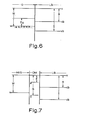
- the metal electrode is denoted M and the LB layer as LB.
- v is the reference energy of an unbound electron at rest
- cb is the conduction band edge of the material of the LB layer (e.g. PDA) at an energy A below V
- vb is the valence band edge of PDA or an energy I below V
- w is the Fermi level of the metal at an energy W below v.
- the available range of W is large so ⁇ D can virtually be chosen at will.
- Suitable metals for use as metal electrodes on PDA crystals include Ag, Al, Au, Cd, Cu, Ga, Hg, In, Mg, Pb, Zn, Sn.
- D can be a p-type semiconductor, in which case it is also the electrode.
- Suitable semiconductors include Ge, Si, Ga-As, GaSb, InP, InAs, InSb, HgTe.
- D is a dye molecule DM, shown in Fig. 7.
- the dye is a strong adsorber of photons of energy (G-E), creating an exciton at energy level e.
- the exciton can auto- ionise to create an electron at level cb and a hole at level w if (G-E)>W-A.
- the net result of the photon adsorbtion is electron injection.
- the auto-ionisation will only be efficient if DM is a monolayer. LB monolayers of dye molecules can be produced, as is mentioned below in reference to the layer F.
- Fig. 7 Another possibility is for D to be a dye molecule DM, shown in Fig. 7.
- the dye is a strong adsorber of photons of energy (G-E), creating an exciton at energy level e.
- the exciton can auto- ionise to create an electron at level cb and a hole at level w if (G-E)>
- w is the Fermi level of a metal or the valence band edge of a semiconductor, depending on whether the electrode is a metal M or a semiconductor S
- g is the electronic ground slate of the dye DM at energy G below V
- e is the first singlet exciton state of the dye at energy E below v
- the other symbols have the same meaning as in Figs. 5 and 6.
- the electron arrival detector F can be a p-type semiconductor as shown in Fig. 8.
- the electron arriving at this electrode can enter the conduction band of the semiconductor provided W-E G >A.
- the electron is then a minority carrier in the p-type semiconductor and can recombine rapidly by emission of a photo of energy EG.
- the conditions for such recombination are identical to those required in a semiconductor laser or light-emitting diode, and thus well established.
- F is then analogous to an LED with the n-type electron injector replaced by the PDA multilayer. It is necessary that W ⁇ I so that dark injection of holes does not occur.
- F can be a dye molecule.
- Fig. 9 shows creation of the exciton by tunnelling of the arriving electron to the electrode. This process requires W-A>(G-E), and that F be a monolayer for efficiency. The subsequent rapid dye fluorescence is the signature of the electron arrival.
- the symbols in Fig. 9 have the same meaning as in Fig. 7.
- Fig. lO shows a further scheme not relying on such a tunnelling process in a monolayer, and which would work with thicker dye layers.
- the symbols have the same meaning as in Fig. 9.
- the process involves the following steps:
- Step 1 occurs spontaneously in the dark and creates positively charged dye molecules. In other than a monolayer of dye the positive charge will migrate in the applied field to the dye molecules adjacent to the PDA.
- the arriving electron which is highly mobile along the PDA chain, can then hunt in the plane of the film and find the positively charged dye molecule.
- Step 2 the electron enters the dye and forms the exciton.
- Step 3 is the rapid dye fluorescence. Migration of this exciton can be prevented by the methods described above.
- Fluorescing dyes in the required range have been studied at length for their use in dye lasers.
- Dyes can be put in layers by evaporation. If a dye of suitable values of E and G is incorporated in a molecule from which LB layers can be formed, then the dye can be put as mono- or multilayer at the D or F side of the PDA multilayer.
- LB layers can be formed from lightly substitued anthracene derivatives with aliphatic side chains, for example a derivative where the side chain has four CHJ. units (known as C4) and a derivative where it has six CH 2 units (known as C6). Attention is directed in this connection to the journal Phys. Technol. Vol. 12, 1981 pp 69 to 87.
- LB films can be formed of derivatives of perylene to obtain perylene fluorescence in the same way.
- the layers of the memory as being of PDA.
- other materials which form LB films can be used instead.
- these are large conjugated organic molecules, because in such molecules the value of I - A is small and there is therefore less chance of impurity and defect trapping of the electrons destroying the spatial coherence of the memory.
- the molecules C4 and C6 mentioned above might be used for the memory, as might a derivative of perylene.
- suitable materials include compounds of the formula where m and n are integers.
- Film-forming compounds of this general formula are known where the values of (m,n) are (12,8), (10,8) (14,8), (16,2) or (16,0).
- a plurality of independent information holding devices can be created in unit area of a film. Three ways in which this can be done are:
Landscapes
- Physics & Mathematics (AREA)
- Spectroscopy & Molecular Physics (AREA)
- General Physics & Mathematics (AREA)
- Semiconductor Memories (AREA)
- Optical Recording Or Reproduction (AREA)
- Bipolar Transistors (AREA)
- Light Receiving Elements (AREA)
Applications Claiming Priority (2)
| Application Number | Priority Date | Filing Date | Title |
|---|---|---|---|
| GB8130024 | 1981-10-05 | ||
| GB8130024 | 1981-10-05 |
Publications (2)
| Publication Number | Publication Date |
|---|---|
| EP0077135A1 true EP0077135A1 (fr) | 1983-04-20 |
| EP0077135B1 EP0077135B1 (fr) | 1986-05-07 |
Family
ID=10524958
Family Applications (1)
| Application Number | Title | Priority Date | Filing Date |
|---|---|---|---|
| EP82304985A Expired EP0077135B1 (fr) | 1981-10-05 | 1982-09-22 | Dispositif de stockage d'information comportant un film multicouche de Langmuir-Blodgett |
Country Status (5)
| Country | Link |
|---|---|
| US (1) | US4534015A (fr) |
| EP (1) | EP0077135B1 (fr) |
| JP (1) | JPS58141495A (fr) |
| DE (1) | DE3271021D1 (fr) |
| GB (1) | GB2108757A (fr) |
Cited By (7)
| Publication number | Priority date | Publication date | Assignee | Title |
|---|---|---|---|---|
| EP0123435A3 (fr) * | 1983-03-25 | 1986-07-23 | QMC Industrial Research Limited | Dispositif de maintien d'informations |
| GB2185352A (en) * | 1986-01-14 | 1987-07-15 | Olympus Optical Co | Three-dimensional tunnel memory device |
| EP0160426A3 (fr) * | 1984-04-06 | 1988-01-07 | QMC Industrial Research Limited | Circuit de maintien de données |
| EP0268370A3 (en) * | 1986-10-13 | 1989-05-31 | Canon Kabushiki Kaisha | Switching device |
| EP0407005A1 (fr) * | 1989-06-10 | 1991-01-09 | THORN EMI plc | Dispositif de vÀ©rification pour un système de sécurité |
| EP0437278A1 (fr) * | 1990-01-12 | 1991-07-17 | Matsushita Electric Industrial Co., Ltd. | Procédé pour la préparation d'une lamination de films monomoléculaires organiques et absorbant chimique utilisé pour le procédé |
| EP0411640A3 (en) * | 1989-08-04 | 1992-07-15 | Olympus Optical Co., Ltd. | Three-dimensional integrated memory |
Families Citing this family (9)
| Publication number | Priority date | Publication date | Assignee | Title |
|---|---|---|---|---|
| EP0238759B1 (fr) * | 1986-03-25 | 1992-03-11 | Kabushiki Kaisha Toshiba | Procédé pour inscrire de l'information optique |
| DE3752099T2 (de) * | 1986-12-24 | 1997-11-13 | Canon Kk | Aufzeichnungsgerät und Wiedergabegerät |
| GB8712057D0 (en) * | 1987-05-21 | 1987-06-24 | British Petroleum Co Plc | Optical modulators |
| JP2756254B2 (ja) * | 1988-03-25 | 1998-05-25 | キヤノン株式会社 | 記録装置及び再生装置 |
| US5270965A (en) * | 1988-03-28 | 1993-12-14 | Canon Kabushiki Kaisha | Method of driving device having metal-insulator-metal(mim)structure |
| JP2680849B2 (ja) * | 1988-08-29 | 1997-11-19 | オリンパス光学工業株式会社 | 三次元メモリ素子およびその制御方法 |
| US5033404A (en) * | 1988-10-26 | 1991-07-23 | Nima Technology Ltd. | Barrier mechanism for isolating drive chain from active chamber in Langmuir trough |
| JP2821194B2 (ja) * | 1989-09-25 | 1998-11-05 | オリンパス光学工業株式会社 | 電荷転送素子とその駆動方法 |
| US5539100A (en) * | 1993-07-01 | 1996-07-23 | The United States Of America As Represented By The United States Department Of Energy | Organic solid state switches incorporating porphyrin compounds and method for producing organic solid state optical switches |
Citations (2)
| Publication number | Priority date | Publication date | Assignee | Title |
|---|---|---|---|---|
| US2833936A (en) * | 1956-01-04 | 1958-05-06 | Ibm | Electrooptical shift register system |
| EP0021695A2 (fr) * | 1979-06-25 | 1981-01-07 | University Patents, Inc. | Matériaux optiques non linéaires et procédés utilisant les diacétylènes |
Family Cites Families (1)
| Publication number | Priority date | Publication date | Assignee | Title |
|---|---|---|---|---|
| NL7309000A (fr) * | 1973-06-28 | 1974-12-31 |
-
1982
- 1982-09-20 US US06/420,000 patent/US4534015A/en not_active Expired - Fee Related
- 1982-09-22 EP EP82304985A patent/EP0077135B1/fr not_active Expired
- 1982-09-22 DE DE8282304985T patent/DE3271021D1/de not_active Expired
- 1982-09-22 GB GB08227014A patent/GB2108757A/en not_active Withdrawn
- 1982-10-05 JP JP57174076A patent/JPS58141495A/ja active Pending
Patent Citations (2)
| Publication number | Priority date | Publication date | Assignee | Title |
|---|---|---|---|---|
| US2833936A (en) * | 1956-01-04 | 1958-05-06 | Ibm | Electrooptical shift register system |
| EP0021695A2 (fr) * | 1979-06-25 | 1981-01-07 | University Patents, Inc. | Matériaux optiques non linéaires et procédés utilisant les diacétylènes |
Non-Patent Citations (1)
| Title |
|---|
| CHEMICAL ABSTRACTS, vol. 95, no. 2, 13th July 1981, page 399, no. 13197f, Columbus Ohio (USA); * |
Cited By (9)
| Publication number | Priority date | Publication date | Assignee | Title |
|---|---|---|---|---|
| EP0123435A3 (fr) * | 1983-03-25 | 1986-07-23 | QMC Industrial Research Limited | Dispositif de maintien d'informations |
| EP0160426A3 (fr) * | 1984-04-06 | 1988-01-07 | QMC Industrial Research Limited | Circuit de maintien de données |
| GB2185352A (en) * | 1986-01-14 | 1987-07-15 | Olympus Optical Co | Three-dimensional tunnel memory device |
| GB2185352B (en) * | 1986-01-14 | 1989-11-29 | Olympus Optical Co | Three-dimensional tunnel memory device |
| EP0268370A3 (en) * | 1986-10-13 | 1989-05-31 | Canon Kabushiki Kaisha | Switching device |
| EP0407005A1 (fr) * | 1989-06-10 | 1991-01-09 | THORN EMI plc | Dispositif de vÀ©rification pour un système de sécurité |
| EP0411640A3 (en) * | 1989-08-04 | 1992-07-15 | Olympus Optical Co., Ltd. | Three-dimensional integrated memory |
| EP0437278A1 (fr) * | 1990-01-12 | 1991-07-17 | Matsushita Electric Industrial Co., Ltd. | Procédé pour la préparation d'une lamination de films monomoléculaires organiques et absorbant chimique utilisé pour le procédé |
| US5246740A (en) * | 1990-01-12 | 1993-09-21 | Matsushita Electric Industrial Co., Ltd. | Process for preparing a lamination of organic monomolecular films, and a chemical adsorbent used for the process |
Also Published As
| Publication number | Publication date |
|---|---|
| JPS58141495A (ja) | 1983-08-22 |
| DE3271021D1 (en) | 1986-06-12 |
| EP0077135B1 (fr) | 1986-05-07 |
| US4534015A (en) | 1985-08-06 |
| GB2108757A (en) | 1983-05-18 |
Similar Documents
| Publication | Publication Date | Title |
|---|---|---|
| US4534015A (en) | Information holding device | |
| US4627029A (en) | Information holding device | |
| JP4594832B2 (ja) | 光電池及びその製造方法 | |
| Ball et al. | Science at the atomic scale. | |
| Weibel et al. | Functional molecules in electronic circuits | |
| US20050253152A1 (en) | Non-contact pumping of light emitters via non-radiative energy transfer | |
| US4819210A (en) | Optical information writing method | |
| EP1442485A2 (fr) | Composant electronique moleculaire servant a la construction de circuits nanoelectroniques, groupe electronique moleculaire, circuit electronique et procedes de fabrication associes | |
| JPH0693258A (ja) | 有機薄膜素子 | |
| Yamaguchi et al. | Transport properties of photoexcited carriers in a fibonacci superlattice | |
| JPH05129645A (ja) | 光・電子デバイスを有する装置 | |
| Kranzelbinder et al. | Picosecond spectroscopy and hyperlinear photoluminescence in poly (para-phenylene)-type ladder polymers | |
| Bondar et al. | Arrays of size-dispersed ZnSe quantum dots as artificial antennas: Role of quasi-coherent regime and in-gap states of excitons for enhanced light harvesting and energy transfer | |
| Bradley | Organic electronics and photonics: concluding remarks | |
| Neubauer et al. | Local cathode luminescence resonant peak in hybrid organic nanocrystal systems | |
| Moses | Charge quantum yield and transient transport properties of anthracene and amorphous selenium | |
| Vannikov | Polymers with electron conductivity and related devices | |
| KR102742152B1 (ko) | 전 무기기반 표면 리간드 치환에 기반하여 형성된 광활성인 나노입자 및 이를 이용한 패터닝 방법 | |
| US7196364B2 (en) | Molecular device, molecule array, rectifier device, rectifying method, sensor device, switching device, circuit device, logical circuit device, operational device and information processing device | |
| Ebler et al. | Electrical detection of excitonic states by time-resolved conductance measurements | |
| Querner et al. | Fluorescence dynamics of semiconductor nanorod clusters studied by correlated atomic force, transmission electron, and fluorescence microscopy | |
| Faulques | Advances in time-resolved spectroscopy | |
| Schroeder | Characterization of organic and inorganic optoelectronic semiconductor devices using advanced spectroscopic methods | |
| Bulović et al. | Organic and Nanostructured Materials in Optoelectronic Applications: Physical Processes and Active Devices | |
| Metzger | Ferrocenes as One-Electron Donors in Unimolecular Rectifiers |
Legal Events
| Date | Code | Title | Description |
|---|---|---|---|
| PUAI | Public reference made under article 153(3) epc to a published international application that has entered the european phase |
Free format text: ORIGINAL CODE: 0009012 |
|
| AK | Designated contracting states |
Designated state(s): CH DE FR GB LI NL |
|
| 17P | Request for examination filed |
Effective date: 19830609 |
|
| GRAA | (expected) grant |
Free format text: ORIGINAL CODE: 0009210 |
|
| AK | Designated contracting states |
Kind code of ref document: B1 Designated state(s): CH DE FR GB LI NL |
|
| PG25 | Lapsed in a contracting state [announced via postgrant information from national office to epo] |
Ref country code: NL Effective date: 19860507 Ref country code: LI Effective date: 19860507 Ref country code: FR Free format text: THE PATENT HAS BEEN ANNULLED BY A DECISION OF A NATIONAL AUTHORITY Effective date: 19860507 Ref country code: CH Effective date: 19860507 |
|
| REF | Corresponds to: |
Ref document number: 3271021 Country of ref document: DE Date of ref document: 19860612 |
|
| REG | Reference to a national code |
Ref country code: CH Ref legal event code: PL |
|
| EN | Fr: translation not filed | ||
| NLV1 | Nl: lapsed or annulled due to failure to fulfill the requirements of art. 29p and 29m of the patents act | ||
| PLBE | No opposition filed within time limit |
Free format text: ORIGINAL CODE: 0009261 |
|
| STAA | Information on the status of an ep patent application or granted ep patent |
Free format text: STATUS: NO OPPOSITION FILED WITHIN TIME LIMIT |
|
| 26N | No opposition filed | ||
| PG25 | Lapsed in a contracting state [announced via postgrant information from national office to epo] |
Ref country code: DE Effective date: 19870602 |
|
| GBPC | Gb: european patent ceased through non-payment of renewal fee | ||
| PG25 | Lapsed in a contracting state [announced via postgrant information from national office to epo] |
Ref country code: GB Effective date: 19881121 |