EP0077200A2 - Producing insulating layers in semiconductor devices - Google Patents
Producing insulating layers in semiconductor devices Download PDFInfo
- Publication number
- EP0077200A2 EP0077200A2 EP82305379A EP82305379A EP0077200A2 EP 0077200 A2 EP0077200 A2 EP 0077200A2 EP 82305379 A EP82305379 A EP 82305379A EP 82305379 A EP82305379 A EP 82305379A EP 0077200 A2 EP0077200 A2 EP 0077200A2
- Authority
- EP
- European Patent Office
- Prior art keywords
- layer
- silicon
- oxide
- substrate
- tantalum
- Prior art date
- Legal status (The legal status is an assumption and is not a legal conclusion. Google has not performed a legal analysis and makes no representation as to the accuracy of the status listed.)
- Granted
Links
Images




Classifications
-
- H—ELECTRICITY
- H10—SEMICONDUCTOR DEVICES; ELECTRIC SOLID-STATE DEVICES NOT OTHERWISE PROVIDED FOR
- H10P—GENERIC PROCESSES OR APPARATUS FOR THE MANUFACTURE OR TREATMENT OF DEVICES COVERED BY CLASS H10
- H10P14/00—Formation of materials, e.g. in the shape of layers or pillars
- H10P14/60—Formation of materials, e.g. in the shape of layers or pillars of insulating materials
- H10P14/69—Inorganic materials
- H10P14/692—Inorganic materials composed of oxides, glassy oxides or oxide-based glasses
- H10P14/6938—Inorganic materials composed of oxides, glassy oxides or oxide-based glasses the material containing at least one metal element, e.g. metal oxides, metal oxynitrides or metal oxycarbides
- H10P14/6939—Inorganic materials composed of oxides, glassy oxides or oxide-based glasses the material containing at least one metal element, e.g. metal oxides, metal oxynitrides or metal oxycarbides characterised by the metal
- H10P14/69393—Inorganic materials composed of oxides, glassy oxides or oxide-based glasses the material containing at least one metal element, e.g. metal oxides, metal oxynitrides or metal oxycarbides characterised by the metal the material containing tantalum, e.g. Ta2O5
-
- H—ELECTRICITY
- H10—SEMICONDUCTOR DEVICES; ELECTRIC SOLID-STATE DEVICES NOT OTHERWISE PROVIDED FOR
- H10P—GENERIC PROCESSES OR APPARATUS FOR THE MANUFACTURE OR TREATMENT OF DEVICES COVERED BY CLASS H10
- H10P14/00—Formation of materials, e.g. in the shape of layers or pillars
- H10P14/60—Formation of materials, e.g. in the shape of layers or pillars of insulating materials
- H10P14/63—Formation of materials, e.g. in the shape of layers or pillars of insulating materials characterised by the formation processes
- H10P14/6302—Non-deposition formation processes
- H10P14/6304—Formation by oxidation, e.g. oxidation of the substrate
- H10P14/6306—Formation by oxidation, e.g. oxidation of the substrate of the semiconductor materials
- H10P14/6308—Formation by oxidation, e.g. oxidation of the substrate of the semiconductor materials of Group IV semiconductors
- H10P14/6309—Formation by oxidation, e.g. oxidation of the substrate of the semiconductor materials of Group IV semiconductors of silicon in uncombined form, i.e. pure silicon
-
- H—ELECTRICITY
- H10—SEMICONDUCTOR DEVICES; ELECTRIC SOLID-STATE DEVICES NOT OTHERWISE PROVIDED FOR
- H10P—GENERIC PROCESSES OR APPARATUS FOR THE MANUFACTURE OR TREATMENT OF DEVICES COVERED BY CLASS H10
- H10P14/00—Formation of materials, e.g. in the shape of layers or pillars
- H10P14/60—Formation of materials, e.g. in the shape of layers or pillars of insulating materials
- H10P14/63—Formation of materials, e.g. in the shape of layers or pillars of insulating materials characterised by the formation processes
- H10P14/6302—Non-deposition formation processes
- H10P14/6304—Formation by oxidation, e.g. oxidation of the substrate
- H10P14/6314—Formation by oxidation, e.g. oxidation of the substrate of a metallic layer
-
- H—ELECTRICITY
- H10—SEMICONDUCTOR DEVICES; ELECTRIC SOLID-STATE DEVICES NOT OTHERWISE PROVIDED FOR
- H10P—GENERIC PROCESSES OR APPARATUS FOR THE MANUFACTURE OR TREATMENT OF DEVICES COVERED BY CLASS H10
- H10P14/00—Formation of materials, e.g. in the shape of layers or pillars
- H10P14/60—Formation of materials, e.g. in the shape of layers or pillars of insulating materials
- H10P14/63—Formation of materials, e.g. in the shape of layers or pillars of insulating materials characterised by the formation processes
- H10P14/6302—Non-deposition formation processes
- H10P14/6322—Formation by thermal treatments
-
- H—ELECTRICITY
- H10—SEMICONDUCTOR DEVICES; ELECTRIC SOLID-STATE DEVICES NOT OTHERWISE PROVIDED FOR
- H10P—GENERIC PROCESSES OR APPARATUS FOR THE MANUFACTURE OR TREATMENT OF DEVICES COVERED BY CLASS H10
- H10P14/00—Formation of materials, e.g. in the shape of layers or pillars
- H10P14/60—Formation of materials, e.g. in the shape of layers or pillars of insulating materials
- H10P14/65—Formation of materials, e.g. in the shape of layers or pillars of insulating materials characterised by treatments performed before or after the formation of the materials
- H10P14/6516—Formation of materials, e.g. in the shape of layers or pillars of insulating materials characterised by treatments performed before or after the formation of the materials of treatments performed after formation of the materials
- H10P14/6529—Formation of materials, e.g. in the shape of layers or pillars of insulating materials characterised by treatments performed before or after the formation of the materials of treatments performed after formation of the materials by exposure to a gas or vapour
-
- H—ELECTRICITY
- H10—SEMICONDUCTOR DEVICES; ELECTRIC SOLID-STATE DEVICES NOT OTHERWISE PROVIDED FOR
- H10P—GENERIC PROCESSES OR APPARATUS FOR THE MANUFACTURE OR TREATMENT OF DEVICES COVERED BY CLASS H10
- H10P14/00—Formation of materials, e.g. in the shape of layers or pillars
- H10P14/60—Formation of materials, e.g. in the shape of layers or pillars of insulating materials
- H10P14/66—Formation of materials, e.g. in the shape of layers or pillars of insulating materials characterised by the type of materials
- H10P14/662—Laminate layers, e.g. stacks of alternating high-k metal oxides
Definitions
- the present invention relates to the production of insulating layers in semiconductor devices.
- Dieletric layers are essential features of some semiconductor devices, for example, gate insulating layers in field effect transistors and dielectric layers of capacitors. Such devices may be included in components comprising transistor-diode logic, transistor- transistor logic, read only memory, or dynamic random access memory.
- the capacitance of capacitors is proportional to the relative dielectric constant of the dielectric material inserted between electrodes and inversely proportional to the distance between the electrodes.
- the trans conductance gm of field effect transistors is also proportional to the relative dielectric constant of the gate--insulating dielectric layer and inversely proportional to the thickness of the layer.
- Silicon dioxide (Si0 2 ) layers have been mainly used as dielectric layers, the functions of which are set forth above, based on the fact that silicon dioxide has a relative dielectric constant of 3.8 and a dielectric breakdown voltage of 10 MV/cm. However, it has been found difficult to form a silicon dioxide layer the thickness of which is less than 10nm without pinholes which will inevitably lead to an increased leakage of current, and, consequently, a lower breakdown voltage.
- tantalum oxide exhibits a relative dielectric constant of from 20 to 28.
- each of these dielectric oxides has disadvantages in tnat the breakdown voltage is low and the leakage of current is large.
- these disadvantages may be reduced by thickening the dielectric layer, but this leads to unfavorable lowering of the capacitance.
- a Ta 2 O 5 /SiO 2 double layer may be used in which a silicon dioxide layer is first formed on a substrate and then a tantalum oxide (Ta 2 O 5 ) layer is formed thereon so as to form the Ta 2 O 5 /SiO 2 double layer.
- such a Ta 2 O 5 /SiO 2 double structure exhibits a disadvantage in that the capacitance is low due to the thickness of the oxidized silicon, which thickness cannot be reduced owing to the occurrence of pin holes, as mentioned above. Furthermore, the electrical properties of the previously formed silicon dioxide layer deteriorate during the formation of tantalum oxide thereon, thereby lowering the breakdown voltage. In addition, such a double structure exhibits an unfavorable hysteresis in respect to the capacitance-voltage characteristic of a diode due to the abrupt heterojunction thereof.
- a method-of manufacturing a semiconductor device wherein a layer of an oxide of an element selected from the group made up of tantalum, titanium, niobium, hafnium, yttrium, zirconium, and vanadium is formed on a semi- conductor substrate characterized in that the said semiconductor substrate having said layer of oxide thereon is heated in an oxidizing atmosphere so as to oxidize semiconductor material of the said substrate thereby to form an insulating layer made of an oxide of said semi- conductor material, sandwiched between said layer of oxide and remaining semiconductor material of the said substrate.
- the oxide layer comprises a tantalum oxide layer
- the semiconductor layer may advantageously be made of silicon.
- said oxidizing atmosphere comprises wet oxygen and the oxidization is carried out at at a temperature in a range from 700°C to 1200°C.
- a preferred embodiment of the present invention provides a process for producing a dielectric layer on a silicon semiconductor layer, characterized by the steps of:
- said silicon semiconductor layer is of a one-conductivity type.
- said process can further comprise the step of forming an electrically conductive layer on said tantalum oxide layer.
- An embodiment of the present invention can provide a process for producing a dielectric layer having a desirably high relative dielectric constant, a relatively high dielectric breakdown voltage, and desirably small current leakage.
- a dielectric layer can be made to exhibit very low hysteresis in respect to the capacitance-voltage characteristic of a diode.
- a high dielectric layer (2 1 ), e.g., tantalum oxide (Ta205), may be formed on a semiconductor substrate (1) either by an indirect process, e.g., first depositing tantalum (2) by vacuum vapor deposition or sputtering (Fig. la) and then oxidizing tantalum into tantalum oxide (2'), or by a direct process, e.g., chemical vapor deposition or oxide sputtering (Fig. lb).
- the thus--obtained oxide may be further subjected to a thermal treatment, whereby the oxide may be crystallized and improved in respect to thermal stability.
- the low breakdown voltage of the tantalum oxide (2') is compensated for by heating the substrate (1) in an oxidizing atmosphere so as to form a layer of oxide of the semiconductor material (3), e.g., silicon oxide, mainly at the interface between the semiconductor substrate (1) and the tantalum oxide (2') (Fig. lc).
- a layer of oxide of the semiconductor material (3) e.g., silicon oxide
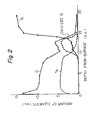
- the thus-formed composite oxide layer is better illustrated in Fig. 2.
- the composition was determined by the Auger sputtering method. At the end of the tantalum region, the silicon shifted in a combined state with the oxygen (Fig. 2).
- the total thickness of the oxide layer was determined by the Talystep method before and after oxidation and then the difference in thickness was assumed to be the thickness of oxidized silicon.
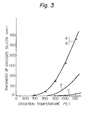
- a silicon substrate coated with tantalum oxide 45 nm thick (A) and a bare silicon substrate B were oxidized.in wet oxygen (Fig. 3).
- a silicon substrate coated with tantalum oxide 24 nm thick (C) and a bare silicon substrate (D) were oxidized in dry oxygen (Fig. 3). These thermal treatments were continued for 30 minutes at various temperatures.
- the substrates (A, B) were oxidized quickly in wet oxygen without regarding the coating of tantalum oxide and were effective at a temperature higher than 700°C. Contrary to this, the substrates (C, D) were oxidized slowly in dry oxygen, particularly in the case coated with tantalum oxide, and were oxidized only at a temperature higher than 900°C. An oxidation temperature higher than 1200°C exhibited no advantages in respect to the consumption of energy in relation to either wet or dry oxidation.
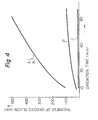
- the thickness of the oxidized silicon gradually increased as heating of the silicon semiconductor substrates A, B, C, and D used in the experiment of Fig. 3 was continued (Fig. 4). These substrates A, B, C, and D were heated at 1000°C. Wet oxidation (A, B) was superior to dry oxidation (C, D) in respect to their growth.
- oxygen in a wet oxygen atmosphere diffuses freely through the tantalum oxide layer. Contrary to this, oxygen in a dry oxygen atmosphere scarcely diffuses therethrough. Furthermore, it was confirmed that oxygen in a wet oxygen atmosphere diffuses several ⁇ m laterally through a tantalum layer 45 nm thick.
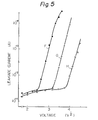
- a silicon substrate coated with tantalum oxide 45 nm thick was heated in wet oxygen at 800°C. Oxidation was continued for 10 minutes (F), 20 minutes (G) and 30 minutes (H) (Fig. 5). Thus, the silicon at the interface was oxidized so as to produce a dielectric layer according to the present invention.
- double oxide layer produced in a method embodying the present invention can exhibit a high dielectric constant and a high breakdown voltage.
- a layer of tantalum 15 nm thick (2) was deposited on a silicon substrate (1) by RF sputtering in argon at 4 x 10 -2 Torr (Fig. la).
- the substrate (1) was heated in dry oxygen at 525°C for 40 minutes. As a result, a tantalum oxide (2') layer 33 nm thick was formed (Fig. lb).
- the substrate (1) having a tantalum oxide layer (2') thereon was heated in wet oxygen at 800°C for 13 minutes.
- Oxide layers (3) comprising silicon oxide were produced mainly under the tantalum oxide layer, i.e., the thickness of the silicon oxide was 0.3 nm on the surface and 5 nm at the interface between the tantalum oxide layer (2') and the silicon substrate (1), respectively (Fig. lc).
- a very thin silicon oxide layer (not shown) was formed on the surface of the tantalum oxide layer (2') during oxidation in a wet oxygen atmosphere.
- the substrate was annealed in nitrogen containing 5% by volume of hydrogen at 1050°C for 30 minutes and then electrodes were produced (not shown).
- the thus-obtained dielectric layer composite having silicon oxide in addition to tantalum oxide . exhibited a relative dielectric constant of 15, a dielectric breakdown voltage of 4 MV/cm, and a leakage current on the order of 10 -10 A at 5 V.
- the relative dielectric constant was more than three times greater than that of silicon oxide, and the breakdown voltage was several times greater than that of tantalum oxide.
- this composite exhibited no hysteresis in respect to the capacitance-voltage characteristic of a diode.
- the amount of silicon contained in an electrode of silicide of a high melting point metal, e.g., molybdenum silicide, which is formed on the tantalum oxide layer not exceed the stoichiometry ratio.
- MoSi 2 satisfies the stoichiometry ratio, i.e., it does not discharge silicon atoms.
- Molybdenum atoms which pile up from a MoSi layer do not react with Ta 2 0 5 , which is thermodynamically stable in the Mo - Ta 2 O 5 system.
- the upper electrode 4 of the molybdenum silicide layer formed on the tantalum oxide layer 3 must not contain silicon in an amount in excess of the stoichiometry ratio.
- silicide-oxide systems which comprises silicide, e.g., of tungsten, tantalum, or platinum and oxide of a metal in the group 3A, 4A, or 5A of the periodic table of elements.
- Figures 6 through 12 are diagrams showing the steps for producing a dynamic random access memory device by a - method embodying the present invention.
- Field oxide layers (12) 1 ⁇ m thick were produced on a p type silicon semiconductor substrate (11) in a usual manner.
- a tantalum layer (13) 20 nm thick was produced on the substrate by RF sputtering in argon at 4 x 10 -2 Torr with an accerelating voltage of 2.3 KV (Fig. 6).
- the tantalum layer (13) was converted to a tantalum oxide layer (13') 44 nm thick by heating it at 500°C and then heating the substrate (11) at 800°C in wet oxygen, and thereby a silicon oxide layer (14) 6 nm thick was produced at the interface between the silicon substrate (11) and the tantalum oxide layer (13') (Fig. 7).
- a molybdenum (Mo) or molybdenum silicide electrode (15) for capacitor electrode was sputtered on the tantalum oxide layer (13') and then an insulating layer (16) of silicon oxide was deposited by chemical vapor deposition (Fig. 8).
- the insulating layer (16), the capacitor electrode (15), and the tantalum oxide layer (13') were partly removed by dry etching with a CHF 3 etchant, thus partially exposing the silicon oxide layer (14) at the interface (Fig. 9).
- a silicon oxide layer (17) was further deposited by chemical vapor deposition (Fig. 10).
- the silicon oxide layer (17) was removed, except for the portion coating the side surface (side wall) of the capacitor electrode (15), by dry etching.
- a transfer gate insulating layer (18) 40 nm thick was formed on the silicon substrate (11) by thermal oxidation (Fig. ll).
- a transfer gate electrode (19) was formed by depositing and patterning polycrystalline silicon. Then, a n type bit line contact region (20) was formed by arsenic (As) ion implantation, whereby arsenic was implanted into the transfer gate electrode (19). An electrode contact window was opened by forming and patterning the silicon oxide layer (21). A bit line (22) was formed by depositing and patterning an aluminum layer (Fig. 12).
- the thus-obtained dynamic random access memory device exhibited a significantly small leakage current and a higher integration.
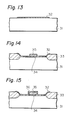
- Figures 13 through 16 are diagrams showing the steps for producing a MOS field effect transistor by a method embodying the present invention.
- a tantalum oxide layer (32) 50 nm thick was produced on a p type silicon semiconductor substrate (31) in a manner similar to that of Example 2 (Fig. 13) and was removed, except for the portion coating the positive regions, by a conventional process.
- Field oxide layers (33) were produced on the field region in a usual manner.
- a silicon oxide layer (34) was formed by thermal oxidation in wet oxygen at 800°C for 50 minutes at the interface between the tantalum oxide layer (32) and the silicon substrate (31).
- a line silicon gate electrode (35) was formed by chemical vapor deposition and dry etching with a CC1 4 etchant (Fig. 14).
- An oxide layer (36) was formed on the gate electrode (35) by heating the substrate in dry oxygen (Fig. 15).
- Source and drain electrodes were formed by self-alignment patterning of the insulating layer (36) and by depositing and patterning aluminum by means of conventional photolithography technique (Fig. 16).
- a tantalum oxide layer is used as a mask for selective oxidation, and, consequently, the occurrence of so-called bird beak, white ribbon, and strain in the substrate is prevented.
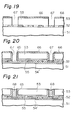
- FIGs 17 through 21 are diagrams showing the steps for producing lateral isolation of integrated circuits.
- a tantalum oxide layer (52) ca. 100 nm thick was deposited on a single crystalline silicon substrate (51) by reactive sputtering (Fig. 17) and was cut open in the desired region by means of photolithography and dry etching with a CHF 3 etchant so as to form lattice-like openings (52') (Fig. 18).
- a polycrystalline silicon layer (53) ca. 3 ⁇ m thick was deposited on the substrate (51) by chemical vapor deposition and was transformed by laser annealing into a single crystalline layer, since the surface of substrate .(51) contacting the polycrystalline silicon layer (53) acted as crystallizing nuclei.
- a silicon nitride layer (66) 100 nm thick was formed on the single crystalline silicon layer (53) by chemical vapor deposition. Windows 67 were opened through the silicon nitride layer (66) and the single crystalline silicon layer (53) by reactive ion etching with a CCl4 etchant (Fig. 19).
- the substrate was treated in wet oxygen at 1000°C for 80 minutes, and oxygen flowed through the windows (67) and diffused through the tantalum oxide layer (52) since the tantalum oxide acted as an oxygen passage. Consequently, not only the side wall (65) of the windows (67) but also the surface (54 1 ) of the silicon substrate (51) and the lower portion (55) of the transformed single crystalline silicon layer (53) were oxidized so as to form a silicon oxide insulating layer (Fig. 20).
- Silicon oxide layers (68) were deposited into the windows (67) by chemical vapor deposition so as to separate the single crystalline silicon islands (53), on which circuit elements could be produced.
- the silicon nitride layer (66) was removed with hot phosphoric acid.
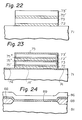
- Figures 22 and 23 are diagrams showing the steps for producing multilayered isolation of integrated circuits.
- a tantalum oxide layer (72) 50 nm thick and a polycrystalline silicon layer (73) were sequentially formed on a silicon substrate (71) in a manner similar to that of Example 4.
- Another tantalum oxide layer (72') and another polycrystalline silicon layer (73 1 ) were further formed thereon. Then these layers (72, 73, 72', 73') were patterned so as to expose the side surfaces of the tantalum oxide layers (72, 72 1 ) (Fig. 22).
- Figures 24 through 29 are diagrams showing the steps for producing a 1(one)-transistor type nonvolatile memory device.
- Field oxide layers (88) and a tantalum oxide layer (89) 44 nm thick were produced on a p type silicon substrate (81) in a manner similar to that of Example 2. Then a polycrystalline silicon layer (86) 500 nm thick was formed on the tantalum oxide layer (89) by chemical vapor deposition (Fig. 24).
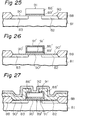
- N type source and drain regions (82, 83) were produced by masking with these layer (86', 89') and implanting arsenic as a donor type impurity into the substrate (81) (Fig. 25).
- the substrate was subjected to thermal oxidation in wet oxygen at 800°C for 10 minutes.
- the exposed silicon surfaces (90, 91) of the substrate and the gate electrode were oxidized.
- oxygen diffused through the tantalum oxide layer (89') so as to form the first and the third insulating layers of silicon oxide .(91', 90') under the gate electrode (86') (Fig. 26).
- the substrate was annealed in a mixture of nitrogen and 5% by volume of hydrogen at 1000°C for 20 minutes so as to reduce the tantalum oxide layer (89'). Consequently, a number of traps were produced due to the vacancy of oxygen in the reduced oxide layer (89"), which traps could accumulate electric charge (Fig. 27).
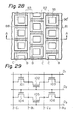
- Figure 28 is a plan of a 1-transistor type nonvolatile semiconductor random access memory device and indicates the following elements: field insulating oxide layers (88), gate electrodes (86'), contact holes (93) opened on the gate electrodes (86 1 ), an n type region (83) constituting bit lines defined by the adjacent dot-dash lines B, and an n type region (82) constituting earth lines defined by the adjacent broken lines C.
- field insulating oxide layers (88' in Fig. 27) and aluminum word lines (92 in Fig. 27) are not shown (Fig. 28).
- Fig. 29 shows an equivalent circuit of the random access memory shown in Fig. 28.
- Figure 29 illustrates bit lines B 1 , B2 and earth lines C 1 , C 2 connected to-drains and sources of each transistor, respectively, and word lines D 1 , D , D 3 connected to gates of each transistor. These constitute the memories 101 through 106.
- bit lines B 2 of cell 103 is maintained at an open potential so as to inhibit writing in cell 103 connected to the same word line as cell 101, and earth lines C 1 , C 2 are also maintained at an open potential so as to inhibit electron injection from the earth lines into cells 101 and 103.
- potentials +3 V and +5 V are applied to word line D 1 and bit line B 1 , respectively, and, then, it is determined whether the cell is ON or OFF, i.e., the absence of and the accumulation of electrons in the gate result in a current and no current between the source and drain, respectively.
- Bit line B 1 is connected to other cells 102, 104, 105.
- a potential +5 V is applied to word lines D 2 , D 3 .
- the effective electron discharge voltage is 5 V, which does not cause the tunnel effect.
- earth lines C 1 , C 2 on both sides of bit line B 1 are maintained at an open potential, thereby inhibiting current flow into the adjacent cells.
Landscapes
- Semiconductor Memories (AREA)
- Semiconductor Integrated Circuits (AREA)
- Formation Of Insulating Films (AREA)
Abstract
Description
- The present invention relates to the production of insulating layers in semiconductor devices.
- Dieletric layers are essential features of some semiconductor devices, for example, gate insulating layers in field effect transistors and dielectric layers of capacitors. Such devices may be included in components comprising transistor-diode logic, transistor- transistor logic, read only memory, or dynamic random access memory.
- Generally, the capacitance of capacitors is proportional to the relative dielectric constant of the dielectric material inserted between electrodes and inversely proportional to the distance between the electrodes. The trans conductance gm of field effect transistors is also proportional to the relative dielectric constant of the gate--insulating dielectric layer and inversely proportional to the thickness of the layer. Thus, it is desirable to produce dielectric layers of a material which has a high relative dielectric constant and also a high dielectric breakdown voltage.
- Silicon dioxide (Si02) layers have been mainly used as dielectric layers, the functions of which are set forth above, based on the fact that silicon dioxide has a relative dielectric constant of 3.8 and a dielectric breakdown voltage of 10 MV/cm. However, it has been found difficult to form a silicon dioxide layer the thickness of which is less than 10nm without pinholes which will inevitably lead to an increased leakage of current, and, consequently, a lower breakdown voltage.
- Recently, in order to reduce the size of the elements and thus improve the integration of the elements, other dielectrip materials having a relative dielectric constant higher than that of silicon dioxide have been used either tentatively or practically. Such dielectric materials are oxides of tantalum (Ta), titanium (Ti),' niobium (Nb), hafnium (Hf), zirconium (Zr), yttrium (Y), and vanadium (V). For example, tantalum oxide exhibits a relative dielectric constant of from 20 to 28.
- However, each of these dielectric oxides has disadvantages in tnat the breakdown voltage is low and the leakage of current is large. Of course, these disadvantages may be reduced by thickening the dielectric layer, but this leads to unfavorable lowering of the capacitance.
- In attempting to increase the breakdown voltage and decrease the leakage of current, a Ta2O5/SiO2 double layer may be used in which a silicon dioxide layer is first formed on a substrate and then a tantalum oxide (Ta2O5) layer is formed thereon so as to form the Ta2O5/SiO2 double layer.
- However, such a Ta2O5/SiO2 double structure exhibits a disadvantage in that the capacitance is low due to the thickness of the oxidized silicon, which thickness cannot be reduced owing to the occurrence of pin holes, as mentioned above. Furthermore, the electrical properties of the previously formed silicon dioxide layer deteriorate during the formation of tantalum oxide thereon, thereby lowering the breakdown voltage. In addition, such a double structure exhibits an unfavorable hysteresis in respect to the capacitance-voltage characteristic of a diode due to the abrupt heterojunction thereof.
- According to the present invention there is provided a method-of manufacturing a semiconductor device, wherein a layer of an oxide of an element selected from the group made up of tantalum, titanium, niobium, hafnium, yttrium, zirconium, and vanadium is formed on a semi- conductor substrate characterized in that the said semiconductor substrate having said layer of oxide thereon is heated in an oxidizing atmosphere so as to oxidize semiconductor material of the said substrate thereby to form an insulating layer made of an oxide of said semi- conductor material, sandwiched between said layer of oxide and remaining semiconductor material of the said substrate.
- In one embodiment of the invention the oxide layer comprises a tantalum oxide layer, and the semiconductor layer may advantageously be made of silicon.
- It can be advantageous if said oxidizing atmosphere comprises wet oxygen and the oxidization is carried out at at a temperature in a range from 700°C to 1200°C.
- A preferred embodiment of the present invention provides a process for producing a dielectric layer on a silicon semiconductor layer, characterized by the steps of:
- depositing a tantalum layer on the surface of said silicon semiconductor layer;
- oxidising said tantalum layer, thereby converting tantalum into tantalum oxide; and
- heating said silicon semiconductor layer having said tantalum oxide layer thereon in an oxidizong atmosphere, thereby thermally oxidizing the silicon constituting said semiconductor layer so as to form an insulating layer which comprises silicon oxide at the interface between said semiconductor layer and said tantalum oxide layer.
- It is desirable that said silicon semiconductor layer is of a one-conductivity type.
- Advantageously said process can further comprise the step of forming an electrically conductive layer on said tantalum oxide layer.
- An embodiment of the present invention can provide a process for producing a dielectric layer having a desirably high relative dielectric constant, a relatively high dielectric breakdown voltage, and desirably small current leakage. Such a dielectric layer can be made to exhibit very low hysteresis in respect to the capacitance-voltage characteristic of a diode.
- It has been noted that A.G. Revesz et al of Comsat Labratories teach in "Film-Substrate Interaction in Si/Ta and Si/Ta205 Structures" in the Journal of the Electrochemical Society, Vol. 123, No. 10, October 1976, that if a tantalum film is deposited on a silicon substrate and oxidized, the resultant tantalum oxide film contains a significant amount of silicon, and the majority of the silicon atoms incorporated into the tantalum oxide film, are concentrated near the interface while a small amount of the Silicon atoms are concentrated at the outer surface of the tantalum oxide film. During oxidation, the thus-diffused silicon atoms are also oxidised by oxygen, which diffuses through the tantalum oxide. However, Revesz et al do not suggest the forming of an effective silicon oxide layer under the tantalum oxide layer so as to realize a dielectric layer to form a necessary feature of a semiconductor device.
- In addition, B.E. Deal et al teach in "General Relationship for the Thermal Oxidation of Silicon" in the Journal of Applied Physics, Vol. 36, No. 12, December 1965, that silicon is oxidized more quickly in wet oxygen than in dry oxygen. However, they do not suggest that oxygen can diffuse through a tantalum oxide layer.
- Reference will now be made, by way of example, to the accompanying drawings, in which
- Figures la. through Ic are sectional diagrams of part of a semiconductor device at different stages of a method embodying the present invention.
- Figure 2 is a graph showing the relationship between the amount of elements and the depth of a:- dielectric layer of Fig. lc.
- Figure 3 is a graph showing the relationship between the thickness of the oxidized silicon and the oxidation temperature.
- Figure 4 is a graph showing the relationship between the thickness of the oxidized silicon and the oxidation time.
- Figure 5 is a graph showing the relationship between the leakage of current and the voltage across the dielectric layer of Fig. lc.
- Figures 6 through 12 are diagrams showing the steps for producing a dynamic random access memory device.
- Figures 13 through 16 are diagrams showing steps for producing a MOS field effect transistor.
- Figures 17 through 21 are diagrams showing steps for producing lateral isolation of integrated circuits.
- Figures 22 and 23 are diagrams showing steps for producing multilayered insulation of integrated circuits.
- Figures 24 through 27 are diagrams showing steps for producing a l(one)-transistor type nonvolatile memory device.
- Figures 28 and 29 are diagrams showing the function of a 1-transistor type nonvolatile memory device.
- A high dielectric layer (21), e.g., tantalum oxide (Ta205), may be formed on a semiconductor substrate (1) either by an indirect process, e.g., first depositing tantalum (2) by vacuum vapor deposition or sputtering (Fig. la) and then oxidizing tantalum into tantalum oxide (2'), or by a direct process, e.g., chemical vapor deposition or oxide sputtering (Fig. lb). The thus--obtained oxide may be further subjected to a thermal treatment, whereby the oxide may be crystallized and improved in respect to thermal stability.
- The low breakdown voltage of the tantalum oxide (2') is compensated for by heating the substrate (1) in an oxidizing atmosphere so as to form a layer of oxide of the semiconductor material (3), e.g., silicon oxide, mainly at the interface between the semiconductor substrate (1) and the tantalum oxide (2') (Fig. lc).
- The thus-formed composite oxide layer is better illustrated in Fig. 2. The composition was determined by the Auger sputtering method. At the end of the tantalum region, the silicon shifted in a combined state with the oxygen (Fig. 2).
- In the following experiments, the total thickness of the oxide layer was determined by the Talystep method before and after oxidation and then the difference in thickness was assumed to be the thickness of oxidized silicon.
- A silicon substrate coated with tantalum oxide 45 nm thick (A) and a bare silicon substrate B were oxidized.in wet oxygen (Fig. 3). A silicon substrate coated with tantalum oxide 24 nm thick (C) and a bare silicon substrate (D) were oxidized in dry oxygen (Fig. 3). These thermal treatments were continued for 30 minutes at various temperatures.
- The substrates (A, B) were oxidized quickly in wet oxygen without regarding the coating of tantalum oxide and were effective at a temperature higher than 700°C. Contrary to this, the substrates (C, D) were oxidized slowly in dry oxygen, particularly in the case coated with tantalum oxide, and were oxidized only at a temperature higher than 900°C. An oxidation temperature higher than 1200°C exhibited no advantages in respect to the consumption of energy in relation to either wet or dry oxidation.
- The thickness of the oxidized silicon gradually increased as heating of the silicon semiconductor substrates A, B, C, and D used in the experiment of Fig. 3 was continued (Fig. 4). These substrates A, B, C, and D were heated at 1000°C. Wet oxidation (A, B) was superior to dry oxidation (C, D) in respect to their growth.
- As can be seen from the graphs of Figs. 3 and 4, oxygen in a wet oxygen atmosphere diffuses freely through the tantalum oxide layer. Contrary to this, oxygen in a dry oxygen atmosphere scarcely diffuses therethrough. Furthermore, it was confirmed that oxygen in a wet oxygen atmosphere diffuses several µm laterally through a tantalum layer 45 nm thick.
- A silicon substrate coated with tantalum oxide 45 nm thick was heated in wet oxygen at 800°C. Oxidation was continued for 10 minutes (F), 20 minutes (G) and 30 minutes (H) (Fig. 5). Thus, the silicon at the interface was oxidized so as to produce a dielectric layer according to the present invention. The dielectric layers F, G, and H, which correspond to the curves F, G, and H, had a breakdown voltage of approximately 6 V, 10 V, and 15 V, respectively, and an effective dielectric constant of 13, 11, and 9, respectively.
- The Si02 layer formed at the interface of Ta205 - Si substrate by oxidation after coating the substrate with Ta2O5 included almost no pin holes and consequently exhibited a breakdown voltage much higher than that of a Si02 layer formed by thermal oxidation of a bare silicon substrate in a conventional manner. Thus, double oxide layer produced in a method embodying the present invention, can exhibit a high dielectric constant and a high breakdown voltage.
- A layer of
tantalum 15 nm thick (2) was deposited on a silicon substrate (1) by RF sputtering in argon at 4 x 10 -2 Torr (Fig. la). - The substrate (1) was heated in dry oxygen at 525°C for 40 minutes. As a result, a tantalum oxide (2')
layer 33 nm thick was formed (Fig. lb). The substrate (1) having a tantalum oxide layer (2') thereon was heated in wet oxygen at 800°C for 13 minutes. Oxide layers (3) comprising silicon oxide were produced mainly under the tantalum oxide layer, i.e., the thickness of the silicon oxide was 0.3 nm on the surface and 5 nm at the interface between the tantalum oxide layer (2') and the silicon substrate (1), respectively (Fig. lc). In addition, a very thin silicon oxide layer (not shown) was formed on the surface of the tantalum oxide layer (2') during oxidation in a wet oxygen atmosphere. The substrate was annealed in nitrogen containing 5% by volume of hydrogen at 1050°C for 30 minutes and then electrodes were produced (not shown). The thus-obtained dielectric layer composite having silicon oxide in addition to tantalum oxide . exhibited a relative dielectric constant of 15, a dielectric breakdown voltage of 4 MV/cm, and a leakage current on the order of 10-10 A at 5 V. The relative dielectric constant was more than three times greater than that of silicon oxide, and the breakdown voltage was several times greater than that of tantalum oxide. In addition, this composite exhibited no hysteresis in respect to the capacitance-voltage characteristic of a diode. - Furthermore, it is preferable that the amount of silicon contained in an electrode of silicide of a high melting point metal, e.g., molybdenum silicide, which is formed on the tantalum oxide layer not exceed the stoichiometry ratio.
- Our experiment revealed that in the case where the molybdenum silicide layer of the upper electrode is MoSi3 , i.e., rich in silicon, an increase in the leakage of current is evident and that, contrary to this, a layer of MoSi or MoSi2 does not exhibit an increased leakage of current even after thermal treatment at 1000°C.
- We consider the reason for this to be as follows. Silicon atoms pile up from the molybdenum silicide layer at the interface between the molybdenum silicide layer and the tantalum oxide layer (2') so as to form an apparent Si - Ta205 interface in the case where the molybdenum silicide layer is rich in silicon, and, thus, Si and Ta2O5 diffuse and react with each other.
- Contrary to this, MoSi2 satisfies the stoichiometry ratio, i.e., it does not discharge silicon atoms. Molybdenum atoms which pile up from a MoSi layer, however, do not react with Ta205 , which is thermodynamically stable in the Mo - Ta2O5 system.
- Thus, the
upper electrode 4 of the molybdenum silicide layer formed on thetantalum oxide layer 3 must not contain silicon in an amount in excess of the stoichiometry ratio. - This holds true not only for the MoSi - Ta2O5 system but also for other silicide-oxide systems which comprises silicide, e.g., of tungsten, tantalum, or platinum and oxide of a metal in the group 3A, 4A, or 5A of the periodic table of elements.
- Figures 6 through 12 are diagrams showing the steps for producing a dynamic random access memory device by a - method embodying the present invention.
- Field oxide layers (12) 1 µm thick were produced on a p type silicon semiconductor substrate (11) in a usual manner. A tantalum layer (13) 20 nm thick was produced on the substrate by RF sputtering in argon at 4 x 10⁻² Torr with an accerelating voltage of 2.3 KV (Fig. 6).
- The tantalum layer (13) was converted to a tantalum oxide layer (13') 44 nm thick by heating it at 500°C and then heating the substrate (11) at 800°C in wet oxygen, and thereby a silicon oxide layer (14) 6 nm thick was produced at the interface between the silicon substrate (11) and the tantalum oxide layer (13') (Fig. 7).
- A molybdenum (Mo) or molybdenum silicide electrode (15) for capacitor electrode was sputtered on the tantalum oxide layer (13') and then an insulating layer (16) of silicon oxide was deposited by chemical vapor deposition (Fig. 8).
- The insulating layer (16), the capacitor electrode (15), and the tantalum oxide layer (13') were partly removed by dry etching with a CHF3 etchant, thus partially exposing the silicon oxide layer (14) at the interface (Fig. 9).
- A silicon oxide layer (17) was further deposited by chemical vapor deposition (Fig. 10). The silicon oxide layer (17) was removed, except for the portion coating the side surface (side wall) of the capacitor electrode (15), by dry etching. Then a transfer gate insulating layer (18) 40 nm thick was formed on the silicon substrate (11) by thermal oxidation (Fig. ll).
- A transfer gate electrode (19) was formed by depositing and patterning polycrystalline silicon. Then, a n type bit line contact region (20) was formed by arsenic (As) ion implantation, whereby arsenic was implanted into the transfer gate electrode (19). An electrode contact window was opened by forming and patterning the silicon oxide layer (21). A bit line (22) was formed by depositing and patterning an aluminum layer (Fig. 12).
- The thus-obtained dynamic random access memory device exhibited a significantly small leakage current and a higher integration.
- Figures 13 through 16 are diagrams showing the steps for producing a MOS field effect transistor by a method embodying the present invention.
- A tantalum oxide layer (32) 50 nm thick was produced on a p type silicon semiconductor substrate (31) in a manner similar to that of Example 2 (Fig. 13) and was removed, except for the portion coating the positive regions, by a conventional process. Field oxide layers (33) were produced on the field region in a usual manner. A silicon oxide layer (34) was formed by thermal oxidation in wet oxygen at 800°C for 50 minutes at the interface between the tantalum oxide layer (32) and the silicon substrate (31). A line silicon gate electrode (35) was formed by chemical vapor deposition and dry etching with a CC14 etchant (Fig. 14).
- An oxide layer (36) was formed on the gate electrode (35) by heating the substrate in dry oxygen (Fig. 15).
- Contact windows were opened by exposing the positive regions in the insulating silicon oxide layer (34) by self-alignment patterning of the tantalum oxide layer (32). Then n type source and drain regions (37, 38) were formed by soft etching and ion implantation. Source and drain electrodes (39, 40) were formed by self-alignment patterning of the insulating layer (36) and by depositing and patterning aluminum by means of conventional photolithography technique (Fig. 16).
- As contact windows are opened by self-alignment, a short channel gate transistor can be easily realized. A tantalum oxide layer is used as a mask for selective oxidation, and, consequently, the occurrence of so-called bird beak, white ribbon, and strain in the substrate is prevented.
- Figures 17 through 21 are diagrams showing the steps for producing lateral isolation of integrated circuits. A tantalum oxide layer (52) ca. 100 nm thick was deposited on a single crystalline silicon substrate (51) by reactive sputtering (Fig. 17) and was cut open in the desired region by means of photolithography and dry etching with a CHF3 etchant so as to form lattice-like openings (52') (Fig. 18).
- A polycrystalline silicon layer (53) ca. 3 µm thick was deposited on the substrate (51) by chemical vapor deposition and was transformed by laser annealing into a single crystalline layer, since the surface of substrate .(51) contacting the polycrystalline silicon layer (53) acted as crystallizing nuclei. A silicon nitride layer (66) 100 nm thick was formed on the single crystalline silicon layer (53) by chemical vapor deposition.
Windows 67 were opened through the silicon nitride layer (66) and the single crystalline silicon layer (53) by reactive ion etching with a CCl4 etchant (Fig. 19). - The substrate was treated in wet oxygen at 1000°C for 80 minutes, and oxygen flowed through the windows (67) and diffused through the tantalum oxide layer (52) since the tantalum oxide acted as an oxygen passage. Consequently, not only the side wall (65) of the windows (67) but also the surface (541) of the silicon substrate (51) and the lower portion (55) of the transformed single crystalline silicon layer (53) were oxidized so as to form a silicon oxide insulating layer (Fig. 20).
- Silicon oxide layers (68) were deposited into the windows (67) by chemical vapor deposition so as to separate the single crystalline silicon islands (53), on which circuit elements could be produced. The silicon nitride layer (66) was removed with hot phosphoric acid. Thus, a large scale integrated circuit, particularly bipolar type semiconductor devices, with complete insulation could be produced.
- In addition, in the case where spacing of the lattice structure of the tantalum oxide layer (52) is selectively broaden in an oxidation process, there remains between the silicon substrate (51) and the single crystalline silicon layer (53) an unoxidized silicon layer. Thereby an electrical connection is obtained between the silicon substrate (51) and the single crystalline silicon layer (53).
- Figures 22 and 23 are diagrams showing the steps for producing multilayered isolation of integrated circuits.
- A tantalum oxide layer (72) 50 nm thick and a polycrystalline silicon layer (73) were sequentially formed on a silicon substrate (71) in a manner similar to that of Example 4. Another tantalum oxide layer (72') and another polycrystalline silicon layer (731) were further formed thereon. Then these layers (72, 73, 72', 73') were patterned so as to expose the side surfaces of the tantalum oxide layers (72, 721) (Fig. 22).
- These layers were oxidized in wet oxygen at 1000°C for 20 minutes. As the tantalum oxide layers (72, 72') acted as passages for the diffusion of oxygen, the surface of both polycrystalline silicon layers (73, 73') and the silicon substrate (71) were oxidized so as to form silicon oxide layers (741, 75', 75", 75"'). The silicon surfaces (74, 75) were oxidized by direct contact with oxygen. The polycrystalline silicon layers (73, 73') which were retained without being oxidized acted as electrical passages.
- Thus the separation of elements and also multilayered wiring could be effected easily and exactly.
- Figures 24 through 29 are diagrams showing the steps for producing a 1(one)-transistor type nonvolatile memory device.
- Field oxide layers (88) and a tantalum oxide layer (89) 44 nm thick were produced on a p type silicon substrate (81) in a manner similar to that of Example 2. Then a polycrystalline silicon layer (86) 500 nm thick was formed on the tantalum oxide layer (89) by chemical vapor deposition (Fig. 24).
- These layers (86, 89) were selectively removed so as to form a polycrystalline silicon gate electrode (86') and the second insulating layer of tantalum oxide (89'). N type source and drain regions (82, 83) were produced by masking with these layer (86', 89') and implanting arsenic as a donor type impurity into the substrate (81) (Fig. 25).
- The substrate was subjected to thermal oxidation in wet oxygen at 800°C for 10 minutes. Thus, the exposed silicon surfaces (90, 91) of the substrate and the gate electrode were oxidized. In addition, oxygen diffused through the tantalum oxide layer (89') so as to form the first and the third insulating layers of silicon oxide .(91', 90') under the gate electrode (86') (Fig. 26).
- The substrate was annealed in a mixture of nitrogen and 5% by volume of hydrogen at 1000°C for 20 minutes so as to reduce the tantalum oxide layer (89'). Consequently, a number of traps were produced due to the vacancy of oxygen in the reduced oxide layer (89"), which traps could accumulate electric charge (Fig. 27).
- During the annealing, silicon in the gate electrode (86') and the substrate (81) was oxidized very slightly, probably due to the discharge of oxigen generated by the reduction of Ta205 with hydrogen. Then, a word line (92) of aluminum was produced on the gate electrode (86'), after a contact hole was opened in the silicon oxide layer (88'), in a usual manner (Fig. 27).
- Figure 28 is a plan of a 1-transistor type nonvolatile semiconductor random access memory device and indicates the following elements: field insulating oxide layers (88), gate electrodes (86'), contact holes (93) opened on the gate electrodes (861), an n type region (83) constituting bit lines defined by the adjacent dot-dash lines B, and an n type region (82) constituting earth lines defined by the adjacent broken lines C. However, insulating silicon oxide layers (88' in Fig. 27) and aluminum word lines (92 in Fig. 27) are not shown (Fig. 28).
- The operation principle of the 1-transistor type nonvolatile semiconductor memory will be illustrated with reference to Fig. 29, which shows an equivalent circuit of the random access memory shown in Fig. 28.
- Figure 29 illustrates bit lines B1, B2 and earth lines C1, C2 connected to-drains and sources of each transistor, respectively, and word lines D1, D , D 3 connected to gates of each transistor. These constitute the
memories 101 through 106. - In order to write only in
cell 101, a potential 10 V is applied to word line D1, and bit line B1 is grounded. Thus, a writing voltage of 10 V is applied to the gate ofcell 101. Electrons are injected and accumulated from n type region constituting the bit line into the second insulating layer of tantalum oxide in the gate. At the same time, bit lines B2 ofcell 103 is maintained at an open potential so as to inhibit writing incell 103 connected to the same word line ascell 101, and earth lines C1, C2 are also maintained at an open potential so as to inhibit electron injection from the earth lines intocells - In order to read out from
cell 101, potentials +3 V and +5 V are applied to word line D1 and bit line B1, respectively, and, then, it is determined whether the cell is ON or OFF, i.e., the absence of and the accumulation of electrons in the gate result in a current and no current between the source and drain, respectively. - Erasing the memory is carried out inversely to the writing procedure. Word line D1 is grounded and a potential 10 V is applied to bit line B1. Consequently, electrons accumulated in the gate are erased by the tunnel effect up to the n type region constituting the bit line. Bit line B1 is connected to
other cells
Claims (9)
Applications Claiming Priority (2)
| Application Number | Priority Date | Filing Date | Title |
|---|---|---|---|
| JP161281/81 | 1981-10-09 | ||
| JP56161281A JPH0722183B2 (en) | 1981-10-09 | 1981-10-09 | Method for manufacturing dielectric layer for semiconductor device |
Publications (3)
| Publication Number | Publication Date |
|---|---|
| EP0077200A2 true EP0077200A2 (en) | 1983-04-20 |
| EP0077200A3 EP0077200A3 (en) | 1985-09-18 |
| EP0077200B1 EP0077200B1 (en) | 1989-08-09 |
Family
ID=15732118
Family Applications (1)
| Application Number | Title | Priority Date | Filing Date |
|---|---|---|---|
| EP82305379A Expired EP0077200B1 (en) | 1981-10-09 | 1982-10-08 | Producing insulating layers in semiconductor devices |
Country Status (3)
| Country | Link |
|---|---|
| EP (1) | EP0077200B1 (en) |
| JP (1) | JPH0722183B2 (en) |
| DE (1) | DE3279873D1 (en) |
Cited By (6)
| Publication number | Priority date | Publication date | Assignee | Title |
|---|---|---|---|---|
| FR2555365A1 (en) * | 1983-11-22 | 1985-05-24 | Efcis | METHOD FOR MANUFACTURING INTEGRATED CIRCUIT WITH TANTALUM SILICIDE CONNECTIONS AND INTEGRATED CIRCUIT PERFORMED ACCORDING TO THIS METHOD |
| EP0161619A3 (en) * | 1984-05-15 | 1989-05-31 | International Business Machines Corporation | Catalytic oxidation of solid materials |
| WO2002009167A3 (en) * | 2000-07-20 | 2002-06-27 | Univ North Carolina State | High dielectric constant metal silicates formed by controlled metal-surface reactions |
| US6642131B2 (en) * | 2001-06-21 | 2003-11-04 | Matsushita Electric Industrial Co., Ltd. | Method of forming a silicon-containing metal-oxide gate dielectric by depositing a high dielectric constant film on a silicon substrate and diffusing silicon from the substrate into the high dielectric constant film |
| WO2005010973A1 (en) * | 2003-07-18 | 2005-02-03 | Forschungszentrum Jülich GmbH | Method for the self-adjusted reduction in size of structures |
| CN111640866A (en) * | 2020-07-16 | 2020-09-08 | 上海华力微电子有限公司 | Resistive random access memory and preparation method thereof |
Families Citing this family (7)
| Publication number | Priority date | Publication date | Assignee | Title |
|---|---|---|---|---|
| US5079191A (en) * | 1985-11-29 | 1992-01-07 | Hitachi, Ltd. | Process for producing a semiconductor device |
| JPS632363A (en) * | 1986-06-20 | 1988-01-07 | Nec Corp | Capacity film |
| JP2770856B2 (en) * | 1987-08-20 | 1998-07-02 | 東京農工大学長 | Method of forming high dielectric constant oxide thin film |
| KR100319571B1 (en) * | 1998-03-12 | 2002-01-09 | 루센트 테크놀러지스 인크 | Electronic Components With Doped Metal Oxide Dielectric Materials And A Process For Making Electronic Components With Doped Metal Oxide Dielectric Materials |
| JP4590556B2 (en) * | 2005-03-11 | 2010-12-01 | 国立大学法人 奈良先端科学技術大学院大学 | Manufacturing method of semiconductor device |
| JP4181195B2 (en) * | 2006-09-14 | 2008-11-12 | 株式会社東芝 | Insulating film and semiconductor device using the same |
| CN107424923A (en) * | 2017-07-06 | 2017-12-01 | 鲁汶仪器有限公司(比利时) | A kind of method from limitation accurate etching silicon |
Family Cites Families (2)
| Publication number | Priority date | Publication date | Assignee | Title |
|---|---|---|---|---|
| DE1923279A1 (en) * | 1969-05-07 | 1970-12-23 | Licentia Gmbh | Transistor with an isolated control electrode |
| JPS5745968A (en) * | 1980-08-29 | 1982-03-16 | Ibm | Capacitor with double dielectric unit |
-
1981
- 1981-10-09 JP JP56161281A patent/JPH0722183B2/en not_active Expired - Lifetime
-
1982
- 1982-10-08 EP EP82305379A patent/EP0077200B1/en not_active Expired
- 1982-10-08 DE DE8282305379T patent/DE3279873D1/en not_active Expired
Cited By (10)
| Publication number | Priority date | Publication date | Assignee | Title |
|---|---|---|---|---|
| FR2555365A1 (en) * | 1983-11-22 | 1985-05-24 | Efcis | METHOD FOR MANUFACTURING INTEGRATED CIRCUIT WITH TANTALUM SILICIDE CONNECTIONS AND INTEGRATED CIRCUIT PERFORMED ACCORDING TO THIS METHOD |
| EP0143700A3 (en) * | 1983-11-22 | 1985-09-18 | Societe Pour L'etude Et La Fabrication De Circuits Integres Speciaux - E.F.C.I.S. | Process for making integrated circuits having connectors comprising tantalum silicides, and integrated circuits made by this process |
| US4593454A (en) * | 1983-11-22 | 1986-06-10 | Societe pour d'Etude et la Fabrication de Circuits Integres Speciaux EFCS | Process for manufacturing an integrated circuit with tantalum silicide connections utilizing self-aligned oxidation |
| EP0161619A3 (en) * | 1984-05-15 | 1989-05-31 | International Business Machines Corporation | Catalytic oxidation of solid materials |
| WO2002009167A3 (en) * | 2000-07-20 | 2002-06-27 | Univ North Carolina State | High dielectric constant metal silicates formed by controlled metal-surface reactions |
| US6521911B2 (en) | 2000-07-20 | 2003-02-18 | North Carolina State University | High dielectric constant metal silicates formed by controlled metal-surface reactions |
| US6642131B2 (en) * | 2001-06-21 | 2003-11-04 | Matsushita Electric Industrial Co., Ltd. | Method of forming a silicon-containing metal-oxide gate dielectric by depositing a high dielectric constant film on a silicon substrate and diffusing silicon from the substrate into the high dielectric constant film |
| US7157780B2 (en) | 2001-06-21 | 2007-01-02 | Matsushita Electric Industrial Co., Ltd. | Semiconductor device and method for producing the same |
| WO2005010973A1 (en) * | 2003-07-18 | 2005-02-03 | Forschungszentrum Jülich GmbH | Method for the self-adjusted reduction in size of structures |
| CN111640866A (en) * | 2020-07-16 | 2020-09-08 | 上海华力微电子有限公司 | Resistive random access memory and preparation method thereof |
Also Published As
| Publication number | Publication date |
|---|---|
| JPS5861634A (en) | 1983-04-12 |
| DE3279873D1 (en) | 1989-09-14 |
| EP0077200A3 (en) | 1985-09-18 |
| JPH0722183B2 (en) | 1995-03-08 |
| EP0077200B1 (en) | 1989-08-09 |
Similar Documents
| Publication | Publication Date | Title |
|---|---|---|
| US4495219A (en) | Process for producing dielectric layers for semiconductor devices | |
| KR930001736B1 (en) | Manufacturing method of semiconductor device | |
| JPS6010773A (en) | Method of forming 1-element fet-memory capacitor circuit | |
| US7262101B2 (en) | Method of manufacturing a semiconductor integrated circuit device | |
| EP0077200B1 (en) | Producing insulating layers in semiconductor devices | |
| KR20000029395A (en) | Method for fabricating semiconductor memory having good electrical characteristics and high reliability | |
| US5518960A (en) | Method of manufacturing a wiring layer including amorphous silicon and refractory metal silicide | |
| JP2003168749A (en) | Nonvolatile semiconductor memory device and method of manufacturing the same | |
| CA1232365A (en) | Dual electron injection structure and process with self-limiting oxidation barrier | |
| EP0685883B1 (en) | Method of forming an improved dielectric in an integrated circuit | |
| US4250206A (en) | Method of making non-volatile semiconductor memory elements | |
| US4288470A (en) | Method of making non-volatile semiconductor memory elements having multiple dielectric layers of silicon nitride, silicon dioxide, and rutile titanium dioxide | |
| US4873203A (en) | Method for formation of insulation film on silicon buried in trench | |
| JP2684978B2 (en) | Semiconductor device | |
| JPH0311552B2 (en) | ||
| EP0274390B1 (en) | Semiconductor memory device and method of manufacturing the same | |
| US5149666A (en) | Method of manufacturing a semiconductor memory device having a floating gate electrode composed of 2-10 silicon grains | |
| US4683640A (en) | Method of making a floating gate memory cell | |
| JP2632839B2 (en) | Manufacturing method of integrated circuit | |
| KR100279052B1 (en) | Non-volatile memory devices using the ferroelectric gate fet and fabrication method thereof | |
| JPH0736438B2 (en) | Semiconductor device | |
| JPS62219659A (en) | Mos type semiconductor memory | |
| KR950003225B1 (en) | Manufacturing method of insulating film | |
| US6730607B2 (en) | Method for fabricating a barrier layer | |
| KR960000963B1 (en) | Manufacturing method of semiconductor integrated circuit device |
Legal Events
| Date | Code | Title | Description |
|---|---|---|---|
| PUAI | Public reference made under article 153(3) epc to a published international application that has entered the european phase |
Free format text: ORIGINAL CODE: 0009012 |
|
| AK | Designated contracting states |
Designated state(s): DE FR GB |
|
| PUAL | Search report despatched |
Free format text: ORIGINAL CODE: 0009013 |
|
| AK | Designated contracting states |
Designated state(s): DE FR GB |
|
| 17P | Request for examination filed |
Effective date: 19851118 |
|
| 17Q | First examination report despatched |
Effective date: 19870924 |
|
| GRAA | (expected) grant |
Free format text: ORIGINAL CODE: 0009210 |
|
| AK | Designated contracting states |
Kind code of ref document: B1 Designated state(s): DE FR GB |
|
| REF | Corresponds to: |
Ref document number: 3279873 Country of ref document: DE Date of ref document: 19890914 |
|
| ET | Fr: translation filed | ||
| PLBE | No opposition filed within time limit |
Free format text: ORIGINAL CODE: 0009261 |
|
| STAA | Information on the status of an ep patent application or granted ep patent |
Free format text: STATUS: NO OPPOSITION FILED WITHIN TIME LIMIT |
|
| 26N | No opposition filed | ||
| PGFP | Annual fee paid to national office [announced via postgrant information from national office to epo] |
Ref country code: FR Payment date: 19931028 Year of fee payment: 12 |
|
| PG25 | Lapsed in a contracting state [announced via postgrant information from national office to epo] |
Ref country code: FR Effective date: 19950630 |
|
| REG | Reference to a national code |
Ref country code: FR Ref legal event code: ST |
|
| PGFP | Annual fee paid to national office [announced via postgrant information from national office to epo] |
Ref country code: GB Payment date: 19950929 Year of fee payment: 14 |
|
| PGFP | Annual fee paid to national office [announced via postgrant information from national office to epo] |
Ref country code: DE Payment date: 19951012 Year of fee payment: 14 |
|
| PG25 | Lapsed in a contracting state [announced via postgrant information from national office to epo] |
Ref country code: GB Effective date: 19961008 |
|
| GBPC | Gb: european patent ceased through non-payment of renewal fee |
Effective date: 19961008 |
|
| PG25 | Lapsed in a contracting state [announced via postgrant information from national office to epo] |
Ref country code: DE Effective date: 19970701 |