EP0077676A2 - Strahlungsbild-Aufzeichnungssystem - Google Patents
Strahlungsbild-Aufzeichnungssystem Download PDFInfo
- Publication number
- EP0077676A2 EP0077676A2 EP82305529A EP82305529A EP0077676A2 EP 0077676 A2 EP0077676 A2 EP 0077676A2 EP 82305529 A EP82305529 A EP 82305529A EP 82305529 A EP82305529 A EP 82305529A EP 0077676 A2 EP0077676 A2 EP 0077676A2
- Authority
- EP
- European Patent Office
- Prior art keywords
- sheet
- stimulable phosphor
- radiation image
- phosphor sheet
- image recording
- Prior art date
- Legal status (The legal status is an assumption and is not a legal conclusion. Google has not performed a legal analysis and makes no representation as to the accuracy of the status listed.)
- Granted
Links
Images

Classifications
-
- G—PHYSICS
- G03—PHOTOGRAPHY; CINEMATOGRAPHY; ANALOGOUS TECHNIQUES USING WAVES OTHER THAN OPTICAL WAVES; ELECTROGRAPHY; HOLOGRAPHY
- G03B—APPARATUS OR ARRANGEMENTS FOR TAKING PHOTOGRAPHS OR FOR PROJECTING OR VIEWING THEM; APPARATUS OR ARRANGEMENTS EMPLOYING ANALOGOUS TECHNIQUES USING WAVES OTHER THAN OPTICAL WAVES; ACCESSORIES THEREFOR
- G03B42/00—Obtaining records using waves other than optical waves; Visualisation of such records by using optical means
- G03B42/02—Obtaining records using waves other than optical waves; Visualisation of such records by using optical means using X-rays
-
- G—PHYSICS
- G01—MEASURING; TESTING
- G01T—MEASUREMENT OF NUCLEAR OR X-RADIATION
- G01T1/00—Measuring X-radiation, gamma radiation, corpuscular radiation, or cosmic radiation
- G01T1/16—Measuring radiation intensity
- G01T1/20—Measuring radiation intensity with scintillation detectors
- G01T1/2012—Measuring radiation intensity with scintillation detectors using stimulable phosphors, e.g. stimulable phosphor sheets
- G01T1/2016—Erasing of stimulable sheets, e.g. with light, heat or the like
-
- G—PHYSICS
- G03—PHOTOGRAPHY; CINEMATOGRAPHY; ANALOGOUS TECHNIQUES USING WAVES OTHER THAN OPTICAL WAVES; ELECTROGRAPHY; HOLOGRAPHY
- G03C—PHOTOSENSITIVE MATERIALS FOR PHOTOGRAPHIC PURPOSES; PHOTOGRAPHIC PROCESSES, e.g. CINE, X-RAY, COLOUR, STEREO-PHOTOGRAPHIC PROCESSES; AUXILIARY PROCESSES IN PHOTOGRAPHY
- G03C5/00—Photographic processes or agents therefor; Regeneration of such processing agents
- G03C5/16—X-ray, infrared, or ultraviolet ray processes
-
- G—PHYSICS
- G21—NUCLEAR PHYSICS; NUCLEAR ENGINEERING
- G21K—HANDLING OF PARTICLES OR IONISING RADIATION NOT OTHERWISE PROVIDED FOR; IRRADIATION DEVICES; GAMMA RAY OR X-RAY MICROSCOPES
- G21K4/00—Conversion screens for the conversion of the spatial distribution of X-rays or particle radiation into visible images, e.g. fluoroscopic screens
Definitions
- This invention relates to a radiation image recording system which can carry out noise-free radiation image recording by effectively preventing the noise developing in a visible image reproduced from a stimulable phosphor sheet carrying a radiation image.
- This invention particularly relates to a radiation image recording system which can carry out noise-free radiation image recording by effectively erasing the noise developing in such a reproduced visible image due to repeated use of the stimulable phosphor sheet in a radiation image information recording and reproducing method where the stimulable phosphor sheet is exposed to a radiation to record a radiation image therein and then exposed to a stimulating ray to emit light in the pattern of the stored image, the emitted light is converted to an electric signal, and a visible image corresponding to the radiation image is reproduced by use of the electric signal.
- phosphors When certain kinds of phosphors are exposed to such radiation as X-rays, a-rays, a-rays, y-rays or ultraviolet rays, they store a part of the energy of the radiation. Then, when the phosphor which has been exposed to the radiation is exposed to a stimulating ray such as a visible ray, light is emitted from the phosphor in the pattern of the stored energy of the radiation.
- a stimulating ray such as a visible ray
- a phosphor exhibiting such properties is referred to as a stimulable phosphor.
- the stimulable phosphor for recording a radiation image of the human body for medical diagnosis.
- the stimulable phosphor is first exposed to a radiation to have a radiation image stored therein, and is then scanned with a stimulating ray which causes it to emit light in the pattern of the stored image.
- the light emitted from the stimulable phosphor upon stimulation thereof is photoelectrically detected and converted to an electric image signal, which is processed as desired to reproduce a visible image of a quality suitable for viewing and diagnostic purposes.
- the final visible image may be reproduced in the form of a hard copy or may be displayed on a cathode ray tube.
- the stimulable phosphor sheet used in this method may be in any of various forms such as a panel, drum or the like, which are herein generally referred to as sheets. For economic reasons, it is desirable that the stimulable phosphor sheet be used repeatedly in many separate radiographic operations.
- the stimulable phosphor sheet to be reused be made completely free from the previously stored radiation image.
- the radiation energy of the radiation image stored in the stimulable phosphor sheet should disappear when the sheet is scanned with a stimulating ray of a sufficient intensity to cause light to emit therefrom in the pattern of the stored radiation image in the course of the radiation image recording and reproducing process as described above.
- the stored radiation energy cannot be completely eliminated only with the stimulating ray used to scan the stimulable phosphor sheet during the aforesaid process.
- a stimulable phosphor contains a trace of radioactive isotopes such as 226 R a and 40 K , which emit radiations and cause the stimulable phosphor sheet to store the emitted radiation energy even when the sheet is not being used in radiography. These traces of radioactive isotopes also constitute a cause of the noise developing in the reproduced visible radiation image. Furthermore, a stimulable phosphor sheet is also affected by environmental radiations such as cosmic rays and X-rays emitted from other X-ray sources and stores the energy thereof.
- the Applicants have proposed in their Japanese Unexamined Patent Publication No. 56(1981)-11392 to stimulate the stimulable phosphor sheet by use of light of wavelengths including the wavelength range of the stimulating ray for the phosphor before storing a radiation image in the stimulable phosphor sheet, thereby to discharge the detrimental radiation energy therefrom to an acceptable extent.
- the inventors conducted experiments to find what levels of radiation energy of the residual image and the fog in the reused phosphor caused noise to develop in the reproduced visible radiation image to an extent adversely affecting diagnosis. From the results of these experiments, it has been found that, in order to eliminate the detrimental noise due to the residual image, the radiation energy of the radiation image stored in the phosphor must be erased to the order of 10 -4 to 10 -6 . Stated differently, the original radiation energy stored in the phosphor must be erased to a level between 0.01 and 0.0001 when the maximum of the original level is 100. On the other hand, the level of the fog developing in the phosphor is generally about 0.1 to 0.001 based on the maximum of the stored original radiation energy which is taken as 100 as described above. It has also been found that the fog must be erased to a level between about 0.01 and 0.0001 in order to prevent the fog from developing detrimental noise in the next radiographic operation.
- the phosphor in order to erase the radiation energy of the previously stored radiation image to the order of 10 to 10- 6 , the phosphor must be exposed to a high illuminance for a long length of time, for example to 30,000 lx for 100 to 1,000 seconds using a tungsten-filament lamp. This necessitates a large-scale erasing apparatus and, in addition, erasing must be started a considerable length of time before a radiograph is to be taken. Thus it is very difficult in practical use to carry out such a troublesome erasing operation each time a radiograph is to be taken. Further, it is very inconvenient in practical use to instal a large-scale erasing apparatus in the vicinity of the radiographic equipment.
- the inventors conducted various experiments with respect to the aforesaid two kinds of causes of noise, and have found that the erasability thereof differs considerably between the residual radiation image having a level of radiation energy of about 0.1, which remains in a stimulable phosphor after the radiation energy of the previously stored image is erased from the level of 100 to about 0.1, and the fog accumulated in the stimulable phosphor to a level of about 0.1 when the phosphor is allowed to stand, even though the level of radiation energy is the same. That is to say, after the previously stored image is erased from the level of 100 to about 0.1, the resulting residual image suddenly becomes difficult to erase.
- the previously stored image can be erased to a level of about 0.1 when exposed to light at an illuminance of 10,000 lx for about 10 seconds, but it takes about 100 seconds for the resulting residual image to be further erased to a level of 0.01.
- the fog of the level of about 0.1 can be erased in less than 1 second at an illuminance of 10,000 lx.
- Japanese Unexamined Patent Publication No. 57(1982)-116300 a noise erasing method comprising two erasing steps wherein the first erasing which requires a long period of time to erase the previously stored image is carried out at an appropriate point of time after the radiation image is stored in a stimulable phosphor and scanned with a stimulating ray, and the second erasing for the fog which can be erased quickly is conducted immediately before the next radiographic operation.
- the first erasing in which the radiation image previously stored in the stimulable phosphor is to be erased at a high illuminance for a long period of time by use of a large-scale apparatus can be carried out at an appropriate point of time after the stimulable phosphor sheet has been used for a radiographic operation.
- the stimulable phosphor sheet can be transferred to the vicinity of the site where it is to be used for the next radiographic operation.
- the second erasing can be conducted for a short length of time to erase the fog, if any, by use of a simple small-scale apparatus.
- the stimulable phosphor sheet be used for the next recording of a radiation image as soon as possible after the second erasing is conducted.
- the second erasing should be conducted just prior to the next recording of a radiation image. Namely, it is most preferable that a means for the second erasing be incorporated in the radiation image recording system.
- a radiation image recording system comprising a sheet feeding section containing a stimulable phosphor sheet material, a stimulable phosphor sheet supplying means for supplying said stimulable phosphor sheet material from said sheet feeding section to a recording position, a stimulable phosphor sheet holding means for holding said stimulable phosphor sheet material in said recording position, a sheet delivery means for ejecting said stimulable phosphor sheet from said recording position after a radiation image is recorded on said stimulable phosphor sheet and for delivering it to a sheet receiving section or a radiation image information read out and reproducing system, and an irradiation means arranged to erase the noise in said stimulable phosphor sheet before it is exposed to said radiation image, said irradiation means having an exposure amount of 500,000 lx . sece or more.
- the radiation image recording system in accordance with the present invention comprises a sheet feed body fitting section which releasably holds a sheet feed body containing stimulable phosphor sheets or a continuous stimulable phosphor sheet used for the radiation image recording and reproduction or a sheet feeding section containing said stimulable phosphor sheets or said continuous stimulable phosphor sheet, a stimulable phosphor sheet supplying means for supplying each said stimulable phosphor sheet or predetermined lengths of said continuous stimulable phosphor sheet from said fitted sheet feed body or said sheet feeding section to a recording position, a stimulable phosphor sheet holding means for holding said stimulable phosphor sheet in said recording position, a sheet delivery means for ejecting said stimulable phosphor sheet from said recording position after a radiation image is recorded on said stimulable phosphor sheet and for delivering it to a sheet receiving section or a radiation image information read out and reproducing system, and an irradiation means which is used to erase the noise in said stimulable phosphor sheet and which is provided between said sheet feed
- the system in accordance with the present invention can easily erase the noise due to the previously stored radiation image and the fog by a single erasing operation. Further, since the erasing is conducted immediately before the stimulable phosphor sheet is to be used to record thereon a radiation image, there is no risk of fog developing thereon after the erasing operation. Accordingly, the system in accordance with the present invention can yield a noise-free, sharp visible image. Further, the system is economically advantageous since only one erasing apparatus is used.
- the exposure amount to be used for erasing the noise varies according to the sensitivity of the stimulable phosphor used. In general, however, it is at least 500,000 lx.sec., preferably from 3,000,000 to 9,000,000 lx.sec., when the previously stored image should be erased to a level between 0.01 and 0.001.
- exposure amount means the illuminance of the erasing light multiplied by the time the stimulable phosphor is exposed to the erasing light.
- the power of the light source and the time during which the stimulable phosphor is exposed thereto may be selected freely, provided that an exposure amount within the aforesaid range is secured.
- the aforesaid preferable range of exposure i.e., from 3,000,000 to 9,000,000 lx.sec.
- the aforesaid preferable range of exposure can be achieved by exposing the stimulable phosphor sheet to a lOkW lamp for at least 7.5 seconds and to 20kW lamp for at most 10 seconds.
- the exposure amount of 500,000 lx.sec. which is the minimum necessary value for erasing the noise can be achieved by exposing the stimulable phosphor sheet to a 10kW lamp for 1.3 seconds.
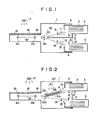
- Figure 1 shows the first embodiment of the radiation image recording system in accordance with the present invention in which discrete stimulable phosphor sheets 2 are used.
- a feed magazine fitting section 4 which releasably holds a feed magazine 3 capable of accommodating a plurality of stimulable phosphor sheets 2 is positioned at the upper section of a radiation image recording system body 1.
- a receiving magazine fitting section 6 which releasably holds a receiving magazine 5 for receiving the respective stimulable phosphor sheets 2 after radiation images have been recorded therein.
- a take-up arm 8 which, using suction, takes up the stimulable phosphor sheets 2 one at a time from the aperture 7 of the feed magazine 3 fitted to the feed magazine fitting section 4.
- sheet feed rollers 9 which receive the sheet 2 taken out of the feed magazine 3 by the take-up arm 8 and carry it toward a radiation image recording position 10, and feed guide plates 11 for guiding the sheet 2 to the sheet feed rollers 9.
- feed guide plates 11 for guiding the sheet 2 to the sheet feed rollers 9.
- sheet loading and unloading rollers 12a, 12b and 12c which load the sheet 2 to and hold it at the recording position 10.
- Sheet receiving rollers 14 and receiving guide plates 15 are located above the receiving magazine fitting section 6 to move the sheet 2 taken out of the recording position 10 up to an aperture 13 of the receiving magazine 5.
- a receiving arm 16 In the vicinity of the aperture 13 of the receiving magazine 5 is positioned a receiving arm 16 which sucks the sheet 2 through the aperture 13 and sets it into the receiving magazine 5.
- a radiation transmitting window 18 made of a material which transmits a radiation emitted from a radiation source 17 but shields light of wavelengths including the wavelength range of the stimulating ray for the stimulable phosphor.
- Shield plates 19 are provided at the necessary sections of the body 1 so as to prevent-the stimulable phosphor sheet 2 from being exposed to radiation and stray light of wavelengths including the wavelength range of the stimulating ray.
- an illuminant 20 for erasing noise is located between the feed magazine fitting section 4 and the sheet loading and unloading rollers 12a.
- the illuminant 20 may for example be a tungsten-filament, fluorescent, sodium, xenon or iodine lamp or the like.
- the feed rollers 9, receiving rollers 14, and sheet loading and unloading rollers 12a, 12b, 12c may each be replaced by a belt, chain or the like which can move the sheets 2 at a predetermined speed.
- the take-up arm 8 may be replaced by any other means which can take up the sheets 2 one at a time from the feed magazine 3. This also applies to the receiving arm 16.
- a plurality of stimulable phosphor sheets 2 contained in the feed magazine 3 are sucked and taken up one at a time by the take-up arm 8.
- the illuminant 20 is synchronized with the movement of the stimulable phosphor sheets 2 so as to start emitting light when the forward end of each sheet 2 taken out of the feed magazine 3 reaches the feed rollers 9.
- the sheet 2 is exposed to light emitted from the illuminant 20 while it is passed under the illuminant 20 at a predetermined speed by the feed rollers 9 and the loading and unloading rollers 12a.
- the exposure amount for the stimulable phosphor sheet is set at 500,000 lx ⁇ sec. or more, preferably from 3,000,000 to 9,000,000 lx-sec.
- the stimulable phosphor sheet 2 is then carried to and held at the recording position 10 by a series of sheet loading and unloading rollers 12a, 12b and 12c. After a radiation image is recorded on the stimulable phosphor sheet 2, the sheet 2 is taken out of the recording position 10 by the loading and unloading rollers 12a, 12b, 12c, and set into the receiving magazine 5 by the receiving rollers 14 and the receiving arm 16.
- the stimulable phosphor sheet 2 is passed under the illuminant 20 at a predetermined speed, so that the whole surface thereof is uniformly exposed to light emitted from the illuminant 20.
- the speed of the feed rollers 9 to carry the stimulable phosphor sheet 2 must be controlled with respect to the light irradiation power of the illuminant 20 so as to secure an exposure amount within the aforesaid range. It is also possible to have the illuminant 20 turned on continuously, instead of operating it in synchronization with the movement of the stimulable phosphor sheets 2. In this case, however, it is necessary to provide a means for shielding the radiation image recording position 10 and the region downstream therefrom from the light emitted from the illuminant 20.
- FIG. 2 shows the second embodiment of the radiation image recording system in accordance with the present invention.
- This second embodiment differs from the first described above in that a pair of supporting plates 21a, 21b are used to guide and support the stimulable phosphor sheets 2 under the illuminant 20 (the supporting plate 21b located on the side of the illuminant 20 is transparent, while the supporting plate 21a on the opposite side serves as a shielding plate), in that a stopper 22 is provided to hold the stimulable phosphor sheets 2 under the illuminant 20, and in that the illuminant 20 may be a flashlamp.
- a plurality of stimulable phosphor sheets 2 contained in the feed magazine 3 are sucked and taken up one at a time by the take-up arm 8.
- the taken-up sheet 2 is moved by the feed rollers 9 and stopped by the stopper 22 with the forward end thereof contacting the stopper 22. In this way, the sheet 2 is supported on the supporting plate 21a. In this condition, the stimulable phosphor sheet 2 is exposed to light emitted from the illuminant 20 through the transparent supporting plate 21b. At this time, the exposure amount is set at 500,000 lx-sec. or more, preferably from 3,000,000 to 9,000,000 lx-sec.
- the stopper 22 is retracted, and the stimulable phosphor sheet 2 is moved to the recording position 10 by the sheet loading and unloading rollers 12a, 12b, 12c.
- a high brightness flashlamp can be used as the illuminant 20.
- a strip-shaped stimulable phosphor sheet 2 is used.
- a sheet feed body fitting section 24 which releasably holds a sheet feed body 23 containing the rolled stimulable phosphor sheet 2.
- a sheet receiving section 26 having a wind-up shaft 25 for winding up the strip-shaped stimulable phosphor sheet 2 in roll form after a radiation image is recorded thereon.
- Two sets of sheet holding rollers 27a, 27b are positioned above the sheet feed body fitting section 24 and the wind-up shaft 25 so as to hold the stimulable phosphor sheet 2.
- a radiation transmitting window 18 made of a material which transmits a radiation emitted from the radiation source 17 but shields light of wavelengths including the wavelength range of the stimulating ray for the stimulable phosphor.
- Shield plates 19 are located around the sheet feed body fitting section 24 and the sheet receiving section 26 as well as other sections requiring shielding so as to prevent the stimulable phosphor sheet 2 from being exposed to radiation and stray light of wavelengths including the wavelength range of the stimulating ray for the stimulable phosphor.
- the illuminant 20 for erasing noise is located between the sheet feed body fitting section 24 and the sheet holding rollers 27a.
- one end of the stimulable phosphor sheet 2 rolled in the sheet feed body 23 is fitted to the wind-up shaft 25. Then the wind-up shaft 25 is rotated to wind up the stimulable phosphor sheet 2 until a predetermined length thereof is pulled out of the sheet feed body 23. At this time, the illuminant 20 for erasing noise is turned on to emit light and erase the noise stored in the stimulable phosphor sheet 2. After a radiation image is recorded on the stimulable phosphor sheet 2 at the recording position 10, the sheet 2 is wound up around the wind-up shaft 25 and accommodated in the receiving section 26.
- the sheet 2 is completely wound up arround the wind-up shaft 25 and ejected from the sheet receiving section 26 together with the wind-up shaft 25, or is rewound into the sheet feed body 23 and ejected from the sheet feed body fitting section 24 in the form of a roll.
- the illuminant 20 is intermittently turned on to erase the noise in the stimulable phosphor sheet 2.
- FIG. 4 shows the fourth embodiment of the radiation image recording system in accordance with the present invention.
- This fourth embodiment differs from the first embodiment described above in that the receiving magazine fitting section 6, receiving arm 16, sheet receiving rollers 14 and receiving guide plates 15 in the first embodiment are omitted, and in that delivery rollers 29 are provided for sending the stimulable phosphor sheet 2 directly to a radiation image information read out and reproducing system 28 after a radiation image has been recorded on the sheet 2.
- the stimulable phosphor sheet 2 on which a radiation image has been recorded in the same manner as in the first embodiment is directly sent to the read out system 28, which has a means for irradiating a stimulating ray for reading out the recorded radiation image, a means for detecting the light emitted from the stimulable phosphor sheet 2 upon stimulation thereof or the like.
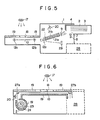
- FIG. 5 shows the fifth embodiment in accordance with the present invention. Like the fourth embodiment described above, this fifth embodiment differs from the second embodiment in that the receiving magazine fitting section 6, receiving arm 16, sheet receiving rollers 14 and receiving guide plates 15 in the second embodiment are omitted, and in that delivery rollers 29 are provided for sending the stimulable phosphor sheet 2 directly to a radiation image information read out and reproducing system 28 after a radiation image has been recorded on the sheet 2.
- FIG. 6 shows the sixth embodiment in accordance with the present invention.
- This sixth embodiment differs from the third embodiment described above in that there are no wind-up shaft 25 or sheet receiving section 26.
- the stimulable phosphor sheet 2 on which a radiation image has been recorded is directly sent to a radiation image information read out and reproducing system 28.
Landscapes
- Physics & Mathematics (AREA)
- General Physics & Mathematics (AREA)
- High Energy & Nuclear Physics (AREA)
- Engineering & Computer Science (AREA)
- General Engineering & Computer Science (AREA)
- Health & Medical Sciences (AREA)
- Life Sciences & Earth Sciences (AREA)
- Molecular Biology (AREA)
- Spectroscopy & Molecular Physics (AREA)
- Radiography Using Non-Light Waves (AREA)
- Conversion Of X-Rays Into Visible Images (AREA)
- Analysing Materials By The Use Of Radiation (AREA)
Applications Claiming Priority (2)
| Application Number | Priority Date | Filing Date | Title |
|---|---|---|---|
| JP56165117A JPS5866930A (ja) | 1981-10-16 | 1981-10-16 | 放射線画像記録装置 |
| JP165117/81 | 1981-10-16 |
Publications (3)
| Publication Number | Publication Date |
|---|---|
| EP0077676A2 true EP0077676A2 (de) | 1983-04-27 |
| EP0077676A3 EP0077676A3 (en) | 1983-09-07 |
| EP0077676B1 EP0077676B1 (de) | 1986-08-06 |
Family
ID=15806229
Family Applications (1)
| Application Number | Title | Priority Date | Filing Date |
|---|---|---|---|
| EP82305529A Expired EP0077676B1 (de) | 1981-10-16 | 1982-10-18 | Strahlungsbild-Aufzeichnungssystem |
Country Status (4)
| Country | Link |
|---|---|
| US (1) | US4543480A (de) |
| EP (1) | EP0077676B1 (de) |
| JP (1) | JPS5866930A (de) |
| DE (2) | DE77676T1 (de) |
Families Citing this family (35)
| Publication number | Priority date | Publication date | Assignee | Title |
|---|---|---|---|---|
| JPS5880633A (ja) * | 1981-11-09 | 1983-05-14 | Fuji Photo Film Co Ltd | 螢光体シ−トのノイズ消去方法および装置 |
| JPS59102227A (ja) * | 1982-12-03 | 1984-06-13 | Fuji Photo Film Co Ltd | 蓄積性螢光体シ−トを用いた高速撮影台 |
| JPS59133500A (ja) * | 1983-01-21 | 1984-07-31 | 富士写真フイルム株式会社 | 蓄積性螢光体シ−ト用カセツテ |
| JPS6064809A (ja) * | 1983-09-20 | 1985-04-13 | Yokohama Rubber Co Ltd:The | タイヤの製造方法 |
| JPS6080837A (ja) * | 1983-10-11 | 1985-05-08 | Toshiba Corp | X線撮影装置 |
| EP0140374B1 (de) * | 1983-11-02 | 1994-05-04 | Fuji Photo Film Co., Ltd. | Vorrichtung für Hochgeschwindigkeitsaufnahmen mittels stimulierbarer Phosphorfolien sowie lichtdichte Taschen dafür |
| US4814618A (en) * | 1984-03-16 | 1989-03-21 | Fuji Photo Film Co., Ltd. | Radiation image read-out method and radiation image recording read-out apparatus |
| JPH0743500B2 (ja) * | 1984-04-28 | 1995-05-15 | 株式会社東芝 | 放射線診断装置 |
| EP0160540B1 (de) * | 1984-04-28 | 1989-12-13 | Kabushiki Kaisha Toshiba | Röntgenvorrichtung |
| DE3576574D1 (de) * | 1984-04-28 | 1990-04-19 | Toshiba Kawasaki Kk | Roentgenvorrichtung. |
| DE3565608D1 (en) * | 1984-04-28 | 1988-11-17 | Toshiba Kk | Radiographic apparatus |
| JPS60256134A (ja) * | 1984-06-01 | 1985-12-17 | Fuji Photo Film Co Ltd | 放射線画像情報記録読取装置 |
| US4868387A (en) * | 1984-06-01 | 1989-09-19 | Fuji Photo Film Co., Ltd. | Radiation image erase unit for use with stimulable phosphor sheet |
| DE3586471T2 (de) * | 1984-06-01 | 1993-03-25 | Fuji Photo Film Co Ltd | Vorrichtung zur strahlungsbildloeschung fuer anregbare phosphorschichten. |
| US4687932A (en) * | 1984-06-01 | 1987-08-18 | Fuji Photo Film Co., Ltd. | Radiation image recording and read-out apparatus |
| US4780609A (en) * | 1984-06-01 | 1988-10-25 | Fuji Photo Film Co., Ltd. | Radiation image erase unit for use with stimulable phosphor sheet |
| JPS60256133A (ja) * | 1984-06-01 | 1985-12-17 | Fuji Photo Film Co Ltd | 放射線画像情報記録読取装置 |
| US4760255A (en) * | 1984-07-20 | 1988-07-26 | Fuji Photo Film Co., Ltd. | Radiation image recording and read-out apparatus |
| JPH0616395B2 (ja) * | 1984-10-12 | 1994-03-02 | 富士写真フイルム株式会社 | 電子顕微鏡像記録装置 |
| US4651220A (en) * | 1984-10-12 | 1987-03-17 | Fuji Photo Film Co., Ltd. | Method of recording and reproducing images produced by an electron microscope |
| EP0181518B1 (de) * | 1984-10-16 | 1989-01-18 | Fuji Photo Film Co., Ltd. | Verfahren und Vorrichtung zur Aufzeichnung und Auslesen eines Strahlungsbildes |
| JPS6197645A (ja) * | 1984-10-17 | 1986-05-16 | Fuji Photo Film Co Ltd | 放射線画像情報記録読取装置 |
| DE3587903T2 (de) * | 1984-10-30 | 1994-12-08 | Fuji Photo Film Co Ltd | Verfahren und Vorrichtung zur Aufnahme und zum Lesen von Strahlungsbildinformation. |
| EP0345832B1 (de) * | 1984-10-30 | 1994-08-10 | Fuji Photo Film Co., Ltd. | Verfahren und Vorrichtung zur Aufnahme und zum Lesen von Strahlungsbildinformation |
| US4851677A (en) * | 1984-12-07 | 1989-07-25 | Fuji Photo Co., Ltd. | Apparatus for recording and reproducing image produced by an electron microscope including an optical filter and a deflecting element |
| EP0346947B1 (de) * | 1985-10-18 | 1994-08-03 | Fuji Photo Film Co., Ltd. | Gerät zur Aufzeichnung und Auswertung von Strahlungsbildern |
| JPH0644129B2 (ja) * | 1985-11-25 | 1994-06-08 | 富士写真フイルム株式会社 | 放射線画像情報読取装置 |
| JP2676509B2 (ja) * | 1986-10-29 | 1997-11-17 | コニカ株式会社 | 放射線画像形成読取装置 |
| EP0287129B1 (de) * | 1987-04-17 | 1990-11-07 | Fuji Photo Film Co., Ltd. | Strahlungsbildaufzeichnungs- und Wiedergabesystem |
| JPH06100792B2 (ja) * | 1987-10-20 | 1994-12-12 | 富士写真フイルム株式会社 | 蓄積性蛍光体シート用消去装置 |
| DE3856230T2 (de) * | 1987-04-20 | 1998-12-10 | Fuji Photo Film Co., Ltd., Minami-Ashigara, Kanagawa | Kassette, Vorrichtung und Wischverfahren für ein stimulierbares Phosphorblatt |
| US5330309A (en) * | 1992-11-25 | 1994-07-19 | Eastman Kodak Company | Reader having cassette locating and unlatching mechanism |
| DE102009060019B4 (de) * | 2009-12-21 | 2017-05-24 | DüRR DENTAL AG | Detektionseinheit für Prüfstrahlen sowie Ausleseeinheit und Untersuchungsgerät mit einer solchen |
| CN102830129B (zh) * | 2012-08-27 | 2015-07-15 | 山东省特种设备检验研究院 | 用于承压类设备焊缝的射线检测底片的快速高清数字化录入装置 |
| JP7066530B2 (ja) * | 2018-05-31 | 2022-05-13 | Toyo Tire株式会社 | タイヤ加硫金型、及びそれを用いたタイヤの製造方法 |
Family Cites Families (11)
| Publication number | Priority date | Publication date | Assignee | Title |
|---|---|---|---|---|
| US3128379A (en) * | 1960-11-14 | 1964-04-07 | Minnesota Mining & Mfg | Thermocopying machine with temperature and speed correlating means |
| US3567931A (en) * | 1969-10-10 | 1971-03-02 | Herman H Eelkema | Radiographic film transport with film conveyor belts which function as intensifying screens |
| JPS51115789A (en) * | 1975-04-03 | 1976-10-12 | Toshiba Corp | Sheet film tipe x-ray photo apparatus |
| DE2526415A1 (de) * | 1975-06-13 | 1976-12-30 | Agfa Gevaert Ag | Elektronenradiografisches verfahren und vorrichtung zur durchfuehrung des verfahrens |
| JPS52105475A (en) * | 1976-02-27 | 1977-09-03 | Canon Kk | Device for sending out paper sheet |
| DE2739244C2 (de) * | 1977-08-31 | 1981-10-15 | Siemens AG, 1000 Berlin und 8000 München | Blattfilmwechsler |
| US4315318A (en) * | 1978-12-26 | 1982-02-09 | Fuji Photo Film Co., Ltd. | Method and apparatus for processing a radiation image |
| JPS55116340A (en) * | 1979-02-28 | 1980-09-06 | Fuji Photo Film Co Ltd | Method and device for processing gradation of radiation picture |
| JPS5611392A (en) * | 1979-07-11 | 1981-02-04 | Fuji Photo Film Co Ltd | Method and device for converting radiation image |
| JPS57119300A (en) * | 1981-01-16 | 1982-07-24 | Fuji Photo Film Co Ltd | Noise eliminator for accumulative phosphor sheet |
| JPS57119340A (en) * | 1981-01-16 | 1982-07-24 | Fuji Photo Film Co Ltd | Radiation picture recorder |
-
1981
- 1981-10-16 JP JP56165117A patent/JPS5866930A/ja active Pending
-
1982
- 1982-10-12 US US06/433,718 patent/US4543480A/en not_active Expired - Lifetime
- 1982-10-18 EP EP82305529A patent/EP0077676B1/de not_active Expired
- 1982-10-18 DE DE198282305529T patent/DE77676T1/de active Pending
- 1982-10-18 DE DE8282305529T patent/DE3272465D1/de not_active Expired
Also Published As
| Publication number | Publication date |
|---|---|
| DE77676T1 (de) | 1983-11-10 |
| DE3272465D1 (en) | 1986-09-11 |
| EP0077676A3 (en) | 1983-09-07 |
| US4543480A (en) | 1985-09-24 |
| JPS5866930A (ja) | 1983-04-21 |
| EP0077676B1 (de) | 1986-08-06 |
Similar Documents
| Publication | Publication Date | Title |
|---|---|---|
| US4543480A (en) | Radiation image recording system | |
| EP0056639B1 (de) | Gerät für das Fluoreszenzbildverfahren | |
| US4439682A (en) | Noise erasing method in a radiation image recording and reproducing method | |
| US4438333A (en) | Noise erasing apparatus for stimulable phosphor sheet | |
| EP0125800B1 (de) | Strahlungsbildaufzeichnungs- und Wiedergabevorrichtung | |
| US4500783A (en) | Noise erasing apparatus for stimulable phosphor sheet | |
| US4496838A (en) | Noise erasing apparatus for stimulable phosphor sheet | |
| US4584483A (en) | Noise erasing method in radiation image recording and reproducing method | |
| US4931641A (en) | Radiation image read-out apparatus | |
| US5013916A (en) | Method and apparatus for recording and reading out radiation images | |
| US5665976A (en) | Radiation image read-out and erasing method and apparatus | |
| US4687932A (en) | Radiation image recording and read-out apparatus | |
| EP0172417B1 (de) | Strahlungsbildaufzeichnungs- und Wiedergabevorrichtung | |
| EP0307937A1 (de) | Vorrichtung zum Auslesen von Strahlungsbildern | |
| US4754137A (en) | Tomographic type panoramic radiation image recording and read-out apparatus | |
| JP2574154B2 (ja) | 放射線画像情報読取装置 | |
| US4864135A (en) | Radiation image read-out and reproducing apparatus | |
| US5061852A (en) | Radiation image read-out apparatus | |
| JPS5988729A (ja) | 放射線画像記録装置 | |
| US4897546A (en) | Radiation image recording, read-out and reproducing apparatus | |
| JP2905166B2 (ja) | 放射画像読出し方法及び装置 | |
| JPH0578817B2 (de) | ||
| JPH0252250B2 (de) | ||
| EP0201636A1 (de) | Rauschlöschvorrichtung für stimulierbares Phosphorblatt | |
| JPS6022128A (ja) | 放射線画像情報記録読取装置 |
Legal Events
| Date | Code | Title | Description |
|---|---|---|---|
| PUAI | Public reference made under article 153(3) epc to a published international application that has entered the european phase |
Free format text: ORIGINAL CODE: 0009012 |
|
| AK | Designated contracting states |
Designated state(s): DE FR NL |
|
| PUAL | Search report despatched |
Free format text: ORIGINAL CODE: 0009013 |
|
| TCNL | Nl: translation of patent claims filed | ||
| EL | Fr: translation of claims filed | ||
| RHK1 | Main classification (correction) |
Ipc: G03B 41/16 |
|
| AK | Designated contracting states |
Designated state(s): DE FR NL |
|
| DET | De: translation of patent claims | ||
| 17P | Request for examination filed |
Effective date: 19840201 |
|
| GRAA | (expected) grant |
Free format text: ORIGINAL CODE: 0009210 |
|
| AK | Designated contracting states |
Kind code of ref document: B1 Designated state(s): DE FR NL |
|
| REF | Corresponds to: |
Ref document number: 3272465 Country of ref document: DE Date of ref document: 19860911 |
|
| ET | Fr: translation filed | ||
| PLBE | No opposition filed within time limit |
Free format text: ORIGINAL CODE: 0009261 |
|
| STAA | Information on the status of an ep patent application or granted ep patent |
Free format text: STATUS: NO OPPOSITION FILED WITHIN TIME LIMIT |
|
| 26N | No opposition filed | ||
| PGFP | Annual fee paid to national office [announced via postgrant information from national office to epo] |
Ref country code: FR Payment date: 20011017 Year of fee payment: 20 |
|
| PGFP | Annual fee paid to national office [announced via postgrant information from national office to epo] |
Ref country code: NL Payment date: 20011031 Year of fee payment: 20 |
|
| PGFP | Annual fee paid to national office [announced via postgrant information from national office to epo] |
Ref country code: DE Payment date: 20011211 Year of fee payment: 20 |
|
| PG25 | Lapsed in a contracting state [announced via postgrant information from national office to epo] |
Ref country code: NL Free format text: LAPSE BECAUSE OF EXPIRATION OF PROTECTION Effective date: 20021018 |
|
| NLV7 | Nl: ceased due to reaching the maximum lifetime of a patent |
Effective date: 20021018 |