EP0078537A2 - Plasmid pHM 1519 - Google Patents
Plasmid pHM 1519 Download PDFInfo
- Publication number
- EP0078537A2 EP0078537A2 EP82110095A EP82110095A EP0078537A2 EP 0078537 A2 EP0078537 A2 EP 0078537A2 EP 82110095 A EP82110095 A EP 82110095A EP 82110095 A EP82110095 A EP 82110095A EP 0078537 A2 EP0078537 A2 EP 0078537A2
- Authority
- EP
- European Patent Office
- Prior art keywords
- plasmid
- glutamic acid
- dna
- phm
- atcc
- Prior art date
- Legal status (The legal status is an assumption and is not a legal conclusion. Google has not performed a legal analysis and makes no representation as to the accuracy of the status listed.)
- Granted
Links
Images
Classifications
-
- C—CHEMISTRY; METALLURGY
- C12—BIOCHEMISTRY; BEER; SPIRITS; WINE; VINEGAR; MICROBIOLOGY; ENZYMOLOGY; MUTATION OR GENETIC ENGINEERING
- C12N—MICROORGANISMS OR ENZYMES; COMPOSITIONS THEREOF; PROPAGATING, PRESERVING, OR MAINTAINING MICROORGANISMS; MUTATION OR GENETIC ENGINEERING; CULTURE MEDIA
- C12N15/00—Mutation or genetic engineering; DNA or RNA concerning genetic engineering, vectors, e.g. plasmids, or their isolation, preparation or purification; Use of hosts therefor
- C12N15/09—Recombinant DNA-technology
- C12N15/63—Introduction of foreign genetic material using vectors; Vectors; Use of hosts therefor; Regulation of expression
- C12N15/74—Vectors or expression systems specially adapted for prokaryotic hosts other than E. coli, e.g. Lactobacillus, Micromonospora
- C12N15/77—Vectors or expression systems specially adapted for prokaryotic hosts other than E. coli, e.g. Lactobacillus, Micromonospora for Corynebacterium; for Brevibacterium
Definitions
- the present invention relates to a plasmid, designated as plasmid pHM 1519 which is capable of propagating in Coryneform glutamic acid-producing bacteria.
- Coryneform glutamic acid producing bacteria so-called “Coryneform bacteria” are known to produce substantial amounts of L-glutamic acid, and mutants of the Coryneform glutamic acid producing bacteria produce amino acids such as lysine and purine nucleotides such as inosinic acid. Therefore, they are of great importance to the fermentation industry.
- the recently developed gene splicing techniques can successfully be applied for producing or improving in- iustrial microorganisms, especially in the case of Escherichia coli. It has been difficult, however, to apply the gene splicing techniques for producing or improving industrially useful microorganisms, which are Coryneform glutamic acid-producing bacteria, since suitable plasmids useful for the construction of such industrially useful Coryneform glutamic acid producing bacteria have not yet been developed.
- Plasmid pHM 1519 is separated from Corynebacterium glutamicum ATCC 13058.
- the plasmid has the following characteristics :
- the plasmid pHM 1519 can be obtained from the cells of the deposited microorganisms Corynebacterium glutamicum ATCC 13058 by lysing the cells previously harvested at a late exponential growth phase by lysozyme and SDS, adding polyethylene glycol to the supernatant obtained from the lysate by centrifugation at 30,000 xg, and purifying the precipitated DNA by fractionation using cesium chloride-ethidium bromide equilibrium density gradient centrifugation.
- Coryneform bacteria are aerobic, gram-positive rods, non-sporulating, and non-acidfast, and are described in Berge y 's Manual of Determinative Bacteriology, 8th ed., 599, (1974).
- Examples of wild strains of Coryneform glutamic acid-producing bacteria useful as hosts in this invention are as follows:
- Coryneform glutamic acid-producing bacteria also include mutants which have lost the ability to produce glutamic acid or are capable of producing other amino acids such as lysine and arginine; purine nucleosides such as inosine; purine nucleotides such as inosine-5'- monophosphate; and other fermentation products.
- the plasmids of the present invention are stably maintained. Since the plasmids of the present invention can propagate in cells of Coryneform glutamic acid-producing bacteria, the information of a foreign gene inserted in the plasmid can be amplified in the hosts.
- the incorporation of plasmid DNA into the hosts of Coryneform glutamic acid-producing bacteria can be done by treating the cells of the DNA-recipient with calcium chloride to increase the permeability for DNA, as is reported regarding E. coli K-12 (Mandel, M and Higa, A., J. Mol. Biol., 53, 159 (1970), or by incorporation into the host at a specific stage of growth when the cells become capable of incorporating DNA therein (competent cells) as is reported for Bacillus subtilis (Duncan, C.H., Wilson, G.A., and Young, F.E., Gene 1, 153 (1977)).
- the plasmid can also be incorporated into the DNA-recipient by forming protoplasts or spheroplasts of the DNA-recipient which easily incorporate plasmid DNA therein, as is known for Bacillus subtilis, actinomycetes and yeast (Chang, S. and Choen, S.N., Molec. Gen. Genet., 168, 111 (1979); Bibb, M.J., Ward, J.M. and Hopwood, O.A., Nature, 274, 398 (1978); Hinnen, A., Hicks, J.B. and Fink, G.R., Proc. Nat'1 Acad. Sci., USA 75, 1929 (1978)).
- a foreign gene can be inserted into the plasmid of the present invention at the positions cleaved by the restriction enzymes shown in Table 1 and more preferably at the cleavage position whose number is one. Genom DNA of Coryneform glutamic acid-producing bacteria is the most preferred of the foreign genes.
- a preferred vector can be obtained from the present plasmid by removing all or a part of the DNA regions other than the drive-unit (vehicle unit) since the molecular weight becomes small. The replication number of the present plasmid is sufficiently large and therefore is suitable for amplifying foreign genes.
- Corynebacterium glutamicu m ATCC 13058 which possessed pHM1519 was cultured at 30°C in CMG medium at pH 7.2 containing 1 g/dl peptone, 1 g/dl yeast extract, 0.5 g/dl glucose and 0.5 g/dl NaCl until the late exponential growth phase was reached.
- Cells were harvested and lysed by treatment with lysozyme and SDS. The lysate was centrifuged to obtain a supernatant, which was added to polyethylene glycol, and the resulting mixture was evaporated to precipitate DNA.
- restriction enzymes sold by Bethesda Research Laboratory Co., Boehringer Mannheim Co., New England Biolab Co., Worthington Biochemical Co. were used.
- the digestion by restriction enzyme was carried out using an excessive amount of restriction enzyme, e.g. more than 3 times the amount required.
- the digestion reaction was carried out according to the directions by the distributors.
- the DNA fragments were thereafter subjected to agarose-gel electrophoresis by the method shown in P.A. Sharp et al., Biochemistry 12, 3055 (1973).
- the agarose concentration was 0.7 to 1%, the voltage was 5 to 20 v and electrophoresis was continued for 1 to 3 hours.
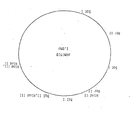
- pHM 1519 The molecular weight of pHM 1519 was calculated by its migration distance in the electrophoresis on agarose gel and by the length of its DNA-chain as determined under an electron microscope,pHM 1519 was cleaved with Bcl I which cut the plasmid at one point, and subjected to agarose-gel electrophoresis shown above. The molecular weight was calculated based on the mobility differences of the ⁇ DNA-Hind III fragment produced by Bethesda Research Laboratory.
- Corynebacterium glutamicum ATCC 13058 containing pHM 1519 was cultured at 30°C in 4 ml of CMG medium at pH 7.0 to obtain cells at the exponential growth phase.
- the cells harvested were lysed by lysozyme-SDS, and the DNAs in the lysate were separated by precipitation.
- the DNAs were thereafter subjected to 0.7% agarose-gel electrophoresis, and from the gel obtained a photograph under ultra-violet light was taken.
- the negative-film thus obtained was put on a densitometer, and the density ratio of plasmid DNA fraction to total DNA was calculated.
- the replication number was determined as 100 when chromosomal DNA of ATCC 13058 is supposed as 3 x 10 dalton.
Landscapes
- Genetics & Genomics (AREA)
- Health & Medical Sciences (AREA)
- Engineering & Computer Science (AREA)
- Life Sciences & Earth Sciences (AREA)
- Chemical & Material Sciences (AREA)
- Wood Science & Technology (AREA)
- Organic Chemistry (AREA)
- Biotechnology (AREA)
- General Engineering & Computer Science (AREA)
- Biomedical Technology (AREA)
- Zoology (AREA)
- Bioinformatics & Cheminformatics (AREA)
- Molecular Biology (AREA)
- Microbiology (AREA)
- Plant Pathology (AREA)
- Physics & Mathematics (AREA)
- Biochemistry (AREA)
- General Health & Medical Sciences (AREA)
- Biophysics (AREA)
- Preparation Of Compounds By Using Micro-Organisms (AREA)
- Micro-Organisms Or Cultivation Processes Thereof (AREA)
- Saccharide Compounds (AREA)
Applications Claiming Priority (2)
| Application Number | Priority Date | Filing Date | Title |
|---|---|---|---|
| JP176193/81 | 1981-11-02 | ||
| JP56176193A JPS5877895A (ja) | 1981-11-02 | 1981-11-02 | プラスミドphm1519 |
Publications (3)
| Publication Number | Publication Date |
|---|---|
| EP0078537A2 true EP0078537A2 (de) | 1983-05-11 |
| EP0078537A3 EP0078537A3 (en) | 1984-04-18 |
| EP0078537B1 EP0078537B1 (de) | 1987-08-12 |
Family
ID=16009259
Family Applications (1)
| Application Number | Title | Priority Date | Filing Date |
|---|---|---|---|
| EP19820110095 Expired EP0078537B1 (de) | 1981-11-02 | 1982-11-02 | Plasmid pHM 1519 |
Country Status (3)
| Country | Link |
|---|---|
| EP (1) | EP0078537B1 (de) |
| JP (1) | JPS5877895A (de) |
| DE (1) | DE3276947D1 (de) |
Cited By (8)
| Publication number | Priority date | Publication date | Assignee | Title |
|---|---|---|---|---|
| GB2134118A (en) * | 1983-01-27 | 1984-08-08 | Stauffer Chemical Co | Corynebacterium plasmid and vector |
| EP0183175A1 (de) * | 1984-11-20 | 1986-06-04 | Ajinomoto Co., Inc. | Rekombinante DNA enthaltende Coryneformbakterien und Verfahren zur Herstellung von aromatischen Aminosäuren unter Verwendung dieser Bakterien |
| EP0158940A3 (en) * | 1984-04-04 | 1986-07-30 | Ajinomoto Co., Inc. | Transducible composite plasmid |
| US5158891A (en) * | 1984-08-21 | 1992-10-27 | Asahi Kasei Kogyo Kabushiki Kaisha | Plasmid containing a gene for tetracycline resistance and DNA fragments derived therefrom |
| US7763447B2 (en) | 2003-08-28 | 2010-07-27 | Ajinomoto Co., Inc. | Method of producing succinic acid with bacterium comprising a modified fumarate reductase gene or a modified succinate dehydrogenase gene |
| US7833763B2 (en) | 2003-07-09 | 2010-11-16 | Mitsubishi Chemical Corporation | Method for producing organic acid |
| US7972823B2 (en) | 2004-05-20 | 2011-07-05 | Ajinomoto Co., Inc. | Succinic acid-producing bacterium and process for producing succinic acid |
| US7993888B2 (en) | 2006-02-24 | 2011-08-09 | Mitsubishi Chemical Corporation | Bacterium having enhanced 2-oxoglutarate dehydrogenase activity |
Families Citing this family (25)
| Publication number | Priority date | Publication date | Assignee | Title |
|---|---|---|---|---|
| JPH06102030B2 (ja) * | 1983-09-28 | 1994-12-14 | 味の素株式会社 | 発酵法によるl−チロシンの製造法 |
| JPS6078591A (ja) * | 1983-10-05 | 1985-05-04 | Ajinomoto Co Inc | 発酵法によるl−プロリンの製造法 |
| JPH0644869B2 (ja) * | 1984-12-27 | 1994-06-15 | 味の素株式会社 | プラスミド及びそれを有する細菌 |
| ATE165606T1 (de) * | 1993-01-13 | 1998-05-15 | Ajinomoto Kk | Zelloberflächenprotein aus brevibakterium lactofermentum |
| BR122019024048B1 (pt) | 2004-12-28 | 2022-05-24 | Ajinomoto Co., Inc | Método para produzir ácido l-glutâmico |
| JP5088136B2 (ja) | 2005-10-18 | 2012-12-05 | 味の素株式会社 | コハク酸の製造方法 |
| JP2010130899A (ja) | 2007-03-14 | 2010-06-17 | Ajinomoto Co Inc | L−グルタミン酸系アミノ酸生産微生物及びアミノ酸の製造法 |
| WO2008126896A1 (ja) | 2007-04-10 | 2008-10-23 | Ajinomoto Co., Inc. | 有機酸の製造方法 |
| WO2008133131A1 (ja) | 2007-04-16 | 2008-11-06 | Ajinomoto Co., Inc. | 有機酸の製造方法 |
| WO2009025363A1 (ja) | 2007-08-23 | 2009-02-26 | Mitsubishi Chemical Corporation | コハク酸の製造方法 |
| WO2009031565A1 (ja) | 2007-09-04 | 2009-03-12 | Ajinomoto Co., Inc. | アミノ酸生産微生物及びアミノ酸の製造法 |
| JP2011067095A (ja) | 2008-01-10 | 2011-04-07 | Ajinomoto Co Inc | 発酵法による目的物質の製造法 |
| CN102272304B (zh) | 2009-01-07 | 2013-10-23 | 三菱化学株式会社 | 切断固醇侧链的酶蛋白质及其应用 |
| JP2012223091A (ja) | 2009-08-25 | 2012-11-15 | Ajinomoto Co Inc | L−アミノ酸の製造法 |
| US9029107B2 (en) | 2010-08-31 | 2015-05-12 | Api Corporation | Hydrolase protein |
| EP2687591B1 (de) | 2011-03-18 | 2021-01-06 | Mitsubishi Chemical Corporation | Verfahren zur herstellung von polymeren, herstellungsverfahren für organische säuren und organische säuren produzierender mikroorganismus |
| JP6136930B2 (ja) | 2011-11-02 | 2017-05-31 | 味の素株式会社 | タンパク質の分泌生産法 |
| WO2013069634A1 (ja) | 2011-11-11 | 2013-05-16 | 味の素株式会社 | 発酵法による目的物質の製造法 |
| WO2013179711A1 (ja) | 2012-05-29 | 2013-12-05 | 味の素株式会社 | 3-アセチルアミノ-4-ヒドロキシ安息香酸の製造方法 |
| US10047382B2 (en) | 2012-07-03 | 2018-08-14 | Kao Corporation | Useful microorganism and method for producing substance of interest |
| WO2016185211A1 (en) | 2015-05-19 | 2016-11-24 | Lucite International Uk Limited | Process for the biological productiion of methacrylic acid and derivatives thereof |
| GB201619827D0 (en) | 2016-11-23 | 2017-01-04 | Lucite Int Uk Ltd | Process for the production of methyl methacrylate |
| WO2019078095A1 (en) | 2017-10-16 | 2019-04-25 | Ajinomoto Co., Inc. | PROCESS FOR PRODUCTION OF PROTEIN HAVING ALPHA-HYDROXYLANTIC PEPTIDYLGLYCIN MONOOXYGENASE ACTIVITY |
| BR112020012044A2 (pt) | 2017-12-26 | 2020-11-24 | Ajinomoto Co., Inc. | método para produzir glicina ou um sal da mesma, e, bactéria produtora de glicina. |
| GB2621337A (en) | 2022-08-08 | 2024-02-14 | Mitsubishi Chemical Uk Ltd | Process for the biological production of methacrylic acid and derivatives thereof |
Family Cites Families (3)
| Publication number | Priority date | Publication date | Assignee | Title |
|---|---|---|---|---|
| JPS57134500A (en) * | 1981-02-12 | 1982-08-19 | Kyowa Hakko Kogyo Co Ltd | Plasmid pcg1 |
| JPS57186496A (en) * | 1981-05-11 | 1982-11-16 | Ajinomoto Co Inc | Preparation of l-threonine by fermentation |
| JPS58893A (ja) * | 1981-06-25 | 1983-01-06 | Ajinomoto Co Inc | 発酵法によるl−イソロイシンの製造法 |
-
1981
- 1981-11-02 JP JP56176193A patent/JPS5877895A/ja active Pending
-
1982
- 1982-11-02 EP EP19820110095 patent/EP0078537B1/de not_active Expired
- 1982-11-02 DE DE8282110095T patent/DE3276947D1/de not_active Expired
Cited By (9)
| Publication number | Priority date | Publication date | Assignee | Title |
|---|---|---|---|---|
| GB2134118A (en) * | 1983-01-27 | 1984-08-08 | Stauffer Chemical Co | Corynebacterium plasmid and vector |
| US4559308A (en) * | 1983-01-27 | 1985-12-17 | Stauffer Chemical Co. | Corynebacterium plasmid and vector |
| EP0158940A3 (en) * | 1984-04-04 | 1986-07-30 | Ajinomoto Co., Inc. | Transducible composite plasmid |
| US5158891A (en) * | 1984-08-21 | 1992-10-27 | Asahi Kasei Kogyo Kabushiki Kaisha | Plasmid containing a gene for tetracycline resistance and DNA fragments derived therefrom |
| EP0183175A1 (de) * | 1984-11-20 | 1986-06-04 | Ajinomoto Co., Inc. | Rekombinante DNA enthaltende Coryneformbakterien und Verfahren zur Herstellung von aromatischen Aminosäuren unter Verwendung dieser Bakterien |
| US7833763B2 (en) | 2003-07-09 | 2010-11-16 | Mitsubishi Chemical Corporation | Method for producing organic acid |
| US7763447B2 (en) | 2003-08-28 | 2010-07-27 | Ajinomoto Co., Inc. | Method of producing succinic acid with bacterium comprising a modified fumarate reductase gene or a modified succinate dehydrogenase gene |
| US7972823B2 (en) | 2004-05-20 | 2011-07-05 | Ajinomoto Co., Inc. | Succinic acid-producing bacterium and process for producing succinic acid |
| US7993888B2 (en) | 2006-02-24 | 2011-08-09 | Mitsubishi Chemical Corporation | Bacterium having enhanced 2-oxoglutarate dehydrogenase activity |
Also Published As
| Publication number | Publication date |
|---|---|
| JPS5877895A (ja) | 1983-05-11 |
| EP0078537B1 (de) | 1987-08-12 |
| EP0078537A3 (en) | 1984-04-18 |
| DE3276947D1 (en) | 1987-09-17 |
Similar Documents
| Publication | Publication Date | Title |
|---|---|---|
| EP0078537B1 (de) | Plasmid pHM 1519 | |
| EP0077548A2 (de) | Plasmide | |
| US4514502A (en) | Composite plasmid | |
| EP0131171B1 (de) | Corynebakterien die rekombinante Plasmide enthalten und ihre Verwendung zur fermentativen Herstellung von L-Threonin und L-Isoleucin | |
| EP0143195B1 (de) | Rekombinante DNA mit einem darin insertierten Phosphoenol-Pyruvat-Carboxylase-Gen, Bakterien, die die genannte rekombinante DNA enthalten und ein Verfahren zur Herstellung von Aminosäuren unter Verwendung der genannten Bakterien | |
| EP0093611B1 (de) | Mehrkomponentenplasmid | |
| JP3979679B2 (ja) | プロモーター機能を有するdna断片 | |
| EP0137348B1 (de) | Rekombinante DNS, diese rekombinante DNS enthaltende Bakterien, und Verfahren zur Herstellung von L-Threonin oder L-Isoleucin unter Verwendung dieser Bakterien | |
| EP0158940B1 (de) | Zusammengesetztes transduzierbares Plasmid | |
| US5426050A (en) | Plasmid vectors for expression of genes in coryneform bacteria | |
| EP0215388B1 (de) | Plasmidvektor und ein Verfahren zur Regulierung der Genexpression unter Verwendung dieses Vektors | |
| US4778762A (en) | Plasmid | |
| EP0137387B1 (de) | Verfahren zur Herstellung von L-Phenylalanin durch Fermentation | |
| US5726299A (en) | Promoter DNA fragment from coryneform bacteria | |
| US4885245A (en) | Process for producing L-tryptophan | |
| EP0169377B1 (de) | Plasmid und die es enthaltenden Bakterien | |
| JPH0616713B2 (ja) | 複合プラスミド | |
| JPS59143591A (ja) | プラスミド | |
| JPH074258B2 (ja) | プラスミドベクタ− | |
| JPH0321154B2 (de) | ||
| JPS6062983A (ja) | 発酵法によるl―ヒスチジンの製造法 | |
| JPH0441996B2 (de) | ||
| JPH0644869B2 (ja) | プラスミド及びそれを有する細菌 | |
| JPS619290A (ja) | プラスミド及びそれを有する細菌 |
Legal Events
| Date | Code | Title | Description |
|---|---|---|---|
| PUAI | Public reference made under article 153(3) epc to a published international application that has entered the european phase |
Free format text: ORIGINAL CODE: 0009012 |
|
| AK | Designated contracting states |
Designated state(s): DE FR GB |
|
| PUAL | Search report despatched |
Free format text: ORIGINAL CODE: 0009013 |
|
| AK | Designated contracting states |
Designated state(s): DE FR GB |
|
| 17P | Request for examination filed |
Effective date: 19840918 |
|
| 17Q | First examination report despatched |
Effective date: 19860218 |
|
| GRAA | (expected) grant |
Free format text: ORIGINAL CODE: 0009210 |
|
| AK | Designated contracting states |
Kind code of ref document: B1 Designated state(s): DE FR GB |
|
| ET | Fr: translation filed | ||
| REF | Corresponds to: |
Ref document number: 3276947 Country of ref document: DE Date of ref document: 19870917 |
|
| PLBE | No opposition filed within time limit |
Free format text: ORIGINAL CODE: 0009261 |
|
| STAA | Information on the status of an ep patent application or granted ep patent |
Free format text: STATUS: NO OPPOSITION FILED WITHIN TIME LIMIT |
|
| 26N | No opposition filed | ||
| PGFP | Annual fee paid to national office [announced via postgrant information from national office to epo] |
Ref country code: FR Payment date: 19960918 Year of fee payment: 15 |
|
| PGFP | Annual fee paid to national office [announced via postgrant information from national office to epo] |
Ref country code: GB Payment date: 19960924 Year of fee payment: 15 |
|
| PGFP | Annual fee paid to national office [announced via postgrant information from national office to epo] |
Ref country code: DE Payment date: 19961231 Year of fee payment: 15 |
|
| PG25 | Lapsed in a contracting state [announced via postgrant information from national office to epo] |
Ref country code: GB Free format text: LAPSE BECAUSE OF NON-PAYMENT OF DUE FEES Effective date: 19971102 |
|
| PG25 | Lapsed in a contracting state [announced via postgrant information from national office to epo] |
Ref country code: FR Free format text: THE PATENT HAS BEEN ANNULLED BY A DECISION OF A NATIONAL AUTHORITY Effective date: 19971130 |
|
| GBPC | Gb: european patent ceased through non-payment of renewal fee |
Effective date: 19971102 |
|
| PG25 | Lapsed in a contracting state [announced via postgrant information from national office to epo] |
Ref country code: DE Free format text: LAPSE BECAUSE OF NON-PAYMENT OF DUE FEES Effective date: 19980801 |
|
| REG | Reference to a national code |
Ref country code: FR Ref legal event code: ST |