EP0079238A2 - Mit Wärmeableitenden Mitteln versehene Halbleiteranordnungen - Google Patents
Mit Wärmeableitenden Mitteln versehene Halbleiteranordnungen Download PDFInfo
- Publication number
- EP0079238A2 EP0079238A2 EP82305961A EP82305961A EP0079238A2 EP 0079238 A2 EP0079238 A2 EP 0079238A2 EP 82305961 A EP82305961 A EP 82305961A EP 82305961 A EP82305961 A EP 82305961A EP 0079238 A2 EP0079238 A2 EP 0079238A2
- Authority
- EP
- European Patent Office
- Prior art keywords
- radiator
- projection
- heat
- recess
- stud
- Prior art date
- Legal status (The legal status is an assumption and is not a legal conclusion. Google has not performed a legal analysis and makes no representation as to the accuracy of the status listed.)
- Granted
Links
Images


Classifications
-
- H—ELECTRICITY
- H10—SEMICONDUCTOR DEVICES; ELECTRIC SOLID-STATE DEVICES NOT OTHERWISE PROVIDED FOR
- H10W—GENERIC PACKAGES, INTERCONNECTIONS, CONNECTORS OR OTHER CONSTRUCTIONAL DETAILS OF DEVICES COVERED BY CLASS H10
- H10W40/00—Arrangements for thermal protection or thermal control
- H10W40/20—Arrangements for cooling
- H10W40/22—Arrangements for cooling characterised by their shape, e.g. having conical or cylindrical projections
-
- H—ELECTRICITY
- H10—SEMICONDUCTOR DEVICES; ELECTRIC SOLID-STATE DEVICES NOT OTHERWISE PROVIDED FOR
- H10W—GENERIC PACKAGES, INTERCONNECTIONS, CONNECTORS OR OTHER CONSTRUCTIONAL DETAILS OF DEVICES COVERED BY CLASS H10
- H10W90/00—Package configurations
- H10W90/701—Package configurations characterised by the relative positions of pads or connectors relative to package parts
- H10W90/751—Package configurations characterised by the relative positions of pads or connectors relative to package parts of bond wires
- H10W90/754—Package configurations characterised by the relative positions of pads or connectors relative to package parts of bond wires between a chip and a stacked insulating package substrate, interposer or RDL
Definitions
- the present invention relates to semiconductor devices provided with beat-dissipating means.
- a heat-dissipation body such as a fin radiator may be attached to a semiconductor package in which a large quantity of heat is generated.
- the fin radiator comprises a support member supporting a plurality of fin plates.
- An embodiment of the presert invention can be constructed so as to provide a semiconductor device having a radiator fixed on a package, in which: said package comprises a projection formed on its surface; said radiator comprises a concave portion for receiving said projection; and said projection is fixed within said concave portion via a resin.
- Figure 1 shows a first embodiment of the present invention.
- reference numeral 20 represents a member from which heat is radiated, for example, a semiconductor package, which comprises a plate 21 consisting of a metal such as molybdenum, an annular ceramic material 22 such as alumina bonded to the metal plate 21 with a high-melting-point solder such as an AgCu alloy, a cap 23 bonded to the ceramic material 22 with a low-melting-point solder such as an AuSn or PbSn alloy to define a sealed interior 24, and a semiconductor element 25 attached to the interior 24.
- Reference numerals 26 and 27 represent inner lead lines and reference numerals 28 and 29 represent outer lead lines.
- Reference numeral 30 represents a projection formed on a bonding face of the package 20, for example, the external face of the metal plate 21, by soldering or the like.
- This projection is, for example, a rod-like member such as a stud.
- the projection is made of metal such as molybdenum or copper, or ceramic such as alumina. This structure will now be described in more detail.
- Reference numeral 33 represents a fin radiator comprising a supporting portion32 having a concavity or recess 3l for receiving the stud (projection)30.
- a plurality of fin plates 34 are mounted on the supporting portion 32 of the radiator 33.
- a heat-conductive binder 35 for example an epoxy resin, comprising a silicon dioxide (Si0 2 ) powder, an alumina (A1 2 0 3 ) powder, or a boron nitride (BN) powder is filled into the space between the package 20, including the stud 30, and,the radiator 33, whereby a strong bond is created between the package 20 and the radiator 33.
- an epoxy resin comprising a silicon dioxide (Si0 2 ) powder, an alumina (A1 2 0 3 ) powder, or a boron nitride (BN) powder is filled into the space between the package 20, including the stud 30, and,the radiator 33, whereby a strong bond is created between the package 20 and the radiator 33.
- Figure 2 illustrates a second embodiment of the present invention.
- This embodiment is different from the embodiment shown in Fig. 1 in that the package 20 is constructed so that a sealed space is formed between the ceramic material 22 and the cap 23, the semiconductor element 25 is contained in the sealed space to form a package free of a metal plate, and the stud 30 is formed on the ceramic material 22.
- Other structural members in the embodiment shown in Fig. 2 are the same as those of the embodiment shown in Fig. 1 and thus are represented by the same reference numerals as those used in Fig. 1. Therefore, an explanation of these members is omitted.
- the effect attained in this embodiment is equivalent to that attained in the embodiment of Fig. 1, an explanation of the effect is omitted.
- FIG. 3 The embodiment shown in Fig. 3 is different from the embodiment shown in Fig. 2 only in that two studs 30 are formed. Since the other structural members are "the same as those in the embodiment shown in Fig. 2, they are represented by the same reference numerals as in Fig. 2 and therefore an explanation of these members is omitted.
- the effect attained in this embodiment is not particularly different from the effect attained in the embodiment shown in Fig. 2 except that the effect is enhanced with an increase of the number of studs.
- the embodiment shown in Fig. 4 is different from the embodiment shown in Fig. 3 only in that the position of the semiconductor element 25 is changed.
- the other structural members in this embodiment are the same as those in Fig. 3 and thus are represented by the same reference numerals as in Fig. 3. Therefore, an explanation of these structural members is omitted.
- the effect attained in this embodiment is substantially the same as the effect attained in the embodiment shown in Fig. 3.
- a metal layer (not shown) is formed on the ceramic material 22 by printing and the stud 30 is soldered onto this metal layer.
- Figure 5 is a sectional view of a semiconductor device in which a portion of the stud 30 of the radiator attachment structure is shown to a magnified scale.
- heat generated from the semiconductor element 25 is transferred to the radiator 33 through a metal block 41, the metal plate 21, and the stud 30 and is radiated into the air through the fin plates 34.
- the stud 30 is bonded to the metal plate 21 by soldering.
- soldering When a fillet 40 of the solder is large, it sometimes happens that the radiator
- the radiator 33 is attached to the stud 30 in the state where the lower end portion of the radiator 33 is kept in contact with this fillet 40. Since the stud 30 is bonded and secured to the radiator 33 through a resin adhesive layer 35, the radiator 33 should be electrically insulated. However, if the lower end portion of the radiator
- the semiconductor element 25 is electrically communicated with the radiator 33 through the metal block 41 and the metal plate 21. Therefore, if a probe is mistakenly brought into contact with the radiator 33 at the time of testing the characteristics of the semiconductor element 25, an abnormal electric current is caused to flow in the semiconductor element 25, and a problem, such as breakage of the semiconductor element, may arise.
- the radiator 33 In order to increase the heat-radiating efficiency, it is necessary that the radiator 33 be brought as close to the metal plate 21 as possible. Accordingly, it is very desirable that the radiator 33 be arranged so that it sufficiently extends toward the base of the stud 30 without coming into contact with the fillet 40. Furthermore, it is desirable that there be no deviation of the characteristics among batches of the semiconductor device, and it is preferred that a high heat-radiating effect be stably attained.
- the outer diameter of the stud 30 is about 3 mm
- the inner diameter of the concavity or recess 31 is about 3.2 mm
- the clearance between the stud 30 and the wall of the recess 31 is as small as about 100 ⁇ m.
- the shape of the fillet 40 be uniform. A means by which the shape of the fillet 40 is predetermined and the radiator 33 is brought sufficiently close to the package 20 will now be described.
- a groove 42 is formed on the periphery of the stud 30 in the vicinity of the lower end thereof, and an annular groove 44 having a diameter larger than the diameter of the stud is formed at the surface of the metal plate 21 around the region to which the stud is to be bonded.
- Grooves 42 and 44 may have a V-shaped or U-shaped section.
- a hard solder, such as a silver solder, is used as a solder 43.
- the so-grooved stud 30 and the metal plate 21 are inserted into a heating furnace with the solder 43 being interposed therebetween and are heated and bonded together as shown in Fig. 7.
- the fused solder is allowed to rise on the stud 30 because of the sticking force thereof and the melt flows so that it expands.on the surface of the.metal plate 21.
- this flow is stopped by the grooves 42 and 44 formed on the stud 30 and the metal plate 21, respectively. Therefore, the size of the fillet 40 of the solder formed between the stud 30 and the metal plate 21 is limited so that the fillet 40 has a certain shape.
- the grooves 42 and 44 are formed at appropriate positions, it is possible to prevent the radiator fin 33 from coming into contact with the fillet 40.
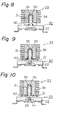
- Figs. 8 through 10 Other embodiments of the present invention are illustrated in Figs. 8 through 10.
- the stud 30 is attached to the package 20 through a metal plate 21. If the stud attachment portion on the package 20 is metallized and the stud 20 is attached to the metallized portion as shown in Fig. 8,by forming a groove on the top face of the package 20 the flow of the solder can be controlled at the bonding step and a certain predetermined shape can be given to the fillet 40. Accordingly, in this embodiment, the radiator 33 can be brought close to the package 20 , as indicated by the arrow in the drawings, without coming into contact with the fillet 40 .
- the boundary of the stud-receiving recess 31 of the radiator 33 may be tapered or rounded near the mouth of that recess in the vicinity of the grooves 42 and 44 for limiting the shape of the fillet, as shown in Figs. 9 and 10. This can enable the radiator 33 to be brought even closer to the package 20, so that the thermal contact between the radiator 33 and the package 20 can substantially be increased and the heat-radiating efficiency can further be enhanced.
- a recess for receiving the stud soldered to the semiconductor package is formed in the radiator, and the stud is inserted into this recess and the radiator is bonded to the package through a heat-conductive adhesive.
- the radiator is thus tightly bonded to the package housing, and deviation of the position or separation of the radiator is thereby resisted when vibrations or shocks occur.
- the efficiency of the assembling operation can be enhanced. If the stud is formed of a material having a high heat ocnductivity, such as molydenum (Mo), the area of contact between the radiator and the package (including the stud) is substantially increased and the heat-radiating efficiency is improved.
- Mo molydenum
- a clearance can be provided between the outer surface of the stud and the boundary surfaces defining the recess in the radiator, and an adhesive can be filled into this clearance to bond the stud to the radiator. This can be advantageous over a press-bonding technique, in which a clearance is not formed.
- the ceramic material is less likely to be broken at the bonding step because press-bonding is not effected, and the assembling operation is thus facilitated.
- self-aligning action of the adhesive can facilitate centering of the stud in the recess.
Landscapes
- Cooling Or The Like Of Semiconductors Or Solid State Devices (AREA)
Applications Claiming Priority (4)
| Application Number | Priority Date | Filing Date | Title |
|---|---|---|---|
| JP56180237A JPS5882550A (ja) | 1981-11-10 | 1981-11-10 | 半導体装置 |
| JP180237/81 | 1981-11-10 | ||
| JP70202/82 | 1982-04-28 | ||
| JP57070202A JPS58188145A (ja) | 1982-04-28 | 1982-04-28 | 半導体装置 |
Publications (3)
| Publication Number | Publication Date |
|---|---|
| EP0079238A2 true EP0079238A2 (de) | 1983-05-18 |
| EP0079238A3 EP0079238A3 (en) | 1984-04-18 |
| EP0079238B1 EP0079238B1 (de) | 1988-04-06 |
Family
ID=26411366
Family Applications (1)
| Application Number | Title | Priority Date | Filing Date |
|---|---|---|---|
| EP82305961A Expired EP0079238B1 (de) | 1981-11-10 | 1982-11-09 | Mit Wärmeableitenden Mitteln versehene Halbleiteranordnungen |
Country Status (3)
| Country | Link |
|---|---|
| EP (1) | EP0079238B1 (de) |
| DE (1) | DE3278321D1 (de) |
| IE (1) | IE54087B1 (de) |
Cited By (7)
| Publication number | Priority date | Publication date | Assignee | Title |
|---|---|---|---|---|
| GB2136205A (en) * | 1983-03-09 | 1984-09-12 | Printed Circuits Int | Semiconductor chip carrier and contact array package and method of construction |
| US4688077A (en) * | 1982-03-29 | 1987-08-18 | Fujitsu Limited | Semiconductor device having radiator |
| US5885853A (en) * | 1990-06-22 | 1999-03-23 | Digital Equipment Corporation | Hollow chip package and method of manufacture |
| WO2001020674A3 (en) * | 1999-09-10 | 2001-09-27 | Llanelli Radiators Ltd | Assembly for electrical/electronic components |
| DE102007056269A1 (de) * | 2007-10-22 | 2009-04-23 | Rohde & Schwarz Gmbh & Co. Kg | Gekühltes Multichipmodul |
| CN102254882A (zh) * | 2010-05-20 | 2011-11-23 | 株式会社电装 | 电功率转换器 |
| CN117913045A (zh) * | 2024-03-20 | 2024-04-19 | 广州市君盘实业股份有限公司 | 一种采用边界流散热的半导体器件散热器 |
Family Cites Families (1)
| Publication number | Priority date | Publication date | Assignee | Title |
|---|---|---|---|---|
| DE1151324B (de) * | 1960-04-11 | 1963-07-11 | Elektronik M B H | Verfahren zur Herstellung von Halbleiteranordnungen |
-
1982
- 1982-11-09 DE DE8282305961T patent/DE3278321D1/de not_active Expired
- 1982-11-09 EP EP82305961A patent/EP0079238B1/de not_active Expired
- 1982-11-10 IE IE2681/82A patent/IE54087B1/en not_active IP Right Cessation
Cited By (10)
| Publication number | Priority date | Publication date | Assignee | Title |
|---|---|---|---|---|
| US4688077A (en) * | 1982-03-29 | 1987-08-18 | Fujitsu Limited | Semiconductor device having radiator |
| GB2136205A (en) * | 1983-03-09 | 1984-09-12 | Printed Circuits Int | Semiconductor chip carrier and contact array package and method of construction |
| US4630172A (en) * | 1983-03-09 | 1986-12-16 | Printed Circuits International | Semiconductor chip carrier package with a heat sink |
| US5885853A (en) * | 1990-06-22 | 1999-03-23 | Digital Equipment Corporation | Hollow chip package and method of manufacture |
| WO2001020674A3 (en) * | 1999-09-10 | 2001-09-27 | Llanelli Radiators Ltd | Assembly for electrical/electronic components |
| DE102007056269A1 (de) * | 2007-10-22 | 2009-04-23 | Rohde & Schwarz Gmbh & Co. Kg | Gekühltes Multichipmodul |
| CN102254882A (zh) * | 2010-05-20 | 2011-11-23 | 株式会社电装 | 电功率转换器 |
| CN102254882B (zh) * | 2010-05-20 | 2015-11-25 | 株式会社电装 | 电功率转换器 |
| CN117913045A (zh) * | 2024-03-20 | 2024-04-19 | 广州市君盘实业股份有限公司 | 一种采用边界流散热的半导体器件散热器 |
| CN117913045B (zh) * | 2024-03-20 | 2024-05-17 | 广州市君盘实业股份有限公司 | 一种采用边界流散热的半导体器件散热器 |
Also Published As
| Publication number | Publication date |
|---|---|
| IE822681L (en) | 1983-05-10 |
| EP0079238A3 (en) | 1984-04-18 |
| DE3278321D1 (en) | 1988-05-11 |
| IE54087B1 (en) | 1989-06-07 |
| EP0079238B1 (de) | 1988-04-06 |
Similar Documents
| Publication | Publication Date | Title |
|---|---|---|
| EP0097782B1 (de) | Wärmeleitendes Brückenelement für Halbleiteranordnungspackungen | |
| US4546405A (en) | Heat sink for electronic package | |
| EP0299775B1 (de) | Verfahren zum Zussamenbau einer Halbleiterchip-Packung mit automatischer Bandmontage | |
| EP0006445A1 (de) | Verfahren zur Herstellung eines elektrischen Geräts, welches eine oder mehrere wärmeerzeugende elektrische Bauteile enthält | |
| JPS6054785B2 (ja) | 集積回路アセンブリの製造方法 | |
| JP2009044156A (ja) | 改善された放熱性を備えた回路支持体構造部 | |
| JPS58164252A (ja) | 熱交換素子 | |
| EP0079238A2 (de) | Mit Wärmeableitenden Mitteln versehene Halbleiteranordnungen | |
| CN115588656A (zh) | 半导体装置及半导体装置的制造方法 | |
| US5469329A (en) | Printed circuit board with bi-metallic heat spreader | |
| JPH0748536B2 (ja) | 電子パッケージ用モジュール | |
| KR100238913B1 (ko) | 반도체장치 및 리드 프레임 | |
| JPH0423456A (ja) | 部品冷却装置 | |
| KR20020007175A (ko) | 반도체 장치 및 그 제조 방법 | |
| GB2168533A (en) | Package for integrated circuits having improved heat sinking capabilities | |
| JP2006332479A (ja) | 電力半導体装置 | |
| JP6349238B2 (ja) | 半導体装置用ステム及び半導体装置 | |
| US3549958A (en) | High power stud mounted diode | |
| JPH04230058A (ja) | 中空チップパッケージおよび製法 | |
| JP3555304B2 (ja) | 電子装置 | |
| US3120052A (en) | Method of making alloyed junction semiconductor devices | |
| JPS63228650A (ja) | 発熱素子用冷却装置 | |
| JPS61290743A (ja) | 半導体デバイスの冷却装置 | |
| JPS6016452A (ja) | 半導体集積回路 | |
| JP2007157801A (ja) | 半導体モジュールとその製造方法 |
Legal Events
| Date | Code | Title | Description |
|---|---|---|---|
| PUAI | Public reference made under article 153(3) epc to a published international application that has entered the european phase |
Free format text: ORIGINAL CODE: 0009012 |
|
| AK | Designated contracting states |
Designated state(s): DE FR GB |
|
| PUAL | Search report despatched |
Free format text: ORIGINAL CODE: 0009013 |
|
| AK | Designated contracting states |
Designated state(s): DE FR GB |
|
| 17P | Request for examination filed |
Effective date: 19840806 |
|
| 17Q | First examination report despatched |
Effective date: 19860214 |
|
| R17C | First examination report despatched (corrected) |
Effective date: 19870129 |
|
| GRAA | (expected) grant |
Free format text: ORIGINAL CODE: 0009210 |
|
| AK | Designated contracting states |
Kind code of ref document: B1 Designated state(s): DE FR GB |
|
| REF | Corresponds to: |
Ref document number: 3278321 Country of ref document: DE Date of ref document: 19880511 |
|
| ET | Fr: translation filed | ||
| PLBE | No opposition filed within time limit |
Free format text: ORIGINAL CODE: 0009261 |
|
| STAA | Information on the status of an ep patent application or granted ep patent |
Free format text: STATUS: NO OPPOSITION FILED WITHIN TIME LIMIT |
|
| 26N | No opposition filed | ||
| PGFP | Annual fee paid to national office [announced via postgrant information from national office to epo] |
Ref country code: GB Payment date: 19991103 Year of fee payment: 18 |
|
| PGFP | Annual fee paid to national office [announced via postgrant information from national office to epo] |
Ref country code: FR Payment date: 19991109 Year of fee payment: 18 |
|
| PGFP | Annual fee paid to national office [announced via postgrant information from national office to epo] |
Ref country code: DE Payment date: 19991115 Year of fee payment: 18 |
|
| PG25 | Lapsed in a contracting state [announced via postgrant information from national office to epo] |
Ref country code: GB Free format text: LAPSE BECAUSE OF NON-PAYMENT OF DUE FEES Effective date: 20001109 |
|
| GBPC | Gb: european patent ceased through non-payment of renewal fee |
Effective date: 20001109 |
|
| PG25 | Lapsed in a contracting state [announced via postgrant information from national office to epo] |
Ref country code: FR Free format text: LAPSE BECAUSE OF NON-PAYMENT OF DUE FEES Effective date: 20010731 |
|
| PG25 | Lapsed in a contracting state [announced via postgrant information from national office to epo] |
Ref country code: DE Free format text: LAPSE BECAUSE OF NON-PAYMENT OF DUE FEES Effective date: 20010801 |
|
| REG | Reference to a national code |
Ref country code: FR Ref legal event code: ST |