EP0080197A1 - Auge en matière plastique - Google Patents
Auge en matière plastique Download PDFInfo
- Publication number
- EP0080197A1 EP0080197A1 EP82110762A EP82110762A EP0080197A1 EP 0080197 A1 EP0080197 A1 EP 0080197A1 EP 82110762 A EP82110762 A EP 82110762A EP 82110762 A EP82110762 A EP 82110762A EP 0080197 A1 EP0080197 A1 EP 0080197A1
- Authority
- EP
- European Patent Office
- Prior art keywords
- bucket
- edge
- ribs
- brim
- wall
- Prior art date
- Legal status (The legal status is an assumption and is not a legal conclusion. Google has not performed a legal analysis and makes no representation as to the accuracy of the status listed.)
- Granted
Links
Images




Classifications
-
- B—PERFORMING OPERATIONS; TRANSPORTING
- B65—CONVEYING; PACKING; STORING; HANDLING THIN OR FILAMENTARY MATERIAL
- B65D—CONTAINERS FOR STORAGE OR TRANSPORT OF ARTICLES OR MATERIALS, e.g. BAGS, BARRELS, BOTTLES, BOXES, CANS, CARTONS, CRATES, DRUMS, JARS, TANKS, HOPPERS, FORWARDING CONTAINERS; ACCESSORIES, CLOSURES, OR FITTINGS THEREFOR; PACKAGING ELEMENTS; PACKAGES
- B65D1/00—Rigid or semi-rigid containers having bodies formed in one piece, e.g. by casting metallic material, by moulding plastics, by blowing vitreous material, by throwing ceramic material, by moulding pulped fibrous material or by deep-drawing operations performed on sheet material
- B65D1/40—Details of walls
- B65D1/42—Reinforcing or strengthening parts or members
- B65D1/48—Reinforcements of dissimilar materials, e.g. metal frames in plastic walls
Definitions
- the invention relates to a bucket made of plastic, in particular for the transport and processing of ready-mixed mortar, of a truncated pyramid shape with an edge reinforcement made of a tube embedded in the plastic, which is bent at an obtuse angle in the region of the narrower side walls, the apex of which is upward points, and which is exposed in the area of the apex by two handle holes.
- Such a plastic bucket has become known from DE-PS 27 0 8 45o.
- This bucket created for mortar has a fabric-reinforced plastic wall that fully encompasses the reinforcement frame made of steel in the circumferential direction of the frame parts, but leaves areas of the frame open in the direction of extension of the frame parts that serve as eyelets for crane hooks or the like, with reinforcing ribs on the outside of the container are arranged.
- the production of fabric-reinforced plastic is very labor intensive. Therefore, such buckets are quite expensive to manufacture. The manufacture of such fabric-reinforced plastic buckets is not suitable for large-scale production.
- suitable for mass production is the injection molding process with which buckets can be made from plastic.
- a bucket was produced according to DE-GM 18 54 763, the edge of which has a bead and a bead under the bead, through which a closed ring can be pressed from a steel tube, which is firmly seated between the bead by the bead and the flanging gets.
- Exposed steel reinforcement rings of this type have not proven themselves in practice, however, because such a bucket cannot have eyelets or handle holes without losing considerable strength.
- buckets according to DE-PS 11 49 292 which have an edge reinforcement in the form of an annularly bent metal tube, which is completely surrounded by the plastic and have an abutment at least at one point on their circumference, have proven effective, the ends of the metal tube being able to be inserted by means of an insertable one Inside or a push-on outer sleeve are connected to each other.
- two opposing partial sections of the tube that forms the edge reinforcement are not overmolded, but are exposed and serve as handles or as attack surfaces for crane hooks.
- the invention improves the bucket of the type mentioned and solves the problem on which it is based in that the plastic used for the one-piece plastic parts of the bucket is a polyolefin, that the walls made of this polyolefin, at least on the long side walls, extend beyond the curvature into one bottom wall part are continued in the manner of a brim so that the bucket wall and the wall part forming the brim run parallel to one another or enclose an acute angle that between the A large number of transverse ribs are arranged in the bucket wall and the wall part forming the brim, the lower edge of which is aligned with the lower edge of the wall part forming the brim and runs parallel to the bucket bottom over its longer part, so that the edge reinforcement consists of two uniformly shaped tubular parts in the middle of the long sides by two pushed over Sockets is connected, and that vertically downwardly extending short ribs are arranged on the edge of the handle holes, the width of which corresponds to the width of the tube-reinforced
- Such a bucket can be cheaply produced as a mass-produced article by injection molding, for which purpose polyethylene is particularly suitable as a plastic.
- the manual work involved is extremely low, it only consists of inserting the pipe and socket parts into the injection mold. These are precisely centered in the injection mold between pins, which are expressed in the edge reinforcement as holes which are directed radially vertically onto the tube center, and by projections in the shape, which are expressed as vertical slots in the plastic which are tangential to the side of the tube, so that the thickness of the plastic surrounding the steel pipe and the sleeves is the same everywhere. This is very important for the stability of the bucket.
- ribs are arranged on the edge of the handle holes, the width of which corresponds to the width of the tube-reinforced edge. These ribs prevent the pipe from being torn from the surrounding art fabric bed or tearing open the edge of the plastic.
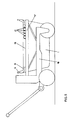
- This design of the bucket also has the advantage that the edge rests on a large area of the fork, which not only increases the stability of the bucket during transport, but also has the advantage that the bucket is much less easily slips off the fork when the transport vehicle brakes hard. Due to the enlarged contact surface, part of the edge does not slip off the fork. As a result, the bucket does not deform as much under the load in it as in the conventional designs. This effect is enhanced by the large number of cross ribs, because the support is secured over the entire length of the long side walls.
- buckets also have no crossbeams arranged on the floor parallel to the bucket transverse axis.
- ribs of the thickness of the bucket walls under the floor, in order to prevent the floor from becoming thinner over time due to grinding when it is set up on the standing surface.
- These ribs are therefore not so much used to reinforce and stiffen the bucket shape, but only to prevent it Grinding of the soil material and preventing the thinning of the bottom wall of the bucket as a result.
- a pair of vertically downwardly extending ribs is arranged on the longitudinal side walls, the length and width of which correspond to the ribs next to the handle holes.
- the internal slot on the edge reinforcement has a base that is angled.
- the distance of the transverse ribs from one another is less than twice the distance of the bucket wall from the wall part forming the brim. Because the closer the cross ribs are to each other, the higher the stability and the better the central wall parts, which are particularly vulnerable to deformation, are protected. It can have the advantage if the transverse ribs are not arranged parallel to one another, but rather two adjacent transverse ribs each form an acute angle with one another, that is to say, for example, V or W-shaped.
- the truncated pyramid-shaped bucket has longitudinal seise ten walls 1, end side walls 2 and a bottom 3.
- the side walls 1, 2 are provided with an edge reinforcing tube 4 and sleeves 5 comprising an edge 6 at the top.
- the tubes 4 and the sleeves 5 are completely surrounded by plastic in the area of the long sides 1.
- the tubes 4 only emerge in a partial area of the side walls without plastic sheathing, in the area of the recesses 7 serving as hand or crane hook holes.
- the tube 4 is angled at an obtuse angle, preferably 40 °. The apex of this bend points upwards.
- the sleeves 5 connecting the two pipe parts 4 are arranged in the middle of the long sides.
- the bottom 3 has ribs 9 on the underside, the height of which is only small and suitably corresponds to the thickness of the wall material. These ribs have less of a reinforcing function than the function of preventing the soil material from being ground down when the bucket is being ground on the ground.
- the plastic sheath 6 has holes lo in the area of the edge reinforcement, which ver extend tical and radial to the center of the tube 4. These holes originate from pins in the injection mold, which were used for the horizontal centering of the tube 4 during the injection molding.
- the sheathing 6 also has slots 11 and 12, which also served to center the tube 4 in the injection mold during the injection molding process. These slots 11, 12 run essentially vertically and tangentially to the tube 4. They can be angular or rounded. They come from projections in the shape that were used to center the tube 4. After opening the injection mold, these holes and slots serve to check that the sheathing 6 around the tube 4 has the same thickness everywhere.
- the slot 12 has a base which is angled and encloses an angle of preferably 135 °. This bending ensures that the plastic of the wall merges seamlessly into the plastic of the casing. Centering holes can also be made where the sleeve 5 is located. These centering holes and centering slots 11, 12 are of great importance for the durability of the buckets because they ensure the uniform thickness of the plastic sheathing. These holes 10 and slots 11, 12 generally do not connect the tube 4 to the outside atmosphere because a very thin plastic skin has formed at the bottom of the holes 10 and the slots 11, 12 during the injection molding process.
- the upper edge 6, with its curvature extending outwards, is continued downward beyond it with a wall part 19 in the manner of a brim.
- This wall part 19 runs either parallel to the longitudinal side wall 1 or at an acute angle, but expediently perpendicular to the bucket bottom 3.
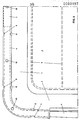
- transverse ribs 21 Between this wall part 19 and the bucket wall 1 there is a large number of transverse ribs 21, the lower edge of which is flush with the lower edge of the wall part 19 forming the brim and runs parallel to the bucket bottom over its longer part.
- the distance A between the transverse ribs 21 is expediently smaller than twice the distance B between the bucket wall 1 and the wall part 19 forming the brim.
- transverse ribs In the cut parts of FIGS. 1 and 2 one can see the arrangement of these transverse ribs - part of the wall part 19 forming the brim is cut away here. 6 and 7 that the transverse ribs are perpendicular to the longitudinal side wall 1 and to the wall part 19 forming the brim. But that doesn't have to be the case. From Fig. 8 it can be seen that these transverse ribs can also have a different arrangement, namely a V-shaped arrangement with the transverse ribs 15, a W-shaped arrangement with the transverse ribs 14 and a U-shaped arrangement with the transverse ribs 13.
- the stability of the container can be through the Increase steel pipe ring 5 significantly. If such is provided, the transverse ribs 21, 13, 14, 15 are located under the curvature which the plastic encasing the steel tube 4 forms.
- the height C of the transverse ribs 21 is expediently at least as high as the diameter of the steel tube reinforcement ring 4, 5.
Landscapes
- Engineering & Computer Science (AREA)
- Ceramic Engineering (AREA)
- Mechanical Engineering (AREA)
- Pallets (AREA)
Priority Applications (1)
| Application Number | Priority Date | Filing Date | Title |
|---|---|---|---|
| AT82110762T ATE12614T1 (de) | 1981-11-25 | 1982-11-22 | Kuebel aus kunststoff. |
Applications Claiming Priority (8)
| Application Number | Priority Date | Filing Date | Title |
|---|---|---|---|
| DE19818134335 DE8134335U1 (de) | 1981-11-25 | 1981-11-25 | Kuebel aus Kunststoff |
| DE3146685 | 1981-11-25 | ||
| DE8134335U | 1981-11-25 | ||
| DE3146685A DE3146685A1 (de) | 1981-11-25 | 1981-11-25 | "kuebel aus kunststoff" |
| DE19828202987 DE8202987U1 (de) | 1982-02-05 | 1982-02-05 | Kuebel aus Kunststoff |
| DE8202987U | 1982-02-05 | ||
| DE3203995 | 1982-02-05 | ||
| DE19823203995 DE3203995A1 (de) | 1982-02-05 | 1982-02-05 | Kuebel aus kunststoff |
Publications (2)
| Publication Number | Publication Date |
|---|---|
| EP0080197A1 true EP0080197A1 (fr) | 1983-06-01 |
| EP0080197B1 EP0080197B1 (fr) | 1985-04-10 |
Family
ID=27432742
Family Applications (1)
| Application Number | Title | Priority Date | Filing Date |
|---|---|---|---|
| EP82110762A Expired EP0080197B1 (fr) | 1981-11-25 | 1982-11-22 | Auge en matière plastique |
Country Status (2)
| Country | Link |
|---|---|
| EP (1) | EP0080197B1 (fr) |
| DE (1) | DE3263029D1 (fr) |
Cited By (2)
| Publication number | Priority date | Publication date | Assignee | Title |
|---|---|---|---|---|
| GB2143479A (en) * | 1983-07-11 | 1985-02-13 | Glasdon Ltd | Improvements in or relating to bins |
| GB2348112A (en) * | 1999-03-25 | 2000-09-27 | Taylor Egbert H & Co Ltd | Container for refuse |
Citations (4)
| Publication number | Priority date | Publication date | Assignee | Title |
|---|---|---|---|---|
| DE1149292B (de) * | 1960-01-25 | 1963-05-22 | Friedrich Stuckenbroeker | Randverstaerkung fuer Transportbehaelter aus Kunststoff |
| DE1169840B (de) * | 1957-12-21 | 1964-05-06 | Mauser Kg | Randausbildung an Gefaessen |
| FR1379277A (fr) * | 1963-12-26 | 1964-11-20 | Cogindus | Bac pour manutention ou autres usages |
| DE2708450A1 (de) * | 1977-02-26 | 1978-08-31 | Siaba Handels Und Transportges | Transportbehaelter fuer moertel |
-
1982
- 1982-11-22 EP EP82110762A patent/EP0080197B1/fr not_active Expired
- 1982-11-22 DE DE8282110762T patent/DE3263029D1/de not_active Expired
Patent Citations (4)
| Publication number | Priority date | Publication date | Assignee | Title |
|---|---|---|---|---|
| DE1169840B (de) * | 1957-12-21 | 1964-05-06 | Mauser Kg | Randausbildung an Gefaessen |
| DE1149292B (de) * | 1960-01-25 | 1963-05-22 | Friedrich Stuckenbroeker | Randverstaerkung fuer Transportbehaelter aus Kunststoff |
| FR1379277A (fr) * | 1963-12-26 | 1964-11-20 | Cogindus | Bac pour manutention ou autres usages |
| DE2708450A1 (de) * | 1977-02-26 | 1978-08-31 | Siaba Handels Und Transportges | Transportbehaelter fuer moertel |
Cited By (3)
| Publication number | Priority date | Publication date | Assignee | Title |
|---|---|---|---|---|
| GB2143479A (en) * | 1983-07-11 | 1985-02-13 | Glasdon Ltd | Improvements in or relating to bins |
| GB2348112A (en) * | 1999-03-25 | 2000-09-27 | Taylor Egbert H & Co Ltd | Container for refuse |
| GB2348112B (en) * | 1999-03-25 | 2003-05-21 | Taylor Egbert H & Company Ltd | Wheeled refuse container |
Also Published As
| Publication number | Publication date |
|---|---|
| DE3263029D1 (en) | 1985-05-15 |
| EP0080197B1 (fr) | 1985-04-10 |
Similar Documents
| Publication | Publication Date | Title |
|---|---|---|
| DE2036914C3 (de) | Stapelbarer Behälter | |
| DE3526921C2 (fr) | ||
| DE7305361U (de) | Palette aus Kunststoff | |
| DE4117159A1 (de) | Transport- und/oder lagerbehaelter | |
| EP3636559A1 (fr) | Boîte empilable | |
| DE2703721C2 (de) | Eimer aus Kunststoff | |
| DE2241289A1 (de) | Kunststoffpalette | |
| DE2200512B2 (de) | Abstandshalter fuer bewehrungsstaebe | |
| EP3377416B1 (fr) | Réceptacle en matière plastique | |
| DE68911728T2 (de) | Behälter oder Trommel. | |
| DE20102840U1 (de) | Behälter für Flüssigkeiten, insbesondere für Waschflüssigkeiten | |
| EP0080197B1 (fr) | Auge en matière plastique | |
| DE19818709B4 (de) | Lagerungs- und Transportvorrichtung für flüssige Medien | |
| EP0079984B1 (fr) | Auge en matière plastique | |
| DE3625995A1 (de) | Sammelbehaelter fuer wiederverwertbares material | |
| EP2767483A2 (fr) | Récipient de transport empilable | |
| DE102004016976B4 (de) | Lagerbox | |
| EP1593301B1 (fr) | Agencement de pot de fleur | |
| DE8202987U1 (de) | Kuebel aus Kunststoff | |
| DE19738649A1 (de) | Behälter, insbesondere untererdig anzuordnender Behälter | |
| DE2434283A1 (de) | Kunststoffbehaelter, insbesondere fass | |
| DE3203995A1 (de) | Kuebel aus kunststoff | |
| DE2856880C2 (de) | Batterietank aus thermoplastischem Kunststoff | |
| DE1484640A1 (de) | Grabeimer fuer Baggermaschinen | |
| DE202008016640U1 (de) | Erdtank zur Aufnahme von Flüssigkeiten |
Legal Events
| Date | Code | Title | Description |
|---|---|---|---|
| PUAI | Public reference made under article 153(3) epc to a published international application that has entered the european phase |
Free format text: ORIGINAL CODE: 0009012 |
|
| AK | Designated contracting states |
Designated state(s): AT BE CH DE FR GB IT LI LU NL SE |
|
| 17P | Request for examination filed |
Effective date: 19830517 |
|
| ITF | It: translation for a ep patent filed | ||
| GRAA | (expected) grant |
Free format text: ORIGINAL CODE: 0009210 |
|
| AK | Designated contracting states |
Designated state(s): AT BE CH DE FR GB IT LI LU NL SE |
|
| REF | Corresponds to: |
Ref document number: 12614 Country of ref document: AT Date of ref document: 19850415 Kind code of ref document: T |
|
| REF | Corresponds to: |
Ref document number: 3263029 Country of ref document: DE Date of ref document: 19850515 |
|
| ET | Fr: translation filed | ||
| PG25 | Lapsed in a contracting state [announced via postgrant information from national office to epo] |
Ref country code: LU Free format text: LAPSE BECAUSE OF NON-PAYMENT OF DUE FEES Effective date: 19851130 |
|
| PLBE | No opposition filed within time limit |
Free format text: ORIGINAL CODE: 0009261 |
|
| 26N | No opposition filed | ||
| PGFP | Annual fee paid to national office [announced via postgrant information from national office to epo] |
Ref country code: AT Payment date: 19861117 Year of fee payment: 5 |
|
| PGFP | Annual fee paid to national office [announced via postgrant information from national office to epo] |
Ref country code: NL Payment date: 19861130 Year of fee payment: 5 |
|
| PG25 | Lapsed in a contracting state [announced via postgrant information from national office to epo] |
Ref country code: AT Effective date: 19871122 |
|
| PG25 | Lapsed in a contracting state [announced via postgrant information from national office to epo] |
Ref country code: SE Effective date: 19871123 |
|
| PG25 | Lapsed in a contracting state [announced via postgrant information from national office to epo] |
Ref country code: LI Effective date: 19871130 Ref country code: CH Effective date: 19871130 Ref country code: BE Effective date: 19871130 |
|
| BERE | Be: lapsed |
Owner name: STUCKI KUNSTSTOFFWERK UND WERKZEUGBAU G.M.B.H. Effective date: 19871130 |
|
| PG25 | Lapsed in a contracting state [announced via postgrant information from national office to epo] |
Ref country code: NL Effective date: 19880601 |
|
| NLV4 | Nl: lapsed or anulled due to non-payment of the annual fee | ||
| GBPC | Gb: european patent ceased through non-payment of renewal fee | ||
| PG25 | Lapsed in a contracting state [announced via postgrant information from national office to epo] |
Ref country code: FR Free format text: LAPSE BECAUSE OF NON-PAYMENT OF DUE FEES Effective date: 19880729 |
|
| REG | Reference to a national code |
Ref country code: CH Ref legal event code: PL |
|
| PG25 | Lapsed in a contracting state [announced via postgrant information from national office to epo] |
Ref country code: DE Effective date: 19880802 |
|
| REG | Reference to a national code |
Ref country code: FR Ref legal event code: ST |
|
| PG25 | Lapsed in a contracting state [announced via postgrant information from national office to epo] |
Ref country code: GB Effective date: 19881122 |
|
| EUG | Se: european patent has lapsed |
Ref document number: 82110762.0 Effective date: 19880913 |