EP0084367B1 - Procédé et appareil pour régler un moteur à courant alternatif - Google Patents
Procédé et appareil pour régler un moteur à courant alternatif Download PDFInfo
- Publication number
- EP0084367B1 EP0084367B1 EP83100348A EP83100348A EP0084367B1 EP 0084367 B1 EP0084367 B1 EP 0084367B1 EP 83100348 A EP83100348 A EP 83100348A EP 83100348 A EP83100348 A EP 83100348A EP 0084367 B1 EP0084367 B1 EP 0084367B1
- Authority
- EP
- European Patent Office
- Prior art keywords
- current
- signal
- motor
- component
- command
- Prior art date
- Legal status (The legal status is an assumption and is not a legal conclusion. Google has not performed a legal analysis and makes no representation as to the accuracy of the status listed.)
- Expired
Links
- 238000000034 method Methods 0.000 title claims description 8
- 230000004907 flux Effects 0.000 claims description 6
- 238000001514 detection method Methods 0.000 description 20
- 230000005284 excitation Effects 0.000 description 18
- 230000001360 synchronised effect Effects 0.000 description 15
- 230000006698 induction Effects 0.000 description 10
- 230000000694 effects Effects 0.000 description 6
- 238000010586 diagram Methods 0.000 description 4
- 238000011161 development Methods 0.000 description 2
- 230000018109 developmental process Effects 0.000 description 2
- 238000010304 firing Methods 0.000 description 2
- 230000009466 transformation Effects 0.000 description 2
- 238000004804 winding Methods 0.000 description 2
- 230000014509 gene expression Effects 0.000 description 1
- 230000010354 integration Effects 0.000 description 1
- 230000010363 phase shift Effects 0.000 description 1
Images



Classifications
-
- H—ELECTRICITY
- H02—GENERATION; CONVERSION OR DISTRIBUTION OF ELECTRIC POWER
- H02P—CONTROL OR REGULATION OF ELECTRIC MOTORS, ELECTRIC GENERATORS OR DYNAMO-ELECTRIC CONVERTERS; CONTROLLING TRANSFORMERS, REACTORS OR CHOKE COILS
- H02P27/00—Arrangements or methods for the control of AC motors characterised by the kind of supply voltage
- H02P27/04—Arrangements or methods for the control of AC motors characterised by the kind of supply voltage using variable-frequency supply voltage, e.g. inverter or converter supply voltage
- H02P27/048—Arrangements or methods for the control of AC motors characterised by the kind of supply voltage using variable-frequency supply voltage, e.g. inverter or converter supply voltage using AC supply for only the rotor circuit or only the stator circuit
-
- H—ELECTRICITY
- H02—GENERATION; CONVERSION OR DISTRIBUTION OF ELECTRIC POWER
- H02P—CONTROL OR REGULATION OF ELECTRIC MOTORS, ELECTRIC GENERATORS OR DYNAMO-ELECTRIC CONVERTERS; CONTROLLING TRANSFORMERS, REACTORS OR CHOKE COILS
- H02P25/00—Arrangements or methods for the control of AC motors characterised by the kind of AC motor or by structural details
- H02P25/02—Arrangements or methods for the control of AC motors characterised by the kind of AC motor or by structural details characterised by the kind of motor
- H02P25/022—Synchronous motors
- H02P25/03—Synchronous motors with brushless excitation
-
- H—ELECTRICITY
- H02—GENERATION; CONVERSION OR DISTRIBUTION OF ELECTRIC POWER
- H02P—CONTROL OR REGULATION OF ELECTRIC MOTORS, ELECTRIC GENERATORS OR DYNAMO-ELECTRIC CONVERTERS; CONTROLLING TRANSFORMERS, REACTORS OR CHOKE COILS
- H02P2207/00—Indexing scheme relating to controlling arrangements characterised by the type of motor
- H02P2207/01—Asynchronous machines
-
- H—ELECTRICITY
- H02—GENERATION; CONVERSION OR DISTRIBUTION OF ELECTRIC POWER
- H02P—CONTROL OR REGULATION OF ELECTRIC MOTORS, ELECTRIC GENERATORS OR DYNAMO-ELECTRIC CONVERTERS; CONTROLLING TRANSFORMERS, REACTORS OR CHOKE COILS
- H02P2207/00—Indexing scheme relating to controlling arrangements characterised by the type of motor
- H02P2207/05—Synchronous machines, e.g. with permanent magnets or DC excitation
Definitions
- the invention relates to a control method and an apparatus for an AC motor driven by a power converter, and in particular to an AC motor control apparatus having a current control system.
- An AC motor is driven by means of a power converter by controlling the motor current (instantaneous value) by turning on/off switching elements constituting the power converter.
- the motor current is controlled by the function of a current control system which operates on the basis of the relation between a given current command signal (AC signal) and a received current detection signal.
- the object of the invention is to provide an AC motor control apparatus and a control method in which the motor torque can be controlled to a desired value with simple configuration and without lowering the response in velocity control.
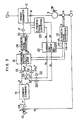
- a synchronous motor 3 is driven by a power converter 2 and a field winding 3F thereof is excited by a not-shown power supply source.
- the power converter 2 converts an AC output of an AC source 1 into a variable frequency AC power and supplies it to the synchronous motor 3.
- Mechanically directly coupled to a rotor of the power converter 2 are a position detector 4 for producing a position signal D (sinusoidal wave signal) corresponding to the relative position between field poles and an armature winding of the synchronous motor 3 and a velocity detector 5 for detecting the rotational velocity of the same.
- the armature current of the synchronous motor 3 is detected by a current detector 16.
- a comparator 31 compares a velocity command signal N * of a velocity command circuit 10 with a velocity detection signal N of the velocity detector 5 in the polarity as shown in the drawing.
- a velocity control circuit 11 is supplied with a velocity deviation AN and produces a current command signal 1 * instructing the magnitude of the armature current of the synchronous motor 3.
- the armature current detected by a current detector 16 is then rectified by a current detector 15 to be a current detection signal I which is then compared by a comparator 32 with the current command signal 1 * .
- the current deviation signal Al the output of the comparator 32, is calculated in a deviation calculating circuit 12 and thereafter applied to an adder 13.
- the adder 13 adds the current command signal 1 * and the current deviation ⁇ l and produces a corrected current command signal (1 * ⁇ l*) which is then applied to a multiplier 14.
- the multiplier 14 multiplies the position signal D by the corrected current command signal (1 * ⁇ l*) to produce a current pattern signal i * (sinusoidal wave signal) which is the position signal D whose amplitude varies in proportion to the corrected current command signal.
- a comparator 33 compares the current pattern signal i * with a current detection signal i (instantaneous value) detected by the current detector 16 so as to produce the current deviation Ai therebetween which is then applied to a current control circuit 17.
- the current control circuit 17 applies a firing control signal for turning on/off switching elements constituting the power converter 2, in accordance with the current deviation ⁇ i.
- a firing control circuit is provided usually between the current control circuit 17 and the power converter 2, it is omitted in the drawing on the assumption that it is incorporated within the power converter 2 in this case.
- the multiplier 14, the comparator 33, the current detector 16, and the current control circuit 17 are shown in the drawing only for one phase, the position detector 4 produces three sets of position signals D for three phases in the case where, for example, the synchronous motor 3 is a three phase machine and therefore, needless to say, three sets of the multipliers 14, the comparators 33, the current detectors 16, and the current control circuits 17 be actually provided.
- the current command signal 1 * of the velocity control circuit 11 is used for instructing the magnitude of the armature current of the synchronous motor 3.
- the rectifier 15 produces the current detection signal I which is proportional to the actual armature current.
- the comparator 32 compares the current detection signal I with the current command signal 1 * and produces the deviation ⁇ l therebetween which is then applied to the deviation calculating circuit 12.
- the deviation calculating circuit 12 produces the current correction signal ⁇ l* which is proportional to the current deviation signal ⁇ l.
- the current command signal 1 * and the current correction signal ⁇ l* are added to each other in the adder 13 so as to supply the corrected current command signal (I * ⁇ l*) to the multiplier 14.
- the multiplier 14 produces the current pattern signal i * which is the position signal D whose amplitude varies in proportion to the corrected current command signal.
- the current control circuit 17 controls the armature current of the synchronous motor 3 so that it agrees with the current pattern signal i * by turning on/off switching elements constituting the power converter 2, in accordance with the current deviation ⁇ i of the current detection signal i from the current pattern signal i *.
- the armature current of the synchronous motor 3 is controlled so as to agree with the position signal D in phase and agree with the current command signal 1 * in magnitude.
- the current correction signal ⁇ l* which is proportional to the current deviation signal ⁇ l is added to the current command signal 1 * to obtain a desired value of the armature current.
- the current correction control system including the deviation calculating circuit 12 for producing the current correction signal ⁇ l * serves to operate as a supplementary system for the current control system.
- the velocity control can be performed with high response and the design as well as adjustment of the control system can be easily attained.
- Fig. 2 illustrates another embodiment of the present invention.
- the embodiment is different from the Fig. 1 embodiment in that an output signal of a deviation calculating circuit 12 is multiplied by the current command signal 1 * in a multiplier 18 to obtain the current correction signal ⁇ l*.
- the current correction signal ⁇ l * is expressed by ⁇ l * ⁇ l * ⁇ ⁇ l. That is, the current correction signal ⁇ l * varies in proportion to the magnitude of the current command signal 1 * . In this manner, the current control may be further improved in response.
- the current detection signal I of a rectifier 15 contains ripple components.
- the deviation calculating circuit 12 effects proportion and integration operations and the response may has a certain limitation if the input signal ⁇ l (current detection signal I) contains ripple components. For this reason, even if there is lag in response time in the deviation calculating circuit 12, the current correction signal ⁇ l * varies in proportion to the magnitude of the current command signal 1 * so that the response may be further improved than the Fig. 1 embodiment.
- Fig. 3 illustrates a further embodiment of the present invention, in which the armature current is decomposed into a component in the same direction as the magnetic flux of the field system and another component in the direction perpendicular to the first-mentioned direction.
- a current command circuit 19 is supplied with the current command signal 1 * performs the following calculation to obtain two perpendicularly intersecting components of the armature current, that is the parallel current component ld * which is parallel to the field magnetic flux and the perpendicular current component Iq * which is perpendicular to the former.
- the perpendicular current component Iq * is applied to an adder 131 and a comparator 321, while the parallel current component Id* is applied to an adder 132 and a comparator 322.
- the position signals (three-phase signals) D detected for each phase by the position detector 4 are applied to a three-phase/two-phase converter circuit 22 so as to be converted into two-phase signals sin ⁇ t and cos ⁇ t which are different from each other by 90 degrees in phase.
- the two-phase signals sin ⁇ t and cos ⁇ t are applied to a current component detecting circuit 20 and a current pattern calculating circuit 21.
- the current detection signals (three-phase signals) detected for each phase by a current detector 16 are applied to a three-phase/two-phase converter circuit 23 so as to be converted into two-phase current detection signals ia, i ⁇ as shown by the following expressions:
- the current component detecting circuit 20 receives the current detecting signals ia, i ⁇ and the two-phase signals sin ⁇ t and cos ⁇ t and calculates the following equation to obtain the d-axis component Id and q-axis component Iq of the armature current:
- the current component detecting circuit 20 may attain the calculation of the equation (3) by using four multipliers.
- the component detection signal Iq and d-axis component detection signal Id detected by the current component detecting circuit 20 are applied to comparators 321 and 322 respectively so as to be compared with the q-axis component command signal Iq * and the d-axis component command signal Id * respectively.
- the current deviation signals ⁇ iq and Aid produced by the comparators 321 and 322 are applied to deviation calculating circuits 121 and 122 respectively so as to obtain the q-axis component correction signal ⁇ Iq* and d-axis component correction signal ⁇ Id* respectively.
- the q-axis component command signal Iq* and the q-axis component correction signal Alq * are added to each other in the adder 131 so as to obtain the q-axis component corrected current command signal (lq * +Alq * ), while the d-axis component command signal ld * an the d-axis component correction signal ⁇ Id* are added to each other in the adder 132 so as to obtain the d-axis component corrected current command signal (Id*+ ⁇ Id*).
- the q-axis component and d-axis component current command signals are applied to the current pattern calculating circuit 21.
- the current pattern calculating circuit 21 receives the q-axis component and d-axis component current command signals and performs coordinate transformation to obtain AC current command signals ia * and i ⁇ * in accordance with the following equation:
- the AC current command signals ia * and i ⁇ * are converted into three-phase current pattern signals through a two-phase/three-phase converter circuit 24.
- the three-phase current pattern signals are generally illustrated as the current pattern signal i * for one phase.
- the current pattern signal i * is compared with the current detection signal i by the comparator 33 which produces the current deviation Ai.
- the current deviation ⁇ i is applied to the current control circuit 17 which controls the power converter 2 by turning on/off the switching elements constituting the converter 2, in the same manner as in the Fig. 1 embodiment.
- Fig. 3 shows the control circuit only for one phase, control is made in the same manner for the other two phases.
- the desired effect can be obtained also in this embodiment in which the armature current of a synchronous motor is decomposed into a component parallel to the field magnetic flux and another component perpendicular to the former and these components are individually controlled to perform the motor control.
- the correction signal may be obtained by multiplying the q-axis component command signal Iq* by the q-axis component correction signal ⁇ Iq* and multiplying the d-axis component command signal Id* by the q-axis component correction signal ⁇ Id*, similarly to the Fig. 2 embodiment.
- Fig. 4 shows a still further embodiment, in which the present invention is applied to a control system in which an induction motor is driven by a power converter.
- Fig. 4 illustrates an example in which the primary current of an induction motor is decomposed into a torque component and an excitation component (constant value) so at these components are individually controlled.
- FIG. 4 the same numerals as used in Fig. 3 denote the same or similar parts or components, and an induction motor 6 is driven by a power converter 2.
- a velocity control circuit 11 receives the velocity command signal N * and the velocity detection signal N and produces the torque component command It * for the primary current.
- the torque component command It * is applied to an adder 131, a comparator 321 and a slip frequency calculating circuit 42.
- the excitation component command lm * produced from an excitation component command circuit 41 is applied to an adder 132 and a comparator 322.
- the slip frequency calculating circuit 42 calculates the slip frequency command ⁇ s * from the following equation (5).
- the slip frequency command ws * and the velocity detection signal N (which is proportional to the rotary frequency wr) are added to each other in an adder 43.
- the adder 43 produces the primary frequency command ⁇ 1 * which is applied to a two-phase oscillator 44.
- the two-phase oscillator 44 produces the two-phase sinusoidal signals, sin ⁇ 1 t and cos ⁇ 1 t, with a frequency equal to the primary frequency command ⁇ 1 * and with a predetermined amplitude. These two-phase signals are applied to a current component detector circuit 45 and a current pattern calculating circuit 46.
- the current component detector circuit 45 receives the current detection signals ia and ip and of a three-phase/two-phase converter circuit 23 and the two-phase sinusoidal signals sin ⁇ 1 t and cos ⁇ 1 t and calculates the torque component It and the excitation component lm of the primary current ifrom the following equation:
- the current component detecting circuits 45 may be the same one as indicated by 20 in Fig. 3.
- the torque component It detected in the current component detecting circuit 45 is inputted to the comparator 321 and the excitation component lm is applied to the comparator 322.
- the current deviations ⁇ lt and ⁇ lm respectively produced from the comparators 321 and 322 are applied to deviation calculating circuits 121 and 122 so as to derive the torque component correction signal ⁇ lt* and the excitation component correction signal Alt * respectively.
- An adder 131 adds the torque component command signal It * and the torque component correction signal ⁇ lt* to each other so as to obtain the corrected torque current command signal (lt * +Alt * ), while another adder 132 adds the excitation component command signal lm * and the excitation component correction signal ⁇ lm* to each other so as to obtain the corrected excitation current command signal (lm * +Alm * ).
- the corrected torque and excitation current command signals are applied to the current pattern calculating circuit 46 which in turn effects the coordinate transformation in accordance with the following equation so as to obtain the AC current command signals ia * and i ⁇ *:
- the AC current command signals ia * and i ⁇ * are converted into three-phase AC current command signals through a two-phase/three-phase converter circuit 24.
- the three-phase AC current command signals are generally illustrated as the current pattern signal i * for one phase.
- the current pattern signal i * is compared with the current detection signal i by a comparator 33 which produces the current deviation Ai.
- the current deviation Ai is then applied to a current control circuit 17 which controls the power converter 2 by turning on/off the switching element constituting the converter 2, thereby controlling the primary current.
- the desired effect can be obtained also in this embodiment in which the primary current of an induction motor is decomposed into a torque component and an excitation component so that these components are individually controlled.
- a current correction system is provided in each of the torque current control system and the excitation current control system in the Fig. 4 embodiment, it may be provided only in the torque current control system in the case the excitation component deviation ⁇ lm is small.
- the invention is of course applicable in the case the excitation component lm * is not maintained constant but arranged to be variable. In this case, however, it is necessary to cause the slip frequency calculating circuit to receive the torque component command It * and the excitation component command lm* so as to obtain the slip frequency ws.
- Fig. 5 shows another embodiment.
- the present invention is applied to an example in which the magnitude, the phase and the frequency of the primary current of an induction motor are individually commanded.
- the current command signal I is applied to an adder 13 and a comparator 32.
- the comparator 32 is further supplied with the current detection signal I 1 , which has been obtained in a rectifier 15, so as to produce the deviation All of the current detection signal I, from the current command signal I, * .
- the deviation All is applied to a deviation calculating circuit 12 which in turn produces and applies the current correction signal. ⁇ l 1 * in accordance with the current deviation All to the adder 13.
- the adder 13 adds the current command signal I, and the current correction signal ⁇ l 1 * to each other so as to produce and applies the corrected current command signal (l 1 *+ ⁇ l 1 *) to a multiplier 14.
- a phase command circuit 52 receives the torque component command signal It * and produces the current phase command signal a * which is expressed as follows: k 3 : constant
- a two-phase oscillator 44 produces two-phase signals sin ⁇ 1 t and cos ⁇ 1 t of the same frequency as the primary frequency command ⁇ 1 and applies then to a phase shifter 53 in the same manner as in the Fig. 4 embodiment.
- the phase shifter 53 phase-shifts the two-phase signals sin ⁇ 1 t and cos ⁇ 1 t by the value corresponding to the current phase command signal a * so as to produce and applies the signals sin ( ⁇ 1 t+ ⁇ *) and cos (w,t+a * ) to a two-phase/three-phase converter circuit 54.
- the two-phase/three-phase converter circuit 54 may be such as shown in Fig. 7 of U.S. Patent No. 3,824,437.
- the two-phase/ three-phase converter circuit 54 obtains the current reference signal ip for each phase and applied it to the multiplier 14 individually provided for each phase.
- the multiplier 14 multiplies the corrected current command signal (i 1 *+ ⁇ l 1 *) by the current reference signal ip so as to produce the current pattern signal i 1 * which is the current reference signal ip the amplitude of which varies in proportion to the corrected current command signal. Controlling the primary current of the induction motor 6 in accordance with the thus obtained current pattern signal i 1 *, it is possible to quickly make the primary current of the induction motor 6 agree with the current command signal I 1 * independently of the frequency response of the current control system including the current control circuit 17.
- the desired effect can be obtained also in this embodiment in which the magnitude, phase and frequency of the primary current of an induction motor is individually commanded so as to effect the velocity control.
- the Fig. 5 embodiment may of course be modified such that the product of the current command signal I, and the current correction signal ⁇ I 1 * may be applied to the adder 13 similarly to the Fig. 2 embodiment.
- the current correction signal proportional to the current deviation is added to the current command signal so as to provide the target value of the motor current. Accordingly, it is possible to cause the magnitude of the motor current to always agree with the current command signal so as to produce desired torque.
Landscapes
- Engineering & Computer Science (AREA)
- Power Engineering (AREA)
- Control Of Ac Motors In General (AREA)
- Control Of Motors That Do Not Use Commutators (AREA)
Claims (6)
Applications Claiming Priority (2)
| Application Number | Priority Date | Filing Date | Title |
|---|---|---|---|
| JP57005017A JPS58123394A (ja) | 1982-01-18 | 1982-01-18 | 交流電動機の制御装置 |
| JP5017/82 | 1982-01-18 |
Publications (3)
| Publication Number | Publication Date |
|---|---|
| EP0084367A2 EP0084367A2 (fr) | 1983-07-27 |
| EP0084367A3 EP0084367A3 (en) | 1984-02-15 |
| EP0084367B1 true EP0084367B1 (fr) | 1986-11-12 |
Family
ID=11599751
Family Applications (1)
| Application Number | Title | Priority Date | Filing Date |
|---|---|---|---|
| EP83100348A Expired EP0084367B1 (fr) | 1982-01-18 | 1983-01-17 | Procédé et appareil pour régler un moteur à courant alternatif |
Country Status (4)
| Country | Link |
|---|---|
| US (1) | US4451771A (fr) |
| EP (1) | EP0084367B1 (fr) |
| JP (1) | JPS58123394A (fr) |
| DE (1) | DE3367708D1 (fr) |
Families Citing this family (42)
| Publication number | Priority date | Publication date | Assignee | Title |
|---|---|---|---|---|
| JPS5963998A (ja) * | 1982-10-04 | 1984-04-11 | Hitachi Ltd | 誘導電動機の制御方法 |
| JPS5972991A (ja) * | 1982-10-19 | 1984-04-25 | Fanuc Ltd | モ−タの制御装置 |
| JPS59156184A (ja) * | 1983-02-23 | 1984-09-05 | Hitachi Ltd | 誘導電動機の制御方法 |
| US4763057A (en) * | 1983-12-30 | 1988-08-09 | Kollmorgen Technologies Corporation | Control for improving induction transient response by excitation angle control |
| DE3427841A1 (de) * | 1984-07-27 | 1986-02-06 | Siemens AG, 1000 Berlin und 8000 München | Verfahren und vorrichtung zum betrieb eines zwischenkreisumrichters mit stromanstiegsbegrenzung |
| DE3584603D1 (de) * | 1984-08-21 | 1991-12-12 | Hitachi Ltd | Verfahren zur regelung eines durch einen wechselrichter angesteuerten induktionsmotors. |
| JPS6152179A (ja) * | 1984-08-22 | 1986-03-14 | Toshiba Corp | 電動機駆動用電源装置 |
| US4672287A (en) * | 1984-08-30 | 1987-06-09 | Fanuc Ltd | Induction motor digital control system |
| JPH063994B2 (ja) * | 1984-10-05 | 1994-01-12 | 株式会社日立製作所 | 複数台デイジタルサーボの制御方法 |
| US4649331A (en) * | 1985-05-13 | 1987-03-10 | General Electric Company | Flux-weakening regime operation of an interior permanent magnet synchronous motor |
| JPS6277081A (ja) * | 1985-09-10 | 1987-04-09 | Nikki Denso Kk | 3相誘導電動機の制御装置 |
| JPH07118950B2 (ja) * | 1986-04-14 | 1995-12-18 | 株式会社日立製作所 | Pwmインバータの制御方法と装置 |
| JPS6331492A (ja) * | 1986-07-25 | 1988-02-10 | Nippon Electric Ind Co Ltd | インダクシヨンモ−タの制御装置 |
| US4716348A (en) * | 1986-08-26 | 1987-12-29 | Magnetek, Inc. | DC motor adaptive controller |
| NZ219439A (en) * | 1987-02-27 | 1990-02-26 | Gec New Zealand Ltd | Ac motor speed controller with controlled current inverter |
| US4885518A (en) * | 1987-08-21 | 1989-12-05 | Westinghouse Electric Corp. | Induction motor torque/flux control system |
| US5003243A (en) * | 1987-09-29 | 1991-03-26 | Kabushiki Kaisha Toshiba | Control apparatus for induction machine |
| US5140248A (en) * | 1987-12-23 | 1992-08-18 | Allen-Bradley Company, Inc. | Open loop motor control with both voltage and current regulation |
| JPH01270793A (ja) * | 1988-04-21 | 1989-10-30 | Fanuc Ltd | Pwm制御における電流制御装置 |
| JP2708479B2 (ja) * | 1988-07-22 | 1998-02-04 | 株式会社日立製作所 | 交流サーボモータの制御装置 |
| US4987358A (en) * | 1989-04-21 | 1991-01-22 | Branam Timothy R | Electronic torque switch |
| WO1990015472A1 (fr) * | 1989-05-31 | 1990-12-13 | Siemens Aktiengesellschaft | Procede de compensation d'une reponse phase et d'une caracteristique d'amplitude entre une valeur de consigne et une valeur reelle polyphasees, et circuit pour la mise en ×uvre de ce procede |
| US5047699A (en) * | 1989-06-26 | 1991-09-10 | Sundstrand Corporation | VSCF start system motor current estimator |
| US4982145A (en) * | 1989-09-08 | 1991-01-01 | Aeg Westinghouse Industrial Automation Corporation | Method and apparatus for the optimization of thyristor power supply transport time delay |
| US4958117A (en) * | 1989-09-29 | 1990-09-18 | Allen-Bradley Company, Inc. | Frequency control based on sensing voltage fed to an induction motor |
| JPH03139192A (ja) * | 1989-10-23 | 1991-06-13 | Mitsubishi Electric Corp | 電動機制御装置 |
| JP3331734B2 (ja) * | 1993-05-18 | 2002-10-07 | 株式会社明電舎 | 回転電機の制御方式 |
| US5502360A (en) * | 1995-03-10 | 1996-03-26 | Allen-Bradley Company, Inc. | Stator resistance detector for use in electric motor controllers |
| JP3709239B2 (ja) * | 1996-04-26 | 2005-10-26 | ファナック株式会社 | Acサーボモータの磁気飽和補正方式 |
| US6008617A (en) * | 1996-05-20 | 1999-12-28 | Hitachi, Ltd. | Motor control device for high frequency AC driven motor |
| JP3321356B2 (ja) * | 1996-05-20 | 2002-09-03 | 株式会社日立製作所 | モータ制御装置及び電気車用制御装置 |
| JP2001238499A (ja) * | 2000-02-24 | 2001-08-31 | Hitachi Ltd | 誘導電動機の速度制御方法 |
| KR100371370B1 (ko) * | 2000-08-18 | 2003-02-06 | 엘지산전 주식회사 | 벡터 제어장치 |
| FI112414B (fi) * | 2001-03-19 | 2003-11-28 | Abb Industry Oy | Menetelmä vaihtosuuntaajan yhteydessä |
| JP4455075B2 (ja) * | 2004-01-28 | 2010-04-21 | 三菱電機株式会社 | モータ制御装置 |
| DE102005048330A1 (de) * | 2005-10-08 | 2007-04-19 | Daimlerchrysler Ag | Ansteuersystem für eine elektrische Maschine |
| JP4816257B2 (ja) * | 2006-05-31 | 2011-11-16 | 日本精工株式会社 | モータ制御装置 |
| JP5259077B2 (ja) * | 2006-12-04 | 2013-08-07 | 株式会社京三製作所 | 瞬時電圧低下補償回路、電力変換装置、瞬時電圧低下補償方法及び瞬時電圧低下補償プログラム |
| EP1944862B1 (fr) * | 2007-01-15 | 2011-08-03 | Hitachi Industrial Equipment Systems Co., Ltd. | Contrôleur de moteur à induction |
| JP4952359B2 (ja) * | 2007-04-25 | 2012-06-13 | アイシン精機株式会社 | 電動機の制御装置、制御方法及びコンピュータプログラム |
| JP6084863B2 (ja) * | 2013-02-28 | 2017-02-22 | 川崎重工業株式会社 | 系統連系する電力変換装置 |
| RU2599529C1 (ru) * | 2015-11-17 | 2016-10-10 | Федеральное государственное автономное образовательное учреждение высшего образования "Южно-Уральский государственный университет (национальный исследовательский университет)" (ФГАОУ ВО "ЮУрГУ (НИУ)") | Устройство частотного управления асинхронным электроприводом |
Family Cites Families (13)
| Publication number | Priority date | Publication date | Assignee | Title |
|---|---|---|---|---|
| US3824437A (en) * | 1969-08-14 | 1974-07-16 | Siemens Ag | Method for controlling asynchronous machines |
| JPS5850119B2 (ja) * | 1976-07-30 | 1983-11-08 | 株式会社日立製作所 | 無整流子電動機の制御装置 |
| JPS5396423A (en) * | 1977-02-01 | 1978-08-23 | Mitsubishi Electric Corp | Control system for induction motor |
| JPS5413919A (en) * | 1977-07-04 | 1979-02-01 | Hitachi Ltd | Preventive controller for torque pulsation |
| US4358726A (en) * | 1977-08-17 | 1982-11-09 | Kabushiki Kaisha Yaskawa Denki Seisakusho | Current type inverter |
| JPS5534854A (en) * | 1978-09-04 | 1980-03-11 | Hitachi Ltd | Controlling method of secondary winding-exciting motor |
| JPS5928146B2 (ja) * | 1978-11-04 | 1984-07-11 | ファナック株式会社 | 誘導電動機の駆動制御方式 |
| DE2915987A1 (de) * | 1979-04-20 | 1981-02-26 | Bosch Gmbh Robert | Reaktionsschneller servoantrieb |
| JPS6016195B2 (ja) * | 1979-06-08 | 1985-04-24 | 富士電機株式会社 | 直流電動機の制御装置 |
| US4330741A (en) * | 1979-06-20 | 1982-05-18 | Hitachi, Ltd. | Electric control apparatus of induction motor |
| US4320331A (en) * | 1979-10-01 | 1982-03-16 | General Electric Company | Transistorized current controlled pulse width modulated inverter machine drive system |
| US4314190A (en) * | 1980-04-22 | 1982-02-02 | General Electric Company | Controlled current inverter with angle command limit |
| DE3026202A1 (de) * | 1980-07-10 | 1982-02-04 | Siemens AG, 1000 Berlin und 8000 München | Drehfeldmaschinenantrieb mit einer umrichtergespeisten drehfeldmaschine und einer mit zwei wechselspannungsintegratoren und einer rechenmodellschaltung verbundenen umrichtersteuerung |
-
1982
- 1982-01-18 JP JP57005017A patent/JPS58123394A/ja active Pending
-
1983
- 1983-01-14 US US06/458,057 patent/US4451771A/en not_active Expired - Lifetime
- 1983-01-17 DE DE8383100348T patent/DE3367708D1/de not_active Expired
- 1983-01-17 EP EP83100348A patent/EP0084367B1/fr not_active Expired
Also Published As
| Publication number | Publication date |
|---|---|
| DE3367708D1 (en) | 1987-01-02 |
| JPS58123394A (ja) | 1983-07-22 |
| EP0084367A2 (fr) | 1983-07-27 |
| US4451771A (en) | 1984-05-29 |
| EP0084367A3 (en) | 1984-02-15 |
Similar Documents
| Publication | Publication Date | Title |
|---|---|---|
| US4451771A (en) | Apparatus for controlling AC motor | |
| KR100354775B1 (ko) | 동기 릴럭턴스 모터의 속도 제어장치 | |
| US4361791A (en) | Apparatus for controlling a PWM inverter-permanent magnet synchronous motor drive | |
| US4125796A (en) | Control apparatus for use in a synchronous machine | |
| US7671558B2 (en) | Induction motor controller | |
| EP0117514B1 (fr) | Méthode pour la commande d'un moteur à induction et appareil y relatif | |
| EP0173216B1 (fr) | Système de commande pour un convertisseur pour l'entraînement de moteurs à induction | |
| EP0082303B1 (fr) | Procédé et appareil de commande d'un moteur à induction | |
| US4060753A (en) | Control system for commutatorless motor | |
| JP2008199706A (ja) | 位相検出方法、位相検出装置、同期モータの制御方法、および同期モータの制御装置 | |
| JPH0828972B2 (ja) | 非循環電流方式サイクロコンバ−タの制御装置 | |
| US20070030705A1 (en) | Voltage source inverter control method | |
| US4527109A (en) | Control apparatus for thyristor motor | |
| US4264853A (en) | Commutatorless motor device | |
| JP3770286B2 (ja) | 誘導電動機のベクトル制御方法 | |
| JPH0344509B2 (fr) | ||
| US20250158544A1 (en) | Multi-motor converter | |
| KR100319142B1 (ko) | 전동기의 속도 제어장치 | |
| JP2590524B2 (ja) | ベクトル制御装置 | |
| SU1108597A2 (ru) | Электропривод с асинхронной машиной с фазным ротором | |
| JPH0667256B2 (ja) | サイクロコンバ−タの制御装置 | |
| JP2549126B2 (ja) | 電力変換装置 | |
| JP2594917B2 (ja) | 電力変換装置の制御装置 | |
| JPH0561876B2 (fr) | ||
| JPS6334715B2 (fr) |
Legal Events
| Date | Code | Title | Description |
|---|---|---|---|
| PUAI | Public reference made under article 153(3) epc to a published international application that has entered the european phase |
Free format text: ORIGINAL CODE: 0009012 |
|
| AK | Designated contracting states |
Designated state(s): DE FR GB |
|
| PUAL | Search report despatched |
Free format text: ORIGINAL CODE: 0009013 |
|
| AK | Designated contracting states |
Designated state(s): DE FR GB |
|
| 17P | Request for examination filed |
Effective date: 19840220 |
|
| GRAA | (expected) grant |
Free format text: ORIGINAL CODE: 0009210 |
|
| AK | Designated contracting states |
Kind code of ref document: B1 Designated state(s): DE FR GB |
|
| REF | Corresponds to: |
Ref document number: 3367708 Country of ref document: DE Date of ref document: 19870102 |
|
| ET | Fr: translation filed | ||
| PLBE | No opposition filed within time limit |
Free format text: ORIGINAL CODE: 0009261 |
|
| STAA | Information on the status of an ep patent application or granted ep patent |
Free format text: STATUS: NO OPPOSITION FILED WITHIN TIME LIMIT |
|
| 26N | No opposition filed | ||
| PGFP | Annual fee paid to national office [announced via postgrant information from national office to epo] |
Ref country code: FR Payment date: 19961218 Year of fee payment: 15 |
|
| PGFP | Annual fee paid to national office [announced via postgrant information from national office to epo] |
Ref country code: GB Payment date: 19970102 Year of fee payment: 15 |
|
| PGFP | Annual fee paid to national office [announced via postgrant information from national office to epo] |
Ref country code: DE Payment date: 19970327 Year of fee payment: 15 |
|
| PG25 | Lapsed in a contracting state [announced via postgrant information from national office to epo] |
Ref country code: GB Free format text: LAPSE BECAUSE OF NON-PAYMENT OF DUE FEES Effective date: 19980117 |
|
| PG25 | Lapsed in a contracting state [announced via postgrant information from national office to epo] |
Ref country code: FR Free format text: THE PATENT HAS BEEN ANNULLED BY A DECISION OF A NATIONAL AUTHORITY Effective date: 19980131 |
|
| GBPC | Gb: european patent ceased through non-payment of renewal fee |
Effective date: 19980117 |
|
| PG25 | Lapsed in a contracting state [announced via postgrant information from national office to epo] |
Ref country code: DE Free format text: LAPSE BECAUSE OF NON-PAYMENT OF DUE FEES Effective date: 19981001 |
|
| REG | Reference to a national code |
Ref country code: FR Ref legal event code: ST |