EP0084452A2 - Halographisches Aufzeichnungsmaterial und Verfahren zur Erzeugung von Halogrammen - Google Patents
Halographisches Aufzeichnungsmaterial und Verfahren zur Erzeugung von Halogrammen Download PDFInfo
- Publication number
- EP0084452A2 EP0084452A2 EP83300224A EP83300224A EP0084452A2 EP 0084452 A2 EP0084452 A2 EP 0084452A2 EP 83300224 A EP83300224 A EP 83300224A EP 83300224 A EP83300224 A EP 83300224A EP 0084452 A2 EP0084452 A2 EP 0084452A2
- Authority
- EP
- European Patent Office
- Prior art keywords
- holographic recording
- dye
- dicarbonyl compound
- holographic
- light
- Prior art date
- Legal status (The legal status is an assumption and is not a legal conclusion. Google has not performed a legal analysis and makes no representation as to the accuracy of the status listed.)
- Granted
Links
Images

Classifications
-
- G—PHYSICS
- G03—PHOTOGRAPHY; CINEMATOGRAPHY; ANALOGOUS TECHNIQUES USING WAVES OTHER THAN OPTICAL WAVES; ELECTROGRAPHY; HOLOGRAPHY
- G03F—PHOTOMECHANICAL PRODUCTION OF TEXTURED OR PATTERNED SURFACES, e.g. FOR PRINTING, FOR PROCESSING OF SEMICONDUCTOR DEVICES; MATERIALS THEREFOR; ORIGINALS THEREFOR; APPARATUS SPECIALLY ADAPTED THEREFOR
- G03F7/00—Photomechanical, e.g. photolithographic, production of textured or patterned surfaces, e.g. printing surfaces; Materials therefor, e.g. comprising photoresists; Apparatus specially adapted therefor
- G03F7/004—Photosensitive materials
- G03F7/027—Non-macromolecular photopolymerisable compounds having carbon-to-carbon double bonds, e.g. ethylenic compounds
- G03F7/028—Non-macromolecular photopolymerisable compounds having carbon-to-carbon double bonds, e.g. ethylenic compounds with photosensitivity-increasing substances, e.g. photoinitiators
- G03F7/031—Organic compounds not covered by group G03F7/029
-
- G—PHYSICS
- G03—PHOTOGRAPHY; CINEMATOGRAPHY; ANALOGOUS TECHNIQUES USING WAVES OTHER THAN OPTICAL WAVES; ELECTROGRAPHY; HOLOGRAPHY
- G03C—PHOTOSENSITIVE MATERIALS FOR PHOTOGRAPHIC PURPOSES; PHOTOGRAPHIC PROCESSES, e.g. CINE, X-RAY, COLOUR, STEREO-PHOTOGRAPHIC PROCESSES; AUXILIARY PROCESSES IN PHOTOGRAPHY
- G03C1/00—Photosensitive materials
- G03C1/72—Photosensitive compositions not covered by the groups G03C1/005 - G03C1/705
- G03C1/73—Photosensitive compositions not covered by the groups G03C1/005 - G03C1/705 containing organic compounds
- G03C1/733—Photosensitive compositions not covered by the groups G03C1/005 - G03C1/705 containing organic compounds with macromolecular compounds as photosensitive substances, e.g. photochromic
-
- G—PHYSICS
- G03—PHOTOGRAPHY; CINEMATOGRAPHY; ANALOGOUS TECHNIQUES USING WAVES OTHER THAN OPTICAL WAVES; ELECTROGRAPHY; HOLOGRAPHY
- G03F—PHOTOMECHANICAL PRODUCTION OF TEXTURED OR PATTERNED SURFACES, e.g. FOR PRINTING, FOR PROCESSING OF SEMICONDUCTOR DEVICES; MATERIALS THEREFOR; ORIGINALS THEREFOR; APPARATUS SPECIALLY ADAPTED THEREFOR
- G03F7/00—Photomechanical, e.g. photolithographic, production of textured or patterned surfaces, e.g. printing surfaces; Materials therefor, e.g. comprising photoresists; Apparatus specially adapted therefor
- G03F7/0005—Production of optical devices or components in so far as characterised by the lithographic processes or materials used therefor
- G03F7/001—Phase modulating patterns, e.g. refractive index patterns
-
- Y—GENERAL TAGGING OF NEW TECHNOLOGICAL DEVELOPMENTS; GENERAL TAGGING OF CROSS-SECTIONAL TECHNOLOGIES SPANNING OVER SEVERAL SECTIONS OF THE IPC; TECHNICAL SUBJECTS COVERED BY FORMER USPC CROSS-REFERENCE ART COLLECTIONS [XRACs] AND DIGESTS
- Y10—TECHNICAL SUBJECTS COVERED BY FORMER USPC
- Y10S—TECHNICAL SUBJECTS COVERED BY FORMER USPC CROSS-REFERENCE ART COLLECTIONS [XRACs] AND DIGESTS
- Y10S430/00—Radiation imagery chemistry: process, composition, or product thereof
- Y10S430/1053—Imaging affecting physical property or radiation sensitive material, or producing nonplanar or printing surface - process, composition, or product: radiation sensitive composition or product or process of making binder containing
- Y10S430/1055—Radiation sensitive composition or product or process of making
- Y10S430/127—Spectral sensitizer containing
Definitions
- the invention relates to holography.
- the invention relates to a holographic recording sensitive material in which the crosslinking reaction of a polymer is to be utilized and to a process for producing holograms with the use of such a sensitive material.
- holography is a technique for reproducing a wave front emerging from an object by recording the wave front in a recording material such as a photo-sensitive material and irradiating the recorded material with light.
- a hologram is the recording in a recording material such as a photo-sensitive material, produced by the interference of a light wave emerging from an object with another light wave interfering therewith.
- Examples of utilizable holographic recording materials are known photo-sensitive materials such as silver salts as well as many materials such as gelatin bichromate and thermoplastics. These known holographic recording materials do not always have all of the desired properties as mentioned below and have a poor workability.
- the desired properties of the holographic recording materials include (1) high definition, (2) high sensitivity, (3) good resistance to moisture at elevated temperatures, (4) good resistance to light, and (5) ease in recording and reproduction.
- polyvinylcarbazole holographic recording materials in which the high sensitivity of an organic halogen compound is to be utilized (see, for example, Japanese Unexamined Patent Publication (Kokai) Nos.53-15153, 54-101343 and 54-102140). These materials may utilize a crosslinking reaction and employ a halogen-containing compound as a crosslinking agent.
- the materials of this type provide excellent definition, sensitivity, and resistance to the environment such as resistance to moisture at elevated temperatures (moist heat) and resistance to light, they have the drawbacks that they are insensitive to light of long wavelengths and are of poor durability. This is because the sensitive wavelengths of the materials depend on the sensitive wavelengths of the employed halogen-containing compounds and, thus, it is difficult to sensitize the materials.
- a desirable sensitive material can be provided by using a polymer containing vinylcarbazole rings together with a cyclic cis- ⁇ -dicarbonyl compound capable of forming radicals on irradiation by light and a dye which is able to serve as either a photosensitizer or a spectral sensitizer.
- a process for producing a hologram which comprises exposing a photo-sensitive material to an interference pattern of visible electromagnetic radiation to form a holographic interference pattern, the said material comprising a polymer containing vinylcarbazole rings, a cyclic cis-,X-dicarbonyl compound capable of forming radicals on irradiation by light and a dye which is able to serve as either a photosensitizer or a spectral sensitizer, subjecting the said material having the holographic pattern formed thereon to a swelling treatment in a first medium in which said material is insoluble but capable of being swollen, and then subjecting said material to a contraction treatment in a second medium which is a non-solvent for the said material.
- the present invention utilizes the crosslinking of the vinylcarbazole polymer resulting from the dehydrogenation of vinylcarbazole ring therein by radicals derived from the cyclic cis-a-dicarbonyl compound on irradiation by light, as represented by the following reaction formula,
- This crosslinking reaction results in a difference in solvent resistance between the exposed areas and the unexposed areas in the material.
- a hologram is obtained by treating the exposed material with a solvent so as to form a relief pattern.
- the cyclic cis-a-dicarbonyl compounds absorb radiation in the visible region and generate a radical through an excited triplet state. Therefore, the compounds may be sensitized by triplet sensitization or spectrally sensitized using various dyes.
- the exposed areas acquire a higher solvent resistance than the unexposed areas. Then, when the exposed material is subjected to solvent treatment, the unexposed areas are selectively dissolved, whereby a relief pattern is formed in the material.
- the mechanism by which a relief pattern is formed may be considered as follows. In the exposed area, carbonyl radicals generated due to the light irradiation cause the dehydrogenation at the 3- or 6-position of the carbazole rings contained in the vinylcarbazole polymer, so as to cause the crosslinking of the carbazole rings, thereby increasing the molecular weight of the polymer. This molecular weight increase results in an increase in the refractive index and solvent resistance of the polymer.
- the unexposed areas are converted into a swollen or partially dissolved state. Then, when the material is brought into contact with a non-solvent, the swollen or partially dissolved areas contract, whereby a relief pattern is formed in the material.
- the cyclic cis-a-dicarbonyl compounds generate a radical through an excited triplet state, they can be increased in sensitivity and photosensitive wavelength region by the use of various sensitizers having an excited electronic energy level capable of causing triplet sensitization.
- thioflavine is particularly advantageously employed as the sensitizing dye and, thus, provides highly sensitive holographic recording materials. It is considered that the remarkable sensitizing effect of thioflavines results from the fact that it has a high probability of transition between the singlet state and the triplet state and its energy levels in the triplet state are very close. Thus, light energy absorbed by
- thioflavine remarkably accelerates the radical reaction of 2,3-bornanedione through the triplet state energy level so as to contribute to the crosslinking reaction of the vinylcarbazole polymer, i.e., the holographic recording.
- Fig. 1 illustrates the energy levels of the singlet state (S 1 ) and triplet state (T 1 ) of 2,3-bornanedione which is a cyclic cis- ⁇ -dicarbonyl compound and the energy levels of the singlet state (S 1 ) and triplet state (T 1 ) of each of thioflavine, Acridine Orange and Michler's ketone which are sensitizing dyes.
- the sensitizing dyes are excited from the singlet ground state (S 0 ) to the excited singlet state (S 1 ) by exciting light, e.g., Ar-laser, and then relaxed to the triplet state (T 1 ) by non-radiating transition.
- the triplet state energy level (T 1 ) of 2,3-bornanedione is 17,800 cm -1
- T 1 of thioflavine is 18,000 cm -1
- T 1 of Michler's ketone is 21,600 cm
- T 1 of Acridine Orange is 16 , 400 cm -1 .
- the vinylcarbazole polymer usable for the present invention may be substituted by a substituent such as halogen, alkyl, amino, nitro or thiocyano. Copolymers of vinylcarbazole with comonomers are also usable.
- the cyclic cis- ⁇ -dicarbonyl compounds usable for the present invention may include 2,3-bornanedione, 2,2,5,5--tetramethyl-tratrahydro-3,4-furandione, parabanic acid (imidazoletrione), indole-2,3-dione (isatin), 1,1,4,4-tetra- methyltetralin-2,3-dione and 3-methyl-l,2-cyclopentadione.
- the sensitizing dyes usable for the present invention may include,as well as thioflavine, bis(p-aminophenyl-a,B--unsaturated) ketones, bis(alkylamino)acridine dyes, cyanine dyes, styryl dye bases and p-aminophenyl ketones such as Michler's ketone.
- the holographic recording sensitive material according to the present invention may be prepared by dissolving or dispersing the above-mentioned components, i.e., the polymer, crosslinking agent and sensitizer in an appropriate solvent at a desired concentration, and then spreading the obtained solution or dispersion in a thin film or coating it onto a substrate such as glass or plastic.
- the amount of the crosslinking agent used may be 0.5% to 50%, preferably 1% to 5% by weight based on the weight of the polymer
- the amount of the sensitizer used may be 0.1% to 50%, preferably 0.5% to 10% by weight based on the weight of the polymer.
- other additives such as plasticizers, reducers and antioxidants may also be added to the solution or dispersion.
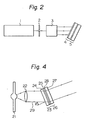
- Holographic recording may be carried out, using the holographic recording material according to the present invention, in a holographic copying optical system as illustrated in Fig. 2, for example.
- the laser beam from a laser 1 passes through a shutter 2 and then a collimator lens 3 to record a hologram onto a sensitive plate 5 after being irradiated onto a master 4.
- a photosensitive solution having the following composition:
- the hologram was allowed to stand in an air-conditioned bath having a temperature of 60°C and a relative humidity of 95%, in order to examine the moisture resistance thereof. Even after 10 days, no change in the diffraction efficiency and in the Bragg angle was observed.
- the hologram was irradiated with an argon laser (wavelength: 488 nm, light intensity: 28 w/cm2) for 10 hours in order to examine the light resistance thereof. No change was observed. Also, the hologram was irradiated with radiation from a superhigh pressure mercury lamp (intensity in the region of 365 nm: 20 mW/cm 2 ). After about 3 hours, the hologram assumed a yellow color and the diffraction efficiency was decreased by about 1%. When the irradiation was further continued, no additional change in the diffraction efficiency was observed and even after the elapse of a period of 10 hours, the diffraction efficiency remained unchanged.
- the hologram formed in this example had excellent resistances to moist heat and to light.
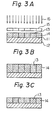
- the coated layer on the glass plate was heat dried at a temperature of 60°C for 15 minutes to obtain a holographic recording sensitive plate.
- a holographic copy was formed using this sensitive plate on an optical system shown in Fig. 4.
- the master 23 comprised a photographic plate 24 on which an amplitude hologram 25 was formed using a plane wave having a crossing angle of 60° (light source being He-Ne laser).
- a superhigh pressure mercury lamp 21 (USH-250D, manufactured by Ushio Denki K.K.) was used as the source of copy light.
- Light from the copy light source was converted to parallel light (i.e. copy light 29) through a lens 22, which copy light 29 was transmitted to the master 23 at a Bragg angle of 8.
- the exposure time was 2 minutes.
- a holographic recording sensitive plate 26 comprised a glass plate 27 on which a photosensitive layer 28 was formed, as described above.
- the plate After exposure, the plate was developed in the vapor of a toluene/xylene mixture as described in Example 1, immersed in n-pentane, and dried in air to obtain a copy hologram.
- the resultant hologram was uniform allover the surface.
- the diffraction efficiency of the hologram was 53% and the thickness of the photosensitive layer was 2.5 U m.
- a hologram was formed by the procedure as described in Example 1, except that Michler's ketone or Acridine Orange was used instead of thioflavine.
- the resultant diffraction efficiency is shown in Table 2 below.
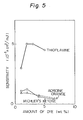
- the above-mentioned procedure was repeated by changing the amount of thioflavine, Michler's ketone or Acridine Orange.
- the resultant sensitivity was as shown in Fig. 5.
- the sensitivity is represented by an exposed light energy necessary to obtain a diffraction efficiency of 50%.
- thioflavine dye This may be for example thioflavine S (chromine G) or thioflavine T (Acronol Yellow T).
Landscapes
- Physics & Mathematics (AREA)
- General Physics & Mathematics (AREA)
- Spectroscopy & Molecular Physics (AREA)
- Chemical & Material Sciences (AREA)
- Engineering & Computer Science (AREA)
- Materials Engineering (AREA)
- Holo Graphy (AREA)
Applications Claiming Priority (2)
| Application Number | Priority Date | Filing Date | Title |
|---|---|---|---|
| JP5695/82 | 1982-01-18 | ||
| JP57005695A JPS58122532A (ja) | 1982-01-18 | 1982-01-18 | ホログラム記録材料 |
Publications (3)
| Publication Number | Publication Date |
|---|---|
| EP0084452A2 true EP0084452A2 (de) | 1983-07-27 |
| EP0084452A3 EP0084452A3 (en) | 1983-12-21 |
| EP0084452B1 EP0084452B1 (de) | 1986-04-30 |
Family
ID=11618232
Family Applications (1)
| Application Number | Title | Priority Date | Filing Date |
|---|---|---|---|
| EP83300224A Expired EP0084452B1 (de) | 1982-01-18 | 1983-01-18 | Halographisches Aufzeichnungsmaterial und Verfahren zur Erzeugung von Halogrammen |
Country Status (4)
| Country | Link |
|---|---|
| US (1) | US4517266A (de) |
| EP (1) | EP0084452B1 (de) |
| JP (1) | JPS58122532A (de) |
| DE (1) | DE3363215D1 (de) |
Cited By (6)
| Publication number | Priority date | Publication date | Assignee | Title |
|---|---|---|---|---|
| EP0369444A3 (en) * | 1988-11-18 | 1990-08-16 | Canon Kabushiki Kaisha | Photosensitive resin composition and method of preparing volume type phase hologram member using same |
| EP0291928A3 (de) * | 1987-05-18 | 1990-08-22 | Canon Kabushiki Kaisha | Holographisches Element |
| US5418113A (en) * | 1988-11-18 | 1995-05-23 | Canon Kabushiki Kaisha | Photosensitive resin composition and method of preparing volume type phase hologram member using same |
| WO2009099898A1 (en) * | 2008-02-05 | 2009-08-13 | Nitto Denko Corporation | Optical devices responsive to blue laser and method of modulating light |
| US7736548B2 (en) | 2006-07-25 | 2010-06-15 | Nitto Denko Corporation | Non-linear optical device with long grating persistency |
| US7985356B2 (en) | 2006-07-25 | 2011-07-26 | Nitto Denko Corporation | Non-linear optical device sensitive to green laser |
Families Citing this family (6)
| Publication number | Priority date | Publication date | Assignee | Title |
|---|---|---|---|---|
| JPS62123489A (ja) * | 1985-08-23 | 1987-06-04 | Fujitsu Ltd | ホログラム記録用感光材料 |
| GB8608278D0 (en) * | 1986-04-04 | 1986-05-08 | Ciba Geigy Ag | Holographic material |
| US5240795A (en) * | 1988-07-04 | 1993-08-31 | Canon Kabushiki Kaisha | Volume phase type hologram film and photosensitive resin composition employed therefor |
| EP0350014B1 (de) * | 1988-07-06 | 1998-10-14 | Canon Kabushiki Kaisha | Volumenhologramm und Verfahren zur Herstellung desselben |
| DE69218288T2 (de) * | 1991-05-23 | 1997-06-26 | Matsushita Electric Ind Co Ltd | Holographisches Aufzeichnungsmaterial, Vorrichtung zum Aufzeichnen eines Hologramms, Verfahren zu deren Herstellung und Aufnahmeverfahren |
| US5422204A (en) * | 1991-07-19 | 1995-06-06 | Canon Kabushiki Kaisha | Photo-crosslinkable resin composition and hologram recording medium |
Family Cites Families (12)
| Publication number | Priority date | Publication date | Assignee | Title |
|---|---|---|---|---|
| US28789A (en) * | 1860-06-19 | Boiler foe | ||
| USRE28789E (en) | 1972-01-25 | 1976-04-27 | E. I. Du Pont De Nemours And Company | Photopolymerizable compositions containing cyclic cis-α-dicarbonyl compounds and selected sensitizers |
| US3951663A (en) * | 1973-10-04 | 1976-04-20 | Rca Corporation | Organic volume phase holographic recording media comprising an α di-ketone |
| US3926637A (en) * | 1973-10-04 | 1975-12-16 | Rca Corp | Permanent organic volume phase holographic recording medium |
| US3963490A (en) * | 1974-09-25 | 1976-06-15 | The United States Of America As Represented By The Secretary Of The Air Force | Dye sensitized dichromated gelatin holographic material |
| DE2451714A1 (de) * | 1974-10-31 | 1976-05-06 | Philips Patentverwaltung | Photothermoplastisches aufzeichnungsmaterial |
| US4055423A (en) * | 1976-04-15 | 1977-10-25 | Rca Corporation | Organic medium for thin-phase holography |
| JPS5315153A (en) * | 1976-07-27 | 1978-02-10 | Canon Inc | Hologram |
| GB1584779A (en) * | 1976-09-24 | 1981-02-18 | Agfa Gevaert | Laserbeam recording |
| US4201441A (en) * | 1978-01-26 | 1980-05-06 | Canon Kabushiki Kaisha | Hologram and method of production thereof |
| NL7906932A (nl) * | 1979-09-18 | 1981-03-20 | Philips Nv | Negatief resist-materiaal, drager met resist-materiaal en werkwijze voor het volgens een patroon aanbrengen van een laag. |
| JPS5854373A (ja) * | 1981-09-29 | 1983-03-31 | Fujitsu Ltd | ホログラム記録用感光材料及びホログラム製造方法 |
-
1982
- 1982-01-18 JP JP57005695A patent/JPS58122532A/ja active Pending
-
1983
- 1983-01-18 DE DE8383300224T patent/DE3363215D1/de not_active Expired
- 1983-01-18 EP EP83300224A patent/EP0084452B1/de not_active Expired
- 1983-01-18 US US06/458,850 patent/US4517266A/en not_active Expired - Fee Related
Cited By (6)
| Publication number | Priority date | Publication date | Assignee | Title |
|---|---|---|---|---|
| EP0291928A3 (de) * | 1987-05-18 | 1990-08-22 | Canon Kabushiki Kaisha | Holographisches Element |
| EP0369444A3 (en) * | 1988-11-18 | 1990-08-16 | Canon Kabushiki Kaisha | Photosensitive resin composition and method of preparing volume type phase hologram member using same |
| US5418113A (en) * | 1988-11-18 | 1995-05-23 | Canon Kabushiki Kaisha | Photosensitive resin composition and method of preparing volume type phase hologram member using same |
| US7736548B2 (en) | 2006-07-25 | 2010-06-15 | Nitto Denko Corporation | Non-linear optical device with long grating persistency |
| US7985356B2 (en) | 2006-07-25 | 2011-07-26 | Nitto Denko Corporation | Non-linear optical device sensitive to green laser |
| WO2009099898A1 (en) * | 2008-02-05 | 2009-08-13 | Nitto Denko Corporation | Optical devices responsive to blue laser and method of modulating light |
Also Published As
| Publication number | Publication date |
|---|---|
| US4517266A (en) | 1985-05-14 |
| JPS58122532A (ja) | 1983-07-21 |
| EP0084452B1 (de) | 1986-04-30 |
| EP0084452A3 (en) | 1983-12-21 |
| DE3363215D1 (en) | 1986-06-05 |
Similar Documents
| Publication | Publication Date | Title |
|---|---|---|
| EP0040977B1 (de) | Abbildungssysteme mit Tetra(aliphatisch)borat-salzen | |
| EP0084452B1 (de) | Halographisches Aufzeichnungsmaterial und Verfahren zur Erzeugung von Halogrammen | |
| US5776634A (en) | Photosensitive recording medium and method of preparing volume type phase hologram member using same | |
| JPH06175561A (ja) | ホログラム記録媒体及びそれを用いた体積位相型ホログラムの製造方法 | |
| JP2880342B2 (ja) | ホログラム形成用感光性記録媒体、及びそれを使用する体積型位相ホログラムの形成方法 | |
| Ohe et al. | A novel dry photopolymer for volume‐phase holograms | |
| US4187105A (en) | Photosensitive image forming composition containing at least one substituted bis-diaryl vinylidene compound and/or at least one substituted bis-diaryl imine compound | |
| US5418113A (en) | Photosensitive resin composition and method of preparing volume type phase hologram member using same | |
| CA1315591C (en) | Visible ray-recording hologram material | |
| Changkakoti et al. | Towards optimum diffraction efficiency for methylene blue sensitized dichromated gelatin holograms | |
| US3775111A (en) | Stabilized bleached silver halide holograms | |
| JPS62123489A (ja) | ホログラム記録用感光材料 | |
| JPS60222883A (ja) | ホログラム記録材料の製造方法 | |
| JPH0431592B2 (de) | ||
| JPS61117587A (ja) | ホログラム記録用感光材料およびホログラム製造方法 | |
| JPS59201051A (ja) | ホログラム記録用感光材料 | |
| JPS6170573A (ja) | ホログラム記録用感光材料 | |
| JPS58211181A (ja) | ホログラム記録用感光材料 | |
| JPS5854373A (ja) | ホログラム記録用感光材料及びホログラム製造方法 | |
| EP0369444B1 (de) | Lichtempfindliche Harzzusammensetzung und Verfahren zur Herstellung von Phasenhologrammen mit dieser Zusammensetzung | |
| JPS6045283A (ja) | ホログラム記録材料 | |
| JPS612181A (ja) | ホログラム製造方法 | |
| JPS60227283A (ja) | ホログラム記録用感光材料およびホログラム製造方法 | |
| JPH0396982A (ja) | ホログラム記録材料 | |
| JPH01216383A (ja) | ホログラム記録材料 |
Legal Events
| Date | Code | Title | Description |
|---|---|---|---|
| PUAI | Public reference made under article 153(3) epc to a published international application that has entered the european phase |
Free format text: ORIGINAL CODE: 0009012 |
|
| AK | Designated contracting states |
Designated state(s): BE DE FR GB |
|
| PUAL | Search report despatched |
Free format text: ORIGINAL CODE: 0009013 |
|
| AK | Designated contracting states |
Designated state(s): BE DE FR GB |
|
| 17P | Request for examination filed |
Effective date: 19840119 |
|
| GRAA | (expected) grant |
Free format text: ORIGINAL CODE: 0009210 |
|
| AK | Designated contracting states |
Kind code of ref document: B1 Designated state(s): BE DE FR GB |
|
| REF | Corresponds to: |
Ref document number: 3363215 Country of ref document: DE Date of ref document: 19860605 |
|
| ET | Fr: translation filed | ||
| PLBE | No opposition filed within time limit |
Free format text: ORIGINAL CODE: 0009261 |
|
| STAA | Information on the status of an ep patent application or granted ep patent |
Free format text: STATUS: NO OPPOSITION FILED WITHIN TIME LIMIT |
|
| 26N | No opposition filed | ||
| PGFP | Annual fee paid to national office [announced via postgrant information from national office to epo] |
Ref country code: FR Payment date: 19891228 Year of fee payment: 8 |
|
| PGFP | Annual fee paid to national office [announced via postgrant information from national office to epo] |
Ref country code: BE Payment date: 19891229 Year of fee payment: 8 |
|
| PGFP | Annual fee paid to national office [announced via postgrant information from national office to epo] |
Ref country code: GB Payment date: 19891231 Year of fee payment: 8 |
|
| PGFP | Annual fee paid to national office [announced via postgrant information from national office to epo] |
Ref country code: DE Payment date: 19900323 Year of fee payment: 8 |
|
| PG25 | Lapsed in a contracting state [announced via postgrant information from national office to epo] |
Ref country code: GB Effective date: 19910118 |
|
| PG25 | Lapsed in a contracting state [announced via postgrant information from national office to epo] |
Ref country code: BE Effective date: 19910131 |
|
| GBPC | Gb: european patent ceased through non-payment of renewal fee | ||
| PG25 | Lapsed in a contracting state [announced via postgrant information from national office to epo] |
Ref country code: FR Effective date: 19910930 |
|
| PG25 | Lapsed in a contracting state [announced via postgrant information from national office to epo] |
Ref country code: DE Effective date: 19911001 |
|
| REG | Reference to a national code |
Ref country code: FR Ref legal event code: ST |