EP0087789B1 - Poröser keramischer Gegenstand - Google Patents
Poröser keramischer Gegenstand Download PDFInfo
- Publication number
- EP0087789B1 EP0087789B1 EP83101888A EP83101888A EP0087789B1 EP 0087789 B1 EP0087789 B1 EP 0087789B1 EP 83101888 A EP83101888 A EP 83101888A EP 83101888 A EP83101888 A EP 83101888A EP 0087789 B1 EP0087789 B1 EP 0087789B1
- Authority
- EP
- European Patent Office
- Prior art keywords
- porous ceramic
- ceramic body
- strands
- porous
- foam
- Prior art date
- Legal status (The legal status is an assumption and is not a legal conclusion. Google has not performed a legal analysis and makes no representation as to the accuracy of the status listed.)
- Expired
Links
Images
Classifications
-
- C—CHEMISTRY; METALLURGY
- C04—CEMENTS; CONCRETE; ARTIFICIAL STONE; CERAMICS; REFRACTORIES
- C04B—LIME, MAGNESIA; SLAG; CEMENTS; COMPOSITIONS THEREOF, e.g. MORTARS, CONCRETE OR LIKE BUILDING MATERIALS; ARTIFICIAL STONE; CERAMICS; REFRACTORIES; TREATMENT OF NATURAL STONE
- C04B41/00—After-treatment of mortars, concrete, artificial stone or ceramics; Treatment of natural stone
- C04B41/009—After-treatment of mortars, concrete, artificial stone or ceramics; Treatment of natural stone characterised by the material treated
-
- B—PERFORMING OPERATIONS; TRANSPORTING
- B01—PHYSICAL OR CHEMICAL PROCESSES OR APPARATUS IN GENERAL
- B01D—SEPARATION
- B01D39/00—Filtering material for liquid or gaseous fluids
- B01D39/14—Other self-supporting filtering material ; Other filtering material
- B01D39/20—Other self-supporting filtering material ; Other filtering material of inorganic material, e.g. asbestos paper, metallic filtering material of non-woven wires
- B01D39/2068—Other inorganic materials, e.g. ceramics
- B01D39/2093—Ceramic foam
-
- C—CHEMISTRY; METALLURGY
- C04—CEMENTS; CONCRETE; ARTIFICIAL STONE; CERAMICS; REFRACTORIES
- C04B—LIME, MAGNESIA; SLAG; CEMENTS; COMPOSITIONS THEREOF, e.g. MORTARS, CONCRETE OR LIKE BUILDING MATERIALS; ARTIFICIAL STONE; CERAMICS; REFRACTORIES; TREATMENT OF NATURAL STONE
- C04B38/00—Porous mortars, concrete, artificial stone or ceramic ware; Preparation thereof
- C04B38/06—Porous mortars, concrete, artificial stone or ceramic ware; Preparation thereof by burning-out added substances by burning natural expanding materials or by sublimating or melting out added substances
- C04B38/0615—Porous mortars, concrete, artificial stone or ceramic ware; Preparation thereof by burning-out added substances by burning natural expanding materials or by sublimating or melting out added substances the burned-out substance being a monolitic element having approximately the same dimensions as the final article, e.g. a porous polyurethane sheet or a prepreg obtained by bonding together resin particles
-
- C—CHEMISTRY; METALLURGY
- C04—CEMENTS; CONCRETE; ARTIFICIAL STONE; CERAMICS; REFRACTORIES
- C04B—LIME, MAGNESIA; SLAG; CEMENTS; COMPOSITIONS THEREOF, e.g. MORTARS, CONCRETE OR LIKE BUILDING MATERIALS; ARTIFICIAL STONE; CERAMICS; REFRACTORIES; TREATMENT OF NATURAL STONE
- C04B41/00—After-treatment of mortars, concrete, artificial stone or ceramics; Treatment of natural stone
- C04B41/45—Coating or impregnating, e.g. injection in masonry, partial coating of green or fired ceramics, organic coating compositions for adhering together two concrete elements
- C04B41/50—Coating or impregnating, e.g. injection in masonry, partial coating of green or fired ceramics, organic coating compositions for adhering together two concrete elements with inorganic materials
- C04B41/5053—Coating or impregnating, e.g. injection in masonry, partial coating of green or fired ceramics, organic coating compositions for adhering together two concrete elements with inorganic materials non-oxide ceramics
-
- C—CHEMISTRY; METALLURGY
- C04—CEMENTS; CONCRETE; ARTIFICIAL STONE; CERAMICS; REFRACTORIES
- C04B—LIME, MAGNESIA; SLAG; CEMENTS; COMPOSITIONS THEREOF, e.g. MORTARS, CONCRETE OR LIKE BUILDING MATERIALS; ARTIFICIAL STONE; CERAMICS; REFRACTORIES; TREATMENT OF NATURAL STONE
- C04B41/00—After-treatment of mortars, concrete, artificial stone or ceramics; Treatment of natural stone
- C04B41/80—After-treatment of mortars, concrete, artificial stone or ceramics; Treatment of natural stone of only ceramics
- C04B41/81—Coating or impregnation
- C04B41/85—Coating or impregnation with inorganic materials
- C04B41/87—Ceramics
Definitions
- the present invention relates to a porous ceramic article for use as molten metal filters, traps for particulates in exhaust gases such as Diesel engine exhaust gases, other filters, catalyst carriers, energy-saving members such as gas-permeable thermal insulators or the like, particularly at elevated temperatures, comprising a porous ceramic body having a three-dimensional network of strands defining interconnected cells and having a bulk specific gravity of 0.25 to 0.6, an average pore diameter of 0.3 to 10 mm, a porosity of 75 to 95% and an air pressure drop of 0.1 to 30 mm in water gauge (9.81-2943 ⁇ bar) when air passes through the porous ceramic body over a thickness of 1 cm at a velocity of 1 m/sec and comprising at least one compound selected from the group consisting of nitrides, carbides, borides and silicides of metals dispersed in or deposited on the strands of the porous ceramic body.
- Porous ceramic bodies are prepared by applying a ceramic slurry to an open-cell synthetic resin foam such as reticulated or cell membrane-free flexible polyurethane foam, and drying and sintering the treated foam. They are advantageously used as filters and energy-saving members at elevated temperatures, for example, as filters for removing metal oxides in molten metal such as molten aluminum and trapping particulates in exhaust gases such as Diesel engine exhaust gases, and as gas-permeable thermal insulators or solid heat-transfer transducers to be mounted in a radiant tube or at a heated-gas outlet of a heating furnace to make use of the radiant heat of the gas.
- an open-cell synthetic resin foam such as reticulated or cell membrane-free flexible polyurethane foam
- porous ceramic bodies When such a porous ceramic body is used at elevated temperatures, it may possibly be broken because of thermal shock or thermal stress.
- porous ceramic bodies are formed to have a reduced coefficient of thermal expansion so that stress occurrence is minimized. There is, however, the need for further improving thermal properties such as thermal shock resistance and heat resistance.
- porous ceramic bodies are often exposed to an extremely high temperature environment ranging from several hundred degrees to one thousand and several hundred degrees in centrigrade, they are also required to have increased strength at such extremely high temperatures.
- the porous ceramic bodies are formed of alumina or cordierite as a main ingredient to achieve such high-temperature strength. There is the need for porous ceramic bodies having further improved high-temperature strength.
- the prior EP-A-0 068 360 discloses a gas-permeable thermal insulator which contains nitrides, carbides and borides, comprising a porous ceramic body of a three-dimensional reticulate structure having interconnected open cells, said porous ceramic body having a bulk specific gravity of 0.25-0.6, an average pore diameter of 0.2-10 mm, a porosity of 75-95%, and an air pressure drop of 0.1-40 mm in water column when air passes through the porous ceramic body over a thickness of 1 cm at a velocity of 1 m/sec.
- GB-A-2 027 688 describes a similar ceramic porous body for use as a filtering material for molten metal. Both ceramic porous bodies do not contain needle-like crystals.
- DE-C-865 721 concerns porous bodies made of a ceramic material, the surfaces of which are provided with a metal conductive coating.
- DE-A-31 08 387 relates to a method for the manufacture of porous ceramic bodies which may consist of a ceramic material basically comprising kaolin, clay, alumina, feldspar, potter's earth, mullite, zircon, zirconia, titania, silicon carbide, cordierite or combinations thereof.
- the porous ceramic bodies may comprise needle-like crystals of mullite.
- compositions on the basis of A1 2 0 3 and Si0 2 can produce a ceramic material containing mullite which is normally present in a needle-like form (W. T. Kingery et. al. "Introduction to ceramics", 2nd edition (1976) pages 304-311).
- the subject matter of the invention therefore is a porous ceramic article comprising a porous ceramic body having a three-dimensional network of strands defining interconnected cells and having a bulk specific gravity of 0.25 to 0.6, an average pore diameter of 0.3 to 10 mm, a porosity of 75 to 95% and an air pressure drop of 0.1 to 30 mm in water gauge (9.81-2943 p bar) when air passes through the porous ceramic body over a thickness of 1 cm at a velocity of 1 m/sec and comprising at least one compound selected from the group consisting of nitrides, carbides, borides and silicides of metals dispersed in or deposited on the strands of the porous ceramic body, which is characterized in that, the porous ceramic body containing 1 to 20% per weight needle-like crystals of mullite on the basis of the weight of the porous ceramic body dispersed in said ceramic body is formed by heating an alumina-based ceramic material containing 70 to 92% by weight of alumina on the basis of
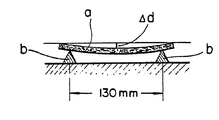
- the single figure attached is an illustration for the measurement of distortion of a porous ceramic body.
- the porous ceramic article according to the present invention is based on a porous ceramic body having a three-dimensional network of strands defining interconnected cells through which a fluid may pass.
- the porous ceramic body is preferably free of clogging or jamming.
- the porous ceramic body is preferably prepared by applying a ceramic slurry to an open-cell foam of synthetic resin, especially a reticulated or cell membrane-free flexible polyurethane foam, and sintering the treated foam to remove the foam resin through carbonization and form a porous ceramic body having substantially the same cell configuration as the resin foam.
- a porous ceramic body which is of a cage configuration consisting of the edges of a regular dodecahed- ron.
- a porous ceramic body of the cage type has a sufficiently increased porosity to allow a fluid such as exhaust gases to pass therethrough without a substantial pressure drop, and comprises interconnected open cells defined by a complicated network of strands upon which a fluid such as exhaust gas impinges during its passage through the cells, removing contaminants in the fluid and providing efficient heat exchange with the fluid.
- the porous ceramic body of the present invention contains 1 to 20% by weight needle-like crystals of mullite (3AI203. 2Si0 2 ) on the basis of the weight of the porous ceramic body dispersed in said ceramic body and is formed by heating a cordierite material having a high alumina content at a temperature of 1 350 to 1 600°C approximate to the decomposition temperature of the cordierite phase or by heating an alumina based ceramic material containing 70 to 92% by weight of alumina.
- cordierite may preferably comprise 5% to 95%, particularly 5% to 25% by weight of the ceramic body.
- the porous ceramic body is formed by using a needle-like crystal-free ceramic slurry having a composition capable of forming needle-like crystals by sintering, immersing a plastic foam in the slurry, drying the immersed foam after removal of excess slurry, and causing needle-like crystals to form during the subsequent sintering, or by reheating the sintered porous ceramic body to a sufficient temperature to form needle-like crystals. Either of these procedures successfully produces a porous ceramic body having needle-like crystals dispersed therein.
- the porous ceramic body is required to have a bulk specific gravity of 0.25 to 0.6, particularly 0.35 to 0.5, an average pore diameter of 0.3 to 10 mm, particularly -0.5 to 5 mm, a porosity of 75 to 95%, particularly 80 to 90%, and an air pressure drop of 0.1 to 30 mm (9.87-2943 p bar), particularly 0.1 to 10 mm (9.81-981 p bar), in water gauge when air passes through the porous ceramic body over a thickness of 1 cm at a velocity of 1 m/sec.
- These requirements must be met to provide a useful porous ceramic article having both the characteristics of gas permeability and thermal insulation. Improved porous ceramic articles can be obtained only when all the requirements are satisfied.
- the porous ceramic article of the present invention is prepared from a porous ceramic body of the above-defined structure by dispersing at least one compound selected from nitrides, carbides, borides and silicides in the strands of the porous ceramic body, or by coating all the strands of the porous ceramic body or at least those strands of the porous ceramic body which are located at and near the ceramic body inlet for incoming fluid with at least one compound selected from nitrides, carbides, borides and silicides.
- the dispersion or deposition of such a compound remarkably improves the thermal properties of the porous ceramic body.
- the metal nitrides include TiN, ZrN, Si 3 N 4 , HfN, VN, TaN, Be 3 N 2 , AIN, Th 3 N 4 , etc.
- the metal carbides include TiC, ZrC, HfC, VC, TaC, NbC, WC, BiC, SiC, etc.
- the metal borides include -AIB, SiB, TiB 2 , ZrB 2 , HfB 2 , VB 2 , TaB, WB, etc.
- the metal silicides include MoSi, TiSi, ZrSi, VSi, etc.
- the metal nitrides and carbides exert improved effect, and TiN, ZrN, Si 3 N 4 , TiC, ZrC, HfC, VC, TaC, NbC, WC, BiC and SiC are particularly preferred.
- These compounds may be dispersed in ceramic body strands by incorporating one or more of the above-listed compounds into a ceramic slurry prior to forming of a porous ceramic body therefrom. Also, they may be deposited on ceramic body strands by immersing a preformed porous ceramic body entirely or partially in a dispersion of one or more of the above-listed compounds in water or any suitable solvent and drying or sintering the immersed ceramic body.
- the dispersing or depositing compounds selected from metal nitrides, carbides, borides and silicides need not necessarily be cemented between grains thereof. It is rather preferable in view of sintering temperature, cost and particularly, physical properties, to disperse the compounds in the strands of a porous ceramic body formed of cordierite phase, alumina or the like.
- a porous ceramic article with excellent properties may be produced at a considerably lower temperature than the sintering temperature of these compounds.
- the amount of the compounds selected from metal nitrides, carbides, borides and silicides dispersed or deposited is not particularly limited and varies with the desired properties. However, smaller amounts will give rise to a problem in improving thermal properties. For such a reason, the compound should be present in an amount of at least 1% by volume based on the total volume of the porous ceramic body, and preferably in an amount of 10% by volume or higher in the case of dispersion and in an amount of 5% by volume or higher in the case of deposition. The upper limit is preferably 97% by volume.
- the porous ceramic article may preferably consist essentially of 99% to 3% by volume of a porous ceramic body forming material and 1 % to 97% by volume of the compound selected from metal nitrides, carbides, borides and silicides.
- the porous ceramic articles of the present invention may be used in applications where a fluid at a high temperature is passed therethrough for various purposes. Usually, they are advantageously used at a place where high-temperature gas or liquid passes, for example, as molten mstal filters, catalyst carriers, Diesel engine emission particulate traps, gas-permeable thermal insulators or the like.
- the most preferred applications of the porous ceramic articles are particulate traps for trapping and removing particulates in Diesel engine emission, and heat-transfer transducers such as gas-permeable thermal insulators which are directly placed in a radiant tube or heating furnace to conduct heat- exchange with high-temperature gas, particularly high-temperature exhaust gas so that the recovered heat may be utilized in the form of radiant heat.
- the passage of a high-temperature fluid or local heating creates a temperature distribution in a conventional porous ceramic body which in turn, creates a thermal stress, causing failure of the body.
- the porous ceramic article of the present invention uses as the porous ceramic body having a three-dimensional network of strands defining interconnected cells a porous ceramic body having a bulk specific gravity of 0.25 to 0.6, an average pore diameter of 0.3 to 10 mm, a porosity of 75 to 95%, and an air pressure drop of 0.1 to 30 mm in water gauge (9.87-2943 u bar) when air passes through the porous ceramic body over a thickness of 1 cm at a velocity of 1 m/ sec.
- a flat plate of 500 mm by 50 mm by 25 mm thick was cut from a cell membrane-free reticulated flexible polyurethane foam having interconnected open cells, immersed in a dispersion of 30 parts of silicon carbide, 70 parts of alumina, 10 parts of cordierite, 10 parts of clay, and 5 parts of flux in 350 parts of water, removed from ths dispersion and dried, and then sintered at 1500°C in flowing nitrogen.
- the resulting porous ceramic body was found to have a bulk specific gravity of 0.37, an average pore diameter of 2 mm, an air pressure drop of 1.0 mm in water gauge (98.1 ⁇ bar) across a thickness of 1 cm at an air velocity of 1 m/sec., and a porosity of 89.2%.
- the porous ceramic body was alternately subjected to hot air at 1300°C and room temperature air each pass for 5 minutes up to 30 passes in total. No crack was found in the ceramic body after its removal from the oven.
- a porous ceramic body having a three-dimensional network of strands defining interconnected open cells was produced by applying a ceramic slurry prepared from a ceramic material containing 85% by weight of alumina, silica and other constituents to a cell membrane-free reticulated flexible polyurethane foam, drying the treated foam, and sintering it at a maximum temperature of 1450°C.
- the porous ceramic body obtained was free of clogging in any direction.
- the porous ceramic body was examined by electron microscopic photography (magnifying power x1000) to find that needle-like crystals of mullite were dispersed in the body.
- the porous ceramic body was also found to have a bulk specific gravity of 0.42, an average pore diameter of 2 mm, an air pressure drop of 10 mm in water gauge (981 ⁇ bar) across a thickness of 1 cm at an air velocity of 1 m/sec., and a porosity of 87.7%.
- porous ceramic body was subjected to a heat distortion test. As shown in the accompanying figure, a porous ceramic body specimen a (150 mm long, 50 mm wide, and 20 mm thick) was placed on two spaced supports b, b and heated to a temperature of 1400°C for the measurement of a distortion ⁇ d of the specimen.
Landscapes
- Chemical & Material Sciences (AREA)
- Engineering & Computer Science (AREA)
- Ceramic Engineering (AREA)
- Materials Engineering (AREA)
- Structural Engineering (AREA)
- Organic Chemistry (AREA)
- Inorganic Chemistry (AREA)
- Life Sciences & Earth Sciences (AREA)
- Geology (AREA)
- Chemical Kinetics & Catalysis (AREA)
- Filtering Materials (AREA)
- Porous Artificial Stone Or Porous Ceramic Products (AREA)
Claims (6)
Applications Claiming Priority (4)
| Application Number | Priority Date | Filing Date | Title |
|---|---|---|---|
| JP3107182A JPS58151382A (ja) | 1982-02-26 | 1982-02-26 | 多孔セラミツク構造物 |
| JP31071/82 | 1982-02-26 | ||
| JP22159082A JPS59111967A (ja) | 1982-12-17 | 1982-12-17 | セラミック多孔体 |
| JP221590/82 | 1982-12-17 |
Publications (2)
| Publication Number | Publication Date |
|---|---|
| EP0087789A1 EP0087789A1 (de) | 1983-09-07 |
| EP0087789B1 true EP0087789B1 (de) | 1987-07-29 |
Family
ID=26369521
Family Applications (1)
| Application Number | Title | Priority Date | Filing Date |
|---|---|---|---|
| EP83101888A Expired EP0087789B1 (de) | 1982-02-26 | 1983-02-25 | Poröser keramischer Gegenstand |
Country Status (3)
| Country | Link |
|---|---|
| US (1) | US4560478A (de) |
| EP (1) | EP0087789B1 (de) |
| DE (1) | DE3372748D1 (de) |
Families Citing this family (25)
| Publication number | Priority date | Publication date | Assignee | Title |
|---|---|---|---|---|
| US4662915A (en) * | 1984-07-09 | 1987-05-05 | Takeda Chemical Industries, Ltd. | Powder-air separator for use in a powder filling apparatus |
| GB8524400D0 (en) * | 1985-10-03 | 1985-11-06 | Foseco Int | Filtration of aluminium-lithium alloys |
| EP0260826B1 (de) * | 1986-09-10 | 1990-10-03 | Imperial Chemical Industries Plc | Katalysatoren |
| JPS6377596A (ja) * | 1986-09-19 | 1988-04-07 | Nippon Steel Corp | 廃水処理用の微生物固定化担体 |
| US4885263A (en) * | 1987-03-23 | 1989-12-05 | Swiss Aluminium Ltd. | Ceramic foam filter and process for preparing same |
| US5225276A (en) * | 1987-09-26 | 1993-07-06 | Kabushiki Kaisha Hayashibara Seibutsu Kagaku Kenkyujo | Filter aid for analytical use and method for preparing the same |
| US4946487A (en) * | 1988-11-14 | 1990-08-07 | Norton Company | High temperature filter |
| US4968467A (en) * | 1989-07-10 | 1990-11-06 | Industrial Filter & Pump Mfg. Co. | Hot gas filter |
| US5281462A (en) * | 1989-11-01 | 1994-01-25 | Corning Incorporated | Material, structure, filter and catalytic converter |
| US5062334A (en) * | 1990-05-21 | 1991-11-05 | Killilea Timothy R | Apparatus for cleaning cutting table support surface |
| US5122309A (en) * | 1990-10-17 | 1992-06-16 | Miles Inc. | Porous ceramic water distributor for quenching hot gases and to a method for quenching hot gases |
| US5098455A (en) * | 1990-12-21 | 1992-03-24 | The Dow Chemical Company | Regenerable exhaust gas filter element for diesel engines |
| US5250094A (en) * | 1992-03-16 | 1993-10-05 | Donaldson Company, Inc. | Ceramic filter construction and method |
| JPH06128658A (ja) * | 1992-10-13 | 1994-05-10 | Ngk Insulators Ltd | 金属溶湯用濾材とその製造方法 |
| GB2277885A (en) * | 1992-10-31 | 1994-11-16 | Richard John Wakeman | Ceramic filter and membrane |
| US5628901A (en) * | 1993-04-30 | 1997-05-13 | Castrol Industrial North America Inc. | Vessel for treating liquids |
| DE69401031T2 (de) * | 1993-06-04 | 1997-04-30 | Millipore Corp | Filterelement aus Metall mit hohem Wirkungsgrad und Verfahren zu dessen Herstellung |
| JP3378404B2 (ja) * | 1994-05-26 | 2003-02-17 | 株式会社荏原製作所 | 摺動材料 |
| US6929866B1 (en) * | 1998-11-16 | 2005-08-16 | Ultramet | Composite foam structures |
| US6919103B2 (en) | 2001-08-10 | 2005-07-19 | The Boeing Company | Surface protection of porous ceramic bodies |
| US7521025B2 (en) * | 2003-06-10 | 2009-04-21 | Ibiden Co., Ltd. | Honeycomb structural body |
| DE602004029544D1 (de) * | 2003-07-15 | 2010-11-25 | Ibiden Co Ltd | Honigwabenstrukturkörper |
| EP2067756B1 (de) * | 2007-11-30 | 2016-01-27 | NGK Insulators, Ltd. | Poröses material auf siliziumkarbidbasis und herstellungsverfahren dafür |
| DE102014205623B4 (de) * | 2014-03-26 | 2020-06-10 | Glatt Gmbh | Verfahren zur herstellung offenzelliger körper |
| CN111578271A (zh) * | 2020-05-09 | 2020-08-25 | 苏州北美国际高级中学 | 一种新型安全酒精灯及制备方法 |
Family Cites Families (9)
| Publication number | Priority date | Publication date | Assignee | Title |
|---|---|---|---|---|
| DE865721C (de) * | 1945-03-20 | 1953-02-05 | Deutsche Edelstahlwerke Ag | Poroese Koerper ohne oder mit Ausfuellung der Poren durch ein Metall |
| US3597165A (en) * | 1969-06-18 | 1971-08-03 | Engelhard Min & Chem | Catalytic exhaust purifier |
| JPS5222327B2 (de) * | 1972-05-15 | 1977-06-16 | ||
| CA1137523A (en) * | 1978-08-12 | 1982-12-14 | Tsuneaki Narumiya | Ceramic porous body |
| JPS5556077A (en) * | 1978-10-21 | 1980-04-24 | Bridgestone Tire Co Ltd | Ceramic porous body |
| US4265659A (en) * | 1979-10-09 | 1981-05-05 | Swiss Aluminium Ltd. | Molten metal filter |
| US4264346A (en) * | 1979-12-12 | 1981-04-28 | General Motors Corporation | Diesel exhaust particulate traps |
| JPS56145153A (en) * | 1980-03-05 | 1981-11-11 | Toyo Tire & Rubber Co | Manufacture of porous ceramic moldings |
| EP0068360B1 (de) * | 1981-06-19 | 1985-05-29 | Bridgestone Tire Company Limited | Verwendung eines porösen keramischen Körpers als gasdurchlässigen Wärme-Isolator |
-
1983
- 1983-02-24 US US06/469,395 patent/US4560478A/en not_active Expired - Fee Related
- 1983-02-25 EP EP83101888A patent/EP0087789B1/de not_active Expired
- 1983-02-25 DE DE8383101888T patent/DE3372748D1/de not_active Expired
Non-Patent Citations (1)
| Title |
|---|
| Kingery "Introduction to ceramics" 2nd edition, 1976, p. 304-311 * |
Also Published As
| Publication number | Publication date |
|---|---|
| DE3372748D1 (en) | 1987-09-03 |
| US4560478A (en) | 1985-12-24 |
| EP0087789A1 (de) | 1983-09-07 |
Similar Documents
| Publication | Publication Date | Title |
|---|---|---|
| US4560478A (en) | Porous ceramic article | |
| EP1710523B1 (de) | Durchlaufbrennofen und verfahren zur herstellung eines porösen keramikglieds damit | |
| US7540898B2 (en) | Honeycomb structured body | |
| US5914187A (en) | Ceramic structural body | |
| CA1205095A (en) | Aluminum titanate-mullite ceramic articles | |
| US6699429B2 (en) | Method of making silicon nitride-bonded silicon carbide honeycomb filters | |
| US6746748B2 (en) | Honeycomb structure and process for production thereof | |
| GB2071639A (en) | Ceramic honeycomb bocy | |
| US5281462A (en) | Material, structure, filter and catalytic converter | |
| US20070082174A1 (en) | Honeycomb structure and method for manufacturing the same | |
| EP1618941A1 (de) | Wabenstrukturkörper | |
| EP2067756B1 (de) | Poröses material auf siliziumkarbidbasis und herstellungsverfahren dafür | |
| JP3431670B2 (ja) | 排気ガスフィルタの製造方法 | |
| EP0586102B1 (de) | Wärmefester keramischer Filter | |
| JPS6061019A (ja) | 集塵用セラミツクスフイルタ | |
| EP0680938B1 (de) | Verfahren zur Herstellung von keramischen Formkörpern mit Honigwabenstruktur aus Cordierit | |
| JPH06327921A (ja) | 窒化アルミニウム質ハニカムフィルター | |
| JP2003328725A (ja) | 排気ガスフィルタ | |
| JP2004275854A (ja) | 炭化珪素質ハニカム構造体とそれを用いたセラミックフィルター | |
| JPH0474308B2 (de) | ||
| JP2507976B2 (ja) | セラミック多孔体の製造方法 | |
| JPS58151382A (ja) | 多孔セラミツク構造物 | |
| JP3689408B2 (ja) | 炭化珪素質ハニカム構造体とそれを用いたセラミックフィルター | |
| JPH0699011A (ja) | 繊維セラミックフィルタ |
Legal Events
| Date | Code | Title | Description |
|---|---|---|---|
| PUAI | Public reference made under article 153(3) epc to a published international application that has entered the european phase |
Free format text: ORIGINAL CODE: 0009012 |
|
| AK | Designated contracting states |
Designated state(s): DE FR GB SE |
|
| 17P | Request for examination filed |
Effective date: 19831108 |
|
| GRAA | (expected) grant |
Free format text: ORIGINAL CODE: 0009210 |
|
| AK | Designated contracting states |
Kind code of ref document: B1 Designated state(s): DE FR GB SE |
|
| REF | Corresponds to: |
Ref document number: 3372748 Country of ref document: DE Date of ref document: 19870903 |
|
| ET | Fr: translation filed | ||
| PLBE | No opposition filed within time limit |
Free format text: ORIGINAL CODE: 0009261 |
|
| STAA | Information on the status of an ep patent application or granted ep patent |
Free format text: STATUS: NO OPPOSITION FILED WITHIN TIME LIMIT |
|
| 26N | No opposition filed | ||
| PGFP | Annual fee paid to national office [announced via postgrant information from national office to epo] |
Ref country code: FR Payment date: 19911223 Year of fee payment: 10 |
|
| PGFP | Annual fee paid to national office [announced via postgrant information from national office to epo] |
Ref country code: SE Payment date: 19920214 Year of fee payment: 10 Ref country code: GB Payment date: 19920214 Year of fee payment: 10 |
|
| PGFP | Annual fee paid to national office [announced via postgrant information from national office to epo] |
Ref country code: DE Payment date: 19920331 Year of fee payment: 10 |
|
| PG25 | Lapsed in a contracting state [announced via postgrant information from national office to epo] |
Ref country code: GB Effective date: 19930225 |
|
| PG25 | Lapsed in a contracting state [announced via postgrant information from national office to epo] |
Ref country code: SE Effective date: 19930226 |
|
| GBPC | Gb: european patent ceased through non-payment of renewal fee |
Effective date: 19930225 |
|
| PG25 | Lapsed in a contracting state [announced via postgrant information from national office to epo] |
Ref country code: FR Effective date: 19931029 |
|
| PG25 | Lapsed in a contracting state [announced via postgrant information from national office to epo] |
Ref country code: DE Effective date: 19931103 |
|
| REG | Reference to a national code |
Ref country code: FR Ref legal event code: ST |
|
| EUG | Se: european patent has lapsed |
Ref document number: 83101888.2 Effective date: 19930912 |