EP0092810A2 - Enrouleur de ceinture de sécurité - Google Patents
Enrouleur de ceinture de sécurité Download PDFInfo
- Publication number
- EP0092810A2 EP0092810A2 EP83103923A EP83103923A EP0092810A2 EP 0092810 A2 EP0092810 A2 EP 0092810A2 EP 83103923 A EP83103923 A EP 83103923A EP 83103923 A EP83103923 A EP 83103923A EP 0092810 A2 EP0092810 A2 EP 0092810A2
- Authority
- EP
- European Patent Office
- Prior art keywords
- shaft
- wheel
- belt
- retractor
- seat belt
- Prior art date
- Legal status (The legal status is an assumption and is not a legal conclusion. Google has not performed a legal analysis and makes no representation as to the accuracy of the status listed.)
- Granted
Links
Images



Classifications
-
- B—PERFORMING OPERATIONS; TRANSPORTING
- B60—VEHICLES IN GENERAL
- B60R—VEHICLES, VEHICLE FITTINGS, OR VEHICLE PARTS, NOT OTHERWISE PROVIDED FOR
- B60R22/00—Safety belts or body harnesses in vehicles
- B60R22/34—Belt retractors, e.g. reels
- B60R22/44—Belt retractors, e.g. reels with means for reducing belt tension during use under normal conditions
-
- B—PERFORMING OPERATIONS; TRANSPORTING
- B60—VEHICLES IN GENERAL
- B60R—VEHICLES, VEHICLE FITTINGS, OR VEHICLE PARTS, NOT OTHERWISE PROVIDED FOR
- B60R22/00—Safety belts or body harnesses in vehicles
- B60R22/34—Belt retractors, e.g. reels
- B60R22/44—Belt retractors, e.g. reels with means for reducing belt tension during use under normal conditions
- B60R2022/442—Belt retractors, e.g. reels with means for reducing belt tension during use under normal conditions using one spring and one additional retraction device in parallel
- B60R2022/444—Belt retractors, e.g. reels with means for reducing belt tension during use under normal conditions using one spring and one additional retraction device in parallel the additional retraction device being an electric actuator
Definitions
- the present invention relates to a seat belt retractor used in a motor vehicle, and more particularly to a retractor of the type in which at least the belt retracting work is effected by an electric motor mounted to the retractor.
- this type retractor has suffered from the drawback that as the belt retracting work (and/or the belt feeding work) is achieved by the electric motor per se, upon failure of the electric circuit for the motor, the motor fails to effect the belt retracting work (and/or the belt feeding work).
- the belt user has to bear the obstructive unretracted seat belt all the time during his or her drive.
- a seat belt retractor for selectively retracting and feeding a seat belt, which comprises a belt take-up shaft on which the seat belt is retractable, first mean for rotating the belt take-up shaft in at least one of the belt retracting direction and the belt feeding direction when operated, second means for rotating the belt take-up shaft in the belt retracting direction when operated, and switch means for selectively operating the first and second means.
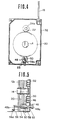
- a seat belt retractor 10 which is a first embodiment of the present invention.
- the retractor 10 comprises a housing 12 having a base wall 12a and two spaced side walls 12b and 12c which extend from the base wall 12a.
- a belt take-up shaft 14 spans across the side walls 12b and 12c in a manner to be rotatable about the axis thereof relative to the housing 12.
- a seat belt 16 is wound on the shaft 14 with its one end secured to the same.
- a known emergency locking mechanism is mounted to the side wall 12b to associate with the belt take-up shaft 14, which inhibits the feeding of the belt 16 from the retractor 10 when sensing a certain shock applied to the retractor 10.
- Designated by numeral 18 is a circular cover for the emergency locking mechanism.
- the shaft 14 has a coaxial extension 14a which is projected outwardly from the side wall 12c.
- An external gear 20 is coaxially and securely mounted on the shaft extension 14a to rotate therewith.
- Engaged with the external gear 20 is a pinion gear 22 securely mounted on a drive shaft 24a of an electric motor 24 which is fixed to the housing 12.
- a wheel 26 having external teeth 26a is slidably rotatably mounted on the shaft extension 14a beside the external gear 20, so that the wheel 26 is rotatable about the axis of the shaft 14 relative to the shaft 14.
- the wheel 26 is formed, at one side thereof facing the external gear 20, with a concentric recess 26b.
- a coil spring 28 is received in the recess 26b and axially compressed between the wheel 26 and the external gear 20, so that the wheel 26 can rotate together with the external gear 20 so long as any external obstruction force is not applied thereto.
- the wheel 26 is formed at the other side thereof with a concentric smaller diameter projected portion 26c.
- Disposed about the portion 26c is a spiral spring 30 which has an inner end secured to the portion 26c and an outer end fixed to a rectangular cover 32 which is bolted to the housing side wall 12c to cover the installed parts.
- the spiral spring 30 acts as an extra belt retracting device which stores energy to retract the belt 16 when turned in a given direction.
- a stopper arm 34 is partially housed in the cover 32 with its one portion 34b projected outwardly from the cover 32.
- the stopper arm 34 is pivotally supported by the cover 32 through a pivot pin 36.
- the other end portion, that is the upper end portion in the drawing, of the stopper arm 34 is formed with teeth 34a which are engageable with the external teeth 26a of the wheel 26 to block rotation of the same when the stopper arm 34 inclines toward the wheel 26.
- a pre-loaded leaf spring 38 is secured at its one end to the cover 32 having the other end abutting on the back of the stopper arm 34, so that the stopper arm 34 is biased in a direction to engage with the wheel 26, that is, in the direction to block the rotation of the wheel 26.
- the teeth 26a of the wheel 26 and teeth 34a of the stopper arm 34 are formed into a saw-teeth shape so that upon engagement of the stopper arm 34 with the wheel 26, only a rotation of the wheel 26 in the same direction (clockwise direction in Fig. 2) as that in which the belt take-up shaft 14 rotates when winding thereon the seat belt 16 is blocked, while permitting a rotation of the wheel 26 in the same direction (counterclockwise direction in Fig. 2) as that in which the shaft 14 rotates when feeding the belt 16 therefrom.
- the wheel 26 rotates together with the shaft 14 due to the frictional engagement of the coil spring 28 to both the external gear 20 and the wheel 26.
- the return spring 30 is wound to store energy which can rotate the wheel 26 in the reversed direction (clockwise direction in Fig. 2).
- the belt feeding rotation of the shaft 14 comes to a predetermined degree wherein the energy stored by the return spring 30 shows a predetermined large value
- the coil spring 28 begins to slip thereby failing to effect the transmission of the rotating motion of the external gear 20 to the wheel 26.
- the return spring 30 is no longer wound up thereby keeping the stored energy at a constant value.
- the reversed rotation of the wheel 26, which would be caused by the stored energy of the spring 30, is blocked by the locking engagement between the teeth 34a of the stopper arm 34 and the teeth 26a of the wheel 26.
- Designated by numeral 40 is a known belt position sensor which senses the angular position of the external gear 20 for monitoring the length of the seat belt 16 practically retracted by the shaft 14.
- the information signal from the sensor 40 is fed to a control unit 42 into which another information signal from a buckle switch 44 is also fed.
- the buckle switch 44 produces a signal representative of engagement and/or disengagement between a buckle and a tongue member of the seat belt 16.
- the control unit 42 supplies the electric motor 24 with an instruction signal by processing the information signals.
- the electric circuit comprising the sensor 40, the buckle switch 44, the motor 24 and the control unit 42 is so designed that when the buckle and tongue member of the seat belt 16 are disengaged from each other for releasing the seat occupant, the motor 24 is energized to rotate the belt take-up shaft 14 in the belt retracting direction, and when, under this belt retracting motion, the sensor 40 senses the belt 16 being sufficiently retracted by the shaft 14, the motor 24 is de-energized to stop the belt retracting rotation of the shaft 14.
- the circuit of a type as stated above is substantially disclosed in the secondarily laid-open Japanese Patent Application Specification No. 52-9897.
- the seat occupant When, for use of the seat belt 16, the seat occupant picks up the tonque member and pulls the same toward the front of him or her, the belt 16 is drawn out from the retractor 10 rotating the shaft 14, external gear 20, the drive shaft 24a of the motor 24'and also the wheel 26. (As has been described hereinafore, the rotation of the wheel 26 in this belt feeding direction causes the return spring 30 to store energy. The energy thus stored is used in an after-mentioned trouble case.) The occupant restraining function is achieved when the tongue member and the buckle are coupled.
- the emergency locking mechanism incased in the cover 18 locks instantly the shaft 14 thereby suppressing the drawing the belt 16 from the retractor 10.
- the belt wearer is protected safely from being thrown forward.
- the control unit 42 When the belt wearer uncouples the tongue member and buckle for his or her release, the control unit 42 functions to energize the motor 24 in response to the information signal issued from the buckle switch 44, so that the released belt 16 is retracted by the shaft 14. When the length of the belt 16 practically wound on the shaft 14 comes to the predetermined degree, the control unit 42 de-energizes the motor 24 in response to the information signal from the belt position sensor 40. Thus, the belt 16 is neatly retracted in the retractor 10.
- the following advantageous function is additionally achieved, which is expected when the electric circuit fails to operate, in particular, when the electric motor 24 does not run even when the belt wearer uncouples the tongue and buckle.
- the seat occupant handles the outwardly projected end 34b of the stopper arm 34 to disengage the teeth 34a thereof from the wheel 26 against the force of the leaf spring 38.
- the wheel 26 is rotated by the stored energy of the return spring 30 in the clockwise direction in Fig. 2.
- the rotation of the wheel 26 induces simultaneous rotation of the external gear 20 and thus the shaft 14 in the same direction, that is, in the belt retracting direction.
- the belt 16 can be retracted even in the above-stated trouble case.
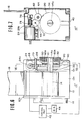
- FIGs. 3 to 5 there is shown a second embodiment of the present invention. Identical parts to those of the first embodiment are designated by the same numerals and detailed explation of them will be omitted from the following description.
- the seat belt retractor 10' of the second embodiment comprises, similar to the retractor 10 of the first embodiment, a housing 12, a belt take-up shaft 14, a known emergency locking mechanism ineased in a cover 18, an external gear 20, a pinion gear 22, an electric motor 24 and an electric circuit (40, 42, 44) which are assembled in substantially the same manner as in the above-mentioned first embodiment.
- a wheel 46 larger than the wheel 26 of the first embodiment is employed.
- the wheel 46 is rotatably mounted on the shaft extension 14a betside the external gear 20, and has a diameter and a gear pitch which are identical to those of the external gear 20. Similar to the first embodiment, the rotation of the wheel 46 in a given direction causes a spiral spring 30 to store energy.
- a shiftable shaft 48 is carried by the housing side wall 12c and the cover 30 to extend in parallel with the belt take-up shaft 14.
- the shaft 48 has a sufficient length to be axially movable relative to the side wall 12c and the cover 30.
- a knob 48a is formed on the outwardly projected end of the shaft 48, while, a locking arm 48b is connected to the inwardly projected end of the shaft 48.
- a pinion gear 50 is rotatably mounted on the shaft 48. The axial movement of the pinion gear 50 relative to the shaft 48 is suppressed by two snap rings 52 and 54 fixed to the shaft 48. The axial length of the pinion gear 50 is so determined that it is engageable with both the external gear 20 and the wheel 46 at the same time when assuming a given position as shown in Fig. 5.
- the shaft 48 is axially movable from a first position shown in Fig. 3 where the pinion gear 50 engages only the wheel 46 to a second position shown in Fig. 5 where the pinion gear 50 engages both the wheel 46 and the external gear 20.
- the shaft 48 can be locked in the second position against the axial movement thereof when the locking arm 48b is engaged with a groove 56a of a catch member 56 secured to the housing 12.
- the engagement and disengagement between locking arm 48b and the catch member 56 are easily achieved by turning the knob 48a of the shaft 48 about its axis.
- Designated by numeral 58 is a stopper which is secured to the cover 32 and has teeth 58a to which the pinion gear 50 is engageable.
- the stopper 58 is so arranged that it can engage the pinion gear 50 only when the latter assumes the first position as shown in Fig. 3.
- the energy storing is carried out by taking the following steps:
- the shaft 48 is manually moved to the second position and locked in the same manner as is stated hereinabove. With this movement, the wheel 46 starts to rotate by the stored energy of the return spring 30, rotating the external gear 20 and thus the shaft 14 in the belt retracting direction. Thus, the belt 16 can be retracted even in the above-mentioned trouble case.
- FIGs. 6 to 9 there is shown a third embodiment of the present invention. Similar to the case of the second embodiment, identical parts to those of the first embodiment are designated by the same numerals and detailed explanation of them will be omitted from the following description.
- the seat belt retractor 10" of this third embodiment comprises, similar to the retractor 10 of the first embodiment, a housing 12, a belt take-up shaft 14, a known emergency locking mechanism housed in a cover 18, an external gear 20 and an electric circuit (40, 42, 44) which are assembled in a manner similar to the above-mentioned first embodiment.
- the external gear 20 is rotatably mounted on the shaft extension 14a.
- a wheel 60 having no external teeth is employed.
- Denoted by numeral 61 is a key for securing the wheel 60 to the shaft extension 14a.
- the wheel 60 is securely disposed on the shaft extension 14a beside the external gear 20.
- the wheel 60 is formed, at one side thereof facing the external gear 20, with a concentric recess 60a for receiving therein a col spring 28 which is axially compressed between the wheel 60 and the external gear 20.
- the wheel 60 is rotatable together with the external gear 20 so long as any external obstruction force is,not applied thereto.
- the wheel 60 is formed at the other side thereof with a concentric smaller diameter projected portion 60b.
- Disposed about the portion 60b is a spiral spring 30 which has an inner end fixed to the portion 60b and an outer end fixed to a rectangular cover 32 which is bolted to the housing side wall 12c to cover the installed parts.
- a pinion gear 62 is journaled on a shiftable shaft 64 which is axially movably carried by the housing side wall 12c and the cover 32.
- a knob 64a is formed on the outwardly projected end of the shaft 64 for easy handling of the shaft 64.
- the axial movement of the pinion gear 62 relative to the shaft 64 is suppressed by a snap ring 66 fixed to the shaft 64.
- the shaft 64 is axially movable from a position as shown in Fig. 8 where the pinion gear 62 engages with the external gear 20 to another position as shown in Fig. 9 where the pinion gear 62 disengages from the external gear 20.
- another pinion gear 68 is journaled on a shaft 70 which is unmovably carried by the housing side wall 12c and the cover 32 beside the shiftable shaft 64.
- the axial movement of the pinion gear 68 relative to the shaft 70 is suppressed by a snap ring 72 fixed to the shaft 70.
- the shaft 70 is so arranged that the pinion gear 68 journaled thereon engages with the pinion gear 62 only when the latter assumes the position to engage with the external gear 20, that is, when the shaft 64 assumes the position as shown in Fig. 8.
- the pinion gear 68 engages constantly with a worm gear 74 carried on a drive shaft 24a of an electric motor 24.
- the motor 24 and a supporter 76 for the drive shaft 24a are bolted to the housing side wall 12c.
- the shiftable shaft 64 is usually located in the operative position of Fig. 8.
- the seat occupant draws the seat belt 16 for the actual use of the belt 16
- the belt take-up shaft 14 and thus the wheel 60 are rotated together leaving the external gear 20 locked.
- the spiral spring 30 becomes wound thereby to store energy.
- the energy thus stored in the return spring 30 tends to rotate the wheel 60 and thus the belt take-up shaft 14 in the belt retracting direction.
- the frictional engagement of the coil spring 28 to both the external gear 20 and the wheel 60 prevents the rotation of the wheel 60. ' This means that the energy now stored in the return spring 30 is left unchanged.
- the electric circuit is designed not only to effect the above-mentioned control, but also to rotate the belt take-up shaft 14 in the belt "feeding" direction for providing a belt slack after completion of the engagement between the buckle and the tonque member, the energy storing work before the actual use of the seat belt 16 is not necessary.
- the energy stored by the return spring 30 is assured once the shaft 14 is rotated in the belt feeding direction by the motor 24.
- such improved electric circuit is applicable to the second and third embodiments. In these cases, the initial energy storing of the return spring 30 may be effected by the electric motor 24.
Landscapes
- Engineering & Computer Science (AREA)
- Mechanical Engineering (AREA)
- Automotive Seat Belt Assembly (AREA)
Applications Claiming Priority (2)
| Application Number | Priority Date | Filing Date | Title |
|---|---|---|---|
| JP69956/82 | 1982-04-26 | ||
| JP57069956A JPS58185351A (ja) | 1982-04-26 | 1982-04-26 | シ−トベルトリトラクタ |
Publications (3)
| Publication Number | Publication Date |
|---|---|
| EP0092810A2 true EP0092810A2 (fr) | 1983-11-02 |
| EP0092810A3 EP0092810A3 (en) | 1985-07-31 |
| EP0092810B1 EP0092810B1 (fr) | 1987-07-29 |
Family
ID=13417607
Family Applications (1)
| Application Number | Title | Priority Date | Filing Date |
|---|---|---|---|
| EP83103923A Expired EP0092810B1 (fr) | 1982-04-26 | 1983-04-21 | Enrouleur de ceinture de sécurité |
Country Status (4)
| Country | Link |
|---|---|
| US (1) | US4570872A (fr) |
| EP (1) | EP0092810B1 (fr) |
| JP (1) | JPS58185351A (fr) |
| DE (1) | DE3372736D1 (fr) |
Cited By (4)
| Publication number | Priority date | Publication date | Assignee | Title |
|---|---|---|---|---|
| GB2265814B (en) * | 1992-04-06 | 1995-12-06 | Takata Corp | Pretensioner for vehicle seat belt systems |
| GB2370536A (en) * | 1997-12-16 | 2002-07-03 | Nsk Ltd | A seat belt system with retraction failure detection |
| EP1736383A4 (fr) * | 2004-04-08 | 2008-05-07 | Tokai Rika Co Ltd | Dispositif d"enroulement de sangles |
| CN110914191A (zh) * | 2017-07-31 | 2020-03-24 | 欧历胜集团 | 安全系统以及包括这种安全系统的升降设备 |
Families Citing this family (24)
| Publication number | Priority date | Publication date | Assignee | Title |
|---|---|---|---|---|
| JPS61111305U (fr) * | 1984-12-26 | 1986-07-14 | ||
| US4669751A (en) * | 1986-01-24 | 1987-06-02 | American Safety Equipment Corporation | Tension eliminator for a vehicle safety belt retractor |
| JPH0176231U (fr) * | 1987-11-10 | 1989-05-23 | ||
| US5005777A (en) * | 1988-12-09 | 1991-04-09 | Angel Fernandez | Seat belt retractor with an electric motor |
| US5224736A (en) * | 1989-02-10 | 1993-07-06 | Autoflug Gmbh & Co. | Safety belt arrangement for occupants of land vehicles and aircraft |
| US5181739A (en) * | 1990-11-27 | 1993-01-26 | Trw Vehicle Safety Systems Inc. | Seat belt system with comfort control |
| US5244231A (en) * | 1990-11-27 | 1993-09-14 | Trw Vehicle Safety Systems Inc. | Seat belt system with comfort control |
| US6702056B2 (en) * | 1997-08-06 | 2004-03-09 | Takata Corporation | Seatbelt retractor |
| JP4467688B2 (ja) * | 1999-01-19 | 2010-05-26 | タカタ株式会社 | シートベルト巻取装置 |
| DE10111323A1 (de) * | 2001-03-08 | 2002-09-12 | Trw Automotive Electron & Comp | Reversibler Gurtstraffer |
| US7020970B1 (en) * | 2001-10-23 | 2006-04-04 | James Welch | Saw guard system |
| US20050173580A1 (en) * | 2002-05-29 | 2005-08-11 | Andreas Lucht | Safety belt retractor having a pretensioning device |
| US20130256445A1 (en) * | 2002-05-29 | 2013-10-03 | Autoliv Development Ab | Safety belt retractor having a pretensioning device |
| JP4238079B2 (ja) * | 2003-01-15 | 2009-03-11 | 株式会社東海理化電機製作所 | ウエビング巻取装置 |
| DE10320836A1 (de) * | 2003-05-08 | 2004-12-02 | Takata Corp. | Gurtaufroller und Gurtaufroller-Federkassettengehäuse für einen Gurtaufroller |
| US7140571B2 (en) | 2003-06-11 | 2006-11-28 | Autoliv, Asp, Inc. | Electric seat belt retractor system |
| US6935590B2 (en) | 2003-05-19 | 2005-08-30 | Autoliv Asp, Inc. | Sensor for a feedback control system |
| DE20311004U1 (de) * | 2003-07-17 | 2003-12-04 | Trw Occupant Restraint Systems Gmbh & Co. Kg | Gurtaufroller für einen Fahrzeug-Sicherheitsgurt |
| DE10339121B4 (de) * | 2003-08-22 | 2014-10-30 | Autoliv Development Ab | Sicherheitsgurtaufroller mit an das Federherz der Aufwickelfeder angeschlossenem Elektromotor |
| JP2006103405A (ja) * | 2004-10-01 | 2006-04-20 | Tokai Rika Co Ltd | ウエビング巻取装置 |
| JP4702833B2 (ja) * | 2005-05-27 | 2011-06-15 | タカタ株式会社 | シートベルトリトラクタおよびこれを用いたシートベルト装置 |
| EP1785321B1 (fr) * | 2005-11-09 | 2008-03-12 | Delphi Technologies, Inc. | Dispositif de ceinture de sécurité |
| DE102006026734B4 (de) * | 2006-06-08 | 2008-09-04 | Siemens Ag | Gurtstrafferantrieb |
| JP2012022809A (ja) | 2010-07-12 | 2012-02-02 | Masstech:Kk | 無劣化鉛蓄電池 |
Family Cites Families (10)
| Publication number | Priority date | Publication date | Assignee | Title |
|---|---|---|---|---|
| JPS529891B1 (fr) * | 1971-05-29 | 1977-03-19 | ||
| DE2220669A1 (de) * | 1972-04-27 | 1973-11-08 | Daimler Benz Ag | Sicherheitsgurtsystem mit einem, eine federbelastete welle aufweisenden gurtaufroller |
| US4382563A (en) * | 1975-02-18 | 1983-05-10 | Nippon Soken, Inc. | Seat belt winding and retracting apparatus |
| DE2511442C3 (de) * | 1975-03-15 | 1978-11-02 | Robert Bosch Gmbh, 7000 Stuttgart | Sicherheitsgurrvorrichtung |
| JPS529891A (en) * | 1975-07-11 | 1977-01-25 | Matsushita Electric Ind Co Ltd | Electrode material for zinc oxide voltage non-linear resistor |
| US3984063A (en) * | 1975-10-24 | 1976-10-05 | General Motors Corporation | Seat belt retractor with assist spring |
| JPS6036972B2 (ja) * | 1977-03-08 | 1985-08-23 | 株式会社日本自動車部品総合研究所 | シ−トベルト巻取り装置 |
| DE2742676A1 (de) * | 1977-09-22 | 1979-04-05 | Volkswagenwerk Ag | Sicherheitsgurtaufwickelvorrichtung |
| FR2422413A1 (fr) * | 1978-04-12 | 1979-11-09 | Securaiglon Sa | Dispositif d'enrouleur-derouleur d'une sangle de ceinture de securite comportant un moteur electrique |
| JPS6237793Y2 (fr) * | 1979-08-10 | 1987-09-26 |
-
1982
- 1982-04-26 JP JP57069956A patent/JPS58185351A/ja active Granted
-
1983
- 1983-03-25 US US06/479,015 patent/US4570872A/en not_active Expired - Fee Related
- 1983-04-21 DE DE8383103923T patent/DE3372736D1/de not_active Expired
- 1983-04-21 EP EP83103923A patent/EP0092810B1/fr not_active Expired
Cited By (7)
| Publication number | Priority date | Publication date | Assignee | Title |
|---|---|---|---|---|
| GB2265814B (en) * | 1992-04-06 | 1995-12-06 | Takata Corp | Pretensioner for vehicle seat belt systems |
| GB2370536A (en) * | 1997-12-16 | 2002-07-03 | Nsk Ltd | A seat belt system with retraction failure detection |
| GB2370536B (en) * | 1997-12-16 | 2002-08-14 | Nsk Ltd | Automotive passenger restraint and protection apparatus and seatbelt protraction and retraction amount-detecting device |
| EP1736383A4 (fr) * | 2004-04-08 | 2008-05-07 | Tokai Rika Co Ltd | Dispositif d"enroulement de sangles |
| US8028949B2 (en) | 2004-04-08 | 2011-10-04 | Kabushiki Kaisha Tokai-Rika-Denki-Seisakusho | Webbing take-up device |
| CN110914191A (zh) * | 2017-07-31 | 2020-03-24 | 欧历胜集团 | 安全系统以及包括这种安全系统的升降设备 |
| CN110914191B (zh) * | 2017-07-31 | 2021-06-15 | 欧历胜集团 | 安全系统以及包括这种安全系统的升降设备 |
Also Published As
| Publication number | Publication date |
|---|---|
| US4570872A (en) | 1986-02-18 |
| EP0092810A3 (en) | 1985-07-31 |
| JPS58185351A (ja) | 1983-10-29 |
| DE3372736D1 (en) | 1987-09-03 |
| EP0092810B1 (fr) | 1987-07-29 |
| JPH0379212B2 (fr) | 1991-12-18 |
Similar Documents
| Publication | Publication Date | Title |
|---|---|---|
| EP0092810B1 (fr) | Enrouleur de ceinture de sécurité | |
| US4592520A (en) | Webbing tension device | |
| US4597546A (en) | Webbing retractor | |
| US4241886A (en) | Retractor device for seat belt mechanism | |
| EP0934856B1 (fr) | Dispositif d'enroulement de sangle | |
| US7506832B2 (en) | Motorized retractor | |
| EP1524159A1 (fr) | Enrouleur de ceinture de sécurité | |
| US20090096201A1 (en) | Seat Belt Retractor and Seat Belt Apparatus | |
| US6848717B2 (en) | Belt tensioner | |
| JP2002509052A (ja) | タイミングクラッチ機構付き自動ロッキングリトラクタ | |
| US3973786A (en) | Belt retractor with winding prevention mechanism | |
| JPH07121673B2 (ja) | 安全ベルト巻取り装置 | |
| US4583701A (en) | Webbing retractor | |
| US4386745A (en) | Tension reliever for seat belt retractor | |
| EP1759942A1 (fr) | Rétracteur de ceinture de sécurité, système de ceinture de sécurité | |
| JPH0572612U (ja) | ウエビング巻取装置 | |
| US5072968A (en) | Seat belt system with tensionless function and acceleration sensor | |
| WO2011043273A1 (fr) | Dispositif de retenue pour passager de véhicule | |
| JPH081985Y2 (ja) | プリローダセンサ | |
| KR101264107B1 (ko) | 리트랙터 및 이를 구비한 시트벨트 | |
| US4809926A (en) | Webbing retractor | |
| US4546934A (en) | Webbing tension device | |
| EP0723895A1 (fr) | Enrouleur de ceinture de sécurité | |
| US4585184A (en) | Webbing tension device | |
| US4391421A (en) | Retractor for seat belt with an alleviating device |
Legal Events
| Date | Code | Title | Description |
|---|---|---|---|
| PUAI | Public reference made under article 153(3) epc to a published international application that has entered the european phase |
Free format text: ORIGINAL CODE: 0009012 |
|
| 17P | Request for examination filed |
Effective date: 19830421 |
|
| AK | Designated contracting states |
Designated state(s): DE FR GB |
|
| PUAL | Search report despatched |
Free format text: ORIGINAL CODE: 0009013 |
|
| RAP1 | Party data changed (applicant data changed or rights of an application transferred) |
Owner name: NISSAN MOTOR CO., LTD. |
|
| AK | Designated contracting states |
Designated state(s): DE FR GB |
|
| 17Q | First examination report despatched |
Effective date: 19860206 |
|
| GRAA | (expected) grant |
Free format text: ORIGINAL CODE: 0009210 |
|
| AK | Designated contracting states |
Kind code of ref document: B1 Designated state(s): DE FR GB |
|
| PG25 | Lapsed in a contracting state [announced via postgrant information from national office to epo] |
Ref country code: FR Free format text: THE PATENT HAS BEEN ANNULLED BY A DECISION OF A NATIONAL AUTHORITY Effective date: 19870729 |
|
| REF | Corresponds to: |
Ref document number: 3372736 Country of ref document: DE Date of ref document: 19870903 |
|
| EN | Fr: translation not filed | ||
| PG25 | Lapsed in a contracting state [announced via postgrant information from national office to epo] |
Ref country code: GB Effective date: 19880421 |
|
| PLBE | No opposition filed within time limit |
Free format text: ORIGINAL CODE: 0009261 |
|
| STAA | Information on the status of an ep patent application or granted ep patent |
Free format text: STATUS: NO OPPOSITION FILED WITHIN TIME LIMIT |
|
| 26N | No opposition filed | ||
| GBPC | Gb: european patent ceased through non-payment of renewal fee | ||
| PGFP | Annual fee paid to national office [announced via postgrant information from national office to epo] |
Ref country code: DE Payment date: 19970428 Year of fee payment: 15 |
|
| PG25 | Lapsed in a contracting state [announced via postgrant information from national office to epo] |
Ref country code: DE Free format text: LAPSE BECAUSE OF NON-PAYMENT OF DUE FEES Effective date: 19990202 |