EP0094802A2 - Procédé et dispositif pour la réalisation d'un fil à effets - Google Patents
Procédé et dispositif pour la réalisation d'un fil à effets Download PDFInfo
- Publication number
- EP0094802A2 EP0094802A2 EP83302708A EP83302708A EP0094802A2 EP 0094802 A2 EP0094802 A2 EP 0094802A2 EP 83302708 A EP83302708 A EP 83302708A EP 83302708 A EP83302708 A EP 83302708A EP 0094802 A2 EP0094802 A2 EP 0094802A2
- Authority
- EP
- European Patent Office
- Prior art keywords
- inlet portion
- fiber bundle
- channel
- contact area
- fiber
- Prior art date
- Legal status (The legal status is an assumption and is not a legal conclusion. Google has not performed a legal analysis and makes no representation as to the accuracy of the status listed.)
- Ceased
Links
- 238000000034 method Methods 0.000 title claims abstract description 9
- 239000000835 fiber Substances 0.000 claims abstract description 122
- 238000011144 upstream manufacturing Methods 0.000 claims abstract description 29
- 238000004519 manufacturing process Methods 0.000 claims description 2
- 238000009987 spinning Methods 0.000 abstract description 6
- 230000000694 effects Effects 0.000 description 8
- 238000005452 bending Methods 0.000 description 5
- 230000001174 ascending effect Effects 0.000 description 4
- 230000004888 barrier function Effects 0.000 description 3
- 230000000903 blocking effect Effects 0.000 description 2
- 230000007423 decrease Effects 0.000 description 2
- 230000003247 decreasing effect Effects 0.000 description 2
- 230000009471 action Effects 0.000 description 1
- 230000002238 attenuated effect Effects 0.000 description 1
- 230000003190 augmentative effect Effects 0.000 description 1
- 239000000919 ceramic Substances 0.000 description 1
- 238000010276 construction Methods 0.000 description 1
- 230000002542 deteriorative effect Effects 0.000 description 1
- 238000009826 distribution Methods 0.000 description 1
- 239000000463 material Substances 0.000 description 1
- 230000004048 modification Effects 0.000 description 1
- 238000012986 modification Methods 0.000 description 1
- 230000009467 reduction Effects 0.000 description 1
- 230000000452 restraining effect Effects 0.000 description 1
Images

Classifications
-
- D—TEXTILES; PAPER
- D01—NATURAL OR MAN-MADE THREADS OR FIBRES; SPINNING
- D01H—SPINNING OR TWISTING
- D01H1/00—Spinning or twisting machines in which the product is wound-up continuously
- D01H1/11—Spinning by false-twisting
- D01H1/115—Spinning by false-twisting using pneumatic means
Definitions
- the present invention relates to a method and an apparatus for producing a fasciated yarn.
- a fiber bundle delivered from a pair of front rollers of a draft means is introduced into an air nozzle and therein is false twisted by a vortex.
- part of the fibers in the fiber bundle entangle around a core portion thereof to form a fasciated yarn.
- the fiber bundle has to be fed in the shape of a ribbon having a sufficient number of free-end fibers prior to being twisted.
- a free-end fiber is a fiber wherein one end thereof is embedded in the body of the bundle and the other end is free.
- a typical conventional air nozzle has a small channel in its fiber passage between the inlet portion and a large channel in which a vortex is generated. The false twist of the fiber bundle can be prevented to a certain extent from ascending to the inlet portion by the small channel.
- twist-blocking effect increases as the cross-sectional size of the small channel becomes smaller.
- a reduction of the size of the small channel causes insufficient suction of the air nozzle, which results in various problems, such as the generation of many flies, fiber wrapping on the roller surface, and the generation of less free-end fibers.
- an apparatus for producing a fasciated yarn having an air nozzle for imparting a false twist to a fiber bundle to be treated comprising a fiber passage in which an inlet portion, a smaller channel, and a large channel are successively arranged from the upstream thereof to the downstream thereof along a traveling route of the fiber bundle, the large channel being provided with a plurality of jets pointing tangentially toward the fiber passage, the apparatus being characterized in that the small channel and the large channel are coaxially arranged and at least a contact area is formed in a zone from the inlet portion to an upstream region of said small channel;
- an apparatus for producing a fasciated yarn comprising an air nozzle for imparting a false twist to a fiber bundle to be treated, the nozzle comprising a fiber passage in which an inlet portions, a small channel and a large channel are successively, coaxially and linearly arranged from the upstream thereof to the downstream thereof along a traveling route of the fiber bundle, said large channel being provided with a plurality of jets pointing tangentially toward the fiber passages, said apparatus being characterized in that said traveling route of the fiber bundle in the inlet portion is deviated from the center axis of said inlet portions, thereby at least a contact area is formed in an upstream region of the small channel; and
- a method for producing a fasciated yarn in which a fiber bundle delivered in a ribbon shape from a draft means is introduced into a fiber passage of an air nozzle, the passage comprising an inlet portion, a small channel, and a large channel, and therein is false twisted by a vortex to form the fasciated yarn, the method being characterized in that the fiber bundle is forcibly pressed against at least one contact area provided in a zone from the inlet portion to an upstream region of the small channel, whereby the traveling route of the fiber bundle is bent at the contact area at an angle G.
- a first feature is characterized by an air nozzle with a bent fiber passage in which the inlet portion is bent relative to the small channel.
- a fiber bundle delivered from a pair of front rollers of a draft means touches the upstream edge of the small channel and the traveling direction thereof is changed.
- the upstream edge of the small channel constitutes a contact area which functions as a barrier or a brake for ballooning and twist ascent.
- a second feature is characterized by an air nozzle with a straight fiber passage in which the inlet portion, the small channel, and the large channel are arranged coaxially in series.
- This type of nozzle is preferably utilized in conjunction with a deflection roller.
- the fiber bundle is introduced into the inlet portion along a path deviated from the center axis thereof so that the fiber bundle touches the upstream edge of the small channel.
- the upstream edge of the small channel constitutes a contact area.
- a third feature is characterized by an air nozzle with a bent inlet portion whereby two contact area are provided in the fiber passage. According to this feature, the above-mentioned twist-blocking effect is more effectively achieved.
- a fourth feature is characterized by an air nozzle having an inlet portion provided with at least one projection in the inner wall.
- the tip of the projection constitutes the contact area.
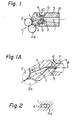
- FIG. 1 downstream of a draft means comprising several pairs of rollers and/or aprons utilized for attenuating the fiber bundle 1, there is provided an air nozzle 3 confronting a pair of front rollers 2, 2a.
- the air nozzle 3 comprises a fiber passage which consists of an inlet portion 4, a small channel 6, and a large channel 8, all of which are arranged along the traveling route of the fiber bundle.
- a plurality of jets 9 is provided in the middle of the air nozzle 3. One end of each of the jets 9 communicates with a reservoir 10 recessed in the outer wall of the air nozzle 3. The other end of each of the jets 9 opens on the inner wall of the large channel 8 in the vicinity of the upstream end thereof.
- the jets 9 incline downstream so as to enhance the traveling of the fiber bundle and deviate tangentially relative to the axis of the fiber passage so as to generate a vortex.
- the reservoir 10, in turn, is connected to a pressurized air source (not shown).
- the fiber passage is bent at the border 5 between the inlet portion 4 and the small channel 6 in such a manner that the axis of the inlet portion 4 is directed towards the nip point of the rollers 2, 2a and intersects the axis of the small channel 6 at a point in the vicinity of the border 5.
- Any directional bending of the fiber passage can be adopted in this embodiment. However, bending in a plane perpendicular to the axes of the rollers 2, 2a, as is shown in Fig. 1 is most preferable.
- a cross section of the inlet portion 4 is preferably of a flattened shape with a long side 4a parallel to the border 5.
- the border 5 constitutes a contact area in the fiber passage (hereinafter the contact area is also indicated by reference numeral 5).
- the contact area 5 is preferably in the form of a sharp edge suitable for blocking the twist acent as long as the fibers to be treated are not damaged by the area 5.
- the long side 4a is preferably a straight line, as is shown in Fig. 2. In such a case, the fiber bundle can be maintained in the ribbon shape imparted to it by the front rollers 2, 2a while at the same time being able to move freely in the traverse direction.
- the cross section of the inlet portion 4 is more preferably a cone with a base flattened in a direction parallel to the rollers 2, 2a rather than a circular base cone. Further, the cross section of the inlet portion 4 preferably gradually decreases in the traveling direction of the fiber bundle 1.
- the fiber bundle 1 attenuated by the draft means is delivered from the nip point of the front rollers 2, 2a as a fiber ribbon to the inlet portion 4 of the air nozzle 3.
- the fiber bundle 1 travels along the axis of the inlet portion 4 and reaches the upstream end of the small channel 6.
- the fiber bundle 1 is forcibly brought into contact with the inner wall of the inlet portion 4 at the contact area 5 and thereafter travels to a downstream end 7 of the small channel 6 while being pressed against the inner wall thereof.
- Air is introduced into the jets 9 opening in the upstream region within the large channel 8.
- The.air forms a spiral vortex around the axis of the large channel 8 and twists the fiber bundle 1 delivered from the small channel 6.
- the vortex created in the large channel 8 is gradually exhausted and looses its spinning torque, resulting in untwisting of the fiber bundle 1 which was twisted in the upstream of the large channel.
- the free-end fibers are entangle around the core portion of the fiber bundle at a spiral angle of the same direction as the vortex, and thereby a fasciated yarn is obtained.
- the twist of the fiber bundle in the inlet portion 4 is preferably as low as possible while that in the small channel 6 is preferably as high as possible for obtaining a good fasciated yarn since the twist difference between the upstream and downstream regions in the treated fiber bundle determines the number and spiral angle of the wrap fibers and, in turn, the structure of the fasciated yarn.
- the above-mentioned desirable twist distribution in the fiber bundle 1 mainly depends on the construction of the contact area 5. Especially, the bent angle of the fiber passage at the border between the small channel 6 and the inlet portion 4 greatly influences the ascending of the twist toward the upstream direction.
- the twist which overflows from the contact area 5 directly reaches the nip point of the rollers 2, 2a since there is no barrier between the contact area and the nip point against the twist ascent. Therefore, the function of the contact point is very important in an air nozzle of this type.
- the fiber passage is constructed in such a manner that a line extending from the nip point of the front rollers 2, 2a to the contact area, i.e., the traveling route of the fiber bundle 1 in the inlet portion 4, intersects the traveling route in the small channel 6 at an angle 0 within a range of from 10 degrees to 60 degrees.
- the above-mentioned bent angle 6 of the traveling route is somewhat different from the bent angle ⁇ ' of the small channel 6 relative to the inlet portion 4, as is shown in Fig. lA.
- the angle 0 can be replaced with the angle 9' without deteriorating the effect of the contact area.
- the cross--sectional size of the small channel can be increased relative to a conventional one since the traveling route of the fiber bundle can be fixed throughout the fiber passage, especially along the center axis of the large channel 8, under which condition yarn ballooning is properly controlled.
- This small channel 6 having an increased cross-sectional size enhances the amount of air sucked thereinto from the open end of the inlet portion 4, thereby decreasing the amount of flies in the vicinity of the front rollers 2, 2a.
- a deflection roller 20 which functions as a barrier against the twist ascent is provided between the front rollers 2, 2a and the air nozzle 3.
- the deflection roller 20 is disposed above the front bottom roller 2a with a slight clearance therebetween and is driven substantially at the same circumferential speed as that of the latter.
- the fiber bundle 1 delivered from the front rollers 2, 2a is carried to the air nozzle 3 while contacting first the front bottom roller 2a and then the deflection roller 20.
- an inlet portion 4, a small channel 6, and a large channel 8 are coaxially arranged along a straight line to form a fiber passage.
- the fiber bundle 1 traveling away from the deflection roller 20 travels through the inlet portion 4 to the small channel 6. Since the deflection roller 20 is disposed in such a manner that the bottom circumference thereof intersects the axis of the yarn passage, the traveling route of the fiber bundle in the inlet portion 4 deviates a maximum of 1 or 2 mm downward from the axis thereof and contacts the lower edge of the upstream end of the small channel 6. Therefore, the edge of the small channel ' 6 constitutes a contact area 5.
- the traveling route is bent at the contact area 5 at a certain angle ⁇ less than the abovesaid angle 0 of the first embodiment.
- the intersecting angle ⁇ may be lower than the angle 6 of the first embodiment.
- the suction force of the air nozzle is strong and the draw ratio of the rollers 2, 2a to a pair of take-up rollers (not shown) is relatively small, the fiber bundle 1 has a high tension while passing through the yarn passage and is strongly pressed against the inner wall thereof. Therefore, a smaller bent anglejpof, e.g., 2 degrees may be sufficient against the twist ascent.
- part of the inner wall of the fiber passage, with which the fiber bundle is in contact is preferably made of nonabrasive material such as ceramic or the like.
- the inlet portion 4 consists of a straight section 4S having a somewhat longer height than that of the small channel 6, a tapered section 4T having a width diverging in the upstream direction and section 4L extending to the vicinity of the bottom roller 2a.
- the border between the straight section 4S and the tapered section 4T constitutes a convex edge 5a, with which the fiber bundle 1 can be in contact if ballooning occurs in the inlet portion 4, thereby suppressing ballooning.
- This convex edge 5a has the same function as the contact area 5 and can check the twist ascent in the abovesaid case.
- the twist imparted to the fiber bundle by the vortex can be blocked, and thus prevented from ascending in the upstream direction, by the contact area 5 constituted of the lower edge of the upstream end of the small channel 6. Further, the bollooning and the twist ascent which accompanied therewith can be suppressed by the convex edge 5a in the inlet portion 4.
- the second embodiment is advantageous in that the stablility of the spinning operation is enhanced and in that a good quality fasciated yarn excellent in evenness and mechanical strength can be produced.
- the second embodiment is superior in respect to the the generation of free-end fibers due to the provision of the deflection roller 20, which prevents the fiber bundle delivered from the nip point of the front rollers 2, 2a from twisting when ascending prior to being introduced into the inlet portion 4, by contact with the surfaces of the bottom roller 2 and the deflection roller 20.
- a modification of the second embodiment results in the same effect as that of the first embodiment, in which the fiber passage is bent at the border between the inlet portion 4 and the small channel 6 at an angle of approximately 2 or 3 degrees and the fiber bundle travels along the axis of the inlet portion 4.
- the bent angle 0 orcs of the traveling route at the contact area 5 is suitably selected within a range of from 2 to 90 degrees, taking the effect of another twist-blocking element, such as the deflection roller which is provided in the vicinity of the front rollers, into consideration.
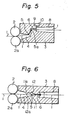
- FIG. 5 A third embodiment which is an actualization of the third feature of the invention is illustrated in Fig. 5.
- two contact area 5, 5a are provided by bending the fiber passage twice in the inlet portion 4.
- the twist ascent can be effectively blocked by the two contact area 5, 5a, and a fasciated yarn of a superior mechanical strength can be obtained.
- the air nozzle 3 shown in Fig. 5 can be manufactured by incorporating at least two segments thereinto.
- the number of bendings of the fiber passage is preferably less than three since an excessive number of bendings increases the frictional resistance of the fiber passage to the fiber bundle, thereby causing a tension unbalance in the latter. That is, the fiber bundle slacks in the inlet portion, thereby causing ballooning, and, on the contrary, becomes tense in the large channel, with the result that the twist efficiency of the vortex is lowered.
- FIG. 6 A fourth embodiment which is an actualization of the fourth feature of the invention is illustrated in Fig. 6.
- the fiber passage has two projections 11, lla in the inner wall thereof.
- a cross section of each of the projections 11, lla is of an arc shape along the axis of the fiber passage.
- the traveling route of the fiber bundle is substantially bent by the projections in such a manner that the fiber bundle contacts the tops of the latter, that is, the projections constitute the contact area.
- the axis of the fiber passage may be straight, as is shown in Fig. 6, or bent as was stated before.
- the generation of ballooning in the fiber passage can be suppressed by making the fiber bundle contact the contact area(s). Further, if ballooning occurs in the fiber passage, it can be easily suppressed before being transmitted to the vicinity of the front rollers by the action of the contact area(s). As a result, unstable spinning can be avoided. Due to the twist-blocking effect of the contact area, a sufficient twist difference can be maintained between the upstream and downstream regions of the fiber bundle, thereby making it possible to obtain a tightly entangled fasciated yarn.
- the suction of the air nozzle can be improved, thereby decreasing the amout of flies.
Landscapes
- Engineering & Computer Science (AREA)
- Mechanical Engineering (AREA)
- Textile Engineering (AREA)
- Spinning Or Twisting Of Yarns (AREA)
Applications Claiming Priority (2)
| Application Number | Priority Date | Filing Date | Title |
|---|---|---|---|
| JP80120/82 | 1982-05-14 | ||
| JP57080120A JPS58197320A (ja) | 1982-05-14 | 1982-05-14 | 結束紡績方法および装置 |
Publications (2)
| Publication Number | Publication Date |
|---|---|
| EP0094802A2 true EP0094802A2 (fr) | 1983-11-23 |
| EP0094802A3 EP0094802A3 (fr) | 1985-03-06 |
Family
ID=13709338
Family Applications (1)
| Application Number | Title | Priority Date | Filing Date |
|---|---|---|---|
| EP83302708A Ceased EP0094802A3 (fr) | 1982-05-14 | 1983-05-12 | Procédé et dispositif pour la réalisation d'un fil à effets |
Country Status (3)
| Country | Link |
|---|---|
| US (1) | US4489545A (fr) |
| EP (1) | EP0094802A3 (fr) |
| JP (1) | JPS58197320A (fr) |
Cited By (2)
| Publication number | Priority date | Publication date | Assignee | Title |
|---|---|---|---|---|
| US4858420A (en) * | 1986-09-16 | 1989-08-22 | Fritz Stahlecker | Pneumatic false-twist spinning process and apparatus |
| EP2009151A1 (fr) * | 2007-06-21 | 2008-12-31 | Murata Machinery, Ltd. | Dispositif de filature à jet d'air |
Families Citing this family (8)
| Publication number | Priority date | Publication date | Assignee | Title |
|---|---|---|---|---|
| JPS5921724A (ja) * | 1982-07-21 | 1984-02-03 | Toyoda Autom Loom Works Ltd | 結束紡績方法並びに装置 |
| US4569193A (en) * | 1984-06-04 | 1986-02-11 | Kabushiki Kaisha Toyoda Jidoshokki Seisakusho | Apparatus for producing a fasciated yarn |
| BG41935A1 (en) * | 1985-05-07 | 1987-09-15 | Bakhov | Air eddy nozzle for spinning of staple fibre yarn |
| JPH01118628A (ja) * | 1987-10-29 | 1989-05-11 | Murata Mach Ltd | 紡績糸の製造装置 |
| US4958487A (en) * | 1987-10-29 | 1990-09-25 | Murata Kikai Kabushiki Kaisha | Apparatus for producing spun yarn |
| JPH0389177U (fr) * | 1989-12-27 | 1991-09-11 | ||
| EP1682702B1 (fr) * | 2003-11-11 | 2010-05-19 | Maschinenfabrik Rieter Ag | Emplacement de filage comprenant un element de guidage des fibres |
| EP1584717A1 (fr) | 2004-04-10 | 2005-10-12 | Schärer Schweiter Mettler AG | Machine de traitement de fil |
Family Cites Families (5)
| Publication number | Priority date | Publication date | Assignee | Title |
|---|---|---|---|---|
| DE1785158C3 (de) * | 1968-08-17 | 1979-05-17 | Metallgesellschaft Ag, 6000 Frankfurt | Runddiise zum Abziehen und Ablegen von Fäden zu einem Fadenvlies |
| US4003194A (en) * | 1973-04-10 | 1977-01-18 | Toray Industries, Inc. | Method and apparatus for producing helically wrapped yarn |
| DE2722319B2 (de) * | 1977-01-10 | 1981-01-15 | Toyo Boseki K.K., Osaka (Japan) | Vorrichtung zum pneumatischen Falschdrallspinnen |
| DE2720519C2 (de) * | 1977-05-06 | 1983-06-23 | Toray Industries, Inc., Tokyo | Verfahren und Vorrichtung zum Starten des Spinnvorganges beim Herstellen eines Garnes aus Stapelfasern |
| JPS63439A (ja) * | 1986-06-19 | 1988-01-05 | Nippon Steel Corp | 高入熱溶接用調質高張力鋼 |
-
1982
- 1982-05-14 JP JP57080120A patent/JPS58197320A/ja active Granted
-
1983
- 1983-05-12 US US06/494,066 patent/US4489545A/en not_active Expired - Lifetime
- 1983-05-12 EP EP83302708A patent/EP0094802A3/fr not_active Ceased
Cited By (2)
| Publication number | Priority date | Publication date | Assignee | Title |
|---|---|---|---|---|
| US4858420A (en) * | 1986-09-16 | 1989-08-22 | Fritz Stahlecker | Pneumatic false-twist spinning process and apparatus |
| EP2009151A1 (fr) * | 2007-06-21 | 2008-12-31 | Murata Machinery, Ltd. | Dispositif de filature à jet d'air |
Also Published As
| Publication number | Publication date |
|---|---|
| JPS6320923B2 (fr) | 1988-05-02 |
| EP0094802A3 (fr) | 1985-03-06 |
| US4489545A (en) | 1984-12-25 |
| JPS58197320A (ja) | 1983-11-17 |
Similar Documents
| Publication | Publication Date | Title |
|---|---|---|
| US4489545A (en) | Method and apparatus for producing a fasciated yarn | |
| JP3111399B2 (ja) | リング精紡装置用牽伸装置 | |
| JPH06104936B2 (ja) | 糸の製造装置 | |
| US6782685B2 (en) | Apparatus for producing a core spun yarn | |
| US6209304B1 (en) | Spinning device | |
| US4437302A (en) | False twisting air nozzle | |
| JP2008190107A (ja) | 集束領域を持つドラフト装置 | |
| US4485528A (en) | Method and apparatus for drafting fiber strands | |
| US4718225A (en) | Pneumatic spinning machine | |
| JP2004509243A5 (fr) | ||
| CN100537864C (zh) | 具有纤维传送通道和导纤表面的纺织加工机 | |
| US4621490A (en) | Method and apparatus for producing a fasciated yarn | |
| US4569193A (en) | Apparatus for producing a fasciated yarn | |
| US4480434A (en) | Air nozzle for processing a fiber bundle | |
| CN1445396A (zh) | 管道式包层 | |
| US5996181A (en) | Apparatus for bundling a drafted roving | |
| US4476672A (en) | Air nozzle for fasciated yarn spinning | |
| JP2023537099A (ja) | 結び目を有するヤーンの製造のための交絡ノズルおよびヤーンを交絡させるための方法 | |
| US4240188A (en) | Process and device for interlacing multifilament yarns | |
| CN111411426B (zh) | 用于喷丝头的纤维导引元件以及配备有所述纤维导引元件的喷丝头 | |
| JPH02118126A (ja) | ドラフト装置 | |
| JP2002105776A (ja) | 圧縮装置を備えた紡績機 | |
| EP0068507B1 (fr) | Machine à fabriquer un filé fascié | |
| US4450678A (en) | Air nozzle utilized for fasciated yarn spinning | |
| JPH0585651B2 (fr) |
Legal Events
| Date | Code | Title | Description |
|---|---|---|---|
| PUAI | Public reference made under article 153(3) epc to a published international application that has entered the european phase |
Free format text: ORIGINAL CODE: 0009012 |
|
| AK | Designated contracting states |
Designated state(s): CH DE GB IT LI |
|
| PUAL | Search report despatched |
Free format text: ORIGINAL CODE: 0009013 |
|
| AK | Designated contracting states |
Designated state(s): CH DE GB IT LI |
|
| 17P | Request for examination filed |
Effective date: 19850515 |
|
| 17Q | First examination report despatched |
Effective date: 19860605 |
|
| STAA | Information on the status of an ep patent application or granted ep patent |
Free format text: STATUS: THE APPLICATION HAS BEEN REFUSED |
|
| 18R | Application refused |
Effective date: 19871129 |
|
| RIN1 | Information on inventor provided before grant (corrected) |
Inventor name: NIIMI, HIROSHI Inventor name: ANAHARA, MEIJI Inventor name: KAWABATA, SUSUMU Inventor name: OMORI, HIROSHI |