EP0095155B1 - Procédé de préparation de composés de silice ayant des groupes d'ammonium quaternaires, dérivés de ces composés et leur emploi - Google Patents
Procédé de préparation de composés de silice ayant des groupes d'ammonium quaternaires, dérivés de ces composés et leur emploi Download PDFInfo
- Publication number
- EP0095155B1 EP0095155B1 EP83104991A EP83104991A EP0095155B1 EP 0095155 B1 EP0095155 B1 EP 0095155B1 EP 83104991 A EP83104991 A EP 83104991A EP 83104991 A EP83104991 A EP 83104991A EP 0095155 B1 EP0095155 B1 EP 0095155B1
- Authority
- EP
- European Patent Office
- Prior art keywords
- quaternary ammonium
- functional
- formula
- carboxylic acid
- group
- Prior art date
- Legal status (The legal status is an assumption and is not a legal conclusion. Google has not performed a legal analysis and makes no representation as to the accuracy of the status listed.)
- Expired
Links
- 150000003377 silicon compounds Chemical class 0.000 title claims abstract description 33
- 238000004519 manufacturing process Methods 0.000 title claims description 5
- 150000003856 quaternary ammonium compounds Chemical class 0.000 claims abstract description 36
- 125000001453 quaternary ammonium group Chemical group 0.000 claims abstract description 31
- 150000001732 carboxylic acid derivatives Chemical class 0.000 claims abstract description 24
- 239000004753 textile Substances 0.000 claims abstract description 17
- -1 Siloxanes Chemical class 0.000 claims description 92
- 238000000034 method Methods 0.000 claims description 19
- 239000004215 Carbon black (E152) Substances 0.000 claims description 16
- 229930195733 hydrocarbon Natural products 0.000 claims description 16
- 239000000463 material Substances 0.000 claims description 16
- XLYOFNOQVPJJNP-UHFFFAOYSA-N water Substances O XLYOFNOQVPJJNP-UHFFFAOYSA-N 0.000 claims description 13
- 239000003586 protic polar solvent Substances 0.000 claims description 10
- 125000004432 carbon atom Chemical group C* 0.000 claims description 9
- 238000006243 chemical reaction Methods 0.000 claims description 9
- 239000003085 diluting agent Substances 0.000 claims description 9
- 239000000203 mixture Substances 0.000 claims description 9
- 125000002843 carboxylic acid group Chemical group 0.000 claims description 7
- RTZKZFJDLAIYFH-UHFFFAOYSA-N ether Substances CCOCC RTZKZFJDLAIYFH-UHFFFAOYSA-N 0.000 claims description 6
- 229910052757 nitrogen Inorganic materials 0.000 claims description 6
- 150000004756 silanes Chemical class 0.000 claims description 5
- 125000003277 amino group Chemical group 0.000 claims description 4
- 150000001875 compounds Chemical class 0.000 claims description 4
- KPUWHANPEXNPJT-UHFFFAOYSA-N disiloxane Chemical class [SiH3]O[SiH3] KPUWHANPEXNPJT-UHFFFAOYSA-N 0.000 claims description 4
- 229910052799 carbon Inorganic materials 0.000 claims description 3
- 150000002170 ethers Chemical class 0.000 claims description 3
- 125000004433 nitrogen atom Chemical group N* 0.000 claims description 3
- 229920006395 saturated elastomer Polymers 0.000 claims description 3
- QVGXLLKOCUKJST-UHFFFAOYSA-N atomic oxygen Chemical compound [O] QVGXLLKOCUKJST-UHFFFAOYSA-N 0.000 claims description 2
- 125000004122 cyclic group Chemical group 0.000 claims description 2
- 239000001301 oxygen Substances 0.000 claims description 2
- 229910052760 oxygen Inorganic materials 0.000 claims description 2
- OKTJSMMVPCPJKN-UHFFFAOYSA-N Carbon Chemical group [C] OKTJSMMVPCPJKN-UHFFFAOYSA-N 0.000 claims 1
- OKKJLVBELUTLKV-UHFFFAOYSA-N Methanol Chemical compound OC OKKJLVBELUTLKV-UHFFFAOYSA-N 0.000 description 31
- 235000013870 dimethyl polysiloxane Nutrition 0.000 description 26
- 229920000435 poly(dimethylsiloxane) Polymers 0.000 description 26
- 239000004205 dimethyl polysiloxane Substances 0.000 description 25
- YXFVVABEGXRONW-UHFFFAOYSA-N Toluene Chemical compound CC1=CC=CC=C1 YXFVVABEGXRONW-UHFFFAOYSA-N 0.000 description 18
- 238000002360 preparation method Methods 0.000 description 17
- 239000000047 product Substances 0.000 description 14
- 239000002904 solvent Substances 0.000 description 12
- VEXZGXHMUGYJMC-UHFFFAOYSA-M Chloride anion Chemical compound [Cl-] VEXZGXHMUGYJMC-UHFFFAOYSA-M 0.000 description 10
- 239000002253 acid Substances 0.000 description 9
- 150000003254 radicals Chemical class 0.000 description 9
- 239000007788 liquid Substances 0.000 description 7
- FALRKNHUBBKYCC-UHFFFAOYSA-N 2-(chloromethyl)pyridine-3-carbonitrile Chemical compound ClCC1=NC=CC=C1C#N FALRKNHUBBKYCC-UHFFFAOYSA-N 0.000 description 6
- IJGRMHOSHXDMSA-UHFFFAOYSA-N Atomic nitrogen Chemical compound N#N IJGRMHOSHXDMSA-UHFFFAOYSA-N 0.000 description 6
- KWYUFKZDYYNOTN-UHFFFAOYSA-M Potassium hydroxide Chemical compound [OH-].[K+] KWYUFKZDYYNOTN-UHFFFAOYSA-M 0.000 description 6
- 239000002585 base Substances 0.000 description 6
- 239000000835 fiber Substances 0.000 description 6
- BDERNNFJNOPAEC-UHFFFAOYSA-N propan-1-ol Chemical compound CCCO BDERNNFJNOPAEC-UHFFFAOYSA-N 0.000 description 6
- WGYKZJWCGVVSQN-UHFFFAOYSA-N propylamine Chemical group CCCN WGYKZJWCGVVSQN-UHFFFAOYSA-N 0.000 description 6
- 239000011541 reaction mixture Substances 0.000 description 6
- 229940014800 succinic anhydride Drugs 0.000 description 6
- ZDZYGYFHTPFREM-UHFFFAOYSA-N 3-[3-aminopropyl(dimethoxy)silyl]oxypropan-1-amine Chemical compound NCCC[Si](OC)(OC)OCCCN ZDZYGYFHTPFREM-UHFFFAOYSA-N 0.000 description 5
- 229920001296 polysiloxane Polymers 0.000 description 5
- QTBSBXVTEAMEQO-UHFFFAOYSA-N Acetic acid Chemical compound CC(O)=O QTBSBXVTEAMEQO-UHFFFAOYSA-N 0.000 description 4
- BLRPTPMANUNPDV-UHFFFAOYSA-N Silane Chemical compound [SiH4] BLRPTPMANUNPDV-UHFFFAOYSA-N 0.000 description 4
- 239000003054 catalyst Substances 0.000 description 4
- 150000001991 dicarboxylic acids Chemical class 0.000 description 4
- 239000004744 fabric Substances 0.000 description 4
- 229910000077 silane Inorganic materials 0.000 description 4
- UHOVQNZJYSORNB-UHFFFAOYSA-N Benzene Chemical compound C1=CC=CC=C1 UHOVQNZJYSORNB-UHFFFAOYSA-N 0.000 description 3
- OFOBLEOULBTSOW-UHFFFAOYSA-N Malonic acid Chemical compound OC(=O)CC(O)=O OFOBLEOULBTSOW-UHFFFAOYSA-N 0.000 description 3
- IMNFDUFMRHMDMM-UHFFFAOYSA-N N-Heptane Chemical compound CCCCCCC IMNFDUFMRHMDMM-UHFFFAOYSA-N 0.000 description 3
- CTQNGGLPUBDAKN-UHFFFAOYSA-N O-Xylene Chemical compound CC1=CC=CC=C1C CTQNGGLPUBDAKN-UHFFFAOYSA-N 0.000 description 3
- MUBZPKHOEPUJKR-UHFFFAOYSA-N Oxalic acid Chemical compound OC(=O)C(O)=O MUBZPKHOEPUJKR-UHFFFAOYSA-N 0.000 description 3
- KDYFGRWQOYBRFD-UHFFFAOYSA-N Succinic acid Natural products OC(=O)CCC(O)=O KDYFGRWQOYBRFD-UHFFFAOYSA-N 0.000 description 3
- 150000007513 acids Chemical class 0.000 description 3
- 150000001412 amines Chemical class 0.000 description 3
- VLKZOEOYAKHREP-UHFFFAOYSA-N n-Hexane Chemical compound CCCCCC VLKZOEOYAKHREP-UHFFFAOYSA-N 0.000 description 3
- HMMGMWAXVFQUOA-UHFFFAOYSA-N octamethylcyclotetrasiloxane Chemical compound C[Si]1(C)O[Si](C)(C)O[Si](C)(C)O[Si](C)(C)O1 HMMGMWAXVFQUOA-UHFFFAOYSA-N 0.000 description 3
- 239000000376 reactant Substances 0.000 description 3
- 150000003512 tertiary amines Chemical class 0.000 description 3
- 239000008096 xylene Substances 0.000 description 3
- WYTZZXDRDKSJID-UHFFFAOYSA-N (3-aminopropyl)triethoxysilane Chemical compound CCO[Si](OCC)(OCC)CCCN WYTZZXDRDKSJID-UHFFFAOYSA-N 0.000 description 2
- UOCLXMDMGBRAIB-UHFFFAOYSA-N 1,1,1-trichloroethane Chemical compound CC(Cl)(Cl)Cl UOCLXMDMGBRAIB-UHFFFAOYSA-N 0.000 description 2
- SYIUWAVTBADRJG-UHFFFAOYSA-N 2H-pyran-2,6(3H)-dione Chemical compound O=C1CC=CC(=O)O1 SYIUWAVTBADRJG-UHFFFAOYSA-N 0.000 description 2
- QGZKDVFQNNGYKY-UHFFFAOYSA-N Ammonia Chemical compound N QGZKDVFQNNGYKY-UHFFFAOYSA-N 0.000 description 2
- QGZKDVFQNNGYKY-UHFFFAOYSA-O Ammonium Chemical compound [NH4+] QGZKDVFQNNGYKY-UHFFFAOYSA-O 0.000 description 2
- HEDRZPFGACZZDS-UHFFFAOYSA-N Chloroform Chemical compound ClC(Cl)Cl HEDRZPFGACZZDS-UHFFFAOYSA-N 0.000 description 2
- LFQSCWFLJHTTHZ-UHFFFAOYSA-N Ethanol Chemical compound CCO LFQSCWFLJHTTHZ-UHFFFAOYSA-N 0.000 description 2
- VEXZGXHMUGYJMC-UHFFFAOYSA-N Hydrochloric acid Chemical compound Cl VEXZGXHMUGYJMC-UHFFFAOYSA-N 0.000 description 2
- LGRFSURHDFAFJT-UHFFFAOYSA-N Phthalic anhydride Natural products C1=CC=C2C(=O)OC(=O)C2=C1 LGRFSURHDFAFJT-UHFFFAOYSA-N 0.000 description 2
- 239000006087 Silane Coupling Agent Substances 0.000 description 2
- 229960000583 acetic acid Drugs 0.000 description 2
- WNLRTRBMVRJNCN-UHFFFAOYSA-N adipic acid Chemical compound OC(=O)CCCCC(O)=O WNLRTRBMVRJNCN-UHFFFAOYSA-N 0.000 description 2
- 150000008044 alkali metal hydroxides Chemical class 0.000 description 2
- 150000001408 amides Chemical class 0.000 description 2
- 125000000129 anionic group Chemical group 0.000 description 2
- 239000002216 antistatic agent Substances 0.000 description 2
- 150000005840 aryl radicals Chemical class 0.000 description 2
- JHIWVOJDXOSYLW-UHFFFAOYSA-N butyl 2,2-difluorocyclopropane-1-carboxylate Chemical compound CCCCOC(=O)C1CC1(F)F JHIWVOJDXOSYLW-UHFFFAOYSA-N 0.000 description 2
- 150000001721 carbon Chemical group 0.000 description 2
- 125000001301 ethoxy group Chemical group [H]C([H])([H])C([H])([H])O* 0.000 description 2
- 239000012362 glacial acetic acid Substances 0.000 description 2
- 238000010438 heat treatment Methods 0.000 description 2
- MUTGBJKUEZFXGO-UHFFFAOYSA-N hexahydrophthalic anhydride Chemical compound C1CCCC2C(=O)OC(=O)C21 MUTGBJKUEZFXGO-UHFFFAOYSA-N 0.000 description 2
- BDJRBEYXGGNYIS-UHFFFAOYSA-N nonanedioic acid Chemical compound OC(=O)CCCCCCCC(O)=O BDJRBEYXGGNYIS-UHFFFAOYSA-N 0.000 description 2
- XNGIFLGASWRNHJ-UHFFFAOYSA-N phthalic acid Chemical compound OC(=O)C1=CC=CC=C1C(O)=O XNGIFLGASWRNHJ-UHFFFAOYSA-N 0.000 description 2
- WLJVNTCWHIRURA-UHFFFAOYSA-N pimelic acid Chemical compound OC(=O)CCCCCC(O)=O WLJVNTCWHIRURA-UHFFFAOYSA-N 0.000 description 2
- BASFCYQUMIYNBI-UHFFFAOYSA-N platinum Chemical compound [Pt] BASFCYQUMIYNBI-UHFFFAOYSA-N 0.000 description 2
- 229920000728 polyester Polymers 0.000 description 2
- 229920000642 polymer Polymers 0.000 description 2
- 150000003242 quaternary ammonium salts Chemical class 0.000 description 2
- 230000035484 reaction time Effects 0.000 description 2
- CXMXRPHRNRROMY-UHFFFAOYSA-N sebacic acid Chemical compound OC(=O)CCCCCCCCC(O)=O CXMXRPHRNRROMY-UHFFFAOYSA-N 0.000 description 2
- SCPYDCQAZCOKTP-UHFFFAOYSA-N silanol Chemical compound [SiH3]O SCPYDCQAZCOKTP-UHFFFAOYSA-N 0.000 description 2
- TYFQFVWCELRYAO-UHFFFAOYSA-N suberic acid Chemical compound OC(=O)CCCCCCC(O)=O TYFQFVWCELRYAO-UHFFFAOYSA-N 0.000 description 2
- 239000000126 substance Substances 0.000 description 2
- VZGDMQKNWNREIO-UHFFFAOYSA-N tetrachloromethane Chemical compound ClC(Cl)(Cl)Cl VZGDMQKNWNREIO-UHFFFAOYSA-N 0.000 description 2
- WGTYBPLFGIVFAS-UHFFFAOYSA-M tetramethylammonium hydroxide Chemical compound [OH-].C[N+](C)(C)C WGTYBPLFGIVFAS-UHFFFAOYSA-M 0.000 description 2
- 238000005406 washing Methods 0.000 description 2
- KMOUUZVZFBCRAM-UHFFFAOYSA-N 1,2,3,6-tetrahydrophthalic anhydride Chemical compound C1C=CCC2C(=O)OC(=O)C21 KMOUUZVZFBCRAM-UHFFFAOYSA-N 0.000 description 1
- RTBFRGCFXZNCOE-UHFFFAOYSA-N 1-methylsulfonylpiperidin-4-one Chemical compound CS(=O)(=O)N1CCC(=O)CC1 RTBFRGCFXZNCOE-UHFFFAOYSA-N 0.000 description 1
- HXJZEGBVQCRLOD-UHFFFAOYSA-N 1-triethoxysilylpropan-2-amine Chemical compound CCO[Si](CC(C)N)(OCC)OCC HXJZEGBVQCRLOD-UHFFFAOYSA-N 0.000 description 1
- FAMGYEKDFTYOPK-UHFFFAOYSA-N 2-(1-triethoxysilylhexan-2-yloxy)ethanamine Chemical compound CCCCC(OCCN)C[Si](OCC)(OCC)OCC FAMGYEKDFTYOPK-UHFFFAOYSA-N 0.000 description 1
- GXCDRJSFHAJTAI-UHFFFAOYSA-N 2-(1-trimethoxysilylpropan-2-yloxy)ethanamine Chemical compound CO[Si](OC)(OC)CC(C)OCCN GXCDRJSFHAJTAI-UHFFFAOYSA-N 0.000 description 1
- JABCKXBEMZTLNI-UHFFFAOYSA-N 2-[[dimethoxy(methyl)silyl]methyl]butane-1,4-diamine Chemical compound CO[Si](C)(OC)CC(CN)CCN JABCKXBEMZTLNI-UHFFFAOYSA-N 0.000 description 1
- 125000000094 2-phenylethyl group Chemical group [H]C1=C([H])C([H])=C(C([H])=C1[H])C([H])([H])C([H])([H])* 0.000 description 1
- 125000003903 2-propenyl group Chemical group [H]C([*])([H])C([H])=C([H])[H] 0.000 description 1
- MBMBNFONTDMABM-UHFFFAOYSA-N 3-(1-tributoxysilylbutan-2-yloxy)propan-1-amine Chemical compound CCCCO[Si](OCCCC)(OCCCC)CC(CC)OCCCN MBMBNFONTDMABM-UHFFFAOYSA-N 0.000 description 1
- WTKWFNIIIXNTDO-UHFFFAOYSA-N 3-isocyanato-5-methyl-2-(trifluoromethyl)furan Chemical compound CC1=CC(N=C=O)=C(C(F)(F)F)O1 WTKWFNIIIXNTDO-UHFFFAOYSA-N 0.000 description 1
- SJECZPVISLOESU-UHFFFAOYSA-N 3-trimethoxysilylpropan-1-amine Chemical compound CO[Si](OC)(OC)CCCN SJECZPVISLOESU-UHFFFAOYSA-N 0.000 description 1
- UHMARZNHEMRXQH-UHFFFAOYSA-N 3a,4,5,7a-tetrahydro-2-benzofuran-1,3-dione Chemical compound C1=CCCC2C(=O)OC(=O)C21 UHMARZNHEMRXQH-UHFFFAOYSA-N 0.000 description 1
- HMMBJOWWRLZEMI-UHFFFAOYSA-N 4,5,6,7-tetrahydro-2-benzofuran-1,3-dione Chemical compound C1CCCC2=C1C(=O)OC2=O HMMBJOWWRLZEMI-UHFFFAOYSA-N 0.000 description 1
- QTBSBXVTEAMEQO-UHFFFAOYSA-M Acetate Chemical compound CC([O-])=O QTBSBXVTEAMEQO-UHFFFAOYSA-M 0.000 description 1
- 244000025254 Cannabis sativa Species 0.000 description 1
- 235000012766 Cannabis sativa ssp. sativa var. sativa Nutrition 0.000 description 1
- 235000012765 Cannabis sativa ssp. sativa var. spontanea Nutrition 0.000 description 1
- 229920000742 Cotton Polymers 0.000 description 1
- SNRUBQQJIBEYMU-UHFFFAOYSA-N Dodecane Natural products CCCCCCCCCCCC SNRUBQQJIBEYMU-UHFFFAOYSA-N 0.000 description 1
- UFHFLCQGNIYNRP-UHFFFAOYSA-N Hydrogen Chemical compound [H][H] UFHFLCQGNIYNRP-UHFFFAOYSA-N 0.000 description 1
- NHTMVDHEPJAVLT-UHFFFAOYSA-N Isooctane Chemical compound CC(C)CC(C)(C)C NHTMVDHEPJAVLT-UHFFFAOYSA-N 0.000 description 1
- 229910019142 PO4 Inorganic materials 0.000 description 1
- 239000004952 Polyamide Substances 0.000 description 1
- 239000004698 Polyethylene Substances 0.000 description 1
- 239000004743 Polypropylene Substances 0.000 description 1
- 229920000297 Rayon Polymers 0.000 description 1
- UKLDJPRMSDWDSL-UHFFFAOYSA-L [dibutyl(dodecanoyloxy)stannyl] dodecanoate Chemical compound CCCCCCCCCCCC(=O)O[Sn](CCCC)(CCCC)OC(=O)CCCCCCCCCCC UKLDJPRMSDWDSL-UHFFFAOYSA-L 0.000 description 1
- 239000001361 adipic acid Substances 0.000 description 1
- 235000011037 adipic acid Nutrition 0.000 description 1
- 125000003158 alcohol group Chemical group 0.000 description 1
- 150000001298 alcohols Chemical class 0.000 description 1
- 125000001931 aliphatic group Chemical group 0.000 description 1
- 150000001338 aliphatic hydrocarbons Chemical class 0.000 description 1
- 150000004703 alkoxides Chemical class 0.000 description 1
- 125000003545 alkoxy group Chemical group 0.000 description 1
- 150000003973 alkyl amines Chemical class 0.000 description 1
- 150000001350 alkyl halides Chemical class 0.000 description 1
- 229910021529 ammonia Inorganic materials 0.000 description 1
- 150000003868 ammonium compounds Chemical class 0.000 description 1
- JFCQEDHGNNZCLN-UHFFFAOYSA-N anhydrous glutaric acid Natural products OC(=O)CCCC(O)=O JFCQEDHGNNZCLN-UHFFFAOYSA-N 0.000 description 1
- 150000004945 aromatic hydrocarbons Chemical class 0.000 description 1
- 239000003849 aromatic solvent Substances 0.000 description 1
- 125000004104 aryloxy group Chemical group 0.000 description 1
- 125000001797 benzyl group Chemical group [H]C1=C([H])C([H])=C(C([H])=C1[H])C([H])([H])* 0.000 description 1
- 230000015572 biosynthetic process Effects 0.000 description 1
- XVNZQBSRKFXKSM-UHFFFAOYSA-N bis[[[[dimethyl(trimethylsilyloxy)silyl]oxy-dimethylsilyl]oxy-dimethylsilyl]oxy]-dimethylsilane Chemical compound C[Si](C)(C)O[Si](C)(C)O[Si](C)(C)O[Si](C)(C)O[Si](C)(C)O[Si](C)(C)O[Si](C)(C)O[Si](C)(C)O[Si](C)(C)C XVNZQBSRKFXKSM-UHFFFAOYSA-N 0.000 description 1
- KDYFGRWQOYBRFD-NUQCWPJISA-N butanedioic acid Chemical compound O[14C](=O)CC[14C](O)=O KDYFGRWQOYBRFD-NUQCWPJISA-N 0.000 description 1
- 125000000484 butyl group Chemical group [H]C([*])([H])C([H])([H])C([H])([H])C([H])([H])[H] 0.000 description 1
- 239000006227 byproduct Substances 0.000 description 1
- 238000003490 calendering Methods 0.000 description 1
- 235000009120 camo Nutrition 0.000 description 1
- 230000015556 catabolic process Effects 0.000 description 1
- 125000002091 cationic group Chemical group 0.000 description 1
- 235000005607 chanvre indien Nutrition 0.000 description 1
- 150000008280 chlorinated hydrocarbons Chemical class 0.000 description 1
- 125000001995 cyclobutyl group Chemical group [H]C1([H])C([H])([H])C([H])(*)C1([H])[H] 0.000 description 1
- 125000005725 cyclohexenylene group Chemical group 0.000 description 1
- 125000000113 cyclohexyl group Chemical group [H]C1([H])C([H])([H])C([H])([H])C([H])(*)C([H])([H])C1([H])[H] 0.000 description 1
- 125000002704 decyl group Chemical group [H]C([H])([H])C([H])([H])C([H])([H])C([H])([H])C([H])([H])C([H])([H])C([H])([H])C([H])([H])C([H])([H])C([H])([H])* 0.000 description 1
- 238000006731 degradation reaction Methods 0.000 description 1
- 239000012975 dibutyltin dilaurate Substances 0.000 description 1
- SBZXBUIDTXKZTM-UHFFFAOYSA-N diglyme Chemical compound COCCOCCOC SBZXBUIDTXKZTM-UHFFFAOYSA-N 0.000 description 1
- JVSWJIKNEAIKJW-UHFFFAOYSA-N dimethyl-hexane Natural products CCCCCC(C)C JVSWJIKNEAIKJW-UHFFFAOYSA-N 0.000 description 1
- 150000002009 diols Chemical class 0.000 description 1
- 229920005645 diorganopolysiloxane polymer Polymers 0.000 description 1
- 125000003438 dodecyl group Chemical group [H]C([H])([H])C([H])([H])C([H])([H])C([H])([H])C([H])([H])C([H])([H])C([H])([H])C([H])([H])C([H])([H])C([H])([H])C([H])([H])C([H])([H])* 0.000 description 1
- 125000001495 ethyl group Chemical group [H]C([H])([H])C([H])([H])* 0.000 description 1
- 239000000706 filtrate Substances 0.000 description 1
- 239000012530 fluid Substances 0.000 description 1
- 239000003365 glass fiber Substances 0.000 description 1
- 229910052736 halogen Inorganic materials 0.000 description 1
- 150000002367 halogens Chemical class 0.000 description 1
- 239000011487 hemp Substances 0.000 description 1
- YCOZIPAWZNQLMR-UHFFFAOYSA-N heptane - octane Natural products CCCCCCCCCCCCCCC YCOZIPAWZNQLMR-UHFFFAOYSA-N 0.000 description 1
- VHHHONWQHHHLTI-UHFFFAOYSA-N hexachloroethane Chemical compound ClC(Cl)(Cl)C(Cl)(Cl)Cl VHHHONWQHHHLTI-UHFFFAOYSA-N 0.000 description 1
- UQEAIHBTYFGYIE-UHFFFAOYSA-N hexamethyldisiloxane Chemical compound C[Si](C)(C)O[Si](C)(C)C UQEAIHBTYFGYIE-UHFFFAOYSA-N 0.000 description 1
- 125000004051 hexyl group Chemical group [H]C([H])([H])C([H])([H])C([H])([H])C([H])([H])C([H])([H])C([H])([H])* 0.000 description 1
- 125000001183 hydrocarbyl group Chemical group 0.000 description 1
- 239000001257 hydrogen Substances 0.000 description 1
- 229910052739 hydrogen Inorganic materials 0.000 description 1
- 125000004356 hydroxy functional group Chemical group O* 0.000 description 1
- 238000007654 immersion Methods 0.000 description 1
- FPYJFEHAWHCUMM-UHFFFAOYSA-N maleic anhydride Chemical compound O=C1OC(=O)C=C1 FPYJFEHAWHCUMM-UHFFFAOYSA-N 0.000 description 1
- 125000002496 methyl group Chemical group [H]C([H])([H])* 0.000 description 1
- JZMJDSHXVKJFKW-UHFFFAOYSA-M methyl sulfate(1-) Chemical compound COS([O-])(=O)=O JZMJDSHXVKJFKW-UHFFFAOYSA-M 0.000 description 1
- 238000013008 moisture curing Methods 0.000 description 1
- TVIDDXQYHWJXFK-UHFFFAOYSA-N n-Dodecanedioic acid Natural products OC(=O)CCCCCCCCCCC(O)=O TVIDDXQYHWJXFK-UHFFFAOYSA-N 0.000 description 1
- HRRDCWDFRIJIQZ-UHFFFAOYSA-N naphthalene-1,8-dicarboxylic acid Chemical compound C1=CC(C(O)=O)=C2C(C(=O)O)=CC=CC2=C1 HRRDCWDFRIJIQZ-UHFFFAOYSA-N 0.000 description 1
- 125000002347 octyl group Chemical group [H]C([*])([H])C([H])([H])C([H])([H])C([H])([H])C([H])([H])C([H])([H])C([H])([H])C([H])([H])[H] 0.000 description 1
- 239000003960 organic solvent Substances 0.000 description 1
- 125000005375 organosiloxane group Chemical group 0.000 description 1
- 235000006408 oxalic acid Nutrition 0.000 description 1
- 125000000913 palmityl group Chemical group [H]C([*])([H])C([H])([H])C([H])([H])C([H])([H])C([H])([H])C([H])([H])C([H])([H])C([H])([H])C([H])([H])C([H])([H])C([H])([H])C([H])([H])C([H])([H])C([H])([H])C([H])([H])C([H])([H])[H] 0.000 description 1
- 125000001997 phenyl group Chemical group [H]C1=C([H])C([H])=C(*)C([H])=C1[H] 0.000 description 1
- 125000000843 phenylene group Chemical group C1(=C(C=CC=C1)*)* 0.000 description 1
- 239000010452 phosphate Substances 0.000 description 1
- 229910052697 platinum Inorganic materials 0.000 description 1
- 229920002239 polyacrylonitrile Polymers 0.000 description 1
- 229920002647 polyamide Polymers 0.000 description 1
- 229920000573 polyethylene Polymers 0.000 description 1
- 229920001155 polypropylene Polymers 0.000 description 1
- 229920002635 polyurethane Polymers 0.000 description 1
- 239000004814 polyurethane Substances 0.000 description 1
- 125000006410 propenylene group Chemical group 0.000 description 1
- 125000001436 propyl group Chemical group [H]C([*])([H])C([H])([H])C([H])([H])[H] 0.000 description 1
- 239000002964 rayon Substances 0.000 description 1
- 239000007787 solid Substances 0.000 description 1
- 238000005507 spraying Methods 0.000 description 1
- 230000003068 static effect Effects 0.000 description 1
- 238000003756 stirring Methods 0.000 description 1
- 239000001384 succinic acid Substances 0.000 description 1
- HQHCYKULIHKCEB-UHFFFAOYSA-N tetradecanedioic acid Natural products OC(=O)CCCCCCCCCCCCC(O)=O HQHCYKULIHKCEB-UHFFFAOYSA-N 0.000 description 1
- 150000003606 tin compounds Chemical class 0.000 description 1
- XJDNKRIXUMDJCW-UHFFFAOYSA-J titanium tetrachloride Chemical compound Cl[Ti](Cl)(Cl)Cl XJDNKRIXUMDJCW-UHFFFAOYSA-J 0.000 description 1
- 125000003944 tolyl group Chemical group 0.000 description 1
- 125000004417 unsaturated alkyl group Chemical group 0.000 description 1
- 125000000391 vinyl group Chemical group [H]C([*])=C([H])[H] 0.000 description 1
- 229920002554 vinyl polymer Polymers 0.000 description 1
- 210000002268 wool Anatomy 0.000 description 1
- 125000005023 xylyl group Chemical group 0.000 description 1
Classifications
-
- D—TEXTILES; PAPER
- D06—TREATMENT OF TEXTILES OR THE LIKE; LAUNDERING; FLEXIBLE MATERIALS NOT OTHERWISE PROVIDED FOR
- D06M—TREATMENT, NOT PROVIDED FOR ELSEWHERE IN CLASS D06, OF FIBRES, THREADS, YARNS, FABRICS, FEATHERS OR FIBROUS GOODS MADE FROM SUCH MATERIALS
- D06M13/00—Treating fibres, threads, yarns, fabrics or fibrous goods made from such materials, with non-macromolecular organic compounds; Such treatment combined with mechanical treatment
- D06M13/50—Treating fibres, threads, yarns, fabrics or fibrous goods made from such materials, with non-macromolecular organic compounds; Such treatment combined with mechanical treatment with organometallic compounds; with organic compounds containing boron, silicon, selenium or tellurium atoms
- D06M13/51—Compounds with at least one carbon-metal or carbon-boron, carbon-silicon, carbon-selenium, or carbon-tellurium bond
-
- C—CHEMISTRY; METALLURGY
- C07—ORGANIC CHEMISTRY
- C07F—ACYCLIC, CARBOCYCLIC OR HETEROCYCLIC COMPOUNDS CONTAINING ELEMENTS OTHER THAN CARBON, HYDROGEN, HALOGEN, OXYGEN, NITROGEN, SULFUR, SELENIUM OR TELLURIUM
- C07F7/00—Compounds containing elements of Groups 4 or 14 of the Periodic Table
- C07F7/02—Silicon compounds
- C07F7/08—Compounds having one or more C—Si linkages
- C07F7/18—Compounds having one or more C—Si linkages as well as one or more C—O—Si linkages
- C07F7/1804—Compounds having Si-O-C linkages
-
- C—CHEMISTRY; METALLURGY
- C07—ORGANIC CHEMISTRY
- C07F—ACYCLIC, CARBOCYCLIC OR HETEROCYCLIC COMPOUNDS CONTAINING ELEMENTS OTHER THAN CARBON, HYDROGEN, HALOGEN, OXYGEN, NITROGEN, SULFUR, SELENIUM OR TELLURIUM
- C07F7/00—Compounds containing elements of Groups 4 or 14 of the Periodic Table
- C07F7/02—Silicon compounds
- C07F7/08—Compounds having one or more C—Si linkages
- C07F7/18—Compounds having one or more C—Si linkages as well as one or more C—O—Si linkages
- C07F7/1804—Compounds having Si-O-C linkages
- C07F7/1872—Preparation; Treatments not provided for in C07F7/20
- C07F7/1892—Preparation; Treatments not provided for in C07F7/20 by reactions not provided for in C07F7/1876 - C07F7/1888
-
- C—CHEMISTRY; METALLURGY
- C08—ORGANIC MACROMOLECULAR COMPOUNDS; THEIR PREPARATION OR CHEMICAL WORKING-UP; COMPOSITIONS BASED THEREON
- C08G—MACROMOLECULAR COMPOUNDS OBTAINED OTHERWISE THAN BY REACTIONS ONLY INVOLVING UNSATURATED CARBON-TO-CARBON BONDS
- C08G77/00—Macromolecular compounds obtained by reactions forming a linkage containing silicon with or without sulfur, nitrogen, oxygen or carbon in the main chain of the macromolecule
- C08G77/04—Polysiloxanes
- C08G77/38—Polysiloxanes modified by chemical after-treatment
- C08G77/382—Polysiloxanes modified by chemical after-treatment containing atoms other than carbon, hydrogen, oxygen or silicon
- C08G77/388—Polysiloxanes modified by chemical after-treatment containing atoms other than carbon, hydrogen, oxygen or silicon containing nitrogen
-
- C—CHEMISTRY; METALLURGY
- C08—ORGANIC MACROMOLECULAR COMPOUNDS; THEIR PREPARATION OR CHEMICAL WORKING-UP; COMPOSITIONS BASED THEREON
- C08G—MACROMOLECULAR COMPOUNDS OBTAINED OTHERWISE THAN BY REACTIONS ONLY INVOLVING UNSATURATED CARBON-TO-CARBON BONDS
- C08G77/00—Macromolecular compounds obtained by reactions forming a linkage containing silicon with or without sulfur, nitrogen, oxygen or carbon in the main chain of the macromolecule
- C08G77/42—Block-or graft-polymers containing polysiloxane sequences
Definitions
- the present invention relates to quaternary ammonium compounds and more particularly to quaternary ammonium functional silicon compounds and their use as antistatic agents for textile materials.
- Quaternary ammonium silicon compounds have been described, for example, in U.S. Patent No. 3,471,541 to Morehouse, in which a tertiary amine is prepared by reacting an alkenyl ether of a tertiary hydroxy polyalkyleneoxy alkylamine with a hydrosilicon compound (i.e., a silane or siloxane containing silicon-bonded hydrogen) in the presence of a platinum catalyst. The resultant tertiary amines are then reacted with hydrocarbyl halides, monocarbylic acids and the hydrocarbyl esters of haloalkanoic acids to form the corresponding quaternary ammonium silicon compounds.
- a hydrosilicon compound i.e., a silane or siloxane containing silicon-bonded hydrogen
- U.S. Patent No. 3,661,963 to Pepe et al describes quaternary ammonium salts of chloromethylated silanes or siloxanes which are useful as antistatic agents. These quaternary ammonium salts are prepared by reacting a tertiary amine of the formula R 3 N, where R is a monovalent organic radical, with a chloromethylarylsilane or chloromethylaralkylsilane.
- U.S. Patent No. 3,734,763 to Plueddemann describes cationic unsaturated amine functional silane coupling agents which can be applied to glass fibers to minimize the build-up of static charge on the fibers.
- These amine functional silane coupling agents can be prepared by reacting conjugated unsaturated alkyl halides with an aminofunctional silane.
- the quaternary ammonium functional silicon compounds of the present invention impart antistatic properties to textile materials which withstand repeated washings.
- the quaternary ammonium functional silicon compounds, especially the quaternary ammonium functional organopolysiloxanes are prepared from commercially available materials.
- Another object of this invention is to provide a process for preparing novel quaternary ammonium functional silicon compounds. Another object of this invention is to provide quaternary ammonium functional silicon compounds which impart antistatic properties to textile materials. Still another object of this invention is to provide quaternary ammonium functional silicon compounds which adhere to textile materials after repeated washings. A further object of the present invention is to provide a process for preparing quaternary ammonium functional organopolysiloxanes which impart antistatic properties to textile materials.
- the carboxylic acid functional quaternary ammonium compounds may be prepared by reacting carbinol functional quaternary ammonium compounds of the formulas wherein R, R 1 , R 3 , X, a and e are the same as above with dicarboxylic acids or cyclic anhydrides thereof to form the carboxylic acid functional quaternary ammonium compounds.
- carboxylic acid functional quaternary ammonium compounds are then reacted with aminofunctional compounds selected from the group consisting of:
- the siloxanes (b) may also contain units of the formula where R and c are the same as above.
- the siloxanes may also be endblocked with silanol, alkoxy, aryloxy or triorganosiloxy groups.
- the carboxylic acid functional quaternary ammonium compounds are reacted with the aminofunctional silicon compounds at a temperature of from 0°C up to 175°C and more preferably from 25°C to 140°C. It is preferred, although it is not essential, that the reaction be conducted in the presence of a non-protic solvent.
- Suitable examples of non-protic solvents are aliphatic hydrocarbon solvents such as hexane and heptane; aromatic hydrocarbon solvents such as benzene, toluene and xylene; ethers such as diglyme and diethyl ether; chlorinated hydrocarbon solvents, such as 1,1,1 trichloroethane, perchloroethane and carbon tetrachloride.
- reaction time may vary over a broad range, it is preferred that the reaction time be limited at temperatures above about 100°C in order to avoid degradation of the quaternary ammonium compound.
- the mole ratio of the carboxylic acid group linked to the quaternary ammonium compound to amine group linked to the silicon compound may vary over a wide range, e.g., from 4:1 to 1:3, with the proviso that at least one carboxylic acid group is reacted with one amine group.
- the solvent may be removed at a temperature of from 25 to 150°C, preferably at reduced pressure.
- the reaction between the carboxylic acid functional quaternary ammonium compound and the aminofunctional silicon compound forms an ammonium caboxylate.
- the ammonium carboxylate may be heated to an elevated temperature to remove a mole of water per ammonium carboxylate to form the corresponding amide.
- the water may be removed by using a non-protic solvent, e.g., toluene, which azeotropes with the water, or the water can be removed in vacuum.
- a non-protic solvent e.g., toluene
- the water can be removed in vacuum.
- the ammonium carboxylate is desired then the removal of the water and the formation of the amide must be avoided.
- the carboxylic acid functional quaternary ammonium compounds employed in this invention may be - prepared by reacting dicarboxylic acids or cyclic anhydrides thereof with the carbinol functional quaternary ammonium compounds at a temperature of from 50 to 175°C and more preferably at a temperature of from 75 to 150°C. Generally, it is preferred that the reaction be conducted in the presence of non-protic solvents.
- the non-protic solvents described above may be used in preparing the carboxylic acid functional quaternary ammonium compounds.
- the solvent may be removed in vacuum at 25 to 150°C.
- the mole ratio of cyclic anhydride to carbinol group may vary over a wide range.
- the mole ratio of cyclic anhydride to carbinol group may range form 1:1 to 1:4 with the proviso that at least one carbinol group is reacted with the cyclic anhydride molecule.
- reaction be conducted in the presence of a non-protic solvent which is capable of azeotroping with the water by-product.
- the solvent may then be removed in vacuum at 25 to 150°C.
- the reaction is conducted in the absence of a non-protic solvent, the water may be removed in vacuum.
- a catalyst may be employed to accelerate the reaction between the dicarboxylic acid and the carbinol functional quaternary ammonium compounds.
- suitable catalysts are bases, such as alkali metal hydroxides or alkoxides; acids such as hydrochloric acid; titanates such as titanium tetrachloride and tin compounds such as dibutyl tin dilaurate.
- bases such as alkali metal hydroxides or alkoxides
- acids such as hydrochloric acid
- titanates such as titanium tetrachloride and tin compounds such as dibutyl tin dilaurate.
- a catalyst level of from 0.1 percent to 10 percent, based on the weight of the reactants will accelerate the reaction:
- the mole ratio of carboxylic acid group to carbinol group may vary over a wide range.
- the mole ratio of carboxylic acid group to carbinol group may range from 8:1 to 2:1, with the proviso that at least one carboxylic acid group be reacted with one carbinol group.
- dicarboxylic acids which may be employed to form the carboxylic acid functional - quaternary ammonium compounds are oxalic acid, malonic acid, succinic acid, glutaric acid, phthalic acid, adipic acid, pimelic acid, suberic acid, azelaic acid and sebacic acid.
- Suitable examples of cyclic anhydrides are succinic anhydride, glutaconic anhydride, maleic anhydride, 1,2 cyclohexane dicarboxylic anhydride, 1-cyclohexene-1,2-dicarboxylic anhydride, 3-cyclohexene-1, 2-dicarboxylic anhydride, 4-cyclohexene-1, 2 dicarboxylic anhydride, 1,8-naphthalic acid anhydride and phthalic anhydride.
- the carbinol functional quaternary ammonium compounds may be prepared by conventional processes. known in the art. For example, they may be prepared by reacting an alkyl halide which also contains an alcohol group with an amine or ammonia.
- the counter-ion in the carbinol functional quaternary ammonium compound can be any anionic group. Suitable examples of anionic groups are halogen, methyl sulfate and phosphate anions.
- Suitable examples of monovalent hydrocarbon radicals represented by R are alkyl radicals, such as methyl, ethyl, propyl, butyl, hexyl, octyl, decyl, dodecyl, hexadecyl, octadecyl radicals; alkenyl radicals such as the vinyl, allyl as well as octadecenyl radicals; aryl radicals such as phenyl and naphthyl radicals; alkaryl radicals such as, tolyl, xylyl and ethylphenyl radicals; cycloalkyl radicals such as cyclobutyl, cyclohexyl and cyclodecyl radicals; aralkyl radicals such as benzyl, 2-phenylethyl and 2-phenylpropyl radicals.
- alkyl radicals such as methyl, ethyl, propyl, buty
- R' examples of suitable divalent hydrocarbonoxy radicals represented by R' are radicals of the formula where the terminal carbon atom is linked to the nitrogen atom, r is an average number of from 1 to 50, and n is 2, 3, or 4.
- Examples of suitable divalent hydrocarbon radicals represented by R 1 , and R 2 having up to 10 carbon atoms are methylene, ethylene, trimethylene, tetramethylene, pentamethylene, hexamethylene, octamethylene and decamethylene radicals.
- Examples of divalent aryl radicals are. phenylene, cyclohexenylene and naphthenylene.
- Examples of suitable divalent hydrocarbon radicals represented by R 3 are ethylene, trimethylene, tetramethylene, pentamethylene, hexamethylene, octamethylene and decamethylene radicals.
- Suitable divalent radicals represented by R 4 are hydrocarbon radicals such as ethylene, trimethylene, hexamethylene, and octamethylene radicals and hydrocarbonoxy containing radicals of the formula where r is from 1 to 50 and z is a number of from 1 to 10.
- Suitable examples of unsaturated divalent radicals represented by R 4 are propenylene, isopropenylene, 2-butenylene, isobutenylene, sec-butenylene, 2-pentenylene, 3-pentenylene, hexenylene, octenylene and decenylene.
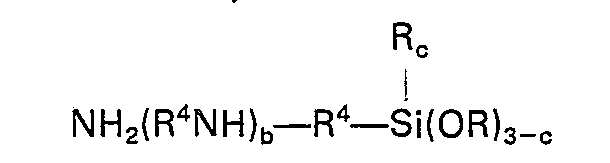
- aminofunctional silanes which may be used in preparing the compositions of this invention are beta-aminopropyltriethoxysilane, gamma-aminopropyltrimethoxysilane, methyl-beta-(aminoethyl)-gamma-aminopropyldimethoxysilane, omega-aminohexyltributoxysilane, beta-(aminoethoxy)propyltrimethoxysilane, beta-(aminoethoxy)hexyltriethoxysilane, beta-(aminopropoxy)butyltributoxysilane.
- Other aminofunctional silanes which may be used are those having the formulas
- aminofunctional siloxanes employed in the process of this invention are well known in the art. They may be prepared in accordance with the process described in U.S. Patent No. 2,947,771 to Bailey, in which an aminofunctional silane is equilibrated with a siloxane in the presence of an alkali-metal hydroxide. Also, they may be 'prepared in accordance with the process-described in U.S. Patent No. 3,598,853 to Friedman et al, in which an aminofunctional silane is condensed with a silanol terminated polydiorganosiloxane. Other methods for preparing aminofunctional siloxane fluids are described in U.S. Patents Nos. 3,890,269 to Martin, 2,930,809 to Jex et al and 3,045,036 to Jex et al. The aminofunctional siloxanes described in these references and their methods of preparation are incorporated herein by reference.
- aminofunctional siloxanes have at least one unit of the formula or of the formula or of the formula wherein b is 0, 1 or 2.
- the quaternary ammonium functional silicon compounds of the present invention may be mixed with various diluents.
- suitable diluents are organic solvents such as alcohols, e.g., ethanol and 1-propanol, aliphatic solvents such as heptane and iso-octane, aromatic solvents such as toluene and xylene and chlorinated solvents such as chloroform and 1,1,1-trichloroethane.
- diluents are water and organosiloxanes having a viscosity up to 100,000 mPa.s at 25°C, such as hexamethyldisiloxane, diorganopolysiloxanes such as dimethylpolysiloxanes, cyclic siloxanes, organofunctional polysiloxanes such as aminofunctional, mercaptofunctional and carboxylic acid functional polysiloxanes.
- Preferred diluents are non-protic solvents or water.
- the quaternary ammonium functional silicon compounds of this invention may be used to treat textile materials to impart antistatic properties thereto.
- the said-quaternary ammonium functional silicon compounds may be applied to textile fabrics in concentrated form or in the presence of a diluent.
- the amount of quaternary ammonium functional silicon compound present in the diluent may range from 0.25 to 99 percent, preferably from 2 to 50 percent by weight based on the weight of the quaternary ammonium functional silicon compound and the diluent.
- The,qtTaternary ammonium functional silicon compounds of this invention may be applied to all textile materials, preferably organic textile materials on which polyorganosiloxanes have been or could have been applied heretofore.
- textile materials are wool, cotton, rayon, hemp, natural silk, polypropylene, polyethylene, polyester, polyurethane, polyamide, cetiutose acetate, polyacrylonitrile fibers, and mixtures of such fibers.
- the textile materials may consist of staple fibers or monofilaments.
- the quaternary ammonium functional silicon compounds of this invention and other substances, if desired, may be applied to the textile materials by any means known in the art, such as by spraying, immersion, padding, calendering or by gliding the fibers across a base which has been saturated with the quaternary ammonium functional silicon compounds of this invention and other materials, if desired.
- the solids add-on is in the range of from 0.001 to 20 percent and more preferably from 0.05 to 10 percent, based on the original weight of the textile material.
- the textile material After the textile material has been treated, it is dried at an elevated temperature, e.g., from 50 to 200°C for a brief period of time. e.g., from 3 to 15 minutes.
- an elevated temperature e.g., from 50 to 200°C for a brief period of time. e.g., from 3 to 15 minutes.
- Example 1 (a) To a flask containing 152.8 parts of the toluene solution containing the carboxylic acid functional quaternary ammonium compound prepared in Example 1 (a) above is added 400 parts of the 3-aminopropyl functional dimethylpolysiloxane prepared in Example 1 (b) above. After a slight exotherm, the reactants are heated at 65°C for three hours and then filtered. The chloride content of the resultant product is 5,000 ppm (parts per million by weight). (Calculated 5500 ppm).
- a flask containing 222 parts of 2-aminoethyl-3-aminopropyltrimethoxysilane, 1110 parts of octamethylcyclotetrasiloxane and 1.5 parts potassium hydroxide is heated for 3 hours at 145°C and then cooled to 100°C. About 1.5 parts of glacial acetic acid are added to the reaction mixture and then filtered. A clear liquid having a base equivalent of 1.5 milliequivalents/g is obtained.
- Example 1(c) The procedure of Example 1(c) is repeated except that 113.8 parts of the 2-aminoethyl-3-aminopropyl functional polydimethylsiloxane prepared in 3(a) above is substituted for the 3-aminopropyl functional polydimethylsiloxane prepared in Example 1(b) above.
- a transparent amber liquid is obtained which forms a gum-like polymer when the solvent is removed in the presence of atmospheric moisture.
- the product is identified as being a quaternary ammonium functional polydimethylsiloxane by Infrared Analysis.
- a flask containing 1802.8 parts of octamethylcyclotetrasiloxane, 850 parts of eicosamethylnonasiloxane, and 2.5 parts of potassium hydroxide is heated to 150°C.
- About 278 parts of 2-aminoethyl-3-aminopropyltrimethoxysilane are mixed with 278 parts of water, and then slowly added to the flask, which is maintained at 150°C for a period of 3 hours.
- the reaction mixture is cooled to 100°C and then 2.5 parts of glacial acetic acid are added.
- the resultant product is cooled to room temperature and filtered.
- a clear, liquid having a viscosity of 71.9 mm 2 /s at 25°C and a base equivalent of 0.75 milliequivalents/g is recovered.
- Example 1(c) The procedure of Example 1(c) is repeated except that 224 parts of 2-aminoethyl-3-aminopropyl functional polydimethylsiloxane prepared in 4(a) above is substituted for the 3-aminopropyl functional dimethylpolysiloxane prepared in Example 1(b) above.
- the resultant product is vacuum stripped for 3 hours-at 85°C.
- An opaque amber liquid is recovered having a viscosity of 200,000 min 2 /s at 25°C. It is identified by Infrared Analysis as being a quaternary ammonium functional polydimethylsiloxane.
- a 2-aminoethyl-3-aminopropyl functional polydimethylsiloxane is prepared by reaching 2-aminoethyl-3-aminopropyltrimethoxysilane with a dimethylpolysiloxane diol.
- the resultant polydimethylsiloxane has the formula
- Example 1 (c) The procedure of Example 1 (c) is repeated except that 72.6 parts of the 2-aminoethyl-3-aminopropyl functional polydimethylsiloxane prepared in 5(a) above is substituted for the ethoxy endblocked 3-aminopropyl functional dimethylpolysiloxane prepared in Example 1(b).
- the quaternary ammonium functional polydimethylsiloxane thus formed is vacuum stripped for 3 hours at 85°C.
- the resultant product is an amber, gum-like polymer which upon exposure to the atmospheric moisture formed a rubber-like film.
- Example 1 (a) The procedure of Example 1 (a) is repeated except that 234.7 parts of phthalic anhydride are reacted with the carbinol functional quaternary compound.
- the acid content of the solution is about 1.0 milliequivalents. (Calculated 1.07 milliequivalents/g).
- a flask containing about 168 parts of the solution containing the carboxylic acid functional quaternary ammonium compound prepared in Example 6(a) above and 400 parts of the 3-aminopropyl functional polydimethylsiloxane prepared in accordance with Example 1(b) is heated for 3 hours at 65°C and then filtered.
- the resultant filtrate has a chloride content of about 5,000 ppm. (Calculated 5,620 ppm). It has a nitrogen content of about 6,000 ppm. (Calculated 6,373 ppm).
- a flask containing 320 parts of a carbinol functional quaternary ammonium compound represented by the formula 187.3 parts of succinic acid and 925 parts of toluene are refluxed until about 27 parts of water are azeotroped off.
- the reaction mixture is cooled to room temperatuure.
- the acid content of the mixture is 1.17 milliequivalents/g. (Calculated 1.1 ,milliequivalents/g).
- the chloride content is 1.8 percent. (Calculated chloride content is 2.0 percent).
- Example 7(a) To a flask containing about 343 parts of the solution containing the carboxylic acid functional quaternary ammonium compound prepared in Example 7(a) above is added 45 parts of 2-aminoethyl-3-aminopropyltrimethoxysilane. The temperature of the reaction mixture increased to about 40°C due to the exotherm. After stirring for 2 hours without heating, the solvent is then removed in vacuum at 60°C. A brown taffy-like liquid is obtained which upon exposure to atmospheric moisture cures to a glass-like film.
- Example 8(a) To a flask containing about 350 parts of the solution containing the carboxylic acid functional quaternary ammonium compound prepared in Example 8(a) above is added 35 parts of 2-aminoethyl-3-aminopropyl trimethoxysilane. An exotherm of about 12°C is observed. The reaction mixture is mixed for 2 hours at a temperature of about 36°C. The solvent is then removed in vacuum at 100°C. A brown, taffy-like liquid is obtained which upon exposure to atmospheric moisture, cures to a glass-like film. The chloride content of the resultant product is about 1.4 percent. (Calculated chloride content is 1.6 percent).
- Example 2 The procedures of Example 1 is repeated except that glutaconic anhydride is substituted for the succinic anhydride. A quaternary ammonium functional polydimethylsiloxane is obtained.
- Example 1 The procedure of Example 1 is repeated except that 1,2-cyclohexane dicarboxylic anhydride is substituted for the succinic anhydride. A quaternary ammonium functional polydimethylsiloxane is obtained.
- Example 11 (a) To a flask containing 65.4 parts of the product prepared in Example 11 (a) are added 500 parts of a trimethylsiloxy end-blocked 3-aminopropyl functional polydimethylsiloxane having a base content of 0.2 milliequivalents/g.
- the resultant product is an amber gum and has an acid content of 0.4 milliequivalents/g, (calculated 0.36 milliequivalents/g) and a chloride content of 5,550 ppm, (calculated 6,600 ppm).
Landscapes
- Chemical & Material Sciences (AREA)
- Organic Chemistry (AREA)
- Chemical Kinetics & Catalysis (AREA)
- Health & Medical Sciences (AREA)
- Medicinal Chemistry (AREA)
- Polymers & Plastics (AREA)
- General Chemical & Material Sciences (AREA)
- Inorganic Chemistry (AREA)
- Engineering & Computer Science (AREA)
- Textile Engineering (AREA)
- Silicon Polymers (AREA)
- Macromolecular Compounds Obtained By Forming Nitrogen-Containing Linkages In General (AREA)
- Polymers With Sulfur, Phosphorus Or Metals In The Main Chain (AREA)
Claims (10)




Priority Applications (1)
| Application Number | Priority Date | Filing Date | Title |
|---|---|---|---|
| AT83104991T ATE21257T1 (de) | 1982-05-21 | 1983-05-20 | Verfahren zur herstellung von quaternaeren ammniumgruppen enthaltenden siliciumverbindungen, ihre reaktionsprodukte und deren anwendung. |
Applications Claiming Priority (2)
| Application Number | Priority Date | Filing Date | Title |
|---|---|---|---|
| US380487 | 1982-05-21 | ||
| US06/380,487 US4394517A (en) | 1982-05-21 | 1982-05-21 | Quaternary ammonium functional silicon compounds |
Publications (3)
| Publication Number | Publication Date |
|---|---|
| EP0095155A2 EP0095155A2 (fr) | 1983-11-30 |
| EP0095155A3 EP0095155A3 (en) | 1984-03-28 |
| EP0095155B1 true EP0095155B1 (fr) | 1986-08-06 |
Family
ID=23501354
Family Applications (1)
| Application Number | Title | Priority Date | Filing Date |
|---|---|---|---|
| EP83104991A Expired EP0095155B1 (fr) | 1982-05-21 | 1983-05-20 | Procédé de préparation de composés de silice ayant des groupes d'ammonium quaternaires, dérivés de ces composés et leur emploi |
Country Status (7)
| Country | Link |
|---|---|
| US (1) | US4394517A (fr) |
| EP (1) | EP0095155B1 (fr) |
| JP (1) | JPS58206596A (fr) |
| AT (1) | ATE21257T1 (fr) |
| AU (1) | AU550222B2 (fr) |
| CA (1) | CA1215381A (fr) |
| DE (1) | DE3365112D1 (fr) |
Families Citing this family (9)
| Publication number | Priority date | Publication date | Assignee | Title |
|---|---|---|---|---|
| DE3705121A1 (de) * | 1987-02-18 | 1988-09-01 | Goldschmidt Ag Th | Polyquaternaere polysiloxan-polymere, deren herstellung und verwendung in kosmetischen zubereitungen |
| JPH0723585B2 (ja) * | 1989-11-06 | 1995-03-15 | 信越化学工業株式会社 | ウール処理剤 |
| JP4036354B2 (ja) * | 1998-10-12 | 2008-01-23 | 信越化学工業株式会社 | オルガノポリシロキサンを主成分とする防水処理剤組成物 |
| US6124490A (en) * | 1999-10-26 | 2000-09-26 | Mona Industries, Inc. | Zwitterionic siloxane polymers and ionically cross-linked polymers formed therefrom |
| EP3286249A4 (fr) * | 2015-04-20 | 2019-04-24 | The Government of the United States of America, as represented by the Secretary of the Navy | Résines polyamide coiffées à leurs extrémités par des silanes |
| EP3645017A4 (fr) | 2017-06-28 | 2021-05-19 | Collidion, Inc. | Compositions, procédés et utilisations pour le nettoyage, la désinfection et/ou la stérilisation |
| SG11202006664UA (en) | 2018-01-14 | 2020-08-28 | Collidion Inc | Compositions, kits, methods and uses for cleaning, disinfecting, sterilizing and/or treating |
| IL295553A (en) | 2020-02-14 | 2022-10-01 | Collidion Inc | Compounds, kits, methods and uses for cleaning, disinfection, sterilization and/or treatment |
| JP7686744B2 (ja) * | 2020-09-08 | 2025-06-02 | ワッカー ケミー アクチエンゲゼルシャフト | シリコーンコポリマー、それらの調製及び繊維状基材の処理のためのそれらの使用 |
Family Cites Families (9)
| Publication number | Priority date | Publication date | Assignee | Title |
|---|---|---|---|---|
| US2415017A (en) * | 1944-02-11 | 1947-01-28 | Montclair Res Corp | Textile treating compounds containing silicon and the process of making same |
| US2637623A (en) * | 1948-09-02 | 1953-05-05 | Deering Milliken Res Trust | Textile treating compounds and method of applying them to textiles |
| US2838423A (en) * | 1957-05-29 | 1958-06-10 | Dow Corning | Amidomethyl quaternary ammonium siloxanes and a method of rendering fabrics water repllent therewith |
| US3819675A (en) * | 1969-05-15 | 1974-06-25 | Dow Corning | Cationic unsaturated amine-functional silane coupling agents |
| US3734763A (en) * | 1969-05-15 | 1973-05-22 | Dow Corning | Cationic unsaturated amine-functional silane coupling agents |
| US3700844A (en) * | 1971-05-07 | 1972-10-24 | Nalco Chemical Co | Quaternary fluorsilicon dispersant |
| FR2443476A1 (fr) * | 1978-12-05 | 1980-07-04 | Oreal | Nouveaux polysiloxanes tensioactifs, procede pour les preparer et compositions les contenant |
| US4312993A (en) * | 1979-09-10 | 1982-01-26 | Sws Silicones Corporation | Silylated polyethers |
| US4246423A (en) * | 1979-10-22 | 1981-01-20 | Sws Silicones Corporation | Silicone polyether copolymers |
-
1982
- 1982-05-21 US US06/380,487 patent/US4394517A/en not_active Expired - Fee Related
-
1983
- 1983-02-14 AU AU11388/83A patent/AU550222B2/en not_active Ceased
- 1983-03-02 CA CA000422681A patent/CA1215381A/fr not_active Expired
- 1983-03-23 JP JP58047313A patent/JPS58206596A/ja active Granted
- 1983-05-20 DE DE8383104991T patent/DE3365112D1/de not_active Expired
- 1983-05-20 AT AT83104991T patent/ATE21257T1/de not_active IP Right Cessation
- 1983-05-20 EP EP83104991A patent/EP0095155B1/fr not_active Expired
Also Published As
| Publication number | Publication date |
|---|---|
| AU550222B2 (en) | 1986-03-06 |
| EP0095155A3 (en) | 1984-03-28 |
| AU1138883A (en) | 1983-11-24 |
| EP0095155A2 (fr) | 1983-11-30 |
| CA1215381A (fr) | 1986-12-16 |
| US4394517A (en) | 1983-07-19 |
| JPS58206596A (ja) | 1983-12-01 |
| ATE21257T1 (de) | 1986-08-15 |
| JPH0136832B2 (fr) | 1989-08-02 |
| DE3365112D1 (en) | 1986-09-11 |
Similar Documents
| Publication | Publication Date | Title |
|---|---|---|
| EP0161888B1 (fr) | Silicones ayant des radicaux diaminohydrocharbyles acylés et procédé pour leur préparation | |
| EP0028357B1 (fr) | Copolymères polysiloxane-polyéther, procédés pour leur fabrication, compositions pour le traitement de matériaux textiles et matériaux revêtus ainsi traités | |
| DE69020175T2 (de) | Verfahren zur Herstellung von Organosiliciumverbindungen. | |
| US4384130A (en) | Quaternary ammonium-functional silicon compounds | |
| US20040029981A1 (en) | Aqueous compositions | |
| JPH0632984A (ja) | オルガノポリシロキサンの水性分散液及び該水性分散液の製法 | |
| JPH073166A (ja) | 新規アミノ官能性ポリシロキサンのエマルジョン組成物 | |
| KR20010049620A (ko) | 질소 원자 함유 폴리실록산, 그의 제조 방법 및 섬유처리제 조성물 | |
| EP0399706B1 (fr) | Procédé de traitement de matériaux fibreux | |
| EP0095676A2 (fr) | Polysiloxanes fonctionnels ayant des groupes carboxyliques, procédé de préparation et leur emploi | |
| KR100956290B1 (ko) | 유기폴리실록산의 수성 분산액으로 파이버필 섬유를처리하는 방법 | |
| JPH0466896B2 (fr) | ||
| US4394517A (en) | Quaternary ammonium functional silicon compounds | |
| EP0095157B1 (fr) | Procédé de préparation de composés de silice ayant des groupes d'ammonium quaternaires, leurs dérivés et leur emploi | |
| US4511727A (en) | Quaternary ammonium-functional silicon compounds | |
| JPS586731B2 (ja) | オルガノシロキサン重合体の製造方法 | |
| JPS584114B2 (ja) | 羊毛を防縮加工するための調製剤 | |
| US4554331A (en) | Liquid copolymeric organosiloxanes | |
| JPS6352061B2 (fr) | ||
| US2803614A (en) | Tin compound as a curing agent for organopolysiloxanes | |
| US4615706A (en) | Quaternary ammonium-functional silicon compounds | |
| JPS6129612B2 (fr) | ||
| EP0044540B1 (fr) | Compositions d'organopolysiloxanes pour le traitement de matières textiles; leur préparation, un procédé pour le traitement de matières textiles et matières textiles ainsi traitées | |
| JPH0717752B2 (ja) | アルコキシ官能性オルガノポリシロキサンの製造方法 | |
| JPH0641566B2 (ja) | 安定化された硫黄官能ポリシロキサン流体 |
Legal Events
| Date | Code | Title | Description |
|---|---|---|---|
| PUAI | Public reference made under article 153(3) epc to a published international application that has entered the european phase |
Free format text: ORIGINAL CODE: 0009012 |
|
| 17P | Request for examination filed |
Effective date: 19830520 |
|
| AK | Designated contracting states |
Designated state(s): AT BE DE FR GB IT NL |
|
| PUAL | Search report despatched |
Free format text: ORIGINAL CODE: 0009013 |
|
| AK | Designated contracting states |
Designated state(s): AT BE DE FR GB IT NL |
|
| GRAA | (expected) grant |
Free format text: ORIGINAL CODE: 0009210 |
|
| AK | Designated contracting states |
Kind code of ref document: B1 Designated state(s): AT BE DE FR GB IT NL |
|
| REF | Corresponds to: |
Ref document number: 21257 Country of ref document: AT Date of ref document: 19860815 Kind code of ref document: T |
|
| REF | Corresponds to: |
Ref document number: 3365112 Country of ref document: DE Date of ref document: 19860911 |
|
| ITF | It: translation for a ep patent filed | ||
| RAP2 | Party data changed (patent owner data changed or rights of a patent transferred) |
Owner name: STAUFFER-WACKER SILICONES CORPORATION |
|
| ET | Fr: translation filed | ||
| BECN | Be: change of holder's name |
Effective date: 19861015 |
|
| NLT2 | Nl: modifications (of names), taken from the european patent patent bulletin |
Owner name: STAUFFER-WACKER SILICONES CORPORATION TE ADRIAN, M |
|
| REG | Reference to a national code |
Ref country code: FR Ref legal event code: CD |
|
| ET1 | Fr: translation filed ** revision of the translation of the patent or the claims | ||
| PLBE | No opposition filed within time limit |
Free format text: ORIGINAL CODE: 0009261 |
|
| STAA | Information on the status of an ep patent application or granted ep patent |
Free format text: STATUS: NO OPPOSITION FILED WITHIN TIME LIMIT |
|
| NLT1 | Nl: modifications of names registered in virtue of documents presented to the patent office pursuant to art. 16 a, paragraph 1 |
Owner name: STAUFFER-WACKER SILICONES CORPORATION TE ADRIAN, M |
|
| 26N | No opposition filed | ||
| REG | Reference to a national code |
Ref country code: FR Ref legal event code: CD |
|
| NLT1 | Nl: modifications of names registered in virtue of documents presented to the patent office pursuant to art. 16 a, paragraph 1 |
Owner name: WACKER SILICONES CORPORATION TE ADRIAN, MICHIGAN, |
|
| PGFP | Annual fee paid to national office [announced via postgrant information from national office to epo] |
Ref country code: AT Payment date: 19890417 Year of fee payment: 7 |
|
| PGFP | Annual fee paid to national office [announced via postgrant information from national office to epo] |
Ref country code: DE Payment date: 19890427 Year of fee payment: 7 |
|
| PGFP | Annual fee paid to national office [announced via postgrant information from national office to epo] |
Ref country code: FR Payment date: 19890515 Year of fee payment: 7 |
|
| PGFP | Annual fee paid to national office [announced via postgrant information from national office to epo] |
Ref country code: BE Payment date: 19890522 Year of fee payment: 7 |
|
| ITTA | It: last paid annual fee | ||
| PGFP | Annual fee paid to national office [announced via postgrant information from national office to epo] |
Ref country code: NL Payment date: 19890531 Year of fee payment: 7 Ref country code: GB Payment date: 19890531 Year of fee payment: 7 |
|
| PG25 | Lapsed in a contracting state [announced via postgrant information from national office to epo] |
Ref country code: GB Effective date: 19900520 Ref country code: AT Effective date: 19900520 |
|
| PG25 | Lapsed in a contracting state [announced via postgrant information from national office to epo] |
Ref country code: BE Effective date: 19900531 |
|
| BERE | Be: lapsed |
Owner name: WACKER SILICONES CORP. Effective date: 19900531 |
|
| PG25 | Lapsed in a contracting state [announced via postgrant information from national office to epo] |
Ref country code: NL Effective date: 19901201 |
|
| GBPC | Gb: european patent ceased through non-payment of renewal fee | ||
| NLV4 | Nl: lapsed or anulled due to non-payment of the annual fee | ||
| PG25 | Lapsed in a contracting state [announced via postgrant information from national office to epo] |
Ref country code: FR Effective date: 19910131 |
|
| PG25 | Lapsed in a contracting state [announced via postgrant information from national office to epo] |
Ref country code: DE Effective date: 19910201 |
|
| REG | Reference to a national code |
Ref country code: FR Ref legal event code: ST |