EP0095973B1 - Elektrochrome Vorrichtung verwendbar als Energiespeicher und elektrochrome Anzeigevorrichtung - Google Patents
Elektrochrome Vorrichtung verwendbar als Energiespeicher und elektrochrome Anzeigevorrichtung Download PDFInfo
- Publication number
- EP0095973B1 EP0095973B1 EP83401027A EP83401027A EP0095973B1 EP 0095973 B1 EP0095973 B1 EP 0095973B1 EP 83401027 A EP83401027 A EP 83401027A EP 83401027 A EP83401027 A EP 83401027A EP 0095973 B1 EP0095973 B1 EP 0095973B1
- Authority
- EP
- European Patent Office
- Prior art keywords
- electrode
- electrolyte
- electrochemical
- polymer
- anion
- Prior art date
- Legal status (The legal status is an assumption and is not a legal conclusion. Google has not performed a legal analysis and makes no representation as to the accuracy of the status listed.)
- Expired
Links
- 238000004146 energy storage Methods 0.000 title description 8
- 229920000642 polymer Polymers 0.000 claims description 28
- 150000001450 anions Chemical class 0.000 claims description 26
- 239000000178 monomer Substances 0.000 claims description 21
- WEVYAHXRMPXWCK-UHFFFAOYSA-N Acetonitrile Chemical compound CC#N WEVYAHXRMPXWCK-UHFFFAOYSA-N 0.000 claims description 19
- 150000001768 cations Chemical class 0.000 claims description 17
- 239000003792 electrolyte Substances 0.000 claims description 17
- 229920006254 polymer film Polymers 0.000 claims description 17
- 238000006116 polymerization reaction Methods 0.000 claims description 15
- WYURNTSHIVDZCO-UHFFFAOYSA-N Tetrahydrofuran Chemical compound C1CCOC1 WYURNTSHIVDZCO-UHFFFAOYSA-N 0.000 claims description 14
- -1 cyano, amino Chemical group 0.000 claims description 13
- BASFCYQUMIYNBI-UHFFFAOYSA-N platinum Chemical compound [Pt] BASFCYQUMIYNBI-UHFFFAOYSA-N 0.000 claims description 12
- 239000002904 solvent Substances 0.000 claims description 10
- YLQBMQCUIZJEEH-UHFFFAOYSA-N tetrahydrofuran Natural products C=1C=COC=1 YLQBMQCUIZJEEH-UHFFFAOYSA-N 0.000 claims description 10
- WHXSMMKQMYFTQS-UHFFFAOYSA-N Lithium Chemical compound [Li] WHXSMMKQMYFTQS-UHFFFAOYSA-N 0.000 claims description 9
- 229910052744 lithium Inorganic materials 0.000 claims description 9
- 125000004663 dialkyl amino group Chemical group 0.000 claims description 7
- 150000002500 ions Chemical class 0.000 claims description 6
- 229910052760 oxygen Inorganic materials 0.000 claims description 6
- VLTRZXGMWDSKGL-UHFFFAOYSA-M perchlorate Chemical compound [O-]Cl(=O)(=O)=O VLTRZXGMWDSKGL-UHFFFAOYSA-M 0.000 claims description 6
- 229910052697 platinum Inorganic materials 0.000 claims description 6
- 125000003545 alkoxy group Chemical group 0.000 claims description 5
- 125000000217 alkyl group Chemical group 0.000 claims description 5
- 125000003118 aryl group Chemical group 0.000 claims description 5
- SIKJAQJRHWYJAI-UHFFFAOYSA-N benzopyrrole Natural products C1=CC=C2NC=CC2=C1 SIKJAQJRHWYJAI-UHFFFAOYSA-N 0.000 claims description 5
- 229910052736 halogen Inorganic materials 0.000 claims description 5
- 150000002367 halogens Chemical class 0.000 claims description 5
- 125000002887 hydroxy group Chemical group [H]O* 0.000 claims description 5
- MHCFAGZWMAWTNR-UHFFFAOYSA-M lithium perchlorate Chemical compound [Li+].[O-]Cl(=O)(=O)=O MHCFAGZWMAWTNR-UHFFFAOYSA-M 0.000 claims description 5
- 229910001486 lithium perchlorate Inorganic materials 0.000 claims description 5
- 230000009467 reduction Effects 0.000 claims description 5
- 125000003107 substituted aryl group Chemical group 0.000 claims description 5
- PZOUSPYUWWUPPK-UHFFFAOYSA-N indole Natural products CC1=CC=CC2=C1C=CN2 PZOUSPYUWWUPPK-UHFFFAOYSA-N 0.000 claims description 4
- RKJUIXBNRJVNHR-UHFFFAOYSA-N indolenine Natural products C1=CC=C2CC=NC2=C1 RKJUIXBNRJVNHR-UHFFFAOYSA-N 0.000 claims description 4
- 239000000203 mixture Substances 0.000 claims description 4
- 125000001997 phenyl group Chemical group [H]C1=C([H])C([H])=C(*)C([H])=C1[H] 0.000 claims description 4
- 150000003839 salts Chemical class 0.000 claims description 4
- 229910052782 aluminium Inorganic materials 0.000 claims description 3
- XAGFODPZIPBFFR-UHFFFAOYSA-N aluminium Chemical compound [Al] XAGFODPZIPBFFR-UHFFFAOYSA-N 0.000 claims description 3
- 229910001914 chlorine tetroxide Inorganic materials 0.000 claims description 3
- 150000001875 compounds Chemical class 0.000 claims description 3
- 125000000623 heterocyclic group Chemical group 0.000 claims description 3
- 125000001041 indolyl group Chemical group 0.000 claims description 3
- 125000002496 methyl group Chemical group [H]C([H])([H])* 0.000 claims description 3
- 239000004411 aluminium Substances 0.000 claims description 2
- 125000005228 aryl sulfonate group Chemical group 0.000 claims description 2
- 239000003960 organic solvent Substances 0.000 claims description 2
- RUOJZAUFBMNUDX-UHFFFAOYSA-N propylene carbonate Chemical compound CC1COC(=O)O1 RUOJZAUFBMNUDX-UHFFFAOYSA-N 0.000 claims description 2
- 239000011248 coating agent Substances 0.000 claims 2
- 238000000576 coating method Methods 0.000 claims 2
- KNKRKFALVUDBJE-UHFFFAOYSA-N 1,2-dichloropropane Chemical compound CC(Cl)CCl KNKRKFALVUDBJE-UHFFFAOYSA-N 0.000 claims 1
- 229910052783 alkali metal Inorganic materials 0.000 claims 1
- 150000001340 alkali metals Chemical class 0.000 claims 1
- 238000005868 electrolysis reaction Methods 0.000 description 12
- YMWUJEATGCHHMB-UHFFFAOYSA-N Dichloromethane Chemical compound ClCCl YMWUJEATGCHHMB-UHFFFAOYSA-N 0.000 description 6
- KAESVJOAVNADME-UHFFFAOYSA-N 1H-pyrrole Natural products C=1C=CNC=1 KAESVJOAVNADME-UHFFFAOYSA-N 0.000 description 5
- QENGPZGAWFQWCZ-UHFFFAOYSA-N 3-Methylthiophene Chemical group CC=1C=CSC=1 QENGPZGAWFQWCZ-UHFFFAOYSA-N 0.000 description 5
- YTPLMLYBLZKORZ-UHFFFAOYSA-N Thiophene Chemical compound C=1C=CSC=1 YTPLMLYBLZKORZ-UHFFFAOYSA-N 0.000 description 5
- 238000004519 manufacturing process Methods 0.000 description 5
- 229910020366 ClO 4 Inorganic materials 0.000 description 4
- 238000009825 accumulation Methods 0.000 description 4
- HSFWRNGVRCDJHI-UHFFFAOYSA-N alpha-acetylene Natural products C#C HSFWRNGVRCDJHI-UHFFFAOYSA-N 0.000 description 4
- 238000012983 electrochemical energy storage Methods 0.000 description 4
- 229920001197 polyacetylene Polymers 0.000 description 4
- QVGXLLKOCUKJST-UHFFFAOYSA-N atomic oxygen Chemical compound [O] QVGXLLKOCUKJST-UHFFFAOYSA-N 0.000 description 3
- 230000008901 benefit Effects 0.000 description 3
- 239000002019 doping agent Substances 0.000 description 3
- 239000000463 material Substances 0.000 description 3
- 229910052751 metal Inorganic materials 0.000 description 3
- 239000002184 metal Substances 0.000 description 3
- 239000001301 oxygen Substances 0.000 description 3
- 239000002861 polymer material Substances 0.000 description 3
- 239000000126 substance Substances 0.000 description 3
- 125000004953 trihalomethyl group Chemical group 0.000 description 3
- 0 *c1c(*)c(*)c(*)c2c1cc[n]2 Chemical compound *c1c(*)c(*)c(*)c2c1cc[n]2 0.000 description 2
- XKRFYHLGVUSROY-UHFFFAOYSA-N Argon Chemical compound [Ar] XKRFYHLGVUSROY-UHFFFAOYSA-N 0.000 description 2
- 230000009471 action Effects 0.000 description 2
- 229920001940 conductive polymer Polymers 0.000 description 2
- 238000010494 dissociation reaction Methods 0.000 description 2
- 230000005593 dissociations Effects 0.000 description 2
- 150000002475 indoles Chemical class 0.000 description 2
- 238000000034 method Methods 0.000 description 2
- 230000003647 oxidation Effects 0.000 description 2
- 238000007254 oxidation reaction Methods 0.000 description 2
- VLTRZXGMWDSKGL-UHFFFAOYSA-N perchloric acid Chemical compound OCl(=O)(=O)=O VLTRZXGMWDSKGL-UHFFFAOYSA-N 0.000 description 2
- 239000011734 sodium Substances 0.000 description 2
- 238000006467 substitution reaction Methods 0.000 description 2
- 229930192474 thiophene Natural products 0.000 description 2
- YHYLDEVWYOFIJK-UHFFFAOYSA-N 1h-indole-5-carbonitrile Chemical group N#CC1=CC=C2NC=CC2=C1 YHYLDEVWYOFIJK-UHFFFAOYSA-N 0.000 description 1
- BVKZGUZCCUSVTD-UHFFFAOYSA-L Carbonate Chemical compound [O-]C([O-])=O BVKZGUZCCUSVTD-UHFFFAOYSA-L 0.000 description 1
- RYGMFSIKBFXOCR-UHFFFAOYSA-N Copper Chemical compound [Cu] RYGMFSIKBFXOCR-UHFFFAOYSA-N 0.000 description 1
- DGAQECJNVWCQMB-PUAWFVPOSA-M Ilexoside XXIX Chemical compound C[C@@H]1CC[C@@]2(CC[C@@]3(C(=CC[C@H]4[C@]3(CC[C@@H]5[C@@]4(CC[C@@H](C5(C)C)OS(=O)(=O)[O-])C)C)[C@@H]2[C@]1(C)O)C)C(=O)O[C@H]6[C@@H]([C@H]([C@@H]([C@H](O6)CO)O)O)O.[Na+] DGAQECJNVWCQMB-PUAWFVPOSA-M 0.000 description 1
- 229920000265 Polyparaphenylene Polymers 0.000 description 1
- 239000004734 Polyphenylene sulfide Substances 0.000 description 1
- ZLMJMSJWJFRBEC-UHFFFAOYSA-N Potassium Chemical compound [K] ZLMJMSJWJFRBEC-UHFFFAOYSA-N 0.000 description 1
- QQONPFPTGQHPMA-UHFFFAOYSA-N Propene Chemical compound CC=C QQONPFPTGQHPMA-UHFFFAOYSA-N 0.000 description 1
- 229910052786 argon Inorganic materials 0.000 description 1
- 230000015572 biosynthetic process Effects 0.000 description 1
- 125000000484 butyl group Chemical group [H]C([*])([H])C([H])([H])C([H])([H])C([H])([H])[H] 0.000 description 1
- 229940075397 calomel Drugs 0.000 description 1
- 230000015556 catabolic process Effects 0.000 description 1
- 239000004020 conductor Substances 0.000 description 1
- 229910052802 copper Inorganic materials 0.000 description 1
- 239000010949 copper Substances 0.000 description 1
- 238000006731 degradation reaction Methods 0.000 description 1
- ZOMNIUBKTOKEHS-UHFFFAOYSA-L dimercury dichloride Chemical compound Cl[Hg][Hg]Cl ZOMNIUBKTOKEHS-UHFFFAOYSA-L 0.000 description 1
- 238000007598 dipping method Methods 0.000 description 1
- 238000007599 discharging Methods 0.000 description 1
- 230000000694 effects Effects 0.000 description 1
- 238000006056 electrooxidation reaction Methods 0.000 description 1
- 125000001495 ethyl group Chemical group [H]C([H])([H])C([H])([H])* 0.000 description 1
- 230000006870 function Effects 0.000 description 1
- 150000002240 furans Chemical class 0.000 description 1
- 239000007789 gas Substances 0.000 description 1
- PCHJSUWPFVWCPO-UHFFFAOYSA-N gold Chemical compound [Au] PCHJSUWPFVWCPO-UHFFFAOYSA-N 0.000 description 1
- 229910052737 gold Inorganic materials 0.000 description 1
- 239000010931 gold Substances 0.000 description 1
- 125000005842 heteroatom Chemical group 0.000 description 1
- PDZGAEAUKGKKDE-UHFFFAOYSA-N lithium;naphthalene Chemical compound [Li].C1=CC=CC2=CC=CC=C21 PDZGAEAUKGKKDE-UHFFFAOYSA-N 0.000 description 1
- 230000007774 longterm Effects 0.000 description 1
- 238000004452 microanalysis Methods 0.000 description 1
- 230000004048 modification Effects 0.000 description 1
- 238000012986 modification Methods 0.000 description 1
- IJJSYKQZFFGIEE-UHFFFAOYSA-N naphthalene;potassium Chemical compound [K].C1=CC=CC2=CC=CC=C21 IJJSYKQZFFGIEE-UHFFFAOYSA-N 0.000 description 1
- URXNVXOMQQCBHS-UHFFFAOYSA-N naphthalene;sodium Chemical compound [Na].C1=CC=CC2=CC=CC=C21 URXNVXOMQQCBHS-UHFFFAOYSA-N 0.000 description 1
- 230000003287 optical effect Effects 0.000 description 1
- 150000003057 platinum Chemical class 0.000 description 1
- 229920000069 polyphenylene sulfide Polymers 0.000 description 1
- 229910052700 potassium Inorganic materials 0.000 description 1
- 239000011591 potassium Substances 0.000 description 1
- 238000004321 preservation Methods 0.000 description 1
- 230000002035 prolonged effect Effects 0.000 description 1
- 150000003233 pyrroles Chemical class 0.000 description 1
- 230000035945 sensitivity Effects 0.000 description 1
- 229910052708 sodium Inorganic materials 0.000 description 1
- 238000001228 spectrum Methods 0.000 description 1
- 150000001420 substituted heterocyclic compounds Chemical class 0.000 description 1
- 238000010408 sweeping Methods 0.000 description 1
- 238000003786 synthesis reaction Methods 0.000 description 1
- 239000012780 transparent material Substances 0.000 description 1
Images
Classifications
-
- C—CHEMISTRY; METALLURGY
- C25—ELECTROLYTIC OR ELECTROPHORETIC PROCESSES; APPARATUS THEREFOR
- C25B—ELECTROLYTIC OR ELECTROPHORETIC PROCESSES FOR THE PRODUCTION OF COMPOUNDS OR NON-METALS; APPARATUS THEREFOR
- C25B3/00—Electrolytic production of organic compounds
- C25B3/20—Processes
- C25B3/29—Coupling reactions
-
- H—ELECTRICITY
- H01—ELECTRIC ELEMENTS
- H01M—PROCESSES OR MEANS, e.g. BATTERIES, FOR THE DIRECT CONVERSION OF CHEMICAL ENERGY INTO ELECTRICAL ENERGY
- H01M4/00—Electrodes
- H01M4/02—Electrodes composed of, or comprising, active material
- H01M4/36—Selection of substances as active materials, active masses, active liquids
- H01M4/60—Selection of substances as active materials, active masses, active liquids of organic compounds
-
- G—PHYSICS
- G02—OPTICS
- G02F—OPTICAL DEVICES OR ARRANGEMENTS FOR THE CONTROL OF LIGHT BY MODIFICATION OF THE OPTICAL PROPERTIES OF THE MEDIA OF THE ELEMENTS INVOLVED THEREIN; NON-LINEAR OPTICS; FREQUENCY-CHANGING OF LIGHT; OPTICAL LOGIC ELEMENTS; OPTICAL ANALOGUE/DIGITAL CONVERTERS
- G02F1/00—Devices or arrangements for the control of the intensity, colour, phase, polarisation or direction of light arriving from an independent light source, e.g. switching, gating or modulating; Non-linear optics
- G02F1/01—Devices or arrangements for the control of the intensity, colour, phase, polarisation or direction of light arriving from an independent light source, e.g. switching, gating or modulating; Non-linear optics for the control of the intensity, phase, polarisation or colour
- G02F1/15—Devices or arrangements for the control of the intensity, colour, phase, polarisation or direction of light arriving from an independent light source, e.g. switching, gating or modulating; Non-linear optics for the control of the intensity, phase, polarisation or colour based on an electrochromic effect
- G02F1/1514—Devices or arrangements for the control of the intensity, colour, phase, polarisation or direction of light arriving from an independent light source, e.g. switching, gating or modulating; Non-linear optics for the control of the intensity, phase, polarisation or colour based on an electrochromic effect characterised by the electrochromic material, e.g. by the electrodeposited material
- G02F1/1516—Devices or arrangements for the control of the intensity, colour, phase, polarisation or direction of light arriving from an independent light source, e.g. switching, gating or modulating; Non-linear optics for the control of the intensity, phase, polarisation or colour based on an electrochromic effect characterised by the electrochromic material, e.g. by the electrodeposited material comprising organic material
- G02F1/15165—Polymers
-
- H—ELECTRICITY
- H01—ELECTRIC ELEMENTS
- H01M—PROCESSES OR MEANS, e.g. BATTERIES, FOR THE DIRECT CONVERSION OF CHEMICAL ENERGY INTO ELECTRICAL ENERGY
- H01M10/00—Secondary cells; Manufacture thereof
- H01M10/36—Accumulators not provided for in groups H01M10/05-H01M10/34
-
- Y—GENERAL TAGGING OF NEW TECHNOLOGICAL DEVELOPMENTS; GENERAL TAGGING OF CROSS-SECTIONAL TECHNOLOGIES SPANNING OVER SEVERAL SECTIONS OF THE IPC; TECHNICAL SUBJECTS COVERED BY FORMER USPC CROSS-REFERENCE ART COLLECTIONS [XRACs] AND DIGESTS
- Y02—TECHNOLOGIES OR APPLICATIONS FOR MITIGATION OR ADAPTATION AGAINST CLIMATE CHANGE
- Y02E—REDUCTION OF GREENHOUSE GAS [GHG] EMISSIONS, RELATED TO ENERGY GENERATION, TRANSMISSION OR DISTRIBUTION
- Y02E60/00—Enabling technologies; Technologies with a potential or indirect contribution to GHG emissions mitigation
- Y02E60/10—Energy storage using batteries
Definitions
- the invention relates to electronic devices and in particular their application to the storage of energy, in the form of batteries, comprising electrodes obtained by electrochemical polymerization of a heterocyclic monomer on an electrically conductive support.
- Energy storage is generally carried out using accumulator batteries whose number of charge-discharge cycles is limited and the bulk, or of batteries whose bulk is small but which are not rechargeable. It therefore appears difficult to have energy storage devices which are both compact, recyclable and reliable in prolonged use.
- energy storage devices which are both compact, recyclable and reliable in prolonged use.
- devices making it possible to provide emergency power to electrical or electronic systems particularly sensitive to interruptions, even very brief, of their power supply, due for example to power outages. This is the case in particular of the equipment used in the IT field or of the bodies constituting the telephone exchanges in order to ensure the preservation of the data stored in memory.
- batteries comprising active polymer elements are high energy stored per unit of weight, about twice as much as conventional lead batteries, and a high number of charge-discharge cycles. Batteries were thus produced using basic polymers such as polyacetylene, polyphenylene and polyphenylene sulfide. However, these polymers have a serious drawback which is a high sensitivity to oxygen. The action of oxygen in the long term causes degradation and breaking of the polymer chains. Furthermore, in the case in particular of polyacetylene, one is forced to choose to make the electrolyte a solvent which resists electrolysis during charging.
- the invention due, on the one hand to MM. F. GARNIER and G. TOURILLON from the Solar Photochemistry Laboratory of the C.N.R.S. and to Mr. J.-C. DUBOIS of THOMSON-CSF on the other hand, offers batteries using electrodes made of conductive polymers obtained by electrochemical polymerization of substituted heterocyclic compounds. These new conductive polymers make it possible to obtain electrochemical energy storage devices having an improved lifespan compared to existing batteries as well as great stability of the materials constituting the electrodes.
- the subject of the invention is also a device serving for the accumulation and the restitution of energy by a redox phenomenon.
- the invention also relates to an electrochromic display system.
- the description will first relate to the method of obtaining the conductors used by the invention; it will then focus on making batteries using these materials.
- the polymers will be used in the form of films deposited on a conductive body.
- the polymer films according to the invention are obtained from monomers which have at least one 5-membered aromatic heterocycle containing a single hetero atom.
- the monomer can be a derivative substituted in position 3, in position 4, or in position 3 or 4 of thiophene or furan. It can be an indole substituted on the phenyl ring by 1 to 4 groups.
- the substitutions can be either a group of alkyl, alkoxyl, hydroxyl, aryl, substituted aryl, halogen, trihalomethyl, cyano, amino, dialkylamino type.
- the polymerization of the monomer is carried out in an electrolysis cell containing the monomer dissolved in an organic solvent such as acetonitrile, tetrahydrofuran, methylene chloride or a water-actetonitrile mixture, in the presence of a conductive salt of formula A + X -.
- the cation A + can be an alkaline element, an ion N + R ,, (R being ethyl, butyl or a similar compound).
- the anion X- can be an ion of the ClO 4 - , BF 4 - , PF 6 - , Br - type or an aryl sulfonate.
- the monomer concentrations can be between 5.10 -3 and 0.1 mole per liter and those in conductive salt between 10 -2 and 1 mole per liter.
- a polymer film is deposited on the conductive body used as the anode of the electrolysis cell.
- the anode can be metallic, for example gold or platinum.
- an anode electrode constituted by a conductive body coated with a polymer film adhering thereto.
- the polymer film which forms on the surface of the anode contains a certain proportion of the anion coming from the electrolyte and its general formula can be written in the form (M + X - y) n where M represents the monomer , X- the anion or counterion, y the proportion of anion in the polymer relative to one mole of monomer and n the degree of polymerization.
- M represents the monomer
- X- the anion or counterion
- y the proportion of anion in the polymer relative to one mole of monomer
- n the degree of polymerization.
- y is a factor that can vary between 0.1 and 0.5.
- the polymer and the anion form a charge transfer complex whose conductivity varies between 10 -2 and 100 ⁇ -1 cm -1 .
- substitutions R 1 to R 6 being the groups already mentioned.
- This example describes the typical manufacture of a doped polymer where the monomer is methyl-3-thiophene and the dopant the ion ClO 4 - .
- the polymerization can be carried out in an electrolysis cell comprising the anode, the cathode and optionally a reference electrode, for example in calomel.
- the cell is filled with a solution containing 10- 2 mol of methyl-3-thiophene and 0.1 mole of lithium perchlorate per 1 liter of acetonitrile.
- the anode is for example a platinum blade.
- the cathode can be in the form of a platinum film.
- the solution is deoxygenated by sweeping dry argon for at least half an hour.
- the potential of the anode is fixed at 1.4 V relative to the reference electrode.
- the polymer obtained by this method is poly methyl-3-thiophene which can be represented by the following chemical formula, determined by microanalysis:
- This polymer is stable in air and under vacuum up to temperatures above 300 ° C. Its conductivity is between 10 and 100 ⁇ -1 . cm -1 .
- the electrode covered with its polymer film is rinsed in acetonitrile and is then ready to serve as an anode in an electrochemical energy storage device.
- the polymer can be doped with other anions.
- tetrabutylammonium hexafluorophosphate N (Bu) 4+ PF 6 - or tetrabutylammonium tetrafluoroborate N (Bu) 4 + BF 4 - in a concentration identical to lithium perchlorate, a poly methyl film is obtained -3-thiophene doped with PF 6 - or BF 4 - anions.
- This example describes the manufacture of a doped polymer where the basic monomer is 5-cyanoindole of chemical formula: and where the dopant is the ClO 4 - anion.
- the synthesis of the polymer is carried out in the same way as that of poly methyl-3-thiophene with a potential difference of 1.4V between the anode and the reference electrode.
- the monomer and electrolyte concentrations are identical to those given in Example 1.
- the electrolyte used can be lithium perchlorate.
- the above examples made it possible to obtain, by electrochemical oxidation, electrodes covered with a polymer film doped with anions.
- the electrons flowing in the discharge circuit go from the least oxidized electrode (cathode) to the most oxidized electrode (anode) until the two electrodes reach the same oxidation state.
- An electrode covered with a polymer film doped with anions will therefore form the anode of an energy storage device.
- the cathode of such a device can be a simple metal electrode or an electrode covered with a polymer doped with cations.
- a first electrochemical reduction is possible just after the polymerization by leaving the anode in the electrolysis cell and causing the discharge of the cell. This discharge causes the anions housed inside the polymer to be extracted and an anion-depleted polymer is obtained which contains sites which can be occupied by cations.
- a second reduction can then be carried out either chemically or electrochemically.
- the chemical route consists in dipping the polymer in a solution containing the desired cations. These cations will occupy the sites left vacant by the original anions.
- the electrochemical route consists in placing the deionized electrode as a cathode in an electrolysis cell containing the desired cations in solution. These are inserted into the sites left vacant by the original anions when the electrolysis of the solution is caused.
- the cations can be alkaline ions such as sodium, potassium, lithium or compounds of the genus (BU) 4 N + or (Et) 4 N + derived from an electrolyte in solution in a solvent such as acetonitrile. or tetrahydrofuran.
- the electrolyte concentration in the solution may be between 10 -2 and 1 mol per 1 liter of solvent.
- Electrodes covered with a film of deionized polymer capable of being again ionized.
- Energy storage devices can then be manufactured using these electrodes as an anode and cathode, their doping with anions or cations being effected during the first charge.
- the electrochemical devices thus produced will generally have the advantage, thanks to the polymers used, of having a higher redox potential than known devices which use other polymers.
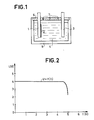
- Figure 2 shows the discharge characteristic of a device such as that described above.
- the device according to the invention can be compared to a battery according to the state of the art.
- the battery of known type indeed had a lithium cathode and an anode comprising a layer of polyacetylene.
- the table below brings together the essential characteristics of the two devices by comparing them.
- the values of the powers are given as a function of the weight of polymer material on the anode.
- the potential difference between anode and cathode is given at the start of discharge.
- the device according to the invention is capable of storing more energy per unit of weight than the device of the known art and that the power delivered is significantly higher.
- the redox potential is higher than using polyacetylene, which leads to having between the anode and the cathode of the device a higher potential difference.
- Polymer materials doped with anions or cations have the property of modifying their color according to their electrochemical state.
- the polymer films deposited on the electrodes undergo oxidation and reduction cycles with modification of the optical spectra. It is therefore possible to use such a device as an electrochromic display cell.
- the device should give free access to a light ray incident on one of the polymer films by choosing transparent materials to manufacture the elements located on the path of the light beam.
- the electrochemical cells according to the invention therefore make it possible to produce energy storage devices having many advantages compared to existing systems: higher redox potential, greater inertia vis-à-vis common solvents, greater temperature stability, better resistance to the action of oxygen. They can be used as non-rechargeable batteries, for example in the case where the cathode made of alkaline material decomposes entirely during discharge. They can be combined to form storage batteries. It is possible to use their electrochromic effects in display devices associated or not with their energy storage properties.
Landscapes
- Chemical & Material Sciences (AREA)
- Physics & Mathematics (AREA)
- Chemical Kinetics & Catalysis (AREA)
- Electrochemistry (AREA)
- General Chemical & Material Sciences (AREA)
- Nonlinear Science (AREA)
- Organic Chemistry (AREA)
- Engineering & Computer Science (AREA)
- Materials Engineering (AREA)
- Optics & Photonics (AREA)
- General Physics & Mathematics (AREA)
- Metallurgy (AREA)
- Manufacturing & Machinery (AREA)
- Secondary Cells (AREA)
- Battery Electrode And Active Subsutance (AREA)
- Polyoxymethylene Polymers And Polymers With Carbon-To-Carbon Bonds (AREA)
Claims (14)


Applications Claiming Priority (2)
| Application Number | Priority Date | Filing Date | Title |
|---|---|---|---|
| FR8209513 | 1982-06-01 | ||
| FR8209513A FR2527844B1 (fr) | 1982-06-01 | 1982-06-01 | Dispositif electrochromique pouvant servir au stockage d'energie et systeme d'affichage electrochromique |
Publications (2)
| Publication Number | Publication Date |
|---|---|
| EP0095973A1 EP0095973A1 (de) | 1983-12-07 |
| EP0095973B1 true EP0095973B1 (de) | 1987-01-28 |
Family
ID=9274514
Family Applications (1)
| Application Number | Title | Priority Date | Filing Date |
|---|---|---|---|
| EP83401027A Expired EP0095973B1 (de) | 1982-06-01 | 1983-05-24 | Elektrochrome Vorrichtung verwendbar als Energiespeicher und elektrochrome Anzeigevorrichtung |
Country Status (5)
| Country | Link |
|---|---|
| US (1) | US4543306A (de) |
| EP (1) | EP0095973B1 (de) |
| JP (1) | JPH0619998B2 (de) |
| DE (1) | DE3369572D1 (de) |
| FR (1) | FR2527844B1 (de) |
Families Citing this family (57)
| Publication number | Priority date | Publication date | Assignee | Title |
|---|---|---|---|---|
| EP0183053B1 (de) * | 1984-11-29 | 1990-02-07 | VARTA Batterie Aktiengesellschaft | Galvanisches Element mit einer Polymerelektrode |
| DE3443455A1 (de) * | 1984-11-29 | 1986-05-28 | Varta Batterie Ag, 3000 Hannover | Galvanisches element mit einer polymerelektrode |
| DE3617777A1 (de) * | 1985-05-27 | 1986-11-27 | Ricoh Co., Ltd., Tokio/Tokyo | Organisches sekundaerelement |
| EP0203438A1 (de) * | 1985-05-31 | 1986-12-03 | Corporation Allied | In Lösung anwendbare Formen von neutralen und elektrisch leitfähigen polysubstituierten heterocyclischen Verbindungen |
| FR2596566B1 (fr) * | 1986-04-01 | 1989-03-10 | Solvay | Polymeres conducteurs derives de 3-alkylthiophenes, procede pour leur fabrication et dispositifs electroconducteurs les contenant |
| JPS6414871A (en) * | 1987-07-08 | 1989-01-19 | Sumitomo Electric Industries | Secondary battery |
| FI82702C (fi) * | 1987-07-29 | 1991-04-10 | Neste Oy | Elledande plastkompositer, som innehaoller poly (3-alkyltiofen) |
| DE3878383T2 (de) * | 1987-10-06 | 1993-09-09 | Sharp Kk | Sekundaerbatterie. |
| DE3838329A1 (de) * | 1987-11-11 | 1989-05-24 | Ricoh Kk | Negative elektrode fuer sekundaerbatterie |
| GB2240984B (en) * | 1989-11-07 | 1993-12-08 | British Aerospace | Conductive compositions |
| JP2631910B2 (ja) * | 1990-11-16 | 1997-07-16 | 帝人株式会社 | ポリマー二次電池用ポリピロール成形体およびその製造方法 |
| JP2958576B2 (ja) * | 1991-01-24 | 1999-10-06 | 富士写真フイルム株式会社 | 電池用正極材料 |
| USH1054H (en) | 1991-06-14 | 1992-05-05 | The United States Of America As Represented By The Secretary Of The Army | Electrochemical cell that delivers high power pulses |
| JP2993272B2 (ja) * | 1992-05-07 | 1999-12-20 | 松下電器産業株式会社 | 可逆性電極 |
| USH1462H (en) * | 1993-11-01 | 1995-07-04 | The United States Of America As Represented By The Secretary Of The Army | Solid state electrochemical lithium/polymer cell |
| US6120839A (en) * | 1995-07-20 | 2000-09-19 | E Ink Corporation | Electro-osmotic displays and materials for making the same |
| US6515649B1 (en) | 1995-07-20 | 2003-02-04 | E Ink Corporation | Suspended particle displays and materials for making the same |
| US7106296B1 (en) | 1995-07-20 | 2006-09-12 | E Ink Corporation | Electronic book with multiple page displays |
| US7071913B2 (en) | 1995-07-20 | 2006-07-04 | E Ink Corporation | Retroreflective electrophoretic displays and materials for making the same |
| US6262706B1 (en) | 1995-07-20 | 2001-07-17 | E Ink Corporation | Retroreflective electrophoretic displays and materials for making the same |
| US7109968B2 (en) | 1995-07-20 | 2006-09-19 | E Ink Corporation | Non-spherical cavity electrophoretic displays and methods and materials for making the same |
| US6727881B1 (en) | 1995-07-20 | 2004-04-27 | E Ink Corporation | Encapsulated electrophoretic displays and methods and materials for making the same |
| US6067185A (en) | 1997-08-28 | 2000-05-23 | E Ink Corporation | Process for creating an encapsulated electrophoretic display |
| US6300932B1 (en) | 1997-08-28 | 2001-10-09 | E Ink Corporation | Electrophoretic displays with luminescent particles and materials for making the same |
| US6839158B2 (en) | 1997-08-28 | 2005-01-04 | E Ink Corporation | Encapsulated electrophoretic displays having a monolayer of capsules and materials and methods for making the same |
| US7002728B2 (en) | 1997-08-28 | 2006-02-21 | E Ink Corporation | Electrophoretic particles, and processes for the production thereof |
| US7247379B2 (en) | 1997-08-28 | 2007-07-24 | E Ink Corporation | Electrophoretic particles, and processes for the production thereof |
| US7242513B2 (en) | 1997-08-28 | 2007-07-10 | E Ink Corporation | Encapsulated electrophoretic displays having a monolayer of capsules and materials and methods for making the same |
| AU3190499A (en) | 1998-03-18 | 1999-10-11 | E-Ink Corporation | Electrophoretic displays and systems for addressing such displays |
| JP4664501B2 (ja) | 1998-04-10 | 2011-04-06 | イー インク コーポレイション | 有機系電界効果トランジスタを用いる電子ディスプレイ |
| JP4651193B2 (ja) | 1998-05-12 | 2011-03-16 | イー インク コーポレイション | ドローイングデバイス用途のためのマイクロカプセル化した電気泳動性の静電的にアドレスした媒体 |
| USD485294S1 (en) | 1998-07-22 | 2004-01-13 | E Ink Corporation | Electrode structure for an electronic display |
| AU6293499A (en) | 1998-10-07 | 2000-04-26 | E-Ink Corporation | Capsules for electrophoretic displays and methods for making the same |
| AU6295899A (en) | 1998-10-07 | 2000-04-26 | E-Ink Corporation | Illumination system for nonemissive electronic displays |
| CA2365847A1 (en) | 1999-04-06 | 2000-10-12 | Gregg M. Duthaler | Methods for producing droplets for use in capsule-based electrophoretic displays |
| US6842657B1 (en) | 1999-04-09 | 2005-01-11 | E Ink Corporation | Reactive formation of dielectric layers and protection of organic layers in organic semiconductor device fabrication |
| US6498114B1 (en) | 1999-04-09 | 2002-12-24 | E Ink Corporation | Method for forming a patterned semiconductor film |
| US8115729B2 (en) | 1999-05-03 | 2012-02-14 | E Ink Corporation | Electrophoretic display element with filler particles |
| US7038655B2 (en) | 1999-05-03 | 2006-05-02 | E Ink Corporation | Electrophoretic ink composed of particles with field dependent mobilities |
| US6693620B1 (en) | 1999-05-03 | 2004-02-17 | E Ink Corporation | Threshold addressing of electrophoretic displays |
| US7030412B1 (en) | 1999-05-05 | 2006-04-18 | E Ink Corporation | Minimally-patterned semiconductor devices for display applications |
| JP3348405B2 (ja) * | 1999-07-22 | 2002-11-20 | エヌイーシートーキン株式会社 | インドール系高分子を用いた二次電池及びキャパシタ |
| EP1208603A1 (de) * | 1999-08-31 | 2002-05-29 | E Ink Corporation | Transistor für eine elektronische anzeigevorrichtung |
| AU7094400A (en) | 1999-08-31 | 2001-03-26 | E-Ink Corporation | A solvent annealing process for forming a thin semiconductor film with advantageous properties |
| US7893435B2 (en) | 2000-04-18 | 2011-02-22 | E Ink Corporation | Flexible electronic circuits and displays including a backplane comprising a patterned metal foil having a plurality of apertures extending therethrough |
| US6825068B2 (en) | 2000-04-18 | 2004-11-30 | E Ink Corporation | Process for fabricating thin film transistors |
| US6683333B2 (en) | 2000-07-14 | 2004-01-27 | E Ink Corporation | Fabrication of electronic circuit elements using unpatterned semiconductor layers |
| DE10034873B4 (de) * | 2000-07-18 | 2005-10-13 | Pacifica Group Technologies Pty Ltd | Verfahren und Bremsanlage zum Regeln des Bremsvorgangs bei einem Kraftfahrzeug |
| US20050156340A1 (en) | 2004-01-20 | 2005-07-21 | E Ink Corporation | Preparation of capsules |
| US7230750B2 (en) | 2001-05-15 | 2007-06-12 | E Ink Corporation | Electrophoretic media and processes for the production thereof |
| US6967640B2 (en) | 2001-07-27 | 2005-11-22 | E Ink Corporation | Microencapsulated electrophoretic display with integrated driver |
| WO2003050607A1 (en) | 2001-12-13 | 2003-06-19 | E Ink Corporation | Electrophoretic electronic displays with films having a low index of refraction |
| CA2474484C (en) * | 2002-01-25 | 2013-03-26 | Powermers, Inc. | Polymer-modified electrode for energy storage devices and electrochemical supercapacitor based on said polymer-modified electrode |
| US6900851B2 (en) | 2002-02-08 | 2005-05-31 | E Ink Corporation | Electro-optic displays and optical systems for addressing such displays |
| US7312916B2 (en) | 2002-08-07 | 2007-12-25 | E Ink Corporation | Electrophoretic media containing specularly reflective particles |
| US8094361B2 (en) * | 2010-01-05 | 2012-01-10 | Raytheon Company | Polymer shutter compositions and devices for infrared systems |
| DE112017004977T5 (de) * | 2016-09-30 | 2019-06-13 | Panasonic Intellectual Property Management Co., Ltd. | Elektrochemische vorrichtung |
Family Cites Families (9)
| Publication number | Priority date | Publication date | Assignee | Title |
|---|---|---|---|---|
| US3185590A (en) * | 1961-01-06 | 1965-05-25 | North American Aviation Inc | Lightweight secondary battery |
| FR94536E (fr) * | 1967-02-20 | 1969-08-29 | Centre Nat Rech Scient | Électrodes a base de semi-conducteurs organiques et générateurs électrochimiques mettant en oeuvre de telles électrodes. |
| US4181779A (en) * | 1979-01-30 | 1980-01-01 | Bell Telephone Laboratories, Incorporated | Cell using halogen reactive material such as organo-metallic polymer |
| US4304465A (en) * | 1979-10-29 | 1981-12-08 | International Business Machines Corporation | Electrochromic display device |
| IT1149265B (it) * | 1979-12-28 | 1986-12-03 | Ibm | Dispositivo di visualizzazione elettrocromico reversibile |
| US4442187A (en) * | 1980-03-11 | 1984-04-10 | University Patents, Inc. | Batteries having conjugated polymer electrodes |
| US4321114A (en) * | 1980-03-11 | 1982-03-23 | University Patents, Inc. | Electrochemical doping of conjugated polymers |
| JPS58112247A (ja) * | 1981-12-25 | 1983-07-04 | Ryuichi Yamamoto | ヨウ素保持力を有する高分子化合物を電極として用いる電池及び蓄電池 |
| IL67556A (en) * | 1981-12-28 | 1987-10-20 | Chevron Res | Batteries fabricated with electroactive polymers |
-
1982
- 1982-06-01 FR FR8209513A patent/FR2527844B1/fr not_active Expired
-
1983
- 1983-05-24 DE DE8383401027T patent/DE3369572D1/de not_active Expired
- 1983-05-24 EP EP83401027A patent/EP0095973B1/de not_active Expired
- 1983-05-31 US US06/499,788 patent/US4543306A/en not_active Expired - Fee Related
- 1983-06-01 JP JP58095881A patent/JPH0619998B2/ja not_active Expired - Lifetime
Also Published As
| Publication number | Publication date |
|---|---|
| DE3369572D1 (en) | 1987-03-05 |
| FR2527844B1 (fr) | 1986-01-24 |
| JPH0619998B2 (ja) | 1994-03-16 |
| FR2527844A1 (fr) | 1983-12-02 |
| EP0095973A1 (de) | 1983-12-07 |
| US4543306A (en) | 1985-09-24 |
| JPS58220363A (ja) | 1983-12-21 |
Similar Documents
| Publication | Publication Date | Title |
|---|---|---|
| EP0095973B1 (de) | Elektrochrome Vorrichtung verwendbar als Energiespeicher und elektrochrome Anzeigevorrichtung | |
| EP0096612B1 (de) | Elektrochromeren Polymerfilm enthaltende Elektrode verwendbar in einer Anzeige- oder Energiespeichervorrichtung | |
| EP0323656B1 (de) | Leitfähige Polymere von mit Äthergruppierung substituierten aromatischen heterocyclischen Verbindungen, Verfahren zu deren Herstellung, Vorrichtung enthaltend diese Polymere, und Monomere die ermöglichen solche Polymere zu gewinnen | |
| EP0240063B1 (de) | Elektrisch leitfähige Polymere aus 3-Alkylthiophen, Verfahren zur Herstellung und elektrische Gegenstände | |
| EP0375005B1 (de) | Substituierte Thiophene, leitfähige Polymere von diesen Thiophenen, Verfahren zu deren Herstellung und Vorrichtungen, enthaltend diese Polymere | |
| EP0105768B1 (de) | Elektrochemische Generatoren mit organischen Polymeren als aktives Elektrodenmaterial | |
| EP0036118B1 (de) | Sekundäre Batterien auf der Basis einer reversiblen elektrochemischen Dotierung von konjugierten Polymeren | |
| US8674215B2 (en) | Photoelectric device | |
| US9159500B2 (en) | Photoelectric conversion element | |
| JP2003100360A (ja) | 光電気化学デバイス | |
| JP5815157B2 (ja) | 電気化学デバイス | |
| JPS60246571A (ja) | 電気化学的セル又は電池 | |
| CN103503099A (zh) | 光电元件 | |
| US8974974B1 (en) | Class of solid-state electrolytes for rechargeable lithium batteries | |
| EP0229563B1 (de) | Verfahren zur Herstellung von Polyparaphenylenfilmen und Verwendungen dieser Filme | |
| US20150340164A1 (en) | Photoelectric converter | |
| US9472352B2 (en) | Photoelectric conversion element | |
| FR2624126A1 (fr) | Polymeres conducteurs derives d'heterocycles aromatiques substitues par un groupement de type ether, procede pour leur obtention et dispositifs contenant ces polymeres | |
| FR2635907A1 (fr) | Polymeres conducteurs derives d'heterocycles aromatiques substitues par un groupement de type ether, procede pour leur obtention, dispositifs contenant ces polymeres et monomeres permettant d'obtenir de tels polymeres | |
| FR2554133A1 (fr) | Materiau polymere conducteur a base de polyselenophene et son application dans les cellules electrochimiques |
Legal Events
| Date | Code | Title | Description |
|---|---|---|---|
| PUAI | Public reference made under article 153(3) epc to a published international application that has entered the european phase |
Free format text: ORIGINAL CODE: 0009012 |
|
| AK | Designated contracting states |
Designated state(s): DE GB IT NL |
|
| 17P | Request for examination filed |
Effective date: 19831227 |
|
| GRAA | (expected) grant |
Free format text: ORIGINAL CODE: 0009210 |
|
| AK | Designated contracting states |
Kind code of ref document: B1 Designated state(s): DE GB IT NL |
|
| ITF | It: translation for a ep patent filed | ||
| REF | Corresponds to: |
Ref document number: 3369572 Country of ref document: DE Date of ref document: 19870305 |
|
| PLBE | No opposition filed within time limit |
Free format text: ORIGINAL CODE: 0009261 |
|
| STAA | Information on the status of an ep patent application or granted ep patent |
Free format text: STATUS: NO OPPOSITION FILED WITHIN TIME LIMIT |
|
| 26N | No opposition filed | ||
| PGFP | Annual fee paid to national office [announced via postgrant information from national office to epo] |
Ref country code: DE Payment date: 19930420 Year of fee payment: 11 |
|
| PGFP | Annual fee paid to national office [announced via postgrant information from national office to epo] |
Ref country code: GB Payment date: 19930422 Year of fee payment: 11 |
|
| ITTA | It: last paid annual fee | ||
| PGFP | Annual fee paid to national office [announced via postgrant information from national office to epo] |
Ref country code: NL Payment date: 19930531 Year of fee payment: 11 |
|
| PG25 | Lapsed in a contracting state [announced via postgrant information from national office to epo] |
Ref country code: GB Effective date: 19940524 |
|
| PG25 | Lapsed in a contracting state [announced via postgrant information from national office to epo] |
Ref country code: NL Effective date: 19941201 |
|
| NLV4 | Nl: lapsed or anulled due to non-payment of the annual fee | ||
| GBPC | Gb: european patent ceased through non-payment of renewal fee |
Effective date: 19940524 |
|
| PG25 | Lapsed in a contracting state [announced via postgrant information from national office to epo] |
Ref country code: DE Effective date: 19950201 |