EP0097467A2 - Dampfdurchlässiges retroreflektives Blattmaterial - Google Patents
Dampfdurchlässiges retroreflektives Blattmaterial Download PDFInfo
- Publication number
- EP0097467A2 EP0097467A2 EP83303387A EP83303387A EP0097467A2 EP 0097467 A2 EP0097467 A2 EP 0097467A2 EP 83303387 A EP83303387 A EP 83303387A EP 83303387 A EP83303387 A EP 83303387A EP 0097467 A2 EP0097467 A2 EP 0097467A2
- Authority
- EP
- European Patent Office
- Prior art keywords
- sheeting
- layer
- microspheres
- transparent
- specularly reflective
- Prior art date
- Legal status (The legal status is an assumption and is not a legal conclusion. Google has not performed a legal analysis and makes no representation as to the accuracy of the status listed.)
- Granted
Links
Images
Classifications
-
- G—PHYSICS
- G09—EDUCATION; CRYPTOGRAPHY; DISPLAY; ADVERTISING; SEALS
- G09F—DISPLAYING; ADVERTISING; SIGNS; LABELS OR NAME-PLATES; SEALS
- G09F13/00—Illuminated signs; Luminous advertising
- G09F13/16—Signs formed of or incorporating reflecting elements or surfaces, e.g. warning signs having triangular or other geometrical shape
-
- Y—GENERAL TAGGING OF NEW TECHNOLOGICAL DEVELOPMENTS; GENERAL TAGGING OF CROSS-SECTIONAL TECHNOLOGIES SPANNING OVER SEVERAL SECTIONS OF THE IPC; TECHNICAL SUBJECTS COVERED BY FORMER USPC CROSS-REFERENCE ART COLLECTIONS [XRACs] AND DIGESTS
- Y10—TECHNICAL SUBJECTS COVERED BY FORMER USPC
- Y10S—TECHNICAL SUBJECTS COVERED BY FORMER USPC CROSS-REFERENCE ART COLLECTIONS [XRACs] AND DIGESTS
- Y10S428/00—Stock material or miscellaneous articles
- Y10S428/913—Material designed to be responsive to temperature, light, moisture
-
- Y—GENERAL TAGGING OF NEW TECHNOLOGICAL DEVELOPMENTS; GENERAL TAGGING OF CROSS-SECTIONAL TECHNOLOGIES SPANNING OVER SEVERAL SECTIONS OF THE IPC; TECHNICAL SUBJECTS COVERED BY FORMER USPC CROSS-REFERENCE ART COLLECTIONS [XRACs] AND DIGESTS
- Y10—TECHNICAL SUBJECTS COVERED BY FORMER USPC
- Y10T—TECHNICAL SUBJECTS COVERED BY FORMER US CLASSIFICATION
- Y10T156/00—Adhesive bonding and miscellaneous chemical manufacture
- Y10T156/10—Methods of surface bonding and/or assembly therefor
- Y10T156/1002—Methods of surface bonding and/or assembly therefor with permanent bending or reshaping or surface deformation of self sustaining lamina
- Y10T156/1043—Subsequent to assembly
-
- Y—GENERAL TAGGING OF NEW TECHNOLOGICAL DEVELOPMENTS; GENERAL TAGGING OF CROSS-SECTIONAL TECHNOLOGIES SPANNING OVER SEVERAL SECTIONS OF THE IPC; TECHNICAL SUBJECTS COVERED BY FORMER USPC CROSS-REFERENCE ART COLLECTIONS [XRACs] AND DIGESTS
- Y10—TECHNICAL SUBJECTS COVERED BY FORMER USPC
- Y10T—TECHNICAL SUBJECTS COVERED BY FORMER US CLASSIFICATION
- Y10T428/00—Stock material or miscellaneous articles
- Y10T428/24—Structurally defined web or sheet [e.g., overall dimension, etc.]
- Y10T428/24355—Continuous and nonuniform or irregular surface on layer or component [e.g., roofing, etc.]
- Y10T428/24372—Particulate matter
-
- Y—GENERAL TAGGING OF NEW TECHNOLOGICAL DEVELOPMENTS; GENERAL TAGGING OF CROSS-SECTIONAL TECHNOLOGIES SPANNING OVER SEVERAL SECTIONS OF THE IPC; TECHNICAL SUBJECTS COVERED BY FORMER USPC CROSS-REFERENCE ART COLLECTIONS [XRACs] AND DIGESTS
- Y10—TECHNICAL SUBJECTS COVERED BY FORMER USPC
- Y10T—TECHNICAL SUBJECTS COVERED BY FORMER US CLASSIFICATION
- Y10T428/00—Stock material or miscellaneous articles
- Y10T428/24—Structurally defined web or sheet [e.g., overall dimension, etc.]
- Y10T428/24355—Continuous and nonuniform or irregular surface on layer or component [e.g., roofing, etc.]
- Y10T428/24372—Particulate matter
- Y10T428/2438—Coated
-
- Y—GENERAL TAGGING OF NEW TECHNOLOGICAL DEVELOPMENTS; GENERAL TAGGING OF CROSS-SECTIONAL TECHNOLOGIES SPANNING OVER SEVERAL SECTIONS OF THE IPC; TECHNICAL SUBJECTS COVERED BY FORMER USPC CROSS-REFERENCE ART COLLECTIONS [XRACs] AND DIGESTS
- Y10—TECHNICAL SUBJECTS COVERED BY FORMER USPC
- Y10T—TECHNICAL SUBJECTS COVERED BY FORMER US CLASSIFICATION
- Y10T428/00—Stock material or miscellaneous articles
- Y10T428/29—Coated or structually defined flake, particle, cell, strand, strand portion, rod, filament, macroscopic fiber or mass thereof
- Y10T428/2982—Particulate matter [e.g., sphere, flake, etc.]
-
- Y—GENERAL TAGGING OF NEW TECHNOLOGICAL DEVELOPMENTS; GENERAL TAGGING OF CROSS-SECTIONAL TECHNOLOGIES SPANNING OVER SEVERAL SECTIONS OF THE IPC; TECHNICAL SUBJECTS COVERED BY FORMER USPC CROSS-REFERENCE ART COLLECTIONS [XRACs] AND DIGESTS
- Y10—TECHNICAL SUBJECTS COVERED BY FORMER USPC
- Y10T—TECHNICAL SUBJECTS COVERED BY FORMER US CLASSIFICATION
- Y10T428/00—Stock material or miscellaneous articles
- Y10T428/29—Coated or structually defined flake, particle, cell, strand, strand portion, rod, filament, macroscopic fiber or mass thereof
- Y10T428/2982—Particulate matter [e.g., sphere, flake, etc.]
- Y10T428/2991—Coated
Definitions
- This invention relates to retroreflective sheeting.
- Retroreflective sheeting is sometimes adhered to painted surfaces, polymeric articles, or other substrates from which gaseous vapors evolve after the sheeting has been adhered in place. Such vapor evolution has caused blistering of prior-art reflective sheeting, especially when the vapor has evolved rapidly or in large volumes, leaving the sheeting with an unsightly appearance and creating a source of delamination, tearing, or other failure of the sheeting.
- Prior-art retroreflective sheeting is rather thick and comprises several layers, and all of these layers undoubtedly contribute to inhibiting migration of vapors.
- our experiments reveal that a metallic specularly reflective layer included in the sheeting is a primary cause of the blistering. Sheeting made without the metallic layer allows sufficient migration of vapors to avoid the previously experienced blistering.
- retroreflective sheeting made without a metallic specularly reflective layer underlying the transparent microspheres also provides a very low level of retroreflection.
- a specularly reflective layer is essential, and the blistering problem must be avoided while still retaining such a layer. Insofar as known, no one has previously taught how to do that.
- the present invention provides a new vapor-permeable retroreflective sheeting.
- This new sheeting is similar to previous sheetings in that it includes a monolayer of transparent microspheres, a metallic specularly reflective layer underlying and in optical connection with the microspheres, usually a transparent spacing layer disposed between the microspheres and specularly reflective layer (to position the specularly reflective layer at the approximate focal point of light transmitted by the microspheres), one or more layers of transparent binder material to support the microspheres or form a flat top surface for the sheeting, and usually an adhesive layer for adhering the sheeting to a substrate.
- the new sheeting is distinctive from previous sheetings in that the metallic specularly reflective layer has an extensive array of minute discontinuities such as fracture lines formed by stretching the layer.
- the discontinuities in the layer are very small and constitute a small percentage of the total area of the layer, but it has been found that vapors migrate through such discontinuities rapidly enough to greatly reduce or avoid the blistering exhibited by conventional reflective sheeting products. Also, despite the discontinuities, the reflectivity of the sheeting is not noticeably affected, and the product remains physically strong and durable.
- Stretching of the metallic specularly reflective layer to fracture it is a preferred method for forming discontinuities, and preferred steps of such a-stretching operation include a) preparing a stretchable intermediate-stage product, which usually comprises at least a monolayer of transparent microspheres, a transparent spacing layer underlying and in optical connection with the microspheres, and a thin metallic specularly reflective layer carried on the bottom surface of the spacing layer; and b) stretching the intermediate-stage product, as in tentering apparatus, so as to fracture the metallic specularly reflective layer and form the described array of discontinuities.
- one or more layers of transparent polymeric material can be added to the top of the product, forming a smooth top surface, and leaving the sheeting capable of reflecting when either wet (as with rain or other moisture) or dry; and one or more layers, typically including an adhesive layer, can be added at the bottom.
- the new retroreflective sheeting is sufficiently permeable that water vapor will pass through the sheeting at a rate of at least 15, and preferably at least 20, grams/square meter/24 hours.
- the test sheeting is placed as a membrane separating two sealed chambers, one of which is maintained at a temperature of 22°C and a relative humidity of 90 percent, and the other of which is maintained at a temperature of 22°C and a relative humidity of zero percent.
- the second chamber contains a water vapor sorbent, which is weighed before and after the period of testing, and the rate of water vapor transmission is calculated from the measured difference in weight.)
- water vapor will pass through conventional retroreflective sheeting at a rate of about 6 grams/square meter/24 hours.
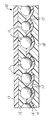
- the drawing is an enlarged sectional view through a representative reflective sheeting of the invention.
- the sheeting 10 shown in the drawings comprises a layer of transparent microspheres 11; a layer 12 of transparent binder material in which the microspheres are supported essentially as a monolayer; a transparent top layer 13; a transparent spacing layer 14 having a bottom surface which generally follows the contour of the bottom of the microspheres, and which is spaced from the microspheres at the approximately focal point for light rays impinging on the front of the reflective sheeting and passing through the microspheres; a specularly reflective layer 16, which is carried on the contoured surface of the spacing layer, and which has an extensive array of minute discontinuities 17; and a bottom layer 18, which most typically is a layer of adhesive such as pressure-sensitive adhesive for adhering the sheeting to a substrate.
- Manufacture of the reflective sheeting shown in the drawing typically begins by coating material for forming the top layer 13 onto a carrier web, either from solution or from some other liquefied form, solidifying that material, and then coating material for the binder layer 12.
- Transparent microspheres are cascaded onto the coated binder layer while the layer is still wet, whereupon the microspheres become partially embedded in the layer.
- material for the spacing layer is coated over the microspheres, again either from solution or from some other liquefied form, and solidified. Thereupon the specularly reflective layer is applied to the spacing layer, typically by vapor-deposition of metal.
- some products of the invention include no spacing layer.
- Such products include so-called "exposed-lens” sheeting in which the front surfaces of the microspheres are not embedded in polymeric material but are exposed to air, and sheeting in which the microspheres have a high index of refraction.
- the specularly reflective layer is directly applied to the rear surface of the microspheres (such an application may be accomplished, for example, while the front surfaces of the microspheres are I temporarily held in a removable carrier sheet), .and ; 1 binder layer is applied over the specularly reflective layer to support the microspheres.
- products as described in the two preceding paragraphs can be subjected to a stretching or tentering operation.
- Conventional tentering equipment which stretches the sheet product transversely as it proceeds along the length of the tentering apparatus, is particularly useful. A five-percent expansion of the transverse width of the sheet product is usually sufficient to develop the described array of minute discontinuities, although we prefer to stretch the sheet product 10 percent.
- the layers of the stretched product generally elongate and remain intact, and the materials and structure of the product are chosen to achieve that result.
- the sheet material is typically allowed to retract, or heated to cause it to retract, so that it usually is no more than about two percent greater than its original dimensions prior to the stretching operation.
- the sheeting is then completed, as by application of a layer of adhesive, which is typically a pressure-sensitive adhesive, but alternatively can be a heat-activated or solvent-activated adhesive.
- Alternative procedures for forming discontinuities in the specularly reflective layer include applying solvent to the described intermediate-stage product so as to cause swelling of the spacing layer, which thereupon results in cracking of the specularly reflective layer; or drawing the intermediate-stage sheet product over a sharp edge so as to fracture the specularly reflective layer; or passing the intermediate stage product through nip rolls under high pressure.
- deposition of thinner specularly reflective layers leaves discontinuities sufficient for the noted migration of vapor, and can provide adequate reflection.
- such a procedure is less preferred, since it is difficult to control the operation to reproducibly achieve the desired balance of discontinuities and reflection; and reflection is reduced.
- the discontinuities formed in the specularly reflective layer are most often a network of narrow lines, which tend to be concentrated between the microspheres.
- the discontinuities should be small in width, so that they are not normally visible to the unaided eye from typical viewing distances of one meter or more. Typically they are less wide than the average diameter of the microspheres in the sheeting.
- a binder layer 12, top layer 13, and spacing layer 14 in a retroreflective sheeting as shown in the drawings are generally made of polymeric materials such as alkyd, vinyl, or acrylic resins; the layer 10 can be a pressure-sensitive-adhesive acrylate copolymer; and the specularly reflective layer can be vapor-deposited aluminum or silver.
- An extensible plasticized vinyl resin containing ultraviolet- and heat-stabilizers was coated from solution onto a paper carrier web presized with an alkyd release agent, and the coated layer was heated to fuse it into a 55-micrometer-thick film useful as the top film of the ultimate sheeting.
- a solution comprising an uralkyd resin and melamine crosslinker was then coated onto the fused top film. After partial drying of the latter layer, transparent glass microspheres having an average diameter of 57 micrometers and an index of refraction of 2.26 were cascaded onto the coated layer as a dense monolayer. The microspheres became partially embedded in the coated layer and partially extended above the coated layer.
- a solution comprising a polyvinyl butyral resin and a butylated melamine hardener was coated onto the microspheres to provide the transparent spacing layer 14, which after drying and curing was approximately 19 micrometers thick.
- Aluminum was vapor-deposited onto the exposed surface of the dried and cured spacing layer to form a metallic specularly reflective layer.
- the resulting assembly was stripped from the carrier web and passed through a tentering apparatus at a rate of 10 meters per second, with the assembly being stretched 10 percent at a rate of 4.7 percent per meter forward travel of the sheeting. The assembly was then heated and allowed to return to approximately its original dimensions.
- the aluminum specularly reflective layer was found to have an extensive array of fractures along lines that generally extended between the microspheres.
- the sheeting was then completed by laminating a layer 18 of pressure-sensitive acrylate adhesive onto the discontinuous aluminum layer.
- the sheeting exhibited a reflectivity of 90 candella per square meter per lux of incident light, and transmitted water vapor through the sheeting at a rate of 24.2 grams per square meter per 24 hours.
Landscapes
- Physics & Mathematics (AREA)
- Geometry (AREA)
- General Physics & Mathematics (AREA)
- Engineering & Computer Science (AREA)
- Theoretical Computer Science (AREA)
- Optical Elements Other Than Lenses (AREA)
- Laminated Bodies (AREA)
- Manufacture Of Macromolecular Shaped Articles (AREA)
Priority Applications (1)
| Application Number | Priority Date | Filing Date | Title |
|---|---|---|---|
| AT83303387T ATE31979T1 (de) | 1982-06-21 | 1983-06-10 | Dampfdurchlaessiges retroreflektives blattmaterial. |
Applications Claiming Priority (2)
| Application Number | Priority Date | Filing Date | Title |
|---|---|---|---|
| US390636 | 1982-06-21 | ||
| US06/390,636 US4418110A (en) | 1982-06-21 | 1982-06-21 | Vapor-permeable retroreflective sheeting |
Publications (3)
| Publication Number | Publication Date |
|---|---|
| EP0097467A2 true EP0097467A2 (de) | 1984-01-04 |
| EP0097467A3 EP0097467A3 (en) | 1985-12-04 |
| EP0097467B1 EP0097467B1 (de) | 1988-01-13 |
Family
ID=23543308
Family Applications (1)
| Application Number | Title | Priority Date | Filing Date |
|---|---|---|---|
| EP83303387A Expired EP0097467B1 (de) | 1982-06-21 | 1983-06-10 | Dampfdurchlässiges retroreflektives Blattmaterial |
Country Status (5)
| Country | Link |
|---|---|
| US (1) | US4418110A (de) |
| EP (1) | EP0097467B1 (de) |
| JP (1) | JPS595051A (de) |
| AT (1) | ATE31979T1 (de) |
| DE (1) | DE3375326D1 (de) |
Cited By (2)
| Publication number | Priority date | Publication date | Assignee | Title |
|---|---|---|---|---|
| US7919674B2 (en) | 2002-11-07 | 2011-04-05 | Immunokick Incorporation | Transgenic mammal carrying GANP gene transferred thereinto and utilization thereof |
| WO2021064577A1 (en) * | 2019-10-03 | 2021-04-08 | 3M Innovative Properties Company | Retroreflective article comprising discontinuous binder-borne reflective layers |
Families Citing this family (19)
| Publication number | Priority date | Publication date | Assignee | Title |
|---|---|---|---|---|
| US4950525A (en) * | 1983-04-11 | 1990-08-21 | Minnesota Mining And Manufacturing Company | Elastomeric retroreflective sheeting |
| JPS60128401A (ja) * | 1983-12-15 | 1985-07-09 | Ide Kogyo Kk | 再帰反射模様物の製造方法 |
| US4682852A (en) * | 1984-07-23 | 1987-07-28 | Victor Weber | Reflective sheeting technology |
| US4756931A (en) * | 1984-11-30 | 1988-07-12 | Potters Industries, Inc. | Retroreflective materials and methods for their production and use |
| US4609587A (en) * | 1984-11-30 | 1986-09-02 | Potters Industries, Inc. | Retroreflective materials and use |
| US4983436A (en) * | 1987-04-15 | 1991-01-08 | Minnesota Mining And Manufacturing Company | Retroreflective sheeting with backing film |
| US5077117A (en) * | 1990-04-05 | 1991-12-31 | Minnesota Mining And Manufacturing Company | Pavement marking material with rupturing top layer |
| US5207852A (en) * | 1991-02-06 | 1993-05-04 | Minnesota Mining And Manufacturing Company | Method for making permeable retroreflective sheeting |
| US5128804A (en) * | 1991-02-06 | 1992-07-07 | Minnesota Mining And Manufacturing Company | Permeable retroreflective sheeting |
| JPH10153701A (ja) | 1996-11-19 | 1998-06-09 | Minnesota Mining & Mfg Co <3M> | 再帰性反射シート |
| RU2165356C2 (ru) * | 1999-03-22 | 2001-04-20 | Тукбаев Эрнст Ерусланович | Способ получения световозвращающего материала с изображением знака |
| KR100297383B1 (ko) * | 1999-04-21 | 2001-09-22 | 김승열 | 도로표지구용 축광반사지 |
| US6931665B2 (en) * | 2001-07-30 | 2005-08-23 | 3M Innovative Properties Company | Vapor permeable retroreflective garment |
| CN102138086B (zh) | 2008-07-10 | 2014-11-26 | 3M创新有限公司 | 具有粘弹性光导的回射制品和装置 |
| WO2010006102A2 (en) * | 2008-07-10 | 2010-01-14 | 3M Innovative Properties Company | Retroreflective articles and devices having viscoelastic lightguide |
| EP2313800A4 (de) | 2008-07-10 | 2014-03-19 | 3M Innovative Properties Co | Viskoelastischer lichtleiter |
| EP2321677A4 (de) | 2008-08-08 | 2011-08-17 | 3M Innovative Properties Co | Lichtleiter mit viskoelastischer schicht zur handhabung von licht |
| TW202107125A (zh) * | 2019-04-25 | 2021-02-16 | 美商3M新設資產公司 | 包含多個局部層壓層的復歸反射物品 |
| CN116234467B (zh) * | 2020-09-24 | 2026-01-09 | 3M创新有限公司 | 包括回射层合物的离散岛状物的织物和服装 |
Family Cites Families (8)
| Publication number | Priority date | Publication date | Assignee | Title |
|---|---|---|---|---|
| US2543800A (en) * | 1947-12-05 | 1951-03-06 | Minnesota Mining & Mfg | Reflex light reflector |
| US3802944A (en) * | 1972-04-17 | 1974-04-09 | Minnesota Mining & Mfg | Retroreflective sheeting |
| GB1447585A (en) * | 1974-03-21 | 1976-08-25 | Minnesota Mining & Mfg | Retro-reflective fiom |
| US4032681A (en) * | 1975-04-21 | 1977-06-28 | Minnesota Mining And Manufacturing Company | Porous reflective fabric |
| JPS51144198A (en) * | 1975-06-06 | 1976-12-10 | Seibu Polymer Kasei Kk | Return reflector |
| JPS5812868B2 (ja) * | 1975-08-01 | 1983-03-10 | ユニチカ株式会社 | ツウキセイオユウスルハンシヤシ−トノセイゾウホウ |
| US4082426A (en) * | 1976-11-26 | 1978-04-04 | Minnesota Mining And Manufacturing Company | Retroreflective sheeting with retroreflective markings |
| US4348312A (en) * | 1978-11-20 | 1982-09-07 | Minnesota Mining And Manufacturing Company | Ultra-high-index glass microspheres and products made therefrom with a fluoropolymer and an ester polymer blend |
-
1982
- 1982-06-21 US US06/390,636 patent/US4418110A/en not_active Expired - Lifetime
-
1983
- 1983-06-10 DE DE8383303387T patent/DE3375326D1/de not_active Expired
- 1983-06-10 EP EP83303387A patent/EP0097467B1/de not_active Expired
- 1983-06-10 AT AT83303387T patent/ATE31979T1/de not_active IP Right Cessation
- 1983-06-20 JP JP58110755A patent/JPS595051A/ja active Granted
Cited By (2)
| Publication number | Priority date | Publication date | Assignee | Title |
|---|---|---|---|---|
| US7919674B2 (en) | 2002-11-07 | 2011-04-05 | Immunokick Incorporation | Transgenic mammal carrying GANP gene transferred thereinto and utilization thereof |
| WO2021064577A1 (en) * | 2019-10-03 | 2021-04-08 | 3M Innovative Properties Company | Retroreflective article comprising discontinuous binder-borne reflective layers |
Also Published As
| Publication number | Publication date |
|---|---|
| JPS595051A (ja) | 1984-01-11 |
| US4418110A (en) | 1983-11-29 |
| EP0097467B1 (de) | 1988-01-13 |
| ATE31979T1 (de) | 1988-01-15 |
| DE3375326D1 (en) | 1988-02-18 |
| JPH0438584B2 (de) | 1992-06-24 |
| EP0097467A3 (en) | 1985-12-04 |
Similar Documents
| Publication | Publication Date | Title |
|---|---|---|
| EP0097467B1 (de) | Dampfdurchlässiges retroreflektives Blattmaterial | |
| US4569857A (en) | Retroreflective sheeting | |
| US4511210A (en) | Retroreflective sheeting | |
| US3689346A (en) | Method for producing retroreflective material | |
| US4367920A (en) | Retroflective sheeting | |
| US4950525A (en) | Elastomeric retroreflective sheeting | |
| US3684348A (en) | Retroreflective material | |
| AU593713B2 (en) | Elastomeric retroreflective sheeting | |
| US3810804A (en) | Method of making retroreflective material | |
| US3811983A (en) | Method for producing retroreflective sheeting | |
| US6558009B2 (en) | Retroreflective sheeting containing a validation image and methods of making the same | |
| US3190178A (en) | Reflex-reflecting sheeting | |
| US5888618A (en) | Fire-resistant, retroreflective structure | |
| JP2610253B2 (ja) | 包まれた平らな表面の逆行反射性シート及びその製造方法 | |
| US5064272A (en) | Encapsulated-lens retroreflective sheeting and method of making | |
| US7504147B2 (en) | Retroreflective sheeting with security and/or decorative image | |
| US20010023009A1 (en) | Retroreflective sheet | |
| US9155346B2 (en) | Process for reflective products | |
| US4682852A (en) | Reflective sheeting technology | |
| CA2135290C (en) | Abrasion-resistant coating composition and abrasion resistant energy control sheet | |
| DE4212203A1 (de) | Rueckstrahlfolie, insbesondere fuer verkehrsfuehrungskegel und verfahren zu dessen herstellung | |
| US5984479A (en) | Lens-type retroreflective sheeting | |
| SE448406B (sv) | Forfarande for framstellning av preholografiskt element och hologram som forses med ett glasartat fuktbarrierskikt | |
| US3493286A (en) | Reflex light reflector | |
| EP0326186A2 (de) | Weitwinklig retroreflektierende Folie und Verfahren zu ihrer Herstellung |
Legal Events
| Date | Code | Title | Description |
|---|---|---|---|
| PUAI | Public reference made under article 153(3) epc to a published international application that has entered the european phase |
Free format text: ORIGINAL CODE: 0009012 |
|
| AK | Designated contracting states |
Designated state(s): AT DE FR GB IT |
|
| PUAL | Search report despatched |
Free format text: ORIGINAL CODE: 0009013 |
|
| AK | Designated contracting states |
Designated state(s): AT DE FR GB IT |
|
| 17P | Request for examination filed |
Effective date: 19860303 |
|
| 17Q | First examination report despatched |
Effective date: 19870325 |
|
| ITF | It: translation for a ep patent filed | ||
| GRAA | (expected) grant |
Free format text: ORIGINAL CODE: 0009210 |
|
| AK | Designated contracting states |
Kind code of ref document: B1 Designated state(s): AT DE FR GB IT |
|
| REF | Corresponds to: |
Ref document number: 31979 Country of ref document: AT Date of ref document: 19880115 Kind code of ref document: T |
|
| REF | Corresponds to: |
Ref document number: 3375326 Country of ref document: DE Date of ref document: 19880218 |
|
| ET | Fr: translation filed | ||
| PLBE | No opposition filed within time limit |
Free format text: ORIGINAL CODE: 0009261 |
|
| STAA | Information on the status of an ep patent application or granted ep patent |
Free format text: STATUS: NO OPPOSITION FILED WITHIN TIME LIMIT |
|
| 26N | No opposition filed | ||
| REG | Reference to a national code |
Ref country code: GB Ref legal event code: 732 |
|
| ITTA | It: last paid annual fee | ||
| PGFP | Annual fee paid to national office [announced via postgrant information from national office to epo] |
Ref country code: AT Payment date: 19950515 Year of fee payment: 13 |
|
| PG25 | Lapsed in a contracting state [announced via postgrant information from national office to epo] |
Ref country code: AT Effective date: 19960610 |
|
| REG | Reference to a national code |
Ref country code: GB Ref legal event code: IF02 |
|
| PGFP | Annual fee paid to national office [announced via postgrant information from national office to epo] |
Ref country code: FR Payment date: 20020517 Year of fee payment: 20 |
|
| PGFP | Annual fee paid to national office [announced via postgrant information from national office to epo] |
Ref country code: GB Payment date: 20020605 Year of fee payment: 20 |
|
| PGFP | Annual fee paid to national office [announced via postgrant information from national office to epo] |
Ref country code: DE Payment date: 20020620 Year of fee payment: 20 |
|
| PG25 | Lapsed in a contracting state [announced via postgrant information from national office to epo] |
Ref country code: GB Free format text: LAPSE BECAUSE OF EXPIRATION OF PROTECTION Effective date: 20030609 |
|
| REG | Reference to a national code |
Ref country code: GB Ref legal event code: PE20 |