EP0097666B1 - Procede de dosage de substances biologiques susceptibles de fixer des produits de degradation de l'acide adenosine 5'-triphosphorique - Google Patents
Procede de dosage de substances biologiques susceptibles de fixer des produits de degradation de l'acide adenosine 5'-triphosphorique Download PDFInfo
- Publication number
- EP0097666B1 EP0097666B1 EP83900049A EP83900049A EP0097666B1 EP 0097666 B1 EP0097666 B1 EP 0097666B1 EP 83900049 A EP83900049 A EP 83900049A EP 83900049 A EP83900049 A EP 83900049A EP 0097666 B1 EP0097666 B1 EP 0097666B1
- Authority
- EP
- European Patent Office
- Prior art keywords
- group
- atp
- mentioned
- modified
- procedure according
- Prior art date
- Legal status (The legal status is an assumption and is not a legal conclusion. Google has not performed a legal analysis and makes no representation as to the accuracy of the status listed.)
- Expired - Lifetime
Links
- 239000000126 substance Substances 0.000 title claims description 33
- ZKHQWZAMYRWXGA-KQYNXXCUSA-N Adenosine triphosphate Chemical compound C1=NC=2C(N)=NC=NC=2N1[C@@H]1O[C@H](COP(O)(=O)OP(O)(=O)OP(O)(O)=O)[C@@H](O)[C@H]1O ZKHQWZAMYRWXGA-KQYNXXCUSA-N 0.000 title claims description 29
- 238000000034 method Methods 0.000 title claims description 24
- 239000007857 degradation product Substances 0.000 title description 3
- ZKHQWZAMYRWXGA-UHFFFAOYSA-N Adenosine triphosphate Natural products C1=NC=2C(N)=NC=NC=2N1C1OC(COP(O)(=O)OP(O)(=O)OP(O)(O)=O)C(O)C1O ZKHQWZAMYRWXGA-UHFFFAOYSA-N 0.000 title 1
- 108090000790 Enzymes Proteins 0.000 claims description 17
- 102000004190 Enzymes Human genes 0.000 claims description 17
- 229940126575 aminoglycoside Drugs 0.000 claims description 8
- GFFGJBXGBJISGV-UHFFFAOYSA-N adenyl group Chemical group N1=CN=C2N=CNC2=C1N GFFGJBXGBJISGV-UHFFFAOYSA-N 0.000 claims description 7
- 238000003556 assay Methods 0.000 claims description 6
- 239000003153 chemical reaction reagent Substances 0.000 claims description 6
- 239000000203 mixture Substances 0.000 claims description 6
- 239000000427 antigen Substances 0.000 claims description 5
- 102000036639 antigens Human genes 0.000 claims description 5
- 108091007433 antigens Proteins 0.000 claims description 5
- 238000005859 coupling reaction Methods 0.000 claims description 5
- 108090001008 Avidin Proteins 0.000 claims description 4
- 239000003242 anti bacterial agent Substances 0.000 claims description 4
- 229940088710 antibiotic agent Drugs 0.000 claims description 4
- 230000008878 coupling Effects 0.000 claims description 4
- 238000010168 coupling process Methods 0.000 claims description 4
- 238000009739 binding Methods 0.000 claims description 3
- 239000013043 chemical agent Substances 0.000 claims description 2
- 239000000677 immunologic agent Substances 0.000 claims description 2
- 229940124541 immunological agent Drugs 0.000 claims description 2
- 125000001917 2,4-dinitrophenyl group Chemical group [H]C1=C([H])C(=C([H])C(=C1*)[N+]([O-])=O)[N+]([O-])=O 0.000 claims 2
- 101100202428 Neopyropia yezoensis atps gene Proteins 0.000 claims 1
- 238000001514 detection method Methods 0.000 claims 1
- 238000002955 isolation Methods 0.000 claims 1
- 125000001424 substituent group Chemical group 0.000 claims 1
- 238000012800 visualization Methods 0.000 claims 1
- 230000004048 modification Effects 0.000 description 18
- 238000012986 modification Methods 0.000 description 18
- 239000000047 product Substances 0.000 description 18
- 238000006243 chemical reaction Methods 0.000 description 11
- UDMBCSSLTHHNCD-KQYNXXCUSA-N adenosine 5'-monophosphate Chemical compound C1=NC=2C(N)=NC=NC=2N1[C@@H]1O[C@H](COP(O)(O)=O)[C@@H](O)[C@H]1O UDMBCSSLTHHNCD-KQYNXXCUSA-N 0.000 description 9
- 150000001875 compounds Chemical class 0.000 description 9
- XTWYTFMLZFPYCI-KQYNXXCUSA-N 5'-adenylphosphoric acid Chemical compound C1=NC=2C(N)=NC=NC=2N1[C@@H]1O[C@H](COP(O)(=O)OP(O)(O)=O)[C@@H](O)[C@H]1O XTWYTFMLZFPYCI-KQYNXXCUSA-N 0.000 description 8
- 230000003115 biocidal effect Effects 0.000 description 8
- 239000000758 substrate Substances 0.000 description 8
- 108090000765 processed proteins & peptides Proteins 0.000 description 6
- 125000002652 ribonucleotide group Chemical group 0.000 description 6
- 108091028664 Ribonucleotide Proteins 0.000 description 5
- 229950006790 adenosine phosphate Drugs 0.000 description 5
- 238000010348 incorporation Methods 0.000 description 5
- 239000002336 ribonucleotide Substances 0.000 description 5
- 239000000243 solution Substances 0.000 description 5
- YBJHBAHKTGYVGT-ZKWXMUAHSA-N (+)-Biotin Chemical compound N1C(=O)N[C@@H]2[C@H](CCCCC(=O)O)SC[C@@H]21 YBJHBAHKTGYVGT-ZKWXMUAHSA-N 0.000 description 4
- MHAJPDPJQMAIIY-UHFFFAOYSA-N Hydrogen peroxide Chemical compound OO MHAJPDPJQMAIIY-UHFFFAOYSA-N 0.000 description 4
- TWRXJAOTZQYOKJ-UHFFFAOYSA-L Magnesium chloride Chemical compound [Mg+2].[Cl-].[Cl-] TWRXJAOTZQYOKJ-UHFFFAOYSA-L 0.000 description 4
- 229910019142 PO4 Inorganic materials 0.000 description 4
- 238000004040 coloring Methods 0.000 description 4
- KWGKDLIKAYFUFQ-UHFFFAOYSA-M lithium chloride Chemical compound [Li+].[Cl-] KWGKDLIKAYFUFQ-UHFFFAOYSA-M 0.000 description 4
- PXFBZOLANLWPMH-UHFFFAOYSA-N 16-Epiaffinine Natural products C1C(C2=CC=CC=C2N2)=C2C(=O)CC2C(=CC)CN(C)C1C2CO PXFBZOLANLWPMH-UHFFFAOYSA-N 0.000 description 3
- 108010039224 Amidophosphoribosyltransferase Proteins 0.000 description 3
- 125000003178 carboxy group Chemical group [H]OC(*)=O 0.000 description 3
- 150000001768 cations Chemical class 0.000 description 3
- 125000003636 chemical group Chemical group 0.000 description 3
- 239000003446 ligand Substances 0.000 description 3
- 102000013415 peroxidase activity proteins Human genes 0.000 description 3
- 108040007629 peroxidase activity proteins Proteins 0.000 description 3
- 239000010452 phosphate Substances 0.000 description 3
- 238000002360 preparation method Methods 0.000 description 3
- 230000008569 process Effects 0.000 description 3
- 150000003839 salts Chemical group 0.000 description 3
- 239000000523 sample Substances 0.000 description 3
- QKNYBSVHEMOAJP-UHFFFAOYSA-N 2-amino-2-(hydroxymethyl)propane-1,3-diol;hydron;chloride Chemical compound Cl.OCC(N)(CO)CO QKNYBSVHEMOAJP-UHFFFAOYSA-N 0.000 description 2
- -1 8 - [- N- (dinitro-phenyl) -amino-hexyl] -aminoadenosine 5'-triphosphate Chemical compound 0.000 description 2
- OXEUETBFKVCRNP-UHFFFAOYSA-N 9-ethyl-3-carbazolamine Chemical compound NC1=CC=C2N(CC)C3=CC=CC=C3C2=C1 OXEUETBFKVCRNP-UHFFFAOYSA-N 0.000 description 2
- OKTJSMMVPCPJKN-UHFFFAOYSA-N Carbon Chemical group [C] OKTJSMMVPCPJKN-UHFFFAOYSA-N 0.000 description 2
- UFHFLCQGNIYNRP-UHFFFAOYSA-N Hydrogen Chemical compound [H][H] UFHFLCQGNIYNRP-UHFFFAOYSA-N 0.000 description 2
- 102000007562 Serum Albumin Human genes 0.000 description 2
- 108010071390 Serum Albumin Proteins 0.000 description 2
- WUBNGZXADUXZOF-PBWSWVRCSA-N [[(2r,3s,4r,5s)-5-amino-5-[6-amino-8-(6-aminohexyl)purin-9-yl]-3,4-dihydroxyoxolan-2-yl]methoxy-hydroxyphosphoryl] phosphono hydrogen phosphate Chemical compound NCCCCCCC1=NC2=C(N)N=CN=C2N1[C@]1(N)O[C@H](COP(O)(=O)OP(O)(=O)OP(O)(O)=O)[C@@H](O)[C@H]1O WUBNGZXADUXZOF-PBWSWVRCSA-N 0.000 description 2
- HXXFSFRBOHSIMQ-VFUOTHLCSA-N alpha-D-glucose 1-phosphate Chemical compound OC[C@H]1O[C@H](OP(O)(O)=O)[C@H](O)[C@@H](O)[C@@H]1O HXXFSFRBOHSIMQ-VFUOTHLCSA-N 0.000 description 2
- UHOVQNZJYSORNB-UHFFFAOYSA-N benzene Substances C1=CC=CC=C1 UHOVQNZJYSORNB-UHFFFAOYSA-N 0.000 description 2
- 230000015572 biosynthetic process Effects 0.000 description 2
- 229960002685 biotin Drugs 0.000 description 2
- 235000020958 biotin Nutrition 0.000 description 2
- 239000011616 biotin Substances 0.000 description 2
- 229910052799 carbon Inorganic materials 0.000 description 2
- 238000007385 chemical modification Methods 0.000 description 2
- 239000007795 chemical reaction product Substances 0.000 description 2
- 238000006482 condensation reaction Methods 0.000 description 2
- 230000008030 elimination Effects 0.000 description 2
- 238000003379 elimination reaction Methods 0.000 description 2
- 229950010772 glucose-1-phosphate Drugs 0.000 description 2
- 229910052739 hydrogen Inorganic materials 0.000 description 2
- 239000001257 hydrogen Substances 0.000 description 2
- 125000004435 hydrogen atom Chemical group [H]* 0.000 description 2
- 125000002887 hydroxy group Chemical group [H]O* 0.000 description 2
- JDNTWHVOXJZDSN-UHFFFAOYSA-N iodoacetic acid Chemical compound OC(=O)CI JDNTWHVOXJZDSN-UHFFFAOYSA-N 0.000 description 2
- 229910001629 magnesium chloride Inorganic materials 0.000 description 2
- 238000004519 manufacturing process Methods 0.000 description 2
- 230000003287 optical effect Effects 0.000 description 2
- 150000007524 organic acids Chemical class 0.000 description 2
- 235000021317 phosphate Nutrition 0.000 description 2
- SCVFZCLFOSHCOH-UHFFFAOYSA-M potassium acetate Chemical compound [K+].CC([O-])=O SCVFZCLFOSHCOH-UHFFFAOYSA-M 0.000 description 2
- 102000004196 processed proteins & peptides Human genes 0.000 description 2
- 210000002966 serum Anatomy 0.000 description 2
- 238000006467 substitution reaction Methods 0.000 description 2
- LMBFAGIMSUYTBN-MPZNNTNKSA-N teixobactin Chemical compound C([C@H](C(=O)N[C@@H]([C@@H](C)CC)C(=O)N[C@@H](CO)C(=O)N[C@H](CCC(N)=O)C(=O)N[C@H]([C@@H](C)CC)C(=O)N[C@@H]([C@@H](C)CC)C(=O)N[C@@H](CO)C(=O)N[C@H]1C(N[C@@H](C)C(=O)N[C@@H](C[C@@H]2NC(=N)NC2)C(=O)N[C@H](C(=O)O[C@H]1C)[C@@H](C)CC)=O)NC)C1=CC=CC=C1 LMBFAGIMSUYTBN-MPZNNTNKSA-N 0.000 description 2
- 229960000707 tobramycin Drugs 0.000 description 2
- NLVFBUXFDBBNBW-PBSUHMDJSA-N tobramycin Chemical compound N[C@@H]1C[C@H](O)[C@@H](CN)O[C@@H]1O[C@H]1[C@H](O)[C@@H](O[C@@H]2[C@@H]([C@@H](N)[C@H](O)[C@@H](CO)O2)O)[C@H](N)C[C@@H]1N NLVFBUXFDBBNBW-PBSUHMDJSA-N 0.000 description 2
- YMXHPSHLTSZXKH-RVBZMBCESA-N (2,5-dioxopyrrolidin-1-yl) 5-[(3as,4s,6ar)-2-oxo-1,3,3a,4,6,6a-hexahydrothieno[3,4-d]imidazol-4-yl]pentanoate Chemical compound C([C@H]1[C@H]2NC(=O)N[C@H]2CS1)CCCC(=O)ON1C(=O)CCC1=O YMXHPSHLTSZXKH-RVBZMBCESA-N 0.000 description 1
- WDCYWAQPCXBPJA-UHFFFAOYSA-N 1,3-dinitrobenzene Chemical compound [O-][N+](=O)C1=CC=CC([N+]([O-])=O)=C1 WDCYWAQPCXBPJA-UHFFFAOYSA-N 0.000 description 1
- PQGCEDQWHSBAJP-UHFFFAOYSA-N 5-phospho-d-ribose 1-diphosphate Chemical compound OC1C(O)C(OP(O)(=O)OP(O)(O)=O)OC1COP(O)(O)=O PQGCEDQWHSBAJP-UHFFFAOYSA-N 0.000 description 1
- CYSPWCARDHRYJX-UHFFFAOYSA-N 9h-fluoren-1-amine Chemical compound C12=CC=CC=C2CC2=C1C=CC=C2N CYSPWCARDHRYJX-UHFFFAOYSA-N 0.000 description 1
- 108010058756 ATP phosphoribosyltransferase Proteins 0.000 description 1
- QTBSBXVTEAMEQO-UHFFFAOYSA-M Acetate Chemical compound CC([O-])=O QTBSBXVTEAMEQO-UHFFFAOYSA-M 0.000 description 1
- 229930024421 Adenine Natural products 0.000 description 1
- NLXLAEXVIDQMFP-UHFFFAOYSA-N Ammonium chloride Substances [NH4+].[Cl-] NLXLAEXVIDQMFP-UHFFFAOYSA-N 0.000 description 1
- VHUUQVKOLVNVRT-UHFFFAOYSA-N Ammonium hydroxide Chemical compound [NH4+].[OH-] VHUUQVKOLVNVRT-UHFFFAOYSA-N 0.000 description 1
- VEXZGXHMUGYJMC-UHFFFAOYSA-M Chloride anion Chemical compound [Cl-] VEXZGXHMUGYJMC-UHFFFAOYSA-M 0.000 description 1
- UDMBCSSLTHHNCD-UHFFFAOYSA-N Coenzym Q(11) Natural products C1=NC=2C(N)=NC=NC=2N1C1OC(COP(O)(O)=O)C(O)C1O UDMBCSSLTHHNCD-UHFFFAOYSA-N 0.000 description 1
- IGXWBGJHJZYPQS-SSDOTTSWSA-N D-Luciferin Chemical compound OC(=O)[C@H]1CSC(C=2SC3=CC=C(O)C=C3N=2)=N1 IGXWBGJHJZYPQS-SSDOTTSWSA-N 0.000 description 1
- GUBGYTABKSRVRQ-WFVLMXAXSA-N DEAE-cellulose Chemical compound OC1C(O)C(O)C(CO)O[C@H]1O[C@@H]1C(CO)OC(O)C(O)C1O GUBGYTABKSRVRQ-WFVLMXAXSA-N 0.000 description 1
- XPDXVDYUQZHFPV-UHFFFAOYSA-N Dansyl Chloride Chemical compound C1=CC=C2C(N(C)C)=CC=CC2=C1S(Cl)(=O)=O XPDXVDYUQZHFPV-UHFFFAOYSA-N 0.000 description 1
- CYCGRDQQIOGCKX-UHFFFAOYSA-N Dehydro-luciferin Natural products OC(=O)C1=CSC(C=2SC3=CC(O)=CC=C3N=2)=N1 CYCGRDQQIOGCKX-UHFFFAOYSA-N 0.000 description 1
- QOSSAOTZNIDXMA-UHFFFAOYSA-N Dicylcohexylcarbodiimide Chemical compound C1CCCCC1N=C=NC1CCCCC1 QOSSAOTZNIDXMA-UHFFFAOYSA-N 0.000 description 1
- 241000588724 Escherichia coli Species 0.000 description 1
- BJGNCJDXODQBOB-UHFFFAOYSA-N Fivefly Luciferin Natural products OC(=O)C1CSC(C=2SC3=CC(O)=CC=C3N=2)=N1 BJGNCJDXODQBOB-UHFFFAOYSA-N 0.000 description 1
- PXGOKWXKJXAPGV-UHFFFAOYSA-N Fluorine Chemical compound FF PXGOKWXKJXAPGV-UHFFFAOYSA-N 0.000 description 1
- 208000027472 Galactosemias Diseases 0.000 description 1
- VEXZGXHMUGYJMC-UHFFFAOYSA-N Hydrochloric acid Chemical compound Cl VEXZGXHMUGYJMC-UHFFFAOYSA-N 0.000 description 1
- 102000004856 Lectins Human genes 0.000 description 1
- 108090001090 Lectins Proteins 0.000 description 1
- 241001071861 Lethrinus genivittatus Species 0.000 description 1
- 108060001084 Luciferase Proteins 0.000 description 1
- 239000005089 Luciferase Substances 0.000 description 1
- DDWFXDSYGUXRAY-UHFFFAOYSA-N Luciferin Natural products CCc1c(C)c(CC2NC(=O)C(=C2C=C)C)[nH]c1Cc3[nH]c4C(=C5/NC(CC(=O)O)C(C)C5CC(=O)O)CC(=O)c4c3C DDWFXDSYGUXRAY-UHFFFAOYSA-N 0.000 description 1
- FYYHWMGAXLPEAU-UHFFFAOYSA-N Magnesium Chemical compound [Mg] FYYHWMGAXLPEAU-UHFFFAOYSA-N 0.000 description 1
- SQVRNKJHWKZAKO-PFQGKNLYSA-N N-acetyl-beta-neuraminic acid Chemical compound CC(=O)N[C@@H]1[C@@H](O)C[C@@](O)(C(O)=O)O[C@H]1[C@H](O)[C@H](O)CO SQVRNKJHWKZAKO-PFQGKNLYSA-N 0.000 description 1
- POECHIXSIXBYKI-UHFFFAOYSA-N N-fluorenylacetamide Chemical group C1C2=CC=CC=C2C2=C1C(NC(=O)C)=CC=C2 POECHIXSIXBYKI-UHFFFAOYSA-N 0.000 description 1
- 108700020962 Peroxidase Proteins 0.000 description 1
- 102000003992 Peroxidases Human genes 0.000 description 1
- 108010039918 Polylysine Proteins 0.000 description 1
- ZLMJMSJWJFRBEC-UHFFFAOYSA-N Potassium Chemical compound [K] ZLMJMSJWJFRBEC-UHFFFAOYSA-N 0.000 description 1
- 229920005654 Sephadex Polymers 0.000 description 1
- 239000012507 Sephadex™ Substances 0.000 description 1
- 108010082433 UDP-glucose-hexose-1-phosphate uridylyltransferase Proteins 0.000 description 1
- 238000000862 absorption spectrum Methods 0.000 description 1
- 239000002253 acid Substances 0.000 description 1
- 230000009471 action Effects 0.000 description 1
- 229960000643 adenine Drugs 0.000 description 1
- HXXFSFRBOHSIMQ-FPRJBGLDSA-N alpha-D-galactose 1-phosphate Chemical compound OC[C@H]1O[C@H](OP(O)(O)=O)[C@H](O)[C@@H](O)[C@H]1O HXXFSFRBOHSIMQ-FPRJBGLDSA-N 0.000 description 1
- 125000003277 amino group Chemical group 0.000 description 1
- 235000011114 ammonium hydroxide Nutrition 0.000 description 1
- 102000005936 beta-Galactosidase Human genes 0.000 description 1
- 108010005774 beta-Galactosidase Proteins 0.000 description 1
- SQVRNKJHWKZAKO-UHFFFAOYSA-N beta-N-Acetyl-D-neuraminic acid Natural products CC(=O)NC1C(O)CC(O)(C(O)=O)OC1C(O)C(O)CO SQVRNKJHWKZAKO-UHFFFAOYSA-N 0.000 description 1
- 239000012472 biological sample Substances 0.000 description 1
- 239000007853 buffer solution Substances 0.000 description 1
- 239000008366 buffered solution Substances 0.000 description 1
- 125000002915 carbonyl group Chemical group [*:2]C([*:1])=O 0.000 description 1
- 239000003054 catalyst Substances 0.000 description 1
- 229920001429 chelating resin Polymers 0.000 description 1
- 239000003795 chemical substances by application Substances 0.000 description 1
- 238000004737 colorimetric analysis Methods 0.000 description 1
- 238000009833 condensation Methods 0.000 description 1
- 230000005494 condensation Effects 0.000 description 1
- 239000007859 condensation product Substances 0.000 description 1
- 239000000470 constituent Substances 0.000 description 1
- ZMXDDKWLCZADIW-UHFFFAOYSA-N dimethylformamide Substances CN(C)C=O ZMXDDKWLCZADIW-UHFFFAOYSA-N 0.000 description 1
- XPPKVPWEQAFLFU-UHFFFAOYSA-J diphosphate(4-) Chemical compound [O-]P([O-])(=O)OP([O-])([O-])=O XPPKVPWEQAFLFU-UHFFFAOYSA-J 0.000 description 1
- 235000011180 diphosphates Nutrition 0.000 description 1
- 238000002845 discoloration Methods 0.000 description 1
- 230000000694 effects Effects 0.000 description 1
- 238000010828 elution Methods 0.000 description 1
- 150000002148 esters Chemical class 0.000 description 1
- IDGUHHHQCWSQLU-UHFFFAOYSA-N ethanol;hydrate Chemical compound O.CCO IDGUHHHQCWSQLU-UHFFFAOYSA-N 0.000 description 1
- 238000001914 filtration Methods 0.000 description 1
- 229910052731 fluorine Inorganic materials 0.000 description 1
- 239000011737 fluorine Substances 0.000 description 1
- 125000001153 fluoro group Chemical group F* 0.000 description 1
- 238000010438 heat treatment Methods 0.000 description 1
- 229940088597 hormone Drugs 0.000 description 1
- 239000005556 hormone Substances 0.000 description 1
- 125000001841 imino group Chemical group [H]N=* 0.000 description 1
- 230000001900 immune effect Effects 0.000 description 1
- 239000002523 lectin Substances 0.000 description 1
- 229920002521 macromolecule Polymers 0.000 description 1
- 239000011777 magnesium Substances 0.000 description 1
- 229910052749 magnesium Inorganic materials 0.000 description 1
- 239000002808 molecular sieve Substances 0.000 description 1
- 229910052757 nitrogen Inorganic materials 0.000 description 1
- IJGRMHOSHXDMSA-UHFFFAOYSA-N nitrogen Substances N#N IJGRMHOSHXDMSA-UHFFFAOYSA-N 0.000 description 1
- QJGQUHMNIGDVPM-UHFFFAOYSA-N nitrogen group Chemical group [N] QJGQUHMNIGDVPM-UHFFFAOYSA-N 0.000 description 1
- 229940094443 oxytocics prostaglandins Drugs 0.000 description 1
- NBIIXXVUZAFLBC-UHFFFAOYSA-K phosphate Chemical compound [O-]P([O-])([O-])=O NBIIXXVUZAFLBC-UHFFFAOYSA-K 0.000 description 1
- 150000003013 phosphoric acid derivatives Chemical class 0.000 description 1
- 150000003017 phosphorus Chemical class 0.000 description 1
- 229920000656 polylysine Polymers 0.000 description 1
- 229920001184 polypeptide Polymers 0.000 description 1
- 239000011591 potassium Substances 0.000 description 1
- 229910052700 potassium Inorganic materials 0.000 description 1
- 235000011056 potassium acetate Nutrition 0.000 description 1
- 125000002924 primary amino group Chemical group [H]N([H])* 0.000 description 1
- 150000003180 prostaglandins Chemical class 0.000 description 1
- 102000004169 proteins and genes Human genes 0.000 description 1
- 108090000623 proteins and genes Proteins 0.000 description 1
- 238000000746 purification Methods 0.000 description 1
- 229940048084 pyrophosphate Drugs 0.000 description 1
- 230000005855 radiation Effects 0.000 description 1
- 230000008707 rearrangement Effects 0.000 description 1
- PYWVYCXTNDRMGF-UHFFFAOYSA-N rhodamine B Chemical compound [Cl-].C=12C=CC(=[N+](CC)CC)C=C2OC2=CC(N(CC)CC)=CC=C2C=1C1=CC=CC=C1C(O)=O PYWVYCXTNDRMGF-UHFFFAOYSA-N 0.000 description 1
- 230000035945 sensitivity Effects 0.000 description 1
- URGAHOPLAPQHLN-UHFFFAOYSA-N sodium aluminosilicate Chemical compound [Na+].[Al+3].[O-][Si]([O-])=O.[O-][Si]([O-])=O URGAHOPLAPQHLN-UHFFFAOYSA-N 0.000 description 1
- 238000002798 spectrophotometry method Methods 0.000 description 1
- 238000012360 testing method Methods 0.000 description 1
- 238000004809 thin layer chromatography Methods 0.000 description 1
- 230000009466 transformation Effects 0.000 description 1
- 125000002264 triphosphate group Chemical group [H]OP(=O)(O[H])OP(=O)(O[H])OP(=O)(O[H])O* 0.000 description 1
- 238000000870 ultraviolet spectroscopy Methods 0.000 description 1
- 238000007794 visualization technique Methods 0.000 description 1
Classifications
-
- C—CHEMISTRY; METALLURGY
- C07—ORGANIC CHEMISTRY
- C07H—SUGARS; DERIVATIVES THEREOF; NUCLEOSIDES; NUCLEOTIDES; NUCLEIC ACIDS
- C07H21/00—Compounds containing two or more mononucleotide units having separate phosphate or polyphosphate groups linked by saccharide radicals of nucleoside groups, e.g. nucleic acids
-
- C—CHEMISTRY; METALLURGY
- C07—ORGANIC CHEMISTRY
- C07H—SUGARS; DERIVATIVES THEREOF; NUCLEOSIDES; NUCLEOTIDES; NUCLEIC ACIDS
- C07H19/00—Compounds containing a hetero ring sharing one ring hetero atom with a saccharide radical; Nucleosides; Mononucleotides; Anhydro-derivatives thereof
- C07H19/02—Compounds containing a hetero ring sharing one ring hetero atom with a saccharide radical; Nucleosides; Mononucleotides; Anhydro-derivatives thereof sharing nitrogen
- C07H19/04—Heterocyclic radicals containing only nitrogen atoms as ring hetero atom
- C07H19/16—Purine radicals
- C07H19/20—Purine radicals with the saccharide radical esterified by phosphoric or polyphosphoric acids
-
- C—CHEMISTRY; METALLURGY
- C12—BIOCHEMISTRY; BEER; SPIRITS; WINE; VINEGAR; MICROBIOLOGY; ENZYMOLOGY; MUTATION OR GENETIC ENGINEERING
- C12Q—MEASURING OR TESTING PROCESSES INVOLVING ENZYMES, NUCLEIC ACIDS OR MICROORGANISMS; COMPOSITIONS OR TEST PAPERS THEREFOR; PROCESSES OF PREPARING SUCH COMPOSITIONS; CONDITION-RESPONSIVE CONTROL IN MICROBIOLOGICAL OR ENZYMOLOGICAL PROCESSES
- C12Q1/00—Measuring or testing processes involving enzymes, nucleic acids or microorganisms; Compositions therefor; Processes of preparing such compositions
- C12Q1/48—Measuring or testing processes involving enzymes, nucleic acids or microorganisms; Compositions therefor; Processes of preparing such compositions involving transferase
Definitions
- the invention relates to a method for the determination of biological substances capable, in the presence of the appropriate enzyme, of incorporating a degradation product of ATP, in other words adenosine 5'-monophosphate acid. (AMP) or adenosine 5'-diphosphate (ADP).
- AMP adenosine 5'-monophosphate acid
- ADP adenosine 5'-diphosphate
- the object of the invention is to provide a sufficiently sensitive method implementing precisely the aforementioned reaction for assaying such biological substances, even when they only exist in the biological samples studied, in minute quantities, in particular of the nanogram or even much less.
- the process according to the invention uses a reagent consisting of an ATP modification product, characterized by the covalent attachment to this ATP of a chemical molecule carrying at least one group not engaged in the aforementioned covalent bond and directly or indirectly couplable with a molecule or a product having a specific affinity for this group and consequently allowing the selective recognition of the aforementioned biolological substances.
- these compounds can be used in methods for assaying these ligands or derivatives thereof, in solutions capable of containing them.
- the methods of the kind in question then comprise reacting the ATP used in the constitution of said conjugates with an appropriate substrate (for example reduced luciferin), where appropriate in the presence of an enzyme acting as a catalyst (by example luciferase), to measure the variation of the activity of ATP with respect to the substrate, and to correlate the variation measured with the existence and the concentration of the "ligand" in the medium studied.
- an appropriate substrate for example reduced luciferin
- an enzyme acting as a catalyst by example luciferase
- the group attached to ATP allows a chemical or immunological affine bond with a molecule or a product itself directly revealable or capable of being revealed in turn by coupling with another product developer. Furthermore, this group is such that it does not modify the capacity of the chosen enzyme to ensure the incorporation of the modified derivative of AMP or of ADP carrying the same modification groups as the initial modified ATP, in or on the substance to be assayed, under normal conditions of incorporation of unmodified MPA or ADP on the same substance in the presence of the same enzyme.
- the method according to the invention for detecting or assaying a substance belonging to the category of substances defined above therefore consists in reacting the composition presumed to contain such a substance with the ATP modified according to the invention, in the presence of the corresponding specific enzyme, under conditions allowing the incorporation of an AMP or of a corresponding modified ADP, into or onto said substance and, where appropriate, after elimination of the excess of free modified ATP, to be placed the composition obtained under conditions allowing the possible coupling of the modification groups carried by the modified AMP or the modified ADP incorporated into said substance, with the molecule or the product allowing the recognition of the modification group of the initial ATP derivative and detecting or assaying the aforementioned substance possibly present carrying said recognition products.
- the assay will therefore implement a reaction which can be schematized by the following equation: or for other substances such as ose-1-phosphate:
- ose-1-phosphate such as galactose-1-phosphate (study of galactosemia) and glucose 1-phosphate, N-acetylneuraminic acid, 5-phosphoribosyl-1-pyrophosphoric acid ...
- the specific enzyme involved in this transformation will generally consist of an adenylyltransferase, an acylneuraminate citidylyltransferase, a glucose 1-phosphate uridyltransferase, ATP phosphoribosyltransferase ...
- the chemical group covalently linked to ATP can take the most diverse forms, as long as it has a group allowing its coupling with affine substances allowing its revelation, preferably in directly viewable form, and it n does not prevent the above enzyme from catalyzing the incorporation of the corresponding AMP or ADP derivative on the above-mentioned substance.
- This other molecule or this other product consists for example of an enzyme, the presence of which can be revealed by the action which it is capable of exerting on a substrate, preferably a substrate. giving rise to coloring or discoloration reactions, or more generally still to modification of absorption spectra detectable respectively by colorimetry or spectrophotometry. It is naturally possible to use molecules or products giving rise to fluorescence reactions, changes in optical density, etc., for example products comprising groups derived from aminofluorene, dansyl chloride, rhodamine, etc.
- Suitable modification groups include chemical groups known to have affinity for another type of chemical molecule.
- these chemical modification groups mention may be made of biotin or avidin, the reciprocal affinities of which are known, the groups derived from one of these molecules being able to be used for the modification of the ribonucleotide chosen and the other of molecule couplable with a reagent labeled by an enzyme or capable of being attached to an enzyme, for example under the conditions described in patent No. 78 10975 of the INSTITUT PASTEUR filed on April 13, 1978.
- This reagent consists, for example, of a specific antibody directed against the modification group or a molecule having a specific affinity for said modification group.
- antigens or haptens capable of being recognized by antibodies previously formed against these antigens or against these haptens, more particularly when these have been previously fixed on a support macromolecule, such as a serum albumin or a polypeptide, for example a polylysine.
- antigens or haptens mention may be made of biotin and avidin themselves, acetylaminofluorene groups, peptides, hormones or prostaglandins, in particular those to which specific antisera or antibodies correspond, lectins, of which the ability to be known coupled with enzymes allowing their revelation, in particular peroxidases, ⁇ -galactosidases, etc ... Such sera or antibodies are available in trade.
- the molecule or the product having characteristics of affinity with respect to the aforementioned modification group possibly also only serves as a relay with respect to another molecule or another product capable of being viewed. in turn, in particular under the conditions indicated above; for example the product having the affinity characteristics, with respect to the aforementioned modification group, consists of an antibody itself unlabeled, but recognizable in turn by antibodies against itself, these latter antibodies being themselves coupled to the enzyme capable of acting on a specific substrate, under standard conditions for immunoenzymatic assay.
- the modification group of the ribonucleotide consists of any molecule or chemical which can be fixed on ATP and then detectable under the conditions which have been indicated, in so far as it meets the conditions indicated above.
- the invention also includes a recognition test for compatible groups. These groups are those which do not prevent the binding of the corresponding modified AMP to aminoglycosides, in particular tobramycin in the presence of adenylyl transferase under the conditions indicated above, this modified AMP naturally having to be supplied by ATP beforehand. modified by the modification group studied.
- the above-mentioned chemical modification group is attached to position 6, preferably 8, of the adenine group.
- This fixing takes place advantageously by means of an arm of the type -NH- (CH2) x -X, or -CO- (CH2) x -X, in which x varies from 2 to 20, in particular from 6 to 12, and X is a group ensuring the connection between a group M, chosen from those which are capable of a reaction of binding with a chemical or immunological agent having a selective affinity for this group.
- the CH2 groups of the above-mentioned arm can in part be replaced by CO or NH groups, provided naturally, these replacement groups are not adjacent to identical groups.
- the modified ribonucleotide obtained can be represented by the formula (case of an arm of the type -NH- (CH2) x -X-): in which R is a triphosphate group, x, X and M have the meanings indicated above.
- the group X is constituted by an NH or CO group.
- a process for manufacturing the derivative of formula I for example from ATP previously brominated in position 8, consists in reacting it under the appropriate conditions, with a compound of formula H2N- (CH2) x -XY, in which Y represents a radical which will then be substituted by the aforementioned group M, in particular by carrying out a condensation reaction with a molecule MZ, during which the condensation product of formula I is then formed, with release of a YZ molecule.
- Y is advantageously hydrogen.
- X is CO
- Y is advantageously a hydroxyl.
- Z can be constituted by any group capable of being detached from M in the above-mentioned condensation reaction, for example fluorine when the donor chemical molecule of the group sought is fluoro -1-dinitro-2,4-benzene, or a hydroxyl or hydrogen in the case of a peptide.
- the attachment of this peptide to the end of the aforementioned arm can, when the XY group consists of an NH2 or COOH group, be carried out by the implementation of coupling reactions, traditional in protein chemistry , between carboxyl and amine groups, respectively carried by the two distinct peptide elements to be coupled, for example by condensation in the presence of a condensing agent, such as dicyclohexyl-carbodiimide or after prior formation of an ester activated with the carboxylic function of that of these two peptide elements which carry it.
- a condensing agent such as dicyclohexyl-carbodiimide
- Position 8 on the ATP adenine cycle is obviously not the only point on which a carrier chain of a modification group can be connected as defined above.
- a carrier chain of a modification group can be connected as defined above.
- substitution which consists in reacting with ATP iodoacetic acid or an equivalent iodized organic acid, allowing the prior formation of a quaternary salt, involving nitrogen in position 1, salt which is then transformed by heating in a basic medium at 35 ° C., at a slightly basic pH, in particular at pH 8, for a sufficient time, for example 72 hours, into a substitution product for one of the hydrogens of the group NH2 fixed on the carbon in position 6 of the adenine group (reaction of the type known under the expression "rearrangement of Dimroth").
- This compound can then be transformed, by reaction with the compound of formula H2N- (CH2) x -XY already defined above, under conditions allowing the chemical bond between the carbonyl group initially contained in the carboxyl group in the compound of formula II and the imino group initially belonging to the amino function of the compound H2N- (CH2) x -XY, which can then be coupled in turn with a compound of formula MZ, under the conditions which have already been defined above.
- reaction product 8- (aminohexyl) -aminoadenosine 5'-triphosphate is reacted with fluoro-1-dinitro-2,4-benzene, in a 10/1 volume% water-ethanol mixture, at pH 8.8, at 40 ° C., and in the presence of a salt, in particular chloride, of magnesium.
- the reaction product finally obtained has the formula:
- the derivative of formula III hereinafter called ATP-DNP, is recovered, after a purification comprising the fixation of the ribonucleotide on DEAE cellulose, elution with a gradient of LiCl O, 2 N, pH 5.5, to LiCl O, 5 N , pH 2 and filtration on a molecular sieve of the SEPHADEX G50 type.
- the reaction yield is 52%.
- the fractions collected are analyzed by absorption spectrophotometry of radiation with wavelengths of 280 and 360 nanometers respectively. We collect that of the fractions whose optical densities in the two above wavelength ranges are in a ratio (DO280 / DO360) equal to 4.
- the product contained in this fraction corresponds to that resulting from the fixation of 1 mole of DNP on 1 mole of ATP. It also only gives a spot in a thin layer chromatography system. The product of this fraction is lyophilized.
- This product has the characteristic of being recognized by antibodies formed beforehand against 2,4-dinitro-benzene, which had previously been fixed on a macromolecular support of the type of serum albumin. Antibodies of this type are also commercially available.
- the sample presumed to contain the above antibiotic consists of serum from a patient treated with an aminoglycoside. This serum is deproteinized beforehand.
- Part of the reaction product is then withdrawn, in particular by an EPPENDORF pipette (GILSON) comprising in its lower part a cation exchanger capable of fixing the antibiotic modified by AMP-DNP, the other constituents, including the 'excess ATP-DNP and the organic phosphates formed then remain in the solution.
- GILSON EPPENDORF pipette
- the cation exchanger (Amberlite CG 50, 200-400 mcsh, NH4 + form) is then washed with the above buffer solution.
- the modified antibiotic is then eluted from the cation exchanger, using a 1N ammonia solution.
- the solute obtained is then neutralized with 1N HCl.
- the assay then finally comprises the step consisting in bringing the above-mentioned solution into contact with an anti-DNP antibody coupled to peroxidase, in collecting the possible complex formed between, on the one hand, the aminoglycoside in which the degradation product of ATP-DNP, and, on the other hand, the above-mentioned antibody and in contacting it with a coloring substrate of peroxidase.
- the presence of antibiotic is then manifested by the coloring of the substrate of the peroxidase, coloring which even makes it possible to provide quantitative indications concerning the quantity of antibiotic that the sample treated initially contained.
Landscapes
- Chemical & Material Sciences (AREA)
- Organic Chemistry (AREA)
- Life Sciences & Earth Sciences (AREA)
- Health & Medical Sciences (AREA)
- Molecular Biology (AREA)
- Engineering & Computer Science (AREA)
- Biochemistry (AREA)
- Genetics & Genomics (AREA)
- General Health & Medical Sciences (AREA)
- Biotechnology (AREA)
- Zoology (AREA)
- Wood Science & Technology (AREA)
- Proteomics, Peptides & Aminoacids (AREA)
- General Engineering & Computer Science (AREA)
- Biophysics (AREA)
- Immunology (AREA)
- Bioinformatics & Cheminformatics (AREA)
- Microbiology (AREA)
- Physics & Mathematics (AREA)
- Analytical Chemistry (AREA)
- Measuring Or Testing Involving Enzymes Or Micro-Organisms (AREA)
- Investigating Or Analysing Biological Materials (AREA)
- Saccharide Compounds (AREA)
- Medicines Containing Antibodies Or Antigens For Use As Internal Diagnostic Agents (AREA)
Description
- L'invention est relative à un à un procédé de dosage de substances biologiques susceptibles, en présence de l'enzyme appropriée, d'incorporer un produit de dégradation de l'ATP, en d'autres termes l'acide adénosine 5'-monophosphate (AMP) ou de l'acide adénosine 5'-diphosphate (ADP).
- Il est connu qu'une catégorie de substances biologiques, notamment certains antibiotiques, plus particulièrement ceux de la classe des aminoglycosides, sont capables, en présence d'enzymes spécifiques, d'incorporer de l'ADP ou de l'AMP, ces dernières molécules étant susceptibles d'être fournies à cet antibiotique à partir de l'ATP. Cette incorporation est schématisée par l'équation de réaction suivante, dans laquelle R-OH représente l'antibiotique :

Les abréviations PPi (pyrophosphate) et Pi (phosphate) sont quelquefois utilisées en biologie pour désigner les dérivés "inorganiques" du phosphore qui sont libérés à l'occasion de réactions biologiques du type sus-indiqué. - Ce type de réaction est certes déjà utilisé dans des dosages de substances biologiques du type sus-indiqué, mais les moyens de révélation connus deviennent inopérants, lorsque ces substances biologiques ne sont présentes qu'en quantités infimes dans les échantillons étudiés.
- L'invention a pour but de fournir un procédé suffisamment sensible mettant précisément en oeuvre la susdite réaction pour doser de telles substances biologiques, même lorsqu'elles n'existent dans les échantillons biologiques étudiés qu'en quantités infimes, notamment du nanogramme ou même beaucoup moins.
- Le procédé selon l'invention met en oeuvre un réactif consistant dans un produit de modification de l'ATP, caractérisé par la fixation de façon covalente sur cet ATP d'une molécule chimique portant au moins un groupe non engagé dans la liaison covalente susdite et couplable directement ou indirectement avec une molécule ou un produit ayant une affinité spécifique pour ce groupe et permettant par conséquent la reconnaissance sélective des substances biolologiques susdites.
- Des produits correspondant à ces réactifs ont déjà été décrits dans des demandes de brevet allemand n° 2.618.419 et n° 2.618.511, toutes deux déposées le 27 avril 1976 par la société MILES LABORATORIES, INC. Ils sont présentés comme constituant des conjugués formés entre une molécule déterminée, alors dénommée "ligand" et de l'ATP.
- Selon ces demandes de brevets, ces composés peuvent être mis en oeuvre dans des procédés de dosage de ces ligands ou de dérivés de ces derniers, dans des solutions susceptibles de les contenir. Les procédés du genre en question comprennent alors la mise en réaction de l'ATP entrant dans la constitution desdits conjugués avec un substrat approprié (par exemple la luciférine réduite), le cas échéant en présence d'une enzyme jouant le rôle de catalyseur (par exemple la luciférase), à mesurer la variation de l'activité de l'ATP à l'égard du substrat, et à corréler la variation mesurée à l'existence et à la concentration du "ligand" dans le milieu étudié.
- Le brevet américain n° 4.255.566 décrit également des conjugués du type sus-indiqué. L'utilisation de ces conjugués était déjà envisagée pour des procédés de dosage pouvant être considérés comme se rattachant à ceux décrits dans les demandes de brevets allemands.
- Dans le procédé selon l' l'invention, le groupe fixé à l'ATP permet une liaison affine chimique ou immunologique avec une molécule ou un produit lui-même directement révélable ou susceptible d'être révélé à son tour par couplage avec un autre produit révélateur. En outre ce groupe est tel qu'il ne modifie pas la capacité de l'enzyme choisie d'assurer l'incorporation du dérivé modifié d'AMP ou d'ADP portant les mêmes groupes de modification que l'ATP modifié initial, dans ou sur la substance à doser, et ce dans les conditions normales d'incorporation de l'AMP ou de l'ADP non modifié sur la même substance en présence de la même enzyme.
- Le procédé selon l'invention de détection ou dosage d'une substance appartenant à la catégorie de substances ci-dessus définie,consiste donc à faire réagir la composition présumée contenir une telle substance avec l'ATP modifié selon l'invention, en présence de l'enzyme spécifique correspondante, dans des conditions permettant l'incorportation d'un AMP ou d'un ADP modifié correspondant, dans ou sur ladite substance et, le cas échéant, après élimination de l'excès d'ATP modifié libre, à placer la composition obtenue dans des conditions permettant l'éventuel couplage des groupes de modification portés par l'AMP modifié ou l'ADP modifié incorporté à ladite substance, avec la molécule ou le produit permettant la reconnaissance du groupe de modification du dérivé initial d'ATP et à détecter ou à doser la susdite substance éventuellement présente portant lesdits produits de reconnaissance.
- Dans le cas d'un aminoglycoside, le dosage mettra par conséquent en oeuvre une réaction qui peut être schématisée par l'équation suivante :

ou encore pour d'autres substances comme les oses-1-phosphate :
- Le dosage du composé R-O-AMP-M (ou du composé R-O-ADP-M), après élimination de l'éventuel excès d'ATP-M, est d'une sensibilité considérable. Dans le cas des antibiotiques, cette méthode permet de doser des quantités d'un nanogramme d'antibiotique.
- Parmi les substances susceptibles d'être dosées par une telle méthode, on citera, outre les antibiotiques du type aminoglycosides, et à titre d'exemples, les oses-1-phosphate comme le galactose-1-phosphate (étude de la galactosémie) et le glucose 1-phosphate, l'acide N-acétylneuraminique, l'acide 5-phosphoribosyl-1-pyrophosphorique ...
- L'enzyme spécifique intervenant dans cette transformation sera en général constituée par une adénylyltransférase, une acylneuraminate citidylyltransférase, une glucose 1-phosphate uridyltransférase, l'ATP phosphoribosyltransférase ....
- Le groupe chimique lié de façon covalente à l'ATP peut revêtir les formes les plus diverses, dès lors qu'il possède un groupe permettant son couplage avec des substances affines permettant sa révélation, de préférence sous forme directement visualisable, et qu'il n'empêche pas l'enzyme susdite de catalyser l'incorporation du dérivé d'AMP ou d'ADP correspondant sur la susbtance sus-visée.
- Parmi les groupes chimiques préférés susceptibles d'être fixés sur les bases des susdits ribonucléotides, on mentionnera tout groupe susceptible d'être reconnu spécifiquement par une autre molécule ou par un produit, lui-même aisément détectable, de préférence par une méthode de visualisation.
- Cette autre molécule ou cet autre produit consiste par exemple en une enzyme, dont la présence peut être révélée par l'action qu'elle est susceptible d'exercer sur un substrat, de préférence un substrat donnant lieu à des réactions de coloration ou de décoloration, ou plus généralement encore de modification de spectres d'absorption respectivement décelables par colorimétrie ou spectrophotométrie. On peut naturellement avoir recours à des molécules ou produits donnant lieu à des réactions de fluorescence, à des modifications de densité optique, etc., par exemple des produits comprenant des groupes dérivés de l'aminofluorène, du chlorure de dansyle, de la rhodamine, etc..
- Parmi les groupes de modification appropriés, on mentionnera les groupes chimiques dont est connue l'affinité pour un autre type de molécule chimique. Parmi ces groupes de modification chimique, on peut mentionner la biotine ou l'avidine, dont on connaît les affinités réciproques, les groupes dérivés de l'une de ces molécules pouvant servir à la modification du ribonucléotide choisi et l'autre de molécule couplable avec un réactif marqué par une enzyme ou susceptible d'être fixée à une enzyme, par exemple dans les conditions décrites dans le brevet n° 78 10975 de l'INSTITUT PASTEUR déposé le 13 avril 1978. Ce réactif consiste par exemple en un anticorps spécifique dirigé contre le groupe de modification ou en une molécule ayant une affinité spécifique pour ledit groupe de modification.
- Parmi les groupes de modification utiles du ribonucléotide initial, figurent également des antigènes ou haptènes susceptibles d'être reconnus par des anticorps préalablement formés contre ces antigènes ou contre ces haptènes, plus particulièrement lorsque ceux-ci ont été fixés au préalable sur une macromolécule support, telle qu'une sérum-albumine ou un polypeptide, par exemple une polylysine. Parmi ces antigènes ou haptènes, on peut citer la biotine et l'avidine elles-mêmes, des groupes acétylaminofluorène, des peptides, hormones ou prostaglandines, notamment ceux auxquels correspondent des antisérums ou anticorps spécifiques, des lectines, dont est connue la capacité à être couplées à des enzymes permettant leur révélation, notamment des péroxydases, β-galactosidases, etc... De tels sérums ou anticorps sont disponibles dans le commerce.
- Mais la molécule ou le produit présentant des caractéristiques d'affinité vis-à-vis du groupe de modification susdit, sert éventuellement aussi seulement de relais vis-à-vis d'une autre molécule ou d'un autre produit susceptible d'être visualisé à son tour, notamment dans les conditions sus-indiquées ; par exemple le produit présentant les caractéristiques d'affinité, vis-à-vis du groupe de modification susdit, est constitué par un anticorps lui-même non marqué, mais reconnaissable à son tour par des anticorps contre lui-même, ces derniers anticorps étant eux-mêmes couplés à l'enzyme susceptible d'agir sur un substrat spécifique, dans les conditions classiques en matière de dosage immunoenzymatique.
- D'une façon générale, le groupe de modification du ribonucléotide est constitué par toute molécule ou produit chimique fixable sur l'ATP et ensuite détectable dans les conditions qui ont été indiquées, dans la mesure où il répond aux conditions sus-indiquées. L'invention comprend également un test de reconnaissance des groupes compatibles. Ces groupes sont ceux qui n'empêchent pas la fixation de l'AMP modifié correspondant sur des aminoglycosides, notamment la tobramycine en présence d'adénylyl-transférase dans les conditions sus-indiquées, cet AMP modifié devant naturellement être fourni par l'ATP préalablement modifié par le groupe de modification étudié.
- Le groupe de modification chimique sus-indiqué est fixé sur la position 6, de préférence 8, du groupe adénine.
- Cette fixation intervient avantageusement par l'intermédiaire d'un bras du type -NH-(CH₂)x-X, ou -CO-(CH₂)x-X, dans lequel x varie de 2 à 20, notamment de 6 à 12, et X est un groupe assurant la liaison entre un groupe M, choisi parmi ceux qui sont susceptibles d'une réaction de liaison avec un agent chimique ou immunologique ayant une affinité sélective pour ce groupe. Les groupes CH₂ du bras susdit peuvent en partie être remplacés par des groupes CO ou NH, à condition naturellement que ces groupes de remplacement ne soient pas adjacents à des groupes identiques.
- Par exemple, si l'on considère le cas de la modification du groupe adénine de l'ATP en sa position 8, le ribonucléotide modifié obtenu peut être représenté par la formule (cas d'un bras du type -NH-(CH₂)x-X-) :

dans laquelle R est un groupe triphosphate, x, X et M ont les significations sus-indiquées. Avantageusement, le groupe X est constitué par un groupe NH ou CO. - Un procédé pour fabriquer le dérivé de formule I, par exemple à partir de l'ATP préalablement bromé en position 8, consiste à le faire réagir dans les conditions appropriées, avec un composé de formule H₂N-(CH₂)x-X-Y, dans lequel Y représente un radical auquel sera ensuite substitué le groupe M susdit, notamment par la mise en oeuvre d'une réaction de condensation avec une molécule MZ, au cours de laquelle est alors formé le produit de condensation de formule I, avec libération d'une molécule Y-Z.
- Lorsque le groupe X est NH, Y est avantageusement de l'hydrogène. Lorsque X est CO, Y est avantageusement un hydroxyle. Z peut être constitué par tout groupe susceptible d'être détaché de M dans la susdite réaction de condensation, par exemple le fluor lorsque la molécule chimique donneuse du groupe recherché est le fluoro -1-dinitro-2,4 benzène, ou un hydroxyle ou de l'hydrogène dans le cas d'un peptide. Dans ce dernier cas, la fixation de ce peptide à l'extrémité du bras susdit peut, lorsque le groupe XY est constitué par un groupe NH₂ ou COOH, être effectué par la mise en oeuvre de réactions de couplage, traditionnelles dans la chimie des protéines, entre groupes carboxyle et amine, respectivement portés par les deux éléments peptidiques distincts à coupler, par exemple par condensation en présence d'un agent de condensation, tel que le dicyclohexyl-carbodiimide ou après formation préalable d'un ester activé à la fonction carboxylique de celui de ces deux éléments peptidiques qui le portent.
- La position 8 sur le cycle adénine de l'ATP ne constitue évidemment pas le seul point sur lequel peut se brancher une chaîne porteuse d'un groupe de modification tel qu'il a été défini plus haut. A titre d'exemple, on peut également substituer l'un des atomes d'hydrogène porté par le carbone en position 6 du cycle adénine par une chaîne porteuse de ce groupe. A titre d'exemple, on mentionnera la possibilité de substitution qui consiste à faire réagir avec l'ATP de l'acide iodoacétique ou un acide organique iodé équivalent, permettant la formation préalable d'un sel quaternaire, faisant intervenir l'azote en position 1, sel qui se transforme ensuite par chauffage en milieu basique à 35°C, à pH légèrement basique, notamment à pH 8, pendant le temps suffisant, par exemple 72 heures, en un produit de substitution de l'un des hydrogènes du groupe NH₂ fixé sur le carbone en position 6 du groupe adénine (réaction du type connu sous l'expression "réarrangement de Dimroth").
- On obtient alors (lorsque l'acide organique iodé est constitué par l'acide iodoacétique) le composé de formule II ci-après :

- Ce composé peut ensuite être transformé, par réaction avec le composé de formule H₂N-(CH₂)x-X-Y déjà défini plus haut, dans des conditions permettant la liaison chimique entre le groupe carbonyle initialement contenu dans le groupe carboxyle dans le composé de formule II et le groupe imino appartenant initialement à la fonction aminée du composé H₂N-(CH₂)x-X-Y, lequel peut alors être couplé à son tour avec un composé de formule MZ, dans les conditions qui ont déjà été définies plus haut.
- Il va de soi que tous les éléments qui précèdent ne visent qu'à illustrer des modes de préparation particuliers qui permettent de fixer sur l'ATP un groupe de modification choisi parmi ceux auxquels correspondent des molécules affines, comme cela a été défini plus haut.
- D'autres caractéristiques de l'invention apparaîtront encore au cours de la description d'exemples de mises en oeuvre préférées de l'invention.
- On fait réagit du 8-(aminohexyl)-aminoadénosine 5'-triphosphate avec du fluoro-1-dinitro-2,4-benzène, au sein d'un mélange eau-éthanol 10/1 volumes %, à pH 8,8, à 40°C, et en présence d'un sel, notamment chlorure,de magnésium. Le produit de réaction finalement obtenu a pour formule :

- On récupère le dérivé de formule III, ci-après dénommé ATP-DNP, après une purification comprenant la fixation du ribonucléotide sur DEAE cellulose, élution avec un gradient de LiCl O,2 N, pH 5,5, à LiCl O,5 N, pH 2 et filtration sur tamis moléculaire du type SEPHADEX G50. Le rendement réactionnel est de 52 %. Les fractions recueillies sont analysées par spectrophotométrie d'absorption de rayonnements de longueurs d'onde de 280 et 360 nanomètres respectivement. On recueille celle des fractions dont les densités optiques dans les deux susdits domaines de longueurs d'onde sont dans un rapport (DO₂₈₀/DO₃₆₀) égal à 4. Le produit contenu dans cette fraction correspond à celui résultant de la fixation de 1 mole de DNP sur 1 mole d'ATP. Il ne donne également qu'une tache dans un système de chromatographie en couche mince. Le produit de cette fraction est lyophilisé.
- Ce produit présente la caractéristique d'être reconnu par des anticorps formés au préalable à l'égard de dinitro-2,4 benzène, qui avait préalablement été fixé sur un support macromoléculaire du type de la sérum-albumine. Des anticorps de ce type sont par ailleurs disponibles dans le commerce.
- On condense du 8-(aminohexyl)-amino-adénosine-5'-triphosphate avec le biotinyl-N-hydroxysuccinimideester, dans les conditions décrites par LANCER et al, telles qu'appliquées à la fabrication du biotinyl-UTP à partir de la 5-(3-amino)allyluridine. On obtient alors le composé de formule :
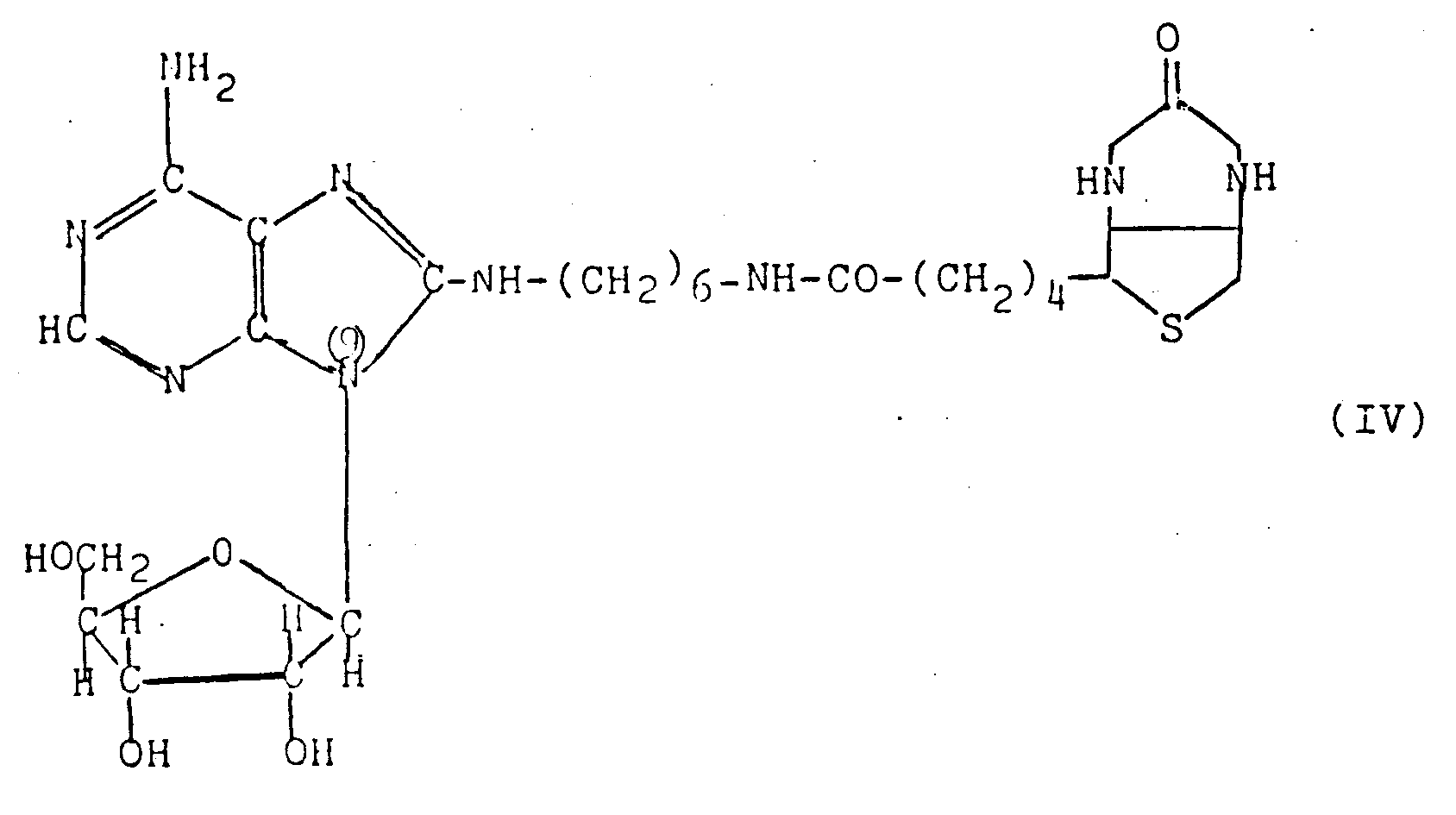
- L'échantillon présumé contenir le susdit antibiotique est constitué par du sérum provenant d'un patient traité par un aminoglycoside. Ce sérum est préalablement déprotéinisé.
- Cet échantillon est mis en solution dans une solution tamponnée dont la composition est la suivante :
- Tris HCl
- 50 mM, pH 7,5
- MgCl₂
- 10 mM,
- DTT
- 1 mM.
- On ajoute à la solution ainsi formée 10 micromoles d'ATP-DNP et on laisse incuber pendant 1 heure à 37° C avec 10 U d'adénylyltransférase extraite de Staphilococcus rivet ou de Escherichia coli R55.
- Une partie du produit de réaction est alors prélevée, notamment par une pipette d'EPPENDORF (GILSON) comprenant dans sa partie inférieure un échangeur de cations capable de fixer l'antibiotique modifié par l'AMP-DNP, les autres constituants, y compris l'excès d'ATP-DNP et les phosphates organiques formés restant alors dans la solution.
- L'échangeur de cations (Amberlite CG 50, 200-400 mcsh, forme NH₄+) est alors lavé avec la susdite solution tampon. L'antibiotique modifié est ensuite élué à partir de l'échangeur de cations, à l'aide d'une solution d'ammoniaque 1N. Le soluté obtenu est ensuite neutralisé avec HCl 1N.
- Le dosage comprend alors finalement l'étape consistant à mettre en contact la susdite solution avec un anticorps anti-DNP couplé à de la péroxydase, à recueillir l'éventuel complexe formé entre, d'une part, l'aminoglycoside dans lequel est incorporé le produit de dégradation de l'ATP-DNP, et, d'autre part, le susdit anticorps et à le mettre en contact avec un substrat colorable de la péroxydase. La présence d'antibiotique est alors manifestée par la coloration du substrat de la péroxydase, coloration qui permet même de fournir des indications quantitatives concernant la quantité d'antibiotique que contenait initialement l'échantillon traité.
- Dans l'exemple considéré le substrat est avantageusement constitué par une solution contenant :
- de l'eau oxygénée : 10 µl d'H₂O₂ à 110 volumes,
- de l'acétate de potassium : 9,5 ml O,05M, pH 5,1,
- du 3-amino-9-éthylcarbazole : 2 mg dissous dans O,5 ml de N-N'-diméthylformamide.
- On peut par cette méthode doser des quantités de l'ordre du nanogramme par millilitre du susdit aminoglycoside.
- L'invention ne se limite évidemment pas aux modes de réalisation décrits ci-dessus à titre d'exemples et l'homme de l'art peut y apporter des modifications sans pour autant sortir du cadre des revendications ci-après.
Claims (10)
- Procédé de détection ou de dosage d'une substance appartenant à la catégorie de substances biologiques, telles que certains antibiotiques plus particulièrement ceux de la classe des aminoglycosides, qui sont capables, en présence d'enzymes spécifiques, d'incorporer de l'ADP ou de l'AMP, ces dernières molécules étant susceptibles d'être fournies à ces substances biologiques à partir d'ATP en présence d'une enzyme spécifique appropriée, caractérisé par les étapes qui consistent :- à mettre la composition présumée contenir la substance recherchée avec un réactif contenant un ATP modifié par une molécule chimique fixée de façon covalente au cycle adénine de cet ATP et portant au moins un groupe non engagé dans la liaison covalente susdite et couplable directement ou indirectement avec une molécule ou un produit ayant une affinité spécifique pour ce groupe et permettant sa reconnaissance, ledit groupe étant en outre tel qu'il n'empêche pas l'ATP modifié qui le porte à fournir l'AMP modifié ou l'ADP modifié correspondant dans une forme incorporable dans ladite substance recherchée.- à placer, le cas échéant, après élimination des ATP modifiés libres, la composition obtenue dans des conditions permettant l'éventuel couplage des groupes de modification portés par l'AMP modifié ou l'ADP modifié incorporé à ladite substance, avec la molécule ou le produit permettant la reconnaissance du groupe de modification du dérivé initial d'ATP, et- à détecter ou à doser la susdite substance éventuellement présente portant lesdits produits de reconnaissance.
- Procédé selon la revendication 1, caractérisé en ce que le réactif utilisé contient un ATP modifié résultant de la fixation covalente sur la position 6, ou de préférence 8, du groupe adénine de l'ATP d'un groupe M, choisi parmi ceux qui sont susceptibles d'une réaction de liaison avec un agent chimique ou immunologique ayant une affinité sélective pour ce groupe, par l'intermédiaire d'un bras du type -NH-(CH₂)x-X, ou -CO-(CH₂)x-X, dans lequel X est un groupe assurant la liaison avec le susdit groupe M et x varie de 2 à 20, notamment de 6 à 12.
- Procédé selon la revendication 1, caractérisé en ce que le susdit groupe M est susceptible d'être reconnu spécifiquement et directement par une autre molécule ou par un produit, lui-même aisément détectable, par une méthode de visualisation.
- Procédé selon la revendication 3, caractérisé en ce que le susdit groupe M est constitué par un antigène ou un haptène susceptible d'être reconnu par un anticorps préalablement formé contre cet antigène ou contre cet haptène.
- procédé selon la revendication 2, caractérisé en ce que le susdit groupe M sert de relais vis-à-vis d'une autre molécule ou d'un autre produit susceptible d'être visualisé à son tour.
- Procédé selon l'une quelconque des revendications 2 à 4, caractérisé en ce que le susdit groupe M est couplable chimiquement avec une molécule affine marquée par une enzyme ou immunologiquement avec un anticorps marqué par une enzyme et ayant une affinité sélective pour ledit groupe.
- Procédé selon la revendication 2 considérée isolément ou en combinaison avec l'une quelconque des revendications 3 à 6, caractérisé en ce que les groupes CH₂ du bras susdit peuvent en partie être remplacés par des groupes CO ou NH, à condition que ces groupes de remplacement ne soient pas adjacents à des groupes identiques.
- Procédé selon l'une quelconque des revendications 2 à 7, caractérisé en ce que le susdit groupe M est dérivé de l'avidine ou un groupe dinitro-2,4-phényle.
- Procédé selon l'une quelconque des revendications 2 à 7, caractérisé en ce que le susdit groupe M est dérivé de l'avidine.
- Procédé selon l'une quelconque des revendications 2 à 7, caractérisé en ce que le susdit groupe M est un groupe dinitro-2,4-phényle.
Applications Claiming Priority (2)
| Application Number | Priority Date | Filing Date | Title |
|---|---|---|---|
| FR8124442A FR2519004B1 (fr) | 1981-12-29 | 1981-12-29 | Acide adenosine 5'-triphosphorique modifie et procede de dosage de substances biologiques susceptibles de fixer des produits de degradation de l'acide adenosine 5'-triphosphorique |
| FR8124442 | 1981-12-29 |
Publications (2)
| Publication Number | Publication Date |
|---|---|
| EP0097666A1 EP0097666A1 (fr) | 1984-01-11 |
| EP0097666B1 true EP0097666B1 (fr) | 1992-08-19 |
Family
ID=9265490
Family Applications (1)
| Application Number | Title | Priority Date | Filing Date |
|---|---|---|---|
| EP83900049A Expired - Lifetime EP0097666B1 (fr) | 1981-12-29 | 1982-12-29 | Procede de dosage de substances biologiques susceptibles de fixer des produits de degradation de l'acide adenosine 5'-triphosphorique |
Country Status (4)
| Country | Link |
|---|---|
| EP (1) | EP0097666B1 (fr) |
| JP (1) | JPS58502206A (fr) |
| FR (1) | FR2519004B1 (fr) |
| WO (1) | WO1983002276A1 (fr) |
Families Citing this family (9)
| Publication number | Priority date | Publication date | Assignee | Title |
|---|---|---|---|---|
| CA1219824A (fr) * | 1981-04-17 | 1987-03-31 | David C. Ward | Nucleotides modifies, leur preparation et leur emploi |
| US4711955A (en) * | 1981-04-17 | 1987-12-08 | Yale University | Modified nucleotides and methods of preparing and using same |
| US7220854B1 (en) | 1982-06-23 | 2007-05-22 | Enzo Life Sciences, Inc. C/O Enzo Biochem, Inc. | Sugar moiety labeled nucleotide, and an oligo- or polynucleotide, and other compositions comprising such sugar moiety labeled nucleotides |
| CA1223831A (fr) | 1982-06-23 | 1987-07-07 | Dean Engelhardt | Nucleotides modifies, methodes de preparation et d'utilisation et composes les contenant |
| US4994373A (en) | 1983-01-27 | 1991-02-19 | Enzo Biochem, Inc. | Method and structures employing chemically-labelled polynucleotide probes |
| US4828979A (en) * | 1984-11-08 | 1989-05-09 | Life Technologies, Inc. | Nucleotide analogs for nucleic acid labeling and detection |
| FR2601956B1 (fr) * | 1986-07-22 | 1989-11-03 | Pasteur Institut | Nouveaux derives de desoxy-2' adenosine, leur procede d'obtention par voie de synthese et leurs applications biologiques |
| GB8621337D0 (en) * | 1986-09-04 | 1986-10-15 | Agricultural Genetics Co | Non-radioactive nucleic acid hybridization probes |
| US5109124A (en) * | 1988-06-01 | 1992-04-28 | Biogen, Inc. | Nucleic acid probe linked to a label having a terminal cysteine |
Family Cites Families (4)
| Publication number | Priority date | Publication date | Assignee | Title |
|---|---|---|---|---|
| IN142734B (fr) * | 1975-04-28 | 1977-08-20 | Miles Lab | |
| JPS53101396A (en) * | 1977-02-10 | 1978-09-04 | Agency Of Ind Science & Technol | Novel adenosine nucleotide derivatives and process for their preparation |
| US4259232A (en) * | 1979-10-23 | 1981-03-31 | Miles Laboratories, Inc. | Flavin adenine dinucleotide-labeled protein and polypeptide conjugates |
| US4255566A (en) * | 1980-02-19 | 1981-03-10 | Miles Laboratories | Flavin adenine dinucleotide derivatives and labeled conjugates prepared therefrom |
-
1981
- 1981-12-29 FR FR8124442A patent/FR2519004B1/fr not_active Expired
-
1982
- 1982-12-29 JP JP58500215A patent/JPS58502206A/ja active Pending
- 1982-12-29 EP EP83900049A patent/EP0097666B1/fr not_active Expired - Lifetime
- 1982-12-29 WO PCT/FR1982/000222 patent/WO1983002276A1/fr not_active Ceased
Also Published As
| Publication number | Publication date |
|---|---|
| WO1983002276A1 (fr) | 1983-07-07 |
| EP0097666A1 (fr) | 1984-01-11 |
| FR2519004B1 (fr) | 1985-09-27 |
| FR2519004A1 (fr) | 1983-07-01 |
| JPS58502206A (ja) | 1983-12-22 |
Similar Documents
| Publication | Publication Date | Title |
|---|---|---|
| EP0097667B1 (fr) | Fragment d'adn marques a l'une au moins de leurs extremites par des ribonucleotides modifies reconnaissables par des molecules affines et procede pour realiser une analyse de tels fragments d'adn | |
| US5650334A (en) | Fluorescent labelling compositions and methods for their use | |
| EP0138357B1 (fr) | DNA marqué | |
| JP2870704B2 (ja) | ホモシステインアッセイ | |
| EP0062277B1 (fr) | Méthode pour mettre en oeuvre des essais immunologiques non isotopiques, réactif marqué et trousses pour utilisation dans un tel essai | |
| US5109124A (en) | Nucleic acid probe linked to a label having a terminal cysteine | |
| EP0525821B1 (fr) | Méthodes et structures utilisant des sondes de polynucléotides marqués chimiquement et non-radioactifs | |
| FR2695405A1 (fr) | Procédé de préparation de conjugués facteur intrinsèque-peroxydase de raifort. | |
| JPH0586199B2 (fr) | ||
| EP0097666B1 (fr) | Procede de dosage de substances biologiques susceptibles de fixer des produits de degradation de l'acide adenosine 5'-triphosphorique | |
| JP5139085B2 (ja) | 固相のオリゴ糖タグ付け:固定化糖質の操作技術 | |
| US4785080A (en) | Labeled analytes | |
| FR2843126A1 (fr) | "methode de determination d'une activite enzymatique endoglycosidase" | |
| FR2678387A1 (fr) | Procede de dosage immuno-enzymatique de la vitamine b12 et de preparation d'un echantillon pour ce dosage. | |
| JP2540482B2 (ja) | ポリヌクレオチド配列の生体内標識化 | |
| US5106950A (en) | Polypeptide-labeled analyte analog for carrying out an immunoassay | |
| FR2565996A1 (fr) | Acides nucleiques marques chimiquement, leur utilisation et necessaire pour sa mise en oeuvre | |
| JPH0138479B2 (fr) | ||
| JPH02257897A (ja) | 酵素―核酸ヒドラゾンおよびヒドラジド結合組成物ならびに結合方法 | |
| JPH079428B2 (ja) | 免疫分析方法 | |
| JPH0812699A (ja) | Peg修飾アビジン及びそれを用いた抗原又は抗体の分離方法 | |
| FR2523311A1 (fr) | Produit de couplage entre une albumine et un ligand specifique, obtention et applications dans le domaine biologique | |
| FR2623193A1 (fr) | Anticorps immobilises, fixes par liaison covalente a un polymere-matrice, et leur procede de preparation | |
| JPH032663A (ja) | 酵素発光測定法 | |
| US7291474B2 (en) | Hydrolytic substrates for an analyte-dependent enzyme activation system |
Legal Events
| Date | Code | Title | Description |
|---|---|---|---|
| PUAI | Public reference made under article 153(3) epc to a published international application that has entered the european phase |
Free format text: ORIGINAL CODE: 0009012 |
|
| AK | Designated contracting states |
Designated state(s): BE CH DE GB LI |
|
| 17P | Request for examination filed |
Effective date: 19831215 |
|
| GRAA | (expected) grant |
Free format text: ORIGINAL CODE: 0009210 |
|
| AK | Designated contracting states |
Kind code of ref document: B1 Designated state(s): BE CH DE GB LI |
|
| GBT | Gb: translation of ep patent filed (gb section 77(6)(a)/1977) | ||
| REF | Corresponds to: |
Ref document number: 3280410 Country of ref document: DE Date of ref document: 19920924 |
|
| PLBE | No opposition filed within time limit |
Free format text: ORIGINAL CODE: 0009261 |
|
| STAA | Information on the status of an ep patent application or granted ep patent |
Free format text: STATUS: NO OPPOSITION FILED WITHIN TIME LIMIT |
|
| 26N | No opposition filed | ||
| PGFP | Annual fee paid to national office [announced via postgrant information from national office to epo] |
Ref country code: CH Payment date: 19941219 Year of fee payment: 13 |
|
| PGFP | Annual fee paid to national office [announced via postgrant information from national office to epo] |
Ref country code: GB Payment date: 19941223 Year of fee payment: 13 |
|
| PGFP | Annual fee paid to national office [announced via postgrant information from national office to epo] |
Ref country code: DE Payment date: 19941224 Year of fee payment: 13 |
|
| PGFP | Annual fee paid to national office [announced via postgrant information from national office to epo] |
Ref country code: BE Payment date: 19950206 Year of fee payment: 13 |
|
| PG25 | Lapsed in a contracting state [announced via postgrant information from national office to epo] |
Ref country code: GB Effective date: 19951229 |
|
| PG25 | Lapsed in a contracting state [announced via postgrant information from national office to epo] |
Ref country code: LI Effective date: 19951231 Ref country code: CH Effective date: 19951231 Ref country code: BE Effective date: 19951231 |
|
| BERE | Be: lapsed |
Owner name: INSTITUT PASTEUR Effective date: 19951231 |
|
| REG | Reference to a national code |
Ref country code: CH Ref legal event code: PL |
|
| GBPC | Gb: european patent ceased through non-payment of renewal fee |
Effective date: 19951229 |
|
| PG25 | Lapsed in a contracting state [announced via postgrant information from national office to epo] |
Ref country code: DE Effective date: 19960903 |