EP0101023B1 - Verfahren zur Herstellung von 2-Carbamoyloxyalkyl-1,4-dihydropyridin-Derivaten und Zwischenprodukte für ihre Herstellung - Google Patents
Verfahren zur Herstellung von 2-Carbamoyloxyalkyl-1,4-dihydropyridin-Derivaten und Zwischenprodukte für ihre Herstellung Download PDFInfo
- Publication number
- EP0101023B1 EP0101023B1 EP83107707A EP83107707A EP0101023B1 EP 0101023 B1 EP0101023 B1 EP 0101023B1 EP 83107707 A EP83107707 A EP 83107707A EP 83107707 A EP83107707 A EP 83107707A EP 0101023 B1 EP0101023 B1 EP 0101023B1
- Authority
- EP
- European Patent Office
- Prior art keywords
- ethyl
- general formula
- amino
- methyl
- butynoate
- Prior art date
- Legal status (The legal status is an assumption and is not a legal conclusion. Google has not performed a legal analysis and makes no representation as to the accuracy of the status listed.)
- Expired
Links
- 0 C*(C)*C(N)=* Chemical compound C*(C)*C(N)=* 0.000 description 6
Classifications
-
- C—CHEMISTRY; METALLURGY
- C07—ORGANIC CHEMISTRY
- C07D—HETEROCYCLIC COMPOUNDS
- C07D211/00—Heterocyclic compounds containing hydrogenated pyridine rings, not condensed with other rings
- C07D211/04—Heterocyclic compounds containing hydrogenated pyridine rings, not condensed with other rings with only hydrogen or carbon atoms directly attached to the ring nitrogen atom
- C07D211/06—Heterocyclic compounds containing hydrogenated pyridine rings, not condensed with other rings with only hydrogen or carbon atoms directly attached to the ring nitrogen atom having no double bonds between ring members or between ring members and non-ring members
- C07D211/08—Heterocyclic compounds containing hydrogenated pyridine rings, not condensed with other rings with only hydrogen or carbon atoms directly attached to the ring nitrogen atom having no double bonds between ring members or between ring members and non-ring members with hydrocarbon or substituted hydrocarbon radicals directly attached to ring carbon atoms
- C07D211/10—Heterocyclic compounds containing hydrogenated pyridine rings, not condensed with other rings with only hydrogen or carbon atoms directly attached to the ring nitrogen atom having no double bonds between ring members or between ring members and non-ring members with hydrocarbon or substituted hydrocarbon radicals directly attached to ring carbon atoms with radicals containing only carbon and hydrogen atoms attached to ring carbon atoms
- C07D211/14—Heterocyclic compounds containing hydrogenated pyridine rings, not condensed with other rings with only hydrogen or carbon atoms directly attached to the ring nitrogen atom having no double bonds between ring members or between ring members and non-ring members with hydrocarbon or substituted hydrocarbon radicals directly attached to ring carbon atoms with radicals containing only carbon and hydrogen atoms attached to ring carbon atoms with hydrocarbon or substituted hydrocarbon radicals attached to the ring nitrogen atom
-
- C—CHEMISTRY; METALLURGY
- C07—ORGANIC CHEMISTRY
- C07D—HETEROCYCLIC COMPOUNDS
- C07D295/00—Heterocyclic compounds containing polymethylene-imine rings with at least five ring members, 3-azabicyclo [3.2.2] nonane, piperazine, morpholine or thiomorpholine rings, having only hydrogen atoms directly attached to the ring carbon atoms
- C07D295/16—Heterocyclic compounds containing polymethylene-imine rings with at least five ring members, 3-azabicyclo [3.2.2] nonane, piperazine, morpholine or thiomorpholine rings, having only hydrogen atoms directly attached to the ring carbon atoms acylated on ring nitrogen atoms
- C07D295/20—Heterocyclic compounds containing polymethylene-imine rings with at least five ring members, 3-azabicyclo [3.2.2] nonane, piperazine, morpholine or thiomorpholine rings, having only hydrogen atoms directly attached to the ring carbon atoms acylated on ring nitrogen atoms by radicals derived from carbonic acid, or sulfur or nitrogen analogues thereof
- C07D295/205—Radicals derived from carbonic acid
-
- C—CHEMISTRY; METALLURGY
- C07—ORGANIC CHEMISTRY
- C07D—HETEROCYCLIC COMPOUNDS
- C07D211/00—Heterocyclic compounds containing hydrogenated pyridine rings, not condensed with other rings
- C07D211/04—Heterocyclic compounds containing hydrogenated pyridine rings, not condensed with other rings with only hydrogen or carbon atoms directly attached to the ring nitrogen atom
- C07D211/80—Heterocyclic compounds containing hydrogenated pyridine rings, not condensed with other rings with only hydrogen or carbon atoms directly attached to the ring nitrogen atom having two double bonds between ring members or between ring members and non-ring members
- C07D211/84—Heterocyclic compounds containing hydrogenated pyridine rings, not condensed with other rings with only hydrogen or carbon atoms directly attached to the ring nitrogen atom having two double bonds between ring members or between ring members and non-ring members with hetero atoms or with carbon atoms having three bonds to hetero atoms, with at the most one bond to halogen directly attached to ring carbon atoms
- C07D211/90—Carbon atoms having three bonds to hetero atoms with at the most one bond to halogen
Definitions
- the present invention relates to a process for preparing 2-carbamoyloxyalkyl-1,4-dihydropyridine derivatives and intermediates useful for the process. More particularly, the present invention relates to a process for the preparation of 2-carbamoyloxyalkyl-1,4-dihydropyridine derivatives which have pharmacological activities, and novel, 3-amino-3-carbamoyloxyalkylacrylic acid derivatives and 3-carbamoyloxyalkylpropiolic acid derivatives which are useful as intermediates for the preparation of the dihydropyridine derivatives.
- 2-Carbamoyloxyalkyl-1,4-dihydropyridine derivatives which have substituents with asymmetric structures at 2- and 6-positions of the dihydropyridine ring, are disclosed EP-0063747 and in Japanese Unexamined Patent Publications No. 118,565/1982 and No. 175,166/1982 by the present inventors.
- the dihydropyridine derivatives have coronary vasodilation activities or hypotensive activities and are expected to be useful as medicines for the treatment of disorders of circulatory organs.
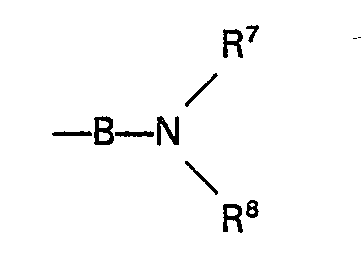
- the present invention provides a process for preparing a 2-carbamoyloxyalkyl-1,4-dihydropyridine derivative represented by the general formula: where R' is halogen, cyano, nitro, hydroxyl, di-lower alkyl substituted amino or lower alkoxy, each of R 2 and R 3 is lower alkyl, haloalkyl, lower alkenyl, lower alkynyl, aralkyl, aryl, pyridyl, quinolyl, pyridyl oxyalkyl, hydroxyalkyl, lower alkoxyalkyl, lower alkenyloxyalkyl, aralkyloxyalkyl, aryloxyalkyl or (where B is straight-chained or branched alkylene, and each of R 7 and R 8 is lower alkyl, aralkyl or aryi, or R 7 and R 8 form, together with the nitrogen atom to which they are attached, a heterocyclic group), R
- the 3-amino-3-carbamoyloxyalkylacrylic acid derivative of the general formula II and the 3-carbamoyloxyalkylpropiolic acid derivative of the general formula VI used as starting materials in the above process, are novel compounds of the present invention.
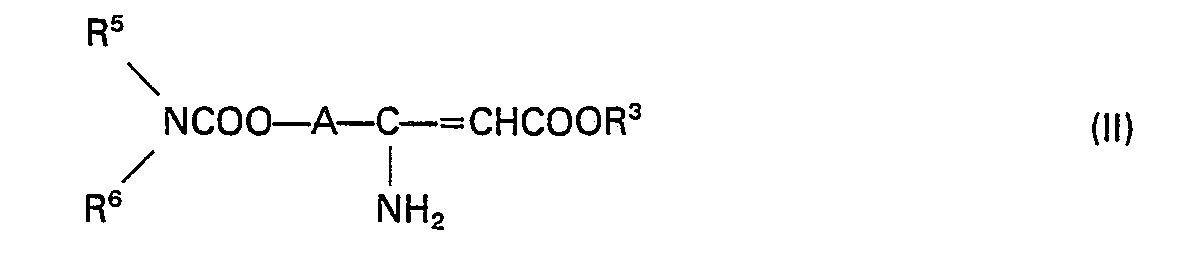
- the 3-amino-3-carbamoyloxyalkylacrylic acid derivative of the general formula II can be prepared by reacting the 3-carbamoyloxyalkylpropiolic acid derivative of the general formula VI with ammonia or an ammonium salt.
- the 3-carbamoyloxyalkylpropiolic acid derivative of the general formula VI can be prepared by:
- R 1 is halogen such as fluorine, chlorine, bromine or iodine; cyano; nitro; hydroxyl; di-substituted amino such as dimethylamino, diethylamino or dipropylamino; lower alkoxy such as methoxy, ethoxy, propoxy or butoxy.
- R2 and R 3 is lower alkyl such as methyl, ethyl, propyl, isopropyl, butyl, isobutyl, tertiary butyl, pentyl or hexyl; haloalkyl such as ( ⁇ -chloroethyl, ⁇ -bromoethyl, ( ⁇ -chloropropyl, A-chloropropyl, w-chlorobutyl, ⁇ , ⁇ -dichloroethyl, trifluoromethyl or ⁇ , ⁇ , ⁇ -trichloroethyl; lower alkenyl such as vinyl, allyl, 3-butenyl or isopropenyl; lower alkynyl such as propargyl or 2-butynyl aralkyl such as benzyl, a-methylbenzyl or phenethyl; aryl such as phenyl, pyridyl, naphthyl or quino
- R 4 is hydrogen; or lower alkyl such as methyl, ethyl, propyl, isopropyl, butyl, isobutyl or tertiary butyl.
- A is alkylene such as methylene, ethylidene, propylidene, benzylidene, isopropylidene, sec-butylidene, methylisobutylmethylene, phenylmethylmethylene, ethylene, methylethylene, ethylethylene, trimethylene or tetramethylene.
- R 5 and R 6 is hydrogen; lower alkyl such as methyl, ethyl, propyl, isopropyl, butyl, isobutyl or tertiarybutyl; haloalkyl such as ⁇ -chloroethyl, a-bromoethyl, ⁇ -chloropropyl, y-chloropropyl, w-chlorobutyl, ⁇ , ⁇ -dichloroethyl, ⁇ , ⁇ , ⁇ -trichloroethyl or trifluoromethyl, hydroxyalkyl such as ⁇ -hydroxyethyl, ⁇ -hydroxypropyl, y-hydroxypropyl or w-hydroxybutyl; cycloalkyl such as cyclopropyl, cyclobutyl, cyclopentyl, cyclohexyl or cycloheptyl; aralkyl such as benzyl, a-methylbenzyl or
- the aromatic rings contained in the aralkyl, aryl, aralkyloxyalkyl, and aryloxyalkyl of R 2 to R 8 may be substituted by 1 to 3 substituents.
- substituents there may be mentioned halogen such as fluorine, chlorine, bromine or iodine; cyano; nitro; hydroxyl; di-substituted amino such as dimethylamino, diethylamino or diisopropylamino; lower alkoxy such as methoxy, ethoxy, propoxy or butoxy; lower alkyl such as methyl, ethyl, propyl, or butyl; and trifluoromethyl.
- R 5 is hydrogen and R 6 is hydrogen, lower alkyl, cycloalkyl, aralkyl or aryl, R I to R 4 and A being as defined above with respect to the general formula I. More specifically, it is preferred that R' is o-nitro, m-nitro, o-chloro, o-cyano or o-methoxy, each of R 2 and R 3 is methyl, ethyl, propyl, isopropyl, butyl, isobutyl, a-chloroethyl, allyl, propargyl, benzyl, phenyl, ⁇ -methoxyethyl, ⁇ -ethoxyethyl, ⁇ -propoxyethyl, ⁇ -isopropoxyethyl, ⁇ -allyloxyethyl, ⁇ -benzyloxyethyl, ⁇ -phenoxyethyl, ⁇ -N-methylbenzylamino
- the methods (a), (b), (c) and (d) are particularly preferred.
- the compound of the general formula I is obtained by reacting a 3-amino-3-carbamoyloxyalkylacrylic acid derivative of the general formula II (hereinafter sometimes referred to simply as "an enamine compound") with the benzylidene compound of the general formula III (method (a)) or with the aldehyde of the general formula IV and the P-keto-ester of the general formula V (method (b)).
- reaction conditions for the methods (a) and (b) are suitably selected depending upon the particular types of the starting materials to be used.
- the benzylidene compound of the general formula III, or the aldehyde of the general formula IV and the ⁇ -keto-ester of the general formula V are used substantially in stoichiometric amounts, i.e. equimolar amounts, relative to the enamine compound of the general formula II.
- the molar ratio of the reactants can be varied within a wide range without adversely affecting the reaction.
- the reaction is usually carried out under cooling, at room temperature, or under warming or heating.
- the solvent for the reaction there may be used water, an inert organic solvent or a solvent mixture of water with an inert organic solvent.
- an inert organic solvent there may be used an alcohol such as methanol, ethanol, propanol, isopropanol or butanol, diethyl ether, dioxane, tetrahydrofuran, acetonitrile, acetone, dimethylformamide, ethyl acetate, benzene or chloroform.
- the reaction may be facilitated by using a catalyst, for example, an acid such as acetic acid, a base such as piperidine or a salt of an acid with a base.
- a catalyst for example, an acid such as acetic acid, a base such as piperidine or a salt of an acid with a base.
- the compound of the general formula I is prepared by reacting a 3-carbamoyloxyalkylpropiolic acid derivative of the general formula VI (hereinafter sometimes referred to simply as "acetylene compound") with the benzylidene compound of the general formula III and ammonia or an ammonium salt, or with the aldehyde of the general formula IV, the ⁇ -keto-ester of the general formula V and ammonia or an ammonium salt.
- reaction conditions for the methods (c) and (d) are optionally selected depending upon the particular types of the starting materials to be used.
- the acetylene compound of the general formula VI, the benzylidene compound of the general formula III, the aldehyde of the general formula IV and the ⁇ -keto-ester of the general formula V are used substantially in stoichiometric amounts, i.e. equimolar amounts, in the respective reactions, and the ammonia or ammonium salt is used in a stoichiometrically excess amount.
- the molar ratio of the reactants can be varied within a wide range without adversely affecting the reaction.
- ammonium salt there may be used an ammonium salt of an organic acid such as acetic acid, formic acid, citric acid, benzoic acid or phenylacetic acid, or an ammonium salt of an inorganic acid such as carbonic acid, bicarbonic acid or boric acid.
- organic acid such as acetic acid, formic acid, citric acid, benzoic acid or phenylacetic acid
- an ammonium salt of an inorganic acid such as carbonic acid, bicarbonic acid or boric acid.
- the reaction is usually carried out under cooling; at room temperature or under warming or heating.
- the solvent for the reaction may be water, an inert organic solvent or a solvent mixture of water with an inert organic solvent.
- an inert organic solvent there may be used an alcohol such as methanol, ethanol, propanol, isopropanol, or butanol, diethyl ether, dioxane, tetrahydrofuran, acetonitrile, acetone, dimethylformamide, ethyl acetate, benzene or chloroform.
- the reaction may be facilitated by using a catalyst such as an acid, a base or a salt of an acid with a base.
- a catalyst such as an acid, a base or a salt of an acid with a base.
- the compounds of the general formula I thus prepared by the process of the present invention may be refined, isolated or collected by usual methods such as extraction by means of an organic solvent, separation and purification by chromatography by means of a carrier such as silica gel or alumina, or crystallization. Further, when the compounds thus prepared ar capable of forming a salt, they may be converted to the respective salts with use of an inorganic acid such as hydrochloric acid or an organic acid such as citric acid.
- the compounds of the general formula I obtained by the present invention have vasodilation activities and hypotensive activities. Particularly, they have strong coronary vasodilation activities and extremely weak toxicity; and thus, they are expected to be quite useful as medicines for the treatment of disorders of the circulatory organs, such as hypertension, cardiac insufficiency, angina pectoris, myocardial infarction ' or intracerebral vascular disorders.
- Samples were intravenously administered to DM strain male mice (18 to 22 g), and LD 50 values were obtained according to the up-and-down method.
- Beagle dogs (13 to 16 kg, d) were subjected to thoracotomy under anesthesia with sodium pentobarbital, and a probe was attached to the heart left coronary anterior descending artery of each animal, whereupon the coronary blood flow (CF) was measured by an electromagnetic flowmeter. Further, a probe was attached to the exposed right femoral artery, and the femoral artery blood flow (FAF) was measured by an electromagnetic flowmeter. A canule was inserted to the left femoral artery, and the systemic blood pressure (BP) was measured by a transducer.
- CF coronary blood flow
- FAF femoral artery blood flow
- the heart rate (HR) was measured by an electrocardiogram.
- the sample solution was intravenously injected to the right femoral vein.
- the coronary blood flow (CF), the femoral artery blood flow (FAF) and the heart rate (HR) were represented by a % increase upon the injection of each sample as compared with the respective control value upon the injection of a saline.
- the systemic blood pressure (BP) was represented by a % decrease as compared with the control.
- the coronary vasodilation effects on the isolated heart preparations of rabbits and acute toxicity against the mice are shown in Tables
- the acute toxicity thereof is as low as 1/6 to 1/17 of the acture toxicity of nifedipine.
- the coronary effects against the beagle dogs are shown in Table 1-2. It is seen that the five representative compounds obtained by the present invention increase the coronary blood flow (CF) in correspondence with the increase in their doses, and their effectiveness is equivalent to or greater than the nifedipine. It is also seen that the coronary effects are thereby obtainable without substantially decreasing the systemic blood pressure (BP) or without substantially affecting the heart rate (HR). Thus, no excessive load will be given to the heart, which, coupled with the minimized toxicity, makes the compounds obtained by the present invention quite useful coronary vasodilators.
- BP systemic blood pressure
- HR heart rate
- the compounds of the general formula I obtained by the process of the present invention are expected to be useful as vasodilators as well as hypotensive drugs.
- the mode of administration of the compounds may be optionally chosen for such a purpose, and it may be e.g. parenteral administration such as intravenous, hypodermic or intramascular injection or rectal administration, or oral administration in a form of tablets, powders, granules capsules, sublingual tablets or syrups.
- the dose may vary depending upon the diseased condition, age and weight of the patient and the mode of the administration, but is usually from 0.1 to 1,000 mg per day, preferably from 1 to 100 mg per day, for an adult.
- the above- mentained formulations may be prepared by conventional methods which are commonly employed.
- the 3-amino-3-carbamoyloxyalkylacrylic acid derivatives of the general formula II are prepared by reacting a 3-carbamoyloxyalkylpropiolic acid derivative represented by the general formula: where R 3 , R 5 , R 6 and A are as defined above, with ammonia or an ammonium salt.
- the ammonium salt may be an inorganic ammonium salt such as ammonium carbonate, bicarbonate or borate, or an organic ammonium salt such as ammonium formate, acetate, propionate, butyrate, tartrate, citrate, glutarate, oxalate, benzoate, phenylacetate, salicylate, phthalate or nicotinate.
- an inorganic ammonium salt such as ammonium carbonate, bicarbonate or borate
- an organic ammonium salt such as ammonium formate, acetate, propionate, butyrate, tartrate, citrate, glutarate, oxalate, benzoate, phenylacetate, salicylate, phthalate or nicotinate.
- ammonia or ammonium salt is usually in an amount of from 1 to 10 moles, preferably from 1 to 5 moles, per mole of the starting material of the general formula VI.
- the reaction is carried out at room temperature or a slightly elevated temperature.
- the solvent for the reaction may be selected from a lower alcohol such as methanol, ethanol, propanol isopropanol, butyl alcohol, isobutyl alcohol, secondary butyl alcohol, tertiary butyl alcohol or amyl alcohol, ethylene glycol, propylene glycol, glycerol, methylcellusolve, ethylene glycol dimethyl ether, dimethyl sulfoxide, dimethylformamide, acetone, tetrahydrofuran and acetonitrile.
- a lower alcohol such as methanol, ethanol, propanol isopropanol, butyl alcohol, isobutyl alcohol, secondary butyl alcohol, tertiary butyl alcohol or amyl alcohol, ethylene glycol, propylene glycol, glycerol, methylcellusolve, ethylene glycol dimethyl ether, dimethyl sulfoxide, dimethylformamide, acetone, tetrahydrofuran and aceton
- a solvent mixture of water with an inert organic solvent such as benzene, ethyl acetate, chloroform or diethyl ether may be used other than the above-mentioned organic solvents.
- the reaction time is usually from 1 to 10 hours, preferably from 1 to 5 hours.
- R 3 is methyl, ethyl, propyl, isopropyl, butyl, isobutyl, ⁇ -chloroethyl, allyl, propargyl, benzyl, phenyl, ⁇ -methoxyethyi, ⁇ -propoxyethyl, ⁇ -isopropoxyethyl, ⁇ -allyloxyethyl, ⁇ -benzyloxyethyl, ⁇ -phenoxyethyl, ⁇ -N-methylbenzylaminoethyl-, ⁇ -piperidinoethyl, ⁇ -(4-methyl-1-piperazinyl)ethyl, or ⁇ -morpholinoethyl, each of R 5 and R 6 is hydrogen, methyl, ethyl, propyl, isopropyl, butyl, isobutyl,.tertiary butyl, ⁇ -chloroethyl, each of R 5 and R
- ⁇ -methoxyethyl 3-amino-4-carbamoyloxycrotonate methyl 3-amino-4-methylcarbamoyloxycrotonate, ethyl 3-amino-4-methylcarbamoyloxycrotonate, ⁇ -methoxyethyl 3-amino-4-methylcarbamoyloxycrotonate, ethyl 3-amino-4-ethylcarbamoyloxycrotonate, ethyl 3-amino-4-propylcarbamoyloxycrotonate, ethyl 3-amino-4-t-butylcarbamoyloxycrotonate, ethyl 3-amino-4-N-cyclohexylcarbamoyloxycrotonate, ethyl 3-amino-4-phenylcarbamoyloxycrotonate, ethyl 3-amino-4-phenylcar
- 3-amino-4-carbamoyloxycrotonate ⁇ -propoxyethyl 3-amino-4-carbamoyloxycrotonate, ⁇ -propoxyethyl 3-amino-4-methylcarbamoyloxycrotonate, methyl 3-amino-4-carbamoyloxycrotonate and isopropyl 3-amino-4-carbamoyloxycrotonate.
- Most preferred are methyl 3-amino-4-carbamoyloxycrotonate and isopropyl 3-amino-4-carbamoyloxycrotonate.
- the 3-carbamoyloxyalkylpropiolic acid derivatives of the general formula VI are prepared by:
- reaction process of the method (a) may be illustrated by the following reaction scheme in a case where ethyl 4-hydroxy-2-butynoate and methyl isocyanate are used as starting materials:
- reaction process of the method (b) may be illustrated by the following reaction scheme in a case where ethyl 4-hydroxy-2-butynoate, phosgene and dimethylamine are used as starting materials:
- reaction process of the method (c) may be illustrated by the following reaction scheme in a case where propargyl alcohol, phosgene, dimethylamine, butyl lithium and ethyl chloroformate are used as starting materials.
- the starting acetylene compounds of the general formulas VII and IX are known compounds or may readily be prepared by known methods if not disclosed in the literature. (M. Mark Midland; J. Org. Chem., 40, 2250 ⁇ 2252 (1975), Henne Greenlee; J. Am. Chem. Soc., 67, 484 (1945)).
- the method (a) is concerned with the preparation of the compound of the formula VI by reacting the acetylene compound of the general formula VII with an isocyanate or a carbamic acid chloride.
- isocyanate of the general formula R 9 NCO (where R 9 is as defined above), there may be mentioned chlorosulfonyl isocyanate, dichlorophosphoryl isocyanate, trichloroacetyl isocyanate, isocyanic acid, methyl isocyanate, ethyl isocyanate, propyl isocyanate, isopropyl isocyanate, butyl isocyanate, isobutyl isocyanate, tert.-butyl isocyanate, allyl isocyanate, cyclohexyl isocyanate, cyclopentyl isocyanate, phenyl isocyanate, o-, m- or p-chlorophenyl isocyanate, o-, m- or p-nitrophenyl isocyanate, m,p-dichlorophenyl isocyanate, p-fluorophenyl isocyanate, p-methoxy
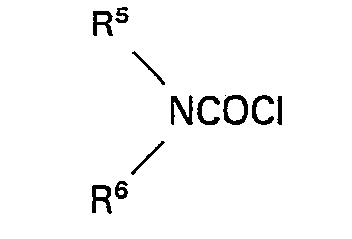
- carbamic acid chloride of the general formula (where R 5 and R 6 are as defined above but excluding hydrogen) to be used in this method there may be mentioned dimethylcarbamoyl chloride, diethylcarbamoyl chloride, dipropylcarbamoyl chloride, diisopropylcarbamoyl chloride, methylethylcarbamoyl chloride, methylbenzylcarbamoyl chloride and methylphenylcarbamoyl chloride.
- a compound capable of forming such an isocyanate under the reaction condition as mentioned below may be used.
- the reaction condition for the method (a) for the preparation of the compound of the general formula VI is suitably selected depending upon the particular types of the starting materials to be used.
- the isocyanate of the general formula R 9 NCO (where R 9 is as defined above) or the carbamic acid chloride of the general formula (where R 5 and R 6 are as defined above) are used in an amount of from 1 to 2 moles per mole of the acetylene compound of the general formula VII.
- the molar ratio of the starting materials may be varied within a wide range without adversely affecting the reaction.
- the reaction is usually carried out under cooling, at room temperature or under warming or heating.
- a base such as pyridine, triethylamine or N,N-dimethylaniline is used in an equimolar amount or in an excess amount relative to the carbamic acid chloride.
- an inert organic solvent such as dichloromethane, chloroform, diethyl ether, tetrahydrofuran or benzene is usually used. The reaction is usually carried out for 1 to 24 hours under stirring.
- chlorosulfonyl isocyanate dichlorophosphoryl isocyanate or trichloroacetyl isocyanate is used as the isocyanate, it will be necessary to hydrolyse the reaction mixture by adding water thereto after the completion of the reaction.
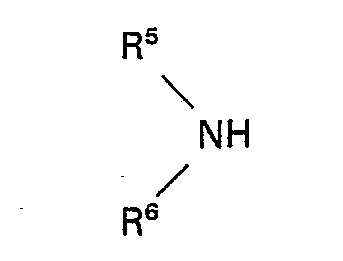
- the compound of the general formula VIII is synthesized by the reaction of the acetylene compound of the general formula VII with phosgene or trichloromethyl chloroformate, and then the compound of the general formula VI is prepared by the reaction of the compound of the general formula VIII with an amine of the general formula (where R 5 and R 6 are as defined above).
- the trichloromethyl chloroformate to be used in this reaction is contacted with a very small amount of pyridine or active carbon, whereupon the generated phosgene gas is absorbed in an inert organic solvent such as benzene, or is added dropwise to a solution of an inert organic solvent such as benzene to obtain a phosgene solution, as a pretreating operation before the reaction with the acetylene compound of the general formula VII.
- amine compound of the general formula (where R 5 and R 6 are as defined above) to be used in this reaction there may be mentioned ammonia, methylamine, ethylamine, propylamine, isopropylamine, butylamine, isobutylamine, tertiary-butylamine, dimethylamine, diethylamine, dipropylamine, diisopropylamine, dibutylamine, diisobutylamine, methylethylamine, diethanolamine, cyclohexylamine, dicyclohexylamine, allylamine, benzylamine, a-methylbenzylamine, phenethylamine, aniline, diphenylamine, a-pyridylamine, a-naphthylamine, N-methylbenzylamine, N-methylaniline, pyperidine, 4-methylpyperazine, 4-methylhomopyperazine, morpholine, homo
- the reaction for the reaction of the acetylene compound VII with phosgene or trichloromethyl chloroformate is usually such that phosgene ortrichloromethyl chloroformate is used in an amount of from 1 to 2 moles per mole of the acetylene compound of the general formula VII.
- the reaction condition for the reaction of the compound of the general formula VIII with the amine compound is usually such that relative to one mole of the compound of the general formula VIII, the amine compound of the general formula (where R 5 and R 6 are as defined above) is used in an amount of from 2 to 3 moles, or the amine compound in an amount of from 1 to 2 moles is used in combination with from 1 to 2 moles of a tertiary amine such as triethylamine, N,N-dimethylaniline or pyridine.
- a tertiary amine such as triethylamine, N,N-dimethylaniline or pyridine.
- the molar ratio of the reactants may be varied within a wide range without adversely affecting the reactions.
- the reaction is carried out under cooling with ice or at room temperature.
- an inert organic solvent such as diethyl ether, tetrahydrofuran, benzene, toluene, dichloromethane or chloroform is usually used as the solvent.
- each reaction is carried out under stirring for 30 minutes to 3 hours, followed by stirring for one night at room temperature for completion.
- the method (c) is a continuous or successive process for the preparation of the compound of the general formula VI in which firstly the compound of the general formula X is prepared by the reaction of the acetylene compound of the general formula IX with phosgene or trichloromethyl chloroformate, then the compound of the general formula XI is prepared by the reaction of the compound of the general formula X with the amine of the general formula (where R 5 and R 6 are as defined above, but excluding hydrogen), further a metallizing reagent is reacted to the compound of the general formula XI to form an organic metal compound and then a chloroformate of the general formula CICOOR 3 (where R 3 is as defined above) is reacted thereto.
- amine of the general formula (where R 5 and R 6 are as defined above, but excluding hydrogen) there may be mentioned the amine compounds mentioned in the above method (b), except for ammonia and primary amines such as methylamine and benzylamine.
- chloroformate of the general formula CICOOR' (where R 3 is as defined above) to be used in the reaction of the method (c) there may be mentioned, methyl chloroformate, ethyl chloroformate, propyl chloroformate, isopropyl chloroformate, ⁇ -chloroethyl- chloroformate, allyl chloroformate, propargyl chloroformate, benzyl chloroformate, phenyl chloroformate, ⁇ -methoxyethyl chloroformate, ⁇ -ethoxyethyl chloroformate, ⁇ -propoxyethyl chloroformate, ⁇ -isopropoxyethyl chloroformate, ⁇ -butoxye
- the reactions of the first two steps i.e. the reaction of the acetylene compound of the general formula IX with phosgene or trichloromethyl chloroformate and the reaction of the compound of the general formula X with the amine compound, are conducted in the same manner, with respect to the reaction conditions, reaction temperatures, solvents and reaction times as the corresponding reactions in the above-mentioned method (b).
- the reaction of the compound of the general formula XI with the metallizing reagent in the method (c) is usually conducted under such a condition that the metallizing reagent is used in an equtmolar amount or a slightly excess amount relative to the compound for the general formula XI, and the chloroformate is used in an amount of from 1 to 2 moles per mole of the compound.
- the reaction with the metallizing reagent is conducted under cooling with ice or at a lower temperature to -120°C, preferably from -60 to -80°C
- the reaction with the chloroformate is conducted under cooling with ice or at a lower temperature to -80°C, preferably from -60 to -80°C.
- an inert organic solvent such as diethyl ether ortetrahydrofuran is used.
- the reaction with the metallizing reagent is conducted for from 10 to 30 minutes, followed immediately by the reaction with the chloroformate for from 30 to 60 minutes.
- R 3 is methyl, ethyl, propyl, isopropyl, butyl, isobutyl, ⁇ -chloroethyl, allyl, propargyl, benzyl, phenyl, ⁇ -methoxyethyl, ⁇ -propoxyethyl, ⁇ -isopropoxyethyl, ⁇ -allyloxyethyl, (3-benzyloxyethyl, ⁇ -phenoxyethyl, ⁇ -N-methylbenzylaminoethyl, ⁇ -piperidinoethyl, ⁇ -(4-methyl-1-piperazinyl)etyl, or ⁇ -morpholinoethyl, each of R 5 and R 6 is hydrogen, methyl, ethyl, propyl, isopropyl, butyl, isobutyl, tertiary butyl, ⁇ -chloroethyl, benzy
- 3-carbamoyloxyalkylpropiolic acid derivatives of the general formula VI thus obtainable, preferred are methyl 4-carbamoyloxy-2-butynoate, ethyl 4-carbamoyloxy-2-butynoate, isopropyl 4-carbamoyloxy-2-butynoate, isobutyl 4-carbamoyloxy-2-butynoate, ⁇ -methoxyethyl 4-carbamoyloxy-2- butynoate, ⁇ -propoxyethyl 4-carbamoyloxy-2-butynoate, methyl 4-methylcarbamoyloxy-2-butynoate, ethyl 4-methylcarbamoyloxy-2-butynoate, ⁇ -methoxyethyl 4-methylcarbamoyloxy-2-butynoate, ⁇ -propoxyethyl 4-methylcarbamoyloxy-2-butynoate
- Most preferred are methyl 4-carbamoyloxy-2-butynoate and isopropyl 4-carbamoyloxy-2-butynoate.
- the primary and secondary crystals were combined and recrystallized from ethyl acetate, whereby 25.1 g (yield: 80%) of methyl 4-carbamoyloxy-2-butynoate in crystal form was obtained.
- Boiling point 44°C/45.22 mbar (34 mmHg) - 47°C/53.2 mbar (40 mmHg).
- Boiling point 71-73°C/10.64 mbar (8 mmHg).
- the reaction mixture was purified in the same manner as in Example VI-37, whereby 3.6 g (yield: 90.5%) of colorless oily ethyl 5-methylcarbamoyloxy-2-pentynoate was obtained.
- IR Liquid film
- cm -1 3450, 3350, 2980, 1695, 1625, 1575, 1480, 1430, 1380, 1365, 1275, 1160, 1120, 1095, 1070, 1005, 790, 765.
- the reaction mixture was concentrated under reduced pressure.
- the residue was dissolved in a mixed solution of 50 ml of ethyl acetate and water and stirred for mixing.
- the ethylacetate extract solution was washed with water, then dried over magnesium sulfate and concentrated under reduced pressure.
- the residue was purified by silica get (Prep PAK 500/silica) column chromatography by means of a liquid chromatography apparatus (System 500 A manufactured by Waters Co.).
- IR liquid film
- cm- 1 3440, 3350, 3000, 1710, 1660, 1620, 1580, 1445, 1360, 1310, 1260, 1165, 1140, 1090, 1030, 955, 790.
- reaction annd purification treatment were conducted in the same manner as in Example 11-43 except that 2.1 g (10.5 millimoles) of ethyl 4-carbamoyloxy-4-methyl-2-pentynoate was used as the starting material, whereby 0.47 g (2.1 millimoles, yield: 20%) of ethyl 3-amino-4-carbamoyloxy-4-methyl-2-pentenoate in crystal form was obtained.
- UV UV: . 235, 350nm.
- the residue was separated and purified by means of a liquid chromatography apparatus (System 500 A manufactured by Waters Co.) by using a Prep PAK-500/silica column and ethyl acetate-hexane (2: 1) as the developer solvent.
- the desired fraction was collected and concentrated under reduced pressure.
- the residue was crystallized from diisopropyl ether, whereby 4.8 g (yield: 21.5%) of 2 - methylcarbamoyloxymethyl - 6 - methyl - 4 - (m - nitrophenyl) - 3,5 - diethoxycarbonyl - 1,4 - dihydropyridine in crystal form was obtained.
- the residue was separated and purified by means of a liquid chromatography apparatus (System 500 A manufactured by Waters Co.) by using a Prep PAK-500/silica column and ethyl acetate-hexane (2:2) as the developer solvent.
- the desired fraction was collected and concentrated under reduced pressure.
- the residue thereby obtained was crystallized from diisopropylether, whereby 5.0 g (yield: 22.3%) of 2 - methylcarbamoyloxymethyl - 6 - methyl - 4 - (m - nitrophenyl) - 3,5 - diethoxycarbonyl - 1,4 - dihydropyridine in crystal form was obtained.
Landscapes
- Chemical & Material Sciences (AREA)
- Organic Chemistry (AREA)
- Pharmaceuticals Containing Other Organic And Inorganic Compounds (AREA)
- Hydrogenated Pyridines (AREA)
- Plural Heterocyclic Compounds (AREA)
- Pyridine Compounds (AREA)
Claims (21)








Priority Applications (1)
| Application Number | Priority Date | Filing Date | Title |
|---|---|---|---|
| AT83107707T ATE28634T1 (de) | 1982-08-06 | 1983-08-04 | Verfahren zur herstellung von 2-carbamoyloxyalkyl-1,4-dihydropyridin-derivate und zwischenprodukte fuer ihre herstellung. |
Applications Claiming Priority (6)
| Application Number | Priority Date | Filing Date | Title |
|---|---|---|---|
| JP57136343A JPS5927871A (ja) | 1982-08-06 | 1982-08-06 | 2−カルバモイルオキシアルキル−1,4−ジヒドロピリジン誘導体の新規な製造法 |
| JP136343/82 | 1982-08-06 | ||
| JP57151706A JPS5942355A (ja) | 1982-09-02 | 1982-09-02 | 3−カルバモイルオキシアルキルプロピオ−ル酸誘導体およびその製造法 |
| JP151706/82 | 1982-09-02 | ||
| JP57177647A JPS5967257A (ja) | 1982-10-12 | 1982-10-12 | 3−アミノ−3−カルバモイルオキシアルキルアクリル酸誘導体およびその製造法 |
| JP177647/82 | 1982-10-12 |
Publications (2)
| Publication Number | Publication Date |
|---|---|
| EP0101023A1 EP0101023A1 (de) | 1984-02-22 |
| EP0101023B1 true EP0101023B1 (de) | 1987-07-29 |
Family
ID=27317251
Family Applications (1)
| Application Number | Title | Priority Date | Filing Date |
|---|---|---|---|
| EP83107707A Expired EP0101023B1 (de) | 1982-08-06 | 1983-08-04 | Verfahren zur Herstellung von 2-Carbamoyloxyalkyl-1,4-dihydropyridin-Derivaten und Zwischenprodukte für ihre Herstellung |
Country Status (6)
| Country | Link |
|---|---|
| US (3) | US4914227A (de) |
| EP (1) | EP0101023B1 (de) |
| KR (1) | KR910000235B1 (de) |
| CA (1) | CA1215978A (de) |
| DE (1) | DE3372758D1 (de) |
| HU (2) | HU197881B (de) |
Families Citing this family (12)
| Publication number | Priority date | Publication date | Assignee | Title |
|---|---|---|---|---|
| HU197881B (en) * | 1982-08-06 | 1989-06-28 | Banyu Pharma Co Ltd | Process for producing new carbamoyl-oxy-alkyl-carboxy-lic acid derivatives |
| US5137889A (en) * | 1983-12-02 | 1992-08-11 | Otsuka Pharmaceutical Co., Ltd. | Dihydropyridine derivatives and process for preparing the same |
| JPS6112662A (ja) * | 1984-06-28 | 1986-01-21 | Yamanouchi Pharmaceut Co Ltd | ジヒドロピリジン誘導体及びその製法 |
| US4624964A (en) * | 1985-03-27 | 1986-11-25 | E. I. Du Pont De Nemours And Company | Aryl oxo-alkynoates as 5-lipoxygenase inhibitors |
| IT1197012B (it) * | 1986-07-29 | 1988-11-25 | Boehringer Biochemia Srl | 2-(aciltio) metil diidropiridine, un processo per la loro preparazione e composizioni farmaceutiche che le contengono |
| JPH0688973B2 (ja) * | 1987-03-12 | 1994-11-09 | 京都薬品工業株式会社 | 1,4−ジヒドロピリジン誘導体 |
| GB8712747D0 (en) * | 1987-05-30 | 1987-07-01 | Pfizer Ltd | Therapeutic agents |
| JP3116364B2 (ja) * | 1989-10-02 | 2000-12-11 | 萬有製薬株式会社 | エンイン誘導体の製造法 |
| US5173209A (en) * | 1990-05-10 | 1992-12-22 | Cyprus Foote Mineral Company | Stable lithium cycloalkylimides |
| US6417366B2 (en) | 1999-06-24 | 2002-07-09 | Abbott Laboratories | Preparation of quinoline-substituted carbonate and carbamate derivatives |
| CN103044315A (zh) * | 2013-01-12 | 2013-04-17 | 石家庄学院 | 一种以酸性离子液体为催化剂制备1,4-二氢吡啶的方法 |
| CN103497147B (zh) * | 2013-09-11 | 2016-02-24 | 常州大学 | 三氟甲磺酸镱催化的1,4-二氢吡啶类化合物的合成方法 |
Family Cites Families (8)
| Publication number | Priority date | Publication date | Assignee | Title |
|---|---|---|---|---|
| GB1552911A (en) * | 1975-07-02 | 1979-09-19 | Fujisawa Pharmaceutical Co | 1,4 dihydropyridine derivatives and the preparation thereof |
| GB1591089A (en) * | 1976-12-17 | 1981-06-10 | Fujisawa Pharmaceutical Co | 1,4-dihydropyridine derivatives and process for preparation thereof |
| DE2658183A1 (de) * | 1976-12-22 | 1978-07-06 | Bayer Ag | In 2-position substituierte 1,4- dihydropyridin-derivate, verfahren zu ihrer herstellung sowie ihre verwendung als arzneimittel |
| SE7910521L (sv) * | 1979-12-20 | 1981-06-21 | Haessle Ab | Nya 2-metyl-6-substituerade-4-(2,3-disubstituerad fenyl)-1,4-dihydropyridin-3,5-diestrar med hypotesiva egenskaper, samt forfarande for deras framstellning, och farmaceutiska beredningar innehallande desamma |
| CS228917B2 (en) * | 1981-03-14 | 1984-05-14 | Pfizer | Method of preparing substituted derivatives of 1,4-dihydropyridine |
| JPS57175166A (en) * | 1981-04-23 | 1982-10-28 | Banyu Pharmaceut Co Ltd | Carbamoyloxyalkyl-1,4-dihydropyridine derivative and its preparation |
| HU197881B (en) * | 1982-08-06 | 1989-06-28 | Banyu Pharma Co Ltd | Process for producing new carbamoyl-oxy-alkyl-carboxy-lic acid derivatives |
| US4686217A (en) * | 1983-04-27 | 1987-08-11 | Fisons Plc | Calcium antagonist 2-fluoroalkyl-1,4-dihydropyridines |
-
1983
- 1983-07-28 HU HU855047A patent/HU197881B/hu unknown
- 1983-07-28 HU HU832661A patent/HU192166B/hu not_active IP Right Cessation
- 1983-07-30 KR KR1019830003579A patent/KR910000235B1/ko not_active Expired
- 1983-08-04 EP EP83107707A patent/EP0101023B1/de not_active Expired
- 1983-08-04 DE DE8383107707T patent/DE3372758D1/de not_active Expired
- 1983-08-05 CA CA000434005A patent/CA1215978A/en not_active Expired
-
1986
- 1986-05-16 US US06/863,984 patent/US4914227A/en not_active Expired - Fee Related
- 1986-05-16 US US06/865,654 patent/US4739106A/en not_active Expired - Fee Related
-
1988
- 1988-08-10 US US07/230,418 patent/US4958024A/en not_active Expired - Fee Related
Also Published As
| Publication number | Publication date |
|---|---|
| KR840005716A (ko) | 1984-11-15 |
| EP0101023A1 (de) | 1984-02-22 |
| HU197881B (en) | 1989-06-28 |
| US4739106A (en) | 1988-04-19 |
| HU192166B (en) | 1987-05-28 |
| KR910000235B1 (ko) | 1991-01-23 |
| US4914227A (en) | 1990-04-03 |
| US4958024A (en) | 1990-09-18 |
| DE3372758D1 (en) | 1987-09-03 |
| CA1215978A (en) | 1986-12-30 |
Similar Documents
| Publication | Publication Date | Title |
|---|---|---|
| EP0153016B1 (de) | Asymmetrische Diester von 1,4-Dihydro-2,6-dimethylpyridine-3,5-dicarboxylsäure | |
| US3985758A (en) | 1,4-Dihydropyridine derivatives | |
| EP0101023B1 (de) | Verfahren zur Herstellung von 2-Carbamoyloxyalkyl-1,4-dihydropyridin-Derivaten und Zwischenprodukte für ihre Herstellung | |
| EP0063365B1 (de) | 1,4-Dihydropyridin-Derivate und diese enthaltende pharmazeutische Zusammensetzungen | |
| US5124451A (en) | Process for the n-alkylation or ureas | |
| KR920005742B1 (ko) | 약제학상 유용한 디하이드로피리디닐디카르복실레이트 아마이드 및 에스테르의 제조방법 | |
| US5169954A (en) | Process for the N-alkylation of ureas | |
| US4032559A (en) | N,2-dicyanoacetimidates | |
| US4578465A (en) | Phenyliperazine derivatives | |
| EP0063747B1 (de) | 2-Substituierte oder nicht-substituierte Aminocarbonyloxyalkyl-1,4-dihydropyridine | |
| US4814455A (en) | Dihydro-3,5-dicarboxylates | |
| EP0173126B1 (de) | Dihydropyridinderivate | |
| EP0086647B1 (de) | Pyrimidin-Verbindungen, ihre Herstellung und diese enthaltende pharmazeutische Zusammenstellungen | |
| US4579859A (en) | Vasodilating trinitratoalkyl esters of 2-cyano-1,4-dihydropyridines | |
| KR910005750B1 (ko) | 3-아미노-3-카르바모일옥시알킬 아크릴산 유도체의 제조방법 | |
| KR910005749B1 (ko) | 3-카르바모일옥시알킬 프로피올산 유도체의 제조방법 | |
| US3221017A (en) | Aralkoxyamides of 4-phenyl-1,2,5,6-tetrahydropyridino alkanoic acids and intermediates thereof | |
| EP0083256B1 (de) | Benzamidderivate | |
| EP0220917B1 (de) | Pharmazeutische 1,4-Dihydropyridinderivate, ihre Salze und Herstellung | |
| US4960883A (en) | Piperazines and homopiperazines | |
| SU1099842A3 (ru) | Способ получени 4-/2-нитрофенил/-2,6-диметил-3,5-дикарбметокси-1,4-дигидропиридина | |
| US4622322A (en) | Aroyl substituted dihydro-1,4-thiazines | |
| EP0063359A1 (de) | 1,4-Dihydropyridin-Derivate und Verfahren zu ihrer Herstellung | |
| US3539630A (en) | Acetylated(1-adamantyloxy) alkylamine compounds | |
| US5106846A (en) | 2,3-thiomorpholinedione-2-oxime derivatives and pharmaceutical compositions containing them |
Legal Events
| Date | Code | Title | Description |
|---|---|---|---|
| PUAI | Public reference made under article 153(3) epc to a published international application that has entered the european phase |
Free format text: ORIGINAL CODE: 0009012 |
|
| AK | Designated contracting states |
Designated state(s): AT BE CH DE FR GB IT LI LU NL SE |
|
| 17P | Request for examination filed |
Effective date: 19840731 |
|
| GRAA | (expected) grant |
Free format text: ORIGINAL CODE: 0009210 |
|
| AK | Designated contracting states |
Kind code of ref document: B1 Designated state(s): AT BE CH DE FR GB IT LI LU NL SE |
|
| REF | Corresponds to: |
Ref document number: 28634 Country of ref document: AT Date of ref document: 19870815 Kind code of ref document: T |
|
| REF | Corresponds to: |
Ref document number: 3372758 Country of ref document: DE Date of ref document: 19870903 |
|
| ET | Fr: translation filed | ||
| ITF | It: translation for a ep patent filed | ||
| PLBE | No opposition filed within time limit |
Free format text: ORIGINAL CODE: 0009261 |
|
| STAA | Information on the status of an ep patent application or granted ep patent |
Free format text: STATUS: NO OPPOSITION FILED WITHIN TIME LIMIT |
|
| 26N | No opposition filed | ||
| ITTA | It: last paid annual fee | ||
| EPTA | Lu: last paid annual fee | ||
| EAL | Se: european patent in force in sweden |
Ref document number: 83107707.8 |
|
| PGFP | Annual fee paid to national office [announced via postgrant information from national office to epo] |
Ref country code: SE Payment date: 19960528 Year of fee payment: 14 |
|
| PGFP | Annual fee paid to national office [announced via postgrant information from national office to epo] |
Ref country code: GB Payment date: 19960726 Year of fee payment: 14 |
|
| PGFP | Annual fee paid to national office [announced via postgrant information from national office to epo] |
Ref country code: FR Payment date: 19960809 Year of fee payment: 14 |
|
| PGFP | Annual fee paid to national office [announced via postgrant information from national office to epo] |
Ref country code: AT Payment date: 19960813 Year of fee payment: 14 |
|
| PGFP | Annual fee paid to national office [announced via postgrant information from national office to epo] |
Ref country code: CH Payment date: 19960821 Year of fee payment: 14 |
|
| PGFP | Annual fee paid to national office [announced via postgrant information from national office to epo] |
Ref country code: NL Payment date: 19960828 Year of fee payment: 14 |
|
| PGFP | Annual fee paid to national office [announced via postgrant information from national office to epo] |
Ref country code: DE Payment date: 19960830 Year of fee payment: 14 |
|
| PGFP | Annual fee paid to national office [announced via postgrant information from national office to epo] |
Ref country code: LU Payment date: 19960901 Year of fee payment: 14 |
|
| PGFP | Annual fee paid to national office [announced via postgrant information from national office to epo] |
Ref country code: BE Payment date: 19961003 Year of fee payment: 14 |
|
| PG25 | Lapsed in a contracting state [announced via postgrant information from national office to epo] |
Ref country code: LU Free format text: LAPSE BECAUSE OF NON-PAYMENT OF DUE FEES Effective date: 19970804 Ref country code: GB Free format text: LAPSE BECAUSE OF NON-PAYMENT OF DUE FEES Effective date: 19970804 Ref country code: AT Free format text: LAPSE BECAUSE OF NON-PAYMENT OF DUE FEES Effective date: 19970804 |
|
| PG25 | Lapsed in a contracting state [announced via postgrant information from national office to epo] |
Ref country code: SE Free format text: LAPSE BECAUSE OF NON-PAYMENT OF DUE FEES Effective date: 19970805 |
|
| PG25 | Lapsed in a contracting state [announced via postgrant information from national office to epo] |
Ref country code: LI Free format text: LAPSE BECAUSE OF NON-PAYMENT OF DUE FEES Effective date: 19970831 Ref country code: CH Free format text: LAPSE BECAUSE OF NON-PAYMENT OF DUE FEES Effective date: 19970831 Ref country code: BE Free format text: LAPSE BECAUSE OF NON-PAYMENT OF DUE FEES Effective date: 19970831 |
|
| BERE | Be: lapsed |
Owner name: BANYU PHARMACEUTICAL CO. LTD Effective date: 19970831 |
|
| PG25 | Lapsed in a contracting state [announced via postgrant information from national office to epo] |
Ref country code: NL Free format text: LAPSE BECAUSE OF NON-PAYMENT OF DUE FEES Effective date: 19980301 |
|
| GBPC | Gb: european patent ceased through non-payment of renewal fee |
Effective date: 19970804 |
|
| REG | Reference to a national code |
Ref country code: CH Ref legal event code: PL |
|
| PG25 | Lapsed in a contracting state [announced via postgrant information from national office to epo] |
Ref country code: FR Free format text: LAPSE BECAUSE OF NON-PAYMENT OF DUE FEES Effective date: 19980430 |
|
| PG25 | Lapsed in a contracting state [announced via postgrant information from national office to epo] |
Ref country code: DE Free format text: LAPSE BECAUSE OF NON-PAYMENT OF DUE FEES Effective date: 19980501 |
|
| EUG | Se: european patent has lapsed |
Ref document number: 83107707.8 |
|
| NLV4 | Nl: lapsed or anulled due to non-payment of the annual fee |
Effective date: 19980301 |
|
| REG | Reference to a national code |
Ref country code: FR Ref legal event code: ST |