EP0101871A1 - Verfahren zur Erzeugung von zinnfreien Stahlblechen mit verbesserter Beständigkeit bei der Biegebehandlung - Google Patents
Verfahren zur Erzeugung von zinnfreien Stahlblechen mit verbesserter Beständigkeit bei der Biegebehandlung Download PDFInfo
- Publication number
- EP0101871A1 EP0101871A1 EP83106972A EP83106972A EP0101871A1 EP 0101871 A1 EP0101871 A1 EP 0101871A1 EP 83106972 A EP83106972 A EP 83106972A EP 83106972 A EP83106972 A EP 83106972A EP 0101871 A1 EP0101871 A1 EP 0101871A1
- Authority
- EP
- European Patent Office
- Prior art keywords
- chromium
- treatment
- solution
- steel sheet
- plating
- Prior art date
- Legal status (The legal status is an assumption and is not a legal conclusion. Google has not performed a legal analysis and makes no representation as to the accuracy of the status listed.)
- Granted
Links
- 239000005029 tin-free steel Substances 0.000 title claims abstract description 37
- 238000011282 treatment Methods 0.000 title claims abstract description 30
- 238000000034 method Methods 0.000 title claims description 10
- ZCDOYSPFYFSLEW-UHFFFAOYSA-N chromate(2-) Chemical compound [O-][Cr]([O-])(=O)=O ZCDOYSPFYFSLEW-UHFFFAOYSA-N 0.000 claims abstract description 44
- VYZAMTAEIAYCRO-UHFFFAOYSA-N Chromium Chemical compound [Cr] VYZAMTAEIAYCRO-UHFFFAOYSA-N 0.000 claims abstract description 25
- 229910052804 chromium Inorganic materials 0.000 claims abstract description 25
- 239000011651 chromium Substances 0.000 claims abstract description 25
- 238000007747 plating Methods 0.000 claims abstract description 22
- 229910000831 Steel Inorganic materials 0.000 claims abstract description 13
- 239000010959 steel Substances 0.000 claims abstract description 13
- 238000005868 electrolysis reaction Methods 0.000 claims abstract description 11
- 238000007743 anodising Methods 0.000 claims abstract description 5
- 230000001747 exhibiting effect Effects 0.000 claims abstract description 4
- 229910001430 chromium ion Inorganic materials 0.000 claims abstract description 3
- 239000000243 solution Substances 0.000 claims description 22
- QAOWNCQODCNURD-UHFFFAOYSA-N Sulfuric acid Chemical compound OS(O)(=O)=O QAOWNCQODCNURD-UHFFFAOYSA-N 0.000 claims description 16
- QAOWNCQODCNURD-UHFFFAOYSA-L Sulfate Chemical compound [O-]S([O-])(=O)=O QAOWNCQODCNURD-UHFFFAOYSA-L 0.000 claims description 9
- 239000007864 aqueous solution Substances 0.000 claims description 9
- 238000000576 coating method Methods 0.000 claims description 9
- UOUJSJZBMCDAEU-UHFFFAOYSA-N chromium(3+);oxygen(2-) Chemical class [O-2].[O-2].[O-2].[Cr+3].[Cr+3] UOUJSJZBMCDAEU-UHFFFAOYSA-N 0.000 claims description 6
- 239000011248 coating agent Substances 0.000 claims description 5
- KRVSOGSZCMJSLX-UHFFFAOYSA-L chromic acid Substances O[Cr](O)(=O)=O KRVSOGSZCMJSLX-UHFFFAOYSA-L 0.000 claims description 3
- AWJWCTOOIBYHON-UHFFFAOYSA-N furo[3,4-b]pyrazine-5,7-dione Chemical compound C1=CN=C2C(=O)OC(=O)C2=N1 AWJWCTOOIBYHON-UHFFFAOYSA-N 0.000 claims description 3
- 239000003973 paint Substances 0.000 abstract description 23
- WGLPBDUCMAPZCE-UHFFFAOYSA-N Trioxochromium Chemical compound O=[Cr](=O)=O WGLPBDUCMAPZCE-UHFFFAOYSA-N 0.000 description 8
- 229940032330 sulfuric acid Drugs 0.000 description 6
- XLYOFNOQVPJJNP-UHFFFAOYSA-N water Substances O XLYOFNOQVPJJNP-UHFFFAOYSA-N 0.000 description 6
- 239000000853 adhesive Substances 0.000 description 5
- 230000001070 adhesive effect Effects 0.000 description 5
- 238000012360 testing method Methods 0.000 description 5
- 238000012856 packing Methods 0.000 description 4
- 239000000758 substrate Substances 0.000 description 4
- NINIDFKCEFEMDL-UHFFFAOYSA-N Sulfur Chemical compound [S] NINIDFKCEFEMDL-UHFFFAOYSA-N 0.000 description 3
- 229910000423 chromium oxide Inorganic materials 0.000 description 3
- 238000010586 diagram Methods 0.000 description 3
- 238000000926 separation method Methods 0.000 description 3
- 229910052717 sulfur Inorganic materials 0.000 description 3
- 239000011593 sulfur Substances 0.000 description 3
- 239000002253 acid Substances 0.000 description 2
- 150000001450 anions Chemical class 0.000 description 2
- 230000000712 assembly Effects 0.000 description 2
- 238000000429 assembly Methods 0.000 description 2
- 239000003153 chemical reaction reagent Substances 0.000 description 2
- 238000005260 corrosion Methods 0.000 description 2
- 230000007797 corrosion Effects 0.000 description 2
- 238000002474 experimental method Methods 0.000 description 2
- 238000004519 manufacturing process Methods 0.000 description 2
- 239000000463 material Substances 0.000 description 2
- 230000013011 mating Effects 0.000 description 2
- 239000005011 phenolic resin Substances 0.000 description 2
- 238000011160 research Methods 0.000 description 2
- 230000001954 sterilising effect Effects 0.000 description 2
- 238000004659 sterilization and disinfection Methods 0.000 description 2
- 239000004952 Polyamide Substances 0.000 description 1
- ATJFFYVFTNAWJD-UHFFFAOYSA-N Tin Chemical compound [Sn] ATJFFYVFTNAWJD-UHFFFAOYSA-N 0.000 description 1
- 239000002313 adhesive film Substances 0.000 description 1
- 235000013405 beer Nutrition 0.000 description 1
- 235000014171 carbonated beverage Nutrition 0.000 description 1
- 239000010960 cold rolled steel Substances 0.000 description 1
- 239000000356 contaminant Substances 0.000 description 1
- 238000005336 cracking Methods 0.000 description 1
- 230000001627 detrimental effect Effects 0.000 description 1
- 230000000694 effects Effects 0.000 description 1
- 230000005611 electricity Effects 0.000 description 1
- 239000003822 epoxy resin Substances 0.000 description 1
- -1 fluoride anions Chemical class 0.000 description 1
- 235000015203 fruit juice Nutrition 0.000 description 1
- 238000010438 heat treatment Methods 0.000 description 1
- 239000012535 impurity Substances 0.000 description 1
- 239000000203 mixture Substances 0.000 description 1
- 229920006284 nylon film Polymers 0.000 description 1
- 238000005554 pickling Methods 0.000 description 1
- 229920002647 polyamide Polymers 0.000 description 1
- 229920000647 polyepoxide Polymers 0.000 description 1
- 238000002203 pretreatment Methods 0.000 description 1
- 238000012545 processing Methods 0.000 description 1
- 229920006395 saturated elastomer Polymers 0.000 description 1
- 238000010998 test method Methods 0.000 description 1
Images

Classifications
-
- C—CHEMISTRY; METALLURGY
- C25—ELECTROLYTIC OR ELECTROPHORETIC PROCESSES; APPARATUS THEREFOR
- C25D—PROCESSES FOR THE ELECTROLYTIC OR ELECTROPHORETIC PRODUCTION OF COATINGS; ELECTROFORMING; APPARATUS THEREFOR
- C25D11/00—Electrolytic coating by surface reaction, i.e. forming conversion layers
- C25D11/38—Chromatising
-
- Y—GENERAL TAGGING OF NEW TECHNOLOGICAL DEVELOPMENTS; GENERAL TAGGING OF CROSS-SECTIONAL TECHNOLOGIES SPANNING OVER SEVERAL SECTIONS OF THE IPC; TECHNICAL SUBJECTS COVERED BY FORMER USPC CROSS-REFERENCE ART COLLECTIONS [XRACs] AND DIGESTS
- Y10—TECHNICAL SUBJECTS COVERED BY FORMER USPC
- Y10S—TECHNICAL SUBJECTS COVERED BY FORMER USPC CROSS-REFERENCE ART COLLECTIONS [XRACs] AND DIGESTS
- Y10S205/00—Electrolysis: processes, compositions used therein, and methods of preparing the compositions
- Y10S205/917—Treatment of workpiece between coating steps
Definitions
- This invention relates to a method of producing tin-free steel sheets having improved retorting resistance, and more particularly, to a method of producing tin-free steel sheets exhibiting improved retorting resistance with respect to paint adhesion and suitable for use as bonded can-forming material.
- Electrolytic chromate treated steel sheets also known as tin-free steel (TFS) of chromium type have improved properties as can-forming material and are regarded as a substitute for tin plates. The demand for them is increasing in these years.
- TFS has metallic chromium and hydrated chromium oxide coatings on the surface, it does not possess sufficient weldability.
- a can must be fabricated from a TFS sheet by applying an epoxy-phenol resin paint to a blank and bonding the mating edges of the blank with a polyamide adhesive to form a can barrel.
- TFS cans are not only used for so-called cold packs prepared by packing contents such as carbonated beverage and beer in cans at relatively low temperatures, but also used for so-called hot packs prepared by packing contents such as fruit juice and coffee in cans at relatively high temperatures for sterilization.
- TFS is also used in those cans requiring a high temperature retorting treatment for sterilization at the end of packing. In the latter applications, there often occurred accidents of rupture of can barrels.
- an object of the present invention to eliminate the above-mentioned problems of the prior art and to provide an improved method of producing tin-free steel sheets which do not undergo any interfacial separation between a TFS substrate and a paint build-up during a retorting treatment.
- the electrolytic chromate treating solution may desirably contain sulfate ions as little as possible.
- commercially available chromates (Cr0 3 ) contain sulfate as one of impurities. It is thus imperative that electrolytic chromate solutions prepared therefrom contain the sulfate contaminant.
- An electrolytic chromate solution whose sulfate concentration is as low as 0.005 g/k will be prepared from a reagent grade chromate which is too expensive to gain commercial acceptance.
- the use of commercial grade chromates results in electrolytic chromate solutions, some of which are successful in improving retorting resistance while the remainings fail.
- a method of producing a tin-free steel sheet exhibiting improved retorting resistance with respect to paint adhesion comprising the steps of
- the present invention is directed to TFS sheets having a plating of metallic chromium ranging from 50 to 200 mg per square meters on each sheet surface and a coating of hydrated chromium oxides ranging from 5 to 30 mg per square meters on the metallic chromium plating surface.
- TFS sheets generally have a metallic chromium plating of 50 to 200 mg/m 2 because thinner platings of less than 50 mg/m have poor corrosion resistance. Thicker platings exceeding 200 mg/m 2 do not provide an additional improvement in corrosion resistance.
- TFS sheets have a coating of hydrated chromium oxides of 5 to 30 mg/m (calculated as metallic chromium) because thinner coatings of less than 5 mg/m 2 do not provide the necessary paint adhesion. Thicker coatings exceeding 30 mg/m 2 have a poor appearance and are prone to cracking during subsequent processing and thus impractical. The most desirable range is 8 - 25 m g/ m 2 .
- the chromium plating bath and electrolytic chromate bath used in TFS manufacture are basically aqueous solutions of chromic acid, chromates and/or dichromates, to which a variety of assistants are-added. Most of these assistants contain one or more anions such as sulfate and fluoride anions, and such anions are codeposited in a substantial proportion in hydrated chromium oxide coatings formed on the TFS surface. Particularly, the sulfate codeposited in the coating is detrimental because it can be dissolved out during a retorting treatment of bonded TFS cans to give rise to paint film-TFS interfacial separation as described earlier.
- the inventors carried out a basic experiment in order to find adequate conditions for the electrolytic chromate treatment to assure that the resulting TFS sheets show consistently excellent retorting resistance with respect to paint adhesion.
- Steel sheets were electrolytically degreased, rinsed and pickled with sulfuric acid in a conventional manner before they were cathodically treated in a chromium plating bath having a composition of 100 to 200 g of Cr0 3 , 5 to 8 g of Na 2 SiF 6 and 0 . 5 to 1 g of H 2 SO 4 per liter of the bath.
- the chromium . plated steel sheets were successively subjected to reverse electrolysis in the same bath while they were set as an anode.
- the steel sheets were rinsed again with water.
- the steel sheets were further subjected to an electrolytic chromate treatment in aqueous chromate solutions prepared from reagent grade chromate (Cr0 3 ) with or without adding H 2 SO 4 thereto while they were set as a cathode.
- TFS sheets having paint applied thereon were coated on one surface with an epoxy-phenol resin paint in an amount of 60 mg/dm 2 and baked at 210°C for 12 minutes. The sheet was then coated on the other surface with the same paint in an amount of 25 mg/dm 2 and baked under the same conditions as above.
- the double-coated sheet was cut to pieces of 70 mm wide by 60 mm long. Two pieces were bonded with an adhesive along their edges.
- Fig. 1A shows a specimen consisting of two bonded pieces 2 and Fig. 1B is an enlarged view of the bonded portion of the specimen.
- one piece 2 was partially overlaid on another piece 2 over an overlapping distance of 8 mm between their mating longitudinal edges while an adhesive nylon film 10 of 100 rm thick was sandwiched between a thick paint build-up 6 of one piece 2 and a thin paint build-up 8 of the other piece 2.
- the thick and thin paint build-ups 6 and 8 were formed on the opposed surfaces of a sheet by applying a phenol- epoxy resin paint to 60 and 25 mg/dm 2 , respectively, as described above.
- each specimen consisting of adhesive bonded two pieces was bent to substantially the same curvature as a can barrel before it was press fitted between the corners of an angle 4 having a bottom length of 70 mm.
- These test assemblies were kept for 150 and 300 minutes in a retort at 125 - 130°C and 1.6 - 1.7 kg/cm. After the test assemblies were taken out of the retort, the specimens were examined for bond failure. The number of separated specimens in a set of 10 specimens is the index representative of retorting resistance of a paint-coated TFS sheet.
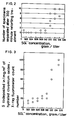
- Fig. 2 The test results are shown in Fig. 2 by plotting the number of separated specimens in relation to the concentration of SO 4 -- in gram/liter in the chromate solutions used in the electrolytic chromate treatment. As evident from Fig. 2, retorting resistance is suddenly aggravated when the SO 4 -- concentration exceeds 0.10 g/f, although retorting resistance is kept very well at SO 4 -- concentrations of lower than 0.10 g/l (inclusive).
- Fig. 3 is a diagram in which the amount of sulfur (S) codeposited in 1 mg/m 2 of hydrated chromium oxides is plotted in relation to the concentration of SO 4 -- in gram/liter in the chromate solutions used in the electrolytic chromate treatment. As evident from Fig. 3, the amount of sulfur codeposited suddenly increases when the SO 4 -- concentration exceeds 0.10 g/l.
- the reverse electrolysis should be effected after the chromium plating so as to reduce the sulfate codeposited with hydrated chromium oxides, but the electrolytic chromate treatment following the reverse electrolysis andrinsing should also be effected in a chromate solution having a limited SO 4 -- concentration of 0.10 g/l or lower.
- SO 4 -- concentration As the SO 4 -- concentration is further lowered below 0.01 g/t, the effect thereof on retorting resistance is saturated or leveled and the operating cost increases.
- the lower limit of the SO 4 -- concentration in the electrolytic chromate solution should be 0.01 g/l.
- a cold rolled steel sheet designated T4CA having a thickness of 0.22 mm was electrolytically degreased in a 5 % homezarine solution at a temperature of 80°C and a current density of 10 ampere/dm 2 , rinsed with water, immersed in a 10% H 2 S0 4 at 40°C for 5 seconds, and rinsed again with water.
- the sheet was then subjected to the following treatments in sequence:
- Steps (A) and (B) were successiveively carried out in the same electrolytic bath. Cold water rinsing and hot water rinsing were carried out both between steps (B) and (C) and at the end of step (C).
- No. 1 was not subjected to reverse electrolysis for comparison purpose.
- the baths used in the electrolytic chromate treatment contained 60 g/l of CrO 3 while the concentration of H 2 S0 4 was varied from 0.01 g/l to 0.20 g/l.
- the electrolytically treated TFS sheets were determined for paint adhesion under retorting conditions by the same test procedure as used in the above-described basic experiment. The results are also shown in Table 1.
- TFS sheets having improved retorting resistance are obtained through a sequence of steps of chromium plating, reverse electrolysis, and electrolytic chromate treatment as long as the chromate solution has a limited SO 4 -- concentration of 0.01 to 0.10 g/l.
- the present invention allows tin-free steel sheets having improved retorting resistance to be produced by carrying out an electrolytic chromate treatment in a chromate solution whose SO 4 -- con- centration is limited to the range from 0.01 to 0.10 g per liter of the solution.
Landscapes
- Chemical & Material Sciences (AREA)
- Engineering & Computer Science (AREA)
- Chemical Kinetics & Catalysis (AREA)
- Electrochemistry (AREA)
- Materials Engineering (AREA)
- Metallurgy (AREA)
- Organic Chemistry (AREA)
- Electroplating Methods And Accessories (AREA)
- Chemical Treatment Of Metals (AREA)
- Electrochemical Coating By Surface Reaction (AREA)
Applications Claiming Priority (2)
| Application Number | Priority Date | Filing Date | Title |
|---|---|---|---|
| JP57126042A JPS6041157B2 (ja) | 1982-07-20 | 1982-07-20 | 耐レトルト処理性にすぐれたテインフリ−鋼板の製造方法 |
| JP126042/82 | 1982-07-20 |
Publications (2)
| Publication Number | Publication Date |
|---|---|
| EP0101871A1 true EP0101871A1 (de) | 1984-03-07 |
| EP0101871B1 EP0101871B1 (de) | 1988-09-28 |
Family
ID=14925214
Family Applications (1)
| Application Number | Title | Priority Date | Filing Date |
|---|---|---|---|
| EP83106972A Expired EP0101871B1 (de) | 1982-07-20 | 1983-07-15 | Verfahren zur Erzeugung von zinnfreien Stahlblechen mit verbesserter Beständigkeit bei der Biegebehandlung |
Country Status (5)
| Country | Link |
|---|---|
| US (1) | US4432845A (de) |
| EP (1) | EP0101871B1 (de) |
| JP (1) | JPS6041157B2 (de) |
| CA (1) | CA1226240A (de) |
| DE (1) | DE3378131D1 (de) |
Cited By (5)
| Publication number | Priority date | Publication date | Assignee | Title |
|---|---|---|---|---|
| EP0121817A1 (de) * | 1983-03-15 | 1984-10-17 | Kawasaki Steel Corporation | Verfahren zur Herstellung zinnfreier Stahlbleche mit verbesserter Adhesion für Firnis |
| EP0194654A1 (de) * | 1985-03-15 | 1986-09-17 | Kawasaki Steel Corporation | Zinnfreie Stahlbänder, die zur Produktion geschweisster Dosen verwendet werden und Verfahren zu ihrer Herstellung |
| EP0250792A1 (de) * | 1986-05-12 | 1988-01-07 | Nippon Steel Corporation | Chromatbehandlung eines metallbeschichteten Stahlbleches |
| EP0135591B1 (de) * | 1983-01-28 | 1989-07-19 | Kawasaki Steel Corporation | Verfahren zur Bestimmung verbesserter Lackadhäsionseigenschaften von einer zinnfreien Stahlplatte |
| US9675332B2 (en) | 2012-01-13 | 2017-06-13 | Aesculap Ag | Surgical retractor |
Families Citing this family (6)
| Publication number | Priority date | Publication date | Assignee | Title |
|---|---|---|---|---|
| JPS58210197A (ja) * | 1982-06-01 | 1983-12-07 | Kawasaki Steel Corp | 耐レトルト処理性にすぐれたテインフリ−鋼の製造方法 |
| JPS6024381A (ja) * | 1983-07-19 | 1985-02-07 | Nippon Steel Corp | 化成処理性の優れた片面めつき鋼板及びその製造法 |
| JPS61281899A (ja) * | 1985-06-08 | 1986-12-12 | Kawasaki Steel Corp | 溶接缶用テインフリ−鋼板およびその製造方法 |
| JP3105322B2 (ja) * | 1991-12-27 | 2000-10-30 | 日産自動車株式会社 | 光輝性アルミホイールの無色クロメート皮膜形成方法 |
| JP3051670B2 (ja) * | 1995-11-02 | 2000-06-12 | 東洋鋼鈑株式会社 | ラミネート鋼板の製造法、ラミネート鋼板及びそれに用いる表面処理鋼板 |
| SE529744C2 (sv) * | 2005-12-22 | 2007-11-13 | Abb Technology Ag | Anordning och metod för metallisk beläggning samt användning av anordningen |
Citations (1)
| Publication number | Priority date | Publication date | Assignee | Title |
|---|---|---|---|---|
| US3986940A (en) * | 1975-02-04 | 1976-10-19 | Nippon Kokan Kabushiki Kaisha | Process for manufacturing electrolytically chromated steel sheet |
Family Cites Families (17)
| Publication number | Priority date | Publication date | Assignee | Title |
|---|---|---|---|---|
| FR1080914A (fr) * | 1953-06-16 | 1954-12-14 | United States Steel Corp | Procédé électrochimique de revêtement des surfaces en acier, produits destinés à sa mise en oeuvre et produits en résultant |
| US3296100A (en) * | 1962-05-09 | 1967-01-03 | Yawata Iron & Steel Co | Process for producing anticorrosive surface treated steel sheets and product thereof |
| GB1106292A (en) * | 1963-12-04 | 1968-03-13 | Ass Chem Co | Improvements in or relating to the treatment of metals |
| US4248676A (en) * | 1966-03-26 | 1981-02-03 | Nippon Steel Corporation | Method for treating steel plate and its manufacture |
| US3479162A (en) * | 1966-03-28 | 1969-11-18 | Fuji Iron & Steel Co Ltd | Chromium plated steel sheet having an almost colorless and transparent chromate film |
| GB1216770A (en) * | 1967-04-28 | 1970-12-23 | Nippon Kokan Kk | Electrodepositing chromium coatings on steel surfaces |
| US3691055A (en) * | 1968-09-27 | 1972-09-12 | Kawasaki Steel Co | Method of coating steel sheet surfaces |
| BE794277A (fr) * | 1972-03-03 | 1973-05-16 | Pennwalt Corp | Procede de preparation d'acier chrome exempt d'etain |
| JPS5424352B2 (de) * | 1972-12-05 | 1979-08-20 | ||
| JPS5326236A (en) * | 1976-08-25 | 1978-03-10 | Toyo Kohan Co Ltd | Surface treated steel sheet for coating |
| JPS6025519B2 (ja) * | 1976-11-06 | 1985-06-18 | 新日本製鐵株式会社 | テインフリ−スチ−ルの製造方法 |
| US4082620A (en) * | 1977-04-29 | 1978-04-04 | Bell Telephone Laboratories, Incorporated | Process for chromating metallic surfaces |
| JPS5425894A (en) * | 1977-07-29 | 1979-02-27 | Vysoka Skola Chem Tech | Method and apparatus for recycling liquid |
| JPS5610996A (en) * | 1979-07-06 | 1981-02-03 | Tanaka Precious Metal Ind | Repairing material for disconnected circuit foil on printed circuit board |
| JPS58210197A (ja) * | 1982-06-01 | 1983-12-07 | Kawasaki Steel Corp | 耐レトルト処理性にすぐれたテインフリ−鋼の製造方法 |
| JPS59170298A (ja) * | 1983-03-15 | 1984-09-26 | Kawasaki Steel Corp | 塗料密着性にすぐれたテインフリ−鋼板の製造方法 |
| JPS6041157A (ja) * | 1983-08-16 | 1985-03-04 | Toshiba Corp | バス争奪制御方式 |
-
1982
- 1982-07-20 JP JP57126042A patent/JPS6041157B2/ja not_active Expired
-
1983
- 1983-07-14 CA CA000432455A patent/CA1226240A/en not_active Expired
- 1983-07-14 US US06/513,662 patent/US4432845A/en not_active Expired - Lifetime
- 1983-07-15 DE DE8383106972T patent/DE3378131D1/de not_active Expired
- 1983-07-15 EP EP83106972A patent/EP0101871B1/de not_active Expired
Patent Citations (1)
| Publication number | Priority date | Publication date | Assignee | Title |
|---|---|---|---|---|
| US3986940A (en) * | 1975-02-04 | 1976-10-19 | Nippon Kokan Kabushiki Kaisha | Process for manufacturing electrolytically chromated steel sheet |
Non-Patent Citations (2)
| Title |
|---|
| CHEMICAL ABSTRACTS, vol. 93, no. 6, September 1980, page 500, no. 122657k, Columbus, Ohio, US & JP-A-55 028 309 (NIPPON STEEL CORP.) 28-02-1980 * |
| PATENT ABSTRACTS OF JAPAN, vol. 4, no. 98 (C-18)(580), July 15, 1980, page 13 C 18 & JP-A-55 058 395 (KAWASAKI SEITETSU K.K.) 01-05-1980 * |
Cited By (6)
| Publication number | Priority date | Publication date | Assignee | Title |
|---|---|---|---|---|
| EP0135591B1 (de) * | 1983-01-28 | 1989-07-19 | Kawasaki Steel Corporation | Verfahren zur Bestimmung verbesserter Lackadhäsionseigenschaften von einer zinnfreien Stahlplatte |
| EP0121817A1 (de) * | 1983-03-15 | 1984-10-17 | Kawasaki Steel Corporation | Verfahren zur Herstellung zinnfreier Stahlbleche mit verbesserter Adhesion für Firnis |
| EP0194654A1 (de) * | 1985-03-15 | 1986-09-17 | Kawasaki Steel Corporation | Zinnfreie Stahlbänder, die zur Produktion geschweisster Dosen verwendet werden und Verfahren zu ihrer Herstellung |
| US4687713A (en) * | 1985-03-15 | 1987-08-18 | Kawasaki Steel Corporation | Tin-free steel strips useful in the manufacture of welded cans and process for making |
| EP0250792A1 (de) * | 1986-05-12 | 1988-01-07 | Nippon Steel Corporation | Chromatbehandlung eines metallbeschichteten Stahlbleches |
| US9675332B2 (en) | 2012-01-13 | 2017-06-13 | Aesculap Ag | Surgical retractor |
Also Published As
| Publication number | Publication date |
|---|---|
| EP0101871B1 (de) | 1988-09-28 |
| JPS5916998A (ja) | 1984-01-28 |
| US4432845A (en) | 1984-02-21 |
| DE3378131D1 (en) | 1988-11-03 |
| JPS6041157B2 (ja) | 1985-09-14 |
| CA1226240A (en) | 1987-09-01 |
Similar Documents
| Publication | Publication Date | Title |
|---|---|---|
| DE2737296C3 (de) | Verfahren zur Herstellung von beschichtetem Stahlblech und dessen Verwendung | |
| EP0101871B1 (de) | Verfahren zur Erzeugung von zinnfreien Stahlblechen mit verbesserter Beständigkeit bei der Biegebehandlung | |
| EP2551378A1 (de) | Stahlblech für ein gefäss mit hervorragender korrosionsbeständigkeit | |
| US3526486A (en) | Corrosion resistant ferrous metal articles and method of preparing the same | |
| US4157944A (en) | Method for pretreatment in the production of tin-free steel | |
| US4519879A (en) | Method of producing tin-free steel sheets | |
| EP0121817A1 (de) | Verfahren zur Herstellung zinnfreier Stahlbleche mit verbesserter Adhesion für Firnis | |
| KR890004791B1 (ko) | 전기저항용접용 표면 처리 강판의 제조방법 | |
| JPS6363640B2 (de) | ||
| US4875984A (en) | Method for manufacturing electrolytically chromated steel sheet | |
| EP0132722A1 (de) | Verfahren zur Herstellung zinnfreier Stahlbänder mit verbessertem Haftvermögen für Lacke | |
| EP0330921B1 (de) | Verfahren zur Herstellung von elektrolytisch chromatiertem Stahlblech | |
| EP0135591B1 (de) | Verfahren zur Bestimmung verbesserter Lackadhäsionseigenschaften von einer zinnfreien Stahlplatte | |
| JPS5974297A (ja) | 耐レトルト処理性にすぐれたテインフリ−スチ−ルの製造方法 | |
| JPS582597B2 (ja) | すずめつき鋼板の製造方法 | |
| JPS60114595A (ja) | 接着性のすぐれたティンフリ−スチ−ル | |
| JP2593194B2 (ja) | 塗装後加工部耐食性に優れた缶用表面処理鋼板の製造方法 | |
| JPS5974296A (ja) | 耐レトルト処理性のすぐれたテインフリ−スチ−ルの製造方法 | |
| JPS62103397A (ja) | 塗膜密着性に優れた製缶用鋼板の製造方法 | |
| JPS631397B2 (de) | ||
| JPS60234995A (ja) | テインフリ−鋼板の製造方法 | |
| JPS6234838B2 (de) | ||
| GB2148324A (en) | Plated steel products | |
| JPH0215640B2 (de) | ||
| JPH11264095A (ja) | 表面外観および耐レトルト処理性に優れたティンフリー鋼板の製造方法 |
Legal Events
| Date | Code | Title | Description |
|---|---|---|---|
| PUAI | Public reference made under article 153(3) epc to a published international application that has entered the european phase |
Free format text: ORIGINAL CODE: 0009012 |
|
| AK | Designated contracting states |
Designated state(s): DE FR GB |
|
| 17P | Request for examination filed |
Effective date: 19840704 |
|
| GRAA | (expected) grant |
Free format text: ORIGINAL CODE: 0009210 |
|
| AK | Designated contracting states |
Kind code of ref document: B1 Designated state(s): DE FR GB |
|
| REF | Corresponds to: |
Ref document number: 3378131 Country of ref document: DE Date of ref document: 19881103 |
|
| ET | Fr: translation filed | ||
| PLBE | No opposition filed within time limit |
Free format text: ORIGINAL CODE: 0009261 |
|
| STAA | Information on the status of an ep patent application or granted ep patent |
Free format text: STATUS: NO OPPOSITION FILED WITHIN TIME LIMIT |
|
| 26N | No opposition filed | ||
| PGFP | Annual fee paid to national office [announced via postgrant information from national office to epo] |
Ref country code: GB Payment date: 19950704 Year of fee payment: 13 |
|
| PGFP | Annual fee paid to national office [announced via postgrant information from national office to epo] |
Ref country code: DE Payment date: 19950710 Year of fee payment: 13 |
|
| PGFP | Annual fee paid to national office [announced via postgrant information from national office to epo] |
Ref country code: FR Payment date: 19950711 Year of fee payment: 13 |
|
| PG25 | Lapsed in a contracting state [announced via postgrant information from national office to epo] |
Ref country code: GB Effective date: 19960715 |
|
| GBPC | Gb: european patent ceased through non-payment of renewal fee |
Effective date: 19960715 |
|
| PG25 | Lapsed in a contracting state [announced via postgrant information from national office to epo] |
Ref country code: FR Effective date: 19970328 |
|
| PG25 | Lapsed in a contracting state [announced via postgrant information from national office to epo] |
Ref country code: DE Effective date: 19970402 |
|
| REG | Reference to a national code |
Ref country code: FR Ref legal event code: ST |