EP0102165A1 - Vorrichtung und Verfahren zum Bestimmen der Geschwindigkeit - Google Patents
Vorrichtung und Verfahren zum Bestimmen der Geschwindigkeit Download PDFInfo
- Publication number
- EP0102165A1 EP0102165A1 EP83304100A EP83304100A EP0102165A1 EP 0102165 A1 EP0102165 A1 EP 0102165A1 EP 83304100 A EP83304100 A EP 83304100A EP 83304100 A EP83304100 A EP 83304100A EP 0102165 A1 EP0102165 A1 EP 0102165A1
- Authority
- EP
- European Patent Office
- Prior art keywords
- speed
- pulses
- period
- motor
- position pulses
- Prior art date
- Legal status (The legal status is an assumption and is not a legal conclusion. Google has not performed a legal analysis and makes no representation as to the accuracy of the status listed.)
- Withdrawn
Links
Images

Classifications
-
- G—PHYSICS
- G01—MEASURING; TESTING
- G01P—MEASURING LINEAR OR ANGULAR SPEED, ACCELERATION, DECELERATION, OR SHOCK; INDICATING PRESENCE, ABSENCE, OR DIRECTION, OF MOVEMENT
- G01P3/00—Measuring linear or angular speed; Measuring differences of linear or angular speeds
- G01P3/42—Devices characterised by the use of electric or magnetic means
- G01P3/44—Devices characterised by the use of electric or magnetic means for measuring angular speed
- G01P3/48—Devices characterised by the use of electric or magnetic means for measuring angular speed by measuring frequency of generated current or voltage
- G01P3/481—Devices characterised by the use of electric or magnetic means for measuring angular speed by measuring frequency of generated current or voltage of pulse signals
- G01P3/489—Digital circuits therefor
-
- G—PHYSICS
- G05—CONTROLLING; REGULATING
- G05B—CONTROL OR REGULATING SYSTEMS IN GENERAL; FUNCTIONAL ELEMENTS OF SUCH SYSTEMS; MONITORING OR TESTING ARRANGEMENTS FOR SUCH SYSTEMS OR ELEMENTS
- G05B19/00—Program-control systems
- G05B19/02—Program-control systems electric
- G05B19/18—Numerical control [NC], i.e. automatically operating machines, in particular machine tools, e.g. in a manufacturing environment, so as to execute positioning, movement or co-ordinated operations by means of program data in numerical form
- G05B19/19—Numerical control [NC], i.e. automatically operating machines, in particular machine tools, e.g. in a manufacturing environment, so as to execute positioning, movement or co-ordinated operations by means of program data in numerical form characterised by positioning or contouring control systems, e.g. to control position from one programmed point to another or to control movement along a programmed continuous path
- G05B19/21—Numerical control [NC], i.e. automatically operating machines, in particular machine tools, e.g. in a manufacturing environment, so as to execute positioning, movement or co-ordinated operations by means of program data in numerical form characterised by positioning or contouring control systems, e.g. to control position from one programmed point to another or to control movement along a programmed continuous path using an incremental digital measuring device
- G05B19/23—Numerical control [NC], i.e. automatically operating machines, in particular machine tools, e.g. in a manufacturing environment, so as to execute positioning, movement or co-ordinated operations by means of program data in numerical form characterised by positioning or contouring control systems, e.g. to control position from one programmed point to another or to control movement along a programmed continuous path using an incremental digital measuring device for point-to-point control
- G05B19/231—Numerical control [NC], i.e. automatically operating machines, in particular machine tools, e.g. in a manufacturing environment, so as to execute positioning, movement or co-ordinated operations by means of program data in numerical form characterised by positioning or contouring control systems, e.g. to control position from one programmed point to another or to control movement along a programmed continuous path using an incremental digital measuring device for point-to-point control the positional error is used to control continuously the servomotor according to its magnitude
- G05B19/232—Numerical control [NC], i.e. automatically operating machines, in particular machine tools, e.g. in a manufacturing environment, so as to execute positioning, movement or co-ordinated operations by means of program data in numerical form characterised by positioning or contouring control systems, e.g. to control position from one programmed point to another or to control movement along a programmed continuous path using an incremental digital measuring device for point-to-point control the positional error is used to control continuously the servomotor according to its magnitude with speed feedback only
-
- G—PHYSICS
- G05—CONTROLLING; REGULATING
- G05B—CONTROL OR REGULATING SYSTEMS IN GENERAL; FUNCTIONAL ELEMENTS OF SUCH SYSTEMS; MONITORING OR TESTING ARRANGEMENTS FOR SUCH SYSTEMS OR ELEMENTS
- G05B2219/00—Program-control systems
- G05B2219/30—Nc systems
- G05B2219/37—Measurements
- G05B2219/37313—Derive speed from position
Definitions
- This invention relates to a speed detection apparatus and method for detecting speed information using position pulses obtained from a position detector. More particularly, the invention relates to a speed detection apparatus and method wherein speed can be detected with great accuracy over a wide range.
- FIG. 1 is a block diagram of a common servo control system.
- a servo motor 1 has a rotary encoder (position detector) 2 connected directly to its rotary shaft for producing position pulses PP, each of which is generated whenever the motor rotates by a predetermined amount.
- the pulses PP are applied to an arithmetic circuit 3, which proceeds to compute the difference between the number of pulses PP generated and a number of position command pulses PCMD obtained from an external unit, the computed difference being set in an error register 4.
- the digital data within the error register 4 are converted into an analog voltage by a digital-to-analog converter 5, and the resulting voltage is applied as a speed command voltage to a speed control circuit 7.
- a speed detecting circuit 6 detects the actual speed of the motor 1 and provides the speed control circuit 7 with a voltage equivalent thereto. The latter controls the speed of the servomotor 1 based on the difference between the speed command voltage and the voltage signal corresponding to the actual speed.
- the accuracy of speed feedback control depends upon the speed detecting precision of the speed detecting circuit 6. The accuracy of speed detection is therefore extremely important in servo control.
- a speed detection apparatus heretofore available in the art has a position detector for generating two signals displaced in phase from each other by ⁇ r/2 and having a frequency f proportional to the rotational speed of the motor.
- the two-phase signals are converting into signals of a frequency 4f by means of a quadrupling circuit.
- a frequency-to-voltage converter generates a voltage proportional to the frequency 4f, that is, a voltage (actual speed voltage) proportional to the rotational speed of the motor.
- a problem encountered in the foregoing prior-art arrangement is that, when the motor speed drops to a low value, the magnitude of the voltage signal produced by the frequency-to-voltage converter no longer remains proportional to the rotational speed of the motor but instead exhibits a sudden decline which diminishes the accuracy of measurement. Accordingly, rather than relying upon a frequency-to-voltage conversion, methods of detecting speed by digital processing using a microcomputer have been proposed as a more desirable expedient in view of LSI techniques.
- One such method performs detection by counting position pulses applied within a fixed period and then treating a value proportional to the counted value as speed information.
- the fixed period is shortened, however, the number of pulses applied within said period diminishes so that there is a decline in the accuracy of speed detection. This makes it necessary to lengthen the period.
- a longer period also lengthens detection time, thereby detracting from the stability of the speed detection system.
- a second detection method performs detection by monitoring the interval (i.e., period) at which position pulses are applied and then treating the reciprocal of the interval as speed information. With this method, however, the period of the position pulses shortens at high-speed rotation so that it becomes difficult to measure the period accurately at such time.
- an object of the present invention is to provide a speed detection apparatus and method through which speed can be detected in a short time and with great accuracy.
- Another object of the present invention is to provide a speed detection apparatus and method which allow use of a circuit arrangement, consisting of counters, registers and arithmetic circuitry, which is well-suited for application of LSI techniques..
- a further object of the present invention is to provide a speed detection apparatus and method wherein a minimum of only two counters need be provided, thereby affording an apparatus of a simple and inexpensive construction.
- the foregoing objects are attained by providing a system for detecting speed information based on position pulses from a position detector for the purpose of controlling the speed of a motor.
- the invention includes means receiving the position pulses as an input thereto for counting the number thereof within a fixed period To, means for measuring an interval Tl between a position pulse generated just prior to the fixed period To and an instant at which the period begins, and means for measuring an interval T2 between a final position pulse generated in the period To and an instant at which the period ends.
- TP represents reference pulses of a fixed period To, such as 0.5 msec.
- P P denotes position pulses produced by a position detector.
- the number N of position pulses PP applied during the period To are counted, an interval Tl is measured, namely the time between a position pulse Sl which occurs just prior to the onset of the measurement period, and the start of said period, namely the instant at which a reference pulse TP is generated, and an interval T2 is measured, this being the time between a position pulse S4, which is the last position pulse in the measurement period, and the end of said period.
- a length of time T required for the application of N position pulses is computed from the following: where To is the fixed period, which is a known quantity. If the time T is divided by the counted pulse number N, the result will be the period per position pulse, and the reciprocal of this period will be the position pulse frequency, namely speed information. Therefore, letting V represent the rotational speed of the motor, V will be obtained from the following: where K is a proportional constant.
- the invention shortens a fixed period to a value of, e.g., 0.5 msec., and computes the average value of the periods of the position pulses in the fixed period. This solves the problem of measurement accuracy at low speed as encountered with the first detection method, and eliminates a decline in measurement accuracy in the high speed region, as occurs in the second detection method.
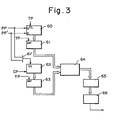
- Fig. 3 is a block diagram illustrating an embodiment of the present invention.
- Numeral 60 denotes an up/down counter for counting up forward rotation position pulses PP from the rotary encoder 2 (Fig. 1), and for counting down reverse rotation position pulses PP' from the rotary encoder, the counter being cleared by a reference pulse TP.
- the output of the up/down counter 60 is connected to the input side of a first register 61, in which the value of the count from the counter 60 is set in response to the reference pulse TP.
- a timer counter 62 counts clock pulses CP and has its contents cleared by either of the position pulses PP, PP', which are applied to an OR gate 67.
- the output of the timer counter 62 is connected to the input side of a second register 63, in which the value of the count from the timer counter 62 is set in response to the reference pulse TP.
- Numeral 64 designates an arithmetic circuit comprising a microprocessor for producing a signal indicative of speed information by executing the operations of Eqs. (1) and (2) using the contents of the first register 61 and second register 63.
- the output of the arithmetic circuit 64 is applied to a third register 65 for temporarily storing the speed information acquired from the arithmetic circuit 64.
- An analog-to-digital (DA) converter 66 converts the contents of the third register 65 into an analog value.
- the timer counter 62 counts the clock pulses CP and is cleared by each of the position pulses PP applied thereto via the OR gate 67. Meanwhile, the value of the count within the timer counter 62 is set in the second register 63 in response to each of the reference pulses TP. Therefore, at the instant the reference pulse Rl (Fig. 2) enters the second register 63, the second register 63 is set to a counted value Tl that is equivalent to the interval between a position pulse Sl and the reference pulse Rl.
- the arithmetic circuit 64 reads in the counted value Tl and stores the value in an internal memory.
- the up/down counter 60 counts up the position pulses PP and has its contents cleared by each of the the reference pulses TP.
- the counter 60 therefore counts the number of position pulses PP during the period To of the reference pulses TP, the value of the count being set in the first register 61 in response to each of the reference pulses TP.
- the timer counter 62 counts the clock pulses CP and is cleared by each of the position pulses PP, but the value of the count is not set in the second register 63 until the reference pulse TP arrives.
- the reference pulse TP is produced, the value of the count in the timer counter 62 is set in the second register 63.
- This value, represented by T2 corresponds to the interval between a position pulse S4 and a reference pulse R2, as shown in Fig. 2.
- the arithmetic circuit 64 reads in the counted value T2 from the second register 63, and computes the input time required T by executing the operation of Eq. (1) using the known period To as well as the previously counted value Tl stored in the internal memory.
- the arithmetic circuit 64 then goes to the first register 61 and reads in the number N of position pulses PP produced in the period extending from the reference pulse Rl to the reference pulse R2, and proceeds to obtain the speed information V by executing Eq. (2).
- the speed information V is fed into the third register 65 and is subsequently converted into an analog value by the DA converter 66.
- the analog value is then delivered to the speed control circuit 7 shown in Fig. 1. It should be noted that the DA converter 66 may be dispensed with if the speed control circuit 7 is to receive the speed information in digital form.
- the speed detection apparatus includes the up/down counter 60 for counting the number of position pulses applied thereto within the fixed period To, and a measurement circuit for measuring the time required for the entry of said number of position pulses, and for producing speed information based on a value obtained by dividing the number of position pulses by the measured time requirement.
- This arrangement makes possible a rapid and highly precise speed detection, and is particularly effective in improving the detection accuracy at high rotational speeds.
- the foregoing advantages can be achieved by a circuit arrangement, consisting of the counters, registers and arithmetic circuitry, which is well-suited for application of LSI techniques.
- a minimum of only counters are required, so that the circuit arrangement is simple and low in cost.
Landscapes
- Engineering & Computer Science (AREA)
- Physics & Mathematics (AREA)
- General Physics & Mathematics (AREA)
- Human Computer Interaction (AREA)
- Manufacturing & Machinery (AREA)
- Automation & Control Theory (AREA)
- Control Of Electric Motors In General (AREA)
- Linear Or Angular Velocity Measurement And Their Indicating Devices (AREA)
- Measuring Frequencies, Analyzing Spectra (AREA)
- Control Of Velocity Or Acceleration (AREA)
Applications Claiming Priority (2)
| Application Number | Priority Date | Filing Date | Title |
|---|---|---|---|
| JP57123284A JPS5913957A (ja) | 1982-07-15 | 1982-07-15 | 速度検出回路 |
| JP123284/82 | 1982-07-15 |
Publications (1)
| Publication Number | Publication Date |
|---|---|
| EP0102165A1 true EP0102165A1 (de) | 1984-03-07 |
Family
ID=14856753
Family Applications (1)
| Application Number | Title | Priority Date | Filing Date |
|---|---|---|---|
| EP83304100A Withdrawn EP0102165A1 (de) | 1982-07-15 | 1983-07-14 | Vorrichtung und Verfahren zum Bestimmen der Geschwindigkeit |
Country Status (3)
| Country | Link |
|---|---|
| US (1) | US4503374A (de) |
| EP (1) | EP0102165A1 (de) |
| JP (1) | JPS5913957A (de) |
Families Citing this family (14)
| Publication number | Priority date | Publication date | Assignee | Title |
|---|---|---|---|---|
| JPS6038658A (ja) * | 1983-08-10 | 1985-02-28 | Mitsubishi Electric Corp | 速度検出装置 |
| US4774446A (en) * | 1984-10-04 | 1988-09-27 | Pitney Bowes Inc. | Microprocessor controlled d.c. motor for controlling printing means |
| JPH06101948B2 (ja) * | 1984-12-25 | 1994-12-12 | ソニー株式会社 | 時間情報検出装置 |
| US4876494A (en) * | 1986-11-20 | 1989-10-24 | Unimation, Inc. | Position and velocity feedback system for a digital robot control |
| JPH02159990A (ja) * | 1988-12-10 | 1990-06-20 | Fanuc Ltd | サーボモータの速度制御方式 |
| US4956592A (en) * | 1989-03-31 | 1990-09-11 | Midmark Corporation | Automatically positionable chair |
| JPH07175515A (ja) * | 1993-12-17 | 1995-07-14 | Kobe Steel Ltd | 機械設備及びローラミルの異常検出方法,安定度算出方法及び運転制御方法 |
| DE59707589D1 (de) * | 1996-08-19 | 2002-08-01 | Sirona Dental Systems Gmbh | Einrichtung zur präzisen Verstellung eines beweglich angeordneten Gerätes mittels eines elektromotorischen Antriebs |
| JP3700325B2 (ja) * | 1997-05-21 | 2005-09-28 | 松下電器産業株式会社 | 駆動源制御方法 |
| JP2002531834A (ja) * | 1998-12-02 | 2002-09-24 | エムティエス・システムズ・コーポレーション | 混合した速度の推定 |
| US7425033B2 (en) | 2003-09-03 | 2008-09-16 | Intier Automotive Closures Inc. | Vehicle sunroof assembly |
| JP6894240B2 (ja) * | 2017-01-06 | 2021-06-30 | Juki株式会社 | ミシン |
| GB202015555D0 (en) * | 2020-10-01 | 2020-11-18 | Thermo Fisher Scient Bremen Gmbh | Determining the average frequency of a series of pulses |
| US12230487B2 (en) * | 2020-10-01 | 2025-02-18 | Thermo Fisher Scientific (Bremen) Gmbh | Determining the average frequency of a series of pulses |
Citations (5)
| Publication number | Priority date | Publication date | Assignee | Title |
|---|---|---|---|---|
| US3829785A (en) * | 1972-04-28 | 1974-08-13 | Philips Corp | Circuit arrangement for digital frequency measurement |
| US3892952A (en) * | 1973-03-22 | 1975-07-01 | Nippon Denso Co | Digital differentiation circuit |
| DE2750157A1 (de) * | 1976-11-09 | 1978-05-24 | Girling Ltd | Verfahren und vorrichtung zum messen der frequenz eines impulssignals, insbesondere fuer geschwindigkeitsmessungen |
| DE2949131A1 (de) * | 1979-12-06 | 1981-06-11 | Deuta-Werke Vorm. Deutsche Tachometerwerke Gmbh, 5070 Bergisch Gladbach | Verfahren zum messen der geschwindigkeit von schienenfahrzeugen und vorrichtung zur durchfuehrung des verfahrens |
| EP0059433A1 (de) * | 1981-02-28 | 1982-09-08 | Hitachi, Ltd. | Vorrichtung zur Geschwindigkeitsermittlung |
Family Cites Families (6)
| Publication number | Priority date | Publication date | Assignee | Title |
|---|---|---|---|---|
| US4315200A (en) * | 1978-08-29 | 1982-02-09 | Canon Kabushiki Kaisha | Servo control apparatus |
| JPS55109184A (en) * | 1979-02-13 | 1980-08-22 | Victor Co Of Japan Ltd | Rotational speed control system |
| JPS5917257B2 (ja) * | 1979-08-03 | 1984-04-20 | 自動車電機工業株式会社 | 自動速度制御装置 |
| US4376914A (en) * | 1980-03-11 | 1983-03-15 | Olympus Optical Company Ltd. | Motor control device |
| JPS5748664A (en) * | 1980-09-06 | 1982-03-20 | Yaskawa Electric Mfg Co Ltd | Pulse frequency detector |
| JPS59433A (ja) * | 1982-06-23 | 1984-01-05 | Nippon Kokan Kk <Nkk> | 鋼製マンホ−ル組体立とその施工方法 |
-
1982
- 1982-07-15 JP JP57123284A patent/JPS5913957A/ja active Pending
-
1983
- 1983-07-14 EP EP83304100A patent/EP0102165A1/de not_active Withdrawn
- 1983-07-15 US US06/514,315 patent/US4503374A/en not_active Expired - Lifetime
Patent Citations (5)
| Publication number | Priority date | Publication date | Assignee | Title |
|---|---|---|---|---|
| US3829785A (en) * | 1972-04-28 | 1974-08-13 | Philips Corp | Circuit arrangement for digital frequency measurement |
| US3892952A (en) * | 1973-03-22 | 1975-07-01 | Nippon Denso Co | Digital differentiation circuit |
| DE2750157A1 (de) * | 1976-11-09 | 1978-05-24 | Girling Ltd | Verfahren und vorrichtung zum messen der frequenz eines impulssignals, insbesondere fuer geschwindigkeitsmessungen |
| DE2949131A1 (de) * | 1979-12-06 | 1981-06-11 | Deuta-Werke Vorm. Deutsche Tachometerwerke Gmbh, 5070 Bergisch Gladbach | Verfahren zum messen der geschwindigkeit von schienenfahrzeugen und vorrichtung zur durchfuehrung des verfahrens |
| EP0059433A1 (de) * | 1981-02-28 | 1982-09-08 | Hitachi, Ltd. | Vorrichtung zur Geschwindigkeitsermittlung |
Also Published As
| Publication number | Publication date |
|---|---|
| JPS5913957A (ja) | 1984-01-24 |
| US4503374A (en) | 1985-03-05 |
Similar Documents
| Publication | Publication Date | Title |
|---|---|---|
| EP0102165A1 (de) | Vorrichtung und Verfahren zum Bestimmen der Geschwindigkeit | |
| US4450403A (en) | Method and apparatus for determining rotational speed | |
| EP0341445B1 (de) | Verfahren und Vorrichtung zur Messung der Drehgeschwindigkeit | |
| EP0058282A1 (de) | Motordrehzahlmesssystem | |
| EP0208788A1 (de) | Geschwindigkeitsregelsystem für servomotoren | |
| US4457074A (en) | Method and apparatus for synchronizing the sensor movement of a pitch and/or concentricity measuring device for gears | |
| US4341995A (en) | Velocity profile analyzer | |
| EP0120692A2 (de) | Phasenmodulationstyp-Digitalpositionsdetektor | |
| US4994723A (en) | Digital servo system for controlling rotational speed of rotary body | |
| EP0078854A1 (de) | Geschwindigkeitsdetektor | |
| US4642542A (en) | Velocity control systems | |
| JPH08128855A (ja) | 速度検出装置 | |
| EP0134029B1 (de) | Drehzahlregelanordnung und Motorregelsystem | |
| JP3339214B2 (ja) | サーボモータの制御装置 | |
| SU1019222A1 (ru) | Измерительный преобразователь | |
| SU1071961A1 (ru) | Измеритель соотношени скоростей | |
| JPH0716555B2 (ja) | ミシン制御装置 | |
| JP2002531834A (ja) | 混合した速度の推定 | |
| SU842916A1 (ru) | Устройство дл контрол преобразователейуглА пОВОРОТА ВАлА B КОд | |
| SU763797A1 (ru) | Цифровой измеритель относительной разности скоростей | |
| JP2550987B2 (ja) | 信号勾配測定器 | |
| Veselov et al. | High-quality microprocessor system for position, velocity, and acceleration measurements of electric drives | |
| SU1520589A1 (ru) | Устройство дл контрол нестабильности скорости вращени магнитного диска накопител | |
| SU1040417A1 (ru) | Устройство дл измерени угловой скорости | |
| JPS61205830A (ja) | 軸馬力計測方法 |
Legal Events
| Date | Code | Title | Description |
|---|---|---|---|
| PUAI | Public reference made under article 153(3) epc to a published international application that has entered the european phase |
Free format text: ORIGINAL CODE: 0009012 |
|
| AK | Designated contracting states |
Designated state(s): DE FR GB |
|
| 17P | Request for examination filed |
Effective date: 19840828 |
|
| STAA | Information on the status of an ep patent application or granted ep patent |
Free format text: STATUS: THE APPLICATION IS DEEMED TO BE WITHDRAWN |
|
| 18D | Application deemed to be withdrawn |
Effective date: 19860318 |
|
| RIN1 | Information on inventor provided before grant (corrected) |
Inventor name: SAKANO, TETSURO |