EP0103867B1 - Dérivé de peptide contenant du phosphore - Google Patents
Dérivé de peptide contenant du phosphore Download PDFInfo
- Publication number
- EP0103867B1 EP0103867B1 EP83109190A EP83109190A EP0103867B1 EP 0103867 B1 EP0103867 B1 EP 0103867B1 EP 83109190 A EP83109190 A EP 83109190A EP 83109190 A EP83109190 A EP 83109190A EP 0103867 B1 EP0103867 B1 EP 0103867B1
- Authority
- EP
- European Patent Office
- Prior art keywords
- unsubstituted
- hydrogen
- substituent
- compound
- same meaning
- Prior art date
- Legal status (The legal status is an assumption and is not a legal conclusion. Google has not performed a legal analysis and makes no representation as to the accuracy of the status listed.)
- Expired
Links
- 0 CCC(C)C(C(NC(*)C(NC(Cc1ccc(*)cc1)*(*)=O)=O)=O)NC Chemical compound CCC(C)C(C(NC(*)C(NC(Cc1ccc(*)cc1)*(*)=O)=O)=O)NC 0.000 description 2
Classifications
-
- C—CHEMISTRY; METALLURGY
- C07—ORGANIC CHEMISTRY
- C07F—ACYCLIC, CARBOCYCLIC OR HETEROCYCLIC COMPOUNDS CONTAINING ELEMENTS OTHER THAN CARBON, HYDROGEN, HALOGEN, OXYGEN, NITROGEN, SULFUR, SELENIUM OR TELLURIUM
- C07F9/00—Compounds containing elements of Groups 5 or 15 of the Periodic Table
- C07F9/02—Phosphorus compounds
- C07F9/28—Phosphorus compounds with one or more P—C bonds
- C07F9/38—Phosphonic acids [RP(=O)(OH)2]; Thiophosphonic acids ; [RP(=X1)(X2H)2(X1, X2 are each independently O, S or Se)]
- C07F9/3804—Phosphonic acids [RP(=O)(OH)2]; Thiophosphonic acids ; [RP(=X1)(X2H)2(X1, X2 are each independently O, S or Se)] not used, see subgroups
- C07F9/3808—Acyclic saturated acids which can have further substituents on alkyl
-
- C—CHEMISTRY; METALLURGY
- C07—ORGANIC CHEMISTRY
- C07C—ACYCLIC OR CARBOCYCLIC COMPOUNDS
- C07C59/00—Compounds having carboxyl groups bound to acyclic carbon atoms and containing any of the groups OH, O—metal, —CHO, keto, ether, groups, groups, or groups
- C07C59/40—Unsaturated compounds
- C07C59/58—Unsaturated compounds containing ether groups, groups, groups, or groups
- C07C59/64—Unsaturated compounds containing ether groups, groups, groups, or groups containing six-membered aromatic rings
- C07C59/66—Unsaturated compounds containing ether groups, groups, groups, or groups containing six-membered aromatic rings the non-carboxylic part of the ether containing six-membered aromatic rings
- C07C59/68—Unsaturated compounds containing ether groups, groups, groups, or groups containing six-membered aromatic rings the non-carboxylic part of the ether containing six-membered aromatic rings the oxygen atom of the ether group being bound to a non-condensed six-membered aromatic ring
-
- C—CHEMISTRY; METALLURGY
- C07—ORGANIC CHEMISTRY
- C07F—ACYCLIC, CARBOCYCLIC OR HETEROCYCLIC COMPOUNDS CONTAINING ELEMENTS OTHER THAN CARBON, HYDROGEN, HALOGEN, OXYGEN, NITROGEN, SULFUR, SELENIUM OR TELLURIUM
- C07F9/00—Compounds containing elements of Groups 5 or 15 of the Periodic Table
- C07F9/02—Phosphorus compounds
- C07F9/28—Phosphorus compounds with one or more P—C bonds
- C07F9/38—Phosphonic acids [RP(=O)(OH)2]; Thiophosphonic acids ; [RP(=X1)(X2H)2(X1, X2 are each independently O, S or Se)]
- C07F9/40—Esters thereof
- C07F9/4003—Esters thereof the acid moiety containing a substituent or a structure which is considered as characteristic
- C07F9/4006—Esters of acyclic acids which can have further substituents on alkyl
-
- C—CHEMISTRY; METALLURGY
- C07—ORGANIC CHEMISTRY
- C07F—ACYCLIC, CARBOCYCLIC OR HETEROCYCLIC COMPOUNDS CONTAINING ELEMENTS OTHER THAN CARBON, HYDROGEN, HALOGEN, OXYGEN, NITROGEN, SULFUR, SELENIUM OR TELLURIUM
- C07F9/00—Compounds containing elements of Groups 5 or 15 of the Periodic Table
- C07F9/02—Phosphorus compounds
- C07F9/28—Phosphorus compounds with one or more P—C bonds
- C07F9/38—Phosphonic acids [RP(=O)(OH)2]; Thiophosphonic acids ; [RP(=X1)(X2H)2(X1, X2 are each independently O, S or Se)]
- C07F9/40—Esters thereof
- C07F9/4003—Esters thereof the acid moiety containing a substituent or a structure which is considered as characteristic
- C07F9/4062—Esters of acids containing the structure -C(=X)-P(=X)(XR)2 or NC-P(=X)(XR)2, (X = O, S, Se)
- C07F9/4065—Esters of acids containing the structure -C(=X)-P(=X)(XR)2, (X = O, S, Se)
-
- C—CHEMISTRY; METALLURGY
- C07—ORGANIC CHEMISTRY
- C07K—PEPTIDES
- C07K5/00—Peptides containing up to four amino acids in a fully defined sequence; Derivatives thereof
- C07K5/04—Peptides containing up to four amino acids in a fully defined sequence; Derivatives thereof containing only normal peptide links
- C07K5/06—Dipeptides
- C07K5/06191—Dipeptides containing heteroatoms different from O, S, or N
-
- A—HUMAN NECESSITIES
- A61—MEDICAL OR VETERINARY SCIENCE; HYGIENE
- A61K—PREPARATIONS FOR MEDICAL, DENTAL OR TOILETRY PURPOSES
- A61K38/00—Medicinal preparations containing peptides
Definitions
- the present invention is related generally to the invention disclosed in EP ⁇ A1 ⁇ 0061172.
- the present invention relates to a phosphorus-containing oligopeptide derivative having an angiotensin converting enzyme-inhibiting action and as the result an anti-hypertensive action, and pharmacologically acceptable salts thereof.
- the present invention relates to a phosphorus-containing peptide derivative represented by the general formula [1]: wherein R 1 is hydrogen, lower alkyl, lower alkoxycarbonyl, aralkyloxycarbonyl or [wherein R 6 is hydrogen, alkyl having 1 to 17 carbon atoms, unsubstituted or substituted aryl (wherein the substituent is selected from lower alkyl, lower alkoxy and halogen), unsubstituted or substituted aralkyl (wherein the substituent is selected from lower alkyl, lower alkoxy and halogen), or cycloalkyl having 5 or 6 carbon atoms; R 2 is hydrogen, unsubstituted or substituted lower alkyl (wherein the substituent is selected from amino, mercapto, lower alkylthio, carboxyl, hydroxyl, guanidino and imimyl, hydroxyl, guanidino and imidazolyl), unsubstituted or substituted aryl (
- the lower alkyl means straight or branched alkyls having 1 to 6 carbon atoms, for example, methyl, ethyl, n-propyl, i-propyl, n-butyl, j-butyl, t-butyl, s-butyl, pentyl or hexyl.
- Preferred lower alkyls are methyl, ethyl, n-propyl or i-propyl.
- the lower alkoxycarbonyl means straight or branched alkoxycarbonyls having 2 to 7 carbon atoms.
- the aralkyloxycarbonyl comprises those having phenyl, naphthyl or biphenyl as the aryl part and alkyl having 1 to 3 carbon atoms as the alkyl part.
- Preferred examples are benzyloxycarbonyl and phenethyloxycarbonyl.
- the alkyl having 1 to 17 carbon atoms may be straight or branched and includes, for example, methyl, ethyl, n-propyl, i-propyl, n-butyl, i-butyl, t-butyl, s-butyl, pentyl, hexyl, octyl, dodecyl and heptadecyl.
- the aryl of unsubstituted or substituted aryl comprises phenyl, naphthyl or biphenyl.
- the lower alkyl and the lower alkoxy means those having 1 to 3 carbon atoms respectively, and the halogen is exemplified by chlorine or bromine.
- the aryl part of the aralkyl of unsubstituted or substituted aralkyl comprises phenyl, naphthyl or biphenyl and the alkyl part means alkyl having 1 to 3 carbon atoms. Substituents similar to those of the substituted aryl are used as a substituent for the substituted aralkyl. For example, benzyl, phenethyl, 3-phenylpropyl or trityl may be used.
- the cycloalkyl having 5 or 6 carbon atoms means cyclopentyl or cyclohexyl. Preferred examples of are formyl, acetyl, propionyl, pivaloyl, stearoyl, benzoyl and phenacetyl.
- the lower alkyl or unsubstituted or substituted lower alkyl means straight or branched alkyls having 1 to 6 carbon atoms.
- the lower alkylthio means those having 1 to 3 carbon atoms.
- the aryl of unsubstituted or substituted aryl in the definition of R 2 includes phenyl, naphthyl and biphenyl.
- the lower alkoxy means those having 1 to 3 carbon atoms
- the aralkyloxy means those having phenyl, naphthyl or biphenyl as the aryl part and an alkyl having 1 to 3 carbon atoms as the alkyl part
- the lower alkyl means those having 1 to 3 carbon atoms
- the halogen means chlorine or bromine.
- the aralkyl of the unsubstituted or substituted aralkyl means those having phenyl, naphthyl or biphenyl as the aryl part and an alkyl having 1 to 3 carbon atoms as the alkyl part.
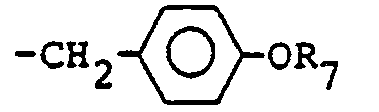
- R 2 is a part corresponding to the side chain of the ordinary amino acid and preferably includes methyl (alanine), i-propyl (valine), 1-methylpropyl (isoleucine), 2-methylpropyl (leucine), 3-aminopropyl (ornithine), 4-aminobutyl (lysine), hydroxymethyl (serine), 1-hydroxyethyl (threonine), 2-hydroxyethyl (homoserine), mercaptomethyl (cysteine), 2-methylthioethyl (methionine), carboxymethyl (aspartic acid), 2-carboxyethyl (glutamic acid), benzyl (phenylalanine), (tyrosine and derivatives thereof) among which methyl, i-propyl, 1-methylpropyl, benzyl, 4-aminobutyl,
- the lower alkyl and the unsubstituted or substituted aralkyl having the same meanings as defined above with respect to R 1 .
- the lower alkyl includes preferably methyl, ethyl, n- or i-propyl and the unsubstituted or substituted aralkyl includes preferably benzyl.
- Preferred examples of are acetyl, propionyl, n-hexanoyl, lauroyl and stearoyl.
- the respective groups of Rg have the same meanings as defined above with respect to R 1 .
- Preferred examples of are ethoxycarbonyl, t-butoxycarbonyl and benzyloxycarbonyl.
- the alkyl having 1 to 18 carbon atoms may be straight or branched, and includes, for example, methyl, ethyl, n-propyl, i-propyl, n-butyl, t-butyl, 1-methylpropyl, pentyl, hexyl, octyl, dodecyl and octadecyl, among which methyl, ethyl, n-propyl, i-propyl, n-butyl, dodecyl and octadecyl are preferred.
- R 4 and R 5 the unsubstituted or substituted aryl and the unsubstituted or substituted aralkyl have the same. meanings as defined above with respect to R 6 , respectively.
- Preferred groups with respect to m or n in R 4 and R 5 are ⁇ (CH 2 CH 2 O) 4 CH 3 , and ⁇ CH[CH 2 OCO(CH 2 ) 10 CH 3 ] 2 .
- a base addition salt can be formed, and when it is a basic compound, an acid addition salt can be formed.
- the salt includes ammonium salts, alkali metal salts such as lithium, sodium and potassium salts, alkaline earth metal salts such as calcium and magnesium salts, salts with organic bases such as triethylamine, morpholine, piperidine, dicyclohexylamine, and salts with amino acids such as arginine and lysine.
- salts with inorganic or organic acids such as hydrochloride, hydrobromide, sulfate, nitrate, formate, acetate, benzoate, maleate, fumarate, succinate, tartrate, citrate, oxalate, methanesulfonate, toluenesulfonate, aspartate or glutamate can be prepared.
- Pharmacologically acceptable non-toxic salts are preferred, but other salts are also usable in the isolation and purification of products.
- These salts can be prepared according to the ordinary procedure, for example, by reacting Compound [I] with an appropriate base or acid in at least an equivalent amount to Compound [I] in a solvent such as water or alcohol and removing the solvent therefrom by evaporation or freeze drying, or by exchanging the cation of a salt of Compound [I] with another cation on an appropriate ion exchange resin.
- the carbon atoms to which CH 3 CH 2 CH(CH 3 )-, R 2 in case of being not hydrogen and are bonded are asymmetric carbons.
- racemates, enantiomers or diastereomers can be obtained as products by proper selection of starting materials and intermediates.
- Diastereomer mixtures as obtained can be separated by the ordinary chromatography or fractional crystallization.
- Compound [I] whose configuration of asymmetric carbon is either R or S can attain the purpose of the present invention, but preferably, the compounds in which the carbons to which CH 3 CH 2 CH(CH 3 )- and R 2 are bonded have each an S-configuration, and the carbon to which is bonded has an R-configuration are selected.
- Compounds of general formula [I] wherein R 1 , R 3 , R 4 and R 5 are not hydrogen, and hydroxyl, amino, guanidino, carboxyl, mercapto or imidazolyl in R 2 , if any, is protected by a protective group usually used in the peptide chemistry (which are hereinafter referred to as Compound [I']) can be synthesized according to the following steps: (wherein Yiss an amino-protecting group; R' 2 has the same definition as R 2 , or when R 2 contains hydroxyl, amino, guanidino, carboxyl, mercapto or imidazolyl, R' 2 is the same as R 2 wherein these groups are protected by a protective group usually used in the peptide chemistry; and R' 1 , R' 3 , R' 4 and R' 5 are respectively the same as R 1 , R 3 , R 4 and R 5 excluding hydrogen).
- Compound [III] can be synthesized according to EP-A1-0061172, and the compound can also be synthesized through a combination of known processes [reference: M. J. Stringer et al, Chem. Biol, Interactions, 9, 411 (1974), Z. H. Kudzin and A. Kotynski, Synthesis, 1028 (1980)].
- Compound [II] is a protective amino acid usually used in the field of peptide synthesis chemistry.
- Condensation of Compounds [II] and [III] can be carried out with a condensing agent usually used in the peptide synthesis.
- a condensing agent usually used in the peptide synthesis.
- DCC N,N'-dicyclohexylcarbodiimide
- DCC in combination with 1-hydroxybenzotriazole or N-hydroxysuccinimide
- a mixed acid anhydride process using ethyl chlorocarbonate or isobutyl chlorocarbonate and an active esterification process through p-nitrophenyl ester can also be used.
- the reaction solvent includes a solvent usually used in the peptide synthesis, for example, tetrahydrofuran, dioxane, chloroform, dichloromethane, ethyl acetate N,N-dimethylformamide and a mixture thereof.
- the reaction is carried out usually in the range of -30 to +30°C.
- Compound [IV] can be separated as a diastereomer.
- Compound [IV] can also be isolated as an acid addition salt such as hydrochloride or hydrobromide and in that case the acid addition salt as such can be used as a starting material for Step 2.
- Compound [I'] can be obtained through reactions and treatments basically similar to those of Step 1. That is, the desired compound can be obtained by reaction of Compound [IV] obtained by the process of Step 1 with Compound [V], using a condensing agent usually used in the field of peptide synthesis chemistry as shown in Step 1 and by treatment under the same conditions as in Step 1.
- Compound [la] can be obtained by synthesizing Compound [I'] whose R' 1 is a group used as an amino- protective group in the ordinary peptide synthesis according to the Steps 1 and 2, and then removing R' 1 therefrom.
- R' 1 is a t-butoxycarbonyl group
- Compound [la] can be obtained by treatment with an acid such as hydrogen chloride
- R' 1 is a benzyloxycarbonyl group
- Compound [la] can be obtained by catalytic hydrogenation.
- Compound [lb] can be obtained by catalytic hydrogenation of Compound [I'] whose R' 3 is benzyl in the presence of a metallic catalyst.
- a metallic catalyst palladium carbon or palladium black are preferred.
- An alcohol such as methanol or ethanol, an ether such as tetrahydrofuran or dioxane, N,N-dimethylformamide, acetic acid, hydrochloric acid or water, alone or in combination are used as the solvent.
- Reaction time depends upon the kind of compound, hydrogen pressure, temperature and the kind of solvent, but usually is 3 to 24 hours.
- Compound [Ic] can be obtained by reacting one mole of Compound [I'] whose R' 4 and R' 5 are lower alkyls such as methyl and ethyl with 2 to 3 moles of trimethylsilyl bromide at room temperature and then by treating the product with water or an alcohol.
- R' 4 and R' 5 are lower alkyls such as methyl and ethyl
- only R' 4 and R' 5 can be selectively converted to hydrogens by the reaction.
- Solvent for use in the reaction includes a halogenated hydrocarbon such as chloroform, dichloromethane, carbon tetrachloride, dichloroethane; acetonitrile; nitromethane. Reaction time is usually 4 to 15 hours.
- Compound [Id] can be obtained by treating Compound [I'] whose R' 3 is benzyl, trityl, t-butyl, benzyloxycarbonyl or t-butoxycarbonyl and whose R' 4 and R' 5 are lower alkyls such as methyl, ethyl, with an acetic acid solution of hydrogen bromide.
- R' 3 , R' 4 and R' 5 can be converted to hydrogens without reaction of R' 1
- R' 1 is t-butoxycarbonyl or benzyloxycarbonyl
- all of R' 1 , R' 3 , R' 4 and R' 5 can be converted to hydrogens.
- the reaction is completed usually in 5 to 15 hours at room temperature.
- R 1 is hydrogen or alkyl
- Compound [ld] can be isolated as a. hydrobromide, and it can be desalted by treating it with propylene oxide in an alcohol, or by treating its aqueous solution with silver oxide.
- the protective group in R' 2 can be removed according to a method generally used in the peptide synthesis. Some kind of protective groups are removed under the conditions of the above Steps 3 to 6. For example, an amino-protecting group and a protective group of phenolic hydroxyl in R' 2 can be removed respectively in Step 3 and in Step 4. Particularly, when R 2 is and R 7 is R' 3 , R 7 is removed in Step 4.
- R' 2 By subjecting Compounds [I'a], [I'b], [I'c] and [I'd] to the same reaction as in Step 7, R' 2 can be converted to R 2 . Furthermore, by subjecting Compound [le] to the same reaction as in Step 3, 4, 5 or 6, at least one of R' 1 , R' 3 , R' 4 and R' 5 can be converted to hydrogen.
- Compound [I] of the present invention having many substituents, i.e. R 1 , R 2 , R 3 , R 4 and R 5 can be synthesized according to the general synthesis procedure, Step 1 to Step 7 alone or in combination. However, when specific groups of R 1 to R 5 are fixed and the remaining groups are varied, the following specific synthetic procedures 1 to 3 (steps 8, 8', 9, 9', 9", 10 and 11] are more efficient.
- R means lower alkoxycarbonyl or aralkyloxycarbonyl in R 1 ;
- R' 2 , R' 3 , R' 4 , R' 5 and R 6 have the same meanings as defined abvoe; and
- X is halogen
- R' 3 is of various types: (wherein R"' 1 is R 1 excluding hydrogen and lower alkyl; R" 3 means lower alkyl or unsubstituted or substituted aralkyl in the definition of R 3 ; and R' 2 , R' 4 , R' 5 , R 7 , R 8 and X have the same meanings as defined above).
- Compound [If] can be obtained by reacting Compound [la] with a reactive derivative of a carboxylic acid represented by in the presence of a base.
- the reactive derivative for use in this step includes an acid halide (for example, acid chloride and acid bromide), an acid anhydride (including a product from a mixed acid anhydride (for example, mixed acid anhydride with alkyl chlorocarbo'nate) and an active ester (p-nitrophenyl ester).
- the base is necessary for neutralization when an acid is formed by the reaction or when Compound [la] is used as an acid salt.
- the base triethylamine, pyridine, 4-dimethylaminopyridine, N-methylmorpholine, sodium hydroxide or sodium hydrogen carbonate can be used.
- the reaction solvent for use in this step includes chloroform, dichloromethane, ethyl acetate, tetrahydrofuran, pyridine, N,N-dimethylformamide and water, either alone or in combination. Reaction is carried out at 0°C to room temperature and is usually complete in 30 minutes to 15 hours.
- Compound [Ig] can be obtained by reacting Compound [la] with R" 1 X in the presence of a base.
- R" 1 X is exemplified by alkyl chlorocarbonate, or aralkyl chlorocarbonate.
- the base, reaction solvent and reaction conditions are the same as in Step 8.
- Compound [lh] can be obtained by reacting Compound [Ib'] with R" 3 X in the presence of a base.
- the base, reaction solvent and reaction conditions are the same as in Step 8.
- Compound [li] can be obtained by reacting Compound [Ib'] with a reactive derivative of a carboxylic acid represented by in the presence of a base.
- the reactive derivative, base, reaction solvent and reaction conditions are the same as in Step 8.
- Compound [lj] can be obtained by reacting Compound [Ib'] with in the presence of a base.
- the base, reaction solvent and reaction conditions are the same as in Step 8.
- Compound [Ik] can be obtained by esterifying Compound [Ic] with a condensing agent such as DCC or 2,4,6-triisopropylbenzenesulfonyl chloride and an alcohol (R' 4 OH or R' 5 OH) in the presence of a base.
- a condensing agent such as DCC or 2,4,6-triisopropylbenzenesulfonyl chloride and an alcohol (R' 4 OH or R' 5 OH)
- R' 4 OH or R' 5 OH an alcohol
- the base for use in the reaction is pyridine or 4-dimethylaminopyridine.
- the reaction solvent for use includes N,N-dimethylformamide, pyridine, tetrahydrofuran, chloroform, either alone or in combination. Reaction is carried out usually at room temperature and is complete in a few hours to one day.
- Compound [IK] having the same R' 4 and R' s can also be obtained by reacting Compound [lc] with diazoalkane.
- a dimethyl ester derivative can be obtained by reacting Compound [lc] with diazomethane in excess in ether or N,N-dimethylformamide at 0°C for 15 minutes to 2 hours.
- N,N'-dicyclohexylurea was removed by filtration, and 100 ml of ethyl acetate was added to the filtrate and then the mixture was washed with an aqueous 5% sodium hydrogen carbonate solution, an aqueous 5% citric acid solution and then an aqueous saturated sodium chloride solution (3 x 30 ml each) and dried over anhydrous sodium sulfate.
- the solvent was removed therefrom under reduced pressure to give a light yellow solid.
- White powdery material was obtained from N-t-butoxycarbonyl-L-isoleucine and diethyl ester hydrochloride of N-L-tyrosyl-(R)-(-)-1-amino-2-(4-methoxyphenyl)ethylphosphonic acid 34a (see Reference Example 2) in the same manner as in Example 1. The material was further treated in the same manner as in Example 2 to give white powdery 3.
- N,N'-dicyclohexylurea was removed therefrom by filtration, and 70 ml of ethyl acetate was added to the filtrate to give a homogeneous solution.
- the solution was washed with an aqueous 5% citric acid solution, an aqueous 5% sodium hydrogen carbonate solution and then an aqueous saturated sodium chloride solution (2 x 10 ml each), and dried over anhydrous sodium sulfate.
- the solvent was removed therefrom under reduced pressure to give a light yellow solid.
- Example 17 In the same manner as in Example 17,4.16 g of a white solid was obtained from diethyl ester of N-(N-acetyl-L-isoleucyl-O-benzyl-L-tyrosyl)-(R)-(-)-1-amino-2-(4-benzyloxyphenyl) ethylphosphonic acid (92%). The solid was recrystallized from DMF to give 2.98 g of white crystalline 23 (Yield: 66%).
- the resulting solution was washed with an aqueous 5% citric acid solution, an aqueous 5% sodium hydrogen carbonate solution and then an aqueous saturated sodium chloride solution (2 x 10 ml each) and dried over anhydrous sodium sulfate.
- the solvent was removed therefrom under reduced pressure to give a light yellow solid.
- 200 mg of 10% palladium-carbon and 5 ml of acetic acid were added to the solid, and the resulting suspension was stirred in a hydrogen gas stream at room temperature overnight.
- Insoluble materials were removed from the reaction mixture by filtration, and the solvent was removed from the filtrate under reduced pressure to give a white solid.
- the solid was recrystallized from methanol to give 274 mg of white crystalline 24 (Yield: 47%).
- the solvent was removed therefrom under reduced pressure to give a light yellow solid.
- 200 mg of 10% palladium-carbon and 5 ml of acetic acid were added to the solid, and the resulting suspension was stirred in a hydrogen gas stream at room temperature overnight.
- Insoluble materials were removed therefrom by filtration, and the solvent was removed from the filtrate to give an oily matter.
- the reaction mixture was brought to 0°C over about 2 hours, and then stirred at room temperature overnight.
- Deposited N,N'-dicyclohexylurea was removed therefrom by filtration, and 100 ml of ethyl acetate was added to the filtrate, and the thus obtained homogeneous solution was washed successively with an aqueous 5% sodium hydrogen carbonate solution, an aqueous 5% citric acid solution, and an aqueous saturated sodium -chloride solution (each 3 x 30 ml).
- the organic layer was dried over anhydrous sodium sulfate, and the solvent was removed therefrom under reduced pressure to give 11.3 g of light yellow powder.
- the reaction mixture was filtered, and 300 ml of ethyl acetate was added to the filtrate. Then, the solution was washed with an aqueous 5% sodium hydrogen carbonate solution, an aqueous 5% citric acid solution and then an aqueous saturated sodium chloride solution (3 x 50 ml each), and dried over anhydrous sodium sulfate. The solvent was removed therefrom under reduced pressure to give 32.4 g of a gummy material. Then, 273 ml of 2.6 N hydrogen chloride solution in ethyl acetate was added to a solution of 25.5 g of the material in 100 ml of ethyl acetate, and the mixture was stirred at room_temperature for one hour.
- the ethyl ether layer was washed successively with an aqueous 5% sodium hydrogen carbonate solution and an aqueous saturated sodium chloride solution (each 2 x 100 ml), and dried over anhydrous sodium sulfate. The solvent was removed therefrom under reduced pressure to give 441 g of the compound (e) as an orange oily substance (99.1%).
Landscapes
- Chemical & Material Sciences (AREA)
- Organic Chemistry (AREA)
- Molecular Biology (AREA)
- Life Sciences & Earth Sciences (AREA)
- Biochemistry (AREA)
- General Health & Medical Sciences (AREA)
- Health & Medical Sciences (AREA)
- Crystallography & Structural Chemistry (AREA)
- Biophysics (AREA)
- Genetics & Genomics (AREA)
- Medicinal Chemistry (AREA)
- Proteomics, Peptides & Aminoacids (AREA)
- Medicines That Contain Protein Lipid Enzymes And Other Medicines (AREA)
- Pharmaceuticals Containing Other Organic And Inorganic Compounds (AREA)
Claims (11)




Applications Claiming Priority (4)
| Application Number | Priority Date | Filing Date | Title |
|---|---|---|---|
| JP161789/82 | 1982-09-17 | ||
| JP57161789A JPS5951294A (ja) | 1982-09-17 | 1982-09-17 | 含リンオリゴペプチド |
| JP161788/82 | 1982-09-17 | ||
| JP57161788A JPS5951295A (ja) | 1982-09-17 | 1982-09-17 | 含リンオリゴペプチド |
Publications (2)
| Publication Number | Publication Date |
|---|---|
| EP0103867A1 EP0103867A1 (fr) | 1984-03-28 |
| EP0103867B1 true EP0103867B1 (fr) | 1986-12-17 |
Family
ID=26487790
Family Applications (1)
| Application Number | Title | Priority Date | Filing Date |
|---|---|---|---|
| EP83109190A Expired EP0103867B1 (fr) | 1982-09-17 | 1983-09-16 | Dérivé de peptide contenant du phosphore |
Country Status (3)
| Country | Link |
|---|---|
| US (1) | US4677125A (fr) |
| EP (1) | EP0103867B1 (fr) |
| DE (1) | DE3368418D1 (fr) |
Families Citing this family (4)
| Publication number | Priority date | Publication date | Assignee | Title |
|---|---|---|---|---|
| EP0207890B1 (fr) * | 1985-06-11 | 1990-03-14 | Ciba-Geigy Ag | Composition microbicide |
| US5217958A (en) * | 1988-03-03 | 1993-06-08 | E. R. Squibb & Sons, Inc. | 1,2-hydroxy phosphonates and derivatives thereof |
| HUT52785A (en) * | 1988-03-03 | 1990-08-28 | Squibb & Sons Inc | Process for producing 1,2-hydroxy-phosphonates and derivatives |
| JPH05148277A (ja) * | 1991-11-05 | 1993-06-15 | Banyu Pharmaceut Co Ltd | アミノホスホン酸誘導体 |
Family Cites Families (17)
| Publication number | Priority date | Publication date | Assignee | Title |
|---|---|---|---|---|
| US4127649A (en) * | 1975-01-27 | 1978-11-28 | Hoffmann-La Roche Inc. | Compositions having antibiotic properties |
| US4100275A (en) * | 1975-01-27 | 1978-07-11 | Hoffmann-La Roche Inc. | Compositions having antibiotic properties |
| IL48835A (en) * | 1975-01-27 | 1979-05-31 | Sparamedica Ag | Amino acyl and peptidyl derivatives of phophonic acids, their preparation and pharmaceutical compositions containingthem |
| GB1533239A (en) * | 1975-01-27 | 1978-11-22 | Roche Products Ltd | Peptide derivatives of phosphonic and phosphinic acids |
| GB1533240A (en) * | 1976-01-26 | 1978-11-22 | Roche Products Ltd | Peptide derivatives of phosphonic and phosphinic acids |
| FR2351125A1 (fr) * | 1976-05-14 | 1977-12-09 | Hoffmann La Roche | Derives peptidiques et procede pour leur preparation |
| GB1577232A (en) * | 1976-05-14 | 1980-10-22 | Roche Products Ltd | Peptide derivatives of phosphonic and phosphinic acids |
| IT1081511B (it) * | 1976-07-13 | 1985-05-21 | Hoffmann La Roche | Derivati di peptidi e loro preparazione |
| GB1585076A (en) * | 1976-07-13 | 1981-02-25 | Roche Products Ltd | Peptides of phosphonic and phosphinic acids |
| AT342192B (de) * | 1976-07-14 | 1978-03-28 | Hoffmann La Roche | Verfahren zur herstellung von wirkstoffkombinationen mit antibiotischen eigenschaften |
| US4134972A (en) * | 1976-07-21 | 1979-01-16 | Hoffmann-La Roche Inc. | Compositions having antibiotic properties |
| GB1585275A (en) * | 1976-07-21 | 1981-02-25 | Roche Products Ltd | Peptide derivatives of phosphonic and phosphinic acids |
| CA1108125A (fr) * | 1977-12-23 | 1981-09-01 | Frank R. Atherton | Derives oligopeptides de l'acide phosphonique |
| GB2030148B (en) * | 1977-12-23 | 1982-04-28 | Roche Products Ltd | Peptide derivatives of phosphonic acids |
| US4331591A (en) * | 1978-10-05 | 1982-05-25 | Ciba-Geigy Corporation | Chemical process for the production of α-aminophosphonic acids and peptide derivatives |
| EP0061172B1 (fr) * | 1981-03-20 | 1985-06-19 | Kyowa Hakko Kogyo Co., Ltd. | Oligopeptides phosphorés, leurs procédés de préparation et compositions pharmaceutiques qui les contiennent |
| JPS5831992A (ja) * | 1981-08-19 | 1983-02-24 | Kyowa Hakko Kogyo Co Ltd | 新規生理活性物質k−4およびその製造法 |
-
1983
- 1983-09-16 EP EP83109190A patent/EP0103867B1/fr not_active Expired
- 1983-09-16 DE DE8383109190T patent/DE3368418D1/de not_active Expired
-
1986
- 1986-08-29 US US06/902,109 patent/US4677125A/en not_active Expired - Fee Related
Also Published As
| Publication number | Publication date |
|---|---|
| US4677125A (en) | 1987-06-30 |
| DE3368418D1 (en) | 1987-01-29 |
| EP0103867A1 (fr) | 1984-03-28 |
Similar Documents
| Publication | Publication Date | Title |
|---|---|---|
| KR870000372B1 (ko) | 아실트리펩타이드의 제조방법 | |
| CA1322076C (fr) | Peptides contenant du phosphore | |
| CA1329445C (fr) | Procede pour la preparation de la n-[1(s)-ethylcarbonyl-3- phenylpropoxy]-l-alanyl-l-proline | |
| SK64993A3 (en) | Hydroxamic acid derivatives, method of their preparation and medicaments with their content | |
| GB2095682A (en) | Compounds of the formula | |
| EP0037231A2 (fr) | Dérivés acylés de l'acide octahydro-1H-indole-carboxylique-2 | |
| GB2086393A (en) | Bicyclic compounds | |
| EP0197478A1 (fr) | Dérivés d'acides diphosphoniques, leur procédé de préparation et médicament contenant ces composés | |
| US5300671A (en) | Gem-diphosphonic acids, and pharmaceutical compositions containing them | |
| AU715451B2 (en) | N-formyl hydroxylamine containing compounds useful as ace inhibitors and/or NEP inhibitors | |
| CA2187451A1 (fr) | Derives de l'aziridine, production et utilisation | |
| EP0085488B1 (fr) | Dérivés d'aminoacides et médicaments antihypertensifs les contenant | |
| Obrecht et al. | Novel open‐chain and cyclic conformationally constrained (R)‐and (S)‐α, α‐disubstituted tyrosine analogues | |
| CA2080227A1 (fr) | Phosphonopeptides ayant une activite inhibitrice de la collagenase | |
| US4677125A (en) | Phosphorus-containing peptide derivatives | |
| KR870000810B1 (ko) | 펩타이드-치환된 헤테로사이클릭 화합물의 제조방법 | |
| US4490386A (en) | Phosphate salts of 1-[2-[(1-alkoxycarbonyl-3-aralkyl)-amino]-1-oxoalkyl]octahydro-1H-indole-2-carboxylic acids, preparation of, and medical compositions thereof | |
| CA1336433C (fr) | Methode pour la preparation d'acides phosphoniques utilises pour preparer des inhibiteurs de l'enzyme de conversion de l'angiotensine, et intermediaires ainsi produits | |
| EP0159396B1 (fr) | Dérivés carboxyalkyl peptides | |
| AU637903B2 (en) | Phosphonopeptides with collagenase inhibiting activity | |
| AU766558B2 (en) | Preparation of (4S-(4alpha,7alpha,10Abeta))-4-amino-octahydro-5-oxo-7H- pyrido(2,1-B)(1,3)thiazepine-7-carboxylic acid, methyl ester and salts thereof via novel disulfides | |
| US4767743A (en) | Peptide immunostimulants | |
| EP0129163B1 (fr) | Arphaménine et ses composés apparentés, un procédé pour leur préparation et leur utilisation comme médicaments | |
| AP1057A (en) | Process for the preparation of azacycloalkylalkanoyl pseudotetrapeptides. | |
| US5446187A (en) | Aminoacyl derivatives of gem-diphosphonic acids, a process for the preparation thereof and pharmaceutical compositions containing them |
Legal Events
| Date | Code | Title | Description |
|---|---|---|---|
| PUAI | Public reference made under article 153(3) epc to a published international application that has entered the european phase |
Free format text: ORIGINAL CODE: 0009012 |
|
| AK | Designated contracting states |
Designated state(s): DE FR GB IT |
|
| 17P | Request for examination filed |
Effective date: 19840926 |
|
| GRAA | (expected) grant |
Free format text: ORIGINAL CODE: 0009210 |
|
| AK | Designated contracting states |
Kind code of ref document: B1 Designated state(s): DE FR GB IT |
|
| ITF | It: translation for a ep patent filed | ||
| REF | Corresponds to: |
Ref document number: 3368418 Country of ref document: DE Date of ref document: 19870129 |
|
| ET | Fr: translation filed | ||
| PLBE | No opposition filed within time limit |
Free format text: ORIGINAL CODE: 0009261 |
|
| STAA | Information on the status of an ep patent application or granted ep patent |
Free format text: STATUS: NO OPPOSITION FILED WITHIN TIME LIMIT |
|
| 26N | No opposition filed | ||
| PGFP | Annual fee paid to national office [announced via postgrant information from national office to epo] |
Ref country code: FR Payment date: 19930915 Year of fee payment: 11 |
|
| PGFP | Annual fee paid to national office [announced via postgrant information from national office to epo] |
Ref country code: DE Payment date: 19930923 Year of fee payment: 11 |
|
| ITTA | It: last paid annual fee | ||
| PGFP | Annual fee paid to national office [announced via postgrant information from national office to epo] |
Ref country code: GB Payment date: 19940909 Year of fee payment: 12 |
|
| PG25 | Lapsed in a contracting state [announced via postgrant information from national office to epo] |
Ref country code: FR Effective date: 19950531 |
|
| PG25 | Lapsed in a contracting state [announced via postgrant information from national office to epo] |
Ref country code: DE Effective date: 19950601 |
|
| REG | Reference to a national code |
Ref country code: FR Ref legal event code: ST |
|
| PG25 | Lapsed in a contracting state [announced via postgrant information from national office to epo] |
Ref country code: GB Effective date: 19950916 |
|
| GBPC | Gb: european patent ceased through non-payment of renewal fee |
Effective date: 19950916 |