EP0104143B1 - Diaryljodosylsalze enthaltende photopolymerisierbare Zusammensetzungen - Google Patents
Diaryljodosylsalze enthaltende photopolymerisierbare Zusammensetzungen Download PDFInfo
- Publication number
- EP0104143B1 EP0104143B1 EP83810411A EP83810411A EP0104143B1 EP 0104143 B1 EP0104143 B1 EP 0104143B1 EP 83810411 A EP83810411 A EP 83810411A EP 83810411 A EP83810411 A EP 83810411A EP 0104143 B1 EP0104143 B1 EP 0104143B1
- Authority
- EP
- European Patent Office
- Prior art keywords
- formula
- composition
- composition according
- iodosyl
- groups
- Prior art date
- Legal status (The legal status is an assumption and is not a legal conclusion. Google has not performed a legal analysis and makes no representation as to the accuracy of the status listed.)
- Expired
Links
Classifications
-
- C—CHEMISTRY; METALLURGY
- C08—ORGANIC MACROMOLECULAR COMPOUNDS; THEIR PREPARATION OR CHEMICAL WORKING-UP; COMPOSITIONS BASED THEREON
- C08G—MACROMOLECULAR COMPOUNDS OBTAINED OTHERWISE THAN BY REACTIONS ONLY INVOLVING UNSATURATED CARBON-TO-CARBON BONDS
- C08G85/00—General processes for preparing compounds provided for in this subclass
-
- C—CHEMISTRY; METALLURGY
- C08—ORGANIC MACROMOLECULAR COMPOUNDS; THEIR PREPARATION OR CHEMICAL WORKING-UP; COMPOSITIONS BASED THEREON
- C08G—MACROMOLECULAR COMPOUNDS OBTAINED OTHERWISE THAN BY REACTIONS ONLY INVOLVING UNSATURATED CARBON-TO-CARBON BONDS
- C08G59/00—Polycondensates containing more than one epoxy group per molecule; Macromolecules obtained by polymerising compounds containing more than one epoxy group per molecule using curing agents or catalysts which react with the epoxy groups
- C08G59/18—Macromolecules obtained by polymerising compounds containing more than one epoxy group per molecule using curing agents or catalysts which react with the epoxy groups ; e.g. general methods of curing
- C08G59/68—Macromolecules obtained by polymerising compounds containing more than one epoxy group per molecule using curing agents or catalysts which react with the epoxy groups ; e.g. general methods of curing characterised by the catalysts used
-
- C—CHEMISTRY; METALLURGY
- C08—ORGANIC MACROMOLECULAR COMPOUNDS; THEIR PREPARATION OR CHEMICAL WORKING-UP; COMPOSITIONS BASED THEREON
- C08L—COMPOSITIONS OF MACROMOLECULAR COMPOUNDS
- C08L61/00—Compositions of condensation polymers of aldehydes or ketones; Compositions of derivatives of such polymers
-
- G—PHYSICS
- G03—PHOTOGRAPHY; CINEMATOGRAPHY; ANALOGOUS TECHNIQUES USING WAVES OTHER THAN OPTICAL WAVES; ELECTROGRAPHY; HOLOGRAPHY
- G03F—PHOTOMECHANICAL PRODUCTION OF TEXTURED OR PATTERNED SURFACES, e.g. FOR PRINTING, FOR PROCESSING OF SEMICONDUCTOR DEVICES; MATERIALS THEREFOR; ORIGINALS THEREFOR; APPARATUS SPECIALLY ADAPTED THEREFOR
- G03F7/00—Photomechanical, e.g. photolithographic, production of textured or patterned surfaces, e.g. printing surfaces; Materials therefor, e.g. comprising photoresists; Apparatus specially adapted therefor
- G03F7/004—Photosensitive materials
- G03F7/027—Non-macromolecular photopolymerisable compounds having carbon-to-carbon double bonds, e.g. ethylenic compounds
- G03F7/028—Non-macromolecular photopolymerisable compounds having carbon-to-carbon double bonds, e.g. ethylenic compounds with photosensitivity-increasing substances, e.g. photoinitiators
- G03F7/029—Inorganic compounds; Onium compounds; Organic compounds having hetero atoms other than oxygen, nitrogen or sulfur
-
- Y—GENERAL TAGGING OF NEW TECHNOLOGICAL DEVELOPMENTS; GENERAL TAGGING OF CROSS-SECTIONAL TECHNOLOGIES SPANNING OVER SEVERAL SECTIONS OF THE IPC; TECHNICAL SUBJECTS COVERED BY FORMER USPC CROSS-REFERENCE ART COLLECTIONS [XRACs] AND DIGESTS
- Y10—TECHNICAL SUBJECTS COVERED BY FORMER USPC
- Y10S—TECHNICAL SUBJECTS COVERED BY FORMER USPC CROSS-REFERENCE ART COLLECTIONS [XRACs] AND DIGESTS
- Y10S430/00—Radiation imagery chemistry: process, composition, or product thereof
- Y10S430/1053—Imaging affecting physical property or radiation sensitive material, or producing nonplanar or printing surface - process, composition, or product: radiation sensitive composition or product or process of making binder containing
- Y10S430/1055—Radiation sensitive composition or product or process of making
- Y10S430/114—Initiator containing
- Y10S430/126—Halogen compound containing
Definitions
- the present invention relates to compositions consisting of a cationically polymerizable material and a diaryl iodosyl salt as well as the polymerization of such compositions by means of actinic radiation and their use as surface coatings, in the production of printing plates and printed circuits and as adhesives.
- aromatic iodonium salts as photopolymerization catalysts for cationically polymerizable materials is already known.
- British Patent No. 1,516,351 describes curable compositions consisting of (A) a monoepoxide polymerizable to a higher molecular weight state, epoxy resin or a mixture thereof and (B) a radiation sensitive halonium salt in an amount sufficient to cure (A ) by releasing an acidic catalyst when exposed to radiation energy.
- aromatic halonium salts are diphenyl iodonium tetrafluoroborate, hexafluorophosphate, hexafluoroantimonate and hexafluoroarsenate.
- the cationically polymerizable organic materials mentioned include oxetanes, lactones, vinyl ethers and mono- or polyepoxides, and diphenyliodonium tetrafluoroborate, hexachloroantimonate, hexafluoroantimonate and hexafluorophosphate are again given as typical iodonium complex salts.
- British Patent No. 1,539,192 discloses photopolymerizable compositions which comprise at least one acid-polymerizable or acid-curable material and at least one iodonium salt of the formula as a photosensitizer wherein m is 1 or 2, R 3 and R 4 each for a hydrogen or halogen atom, a nitro group, an optionally substituted hydrocarbon group or a heterocyclic group and X' ⁇ - for a different from one for the polymerization or curing of the acid-polymerizable or acid-curable material capable acid-dissipating anion.
- Suitable acid-polymerizable or acid-curable materials are epoxides, episulfides, phenolic resins, aminoplasts and poly (N-methylol) derivatives of polycarboxylic acid amides such as polyacrylamide, and diphenyliodonium tetrafluoroborate, 4,4'-dimethyldiphenyliodosulfonate and others are suitable as iodonium salts , 4'-dichlorodiphenyl iodonium hexafluoroarsenate.
- the U.S. Patent No. 4090936 describes photo-curable liquid compositions which consist of an epoxy compound with an average epoxy functionality of 1 to 1.3, a compatible polymer with a glass transition temperature of 20 to 105 ° C, namely an acrylate or methacrylate polymer, a styrene / allyl alcohol copolymer or polyvinyl butyral, and consist of an aromatic complex salt as a photoinitiator, the latter term being intended to include the diaryl iodonium salts of the formula 1.
- photocurable compositions consist of a halogenated oligomeric ester, such as an ester derived from tetrachlorophthalic anhydride and ethylene glycol, an acrylate or methacrylate monomer, such as butanediol acrylate, a cationic initiator, such as diphenyliodonium hexafluorophosphate, such as a radio nuisancede, and an epoxy compound - Ethoxy acetophenone exist.
- a halogenated oligomeric ester such as an ester derived from tetrachlorophthalic anhydride and ethylene glycol
- an acrylate or methacrylate monomer such as butanediol acrylate
- a cationic initiator such as diphenyliodonium hexafluorophosphate, such as a radio nuisancede
- an epoxy compound - Ethoxy acetophenone exist.
- British Patent No. 2,073,760 describes radiation-curable compositions which contain a dihydropyran and, as the catalyst which releases an acid when exposed to radiation, an aryliodonium, aryldiazonium or arylsulfonium salt.
- curable compositions which consist of a cationically polymerizable material, such as a mixture of an epoxynovolak and 4-vinylcyclohexene dioxide or diethylene glycol divinyl ether, together with a radiation-sensitive sulfonate, the latter term Jodoniu msulfonate of the formula wherein R 7 is an aromatic monovalent group and R 8 is an aromatic divalent group, p is zero or 2 and q is zero or 1 such that one of p and q, but not both, are zero, and X "is an aromatic hydrocarbon group having 6 to 13 carbon atoms, an alkyl or haloalkyl group having 1 to 8 carbon atoms or fluorine.
- a cationically polymerizable material such as a mixture of an epoxynovolak and 4-vinylcyclohexene dioxide or diethylene glycol divinyl ether
- the iodonium salts of the prior art are also said to be hot curing or hot polymerization catalysts.
- the iodosyl salts in the compositions according to the invention when heated in the absence of actinic radiation, have only a weak or no effect on compounds which can be converted into higher molecular weight material under the action of a cationic catalyst.
- compositions according to the invention have a desirable long pot life if they are protected from actinic radiation.
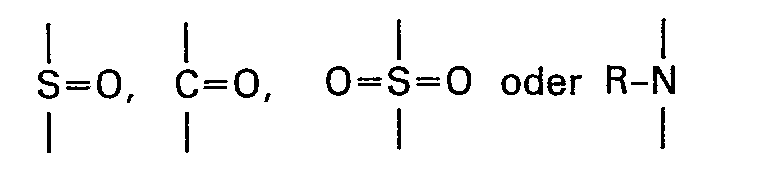
- This invention accordingly relates to photopolymerizable compositions which comprise at least one cationically polymerizable material and, as a photoinitiator, at least one diaryl iodosyl salt of the formula wherein R 9 and R IO may be the same or different and each represents an unsubstituted or substituent which does not interfere with the release of an acidic compound when the diaryl iodosyl salt is irradiated, is a monovalent aromatic radical having 4 to 25 carbon atoms, x is 1, 2 or 3 and Zx- means an x-valent anion of a protonic acid.
- Suitable anions Zx- are those which are derived from organic carboxylic acids, such as acetates and trifluoroacetates, those which are derived from organic sulfonic acids Y-SO 3 H, in which Y is an aliphatic, aromatic or aliphatic-substituted aromatic radical which is optionally mono- or polysubstituted by halogen atoms Is preferably a group having 1 to 20 carbon atoms, such as methanesulfonates, benzenesulfonates, toluene-p-sulfonates and trifluoromethanesulfonates, and those derived from inorganic acids, typically halides such as fluorides, chlorides and bromides, halogenates such as iodates, perhalates such as perchlorates as well as nitrates, sulfates, hydrogen sulfates, phosphates, hydrogen sulfates, phosphates, hydrogen sul
- This invention therefore relates to a process for the preparation of polymeric or crosslinked material, which is characterized in that a photopolymerizable composition consisting of at least one cationically polymerizable material and a photoinitiator of the formula V is exposed to the radiation of such a wavelength that the photoinitiator is activated and the Composition is polymerized or crosslinked.
- the radiation used in the method according to the invention can be exclusively ultraviolet radiation or also radiation with wavelengths both in the ultraviolet and in the visible spectral range.
- the compositions may also contain dyes so that they are sensitive to different visible spectral ranges. Suitable dyes are e.g. No. 4026705, and these are usually cationic, such as acridine yellow, acrididine orange, phosphine R, benzoflavin, setoflavin T and mixtures thereof.
- the preferred wavelength range of the radiation used in the method according to the invention is in the range from 200 to 600 nm, in particular 200 to 400 nm.
- the groups R 9 and R IO are preferably the same and are optionally substituted mono-, di- or tri-homocyclic or heterocyclic aromatic groups.
- suitable heterocyclic aromatic groups are thienyl, furyl, pyridyl and pyrazolyl groups.
- Suitable tricyclic aromatic groups are, for example, anthryl, phenanthryl and fluorenyl groups, while suitable mono- and dicyclic aromatic groups are phenyl and naphthyl groups and groups of the formula where Y l represents a carbon-carbon bond, an ether oxygen atom or a group of the formula -CH 2 - or -C (CH 3 ) 2 -, are suitable.
- aromatic groups can optionally be mono- or polysubstituted by atoms or groups which do not interfere with the release of a kind of acidic compound when the diaryl iodosyl salt is irradiated.
- substituents include alkyl and alkoxy groups with 1 to 4 carbon atoms, nitro groups and halogen atoms.
- R 9 and R 10 are preferably both phenyl and are optionally substituted on the phenyl rings by an alkyl group having 1 to 4 carbon atoms, in particular a methyl or isopropyl group, a halogen atom, in particular a fluorine atom, or a nitro group.
- the anions of the formula MQ w are preferably polyhalides of antimony, arsenic, bismuth, iron, tin, boron and phosphorus, such as hexafluoroantimonate, hexachloroantimonate, hexafluoroarsenate, Pentachlorowismutat, tetrachloroferrate, hexachlorostannate, tetrafluoroborate, or hexafluorophosphate, with the latter two being particularly preferred.
- Any cationically polymerizable material can be cured or polymerized by exposure to radiation in the presence of a suitable diaryl iodosyl salt of the formula V.
- a suitable diaryl iodosyl salt of the formula V is hardened by all such salts, and the exact nature of the material and the anion Z is critical and must be selected accordingly for effective hardening.
- the coordination of a cationically polymerizable material with a suitable anion certainly belongs to the knowledge of a person skilled in the art in the curing or polymerization of cationically polymerizable compositions.
- salts containing anions derived from organic carboxylic acids, organic sulfonic acids and inorganic acids in particular acetates, trifluoroacetates, methanesulfonates, benzenesulfonates, toluene-p-sulfonates, trifluoromethanesulfonates, fluorides, chlorides, bromides, iodates, perchlorates, nitrates, sulfates, hydrogenates Phosphates or hydrogen phosphates, for hardening phenoplasts such as phenol / formaldehyde resins and amino plastics such as urea / formaldehyde and melamine / formaldehyde resins.
- phenoplasts such as phenol / formaldehyde resins and amino plastics such as urea / formaldehyde and melamine / formaldehyde resins.
- Salts containing a metal or metalloid halide anion can harden epoxy resins or episulfide resins or polymerize mono-1,2-epoxides, monoepisulfides or vinyl ethers.
- Other materials which can be hardened or polymerized by irradiation in the presence of an iodonium salt can be hardened or polymerized by irradiation in the presence of a suitable diaryl iodosyl salt of the formula V.
- Suitable cationically polymerizable material used according to the invention are an oxetane, a thiirane or a tetrahydrofuran. It is preferably a 1,2-monoepoxide or episulfide having 2 to 20 carbon atoms, such as ethylene oxide, ethylene sulfide, propylene oxide or propylene sulfide, an epoxy resin, in particular a polyglycidyl ether of a bisphenol, a phenoplast, an aminoplast such as a urea / formaldehyde or Melamine / formaldehyde resin or another methylol compound such as a poly (N-methylol) derivative of a polycarboxamide.
- Cationically polymerizable, ethylenically unsaturated materials such as diketene, vinyl ether, vinyl carbazole or styrene can also be used.
- diaryl iodosyl salt present in the compositions is generally not critical since only catalytic amounts are required to initiate curing or photopolymerization. In general, 0.01 to 10% by weight and preferably 0.5 to 5% by weight, based on the weight of the cationically polymerizable material, is used.
- compositions according to the invention include diluents, in particular liquid diluents, fillers such as silica, talc, glass microbalions, clays, powdered metals or zinc oxide, viscosity regulators such as asbestos, and rubbers, tackifiers and pigments.
- diluents in particular liquid diluents, fillers such as silica, talc, glass microbalions, clays, powdered metals or zinc oxide, viscosity regulators such as asbestos, and rubbers, tackifiers and pigments.
- compositions according to the invention preferably also contain a photochemical free radical generator or a photosensitizer. It has been found that by incorporating suitable accelerators of this type, the hardening speed can be increased further, thereby making it possible to use shorter exposure times and / or less energy-intensive radiation sources.
- Aromatic carbonyl compounds are particularly preferred as radical formers. Although these have already been used for radical polymerization of ethylenically unsaturated compounds, it is surprising that they accelerate the cationic polymerization.
- Suitable aromatic carbonyl compounds include ketals of aromatic diketones, in particular compounds of the formula wherein R 11 represents a hydrogen atom, an alkyl group having 1 to 5 carbon atoms, an alkenyl group having 2 or 3 carbon atoms, an aralkyl group having 7 to 9 carbon atoms, an aralkenyl group having 8 or 9 carbon atoms or a group of the formula - (CH 2 ) - m R 13 , R 12 for a group of the formula -CH 2 CH (R 15 ) or -CH 2 CH (R 15 ) CH 2 - and R 13 for a halogen atom or a group of the formula -OR 14 , -SR 14 , -OR I8, -SR18, -OCOR 14 or -COOR stand 14, m is 1, or 3 and R 14 is an alkyl group having 1 to 4 carbon atoms, R omen 15 represents a hydrogen atom or an alkyl group having 1 to 18 Kohlenstoffa
- Examples of compounds of the formula VII are benzil dimethyl ketal, benzil diethyl ketal, benzil di (2-methoxyethyl) ketal and benzil di (2-chloroethyl) ketal.
- Compounds of the formula VIII are, for example, 2-phenyl-2-benzoyl-4-methyl-1,3-dioxolane and 2-phenyl-2-benzoyl-1,3-dioxane.
- Benzil dimethyl ketal is particularly preferred as such an aromatic carbonyl compound.
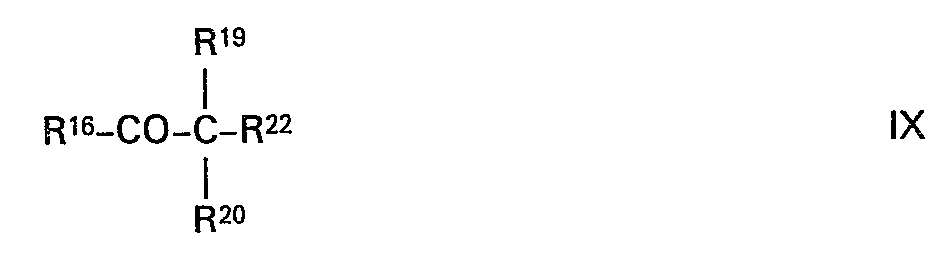
- R 16 has the meaning given above
- R 19 and R 20 each represent a monovalent aliphatic, cycloaliphatic or araliphatic group or together with the carbon atom bonded to it can mean a cycloalkylene group
- R 21 is a carbon-carbon bond or a divalent organic radical
- R22 a hydroxyl or amino group or a monovalent etherified or silylated such group
- R 23 a divalent amino, ether or siloxy group
- R 24 a direct chemical bond or -CH 2 - and R 25 -O-, -S-, -S0 2 -, -CH 2 -, or -C (CH 3 ) 2 .
- 2-Benzyloxy-2-methylpropiophenone, 2-hydroxy-2-methyl-p-phenoxypropiophenone, 1-benzoylcyclohexanol, 1-benzoylcyclopentanol and bis- [4- (a-hydroxyisobutyryl) phenyl] ether belong to the European patent application No. 0 003 002 also described as photopolymerization catalysts for ethylenically unsaturated compounds and as a photocrosslinker for polyolefins.
- Other compounds which can be used to increase the rate of photopolymerization with salts of the formula V are 2-substituted thioxanthones of the formula wherein R 26 represents either a chlorine atom or an alkyl group having 1 to 6 carbon atoms such as an isopropyl or tert-butyl group.
- R 26 represents either a chlorine atom or an alkyl group having 1 to 6 carbon atoms such as an isopropyl or tert-butyl group.
- Compounds of the formula XIII, in particular the 2-chloro compound are used industrially as photopolymerization catalysts for ethylenically unsaturated compounds and as photocrosslinkers for polyolefins.
- compositions may also include photosensitizers such as polyarylenes (e.g. perylene and 9,10-diethoxyanthracene), polyaryl polyenes, 2,5-diarylisobenzofurans, 2,5-diarylfurans, 2,5-diarylthiofurans, 2,5-diarylpyrroles, 2,5-diarylcyclopentadienes, Contain polyarylphenylenes, coumarin and polyaryl-2-pyrazolines.
- photosensitizers such as polyarylenes (e.g. perylene and 9,10-diethoxyanthracene), polyaryl polyenes, 2,5-diarylisobenzofurans, 2,5-diarylfurans, 2,5-diarylthiofurans, 2,5-diarylpyrroles, 2,5-diarylcyclopentadienes, Contain polyarylphenylenes, coumarin and polyary
- Diaryl iodosyl salts of the formula V can be prepared by a method similar to that described by FM Beringer and P. Bodlaender, op. Cit.
- An iodarene of formula XIV is oxidized with peracetic acid to the corresponding iodine oxyarene of formula XV.
- Treatment of the iodoxy arene or a mixture of two iodoxy arenes with an alkali metal hydroxide provides the iodosyl hydroxide of the formula XVI, which can be converted into the carbonate of the formula XVII by treatment with carbon dioxide. This hydroxide or carbonate is treated with an acid of the formula H x Z (if such acids exist) to form the desired salt.
- the hydroxide or carbonate can be mixed with acetic acid or trifluoroacetic acid to give the corresponding acetate Implement formula XVIII or trifluoroacetate of formula XIX.
- acetic acid or trifluoroacetic acid to give the corresponding acetate Implement formula XVIII or trifluoroacetate of formula XIX.
- Such a salt is treated with an alkali or ammonium salt of the acid H X Z, for example a phosphate, hexafluorophosphate, tetrachloroferrate or hexafluoroantimonate, to give the desired product of the formula V by double reaction.
- Hexafluoroantimonates can be prepared by adding solid sodium or potassium hexafluoroantimonate to an aqueous solution of iodosylacetate or trifluoroacetate; if the sodium or potassium salt is first dissolved in water, the product isolated is the hydroxopentafluoroantimonate (Zx- - SbF 5 (OH) -) due to hydrolysis.
- compositions according to the invention can be partially cured by irradiation and the curing can be completed by heating.
- a two-stage curing process requires that the composition contain a heat-activated hardener for the hardenable material.
- heat-activated hardeners are known, and it is within the scope of a person skilled in the art in hardening processes to select a heat hardener suitable for the respective hardenable material. Under these circumstances, it is of course important that the irradiation be carried out at a temperature below that at which the hot curing of the photopolymerized product would take place substantially.
- compositions according to the invention can be used as surface coatings. They can be applied to a base such as steel, aluminum, copper, cadmium, zinc, paper or wood, preferably as a liquid, and are then irradiated or heated. By partial photopolymerization of the coating, such as by irradiation through a mask, the unexposed areas can be washed out with a solvent to remove the unpolymerized portions, the photopolymerized, insoluble portions remaining in place.
- the compositions according to the invention can thus be used for the production of printing plates and printed circuits. Methods of making printing plates and printed circuits from photopolymerizable compositions are well known (see, for example, applicant's British Patent No. 1,495,746).
- compositions can also be used as adhesives.
- a layer of the composition can be placed between two surfaces of articles, the assembly is then irradiated and, if desired, heated to complete the polymerization.
- at least one of the objects is transparent to actinic radiation, e.g. is made of glass.
- compositions are also useful in the manufacture of fiber reinforced composites, including premixed molding compositions.
- fibers including spun threads, filaments and whiskers
- fibers that are woven or non-woven, unidirectional lengths or cut spun threads, in particular made of glass, boron, stainless steel, tungsten, clay, silicon carbide, asbestos or potassium titanate whiskers, an aromatic polyamide such as poly (m-phenylene isophthalamide), poly (p-phenylene terephthalamide) or poly (p-benzamide), polyethylene, polypropylene or carbon.
- the fiber-reinforced composite can also be produced by a batch process or continuously from films of the photopolymerizable composition.
- the fibrous reinforcing material is placed on a film of the photopolymerized composition which is expediently under a low tension, a second film of this type is optionally placed over it, and the structure is then pressed with heating.
- the composite can also be manufactured continuously, e.g. by contacting the fibrous reinforcing material with a film of the photopolymerized composition, then, if desired, placing a second such film on the back of the fibrous reinforcing material and allowing heat and pressure to act. It is easier to apply two such foils, preferably supported on the back by tapes or peelable sheets, to the fibrous reinforcing material at the same time in such a way that it comes into contact with each exposed surface. When two such foils are applied, they can be the same or different.
- Multi-layer composites can be produced by pressure heating intermediate films and layers from one or more fibrous reinforcing materials. If unidirectional fibers are used as the reinforcing material, successive layers can be oriented by them in such a way that they result in crossed layer structures.
- the fibrous reinforcement material can be used for additional reinforcement types such as a metal foil (e.g. aluminum, steel or titanium) or a foil made of plastic (e.g. an aromatic or aliphatic polyamide, a polyimide, polysulfone or polycarbonate) or a rubber (e.g. a neoprene or acrylonitrile rubber). also use.
- a composition according to the invention together with the reinforcing material made from cut fibers and other components, is exposed to the radiation in layers through support arches.
- the polymerizable composition is preferably applied in such a way that the composite contains a total of 20 to 80% by weight of this composition and correspondingly 80 to 20% by weight of reinforcement. A total of 30 to 50% by weight of the composition is particularly preferably used.
- compositions according to the invention can be used for the production of putties and fillers. They can be used for dip coatings, in which an object to be coated is immersed in the liquid composition, removed and the adhering coating is then used for the photopolymer sation (and thus solidification) irradiated and then heated if desired.
- diaryl iodosyl salts of Fomel V it is possible to cure epoxy resins and phenoplasts in two stages; the resin is first converted into the partially hardened B stage by exposure to actinic radiation in the presence of such a diaryl iodosyl salt and a latent, heat-activatable crosslinking agent for the epoxy resin or phenoplast, and in a second step the partially hardened composition is heated so that the hardening means of the heat-activated crosslinking agent is completed. It is thus possible to produce a semi-liquid composition which can then be deformed or used to impregnate a substrate with simultaneous irradiation to solidify it; the solidified body is then heated, if desired, to complete the curing of the resin.
- an epoxy resin or a phenoplast is irradiated in the presence of an effective amount of a Fomel V diaryl iodosyl salt and a latent hardener therefor to form a B-stage product and, if desired, the curing of the composition is completed by heating.
- a further embodiment comprises an epoxy resin or phenoplast, an amount of a diaryl iodosyl salt of the formula V which is effective for polymerizing it when the composition is exposed to actinic radiation, and a curing amount of a latent hardener for the composition containing the epoxy resin or phenoplast.
- Suitable heat-activatable crosslinking agents for the epoxy resin compositions include polycarboxylic acid anhydrides, complexes of amines, in particular primary or tertiary aliphatic amines such as ethylamine, trimethylamine and n-octyldimethylamine, with boron trifluoride or boron trichloride and latent boron difluoride chelates.
- Aromatic polyamines and imidazoles are generally not preferred because of poor results, possibly due to a reaction between the acid released catalyst and the amine.
- Dicyandiamide can be used successfully, provided that it is in relatively coarse particles.
- Suitable heat-activated crosslinking agents for novolaks include hexamethylenetetramine and paraform.
- the temperature and heating time required for hot curing after photopolymerization and the proportions of heat-activated hardener can easily be determined by series tests or derived from the already well-known specialist knowledge about the hot curing of epoxy resins and phenol / aldehyde novolaks.
- compositions containing resins with epoxy groups or phenolic hydroxyl groups, through which they can be heat-cured after photopolymerization, are particularly useful in the manufacture of multilayer printed circuits.
- a multilayer printed circuit is made from a plurality of double-sided printed circuit boards made of copper, which are stacked on top of one another and separated from one another by insulating foils, usually made of glass fibers impregnated with an epoxy resin or phenol / formaldehyde resin in the B stage. If no hot hardener is mixed into the photopolymerizable resin layer in the printed circuit board, it can be incorporated into the insulating layers alternating with the plates, which conventionally consist of an epoxy resin or phenol / formaldehyde resin prepreg; provided that the prepreg is not too thick, enough hot hardener contained therein migrates to initiate the crosslinking of the photopolymerized epoxy resin or phenol / formaldehyde resin.
- the stack is heated and pressed together to bind the layers.
- conventional photopolymerizable materials do not form strong bonds with copper or resin impregnated glass fiber sheets.
- a stack that still covers the copper and is bound with the photopolymer is therefore weak in itself and can peel apart in use. It is therefore normal practice after the etching step to remove the remaining photopolymer either by strong solvents or by a mechanical method, e.g. Brushing to remove.
- a mechanical method e.g. Brushing to remove.
- Such a stripping process can damage the copper of the printed circuit or the surface of the laminate on which it rests, and there is therefore a need for a method which would avoid the need to remove the photopolymerized material before pressing the board.
- compositions according to the invention means that crosslinking can occur when the plates are pressed, which results in good adhesion to the copper and to the resin-impregnated glass fiber substrate, which eliminates the need just mentioned; products with a higher glass transition point are also obtained.
- Another application which involves hot curing after the photopolymerization of the compositions according to the invention, is in the winding process.
- An endless cable of fibrous reinforcement is impregnated with a composition containing a latent heat hardener and then wound onto a mandrel or core while the winding is exposed to actinic radiation.
- Such thread packages still have a certain degree of flexibility, so that the mandrel or core is easier to remove than if a rigid winding is formed in one step. If necessary, the winding is heated to crosslink the composition.
- a layer of the composition becomes liquid
- the mold is irradiated until it solidifies to form an adhesive film which is then placed between and in contact with two surfaces to be bonded, and the assembly is then heated to complete the crosslinking of the composition.
- the film can be provided on one side with a removable protective film, for example made from a polyolefin or polyester or from cellulose-containing paper with a silicone release agent coating.
- the structure is often easier to handle if the film has a sticky surface. This can be accomplished by coating the film with a substance that is tacky at room temperature, but crosslinked to a hard, insoluble, infusible resin under the conditions used to complete the crosslinking of the composition. A sufficient degree of stickiness, however, often exists without additional treatment, especially if the polymerization of the composition has not progressed too far.
- Suitable adhesive substrates include metals such as iron, zinc, copper, nickel and aluminum, ceramics, glass and rubbers.
- This monohydrate (1.87 g) is dissolved in boiling water (25 ml). The solution is treated with decolorizing carbon and hot filtered. Then a saturated aqueous potassium hexafluorophosphate solution is slowly added until the addition no longer gives any further precipitate. The mixture is then cooled, filtered and the residue is dried in vacuo at room temperature over phosphorus pentoxide, which gives diphenyl iodosyl hexafluorophosphate (0.87 g) with a melting point of 120-130 ° C. (dec.).
- Iodine oxybenzene (35.4 g) is added to 1 normal sodium hydroxide solution (300 ml) at 0 ° C. with vigorous stirring. After 2 hours the mixture is filtered and carbon dioxide is bubbled through the filtrate until the solution is neutral. A portion of this carbonate solution (100 ml) is slowly mixed with fluoroboric acid (40%) until the evolution of carbon dioxide stops. Then another amount of the acid (2 ml) is added and the precipitate is filtered off, which is washed with ice-cold water and dried, giving diphenyl iodosyl tetrafluoroborate (2.4 g) with a melting range of 110 ° -120 ° C. (dec.). results.
- Diphenyl iodosyl trifluoroacetate is used according to F.M. Beringer and P. Bodsley, op. Cit.
- Bis- (4-methylphenyl) iodosyl trifluoroacetate (1.16 g; manufactured according to FM Beringer and P. Bodsley, loc. Cit.) Is dissolved in boiling water (10 ml), filtered and potassium hexafluorophosphate (0.49 g) as a saturated aqueous solution. The mixture is evaporated to about half the volume and the precipitate is filtered off. This is then dried to give bis (4-methylphenyl) iodosyl hexafluorophosphate (0.68 g), melting at 125 ° C (dec.).
- Diphenyl iodosyl trifluoroacetate (1.2 g) is dissolved in hot water, treated with activated carbon and filtered hot.
- Aqueous ammonium tetrachloroferrate solution (0.7 g) is added to the filtrate, a white precipitate forming. This is filtered off and dried, which gives diphenyl iodosyl tetrachloroferrate with a melting point of 164 ° C.
- Iodine oxybenzene (11.8 g) is added to 1 molar sodium hydroxide solution at 0 ° C. while stirring. After 2 hours the mixture is filtered and the filtrate is treated with carbon dioxide at 0 ° C until it is neutral. Aqueous 4-toluenesulfonic acid solution is added with vigorous stirring until the carbon dioxide is completely released. The solid formed is collected by filtration, washed with ice-cold water and dried in vacuo over phosphorus pentoxide, which gives diphenyl iodosyl-4-toluenesulfonate with a melting point of 108-110 ° C.
- Bis- (4-methylphenyl) iodosyl trifluoroacetate (F.M. Beringer and P. Bodlaender, op. Cit.) G) is dissolved in boiling water (25 ml), treated with activated carbon and filtered hot. Saturated sodium chloride solution is added to the filtrate and the mixture is cooled, during which crystals of bis (4-methylphenyl) iodosyl chloride separate. The crystals are filtered off and air dried to give 0.35 g of the chloride, melting at 146 ° C.
- Iodine oxybenzene (11.8 g) is added to 1 molar sodium hydroxide solution (100 ml) with stirring at 0 ° C. and stirring is continued for a further 1% hours at this temperature. The mixture is then filtered to remove the precipitated sodium iodate. The filtrate is mixed with 10% orthophosphoric acid solution up to pH 5. Crystallization takes place by cooling the solution to 0 ° C. overnight. The crystals are collected by filtration and on air dried to give diphenyl iodosyl orthophosphate (2.5 g) melting at 115-116 ° C (dec.).
- Diphenyl iodosyl sulfate is prepared as described above for the orthophosphate, but using a 10% sulfuric acid solution instead of the orthophosphoric acid. When the acid is added, a yellow precipitate forms. This is filtered off and the solid is recovered. The yellowish solid represents diphenyl iodosyl sulfate (2.0 g) with a melting point of 126-128 ° C. (dec.).
- Diphenyl iodosyl trifluoroacetate (1.23 g) is dissolved in 30 ml of hot water, sodium hexafluoroantimonate (0.78 g) is added and the resulting solution is cooled to 0 ° C. overnight.
- the white crystalline solid formed is collected by filtration, which gives 0.5 g of diphenyl iodosyl hexafluoroantimonate with a melting point of 142-144 ° C. (decomposition).
- 3-nitroiodobenzene (11.25 g) with a melting point of 206 ° C. (decomposition), produced in 75% yield by oxidation of 3-nitroiodobenzene with peracetic acid, is added to 1 molar sodium hydroxide solution (80 ml) with stirring at 0 ° C. . After 90 minutes, filter to remove the precipitated sodium iodate. Hexafluorophosphoric acid solution (10%) is added to the filtrate. When the pH is lowered, the iodosyl salt precipitates out of the solution. The acid addition is stopped when the pH reaches about 5. The precipitate is collected by filtration and air dried. It is bis- (3-nitrophenyl) -joso-dosyl-hexafluorophosphate (0.2 g) with a melting point of 182 ° C (decomposition).
- the resin (10 g) is mixed with diphenyl iodosyl hexafluorophosphate (0.3 g) and acetone (0.15 ml) and spread as a 10 ⁇ m thick coating on tinplate.
- the coating is irradiated with an 80 W / cm medium pressure mercury arc lamp at a distance of 20 cm.
- the resins used, the irradiation times and the properties of the irradiated coatings are given in the table below:
- Example 2 The procedure is as in Example 1, using bis (4-methylphenyl) iodosyl hexafluorophosphate (0.2 g), resin IV (5.02 g) and acetone (0.15 ml). The coating obtained is tack-free after 20 seconds of irradiation.
- benzil dimethyl ketal (0.123 g) is also incorporated into the composition, it becomes tack-free after 8 seconds of irradiation.
- Example 2 The procedure is as in Example 1, using resin 1 (10 g) and diphenyl iodosyl tetrafluoroborate (0.3 g). The coating is tack-free after 30 seconds of irradiation. When 2-chlorothiosanthone (0.15 g) is incorporated, the composition becomes tack-free after only 10 seconds of irradiation.
- Example 2 The procedure is as in Example 1, using resin 111 (5 g) and bis- (4-methylphenyl) iodosyl hexafluorophosphate (0.15 g). The coating becomes tack-free after 10 seconds of irradiation. When benzil dimethyl ketal (0.15 g) is incorporated into the composition, the coating becomes tack-free after only 6 seconds of irradiation.
- Resins VII and VIII become tack-free as soon as the irradiation time ends.
- Resin VI a melamine resin
- Resin VI must be heated to cause curing with some type of acidic compound. It is therefore heated to 120 ° C for 15 minutes after irradiation and is thus tack-free.
- a resin IX (5 g), resin X (4 g), resin I (1 g) and diphenyliodosyl hexafluorophosphate (0.2 g) in cyclohexanone (10 g) was prepared.
- a copper-clad laminate is coated with this composition and the solvent is allowed to evaporate, leaving a 5 ⁇ m thick coating. This is irradiated for 6 minutes through a negative with a 500 W medium-pressure mercury lamp at a distance of 22 cm. After development in 1,1,1-trichloroethane, a sharp, glossy relief image is obtained.
- the uncoated copper areas are removed by treatment with aqueous iron (III) chloride solution (40% by weight FeCl 3 ), the coated areas remaining intact.
- a solution according to Example 6 is treated with 2-chlorothioxanthone (0.05 g) and applied to a copper-clad laminate. After the solvent has evaporated, an 8 ⁇ m thick layer remains on the copper surface. This layer is irradiated through a negative for 10 seconds with a 5000 W metal halide lamp at a distance of 75 cm. Developing in 1,1,1-trichiorethane provides a sharp, glossy image.
- Example 2 The procedure is as in Example 1, using bis (4-isopropylphenyl) iodosyl hexafluorophosphate (0.03 g), Resin I (1.0 g) and y-butyrolactone (0.03 g). The resulting coating becomes tack-free for 1 second after irradiation.
- Resin XII 100 g
- diphenyl iodosyl tetrachloroferrate 3 g
- the coating is irradiated with an 80 W / cm medium pressure mercury arc lamp at a distance of 20 cm, which results in a tack-free film after 7 seconds.
- Example 10 is repeated, replacing the tetrachloroferrate with the same amount by weight of diphenyl iodosyl-4-toluenesulfonate. A tack-free film is obtained after 8 seconds.
- Example 10 is repeated, but replacing the tetrachloroferrate with the same amount by weight of bis (4-methylphenyl) iodosyl chloride. A tack-free film is obtained after 5 seconds.
- Resin XIII (97 g) and diphenyl iodosyl hexafluorophosphate (3 g) are ground and passed through a sieve with a mesh size of 210 ⁇ m.
- the powder obtained is dusted onto a loaded copper-clad laminate, which is then heated at 100 ° C. for 3 minutes, as a result of which the powder coating melts and an approximately 50 ⁇ m thick layer remains.
- the layer is then irradiated through a negative with a 5000 W metal halide lamp at a distance of 75 cm for 3 minutes. Developing with 1,1,1-trichloroethane gives a good, sharp image.
- Tinplate is coated with a mixture of resin XII (100 g) and diphenyl iodosyl phosphate (3 g) to a thickness of 4-6 ⁇ m. Irradiation of the coating with an 80 W / cm medium pressure lamp at a distance of 20 cm results in a tack-free coating after 30 seconds.
- Tinplate is coated with a mixture of resin XII (100 g) and diphenyl iodosyl sulfate (3 g) to form a 6 ⁇ m thick layer. 35 seconds of irradiation in the same manner as in Example 14 provides a tack free coating.
- Tinplate is coated with a mixture of resin I (100 parts by weight), acetone (3 parts by weight) and bis (3-nitrophenyl) iodosyl hexafluorophosphate (3 parts by weight) to a thickness of 6-8 ⁇ m. 10 seconds of irradiation with an 80 W / cm medium pressure mercury lamp at a distance of 20 cm provides a non-stick coating.
Landscapes
- Chemical & Material Sciences (AREA)
- Chemical Kinetics & Catalysis (AREA)
- Medicinal Chemistry (AREA)
- Polymers & Plastics (AREA)
- Organic Chemistry (AREA)
- Health & Medical Sciences (AREA)
- Physics & Mathematics (AREA)
- Inorganic Chemistry (AREA)
- Spectroscopy & Molecular Physics (AREA)
- General Physics & Mathematics (AREA)
- Epoxy Resins (AREA)
- Phenolic Resins Or Amino Resins (AREA)
- Compositions Of Macromolecular Compounds (AREA)
- Polymerization Catalysts (AREA)
- Paints Or Removers (AREA)
Description
- Vorliegende Erfindung betrifft aus einem kationisch polymerisierbaren Material und einem Diaryljodosylsalz bestehende Zusammensetzungen sowie die Polymerisation solcher Zusammensetzungen mittels aktinischer Strahlung und deren Verwendung als Oberflächenüberzüge, bei der Herstellung von Druckplatten und gedruckten Schaltungen und als Klebstoffe.
- Bekannterweise ist es wünschenswert, die Polymerisation in organischen Materialien mittels aktinischer Strahlung einzuleiten. Mit solchen Verfahren kann man beispielsweise die Verwendung toxischer und/oder brennbarer Lösungsmittel mit ihren begleitenden Problemen der Umweltbelastung und der Rückgewinnungskosten vermeiden. Photopolymerisation ermöglicht es, die Unlöslichmachung von Harzzusammensetzungen auf bestimmte Stellen zu beschränken, d.h. die bestrahlten Stellen, und gestattet daher die Herstellung von gedruckten Schaltungen und Druckplatten bzw. erlaubt es, die Verklebung von Substraten auf die gewünschten Zonen zu begrenzen. Ferner sind Bestrahlungsverfahren häufig schneller als solche, bei denen Erhitzen und folglich eine Abkühlungsstufe erforderlich sind.
- Die Verwendung aromatischer Jodoniumsalze als Photopolymerisationskatalysatoren für kationisch polymerisierbare Materialien ist schon bekannt.
- So beschreibt die britische Patentschrift Nr. 1 516 351 härtbare Zusammensetzungen, die aus (A) einem zu einem höheren Molekulargewichtszustand polymerisierbaren Monoepoxid, Epoxidharz oder einem Gemisch von diesen und (B) einem strahlungsempfindlichen Haloniumsalz in einer Menge bestehen, welche die Härtung von (A) durch Freisetzung eines sauren Katalysators bei Belichtung mit Strahlungsenergie bewirken kann.
- Typische solche aromatische Haloniumsalze sind Diphenyljodonium-tetrafluoroborat, -hexafluorophosphat, -hexafluoroantimonat und -hexafluoroarsenat.
- In der britischen Patentschrift Nr. 1 491 539 sind photopolymerisierbare Zusammensetzungen beschrieben, die aus (A) einem kationisch polymerisierbaren organischen Material und (B) 0,5 bis 30 Teilen auf 100 Gewichtsteile organisches Material eines aromatischen Jodoniumkomplexsalzphotoinitiators der Formel


- Die angeführten kationisch polymerisierbaren organischen Materialien umfassen Oxetane, Lactone, Vinyläther und Mono- oder Polyepoxide, und als typische Jodoniumkomplexsalze sind wiederum Diphenyljodonium-tetrafluoroborat, -hexachloroantimonat, -hexafluorantimonat und -hexafluorophosphat angegeben.
- Aus der britischen Patentschrift Nr. 1 539192 sind photopolymerisierbare Zusammensetzungen bekannt, die mindestens ein säurepolymerisierbares oder säurehärtbares Material und als Photosensibilisator mindestens ein Jodoniumsalz der Formel

- Weitere Patentschriften beschreiben die Photopolymerisation spezieller Materialtypen in Gegenwart eines Diaryljodoniumsalzes. Beispielsweise ist in der britischen Patentschrift Nr. 1565671 und der entsprechenden U.S. Patentschrift Nr. 4256828 eine Zusammensetzung beschrieben, die aus einem Polyepoxid, einer organischen Hydroxylverbindung mit einer Hydroxylfunktionalität von 1 oder höher, wie einem Alkylenglycol, und als Photoinitiator einem Salz der Formel 1 besteht.
- Aus der britischen Patentschrift Nr. 1 554389 und der entsprechenden U.S. Patentschrift Nr. 4193799 sind photohärtbare Zusammensetzungen bekannt, die aus einem Epoxidharz, einem Polyvinylacetal und einem aromatischen Oniumsalz bestehen, wobei der letztere Begriff Jodoniumsalze wie Diphenyljodonium-hexafluoroarsenat umfassen soll.
- Die U.S. Patentschrift Nr. 4090936 beschreibt photohärtbare flüssige Zusammensetzungen, die aus einer Epoxidverbindung mit einer Durchschnittsepoxidfunktionalität von 1 bis 1,3, einem verträglichen Polymer mit einer Glasübergangstemperatur von 20 bis 105°C, nämlich einem Acrylat- oder Methacrylatpolymer, einem Styrol/Allylalkoholcopolymer oder Polyvinylbutyral, und als Photoinitiator einem aromatischen Komplexsalz bestehen, wobei letzterer Begriff die Diaryljodoniumsalze der Formel 1 umfassen soll.
- Die belgische Patentanmeldung Nr. 880 959 beschreibt lagerfähige, UV-härtbare Epoxi-silanzusammensetzungen, die als Photoinitiator ein Diaryljodoniumsalz der Formel

- Aus der U.S. Patentschrift Nr. 4227978 sind photohärtbare Zusammensetzungen bekannt, die aus einem halogenierten oligomeren Ester, wie einem sich von Tetrachlorphthalsäureanhydrid und Äthylenglykol ableitenden Ester, einem Acrylat- oder Methacrylatmonomer, wie Butandiolacrylat, einem kationischen Initiator wie Diphenyljodonium-hexafluorophosphat, einer Epoxidverbindung und einem Radikalinitiator wie Di- äthoxyacetophenon bestehen.
- In der britischen Patentschrift Nr. 2 073 760 sind strahlungshärtbare Zusammensetzungen beschrieben, die ein Dihydropyran und als bei Belichtung mit Strahlung eine Säure freisetzenden Katalysator ein Aryljodonium-, Aryldiazonium-oder Arylsulfoniumsalz enthalten.
- Schliesslich offenbaren die britische Patentschrift Nr. 1 535492 und die entsprechende U.S. Patentschrift Nr. 4108747 härtbare Zusammensetzungen, die aus einem kationisch polymerisierbaren Material, wie einem Gemisch aus einem Epoxinovolak und 4-Vinylcyclohexendioxyd oder Diäthylenglykoldivinyläther zusammen mit einem strahlungsempfindlichen Sulfonat bestehen, wobei letzterer Begriff Jodoniu msulfonate der Formel

- In einem Artikel von F. M. Beringer und P. Bodlaender, J. Org. Chem., 1968, 33, 2981-4 sind verschiedene Diaryljodosylsalze und deren Herstellung beschrieben. Dieser Artikel gibt jedoch keinen Hinweis auf das Verhalten solcher Salze, wenn sie aktinischer Strahlung ausgesetzt werden, und gibt auch keine mögliche Verwendung für diese an.
- Überraschenderweise wurde nun gefunden, dass gewisse Jodsalze, in denen sich das Jod in einem höheren Oxydationszustand befindet, d.h. Diaryljodosylsalze, auch als Photoinitiatoren wirken werden, da sie bei Belichtung mit UV-Licht eine Art saure Verbindung freisetzen. Keine der Veröffentlichungen des Standes der Technik legt es nah, dass ein Jodosylsalz diese wertvolle Eigenschaft besitzen würde.
- Die Jodoniumsalze des Standes der Technik sollen auch Heisshärtungs- oder Heisspolymerisationskatalysatoren sein. Dagegen besitzen die Jodosylsalze in den erfindungsgemässen Zusammensetzungen beim Erhitzen in Abwesenheit aktinischer Strahlung nur eine schwache oder gar keine Wirkung auf Verbindungen, die unter der Einwirkung eines kationischen Katalysators in höhermolekulares Material umgewandelt werden können. So trat bei 48 Stunden Erhitzen auf 150°C keine Gelierung einer 2 Gewichtsteile Diphenyljodosyl-hexafluorophosphat und 100 Gewichtsteile des am weitesten verwendeten Epoxidharzes [2,2-Bis-(4-glycidyloxyphenyl)-propan] enthaltenden Zusammensetzung ein. Daraus folgt, dass erfindungsgemässe Zusammensetzungen wünschenswert lange Topfzeiten aufweisen, wenn sie vor aktinischer Strahlung geschützt sind. Gegenstand dieser Erfindung sind dementsprechend photopolymerisierbare Zusammensetzungen, die mindestens ein kationisch polymerisierbares Material und als Photoinitiator mindestens ein Diaryljodosylsalz der Formel

- Geeignete Anionen Zx- sind solche, die sich von organischen Carbonsäuren ableiten, wie Acetate und Trifluoracetate, solche, die sich von organischen Sulfonsäuren Y-SO3H, worin Y einen gegebenenfalls einfach oder mehrfach durch Halogenatome substituierte aliphatische, aromatische oder aliphatisch-substituierte aromatische Gruppe mit vorzugsweise 1 bis 20 Kohlenstoffatomen bedeutet, ableiten, wie Methansulfonate, Benzolsulfonate, Toluol-p-sulfonate und Trifluormethansulfonate, und solche, die sich von anorganischen Säuren ableiten, typischerweise Halogenide wie Fluoride, Chloride und Bromide, Halogenate wie Jodate, Perhalogenate wie Perchlorate sowie Nitrate, Sulfate, Hydrogensulfate, Phosphate, Hydrogensulfate, Phosphate, Hydrogenphosphate und komplexe Anionen wie Pentafluorohydroxoantimonate und solche der Formel MYW-, worin M für ein Metall- oder Metalloidatom und Q für ein Halogenatom stehen und w eine ganze Zahl von 4 bis 6 und um eins grösser als die Wertigkeit von M ist.
- Bei der Belichtung dieser neuartigen Zusammensetzungen mit Strahlung geeigneter Wellenlänge setzt der Photoinitiator der Formel V eine Art saure Verbindung frei, die Polymerisation oder Vernetzung der Zusammensetzung bewirkt. Gegenstand dieser Erfindung ist daher ein Verfahren zur Herstellung polymeren oder vernetzten Materials, welches dadurch gekennzeichnet ist, dass man eine aus mindestens einem kationisch polymerisierbaren Material und einem Photoinitiator der Formel V bestehende photopolymerisierbare Zusammensetzung der Strahlung einer solchen Wellenlänge aussetzt, dass der Photoinitiator aktiviert und die Zusammensetzung polymerisiert oder vernetzt wird.
- Bei der im erfindungsgemässen Verfahren verwendeten Strahlung kann es sich ausschliesslich um Ultraviolettstrahlung oder auch um Strahlung mit Wellenlängen sowohl im ultravioletten als auch im sichtbaren Spektralbereich handeln. Die Zusammensetzungen können ferner Farbstoffe enthalten, so dass sie für verschiedene sichtbare Spektralbereiche empfindlich sind. Geeignete Farbstoffe sind beispielsweise in der U.S. Patentschrift Nr. 4026705 offenbart, und diese sind üblicherweise kationisch, wie Acridingelb, Acrididinorange, Phosphin R, Benzoflavin, Setoflavin T und deren Gemische.
- Der bevorzugte Wellenlängenbereich der im erfindungsgemässen Verfahren angewandten Strahlung liegt im Bereich von 200 bis 600 nm, insbesondere 200 bis 400 nm.
- In den Diaryljodosylsalzen der Formel V sind die Gruppen R9 und RIO vorzugsweise gleich und stellen gegebenenfalls substituierte mono-, di-oder tri-homocyclische oder heterocyclische aromatische Gruppen dar. Beispiele für geeignete heterocyclische aromatische Gruppen sind Thienyl-, Furyl-, Pyridyl- und Pyrazolylgruppen. Geeignete tricyclische aromatische Gruppen sind beispielsweise Anthryl-, Phenanthryl- und Fluorenylgruppen, während als geeignete mono- und dicyclische aromatische Gruppen Phenyl- und Naphthylgruppen sowie Gruppen der Formel

- Die Anionen der Formel MQw sind vorzugsweise Polyhalogenide des Antimons, Arsens, Wismuts, Eisens, Zinns, Bors und Phosphors, wie Hexafluoroantimonat, Hexachloroantimonat, Hexafluoroarsenat, Pentachlorowismutat, Tetrachloroferrat, Hexachlorostannat, Tetrafluoroborat oder Hexafluorophosphat, wobei die beiden letztgenannten besonders bevorzugt sind.
- Jedes kationisch polymerisierbare Material lässt sich durch Belichtung mit Strahlung in Gegenwart eines geeigneten Diaryljodosylsalzes der Formel V härten oder polymerisieren. Es wird jedoch nicht jedes solche Material durch alle solchen Salze gehärtet, und die genaue Art des Materials und des Anions Z ist dabei kritisch und muss fürwirksame Härtung entsprechend ausgewählt werden. Die Abstimmung eines kationisch polymerisierbaren Materials mit einem geeigneten Anion gehört durchaus zum Wissen eines Fachmanns in der Härtung oder Polymerisation kationisch polymerisierbarer Zusammensetzungen. Beispielsweise sind sich von organischen Carbonsäuren, organischen Sulfonsäuren und anorganischen Säuren ableitende Anionen enthaltende Salze, insbesondere Acetate, Trifluoracetate, Methansulfonate, Benzolsulfonate, Toluol-p-sulfonate, Trifluormethansulfonate, Fluoride, Chloride, Bromide, Jodate, Perchlorate, Nitrate, Sulfate, Hydrogensulfate, Phosphate oder Hydrogenphosphate, zur Härtung von Phenoplasten wie Phenol/Formaldehydharzen und Aminoplasten wie Harnstoff/Formaldehyd- und Melamin/Formaldehydharzen befähigt. Ein Metall- oder Metalloidhalogenidanion enthaltende Salze können Epoxidharze oder Episulfidharze härten bzw. Mono-1,2-epoxide, Monoepisulfide oder Vinyläther polymerisieren. Weitere durch Bestrahlung in Gegenwart eines Jodoniumsalzes, wie in den bei der Würdigung des Standes der Technik hierin angeführten Patentschriften erwähnt, härtbare oder polymerisierbare Materialien lassen sich durch Bestrahlung in Gegenwart eines geeigneten Diaryljodosylsalzes der Formel V härten bzw. polymerisieren.
- Als erfindungsgemäss verwendetes kationisch polymerisierbares Material kommen beispielsweise ein Oxetan, ein Thiiran oder ein Tetrahydrofuran in Betracht. Vorzugsweise handelt es sich um ein 1,2-Monoepoxid oder -episulfid mit 2 bis 20 Kohlenstoffatomen, wie Äthylenoxyd, Äthylensulfid, Propylenoxyd oder Propylensulfid, ein Epoxidharz, insbesondere einen Polyglycidyläther eines Bisphenols, ein Phenoplast, ein Aminoplast wie ein Harnstoff/Formaldehyd- oder Melamin/Formaldehydharz oder eine sonstige Methylolverbindung wie ein Poly-(N-methylol)-derivat eines Polycarbonsäureamids. Kationisch polymerisierbare, äthylenisch ungesättigte Materialien, wie Diketen, Vinyläther, Vinylcarbazol oder Styrol sind ebenfalls verwendbar.
- Die in den Zusammensetzungen vorliegende Menge Diaryljodosylsalz ist im allgemeinen nicht entscheidend, da nur katalytische Mengen erforderlich sind, um die Härtung oder Photopolymerisation in Gang zu bringen. Im allgemeinen setzt man dabei 0,01 bis 10 Gew.% und vorzugsweise 0,5 bis 5 Gew.%, bezogen auf das Gewicht des kationisch polymerisierbaren Materials, ein.
- Zu weiteren Materialien, die in die erfindungsgemässen Zusammensetzungen eingearbeitet werden können, gehören Verdünnungsmittel, insbesondere flüssige Verdünnungsmittel, Füllstoffe wie Kieselsäure, Talkum, Glasmikrobalions, Tone, gepulverte Metalle oder Zinkoxyd, Viskositätsregler, wie Asbest, und Kautschuke, Klebrigmacher sowie Pigmente.
- Vorzugsweise enthalten die erfindungsgemässen Zusammensetzungen ferner einen photochemischen Radikalbildner oder einen Photosensibilisator. Es wurde gefunden, dass man durch Einarbeitung geeigneter solcher Beschleuniger die Härtungsgeschwindigkeit weiter steigern und dadurch die Anwendung kürzerer Belichtungszeiten und/oder weniger energiereicher Strahlungsquellen ermöglichen kann. Aromatische Carbonylverbindungen sind als Radikalbildner besonders bevorzugt. Diese sind zwar schon zur Radikalpolymerisation äthylenisch ungesättigter Verbindungen verwendet worden, doch ist es überraschend, dass sie die kationische Polymerisation beschleunigen.
- Zu geeigneten aromatischen Carbonylverbindungen zählen Ketale aromatischer Diketone, insbesondere Verbindungen der Formel

- Beispiele für Verbindungen der Formel VII sind Benzildimethylketal, Benzildiäthylketal, Benzil-di-(2-methoxyäthyl)-ketal und Benzil-di-(2-chloräthyl)-ketal. Verbindungen der Formel VIII sind beispielsweise 2-Phenyl-2-benzoyl-4-methyl-1,3-dioxolan und 2-Phenyl-2-benzoyl-1,3-dioxan. Benzildimethylketal ist als solche aromatische Carbonylverbindung besonders bevorzugt.
- Verbindungen der Formel VII oder Vill sind in der britischen Patentschrift Nr. 1390006 beschrieben, wo sie zur Photopolymerisation und Photovernetzung äthylenisch ungesättigter Verbindungen wie Methylacrylat, styrolhaltigen Polyestern auf Maleinsäuregrundlage und Diallylphthalatpräpolymerer eingesetzt werden.
- Weitere zur Verwendung als Photobeschleuniger geeignete Substanzen sind unter anderem aromatisch-aliphatische Ketone einer der Formeln


- Diese Verbindungen, zu deren bevorzugten Mitgliedern 2-Allyloxy-2-methylpropiophenon,
- 2-Benzyloxy-2-methylpropiophenon, 2-Hydroxy-2-methyl-p-phenoxypropiophenon, 1-Benzoylcyclohexanol, 1-Benzoylcyclopentanol und Bis-[4-(a-hydroxyisobutyryl)-phenyl]-äther gehören, sind in der europäischen Patentanmeldung Nr. 0 003 002 ebenfalls als Photopolymerisationskatalysatoren für äthylenisch ungesättigte Verbindungen und als Photovernetzer für Polyolefine beschrieben.
- Weitere, zur Erhöhung der Photopolymerisationsgeschwindigkeit mit Salzen der Formel V verwendbare Verbindungen sind 2-substituierte Thioxanthone der Formel

- Bevorzugt werden 30 bis 125 Gew.%, und insbesondere 50 bis 100 Gew.%, des Photobeschleunigers, berechnet auf das Gewicht des Diaryljodosylsalzes der Formel V, mitverwendet.
- Die Zusammensetzungen können ferner Photosensibilisatoren wie Polyarylene (z.B. Perylen und 9,10-Diäthoxyanthracen), Polyarylpolyene, 2,5-Diarylisobenzofurane, 2,5-Diarylfurane, 2,5-Diarylthiofurane, 2,5-Diarylpyrrole, 2,5-Diarylcyclopentadiene, Polyarylphenylene, Cumarin und Polyaryl-2-pyrazoline enthalten.
- Diaryljodosylsalze der Formel V lassen sich nach einer Methode ähnlich wie von F. M. Beringer und P. Bodlaender, a.a.O., beschrieben, herstellen. Ein Jodaren der Formel XIV wird mit Peressigsäure zum entsprechenden Jodoxyaren der Formel XV oxydiert. Behandlung des Jodoxyarens oder eines Gemisches von zwei Jodoxyarenen mit einem Alkalihydroxyd liefert das Jodosylhydroxyd der Formel XVI, das sich durch Behandlung mit Kohlendioxyd in das Carbonat der Formel XVII überführen lässt. Dieses Hydroxyd bzw. Carbonat wird mit einer Säure der Formel HxZ (falls solche Säuren existieren) zur Bildung des gewünschten Salzes behandelt. (Direkte Neutralisation des Jodosylhydroxyds ergibt manchmal niedrigere Ausbeuten des gewünschten Salzes als bei vorhergehender Überführung in das Carbonat.) Wo solche Säuren im freien Zustand nicht existieren oder schwer zu handhaben sind, kann man das Hydroxyd oder Carbonat z.B. mit Essigsäure oder Trifluoressigsäure zum entsprechenden Acetat der Formel XVIII bzw. Trifluoracetat der Formel XIX umsetzen. Ein solches Salz wird mit einem Alkali- oder Ammoniumsalz der Säure HXZ, z.B. einem Phosphat, Hexafluorophosphat, Tetrachloroferrat oder Hexafluoroantimonat, behandelt, um das gewünschte Produkt der Formel V durch doppelte Umsetzung zu ergeben. Diese Reaktionen sind in dem nachstehenden Schema erläutert.

- Hexafluoroantimonate sind durch Zusatz festen Natrium- oder Kaliumhexafluoroantimonats zu einer wässrigen Lösung des Jodosylacetats bzw. -trifluoracetats herstellbar; wird das Natrium- oder Kaliumsalz zunächst in Wasser gelöst, dann ist das isolierte Produkt wegen Hydrolyse das Hydroxopentafluoroantimonat (Zx- - SbF5(OH)-).
- Gewünschtenfalls kann man die erfindungsgemässen Zusammensetzungen durch Bestrahlung teilweise härten und die Härtung durch Erhitzen vervollständigen. Für ein solches zweistufiges Härtungsverfahren ist es erforderlich, dass die Zusammensetzung einen hitzeaktivierbaren Härter für das härtbare Material enthält. Solche hitzeaktivierbare Härter sind bekannt, und es liegt im Rahmen der Fähigkeiten eines Fachmanns in Härtungsverfahren, einen für das jeweilige härtbare Material geeigneten Heisshärter auszuwählen. Unter diesen Umständen ist es natürlich wichtig, dass die Bestrahlung bei einer Temperatur unterhalb derjenigen ausgeführt wird, bei der eine wesentliche Heisshärtung des photopolymerisierten Produkts mittels des Heisshärters eintreten würde.
- Die erfindungsgemässen Zusammensetzungen sind als Oberflächenüberzüge verwendbar. Sie lassen sich auf eine Unterlage wie Stahl, Aluminium, Kupfer, Cadmium, Zink, Papier oder Holz, vorzugsweise als Flüssigkeit, aufbringen und werden dann bestrahlt oder erhitzt. Durch teilweise Photopolymerisation des Überzugs, wie mittels Bestrahlung durch eine Maske hindurch, können die unbelichteten Stellen zur Entfernung der nicht polymerisierten Anteile mit einem Lösungsmittel ausgewaschen werden, wobei die photopolymerisierten, unlöslichen Anteile an Ort und Stelle bleiben. Die erfindungsgemässen Zusammensetzungen lassen sich somit zur Herstellung von Druckplatten und gedruckten Schaltungen verwenden. Methoden zur Herstellung von Druckplatten und gedruckten Schaltungen aus photopolymerisierbaren Zusammensetzungen sind wohlbekannt (siehe z.B. die britische Patentschrift Nr. 1 495 746 der Anmelderin).
- Die Zusammensetzungen sind auch als Klebstoffe einsetzbar. Eine Schicht der Zusammensetzung kann zwischen zwei Oberflächen von Gegenständen eingebracht werden, der Aufbau wird dann bestrahlt und gewünschtenfalls erhitzt, um die Polymerisation zu Ende zu führen. Dabei ist es natürlich erforderlich, dass mindestens einer der Gegenstände für aktinische Strahlung durchlässig ist, z.B. aus Glas besteht.
- Die Zusammensetzungen sind auch bei der Herstellung von faserverstärkten Verbundstoffen, einschliesslich vorgemischten Formmassen nützlich.
- Sie können direkt und kontinuierlich oder diskontinuierlich in flüssiger Form auf Verstärkungsfasern (einschliesslich Spinnfäden, Filamente und Whiskers) aufgebracht werden, die als Gewebe oder Vlies, unidirektionale Längen oder geschnittene Spinnfäden, insbesondere aus Glas, Bor, Edelstahl, Wolfram, Tonerde, Siliciumcarbid, Asbest oder Kaliumtitanatwhiskers, einem aromatischen Polyamid wie Poly(m-phenylen- isophthalamid), Poly-(p-phenylenterephthala- mid) oder Poly-(p-benzamid), Polyäthylen, Polypropylen oder Kohlenstoff vorliegen können. Der faserverstärkte Verbundstoff kann auch nach einem Chargenverfahren oder kontinuierlich aus Folien der photopolymerisierbaren Zusammensetzung hergestellt werden. Beim chargenweisen Verfahren wird das fasrige Verstärkungsmaterial auf eine zweckmässig unter einer geringen Spannung stehende Folie aus der photopolymerisierten Zusammensetzung aufgelegt, gegebenenfalls wird eine zweite solche Folie darübergelegt, und der Aufbau wird dann unter Erhitzen verpresst. Der Verbundstoff lässt sich auch kontinuierlich herstellen, z.B. indem man das fasrige Verstärkungsmaterial mit einer Folie der photopolymerisierten Zusammensetzung in Berührung bringt, dann gewünschtenfalls eine zweite solche Folie auf die Rückseite des fasrigen Verstärkungsmaterials legt und Hitze und Druck einwirken lässt. Einfacher ist es, zwei solche, vorzugsweise auf der Rückseite durch Bänder oder abziehbare Bögen abgestützte Folien gleichzeitig so auf das fasrige Verstärkungsmaterial aufzubringen, dass es mit jeder belichteten Fläche in Berührung kommt. Bei Aufbringung zweier solcher Folien können diese gleich oder verschieden sein.
- Mehrschichtige Verbundstoffe lassen sich durch Druckerhitzung zwischengeordneter Folien und Schichten aus einem oder mehreren fasrigen Verstärkungsmaterialien herstellen. Bei Verwendung unidirektioneller Fasern als Verstärkungsmaterial können aufeinanderfolgende Schichten von diesen so orientiert werden, dass sie verkreuzte Schichtstrukturen ergeben.
- Mit dem fasrigen Verstärkungsmaterial kann man zusätzliche Verstärkungstypen wie eine Metallfolie (z.B. Aluminium, Stahl oder Titan) oder eine Folie aus Kunststoff (z.B. einem aromatischen oder aliphatischen Polyamid, einem Polyimid, Polysulfon oder Polycarbonat) oder einem Kautschuk (z.B. einem Neopren- oder Acrylnitrilkautschuk) mitverwenden. Bei der Herstellung von vorgemischten Formmassen wird eine erfindungsgemässe Zusammensetzung zusammen mit dem Verstärkungsmaterial aus geschnittenen Fasern und weiteren Komponenten der Bestrahlung in Schichten durch Stützbögen hindurch ausgesetzt. Die polymerisierbare Zusammensetzung wird vorzugsweise so aufgetragen, dass der Verbundstoff insgesamt 20 bis 80 Gew.-% dieser Zusammensetzung sowie entsprechend 80 bis 20 Gew.-% Verstärkung enthält. Besonders bevorzugt werden insgesamt 30 bis 50 Gew.-% der Zusammensetzung eingesetzt.
- Die erfindungsgemässen Zusammensetzungen sind zur Herstellung von Kitten und Füllstoffen verwendbar. Man kann sie für Tauchbeschichtungen einsetzen, wobei ein zu beschichtender Gegenstand in die flüssige Zusammensetzung eingetaucht, herausgenommen und die anhaftende Beschichtung dann zur Photopolymerisation (und somit Verfestigung) bestrahlt und danach gewünschtenfalls erhitzt wird.
- Es wurde gefunden, dass es bei der Verwendung von Diaryljodosylsalzen der Fomel V möglich ist, Epoxidharze und Phenoplaste in zwei Stufen zu härten; das Harz wird zunächst durch Belichtung mit aktinischer Strahlung in Gegenwart eines solchen Diaryljodosylsalzes und eines latenten, hitzeaktivierbaren Vernetzungsmittels für das Epoxidharz oder Phenoplast in die teilweise gehärtete B-Stufe überführt und in einem zweiten Schritt wird die teilweise gehärtete Zusammensetzung so erhitzt, dass die Härtung mittels des hitzeaktivierbaren Vernetzungsmittels vervollständigt wird. Somit kann man eine halbflüssige Zusammensetzung herstellen, die sich dann verformen oder zum Tränken eines Substrats mit gleichzeitiger Bestrahlung zu dessen Verfestigung verwenden lässt; der verfestigte Körper wird dann gewünschtenfalls erhitzt, um die Härtung des Harzes zu vervollständigen.
- Gemäss einer weiteren Ausführungsform dieser Erfindung wird daher ein Epoxidharz oder ein Phenoplast in Gegenwart einer zu dessen Polymerisation wirksamen Menge eines Diaryljodosylsalzes der Fomel V und eines latenten Härters dafür zur Bildung eines B-Stufenprodukts bestrahlt, und gewünschtenfalls wird die Härtung der Zusammensetzung durch Erhitzen vervollständigt.
- Eine weitere Ausführungsform umfasst eine ein Epoxidharz oder Phenoplast, eine zu dessen Polymerisation bei Belichtung der Zusammensetzung mit aktinischer Strahlung wirksame Menge eines Diaryljodosylsalzes der Formel V und eine härtende Menge eines latenten Härters für das Epoxidharz oder Phenoplast enthaltende Zusammensetzung.
- Zu geeigneten hitzeaktivierbaren Vernetzungsmitteln für die Epoxidharzzusammensetzungen zählen Polycarbonsäureanhydride, Komplexe von Aminen, insbesondere primären oder tertiären aliphatischen Aminen wie Aethylamin, Trimethylamin und n-Octyldimethylamin, mit Bortrifluorid oder Bortrichlorid sowie latente Bordifluoridchelate. Aromatische Polyamine und Imidazole sind im allgemeinen nicht vorzuziehen, da man mässige Ergebnisse erzielt, möglicherweise wegen einer Reaktion zwischen dem durch die Säure freigesetzten Katalysator und dem Amin. Dicyandiamid lässt sich erfolgrich einsetzen, vorausgesetzt, dass es in verhältnismässig groben Teilchen vorliegt.
- Als hitzeaktivierbare Vernetzungsmittel für Novolake eignen sich unter anderem Hexamethylentetramin und Paraform. Die zur Heisshärtung nach der Photopolymerisation erforderliche Temperatur und Erhitzungsdauer sowie die Anteile an hitzeaktivierbarem Härter lassen sich leicht durch Serienversuche ermitteln oder aus dem bereits wohlbekannten Fachwissen über die Heisshärtung von Epoxidharzen und Phenol/Aldehydnovolaken herleiten.
- Zusammensetzungen, die Harze mit Epoxidgruppen oder phenolischen Hydroxylgruppen, über die sie nach der Photopolymerisation heissgehärtet werden können, enthalten, sind besonders nützlich bei der Herstellung von mehrschichtigen gedruckten Schaltungen.
- Herkömmlicherweise wird eine mehrschichtige gedruckte Schaltung aus mehreren zweiseitigen bedruckten Leiterplatten aus Kupfer hergestellt, die übereinandergestapelt und voneinander durch isolierende Folien, üblicherweise aus mit einem Epoxidharz oder Phenol/Formaldehydharz in der B-Stufe imprägnierten Glasfasern, getrennt sind. Wird kein Heisshärter in die photopolymerisierbare Harzschicht in der Leiterplatte eingemischt, so kann dieser in die mit den Platten abwechselnden Isolierschichten eingearbeitet werden, die herkömmlicherweise aus einem Epoxidharz- oder Phenol/Formaldehydharzpräpreg bestehen; vorausgesetzt, dass der Präpreg nicht zu dick ist, wandert genügend darin enthaltender Heisshärter aus, um die Vernetzung des photopolymerisierten Epoxidharzes oder Phenol/Formaldehydharzes einzuleiten. Der Stapel wird erhitzt und zur Bindung der Schichten gegeneinander gepresst. Herkömmliche photopolymerisierbare Materialien bilden jedoch keine starken Bindungen mit Kupfer oder mit Harz imprägnierten Glasfaserbögen. Ein das Kupfer noch bedeckender, mit dem Photopolymer gebundener Stapel ist deshalb an sich schwach und kann im Gebrauch auseinanderblättern. Es ist deshalb normale Praxis, nach der Ätzstufe das restliche Photopolymer entweder durch starke Lösungsmittel oder eine mechanische Methode, z.B. Bürsten, zu entfernen. Solch ein Abstreifverfahren kann das Kupfer der gedruckten Schaltung oder die Oberfläche des Schichtkörpers, auf dem diese aufliegt, beschädigen, und es besteht daher ein Bedarf nach einer Methode, bei der die Notwendigkeit einer Entfernung des photopolymerisierten Materials vor dem Verpressen der Platte vermieden würde. Die Gegenwart restlicher Vernetzungsgruppen in den erfindungsgemässen Zusammensetzungen bedeutet, dass beim Verpressen der Platten Vernetzung eintreten kann, was gute Haftung am Kupfer und am harzimprägnierten Glasfasersubstrat ergibt, wodurch die eben erwähnte Notwendigkeit entfällt; ferner erhält man Produkte mit einem höheren Glasübergangspunkt.
- Eine weitere Anwendung, bei der es sich um Heisshärtung nach der Photopolymerisation der erfindungsgemässen Zusammensetzungen handelt, besteht beim Wickelverfahren. Dabei wird ein endloses Kabel fasriger Verstärkung mit einer einen latenten Heisshärter enthaltenden Zusammensetzung imprägniert und dann unter Belichtung der Wicklung mit aktinischer Strahlung auf einen Dorn oder Kern aufgewickelt. Solche Fadenwickel besitzen immer noch einen gewissen Grad an Biegsamkeit, so dass sich der Dorn oder Kern leichter entfernen lässt, als wenn eine starre Wicklung in einer Stufe gebildet wird. Erforderlichenfalls wird die Wicklung zur Vernetzung der Zusammensetzung erhitzt.
- Bei einer weiteren solchen Anwendung wird eine Schicht der Zusammensetzung in flüssiger Form bestrahlt, bis sie sich unter Bildung eines Klebfilms verfestigt, der dann zwischen zwei zu verbindende Oberflächen und in Berührung mit diesen eingelegt wird, und der Aufbau wird dann erhitzt, um die Vernetzung der Zusammensetzung zu vervollständigen. Der Film kann dabei auf einer Seite mit einer abziehbaren Schutzfolie, z.B. aus einem Polyolefin oder Polyester oder aus cellulosehaltigem Papier mit einer Silicontrennmittelbeschichtung, versehen sein. Der Aufbau ist häufig leichter zu handhaben, wenn der Film eine klebrige Oberfläche besitzt. Dies lässt sich dadurch erreichen, dass man den Film mit einer Substanz beschichtet, die bei Raumtemperatur klebrig ist, aber unter den zur Vervollständigung der Vernetzung der Zusammensetzung eingesetzten Bedingungen zu einem harten, unlöslichen, unschmelzbaren Harz vernetzt. Ein hinreichendes Mass Klebrigkeit besteht jedoch häufig ohne zusätzliche Behandlung, insbesondere wenn die Polymerisation der Zusammensetzung nicht zu weit fortgeschritten ist. Geeignete Klebsubstrate sind unter anderem Metalle wie Eisen, Zink, Kupfer, Nickel und Aluminium, Keramik, Glas und Kautschuke.
- Die nachfolgenden Beispiele erläutern die Erfindung.
- Jodosylsalze werden wie folgt hergestellt:
- Man gibt Jodoxybenzol (4,72 g) bei 0°C unter kräftigem Rühren zu 1-normaler wässriger Natronlauge (40 ml). Nach 2 Stunden wird das ausgefallene Natriumjodat durch Filtrieren entfernt und Kohlendioxyd durch das Filtrat geperlt, bis die Lösung neutral ist. Dann gibt man zur Freisetzung des Kohlendioxyds langsam 1-normale Essigsäurelösung in geringem Überschuss dazu. Diphenyljodosylacetatmonohydrat wird als weisser Feststoff vom Schmelzpunkt 105-110°C (Zers.) abfiltriert, wobei man 2,76 g erhält.
- Dieses Monohydrat (1,87 g) löst man in siedendem Wasser (25 ml). Die Lösung wird mit Entfärbungskohle behandelt und heissfiltriert. Dann setzt man langsam eine gesättigte wässrige Kaliumhexafluorophosphatlösung dazu, bis die Zugabe keinen weiteren Niederschlag mehr ergibt. Dann kühlt man ab, filtriert und trocknet den Rückstand im Vakuum bei Raumtemperatur über Phosphorpentoxyd, was Diphenyljodosylhexafluorophosphat (0,87 g) vom Schmelzpunkt 120-130°C (Zers.) ergibt.
- Man gibt Jodoxybenzol (35,4 g) bei 0°C unter kräftigem Rühren zu 1-normaler Natronlauge (300 ml). Nach 2 Stunden wird filtriert und Kohlendioxyd durch das Filtrat geperlt, bis die Lösung neutral ist. Ein Teil dieser Carbonatlösung (100 ml) wird langsam mit Fluoroborsäure (40%) versetzt, bis die Kohlendioxydentwicklung aufhört. Dann gibt man eine weitere Menge der Säure (2 ml) dazu und filtriert den Niederschlag ab, der mit eiskaltem Wasser gewaschen und getrocknet wird, was Diphenyljodosyl-tetrafluoroborat (2,4 g) vom Schmelzbereich 110°-120°C (Zers.) ergibt.
- Diphenyljodosyl-trifluoracetat wird nach F.M. Beringer und P. Bodländer, a.a.O., hergestellt.
- Bis-(4-methylphenyl)-jodosyl-trifluoracetat (1,16 g; nach F.M. Beringer und P. Bodländer, a.a.O., hergestellt) löst man in siedendem Wasser (10 ml), filtriert und versetzt das Filtrat mit Kaliumhexafluorophosphat (0,49 g) als gesättigte wässrige Lösung. Man dampft das Gemisch auf etwa das halbe Volumen ein und filtriert den Niederschlag ab. Dieser wird dann getrocknet, was Bis-(4-methylphenyl)-jodosyl-hexafluorophosphat (0,68 g) vom Schmelzpunkt 125°C (Zers.) ergibt.
- Verfährt man wie oben, jedoch ausgehend von Bis-(4-fluorphenyl)-jodosyl-trifluoracetat (seinerseits nach F.M. Beringer und P. Bodländer, a.a.O., hergestellt), so erhält man Bis-(4-fluorphenyl)-jo- dosyl-hexafluorophosphat vom Schmelzpunkt 126°C (Zersetzung).
- Verfährt man wie oben, jedoch ausgehend von
- Bis-(4-isopropylphenyl)-jodosyl-trifluoracetat (seinerseits gemäss einer ähnlichen Methode wie nach F.M. Beringer und P. Bodländer, a.a.O., hergestellt), so erhält man Bis-(4-isopropylphenyl)-jodosyl-hexafluorophosphat vom Schmelzpunkt 84°C.
- Man löst Diphenyljodosyl-trifluoracetat (1,2 g) in heissem Wasser, behandelt mit Aktivkohle und filtriert heiss. Das Filtrat wird mit wässriger Ammoniumtetrachloroferratlösung (0,7 g) versetzt, wobei sich ein weisser Niederschlag bildet. Dieser wird abfiltriert und getrocknet, was Diphenyljodosyl-tetrachloroferrat vom Schmelzpunkt 164°C ergibt.
- Man gibt Jodoxybenzol (11,8 g) unter Rühren zu 1-molarer Natronlauge bei 0°C. Nach 2 Stunden wird das Gemisch filtriert und das Filtrat bei 0°C mit Kohlendioxyd behandelt, bis es neutral ist. Unter kräftigem Rühren gibt man wässrige 4-Toluolsulfonsäurelösung dazu, bis völlige Freisetzung des Kohlendioxyds erreicht ist. Der gebildete Feststoff wird durch Filtrieren gewonnen, mit eiskaltem Wasser gewaschen und im Vakuum über Phosphorpentoxyd getrocknet, was Diphenyljodosyl-4-toluolsulfonat vom Schmelzpunkt 108-110°C ergibt.
- Man löst Bis-(4-methylphenyl)-jodosyl-trifluoracetat (F.M. Beringer und P. Bodlaender, a.a.O.) g) in siedendem Wasser (25 ml), behandelt mit Aktivkohle und filtriert heiss. Das Filtrat wird mit gesättigter Natriumchloridlösung versetzt und abgekühlt, wobei sich Kristalle von Bis-(4-methylphenyl)-jodosylchlorid abscheiden. Die Kristalle werden abfiltriert und an der Luft getrocknet, was 0,35 g des Chlorids vom Schmelzpunkt 146°C ergibt.
- Man gibt Jodoxybenzol (11,8 g) unter Rühren bei 0°C zu 1-molarer Natronlauge (100 ml) und rührt noch 1% Stunden bei dieser Temperatur weiter. Zur Entfernung des ausgefallenen Natriumjodats wird das Gemisch dann filtriert. Das Filtrat wird mit 10%iger Orthophosphorsäurelösung bis auf pH 5 versetzt. Kristallisation erfolgt durch Kühlung der Lösung auf 0°C über Nacht. Die Kristalle werden durch Filtrieren gewonnen und an der Luft getrocknet, was Diphenyljodosylorthophosphat (2,5 g) vom Schmelzpunkt 115-116°C (Zers.) liefert.
- Diphenyljodosylsulfat wird wie oben für das Orthophosphat beschrieben hergstellt, jedoch unter Verwendung einer 10%igen Schwefelsäurelösung anstelle der Orthophosphorsäure. Bei der Zugabe der Säure bildet sich ein gelber Niederschlag. Dieser wird abfiltriert und der Feststoff gewonnen. Der gelbliche Feststoff stellt Diphenyljodosylsulfat (2,0 g) vom Schmelzpunkt 126-128°C (Zers.) dar.
- Man löst Diphenyljodosyl-trifluoracetat (1,23 g) in 30 ml heissem Wasser, versetzt mit Natriumhexafluoroantimonat (0,78 g) und kühlt die enstandene Lösung über Nacht auf 0°C. Der gebildete weisse kristalline Feststoff wird durch Filtrieren gewonnen, was 0,5 g Diphenyljodosyl-hexafluoroantimonat vom Schmelzpunkt 142-144°C (Zersetzung) liefert.
- 3-Nitrojodoxybenzol (11,25 g) vom Schmelzpunkt 206°C (Zersetzung), hergestellt in 75%iger Ausbeute durch Oxydation von 3-Nitrojodbenzol mit Peressigsäure, wird unter Rühren bei 0°C zu 1-molarer Natronlauge (80 ml) gegeben. Nach 90 Minuten filtriert man zur Entfernung des ausgefallenen Natriumjodats. Das Filtrat wird mit Hexafluorophosphorsäurelösung (10%) versetzt. Mit der Erniedrigung des pH fällt das Jodosylsalz aus der Lösung aus. Die Säurezugabe wird abgebrochen, wenn der pH etwa 5 erreicht. Der Niederschlag wird durch Filtrieren gewonnen und an der Luft getrocknet. Er stellt Bis-(3-nitrophenyl)-jo- dosyl-hexafluorophosphat (0,2 g) vom Schmelzpunkt 182°C (Zersetzung) dar.
- Die folgenden Harze werden in den Beispielen verwendet:
- Harz I bedeutet den Diglycidyläther des 2,2-Bis-(4-hydroxyphenyl)-propans.
- Harz ll bedeutet 3,4-Epoxicyclohexancarbon- säure-3,4-epoxicyclohexylmethylester.
- Harz lll bedeutet 1,2-Cyclohexandicarbonsäure-diglycidylester.
- Harz IV bedeutet 1,2-Cyclohex-4-endicarbon- säure-diglycidylester.
- Harz V bedeutet 3,4-Dihydro-2H-pyran-2-carbonsäure-3,4-dihydro-2H-pyran-2-ylmethylester.
- Harz VI bedeutet Hexamethoxymethylmelamin.
- Harz VII bedeutet ein aus Phenol und Formaldehyd hergestelltes Resol mit einem Phenol/Formaldehydmolverhältnis von 1:1,43, einer Viskosität von 0,35 Pa.s bei 25°C und einem Feststoffgehalt von 70%.
- Harz VIII bedeutet ein Harnstoff-Formaldehydharz mit einem Formaldehyd/Harnstoffmolverhältnis von 1,87:1.
- Harz IX bedeutet mit einem bromhaltigen Phenol zu einem Erweichungspunkt von 50°C vorverlängertes Harz I mit einem Epoxidgehalt von 2,0 val/kg.
- Harz X bedeutet den Tetraglycidyläther des 1,1,2,2-Tetrakis-(4-hydroxyphenyl)-äthans mit einem Epoxidgehalt von 5,2 val/kg.
- Harz XI bedeutet 1,4-Butandiol-diglycidyläther mit einem Epoxidgehalt von 9,4val/kg.
- Harz XII bedeutet ein aus Phenol und Formaldehyd hergestelltes Resol mit einem Phenol/Formaldehydmolverhältnis von 1:1,14, einer Viskosität von 0,7 Pa.s bei 25°C und einem Feststoffgehalt von 76%, mit 4-Toluolsulfonsäure neutralisiert.
- Harz XIII bedeutet einen aus 2,2-Bis-(4-hydroxyphenyl)-propan und Formaldehyd hergestellten glycidylierten Novolak mit einem Erweichungspunkt von 72°C und einem Epoxidgehalt von 4,9 val/kg.
- Man vermischt das Harz (10 g) mit Diphenyljodosylhexafluorophosphat (0,3 g) und Aceton (0,15 ml) und streicht es als 10 µm dicken Überzug auf Weissblech. Der Überzug wird mit einer 80 W/cm-Mitteldruckquecksilberbogenlampe in 20 cm Abstand bestrahlt. Die verwendeten Harze, die Bestrahlungszeiten und die Eigenschaften der bestrahlten Überzüge sind in der nachfolgenden Tabelle angegeben:

- Man verfährt wie in Beispiel 1, unter Verwendung von Bis-(4-methylphenyl)-jodosyl-hexafluorophosphat (0,2 g), Harz IV (5,02 g) und Aceton (0,15 ml). Der erhaltene Überzug ist nach 20 Sekunden Bestrahlung klebfrei.
- Wird Benzildimenthylketal (0,123 g) ebenfalls in die Zusammensetzung eingearbeitet, so wird sie schon nach 8 Sekunden Bestrahlung klebfrei.
- Man verfährt wie in Beispiel 1, unter Verwendung von Harz 1 (10 g) und Diphenyljodosyl-tetrafluoroborat (0,3 g). Der Überzug ist nach 30 Sekunden Bestrahlung klebfrei. Bei Einarbeitung von 2-Chlorthiosanthon (0,15 g) wird die Zusammensetzung schon nach 10 Sekunden Bestrahlung klebfrei.
- Man verfährt wie in Beispiel 1, unter Verwendung von Harz 111 (5 g) und Bis-(4-methylphenyl)-jodosyl-hexafluorophosphat (0,15 g). Der Überzug wird nach 10 Sekunden Bestrahlung klebfrei. Bei Einarbeitung von Benzildimethylketal (0,15 g) in die Zusammensetzung wird der Überzug schon nach 6 Sekunden Bestrahlung klebfrei.
- Man verfährt wie in Beispiel 1, unter Verwendung von Diphenyljodosyl-acetat oder -trifluoracetat (0,15 g) und verschiedenen Harzen (5 g). Die Ergebnisse sind in der nachfolgenden Tabelle angeführt.

- Die Phenol- und Harnstoff/Formaldehydharze, d.h. Harze VII bzw. VIII, werden klebfrei, sobald die Bestrahlungszeit endet. Harz VI, ein Melaminharz, muss erhitzt werden, um Härtung mit einer Art saurer Verbindung zu bewirken. Es wird deshalb nach der Bestrahlung 15 Minuten lang auf 120°C erhitzt und wird so klebfrei.
- Man bereitet eine Harz IX (5 g), Harz X (4 g), Harz I (1 g) und Diphenyljodosyl-hexafluorophosphat (0,2 g) in Cyclohexanon (10 g) enthaltende Lösung. Ein kupferkaschierter Schichtstoff wird mit dieser Zusammensetzung beschichtet und das Lösungsmittel verdunsten gelassen, wobei eine 5 µm dicke Beschichtung verbleibt. Diese wird 6 Minuten durch ein Negativ hindurch mit einer 500 W-Mitteldruckquecksilberlampe in 22 cm Abstand bestrahlt. Nach Entwickeln in 1,1,1-Trichloräthan erhält man eine scharfe, glänzende Reliefabbildung. Die unbeschichteten Kufperstellen werden durch Behandlung mit wässriger Eisen-III-Chloridlösung (40 Gew.-% FeCl3) entfernt, wobei die beschichteten Stellen intakt bleiben.
- Eine Lösung gemäss Beispiel 6 wird mit 2-Chlorthioxanthon (0,05 g) behandelt und auf einen kupferkaschierten Schichtkörper aufgebracht. Nach Verdunstung des Lösungsmittels verbleibt eine 8 µm dicke Schicht auf der Kupferoberfläche. Diese Schicht wird durch ein Negativ hindurch 10 Sekunden mit einer 5000 W-Metallhalogenidlampe in 75 cm Abstand bestrahlt. Entwickeln in 1,1,1-Trichioräthan liefert eine scharfe, glänzende Abbildung.
- Man verfährt wie in Beispiel 1, unter Verwendung von Bis-(4-isopropylphenyl)-jodosyl-hexafluorophosphat (0,03 g), Harz I (1,0 g) und y-Butyrolacton (0,03 g). Die dabei erhaltene Beschichtung wird nach Bestrahlung für 1 Sekunde klebfrei.
- Man streicht ein Gemisch aus Harz 11 (50 g), Harz XI (50 g), Bis-(4-fluorphenyl)-jodosyl-hexafluorophosphat (0,3 g) und Aceton (0,3 g) als 8 gm dicken Überzug auf Weissblech. Der Überzug wird mit einer 80 W/cm-Mitteldruckquecksilberbogenlampe in 20 cm Abstand bestrahlt, was nach 5 Sekunden einen klebfreien Überzug ergibt.
- Harz XII (100 g) und Diphenyljodosyl-tetrachloroferrat (3 g) werden vermischt und auf Weissblech zu einem 6-8 µm dicken Überzug vergossen. Der Überzug wird mit einer 80 W/cm-Mitteldruckquecksilberbogenlampe in 20 cm Abstand bestrahlt, was nach 7 Sekunden einen klebfreien Film ergibt.
- Man wiederholt Beispiel 10 unter Ersatz des Tetrachloroferrats durch die gleiche Gewichtsmenge Diphenyljodosyl-4-toluolsulfonat. Nach 8 Sekunden erhält man einen klebfreien Film.
- Beispiel 10 wird wiederholt, jedoch unter Ersatz des Tetrachloroferrats durch die gleiche Gewichtsmenge Bis-(4-methylphenyl)-jodosyl-chlorid. Nach 5 Sekunden erhält man einen klebfreien Film.
- Man vermahlt Harz XIII (97 g) und Diphenyljodosylhexafluorophosphat (3 g) und passiert sie durch ein Sieb mit 210 µm Maschenweite. Das erhaltene Pulver wird auf einen geladenen kupferkaschierten Schichtkörper aufgestäubt, der dann 3 Minuten auf 100°C erhitzt wird, wodurch die Pulverbeschichtung schmilzt und eine ungefähr 50 µm dicke Schicht verbleibt. Die Schicht wird dann 3 Minuten durch ein Negativ hindurch mit einer 5000 W-Metallhalogenidlampe in 75 cm Abstand bestrahlt. Entwickeln mit 1,1,1-Trichloräthan ergibt eine gute, scharfe Abbildung.
- Man beschichtet Weissblech mit einem Gemisch aus Harz XII (100 g) und Diphenyljodosylphosphat (3 g) zu einer Dicke von 4-6 µm. Bestrahlung der Beschichtung mit einer 80 W/cm-Mitteldrucklampe in 20 cm Abstand ergibt nach 30 Sekunden einen klebfreien Überzug.
- Man beschichtet Weissblech mit einem Gemisch aus Harz XII (100 g) und Diphenyljodosylsulfat (3 g) zu einer 6 µm dicken Schicht. 35 Sekunden Bestrahlung in der gleichen Weise wie in Beispiel 14 liefert einen klebfreien Überzug.
- Man beschichtet Weissblech mit einem Gemisch aus Harz I (100 Gewichtsteile), Aceton (3 Gewichtsteile) und Bis-(3-nitrophenyl)-jodosyl- hexafluorophosphat (3 Gewichtsteile) zu einer Dicke von 6-8 µm. 10 Sekunden Bestrahlung mit einer 80 W/cm-Mitteldruckquecksilberlampe in 20 cm Abstand liefert einen klebfreien Überzug.
- Man verfährt wie in Beispiel 1, unter Verwendung von Harz 1 (10 g), Diphenyljodosyl-hexafluoroantimonat (0,3 g) und Aceton (0,15 ml). Dabei erhält man nach 12 Sekunden Bestrahlung eine klebfreie Oberfläche.
Claims (12)


Applications Claiming Priority (4)
| Application Number | Priority Date | Filing Date | Title |
|---|---|---|---|
| GB8226707 | 1982-09-18 | ||
| GB8226707 | 1982-09-18 | ||
| GB8315926 | 1983-06-10 | ||
| GB838315926A GB8315926D0 (en) | 1982-09-18 | 1983-06-10 | Photopolymerisable compositions |
Publications (2)
| Publication Number | Publication Date |
|---|---|
| EP0104143A1 EP0104143A1 (de) | 1984-03-28 |
| EP0104143B1 true EP0104143B1 (de) | 1986-10-29 |
Family
ID=26283875
Family Applications (1)
| Application Number | Title | Priority Date | Filing Date |
|---|---|---|---|
| EP83810411A Expired EP0104143B1 (de) | 1982-09-18 | 1983-09-12 | Diaryljodosylsalze enthaltende photopolymerisierbare Zusammensetzungen |
Country Status (5)
| Country | Link |
|---|---|
| US (1) | US4518676A (de) |
| EP (1) | EP0104143B1 (de) |
| CA (1) | CA1209741A (de) |
| DE (1) | DE3367235D1 (de) |
| ES (1) | ES8503017A1 (de) |
Cited By (9)
| Publication number | Priority date | Publication date | Assignee | Title |
|---|---|---|---|---|
| EP1955850A2 (de) | 2007-02-07 | 2008-08-13 | FUJIFILM Corporation | Wartungsvorrichtung für einen Tintenstrahldruckkopf, Tintenstrahlaufzeichnungsvorrichtung und Wartungsverfahren für einen Tintenstrahldruckkopf |
| EP2042243A2 (de) | 2007-09-28 | 2009-04-01 | FUJIFILM Corporation | Beschichter und Tintenstrahlaufzeichnungsvorrichtung, die diesen Beschichter einsetzt |
| EP2110261A2 (de) | 2008-04-18 | 2009-10-21 | FUJIFILM Corporation | Aluminiumlegierungsplatte für eine lithographische Druckplatte, lithographische Druckplattenträger, Druckplattenvorläufer, Verfahren zur Herstellung einer Aluminiumlegierungsplatte für eine lithographische Druckplatte und Verfahren zur Herstellung eines lithographischen Druckplatteträgers |
| EP2145772A2 (de) | 2008-07-16 | 2010-01-20 | FUJIFILM Corporation | Verfahren zur Herstellung einer Aluminiumlegierungsplatte für eine lithografische Druckplatte, Aluminiumlegierungsplatte für eine lithografische Druckplatte, lithographische Druckplattenträger und Druckplattenvorläufer |
| WO2013099945A1 (ja) | 2011-12-28 | 2013-07-04 | 富士フイルム株式会社 | 光学部材セット及びこれを用いた固体撮像素子 |
| WO2013099948A1 (ja) | 2011-12-28 | 2013-07-04 | 富士フイルム株式会社 | 光学部材セット及びこれを用いた固体撮像素子 |
| WO2015119089A1 (ja) | 2014-02-04 | 2015-08-13 | 富士フイルム株式会社 | 平版印刷版原版及びその製造方法、平版印刷版の製版方法、並びに、印刷方法 |
| WO2023032545A1 (ja) | 2021-08-31 | 2023-03-09 | 富士フイルム株式会社 | 硬化物の製造方法、積層体の製造方法、及び、半導体デバイスの製造方法、並びに、処理液 |
| WO2025094853A1 (ja) | 2023-10-31 | 2025-05-08 | 富士フイルム株式会社 | 機上現像型平版印刷版原版、平版印刷版の製造方法、印刷方法 |
Families Citing this family (213)
| Publication number | Priority date | Publication date | Assignee | Title |
|---|---|---|---|---|
| GB8332073D0 (en) * | 1983-12-01 | 1984-01-11 | Ciba Geigy Ag | Polymerisable compositions |
| US4920156A (en) * | 1984-03-23 | 1990-04-24 | Union Carbide Chemicals And Plastics Company Inc. | Blends of cyclic vinyl ether containing compounds and urethane acrylates |
| US5194365A (en) * | 1985-06-19 | 1993-03-16 | Ciba-Geigy Corporation | Method for forming images |
| US4786569A (en) * | 1985-09-04 | 1988-11-22 | Ciba-Geigy Corporation | Adhesively bonded photostructurable polyimide film |
| US4882245A (en) * | 1985-10-28 | 1989-11-21 | International Business Machines Corporation | Photoresist composition and printed circuit boards and packages made therewith |
| CH678897A5 (de) * | 1986-05-10 | 1991-11-15 | Ciba Geigy Ag | |
| US4857437A (en) * | 1986-12-17 | 1989-08-15 | Ciba-Geigy Corporation | Process for the formation of an image |
| DE3643400A1 (de) * | 1986-12-19 | 1988-07-07 | Henkel Kgaa | Verfahren zum kleben nichttransparenter substrate und dazu verwendbare klebesysteme |
| US4840977A (en) * | 1987-10-01 | 1989-06-20 | General Electric Company | Polymeric iodonium salts, method for making, and heat curable compositions |
| US4889792A (en) * | 1987-12-09 | 1989-12-26 | Minnesota Mining And Manufacturing Company | Ternary photoinitiator system for addition polymerization |
| US4959297A (en) * | 1987-12-09 | 1990-09-25 | Minnesota Mining And Manufacturing Company | Ternary photoinitiator system for addition polymerization |
| US4791045A (en) * | 1988-01-25 | 1988-12-13 | Minnesota Mining And Manufacturing Company | Photosensitizers and polymerizable compositions with mannich bases and iodonium salts |
| DE68928521T2 (de) * | 1988-02-19 | 1998-04-16 | Asahi Denka Kogyo Kk | Kunststoffzusammensetzung für optisches modellieren |
| US5434196A (en) * | 1988-02-19 | 1995-07-18 | Asahi Denka Kogyo K.K. | Resin composition for optical molding |
| CA2019693A1 (en) * | 1989-07-07 | 1991-01-07 | Karen Ann Graziano | Acid-hardening photoresists of improved sensitivity |
| GB2241194B (en) * | 1990-02-06 | 1994-07-27 | Honda Motor Co Ltd | Method for molding fiber-reinforced resin |
| US5102771A (en) * | 1990-11-26 | 1992-04-07 | Minnesota Mining And Manufacturing Company | Photosensitive materials |
| DE4110793C1 (en) * | 1991-04-04 | 1992-04-02 | Th. Goldschmidt Ag, 4300 Essen, De | Organo:polysiloxane - used as photoinitiator in cationically curable organo:polysiloxane compsn. esp. contg. epoxy¨ or vinyl¨ gps. |
| US5426222A (en) * | 1994-08-17 | 1995-06-20 | Dow Corning Corporation | Method for the preparation of iodonium salts |
| JPH0954437A (ja) | 1995-06-05 | 1997-02-25 | Fuji Photo Film Co Ltd | 化学増幅型ポジレジスト組成物 |
| JP3604700B2 (ja) * | 1995-10-06 | 2004-12-22 | ポラロイド コーポレイション | ホログラフィ媒体およびプロセス |
| US5814431A (en) | 1996-01-10 | 1998-09-29 | Mitsubishi Chemical Corporation | Photosensitive composition and lithographic printing plate |
| US6482868B1 (en) * | 1998-12-31 | 2002-11-19 | 3M Innovative Properties Company | Accelerators useful for energy polymerizable compositions |
| JP4130030B2 (ja) | 1999-03-09 | 2008-08-06 | 富士フイルム株式会社 | 感光性組成物および1,3−ジヒドロ−1−オキソ−2h−インデン誘導体化合物 |
| GB9921779D0 (en) | 1999-09-16 | 1999-11-17 | Ciba Sc Holding Ag | UV-Curable compositions |
| WO2001040167A1 (en) * | 1999-12-03 | 2001-06-07 | Toyo Gosei Kogyo Co., Ltd. | Process for producing onium salt derivative and novel onium salt derivative |
| EP1160083A3 (de) | 2000-06-02 | 2010-03-24 | FUJIFILM Corporation | Flachdruckplattenvorläufer |
| US6635689B1 (en) * | 2000-06-26 | 2003-10-21 | 3M Innovative Properties Company | Accelerators for cationic polymerization catalyzed by iron-based catalysts |
| CN1441818A (zh) * | 2000-07-11 | 2003-09-10 | 万迪科股份公司 | 高官能聚合物 |
| US6511790B2 (en) | 2000-08-25 | 2003-01-28 | Fuji Photo Film Co., Ltd. | Alkaline liquid developer for lithographic printing plate and method for preparing lithographic printing plate |
| DE60144036D1 (de) | 2000-11-30 | 2011-03-24 | Fujifilm Corp | Flachdruckplattenvorläufer |
| US7521168B2 (en) | 2002-02-13 | 2009-04-21 | Fujifilm Corporation | Resist composition for electron beam, EUV or X-ray |
| US20040067435A1 (en) | 2002-09-17 | 2004-04-08 | Fuji Photo Film Co., Ltd. | Image forming material |
| US7081330B2 (en) | 2002-09-20 | 2006-07-25 | Fuji Photo Film Co., Ltd. | Method of making lithographic printing plate |
| JP4570857B2 (ja) | 2003-03-31 | 2010-10-27 | 富士フイルム株式会社 | 感光性組成物及び平版印刷版原版 |
| JP2005028774A (ja) | 2003-07-07 | 2005-02-03 | Fuji Photo Film Co Ltd | 平版印刷版用原版および平版印刷方法 |
| US20050153239A1 (en) | 2004-01-09 | 2005-07-14 | Fuji Photo Film Co., Ltd. | Lithographic printing plate precursor and lithographic printing method using the same |
| JP4199687B2 (ja) | 2004-03-17 | 2008-12-17 | 富士フイルム株式会社 | 平版印刷版原版 |
| WO2005111717A2 (en) | 2004-05-19 | 2005-11-24 | Fujifilm Corporation | Image recording method |
| US20050263021A1 (en) | 2004-05-31 | 2005-12-01 | Fuji Photo Film Co., Ltd. | Platemaking method for lithographic printing plate precursor and planographic printing method |
| JP4452572B2 (ja) | 2004-07-06 | 2010-04-21 | 富士フイルム株式会社 | 感光性組成物およびそれを用いた画像記録方法 |
| JP2006021396A (ja) | 2004-07-07 | 2006-01-26 | Fuji Photo Film Co Ltd | 平版印刷版原版および平版印刷方法 |
| US7146909B2 (en) | 2004-07-20 | 2006-12-12 | Fuji Photo Film Co., Ltd. | Image forming material |
| US7425406B2 (en) | 2004-07-27 | 2008-09-16 | Fujifilm Corporation | Lithographic printing plate precursor and lithographic printing method |
| US20060032390A1 (en) | 2004-07-30 | 2006-02-16 | Fuji Photo Film Co., Ltd. | Lithographic printing plate precursor and lithographic printing method |
| DE602005005403T2 (de) | 2004-08-24 | 2009-04-23 | Fujifilm Corp. | Verfahren zur Herstellung einer lithographischen Druckplatte |
| JP2006062188A (ja) | 2004-08-26 | 2006-03-09 | Fuji Photo Film Co Ltd | 色画像形成材料及び平版印刷版原版 |
| JP2006068963A (ja) | 2004-08-31 | 2006-03-16 | Fuji Photo Film Co Ltd | 重合性組成物、それを用いた親水性膜、及び、平版印刷版原版 |
| JP4404734B2 (ja) | 2004-09-27 | 2010-01-27 | 富士フイルム株式会社 | 平版印刷版原版 |
| US20060150846A1 (en) | 2004-12-13 | 2006-07-13 | Fuji Photo Film Co. Ltd | Lithographic printing method |
| JP2006181838A (ja) | 2004-12-27 | 2006-07-13 | Fuji Photo Film Co Ltd | 平版印刷版原版 |
| EP1798031A3 (de) | 2005-01-26 | 2007-07-04 | FUJIFILM Corporation | Flachdruckplattenvorläufer und Flachdruckverfahren |
| JP4439409B2 (ja) | 2005-02-02 | 2010-03-24 | 富士フイルム株式会社 | レジスト組成物及びそれを用いたパターン形成方法 |
| JP4474296B2 (ja) | 2005-02-09 | 2010-06-02 | 富士フイルム株式会社 | 平版印刷版原版 |
| EP1696268B1 (de) | 2005-02-28 | 2016-11-09 | FUJIFILM Corporation | Flachdruckplattenvorläufer |
| US20060204732A1 (en) | 2005-03-08 | 2006-09-14 | Fuji Photo Film Co., Ltd. | Ink composition, inkjet recording method, printed material, method of producing planographic printing plate, and planographic printing plate |
| EP1701213A3 (de) | 2005-03-08 | 2006-11-22 | Fuji Photo Film Co., Ltd. | Lichtempfindliche Zusammensetzung |
| JP4404792B2 (ja) | 2005-03-22 | 2010-01-27 | 富士フイルム株式会社 | 平版印刷版原版 |
| JP4474317B2 (ja) | 2005-03-31 | 2010-06-02 | 富士フイルム株式会社 | 平版印刷版の作製方法 |
| JP2007051193A (ja) | 2005-08-17 | 2007-03-01 | Fujifilm Corp | インク組成物、インクジェット記録方法、印刷物、平版印刷版の製造方法、及び、平版印刷版 |
| JP4815270B2 (ja) | 2005-08-18 | 2011-11-16 | 富士フイルム株式会社 | 平版印刷版の作製方法及び作製装置 |
| JP4759343B2 (ja) | 2005-08-19 | 2011-08-31 | 富士フイルム株式会社 | 平版印刷版原版および平版印刷方法 |
| DE602006003029D1 (de) | 2005-08-23 | 2008-11-20 | Fujifilm Corp | Härtbare Tinte enthaltend modifiziertes Oxetan |
| JP4757574B2 (ja) | 2005-09-07 | 2011-08-24 | 富士フイルム株式会社 | インク組成物、インクジェット記録方法、印刷物、平版印刷版の製造方法、及び、平版印刷版 |
| DE602006019366D1 (de) | 2005-11-04 | 2011-02-17 | Fujifilm Corp | Härtbare Tintenzusammensetzung und Oxetanverbindung |
| ATE496766T1 (de) | 2006-03-03 | 2011-02-15 | Fujifilm Corp | Härtbare zusammensetzung, tintenzusammensetzung, tintenstrahlaufzeichnungsverfahren und flachdruckplatte |
| JP2007241144A (ja) | 2006-03-10 | 2007-09-20 | Fujifilm Corp | 感光性組成物、並びに光記録媒体及びその製造方法、光記録方法、光記録装置 |
| JP5171005B2 (ja) | 2006-03-17 | 2013-03-27 | 富士フイルム株式会社 | 高分子化合物およびその製造方法、並びに顔料分散剤 |
| JP4698470B2 (ja) | 2006-03-31 | 2011-06-08 | 富士フイルム株式会社 | 光記録媒体の処理方法及び処理装置、並びに光記録再生装置 |
| US20070248890A1 (en) * | 2006-04-20 | 2007-10-25 | Inphase Technologies, Inc. | Index Contrasting-Photoactive Polymerizable Materials, and Articles and Methods Using Same |
| JP5276264B2 (ja) | 2006-07-03 | 2013-08-28 | 富士フイルム株式会社 | インク組成物、インクジェット記録方法、印刷物、及び、平版印刷版の製造方法 |
| JP4777226B2 (ja) | 2006-12-07 | 2011-09-21 | 富士フイルム株式会社 | 画像記録材料、及び新規化合物 |
| US8771924B2 (en) | 2006-12-26 | 2014-07-08 | Fujifilm Corporation | Polymerizable composition, lithographic printing plate precursor and lithographic printing method |
| JP2008189776A (ja) | 2007-02-02 | 2008-08-21 | Fujifilm Corp | 活性放射線硬化型重合性組成物、インク組成物、インクジェット記録方法、印刷物、平版印刷版の作製方法、及び平版印刷版 |
| JP4881756B2 (ja) | 2007-02-06 | 2012-02-22 | 富士フイルム株式会社 | 感光性組成物、平版印刷版原版、平版印刷方法、及び新規シアニン色素 |
| EP1955858B1 (de) | 2007-02-06 | 2014-06-18 | FUJIFILM Corporation | Tintenstrahlaufzeichnungsverfahren und Vorrichtung |
| JP5227521B2 (ja) | 2007-02-26 | 2013-07-03 | 富士フイルム株式会社 | インク組成物、インクジェット記録方法、印刷物、及び、インクセット |
| JP2008208266A (ja) | 2007-02-27 | 2008-09-11 | Fujifilm Corp | インク組成物、インクジェット記録方法、印刷物、平版印刷版の製造方法、および平版印刷版 |
| JP5224699B2 (ja) | 2007-03-01 | 2013-07-03 | 富士フイルム株式会社 | インク組成物、インクジェット記録方法、印刷物、平版印刷版の製造方法、及び平版印刷版 |
| JP2008233660A (ja) | 2007-03-22 | 2008-10-02 | Fujifilm Corp | 浸漬型平版印刷版用自動現像装置およびその方法 |
| ATE471812T1 (de) | 2007-03-23 | 2010-07-15 | Fujifilm Corp | Negativ-lithografiedruckplattenvorläufer und lithografiedruckverfahren damit |
| JP4860525B2 (ja) | 2007-03-27 | 2012-01-25 | 富士フイルム株式会社 | 硬化性組成物及び平版印刷版原版 |
| JP5030638B2 (ja) | 2007-03-29 | 2012-09-19 | 富士フイルム株式会社 | カラーフィルタ及びその製造方法 |
| EP1974914B1 (de) | 2007-03-29 | 2014-02-26 | FUJIFILM Corporation | Verfahren zur Herstellung einer Lithographiedruckplatte |
| EP1975702B1 (de) | 2007-03-29 | 2013-07-24 | FUJIFILM Corporation | Farbige lichthärtbare Zusammensetzung für eine Festkörperbildaufnahmevorrichtung, Farbfilter und Verfahren zur Herstellung davon, sowie Festkörperbildaufnahmevorrichtung |
| JP5306681B2 (ja) | 2007-03-30 | 2013-10-02 | 富士フイルム株式会社 | 重合性化合物、重合体、インク組成物、印刷物及びインクジェット記録方法 |
| EP1975706A3 (de) | 2007-03-30 | 2010-03-03 | FUJIFILM Corporation | Lithografiedruckplattenvorläufer |
| JP5243072B2 (ja) | 2007-03-30 | 2013-07-24 | 富士フイルム株式会社 | インク組成物、並びに、それを用いた画像記録方法及び画像記録物 |
| JP5159141B2 (ja) | 2007-03-30 | 2013-03-06 | 富士フイルム株式会社 | インク組成物、インクジェット記録方法、印刷物、平版印刷版の作製方法及び平版印刷版 |
| EP1975710B1 (de) | 2007-03-30 | 2013-10-23 | FUJIFILM Corporation | Plattenherstellungsverfahren eines Lithografiedruckplattenvorläufers |
| JP5046744B2 (ja) | 2007-05-18 | 2012-10-10 | 富士フイルム株式会社 | 平版印刷版原版、及びそれを用いた印刷方法 |
| JP5376844B2 (ja) | 2007-06-21 | 2013-12-25 | 富士フイルム株式会社 | 平版印刷版原版および平版印刷方法 |
| US8426102B2 (en) | 2007-06-22 | 2013-04-23 | Fujifilm Corporation | Lithographic printing plate precursor and plate making method |
| EP2011643B1 (de) | 2007-07-02 | 2010-10-13 | FUJIFILM Corporation | Flachdruckplattenvorläufer und Flachdruckverfahren damit |
| JP5213375B2 (ja) | 2007-07-13 | 2013-06-19 | 富士フイルム株式会社 | 顔料分散液、硬化性組成物、それを用いるカラーフィルタ及び固体撮像素子 |
| JP2009069761A (ja) | 2007-09-18 | 2009-04-02 | Fujifilm Corp | 平版印刷版の製版方法 |
| JP2009091555A (ja) | 2007-09-18 | 2009-04-30 | Fujifilm Corp | 硬化性組成物、画像形成材料及び平版印刷版原版 |
| JP5111039B2 (ja) | 2007-09-27 | 2012-12-26 | 富士フイルム株式会社 | 重合性化合物、重合開始剤、および染料を含有する光硬化性組成物 |
| JP4890403B2 (ja) | 2007-09-27 | 2012-03-07 | 富士フイルム株式会社 | 平版印刷版原版 |
| JP2009083106A (ja) | 2007-09-27 | 2009-04-23 | Fujifilm Corp | 平版印刷版用版面保護剤及び平版印刷版の製版方法 |
| JP2009085984A (ja) | 2007-09-27 | 2009-04-23 | Fujifilm Corp | 平版印刷版原版 |
| JP4994175B2 (ja) | 2007-09-28 | 2012-08-08 | 富士フイルム株式会社 | 平版印刷版原版、及びそれに用いる共重合体の製造方法 |
| JP5227560B2 (ja) | 2007-09-28 | 2013-07-03 | 富士フイルム株式会社 | インク組成物、インクジェット記録方法、印刷物、及び、成形印刷物の製造方法 |
| JP5002399B2 (ja) | 2007-09-28 | 2012-08-15 | 富士フイルム株式会社 | 平版印刷版原版の処理方法 |
| JP5055077B2 (ja) | 2007-09-28 | 2012-10-24 | 富士フイルム株式会社 | 画像形成方法および平版印刷版原版 |
| JP2009098688A (ja) | 2007-09-28 | 2009-05-07 | Fujifilm Corp | 平版印刷版原版、平版印刷版の作製方法および平版印刷方法 |
| JP4790682B2 (ja) | 2007-09-28 | 2011-10-12 | 富士フイルム株式会社 | 平版印刷版原版 |
| DE602008001931D1 (de) | 2007-09-28 | 2010-09-09 | Fujifilm Corp | Negatives lichtempfindliches Material und negativer planographischer Druckplattenvorläufer |
| JP4898618B2 (ja) | 2007-09-28 | 2012-03-21 | 富士フイルム株式会社 | インクジェット記録方法 |
| JP5244518B2 (ja) | 2007-09-28 | 2013-07-24 | 富士フイルム株式会社 | 平版印刷版原版及び平版印刷版の作製方法 |
| JP4951454B2 (ja) | 2007-09-28 | 2012-06-13 | 富士フイルム株式会社 | 平版印刷版の作成方法 |
| JP5322537B2 (ja) | 2007-10-29 | 2013-10-23 | 富士フイルム株式会社 | 平版印刷版原版 |
| WO2009063824A1 (ja) | 2007-11-14 | 2009-05-22 | Fujifilm Corporation | 塗布膜の乾燥方法及び平版印刷版原版の製造方法 |
| US8240838B2 (en) | 2007-11-29 | 2012-08-14 | Fujifilm Corporation | Ink composition for inkjet recording, inkjet recording method, and printed material |
| JP2009139852A (ja) | 2007-12-10 | 2009-06-25 | Fujifilm Corp | 平版印刷版の作製方法及び平版印刷版原版 |
| JP5066452B2 (ja) | 2008-01-09 | 2012-11-07 | 富士フイルム株式会社 | 平版印刷版用現像処理方法 |
| JP2009186997A (ja) | 2008-01-11 | 2009-08-20 | Fujifilm Corp | 平版印刷版原版、平版印刷版の作製方法及び平版印刷版方法 |
| JP5155677B2 (ja) | 2008-01-22 | 2013-03-06 | 富士フイルム株式会社 | 平版印刷版原版、およびその製版方法 |
| JP5371449B2 (ja) | 2008-01-31 | 2013-12-18 | 富士フイルム株式会社 | 樹脂、顔料分散液、着色硬化性組成物、これを用いたカラーフィルタ及びその製造方法 |
| JP2009184188A (ja) | 2008-02-05 | 2009-08-20 | Fujifilm Corp | 平版印刷版原版および印刷方法 |
| JP5150287B2 (ja) | 2008-02-06 | 2013-02-20 | 富士フイルム株式会社 | 平版印刷版の作製方法及び平版印刷版原版 |
| JP5254632B2 (ja) | 2008-02-07 | 2013-08-07 | 富士フイルム株式会社 | インク組成物、インクジェット記録方法、印刷物、及び、成形印刷物 |
| US20090214797A1 (en) | 2008-02-25 | 2009-08-27 | Fujifilm Corporation | Inkjet ink composition, and inkjet recording method and printed material employing same |
| JP5175582B2 (ja) | 2008-03-10 | 2013-04-03 | 富士フイルム株式会社 | 平版印刷版の作製方法 |
| JP5448352B2 (ja) | 2008-03-10 | 2014-03-19 | 富士フイルム株式会社 | 着色硬化性組成物、カラーフィルタ、及び、固体撮像素子 |
| JP5583329B2 (ja) | 2008-03-11 | 2014-09-03 | 富士フイルム株式会社 | 顔料組成物、インク組成物、印刷物、インクジェット記録方法、及びポリアリルアミン誘導体 |
| JP2009214428A (ja) | 2008-03-11 | 2009-09-24 | Fujifilm Corp | 平版印刷版原版および平版印刷方法 |
| JP5334624B2 (ja) | 2008-03-17 | 2013-11-06 | 富士フイルム株式会社 | 着色硬化性組成物、カラーフィルタ、及びカラーフィルタの製造方法 |
| JP4940174B2 (ja) | 2008-03-21 | 2012-05-30 | 富士フイルム株式会社 | 平版印刷版用自動現像装置 |
| JP2009229771A (ja) | 2008-03-21 | 2009-10-08 | Fujifilm Corp | 平版印刷版用自動現像方法 |
| JP5422134B2 (ja) | 2008-03-25 | 2014-02-19 | 富士フイルム株式会社 | 浸漬型平版印刷版用自動現像方法 |
| JP5422146B2 (ja) | 2008-03-25 | 2014-02-19 | 富士フイルム株式会社 | 平版印刷版作成用処理液および平版印刷版原版の処理方法 |
| JP2009236942A (ja) | 2008-03-25 | 2009-10-15 | Fujifilm Corp | 平版印刷版原版及びその製版方法 |
| JP5020871B2 (ja) | 2008-03-25 | 2012-09-05 | 富士フイルム株式会社 | 平版印刷版の製造方法 |
| JP4914862B2 (ja) | 2008-03-26 | 2012-04-11 | 富士フイルム株式会社 | インクジェット記録方法、及び、インクジェット記録装置 |
| JP2009236355A (ja) | 2008-03-26 | 2009-10-15 | Fujifilm Corp | 乾燥方法及び装置 |
| JP5535444B2 (ja) | 2008-03-28 | 2014-07-02 | 富士フイルム株式会社 | 固体撮像素子用緑色硬化性組成物、固体撮像素子用カラーフィルタ及びその製造方法 |
| EP2105298B1 (de) | 2008-03-28 | 2014-03-19 | FUJIFILM Corporation | Negativ arbeitender Lithografiedruckplattenvorläufer und Lithografiedruckverfahren damit |
| JP5528677B2 (ja) | 2008-03-31 | 2014-06-25 | 富士フイルム株式会社 | 重合性組成物、固体撮像素子用遮光性カラーフィルタ、固体撮像素子および固体撮像素子用遮光性カラーフィルタの製造方法 |
| JP5137662B2 (ja) | 2008-03-31 | 2013-02-06 | 富士フイルム株式会社 | 硬化性組成物、カラーフィルタ及びその製造方法、並びに固体撮像素子 |
| JP5164640B2 (ja) | 2008-04-02 | 2013-03-21 | 富士フイルム株式会社 | 平版印刷版原版 |
| KR101441998B1 (ko) | 2008-04-25 | 2014-09-18 | 후지필름 가부시키가이샤 | 중합성 조성물, 차광성 컬러필터, 흑색 경화성 조성물, 고체촬상소자용 차광성 컬러필터와 그 제조 방법, 및 고체촬상소자 |
| JP5414367B2 (ja) | 2008-06-02 | 2014-02-12 | 富士フイルム株式会社 | 顔料分散物及びそれを用いたインク組成物 |
| JP5106285B2 (ja) | 2008-07-16 | 2012-12-26 | 富士フイルム株式会社 | 光硬化性組成物、インク組成物、及び該インク組成物を用いたインクジェット記録方法 |
| JP5274151B2 (ja) | 2008-08-21 | 2013-08-28 | 富士フイルム株式会社 | 感光性樹脂組成物、カラーフィルタ及びその製造方法、並びに、固体撮像素子 |
| JP5444933B2 (ja) | 2008-08-29 | 2014-03-19 | 富士フイルム株式会社 | ネガ型平版印刷版原版及びそれを用いる平版印刷方法 |
| JP5183380B2 (ja) | 2008-09-09 | 2013-04-17 | 富士フイルム株式会社 | 赤外線レーザ用感光性平版印刷版原版 |
| JP5383133B2 (ja) | 2008-09-19 | 2014-01-08 | 富士フイルム株式会社 | インク組成物、インクジェット記録方法及び印刷物成形体の製造方法 |
| JP5449898B2 (ja) | 2008-09-22 | 2014-03-19 | 富士フイルム株式会社 | 平版印刷版原版、及びそれを用いた印刷方法 |
| JP5408942B2 (ja) | 2008-09-22 | 2014-02-05 | 富士フイルム株式会社 | 平版印刷版原版および製版方法 |
| JP2010102330A (ja) | 2008-09-24 | 2010-05-06 | Fujifilm Corp | 平版印刷版の作製方法 |
| JP2010077228A (ja) | 2008-09-25 | 2010-04-08 | Fujifilm Corp | インク組成物、インクジェット記録方法、及び、印刷物 |
| EP2169018B1 (de) | 2008-09-26 | 2012-01-18 | Fujifilm Corporation | Tintenzusammensetzung und Tintenaufzeichnungsverfahren |
| JP5461809B2 (ja) | 2008-09-29 | 2014-04-02 | 富士フイルム株式会社 | インク組成物、及び、インクジェット記録方法 |
| JP5079653B2 (ja) | 2008-09-29 | 2012-11-21 | 富士フイルム株式会社 | 着色硬化性組成物、カラーフィルタ及びその製造方法、並びに固体撮像素子 |
| JP5171514B2 (ja) | 2008-09-29 | 2013-03-27 | 富士フイルム株式会社 | 着色硬化性組成物、カラーフィルタ、及びカラーフィルタの製造方法 |
| JP5660268B2 (ja) | 2008-09-30 | 2015-01-28 | 富士フイルム株式会社 | 平版印刷版原版、平版印刷版の製版方法及び重合性モノマー |
| JP5127651B2 (ja) | 2008-09-30 | 2013-01-23 | 富士フイルム株式会社 | 着色硬化性組成物、カラーフィルタ及びその製造方法、並びに固体撮像素子 |
| JP5340102B2 (ja) | 2008-10-03 | 2013-11-13 | 富士フイルム株式会社 | 分散組成物、重合性組成物、遮光性カラーフィルタ、固体撮像素子、液晶表示装置、ウェハレベルレンズ、及び撮像ユニット |
| JP2010180330A (ja) | 2009-02-05 | 2010-08-19 | Fujifilm Corp | 非水系インク、インクセット、画像記録方法、画像記録装置、および記録物 |
| JP5350827B2 (ja) | 2009-02-09 | 2013-11-27 | 富士フイルム株式会社 | インク組成物、及び、インクジェット記録方法 |
| JP2010221692A (ja) | 2009-02-26 | 2010-10-07 | Fujifilm Corp | 平版印刷版原版及びその製版方法 |
| JP5349095B2 (ja) | 2009-03-17 | 2013-11-20 | 富士フイルム株式会社 | インク組成物、及び、インクジェット記録方法 |
| JP5349097B2 (ja) | 2009-03-19 | 2013-11-20 | 富士フイルム株式会社 | インク組成物、インクジェット記録方法、印刷物、及び、成形印刷物の製造方法 |
| JP5292156B2 (ja) | 2009-03-30 | 2013-09-18 | 富士フイルム株式会社 | 平版印刷版原版及びその製版方法 |
| JP5383289B2 (ja) | 2009-03-31 | 2014-01-08 | 富士フイルム株式会社 | インク組成物、インクジェット用であるインク組成物、インクジェット記録方法、およびインクジェット法による印刷物 |
| JP5572026B2 (ja) | 2009-09-18 | 2014-08-13 | 富士フイルム株式会社 | インク組成物、及び、インクジェット記録方法 |
| WO2011037005A1 (ja) | 2009-09-24 | 2011-03-31 | 富士フイルム株式会社 | 平版印刷版原版 |
| JP5530141B2 (ja) | 2009-09-29 | 2014-06-25 | 富士フイルム株式会社 | インク組成物及びインクジェット記録方法 |
| JP2011073211A (ja) | 2009-09-29 | 2011-04-14 | Fujifilm Corp | 平版印刷版原版の製造方法 |
| JP2011148292A (ja) | 2009-12-25 | 2011-08-04 | Fujifilm Corp | 平版印刷版原版及びその製版方法 |
| JP5322963B2 (ja) | 2010-01-29 | 2013-10-23 | 富士フイルム株式会社 | 平版印刷版原版及び平版印刷版の作製方法 |
| JP5537980B2 (ja) | 2010-02-12 | 2014-07-02 | 富士フイルム株式会社 | 平版印刷版原版及びその製版方法 |
| US8828648B2 (en) | 2010-02-17 | 2014-09-09 | Fujifilm Corporation | Method for producing a planographic printing plate |
| EP2549331B1 (de) | 2010-03-19 | 2015-11-11 | FUJIFILM Corporation | Lichtempfindliche farbentwicklungszusammensetzung, original-lithographiedruckplatte und herstellungsverfahren dafür |
| WO2011118457A1 (ja) | 2010-03-26 | 2011-09-29 | 富士フイルム株式会社 | 平版印刷版原版及びその製造方法 |
| BR112012024549A2 (pt) | 2010-03-26 | 2016-05-31 | Fujifilm Corp | precursor placa impressão litográfica e método de produção do mesmo |
| WO2011122378A1 (ja) | 2010-03-30 | 2011-10-06 | 富士フイルム株式会社 | 平版印刷版の製版方法 |
| JP5791874B2 (ja) | 2010-03-31 | 2015-10-07 | 富士フイルム株式会社 | 着色組成物、インクジェット用インク、カラーフィルタ及びその製造方法、固体撮像素子、並びに表示装置 |
| JP5629628B2 (ja) | 2010-03-31 | 2014-11-26 | 富士フイルム株式会社 | 平版印刷版原版処理用の現像液、該現像液を用いた平版印刷版の作製方法、及び、印刷方法 |
| EP2610067B1 (de) | 2010-08-27 | 2014-11-26 | FUJIFILM Corporation | Master-flachdruckplatte für entwicklung auf der druckpresse und plattenherstellungsverfahren unter verwendung dieser master-flachdruckplatte |
| JP5789448B2 (ja) | 2010-08-31 | 2015-10-07 | 富士フイルム株式会社 | 平版印刷版原版及びその製版方法 |
| JP5656784B2 (ja) | 2010-09-24 | 2015-01-21 | 富士フイルム株式会社 | 重合性組成物及びそれを用いた平版印刷版原版、並びに平版印刷方法 |
| JP5286350B2 (ja) | 2010-12-28 | 2013-09-11 | 富士フイルム株式会社 | 平版印刷版原版、その製版方法、及び、その平版印刷方法 |
| JP5205505B2 (ja) | 2010-12-28 | 2013-06-05 | 富士フイルム株式会社 | 平版印刷版原版及びその平版印刷方法 |
| JP5244987B2 (ja) | 2011-02-28 | 2013-07-24 | 富士フイルム株式会社 | 平版印刷版原版及びその製版方法 |
| EP3001249B1 (de) | 2011-02-28 | 2019-12-25 | FUJIFILM Corporation | Lithografiedruckplattenvorläufer und verfahren zur herstellung von lithografiedruckplatten |
| JP5417364B2 (ja) | 2011-03-08 | 2014-02-12 | 富士フイルム株式会社 | 固体撮像素子用硬化性組成物、並びに、これを用いた感光層、永久パターン、ウエハレベルレンズ、固体撮像素子、及び、パターン形成方法 |
| JP5651538B2 (ja) | 2011-05-31 | 2015-01-14 | 富士フイルム株式会社 | 平版印刷版原版及びその製版方法 |
| BR112014002574A2 (pt) | 2011-08-22 | 2019-12-17 | Fujifilm Corp | precursores de placa de impressão litográfica e processos para preparação de placas de impressão litográfica |
| JP5432960B2 (ja) | 2011-08-24 | 2014-03-05 | 富士フイルム株式会社 | 平版印刷版原版及び平版印刷版の作製方法 |
| JP5514781B2 (ja) | 2011-08-31 | 2014-06-04 | 富士フイルム株式会社 | 平版印刷版原版及びこれを用いた平版印刷版の作成方法 |
| JP5602195B2 (ja) | 2011-09-27 | 2014-10-08 | 富士フイルム株式会社 | 平版印刷版原版及び平版印刷版の作製方法 |
| JP5690696B2 (ja) | 2011-09-28 | 2015-03-25 | 富士フイルム株式会社 | 平版印刷版の製版方法 |
| JP5740275B2 (ja) | 2011-09-30 | 2015-06-24 | 富士フイルム株式会社 | 機上現像型の平版印刷版原版を用いる印刷方法 |
| JP5771738B2 (ja) | 2012-02-23 | 2015-09-02 | 富士フイルム株式会社 | 発色性組成物、発色性硬化組成物、平版印刷版原版及び製版方法、並びに発色性化合物 |
| JP5490168B2 (ja) | 2012-03-23 | 2014-05-14 | 富士フイルム株式会社 | 平版印刷版原版及び平版印刷版の作製方法 |
| JP5579217B2 (ja) | 2012-03-27 | 2014-08-27 | 富士フイルム株式会社 | 平版印刷版原版 |
| EP2644664B1 (de) | 2012-03-29 | 2015-07-29 | Fujifilm Corporation | Durch aktinische Strahlung härtbare Tintenzusammensetzung, Tintenstrahlaufzeichnungsverfahren, Dekorfolie, Dekorfolienformprodukt, Verfahren zur Herstellung eines In-Mold-Formartikels sowie In-Mold-Formartikel |
| JP5512730B2 (ja) | 2012-03-30 | 2014-06-04 | 富士フイルム株式会社 | 平版印刷版の作製方法 |
| CN104395834B (zh) | 2012-06-29 | 2019-07-05 | 富士胶片株式会社 | 显影处理废液浓缩方法及显影处理废液的再循环方法 |
| JP5699112B2 (ja) | 2012-07-27 | 2015-04-08 | 富士フイルム株式会社 | 平版印刷版原版及びその製版方法 |
| BR112015006206A2 (pt) | 2012-09-20 | 2017-07-04 | Fujifilm Corp | precursor de chapa de impressão litográfica e método de preparação da chapa |
| WO2014050359A1 (ja) | 2012-09-26 | 2014-04-03 | 富士フイルム株式会社 | 平版印刷版原版及び平版印刷版の製版方法 |
| WO2014050435A1 (ja) | 2012-09-26 | 2014-04-03 | 富士フイルム株式会社 | 平版印刷版原版及び製版方法 |
| CN105102560A (zh) | 2012-12-28 | 2015-11-25 | 富士胶片株式会社 | 红外线反射膜形成用的硬化性树脂组合物、红外线反射膜及其制造方法、以及红外线截止滤波器及使用其的固体摄影元件 |
| CN104884537A (zh) | 2012-12-28 | 2015-09-02 | 富士胶片株式会社 | 硬化性树脂组合物、红外线截止滤波器及使用其的固体摄影元件 |
| EP2963495B1 (de) | 2013-02-27 | 2019-06-05 | FUJIFILM Corporation | Infrarotempfindliche chromogene zusammensetzung, infrarothärtbare chromogene zusammensetzung, lithografiedruckplattenvorläufer und plattenherstellungsverfahren |
| JP5980702B2 (ja) | 2013-03-07 | 2016-08-31 | 富士フイルム株式会社 | インクジェットインク組成物、インクジェット記録方法、及び、成型印刷物の製造方法 |
| JP5939644B2 (ja) | 2013-08-30 | 2016-06-22 | 富士フイルム株式会社 | 画像形成方法、インモールド成型品の製造方法、及び、インクセット |
| CA3014414A1 (en) | 2016-03-09 | 2017-09-14 | Tokuyama Dental Corporation | A photocurable composition containing an aryl iodonium salt as a component of photopolymerization initiator |
| EP3564755B1 (de) | 2017-02-28 | 2021-04-21 | FUJIFILM Corporation | Verfahren zur herstellung einer flachdruckplatte |
| US20230051188A1 (en) | 2019-12-18 | 2023-02-16 | 3M Innovative Properties Company | Composition including unsaturated polyester resin, epoxy resin, and photoinitiator and method of using the same |
Family Cites Families (17)
| Publication number | Priority date | Publication date | Assignee | Title |
|---|---|---|---|---|
| FI60194C (fi) * | 1972-07-28 | 1981-12-10 | Ciba Geigy Ag | Foerfarande foer framstaellning av bensil-monoketaler |
| AU497960B2 (en) * | 1974-04-11 | 1979-01-25 | Minnesota Mining And Manufacturing Company | Photopolymerizable compositions |
| GB1516352A (en) * | 1974-05-02 | 1978-07-05 | Gen Electric | Halonium salts |
| GB1495746A (en) * | 1974-07-05 | 1977-12-21 | Ciba Geigy Ag | Polymerisation of unsaturated amides |
| GB1539192A (en) * | 1975-01-27 | 1979-01-31 | Ici Ltd | Photopolymerisable compositions |
| US4026705A (en) * | 1975-05-02 | 1977-05-31 | General Electric Company | Photocurable compositions and methods |
| US4256828A (en) * | 1975-09-02 | 1981-03-17 | Minnesota Mining And Manufacturing Company | Photocopolymerizable compositions based on epoxy and hydroxyl-containing organic materials |
| US4193799A (en) * | 1976-07-09 | 1980-03-18 | General Electric Company | Method of making printing plates and printed circuit |
| US4108747A (en) * | 1976-07-14 | 1978-08-22 | General Electric Company | Curable compositions and method for curing such compositions |
| US4090936A (en) * | 1976-10-28 | 1978-05-23 | Minnesota Mining And Manufacturing Company | Photohardenable compositions |
| EP0003002B1 (de) * | 1977-12-22 | 1984-06-13 | Ciba-Geigy Ag | Verwendung von aromatisch-aliphatischen Ketonen als Photoinitiatoren, photopolymerisierbare Systeme enthaltend solche Ketone und neue aromatisch-aliphatische Ketone |
| US4310469A (en) * | 1978-12-29 | 1982-01-12 | General Electric Company | Diaryliodonium salts |
| US4299938A (en) * | 1979-06-19 | 1981-11-10 | Ciba-Geigy Corporation | Photopolymerizable and thermally polymerizable compositions |
| US4227978A (en) * | 1979-06-27 | 1980-10-14 | Minnesota Mining And Manufacturing Company | Photohardenable composition |
| US4339567A (en) * | 1980-03-07 | 1982-07-13 | Ciba-Geigy Corporation | Photopolymerization by means of sulphoxonium salts |
| GB2073760B (en) * | 1980-04-11 | 1984-09-26 | Union Carbide Corp | Cationically polymerizable radiation currable compositions |
| US4319974A (en) * | 1980-04-21 | 1982-03-16 | General Electric Company | UV Curable compositions and substrates treated therewith |
-
1983
- 1983-09-09 US US06/530,800 patent/US4518676A/en not_active Expired - Fee Related
- 1983-09-12 DE DE8383810411T patent/DE3367235D1/de not_active Expired
- 1983-09-12 EP EP83810411A patent/EP0104143B1/de not_active Expired
- 1983-09-16 CA CA000436837A patent/CA1209741A/en not_active Expired
- 1983-09-17 ES ES525703A patent/ES8503017A1/es not_active Expired
Cited By (10)
| Publication number | Priority date | Publication date | Assignee | Title |
|---|---|---|---|---|
| EP1955850A2 (de) | 2007-02-07 | 2008-08-13 | FUJIFILM Corporation | Wartungsvorrichtung für einen Tintenstrahldruckkopf, Tintenstrahlaufzeichnungsvorrichtung und Wartungsverfahren für einen Tintenstrahldruckkopf |
| EP2042243A2 (de) | 2007-09-28 | 2009-04-01 | FUJIFILM Corporation | Beschichter und Tintenstrahlaufzeichnungsvorrichtung, die diesen Beschichter einsetzt |
| EP2110261A2 (de) | 2008-04-18 | 2009-10-21 | FUJIFILM Corporation | Aluminiumlegierungsplatte für eine lithographische Druckplatte, lithographische Druckplattenträger, Druckplattenvorläufer, Verfahren zur Herstellung einer Aluminiumlegierungsplatte für eine lithographische Druckplatte und Verfahren zur Herstellung eines lithographischen Druckplatteträgers |
| EP2145772A2 (de) | 2008-07-16 | 2010-01-20 | FUJIFILM Corporation | Verfahren zur Herstellung einer Aluminiumlegierungsplatte für eine lithografische Druckplatte, Aluminiumlegierungsplatte für eine lithografische Druckplatte, lithographische Druckplattenträger und Druckplattenvorläufer |
| WO2013099945A1 (ja) | 2011-12-28 | 2013-07-04 | 富士フイルム株式会社 | 光学部材セット及びこれを用いた固体撮像素子 |
| WO2013099948A1 (ja) | 2011-12-28 | 2013-07-04 | 富士フイルム株式会社 | 光学部材セット及びこれを用いた固体撮像素子 |
| WO2015119089A1 (ja) | 2014-02-04 | 2015-08-13 | 富士フイルム株式会社 | 平版印刷版原版及びその製造方法、平版印刷版の製版方法、並びに、印刷方法 |
| EP3489026A1 (de) | 2014-02-04 | 2019-05-29 | FUJIFILM Corporation | Flachdruckplattenvorläufer |
| WO2023032545A1 (ja) | 2021-08-31 | 2023-03-09 | 富士フイルム株式会社 | 硬化物の製造方法、積層体の製造方法、及び、半導体デバイスの製造方法、並びに、処理液 |
| WO2025094853A1 (ja) | 2023-10-31 | 2025-05-08 | 富士フイルム株式会社 | 機上現像型平版印刷版原版、平版印刷版の製造方法、印刷方法 |
Also Published As
| Publication number | Publication date |
|---|---|
| ES525703A0 (es) | 1985-02-01 |
| DE3367235D1 (en) | 1986-12-04 |
| ES8503017A1 (es) | 1985-02-01 |
| CA1209741A (en) | 1986-08-12 |
| EP0104143A1 (de) | 1984-03-28 |
| US4518676A (en) | 1985-05-21 |
Similar Documents
| Publication | Publication Date | Title |
|---|---|---|
| EP0104143A1 (de) | Diaryljodosylsalze enthaltende photopolymerisierbare Zusammensetzungen | |
| EP0035969B1 (de) | Zusammensetzung aus kationisch polymerisierbarem Material und einem Katalysator | |
| EP0146501B1 (de) | Polymerisierbare Zusammensetzungen | |
| EP0054509B1 (de) | Sulfoxoniumsalzpolymerisationskatalysatoren | |
| EP0022081B1 (de) | Sulphoxoniumsalze enthaltende polymerisierbare Mischungen sowie Verfahren zur Herstellung hochmolekularer Produkte aus diesen Mischungen durch Bestrahlung | |
| EP0044274B1 (de) | Photopolymerisation mittels Carbamoylsulfoxoniumsalzen | |
| EP0094914B1 (de) | Photopolymerisation mittels organometallischer Salze | |
| EP0233567B1 (de) | Härtbare Mischungen, enthaltend N-Sulfonylaminosulfoniumsalze als kationisch wirksame Katalysatoren | |
| DE2559718C2 (de) | Verfahren zur kationischen Polymerisation von Epoxyharz | |
| DE69404147T2 (de) | Stabilisierte härtbare klebstoffe | |
| EP0151372A2 (de) | Verfahren zur Bilderzeugung | |
| DE2618897A1 (de) | Haertbare zusammensetzungen | |
| EP0085024B1 (de) | Verfahren zur Erzeugung von Abbildungen in Photoresistschichten | |
| DE2518656B2 (de) | Härtbare Zusammensetzungen | |
| DE3604581A1 (de) | 4-acylbenzylsulfoniumsalze, ihre herstellung sowie sie enthaltende photohaertbare gemische und aufzeichnungsmaterialien | |
| EP0094915A2 (de) | Härtbare, Metallocenkomplexe enthaltende Zusammensetzungen, daraus erhältliche aktivierte Vorstufen und deren Verwendung | |
| DE2901685A1 (de) | Epoxidhaltige massen und deren polymerisation | |
| CH626643A5 (de) | ||
| DE3902114A1 (de) | Strahlungsempfindliche, ethylenisch ungesaettigte, copolymerisierbare sulfoniumsalze und verfahren zu deren herstellung | |
| EP0119959B1 (de) | Verfahren zur Bilderzeugung | |
| EP0145653B1 (de) | Photopolymerisierbare Zusammensetzungen | |
| EP0214930B1 (de) | Geformte Verbundstoffe | |
| EP0115471A2 (de) | Verfahren zur Bilderzeugung | |
| DE2901686A1 (de) | Mischungen auf basis von alkenylsubstituierten phenolen und polymercaptanen | |
| EP0889361B1 (de) | Initiatoren für die kationische Polymerisation |
Legal Events
| Date | Code | Title | Description |
|---|---|---|---|
| PUAI | Public reference made under article 153(3) epc to a published international application that has entered the european phase |
Free format text: ORIGINAL CODE: 0009012 |
|
| 17P | Request for examination filed |
Effective date: 19830914 |
|
| AK | Designated contracting states |
Designated state(s): BE CH DE FR GB IT LI NL SE |
|
| GRAA | (expected) grant |
Free format text: ORIGINAL CODE: 0009210 |
|
| AK | Designated contracting states |
Kind code of ref document: B1 Designated state(s): BE CH DE FR GB IT LI NL SE |
|
| ITF | It: translation for a ep patent filed | ||
| REF | Corresponds to: |
Ref document number: 3367235 Country of ref document: DE Date of ref document: 19861204 |
|
| ET | Fr: translation filed | ||
| PLBE | No opposition filed within time limit |
Free format text: ORIGINAL CODE: 0009261 |
|
| STAA | Information on the status of an ep patent application or granted ep patent |
Free format text: STATUS: NO OPPOSITION FILED WITHIN TIME LIMIT |
|
| 26N | No opposition filed | ||
| PGFP | Annual fee paid to national office [announced via postgrant information from national office to epo] |
Ref country code: FR Payment date: 19890725 Year of fee payment: 7 |
|
| PGFP | Annual fee paid to national office [announced via postgrant information from national office to epo] |
Ref country code: DE Payment date: 19890818 Year of fee payment: 7 |
|
| PGFP | Annual fee paid to national office [announced via postgrant information from national office to epo] |
Ref country code: GB Payment date: 19890831 Year of fee payment: 7 |
|
| PGFP | Annual fee paid to national office [announced via postgrant information from national office to epo] |
Ref country code: SE Payment date: 19890901 Year of fee payment: 7 |
|
| PGFP | Annual fee paid to national office [announced via postgrant information from national office to epo] |
Ref country code: BE Payment date: 19890919 Year of fee payment: 7 |
|
| PGFP | Annual fee paid to national office [announced via postgrant information from national office to epo] |
Ref country code: CH Payment date: 19890921 Year of fee payment: 7 |
|
| ITTA | It: last paid annual fee | ||
| PGFP | Annual fee paid to national office [announced via postgrant information from national office to epo] |
Ref country code: NL Payment date: 19890930 Year of fee payment: 7 |
|
| PG25 | Lapsed in a contracting state [announced via postgrant information from national office to epo] |
Ref country code: GB Effective date: 19900912 |
|
| PG25 | Lapsed in a contracting state [announced via postgrant information from national office to epo] |
Ref country code: SE Effective date: 19900913 |
|
| PG25 | Lapsed in a contracting state [announced via postgrant information from national office to epo] |
Ref country code: LI Effective date: 19900930 Ref country code: CH Effective date: 19900930 Ref country code: BE Effective date: 19900930 |
|
| BERE | Be: lapsed |
Owner name: CIBA-GEIGY A.G. Effective date: 19900930 |
|
| PG25 | Lapsed in a contracting state [announced via postgrant information from national office to epo] |
Ref country code: NL Effective date: 19910401 |
|
| GBPC | Gb: european patent ceased through non-payment of renewal fee | ||
| NLV4 | Nl: lapsed or anulled due to non-payment of the annual fee | ||
| PG25 | Lapsed in a contracting state [announced via postgrant information from national office to epo] |
Ref country code: FR Effective date: 19910530 |
|
| REG | Reference to a national code |
Ref country code: CH Ref legal event code: PL |
|
| PG25 | Lapsed in a contracting state [announced via postgrant information from national office to epo] |
Ref country code: DE Effective date: 19910601 |
|
| REG | Reference to a national code |
Ref country code: FR Ref legal event code: ST |
|
| EUG | Se: european patent has lapsed |
Ref document number: 83810411.5 Effective date: 19910527 |