EP0104375A1 - Neue, phosphorhaltige Biphenylderivate und deren Verwendung für asymmetrische Hydrierungen und enantioselektive Wasserstoffverschiebungen - Google Patents
Neue, phosphorhaltige Biphenylderivate und deren Verwendung für asymmetrische Hydrierungen und enantioselektive Wasserstoffverschiebungen Download PDFInfo
- Publication number
- EP0104375A1 EP0104375A1 EP83107753A EP83107753A EP0104375A1 EP 0104375 A1 EP0104375 A1 EP 0104375A1 EP 83107753 A EP83107753 A EP 83107753A EP 83107753 A EP83107753 A EP 83107753A EP 0104375 A1 EP0104375 A1 EP 0104375A1
- Authority
- EP
- European Patent Office
- Prior art keywords
- compound
- formula
- methyl
- general formula
- bis
- Prior art date
- Legal status (The legal status is an assumption and is not a legal conclusion. Google has not performed a legal analysis and makes no representation as to the accuracy of the status listed.)
- Granted
Links
- 0 CC*C(CCC(C)(CC)CC1C2C*CC2)C1C(C(CCC(C)(CC)C1)*(*C)**)C1C1CIC1 Chemical compound CC*C(CCC(C)(CC)CC1C2C*CC2)C1C(C(CCC(C)(CC)C1)*(*C)**)C1C1CIC1 0.000 description 2
Classifications
-
- B—PERFORMING OPERATIONS; TRANSPORTING
- B01—PHYSICAL OR CHEMICAL PROCESSES OR APPARATUS IN GENERAL
- B01J—CHEMICAL OR PHYSICAL PROCESSES, e.g. CATALYSIS OR COLLOID CHEMISTRY; THEIR RELEVANT APPARATUS
- B01J31/00—Catalysts comprising hydrides, coordination complexes or organic compounds
- B01J31/16—Catalysts comprising hydrides, coordination complexes or organic compounds containing coordination complexes
- B01J31/24—Phosphines, i.e. phosphorus bonded to only carbon atoms, or to both carbon and hydrogen atoms, including e.g. sp2-hybridised phosphorus compounds such as phosphabenzene, phosphole or anionic phospholide ligands
- B01J31/2404—Cyclic ligands, including e.g. non-condensed polycyclic ligands, the phosphine-P atom being a ring member or a substituent on the ring
- B01J31/2409—Cyclic ligands, including e.g. non-condensed polycyclic ligands, the phosphine-P atom being a ring member or a substituent on the ring with more than one complexing phosphine-P atom
-
- C—CHEMISTRY; METALLURGY
- C07—ORGANIC CHEMISTRY
- C07F—ACYCLIC, CARBOCYCLIC OR HETEROCYCLIC COMPOUNDS CONTAINING ELEMENTS OTHER THAN CARBON, HYDROGEN, HALOGEN, OXYGEN, NITROGEN, SULFUR, SELENIUM OR TELLURIUM
- C07F15/00—Compounds containing elements of Groups 8, 9, 10 or 18 of the Periodic Table
- C07F15/0006—Compounds containing elements of Groups 8, 9, 10 or 18 of the Periodic Table compounds of the platinum group
- C07F15/0013—Compounds containing elements of Groups 8, 9, 10 or 18 of the Periodic Table compounds of the platinum group without a metal-carbon linkage
-
- C—CHEMISTRY; METALLURGY
- C07—ORGANIC CHEMISTRY
- C07F—ACYCLIC, CARBOCYCLIC OR HETEROCYCLIC COMPOUNDS CONTAINING ELEMENTS OTHER THAN CARBON, HYDROGEN, HALOGEN, OXYGEN, NITROGEN, SULFUR, SELENIUM OR TELLURIUM
- C07F15/00—Compounds containing elements of Groups 8, 9, 10 or 18 of the Periodic Table
- C07F15/0006—Compounds containing elements of Groups 8, 9, 10 or 18 of the Periodic Table compounds of the platinum group
- C07F15/0073—Rhodium compounds
-
- C—CHEMISTRY; METALLURGY
- C07—ORGANIC CHEMISTRY
- C07F—ACYCLIC, CARBOCYCLIC OR HETEROCYCLIC COMPOUNDS CONTAINING ELEMENTS OTHER THAN CARBON, HYDROGEN, HALOGEN, OXYGEN, NITROGEN, SULFUR, SELENIUM OR TELLURIUM
- C07F9/00—Compounds containing elements of Groups 5 or 15 of the Periodic Table
- C07F9/02—Phosphorus compounds
- C07F9/28—Phosphorus compounds with one or more P—C bonds
- C07F9/50—Organo-phosphines
- C07F9/5027—Polyphosphines
-
- B—PERFORMING OPERATIONS; TRANSPORTING
- B01—PHYSICAL OR CHEMICAL PROCESSES OR APPARATUS IN GENERAL
- B01J—CHEMICAL OR PHYSICAL PROCESSES, e.g. CATALYSIS OR COLLOID CHEMISTRY; THEIR RELEVANT APPARATUS
- B01J2231/00—Catalytic reactions performed with catalysts classified in B01J31/00
- B01J2231/50—Redistribution or isomerisation reactions of C-C, C=C or C-C triple bonds
- B01J2231/52—Isomerisation reactions
-
- B—PERFORMING OPERATIONS; TRANSPORTING
- B01—PHYSICAL OR CHEMICAL PROCESSES OR APPARATUS IN GENERAL
- B01J—CHEMICAL OR PHYSICAL PROCESSES, e.g. CATALYSIS OR COLLOID CHEMISTRY; THEIR RELEVANT APPARATUS
- B01J2231/00—Catalytic reactions performed with catalysts classified in B01J31/00
- B01J2231/60—Reduction reactions, e.g. hydrogenation
- B01J2231/64—Reductions in general of organic substrates, e.g. hydride reductions or hydrogenations
- B01J2231/641—Hydrogenation of organic substrates, i.e. H2 or H-transfer hydrogenations, e.g. Fischer-Tropsch processes
- B01J2231/645—Hydrogenation of organic substrates, i.e. H2 or H-transfer hydrogenations, e.g. Fischer-Tropsch processes of C=C or C-C triple bonds
-
- B—PERFORMING OPERATIONS; TRANSPORTING
- B01—PHYSICAL OR CHEMICAL PROCESSES OR APPARATUS IN GENERAL
- B01J—CHEMICAL OR PHYSICAL PROCESSES, e.g. CATALYSIS OR COLLOID CHEMISTRY; THEIR RELEVANT APPARATUS
- B01J2531/00—Additional information regarding catalytic systems classified in B01J31/00
- B01J2531/02—Compositional aspects of complexes used, e.g. polynuclearity
- B01J2531/0261—Complexes comprising ligands with non-tetrahedral chirality
- B01J2531/0266—Axially chiral or atropisomeric ligands, e.g. bulky biaryls such as donor-substituted binaphthalenes, e.g. "BINAP" or "BINOL"
-
- B—PERFORMING OPERATIONS; TRANSPORTING
- B01—PHYSICAL OR CHEMICAL PROCESSES OR APPARATUS IN GENERAL
- B01J—CHEMICAL OR PHYSICAL PROCESSES, e.g. CATALYSIS OR COLLOID CHEMISTRY; THEIR RELEVANT APPARATUS
- B01J2531/00—Additional information regarding catalytic systems classified in B01J31/00
- B01J2531/80—Complexes comprising metals of Group VIII as the central metal
- B01J2531/82—Metals of the platinum group
- B01J2531/822—Rhodium
Definitions
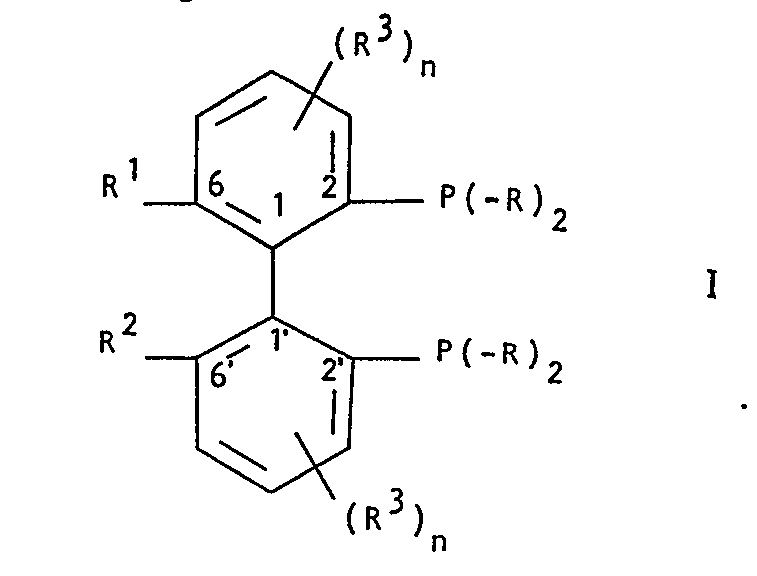
- the present invention relates to new chiral phosphorus compounds of the general formula present in (R) or (S) form wherein R is phenyl, R 1 and R 2 , which may be the same or different, hydrogen, lower alkyl, lower alkoxy, di-lower alkylamino, protected hydroxymethyl or R 1 and R 2 together the groups mean, where m is a number 3 to 5, R 4 is lower alkyl, phenyl or benzyl and R is lower alkyl or both R together are lower alkylene, R is methyl, lower alkoxy, di-lower alkylamino or fluorine and n is the number 0, 1, 2 or 3 mean.
- the invention further relates to the preparation of the phosphorus compounds of the formula I and their use for asymmetric hydrogenations or also for enantioselective hydrogen shifts in prochiral allylic systems.
- the phenyl and benzyl radicals mentioned can be both unsubstituted and also in the ortho, meta or para position or else multiply substituted.
- Lower alkyl or lower alkoxy groups preferably methyl or methoxy groups, or also di-lower alkylamino, preferably dimethylamino groups, and fluorine are suitable as substituents here.
- the term “lower alkyl” means straight-chain or branched alkyl groups having 1 to 4 carbon atoms, such as methyl, ethyl, propyl, isopropyl, n-butyl, isobutyl and tert. Butyl.
- lower alkoxy means groups in which the alkyl radical has the previous meaning.
- lower alkylene means di- or trimethylene.
- Protective groups for the hydroxymethyl group in the context of the present invention are in particular the usual ether-forming groups, such as Benzyl, methyl, tert. Butyl, methoxymethyl and the like, as well as ester-forming groups such as acetyl, benzoyl and the like.
- the term “leaving group” used in the following is understood to mean groups such as, for example, halogen, in particular chlorine and bromine, and also alkoxy groups such as methoxy and the like.
- Preferred phosphorus compounds of the above formula I are those in which R is unsubstituted or methyl or fluorine-substituted phenyl, R 1 and R 2 are the same and lower alkyl or together the group -CH 2 -O-CH 2 -, n the number 0 or 1 and R is methyl, fluorine or di-lower alkylamino. If n represents the number 1, the substituent R 3 is preferably in the m position to the phosphorus.
- the reaction of a compound of formula II with a compound of formula III can be carried out in a manner known per se.
- the reaction is conveniently carried out in an inert aprotic organic solvent such as an ether A such as diethyl ether, tetrahydrofuran, dimethoxyethane and the like.
- the reaction is also conveniently carried out at a temperature from about room temperature to about -120 ° C., preferably below about -60 ° C. and in particular below about -90 ° C.
- the pressure here is not a critical variable and the reaction can easily take place at atmospheric pressure.
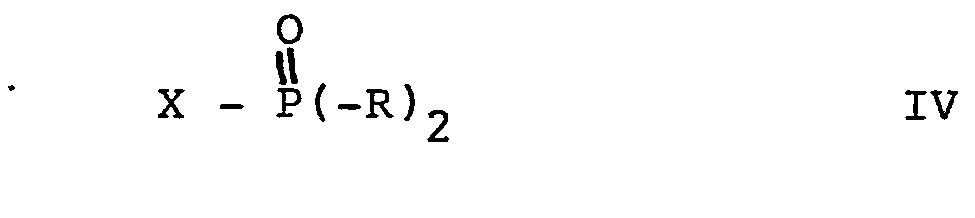
- reaction of a compound of formula II with a compound of formula IV can be carried out in an analogous manner to the reaction described above.
- the reduction of a compound of formula V can be carried out in a manner known per se.
- This reduction is expediently carried out using silanes such as Phenylsilanes, trichlorosilane, hexachlorodisilane and the like.
- Inert organic solvents such as e.g. aromatic hydrocarbons such as benzene, toluene and the like, halogenated hydrocarbons such as chloroform, dichloromethane or also acetonitrile and the like can be used.
- the reduction can also be carried out in the absence of solvents, e.g. in the case of using phenylsilanes.
- the reduction is expediently carried out at elevated temperature and preferably at the reflux temperature of the reaction mixture.
- the pressure is not a critical variable in this reaction, which can therefore be carried out easily at atmospheric pressure, but, if desired, even at elevated pressure.
- the cleavage of a compound of formula I can be carried out in a manner known per se. This is conveniently done e.g. by complex formation with di-u-chloro-bis - [(R) -2- (1-dimethylamino) ethyl) phenyl-C, N1-dipalladium (II) or with di- ⁇ -chloro-bis [(S) -2 - (1- (dimethylamino) ethyl) phenyl-C, N] -dipalladium (II), separation of the two diastereomeric complexes by fractional crystallization and: subsequent reductive release of the corresponding antipodes.
- the cleavage can also be carried out by salt formation with formaldehyde in the presence of an optically active acid, e.g. Camphorsulfonic acid, crystallization and subsequent release of the corresponding antipode with base.
- the compounds of the formulas III and IV used as starting material are known compounds or analogs of known compounds which can easily be prepared in a manner known per se.
- racemic compounds of the formula II are likewise known compounds or analogs of known compounds which can also be prepared in a manner known per se.
- the corresponding optically active compounds of the formula II are new and likewise form the subject of the present invention.
- the new, optically active compounds of the formula II can, for example, start from compounds of the general formula wherein R 1 , R2, R and n are as defined above.
- racemic compounds of the formula VI can be split into the optical antipodes in a manner known per se. This is done, for example, by salt formation with optically active acids such as tartaric acid and then separation by fractional crystallization.
- optically active compounds of the formula VI thus obtained can then, like the corresponding racemates, be converted into the corresponding racemic or optically active compounds of the formula II in a manner known per se.
- racemate resolution required for the preparation of optically active compounds of the formula II can also be carried out with compounds of the general formula wherein R 1 , R and Y have the meaning given above, in an analogous manner to the cleavage of compounds of the general formula VI.
- the amino groups can then, for example, be alkylated to give compounds of the formula VII, in which n is the number 1 and R 3 is di-lower alkylamino. They can also be diazotized and then reduced to compounds of the formula VII, in which n is the number 0, or they can be diazotized and then converted by the Schiemann method into compounds of the formula VII, in which n is the number 1 and R 3 is fluorine .
- A denotes oxygen, or , where R 4 and R 5 in turn have the above meaning.
- the phosphorus compounds of the formula I according to the invention form complexes with metals of group VIII, in particular with rhodium, iridium and cobalt, which can be used as catalysts in asymmetric hydrogenations and also for enantioselective hydrogen shifts in prochiral allylic systems. Rhodium is particularly preferred.
- These catalysts ie the complexes of a metal from Group VIII and the phosphorus compounds of the formula I are new and also a subject of the present invention.
- These catalysts can be prepared in a simple and known manner, for example by reacting a compound of formula I with a compound which can give off a Group VIII metal in a suitable inert organic or aqueous solvent. Compounds that can donate a Group VIII metal are known.
- Suitable compounds which give off rhodium are, for example, rhodium trichloride hydrate, rhodium tribromide hydrate, rhodium sulfate, or else organic rhodium complexes with ethylene, propylene and the like, and also with bis-olefins, for example 1,5-cyclooctadiene, 1,5-hexadiene , Bicyclo- [2.2.1] hepta-2,5-diene or with other dienes which form complexes which are readily soluble with rhodium.
- Preferred rhodium-releasing compounds are, for example, di-u-chloro-bis- [ ⁇ 4 -1,5-cyclooctadiene] dirhodium (I) or di-u-chloro-bis [ ⁇ 4 -norbornadiene] dirhodium (I).
- Examples of other suitable compounds which give off one of the other Group VIII metals are: iridium trichloride hydrate, di-u-chloro-bis- [ ⁇ 4 -1,5-cyclooctadiene] diiridium (I),
- Cobalt dichloride Cobalt (II) acetate or naphthenate, Cobalt (II) or cobalt (III) acetylacetonate and the like.
- the aforementioned complexes of phosphorus compounds of formula I and Group VIII metals, as mentioned, are useful as catalysts in asymmetric hydrogenations, e.g. in the asymmetric hydrogenation of compounds of the a- (acylamino) acrylic acid type, such as 2- (acetylamino) -3- (4-acetyloxy-3-methoxyphenyl) -2-propenoic acid.
- the catalysts mentioned can be used for enantioselective hydrogen shifts in prochiral allylic systems. They are particularly interesting, for example, in connection with the production of optically active compounds of the general formula wherein R is protected hydroxymethyl or a radical of the formula represents, in which the dashed line may represent an additional bond, and R 1 and R 2 represent lower alkyl (1-7 C atoms), starting from compounds of the general formula wherein R , R 1 and R 2 have the above meaning.
- the phosphorus compounds of the formula I as such in a solution of a compound to be treated, can be brought into contact with a compound which releases a metal from Group VIII.
- the phosphorus compounds of the formula I can first be reacted in a suitable solvent with a compound which gives off a metal of Group VIII to the corresponding catalyst complex and this can then be added to a solution of a compound to be treated, the latter method being preferred.
- Both the reaction of the phosphorus compounds of the formula I with a compound which releases a metal from Group VIII and the asymmetrical hydrogenations and hydrogen shifts mentioned can be carried out in suitable organic solvents which are inert under the reaction conditions.
- suitable organic solvents which are inert under the reaction conditions.
- lower alkanols such as e.g. Methanol or ethanol
- aromatic hydrocarbons such as benzene or toluene
- cyclic ethers such as tetrahydrofuran or dioxane
- esters such as e.g. Ethyl acetate or mixtures thereof and the like.
- the complex formation can also be carried out in an aqueous medium or in dichloromethane.
- the ratio between Group VIII metal and the ligands of the formula I is advantageously between about 0.05 and about 5 moles, preferably between about 0.5 and about 2 moles of metal per mole of the ligand of the formula I.
- the amount of metal in the complexes with the ligands of the formula I, based on the compounds to be treated, is advantageously between about 0.01 and about 2 mol%, preferably between about 0.05 and about 1 mol% and in particular between about 0.1 and about 0.5 mole%.
- the asymmetric hydrogenations using metal complexes with the ligands of the formula I can advantageously be carried out at temperatures from about 20 ° C. to about 100 ° C., preferably from about 40 ° C. to about 90 ° C. These hydrogenations are advantageously carried out under pressure, in particular under a pressure of about 1 to 100 bar, preferably 2 to 50 bar.
- the hydrogen shifts mentioned using metal complexes with the ligand of the formula I can expediently be carried out in an inert, organic solvent and at a temperature from about room temperature to about 130 ° C.
- This reaction preferably takes place at elevated temperature, i.e. depending on the solvent used, either at the reflux temperature of the reaction mixture or in a closed vessel under pressure.
- reaction solution was stirred for a further 20 minutes at about -100 ° C., during which it slowly became whitish.
- a solution of 880 mg (4 mmol) of chlorodiphenylphosphine in 5 ml of absolute diethyl ether was then added dropwise at about -90 ° to -100 ° C. in the course of 15 minutes.
- the reaction mixture was allowed to warm to room temperature over a period of 2 hours, with the precipitation of a white precipitate beginning at about -60 ° C., and stirring was continued for a further hour at room temperature.
- the mixture was mixed with argon with water and dichloromethane, the organic phase was separated off, washed with water and dried by filtration over Na 2 SO 4 .
- Diazonium salt solution was transferred to a dropping funnel and added dropwise to a hot (70-75 ° C. ) solution of 25 ml of a 2M copper (I) bromide solution in 48% aqueous hydrogen bromide solution within 15 minutes.
- the diazonium salt solution was kept at 0 ° C. by occasionally adding ice. After the dropping had ended, the mixture was boiled under reflux for a further 5 minutes. The cooled reaction solution was then extracted three times with 100 ml of ether each time. The combined organic extracts were washed twice with 50 ml of 2N HCl, twice with 50 ml of saturated NaHC03 solution and three times with 50 ml of water and then dried over Na 2 SO 4 .
- the product (6 g) obtained after filtration and evaporation consisted of an 8:23:59 mixture of 2-bromo-6,6'-dimethyl-biphenyl, 2-bromo-2'-hydroxy-6,6 'according to gas chromatography. -dimethyl-biphenyl and (RS) -2,2'-dibromo-6,6'-dimethyl-biphenyl.
- optically active (R) -2,21-dibromo-6,6'-dimethyl-biphenyl used as starting material was obtained in an analogous manner to Example 1 from (R) -6,6'-dimethyl-2,2'-biphenyl- diamine made.
- the (S) -2,2'-dibromo-6,6'-dimethyl-biphenyl used as the starting material was prepared in an analogous manner to Example 1 from (S) -6,6'-dimethyl-2,2'-biphenyldiamine.
Landscapes
- Chemical & Material Sciences (AREA)
- Organic Chemistry (AREA)
- Biochemistry (AREA)
- Health & Medical Sciences (AREA)
- General Health & Medical Sciences (AREA)
- Molecular Biology (AREA)
- Life Sciences & Earth Sciences (AREA)
- Inorganic Chemistry (AREA)
- Engineering & Computer Science (AREA)
- Materials Engineering (AREA)
- Chemical Kinetics & Catalysis (AREA)
- Organic Low-Molecular-Weight Compounds And Preparation Thereof (AREA)
- Catalysts (AREA)
Abstract

Description
- Die vorliegende Erfindung betrifft neue chirale, in (R)- oder (S)-Form vorliegende Phosphorverbindungen der allqemeinen Formel


- Die Erfindung betrifft ferner die Herstellung der Phosphorverbindungen der Formel I, sowie deren Verwendung für asymmetrische Hydrierungen oder auch für enantioselektive Wasserstoffverschiebungen in prochiralen allylischen Systemen.
- Die erwähnten Phenyl- und Benzylreste können, im Rahmen der vorliegenden Erfindung, sowohl unsubstituiert als auch in ortho, meta oder para Stellung oder auch mehrfach substituiert sein. Als Substituenten kommen hier in Frage niedere Alkyl- oder niedere Alkoxygruppen, vorzugsweise Methyl- oder Methoxygruppen, oder auch Di-niederes Alkylamino, vorzugsweise Dimethylaminogruppen, sowie Fluor. Der Ausdruck "niederes Alkyl" bedeutet, im Rahmen der vorliegenden Erfindung, geradkettige oder verzweigte Alkylgruppen mit 1 bis 4 Kohlenstoffatomen wie Methyl, Aethyl, Propyl, Isopropyl, n-Butyl, Isobutyl und tert. Butyl. Die Ausdrücke "niederes Alkoxy", "Di-niederes Alkylamino" und "niederes Alkoxycarbonyl" bedeuten Gruppen, in denen der Alkylrest die vorhergehende Bedeutung hat. Der Ausdruck "niederes Alkylen" bedeutet Di- oder Trimethylen. Als Schutzgruppen für die Hydroxymethylgruppe kommen im Rahmen der vorliegenden Erfindung insbesondere in Frage die üblichen, Aether-bildenden Gruppen wie z.B. Benzyl, Methyl, tert. Butyl, Methoxymethyl und dergleichen, sowie auch Ester-bildende Gruppen wie etwa Acetyl, Benzoyl und dergleichen.
- Unter dem im nachfolgenden verwendeten Ausdruck "austretende Gruppe" sind im Rahmen der vorliegenden Erfindung Gruppen zu verstehen wie zum Beispiel Halogen, insbesondere Chlor und Brom, sowie Alkoxygruppen wie Methoxy und dergleichen.
- Bevorzugte Phosphorverbindungen der obigen Formel I sind solche, worin R unsubstituiertes oder Methyl oder Fluor substituiertes Phenyl, R1 und R2 gleich sind und niederes Alkyl oder zusammen die Gruppe -CH2-O-CH2-, n die Zahl 0 oder 1 und R Methyl, Fluor oder Di-niederes Alkylamino bedeuten. Sofern n die Zahl 1 darstellt, befindet sich der Substituent R3 vorzugsweise in m-Stellung zum Phosphor.
- Als Beispiele von bevorzugten Verbindungen der Formel I können folgende genannt werden:
- (R)- oder (S)-(6,6'-Dimethyl-2,2'-biphenylylen)-bis-(diphenylphosphin),
- (R)- oder (S)-(4,4',6,6'-Tetramethyl-2,2'-biphenyl- ylen)-bis(diphenylphosphin),
- (R)- oder (S)-(3,3',6,6'-Tetramethyl-2,2'-biphenyl- ylen)-bis(diphenylphosphin),
- (R)- oder (S)-(4,4'-Bis(dimethylamino)-6,6'-dimethyl-2,2'-biphenylylen)-bis(diphenylphosphin),
- (R)- oder (S)-(4,4'-Difluor-6,6'-dimethyl-2,2'-biphenylylen)-bis(diphenylphosphin),
- (R)- oder (S)-(6,6'-Dimethyl-2,2'-biphenylylen)-bis-(di-p-tolylphosphin),
- (R)- oder (s)-(6,6'-Dimethyl-2,2'-biphenylylen)-bis-(di-o-tolylphosphin),
- (R)- oder (S)-(6,6'-Dimethyl-2,2'-biphenylylen)-bis-(di-m-fluorphenylphosphin),
- (R)- oder (S)-1,11-Bis(diphenylphosphino)-5,7-dihydro- dibenz[c,e]oxepin.
- Die erfindungsgemässen Verbindungen der Formel I können dadurch hergestellt werden, dass man
- a) eine racemische oder optisch aktive Verbindung der Formel


- b) eine racemische oder optisch aktive Verbindung der allgemeinen Formel II mit einer Verbindung der allgemeinen Formel


- Die Umsetzung einer Verbindung der Formel II mit einer Verbindung der Formel III kann in an sich bekannter Weise erfolgen. Die Umsetzung erfolgt zweckmässig in einem inerten, aprotischen organischen Lösungsmittel, wie z.B. einem Aether wie etwa Diäthyläther, Tetrahydrofuran, Dimethoxy- äthan und dergleichen. Die Reaktion erfolgt auch zweckmässig bei einer Temperatur von etwa Raumtemperatur bis etwa -120°C, vorzugsweise unterhalb etwa -60°C und insbesondere unterhalb etwa -90°C. Der Druck ist hierbei keine kritische Grösse und die Reaktion kann ohne weiteres bei Atmosphärendruck erfolgen.
- Die Umsetzung einer Verbindung der Formel II mit einer Verbindung der Formel IV kann in zur vorhergehend beschriebenen Umsetzung analoger Weise durchgeführt werden.
- Die Reduktion einer Verbindung der Formel V kann in an sich bekannter Weise durchgeführt werden. Zweckmässig erfolgt diese Reduktion mit Silanen wie z.B. Phenylsilane, Trichlorsilan, Hexachlordisilan und dergleichen. Als Lösungsmittel können inerte, organische Lösungsmittel wie z.B. aromatische Kohlenwasserstoffe, wie Benzol, Toluol und dergleichen, halogenierte Kohlenwasserstoffe wie etwa Chloroform, Dichlormethan oder auch Acetonitril und dergleichen verwendet werden. In gewissen Fällen kann die Reduktion auch in Abwesenheit von Lösungsmitteln durchgeführt werden, z.B. im Falle der Verwendung von Phenylsilanen. Die Reduktion erfolgt zweckmässig bei erhöhter Temperatur und vorzugsweise bei Rückflusstemperatur des Reaktionsgemisches. Der Druck ist keine kritische Grösse bei dieser Reaktion, welche somit ohne weiteres bei Atmosphärendruck aber, gewünschtenfalls, auch bei erhöhtem Druck durchgeführt werden kann.
- Die Spaltung einer Verbindung der Formel I kann in an sich bekannter Weise durchgeführt werden. Zweckmässig erfolgt dies z.B. durch Komplexbildung mit Di-u-chloro-bis-[(R)-2-(1-dimethylamino)äthyl)phenyl-C,N1-dipalladium(II) oder mit Di-µ-chloro-bis[(S)-2-(1-(dimethylamino)äthyl)-phenyl-C,N]-dipalladium(II), Trennung der beiden diastereomeren Komplexe durch fraktionierte Kristallisation und : anschliessende reduktive Freisetzung der entsprechenden Antipoden. Die Spaltung kann auch erfolgen durch Salzbildung mit Formaldehyd in Gegenwart einer optisch aktiven Säure, wie z.B. Camphersulfonsäure, Kristallisation und anschliessende Freisetzung des entsprechenden Antipoden mit Base.
- Die als Ausgangsmaterial verwendeten Verbindungen der Formeln III und IV sind bekannte Verbindungen oder Analoge bekannter Verbindungen, welche leicht in an sich bekannter Weise hergestellt werden können.
- Die racemischen Verbindungen der Formel II sind ebenfalls bekannte Verbindungen oder Analoge bekannter Verbindungen, welche ebenfalls in an sich bekannter Weise hergestellt werden können. Die entsprechenden optisch aktiven Verbindungen der Formel II sind jedoch neu und bilden ebenfalls Gegenstand der vorliegenden Erfindung.
- Die neuen, optisch aktiven Verbindungen der Formel II können z.B. ausgehend von Verbindungen der allgemeinen Formel

- Die racemischen Verbindungen der Formel VI können in an sich bekannter Weise in die optischen Antipoden aufgespalten werden. Dies erfolgt z.B. durch Salzbildung mit optisch aktiven Säuren wie etwa Weinsäure und anschliessend Trennung durch fraktionierte Kristallisation. Die so erhaltenen optisch aktiven Verbindungen der Formel VI können sodann, ebenso wie die entsprechenden Racemate, in an sich bekannter Weise in die entsprechenden racemischen oder optisch aktiven Verbindungen der Formel II übergeführt werden. Dies kann z.B. dadurch erfolgen, dass man eine racemische oder optisch aktive Verbindung der allgemeinen Formel VI mittels Diazotierung und Sandmeyer-Reaktion bzw. Umsetzung mit einem Alkalimetalljodid in eine Verbindung der allgemeinen Formel

- Die zur Herstellung von optisch aktiven Verbindungen der Formel II nötige Racematspaltung kann auch mit Verbindungen der allgemeinen Formel

- Die Verbindungen der Formel II, worin R 1 und R 2 geschütztes Hydroxymethyl oder zusammen die Gruppen


- In den Verbindungen der Formel XIII bedeutet A Sauerstoff,


- Die erfindungsgemässen Phosphorverbindungen der Formel I bilden Komplexe mit Metallen der Gruppe VIII, insbesondere mit Rhodium, Iridium und Cobalt, welche als Katalysatoren bei asymmetrischen Hydrierungen und auch für enantioselektive Wasserstoffverschiebungen in prochiralen allylischen Systemen verwendbar sind. Besonders bevorzugt ist Rhodium. Diese Katalysatoren, d.h. die Komplexe aus einem Metall der Gruppe VIII und den Phosphorverbindungen der Formel I sind neu und ebenfalls Gegenstand der vorliegenden Erfindung. Diese Katalysatoren können in einfacher und an sich bekannter Weise hergestellt werden, z.B. indem man eine Verbindung der Formel I mit einer Verbindung, welche ein Metall der Gruppe VIII abgeben kann, ineinem geeigneten inerten organischen oder wässrigen Lösungsmittel umsetzt. Verbindungen, welche ein Metall der Gruppe VIII abgeben können, sind bekannt. Als geeignete, z.B. Rhodium abgebende Verbindungen können beispielsweise genannt werden Rhodiumtrichlorid-Hydrat, Rhodiumtribromid-Hydrat, Rhodiumsulfat, oder auch organische Rhodiumkomplexe mit Aethylen, Propylen und dergleichen, sowie mit bis-Olefinen, z.B. 1,5-Cyclooctadien, 1,5-Hexadien, Bicyclo-[2.2.1]hepta-2,5-dien oder mit weiteren Dienen, welche mit Rhodium leicht lösliche Komplexe bilden. Bevorzugte, Rhodium abgebende Verbindungen sind z.B. Di-u-chloro-bis-[η4-1,5-cyclooctadien]dirhodium(I) oder auch Di-u-chloro- bis[η4-norbornadien]dirhodium(I).
- Als weitere geeignete, eines der anderen Metalle der Gruppe VIII abgebende Verbindungen können beispielsweise noch genannt werden: Iridiumtrichlorid-Hydrat, Di-u-chloro-bis-[η4-1,5-cyclooctadien]diiridium(I),
- Cobaltdichlorid, Cobalt(II)-acetat oder -naphthenat, Cobalt(II)- oder Cobalt(III)-acetylacetonat und dergleichen.
- Die vorhergehend erwähnten Komplexe aus Phosphorverbindungen der Formel I und Metallen der Gruppe VIII sind, wie erwähnt, verwendbar als Katalysatoren bei asymmetrischen Hydrierungen, z.B. bei der asymmetrischen Hydrierung von Verbindungen vom Typus der a-(Acylamino)-acrylsäuren, wie etwa 2-(Acetylamino)-3-(4-acetyloxy-3-methoxyphenyl)-2-propensäure.
- Weiterhin sind die erwähnten Katalysatoren verwendbar für enantioselektive Wasserstoffverschiebungen in prochiralen allylischen Systemen. Besonders interessant sind sie z.B. im Zusammenhang mit der Herstellung von optisch aktiven Verbindungen der allgemeinen Formel


- Die Verbindungen IX, bzw. die daraus durch Hydrolyse erhaltenen Aldehyde, sowie die von letzteren abgeleiteten Säuren und Alkohole sind z.B. von Interesse als Zwischenprodukte bei der Synthese der Seitenketten der Vitamine E und K 11
- Zur Durchführung der erwähnten asymmetrischen Hydrierungen, sowie der erwähnten Wasserstoffverschiebungen, können die Phosphorverbindungen der Formel I als solche, in einer Lösung einer zu behandelnden Verbindung, mit einer ein Metall der Gruppe VIII abgebenden Verbindung in Kontakt gebracht werden. Andererseits können die Phosphorverbindungen der Formel I zunächst in einem geeigneten Lösungsmittel mit einer ein Metall der Gruppe VIII abgebenden Verbindung zu dem entsprechenden Katalysator-Komplex umgesetzt werden und dieser dann zu einer Lösung einer zu behandelnden Verbindung gegeben werden, wobei die letztere Methode bevorzugt ist.
- Sowohl die Umsetzung der Phosphorverbindungen der Formel I mit einer ein Metall der Gruppe VIII abgebenden Verbindung wie auch die erwähnten asymmetrischen Hydrierungen und Wasserstoffverschiebungen können in geeigneten, unter den Reaktionsbedingungen inerten organischen Lösungsmitteln durchgeführt werden. Als solche können insbesondere genannt werden niedere Alkanole wie z.B. Methanol oder Aethanol, aromatische Kohlenwasserstoffe wie Benzol oder Toluol, cyclische Aether wie Tetrahydrofuran oder Dioxan, Ester wie z.B. Essigester oder auch Gemische hiervon und dergleichen. Weiterhin können die Komplexbildungen auch noch in wässrigem Medium oder in Dichlormethan durchgeführt werden.
- Das Verhältnis zwischen Metall der Gruppe VIII und den Liganden der Formel I liegt zweckmässig zwischen etwa 0,05 und etwa 5 Mol, vorzugsweise zwischen etwa 0,5 und etwa 2 Mol Metall pro Mol Ligand der Formel I.
- Die Menge an Metall, in den Komplexen mit den Liganden der Formel I, bezogen auf die zu behandelnden Verbindungen, liegt zweckmässig zwischen etwa 0,01 und etwa 2 Mol %, vorzugsweise zwischen etwa 0,05 und etwa 1 Mol % und insbesondere zwischen etwa 0,1 und etwa 0,5 Mol %.
- Die asymmetrischen Hydrierungen unter Verwendung von Metall-Komplexen mit den Liganden der Formel I können zweckmässig bei Temperaturen von etwa 20°C bis etwa 100°C, vorzugsweise von etwa 40°C bis etwa 90°C, durchgeführt werden. Diese Hydrierungen erfolgen zweckmässig unter Druck, insbesondere unter einem Druck von etwa 1 bis 100 bar, vorzugsweise 2 bis 50 bar.
- Die erwähnten Wasserstoffverschiebungen unter Verwendung von Metall-Komplexen mit dem Liganden der Formel I können zweckmässig in einem inerten, organischen Lösungsmittel und bei einer Temperatur von etwa Raumtemperatur bis etwa 130°C durchgeführt werden. Diese Reaktion erfolgt vorzugsweise bei erhöhter Temperatur, d.h. je nach verwendetem Lösungsmittel entweder bei Rückflusstemperatur des Reaktionsgemisches oder in einem geschlossenen Gefäss, unter Druck.
- In einem 100 ml Sulfierkolben, versehen mit Tropftrichter, Thermometer, Gummiseptum und Magnetrührer, wurden unter Argonbegasung 680 mg (2 mMol) (RS)-2,2'-Dibrom-6,6'-dimethyl-biphenyl vorgelegt und 20 ml absoluter Diäthyläther mittels einer Spritze injiziert. Die entstandene Lösung wurde auf ca. -90° bis -100°C gekühlt und bei dieser Temperatur tropfenweise mit 5,6 ml einer ca. 1,4M tert.-Butyllithiumlösung in Pentan (8 mMol) versetzt. Die Reaktionslösung wurde noch 20 Minuten bei ca. -100°C nachgerührt, wobei sie sich langsam weisslich trübte. Dann wurde eine Lösung von 880 mg (4 mMol) Chlordiphenylphosphin in 5 ml absolutem Diäthyläther innerhalb 15 Minuten bei ca. -90° bis -100°C eingetropft. Die Reaktionsmischung wurde während 2 Stunden auf Raumtemperatur erwärmen gelassen, wobei bei ca. -60°C die Ausfällung eines weissen Niederschlages einsetzte, und noch 1 Stunde bei Raumtemperatur nachgerührt. Zur Aufarbeitung wurde das Gemisch unter Argon mit Wasser und Dichlormethan versetzt, die organische Phase abgetrennt, mit Wasser gewaschen und durch Filtration über Na2S04 getrocknet. Der nach dem Eindampfen erhaltene kristalline Rückstand wurde aus Essigsäureäthylester umkristallisiert, und man erhielt 620 mg (RS)-(6,6'-Dimethyl-2,2'-biphenylylen)-bis(diphenylphosphin) als weisse Kristalle mit einem Schmelzpunkt von 242-243°C. Aus der Mutterlauge wurden nach Kristallisation aus Aethanol/ Toluol weitere 84 mg Produkt mit einem Schmelzpunkt von 240-242°C gewonnen; Gesamtausbeute 704 mg.
- Das als Augangsmaterial verwendete (RS)-2,2'-Dibrom-6,6'-dimethyl-biphenyl kann wie folgt hergestellt werden:
- Zu einer Lösung von 4,24 g (20 mMol) (RS)-6,6'-Dimethyl-2,2'-biphenyldiamin in 12 ml 48%iger wässriger Bromwasserstofflösung wurde bei -5 bis 0°C eine Lösung von 2,77 g (40,1 mMol) Natriumnitrit in 5 ml Wasser innerhalb von 2 Stunden zugetropft. Die eiskalte, dunkle
- Diazoniumsalzlösung wurde in einen Tropftrichter transferiert und innerhalb von 15 Minuten zu einer heissen (70-75°C) Lösung von 25 ml einer 2M Kupfer(I)bromid-Lösung in 48%iger wässriger Bromwasserstofflösung getropft. Die Diazoniumsalzlösung wurde dabei durch gelegentliches Zufügen von Eis bei 0°C gehalten. Nach beendigtem Zutropfen wurde noch 5 Minuten am Rückfluss gekocht. Die abgekühlte Reaktionslösung wurde dann dreimal mit je 100 ml Aether extrahiert. Die vereinigten organischen Extrakte wurden zweimal mit je 50 ml 2N HCl, zweimal mit je 50 ml gesättigter NaHC03-Lösung und dreimal mit je 50 ml Wasser gewaschen und dann über Na2SO4 getrocknet. Das nach Filtration und Eindampfen erhaltene Produkt (6 g) bestand gemäss Gaschromatographie aus einem 8:23:59-Gemisch von 2-Brom-6,6'-dimethyl-biphenyl, 2-Brom-2'-hydroxy-6,6'-dimethyl- biphenyl und (RS)-2,2'-Dibrom-6,6'-dimethyl-biphenyl. Chromatographie an Kieselgel (Hexan/Aether 9:1) lieferte 3,5 g eines 12:87-Gemisches von 2-Brom-6,6'-dimethyl-biphenyl und (RS)-6,6'-Dimethyl-2,2'-dibrom-biphenyl, aus welchem durch zweimaliges Umkristallisieren aus Pentan schliesslich 1,3 g reines (RS)-2,2'-Dibrom-6,6'-dimethyl- biphenyl erhalten wurden mit einem Schmelzpunkt von 111-112°C.
- In zum vorhergehenden analoger Weise wurden folgende Verbindungen hergestellt:
- (RS)-(4,4',6,6'-Tetramethyl-2,2'-biphenylylen)-bis-(diphenylphosphin). Smp. 249-251°C.
- (RS)-(4,4'-Bis(dimethylamino)-6,6'-dimethyl-2,2'-biphenylylen)-bis(diphenylphosphin). Smp. 217,5-219°C.
- Eine Suspension von 2,49 g (4,52 mMol) (RS)-(6,6'-Dimethyl-2,2'-biphenylylen)-bis(diphenylphosphin) und 1,31 g (2,26 mMol) Di-µ-chloro-bis[(R)-2-(1-(dimethylamino)-äthyl)phenyl-C,N3-dipalladium(II) in 100 ml Methanol wurde unter Argon bei Raumtemperatur gerührt, bis eine homogene Lösung entstanden war (ca. 4 Stunden). Dazu wurde eine Lösung von 0,95 g (9,04 mMol) Ammoniumtetrafluoroborat in 63 ml Wasser getropft, wobei nach Zugabe von ca. 20 ml die Ausfällung eines gelblichen Niederschlages einsetzte. Der entstandene Niederschlag wurde abfiltriert, mit Methanol/Wasser 1:1 gewaschen und bei 0,2 Torr über Phosphorpentoxid getrocknet, worauf 1,79 g gelbliche Kristalle erhalten wurden. Das Filtrat wurde mit 50 ml Wasser verdünnt und bis zur Koagulation der entstandenen Fällung gerührt (1 Stunde). Filtration und Trocknung lieferten weitere 1,84 g gelbliche Kristalle; Gesamtausbeute 3,63 g.
- Die vereinigten Kristallfraktionen wurden in 150 ml Dichlormethan/Diäthyläther 1:2 gelöst. Durch langsames Zutropfen von 50 ml Hexan wurde ein Niederschlag erhalten, wobei nach Filtration 1,5 g gelbliche Kristalle erhalten wurden. Dieses Material wurde noch zweimal aus 10 ml Dichlormethan durch portionenweises Zugeben von viermal 10 ml Diäthyläther umkristallisiert. Auf diese Weise wurden 1,07 g [(R)-2-(1-(Dimethylamino)äthyl)phenyl-C,N][(R)-6,6'-dimethyl-2,2'-biphenylylen)-bis(diphenylphosphin)]-palladium(II)-tetrafluoroborat mit einem Schmelzpunkt von 2l3-216°C erhalten; [α]20 D = +301,4° (c = 1% in CHC13).
- In eine Suspension von 42,6 mg (1,12 mMol) Lithiumaluminiumhydrid in 15 ml absolutem Tetrahydrofuran wurden bei Raumtemperatur 1 g (1,12 mMol) des vorhergehend hergestellten Tetrafluoroborates in kleinen Portionen innerhalb von 30 Minuten eingetragen. Die entstehende schwarze Reaktionsmischung wurde 1 Stunde nachgerührt. Danach wurde die Reaktion durch Zugabe von einigen Tropfen gesättigter NaCl-Lösung abgebrochen, das Gemisch mit Aktivkohle versetzt und über ein Bett von Na2SO4 und Celite filtriert, und viermal mit je 10 ml Tetrahydrofuran nachgewaschen. Der nach dem Eindampfen des Filtrates anfallende schwarzbraune Rückstand wurde in wenig Dichlormethan aufgenommen und über eine kurze Säule von Kieselgel mit Dichlormethan filtriert. Das gelbe Filtrat wurde eingedampft und der kristalline Rückstand wurde aus Aethanol/Toluol umkristallisiert. Man erhielt 121 mg (R)-(6,6'-Dimethyl-2,2'-biphenyl- ylen)-bis(diphenylphosphin) als weisse Kristalle mit einem Schmelzpunkt von 210-212,5°C; [α]20 D = -42,7° (c = 1% in CHCl3).
- In zu Beispiel 1 analoger Weise wurden 5,1 g (15 mMol) (R)-2,2'-Dibrom-6,6'-dimethyl-diphenyl (Smp. 107,5-109°C; optische Reinheit ca. 80%) mit tert.-Butyllithium und anschliessend mit Chlordiphenylphosphin umgesetzt. Das erhaltene Reaktionsgemisch wurde zur Aufarbeitung mit 80 ml Dichlormethan, 60 ml Tetrahydrofuran und 50 ml Wasser versetzt und kurz aufgewärmt, um allen Niederschlag in Lösung zu bringen. Die wässrige Phase wurde mittels einer Kanüle entfernt und die organische Phase noch zweimal mit je 50 ml Wasser gewaschen. Anschliessend wurde das Lösungsmittel abgedampft und der Rückstand aus 210 ml Essigsäureäthylester umkristallisiert. Nach 2 Tagen wurde von 1,62 g racemischem (RS)-(6,6'-Dimethyl-2,2'-biphenylylen)-bis(diphenylphosphin) abfiltriert. Das Filtrat wurde eingedampft und der Rückstand (7,9 g) wurde aus 50 ml Aethanol/25 ml Toluol umkristallisiert. Auf diese Weise wurden 3,43 g optisch aktives (R)-(6,6'-Dimethyl-2,2'-biphenylylen)-bis(diphenylphosphin) mit einem Schmelzpunkt von 212-213°C erhalten; [α]20 D = -42° (c = 1% in CHC13). Aus der Mutterlauge wurden weitere 0,61 g Produkt vom Schmelzpunkt 209-210,5°C gewonnen; [α]20 D = -39,9° (c = 1% in CHC13); Gesamtausbeute 4,04 g.
- Das als Ausgangsmaterial verwendete optisch aktive (R)-2,21-Dibrom-6,6'-dimethyl-biphenyl wurde in zu Beispiel 1 analoger Weise aus (R)-6,6'-Dimethyl-2,2'-biphenyl- diamin hergestellt.
- In zu Beispiel 3 analoger Weise wurden, ausgehend von 5,1 g (15 mMol) (S)-2,2'-Dibrom-6,6'-dimethyl-biphenyl (Smp. 108,5-109°C; [α]25 D = -11,7° (c = 1% in Aethanol); optische Reinheit ca. 90%), 4,25 g optisch aktives (S)-(6,6'-Dimethyl-2,2'-biphenylylen)-bis(diphenylphosphin) mit einem Schmelzpunkt von 212-213°C erhalten; [α]20 D = +41,7° (c = 1% in CHCl3). Aus der Mutterlauge wurden weitere 0,40 g Produkt mit einem Schmelzpunkt von 213-214°C erhalten; [α]20 D = +41,4° (c = 1% in CHC13). Gesamtausbeute 4,65 g.
- Das als Ausgangsmaterial verwendete (S)-2,2'-Dibrom-6,6'-dimethyl-biphenyl wurde in zu Beispiel 1 analoger Weise aus (S)-6,6'-Dimethyl-2,2'-biphenyldiamin hergestellt.
- In einem 0,5 1 Sulfierkolben, versehen mit Tropftrichter, Magnetrührer und Argonbegasung, wurden 11,0 g (20 mMol) (RS)-(4,4',6,6'-Tetramethyl-2,2'-biphenylylen)-bis(diphenylphosphin) (hergestellt in zu Beispiel 1 analoger Weise) und 5,80 g (10 mMol) Di-u-chloro-bis[(R)-2-(1-(dimethylamino)äthyl)phenyl-C,N]dipalladium(II) vorgelegt und mittels einer Injektionsspritze mit 200 ml deoxygeniertem Methanol versetzt. Die Suspension wurde über Nacht bei Raumtemperatur gerührt, wonach eine klare gelbe Lösung entstanden war. Dazu wurde nun innerhalb von 1 Stunde eine Lösung von 1,16 g (11 mMol) NH4BF4 in 50 ml deoxygeniertem H2O getropft, wobei nach Zugabe von ca. der Hälfte der Lösung die Ausfällung eines Niederschlages einsetzte. Nach einer zusätzlichen Rührdauer von 3 Stunden wurde filtriert, der Filterrückstand mit 20 ml Methanol/ H20 4:1 gewaschen und am Hochvakuum getrocknet, worauf 6,86 g [(R)-2-(1-Dimethylamino)äthyl)phenyl-C,N][(R)-(4,4',6,6'-tetramethyl-2,2'-biphenylylen)-bis(diphenyl- phosphin)]palladium(II)-tetrafluoroborat in Form eines gelblichen Pulvers erhalten wurden; Smp. 190-193°C (Zers.); [α]20 D +286,0° (c = 1,16% in CHCl3).
- Zum oben erhaltenen Filtrat wurde nochmals eine Lösung von 1,16 g (11 mMol) NH4BF4 in 50 ml H20 getropft, und das ausgefallene Kristallisat wurde nach einer Nachrührdauer von 1 Stunde abfiltriert, gewaschen mit 20 ml Methanol/H20 2:1 und am Hochvakuum getrocknet. Dabei wurden 9,6 g eines gelblichen Pulvers erhalten. Durch Behandeln des zweiten Filtrates mit 200 ml H20 wurden zusätzliche 0,92 g eines gelblichen Pulvers gewonnen. Die beiden letzteren Kristallfraktionen wurden vereinigt und umkristallisiert aus 40 ml CH2C12/100 ml Aether. Dabei wurden 5,54 g [(R)-2-(1-(Dimethylamino)äthyl)phenyl-C,N]-[(S)-(4,4',6,6'-tetramethyl-2,2'-biphenylylen)-bis-(diphenylphosphin)]palladium(II)-tetrafluoroborat als gelbliche Kristalle erhalten. Smp. 198-200°C (Zers.); [α]20 D -298° (c = 1,19% in CHCl3).
- Eine Lösung von 6,30 g (6,85 mMol) [(R)-2-(1-(Dimethylamino)äthyl)phenyl-C,N][(R)-(4,4',6,6'-tetramethyl-2,2'-biphenylylen)-bis(diphenylphosphin)]palladium-(II)-tetrafluoroborat in 85 ml Aceton wurde unter Argon gesetzt, dann mit 17 ml 10 M HC1 versetzt, erhitzt und 60 Minuten unter Rückfluss gekocht. Zu der noch warmen gelben Reaktionslösung wurden dann langsam unter gutem Rühren 300 ml H20 getropft. Die entstandene Suspension wurde noch 30 Minuten weitergerührt. Der Niederschlag wurde abfiltriert, zweimal mit H20 gewaschen und am Hochvakuum getrocknet, wobei 5,62 g rohes Dichloro-[(R)-(4,4',6,6'-tetramethyl-2,2'-biphenylylen)-bis(diphenylphosphin)]palladium(II) als gelbes Pulver erhalten wurden.
- Eine Lösung von 5,57 g dieser Substanz in 100 ml CH2Cl2 wurde mit 40 ml H20 versetzt, die Mischung wurde unter Argon gesetzt und dann mit 5,3 g (81 mMol) KCN in einer Portion versetzt. Das Zweiphasensystem wurde 30 Minuten kräftig durchgerührt, dann wurde die CH2C12-Phase abgetrennt und die wässrige Lösung noch einmal mit CH2Cl2 extrahiert. Die vereinigten organischen Phasen wurden gewaschen (H20, ges. NaCl-Lös.), getrocknet (Na2SO4), filtriert und eingedampft. Der gelbe, kristalline Rückstand wurde in 15 ml Toluol aufgenommen, und die Lösung wurde mit Aktivkohle behandelt, filtriert über Celite und wiederum eingedampft. Umkristallisation des Rückstandes aus Aethanol/Toluol lieferte 2,70 g (R)-(4,4',6,6'-Tetramethyl-2,2'-biphenylylen)-bis(diphenylphosphin) als weisse Kristalle vom Smp. 217-218°C; [α]20 D = -21,5° (c = 1,03% in CHC13). Aus der Mutterlauge wurden zusätzliche 0,5 g Substanz vom Smp. 215,5-218°C isoliert; die Gesamtausbeute beträgt somit 3,2 g.
- Die Freisetzung des entsprechenden (S)-(4,4',6,6'-Tetramethyl-2,2'-biphenylylen)-bis(diphenylphosphin) erfolgte in analoger Weise und man erhielt ein Produkt mit einem Smp. von 217,5-219°C. [a]20 D +21,4° (c = 1,11% in CHCl3).
- In zum vorhergehenden analoger Weise, jedoch unter Freisetzung der Phosphine mit LiAlH4, wie in Beispiel 2 beschrieben, wurden folgende Verbindungen hergestellt:
- (R)-(4,4'-Bis(dimethylamino)-6,6'-dimethyl-2,2'-bi- phenylylen)-bis(diphenylphosphin). Smp. 184-185°C; [α]20 D +25,4° (c = 1% in CHCl3).
- (S)-(4,4'-Bis(dimethylamino)-6,6'-dimethyl-2,2'-bi- phenylylen)-bis(diphenylphosphin). Smp. 184-185°C. [α]20 D -26,3° (c = 1% in CHCl3).
- In einem Schlenkrohr wurden 275 mg (0,5 mMol) (R)-(6,6'-Dimethyl-2,2'-biphenylylen)-bis(diphenylphosphin) und 115 mg (0,25 mMol) Di-µ-chloro-bis[η4-bicyclo[2.2.1]hepta-2,5-dien]-dirhodium(I) unter Argon vorgelegt und mit 4 ml deoxygeniertem Methanol versetzt. Die Reaktionsmischung wurde gerührt, bis eine homogene rote Lösung entstanden war (1,5 Stunden). Dazu wurde nun innerhalb von 45 Minuten eine Lösung von 61 mg (0,55 mMol) Natriumtetrafluoroborat in 1,1 ml deoxygeniertem Wasser getropft, wobei ein oranger Niederschlag ausfiel. Nach einer zusätzlichen Rührdauer von 1 Stunde wurde unter Argon filtriert, der Filterrückstand zweimal mit je 0,5 ml Wasser gewaschen und am Hochvakuum getrocknet. Es wurden 360 mg [η4-Bicyclo[2.2.1]-hepta-2,5-dien][(R)-(6,6'-dimethyl-2,2'-biphenylylen)-bis(diphenylphosphin)]rhodium(I)-tetrafluoroborat erhalten als orange Mikrokristalle mit [α]20 D = -35,9° (c = 0,445% in CHC13).
- In zum vorhergehenden analoger Weise wurden ausgehend von 1,10 g (2 mMol) (S)-(6,6'-Dimethyl-2,2'-biphenylylen)-bis(diphenylphosphin) 1,52 g [η4-Bicyclo[2.2.1]hepta-2,5-dien][(S)-(6,6'-dimethyl-2,2'-biphenylylen)-bis(di- phenylphosphin)]rhodium(I)-tetrafluoroborat erhalten; [α]20 D = +31,95° (c = 0,482% in CHCl3). Die Umkristallisation aus deoxygeniertem Methanol lieferte 1,11 g dieser Substanz als tiefrote Kristalle mit [α]20 D = +34° (c = 0,54% in CHCl3).
- In Analogie zu R.R. Schrock, et al., J.A.C.S., 93, 3089 (1971) wurden folgende Verbindungen hergestellt:
- [η4-1,5-Cyclooctadien][(R)-(6,6'-dimethyl-2,2'-bi- phenylylen)-bis(diphenylphosphin)]rhodium(I)-perchlorat. Bei Drehwertbestimmungen in CH2C12 wie auch in Acetonitril wurde Mutarotation beobachtet.
- [η4-1,5-Cyclooctadien][(S)-(6,6'-dimethyl-2,2'-bi- phenylylen)-bis(diphenylphosphin)]rhodium(I)-perchlorat. Bei der Drehwertbestimmung in CHC13 wurde Mutarotation beobachtet.
- [α]20 D (ca. 1 Min.) = +20,5° (c = 0,464% in CHC13)
- [α]20 D (ca. 5 Min.) = -26,9° (c = 0,464% in CHC13)
- In einem Pyrex-Bombenrohr wurden 1,14 g (5,0 mMol) (Z)-N,N-Diäthyl-3,7-dimethyl-2,6-octadienylamin, 5 ml Tetrahydrofuran und 16 mg (0,0192 mMol) [η4-Bicyclo[2.2.1]-hepta-2,5-dien][(R)-(6,6'-dimethyl-2,2'-biphenylylen)-bis(diphenylphosphin)]rhodium(I)-tetrafluoroborat unter Stickstoff vorgelegt. Nach Entgasung der Mischung wurde das Rohr zugeschmolzen und während 19 Stunden in einem Bombenrohrofen bei 85° bis 90°C erhitzt. Die bräunlichrote Reaktionsmischung wurde eingedampft und der Rückstand im Kugelrohr bei ca. 120°C/0,5 mmHg destilliert. Man erhielt 1,09 g (1E,3R)-N,N-Diäthyl-3,7-dimethyl-1,6-octa- dienylamin als farbloses Destillat.
- Das erhaltene farblose Destillat wurde anschliessend bei 0°C mit 8 ml 50%iger Essigsäure versetzt, die Mischung während 10 Minuten kräftig gerührt, mit Pentan überschichtet und noch 30 Minuten nachgerührt. Zur Aufarbeitung wurden die Phasen getrennt und die wässrige Phase noch zweimal mit Pentan extrahiert. Die vereinigten organischen Extrakte wurden je einmal mit 0,2N H2SO4, Wasser und gesättigter NaCl-Lösung gewaschen, über Na2S04 getrocknet, filtriert und eingedampft. Nach Kugelrohrdestillation des Rückstandes bei ca. 120°C/15 mmHg erhielt man 0,72 g (R)-Citronellal mit einer GC-Reinheit von 93,5%.
- Eine Probe dieses Materials wurde durch Chromatographie an Si02 (Hexan/4% Essigsäureäthylester) weiter gereinigt: [α]20 D +19,3° (c = 5% in CHCl3). Die enantiomere Reinheit (ee) wurde in Analogie zur Methode von D. Valentine, Jr., et al., in J. Org. Chem. 41, 62 (1976) durch Oxidation zur Säure, Amidbildung mit (R)-a-Methyl-4-nitrobenzylamin und Analyse der diastereomeren Amide mittels GC bzw. LC bestimmt. Dabei wurde ein RR/SR-Diastereomerenverhältnis von 99,2:0,8 bzw. 99,0:1,0 gefunden, woraus sich für die enantiomere Reinheit ein Wert von 98% ee ableitet.
- In zu Beispiel 8 analoger Weise wurde (Z)-N,N-Diäthyl-8,7-dimethyl-2,6-octadienylamin mit [η4-Bicyclo[2.2.1]-hepta-2,5-dien][(S)-(6,6'-dimethyl-2,2'-biphenylylen)-bis (diphenylphosphin)]rhodium(I)-tetrafluoroborat isomerisiert. Die Hydrolyse des erhaltenen Enamins zum (S)-Citronellal und die Bestimmung der enantiomeren Reinheit wurden ebenfalls in zu Beispiel 8 analoger Weise durchgeführt. Die enantiomere Reinheit betrug 99% ee.
- In zu Beispiel 8 analoger Weise wurde (E)-N,N-Diäthyl-4-benzyloxy-3-methyl-2-butenylamin mit [η4-1,5-Cyclooctadien][(S)-(6,6'-dimethyl-2,2'-biphenylylen)-bis(diphenyl- phosphin)]rhodium(I)-perchlorat zum (lE,3S)-N,N-Diäthyl-4-benzyloxy-3-methyl-l-butenylamin isomerisiert (Reaktionstemperatur 85°C) und dieses zum (S)-4-Benzyloxy-3-methyl- butanal hydrolysiert. Die enantiomere Reinheit wurde zu 98,8% ee ermittelt.
- In zu Beispiel 8 analoger Weise wurde (E)-N,N-Diäthyl-4-benzyloxy-3-methyl-2-butenylamin mit [η4-1,5-Cyclooctadien][(R)-(6,6'-dimethyl-2,2'-biphenylylen)-bis(diphenyl- phosphin)]rhodium(I)-perchlorat zum (lE,3R)-N,N-Diäthyl-4-benzyloxy-3-methyl-l-butenylamin isomerisiert (Reaktionstemperatur 75°C) und dieses zum (R)-4-Benzyloxy-3-methylbutanal hydrolysiert. Die enantiomere Reinheit wurde zu 99,2% ee ermittelt.
Claims (17)







Priority Applications (1)
| Application Number | Priority Date | Filing Date | Title |
|---|---|---|---|
| AT83107753T ATE22897T1 (de) | 1982-08-27 | 1983-08-06 | Neue, phosphorhaltige biphenylderivate und deren verwendung fuer asymmetrische hydrierungen und enantioselektive wasserstoffverschiebungen. |
Applications Claiming Priority (4)
| Application Number | Priority Date | Filing Date | Title |
|---|---|---|---|
| CH5109/82 | 1982-08-27 | ||
| CH510982 | 1982-08-27 | ||
| CH364183 | 1983-07-01 | ||
| CH3641/83 | 1983-07-01 |
Publications (2)
| Publication Number | Publication Date |
|---|---|
| EP0104375A1 true EP0104375A1 (de) | 1984-04-04 |
| EP0104375B1 EP0104375B1 (de) | 1986-10-15 |
Family
ID=25693506
Family Applications (1)
| Application Number | Title | Priority Date | Filing Date |
|---|---|---|---|
| EP83107753A Expired EP0104375B1 (de) | 1982-08-27 | 1983-08-06 | Neue, phosphorhaltige Biphenylderivate und deren Verwendung für asymmetrische Hydrierungen und enantioselektive Wasserstoffverschiebungen |
Country Status (4)
| Country | Link |
|---|---|
| US (1) | US4556740A (de) |
| EP (1) | EP0104375B1 (de) |
| DE (1) | DE3366931D1 (de) |
| DK (1) | DK350383A (de) |
Cited By (29)
| Publication number | Priority date | Publication date | Assignee | Title |
|---|---|---|---|---|
| EP0302021A3 (de) * | 1987-07-30 | 1990-01-24 | University Of British Columbia | Verfahren zur Herstellung von optisch aktiven sekundären Arylaminen |
| US4994615A (en) * | 1986-08-04 | 1991-02-19 | Ciba-Geigy Corporation | Process for the preparation of optically active secondary arylamines |
| EP0301457A3 (de) * | 1987-07-28 | 1991-03-06 | Ciba-Geigy Ag | Verfahren zur Herstellung von optisch aktiven sekundären Aminen |
| EP0398132A3 (de) * | 1989-05-18 | 1991-07-24 | F. Hoffmann-La Roche Ag | Phosphorverbindungen |
| EP0491240A1 (de) * | 1990-12-17 | 1992-06-24 | Hoechst Aktiengesellschaft | Verfahren zur Herstellung wasserlöslicher sulfonierter Diphosphane |
| WO1993015090A1 (de) * | 1992-01-31 | 1993-08-05 | F. Hoffmann-La Roche Ag | Diphosphinliganden |
| WO1993015089A1 (de) * | 1992-01-31 | 1993-08-05 | F. Hoffmann-La Roche Ag | Diphosphinliganden |
| US5274125A (en) * | 1991-03-15 | 1993-12-28 | Hoffmann-La Roche Inc. | Chirale phosphines |
| US5334766A (en) * | 1991-04-29 | 1994-08-02 | Hoffmann-La Roche Inc. | Process for the resolution of racemic diphosphine oxides |
| EP0614901A1 (de) * | 1993-03-12 | 1994-09-14 | Mitsubishi Gas Chemical Company, Inc. | Phosphin-verbindung und dasselbe Ligand enthaltende Übergangsmetall-Phosphin Komplex |
| EP0621075A3 (en) * | 1993-04-19 | 1994-11-09 | Kuraray Co | Novel rhodium-containing catalyst. |
| US5374727A (en) * | 1992-06-19 | 1994-12-20 | Hoffmann-La Roche Inc. | Asymmetric hydrogenation of dihydro-pyrido [1,2-a]indoles |
| EP0614903A3 (de) * | 1993-03-12 | 1995-01-11 | Takasago Perfumery Co Ltd | Phosphin-Verbindungen, diese Phosphin-Verbindungen als ligande enthaltende Komplexe, Verfahren zur Herstellung von optisch-aktiven Aldehyden durch Mittel der Phosphin-Verbindungen oder des Komplexes, und 4-(R/-1'-formylethyl Azetidin-2-One Derivate. |
| EP0643065A1 (de) * | 1993-09-10 | 1995-03-15 | Bayer Ag | Neue Bisphosphine für asymmetrische Hydrierkatalysatoren |
| US5481008A (en) * | 1993-09-13 | 1996-01-02 | Hoffmann-La Roche Inc. | Process for the preparation of optically active compounds |
| EP0749973A1 (de) * | 1995-06-20 | 1996-12-27 | Bayer Ag | Neue Bisphosphine als Katalysatoren für asymmetrische Reaktionen |
| EP0795559A1 (de) * | 1996-03-11 | 1997-09-17 | Hoechst Aktiengesellschaft | Substituierte Diphenyldiphosphane und ein Verfahren zu ihrer Herstellung |
| US5750690A (en) * | 1992-05-18 | 1998-05-12 | Hoffmann-La Roche Inc. | Asymmetric hydrogenation process using ruthenium-diphosphine complexe |
| EP0974590A1 (de) * | 1998-07-13 | 2000-01-26 | F. Hoffmann-La Roche Ag | Verfahren zur Herstellung chiraler Lactone durch asymetrische Hydrogenierung |
| EP1002801A1 (de) * | 1998-11-19 | 2000-05-24 | Solvias AG | Chirale Diphenyldiphosphine und d-8 Metall-Komplexe davon |
| US6222039B1 (en) | 1998-07-13 | 2001-04-24 | Hoffman-La Roche Inc. | Process for the preparation of chiral lactones |
| EP1186609A2 (de) | 2000-09-11 | 2002-03-13 | Bayer Ag | Diphosphine |
| WO2002055528A1 (de) * | 2001-01-10 | 2002-07-18 | Oxeno Olefinchemie Gmbh | Neue n-phenylpyrrolbisphosphanverbindungen und deren metallkomplexe |
| EP1341797A4 (de) * | 2000-11-17 | 2005-06-15 | Penn State Res Found | Orthosubstituierte chirale phosphine und phosphinite und deren verwendung in der asymmetrischen katalyse |
| WO2011018445A2 (en) | 2009-08-13 | 2011-02-17 | F. Hoffmann-La Roche Ag | Process for the preparation of (r)-2-phenyl propionic acid derivatives |
| WO2011023706A1 (en) | 2009-08-28 | 2011-03-03 | F. Hoffmann-La Roche Ag | Process for the preparation of a glucokinase activator compound |
| WO2011061439A1 (fr) | 2009-11-17 | 2011-05-26 | Universite De Strasbourg | Procede de phosphination catalytique |
| US8288541B2 (en) | 2007-08-13 | 2012-10-16 | Hoffmann-La Roche Inc. | Piperazine amide derivatives |
| US8344161B2 (en) | 2008-12-16 | 2013-01-01 | Hoffmann-La Roche Inc. | Process for the preparation of pyrollidine-3-carboxylic acids |
Families Citing this family (17)
| Publication number | Priority date | Publication date | Assignee | Title |
|---|---|---|---|---|
| DE3763681D1 (de) * | 1986-02-11 | 1990-08-23 | Ici Plc | Produktion von phosphiniten und phosphoniten. |
| FR2600330B1 (fr) * | 1986-06-23 | 1988-12-16 | Charbonnages Ste Chimique | Procede d'hydrogenation asymetrique de composes carbonyles et composes obtenus |
| US5026886A (en) * | 1988-01-25 | 1991-06-25 | Eastman Kodak Company | Preparation of bidentate ligands |
| ATE141278T1 (de) * | 1991-03-15 | 1996-08-15 | Hoffmann La Roche | Diphosphonsaurederivate als zwischenprodukte zur herstellung von diphosphinliganden |
| JPH0761955A (ja) * | 1993-08-23 | 1995-03-07 | Fuji Xerox Co Ltd | 新規なベンジジン誘導体およびその製造方法 |
| ES2130321T3 (es) * | 1993-10-08 | 1999-07-01 | Hoffmann La Roche | Compuestos de fosforo opticamente activos. |
| JP3441284B2 (ja) * | 1995-03-14 | 2003-08-25 | 高砂香料工業株式会社 | 光学活性アミンの製造方法 |
| JP3338243B2 (ja) * | 1995-07-21 | 2002-10-28 | 高砂香料工業株式会社 | 光学活性非対称ジホスフィン化合物及びその製造方法 |
| DE19630534C1 (de) * | 1996-07-29 | 1998-06-18 | Hoechst Ag | Alkylenglykolgruppen enthaltende tertiäre Phosphane |
| JP3493266B2 (ja) * | 1996-08-27 | 2004-02-03 | 高砂香料工業株式会社 | 新規な光学活性ジホスフィン化合物、該化合物を製造す る方法、該化合物を配位子とする遷移金属錯体並びに該 錯体を用いた光学活性体の製造方法 |
| CA2240107C (en) * | 1997-07-02 | 2008-04-15 | F. Hoffmann-La Roche Ag | Novel diphenylarsines |
| DE10027154A1 (de) | 2000-05-31 | 2001-12-13 | Bayer Ag | Verfahren zur Herstellung optisch aktiver Trimethylmilchsäure und ihrer Ester |
| DE10056310A1 (de) | 2000-11-14 | 2002-05-16 | Bayer Ag | Verbessertes Verfahren zur Herstellung von enantiomerenreinen(5,5`-Dichlor-6,6`-dimethoxybiphenyl-2,2`-diyl)-bis-(diphenylphosphinoxiden) |
| CA2521635A1 (en) * | 2003-04-07 | 2004-10-21 | Solvias Ag | Amine-substituted diphenyldiphosphines and the use thereof in metal complexes for asymmetric syntheses |
| DE10342672A1 (de) * | 2003-09-16 | 2005-04-21 | Bayer Chemicals Ag | Chirale Phosphane zur Verwendung in asymmetrischen Synthesen |
| DE102005005946A1 (de) * | 2005-02-10 | 2006-08-17 | Basf Ag | Verfahren zur Herstellung tertiärer Phosphine |
| ATE453622T1 (de) * | 2006-04-03 | 2010-01-15 | Hoffmann La Roche | Verfahren zur herstellung von enantiomeren angereicherten cyclischen beta-aryl- oder heteroarylcarbonsäuren |
Citations (4)
| Publication number | Priority date | Publication date | Assignee | Title |
|---|---|---|---|---|
| DE1235913B (de) * | 1965-07-21 | 1967-03-09 | Technochemie G M B H Verfahren | Verfahren zur Herstellung von sechsbindigen Phosphorverbindungen |
| EP0000403A1 (de) * | 1977-07-18 | 1979-01-24 | F. HOFFMANN-LA ROCHE & CO. Aktiengesellschaft | Bis-phosphin-Metallkomplexe, Verfahren zu ihrer Herstellung, Hydrierungskatalysatoren aus diesen Komplexen und Hydrierungsverfahren unter Verwendung dieser Katalysatoren |
| US4174447A (en) * | 1975-02-26 | 1979-11-13 | Standard Oil Company (Indiana) | Process for dimerization, arylation and trifluoromethylation of aromatic and heterocyclic compounds |
| EP0043382A1 (de) * | 1979-06-27 | 1982-01-13 | E.I. Du Pont De Nemours And Company | Herstellung von Isobuttersäure und deren Estern |
Family Cites Families (4)
| Publication number | Priority date | Publication date | Assignee | Title |
|---|---|---|---|---|
| US3064055A (en) * | 1962-04-19 | 1962-11-13 | David L Herring | Preparation of 1, 4-bis(diphenylphosphino) benzene |
| FR2116905A5 (fr) * | 1970-12-10 | 1972-07-21 | Inst Francais Du Petrole | Nouveaux coordinats bidentes,leur fabrication et leurs applications |
| US4123465A (en) * | 1975-10-16 | 1978-10-31 | Hoffmann-La Roche Inc. | Chiral tertiary phosphines |
| DE3000445C2 (de) * | 1980-01-08 | 1982-12-02 | Degussa Ag, 6000 Frankfurt | Rhodiumkomplexe und deren Verwendung |
-
1983
- 1983-07-29 DK DK350383A patent/DK350383A/da unknown
- 1983-08-06 EP EP83107753A patent/EP0104375B1/de not_active Expired
- 1983-08-06 DE DE8383107753T patent/DE3366931D1/de not_active Expired
- 1983-08-19 US US06/524,714 patent/US4556740A/en not_active Expired - Fee Related
Patent Citations (4)
| Publication number | Priority date | Publication date | Assignee | Title |
|---|---|---|---|---|
| DE1235913B (de) * | 1965-07-21 | 1967-03-09 | Technochemie G M B H Verfahren | Verfahren zur Herstellung von sechsbindigen Phosphorverbindungen |
| US4174447A (en) * | 1975-02-26 | 1979-11-13 | Standard Oil Company (Indiana) | Process for dimerization, arylation and trifluoromethylation of aromatic and heterocyclic compounds |
| EP0000403A1 (de) * | 1977-07-18 | 1979-01-24 | F. HOFFMANN-LA ROCHE & CO. Aktiengesellschaft | Bis-phosphin-Metallkomplexe, Verfahren zu ihrer Herstellung, Hydrierungskatalysatoren aus diesen Komplexen und Hydrierungsverfahren unter Verwendung dieser Katalysatoren |
| EP0043382A1 (de) * | 1979-06-27 | 1982-01-13 | E.I. Du Pont De Nemours And Company | Herstellung von Isobuttersäure und deren Estern |
Non-Patent Citations (2)
| Title |
|---|
| Patent Abstracts of Japan Band 4, Nr. 98, 15. Juli 1980 Seite 115C18 & JP-A-55 061937 * |
| Patent Abstracts of Japan Band 5, Nr. 75, 19. Mai 1981 & JP-A-56 025122 * |
Cited By (48)
| Publication number | Priority date | Publication date | Assignee | Title |
|---|---|---|---|---|
| US4994615A (en) * | 1986-08-04 | 1991-02-19 | Ciba-Geigy Corporation | Process for the preparation of optically active secondary arylamines |
| EP0256982B1 (de) * | 1986-08-04 | 1991-08-28 | Ciba-Geigy Ag | Verfahren zur Herstellung von optisch aktiven sekundären Arylaminen |
| EP0301457A3 (de) * | 1987-07-28 | 1991-03-06 | Ciba-Geigy Ag | Verfahren zur Herstellung von optisch aktiven sekundären Aminen |
| US5011995A (en) * | 1987-07-28 | 1991-04-30 | Ciba-Geigy Corporation | Process for the preparation of optically active secondary amines |
| US4996361A (en) * | 1987-07-30 | 1991-02-26 | The University Of British Columbia | Process for the preparation of optically active secondary arylamines |
| EP0302021A3 (de) * | 1987-07-30 | 1990-01-24 | University Of British Columbia | Verfahren zur Herstellung von optisch aktiven sekundären Arylaminen |
| EP0398132A3 (de) * | 1989-05-18 | 1991-07-24 | F. Hoffmann-La Roche Ag | Phosphorverbindungen |
| EP0491240A1 (de) * | 1990-12-17 | 1992-06-24 | Hoechst Aktiengesellschaft | Verfahren zur Herstellung wasserlöslicher sulfonierter Diphosphane |
| JPH04290889A (ja) * | 1990-12-17 | 1992-10-15 | Hoechst Ag | 水溶性ジホスフィンの製造方法 |
| US5274125A (en) * | 1991-03-15 | 1993-12-28 | Hoffmann-La Roche Inc. | Chirale phosphines |
| US5334766A (en) * | 1991-04-29 | 1994-08-02 | Hoffmann-La Roche Inc. | Process for the resolution of racemic diphosphine oxides |
| US5508438A (en) * | 1992-01-31 | 1996-04-16 | Hoffmann-La Roche Inc. | Phosphorus compounds |
| US5430191A (en) * | 1992-01-31 | 1995-07-04 | Hoffmann-La Roche Inc. | Phosphorus compounds |
| WO1993015089A1 (de) * | 1992-01-31 | 1993-08-05 | F. Hoffmann-La Roche Ag | Diphosphinliganden |
| WO1993015090A1 (de) * | 1992-01-31 | 1993-08-05 | F. Hoffmann-La Roche Ag | Diphosphinliganden |
| WO1993015091A1 (de) * | 1992-01-31 | 1993-08-05 | F. Hoffmann-La Roche Ag | Disphosphinliganden |
| US5457219A (en) * | 1992-01-31 | 1995-10-10 | Hoffmann-La Roche Inc. | Phosphorus compounds |
| US5750690A (en) * | 1992-05-18 | 1998-05-12 | Hoffmann-La Roche Inc. | Asymmetric hydrogenation process using ruthenium-diphosphine complexe |
| US5374727A (en) * | 1992-06-19 | 1994-12-20 | Hoffmann-La Roche Inc. | Asymmetric hydrogenation of dihydro-pyrido [1,2-a]indoles |
| EP0614903A3 (de) * | 1993-03-12 | 1995-01-11 | Takasago Perfumery Co Ltd | Phosphin-Verbindungen, diese Phosphin-Verbindungen als ligande enthaltende Komplexe, Verfahren zur Herstellung von optisch-aktiven Aldehyden durch Mittel der Phosphin-Verbindungen oder des Komplexes, und 4-(R/-1'-formylethyl Azetidin-2-One Derivate. |
| EP0684249A1 (de) * | 1993-03-12 | 1995-11-29 | Takasago International Corporation | Phosphin-Verbindungen, diese Phosphin-Verbindungen als ligande enthaltende Komplexe, Verfahren zur Herstellung von optisch-aktiven Aldehyden durch Mittel der Phosphin-Verbindungen oder des Komplexes |
| EP0614901A1 (de) * | 1993-03-12 | 1994-09-14 | Mitsubishi Gas Chemical Company, Inc. | Phosphin-verbindung und dasselbe Ligand enthaltende Übergangsmetall-Phosphin Komplex |
| US5434311A (en) * | 1993-04-19 | 1995-07-18 | Kuraray Co., Ltd. | Rhodium-containing catalyst |
| EP0621075A3 (en) * | 1993-04-19 | 1994-11-09 | Kuraray Co | Novel rhodium-containing catalyst. |
| EP0643065A1 (de) * | 1993-09-10 | 1995-03-15 | Bayer Ag | Neue Bisphosphine für asymmetrische Hydrierkatalysatoren |
| US5510503A (en) * | 1993-09-10 | 1996-04-23 | Bayer Aktiengesellschaft | Bisphosphines for asymmetric hydrogenation catalysts |
| US5481008A (en) * | 1993-09-13 | 1996-01-02 | Hoffmann-La Roche Inc. | Process for the preparation of optically active compounds |
| EP0749973A1 (de) * | 1995-06-20 | 1996-12-27 | Bayer Ag | Neue Bisphosphine als Katalysatoren für asymmetrische Reaktionen |
| US5801261A (en) * | 1995-06-20 | 1998-09-01 | Bayer Aktiengesellschaft | Bisphosphines as catalysts for asymmetric reactions |
| US5710339A (en) * | 1995-06-20 | 1998-01-20 | Bayer Aktiengesellschaft | Bisphosphines as catalysts for asymmetric reactions |
| US5801287A (en) * | 1996-03-11 | 1998-09-01 | Regnat; Dieter | Substituted diphenyldiphosphines and a process for their preparation |
| US5972825A (en) * | 1996-03-11 | 1999-10-26 | Celanese Gmbh | Substituted diphenyldiphosphines and a process for their preparation |
| EP0795559A1 (de) * | 1996-03-11 | 1997-09-17 | Hoechst Aktiengesellschaft | Substituierte Diphenyldiphosphane und ein Verfahren zu ihrer Herstellung |
| EP0974590A1 (de) * | 1998-07-13 | 2000-01-26 | F. Hoffmann-La Roche Ag | Verfahren zur Herstellung chiraler Lactone durch asymetrische Hydrogenierung |
| US6222039B1 (en) | 1998-07-13 | 2001-04-24 | Hoffman-La Roche Inc. | Process for the preparation of chiral lactones |
| US6277997B1 (en) | 1998-07-13 | 2001-08-21 | Hoffmann-La Roche Inc. | Process for the preparation of chiral lactones |
| EP1002801A1 (de) * | 1998-11-19 | 2000-05-24 | Solvias AG | Chirale Diphenyldiphosphine und d-8 Metall-Komplexe davon |
| US6281390B1 (en) | 1998-11-19 | 2001-08-28 | Solvias Ag | Chiral diphenyldiphosphines and d-8 metal complexes thereof |
| US6515183B2 (en) | 1998-11-19 | 2003-02-04 | Solvias Ag | Chiral diphenyldiphosphines and d-8 metal complexes thereof |
| EP1186609A2 (de) | 2000-09-11 | 2002-03-13 | Bayer Ag | Diphosphine |
| EP1341797A4 (de) * | 2000-11-17 | 2005-06-15 | Penn State Res Found | Orthosubstituierte chirale phosphine und phosphinite und deren verwendung in der asymmetrischen katalyse |
| WO2002055528A1 (de) * | 2001-01-10 | 2002-07-18 | Oxeno Olefinchemie Gmbh | Neue n-phenylpyrrolbisphosphanverbindungen und deren metallkomplexe |
| US7109346B2 (en) | 2001-01-10 | 2006-09-19 | Oxeno Olefinchemie Gmbh & Co. Kg | N-phenyl-pyrrol bisphosphane compounds and the metal complexes of the same |
| US8288541B2 (en) | 2007-08-13 | 2012-10-16 | Hoffmann-La Roche Inc. | Piperazine amide derivatives |
| US8344161B2 (en) | 2008-12-16 | 2013-01-01 | Hoffmann-La Roche Inc. | Process for the preparation of pyrollidine-3-carboxylic acids |
| WO2011018445A2 (en) | 2009-08-13 | 2011-02-17 | F. Hoffmann-La Roche Ag | Process for the preparation of (r)-2-phenyl propionic acid derivatives |
| WO2011023706A1 (en) | 2009-08-28 | 2011-03-03 | F. Hoffmann-La Roche Ag | Process for the preparation of a glucokinase activator compound |
| WO2011061439A1 (fr) | 2009-11-17 | 2011-05-26 | Universite De Strasbourg | Procede de phosphination catalytique |
Also Published As
| Publication number | Publication date |
|---|---|
| DE3366931D1 (en) | 1986-11-20 |
| DK350383A (da) | 1984-02-28 |
| DK350383D0 (da) | 1983-07-29 |
| US4556740A (en) | 1985-12-03 |
| EP0104375B1 (de) | 1986-10-15 |
Similar Documents
| Publication | Publication Date | Title |
|---|---|---|
| EP0104375B1 (de) | Neue, phosphorhaltige Biphenylderivate und deren Verwendung für asymmetrische Hydrierungen und enantioselektive Wasserstoffverschiebungen | |
| EP0398132B1 (de) | Phosphorverbindungen | |
| EP0643065B1 (de) | Neue Bisphosphine für asymmetrische Hydrierkatalysatoren | |
| DE2463010C2 (de) | Optisch aktive Katalysatoren und deren Verwendung | |
| EP0582692B1 (de) | Diphosphinliganden | |
| EP0579797B1 (de) | Diphosphinliganden | |
| EP2459579A2 (de) | Imidazolgruppenhaltige phosphinoboran-verbindungen und verfahren zur herstellung von imidazolgruppenhaltige phosphorverbindungen | |
| DE69114986T2 (de) | Eine Phosphino-Binapthyl-Verbindung und Übergangsmetall-Komplexe davon. | |
| EP0749973B1 (de) | Neue Bisphosphine als Katalysatoren für asymmetrische Reaktionen | |
| EP0530336B1 (de) | Chirale phosphine | |
| DE3874627T2 (de) | Herstellungsverfahren eines optisch aktiven alkohols. | |
| EP0138141A1 (de) | Verfahren zur selektiven Hydrierung von C-C-Doppelbindungen in Gegenwart von reduzierbaren, stickstoffhaltigen Gruppen | |
| DE69223240T2 (de) | Chirale dreizahnige bis-phospholan-liganden | |
| DE69521605T2 (de) | Optisch aktive diphosphine und herstellungsverfahren durch auftrennung der racematmischung | |
| DE68904558T2 (de) | Verfahren zu herstellung von bidentatliganden. | |
| EP1200452B1 (de) | Neue chirale phosphorliganden und ihre verwendung in der herstellung optisch aktiver produkte | |
| EP0104376B1 (de) | Verfahren zur Herstellung von optisch aktiven Aminen und Enaminen | |
| EP0251994A1 (de) | Optisch aktive Styrolderivate, Polymere daraus, Komplexe mit Iridium (I) und deren Verwendung | |
| EP1186609B1 (de) | Diphosphine | |
| EP0031877A1 (de) | Optisch aktive 1,2-Bis(diphenylphosphino)-verbindungen, diese als chirale Liganden enthaltende Metallkomplexe und deren Verwendung | |
| EP0397042B1 (de) | Herstellung von Isochinolinderivaten | |
| EP1409493B1 (de) | Verfahren zur herstellung von nicht-chiralen und optisch aktiven hydroxygruppen enthaltenden organischen verbindungen | |
| EP1636243B1 (de) | Chirale liganden zur anwendung in asymmetrischen synthesen | |
| WO2004031110A2 (de) | Isomerisierung von chiral einheitlichen o,o'-dihydroxy-biphenylderivaten | |
| DE2210938A1 (de) | Verfahren zur Herstellung von 3(3,4-Dihydroxyphenyl)-L-alanin |
Legal Events
| Date | Code | Title | Description |
|---|---|---|---|
| PUAI | Public reference made under article 153(3) epc to a published international application that has entered the european phase |
Free format text: ORIGINAL CODE: 0009012 |
|
| 17P | Request for examination filed |
Effective date: 19830806 |
|
| AK | Designated contracting states |
Designated state(s): AT BE CH DE FR GB IT LI NL |
|
| GRAA | (expected) grant |
Free format text: ORIGINAL CODE: 0009210 |
|
| AK | Designated contracting states |
Kind code of ref document: B1 Designated state(s): AT BE CH DE FR GB IT LI NL |
|
| REF | Corresponds to: |
Ref document number: 22897 Country of ref document: AT Date of ref document: 19861115 Kind code of ref document: T |
|
| ITF | It: translation for a ep patent filed | ||
| REF | Corresponds to: |
Ref document number: 3366931 Country of ref document: DE Date of ref document: 19861120 |
|
| ET | Fr: translation filed | ||
| PLBE | No opposition filed within time limit |
Free format text: ORIGINAL CODE: 0009261 |
|
| STAA | Information on the status of an ep patent application or granted ep patent |
Free format text: STATUS: NO OPPOSITION FILED WITHIN TIME LIMIT |
|
| 26N | No opposition filed | ||
| ITPR | It: changes in ownership of a european patent |
Owner name: CESSIONE;F. HOFFMANN - LA ROCHE AG |
|
| NLS | Nl: assignments of ep-patents |
Owner name: F. HOFFMANN-LA ROCHE AG TE BAZEL, ZWITSERLAND. |
|
| REG | Reference to a national code |
Ref country code: FR Ref legal event code: TP |
|
| REG | Reference to a national code |
Ref country code: CH Ref legal event code: PUE Owner name: F. HOFFMANN-LA ROCHE AG |
|
| REG | Reference to a national code |
Ref country code: GB Ref legal event code: 732 |
|
| ITTA | It: last paid annual fee | ||
| PGFP | Annual fee paid to national office [announced via postgrant information from national office to epo] |
Ref country code: GB Payment date: 19920715 Year of fee payment: 10 |
|
| PGFP | Annual fee paid to national office [announced via postgrant information from national office to epo] |
Ref country code: BE Payment date: 19920731 Year of fee payment: 10 |
|
| PGFP | Annual fee paid to national office [announced via postgrant information from national office to epo] |
Ref country code: DE Payment date: 19920810 Year of fee payment: 10 |
|
| PGFP | Annual fee paid to national office [announced via postgrant information from national office to epo] |
Ref country code: FR Payment date: 19920813 Year of fee payment: 10 |
|
| PGFP | Annual fee paid to national office [announced via postgrant information from national office to epo] |
Ref country code: CH Payment date: 19920828 Year of fee payment: 10 |
|
| PGFP | Annual fee paid to national office [announced via postgrant information from national office to epo] |
Ref country code: NL Payment date: 19920831 Year of fee payment: 10 Ref country code: AT Payment date: 19920831 Year of fee payment: 10 |
|
| PG25 | Lapsed in a contracting state [announced via postgrant information from national office to epo] |
Ref country code: GB Effective date: 19930806 Ref country code: AT Effective date: 19930806 |
|
| PG25 | Lapsed in a contracting state [announced via postgrant information from national office to epo] |
Ref country code: LI Effective date: 19930831 Ref country code: CH Effective date: 19930831 Ref country code: BE Effective date: 19930831 |
|
| BERE | Be: lapsed |
Owner name: F. HOFFMANN-LA ROCHE A.G. Effective date: 19930831 |
|
| PG25 | Lapsed in a contracting state [announced via postgrant information from national office to epo] |
Ref country code: NL Effective date: 19940301 |
|
| GBPC | Gb: european patent ceased through non-payment of renewal fee |
Effective date: 19930806 |
|
| NLV4 | Nl: lapsed or anulled due to non-payment of the annual fee | ||
| PG25 | Lapsed in a contracting state [announced via postgrant information from national office to epo] |
Ref country code: FR Effective date: 19940429 |
|
| REG | Reference to a national code |
Ref country code: CH Ref legal event code: PL |
|
| PG25 | Lapsed in a contracting state [announced via postgrant information from national office to epo] |
Ref country code: DE Effective date: 19940503 |
|
| REG | Reference to a national code |
Ref country code: FR Ref legal event code: ST |