EP0643065A1 - Neue Bisphosphine für asymmetrische Hydrierkatalysatoren - Google Patents
Neue Bisphosphine für asymmetrische Hydrierkatalysatoren Download PDFInfo
- Publication number
- EP0643065A1 EP0643065A1 EP94113441A EP94113441A EP0643065A1 EP 0643065 A1 EP0643065 A1 EP 0643065A1 EP 94113441 A EP94113441 A EP 94113441A EP 94113441 A EP94113441 A EP 94113441A EP 0643065 A1 EP0643065 A1 EP 0643065A1
- Authority
- EP
- European Patent Office
- Prior art keywords
- general formula
- bisphosphines
- complexes
- compounds
- formula
- Prior art date
- Legal status (The legal status is an assumption and is not a legal conclusion. Google has not performed a legal analysis and makes no representation as to the accuracy of the status listed.)
- Granted
Links
- 239000003054 catalyst Substances 0.000 title abstract description 14
- 238000005984 hydrogenation reaction Methods 0.000 title description 14
- 238000000034 method Methods 0.000 claims abstract description 16
- 229910052751 metal Inorganic materials 0.000 claims abstract description 14
- 239000002184 metal Substances 0.000 claims abstract description 14
- 238000009876 asymmetric hydrogenation reaction Methods 0.000 claims abstract description 11
- 230000008569 process Effects 0.000 claims abstract description 10
- 238000002360 preparation method Methods 0.000 claims abstract description 5
- 150000001875 compounds Chemical class 0.000 claims description 27
- 239000001257 hydrogen Substances 0.000 claims description 20
- 229910052739 hydrogen Inorganic materials 0.000 claims description 20
- 125000000217 alkyl group Chemical group 0.000 claims description 13
- 125000004432 carbon atom Chemical group C* 0.000 claims description 11
- 229910052801 chlorine Inorganic materials 0.000 claims description 9
- 239000000460 chlorine Substances 0.000 claims description 9
- 229910052736 halogen Inorganic materials 0.000 claims description 9
- 150000002367 halogens Chemical class 0.000 claims description 9
- 229910052741 iridium Inorganic materials 0.000 claims description 8
- 229910052703 rhodium Inorganic materials 0.000 claims description 8
- WKBOTKDWSSQWDR-UHFFFAOYSA-N Bromine atom Chemical compound [Br] WKBOTKDWSSQWDR-UHFFFAOYSA-N 0.000 claims description 7
- 229910052707 ruthenium Inorganic materials 0.000 claims description 7
- KJTLSVCANCCWHF-UHFFFAOYSA-N Ruthenium Chemical compound [Ru] KJTLSVCANCCWHF-UHFFFAOYSA-N 0.000 claims description 6
- 229910052794 bromium Inorganic materials 0.000 claims description 6
- 239000002253 acid Substances 0.000 claims description 5
- 150000001298 alcohols Chemical class 0.000 claims description 5
- 150000002739 metals Chemical class 0.000 claims description 5
- ZCYVEMRRCGMTRW-UHFFFAOYSA-N 7553-56-2 Chemical compound [I] ZCYVEMRRCGMTRW-UHFFFAOYSA-N 0.000 claims description 4
- 150000007513 acids Chemical class 0.000 claims description 4
- GDTBXPJZTBHREO-UHFFFAOYSA-N bromine Substances BrBr GDTBXPJZTBHREO-UHFFFAOYSA-N 0.000 claims description 4
- 238000007796 conventional method Methods 0.000 claims description 4
- 229910052740 iodine Inorganic materials 0.000 claims description 4
- 239000011630 iodine Substances 0.000 claims description 4
- HBAQYPYDRFILMT-UHFFFAOYSA-N 8-[3-(1-cyclopropylpyrazol-4-yl)-1H-pyrazolo[4,3-d]pyrimidin-5-yl]-3-methyl-3,8-diazabicyclo[3.2.1]octan-2-one Chemical class C1(CC1)N1N=CC(=C1)C1=NNC2=C1N=C(N=C2)N1C2C(N(CC1CC2)C)=O HBAQYPYDRFILMT-UHFFFAOYSA-N 0.000 claims description 3
- WHXSMMKQMYFTQS-UHFFFAOYSA-N Lithium Chemical compound [Li] WHXSMMKQMYFTQS-UHFFFAOYSA-N 0.000 claims description 3
- 229910052744 lithium Inorganic materials 0.000 claims description 3
- XODAOBAZOQSFDS-UHFFFAOYSA-N 2-acetamido-3-phenylprop-2-enoic acid Chemical class CC(=O)NC(C(O)=O)=CC1=CC=CC=C1 XODAOBAZOQSFDS-UHFFFAOYSA-N 0.000 claims description 2
- 238000003747 Grignard reaction Methods 0.000 claims description 2
- 238000006887 Ullmann reaction Methods 0.000 claims description 2
- QPQGTZMAQRXCJW-UHFFFAOYSA-N [chloro(phenyl)phosphoryl]benzene Chemical compound C=1C=CC=CC=1P(=O)(Cl)C1=CC=CC=C1 QPQGTZMAQRXCJW-UHFFFAOYSA-N 0.000 claims description 2
- MPQXHAGKBWFSNV-UHFFFAOYSA-N oxidophosphanium Chemical class [PH3]=O MPQXHAGKBWFSNV-UHFFFAOYSA-N 0.000 claims description 2
- 150000003839 salts Chemical class 0.000 claims description 2
- 150000004799 α-ketoamides Chemical class 0.000 claims description 2
- 150000004798 β-ketoamides Chemical class 0.000 claims description 2
- 125000004435 hydrogen atom Chemical group [H]* 0.000 claims 7
- 125000001309 chloro group Chemical group Cl* 0.000 claims 4
- 150000004808 allyl alcohols Chemical class 0.000 claims 1
- 125000005059 halophenyl group Chemical group 0.000 claims 1
- 125000000468 ketone group Chemical group 0.000 claims 1
- OKKJLVBELUTLKV-UHFFFAOYSA-N Methanol Chemical compound OC OKKJLVBELUTLKV-UHFFFAOYSA-N 0.000 description 39
- WYURNTSHIVDZCO-UHFFFAOYSA-N Tetrahydrofuran Chemical compound C1CCOC1 WYURNTSHIVDZCO-UHFFFAOYSA-N 0.000 description 38
- ZMANZCXQSJIPKH-UHFFFAOYSA-N Triethylamine Chemical compound CCN(CC)CC ZMANZCXQSJIPKH-UHFFFAOYSA-N 0.000 description 31
- YMWUJEATGCHHMB-UHFFFAOYSA-N Dichloromethane Chemical compound ClCCl YMWUJEATGCHHMB-UHFFFAOYSA-N 0.000 description 29
- 239000000203 mixture Substances 0.000 description 29
- XEKOWRVHYACXOJ-UHFFFAOYSA-N Ethyl acetate Chemical compound CCOC(C)=O XEKOWRVHYACXOJ-UHFFFAOYSA-N 0.000 description 27
- YXFVVABEGXRONW-UHFFFAOYSA-N Toluene Chemical compound CC1=CC=CC=C1 YXFVVABEGXRONW-UHFFFAOYSA-N 0.000 description 24
- ZMXDDKWLCZADIW-UHFFFAOYSA-N N,N-Dimethylformamide Chemical compound CN(C)C=O ZMXDDKWLCZADIW-UHFFFAOYSA-N 0.000 description 15
- ZXERHWHPKSHPGT-UHFFFAOYSA-N 2-(3-benzylphenyl)prop-2-enoic acid Chemical compound OC(=O)C(=C)C1=CC=CC(CC=2C=CC=CC=2)=C1 ZXERHWHPKSHPGT-UHFFFAOYSA-N 0.000 description 14
- UFHFLCQGNIYNRP-UHFFFAOYSA-N Hydrogen Chemical compound [H][H] UFHFLCQGNIYNRP-UHFFFAOYSA-N 0.000 description 14
- HEDRZPFGACZZDS-MICDWDOJSA-N Trichloro(2H)methane Chemical compound [2H]C(Cl)(Cl)Cl HEDRZPFGACZZDS-MICDWDOJSA-N 0.000 description 14
- 238000006243 chemical reaction Methods 0.000 description 13
- 239000002904 solvent Substances 0.000 description 12
- HEDRZPFGACZZDS-UHFFFAOYSA-N Chloroform Chemical compound ClC(Cl)Cl HEDRZPFGACZZDS-UHFFFAOYSA-N 0.000 description 11
- -1 acryloyl-amino Chemical group 0.000 description 11
- GPAYUJZHTULNBE-UHFFFAOYSA-N diphenylphosphine Chemical compound C=1C=CC=CC=1PC1=CC=CC=C1 GPAYUJZHTULNBE-UHFFFAOYSA-N 0.000 description 11
- 238000005481 NMR spectroscopy Methods 0.000 description 9
- CSNNHWWHGAXBCP-UHFFFAOYSA-L Magnesium sulfate Chemical compound [Mg+2].[O-][S+2]([O-])([O-])[O-] CSNNHWWHGAXBCP-UHFFFAOYSA-L 0.000 description 8
- 230000007717 exclusion Effects 0.000 description 8
- 238000010992 reflux Methods 0.000 description 8
- GKOZUEZYRPOHIO-UHFFFAOYSA-N iridium atom Chemical compound [Ir] GKOZUEZYRPOHIO-UHFFFAOYSA-N 0.000 description 7
- HFPZCAJZSCWRBC-UHFFFAOYSA-N p-cymene Chemical compound CC(C)C1=CC=C(C)C=C1 HFPZCAJZSCWRBC-UHFFFAOYSA-N 0.000 description 7
- 239000010948 rhodium Substances 0.000 description 7
- MHOVAHRLVXNVSD-UHFFFAOYSA-N rhodium atom Chemical compound [Rh] MHOVAHRLVXNVSD-UHFFFAOYSA-N 0.000 description 7
- UHOVQNZJYSORNB-UHFFFAOYSA-N Benzene Chemical compound C1=CC=CC=C1 UHOVQNZJYSORNB-UHFFFAOYSA-N 0.000 description 6
- ZAMOUSCENKQFHK-UHFFFAOYSA-N Chlorine atom Chemical compound [Cl] ZAMOUSCENKQFHK-UHFFFAOYSA-N 0.000 description 6
- RTZKZFJDLAIYFH-UHFFFAOYSA-N Diethyl ether Chemical compound CCOCC RTZKZFJDLAIYFH-UHFFFAOYSA-N 0.000 description 6
- LFQSCWFLJHTTHZ-UHFFFAOYSA-N Ethanol Chemical compound CCO LFQSCWFLJHTTHZ-UHFFFAOYSA-N 0.000 description 6
- IMNFDUFMRHMDMM-UHFFFAOYSA-N N-Heptane Chemical compound CCCCCCC IMNFDUFMRHMDMM-UHFFFAOYSA-N 0.000 description 6
- HEMHJVSKTPXQMS-UHFFFAOYSA-M Sodium hydroxide Chemical compound [OH-].[Na+] HEMHJVSKTPXQMS-UHFFFAOYSA-M 0.000 description 6
- 239000003960 organic solvent Substances 0.000 description 6
- 150000003303 ruthenium Chemical class 0.000 description 6
- NIXOWILDQLNWCW-UHFFFAOYSA-N Acrylic acid Chemical class OC(=O)C=C NIXOWILDQLNWCW-UHFFFAOYSA-N 0.000 description 5
- JUJWROOIHBZHMG-UHFFFAOYSA-N Pyridine Chemical compound C1=CC=NC=C1 JUJWROOIHBZHMG-UHFFFAOYSA-N 0.000 description 5
- VYPSYNLAJGMNEJ-UHFFFAOYSA-N Silicium dioxide Chemical compound O=[Si]=O VYPSYNLAJGMNEJ-UHFFFAOYSA-N 0.000 description 5
- 239000003446 ligand Substances 0.000 description 5
- 150000003018 phosphorus compounds Chemical class 0.000 description 5
- 229920000642 polymer Polymers 0.000 description 5
- RYHBNJHYFVUHQT-UHFFFAOYSA-N 1,4-Dioxane Chemical compound C1COCCO1 RYHBNJHYFVUHQT-UHFFFAOYSA-N 0.000 description 4
- UNLWPFIXHBWGJY-UHFFFAOYSA-N 3-diphenylphosphoryldibenzofuran Chemical compound C=1C=CC=CC=1P(C=1C=C2C(C3=CC=CC=C3O2)=CC=1)(=O)C1=CC=CC=C1 UNLWPFIXHBWGJY-UHFFFAOYSA-N 0.000 description 4
- YFPJFKYCVYXDJK-UHFFFAOYSA-N Diphenylphosphine oxide Chemical compound C=1C=CC=CC=1[P+](=O)C1=CC=CC=C1 YFPJFKYCVYXDJK-UHFFFAOYSA-N 0.000 description 4
- BZLVMXJERCGZMT-UHFFFAOYSA-N Methyl tert-butyl ether Chemical compound COC(C)(C)C BZLVMXJERCGZMT-UHFFFAOYSA-N 0.000 description 4
- CTQNGGLPUBDAKN-UHFFFAOYSA-N O-Xylene Chemical compound CC1=CC=CC=C1C CTQNGGLPUBDAKN-UHFFFAOYSA-N 0.000 description 4
- CUJRVFIICFDLGR-UHFFFAOYSA-N acetylacetonate Chemical compound CC(=O)[CH-]C(C)=O CUJRVFIICFDLGR-UHFFFAOYSA-N 0.000 description 4
- 239000013078 crystal Substances 0.000 description 4
- 238000000354 decomposition reaction Methods 0.000 description 4
- ZCSHNCUQKCANBX-UHFFFAOYSA-N lithium diisopropylamide Chemical compound [Li+].CC(C)[N-]C(C)C ZCSHNCUQKCANBX-UHFFFAOYSA-N 0.000 description 4
- 229910052943 magnesium sulfate Inorganic materials 0.000 description 4
- 235000019341 magnesium sulphate Nutrition 0.000 description 4
- 239000012071 phase Substances 0.000 description 4
- 125000001997 phenyl group Chemical group [H]C1=C([H])C([H])=C(*)C([H])=C1[H] 0.000 description 4
- 239000000741 silica gel Substances 0.000 description 4
- 229910002027 silica gel Inorganic materials 0.000 description 4
- 239000000126 substance Substances 0.000 description 4
- YLQBMQCUIZJEEH-UHFFFAOYSA-N tetrahydrofuran Natural products C=1C=COC=1 YLQBMQCUIZJEEH-UHFFFAOYSA-N 0.000 description 4
- IMFACGCPASFAPR-UHFFFAOYSA-N tributylamine Chemical compound CCCCN(CCCC)CCCC IMFACGCPASFAPR-UHFFFAOYSA-N 0.000 description 4
- 239000008096 xylene Substances 0.000 description 4
- WEVYAHXRMPXWCK-UHFFFAOYSA-N Acetonitrile Chemical compound CC#N WEVYAHXRMPXWCK-UHFFFAOYSA-N 0.000 description 3
- XDTMQSROBMDMFD-UHFFFAOYSA-N Cyclohexane Chemical compound C1CCCCC1 XDTMQSROBMDMFD-UHFFFAOYSA-N 0.000 description 3
- FAPWRFPIFSIZLT-UHFFFAOYSA-M Sodium chloride Chemical class [Na+].[Cl-] FAPWRFPIFSIZLT-UHFFFAOYSA-M 0.000 description 3
- 230000008859 change Effects 0.000 description 3
- 238000004128 high performance liquid chromatography Methods 0.000 description 3
- 239000000543 intermediate Substances 0.000 description 3
- PNDPGZBMCMUPRI-UHFFFAOYSA-N iodine Chemical compound II PNDPGZBMCMUPRI-UHFFFAOYSA-N 0.000 description 3
- 239000012074 organic phase Substances 0.000 description 3
- 150000003283 rhodium Chemical class 0.000 description 3
- 238000000926 separation method Methods 0.000 description 3
- XLYOFNOQVPJJNP-UHFFFAOYSA-N water Substances O XLYOFNOQVPJJNP-UHFFFAOYSA-N 0.000 description 3
- WFSASGPIUSKYPG-UHFFFAOYSA-N 1-chloro-3-diphenylphosphoryl-2-iodobenzene Chemical compound ClC1=CC=CC(P(=O)(C=2C=CC=CC=2)C=2C=CC=CC=2)=C1I WFSASGPIUSKYPG-UHFFFAOYSA-N 0.000 description 2
- CYIZOKWDBQVWLE-UHFFFAOYSA-N 1-chloro-3-diphenylphosphorylbenzene Chemical compound ClC1=CC=CC(P(=O)(C=2C=CC=CC=2)C=2C=CC=CC=2)=C1 CYIZOKWDBQVWLE-UHFFFAOYSA-N 0.000 description 2
- SFUHNBQEUDLHPL-UHFFFAOYSA-N 3-diphenylphosphoryl-4-iododibenzofuran Chemical compound C1=CC=2C3=CC=CC=C3OC=2C(I)=C1P(=O)(C=1C=CC=CC=1)C1=CC=CC=C1 SFUHNBQEUDLHPL-UHFFFAOYSA-N 0.000 description 2
- CSCPPACGZOOCGX-UHFFFAOYSA-N Acetone Chemical compound CC(C)=O CSCPPACGZOOCGX-UHFFFAOYSA-N 0.000 description 2
- XKRFYHLGVUSROY-UHFFFAOYSA-N Argon Chemical compound [Ar] XKRFYHLGVUSROY-UHFFFAOYSA-N 0.000 description 2
- IAZDPXIOMUYVGZ-UHFFFAOYSA-N DMSO Substances CS(C)=O IAZDPXIOMUYVGZ-UHFFFAOYSA-N 0.000 description 2
- PXGOKWXKJXAPGV-UHFFFAOYSA-N Fluorine Chemical compound FF PXGOKWXKJXAPGV-UHFFFAOYSA-N 0.000 description 2
- WRQNANDWMGAFTP-UHFFFAOYSA-N Methylacetoacetic acid Chemical compound COC(=O)CC(C)=O WRQNANDWMGAFTP-UHFFFAOYSA-N 0.000 description 2
- DKGAVHZHDRPRBM-UHFFFAOYSA-N Tert-Butanol Chemical compound CC(C)(C)O DKGAVHZHDRPRBM-UHFFFAOYSA-N 0.000 description 2
- 125000000746 allylic group Chemical group 0.000 description 2
- 235000001014 amino acid Nutrition 0.000 description 2
- 150000001413 amino acids Chemical class 0.000 description 2
- 238000009835 boiling Methods 0.000 description 2
- 229910001914 chlorine tetroxide Inorganic materials 0.000 description 2
- 229960001701 chloroform Drugs 0.000 description 2
- 238000004587 chromatography analysis Methods 0.000 description 2
- 239000012043 crude product Substances 0.000 description 2
- 150000004292 cyclic ethers Chemical class 0.000 description 2
- 238000001035 drying Methods 0.000 description 2
- 229940052308 general anesthetics halogenated hydrocarbons Drugs 0.000 description 2
- 150000008282 halocarbons Chemical class 0.000 description 2
- 150000002431 hydrogen Chemical class 0.000 description 2
- 125000004029 hydroxymethyl group Chemical group [H]OC([H])([H])* 0.000 description 2
- 238000011065 in-situ storage Methods 0.000 description 2
- 230000004048 modification Effects 0.000 description 2
- 238000012986 modification Methods 0.000 description 2
- 238000006386 neutralization reaction Methods 0.000 description 2
- VLTRZXGMWDSKGL-UHFFFAOYSA-M perchlorate Chemical compound [O-]Cl(=O)(=O)=O VLTRZXGMWDSKGL-UHFFFAOYSA-M 0.000 description 2
- 239000000843 powder Substances 0.000 description 2
- 239000000047 product Substances 0.000 description 2
- UMJSCPRVCHMLSP-UHFFFAOYSA-N pyridine Natural products COC1=CC=CN=C1 UMJSCPRVCHMLSP-UHFFFAOYSA-N 0.000 description 2
- 125000001424 substituent group Chemical group 0.000 description 2
- 239000000758 substrate Substances 0.000 description 2
- 150000003512 tertiary amines Chemical class 0.000 description 2
- ZDHXKXAHOVTTAH-UHFFFAOYSA-N trichlorosilane Chemical compound Cl[SiH](Cl)Cl ZDHXKXAHOVTTAH-UHFFFAOYSA-N 0.000 description 2
- 239000005052 trichlorosilane Substances 0.000 description 2
- IYWJIYWFPADQAN-LNTINUHCSA-N (z)-4-hydroxypent-3-en-2-one;ruthenium Chemical compound [Ru].C\C(O)=C\C(C)=O.C\C(O)=C\C(C)=O.C\C(O)=C\C(C)=O IYWJIYWFPADQAN-LNTINUHCSA-N 0.000 description 1
- POILWHVDKZOXJZ-ARJAWSKDSA-M (z)-4-oxopent-2-en-2-olate Chemical compound C\C([O-])=C\C(C)=O POILWHVDKZOXJZ-ARJAWSKDSA-M 0.000 description 1
- VNNMRVBJAGPLQV-UHFFFAOYSA-N 1,2-dichlorocycloocta-1,5-diene;ruthenium Chemical compound [Ru].ClC1=C(Cl)CCC=CCC1 VNNMRVBJAGPLQV-UHFFFAOYSA-N 0.000 description 1
- PRBHEGAFLDMLAL-UHFFFAOYSA-N 1,5-Hexadiene Natural products CC=CCC=C PRBHEGAFLDMLAL-UHFFFAOYSA-N 0.000 description 1
- VYXHVRARDIDEHS-UHFFFAOYSA-N 1,5-cyclooctadiene Chemical compound C1CC=CCCC=C1 VYXHVRARDIDEHS-UHFFFAOYSA-N 0.000 description 1
- 239000004912 1,5-cyclooctadiene Substances 0.000 description 1
- JRGGUPZKKTVKOV-UHFFFAOYSA-N 1-bromo-3-chlorobenzene Chemical compound ClC1=CC=CC(Br)=C1 JRGGUPZKKTVKOV-UHFFFAOYSA-N 0.000 description 1
- 238000005160 1H NMR spectroscopy Methods 0.000 description 1
- PAORVUMOXXAMPL-UHFFFAOYSA-N 3,3,3-trifluoro-2-methoxy-2-phenylpropanoyl chloride Chemical compound COC(C(Cl)=O)(C(F)(F)F)C1=CC=CC=C1 PAORVUMOXXAMPL-UHFFFAOYSA-N 0.000 description 1
- AZFABGHLDGJASW-UHFFFAOYSA-N 3-bromodibenzofuran Chemical compound C1=CC=C2C3=CC=C(Br)C=C3OC2=C1 AZFABGHLDGJASW-UHFFFAOYSA-N 0.000 description 1
- QNAYBMKLOCPYGJ-REOHCLBHSA-N L-alanine Chemical compound C[C@H](N)C(O)=O QNAYBMKLOCPYGJ-REOHCLBHSA-N 0.000 description 1
- ROHFNLRQFUQHCH-YFKPBYRVSA-N L-leucine Chemical compound CC(C)C[C@H](N)C(O)=O ROHFNLRQFUQHCH-YFKPBYRVSA-N 0.000 description 1
- KZSNJWFQEVHDMF-BYPYZUCNSA-N L-valine Chemical compound CC(C)[C@H](N)C(O)=O KZSNJWFQEVHDMF-BYPYZUCNSA-N 0.000 description 1
- ROHFNLRQFUQHCH-UHFFFAOYSA-N Leucine Natural products CC(C)CC(N)C(O)=O ROHFNLRQFUQHCH-UHFFFAOYSA-N 0.000 description 1
- CERQOIWHTDAKMF-UHFFFAOYSA-N Methacrylic acid Chemical class CC(=C)C(O)=O CERQOIWHTDAKMF-UHFFFAOYSA-N 0.000 description 1
- 239000012327 Ruthenium complex Substances 0.000 description 1
- VMHLLURERBWHNL-UHFFFAOYSA-M Sodium acetate Chemical compound [Na+].CC([O-])=O VMHLLURERBWHNL-UHFFFAOYSA-M 0.000 description 1
- KZSNJWFQEVHDMF-UHFFFAOYSA-N Valine Natural products CC(C)C(N)C(O)=O KZSNJWFQEVHDMF-UHFFFAOYSA-N 0.000 description 1
- 239000003463 adsorbent Substances 0.000 description 1
- 235000004279 alanine Nutrition 0.000 description 1
- 230000001476 alcoholic effect Effects 0.000 description 1
- 150000001299 aldehydes Chemical class 0.000 description 1
- 125000001118 alkylidene group Chemical group 0.000 description 1
- 239000012736 aqueous medium Substances 0.000 description 1
- 239000003125 aqueous solvent Substances 0.000 description 1
- 229910052786 argon Inorganic materials 0.000 description 1
- 150000004945 aromatic hydrocarbons Chemical class 0.000 description 1
- 239000011324 bead Substances 0.000 description 1
- 150000001555 benzenes Chemical group 0.000 description 1
- MUALRAIOVNYAIW-UHFFFAOYSA-N binap Chemical compound C1=CC=CC=C1P(C=1C(=C2C=CC=CC2=CC=1)C=1C2=CC=CC=C2C=CC=1P(C=1C=CC=CC=1)C=1C=CC=CC=1)C1=CC=CC=C1 MUALRAIOVNYAIW-UHFFFAOYSA-N 0.000 description 1
- 230000015572 biosynthetic process Effects 0.000 description 1
- 150000001735 carboxylic acids Chemical class 0.000 description 1
- 239000003795 chemical substances by application Substances 0.000 description 1
- 230000009918 complex formation Effects 0.000 description 1
- 238000002425 crystallisation Methods 0.000 description 1
- 230000008025 crystallization Effects 0.000 description 1
- VAPWTROGEMVJNA-UHFFFAOYSA-K cycloocta-1,3-diene rhodium(3+) triperchlorate Chemical compound [Rh+3].[O-][Cl](=O)(=O)=O.[O-][Cl](=O)(=O)=O.[O-][Cl](=O)(=O)=O.C1CCC=CC=CC1.C1CCC=CC=CC1 VAPWTROGEMVJNA-UHFFFAOYSA-K 0.000 description 1
- 150000001993 dienes Chemical class 0.000 description 1
- XBDQKXXYIPTUBI-UHFFFAOYSA-N dimethylselenoniopropionate Natural products CCC(O)=O XBDQKXXYIPTUBI-UHFFFAOYSA-N 0.000 description 1
- 238000006073 displacement reaction Methods 0.000 description 1
- 239000003480 eluent Substances 0.000 description 1
- 150000002148 esters Chemical class 0.000 description 1
- 150000002170 ethers Chemical class 0.000 description 1
- 239000000284 extract Substances 0.000 description 1
- 239000011737 fluorine Substances 0.000 description 1
- 229910052731 fluorine Inorganic materials 0.000 description 1
- 150000002240 furans Chemical class 0.000 description 1
- 238000004817 gas chromatography Methods 0.000 description 1
- 239000011521 glass Substances 0.000 description 1
- PYGSKMBEVAICCR-UHFFFAOYSA-N hexa-1,5-diene Chemical compound C=CCCC=C PYGSKMBEVAICCR-UHFFFAOYSA-N 0.000 description 1
- 229930195733 hydrocarbon Natural products 0.000 description 1
- 150000002430 hydrocarbons Chemical class 0.000 description 1
- 230000007062 hydrolysis Effects 0.000 description 1
- 238000006460 hydrolysis reaction Methods 0.000 description 1
- 238000006317 isomerization reaction Methods 0.000 description 1
- DKYWVDODHFEZIM-UHFFFAOYSA-N ketoprofen Chemical compound OC(=O)C(C)C1=CC=CC(C(=O)C=2C=CC=CC=2)=C1 DKYWVDODHFEZIM-UHFFFAOYSA-N 0.000 description 1
- 238000004519 manufacturing process Methods 0.000 description 1
- CZFNISFYDPIDNM-UHFFFAOYSA-N n,n-dimethylformamide;oxolane Chemical compound CN(C)C=O.C1CCOC1 CZFNISFYDPIDNM-UHFFFAOYSA-N 0.000 description 1
- DUWWHGPELOTTOE-UHFFFAOYSA-N n-(5-chloro-2,4-dimethoxyphenyl)-3-oxobutanamide Chemical compound COC1=CC(OC)=C(NC(=O)CC(C)=O)C=C1Cl DUWWHGPELOTTOE-UHFFFAOYSA-N 0.000 description 1
- SJYNFBVQFBRSIB-UHFFFAOYSA-N norbornadiene Chemical compound C1=CC2C=CC1C2 SJYNFBVQFBRSIB-UHFFFAOYSA-N 0.000 description 1
- 239000003791 organic solvent mixture Substances 0.000 description 1
- 230000003647 oxidation Effects 0.000 description 1
- 238000007254 oxidation reaction Methods 0.000 description 1
- YTZKOQUCBOVLHL-UHFFFAOYSA-N p-methylisopropylbenzene Natural products CC(C)(C)C1=CC=CC=C1 YTZKOQUCBOVLHL-UHFFFAOYSA-N 0.000 description 1
- QMVQPDHYQQDAJA-UHFFFAOYSA-N phosphane;ruthenium Chemical compound P.P.[Ru] QMVQPDHYQQDAJA-UHFFFAOYSA-N 0.000 description 1
- 150000003003 phosphines Chemical class 0.000 description 1
- 150000003004 phosphinoxides Chemical class 0.000 description 1
- 239000002243 precursor Substances 0.000 description 1
- 238000004237 preparative chromatography Methods 0.000 description 1
- BDERNNFJNOPAEC-UHFFFAOYSA-N propan-1-ol Chemical compound CCCO BDERNNFJNOPAEC-UHFFFAOYSA-N 0.000 description 1
- 235000019260 propionic acid Nutrition 0.000 description 1
- 239000012264 purified product Substances 0.000 description 1
- 239000011541 reaction mixture Substances 0.000 description 1
- AKHNMLFCWUSKQB-UHFFFAOYSA-L sodium thiosulfate Chemical compound [Na+].[Na+].[O-]S([O-])(=O)=S AKHNMLFCWUSKQB-UHFFFAOYSA-L 0.000 description 1
- 235000019345 sodium thiosulphate Nutrition 0.000 description 1
- 238000001228 spectrum Methods 0.000 description 1
- 238000003786 synthesis reaction Methods 0.000 description 1
- 238000010189 synthetic method Methods 0.000 description 1
- 229910052723 transition metal Inorganic materials 0.000 description 1
- 150000003624 transition metals Chemical class 0.000 description 1
- 230000007306 turnover Effects 0.000 description 1
- 239000004474 valine Substances 0.000 description 1
- 235000019165 vitamin E Nutrition 0.000 description 1
- 239000011709 vitamin E Substances 0.000 description 1
- 235000019168 vitamin K Nutrition 0.000 description 1
- 239000011712 vitamin K Substances 0.000 description 1
- 238000010626 work up procedure Methods 0.000 description 1
Classifications
-
- C—CHEMISTRY; METALLURGY
- C07—ORGANIC CHEMISTRY
- C07F—ACYCLIC, CARBOCYCLIC OR HETEROCYCLIC COMPOUNDS CONTAINING ELEMENTS OTHER THAN CARBON, HYDROGEN, HALOGEN, OXYGEN, NITROGEN, SULFUR, SELENIUM OR TELLURIUM
- C07F15/00—Compounds containing elements of Groups 8, 9, 10 or 18 of the Periodic Table
- C07F15/0006—Compounds containing elements of Groups 8, 9, 10 or 18 of the Periodic Table compounds of the platinum group
- C07F15/0046—Ruthenium compounds
- C07F15/0053—Ruthenium compounds without a metal-carbon linkage
-
- B—PERFORMING OPERATIONS; TRANSPORTING
- B01—PHYSICAL OR CHEMICAL PROCESSES OR APPARATUS IN GENERAL
- B01J—CHEMICAL OR PHYSICAL PROCESSES, e.g. CATALYSIS OR COLLOID CHEMISTRY; THEIR RELEVANT APPARATUS
- B01J31/00—Catalysts comprising hydrides, coordination complexes or organic compounds
- B01J31/16—Catalysts comprising hydrides, coordination complexes or organic compounds containing coordination complexes
- B01J31/24—Phosphines, i.e. phosphorus bonded to only carbon atoms, or to both carbon and hydrogen atoms, including e.g. sp2-hybridised phosphorus compounds such as phosphabenzene, phosphole or anionic phospholide ligands
-
- C—CHEMISTRY; METALLURGY
- C07—ORGANIC CHEMISTRY
- C07C—ACYCLIC OR CARBOCYCLIC COMPOUNDS
- C07C51/00—Preparation of carboxylic acids or their salts, halides or anhydrides
- C07C51/347—Preparation of carboxylic acids or their salts, halides or anhydrides by reactions not involving formation of carboxyl groups
- C07C51/36—Preparation of carboxylic acids or their salts, halides or anhydrides by reactions not involving formation of carboxyl groups by hydrogenation of carbon-to-carbon unsaturated bonds
-
- C—CHEMISTRY; METALLURGY
- C07—ORGANIC CHEMISTRY
- C07C—ACYCLIC OR CARBOCYCLIC COMPOUNDS
- C07C67/00—Preparation of carboxylic acid esters
- C07C67/30—Preparation of carboxylic acid esters by modifying the acid moiety of the ester, such modification not being an introduction of an ester group
- C07C67/313—Preparation of carboxylic acid esters by modifying the acid moiety of the ester, such modification not being an introduction of an ester group by introduction of doubly bound oxygen containing functional groups, e.g. carboxyl groups
-
- C—CHEMISTRY; METALLURGY
- C07—ORGANIC CHEMISTRY
- C07F—ACYCLIC, CARBOCYCLIC OR HETEROCYCLIC COMPOUNDS CONTAINING ELEMENTS OTHER THAN CARBON, HYDROGEN, HALOGEN, OXYGEN, NITROGEN, SULFUR, SELENIUM OR TELLURIUM
- C07F9/00—Compounds containing elements of Groups 5 or 15 of the Periodic Table
- C07F9/02—Phosphorus compounds
- C07F9/28—Phosphorus compounds with one or more P—C bonds
- C07F9/50—Organo-phosphines
- C07F9/5027—Polyphosphines
-
- C—CHEMISTRY; METALLURGY
- C07—ORGANIC CHEMISTRY
- C07F—ACYCLIC, CARBOCYCLIC OR HETEROCYCLIC COMPOUNDS CONTAINING ELEMENTS OTHER THAN CARBON, HYDROGEN, HALOGEN, OXYGEN, NITROGEN, SULFUR, SELENIUM OR TELLURIUM
- C07F9/00—Compounds containing elements of Groups 5 or 15 of the Periodic Table
- C07F9/02—Phosphorus compounds
- C07F9/28—Phosphorus compounds with one or more P—C bonds
- C07F9/50—Organo-phosphines
- C07F9/53—Organo-phosphine oxides; Organo-phosphine thioxides
- C07F9/5325—Aromatic phosphine oxides or thioxides (P-C aromatic linkage)
-
- C—CHEMISTRY; METALLURGY
- C07—ORGANIC CHEMISTRY
- C07F—ACYCLIC, CARBOCYCLIC OR HETEROCYCLIC COMPOUNDS CONTAINING ELEMENTS OTHER THAN CARBON, HYDROGEN, HALOGEN, OXYGEN, NITROGEN, SULFUR, SELENIUM OR TELLURIUM
- C07F9/00—Compounds containing elements of Groups 5 or 15 of the Periodic Table
- C07F9/02—Phosphorus compounds
- C07F9/28—Phosphorus compounds with one or more P—C bonds
- C07F9/50—Organo-phosphines
- C07F9/53—Organo-phosphine oxides; Organo-phosphine thioxides
- C07F9/5329—Polyphosphine oxides or thioxides
-
- C—CHEMISTRY; METALLURGY
- C07—ORGANIC CHEMISTRY
- C07F—ACYCLIC, CARBOCYCLIC OR HETEROCYCLIC COMPOUNDS CONTAINING ELEMENTS OTHER THAN CARBON, HYDROGEN, HALOGEN, OXYGEN, NITROGEN, SULFUR, SELENIUM OR TELLURIUM
- C07F9/00—Compounds containing elements of Groups 5 or 15 of the Periodic Table
- C07F9/02—Phosphorus compounds
- C07F9/547—Heterocyclic compounds, e.g. containing phosphorus as a ring hetero atom
- C07F9/655—Heterocyclic compounds, e.g. containing phosphorus as a ring hetero atom having oxygen atoms, with or without sulfur, selenium, or tellurium atoms, as the only ring hetero atoms
- C07F9/65515—Heterocyclic compounds, e.g. containing phosphorus as a ring hetero atom having oxygen atoms, with or without sulfur, selenium, or tellurium atoms, as the only ring hetero atoms the oxygen atom being part of a five-membered ring
- C07F9/65517—Heterocyclic compounds, e.g. containing phosphorus as a ring hetero atom having oxygen atoms, with or without sulfur, selenium, or tellurium atoms, as the only ring hetero atoms the oxygen atom being part of a five-membered ring condensed with carbocyclic rings or carbocyclic ring systems
-
- B—PERFORMING OPERATIONS; TRANSPORTING
- B01—PHYSICAL OR CHEMICAL PROCESSES OR APPARATUS IN GENERAL
- B01J—CHEMICAL OR PHYSICAL PROCESSES, e.g. CATALYSIS OR COLLOID CHEMISTRY; THEIR RELEVANT APPARATUS
- B01J2231/00—Catalytic reactions performed with catalysts classified in B01J31/00
- B01J2231/40—Substitution reactions at carbon centres, e.g. C-C or C-X, i.e. carbon-hetero atom, cross-coupling, C-H activation or ring-opening reactions
- B01J2231/48—Ring-opening reactions
- B01J2231/482—Ring-opening reactions asymmetric reactions, e.g. kinetic resolution of racemates
-
- B—PERFORMING OPERATIONS; TRANSPORTING
- B01—PHYSICAL OR CHEMICAL PROCESSES OR APPARATUS IN GENERAL
- B01J—CHEMICAL OR PHYSICAL PROCESSES, e.g. CATALYSIS OR COLLOID CHEMISTRY; THEIR RELEVANT APPARATUS
- B01J2531/00—Additional information regarding catalytic systems classified in B01J31/00
- B01J2531/80—Complexes comprising metals of Group VIII as the central metal
- B01J2531/82—Metals of the platinum group
- B01J2531/821—Ruthenium
Definitions
- the invention relates to new enantiomerically pure bisphosphines, processes for their preparation and their use in metal complexes as catalysts for asymmetric hydrogenations.
- EP-A 529 444 also describes, for example, the enantioselective hydrogenation of 2- (3-benzylphenyl) propenoic acid to the corresponding propanoic acid with a ruthenium-bisphosphine complex (BINAP complex) with a maximum enantioselectivity of 80% ee.
- the ruthenium complexes according to the invention provide a more significant enantioselectivity in the corresponding enantioselective hydrogenation of propenoic acid derivatives.
- the use of the ruthenium complex with the bisphosphine furan derivative gives an enantioselectivity of approximately 88% ee.
- the compounds of the formula (I) according to the invention and the complexes formed with them are therefore particularly suitable for carrying out special asymmetric hydrogenations in high yields and good enantioselectivity.
- Optically active polymers of optically active (meth) acrylic acid derivatives are preferably used as the chiral phase.
- Polymers of optically active N- (meth) acryloyl-amino acid derivatives as described in EP-379 917 are particularly preferred here.
- Polymers made from the following optically active N-methacryloyl-amino acid amides are particularly preferred: N-methacryloyl-L- or -D-amino acid ethyl amides, where the amino acid is e.g. Alanine, leucine, valine or other amino acids come into question.
- organic solvents or solvent mixtures which swell the polymer used as adsorbent and dissolve the racemate to be separated are used as flow agents for the separation of the racemates.
- hydrocarbons such as benzene, toluene or xylene
- ethers such as diethyl ether, dioxane, tetrahydrofuran, halogenated hydrocarbons such as di- or trichloromethane, acetone, acetonitrile
- alcohols such as ethanol or propanol or ethyl acetate or mixtures of the solvents mentioned.
- Mixtures of toluene and tetrahydrofuran as well as toluene and dioxane have proven to be particularly suitable.
- the invention also relates to the new intermediates of the general formula (V) and the formula (VI), the meanings of the substituents each corresponding to the meanings given for the formula (I), and to the processes for preparing these intermediates.
- the phosphorus compounds of the formula (I) according to the invention form complexes with transition metals such as Group VIII metals, in particular with ruthenium, rhodium and iridium, which can be used as catalysts in asymmetric hydrogenations and also for enantioselective hydrogen shifts in prochiral, allylic systems.
- Transition metals such as Group VIII metals
- ruthenium, rhodium and iridium which can be used as catalysts in asymmetric hydrogenations and also for enantioselective hydrogen shifts in prochiral, allylic systems.
- Ruthenium, iridium and rhodium complexes are preferred for the hydrogenations mentioned, while rhodium complexes are preferred for isomerizations.
- These catalysts i.e. the complexes from a metal of group VIII and the phosphorus compounds of formula (I) are new and also the subject of the present invention.
- the complexes in question can be prepared in a manner known per se, for example by reacting a compound of the formula (I) with a compound which can give off a Group VIII metal in a suitable, inert organic or aqueous solvent.
- suitable compounds which give off rhodium for example, are organic rhodium complexes with ethylene, propylene and the like, and also with bis-olefins, for example 1,5-cyclooctadiene, 1,5-hexadiene, bicyclo (2.2.1) hepta- 2,5-diene or with other dienes which form complexes which are readily soluble with rhodium.
- Preferred rhodium-donating compounds are, for example, di-chloro-bis- (1,5-cyclooctadiene) dirhodium, di-chloro-bis (-norbornadiene) dirhodium, bis- (1,5-cyclooctadiene) -rhodium tetrafluoroborate or bis- ( cyclooctadiene) rhodium perchlorate.
- Iridium donating compound can be called, for example, di-chloro-bis- (1,5-cyclooctadiene) diiridium.
- the complexes of the formulas (VII) to (XIII) can be prepared by methods known per se.
- the complexes of the general formula (VIII) result, for example, from the reaction of known ruthenium complexes [RuHal2Q] 2 with bisphosphines of the general formula (I) in inert organic solvents, as described, for example, in EP 366 390.
- the complexes of the general formula (X) can be prepared analogously to the process according to EP-256 634.
- the complexes of the general formula (XI) can be prepared analogously to the process according to EP-470 756 by reacting the Ru precursors described there with the bisphosphines of the general formula (I) according to the invention.
- the bisphosphines according to the invention in the form of their complexes with metals from group VIII and in particular ruthenium can be used for asymmetric hydrogenations.
- Suitable substrates are substituted or unsubstituted ⁇ - or ⁇ -keto esters or ⁇ - or ⁇ -keto amides, ⁇ - or ⁇ -amino or ⁇ - or ⁇ -hydroxy-ketones and acetamidocinnamic acid derivatives.
- 2-arylpropene acids such as 2- (6'-methoxy-2'-naphthyl) propenoic acid, 2- (4-isobutyl) propenoic acid and 2- (3-benzylphenyl) propenoic acid and their salts, for example with tertiary amines.
- these complexes can first be prepared and then added to a solution of the substance to be hydrogenated. Alternatively, however, they can also be made in situ, e.g. even in the presence of a substance to be hydrogenated.
- the asymmetric hydrogenation can be carried out in a suitable organic solvent which is inert under the reaction conditions.
- suitable organic solvent which is inert under the reaction conditions.
- solvents can be mentioned in particular, lower alcohols such as methanol or Ethanol, or mixtures of such alcohols with halogenated hydrocarbons such as methylene chloride, chloroform and the like, or with cyclic ethers such as tetrahydrofuran or dioxane, and the like.
- the ratio of the metals to bisphosphines of the general formula (I) is advantageously between about 0.5 and about 2 moles, preferably about 1 mole of ruthenium per mole of bisphosphine ligand.
- the ratio of metal in the complexes to the hydrogenating substances is advantageously between about 0.0005 and 1 mol%, preferably between about 0.005 and 0.6 mol%.
- the asymmetric hydrogenation with the complexes according to the invention is expediently carried out at a temperature of about 0 ° C. to about 100 ° C., depending on the substrate used.
- This hydrogenation is also advantageously carried out under a pressure, preferably at a pressure of about 5 to about 200 bar, particularly preferably from about 40 to about 140 bar.
- the compounds (XIV) or the aldehydes obtained therefrom by hydrolysis, and the acids and alcohols derived from the latter, are of interest, for example, as intermediates in the synthesis of the side chains of vitamins E and K I.
- the phosphorus compounds of the formula (I) as such can be in a solution of a compound to be treated with a e.g. Rhodium or iridium donating compound are brought into contact.
- the phosphorus compounds of formula (I) can first be dissolved in a suitable solvent with e.g. Rhodium or iridium donating compound are reacted to the corresponding catalyst complex, and this is then added to a solution of a compound to be treated, the latter method being preferred.
- Both the reaction of the phosphorus compounds of the formula (I) with a compound which releases, for example, rhodium or iridium, and the hydrogen displacements mentioned can be carried out in suitable organic solvents which are inert under the reaction conditions.
- suitable organic solvents which are inert under the reaction conditions.
- these include, in particular, lower alkanols such as methanol or ethanol, aromatic hydrocarbons such as benzene or toluene, cyclic ethers such as tetrahydrofuran or dioxane, esters such as ethyl acetate, or mixtures thereof, and the like.
- the complex formation can also be carried out in an aqueous medium or in dichloromethane.
- Rhodium or iridium is advantageously between about 0.05 and about 5 moles, preferably between about 0.5 and about 2 moles of metal per mole of ligand of formula (I).
- the amount of metal in the complexes with the ligands of the formula (I), based on the compounds to be treated for the purpose of shifting hydrogen, is preferably between about 0.005 and about 0.5 mol%, in particular between about 0.01 and about 0, 2 mole%.
- the hydrogen shifts mentioned using metal complexes with the ligands of the formula (I) can expediently be carried out in an inert, organic solvent and at a temperature from about room temperature to about 130 ° C.
- This reaction is preferably carried out at elevated temperature, ie, depending on the solvent used, either at the reflux temperature of the reaction mixture or in a closed vessel under pressure.
- a solution of 25 g of 3-bromo-dibenzofuran in 90 ml of THF is added to a boiling mixture of 4.31 g of Mg and 10 ml of THF and the mixture is boiled under reflux for 1 hour.
- a solution of 23.9 g of diphenylphosphine oxychloride in 45 ml of THF is then added dropwise at 0 ° C. and the mixture is stirred at room temperature for 1 h.
- the enantiomers are separated analogously to the procedure described in 1d).
- a mixture of toluene / THF 2: 1 (v / v) is used as the eluent.
- the (-) enantiomer elutes.
- Example B5 30 mg of the catalyst prepared in Example B5 is added to a solution of 1 g of 2- (3-benzylphenyl) propenoic acid and 460 mg of triethylamine in 15 ml of degassed methanol with the exclusion of air. The mixture is then hydrogenated at RT with 90 atm of hydrogen for 60 h. Sales and yield: quantitative Enantiomeric excess: 87.6% ee ((+) form)
Landscapes
- Chemical & Material Sciences (AREA)
- Organic Chemistry (AREA)
- Health & Medical Sciences (AREA)
- Life Sciences & Earth Sciences (AREA)
- Biochemistry (AREA)
- General Health & Medical Sciences (AREA)
- Molecular Biology (AREA)
- Engineering & Computer Science (AREA)
- Chemical Kinetics & Catalysis (AREA)
- Oil, Petroleum & Natural Gas (AREA)
- Inorganic Chemistry (AREA)
- Materials Engineering (AREA)
- Catalysts (AREA)
- Organic Low-Molecular-Weight Compounds And Preparation Thereof (AREA)
- Low-Molecular Organic Synthesis Reactions Using Catalysts (AREA)
- Furan Compounds (AREA)
Abstract
Description
- Die Erfindung betrifft neue enantiomerenreine Bisphosphine, Verfahren zu ihrer Herstellung und ihre Verwendung in Metallkomplexen als Katalysatoren für asymmetrische Hydrierungen.
- Es ist bereits bekannt, Komplexe von bestimmten Bisphosphinen mit Metallen der Gruppe VIII für asymmetrische Hydrierungen und enantioselektive Wasserstoffverschiebungen einzusetzen (vgl. EP-A 398 132 und R. Noyori, Modern Synthetic Methods, 113-198 (1989)). Die erfindungsgemäßen Phosphine und die aus ihnen hergestellten Komplexe unterscheiden sich in ihrer chemischen Struktur eindeutig von den bisher bekannten Verbindungen. Es konnte nicht erwartet werden das durch die erfindungsgemäße Änderung der Substituenten Bisphosphine bzw. Bisphosphinruthenium-Komplexe erhalten werden mit denen sich die obengenannten enantioselektiven Reaktionen mit höherer Enantioselektivität durchführen lassen als mit den bekannten Bisphosphinkomplexen. Auch in EP-A 529 444 wird z.B. die enantioselektive Hydrierung von 2-(3-Benzyl-phenyl)-propensäure zur entsprechenden Propansäure mit einem Ruthenium-Bisphosphin-Komplex (BINAP-Komplex) mit einer maximalen Enantioselektivität von 80 % e.e. beschrieben. Die erfindungsgemäßen Rutheniumkomplexe liefern bei der entsprechenden enantioselektiven Hydrierung von Propensäurederivaten eine signifikantere Enantioselektivität. So ergibt sich z.B. beim Einsatz des Rutheniumkomplexes mit dem Bisphosphinfuranderivat eine Enantioselektivität von ca. 88 % e.e. Die erfindungsgemäßen Verbindungen der Formel (I) und die mit ihnen gebildeten Komplexe sind somit besonders geeignet spezielle asymmetrische Hydrierungen in hohen Ausbeuten und guter Enantioselektivität durchzuführen.
- Die Erfindung betrifft enantiomerenreine Bisphosphine der allgemeinen Formel (I)

in welcher - R
- für Wasserstoff oder Alkyl mit 1 bis 4 C-Atomen steht,
- R¹
- für Wasserstoff steht und
- R²
- für Chlor steht oder
- R¹ und R²
- gemeinsam für den Rest der Formel
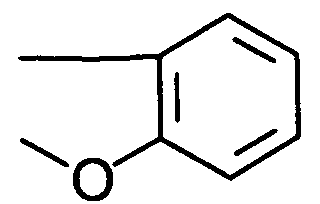
- Besonders bevorzugt sind Bisphosphine der allgemeinen Formel (I), in welcher
- R
- für Wasserstoff steht und
- R¹ und R²
- die oben angegebene Bedeutung haben.
- Die Bisphosphine der allgemeinen Formel (I) können hergestellt werden, indem man 3-Halogenphenylverbindungen der allgemeinen Formel (II)

in welcher - R¹ und R²
- die oben angegebene Bedeutung haben und
- Hal
- für Halogen, insbesondere für Brom steht,
- R
- die oben angegebene Bedeutung hat,
- R, R¹ und R²
- die oben angegebene Bedeutung haben,
- R, R¹ und R²
- die oben angegebene Bedeutung haben,
- Bevorzugt verwendet man als chirale Phase optisch aktive Polymere von optisch aktiven (Meth)acrylsäure-Derivaten. Besonders bevorzugt sind hier Polymerisate von optisch aktiven N-(Meth)acryloyl-aminosäure-Derivaten, wie sie in EP-379 917 beschrieben sind. Ganz besonders bevorzugt seien hier Polymerisate aus folgenden optisch aktiven N-Methacryloyl-aininosäureamiden genannt: N-Methacryloyl-L- bzw. -D-aminosäurementhylamide, wobei als Aminosäure z.B. Alanin, Leucin, Valin oder sonstige Aminosäuren in Frage kommen.
- Als Fließmittel für die Trennung der Racemate werden übliche organische Lösemittel bzw. Lösemittelgemische verwendet, die das als Adsorbens eingesetzte Polymerisat anquellen und das zu trennende Racemat lösen. Beispielsweise seien genannt: Kohlenwasserstoffe wie Benzol, Toluol oder Xylol, Ether wie Diethylether, Dioxan, Tetrahydrofuran, Halogenkohlenwasserstoffe wie Di- oder Trichlormethan, Aceton, Acetonitril, Alkohole wie Ethanol oder Propanol oder Essigester oder aber Gemische der genannten Lösemittel. Als besonders geeignet haben sich Mischungen aus Toluol und Tetrahydrofuran sowie Toluol und Dioxan erwiesen.
- Die Erfindung betrifft auch die neuen Zwischenprodukte der allgemeinen Formel (V) und der Formel (VI), wobei die Substituentenbedeutungen jeweils den für die Formel (I) angegebenen Bedeutungen entsprechen, sowie die Verfahren zur Herstellung dieser Zwischenprodukte.
- Die erfindungsgemäßen Phosphorverbindungen der Formel (I) bilden Komplexe mit Übergangsmetallen wie etwa Metallen der Gruppe VIII, insbesondere mit Ruthenium, Rhodium und Iridium, welche als Katalysatoren bei asymmetrischen Hydrierungen und auch für enantioselektive Wasserstoffverschiebungen in prochiralen, allylischen Systemen verwendbar sind. Für die erwähnten Hydrierungen sind Ruthenium-, Iridium- und Rhodium-Komplexe bevorzugt, während für Isomerisierungen Rhodium-Komplexe bevorzugt sind. Diese Katalysatoren, d.h. die Komplexe aus einem Metall der Gruppe VIII und den Phosphorverbindungen der Formel (I) sind neu und ebenfalls Gegenstand der vorliegenden Erfindung.
- Die in Frage stehenden Komplexe können in an sich bekannter Weise hergestellt werden, z.B. indem man eine Verbindung der Formel (I) mit einer Verbindung, welche ein Metall der Gruppe VIII abgeben kann, in einem geeigneten, inerten organischen oder wäßrigen Lösungsmittel umsetzt. Als geeignete, z.B. Rhodium abgebende Verbindungen können beispielsweise genannt werden, organische Rhodium-Komplexe mit Ethylen, Propylen und dergleichen, sowie mit bis-Olefinen, z.B. 1,5-Cyclooctadien, 1,5-Hexadien, Bicyclo(2.2.1)hepta-2,5-dien oder mit weiteren Dienen, welche mit Rhodium leicht lösliche Komplexe bilden. Bevorzugte, Rhodium abgebende Verbindungen sind z.B. Di-chloro-bis-(1,5-cyclooctadien)dirhodium, Di-chloro-bis(-norbornadien)dirhodium, Bis-(1,5-cyclooctadien)-rhodium-tetrafluorborat oder Bis-(cyclooctadien)rhodium-perchlorat. Als Iridium abgebende Verbindung kann beispielsweise Di-chloro-bis-(1,5-cyclooctadien)diiridium genannt werden.
- Von besonderem Interesse sind Rutheniumkomplexe mit Bisphosphinen der allgemeinen Formel (I). Als typisch aber nicht als Einschränkung seien die Rutheniumkomplexe der folgenden Formeln (VII) bis (XI) genannt.
-
Ru₂Cl₄B₂(S) (VII)
[Ru Hal Q B]⊕ Y ⊖ (VIII)
Ru Bn OOCR³OOCR⁴ (IX)
[Ru Hx Bn]m⊕ Ym ⊖ (X)
[Ru Hal (PR⁵₂R⁶)B](2+) Hal₂⊖ (XI)
[Ru H Hal B₂] (XII)
[B Ru (acac)₂] (XIII)
worin: - acac
- Acetylacetonat
- B
- für ein Bisphosphin der allgemeinen Formel (I) steht,
- Hal
- für Halogen, insbesondere für Iod, Chlor oder Brom steht,
- R³ und R⁴
- gleich oder verschieden sind und für Alkyl mit bis zu 9 C-Atomen, vorzugsweise bis zu 4 C-Atomen, welches gegebenenfalls substituiert ist durch Halogen, insbesondere Fluor, Chlor oder Brom oder für Phenyl stehen, welches gegebenenfalls durch Alkyl mit 1 bis 4 C-Atomen substituiert ist oder für eine α-Aminoalkylsäure mit vorzugsweise bis zu 4 C-Atomen stehen,
oder
gemeinsam eine Alkylidengruppe mit bis zu 4 C-Atomen bilden, - R⁵ und R⁶
- jeweils gleich oder verschieden sind und für gegebenenfalls substituiertes Phenyl stehen, vorzugsweise substituiert durch Alkyl mit 1 bis 4 C-Atomen oder Halogen,
- Y
- für Cl, Br, J, ClO₄, BF₄ oder PF₆ steht,
- Q
- für einen unsubstituierten oder substituierten Benzolring wie p-Cymol steht,
- S
- für ein tertiäres Amin wie z.B. Triethylamin, Tri-n-Butylamin oder Pyridin steht,
- n und m
- stehen jeweils für 1 oder 2,
- x
- steht für 0 oder 1,
- Die Komplexe der Formeln (VII) bis (XIII) können nach an sich bekannten Methoden hergestellt werden.
- Die Komplexe der Formeln (VII) und (XII) lassen sich z.B. in analoger Weise gemäß den Verfahren herstellen, die in EP-174 057 oder in Chem. Comm. 922 (1985) beschrieben werden.
- Die Komplexe der allgemeinen Formel (VIII) ergeben sich z.B. durch Umsetzung von bekannten Rutheniumkomplexen [RuHal₂Q]₂ mit Bisphosphinen der allgemeinen Formel (I) in inerten organischen Lösungsmitteln, wie z.B. in EP 366 390 beschrieben.
- Komplexe der allgemeinen Formel (IX), n = 1 können z.B. erhalten werden nach Verfahren, die in EP 245 959 angegeben sind, indem man Komplexe der allgemeinen Formel (VII) mit entsprechenden Carbonsäuren, vorzugsweise in alkoholischen Lösungsmitteln umsetzt.
- Komplexe der Formeln (IX) n = 2 und mit n = 1 und R³, R⁴ = CF₃ können nach den in EP 272 787 angegebenen Verfahren hergestellt werden.
- Die Komplexe der allgemeinen Formel (X) können hergestellt werden analog dem Verfahren gemäß EP-256 634.
- Die Komplexe der allgemeinen Formel (XI) können hergestellt werden analog dem Verfahren gemaß EP-470 756 durch Umsetzung der dort beschriebenen Ru-Vorstufen mit den erfindungsgemäßen Bisphosphinen der allgemeinen Formel (I).
- Komplexe der Formel (XIII) können analog den in P. Stahly et al., Organomettalics 1993, 1467 ff. angegebenen Verfahren dargestellt werden.
- Die erfindungsgemäßen Bisphosphine in Form ihrer Komplexe mit Metallen der Gruppe VIII und insbesondere Ruthenium sind verwendbar für asymmetrische Hydrierungen. Geeignete Substrate sind substituierte oder unsubstituierte α- oder β-Ketoester oder α- oder β-Keto-Amide, α- oder β-Amino- oder α- oder β-Hydroxy-Ketone und Acetamidozimtsäurederivate.
Besonders geeignet sind 2-Arylpropensäuren wie z.B. 2-(6'-Methoxy-2'-naphthyl)propensäure, 2-(4-Isobutyl)-propensäure und 2-(3-Benzyl-phenyl)-propensäure und ihre Salze, z.B mit tertiären Aminen. - Bei der Durchführung derartiger Hydrierungen können diese Komplexe zuerst hergestellt und dann zu einer Lösung der zu hydrierenden Substanz gegeben werden. Alternativ können sie jedoch auch in situ hergestellt werden, z.B. auch in Gegenwart einer zu hydrierenden Substanz.
- Die asymmetrische Hydrierung kann in einem geeigneten, unter den Reaktionsbedingungen inerten organischen Lösungsmittel erfolgen. Als derartige Lösungsmittel können insbesondere genannt werden, niedere Alkohole wie z.B. Methanol oder Ethanol, oder Gemische derartiger Alkohole mit halogenierten Kohlenwasserstoffen wie Methylenchlorid, Chloroform und dergleichen, oder mit cyclischen Ethern wie Tetrahydrofuran oder Dioxan, und dergleichen.
- Das Verhältnis von den Metallen zu Bisphosphinen der allgemeinen Formel (I) liegt zweckmäßig zwischen etwa 0,5 und etwa 2 Mol, vorzugsweise bei etwa 1 Mol Ruthenium pro Mol Bisphosphin-Ligand. Das Verhältnis von Metall in den Komplexen zu den hydrierenden Substanzen liegt zweckmäßig zwischen etwa 0,0005 und 1 Mol-%, vorzugsweise zwischen etwa 0,005 und 0,6 Mol-%.
- Die asymmetrische Hydrierung mit den erfindungsgemäßen Komplexen erfolgt zweckmäßig bei einer Temperatur von etwa 0°C bis etwa 100°C, in Abhängigkeit des verwendeten Substrates. Diese Hydrierung erfolgt zweckmäßig auch unter einem Druck, vorzugsweise bei einem Druck von etwa 5 bis etwa 200 bar, besonders bevorzugt von etwa 40 bis etwa 140 bar.
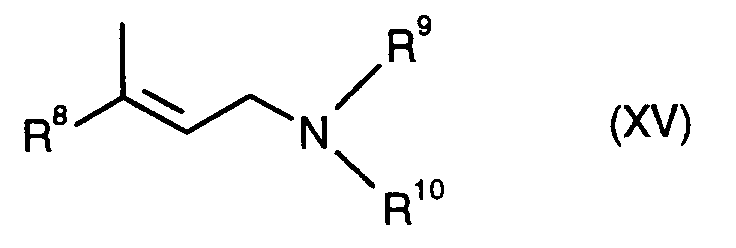
- Weiterhin sind die erfindungsgemäßen Bisphosphinkomplexe als Katalysatoren verwendbar für enantioselektive Wasserstoffverschiebungen in prochiralen allylischen Systemen. Besonders interessant sind sie z.B. im Zusammenhang mit der Herstellung von optisch aktiven Verbindungen der allgemeinen Formel (XIV)

worin - R⁸
- geschütztes Hydroxymethyl oder einen Rest der Formel

- R⁹ und R¹⁰
- gleich oder verschieden sind und niederes Alkyl (1-7 C-Atome) bedeuten,
- R⁸, R⁹ und R¹⁰
- die obige Bedeutung haben.
- Die Verbindungen (XIV) bzw. die daraus durch Hydrolyse erhaltenen Aldehyde, sowie die von letzteren abgeleiteten Säuren und Alkohole sind z.B. von Interesse als Zwischenprodukte bei der Synthese der Seitenketten der Vitamine E und KI.
- Zur Durchführung der erwähnten Wasserstoffverschiebungen können die Phosphorverbindungen der Formel (I) als solche in einer Lösung einer zu behandelnden Verbindung mit einer z.B. Rhodium oder Iridium abgebenden Verbindung in Kontakt gebracht werden. Andererseits können die Phosphorverbindungen der Formel (I) zunächst in einem geeigneten Lösungsmittel mit einer z.B. Rhodium oder Iridium abgebenden Verbindung zu dem entsprechenden Katalysator-Komplex umgesetzt werden, und dieser dann zu einer Lösung einer zu behandelnden Verbindung gegeben werden, wobei die letztere Methode bevorzugt ist.
- Sowohl die Umsetzung der Phosphorverbindungen der Formel (I) mit einer z.B. Rhodium oder Iridium abgebenden Verbindung, wie auch die erwähnten Wasserstoffverschiebungen können in geeigneten, unter den Reaktionsbedingungen inerten organischen Lösungsmitteln durchgeführt werden. Als solche seien insbesondere genannt niedere Alkanole wie z.B. Methanol oder Ethanol, aromatische Kohlenwasserstoffe wie Benzol oder Toluol, cyclische Ether wie Tetrahydrofuran oder Dioxan, Ester wie z.B. Essigester, oder auch Gemische hiervon, und dergleichen. Weiterhin können die Komplexbildungen auch in wäßrigem Medium oder in Dichlormethan durchgeführt werden.
- Das Verhältnis zwischen z.B. Rhodium oder Iridium und den Liganden der Formel (I) liegt zweckmäßig zwischen etwa 0,05 und etwa 5 Mol, vorzugsweise zwischen etwa 0,5 und etwa 2 Mol Metall pro Mol Ligand der Formel (I).
- Die Menge an Metall, in den Komplexen mit den Liganden der Formel (I), bezogen auf die zwecks Wasserstoffverschiebung zu behandelnden Verbindungen, liegt vorzugsweise zwischen etwa 0,005 und etwa 0,5 Mol-%, insbesondere zwischen etwa 0,01 und etwa 0,2 Mol-%.
- Die erwähnten Wasserstoffverschiebungen unter Verwendung von Metall-Komplexen mit den Liganden der Formel (I) können zweckmäßig in einem inerten, organischen Lösungsmittel und bei einer Temperatur von etwa Raumtemperatur bis etwa 130°C durchgeführt werden. Diese Reaktion erfolgt vorzugsweise bei erhöhter Temperatur, d.h. je nach verwendetem Lösungsmittel entweder bei Rückflußtemperatur des Reaktionsgemisches oder in einem geschlossenen Gefäß unter Druck.
- Verwendete Abkürzungen:
cym (=Cymol) =p-Methyl-isopropylbenzol
THF = Tetrahydrofuran
DMF = Dimethylformamid
alle ³¹P-Spektren sind {¹H}-breitband entkoppelt - Zu einer siedenden Mischung aus 1,27 g Mg und 10 ml THF wird eine Lösung von 10 g 3-Brom-chlorbenzol in 30 ml THF gegeben und noch 1 Stunde unter Rückfluß gekocht. Anschließend wird eine Lösung von 12,4 g Diphenylphosphinoxychlorid in 30 ml Toluol bei 0°C zugetropft und noch 1 h bei Raumtemperatur gerührt.
Nach Neutralisation der Reaktionslösung mit 2N HCl wird mit 150 ml Essigester und Wasser versetzt und die organische Phase wird getrocknet und eingeengt. Man erhält 8,82 g (54 % d.Th.) gelbe Kristalle.
Fp.: 108-110°C - 8,81 g (3-Chlor-phenyl)-diphenylphosphinoxid in 70 ml THF wird mit 14,5 ml einer 2M Lösung von Lithium-diisopropylamid in THF/n-Heptan versetzt und noch 10 min bei -76°C gerührt. Bei -76°C wird eine Lösung von 7,83 g Iod in 30 ml THF zugegeben.
Anschließend wird mit 2N HCl hydrolysiert und mit Essigester exträhiert. Die organische Phase wird über Kieselgel filtriert, getrocknet und eingeengt. Es bleiben 11,7 g (Ausbeute: 95 % d.Th.) Rohprodukt, das direkt gemäß c) weiter eingesetzt wird. - Eine Mischung aus 11,4 g (3-Chlor-2-iod-phenyl)-diphenylphosphinoxid, 5,00 g Cu-Pulver und 55 ml DMF werden 3 Tage bei 140°C intensiv unter Luftausschluß gerührt. Die erkaltete Reaktionslösung wird vom Lösungsmittel befreit und über Kieselgel chromatographiert (Laufmittel: Essigester in Cyclohexan; 25 bis 75 %).
Die Hauptfraktion wird in tert.-Butylmethylether ausgerührt.
Es bleiben 5,42 g Kristalle (67 % Ausbeute).
³¹P-NMR ([D₆]-DMSO): 28,0 ppm - 1 g racemisches (6,6'-Dichlor-biphenyl-2,2'-diyl)-bis-diphenylphosphinoxid aus Beispiel 1c), gelöst in 100 ml THF wird auf eine Glassäule (10 cm, Länge 100 cm) mit gequollenem Perlpolymerisat aus N-(Methacryloyl-L-alanin-1-menthylamid) (EP-379 917) aufgegeben und mit Toluol/THF 3:1 (v/v) bei einem Fluß von 10 ml/min eluiert. Nach 15 h eluiert das erste Enantiomer. Die fraktionierten Eluate werden nach analytischer Kontrolle auf Enantiomerenreinheit vereinigt. Nach üblicher Aufarbeitung erhält man 0,4 g des zuerst eluierten (+)-Enantiomeren und 0,35 g des entsprechenden (-)-Enantiomeren.
(R)-(+)-(6,6'-Dichlorbiphenyl-2,2'-diyl)-bis-diphenylphosphinoxid (VI)
[α]D = +46° (c = 1, DMF)
Fp.: ab 270°C Zersetzung
(S)-(-)-(6,6'-Dichlorbiphenyl-2,2'-diyl)-bis-diphenylphosphinoxid (VI)
[α]D = -46° (c = 1, DMF)
Fp.: ab 270°C Zersetzung - Eine Mischung aus 860 mg (S)-(-)-(6,6'-Dichlor-biphenyl-2,2'-diyl)-bis-diphenylphosphinoxid, 3 ml Tributylamin, 40 ml Xylol und 0,81 ml Trichlorsilan werden 16 h am Rückfluß gekocht. Bei 0°C werden anschließend 13 ml 30 % NaOH zugegeben. Die Mischung wird mit Methylenchlorid extrahiert. Nach Trocknung mit gesättigter Natriumchloridlösung und MgSO₄ wird durch Chromatographie an Kieselgel (10 bis 40 % Essigester in Cyclohexan) gereinigt.
Ausbeute: 670 mg (82 % der Theorie), Fp. = 230-235°C
[α]D = +51° (c = 1, CHCl₃) - Die Reaktion wurde analog e) mit 916 mg (R)-(+)-(6,6'-Dichlorbiphenyl-2,2'-diyl)-bis-diphenylphosphinoxid durchgeführt:
Ausbeute: 710 mg (82 % der Theorie)
Fp.: 230-235°C
[α]D = -50° (c = 1, CHCl₃) - Zu einer siedenden Mischung aus 4,31 g Mg und 10 ml THF wird eine Lösung von 25 g 3-Brom-dibenzofuran in 90 ml THF gegeben und noch 1 Stunde unter Rückfluß gekocht. Anschließend wird eine Lösung von 23,9 g Diphenylphosphinoxychlorid in 45 ml THF bei 0°C zugetropft und noch 1 h bei Raumtemperatur gerührt.
- Nach Neutralisation der Reaktionslösung mit 1N HCl wird mit 150 ml Essigester und Wasser versetzt und die organische Phase mit MgSO₄ getrocknet und eingeengt. Der Rückstand wird mit tert.-Butyl-methylether 16 h gerührt und filtriert. Als Rückstand bleiben 24,9 g gelbe Kristalle (65 % d.Th.).
Fp.: 151-155°C - 9,8 g (Dibenzofuran-3-yl)-diphenyl-phosphinoxid in 100 ml THF wird mit 13,3 ml einer 2M Lösung von Lithium-diisopropylamid in THF/n-Heptan versetzt und noch 10 min bei -78°C gerührt. Bei -76°C wird eine Lösung von 7,9 g Iod in 30 ml THF zugegeben.
- Anschließend wird mit 2N HCl hydrolysiert, Essigester zugesetzt, mit Natriumthiosulfat-Lösung, Wasser und gesättigter NaCl-Lösung gewaschen, mit MgSO₄ getrocknet und eingeengt. Es bleiben 12,7 g (98 % d.Th.) Rohprodukt.
Reinheit (HPLC): 94 %
Fp.: 288 bis 294°C (gereinigtes Produkt) - Eine Mischung aus 6,23 g (4-Iod-dibenzofuran-3-yl)-diphenyl-phosphinoxid, 2,39 g Cu-Pulver und 28 ml DMF werden 16 h bei 140°C intensiv unter Luftausschluß gerührt. Die erkaltete Reaktionslösung wird über Celite filtriert, vom Lösungsmittel befreit und mit tert.-Butylmethylether ausgerührt.
Es bleiben 4,08 g Kristalle (88 % d.Th.)
Fp.: 292-300°C (Zers.)
³¹P-NMR ([D₆]-DMSO): 28,6 ppm (S) - Die Trennung der Enantiomeren erfolgt analog der in 1d) beschriebenen Vorgehensweise. Als Elutionsmittel wird ein Gemisch aus Toluol/THF 2:1 (v/v) verwendet. Als erstes eluiert das (-)-Enantiomer.
(S)-(-)-(Bis-4,4'-dibenzofuran-3,3'-diyl)-bis(diphenylphosphinoxid) (VI)
Fp.: 250°C (Modifikations-Änderung), ab 280°C Zersetzung
[α]D = -189° (c=1, DMF)
(R)-(+)-(Bis-4,4'-dibenzofuran-3,3'-diyl)-bis(diphenylphosphinoxid) (VI)
Fp.: 250°C (Modifikations-Änderung), ab 280°C Zersetzung
[α]D = +196° (c=1, DMF) - Eine Mischung aus 1,0 g (1,36 mol) (S)-(-)-(Bis-4,4'-dibenzofuran-3,3'-diyl)-bis(diphenylphosphinoxid), 6,5 ml Tributylamin, 36 ml Xylol und 1,65 ml Trichlorsilan werden 3 h am Rückfluß gekocht. Bei 0°C werden anschließend 10 ml einer 30 %igen NaOH-Lösung zugegeben. Die Mischung wird mit Methylenchlorid extrahiert.
- Nach Trocknung mit gesättigter NaCl-Lösung und MgSO₄ wird durch Chromatographie an Kieselgel (10 % bis 30 % Essigester in Cyclohexan) gereinigt und aus tert.-Butylmethylether ausgerührt.
Ausbeute: 713 mg (75 % d.Th.).
Fp.: 248-250°C
[α]D = -118° (c=1, CHCl₃)
³¹P-NMR (CDCl₃): -13,4 ppm (s) - Die Reaktion wurde analog e) mit 1 g (R)-(+)-(Bis-4,4'-dibenzofuran-3,3'-diyl)-bis(diphenylphinoxid) durchgeführt.
Ausbeute: 721 mg (76 % d.Th.)
Fp.: 248-250°C
[α]D = +119° (c=1, CHCl₃)
³¹P-NMR (CDCl₃): -13,4 ppm (s) - Eine Mischung aus 21,4 mg Dichloro-cycloocta-1,5-dien-ruthenium-(II), 59 mg (R)-(+)-(Bis-4,4'-dibenzofuran-3,3'-diyl)-bis(diphenylphosphin), 0,17 ml Triethylamin und 1,7 ml Xylol werden 4 h bei 140°C unter Luftausschluß gerührt.
Anschließend wird das Lösungsmittel im Hochvakuum entfernt.
Ausbeute: quantitativ
³¹P-NMR (CDCl₃): 50,7 (d; J=38,4 Hz); 52,3 (d; J = 38,4 Hz) - Eine Mischung aus 7,5 mg Dichloro-cycloocta-1,5-dien-ruthenium (II), 17,4 mg (R)-6,6'-Dichlorbiphenyl-2,2'-diyl)-bis-diphenylphosphin, 0,06 ml Triethylamin und 2 ml Toluol werden 4 h bei 140°C unter Luftausschluß gerührt. Anschließend wird das Lösungsmittel im Hochvakuum entfernt.
Ausbeute: quantitativ
³¹P-NMR (CDCl₃): 54,8 (d; J = 38 Hz); 55,8 (d; J = 38 Hz) - Eine Lösung von 34 mg (cym₂Ru₂I₄) in 3 ml Methanol/Methylenchlorid (1:1) wird zu einer Mischung von 50 mg (R)-Bis-4,4'-dibenzofuran-3,3'-diyl)-bis(diphenylphosphin) in 3 ml Methanol/Methylenchlorid (1:1) gegeben, es wird 10 min unter Luftausschluß unter Rückfluß gekocht und eingeengt.
³¹P-NMR (CDCl₃): 41,0 (d; J=57 Hz); 23,5 (d; J=57 Hz) - Eine Lösung von 42 mg (cym₂Ru₂I₄) in 3 ml Methanol/Methylenchlorid (1:1) wird zu einer Mischung von 34 mg (R)-6,6'-Dichlor-biphenyl-2,2'-diyl)-bis-diphenylphosphin in 3 ml Methanol/Methylenchlorid (1:1) gegeben, es wird 10 min unter Luftausschluß unter Rückfluß gekocht und eingeengt.
³¹P-NMR (CDCl₃): 43,5 (d; J=61 Hz); 26,4 (d; J=61 Hz) - 211 mg des auf gleiche Weise wie im Beispiel B1 hergestellten Katalysators {[((-)-Bis-4,4'-dibenzofuran-3,3'-diyl)-bis-(diphenyl-phosphin))₂Ru₂Cl₄]NEt₃} und 50.5 mg NaOAc wurden in 12 ml entgastem tert.-Butanol unter Luftausschluß unter Rückfluß 12 h gekocht. Das Lösungsmittel wurde unter vermindertem Druck abdestilliert und der Rückstand wurde zweimal mit je 7 ml entgastem Diethylether extrahiert und gefiltert. Die vereinigten Extrakte wurden vom Lösungsmittel befreit und der Rückstand wurde direkt für Hydrierungen eingesetzt.
³¹P-NMR (CDCl₃): 64 ppm (s) - Eine Lösung von 1 g 2-(3-Benzyl-phenyl)-propensäure und 460 mg Triethylamin in 15 ml entgastem Methanol wird unter Luftausschluß bereitet und mit 21 mg des in Beispiel B1 hergestellten Katalysators versetzt. Anschließend wird 48 h bei 100 atm bei Raumtemperatur hydriert.
Ausbeute: quantitativ
Enantiomerenüberschuß: 89 % e.e. ((-)-Form)
(Die Bestimmung des Enantiomerenüberschusses erfolgt nach Oxidation zu 2-(3-Benzoyl-phenyl)-propionsäure durch HPLC an einer chiralen Phase wie in EP-A-529 444 beschrieben) - Eine Lösung von 1 g 2-(3-Benzyl-phenyl)-propensäure in 460 mg Triethylamin in 15 ml entgastem Methanol wird unter Luftausschluß mit der Hälfte des im Beispiel B2 bereiteten Katalysators versetzt. Anschließend wird 48 h bei 90 atm bei RT hydriert.
Umsatz und Ausbeute: quantitativ
Enantiomerenüberschuß: 84,2 % e.e ((-)-Form)
(Die Bestimmung des Enantiomerenüberschusses erfolgt durch HPLC wie in Anwendungsbeispiel 1 beschrieben) - 1,0 g Acetessigsäuremethylester werden in 15 ml sauerstofffreiem MeOH/CH₂Cl₂ (1:1) gelöst. Anschließend wird die Hälfte des im Beispiel B3 hergestellten Katalysators zugegeben und die Lösung wird in einem mit Argon gespülten Autoklaven transferiert. Anschließend wird 2 Tage bei Raumtemperatur und 90 atm Wasserstoffdruck hydriert. Zur Aufarbeitung wird das Lösungsmittel entfernt.
Umsatz (¹H-NMR): 100 %
Bestimmung des Enantiomerenüberschusses: - Eine Mischung aus 20 mg des Produktes aus Beispiel C3, 1 ml CH₂Cl₂ abs., 50 mg LAC (+)-Methoxyphenyl-trifluormethylessigsäurechlorid und 0,26 ml Pyridin wird über Nacht bei Raumtemperatur gerührt und gaschromatographisch analysiert:
Enantiomerenüberschuß: 98,3 % e.e. ((-)-Form). - Eine Lösung von 1 g 2-(3-Benzyl-phenyl)-propensäure in 15 ml entgastem Methanol wird unter Luftausschluß bereitet und mit der Hälfte des Produktes von Beispiel B4 versetzt. Anschließend wird 48 h bei 100 atm bei Raumtemperatur hydriert.
Ausbeute und Umsatz: quantitativ
Enantiomerenüberschuß: 83 % e.e. ((-)-Form)
(Die Bestimmung des Enantiomerenüberschusses erfolgt wie unter Beispiel C1 beschrieben) - Eine Lösung von 1 g 2-(3-Benzyl-phenyl)-propensäure und 460 mg Triethylamin in 15 ml entgastem Methanol wird unter Luftausschluß mit einem Drittel des in Beispiels B3 bereiteten Katalysators versetzt. Anschließend wird 48 h bei 90 atm bei RT hydriert.
Umsatz und Ausbeute: quantitativ
Enantiomerenüberschuß: 87 % e.e.((-)-Form) - Zu einer Lösung von 1 g 2-(3-Benzyl-phenyl)-propensäure und 460 mg Triethylamin in 15 ml entgastem Methanol wird unter Luftausschluß 30 mg des im Beispiel B5 hergestellten Katalysators zugegeben. Die Mischung wird dann 60 h bei RT mit 90 atm Wasserstoff hydriert.
Umsatz und Ausbeute: quantitativ
Enantiomerenüberschuß: 87,6 % e.e. ((+)-Form) - Eine Lösung von 22 mg Ru(acac)₃, 43 mg (-)-Bis-4,4'-dibenzofuran-3,3'-diyl)-bis-(diphenyl-phosphin), 2 g 2-(3-benzyl-phenyl)-propensäure und 0,92 g Triethylamine in 30 ml entgastem Methanol wird 48 h bei RT und 90 atm Wasserstoff hydriert.
Umsatz und Ausbeute: quantitativ
Enantiomerenüberschuß: 83,0 % e.e. ((+)-Form)

in welcher

in welcher

umsetzt, nach üblichen Methoden (Ullmann-Kupplung) zu racemischen Verbindungen der allgemeinen Formel (VI)

in welcher
worin
Claims (11)
- Enantiomerenreine Bisphosphine der allgemeinen Formel (I)
 R für Wasserstoff oder Alkyl mit 1 bis 4 C-Atomen steht,R¹ für Wasserstoff steht undR² für Chlor steht oderR¹ und R² gemeinsam für den Rest der Formel
- Bisphosphine der allgemeinen Formel (I) gemäß Anspruch 1, in welcherR und R¹ für Wasserstoff stehen,R² für Chlor stehtoderR¹ und R² gemeinsam für den Rest der Formelstehen.

- Verfahren zur Herstellung von Bisphosphinen der allgemeinen Formel (I) gemäß Anspruch 1, dadurch gekennzeichnet, daß man Halogenphenylverbindungen der allgemeinen Formel (II)
 R¹ und R² die oben angegebene Bedeutung haben undHal für Halogen, insbesondere für Brom steht,mit Diphenylphosphoroxychlorid der allgemeinen Formel (III)
 R die oben angegebene Bedeutung hat,nach üblichen Methoden z.B. über eine Grignard-Reaktion zu Verbindungen der allgemeinen Formel (IV)
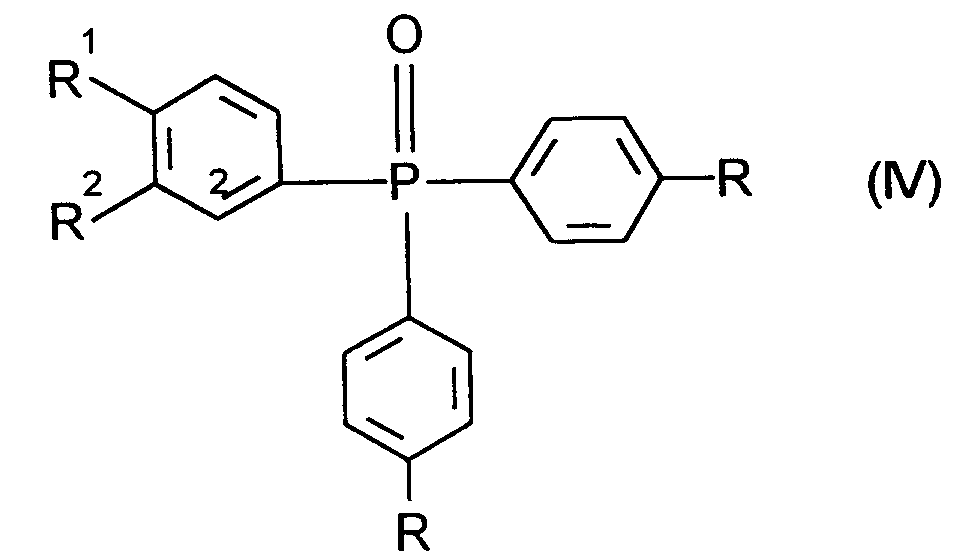 R, R¹ und R² die oben angegebene Bedeutung haben,umsetzt und diese mit Lithium in der 2-Position metalliert und anschließend mit Iod zu Verbindungen der Formel (V)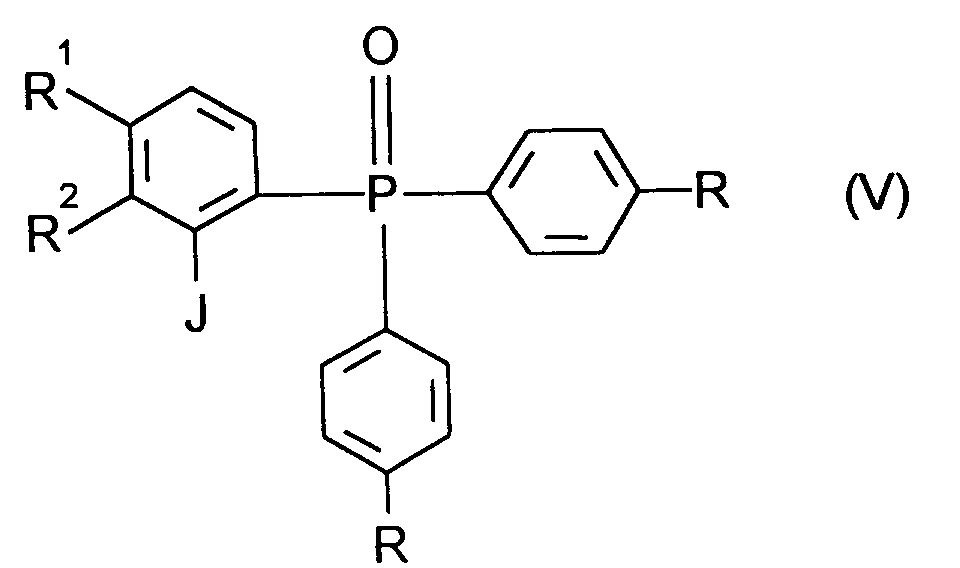
 R, R¹ und R² die oben angegebene Bedeutung haben,dimerisiert, und diese Phosphinoxide in ihre Enantiomere auftrennt und anschließend die erhaltenen (S)- oder (R)-Enantiomere nach üblichen Methoden zu Verbindungen der Formel (I) reduziert.
 - Verbindungen der allgemeinen Formel (V)
 R für Wasserstoff oder Alkyl mit 1 bis 4 C-Atomen steht,R¹ für Wasserstoff steht undR² für Chlor steht oderR¹ und R² gemeinsam für den Rest der Formelstehen.
- Verbindungen der allgemeinen Formel (VI)
 R für Wasserstoff oder Alkyl mit 1 bis 4 C-Atomen steht,R¹ für Wasserstoff steht undR² für Chlor steht oderR¹ und R² gemeinsam für den Rest der Formestehen, in ihrer racemischen oder in ihrer (R)- oder (S)-Form.
- Komplexe von Bisphosphinen der allgemeinen Formel (I) mit einem Metall der Gruppe (VIII).
- Komplexe von Bisphosphinen der allgemeinen Formel (I) mit Ru, Rh oder Ir.
- Komplexe von Bisphosphinen der allgemeinen Formel (I) mit Ru.
- Verwendung von Bisphosphinen der allgemeinen Formel (I) gemäß Anspruch 1 in Form ihrer Komplexe mit Metallen der Gruppe (VIII) bei der Durchführung von asymmetrischen Hydrierungen und für enantioselektive H-Verschiebungen in prochiralen Systemen.
- Verwendung von Verbindungen der allgemeinen Formel (I) gemäß Anspruch 1 in Form ihrer Komplexe mit Ruthenium bei der asymmetrischen Hydrierung von 2-Arylpropensäuren oder ihrer Salze.
- Verwendung von Bisphosphinen der allgemeinen Formel (I) gemäß Anspruch 1 in Form ihrer Komplexe mit Ruthenium bei der asymmetrischen Hydrierung vona) folgenden Ketogruppen zu den entsprechenden Alkoholen,a1) von substituierten oder unsubstituierten α- oder β-Ketoestern oder α- oder β-Ketoamiden,a2) von α- oder β-Aminoketonen oder von α- oder β-Hydroxyketonenoderb) der C-C-Doppelbindung von Allylaminen, Allylalkoholen oder Acetamidozimtsäure-Derivaten.
Priority Applications (1)
| Application Number | Priority Date | Filing Date | Title |
|---|---|---|---|
| SI9430296T SI0643065T1 (en) | 1993-09-10 | 1994-08-29 | Novel bisphosphines for asymetric hydrogenation catalysts |
Applications Claiming Priority (2)
| Application Number | Priority Date | Filing Date | Title |
|---|---|---|---|
| DE4330730A DE4330730A1 (de) | 1993-09-10 | 1993-09-10 | Neue Bisphosphine für asymmetrische Hydrierkatalysatoren |
| DE4330730 | 1993-09-10 |
Publications (2)
| Publication Number | Publication Date |
|---|---|
| EP0643065A1 true EP0643065A1 (de) | 1995-03-15 |
| EP0643065B1 EP0643065B1 (de) | 1999-11-10 |
Family
ID=6497384
Family Applications (1)
| Application Number | Title | Priority Date | Filing Date |
|---|---|---|---|
| EP94113441A Expired - Lifetime EP0643065B1 (de) | 1993-09-10 | 1994-08-29 | Neue Bisphosphine für asymmetrische Hydrierkatalysatoren |
Country Status (12)
| Country | Link |
|---|---|
| US (1) | US5510503A (de) |
| EP (1) | EP0643065B1 (de) |
| JP (1) | JP3681418B2 (de) |
| KR (1) | KR100341258B1 (de) |
| AT (1) | ATE186539T1 (de) |
| CA (1) | CA2131571C (de) |
| DE (2) | DE4330730A1 (de) |
| DK (1) | DK0643065T3 (de) |
| ES (1) | ES2139695T3 (de) |
| GR (1) | GR3032397T3 (de) |
| SI (1) | SI0643065T1 (de) |
| TW (1) | TW370521B (de) |
Cited By (15)
| Publication number | Priority date | Publication date | Assignee | Title |
|---|---|---|---|---|
| EP0690065A1 (de) * | 1994-06-30 | 1996-01-03 | Hoechst Aktiengesellschaft | Halogenierte Biphenyl-2,2'diyl-bis-diphenylphosphine, ihre Herstellung und ihre Verwendung |
| WO1996001831A1 (en) * | 1994-07-12 | 1996-01-25 | Italfarmaco Sud S.P.A. | Heteroaromatic diphosphines as chiral ligands |
| EP0749973A1 (de) * | 1995-06-20 | 1996-12-27 | Bayer Ag | Neue Bisphosphine als Katalysatoren für asymmetrische Reaktionen |
| EP0764652A1 (de) * | 1995-09-22 | 1997-03-26 | Bayer Ag | Neue Zwischenprodukte für die Synthese von Bisphosphinverbindungen |
| WO1997047632A1 (en) * | 1996-06-12 | 1997-12-18 | Merck & Co., Inc. | Novel chiral bisphosphines |
| WO1998022484A1 (en) * | 1996-11-20 | 1998-05-28 | Chemi S.P.A. | Heteroarylic-arylic diphosphines as chiral ligands |
| EP0850945A1 (de) * | 1996-12-26 | 1998-07-01 | Takasago International Corporation | Chirale Diphosphin-Verbindung, Zwischenprodukte zu ihrer Herstellung, Übergangsmetall-Komplexe davon und asymmetrischer Hydrierungskatalysator |
| EP0826691A3 (de) * | 1996-08-27 | 1999-02-10 | Takasago International Corporation | Optisch aktive Diphospin Verbindungen,Verfahren zu ihrer Herstellung, Übergangsmetall Komplexe, die diese Verbindungen als Ligand enthalten und Verfahren zur Herstellung optisch aktiver Substanzen unter Verwendung dieser Komplexe |
| EP0759425A3 (de) * | 1995-08-17 | 1999-06-30 | Bayer Ag | Verfahren zur Herstellung von optisch aktiven 1-Aryl-alkylaminen |
| US6020527A (en) * | 1998-04-07 | 2000-02-01 | Firmenich Sa | Stereospecific isomerisation of allyl amines using chiral phosphorous ligands |
| EP0945457A3 (de) * | 1998-03-23 | 2000-12-13 | Takasago International Corporation | Rutheniumphosphinkomplex und Verfahren zur deren Herstellung |
| DE10027154A1 (de) * | 2000-05-31 | 2001-12-13 | Bayer Ag | Verfahren zur Herstellung optisch aktiver Trimethylmilchsäure und ihrer Ester |
| US6350910B1 (en) | 1999-06-17 | 2002-02-26 | Firmenich Sa | Stereospecific isomerisation of allylamines with the aid of immobilized phosphorated chiral ligands |
| EP1346977A1 (de) | 2002-03-20 | 2003-09-24 | Bayer Aktiengesellschaft | Verfahren zur Herstellung von Aryl-aminopropanolen |
| US6965029B2 (en) | 2000-07-27 | 2005-11-15 | Viatris Gmbh & Co. Kg | Method for producing enantiomer-free 6,8 dihydroxy octanoic acid esters by means of asymmetric, catalytic hydrogenation |
Families Citing this family (17)
| Publication number | Priority date | Publication date | Assignee | Title |
|---|---|---|---|---|
| US5935892A (en) | 1994-02-22 | 1999-08-10 | California Institute Of Technology | Supported phase catalyst |
| US5736480A (en) * | 1994-02-22 | 1998-04-07 | California Institute Of Technology | Supported phase chiral sulfonated BINAP catalyst solubilized in alcohol and method of asymmetric hydrogenation |
| JP3789508B2 (ja) * | 1995-03-14 | 2006-06-28 | 高砂香料工業株式会社 | 光学活性非対称ジホスフィン及び該化合物の存在下にて光学活性体を得る方法 |
| JP3431749B2 (ja) * | 1996-03-07 | 2003-07-28 | 高砂香料工業株式会社 | 新規な1−置換−2−ジフェニルホスフィノナフタレンおよびこれを配位子とする遷移金属錯体 |
| JPH1059992A (ja) * | 1996-08-15 | 1998-03-03 | Takasago Internatl Corp | 新規ルテニウム錯体 |
| US6207868B1 (en) * | 1997-06-13 | 2001-03-27 | The Penn State Research Foundation | Asymmetric synthesis catalyzed by transition metal complexes with chiral ligands |
| US6162929A (en) * | 1997-12-23 | 2000-12-19 | Hoffmann-La Roche Inc. | Process for the manufacture of bisphosphine oxide and bisphosphonate compounds |
| US6307087B1 (en) | 1998-07-10 | 2001-10-23 | Massachusetts Institute Of Technology | Ligands for metals and improved metal-catalyzed processes based thereon |
| US7223879B2 (en) * | 1998-07-10 | 2007-05-29 | Massachusetts Institute Of Technology | Ligands for metals and improved metal-catalyzed processes based thereon |
| IT1303757B1 (it) * | 1998-11-16 | 2001-02-23 | Sigma Tau Ind Farmaceuti | Processo industriale per la produzione di l-carnitina. |
| US6563005B1 (en) | 1998-12-03 | 2003-05-13 | Cytec Technology Corp. | Preparation of mono- and di-arylphosphines |
| DE10056310A1 (de) | 2000-11-14 | 2002-05-16 | Bayer Ag | Verbessertes Verfahren zur Herstellung von enantiomerenreinen(5,5`-Dichlor-6,6`-dimethoxybiphenyl-2,2`-diyl)-bis-(diphenylphosphinoxiden) |
| CA2496883C (en) | 2002-08-27 | 2011-03-08 | Merck Patent Gesellschaft Mit Beschraenkter Haftung | Process for the enantioselective hydrogenation of amino alcohols |
| WO2008141077A1 (en) * | 2007-05-10 | 2008-11-20 | Janssen Pharmaceutica N.V. | Process for the preparation of tetrahydroquinolinyl, benzoxazine and benzothiazine derivatives |
| FR2952638A1 (fr) * | 2009-11-17 | 2011-05-20 | Univ Strasbourg | Procede de phosphination catalytique double ou triple de composes di, tri ou tetrahalobiaryles, intermediaires employes, composes obtenus et leurs utilisations |
| JP5810847B2 (ja) * | 2011-11-08 | 2015-11-11 | コニカミノルタ株式会社 | 有機エレクトロルミネッセンス素子用材料、有機エレクトロルミネッセンス素子、表示装置及び照明装置 |
| TWI617352B (zh) * | 2012-12-25 | 2018-03-11 | 南帝化學工業股份有限公司 | 催化劑組成物及使用該組成物之不飽合共聚物之氫化方法 |
Citations (2)
| Publication number | Priority date | Publication date | Assignee | Title |
|---|---|---|---|---|
| EP0104375A1 (de) * | 1982-08-27 | 1984-04-04 | F. HOFFMANN-LA ROCHE & CO. Aktiengesellschaft | Neue, phosphorhaltige Biphenylderivate und deren Verwendung für asymmetrische Hydrierungen und enantioselektive Wasserstoffverschiebungen |
| EP0398132A2 (de) * | 1989-05-18 | 1990-11-22 | F. Hoffmann-La Roche Ag | Phosphorverbindungen |
Family Cites Families (8)
| Publication number | Priority date | Publication date | Assignee | Title |
|---|---|---|---|---|
| JPS6163690A (ja) * | 1984-09-04 | 1986-04-01 | Takasago Corp | ルテニウム−ホスフイン錯体 |
| JPS6341487A (ja) * | 1986-08-06 | 1988-02-22 | Takasago Corp | ルテニウム−ホスフイン錯体 |
| DE3778857D1 (de) * | 1986-11-14 | 1992-06-11 | Takasago Perfumery Co Ltd | Katalytische produktion von optisch aktiven carbonsaeuren. |
| JPH0757758B2 (ja) * | 1988-10-24 | 1995-06-21 | 高砂香料工業株式会社 | ルテニウム―ホスフィン錯体 |
| US5274167A (en) * | 1989-01-26 | 1993-12-28 | Bayer Aktiengesellschaft | Polymeriable optically active (meth) acrylic acid derivatives |
| JP2775335B2 (ja) * | 1990-08-01 | 1998-07-16 | 高砂香料工業株式会社 | ルテニウム―ホスフィン錯体及びその製造中間体 |
| US5187281A (en) * | 1991-06-17 | 1993-02-16 | Ethyl Corporation | Asymmetric hydrogenation of aromatic-substituted olefins using organoiridium catalyst |
| JP2850068B2 (ja) * | 1991-10-22 | 1999-01-27 | 高砂香料工業株式会社 | ルテニウム−ホスフィン錯体及びこれを触媒とする光学活性1−置換−1,3−プロパンジオールの製造方法 |
-
1993
- 1993-09-10 DE DE4330730A patent/DE4330730A1/de not_active Withdrawn
-
1994
- 1994-07-12 TW TW083106285A patent/TW370521B/zh not_active IP Right Cessation
- 1994-08-29 DE DE59408907T patent/DE59408907D1/de not_active Expired - Lifetime
- 1994-08-29 EP EP94113441A patent/EP0643065B1/de not_active Expired - Lifetime
- 1994-08-29 SI SI9430296T patent/SI0643065T1/xx not_active IP Right Cessation
- 1994-08-29 AT AT94113441T patent/ATE186539T1/de active
- 1994-08-29 ES ES94113441T patent/ES2139695T3/es not_active Expired - Lifetime
- 1994-08-29 DK DK94113441T patent/DK0643065T3/da active
- 1994-09-02 US US08/300,507 patent/US5510503A/en not_active Expired - Lifetime
- 1994-09-07 KR KR1019940022434A patent/KR100341258B1/ko not_active Expired - Fee Related
- 1994-09-07 JP JP23862494A patent/JP3681418B2/ja not_active Expired - Fee Related
- 1994-09-07 CA CA002131571A patent/CA2131571C/en not_active Expired - Fee Related
-
2000
- 2000-01-14 GR GR20000400091T patent/GR3032397T3/el unknown
Patent Citations (2)
| Publication number | Priority date | Publication date | Assignee | Title |
|---|---|---|---|---|
| EP0104375A1 (de) * | 1982-08-27 | 1984-04-04 | F. HOFFMANN-LA ROCHE & CO. Aktiengesellschaft | Neue, phosphorhaltige Biphenylderivate und deren Verwendung für asymmetrische Hydrierungen und enantioselektive Wasserstoffverschiebungen |
| EP0398132A2 (de) * | 1989-05-18 | 1990-11-22 | F. Hoffmann-La Roche Ag | Phosphorverbindungen |
Cited By (30)
| Publication number | Priority date | Publication date | Assignee | Title |
|---|---|---|---|---|
| US5621128A (en) * | 1994-06-30 | 1997-04-15 | Hoechst Aktiengesellschaft | Halogenated biphenyl-2,2'-diylbisdiphenylphosphines, their preparation and their use |
| EP0690065A1 (de) * | 1994-06-30 | 1996-01-03 | Hoechst Aktiengesellschaft | Halogenierte Biphenyl-2,2'diyl-bis-diphenylphosphine, ihre Herstellung und ihre Verwendung |
| US5907045A (en) * | 1994-07-12 | 1999-05-25 | Italfarmaco Sud S.P.A. | Heteroaromatic diphosphines as chiral ligands |
| WO1996001831A1 (en) * | 1994-07-12 | 1996-01-25 | Italfarmaco Sud S.P.A. | Heteroaromatic diphosphines as chiral ligands |
| US6586357B1 (en) | 1994-07-12 | 2003-07-01 | Chemi S.P.A. | Heteroaromatic diphosphines as chiral ligands |
| US6297387B1 (en) | 1994-07-12 | 2001-10-02 | Italfarmaco Sud S.P.A. | Heteroaromatic diphosphines as chiral ligands |
| AU685660B2 (en) * | 1994-07-12 | 1998-01-22 | Italfarmaco Sud S.P.A. | Heteroaromatic diphosphines as chiral ligands |
| US6133191A (en) * | 1994-07-12 | 2000-10-17 | Italfarmaco Sud S.P.A. | Heteroaromatic diphosphines as chiral ligands |
| US6077958A (en) * | 1994-07-12 | 2000-06-20 | Italfarmaco Sud S.P.A. | Heteroaromatic diphosphines as chiral ligands |
| EP0749973A1 (de) * | 1995-06-20 | 1996-12-27 | Bayer Ag | Neue Bisphosphine als Katalysatoren für asymmetrische Reaktionen |
| US5710339A (en) * | 1995-06-20 | 1998-01-20 | Bayer Aktiengesellschaft | Bisphosphines as catalysts for asymmetric reactions |
| US5801261A (en) * | 1995-06-20 | 1998-09-01 | Bayer Aktiengesellschaft | Bisphosphines as catalysts for asymmetric reactions |
| EP0759425A3 (de) * | 1995-08-17 | 1999-06-30 | Bayer Ag | Verfahren zur Herstellung von optisch aktiven 1-Aryl-alkylaminen |
| EP0764652A1 (de) * | 1995-09-22 | 1997-03-26 | Bayer Ag | Neue Zwischenprodukte für die Synthese von Bisphosphinverbindungen |
| US5739360A (en) * | 1995-09-22 | 1998-04-14 | Bayer Aktiengesellschaft | Intermediates for the synthesis of bisphosphine compounds |
| WO1997047632A1 (en) * | 1996-06-12 | 1997-12-18 | Merck & Co., Inc. | Novel chiral bisphosphines |
| EP0826691A3 (de) * | 1996-08-27 | 1999-02-10 | Takasago International Corporation | Optisch aktive Diphospin Verbindungen,Verfahren zu ihrer Herstellung, Übergangsmetall Komplexe, die diese Verbindungen als Ligand enthalten und Verfahren zur Herstellung optisch aktiver Substanzen unter Verwendung dieser Komplexe |
| WO1998022484A1 (en) * | 1996-11-20 | 1998-05-28 | Chemi S.P.A. | Heteroarylic-arylic diphosphines as chiral ligands |
| US6153758A (en) * | 1996-11-20 | 2000-11-28 | Chemi S.P.A. | Heteroarylic-arylic diphosphines as chiral ligands |
| EP0850945A1 (de) * | 1996-12-26 | 1998-07-01 | Takasago International Corporation | Chirale Diphosphin-Verbindung, Zwischenprodukte zu ihrer Herstellung, Übergangsmetall-Komplexe davon und asymmetrischer Hydrierungskatalysator |
| EP0945457A3 (de) * | 1998-03-23 | 2000-12-13 | Takasago International Corporation | Rutheniumphosphinkomplex und Verfahren zur deren Herstellung |
| US6020527A (en) * | 1998-04-07 | 2000-02-01 | Firmenich Sa | Stereospecific isomerisation of allyl amines using chiral phosphorous ligands |
| US6350910B1 (en) | 1999-06-17 | 2002-02-26 | Firmenich Sa | Stereospecific isomerisation of allylamines with the aid of immobilized phosphorated chiral ligands |
| DE10027154A1 (de) * | 2000-05-31 | 2001-12-13 | Bayer Ag | Verfahren zur Herstellung optisch aktiver Trimethylmilchsäure und ihrer Ester |
| EP1160237A3 (de) * | 2000-05-31 | 2003-11-12 | Bayer Ag | Verfahren zur Herstellung optisch aktiver Trimethylmilchsäure und ihrer Ester |
| US6965029B2 (en) | 2000-07-27 | 2005-11-15 | Viatris Gmbh & Co. Kg | Method for producing enantiomer-free 6,8 dihydroxy octanoic acid esters by means of asymmetric, catalytic hydrogenation |
| EP1346977A1 (de) | 2002-03-20 | 2003-09-24 | Bayer Aktiengesellschaft | Verfahren zur Herstellung von Aryl-aminopropanolen |
| US7169938B2 (en) | 2002-03-20 | 2007-01-30 | Markus Eckert | Process for preparing arylaminopropanols |
| US7582776B2 (en) | 2002-03-20 | 2009-09-01 | Lanxess Deutschland Gmbh | Process for preparing arylaminopropanols |
| US7893281B2 (en) | 2002-03-20 | 2011-02-22 | Lanxess Deutschland Gmbh | Process for preparing arylaminopropanols |
Also Published As
| Publication number | Publication date |
|---|---|
| KR950008525A (ko) | 1995-04-19 |
| ATE186539T1 (de) | 1999-11-15 |
| DE4330730A1 (de) | 1995-03-16 |
| CA2131571A1 (en) | 1995-03-11 |
| EP0643065B1 (de) | 1999-11-10 |
| DK0643065T3 (da) | 2000-05-08 |
| CA2131571C (en) | 2005-07-26 |
| TW370521B (en) | 1999-09-21 |
| GR3032397T3 (en) | 2000-05-31 |
| ES2139695T3 (es) | 2000-02-16 |
| JP3681418B2 (ja) | 2005-08-10 |
| JPH0782282A (ja) | 1995-03-28 |
| US5510503A (en) | 1996-04-23 |
| DE59408907D1 (de) | 1999-12-16 |
| KR100341258B1 (ko) | 2002-11-04 |
| SI0643065T1 (en) | 2000-02-29 |
Similar Documents
| Publication | Publication Date | Title |
|---|---|---|
| EP0643065B1 (de) | Neue Bisphosphine für asymmetrische Hydrierkatalysatoren | |
| EP0104375B1 (de) | Neue, phosphorhaltige Biphenylderivate und deren Verwendung für asymmetrische Hydrierungen und enantioselektive Wasserstoffverschiebungen | |
| DE69220061T2 (de) | Herstellung von chiralen phospholanen aus chiralen zyklischen sulfaten von 1,4-diolen | |
| EP0398132B1 (de) | Phosphorverbindungen | |
| DE69717406T2 (de) | Chirale Diphosphin-Verbindung, Zwischenprodukte zu ihrer Herstellung, Übergangsmetall-Komplexe davon und asymmetrischer Hydrierungskatalysator | |
| EP2459579B1 (de) | Imidazolgruppenhaltige phosphinoboran-verbindungen und verfahren zur herstellung von imidazolgruppenhaltige phosphorverbindungen | |
| EP0749973B1 (de) | Neue Bisphosphine als Katalysatoren für asymmetrische Reaktionen | |
| DE69512415T2 (de) | Heteroaromatische diphospine als chirale liganden | |
| DE69114986T2 (de) | Eine Phosphino-Binapthyl-Verbindung und Übergangsmetall-Komplexe davon. | |
| EP0579797B1 (de) | Diphosphinliganden | |
| EP0780157B1 (de) | Rutheniumkomplexe mit einem chiralen, zweizähnigen Phosphinoxazolin-Liganden zur enantioselektiven Transferhydrierung von prochiralen Ketonen | |
| DE69713841T2 (de) | Optisch aktive Diphospin Verbindungen,Verfahren zu ihrer Herstellung, Übergangsmetall Komplexe, die diese Verbindungen als Ligand enthalten und Verfahren zur Herstellung optisch aktiver Substanzen unter Verwendung dieser Komplexe | |
| DE69123025T2 (de) | Verfahren zur Herstellung von optisch aktiven Gamma-butyrolactonderivaten | |
| EP1175426A1 (de) | Bidentate organophosphorliganden und ihre verwendung | |
| DE69507355T2 (de) | Verfahren zur Herstellung von optisch aktiven Carbonsäuren sowie chirale Liganten hierfür | |
| DE69432139T2 (de) | Phosphin-Verbindungen, diese Phosphin-Verbindungen als ligande enthaltende Komplexe, Verfahren zur Herstellung von optisch-aktiven Aldehyden durch Mittel der Phosphin-Verbindungen oder des Komplexes | |
| DE3781749T3 (de) | Herstellungsverfahren von optisch aktiven Alkoholen. | |
| EP1499625B1 (de) | Ferrocenylliganden und ein verfahren zur herstellung solcher liganden | |
| DE69403697T2 (de) | Phosphinverbindungen und Übergangsmetall-Phosphin-Komplexverbindungen, die diese als Liganden enthalten | |
| US4906773A (en) | Process for preparing optically active threonine | |
| DE19535243A1 (de) | Neue Zwischenprodukte für die Synthese von Bisphosphinverbindungen | |
| EP1636243B1 (de) | Chirale liganden zur anwendung in asymmetrischen synthesen | |
| EP0512416B1 (de) | Neue homochirale Diphosphine | |
| DE60307724T2 (de) | Neue Diphosphinverbindung, Zwischenprodukte für deren Herstellung, Übergangsmetallkomplex enthaltend die Verbindung als Ligand und Katalysator für asymmetrische Hydrierungen, welcher den Komplex enthält | |
| DE10327109A1 (de) | Liganden zur Anwendung in stereoselektiven Synthesen |
Legal Events
| Date | Code | Title | Description |
|---|---|---|---|
| PUAI | Public reference made under article 153(3) epc to a published international application that has entered the european phase |
Free format text: ORIGINAL CODE: 0009012 |
|
| AK | Designated contracting states |
Kind code of ref document: A1 Designated state(s): AT BE CH DE DK ES FR GB GR IE IT LI LU MC NL PT SE |
|
| RAX | Requested extension states of the european patent have changed |
Free format text: SI PAYMENT 940829 |
|
| 17P | Request for examination filed |
Effective date: 19950830 |
|
| 17Q | First examination report despatched |
Effective date: 19980626 |
|
| GRAG | Despatch of communication of intention to grant |
Free format text: ORIGINAL CODE: EPIDOS AGRA |
|
| GRAG | Despatch of communication of intention to grant |
Free format text: ORIGINAL CODE: EPIDOS AGRA |
|
| GRAH | Despatch of communication of intention to grant a patent |
Free format text: ORIGINAL CODE: EPIDOS IGRA |
|
| GRAH | Despatch of communication of intention to grant a patent |
Free format text: ORIGINAL CODE: EPIDOS IGRA |
|
| GRAA | (expected) grant |
Free format text: ORIGINAL CODE: 0009210 |
|
| AK | Designated contracting states |
Kind code of ref document: B1 Designated state(s): AT BE CH DE DK ES FR GB GR IE IT LI LU MC NL PT SE |
|
| AX | Request for extension of the european patent |
Free format text: SI PAYMENT 19940829 |
|
| REF | Corresponds to: |
Ref document number: 186539 Country of ref document: AT Date of ref document: 19991115 Kind code of ref document: T |
|
| REG | Reference to a national code |
Ref country code: CH Ref legal event code: NV Representative=s name: E. BLUM & CO. PATENTANWAELTE Ref country code: CH Ref legal event code: EP |
|
| GBT | Gb: translation of ep patent filed (gb section 77(6)(a)/1977) |
Effective date: 19991117 |
|
| REF | Corresponds to: |
Ref document number: 59408907 Country of ref document: DE Date of ref document: 19991216 |
|
| REG | Reference to a national code |
Ref country code: IE Ref legal event code: FG4D Free format text: GERMAN |
|
| ITF | It: translation for a ep patent filed | ||
| PG25 | Lapsed in a contracting state [announced via postgrant information from national office to epo] |
Ref country code: PT Free format text: LAPSE BECAUSE OF FAILURE TO SUBMIT A TRANSLATION OF THE DESCRIPTION OR TO PAY THE FEE WITHIN THE PRESCRIBED TIME-LIMIT Effective date: 20000210 |
|
| REG | Reference to a national code |
Ref country code: ES Ref legal event code: FG2A Ref document number: 2139695 Country of ref document: ES Kind code of ref document: T3 |
|
| ET | Fr: translation filed | ||
| REG | Reference to a national code |
Ref country code: DK Ref legal event code: T3 |
|
| PG25 | Lapsed in a contracting state [announced via postgrant information from national office to epo] |
Ref country code: LU Free format text: LAPSE BECAUSE OF NON-PAYMENT OF DUE FEES Effective date: 20000829 |
|
| PG25 | Lapsed in a contracting state [announced via postgrant information from national office to epo] |
Ref country code: MC Free format text: THE PATENT HAS BEEN ANNULLED BY A DECISION OF A NATIONAL AUTHORITY Effective date: 20000831 |
|
| PLBE | No opposition filed within time limit |
Free format text: ORIGINAL CODE: 0009261 |
|
| STAA | Information on the status of an ep patent application or granted ep patent |
Free format text: STATUS: NO OPPOSITION FILED WITHIN TIME LIMIT |
|
| 26N | No opposition filed | ||
| REG | Reference to a national code |
Ref country code: GB Ref legal event code: IF02 |
|
| REG | Reference to a national code |
Ref country code: SI Ref legal event code: IF |
|
| REG | Reference to a national code |
Ref country code: GB Ref legal event code: 732E |
|
| NLS | Nl: assignments of ep-patents |
Owner name: LANXESS DEUTSCHLAND GMBH Effective date: 20070305 |
|
| REG | Reference to a national code |
Ref country code: CH Ref legal event code: PFA Owner name: BAYER AG Free format text: BAYER AG# #51368 LEVERKUSEN (DE) -TRANSFER TO- BAYER AG# #51368 LEVERKUSEN (DE) |
|
| REG | Reference to a national code |
Ref country code: FR Ref legal event code: TP |
|
| PGFP | Annual fee paid to national office [announced via postgrant information from national office to epo] |
Ref country code: NL Payment date: 20100810 Year of fee payment: 17 Ref country code: IE Payment date: 20100812 Year of fee payment: 17 Ref country code: ES Payment date: 20100915 Year of fee payment: 17 |
|
| PGFP | Annual fee paid to national office [announced via postgrant information from national office to epo] |
Ref country code: SE Payment date: 20100812 Year of fee payment: 17 Ref country code: IT Payment date: 20100823 Year of fee payment: 17 Ref country code: FR Payment date: 20100824 Year of fee payment: 17 Ref country code: AT Payment date: 20100812 Year of fee payment: 17 |
|
| PGFP | Annual fee paid to national office [announced via postgrant information from national office to epo] |
Ref country code: GR Payment date: 20100719 Year of fee payment: 17 Ref country code: GB Payment date: 20100825 Year of fee payment: 17 |
|
| PGFP | Annual fee paid to national office [announced via postgrant information from national office to epo] |
Ref country code: DK Payment date: 20100812 Year of fee payment: 17 |
|
| PGFP | Annual fee paid to national office [announced via postgrant information from national office to epo] |
Ref country code: BE Payment date: 20100818 Year of fee payment: 17 |
|
| BERE | Be: lapsed |
Owner name: *LANXESS DEUTSCHLAND G.M.B.H. Effective date: 20110831 |
|
| REG | Reference to a national code |
Ref country code: NL Ref legal event code: V1 Effective date: 20120301 |
|
| REG | Reference to a national code |
Ref country code: SE Ref legal event code: EUG |
|
| GBPC | Gb: european patent ceased through non-payment of renewal fee |
Effective date: 20110829 |
|
| REG | Reference to a national code |
Ref country code: GR Ref legal event code: ML Ref document number: 20000400091 Country of ref document: GR Effective date: 20120302 |
|
| REG | Reference to a national code |
Ref country code: DK Ref legal event code: EBP |
|
| REG | Reference to a national code |
Ref country code: FR Ref legal event code: ST Effective date: 20120430 |
|
| REG | Reference to a national code |
Ref country code: IE Ref legal event code: MM4A |
|
| PG25 | Lapsed in a contracting state [announced via postgrant information from national office to epo] |
Ref country code: BE Free format text: LAPSE BECAUSE OF NON-PAYMENT OF DUE FEES Effective date: 20110831 Ref country code: NL Free format text: LAPSE BECAUSE OF NON-PAYMENT OF DUE FEES Effective date: 20120301 Ref country code: GR Free format text: LAPSE BECAUSE OF NON-PAYMENT OF DUE FEES Effective date: 20120302 Ref country code: IT Free format text: LAPSE BECAUSE OF NON-PAYMENT OF DUE FEES Effective date: 20110829 |
|
| PG25 | Lapsed in a contracting state [announced via postgrant information from national office to epo] |
Ref country code: DK Free format text: LAPSE BECAUSE OF NON-PAYMENT OF DUE FEES Effective date: 20110831 Ref country code: IE Free format text: LAPSE BECAUSE OF NON-PAYMENT OF DUE FEES Effective date: 20110829 |
|
| PG25 | Lapsed in a contracting state [announced via postgrant information from national office to epo] |
Ref country code: FR Free format text: LAPSE BECAUSE OF NON-PAYMENT OF DUE FEES Effective date: 20110831 Ref country code: GB Free format text: LAPSE BECAUSE OF NON-PAYMENT OF DUE FEES Effective date: 20110829 |
|
| REG | Reference to a national code |
Ref country code: ES Ref legal event code: FD2A Effective date: 20121207 |
|
| REG | Reference to a national code |
Ref country code: AT Ref legal event code: MM01 Ref document number: 186539 Country of ref document: AT Kind code of ref document: T Effective date: 20110829 |
|
| PG25 | Lapsed in a contracting state [announced via postgrant information from national office to epo] |
Ref country code: AT Free format text: LAPSE BECAUSE OF NON-PAYMENT OF DUE FEES Effective date: 20110829 |
|
| PG25 | Lapsed in a contracting state [announced via postgrant information from national office to epo] |
Ref country code: ES Free format text: LAPSE BECAUSE OF NON-PAYMENT OF DUE FEES Effective date: 20110830 |
|
| PG25 | Lapsed in a contracting state [announced via postgrant information from national office to epo] |
Ref country code: SE Free format text: LAPSE BECAUSE OF NON-PAYMENT OF DUE FEES Effective date: 20110830 |
|
| PGFP | Annual fee paid to national office [announced via postgrant information from national office to epo] |
Ref country code: DE Payment date: 20130821 Year of fee payment: 20 Ref country code: CH Payment date: 20130813 Year of fee payment: 20 |
|
| REG | Reference to a national code |
Ref country code: DE Ref legal event code: R082 Ref document number: 59408907 Country of ref document: DE Representative=s name: WICHMANN, BIRGID, DIPL.-CHEM. DR.RER.NAT., DE |
|
| REG | Reference to a national code |
Ref country code: DE Ref legal event code: R082 Ref document number: 59408907 Country of ref document: DE Representative=s name: WICHMANN, BIRGID, DIPL.-CHEM. DR.RER.NAT., DE Effective date: 20131213 Ref country code: DE Ref legal event code: R081 Ref document number: 59408907 Country of ref document: DE Owner name: SALTIGO GMBH, DE Free format text: FORMER OWNER: SALTIGO GMBH, 51371 LEVERKUSEN, DE Effective date: 20131213 |
|
| REG | Reference to a national code |
Ref country code: DE Ref legal event code: R071 Ref document number: 59408907 Country of ref document: DE |
|
| REG | Reference to a national code |
Ref country code: CH Ref legal event code: PL |
|
| PG25 | Lapsed in a contracting state [announced via postgrant information from national office to epo] |
Ref country code: DE Free format text: LAPSE BECAUSE OF EXPIRATION OF PROTECTION Effective date: 20140830 |