EP0251994A1 - Optisch aktive Styrolderivate, Polymere daraus, Komplexe mit Iridium (I) und deren Verwendung - Google Patents
Optisch aktive Styrolderivate, Polymere daraus, Komplexe mit Iridium (I) und deren Verwendung Download PDFInfo
- Publication number
- EP0251994A1 EP0251994A1 EP87810297A EP87810297A EP0251994A1 EP 0251994 A1 EP0251994 A1 EP 0251994A1 EP 87810297 A EP87810297 A EP 87810297A EP 87810297 A EP87810297 A EP 87810297A EP 0251994 A1 EP0251994 A1 EP 0251994A1
- Authority
- EP
- European Patent Office
- Prior art keywords
- formula
- alkyl
- formulas
- mol
- phenyl
- Prior art date
- Legal status (The legal status is an assumption and is not a legal conclusion. Google has not performed a legal analysis and makes no representation as to the accuracy of the status listed.)
- Withdrawn
Links
- 229920000642 polymer Polymers 0.000 title claims abstract description 46
- JAZCEXBNIYKZDI-UHFFFAOYSA-N [Ir+] Chemical compound [Ir+] JAZCEXBNIYKZDI-UHFFFAOYSA-N 0.000 title claims abstract description 8
- 125000003011 styrenyl group Chemical class [H]\C(*)=C(/[H])C1=C([H])C([H])=C([H])C([H])=C1[H] 0.000 title 1
- 150000001875 compounds Chemical class 0.000 claims abstract description 33
- 125000001997 phenyl group Chemical group [H]C1=C([H])C([H])=C(*)C([H])=C1[H] 0.000 claims abstract description 27
- 125000001797 benzyl group Chemical group [H]C1=C([H])C([H])=C(C([H])=C1[H])C([H])([H])* 0.000 claims abstract description 20
- 229920001577 copolymer Polymers 0.000 claims abstract description 19
- 125000002496 methyl group Chemical group [H]C([H])([H])* 0.000 claims abstract description 16
- 239000011982 enantioselective catalyst Substances 0.000 claims abstract description 10
- 150000001993 dienes Chemical class 0.000 claims abstract description 8
- 125000004432 carbon atom Chemical group C* 0.000 claims description 44
- 238000000034 method Methods 0.000 claims description 34
- 125000000217 alkyl group Chemical group 0.000 claims description 32
- WEVYAHXRMPXWCK-UHFFFAOYSA-N Acetonitrile Chemical compound CC#N WEVYAHXRMPXWCK-UHFFFAOYSA-N 0.000 claims description 27
- -1 cyclic diene Chemical class 0.000 claims description 25
- 239000000460 chlorine Substances 0.000 claims description 24
- 150000003254 radicals Chemical class 0.000 claims description 21
- 229910052739 hydrogen Inorganic materials 0.000 claims description 19
- 150000002503 iridium Chemical class 0.000 claims description 19
- 229910015892 BF 4 Inorganic materials 0.000 claims description 18
- 238000009901 transfer hydrogenation reaction Methods 0.000 claims description 18
- 238000002360 preparation method Methods 0.000 claims description 16
- 239000000178 monomer Substances 0.000 claims description 15
- 150000001412 amines Chemical class 0.000 claims description 14
- 239000001257 hydrogen Substances 0.000 claims description 13
- 150000007524 organic acids Chemical class 0.000 claims description 13
- 150000001450 anions Chemical class 0.000 claims description 12
- 239000003431 cross linking reagent Substances 0.000 claims description 12
- 150000007522 mineralic acids Chemical class 0.000 claims description 12
- MYRTYDVEIRVNKP-UHFFFAOYSA-N 1,2-Divinylbenzene Chemical compound C=CC1=CC=CC=C1C=C MYRTYDVEIRVNKP-UHFFFAOYSA-N 0.000 claims description 11
- 150000002576 ketones Chemical class 0.000 claims description 11
- 125000000113 cyclohexyl group Chemical group [H]C1([H])C([H])([H])C([H])([H])C([H])(*)C([H])([H])C1([H])[H] 0.000 claims description 9
- 125000002897 diene group Chemical group 0.000 claims description 9
- PYGSKMBEVAICCR-UHFFFAOYSA-N hexa-1,5-diene Chemical compound C=CCCC=C PYGSKMBEVAICCR-UHFFFAOYSA-N 0.000 claims description 9
- 150000002431 hydrogen Chemical class 0.000 claims description 9
- 150000003333 secondary alcohols Chemical class 0.000 claims description 9
- CSDSSGBPEUDDEE-UHFFFAOYSA-N 2-formylpyridine Chemical compound O=CC1=CC=CC=N1 CSDSSGBPEUDDEE-UHFFFAOYSA-N 0.000 claims description 8
- 229910020366 ClO 4 Inorganic materials 0.000 claims description 7
- PPBRXRYQALVLMV-UHFFFAOYSA-N Styrene Chemical group C=CC1=CC=CC=C1 PPBRXRYQALVLMV-UHFFFAOYSA-N 0.000 claims description 7
- 229910052799 carbon Inorganic materials 0.000 claims description 7
- ZAMOUSCENKQFHK-UHFFFAOYSA-N Chlorine atom Chemical compound [Cl] ZAMOUSCENKQFHK-UHFFFAOYSA-N 0.000 claims description 6
- 229910052801 chlorine Inorganic materials 0.000 claims description 6
- 125000004093 cyano group Chemical group *C#N 0.000 claims description 6
- VYXHVRARDIDEHS-QGTKBVGQSA-N (1z,5z)-cycloocta-1,5-diene Chemical compound C\1C\C=C/CC\C=C/1 VYXHVRARDIDEHS-QGTKBVGQSA-N 0.000 claims description 4
- UFHFLCQGNIYNRP-UHFFFAOYSA-N Hydrogen Chemical compound [H][H] UFHFLCQGNIYNRP-UHFFFAOYSA-N 0.000 claims description 4
- 229910010082 LiAlH Inorganic materials 0.000 claims description 4
- URYYVOIYTNXXBN-UPHRSURJSA-N cyclooctene Chemical compound C1CCC\C=C/CC1 URYYVOIYTNXXBN-UPHRSURJSA-N 0.000 claims description 4
- 239000004913 cyclooctene Substances 0.000 claims description 4
- 125000003545 alkoxy group Chemical group 0.000 claims description 3
- 150000004820 halides Chemical class 0.000 claims description 3
- 229910052736 halogen Inorganic materials 0.000 claims description 3
- 150000002367 halogens Chemical class 0.000 claims description 3
- 229920001519 homopolymer Polymers 0.000 claims description 3
- 125000000449 nitro group Chemical group [O-][N+](*)=O 0.000 claims description 3
- SJYNFBVQFBRSIB-UHFFFAOYSA-N norbornadiene Chemical compound C1=CC2C=CC1C2 SJYNFBVQFBRSIB-UHFFFAOYSA-N 0.000 claims description 3
- 125000000951 phenoxy group Chemical group [H]C1=C([H])C([H])=C(O*)C([H])=C1[H] 0.000 claims description 3
- 125000003944 tolyl group Chemical group 0.000 claims description 3
- 230000000379 polymerizing effect Effects 0.000 claims 2
- 125000004178 (C1-C4) alkyl group Chemical group 0.000 abstract 1
- UHOVQNZJYSORNB-UHFFFAOYSA-N Benzene Chemical compound C1=CC=CC=C1 UHOVQNZJYSORNB-UHFFFAOYSA-N 0.000 description 45
- XEKOWRVHYACXOJ-UHFFFAOYSA-N Ethyl acetate Chemical compound CCOC(C)=O XEKOWRVHYACXOJ-UHFFFAOYSA-N 0.000 description 45
- OKKJLVBELUTLKV-UHFFFAOYSA-N Methanol Chemical compound OC OKKJLVBELUTLKV-UHFFFAOYSA-N 0.000 description 42
- 229910052757 nitrogen Inorganic materials 0.000 description 40
- RTZKZFJDLAIYFH-UHFFFAOYSA-N Diethyl ether Chemical compound CCOCC RTZKZFJDLAIYFH-UHFFFAOYSA-N 0.000 description 37
- 239000000243 solution Substances 0.000 description 35
- WYURNTSHIVDZCO-UHFFFAOYSA-N Tetrahydrofuran Chemical compound C1CCOC1 WYURNTSHIVDZCO-UHFFFAOYSA-N 0.000 description 30
- HEDRZPFGACZZDS-UHFFFAOYSA-N Chloroform Chemical compound ClC(Cl)Cl HEDRZPFGACZZDS-UHFFFAOYSA-N 0.000 description 24
- LFQSCWFLJHTTHZ-UHFFFAOYSA-N Ethanol Chemical compound CCO LFQSCWFLJHTTHZ-UHFFFAOYSA-N 0.000 description 24
- HEMHJVSKTPXQMS-UHFFFAOYSA-M Sodium hydroxide Chemical compound [OH-].[Na+] HEMHJVSKTPXQMS-UHFFFAOYSA-M 0.000 description 21
- KFZMGEQAYNKOFK-UHFFFAOYSA-N Isopropanol Chemical compound CC(C)O KFZMGEQAYNKOFK-UHFFFAOYSA-N 0.000 description 20
- 238000006243 chemical reaction Methods 0.000 description 20
- 239000003054 catalyst Substances 0.000 description 15
- 238000000921 elemental analysis Methods 0.000 description 15
- 239000000839 emulsion Substances 0.000 description 15
- 239000000047 product Substances 0.000 description 15
- YLQBMQCUIZJEEH-UHFFFAOYSA-N tetrahydrofuran Natural products C=1C=COC=1 YLQBMQCUIZJEEH-UHFFFAOYSA-N 0.000 description 15
- 229910001868 water Inorganic materials 0.000 description 15
- XKRFYHLGVUSROY-UHFFFAOYSA-N Argon Chemical compound [Ar] XKRFYHLGVUSROY-UHFFFAOYSA-N 0.000 description 14
- 239000013078 crystal Substances 0.000 description 14
- 239000000203 mixture Substances 0.000 description 14
- 239000002904 solvent Substances 0.000 description 14
- XLYOFNOQVPJJNP-UHFFFAOYSA-N water Substances O XLYOFNOQVPJJNP-UHFFFAOYSA-N 0.000 description 14
- OZAIFHULBGXAKX-UHFFFAOYSA-N 2-(2-cyanopropan-2-yldiazenyl)-2-methylpropanenitrile Chemical compound N#CC(C)(C)N=NC(C)(C)C#N OZAIFHULBGXAKX-UHFFFAOYSA-N 0.000 description 13
- HQRWWHIETAKIMO-UHFFFAOYSA-N 1-phenylbutan-1-ol Chemical compound CCCC(O)C1=CC=CC=C1 HQRWWHIETAKIMO-UHFFFAOYSA-N 0.000 description 12
- YMWUJEATGCHHMB-UHFFFAOYSA-N Dichloromethane Chemical compound ClCCl YMWUJEATGCHHMB-UHFFFAOYSA-N 0.000 description 12
- GKDLTXYXODKDEA-UHFFFAOYSA-N 1-phenylbutan-2-one Chemical compound CCC(=O)CC1=CC=CC=C1 GKDLTXYXODKDEA-UHFFFAOYSA-N 0.000 description 11
- 230000003197 catalytic effect Effects 0.000 description 11
- 239000012071 phase Substances 0.000 description 11
- 239000004912 1,5-cyclooctadiene Substances 0.000 description 10
- 239000003446 ligand Substances 0.000 description 10
- VLKZOEOYAKHREP-UHFFFAOYSA-N n-Hexane Chemical compound CCCCCC VLKZOEOYAKHREP-UHFFFAOYSA-N 0.000 description 10
- 238000003756 stirring Methods 0.000 description 10
- YXFVVABEGXRONW-UHFFFAOYSA-N Toluene Chemical compound CC1=CC=CC=C1 YXFVVABEGXRONW-UHFFFAOYSA-N 0.000 description 9
- 230000007717 exclusion Effects 0.000 description 9
- GHMRLAGSBJPPDG-UHFFFAOYSA-N 5-ethyl-2-methylnon-2-enoic acid Chemical compound CCCCC(CC)CC=C(C)C(O)=O GHMRLAGSBJPPDG-UHFFFAOYSA-N 0.000 description 8
- PMZURENOXWZQFD-UHFFFAOYSA-L Sodium Sulfate Chemical compound [Na+].[Na+].[O-]S([O-])(=O)=O PMZURENOXWZQFD-UHFFFAOYSA-L 0.000 description 7
- 229910052786 argon Inorganic materials 0.000 description 7
- BMCKWMRGIJDEGE-CQSZACIVSA-N n-[(1r)-1-(4-ethenylphenyl)ethyl]-1-(6-methylpyridin-2-yl)methanimine Chemical compound N([C@H](C)C=1C=CC(C=C)=CC=1)=CC1=CC=CC(C)=N1 BMCKWMRGIJDEGE-CQSZACIVSA-N 0.000 description 7
- 239000003921 oil Substances 0.000 description 7
- 229910052760 oxygen Inorganic materials 0.000 description 7
- 229910052938 sodium sulfate Inorganic materials 0.000 description 7
- 235000011152 sodium sulphate Nutrition 0.000 description 7
- RYHBNJHYFVUHQT-UHFFFAOYSA-N 1,4-Dioxane Chemical compound C1COCCO1 RYHBNJHYFVUHQT-UHFFFAOYSA-N 0.000 description 6
- CSCPPACGZOOCGX-UHFFFAOYSA-N Acetone Chemical compound CC(C)=O CSCPPACGZOOCGX-UHFFFAOYSA-N 0.000 description 6
- KRKNYBCHXYNGOX-UHFFFAOYSA-N citric acid Chemical compound OC(=O)CC(O)(C(O)=O)CC(O)=O KRKNYBCHXYNGOX-UHFFFAOYSA-N 0.000 description 6
- 239000007789 gas Substances 0.000 description 6
- 239000000843 powder Substances 0.000 description 6
- JUJWROOIHBZHMG-UHFFFAOYSA-N pyridine Substances C1=CC=NC=C1 JUJWROOIHBZHMG-UHFFFAOYSA-N 0.000 description 6
- QVGXLLKOCUKJST-UHFFFAOYSA-N atomic oxygen Chemical compound [O] QVGXLLKOCUKJST-UHFFFAOYSA-N 0.000 description 5
- 238000001816 cooling Methods 0.000 description 5
- 238000004817 gas chromatography Methods 0.000 description 5
- 230000003287 optical effect Effects 0.000 description 5
- 239000012074 organic phase Substances 0.000 description 5
- 239000001301 oxygen Substances 0.000 description 5
- 230000001681 protective effect Effects 0.000 description 5
- LNQOHNKBFDWGEQ-QMMMGPOBSA-N (1s)-1-(4-ethenylphenyl)ethanamine Chemical class C[C@H](N)C1=CC=C(C=C)C=C1 LNQOHNKBFDWGEQ-QMMMGPOBSA-N 0.000 description 4
- QADWKIQNFWXZBT-KMDXXIMOSA-N (2r,4s,5s)-2-(4-ethenylphenyl)-4-phenyl-n-(pyridin-2-ylmethyl)-1,3-dioxan-5-amine Chemical compound C1=CC(C=C)=CC=C1[C@H]1O[C@@H](C=2C=CC=CC=2)[C@@H](NCC=2N=CC=CC=2)CO1 QADWKIQNFWXZBT-KMDXXIMOSA-N 0.000 description 4
- PRBHEGAFLDMLAL-UHFFFAOYSA-N 1,5-Hexadiene Natural products CC=CCC=C PRBHEGAFLDMLAL-UHFFFAOYSA-N 0.000 description 4
- WDQMWEYDKDCEHT-UHFFFAOYSA-N 2-ethylhexyl 2-methylprop-2-enoate Chemical compound CCCCC(CC)COC(=O)C(C)=C WDQMWEYDKDCEHT-UHFFFAOYSA-N 0.000 description 4
- AHISYUZBWDSPQL-UHFFFAOYSA-N 6-methylpyridine-2-carbaldehyde Chemical compound CC1=CC=CC(C=O)=N1 AHISYUZBWDSPQL-UHFFFAOYSA-N 0.000 description 4
- NLZUEZXRPGMBCV-UHFFFAOYSA-N Butylhydroxytoluene Chemical compound CC1=CC(C(C)(C)C)=C(O)C(C(C)(C)C)=C1 NLZUEZXRPGMBCV-UHFFFAOYSA-N 0.000 description 4
- 0 CCC*(*)(CCCN(C)C)*(C)CC Chemical compound CCC*(*)(CCCN(C)C)*(C)CC 0.000 description 4
- FAPWRFPIFSIZLT-UHFFFAOYSA-M Sodium chloride Chemical compound [Na+].[Cl-] FAPWRFPIFSIZLT-UHFFFAOYSA-M 0.000 description 4
- AAAVXUGZDVWQKP-UHFFFAOYSA-N [Ir+].[Ir+].C1=CCCCCCC1 Chemical compound [Ir+].[Ir+].C1=CCCCCCC1 AAAVXUGZDVWQKP-UHFFFAOYSA-N 0.000 description 4
- 125000004202 aminomethyl group Chemical group [H]N([H])C([H])([H])* 0.000 description 4
- 239000012300 argon atmosphere Substances 0.000 description 4
- 238000002425 crystallisation Methods 0.000 description 4
- 230000008025 crystallization Effects 0.000 description 4
- 239000000499 gel Substances 0.000 description 4
- UAEPNZWRGJTJPN-UHFFFAOYSA-N methylcyclohexane Chemical compound CC1CCCCC1 UAEPNZWRGJTJPN-UHFFFAOYSA-N 0.000 description 4
- 238000006116 polymerization reaction Methods 0.000 description 4
- UMJSCPRVCHMLSP-UHFFFAOYSA-N pyridine Natural products COC1=CC=CN=C1 UMJSCPRVCHMLSP-UHFFFAOYSA-N 0.000 description 4
- WEERVPDNCOGWJF-UHFFFAOYSA-N 1,4-bis(ethenyl)benzene Chemical compound C=CC1=CC=C(C=C)C=C1 WEERVPDNCOGWJF-UHFFFAOYSA-N 0.000 description 3
- QTBSBXVTEAMEQO-UHFFFAOYSA-N Acetic acid Chemical compound CC(O)=O QTBSBXVTEAMEQO-UHFFFAOYSA-N 0.000 description 3
- LYCAIKOWRPUZTN-UHFFFAOYSA-N Ethylene glycol Chemical compound OCCO LYCAIKOWRPUZTN-UHFFFAOYSA-N 0.000 description 3
- VEXZGXHMUGYJMC-UHFFFAOYSA-N Hydrochloric acid Chemical compound Cl VEXZGXHMUGYJMC-UHFFFAOYSA-N 0.000 description 3
- DGAQECJNVWCQMB-PUAWFVPOSA-M Ilexoside XXIX Chemical compound C[C@@H]1CC[C@@]2(CC[C@@]3(C(=CC[C@H]4[C@]3(CC[C@@H]5[C@@]4(CC[C@@H](C5(C)C)OS(=O)(=O)[O-])C)C)[C@@H]2[C@]1(C)O)C)C(=O)O[C@H]6[C@@H]([C@H]([C@@H]([C@H](O6)CO)O)O)O.[Na+] DGAQECJNVWCQMB-PUAWFVPOSA-M 0.000 description 3
- WHXSMMKQMYFTQS-UHFFFAOYSA-N Lithium Chemical compound [Li] WHXSMMKQMYFTQS-UHFFFAOYSA-N 0.000 description 3
- ZMXDDKWLCZADIW-UHFFFAOYSA-N N,N-Dimethylformamide Chemical compound CN(C)C=O ZMXDDKWLCZADIW-UHFFFAOYSA-N 0.000 description 3
- VYPSYNLAJGMNEJ-UHFFFAOYSA-N Silicium dioxide Chemical compound O=[Si]=O VYPSYNLAJGMNEJ-UHFFFAOYSA-N 0.000 description 3
- 239000003708 ampul Substances 0.000 description 3
- 239000012267 brine Substances 0.000 description 3
- 239000012230 colorless oil Substances 0.000 description 3
- 150000002148 esters Chemical class 0.000 description 3
- 150000002170 ethers Chemical class 0.000 description 3
- 238000001704 evaporation Methods 0.000 description 3
- 239000002638 heterogeneous catalyst Substances 0.000 description 3
- 238000005984 hydrogenation reaction Methods 0.000 description 3
- 239000005457 ice water Substances 0.000 description 3
- 229910052741 iridium Inorganic materials 0.000 description 3
- GKOZUEZYRPOHIO-UHFFFAOYSA-N iridium atom Chemical compound [Ir] GKOZUEZYRPOHIO-UHFFFAOYSA-N 0.000 description 3
- 229910052744 lithium Inorganic materials 0.000 description 3
- 239000002244 precipitate Substances 0.000 description 3
- 239000011541 reaction mixture Substances 0.000 description 3
- 150000003839 salts Chemical class 0.000 description 3
- 239000000741 silica gel Substances 0.000 description 3
- 229910002027 silica gel Inorganic materials 0.000 description 3
- 229910052708 sodium Inorganic materials 0.000 description 3
- 239000011734 sodium Substances 0.000 description 3
- FVAUCKIRQBBSSJ-UHFFFAOYSA-M sodium iodide Chemical compound [Na+].[I-] FVAUCKIRQBBSSJ-UHFFFAOYSA-M 0.000 description 3
- HPALAKNZSZLMCH-UHFFFAOYSA-M sodium;chloride;hydrate Chemical compound O.[Na+].[Cl-] HPALAKNZSZLMCH-UHFFFAOYSA-M 0.000 description 3
- 239000007787 solid Substances 0.000 description 3
- ZPQHOHDJPADBDM-VMESBRQFSA-N (1R)-1-(4-ethenylphenyl)ethanamine (2S)-2-hydroxybutanedioic acid Chemical compound O[C@@H](CC(O)=O)C(O)=O.C[C@@H](N)c1ccc(C=C)cc1 ZPQHOHDJPADBDM-VMESBRQFSA-N 0.000 description 2
- LNQOHNKBFDWGEQ-MRVPVSSYSA-N (1r)-1-(4-ethenylphenyl)ethanamine Chemical compound C[C@@H](N)C1=CC=C(C=C)C=C1 LNQOHNKBFDWGEQ-MRVPVSSYSA-N 0.000 description 2
- HQRWWHIETAKIMO-SNVBAGLBSA-N (1r)-1-phenylbutan-1-ol Chemical compound CCC[C@@H](O)C1=CC=CC=C1 HQRWWHIETAKIMO-SNVBAGLBSA-N 0.000 description 2
- JPDDVWWKSHTIPJ-INIZCTEOSA-N (1s)-1-(4-ethenylphenyl)-2-phenylethanamine Chemical compound C([C@H](N)C=1C=CC(C=C)=CC=1)C1=CC=CC=C1 JPDDVWWKSHTIPJ-INIZCTEOSA-N 0.000 description 2
- HXPHJSSRFIRQDN-NTISSMGPSA-N (1s)-1-[4-(2-bromoethyl)phenyl]-2-phenylethanamine;hydrochloride Chemical compound Cl.C([C@H](N)C=1C=CC(CCBr)=CC=1)C1=CC=CC=C1 HXPHJSSRFIRQDN-NTISSMGPSA-N 0.000 description 2
- MSMDYXQMFAZAHU-OKZBNKHCSA-N (2r,4s,5s)-2-(4-ethenylphenyl)-4-phenyl-1,3-dioxan-5-amine Chemical compound C1([C@@H]2O[C@@H](OC[C@@H]2N)C=2C=CC(C=C)=CC=2)=CC=CC=C1 MSMDYXQMFAZAHU-OKZBNKHCSA-N 0.000 description 2
- BJEPYKJPYRNKOW-UWTATZPHSA-N (R)-malic acid Chemical compound OC(=O)[C@H](O)CC(O)=O BJEPYKJPYRNKOW-UWTATZPHSA-N 0.000 description 2
- BJEPYKJPYRNKOW-REOHCLBHSA-N (S)-malic acid Chemical compound OC(=O)[C@@H](O)CC(O)=O BJEPYKJPYRNKOW-REOHCLBHSA-N 0.000 description 2
- QPFMBZIOSGYJDE-UHFFFAOYSA-N 1,1,2,2-tetrachloroethane Chemical compound ClC(Cl)C(Cl)Cl QPFMBZIOSGYJDE-UHFFFAOYSA-N 0.000 description 2
- VYXHVRARDIDEHS-UHFFFAOYSA-N 1,5-cyclooctadiene Chemical compound C1CC=CCCC=C1 VYXHVRARDIDEHS-UHFFFAOYSA-N 0.000 description 2
- IGRZQASCLLHHBH-UHFFFAOYSA-N 2-amino-1-phenylpropane-1,3-diol;hydrobromide Chemical compound Br.OCC(N)C(O)C1=CC=CC=C1 IGRZQASCLLHHBH-UHFFFAOYSA-N 0.000 description 2
- KUDUQBURMYMBIJ-UHFFFAOYSA-N 2-prop-2-enoyloxyethyl prop-2-enoate Chemical compound C=CC(=O)OCCOC(=O)C=C KUDUQBURMYMBIJ-UHFFFAOYSA-N 0.000 description 2
- NOWKCMXCCJGMRR-UHFFFAOYSA-N Aziridine Chemical compound C1CN1 NOWKCMXCCJGMRR-UHFFFAOYSA-N 0.000 description 2
- XDTMQSROBMDMFD-UHFFFAOYSA-N Cyclohexane Chemical compound C1CCCCC1 XDTMQSROBMDMFD-UHFFFAOYSA-N 0.000 description 2
- FEWJPZIEWOKRBE-JCYAYHJZSA-N Dextrotartaric acid Chemical compound OC(=O)[C@H](O)[C@@H](O)C(O)=O FEWJPZIEWOKRBE-JCYAYHJZSA-N 0.000 description 2
- MHAJPDPJQMAIIY-UHFFFAOYSA-N Hydrogen peroxide Chemical compound OO MHAJPDPJQMAIIY-UHFFFAOYSA-N 0.000 description 2
- CTQNGGLPUBDAKN-UHFFFAOYSA-N O-Xylene Chemical compound CC1=CC=CC=C1C CTQNGGLPUBDAKN-UHFFFAOYSA-N 0.000 description 2
- OFBQJSOFQDEBGM-UHFFFAOYSA-N Pentane Chemical compound CCCCC OFBQJSOFQDEBGM-UHFFFAOYSA-N 0.000 description 2
- KFSLWBXXFJQRDL-UHFFFAOYSA-N Peracetic acid Chemical compound CC(=O)OO KFSLWBXXFJQRDL-UHFFFAOYSA-N 0.000 description 2
- CDBYLPFSWZWCQE-UHFFFAOYSA-L Sodium Carbonate Chemical compound [Na+].[Na+].[O-]C([O-])=O CDBYLPFSWZWCQE-UHFFFAOYSA-L 0.000 description 2
- 230000004913 activation Effects 0.000 description 2
- 150000001298 alcohols Chemical class 0.000 description 2
- 150000001336 alkenes Chemical class 0.000 description 2
- BJEPYKJPYRNKOW-UHFFFAOYSA-N alpha-hydroxysuccinic acid Natural products OC(=O)C(O)CC(O)=O BJEPYKJPYRNKOW-UHFFFAOYSA-N 0.000 description 2
- 229920001429 chelating resin Polymers 0.000 description 2
- MVPPADPHJFYWMZ-UHFFFAOYSA-N chlorobenzene Chemical compound ClC1=CC=CC=C1 MVPPADPHJFYWMZ-UHFFFAOYSA-N 0.000 description 2
- 238000004140 cleaning Methods 0.000 description 2
- YWEUIGNSBFLMFL-UHFFFAOYSA-N diphosphonate Chemical compound O=P(=O)OP(=O)=O YWEUIGNSBFLMFL-UHFFFAOYSA-N 0.000 description 2
- 238000001035 drying Methods 0.000 description 2
- 125000001495 ethyl group Chemical group [H]C([H])([H])C([H])([H])* 0.000 description 2
- 230000008020 evaporation Effects 0.000 description 2
- 239000000706 filtrate Substances 0.000 description 2
- 238000001914 filtration Methods 0.000 description 2
- 150000008282 halocarbons Chemical class 0.000 description 2
- 239000002815 homogeneous catalyst Substances 0.000 description 2
- 229930195733 hydrocarbon Natural products 0.000 description 2
- 150000002430 hydrocarbons Chemical class 0.000 description 2
- 239000012442 inert solvent Substances 0.000 description 2
- 238000002955 isolation Methods 0.000 description 2
- 239000007788 liquid Substances 0.000 description 2
- 238000004519 manufacturing process Methods 0.000 description 2
- 238000002844 melting Methods 0.000 description 2
- 230000008018 melting Effects 0.000 description 2
- 229910052751 metal Inorganic materials 0.000 description 2
- 239000002184 metal Substances 0.000 description 2
- GYNNXHKOJHMOHS-UHFFFAOYSA-N methyl-cycloheptane Natural products CC1CCCCCC1 GYNNXHKOJHMOHS-UHFFFAOYSA-N 0.000 description 2
- AMBMOCQAZGMRHI-QHCPKHFHSA-N n-[(1s)-1-(4-ethenylphenyl)-2-phenylethyl]-1-(6-methylpyridin-2-yl)methanimine Chemical compound CC1=CC=CC(C=N[C@@H](CC=2C=CC=CC=2)C=2C=CC(C=C)=CC=2)=N1 AMBMOCQAZGMRHI-QHCPKHFHSA-N 0.000 description 2
- 235000005985 organic acids Nutrition 0.000 description 2
- DLYUQMMRRRQYAE-UHFFFAOYSA-N phosphorus pentoxide Inorganic materials O1P(O2)(=O)OP3(=O)OP1(=O)OP2(=O)O3 DLYUQMMRRRQYAE-UHFFFAOYSA-N 0.000 description 2
- XXQBEVHPUKOQEO-UHFFFAOYSA-N potassium superoxide Chemical compound [K+].[K+].[O-][O-] XXQBEVHPUKOQEO-UHFFFAOYSA-N 0.000 description 2
- BDERNNFJNOPAEC-UHFFFAOYSA-N propan-1-ol Chemical compound CCCO BDERNNFJNOPAEC-UHFFFAOYSA-N 0.000 description 2
- 238000010526 radical polymerization reaction Methods 0.000 description 2
- 238000010992 reflux Methods 0.000 description 2
- GHMLBKRAJCXXBS-UHFFFAOYSA-N resorcinol Chemical compound OC1=CC=CC(O)=C1 GHMLBKRAJCXXBS-UHFFFAOYSA-N 0.000 description 2
- 150000003283 rhodium Chemical class 0.000 description 2
- 239000011780 sodium chloride Substances 0.000 description 2
- 239000000758 substrate Substances 0.000 description 2
- 239000000725 suspension Substances 0.000 description 2
- SJMYWORNLPSJQO-UHFFFAOYSA-N tert-butyl 2-methylprop-2-enoate Chemical compound CC(=C)C(=O)OC(C)(C)C SJMYWORNLPSJQO-UHFFFAOYSA-N 0.000 description 2
- CIHOLLKRGTVIJN-UHFFFAOYSA-N tert‐butyl hydroperoxide Chemical compound CC(C)(C)OO CIHOLLKRGTVIJN-UHFFFAOYSA-N 0.000 description 2
- VZGDMQKNWNREIO-UHFFFAOYSA-N tetrachloromethane Chemical compound ClC(Cl)(Cl)Cl VZGDMQKNWNREIO-UHFFFAOYSA-N 0.000 description 2
- 238000010626 work up procedure Methods 0.000 description 2
- 239000008096 xylene Substances 0.000 description 2
- CHJIMLHSJQHZMW-CQSZACIVSA-N (1r)-1-(4-ethenylphenyl)-n-[(6-methylpyridin-2-yl)methyl]ethanamine Chemical compound N([C@H](C)C=1C=CC(C=C)=CC=1)CC1=CC=CC(C)=N1 CHJIMLHSJQHZMW-CQSZACIVSA-N 0.000 description 1
- HGSPEKJGPNCMCM-NTISSMGPSA-N (1s)-1-(4-ethenylphenyl)-2-phenylethanamine;hydrochloride Chemical compound Cl.C([C@H](N)C=1C=CC(C=C)=CC=1)C1=CC=CC=C1 HGSPEKJGPNCMCM-NTISSMGPSA-N 0.000 description 1
- ZYECOAILUNWEAL-NUDFZHEQSA-N (4z)-4-[[2-methoxy-5-(phenylcarbamoyl)phenyl]hydrazinylidene]-n-(3-nitrophenyl)-3-oxonaphthalene-2-carboxamide Chemical compound COC1=CC=C(C(=O)NC=2C=CC=CC=2)C=C1N\N=C(C1=CC=CC=C1C=1)/C(=O)C=1C(=O)NC1=CC=CC([N+]([O-])=O)=C1 ZYECOAILUNWEAL-NUDFZHEQSA-N 0.000 description 1
- ZJQIXGGEADDPQB-UHFFFAOYSA-N 1,2-bis(ethenyl)-3,4-dimethylbenzene Chemical class CC1=CC=C(C=C)C(C=C)=C1C ZJQIXGGEADDPQB-UHFFFAOYSA-N 0.000 description 1
- QLLUAUADIMPKIH-UHFFFAOYSA-N 1,2-bis(ethenyl)naphthalene Chemical class C1=CC=CC2=C(C=C)C(C=C)=CC=C21 QLLUAUADIMPKIH-UHFFFAOYSA-N 0.000 description 1
- VDFVNEFVBPFDSB-UHFFFAOYSA-N 1,3-dioxane Chemical compound C1COCOC1 VDFVNEFVBPFDSB-UHFFFAOYSA-N 0.000 description 1
- CAGIBUJGQRHYEW-UHFFFAOYSA-N 1,4-diphenylbutan-1-ol Chemical compound C=1C=CC=CC=1C(O)CCCC1=CC=CC=C1 CAGIBUJGQRHYEW-UHFFFAOYSA-N 0.000 description 1
- PFJFIFJKDPIALO-UHFFFAOYSA-N 1,4-diphenylbutan-2-one Chemical compound C=1C=CC=CC=1CC(=O)CCC1=CC=CC=C1 PFJFIFJKDPIALO-UHFFFAOYSA-N 0.000 description 1
- VRNZQHXPHCEYJO-UHFFFAOYSA-N 1-[4-(2-bromoethyl)phenyl]-2-phenylethanone Chemical compound C1=CC(CCBr)=CC=C1C(=O)CC1=CC=CC=C1 VRNZQHXPHCEYJO-UHFFFAOYSA-N 0.000 description 1
- DURPTKYDGMDSBL-UHFFFAOYSA-N 1-butoxybutane Chemical compound CCCCOCCCC DURPTKYDGMDSBL-UHFFFAOYSA-N 0.000 description 1
- YSULOORXQBDPCU-UHFFFAOYSA-N 2-(trimethylazaniumyl)ethanehydrazonate;hydrochloride Chemical compound [Cl-].C[N+](C)(C)CC(=O)NN YSULOORXQBDPCU-UHFFFAOYSA-N 0.000 description 1
- WOXFMYVTSLAQMO-UHFFFAOYSA-N 2-Pyridinemethanamine Chemical group NCC1=CC=CC=N1 WOXFMYVTSLAQMO-UHFFFAOYSA-N 0.000 description 1
- LBQJCDLKJGOHEA-UHFFFAOYSA-N 2-ethenylbut-3-enylbenzene Chemical class C=CC(C=C)CC1=CC=CC=C1 LBQJCDLKJGOHEA-UHFFFAOYSA-N 0.000 description 1
- PAORVUMOXXAMPL-UHFFFAOYSA-N 3,3,3-trifluoro-2-methoxy-2-phenylpropanoyl chloride Chemical compound COC(C(Cl)=O)(C(F)(F)F)C1=CC=CC=C1 PAORVUMOXXAMPL-UHFFFAOYSA-N 0.000 description 1
- FRIBMENBGGCKPD-UHFFFAOYSA-N 3-(2,3-dimethoxyphenyl)prop-2-enal Chemical compound COC1=CC=CC(C=CC=O)=C1OC FRIBMENBGGCKPD-UHFFFAOYSA-N 0.000 description 1
- DBCAQXHNJOFNGC-UHFFFAOYSA-N 4-bromo-1,1,1-trifluorobutane Chemical compound FC(F)(F)CCCBr DBCAQXHNJOFNGC-UHFFFAOYSA-N 0.000 description 1
- XESZUVZBAMCAEJ-UHFFFAOYSA-N 4-tert-butylcatechol Chemical compound CC(C)(C)C1=CC=C(O)C(O)=C1 XESZUVZBAMCAEJ-UHFFFAOYSA-N 0.000 description 1
- USFZMSVCRYTOJT-UHFFFAOYSA-N Ammonium acetate Chemical compound N.CC(O)=O USFZMSVCRYTOJT-UHFFFAOYSA-N 0.000 description 1
- 239000005695 Ammonium acetate Substances 0.000 description 1
- OMPJBNCRMGITSC-UHFFFAOYSA-N Benzoylperoxide Chemical compound C=1C=CC=CC=1C(=O)OOC(=O)C1=CC=CC=C1 OMPJBNCRMGITSC-UHFFFAOYSA-N 0.000 description 1
- VEXZGXHMUGYJMC-UHFFFAOYSA-M Chloride anion Chemical compound [Cl-] VEXZGXHMUGYJMC-UHFFFAOYSA-M 0.000 description 1
- PEDCQBHIVMGVHV-UHFFFAOYSA-N Glycerine Chemical compound OCC(O)CO PEDCQBHIVMGVHV-UHFFFAOYSA-N 0.000 description 1
- 241001026509 Kata Species 0.000 description 1
- 239000001358 L(+)-tartaric acid Substances 0.000 description 1
- 235000011002 L(+)-tartaric acid Nutrition 0.000 description 1
- FEWJPZIEWOKRBE-LWMBPPNESA-N L-(+)-Tartaric acid Natural products OC(=O)[C@@H](O)[C@H](O)C(O)=O FEWJPZIEWOKRBE-LWMBPPNESA-N 0.000 description 1
- FXHOOIRPVKKKFG-UHFFFAOYSA-N N,N-Dimethylacetamide Chemical compound CN(C)C(C)=O FXHOOIRPVKKKFG-UHFFFAOYSA-N 0.000 description 1
- XBDQKXXYIPTUBI-UHFFFAOYSA-M Propionate Chemical compound CCC([O-])=O XBDQKXXYIPTUBI-UHFFFAOYSA-M 0.000 description 1
- 229910018286 SbF 6 Inorganic materials 0.000 description 1
- QAOWNCQODCNURD-UHFFFAOYSA-L Sulfate Chemical compound [O-]S([O-])(=O)=O QAOWNCQODCNURD-UHFFFAOYSA-L 0.000 description 1
- FEWJPZIEWOKRBE-UHFFFAOYSA-N Tartaric acid Natural products [H+].[H+].[O-]C(=O)C(O)C(O)C([O-])=O FEWJPZIEWOKRBE-UHFFFAOYSA-N 0.000 description 1
- FXRDDHAARFQORE-UHFFFAOYSA-N [2-(2-methylpropyl)cyclohexyl] acetate Chemical compound CC(C)CC1CCCCC1OC(C)=O FXRDDHAARFQORE-UHFFFAOYSA-N 0.000 description 1
- KXKVLQRXCPHEJC-UHFFFAOYSA-N acetic acid trimethyl ester Natural products COC(C)=O KXKVLQRXCPHEJC-UHFFFAOYSA-N 0.000 description 1
- NLTQZUCBHQFOIO-UHFFFAOYSA-N acetohydrazide;trimethylazanium;chloride Chemical compound [Cl-].C[NH+](C)C.CC(=O)NN NLTQZUCBHQFOIO-UHFFFAOYSA-N 0.000 description 1
- FPSCEFKLBRPLSM-UHFFFAOYSA-N acetonitrile;cycloocta-1,5-diene Chemical compound CC#N.CC#N.C1CC=CCCC=C1 FPSCEFKLBRPLSM-UHFFFAOYSA-N 0.000 description 1
- 229910052783 alkali metal Inorganic materials 0.000 description 1
- 229940043376 ammonium acetate Drugs 0.000 description 1
- 235000019257 ammonium acetate Nutrition 0.000 description 1
- 239000008346 aqueous phase Substances 0.000 description 1
- 239000012298 atmosphere Substances 0.000 description 1
- 238000010533 azeotropic distillation Methods 0.000 description 1
- 239000002585 base Substances 0.000 description 1
- 235000019400 benzoyl peroxide Nutrition 0.000 description 1
- WXMZPPIDLJRXNK-UHFFFAOYSA-N butyl(diphenyl)phosphane Chemical compound C=1C=CC=CC=1P(CCCC)C1=CC=CC=C1 WXMZPPIDLJRXNK-UHFFFAOYSA-N 0.000 description 1
- 235000010354 butylated hydroxytoluene Nutrition 0.000 description 1
- 238000005119 centrifugation Methods 0.000 description 1
- 239000013522 chelant Substances 0.000 description 1
- 239000007795 chemical reaction product Substances 0.000 description 1
- 150000001805 chlorine compounds Chemical class 0.000 description 1
- 238000004587 chromatography analysis Methods 0.000 description 1
- 230000000536 complexating effect Effects 0.000 description 1
- 239000000470 constituent Substances 0.000 description 1
- 239000012043 crude product Substances 0.000 description 1
- LSXWFXONGKSEMY-UHFFFAOYSA-N di-tert-butyl peroxide Chemical compound CC(C)(C)OOC(C)(C)C LSXWFXONGKSEMY-UHFFFAOYSA-N 0.000 description 1
- 239000012933 diacyl peroxide Substances 0.000 description 1
- 238000004821 distillation Methods 0.000 description 1
- 239000003480 eluent Substances 0.000 description 1
- 238000007720 emulsion polymerization reaction Methods 0.000 description 1
- HJWBBBADPXPUPA-UHFFFAOYSA-N ethyl 3-(4-chlorophenyl)-5-methyl-1,2-oxazole-4-carboxylate Chemical compound CCOC(=O)C1=C(C)ON=C1C1=CC=C(Cl)C=C1 HJWBBBADPXPUPA-UHFFFAOYSA-N 0.000 description 1
- STVZJERGLQHEKB-UHFFFAOYSA-N ethylene glycol dimethacrylate Substances CC(=C)C(=O)OCCOC(=O)C(C)=C STVZJERGLQHEKB-UHFFFAOYSA-N 0.000 description 1
- 239000010419 fine particle Substances 0.000 description 1
- 238000000806 fluorine-19 nuclear magnetic resonance spectrum Methods 0.000 description 1
- 238000001640 fractional crystallisation Methods 0.000 description 1
- 239000012458 free base Substances 0.000 description 1
- 235000011187 glycerol Nutrition 0.000 description 1
- AHAREKHAZNPPMI-UHFFFAOYSA-N hexa-1,3-diene Chemical compound CCC=CC=C AHAREKHAZNPPMI-UHFFFAOYSA-N 0.000 description 1
- IXCSERBJSXMMFS-UHFFFAOYSA-N hydrogen chloride Substances Cl.Cl IXCSERBJSXMMFS-UHFFFAOYSA-N 0.000 description 1
- 229910000041 hydrogen chloride Inorganic materials 0.000 description 1
- 150000002466 imines Chemical class 0.000 description 1
- 239000011261 inert gas Substances 0.000 description 1
- 239000003999 initiator Substances 0.000 description 1
- 150000002500 ions Chemical class 0.000 description 1
- 125000000959 isobutyl group Chemical group [H]C([H])([H])C([H])(C([H])([H])[H])C([H])([H])* 0.000 description 1
- 125000001449 isopropyl group Chemical group [H]C([H])([H])C([H])(*)C([H])([H])[H] 0.000 description 1
- 230000002101 lytic effect Effects 0.000 description 1
- 150000002736 metal compounds Chemical class 0.000 description 1
- 239000012452 mother liquor Substances 0.000 description 1
- ZIUHHBKFKCYYJD-UHFFFAOYSA-N n,n'-methylenebisacrylamide Chemical compound C=CC(=O)NCNC(=O)C=C ZIUHHBKFKCYYJD-UHFFFAOYSA-N 0.000 description 1
- AYGYHGXUJBFUJU-UHFFFAOYSA-N n-[2-(prop-2-enoylamino)ethyl]prop-2-enamide Chemical compound C=CC(=O)NCCNC(=O)C=C AYGYHGXUJBFUJU-UHFFFAOYSA-N 0.000 description 1
- 125000004108 n-butyl group Chemical group [H]C([H])([H])C([H])([H])C([H])([H])C([H])([H])* 0.000 description 1
- 125000004123 n-propyl group Chemical group [H]C([H])([H])C([H])([H])C([H])([H])* 0.000 description 1
- 150000002894 organic compounds Chemical class 0.000 description 1
- 150000001451 organic peroxides Chemical class 0.000 description 1
- 125000002524 organometallic group Chemical group 0.000 description 1
- 239000002245 particle Substances 0.000 description 1
- DBSDMAPJGHBWAL-UHFFFAOYSA-N penta-1,4-dien-3-ylbenzene Chemical class C=CC(C=C)C1=CC=CC=C1 DBSDMAPJGHBWAL-UHFFFAOYSA-N 0.000 description 1
- WXZMFSXDPGVJKK-UHFFFAOYSA-N pentaerythritol Chemical compound OCC(CO)(CO)CO WXZMFSXDPGVJKK-UHFFFAOYSA-N 0.000 description 1
- 239000003208 petroleum Substances 0.000 description 1
- 239000002798 polar solvent Substances 0.000 description 1
- 229920001289 polyvinyl ether Polymers 0.000 description 1
- TYJJADVDDVDEDZ-UHFFFAOYSA-M potassium hydrogencarbonate Chemical compound [K+].OC([O-])=O TYJJADVDDVDEDZ-UHFFFAOYSA-M 0.000 description 1
- 230000001376 precipitating effect Effects 0.000 description 1
- 238000012673 precipitation polymerization Methods 0.000 description 1
- 238000000746 purification Methods 0.000 description 1
- 239000012429 reaction media Substances 0.000 description 1
- 238000000926 separation method Methods 0.000 description 1
- 229910000029 sodium carbonate Inorganic materials 0.000 description 1
- BEOOHQFXGBMRKU-UHFFFAOYSA-N sodium cyanoborohydride Chemical compound [Na+].[B-]C#N BEOOHQFXGBMRKU-UHFFFAOYSA-N 0.000 description 1
- 235000009518 sodium iodide Nutrition 0.000 description 1
- 150000003440 styrenes Chemical class 0.000 description 1
- 239000000126 substance Substances 0.000 description 1
- 239000006228 supernatant Substances 0.000 description 1
- 239000010414 supernatant solution Substances 0.000 description 1
- 238000010557 suspension polymerization reaction Methods 0.000 description 1
- 238000003786 synthesis reaction Methods 0.000 description 1
- 229940095064 tartrate Drugs 0.000 description 1
- GJBRNHKUVLOCEB-UHFFFAOYSA-N tert-butyl benzenecarboperoxoate Chemical compound CC(C)(C)OOC(=O)C1=CC=CC=C1 GJBRNHKUVLOCEB-UHFFFAOYSA-N 0.000 description 1
- 125000000999 tert-butyl group Chemical group [H]C([H])([H])C(*)(C([H])([H])[H])C([H])([H])[H] 0.000 description 1
- 238000005406 washing Methods 0.000 description 1
Classifications
-
- C—CHEMISTRY; METALLURGY
- C07—ORGANIC CHEMISTRY
- C07D—HETEROCYCLIC COMPOUNDS
- C07D213/00—Heterocyclic compounds containing six-membered rings, not condensed with other rings, with one nitrogen atom as the only ring hetero atom and three or more double bonds between ring members or between ring members and non-ring members
- C07D213/02—Heterocyclic compounds containing six-membered rings, not condensed with other rings, with one nitrogen atom as the only ring hetero atom and three or more double bonds between ring members or between ring members and non-ring members having three double bonds between ring members or between ring members and non-ring members
- C07D213/04—Heterocyclic compounds containing six-membered rings, not condensed with other rings, with one nitrogen atom as the only ring hetero atom and three or more double bonds between ring members or between ring members and non-ring members having three double bonds between ring members or between ring members and non-ring members having no bond between the ring nitrogen atom and a non-ring member or having only hydrogen or carbon atoms directly attached to the ring nitrogen atom
- C07D213/24—Heterocyclic compounds containing six-membered rings, not condensed with other rings, with one nitrogen atom as the only ring hetero atom and three or more double bonds between ring members or between ring members and non-ring members having three double bonds between ring members or between ring members and non-ring members having no bond between the ring nitrogen atom and a non-ring member or having only hydrogen or carbon atoms directly attached to the ring nitrogen atom with substituted hydrocarbon radicals attached to ring carbon atoms
- C07D213/44—Radicals substituted by doubly-bound oxygen, sulfur, or nitrogen atoms, or by two such atoms singly-bound to the same carbon atom
- C07D213/53—Nitrogen atoms
-
- C—CHEMISTRY; METALLURGY
- C07—ORGANIC CHEMISTRY
- C07D—HETEROCYCLIC COMPOUNDS
- C07D213/00—Heterocyclic compounds containing six-membered rings, not condensed with other rings, with one nitrogen atom as the only ring hetero atom and three or more double bonds between ring members or between ring members and non-ring members
- C07D213/02—Heterocyclic compounds containing six-membered rings, not condensed with other rings, with one nitrogen atom as the only ring hetero atom and three or more double bonds between ring members or between ring members and non-ring members having three double bonds between ring members or between ring members and non-ring members
- C07D213/04—Heterocyclic compounds containing six-membered rings, not condensed with other rings, with one nitrogen atom as the only ring hetero atom and three or more double bonds between ring members or between ring members and non-ring members having three double bonds between ring members or between ring members and non-ring members having no bond between the ring nitrogen atom and a non-ring member or having only hydrogen or carbon atoms directly attached to the ring nitrogen atom
- C07D213/24—Heterocyclic compounds containing six-membered rings, not condensed with other rings, with one nitrogen atom as the only ring hetero atom and three or more double bonds between ring members or between ring members and non-ring members having three double bonds between ring members or between ring members and non-ring members having no bond between the ring nitrogen atom and a non-ring member or having only hydrogen or carbon atoms directly attached to the ring nitrogen atom with substituted hydrocarbon radicals attached to ring carbon atoms
- C07D213/36—Radicals substituted by singly-bound nitrogen atoms
- C07D213/38—Radicals substituted by singly-bound nitrogen atoms having only hydrogen or hydrocarbon radicals attached to the substituent nitrogen atom
-
- C—CHEMISTRY; METALLURGY
- C07—ORGANIC CHEMISTRY
- C07D—HETEROCYCLIC COMPOUNDS
- C07D405/00—Heterocyclic compounds containing both one or more hetero rings having oxygen atoms as the only ring hetero atoms, and one or more rings having nitrogen as the only ring hetero atom
- C07D405/02—Heterocyclic compounds containing both one or more hetero rings having oxygen atoms as the only ring hetero atoms, and one or more rings having nitrogen as the only ring hetero atom containing two hetero rings
- C07D405/12—Heterocyclic compounds containing both one or more hetero rings having oxygen atoms as the only ring hetero atoms, and one or more rings having nitrogen as the only ring hetero atom containing two hetero rings linked by a chain containing hetero atoms as chain links
-
- C—CHEMISTRY; METALLURGY
- C07—ORGANIC CHEMISTRY
- C07F—ACYCLIC, CARBOCYCLIC OR HETEROCYCLIC COMPOUNDS CONTAINING ELEMENTS OTHER THAN CARBON, HYDROGEN, HALOGEN, OXYGEN, NITROGEN, SULFUR, SELENIUM OR TELLURIUM
- C07F15/00—Compounds containing elements of Groups 8, 9, 10 or 18 of the Periodic Table
- C07F15/0006—Compounds containing elements of Groups 8, 9, 10 or 18 of the Periodic Table compounds of the platinum group
- C07F15/0033—Iridium compounds
-
- C—CHEMISTRY; METALLURGY
- C08—ORGANIC MACROMOLECULAR COMPOUNDS; THEIR PREPARATION OR CHEMICAL WORKING-UP; COMPOSITIONS BASED THEREON
- C08F—MACROMOLECULAR COMPOUNDS OBTAINED BY REACTIONS ONLY INVOLVING CARBON-TO-CARBON UNSATURATED BONDS
- C08F12/00—Homopolymers and copolymers of compounds having one or more unsaturated aliphatic radicals, each having only one carbon-to-carbon double bond, and at least one being terminated by an aromatic carbocyclic ring
- C08F12/02—Monomers containing only one unsaturated aliphatic radical
- C08F12/04—Monomers containing only one unsaturated aliphatic radical containing one ring
- C08F12/14—Monomers containing only one unsaturated aliphatic radical containing one ring substituted by hetero atoms or groups containing heteroatoms
- C08F12/22—Oxygen
-
- C—CHEMISTRY; METALLURGY
- C08—ORGANIC MACROMOLECULAR COMPOUNDS; THEIR PREPARATION OR CHEMICAL WORKING-UP; COMPOSITIONS BASED THEREON
- C08F—MACROMOLECULAR COMPOUNDS OBTAINED BY REACTIONS ONLY INVOLVING CARBON-TO-CARBON UNSATURATED BONDS
- C08F12/00—Homopolymers and copolymers of compounds having one or more unsaturated aliphatic radicals, each having only one carbon-to-carbon double bond, and at least one being terminated by an aromatic carbocyclic ring
- C08F12/02—Monomers containing only one unsaturated aliphatic radical
- C08F12/04—Monomers containing only one unsaturated aliphatic radical containing one ring
- C08F12/14—Monomers containing only one unsaturated aliphatic radical containing one ring substituted by hetero atoms or groups containing heteroatoms
- C08F12/26—Nitrogen
Definitions
- the invention relates to optically active styrene derivatives having a 2-pyridinaldimino group or 2- (aminomethyl) pyridine group, their homo- and copolymers with olefinic comonomers, complexes of the monomers and polymers with iridium (I), and their use as enantioselective catalysts for the transfer hydrogenation of prochirals Ketones with secondary alcohols.
- Rhodium complexes of DIOP bound to amberlite which are suitable as enantioselective hydrogenation catalysts for prochiral ketones.
- the invention relates to optically active compounds of the formula I. wherein R 1 is C 1 -C 4 alkyl, phenyl or benzyl, R 2 is a radical of the formulas II or IIa represents, wherein R 3 is H or -CH 3 , or R 1 and R 2 together are a radical of the formula are in which R 2 has the meaning given above; and * stands for predominantly R or predominantly S configuration.
- R 1 as C I -C 4 alkyl can be branched, preferably linear, alkyl. Examples are methyl, ethyl, n-propyl, i-propyl, n-, i- and t-butyl. R 1 is preferably methyl or benzyl.
- the compounds of the formula I can be obtained, for example, by preparing a pyridinaldehyde of the formula III to prepare the compounds of the formula I in which R 2 is a radical of the formula II with an amine of formula IV or with an amine of formula V and for the preparation of compounds of the formula I in which R2 is a radical of the formula IIa, the pyridinaldimines formed are hydrogenated with LiAlH 4 , where R 1 and R 3 have the meaning indicated above.
- Suitable solvents are, for example, hydrocarbons (e.g. pentane, hexane, cyclohexane, methylcyclohexane, benzene, toluene and xylene), halogenated hydrocarbons (e.g. chloroform, methylene chloride, carbon tetrachloride, 1,1,2,2-tetrachloroethane), ethers (e.g. diethyl ether, dioxane, tetrahydrofuran ) and alcohols (e.g. methanol, ethanol and n-propanol).
- hydrocarbons e.g. pentane, hexane, cyclohexane, methylcyclohexane, benzene, toluene and xylene
- halogenated hydrocarbons e.g. chloroform, methylene chloride, carbon tetrachloride, 1,1,2,2-tetrach
- Solvents are advantageously used with which the water of reaction formed can be removed from the reaction medium by azeotropic distillation.
- the desired compounds are expediently isolated by distillation or crystallization.
- the reaction of the imines of the formula I formed, in which R 2 is a radical of the formula II, with LiAlH 4 for the preparation of the amines of the formula I, in which R 2 is a radical of the formula IIa, is advantageously carried out in a manner known per se at a temperature of preferably -20 to 30 ° C. in an ether (for example diethyl ether, dioxane or tetrahydrofuran) carried out.
- an ether for example diethyl ether, dioxane or tetrahydrofuran
- the pyridine aldehydes of the formula III are known and commercially available.
- the new amine of formula V is analogous to that of K. Weinges et al. in Chem. Ber. 113, pp. 710 - 721 (1980) obtained by reacting (+) - 2-amino-l-phenyl-1,3-propanediol hydrobromide with p-styrylaldehyde.
- Another object of the invention are pure stereoisomeric optically active amines of the formulas IV or V wherein R 1 is C I -C 4 alkyl, phenyl or benzyl and the chiral * C atom in formula IV has either R or S configuration and the chiral C atoms in formula V have 2R, 4S, 5S configuration.
- the compounds of formula I are suitable as N, N-chelate ligands for the preparation of complexes.
- the invention further relates to iridium complexes with compounds of the formula I, characterized in that the complex corresponds to the formulas VI or VIa, in which * represents predominantly R or predominantly S configuration, R 1 and R 3 have the meaning given above, R 4 and R 5 each represent H or together represent a bond, X ⁇ represents the anion of a monobasic inorganic or organic acid and Y is an open-chain or cyclic diene with 6 to 10 C atoms, the diene groups of which are connected via 1 or 2 C atoms.
- the compounds of the formulas VI and VIa can also be present in hydrated form.
- R 1 in formula VI is preferably methyl or benzyl.
- X 9 as the anion of a monobasic inorganic or organic acid can, for example, be F ⁇ , Cl ⁇ , Br ⁇ , J ⁇ , C10 4 ⁇ , NO 3 ⁇ , BrO 3 ⁇ , HSO 4 ⁇ , H 2 P0 3 ⁇ , H 2 PO 4 ⁇ , BF 4 ⁇ , B (phenyl) 4 ⁇ , PF 6 ⁇ , SbF 6 ⁇ , AeF 6 ⁇ , SbCl 6 ⁇ , SbCl 5 F ⁇ , HCOO ⁇ , CH 3 COO ⁇ , CCl 3 COO ⁇ , CF 3 COO ⁇ , CH 3 SO 3 ⁇ , CCl 3 SO 3 ⁇ , CF 3 SO 3 ⁇ , phenyl-SO 3 ⁇ or p-toluyl-SO 3 ⁇ .
- X ⁇ represents halide, BF 4 ⁇
- a preferred subgroup of iridium complexes are those in which X in the formulas VI and VIa is Cl ⁇ , 8r ⁇ , J ⁇ , BF 4 ⁇ , ClO 4 ⁇ , CF 3 SO 3 ⁇ or PF 6 ⁇ , and R 4 and R 5 together represent a bond.
- iridium complexes are those in which X in the formulas VI and VIa is BF 4 ⁇ , C10 4 ⁇ , CF 3 SO 3 ⁇ or PF 6 ⁇ and R 4 and R 5 together each represent H.
- Y preferably represents a diene having 6 to 8 carbon atoms, the diene groups of which are in particular connected via 2 carbon atoms.
- Y represents 1,5-cyclooctadiene, norbornadiene or 1,5-hexadiene.
- iridium complexes are those of the formulas where * stands for predominantly R or S configuration or 2R, 4S, 5S configuration.
- the iridium complexes of the formulas VI or VIa can be obtained by processes known per se [see Inorganica Chimica Acta 73 (1983), pp. 275-279] by using [(acetonitrile) Z (Y)] IrX, where X and Y are the have the meaning given above, with a compound of the formula I.
- the preparation of the acetonitrile complex is also described there.
- the complexes [lrCl (Y)] 2 used to prepare the acetonitrile complex can be obtained, for example, by reacting dichlorotetrakis (alkene) diiridium (l) (alkene, for example cyclooctene) with a diene Y.
- the iridium complexes of the formulas VI and VIa can also be prepared by processes known per se [see J. of Organom. Chem., 222, pp. 323-329 (1981)] can be obtained by reacting a diiridium complex of the formula [Ir (Y) Cl] 2 with a compound of the formula I.
- the reactions are generally carried out at temperatures from -10 to 30 ° C in an inert solvent and in the absence of air (inert gas atmosphere).
- Suitable inert solvents are hydrocarbons such as benzene, toluene, xylene, petrol - ether, hexane, cyclohexane, methylcyclohexane; and ethers such as diethyl ether, dibutyl ether, tetrahydrofuran and dioxane, and halogenated hydrocarbons such as chloroform, methylene chloride and chlorobenzene.
- salts of the formula VI or VIa With anions of monobasic inorganic or organic acids, the salts, especially the chlorides, of the formulas VI or VIa, either directly after the reaction or after isolation and purification and redissolving in polar solvents (for example alcohols, ethers or ketones, if appropriate with addition) are umgesalzt of water) with an alkali metal salt M ⁇ X ' ⁇ and thereafter isolated.
- polar solvents for example alcohols, ethers or ketones, if appropriate with addition
- X ' ⁇ means an anion of a monobasic inorganic or organic acid different from X e
- M 0 preferably represents sodium.
- the compounds of formula I are suitable for the preparation of polymers with optically active side groups.
- the invention further relates to homopolymers and copolymers with optically active side groups, comprising, based on the polymers, a) 0.005 to 100 mol% of at least one recurring structural element of the formula VII in which R 1 is C 1 -C 4 -alkyl, phenyl or benzyl, R 2 is a radical of the formulas II or IIa represents, wherein R 3 is H or -CH 3 , or R 1 and R 2 together are a radical of the formula are in which R 2 has the meaning given above; and * represents predominantly R or predominantly S configuration, and b) 99.995 to 0 mol% of at least one structural element derived from an olefinic comonomer, which is different from component a).
- the structural elements of the formula VII are preferably in an amount of 0.05 to 100, particularly 0.1 to 50 and in particular 0.1 to 10 mol. %, and the structural elements of an olefinic comonomer accordingly in an amount of 99.95 to 0, particularly 50 to 99.9 and in particular 99.9 to 90 mol%.
- the structural element of the olefinic comonomer preferably corresponds to formula VIII wherein X 1 is hydrogen, X 2 is hydrogen, chlorine or methyl and X 3 is hydrogen, methyl, chlorine, -CN, -CONR 7 R 8 , where R 7 and R 8 are independently H or C 1 -C 18 alkyl, phenyl, Methylphenyl, methoxyphenyl, cyclohexyl, -COO-alkyl with 1 - 12 C-atoms in the alkyl, -COO-phenyl, -COO-alkyl-OH with 2 - 6 C-atoms in the alkyl, -OCO-alkyl with 1 - 4 C -Atoms in alkyl, -OCO-phenyl, alkoxy with 1-20 C atoms or phenoxy, or X 2 hydrogen and X 1 and X 3 together form a group -CO-NR 6- CO- or each -COO-alky
- copolymers in which in formula VIII X 1 is H, X 2 is H or -CH 3 and X 3 is phenyl, cyclohexyl, -COOalkyl with 1-12 C-atoms in the alkyl, -COO-hydroxyalkyl with 2 to 4 C -atoms in the alkyl, or -CONR 7 R 8, wherein R 7 and R 8 are independently H or C l - 12 alkyl stands.
- copolymers in which, in formula VIII, X 1 and X 2 for H and X 3 for phenyl, or X 1 for H, X 2 for -CH 3 and X 3 for -COO alkyl having 1 to 12 carbon atoms in the Stand alkyl.
- X 3 , R 6 , R 7 and R 8 as alkyl can be linear or branched and preferably contain 1 to 12, especially 1 to 6, carbon atoms.
- the polymers according to the invention can additionally, based on the monomers present, contain up to 60 mol% of structural elements of a bi- or poly-olefinically unsaturated crosslinking agent.
- Suitable polyunsaturated crosslinking agents are, for example, divinylbenzenes, divinyltoluenes, divinylnaphthalenes, divinylxylenes, divinylethylbenzenes, divinylsebacate, trivinylbenzenes, trivinylnaphthalenes, polyvinylanthracenes; Ethylene glycol diacrylate, ethylene glycol dimethacrylate, N, N'-methylenediacrylamide, N, N'-methylenedimethylacrylamide, N, N'-ethylenediacrylamide, polyvinyl ether of ethylene glycol, propanetriol, pentaerythritol and resorcinol.
- the crosslinking agent is preferably used in an amount of 0.1-10 mol%.
- Preferred crosslinking agents are divinylbenzenes.
- the properties of the polymers can be adapted to the desired specific applications by suitable selection of the comonomers and / or crosslinking agents.
- the polymers can have an average molecular weight (M w ) of 1,000 to 5,000,000, preferably 5,000 to 1,000,000 and particularly 5,000 to 500,000 (osmometric determination).
- Radical polymerization is preferred. It is expedient to use about 0.01 to 5% by weight, preferably 0.01 to 1.5% by weight, based on the total weight of the monomers and any crosslinking agents, of free radical initiators known per se, such as inorganic or organic peroxides or azo compounds, e.g. Hydrogen peroxide, potassium peroxide sulfate, tert-butyl hydroperoxide, di-tert-butyl peroxide, peracetic acid, dibenzoyl peroxide, diacyl peroxides, cumene hydroperoxide, tert-butyl perbenzoate, tert-alkyl peroxide carbonates and a, a'-azoisobutyronitrile.
- free radical initiators known per se, such as inorganic or organic peroxides or azo compounds, e.g. Hydrogen peroxide, potassium peroxide sulfate, tert-butyl hydroperoxide, di-tert
- the reaction temperatures for the radical polymerization are generally between about 30 and 100 ° C.
- the polymerization can be carried out in a homogeneous phase, e.g. in substance or in solution, or in heterogeneous phase, i.e. as precipitation polymerization, emulsion or suspension polymerization. Polymerization in solution is preferred. Suitable solvents are e.g. Toluene, N, N-dimethylformamide, N, N-dimethylacetamide, acetonitrile, tetrahydrofuran and dioxane.
- the polymers according to the invention can be partially or completely complexed with iridium (I) salts.
- the invention further relates to polymers which are characterized in that at least some of the structural elements of the formula VII are complexed with iridium (I) and correspond to the formulas IX or X, in which R 1 is C 1 -C 4 -alkyl, phenyl or benzyl, R 3 is H or -CH 3 , R 4 and R 5 are each H or together represent a bond, X ⁇ is the anion of a monobasic inorganic or organic Acid and Y are an open-chain or cyclic diene with 6 to 10 carbon atoms, the diene groups of which are connected via 1 or 2 carbon atoms.
- R l to R5 X ⁇ and Y and for the polymers, the preferences given above apply.
- At least 50, in particular at least 90 mol% of the structural elements of the formula VII present are preferably complexed.
- the complexed polymers can be prepared by A) a) 0.005 to 100 mol% of at least one monomer of the formulas VI or VIa, optionally together with a monomer of the formula I, and b) 0 to 99.995 mol% of at least one olefinic comonomer, which is different from component a), polymerizes, or B) that in solution a homo- or copolymer according to the invention having structural elements of the formula VII with [(acetonitrile) 2 (Y)] IrX or with di- [ ⁇ -chlorotetrakis (cyclooctene) -diiridium (I)] Cl and a diene Y, where X is the anion of a monobasic inorganic or organic acid.
- Process A) is carried out essentially in the same way as the polymerization for producing the non-complexed polymers according to the invention.
- Process B) is carried out essentially in the same way as the preparation of the complexes of the formulas VI or VIa.
- the iridium complexes and complexed polymers according to the invention are suitable as homogeneous or heterogeneous enantioselective catalysts for the hydrogenation of unsaturated organic compounds with preferably at least one prochiral carbon atom.
- they are suitable as such catalysts for transfer hydrogenations, preferably of ketones.
- Another object of the invention is the use of iridium complexes of the formulas VI and VIa as homogeneous enantioselective catalysts for the transfer hydrogenation of prochiral ketones with secondary alcohols and the use of complexed polymers according to the invention as homogeneous or heterogeneous enantioselective catalysts for the transfer hydrogenation of prochiral ketones with secondary alcohols .
- Isopropanol is particularly suitable as the secondary alcohol.
- the reaction is advantageously carried out in the absence of oxygen and at an elevated temperature (for example 50-150 ° C.).
- the secondary alcohol used is expediently used as the solvent.
- the catalyst concentration is preferably 10 to 10 -5 mol / l, based on the reaction volume.
- the reaction is preferably carried out in the presence of a base, especially NaOH.
- the polymerizable compounds of formula I and their polymers are valuable optically active ligands for the production of chiral, homogeneous and heterogeneous catalysts with various complexing metal compounds.
- the monomeric metal complexes can surprisingly be polymerized.
- a particular advantage of the heterogeneous, polymeric catalysts is that they can easily be removed from the reaction mixture and reused.
- the monomeric metal complexes have good selectivity as catalysts tivity (optical yield) and high yields, which is even exceeded by the heterogeneous polymeric catalysts.
- (+) - 2-amino-l-phenyl-1,3-propanediol hydrobromide 25 ml of p-styrylaldehyde and a spatula tip of 2,6-di-tert-butyl-p- 5.9 g (0.021 mol) of phosphorus pentoxide are added at 5.degree. C. with stirring.
- the suspension is kept at 20 ° C. by means of ice cooling and stirred for 6 hours.
- 20 ml of concentrated potassium carbonate solution are then added at 0 ° C. and a layer of 50 ml of ethyl acetate is overlaid.
- Example c The mother liquors obtained in the crystallizations described in Example c are combined and largely freed from the solvent at about 2 kPa.
- the amine is released and distilled.
- the amine (18.8 g) is dissolved in 125 ml of methanol and reacted with D - (+) - malic acid (17.12 g).
- Example 4 1.15 g of N- (6-methyl-pyridine-2-carbaldehyde) - (S) -1- (4-vinylphenyl) -2-phenylethylimine are reduced by means of 0.2 g of lithium alanate. 0.9 g (83% of theory) of a colorless oil are obtained, which is chromatographed on silica gel (mobile phase: ethyl acetate). After concentrating the 2nd fraction (main fraction) and drying the remaining oil in vacuo (approx. 1.2 Pa), 0.6 g of product is obtained as a colorless oil.
- Example 7 [Ir (N, N) (HD) Cl], N, N: Compound according to Example 1 0.600 g (0.68 mmol) of di-u-chlorotetrakis (cyclooctene) diiridium (I) are added in 50 under an argon protective gas ml of benzene dissolved. 4.4 ml of 1,5-hexadiene (HD) are added at 10 ° C. After stirring for 30 minutes at room temperature, 375 mg (1.5 mmol) of N- (6-methylpyridine-2-carbaldehyde) - (R) -1- (4-vinylphenyl) ethylimine (Example 1) are added.
- Example 9 [Ir (N, N) (COD)] BF 4 , NN: compound according to Example 4, COD: cycloocta-1,5-diene
- Example 10 [Ir (N, N) (COD)] BF 4 , N, N: compound according to Example 5
- Example 11 [Ir (N, N) (COD)) BF 4 , N, N: compound according to Example 6
- Example 6 Analogously to Example 9, 0.260 g (0.605 mmol) of bis (acetonitrile) cyclo-octa-1,5-diene) iridium tetrafluoroborate with 0.225 g (0.605 mmol) of 2- ⁇ N - ((2R, 4S, 5S) -2- (4-vinylphenyl) -4-phenyl-1,3-dioxan-5-yl) aminomethyl ⁇ pyridine (Example 6) reacted. After appropriate work-up, 0.380 g (79% of theory) of orange-brown crystals are obtained.
- Example 12 Copolymer of [Ir (N, N) (HD) Cl] according to Example 7 (2 mol%) 2-ethylhexyl methacrylic acid (96 mol%) and technical grade divinylbenzene (2 mol%)
- the volume is reduced to 3.5 ml and the emulsion is used for catalytic use.
- the catalyst capacity is determined using 1.148 ⁇ 10 -5 mol repetition units of iridium complex per 1 ml of emulsion.
- Example 13 Copolymer of N, N ligand (according to Example 1, 5 mol%) and styrene (95 mol%)
- Example 14 Copolymer of [Ir (N, N) (HD) Cl] (5 mol%) and styrene (95 mol%) by polymer-analogous reaction on the polymer ligand according to Example 13
- Example 15 Copolymer of [Ir (N, N (COD)] BF 4 (according to Example 9) (2 mol%), 2-ethylhexyl methacrylic acid (96 mol%) and 1,4-divinylbenzene (2 mol%)
- a viscous, finely divided emulsion with a light red-brown color is obtained.
- the volume is adjusted to 10 ml, the catalyst capacity being determined using 1.42 10 -5 mol repetition units of iridium complex per 1 ml of emulsion.
- Example 16 Copolymer of (Ir (N, N) (COD)] BF 4 (according to Example 10)] (2 mol%), 2-ethylhexyl methacrylate (96 mol%) and 1,4-DVB (2 mol%) )
- Example 15 Analogously to Example 15, 107.3 mg (0.15 mmol) of complex, prepared according to Example 10, 19.5 mg (0.15 mmol) of 1,4-DVB and 1.428 g (7.2 mmol) of 2-ethylhexyl methacrylate are prepared copolymerized in 12 ml of tetrahydrofuran. A viscous, finely divided emulsion with an ocher yellow color is obtained.
- Example 17 Copolymer of [Ir (N, N) (COD) BF 4 (according to Example 11) (2 mol X), 2-ethylhexyl methacrylic acid (96 mol%) and 1,4-DVB (2 mol%)
- Example 15 113.9 mg (0.15 mmol) of complex prepared in accordance with Example 11, 19.5 mg (0.15 mmol) of 1,4-DVB and 1.428 g (7.2 mmol) of 2-ethylhexyl methacrylate are prepared copolymerized in 12 ml of tetrahydrofuran.
- a viscous orange-brown emulsion is obtained.
- the concentration is adjusted as described in Example 15.
- Example 18 Copolymer of N, N ligand (according to Example 3, 2 mol%), 2-ethylhexyl methacrylic acid (96 mol%) and 1,4-DVB (2 mol%)
- Example 19 Analogously to Example 13, 111.1 mg (0.3 mmol) of N- (pyridine-2-carbaldehyde) - (2R, 4S, 55) -5-imino-2- (4-vinylphenyl) -4-phenyl- Copolymerized 1,3-dioxane, 39.1 mg (0.3 mmol) 1,4-DVB and 2.856 g (0.0144 mol) 2-ethylhexyl methacrylic acid in 15 ml tetrahydrofuran. After 22 hours, a colorless oil is obtained which is swollen at about 3 kPa by adding benzene twice and evaporating tetrahydrofuran. The product undergoes further reaction without isolation (Example 19).
- Example 19 Copolymer of [Ir (N, N) (HD) Cl) (2 mol%), 2-ethylhexyl methacrylic acid (96 mol%) and 1,4-DVB (2 mol%) by polymer-analogous reaction on the polymer ligands according to example 18
- Example 20 Copolymer of [Ir (N, N) (COD)] BF 4 according to Example 9 (2 mol%), methacrylic acid tert-butyl ester (96 mol%) and 1,4-divinylbenzene (2 mol%)
- Example 15 Analogously to Example 15, 128 mg (0.2 mmol) of complex, prepared according to Example 9, 26 mg (0.2 mmol) of 1,4-DVB and 1,365 g (9.6 mmol) of methacrylic acid tert-butyl ester in 12 ml of tetrahydrofuran copolymerized.
- a viscous, finely divided emulsion with an orange-brown color is obtained.
- the volume is adjusted to 10 ml.
- Example 21 70.0 mg of the complex prepared according to Example 7 are dissolved in 31 ml of isopropanol with the exclusion of oxygen (argon atmosphere). After stirring for 1 hour at 60 ° C., 5.0 ml of 0.1 normal sodium hydroxide solution are added. The mixture is stirred for a further hour at 60 ° C. and then a solution of 31 ml of isopropanol and 1.85 g of 1-phenylbutanone is added with the exclusion of oxygen.
- Example 22 According to Example 21, the complex according to Example 8 is used for the catalytic enantioselective transfer hydrogenation of 1-phenylbutanone.
- Example 23 According to Example 21, the complex according to Example 9 is used for the catalytic, enantioselective transfer hydrogenation of 1-phenylbutanone.
- Example 24 According to Example 21, the complex according to Example 11 is used for the catalytic, enantioselective transfer hydrogenation of 1-phenylbutanone.
- Example 25 3.5 ml of the emulsion obtained according to Example 12 are added to 15 ml of isopropanol with the exclusion of oxygen (argon atmosphere). After stirring for 1 hour at 60 ° C., 1.61 ml of 0.1 normal sodium hydroxide solution are added, the polymer, which was previously dispersed in fine particles, agglomerating into larger particles. The mixture is stirred for a further hour at 60 ° C. and then a solution of 5 ml of isopropanol and 0.60 g of 1-phenylbutanone is added with the exclusion of oxygen. The molar ratio of substrate to catalyst is thus [S] / [Cat.] - 100.
- a sample (approx. 0.5 ml) is largely freed from the solvent and 50 ⁇ l of optically pure ⁇ -methoxy- ⁇ -trifluoromethylphenylacetyl chloride and 0.25 ml of dry pyridine are added at 0 ° C. After 15 minutes, the mixture is heated to 70 ° C. for 30 minutes, mixed with 3 ml of 10 percent citric acid solution after cooling, and the diastereomeric esters are extracted with diethyl ether.
- Example 26 According to Example 25, 5.5 ml of the solution obtained according to Example 14 are used for the catalytic enantioselective transfer hydrogenation of 1-phenylbutanone. The catalyst agglomerates into a compact mass under the reaction conditions of activation.
- Example 29 The catalyst used according to Example 28 is recovered by separating it from the supernatant solution and washing the remaining brown gel twice with isopropanol with the exclusion of air. After decanting, the gel is dispersed with 30 ml of isopropanol and mixed with 3.98 ml of 0.1 normal sodium hydroxide solution at 60 ° C. After one hour at 60 ° C., 1.48 g of 1-phenylbutanone in 30 ml of isopropanol are added. The procedure is further as described in Example 25.
- Example 30 According to Example 25, 2.2 ml of the emulsion obtained according to Example 15 are used for the catalytic enantioselective transfer hydrogenation of 1,4-diphenylbutanone.
- Example 31 Analogously to Example 25, 7.0 ml of the emulsion obtained according to Example 17 are used for the catalytic, enantioselective transfer hydrogenation of 1-phenylbutanone.
- the heterogeneous catalyst is largely dispersed during the reaction.
Landscapes
- Chemical & Material Sciences (AREA)
- Organic Chemistry (AREA)
- Health & Medical Sciences (AREA)
- Chemical Kinetics & Catalysis (AREA)
- Medicinal Chemistry (AREA)
- Polymers & Plastics (AREA)
- Emergency Medicine (AREA)
- Organic Low-Molecular-Weight Compounds And Preparation Thereof (AREA)
- Heterocyclic Compounds That Contain Two Or More Ring Oxygen Atoms (AREA)
- Polymerisation Methods In General (AREA)
- Addition Polymer Or Copolymer, Post-Treatments, Or Chemical Modifications (AREA)
- Pyridine Compounds (AREA)
Abstract
Optisch aktive Verbindungen der Formel I <IMAGE> worin R¹ C1-C4-Alkyl, Phenyl oder Benzyl bedeutet, R² einen Rest der Formeln II oder IIa <IMAGE> darstellt, worin R³ für H oder -CH3 steht, oder R¹ und R² zusammen ein Rest der Formel <IMAGE> sind, worin R² die zuvor angegebene Bedeutung hat; und * für überwiegend R- oder überwiegend S-Konfiguration steht. Die Verbindungen können zu Homo- oder Copolymeren polymerisiert werden. Die Verbindungen und die Polymeren können mit Iridium (I)-Salzen in Gegenwart eines Diens komplexiert werden. Die Komplexe eignen sich als enantioselektive Katalysatoren.
Description
- Die Erfindung betrifft optisch aktive Styrolderivate mit einer 2-Pyridinaldiminogruppe oder 2-(Aminomethyl)pyridingruppe, deren Homo- und Copolymere mit olefinischen Comonomeren, Komplexe der Monomeren und Polymeren mit Iridium (I), sowie deren Verwendung als enantioselektive Katalysatoren für die Transferhydrierung von prochiralen Ketonen mit sekundären Alkoholen.
- P. Hodge et al. beschreiben in Polymer-supported Reactions in Organic Synthesis, John Wiley & Sons (1980), S. 281 - 283, an Polymere gebundene Rhodiumkomplexe von 2,3-0-Isopropyliden-2,3-dihydroxy-1,4-bis(diphenylphosphinobutan) (DIOP) als enantioselektive Katalysatoren für Hydrierungen.
- K. Ohkubo et al. beschreiben in Inorg. Nucl. Chem. Letters, Vol 17, S. 215 - 218 (1981).an Amberlit gebundene Rhodiumkomplexe von DIOP, die als enantioselektive Hydrierkatalysatoren für prochirale Ketone geeignet sind.
- G. Zassinovich et al. beschreiben im Journal of Organometallic Chemistry, 222, S. 323 - 329 (1981) kationische Iridium(I)-Komplexe mit einem 1,5-Cyclooctadienliganden und einem 2-Pyridinaldiminliganden, der am Imin-N-Atom durch optisch aktives a-Phenylethyl oder Pinan-3-methyl substituiert ist. Sie wirken als enantioselektive homogene Katalysatoren bei der Transferhydrierung von prochiralen Ketonen mit Isopropanol. Bei der Reaktion werden zwar hohe Ausbeuten erzielt, aber die optische Ausbeute (Enantiomerenüberschuss) ist relativ gering.
- Ein Gegenstand der Erfindung sind optisch aktive Verbindungen der Formel I


- Bei R1 als CI-C4-Alkyl kann es sich um verzweigtes, bevorzugt lineares Alkyl handeln. Beispiele sind Methyl, Ethyl, n-Propyl, i-Propyl, n-, i- und t-Butyl. Bevorzugt ist R1 Methyl oder Benzyl.
- Die Verbindungen der Formel I sind z.B. erhältlich, indem man zur Herstellung der Verbindungen der Formel I, worin R2 ein Rest der Formel II ist, einen Pyridinaldehyd der Formel III


- Die Umsetzung wird zweckmässig in einem Lösungmittel und vorzugsweise bei erhöhter Temperatur, insbesondere bei 40 - 120°C, durchgeführt. Geeignete Lösungmittel sind z.B. Kohlenwasserstoffe (z.B. Pentan, Hexan, Cyclohexan, Methylcyclohexan, Benzol, Toluol und Xylol), Halogenkohlenwasserstoffe (z.B. Chloroform, Methylenchlorid, Tetrachlorkohlenstoff, 1,1,2,2-Tetrachlorethan), Ether (z.B. Diethylether, Dioxan, Tetrahydrofuran) und Alkohole (z.B. Methanol, Ethanol und n-Propanol). Vorteilhaft werden solche Lösungsmittel eingesetzt, mit denen das entstehende Reaktionswasser durch azeotrope Destillation aus dem Reaktionsmedium entfernt werden kann. Die Isolierung der gewünschten Verbindungen erfolgt zweckmässig durch Destillation bzw. Kristallisation. Die Umsetzung der gebildeten Imine der Formel I, worin R2 ein Rest der Formel II ist, mit LiAlH4 zur Herstellung der Amine der Formel I, worin R2 ein Rest der Formel IIa ist, wird zweckmässig in an sich bekannter Weise bei einer Temperatur von vorzugsweise -20 bis 30°C in einem Ether (z.B. Diethylether, Dioxan oder Tetrahydrofuran) durchgeführt. Zur Isolierung der gewünschten Verbindungen wird das Reaktionsgemisch hydrolysiert, die organische Phase abgetrennt und anschliessend chromatographiert oder destilliert.
- Die Pyridinaldehyde der Formel III sind bekannt und käuflich.
- Die neuen Verbindungen der Formel IV, worin R1 CI-C4-Alkyl, Phenyl oder Benzyl ist, sind nach dem in G. Wulff et al., Makromol. Chem. 183, S. 2459 - 2467 (1982) beschriebenen Verfahren erhältlich. Es wurde gefunden, dass die optische Drehung der dort angegebenen (R)- bzw. (S)-1-(4-Vinylphenyl)-ethylamine zu niedrig ist und demzufolge Gemische mit einem Ueberschuss je eines stereoisomeren Amins offenbart sind. Die Werte der optischen Drehung für die reinen Stereoisomeren liegen jeweils etwa 12° höher. Die für das von G. Wulff et al. beschriebene Verfahren benötigten Ausgangsprodukte der Formel

- Das neue Amin der Formel V wird analog zu der von K. Weinges et al. in Chem.Ber. 113, S. 710 - 721 (1980) beschriebenen Verfahren durch Umsetzung von (+)-2-Amino-l-phenyl-1,3-propandiol-hydrobromid mit p-Styrylaldehyd erhalten.
- Ein weiterer Gegenstand der Erfindung sind reine stereoisomere optisch aktive Amine der Formeln IV oder V

- Ein weiterer Gegenstand der Erfindung sind Iridiumkomplexe mit Verbindungen der Formel I, dadurch gekennzeichnet, dass der Komplex den Formeln VI oder VIa entspricht,

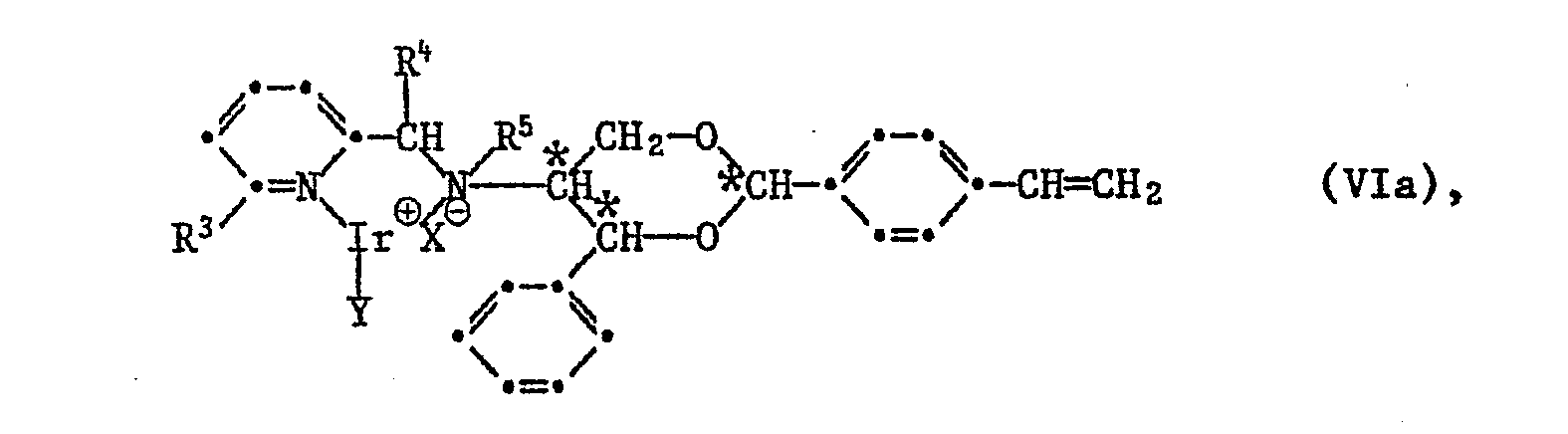
- Bevorzugt ist R1 in Formel VI Methyl oder Benzyl.
- Bei X9 als Anion einer einbasischen anorganischen oder organischen Säure kann es sich zum Beispiel um F⊖, Cl⊖, Br⊖, J⊖, C104 ⊖, NO3 ⊖, BrO3 ⊖, HSO4 ⊖, H2P03 ⊖, H2PO4 ⊖, BF4 ⊖, B(Phenyl)4 ⊖, PF6 ⊖, SbF6 ⊖, AeF6 ⊖, SbCl6 ⊖, SbCl5F⊖, HCOO⊖, CH3COO⊖, CCl3COO⊖, CF3COO⊖, CH3SO3 ⊖, CCl3SO3 ⊖, CF3SO3 ⊖, Phenyl-SO3 ⊖ oder p-Toluyl-SO3 ⊖ handeln. In einer bevorzugten Ausführungsform stellt X⊖ Halogenid, BF4 ⊖, C104 ⊖, CF3SO3 ⊖ oder PF6 ⊖ dar.
- Eine bevorzugte Untergruppe von Iridiumkomplexen sind solche, in denen X in den Formeln VI und VIa Cl⊖, 8r⊖, J⊖, BF4 ⊖, ClO4 ⊖, CF3SO3⊖ oder PF6 ⊖ ist, und R4 und R5 zusammen für eine Bindung stehen.
- Eine weitere bevorzugte Untergruppe von Iridiumkomplexen sind solche, in denen X in den Formeln VI und VIa BF4 ⊖, C104 ⊖, CF3SO3 ⊖ oder PF6 ⊖ ist und R4 und R5 zusammen je für H stehen.
- Y stellt bevorzugt ein Dien mit 6 bis 8 C-Atomen, deren Diengruppen insbesondere über 2 C-Atome verbunden sind, dar. In einer bevorzugten Ausführungsform steht Y für 1,5-Cyclooctadien, Norbornadien oder 1,5-Hexadien.
- Besonders bevorzugte Iridiumkomplexe sind solche der Formeln


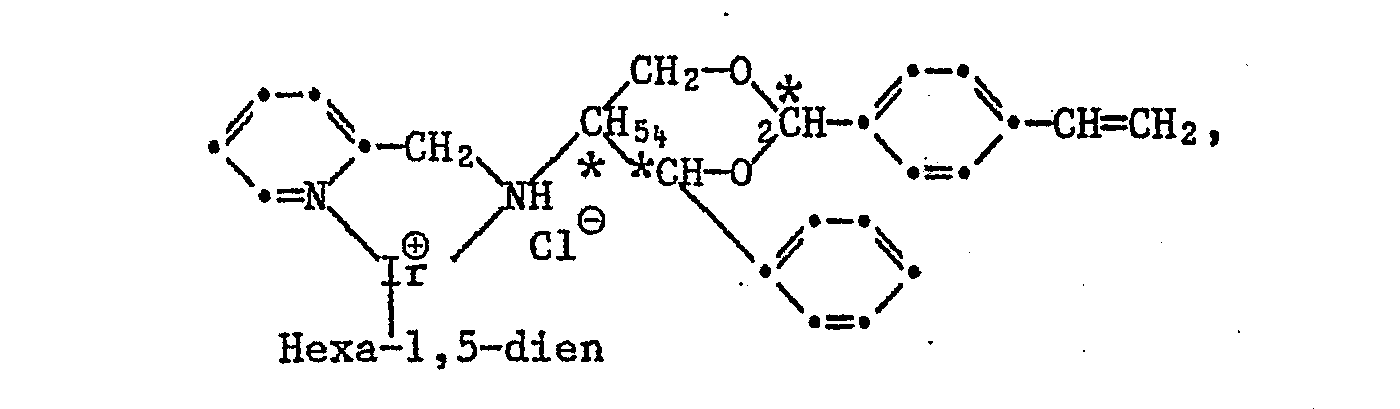
- Die Iridiumkomplexe der Formeln VI oder VIa können nach an sich bekannten Verfahren [siehe Inorganica Chimica Acta 73 (1983), S. 275 - 279] erhalten werden, indem man [(Acetonitril)Z(Y)]IrX, worin X und Y die zuvor angegebene Bedeutung haben, mit einer Verbindung der Formel I umsetzt. Die Herstellung des Acetonitrilkomplexes ist dort ebenfalls beschrieben. Die zur Herstellung des Acetonitrilkomplexes verwendeten Komplexe [lrCl(Y)]2 sind z.B. durch die Umsetzung von Dichlorotetrakis(alken)diiridium(l) (Alken z.B. Cycloocten) mit einem Dien Y erhältlich. Die Iridiumkomplexe der Formeln VI und VIa können auch nach an sich bekannten Verfahren [siehe J. of Organom. Chem., 222, S. 323 - 329 (1981)] erhalten werden, indem man einen Diiridiumkomplex der Formel [Ir(Y)Cl]2 mit einer Verbindung der Formel I umsetzt.
- Die Umsetzungen werden im allgemeinen bei Temperaturen von -10 bis 30°C in einem inerten Lösungsmittel und unter Luftausschluss (Inertgasatmosphäre) durchgeführt. Geeignete inerte Lösungsmittel sind z.B. Kohlenwasserstoffe, wie Benzol, Toluol, Xylol, Petrol- ether, Hexan, Cyclohexan, Methylcyclohexan; und Ether wie z.B. Diethylether, Dibutylether, Tetrahydrofuran und Dioxan, sowie halogenierte Kohlenwasserstoffe, z.B. Chloroform, Methylenchlorid und Chlorbenzol. Zur Herstellung von Salzen der Formel VI oder VIa mit Anionen einbasischer anorganischer oder organischer Säuren können die Salze, besonders die Chloride, der Formeln VI oder VIa, entweder direkt nach der Reaktion oder nach der Isolierung und Reinigung und dem erneuten Lösen in polaren Lösungsmitteln (z.B. Alkoholen, Ethern oder Ketonen, gegebenenfalls unter Zusatz von Wasser) mit einem Alkalisalz M⊕X'⊖ umgesalzt und danach isoliert werden. X'⊖ bedeutet ein von Xe verschiedenes Anion einer einbasischen anorganischen oder organischen Säure, M0 steht bevorzugt für Natrium.
- Die Verbindungen der Formel I eignen sich zur Herstellung von Polymeren mit optisch aktiven Seitengruppen. Ein weiterer Gegenstand der Erfindung sind Homo- und Copolymere mit optisch aktiven Seitengruppen, enthaltend, bezogen auf die Polymeren, a) 0,005 bis 100 Mol-% mindestens eines wiederkehrenden Strukturelementes der Formel VII


- Für die Strukturelemente der Formel VII gelten die gleichen Bevorzugungen wie für die Verbindungen der Formel I. Die Strukturelemente der Formel VII sind bevorzugt in einer Menge von 0,05 bis 100, besonders 0,1 bis 50 und insbesondere 0,1 bis 10 Mol-%, und die Strukturelemente eines olefinischen Comonomers entsprechend in einer Menge von 99,95 bis 0, besonders 50 bis 99,9 und insbesondere 99,9 bis 90 Mol-% enthalten.
- Das Strukturelement des olefinischen Comonomers entspricht bevorzugt der Formel VIII

- Bevorzugt sind Copolymere, worin in Formel VIII X1 für H steht, X2 H oder -CH3 bedeutet und X3 Phenyl, Cyclohexyl, -COOAlkyl mit 1 - 12 C-Atomen im Alkyl, -COO-Hydroxyalkyl mit 2 bis 4 C-Atomen im Alkyl, oder -CONR7R8 darstellt, worin R7 und R8 unabhängig für H oder Cl-12-Alkyl steht.
- Besonders bevorzugt sind Copolymere, worin in Formel VIII, X1 und X2 für H und X3 für Phenyl, oder X1 für H, X2 für -CH3 und X3 für -COO Alkyl mit 1 bis 12 C-Atomen im Alkyl stehen.
- X3, R6, R7 und R8 als Alkyl können linear oder verzweigt sein und enthalten bevorzugt 1 bis 12, besonders 1 bis 6 C-Atome. Die erfindungsgemässen Polymere können zusätzlich, bezogen auf die vorhandenen Monomeren, bis zu 60 Mol-% Strukturelemente eines zwei-oder mehrfach olefinisch ungesättigten Vernetzungsmittels enthalten. Geeignete mehrfach ungesättigte Vernetzungsmittel sind z.B. Divinylbenzole, Divinyltoluole, Divinylnaphthaline, Divinylxylole, Divinylethylbenzole, Divinylsebacat, Trivinylbenzole, Trivinylnaphthaline, Polyvinylanthracene; Ethylenglycoldiacrylat, Ethylenglycoldimethacrylat, N,N'-Methylendiacrylamid, N,N'-Methylendimethylacryl- amid, N,N'-Ethylendiacrylamid, Polyvinylether von Ethylenglycol, Propantriol, Pentaerythritol und Resorcinol.
- Das Vernetzungsmittel wird vorzugsweise in einer Menge von 0,1 - 10 Mol % eingesetzt. Bevorzugte Vernetzungsmittel sind Divinylbenzole. Durch geeignete Wahl der Comonomeren und/oder Vernetzungsmittel können die Eigenschaften der Polymeren den gewünschten spezifischen Anwendungen angepasst werden.
- Die Polymeren können ein mittleres Molekulargewicht (Mw) von 1 000 bis 5 000 000, vorzugsweise 5 000 bis 1 000 000 und besonders 5 000 bis 500 000 aufweisen (osmometrische Bestimmung).
- Die erfindungsgemässen Polymeren können in bekannter Weise erhalten werden, indem man
- a) 0,005 bis 100 Mol-% mindestens eines Monomers der Formel I und
- b) 0 bis 99,995 Mol-% mindestens eines olefinischen Comonomers, das von Komponente a) verschieden ist, polymerisiert.
- Bevorzugt ist die radikalische Polymerisation. Dabei verwendet man zweckmässig etwa 0,01 bis 5 Gew.%, vorzugsweise 0,01 bis 1,5 Gew.%, bezogen auf das Gesamtgewicht der Monomeren und allfälliger Vernetzungsmittel, an sich bekannter Radikalinitiatoren, wie anorganische oder organische Peroxide oder Azoverbindungen, z.B. Wasserstoffperoxid, Kaliumperoxidsulfat, tert-Butylhydroperoxid, Di-tert-butylperoxid, Peressigsäure, Dibenzoylperoxid, Diacylperoxide, Cumolhydroperoxid, tert-Butylperbenzoat, tert-Alkylperoxidcarbonate und a,a'-Azoisobutyronitril. Die Reaktionstemperaturen für die radikalische Polymerisation liegen im allgemeinen zwischen etwa 30 und 100°C. Die Polymerisation kann in homogener Phase, z.B. in Substanz oder in Lösung, oder in heterogener Phase, d.h. als Fällungspolymerisation, Emulsions- oder Suspensionspolymerisation, erfolgen. Bevorzugt ist die Polymerisation in Lösung. Geeignete Lösungsmittel sind z.B. Toluol, N,N-Dimethylformamid, N,N-Dimethylacetamid, Acetonitril, Tetrahydrofuran und Dioxan.
- Die erfindungsgemässen Polymeren können teilweise oder ganz mit Iridium (I)-Salzen komplexiert sein. Ein weiterer Gegenstand der Erfindung sind Polymere, die dadurch gekennzeichnet sind, dass mindestens ein Teil der Strukturelemente der Formel VII mit Iridium (I) komplexiert sind und den Formeln IX oder X entsprechen,

- Die komplexierten Polymeren können hergestellt werden, indem man A) a) 0,005 bis 100 Mol-% mindestens eines Monomers der Formeln VI oder VIa gegebenenfalls zusammen mit einem Monomer der Formel I, und b) 0 bis 99,995 Mol-% mindestens eines olefinischen Comonomers, das von Komponente a) verschieden ist, polymerisiert, oder B) dass man in Lösung ein erfindungsgemässes Homo- oder Copolymer mit Strukturelementen der Formel VII mit [(Acetonitril)2(Y)]IrX oder mit Di-[µ-Chlorotetrakis(cycloocten)-diiridium (I)]Cl und einem Dien Y umsetzt, wobei X das Anion einer einbasischen anorganischen oder organischen Säure ist.
- Die Durchführung des Verfahrens A) erfolgt im wesentlichen gleich wie die Polymerisation zur Herstellung der erfindungsgemässen nicht komplexierten Polymeren. Die Durchführung des Verfahrens B) erfolgt im wesentlichen gleich wie die Herstellung der Komplexe der Formeln VI oder VIa.
- Die erfindungsgemässen Iridiumkomplexe und komplexierten Polymere eignen sich als homogene oder heterogene enantioselektive Katalysatoren für die Hydrierung von ungesättigten organischen Verbindungen mit bevorzugt mindestens einem prochiralen C-Atom. Insbesondere eignen sie sich als solche Katalysatoren für Transferhydrierungen, bevorzugt von Ketonen.
- Ein weiterer Gegenstand der Erfindung ist die Verwendung von Iridiumkomplexen der Formeln VI und VIa als homogene enantioselektive Katalysatoren für die Transferhydrierung von prochiralen Ketonen mit sekundären Alkoholen sowie die Verwendung von erfindungsgemässen komplexierten Polymeren als homogene oder heterogene enantioselektive Katalysatoren für die Transferhydrierung von prochiralen Ketonen mit sekundären Alkoholen. Als sekundärer Alkohol ist besonders Isopropanol geeignet. Die Reaktion wird vorteilhaft unter Sauerstoffausschluss und bei erhöhter Temperatur (z.B. 50 - 150°C) durchgeführt. Zweckmässig wird der verwendete sekundäre Alkohol als Lösungsmittel eingesetzt. Die Katalysatorkonzentration beträgt bevorzugt 10 bis 10-5 Mol/l, bezogen auf das Reaktionsvolumen. Die Reaktion wird bevorzugt in Gegenwart einer Base, besonders NaOH, durchgeführt.
- Die polymerisierbaren Verbindungen der Formel I und deren Polymere sind wertvolle optisch aktive Liganden für die Herstellung von chiralen, homogenen und heterogenen Katalysatoren mit verschiedenen komplexierenden Metallverbindungen. Die monomeren Metallkomplexe können überraschend polymerisiert werden. Ein besonderer Vorteil der heterogenen, polymeren Katalysatoren ist, dass sie leicht aus dem Reaktionsgemisch entfernt und wiederverwendet werden können. Die monomeren Metallkomplexe weisen als Katalysatoren eine gute Selektivität (optische Ausbeute) und hohe Ausbeuten auf, die von den heterogenen polymeren Katalysatoren sogar noch übertroffen wird. Die nachfolgenden Beispiele erläutern die Erfindung näher.
- Zu einer Mischung von 6 g (0,024 Mol) (+)-2-Amino-l-phenyl-1,3-propandiol-hydrobromid, 25 ml p-Styrylaldehyd sowie einer Spatelspitze 2,6-Di-tert-butyl-p-kresol werden bei 5°C und unter Rühren 5,9 g (0,021 Mol) Phosphorpentoxid zugegeben. Die Suspension wird mittels Eiskühlung auf 20°C gehalten und 6 Stunden gerührt. Anschliessend wird bei 0°C mit 20 ml konzentrierter Kaliumcarbonat-Lösung versetzt und mit 50 ml Essigsäureethylester überschichtet. Unter Zugabe von 50 ml Eiswasser wird kräftig gerührt und dann das Gemisch durch Filtration von festen Bestandteilen befreit. Die wässrige Phase wird abgetrennt und zweimal mit Essigsäureethylester gewaschen. Die vereinigten organischen Phasen werden mit konzentrierter Natriumchlorid-Lösung (Sole) gewaschen, über Natriumsulfat getrocknet und bei ca. 2 kPa weitgehend vom Lösungsmittel befreit.
- Der Rückstand wird in 250 ml Methanol aufgeschlämmt und mit 20 ml Essigsäure, einer Spatelspitze 2,6-Di-tert.-butyl-p-kresol sowie 42,3 g Acethydrazid-Trimethylammoniumchlorid (Girard-Reagens T) versetzt. Nach 15 Stunden Rühren bei Raumtemperatur wird das Reaktionsgemisch auf 1,5 1 Eiswasser gegossen. Es werden portionsweise 33,3 g Natriumcarbonat zugegeben, anschliessend wird das Produkt viermal mit ca. 200 ml Essigsäureethylester extrahiert. Nach Trocknung über Natriumsulfat wird bei 1,5 kPa vom Lösungsmittel befreit. Das verbleibende gelbe Oel wird zur Reinigung an Kieselgel chromatographiert (Laufmittel: Methanol). Es werden 3,9 g (57 % der Theorie) öliges Produkt erhalten. [α]D 20= +35,7° (c = 1,143, Chloroform).
- 250 MHZ-IHFT-NMR (CDC13):
- δ= 1,55 (s; 2H), 2,95 (m; 1H), 4,31 (m; 2H), 5,13 (m; 1H), 5,27 (m; 1H), 5,72 (s; 1H), 5,76 (m; 1H), 6,74 (m; 1H), 7,24 - 7,61 (m; 9H)ppm.
- Zu einer Lösung aus 20 g (0,066 Mol) 4-(2-Bromethyl)phenyl-benzyl- keton in 100 ml Dioxan werden eine Lösung aus 50 g (0,66 Mol) Ammoniumacetat in 200 ml Methanol, 2,7 g (0,43 Mol) Natriumcyanoborhydrid sowie ca. 100 mg 4-tert.-Butylbrenzkatechin zugegeben. Nach 48 Stunden Rühren bei Raumtemperatur wird mit 50 ml konzentrierter Salzsäure angesäuert (pH 2). Anschliessend werden bei ca. 2 kPa Methanol und Dioxan weitgehend abdestilliert und durch Essigsäureethylester ersetzt. Die Lösung wird zweimal mit je 100 ml Wasser gewaschen und bei ca. 2 kPa eingeengt. Der Rückstand wird mit Ethanol/Diethylether (1 : 1) aufgenommen. Der entstandene weisse Niederschlag wird abfiltriert und das Filtrat zu einem Oel eingeengt. Nach Zugabe von 50 ml Essigsäureethylester setzt Kristallisation des Produkts ein. Es wird abgesaugt und getrocknet. Ausbeute: 10,8 g (48 % d. Theorie) weisse Kristalle. Schmelzpunkt: 165 - 168°C/Zers.
- Elementaranalyse:
- Gef.: C 56,49; H 5,31; N 4,29; Br 23,02 %
- Ber. für C16H19NBrCl (340,69): C 56,44; H 5,62; N 4,11; Br 23,45 %.
- Aus 14,7 g (0,634 Mol) Natrium und 480 ml Ethanol wird eine Natriumalkoholat-Lösung hergestellt. Es werden 65 g (0,191 Mol) (R),(S)-1-[4-(2-Bromethyl)phenyl]-2-phenylethylamin-hydrochlorid zugegeben. Die gelbe Suspension wird 15 Minuten zum Rückfluss erhitzt und nach Abkühlen auf 1 1 Eiswasser gegossen. Das Produkt wird dreimal mit je 500 ml Diethylether extrahiert. Die etherische Phase wird mit Natriumsulfat getrocknet und mit Chlorwasserstoffgas versetzt. Nach Abdestillieren des Ethers wird das Rohprodukt aus Ethanol/Diethylether (1 : 1) umkristallisiert. Ausbeute: 32,2 g (65 % d. Theorie) weisse Kristalle Schmelzpunkt: 268 - 271°C/Zers. Elementaranalyse:
- Gef.: C 70,96; H 7,27; N 5,40; Cl 12,96; H2O 3,78 %
- Ber. für C16H18NCl. 0,57 H20: C 71,18 %; H 7,14; N 5,19; Cl 13,13; H20 3,78 %.
- Aus (R),(S)-1-(4-Vinylphenyl)-2-phenylethylamin-hydrochlorid wird durch Behandeln mit Ionenaustauscher (Amberlyst A 26,OH-Form, Laufmittel : Methanol) die freie Base gewonnen. 23,1 g davon (0,103 Mol) werden in 500 ml Essigsäureethylester gelöst und mit 7,75 g (0,0502 Mol) L-(+)-Weinsäure, gelöst in 40 ml Ethanol, versetzt. Nach 48 Stunden bei ca. -15°C werden 25 g eines kristallinen Produkts erhalten, [α]D 20= + 17,7° (MeOH, C = 0,926). Dieses wird sechsmal aus Ethanol umkristallisiert, wobei die optische Drehung auf den Wert [α]D 20= +134,5° (MeOH, c = 1,006) steigt. Ausbeute: 3,8 g Elementaranalyse:
- Gef.: C 71,50; H 6,76; N 4,97; 0 16,43 %;
- Ber. für C36 H42 O6N2:
- C 72,22; H 7,07; N 4,68; 0 16,03 %.
- 2,87 g (0,0048 Mol) des zuvor beschriebenen Tartrats werden in 50 ml Essigsäureethylester gelöst. Es werden 50 ml konzentrierte Natronlauge zugegeben. Die Essigesterphase wird abgetrennt und die Wasserphase noch zweimal mit je 25 ml Essigsäureethylester nachextrahiert. Die vereinigten organischen Phasen werden mit 25 ml Sole gewaschen, über Natriumsulfat getrocknet, mit einer Spatelspitze Di-tert.-Butyl-p-kresol versetzt und bei ca. 2 kPa eingeengt. Der Rückstand wird im Kugelrohrofen bei 180°C und 9·10-3 Pa destilliert. Ausbeute 2,0 g kristallisierendes Oel. [α]D 20= + 30,4° (Chloroform, c = 1,466). Elementaranalyse:
- Gef.: C 85.66, H 7,66; N 6,16 %
- Ber. für C16H17N:
- C 86,06; H 7,68; N 6,28 %.
- Zu einer Lösung aus 41,06 g (0,279 Mol) (R),(S)-1-(4-Vinyl- phenyl)ethylamin in 250 Methanol werden bei 0°C 37,4 g (0,279 Mol) L-(-)--Aepfelsäure gegeben. Nach 15 Stunden werden die ausgefallenen Kristalle (31,0 g) abgesaugt, die Mutterlauge wird unter Vakuum eingeengt, bis erneut Kristallisation einsetzt. Es werden weitere 15 g Produkt erhalten. Die Kristallfraktionen werden vereinigt und zweimal in je 250 ml Methanol unter Zusatz von ca. 50 mg Di-tert.-butyl-p-kresol umkristallisiert. Ausbeute: 15,2 g weisses Kristallpulver, [α]D 20= + 2,10° (H2O, c= 0,95).
- 14,0 g des Kristallpulvers [(R)-1-(4-Vinylphenyl)ethylamin-L-malat] werden.in wenig Wasser gelöst und mit 100 ml Essigsäuremethylester überschichtet. Es wird mit 30 prozentiger Natronlauge alkalisch gestellt (pH > 10) und die Essigsäureethylester-Phase abgetrennt. Die Wasserphase wird 2x mit je 50 ml Essigsäureethylester nachgewaschen. Die organischen Phasen werden vereinigt, mit konzentrierter Natriumchlorid-Lösung (Sole) gewaschen, über Natriumsulfat getrocknet und unter Zusatz einer Spatelspitze Di-tert.-butyl-p-kresol eingeengt. Der Rückstand wird im Hochvakuum destilliert. Sdp. 54°C/1.10-2 Pa, Ausbeute: 7,4 g farblose Flüssigkeit [α]D 20=+ 36,20 (Chloroform, c = 0,968).
- Die bei den unter Beispiel c beschriebenen Kristallisationen anfallenden Mutterlaugen werden vereinigt und bei ca. 2 kPa weitgehend vom Lösungsmittel befreit. Analog dem in Beispiel c beschriebenen Verfahren wird das Amin freigesetzt und destilliert. Entsprechend Beispiel c wird das Amin (18,8 g) in 125 ml Methanol gelöst und mit D-(+)-Aepfelsäure (17,12 g) zur Reaktion gebracht. Das anfallende Kristallisat wird zweimal in Methanol umkristallisiert. Ausbeute: 15,0 g weisses Kristallpulver, [α]D 20= 1,84° (H2O,c = 1,25).
- Analog Beispiel c werden 14 g (S)-1-(4-Vinylphenyl)ethylamin-L-malat mit Natriumhydroxid behandelt. Nach Aufarbeitung werden 7,5 g einer farblosen Flüssigkeit erhalten. Sdp. 53°C/1·10-2 Pa, [α]D 20= -34,9° (Chloroform, c = 0,986).
- Beispiel 1: N-(6-Methyl-pyridin-2-carbaldehyd)-(R)-1-(4-vinyl-
-

- Gef. C 81,71; H 7,25; N 11,02 %
- Ber. für C17H18N2 (250,35):
- C 81,56; H 7,25; N 11,19 %.
-

- Nach vollständigem Entfernen des Lösungsmittels bei ca. 1,5 Pa werden 1,5 g (97 % d. Theorie) weisse Kristalle erhalten. Elementaranalyse: Gef. C 84,55; H 6,74; N 8,32 % Ber. für C23H22N2 (326,45): C 84,62; H 6,79; N 8,58 %
-

- Ber. für C24H22N2O2 (370,45):
- C 77,81; H 5,99; N 7,56; 0 8,64 %.
-

- [α]D 20= +52,9 (0,926, Chloroform). 250 MHz-1HFT-NMR (CDC13): δ= 1.41 (d; 3H), 2,26 (breit; 1H), 2,53 (s; 3H), 3,70 (s; 2H), 3,82 (q; 1H), 5,21 (m; 1H), 5,72 (m; 1H), 6,71 (m; 1H), 6,97 - 7,50 (m; 7H)ppm.
-
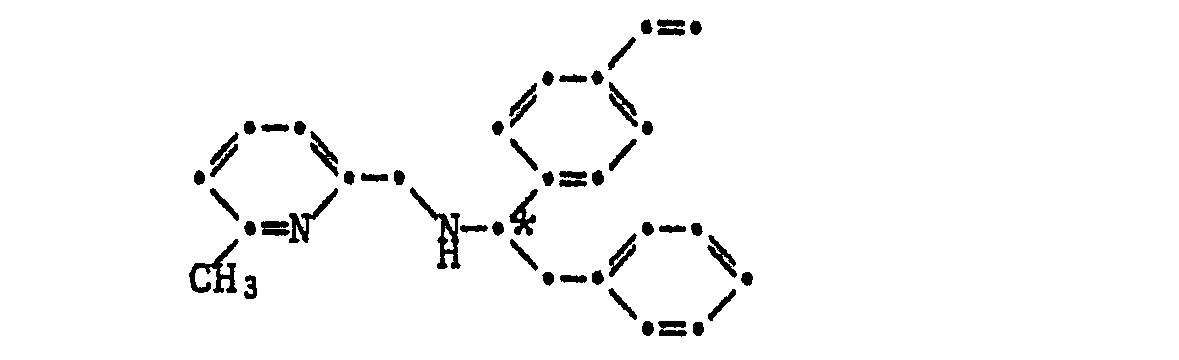
-

- 250 MHz-1HFT-NMR (CDCl3): δ= 2,28 (breit; 1H), 2,71 (d; 1H), 3,68-3,93 (m; 2H), 4,10 - 4,49 (m; 2H), 5,12 (d; 1H), 5,26 (m; 1H), 5,74 (s; 1H), 5,77 (m; 1H), 6,72 (m; 1H), 6,76 - 8,35 (m; 13 H).
- Beispiel 7: [Ir(N,N)(HD)Cl], N,N: Verbindung gemäss Beispiel 1 Unter Argonschutzgas werden 0,600 g (0,68 mmol) Di-u-chlorotetrakis-(cycloocten)diiridium (I) in 50 ml Benzol gelöst. Bei 10°C werden 4,4 ml 1,5-Hexadien (HD) zugegeben. Nach 30 Minuten Rühren bei Raumtemperatur werden 375 mg (1,5 mmol) N-(6-Nethyl-pyridin-2-carb- aldehyd)-(R)-1-(4-vinylphenyl)ethylimin (Beispiel 1) zugegeben.
- Nach 1 Stunde Rühren bei Raumtemperatur werden unter Luftausschluss 100 ml n-Hexan zugegeben. Im Verlauf von 2 Stunden kristallisiert bei 0°C das Produkt aus. Es wird unter Argonatmosphäre abgesaugt, mit n-Hexan gewaschen und 3 Stunden bei 1,3 Pa getrocknet. Ausbeute: 0,500 g (66 % d. Theorie) beiges Pulver.
- Elementaranalyse: Gef. C 48,05; H 5,16; N 4,99; Ir 34,3 % Ber. für C23H28NzIrCl (560.16): C 49,32; H 5,04; N 5,00; Ir 34,31 %.
- Beispiel 8: [Ir(N,N)(HD)J], N,N: Verbindung gemäss Beispiel 3 Unter Argonschutzgas werden 0,492 g (0,55 mmol) Di-µ-chlortetra- kis(cycloocten)diiridium (I) in 80 ml Aceton gelöst. Bei 5°C werden 3,4 ml 1,5-Hexadien (HD) zugegeben. Es wird 10 Minuten auf 35°C erwärmt, anschliessend bei 0°C eine Lösung aus 0,380 g (2,5 mmol) Natriumjodid in 12 ml Wasser unter Luftausschluss zugegeben, unmittelbar darauf eine Lösung aus N-(Pyridin-2-carbaldehyd)-(2R,4S,5S)-5-imino-2-(4-vinylphenyl)-4-phenyl-1,3-dioxan (Beispiel 3) in 4 ml Aceton. Nach 1 Stunde wird auf die Hälfte des Volumens eingeengt. Im Verlauf einer Stunde kristallisiert das Produkt bei 0°C aus. Es wird unter Schutzgas abgesaugt, mit ca. 40 ml Wasser gewaschen und 8 Stunden bei 0,13 Pa über Phosphorpentoxid getrocknet. Ausbeute: 0,520 g (67 % d. Theorie) dunkelblaue Kristalle. Elementaranalyse:
- Gef. C 46,59; H 4,16; N 3,60; J 16,31;
- Ber. für C30H32N2O2Ir (771,71): C 46,69; H 4,18, N 3,63; J 16,44%.
- Unter Argonschutzgas werden 0,469 g (1,0 mmol) [Bis(acetonitril)cycloocta-1,5-dien]iridiumtetrafluoroborat in 15 ml Dichlormethan gelöst. Bei Raumtemperatur und unter Rühren wird eine Lösung aus 5 ml Dichlormethan und 0,252 g (1.0 mmol) 2-{N-[(N-[(R)-1-(4-Vinyl- phenyl)ethyl]aminomethyl}-6-methyl-pyridin (Beipiel 4) zugetropft. Nach 1 Stunde wird bei ca. 600 Pa auf etwa ein Drittel des Volumens eingeengt. Es werden 60 ml Diethylether zugegeben, wobei das Produkt innerhalb 2 Stunden als fester Niederschlag ausfällt. Das Produkt wird unter Argonatmosphäre abgesaugt, dreimal mit Diethylether gewaschen und 15 Stunden bei 0,1 Pa getrocknet. Ausbeute 0,588 g (92 % d. Theorie) ockergelbe Kristalle.
- Elementaranalyse:
- Gef.: C 45,07; H 5,12; N 4,27; Ir 28,5 %
- Ber. für C25H32N2IrBF4, ·1,5 H2O (666,57):
- C 45,05; H 5,29; N 4,20; Ir 28,83 %.
- Analog Beispiel 9 werden 0,469 g (1,0 mmol) Bis(acetonitril(cyclo- octa-1,5-dien)iridium-tetrafluoroborat mit 0,316 g (1.0 mmol) 2-{N-[(S)-1-(4-Vinylphenyl)-2-phenyl-ethyl]aminomethyl}-6-methyl- pyridin (Beispiel 5) zur Reaktion gebracht. Nach entsprechender Aufarbeitung werden 0,641 g (91 % d. Theorie) gelbe Kristalle erhalten.
- Elementaranalyse:
- Gef.: C 49,80; H 5,19; N 3,82; Ir 24,9 %; F 10,32 %
- Ber. für C31H36N2IrBF4·2 Hz0 (751,68):
- C 49,53; H 5,36; N 3,79; Ir 25,57 %; F 10,11 %.
- Analog Beispiel 9 werden 0,260 g (0,605 mmol) Bis(acetonitril)cyclo- octa-1,5-dien)iridium-tetrafluoroborat mit 0,225 g (0,605 mmol) 2-{N-((2R,4S,5S)-2-(4-Vinylphenyl)-4-phenyl-1,3-dioxan-5-yl)aminomethyl}pyridin (Beispiel 6) zur Reaktion gebracht. Nach entsprechender Aufarbeitung werden 0,380 g (79 % der Theorie) orange-braune Kristalle erhalten.
- Elementaranalyse:
- Gef. C 48,36; H 4,93; N 3,74; F 10,18; Ir-24,5 %
- Ber. für C32H40N2O4IrBF4·2 H2O (795,69): C 48,30; H 5,07; N 3,52;
- F 9,55; Ir 24,16 %.
- 30,0 mg (0,0536 mmol) Komplex, hergestellt gemäss Beispiel 7, 6,97 mg (0,0536 mmol) techn. Divinylbenzol (techn. DVB) und 509,8 mg (2,571 mmol) frisch destillierter Methacrylsäure-2-ethylhexylester werden in 7 ml Tetraydrofuran gelöst. In einer mit Argon gespülten Ampulle wird die dunkel rotbraune Lösung mit 3,3 mg Azobisisobutyronitril (AIBN), gelöst in 1 ml Tetrahydrofuran, gemischt. Es wird unter Luftausschluss auf 70°C erhitzt und nach 24 Stunden, dann nach weiteren 18 Stunden je die gleiche Menge AIBN zugegeben. Nach weiteren 30 Stunden Polymerisation bei 75°C wird eine im Durchlicht leuchtend rote feinteilige Emulsion erhalten. Der Restmonomerengehalt an Methacrylsäure-2-ethylhexylester wird mittels Gaschromatographie (CW-20 M) auf 7 % der ursprünglich eingesetzten Menge bestimmt.
- Das Volumen wird auf 3,5 ml eingeengt und die Emulsion für die katalytische Anwendung verwendet. Die Katalysatorkapazität wird mit 1,148·10-5 Mol Wiederholungseinheiten Iridiumkomplex pro 1 ml Emulsion bestimmt.
- 0,2504 g (1 mmol) N-(6-Methyl-pyridin-2-carbaldehyd)-(R)-1-vinyl- phenyl)ethylimin(N,N-Ligand) und 1,979 g (19,0 mmol) frisch destilliertes Styrol werden in 5 ml Benzol gelöst. In einer mit Argon gespülten Ampulle wird die Lösung mit 24,6 mg AIBN gemischt und 20 Stunden auf 70°C erhitzt. Die entstandene viskose Lösung wird um ca. 1/3 des Volumens mit Benzol verdünnt. Durch Eingiessen in 250 ml Methanol wird ein weisses Pulver erhalten. Es wird in Tetrahydrofuran gelöst und aus Methanol umgefällt. Es wird durch Zentrifugieren vom überstehenden Fällungsmittel abgetrennt und 15 Stunden bei 40°C und 0,12 Pa getrocknet. Ausbeute 1,03 g [a]t3= +0,44° (c = 4,966, Chloroform). Elementaranalyse Gef.: C 90,43; H 7,70; N 1,39 %, Ber. für 0,056 (C17H18N2) + 0,944 (C8H8): C 90,92; H 7,68; N 1,40 % Ligandenkapazität: 0,499 mmol/g.
- Unter Argonschutzgas werden 0,0893 g Di-p-chlorotetrakis (cycloocten)diiridium(I) BF4 in 5 ml Benzol gelöst. Bei 10°C werden 1,2 ml 1,5-Hexadien (HD) zugegeben. Nach 30 Minuten Rühren bei Raumtemperatur wird eine Lösung aus 0,4000 g Polymer, hergestellt nach Beispiel 13, und 5 ml Benzol zugetropft. Es entsteht eine dunkelrote Lösung, die nach 1 Stunde Rühren unter Luftausschluss auf ca. 1/3 des Volumens eingeengt und direkt zur katalytischen Transferhydrierung verwendet wird. Die Katalysatorkapazität wird mit 1,766·10-5 Mol Wiederholungseinheiten pro 1 ml Lösung bestimmt.
- 95,9 mg (0,15 mmol) Komplex, hergestellt gemäss Beispiel 9, 19,5 mg (0,15 mmol) 1,4-Divinylbenzol (1,4-DVB) und 1,428 g (7,2 mmol) frisch destillierter Methacrylsäure-2-ethylhexylester werden in 12 ml Tetrahydrofuran gelöst. In einer mit Argon gespülten Ampulle wird die ockerfarbene Lösung mit 9,23 mg AIBN, gelöst in 0,2 ml Tetrahydrofuran, gemischt. Es wird unter Luftausschluss auf 70°C erhitzt und nach 65 Stunden erneut die gleich Menge AIBN zugegeben. Nach weiteren 48 Stunden bei 70°C wird eine viskose, feinteilige Emulsion mit heller rotbrauner Farbe erhalten. Das Volumen wird auf 10 ml eingestellt, wobei die Katalysatorkapazität mit 1,42 10-5 Mol Wiederholungseinheiten Iridiumkomplex pro 1 ml Emulsion bestimmt wird.
- Analog Beispiel 15 werden 107,3 mg (0,15 mmol) Komplex, hergestellt gemäss Beispiel 10, 19,5 mg (0,15 mmol) 1,4-DVB und 1,428 g (7,2 mmol) Methacrylsäure-2-ethylhexylester in 12 ml Tetrahydrofuran copolymerisiert. Es wird eine viskose, feinteilige Emulsion mit ockergelber Farbe erhalten.
- Analog Beispiel 15 werden 113,9 mg (0,15 mmol) Komplex, hergestellt gemäss Beispiel 11, 19,5 mg (0,15 mmol) 1,4-DVB und 1,428 g (7,2 mmol) Methacrylsäure-2-ethylhexylester in 12 ml Tetrahydrofuran copolymerisiert.
- Es wird eine viskose orangebraune Emulsion erhalten. Die Konzentration wird wie in Beispiel 15 beschrieben eingestellt.
- Beispiel 18: Copolymer aus N,N-Ligand (gemäss Beispiel 3, 2 Mol %), Methacrylsäure-2-ethylhexylester (96 Mol %) und 1,4-DVB (2 Mol %)
- Analog Beispiel 13 werden 111,1 mg (0,3 mmol) N-(Pyridin-2-carbal- dehyd)-(2R,4S,55)-5-imino-2-(4-vinylphenyl)-4-phenyl-1,3-dioxan, 39,1 mg (0,3 mmol) 1,4-DVB und 2,856 g (0,0144 Mol) Methacrylsäure-2-ethyl-hexylester in 15 ml Tetrahydrofuran copolymerisiert. Nach 22 Stunden wird ein farbloses Oel erhalten, welches durch zweimaliges Versetzen mit Benzol und Abdampfen von Tetrahydrofuran bei ca. 3 kPa umgequollen wird. Das Produkt gelangt ohne Isolierung zur weiteren Umsetzung (Beispiel 19).
- Analog Beispiel 3 werden 0,130 g Di-µ-chlorotetrakis(cycloocten)di- iridium (I) mit 1,5 Hexadien und dem Polymer gemäss Beispiel 18 umgesetzt. Nach 16 Stunden wird ein tiefblaues, im Durchlicht rotviolettes Gel erhalten. Es wird durch dreimaliges Versetzen mit Isopropanol unter Luftausschluss und Abdampfen vom Lösungsmittel gequollen. Es wird ein braunes Gel erhalten, das direkt zur katalytischen Anwendung gelangt. Eine Probe wird 15 Sekunden bei 0,1 Pa getrocknet. Elementaranalyse:
- Gef. C 71,48; H 10,73; N 0.3; Ir 1,71 %,
- Ber. für 0,02 (C30H32N2O2IrCl) + 0,02 (CloHlo) + 0,96 (C12H22O2) C 71,63; H 10,72; N 0,27; Ir 1,86 %.
- Analog Beispiel 15 werden 128 mg (0,2 mmol) Komplex, hergestellt gemäss Beispiel 9, 26 mg (0,2 mmol) 1,4-DVB und 1,365 g (9,6 mmol) Methacrylsäure-tert-butylester in 12 ml Tetrahydrofuran copolymerisiert.
- Es wird eine viskose, feinteilige Emulsion mit orange-brauner Farbe erhalten. Das Volumen wird auf 10 ml eingestellt.
- Beispiel 21: 70,0 mg des gemäss Beispiel 7 hergestellten Komplexes werden unter Sauerstoffausschluss (Argonatomosphäre) in 31 ml Isopropanol gelöst. Nach 1 Stunde Rühren bei 60°C werden 5,0 ml 0,1 normale Natriumhydroxid-Lösung zugegeben. Es wird eine weitere Stunde bei 60°C gerührt und anschliessend eine Lösung aus 31 ml Isopropanol und 1,85 g 1-Phenylbutanon unter Sauerstoffausschluss hinzugefügt. Das molare Verhältnis Substrat zu Katalysator beträgt somit [S]/[Kat.] = 100, die Katalysatorkonzentration [Kat.] = 2 ·10-3 Mol/l.
- Nach 16 Stunden bei 60°C wird gaschromatographisch (10 % CW - 20 M, 185°C, isotherm) eine Ausbeute an 1-Phenylbutanol von 81,1 % bestimmt.
- Zur Bestimmung des Enantiomerengehalts nach Mosher (J.A. DALE, D.L. DULL and H.S. MOSHER, J. Org. Chem. 34 (1969) 2543) wird eine Probe (ca. 0,5 ml) weitgehend vom Lösungsmittel befreit und bei 0°C mit 50 µl optisch reinem a-Methoxy-a-trifluormethylphenylacetylchlorid sowie 0,25 ml trockenem Pyridin versetzt. Nach 15 Minuten wird 30 Minuten auf 70°C erwärmt, nach Abkühlen mit 3 ml 10 prozentiger Zitronensäurelösung versetzt und mit Diethylether die diastereomeren Ester extrahiert.
- Gaschromatographisch (Kapillarsäule CW 20, 190°C, isotherm) wird ein Enantiomerenüberschuss an (R)-1-Phenylbutanol von ee = 26,0 % bestimmt.
- Beispiel 22: Entsprechend Beispiel 21 wird der Komplex nach Beispiel 8 zur katalytischen enantioselektiven Transferhydrierung von 1-Phenylbutanon verwendet.
- Nach 19 Stunden 30 Minuten beträgt die Ausbeute 23,6 % an 1-Phenylbutanol, der Enantiomerenüberschuss ee = 60,3 % (S).
- Beispiel 23: Entsprechend Beispiel 21 wird der Komplex nach Beispiel 9 zur katalytischen, enantioselektiven Transferhydrierung von 1-Phenylbutanon verwendet.
- Nach 2 Stunden 50 Minuten beträgt die Ausbeute 97,3 % an 1-Phenylbutanol, der Enantiomerenüberschuss ee = 48,7 % (R).
- Beispiel 24: Entsprechend Beispiel 21 wird der Komplex nach Beispiel 11 zur katalytischen, enantioselektiven Transferhydrierung von 1-Phenylbutanon verwendet.
- Nach 20 Stunden beträgt die Ausbeute 75,2 % an 1-Phenylbutanol, der Enantiomerenüberschuss ee = 58,1 % (S).
- Beispiel 25: 3,5 ml der nach Beispiel 12 erhaltenen Emulsion werden unter Sauerstoffausschluss (Argonatmosphäre) zu 15 ml Isopropanol gegeben. Nach 1 Stunde Rühren bei 60°C werden 1,61 ml 0,1 normale Natriumhydroxid-Lösung zugegeben, wobei das zuvor feinteilig dispergierte Polymer zu grösseren Partikeln agglomeriert. Es wird eine weitere Stunde bei 60°C gerührt und anschliessend eine Lösung aus 5 ml Isopropanol und 0,60 g 1-Phenylbutanon unter Sauerstoffausschluss hinzugefügt. Das molare Verhältnis Substrat zu Katalysator beträgt somit [S]/[Kat.] - 100.
- Nach 19 Stunden bei 60°C wird gaschromatographisch (10 % CW - 20 M, 185°C, isotherm) eine Ausbeute an 1-Phenylbutanol von 79,7 % bestimmt.
- Zur Bestimmung des Enantiomerengehalts nach Mosher wird eine Probe (ca. 0,5 ml) weitgehend vom Lösungsmittel befreit und bei 0°C mit 50 ul optisch reinem α-Methoxy-α-trifluormethylphenylacetylchlorid sowie 0,25 ml trockenem Pyridin versetzt. Nach 15 Minuten wird 30 Minuten auf 70°C erwärmt, nach Abkühlen mit 3 ml 10 prozentiger Zitronensäurelösung versetzt und mit Diethylether die diastereomeren Ester extrahiert.
- Gaschromatographich (Kapillarsäule CW 20, 190°C, isotherm) wird ein Enantiomerenüberschuss an (R)-1-Phenylbutanol von ee = 66,2 % (R) bestimmt.
- Beispiel 26: Entsprechend Beispiel 25 werden 5,5 ml der nach Beispiel 14 erhaltenen Lösung zur katalytischen enantioselektiven Transferhydrierung von 1-Phenylbutanon verwendet. Der Katalysator agglomeriert unter den Reaktionsbedingungen der Aktivierung zu einer kompakten Masse.
- Nach 41 Stunden beträgt die Ausbeute 12,4 % an 1-Phenylbutanol, der Enantiomerenüberschuss ee = 42,2 % (R).
- Beispiel 27: Entsprechend Beispiel 25 werden 0,8 ml der nach Beispiel 15 erhaltenen Emulsion zur katalytischen, enantioselektiven Transferhydrierung von 1-Phenylbutanon verwendet. Es wird jedoch das Konzentrationsverhältnis [S]/[Kat] = 1000 gewählt. Der heterogene Katalysator ist während der Reaktion feinteilig dispergiert.
- Nach 6 Stunden beträgt die Ausbeute 91,9 % an 1-Phenylbutanol, der Enantiomerenüberschuss ee = 85,3 % (R).
- Beispiel 28: Entsprechend Beispiel 25 werden 70 ml der nach Beispiel 15 erhaltenen Emulsion zur katalytischen, enantioselektiven Transferhydrierung von 1-Phenylbutanon verwendet. Es wird das Konzentrationsverhältnis [S]/[Kat.] = 100 gewählt.
- Nach 2 Stunden 50 Minuten beträgt die Ausbeute 96,1 % an 1-Phenylbutanol, der Enantiomerenüberschuss ee = 78,7 % (R).
- Beispiel 29: Der gemäss Beispiel 28 verwendete Katalysator wird wiedergewonnen, indem er von der überstehenden Lösung abgetrennt und das zurückbleibende braune Gel zweimal mit Isopropanol unter Luftausschluss gewaschen wird. Nach dem Dekantieren wird das Gel mit 30 ml Isopropanol dispergiert und bei 60°C mit 3,98 ml 0,1 normaler Natriumhydroxid-Lösung versetzt. Nach einer Stunde bei 60°C werden 1,48 g 1-Phenylbutanon in 30 ml Isopropanol zugegeben. Des weiteren wird wie in Beispiel 25 beschrieben verfahren.
- Nach 2 Stunden beträgt die Ausbeute 94,5 % an 1-Phenylbutanol, der Enantiomerenüberschuss ee * 82,6 % (R).
- Die Vorgänge des Wiedergewinnens, Reinigens und Wiedereinsetzens des Katalysators werden noch zweimal wiederholt.
- Die Ausbeuten an 1-Phenylbutanol betragen nach 3 Stunden 25 Minuten 94,6 % bzw. nach 3 Stunden 45 Minuten 90,9 %, die Enantiomeren- überschüsse ee = 80,8 % (R) bzw. ee = 78,8 % (R).
- Beispiel 30: Entsprechend Beispiel 25 werden 2,2 ml der nach Beispiel 15 erhaltenen Emulsion zur katalytischen enantioselektiven Transferhydrierung von 1,4-Diphenylbutanon verwendet.
- Nach 6 Stunden 30 Minuten beträgt die Ausbeute 94,5 % an 1,4-Diphenylbutanol. Der Enantiomerenüberschuss wird aus dem 19F-NMR-Spektrum der diastereomeren Ester nach Mosher mit ee = 85,7 % bestimmt.
- Beispiel 31: Analog Beispiel 25 werden 7,0 ml der nach Beispiel 17 erhaltenen Emulsion zur katalytischen, enantioselektiven Transferhydrierung von 1-Phenylbutanon verwendet. Der heterogene Katalysator ist während der Reaktion grobteilig dispergiert.
- Nach 20 Stunden beträgt die Ausbeute 85,8 % an 1-Phenylbutanol, der Enantiomerenüberschuss ee = 78,7 % (S).
- Beispiel 32: Entsprechend Beispiel 25 werden 5 ml der nach Beispiel 20 erhaltenen Emulsion zur katalytischen enantioselektiven Transferhydrierung von 1-Phenylbutanon verwendet. Es wird das Konzentrationsverhältnis [S]/[Kat] = 100 gewählt. Nach Beendigung der Aktivierungszeit wird die Reaktionstemperatur auf 24°C gesenkt.
- Nach 45 Stunden beträgt die Ausbeute 95,2 % an 1-Phenylbutanol, der Enantiomerenüberschuss ee = 90,6 % (R).
Claims (51)
1. Optisch aktive Verbindungen der Formel I

worin R1 C1-C4-Alkyl, Phenyl oder Benzyl bedeutet, R2 einen Rest der Formeln II oder IIa

darstellt, worin R3 für H oder -CH3 steht, oder R1 und R2 zusammen ein Rest der Formel

sind, worin R2 die zuvor angegebene Bedeutung hat; und * für überwiegend R- oder überwiegend S-Konfiguration steht.
2. Verbindungen der Formel I gemäss Anspruch 1, worin R1 Methyl oder Benzyl ist.
3. Verfahren zur Herstellung von Verbindungen der Formel I gemäss Anspruch 1, dadurch gekennzeichnet, dass man zur Herstellung der Verbindungen der Formel I, worin R2 ein Rest der Formel II ist, einen Pyridinaldehyd der Formel III
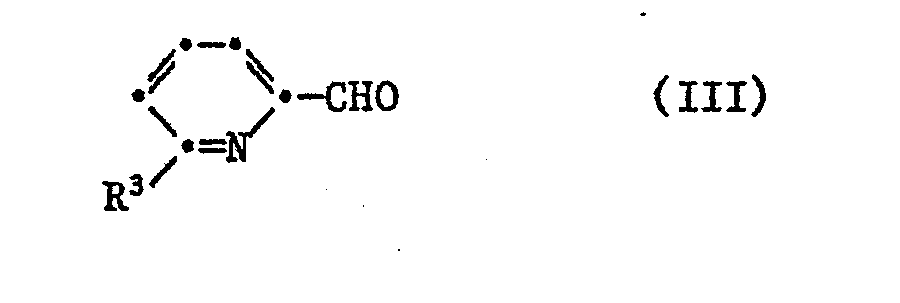


4. Iridiumkomplexe mit Verbindungen der Formel I gemäss Anspruch 1, dadurch gekennzeichnet, dass der Komplex den Formeln VI oder VIa entspricht,
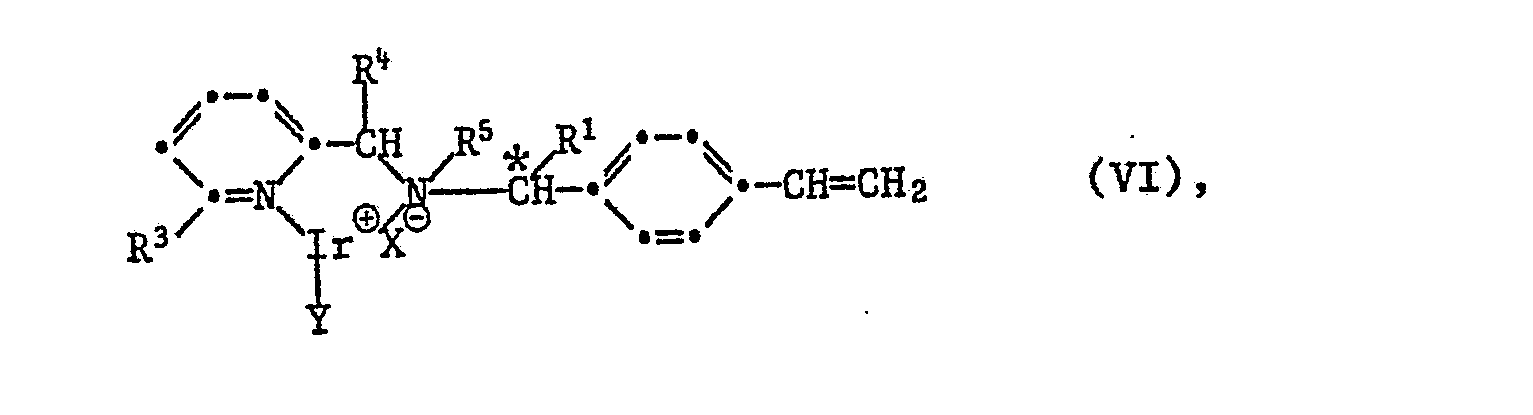

worin * für überwiegend R- oder überwiegend S-Konfiguration steht, Rl und R3 die in Anspruch 1 angegebene Bedeutung haben, R4 und R5 je für H stehen oder zusammen eine Bindung darstellen, X⊖ für das Anion einer einbasischen anorganischen oder organischen Säure und Y ein offenkettiges oder cyclisches Dien mit 6 bis 10 C-Atomen, dessen Diengruppen über 1 oder 2 C-Atome verbunden sind, bedeuten.
5. Iridiumkomplexe gemäss Anspruch 4, worin Rl in Formel VI Methyl oder Benzyl ist.
6. Iridiumkomplexe gemäss Anspruch 4, worin Y in den Formeln VI und VIa ein Dien mit 6 bis 8 C-Atomen darstellt, dessen Diengruppen über 2 C-Atome verbunden sind.
7. Iridiumkomplexe gemäss Anspruch 4, worin Y in den Formeln VI und VIa für Cycloocta-1,5-dien, Norbornadien oder Hexa-1,5-dien stehen.
8. Iridiumkomplexe gemäss Anspruch 4, worin X⊖ in den Formeln VI und VIa Halogenid, BF4 ⊖, ClO4 ⊖, CF3SO3 ⊖ oder PF6 9 ist.
9. Iridiumkomplexe gemäss Anspruch 4, worin X⊖ in den Formeln VI und VIa Cl⊖, Br⊖, J⊖, BF4 ⊖, ClO4 ⊖, CF3SO3 ⊖ oder PF6 ist, und R4 und R5 zusammen für eine Bindung stehen.
10. Iridiumkomplexe gemäss Anspruch 4, worin X⊖ in den Formeln VI und VIa BF4 ⊖, ClO4 ⊖, CF3SO3 ⊖ oder PF6 e ist und R4 und R5 zusammen je für H stehen.
11. Iridiumkomplexe gemäss Anspruch 4 der Formeln

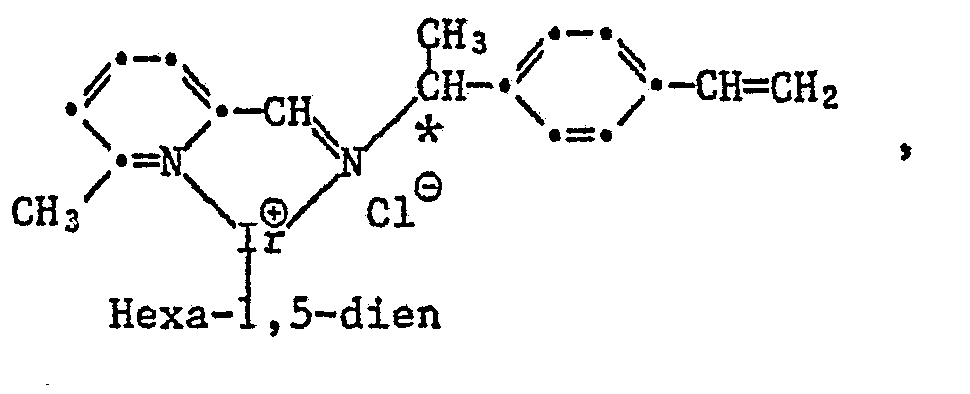
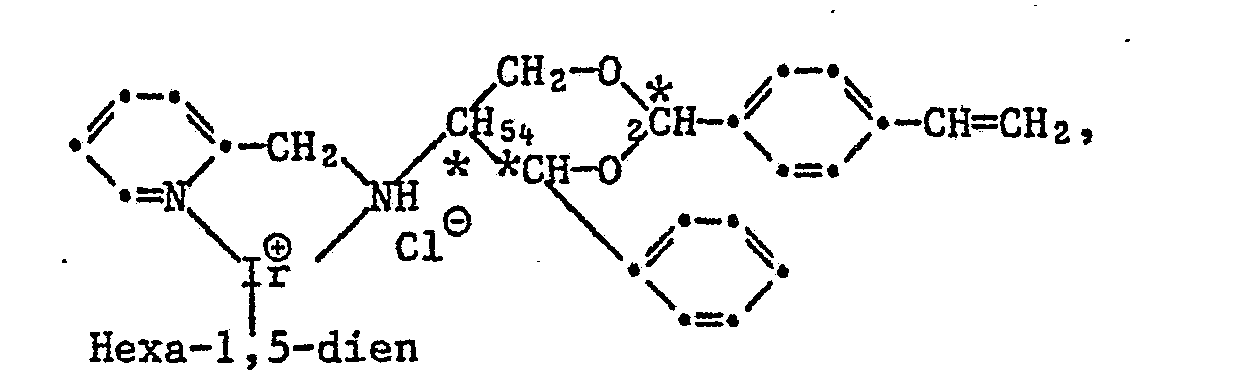
worin * für überwiegend R-Konfiguration bzw. 2R,4S,5S-Konfiguration steht.
12. Homo- und Copolymere mit optisch aktiven Seitengruppen, enthaltend, bezogen auf die Polymeren
a) 0,005 bis 100 Mol-% mindestens eines wiederkehrenden Strukturelementes der Formeln VII

worin R1 C1-C4-Alkyl, Phenyl oder Benzyl bedeutet, R2 einen Rest der Formeln II oder IIa

darstellt, worin R3 für H oder -CH3 steht, oder R1 und R2 zusammen ein Rest der Formel

sind, worin R2 die zuvor angegebene Bedeutung hat; und * für überwiegend R- oder überwiegend S-Konfiguration steht, und
b) 99,995 bis 0 Mol-% mindestens eines von einem olefinischen Comonomer abgeleiteten Strukturelementes, das von Komponente a) verschieden ist.
13. Polymere gemäss Anspruch 12, worin R1 in Formel VII für Methyl oder Benzyl steht.
14. Polymere gemäss Anspruch 12, die
a) 0,05 bis 100 Mol-% der Strukturelemente der Formel VII und
b) 99,95 bis 0 Mol-% Strukturelemente eines olefinischen Comonomers enthalten.
15. Polymere gemäss Anspruch 14, die
a) 0,1 bis 10 Mol-% der Strukturelemente der Formel VII und
b) 99,9 bis 90 Mol-X Strukturelemente eines olefinischen Comonomers enthalten.
16. Polymere gemäss Anspruch 12, in denen das Strukturelement der Komponente b) der Formel VIII

entspricht, worin X1 Wasserstoff, X2 Wasserstoff, Chlor oder Methyl und X3 Wasserstoff, Methyl, Chlor, -CN, -CONR7R8, worin R7 und R8 unabhängig H oder C1-C18-Alkyl sind, Phenyl, Methylphenyl, Methoxyphenyl, Cyclohexyl, -COO-Alkyl mit 1 - 12 C-Atomen im Alkyl, -COO-Phenyl, -COO-Alkyl-OH mit 2 - 6 C-Atomen im Alkyl, -OCO-Alkyl mit 1 - 4 C-Atomen im Alkyl, -OCO-Phenyl, Alkoxy mit 1 - 20 C-Atomen oder Phenoxy, oder X2 Wasserstoff und X1 und X3 zusammen eine Gruppierung -CO-NR6-CO- oder je -COO-Alkyl mit 1 - 6 C-Atomen im Alkyl darstellen, wobei R6 geradkettiges oder verzweigtes C1-C18-Alkyl, Cyclohexyl oder Phenyl bedeutet, das durch CI-C6-Alkyl, Halogen, Cyano, Nitro und/oder C1-C3 Alkoxy mono- oder disubstituiert sein kann.
17. Polymere gemäss Anspruch 16, worin in Formel VIII Xl für H steht, X2 H oder -CH3 bedeutet und X3 Phenyl, Cyclohexyl, -COO-Alkyl mit 1 - 12 C-Atomen im Alkyl, -COO-Hydroxyalkyl mit 2 bis 4 C-Atomen im Alkyl, oder -CONR7R8 darstellt, worin R7 und R8 unabhängig für H oder Cl-12-Alkyl steht.
18. Polymere gemäss Anspruch 16, worin in Formel VIII X1 und X2 für H und X3 für Phenyl, oder X1 für H, X2 für -CH3 und X3 für -COO-Alkyl mit 1 bis 12 C-Atomen im Alkyl stehen.
19. Polymere gemäss Anspruch 12, dadurch gekennzeichnet, dass sie, bezogen auf die vorhandenen Monomeren, bis zu 60 Mol-% Strukturelemente eines zwei- oder mehrfach olefinisch ungesättigten Vernetzungsmittels enthalten.
20. Polymere gemäss Anspruch 19, dadurch gekennzeichnet, dass sie 0,1 bei 10 Mol-% Vernetzungsmittel enthalten.
21. Polymere gemäss Anspruch 19, dadurch gekennzeichnet, dass sie ein Divinylbenzol als Vernetzungsmittel enthalten.
22. Polymere gemäss Anspruch 12, dadurch gekennzeichnet, dass mindestens ein Teil der Strukturelemente der Formel VII mit Iridium (I) komplexiert sind und den Formeln IX oder X entsprechen,

worin R1 C1-C4-Alkyl, Phenyl oder Benzyl bedeutet, R3 H oder -CH3 sind, R4 und R5 je für H stehen oder zusammen eine Bindung darstellen, Xe für das Anion einer einbasischen anorganischen oder organischen Säure und Y ein offenkettiges oder cyclisches Dien mit 6 bis 10 C-Atomen, dessen Diengruppen über 1 oder 2 C-Atome verbunden sind, bedeuten.
23. Verfahren zur Herstellung von Polymeren gemäss Anspruch 12, dadurch gekennzeichnet, dass man
a) 0,005 bis 100 Mol-% mindestens eines Monomers der Formel I gemäss Anspruch 1 und
b) 0 bis 99,995 Mol-% mindestens eines olefinischen Comonomers, das von Komponente a) verschieden ist, polymerisiert.
24. Verfahren zur Herstellung von mit Iridium (I) komplexierten Polymeren gemäss Anspruch 22, dadurch gekennzeichnet, dass man
A) a) 0,005 bis 100 Mol-% mindestens eines Monomers der Formeln VI oder VIa gemäss Anspruch 4 gegebenenfalls zusammen mit einem Monomer der Formel I gemäss Anspruch 1, und
b) 0 bis 99,995 Mol-% mindestens eines olefinischen Comonomers, das von Komponente a) verschieden ist, polymerisiert, oder
B) dass man in Lösung ein Homo- oder Copolymer gemäss Anspruch 12 mit [(Acetonitril)2(Y)]IrX oder mit Di-[µ-Chlorotetrakis(cycloocten)-diiridium (I)] Cl und einem Dien Y umsetzt, wobei X das Anion einer einbasischen anorganischen oder organischen Säure ist.
25. Verwendung von Iridiumkomplexen der Formeln VI und VIa gemäss Anspruch 4 als homogene enantioselektive Katalysatoren für die Transferhydrierung von prochiralen Ketonen mit sekundären Alkoholen.
26. Verwendung von komplexierten Polymeren gemäss Anspruch 22 als homogene oder heterogene enantioselektive Katalysatoren für die Transferhydrierung von prochiralen Ketonen mit sekundären Alkoholen.
27. Reine stereoisomere optisch aktive Amine der Formeln IV oder V
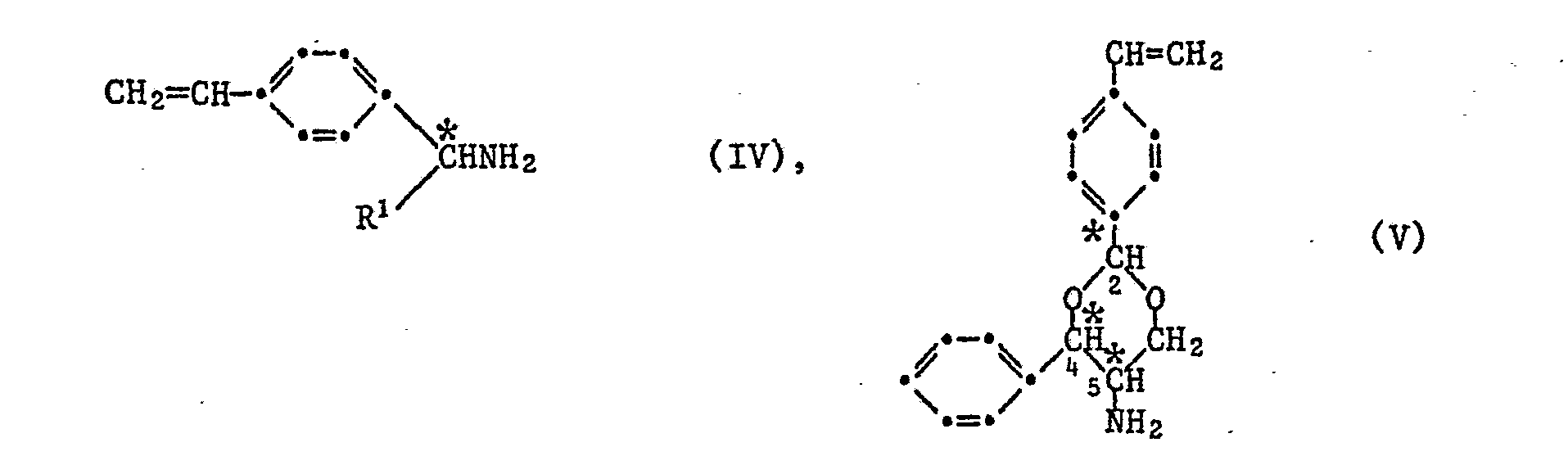
worin R1 C1-C4-Alkyl, Phenyl oder Benzyl bedeutet und das chirale *C-Atom in Formel IV entweder R- oder S-Konfiguration aufweist und die chiralen C-Atome in Formel V 2R,4S,5S-Konfiguration aufweisen.
1. Verfahren zur Heritellung von optisch aktiven Verbindungen der Formel I

worin R1 C1-C4-Alkyl, Phenyl oder Banzyl bedeutet, R2 einen Rest der Formeln II oder IIa

darstellt, worin R3 für H oder -CH3 steht, oder R1 und R2 zusammen ein Rest der Formel

sind, worin R2 die zuvor angegebene Bedeutung hat; und * für überwiegend R- oder überwiegend S-Konfiguration steht, dadurch gekennzeichnet, dass man zur Herstellung der Verbindungen der Formel I, worin R2 ein Rest der Formel II ist, einen Pyridinaldehyd der Formel III

mit einen Amin der Formel IV

oder mit einem Amin der Formel V
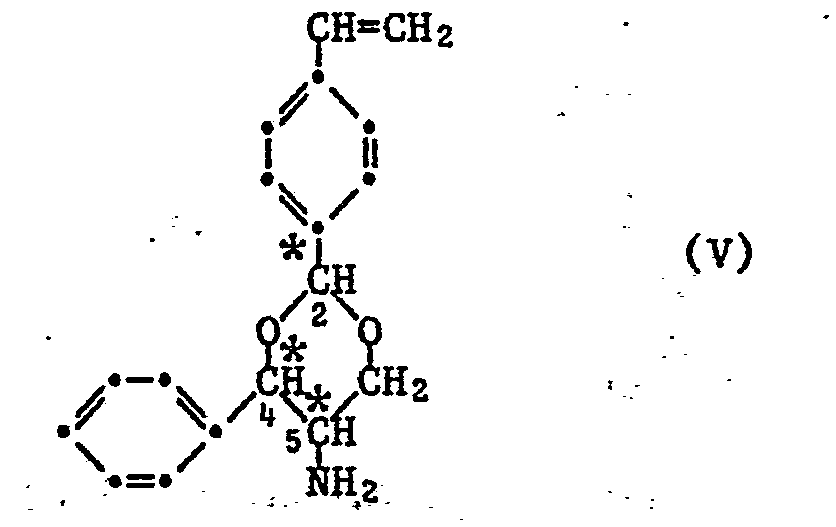
umsetzt, und zur Herstellung von Verbindungen der Formel I, worin R2 ein Rest der Formel IIa ist, die gebildeten Pyridinaldimine mit LiAlH4 hydriert, wobei R1 und R3 die zuvor angegebenen Bedeütungen haben.
2. Verfahren gemäss Anspruch 1, worin in Formel I R1 Methyl oder Benzyl ist.
3. Verfahren zur Herstellung von Iridiumkomplexen der Formeln VI oder VIa


worin * für überwiegend R- oder überwiegend S-Konfiguration steht, R1 und R3 die in Anspruch 1 angegebene Bedeutung haben, R4 und R6 je für H stehen oder zusammen eine Bindung darstellen, X⊖ für das Anion einer einbssischen anorganischen oder organischen Säure und Y ein offenkettiges oder cyclisches Dien mit 6 bis 10 C-Atomen, dassen Diengruppen über 1 oder 2 C-Atose verbunden sind, bedeuten, dadurch gekennzeichnet, dass man [(Acetonitril)(Y))IrX oder (IR(Y)Cl]2 mit einer Verbindung der Formel I gemäss Anspruch I umsetzt.
4. Verfahren gemäss Anspruch 3, worin R1 in Formel VI Methyl oder Benzyl ist.
5. Verfahren gemäss Anspruoh 3, worin Y in den Formeln VI und VIa ein Dien mit 6 bis 8 C-Atomen darstellt, desson Diengruppen über 2 C-Atome verbunden sind.
6. Verfahren gemäss Anspruch 3, worin Y in den Formeln VI und VIa für Cycloocta-1,5-dien, Norbornadien oder Hexa-1,5-dien stehen.
7. Verfahren gemäss Anspruch 3, worin X⊖ in den Formeln VI und VIa Halogenid, BF4 ⊖, ClO4 ⊖, CF3SO3 ⊖ oder PF6 ⊖ ist.
8. Verfahren gemäss Anspruch 3, worin Xe in den Formeln VI und VIa Cl⊖, Br⊖, J⊖, BF4 ⊖, ClO4 ⊖, CF3SO3 ⊖ oder PF6 ⊖ ist, und R4 und R5 zusammen für eine Bindung stehen.
9. Verfahren gemäss Anspruch 3, worin X⊖ in den Formeln VI und VIa BF4 ⊖, ClO4 ⊖, CF3SO3 ⊖ oder PF6 ⊖ ist und R4 und R5 zusammen je für H stehen.
10. Verfahren gemäss Anspruch 3, worin die Komplexe den Formeln


entsprechen, worin * für überwiegend R-Konfiguration bzw. 2R,4S,5S-Konfiguration steht.
11. Verfahren zur Herstellung von Homo- und Copolymeren mit optisch aktiven Seitengruppen, enthaltend, bezogen auf die Polymeren
a) 0,005 bis 100 Mol-% mindestens eines wiederkehrenden Strukturelementes der Formeln VII

worin R1 C1-C4-Alkyl, Phenyl oder Benzyl bedeutet, R2 einen Rest der Formeln II oder IIa

darstellt, worin R3 für H oder -CH3 steht, oder R1 und R2 zusammen ein Rest der Formel
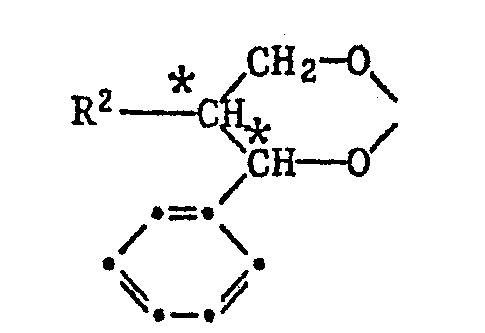
sind, worin R2 die zuvor angegebene Bedeutung hat; und * für überwiegend R- oder überwiegend S-Konfiguration steht, und
b) 99,995 bis 0 Mol-% mindestens eines von einem olefinischen Comonomer abgeleiteten Strukturelementes, das von Komponente a) verschieden ist, dadurch gekennzeichnet, dass man ein Styrolmonomer der Formel I gemäss Anspruch 1 gegebenenfalls zusammen mit einem olefinischen Comonomer polymerisiert.
12. Verfahren gemäss Anspruch 11, woriw R1 in Formel VII für Methyl oder Benzyl steht.
13. Verfahren gemäss Anspruch 11, wobei das Polymer
a) 0,05 bis 100 Mol-% der Strukturelemente der Formel VII und
b) 99,95 bis 0 Mol-% Strukturelemente eines olefinischen Comonomers enthalten.
14. Verfahren gemäss Anspruch 13, wobei das Polymer
a) 0,1 bis 10 Mol-% der Strukturelemente der Formel VII und
b) 99,9 bis 90 Mol-% Strukturelemente eines olefinischen Comonomers enthalten.
15. Verfahren gemäss Anspruch 11, wobei im Polymer das Strukturelement der Komponente b) der Formel VIII

entspricht, worin X1 Wasserstoff, X2 Wasserstoff, Chlor oder Methyl und X3 Wasserstoff, Methyl, Chlor, -CN, -CONR7R8, worin R7 und R8 unabhängig H oder C1-C18-Alkyl sind, Phenyl, Methylphenyl, Methoxy- phenyl, Cyclohexyl, -COO-Alkyl mit 1 - 12 C-Atomen im Alkyl, -COO-Phenyl, -COO-Alkyl-OH mit 2 - 6 C-Atomen im Alkyl, -OCO-Alkyl mit 1 - 4 C-Atomen im Alkyl, -OCO-Phenyl, Alkoxy mit 1 - 20 C-Atomen oder Phenoxy, oder X2 Wasserstoff und XI und X3 zusammen eine Gruppierung -CO-NR6-CO- oder je -COO-Alkyl mit 1 - 6 C-Atomen im Alkyl darstellen, wobei R6 geradkettiges oder verzweigtes C1-C18-Alkyl, Cyclohexyl oder Phenyl bedeutet, das durch CI-C6-Alkyl, Halogen, Cyano, Nitro und/oder C1-C3-Alkoxy mono- oder disubstituiert sein kann.
16. Verfahren gemäss Anspruch 15, worin in Formel VIII X1 für H steht, X2 H oder -CH3 bedeutet und X3 Phenyl, Cyclohexyl, -COO-Alkyl mit 1 - 12 C-Atomen im Alkyl, -COO-Hydroxyalkyl mit 2 bis 4 C-Atomen im Alkyl, oder -CONR7R8 darstellt, worin R7 und R8 unabhängig für H oder C1-12-Alkyl steht.
17. Verfahren gemäss Anspruch 15, worin in Formel VIII X1 und X2 für H und X3 für Phenyl, oder X1 für H, X2 für -CH3 und X3 für -COO-Alkyl mit 1 bis 12 C-Atomen im Alkyl stehen.
18. Verfahren gemäss Anspruch 11, dadurch gekennzeichnet, dass das Polymer bezogen auf die vorhandenen Monomeren, bis zu 60 Mol-% Strukturelemente eines zwei- oder mehrfach olefinisch ungesättigten Vernetzungsmittels enthalten.
19. Verfahren gemäss Anspruch 18, dadurch gekennzeichnet, dass das Polymer 0,1 bei 10 Mol-% Vernetzungsmittel enthalten.
20. Verfahren gemäss Anspruch 18, dadurch gekennzeichnet, dass das Polymer ein Divinylbenzol als Vernetzungsmittel enthalten.
21. Verfahren zur Herstellung von mit Iridium (I) komplexierten Polymeren bei denen mindestens ein Teil der Strukturelemente der Formel VII gemäss Anspruch 12 mit Iridium (I) komplexiert sind und den Formeln IX oder X entsprechen,

worin R1 C1-C4-Alkyl, Phenyl oder Benzyl bedeutet, R3 H ode r -CH3 sind, R4 und R5 je für H stehen oder zusammen eine Bindung darstellen, X für das Anion einer einbasischen anorganischen oder organischen Säure und Y ein offenkettiges oder cyclisches Dien mit 6 bis 10 C-Atomen, dessen Diengruppen über 1 oder 2 C-Atome verbunden sind, bedeuten, dadurch gekennzeichnet, dass man
A) a) 0,005 bis 100 Mol-% mindestens eines Monomers der Formeln VI oder VIa gemäss Anspruch 4 gegebenenfalls zusammen mit einem Monomer der Formel I gemäss Anspruch 1, und
b) 0 bis 99,995 Mol-% mindestens eines olefinischen Comonomers, das von Komponente a) verschieden ist, polymerisiert, oder
B) dass man in Lösung ein Homo- oder Copolymer gemäss Anspruch 12 mit [(Acetonitril)2(Y)]lrX oder mit Di-[µ-Chlorotetrakis(cycloocten)-diiridium (I)] Cl und einem Dien Y umsetzt, wobei X das Anion einer einbasischen anorganischen oder organischen Säure ist.
22. Verwendung von Iridiumkomplexen der Formeln VI und VIa gemäss Anspruch 3 als homogene enantioselektive Katalysatoren für die Transferhydrierung von prochiralen Ketonen mit sekundären Alkoholen.
23. Verwendung von komplexierten Polymeren gemäss Anspruch 21 als homogene oder heterogene enantioselektive Katalysatoren für die Transferhydrierung von prochiralen Ketonen mit sekundären Alkoholen.
Applications Claiming Priority (3)
| Application Number | Priority Date | Filing Date | Title |
|---|---|---|---|
| CH198586 | 1986-05-16 | ||
| CH1985/86 | 1986-05-16 | ||
| SG1996001188A SG43814A1 (en) | 1986-05-16 | 1987-05-11 | Optically active atyrene derivatives polymers obtained from these complexes with iridium(I) and their use |
Publications (1)
| Publication Number | Publication Date |
|---|---|
| EP0251994A1 true EP0251994A1 (de) | 1988-01-07 |
Family
ID=25689177
Family Applications (1)
| Application Number | Title | Priority Date | Filing Date |
|---|---|---|---|
| EP87810297A Withdrawn EP0251994A1 (de) | 1986-05-16 | 1987-05-11 | Optisch aktive Styrolderivate, Polymere daraus, Komplexe mit Iridium (I) und deren Verwendung |
Country Status (5)
| Country | Link |
|---|---|
| US (5) | US4800224A (de) |
| EP (1) | EP0251994A1 (de) |
| JP (1) | JP2614614B2 (de) |
| CA (1) | CA1305153C (de) |
| SG (1) | SG43814A1 (de) |
Cited By (1)
| Publication number | Priority date | Publication date | Assignee | Title |
|---|---|---|---|---|
| US6316639B1 (en) | 1999-09-07 | 2001-11-13 | Consortium für elektrochemische Industrie GmbH | Process for the preparation of cyclic N-hydroxydicarboximides |
Families Citing this family (9)
| Publication number | Priority date | Publication date | Assignee | Title |
|---|---|---|---|---|
| EP0502819A1 (de) * | 1991-03-01 | 1992-09-09 | Ciba-Geigy Ag | Säurekatalytisch vernetzbare Copolymere |
| US6255367B1 (en) | 1995-03-07 | 2001-07-03 | Landec Corporation | Polymeric modifying agents |
| US6831116B2 (en) * | 1995-03-07 | 2004-12-14 | Landec Corporation | Polymeric modifying agents |
| JPH09323948A (ja) * | 1996-05-31 | 1997-12-16 | Kanegafuchi Chem Ind Co Ltd | 光学活性アルコール化合物の製造方法 |
| US7176158B2 (en) * | 2002-10-25 | 2007-02-13 | Exxonmobil Chemical Patents Inc. | Polymerization catalyst composition |
| US7319083B2 (en) * | 2002-10-25 | 2008-01-15 | Exxonmobil Chemical Patents Inc. | Polymerized catalyst composition |
| US7119155B2 (en) * | 2002-10-25 | 2006-10-10 | Exxonmobil Chemical Patents Inc. | Polymerized catalyst composition II |
| US20040152591A1 (en) * | 2002-10-25 | 2004-08-05 | Guo-Xin Jin | Polymerized metallocene catalyst composition |
| JP5510040B2 (ja) * | 2010-04-28 | 2014-06-04 | セントラル硝子株式会社 | 光学活性(r)−1−(4−フルオロフェニル)エチルアミンを得る光学分割 |
Citations (3)
| Publication number | Priority date | Publication date | Assignee | Title |
|---|---|---|---|---|
| GB1188154A (en) * | 1966-05-28 | 1970-04-15 | Egyt Gyogyszervegyeszeti Gyar | New Pyridine Derivatives and process for their preparation |
| DE2851039A1 (de) * | 1978-11-25 | 1980-06-12 | Basf Ag | Verfahren zur razemisierung von optisch aktiven 1-arylaminen |
| US4383122A (en) * | 1978-11-02 | 1983-05-10 | Sumitomo Chemical Company, Limited | Process for preparing α-hydroxyaldehyde |
Family Cites Families (3)
| Publication number | Priority date | Publication date | Assignee | Title |
|---|---|---|---|---|
| US3026328A (en) * | 1957-12-24 | 1962-03-20 | Boehringer & Soehne Gmbh | Processes for converting l-threo-5-amino-6-phenyl dioxane to the corresponding l-erythro dioxane |
| CH660370A5 (de) * | 1984-03-23 | 1987-04-15 | Ciba Geigy Ag | Strahlungsempfindliche polymere und deren metallkomplexe. |
| US4851534A (en) * | 1986-05-16 | 1989-07-25 | Ciba-Geigy Corporation | Optically active iridium complexes, their preparation and their use in transfer hydrogenation |
-
1987
- 1987-05-08 US US07/047,099 patent/US4800224A/en not_active Expired - Fee Related
- 1987-05-11 EP EP87810297A patent/EP0251994A1/de not_active Withdrawn
- 1987-05-11 SG SG1996001188A patent/SG43814A1/en unknown
- 1987-05-14 CA CA000537148A patent/CA1305153C/en not_active Expired - Lifetime
- 1987-05-16 JP JP62118129A patent/JP2614614B2/ja not_active Expired - Lifetime
-
1988
- 1988-10-17 US US07/258,368 patent/US4891412A/en not_active Expired - Fee Related
- 1988-10-17 US US07/258,369 patent/US4904790A/en not_active Expired - Fee Related
-
1989
- 1989-10-11 US US07/419,792 patent/US4954592A/en not_active Expired - Fee Related
- 1989-12-21 US US07/454,321 patent/US4983739A/en not_active Expired - Fee Related
Patent Citations (3)
| Publication number | Priority date | Publication date | Assignee | Title |
|---|---|---|---|---|
| GB1188154A (en) * | 1966-05-28 | 1970-04-15 | Egyt Gyogyszervegyeszeti Gyar | New Pyridine Derivatives and process for their preparation |
| US4383122A (en) * | 1978-11-02 | 1983-05-10 | Sumitomo Chemical Company, Limited | Process for preparing α-hydroxyaldehyde |
| DE2851039A1 (de) * | 1978-11-25 | 1980-06-12 | Basf Ag | Verfahren zur razemisierung von optisch aktiven 1-arylaminen |
Cited By (1)
| Publication number | Priority date | Publication date | Assignee | Title |
|---|---|---|---|---|
| US6316639B1 (en) | 1999-09-07 | 2001-11-13 | Consortium für elektrochemische Industrie GmbH | Process for the preparation of cyclic N-hydroxydicarboximides |
Also Published As
| Publication number | Publication date |
|---|---|
| JP2614614B2 (ja) | 1997-05-28 |
| CA1305153C (en) | 1992-07-14 |
| SG43814A1 (en) | 1997-11-14 |
| US4891412A (en) | 1990-01-02 |
| US4904790A (en) | 1990-02-27 |
| US4983739A (en) | 1991-01-08 |
| JPS63119465A (ja) | 1988-05-24 |
| US4954592A (en) | 1990-09-04 |
| US4800224A (en) | 1989-01-24 |
Similar Documents
| Publication | Publication Date | Title |
|---|---|---|
| EP0104375B1 (de) | Neue, phosphorhaltige Biphenylderivate und deren Verwendung für asymmetrische Hydrierungen und enantioselektive Wasserstoffverschiebungen | |
| DE69106703T2 (de) | Chirale phospholanübergangsmetallkatalysatoren. | |
| EP0564406A1 (de) | Ferrocenyldiphosphine als Liganden für homogene Katalysatoren | |
| EP0579797B1 (de) | Diphosphinliganden | |
| EP0496700B1 (de) | Silangruppen enthaltende Diphosphine, immobilisierte Diophoshine und deren Verwendung als Hydrierkatalysatoren | |
| WO2006092433A1 (de) | Diarylphenoxy-aluminium-verbindungen | |
| EP0530336B1 (de) | Chirale phosphine | |
| EP0251994A1 (de) | Optisch aktive Styrolderivate, Polymere daraus, Komplexe mit Iridium (I) und deren Verwendung | |
| DE3586403T2 (de) | Methode zum isomerisieren eines glycidats. | |
| EP0273270B1 (de) | Verfahren zur Herstellung von (+)-Biotin | |
| DE602004008478T2 (de) | Biphosphinrutheniumkomplexe mit chiralen diaminliganden als katalysatoren | |
| DE3153690C2 (de) | ||
| DE19617864A1 (de) | Neue chirale Phenyldihydrofuranone | |
| DE69610131T2 (de) | Optisch aktive asymmetrische Diphosphine und Verfahren zur Herstellung optisch aktiver Substanzen in ihrer Anwesenheit | |
| DE69300826T2 (de) | Hydrierung. | |
| EP0104376A2 (de) | Verfahren zur Herstellung von optisch aktiven Aminen und Enaminen | |
| EP1409493B1 (de) | Verfahren zur herstellung von nicht-chiralen und optisch aktiven hydroxygruppen enthaltenden organischen verbindungen | |
| EP1692149B1 (de) | Verfahren zur herstellung von orthometallierten und orthosubstituierten aromatischen verbindungen | |
| EP0391212B1 (de) | Verfahren zur Herstellung von bifunktionellen Z-Stilbenverbindungen, neue bifunktionelle Z-Stilbenverbindungen sowie die Verwendung der Z-Stilbenverbindungen zur Herstellung von Polymeren | |
| DE60000660T2 (de) | Verbesserte verfahren fur assymmetrische hydrogenation | |
| DE19809341C1 (de) | Verfahren zur selektiven Alkylierung von Aldehyden mit Organozinkverbindungen | |
| EP0094347A1 (de) | Verfahren zur Herstellung von 1-Hydroxyketonen | |
| DE19535243A1 (de) | Neue Zwischenprodukte für die Synthese von Bisphosphinverbindungen | |
| WO2004089920A2 (de) | Amin-substituierte diphenyldiphosphine und deren verwendung in metallkomplexen für asymmetrische synthesen | |
| DE2338216A1 (de) | Optisch aktive chelate und ihre verwendung fuer die asymmetrische synthese optisch aktiver verbindungen |
Legal Events
| Date | Code | Title | Description |
|---|---|---|---|
| PUAI | Public reference made under article 153(3) epc to a published international application that has entered the european phase |
Free format text: ORIGINAL CODE: 0009012 |
|
| 17P | Request for examination filed |
Effective date: 19870513 |
|
| AK | Designated contracting states |
Kind code of ref document: A1 Designated state(s): AT BE CH DE FR GB IT LI NL SE |
|
| 17Q | First examination report despatched |
Effective date: 19900221 |
|
| RAP1 | Party data changed (applicant data changed or rights of an application transferred) |
Owner name: NOVARTIS AG |
|
| STAA | Information on the status of an ep patent application or granted ep patent |
Free format text: STATUS: THE APPLICATION IS DEEMED TO BE WITHDRAWN |
|
| 18D | Application deemed to be withdrawn |
Effective date: 19980922 |
|
| RIN1 | Information on inventor provided before grant (corrected) |
Inventor name: KASCHIG, JUERGEN, DR. |