EP0107897B1 - Polyamino-bis-imid-Harz - Google Patents
Polyamino-bis-imid-Harz Download PDFInfo
- Publication number
- EP0107897B1 EP0107897B1 EP19830305250 EP83305250A EP0107897B1 EP 0107897 B1 EP0107897 B1 EP 0107897B1 EP 19830305250 EP19830305250 EP 19830305250 EP 83305250 A EP83305250 A EP 83305250A EP 0107897 B1 EP0107897 B1 EP 0107897B1
- Authority
- EP
- European Patent Office
- Prior art keywords
- bis
- polyamino
- imide
- resin
- imide resin
- Prior art date
- Legal status (The legal status is an assumption and is not a legal conclusion. Google has not performed a legal analysis and makes no representation as to the accuracy of the status listed.)
- Expired
Links
- 229920005989 resin Polymers 0.000 title claims description 80
- 239000011347 resin Substances 0.000 title claims description 80
- 150000004985 diamines Chemical class 0.000 claims description 28
- 238000006243 chemical reaction Methods 0.000 claims description 23
- 238000009835 boiling Methods 0.000 claims description 21
- 125000000962 organic group Chemical group 0.000 claims description 16
- 239000003960 organic solvent Substances 0.000 claims description 14
- RYGMFSIKBFXOCR-UHFFFAOYSA-N Copper Chemical compound [Cu] RYGMFSIKBFXOCR-UHFFFAOYSA-N 0.000 claims description 13
- ZWEHNKRNPOVVGH-UHFFFAOYSA-N 2-Butanone Chemical compound CCC(C)=O ZWEHNKRNPOVVGH-UHFFFAOYSA-N 0.000 claims description 12
- 125000001997 phenyl group Chemical group [H]C1=C([H])C([H])=C(*)C([H])=C1[H] 0.000 claims description 12
- XNWFRZJHXBZDAG-UHFFFAOYSA-N 2-METHOXYETHANOL Chemical compound COCCO XNWFRZJHXBZDAG-UHFFFAOYSA-N 0.000 claims description 10
- 229910052802 copper Inorganic materials 0.000 claims description 9
- 239000010949 copper Substances 0.000 claims description 9
- 125000003118 aryl group Chemical group 0.000 claims description 7
- 239000011203 carbon fibre reinforced carbon Substances 0.000 claims description 7
- 125000004435 hydrogen atom Chemical group [H]* 0.000 claims description 6
- ZNQVEEAIQZEUHB-UHFFFAOYSA-N 2-ethoxyethanol Chemical compound CCOCCO ZNQVEEAIQZEUHB-UHFFFAOYSA-N 0.000 claims description 5
- 125000000217 alkyl group Chemical group 0.000 claims description 5
- 239000011889 copper foil Substances 0.000 claims description 5
- XQUPVDVFXZDTLT-UHFFFAOYSA-N 1-[4-[[4-(2,5-dioxopyrrol-1-yl)phenyl]methyl]phenyl]pyrrole-2,5-dione Chemical compound O=C1C=CC(=O)N1C(C=C1)=CC=C1CC1=CC=C(N2C(C=CC2=O)=O)C=C1 XQUPVDVFXZDTLT-UHFFFAOYSA-N 0.000 claims description 4
- 229940093475 2-ethoxyethanol Drugs 0.000 claims description 4
- 125000005843 halogen group Chemical group 0.000 claims description 4
- 229920001187 thermosetting polymer Polymers 0.000 claims description 4
- HCGFUIQPSOCUHI-UHFFFAOYSA-N 2-propan-2-yloxyethanol Chemical compound CC(C)OCCO HCGFUIQPSOCUHI-UHFFFAOYSA-N 0.000 claims description 3
- IPZJQDSFZGZEOY-UHFFFAOYSA-N dimethylmethylene Chemical compound C[C]C IPZJQDSFZGZEOY-UHFFFAOYSA-N 0.000 claims description 3
- 125000005010 perfluoroalkyl group Chemical group 0.000 claims description 3
- INFFATMFXZFLAO-UHFFFAOYSA-N 2-(methoxymethoxy)ethanol Chemical compound COCOCCO INFFATMFXZFLAO-UHFFFAOYSA-N 0.000 claims description 2
- 239000000835 fiber Substances 0.000 claims 2
- 239000004305 biphenyl Substances 0.000 claims 1
- 239000000243 solution Substances 0.000 description 23
- 239000002904 solvent Substances 0.000 description 17
- OKKJLVBELUTLKV-UHFFFAOYSA-N Methanol Chemical compound OC OKKJLVBELUTLKV-UHFFFAOYSA-N 0.000 description 6
- 238000000034 method Methods 0.000 description 6
- SECXISVLQFMRJM-UHFFFAOYSA-N N-Methylpyrrolidone Chemical compound CN1CCCC1=O SECXISVLQFMRJM-UHFFFAOYSA-N 0.000 description 4
- 238000002360 preparation method Methods 0.000 description 4
- 239000007787 solid Substances 0.000 description 4
- ZMXDDKWLCZADIW-UHFFFAOYSA-N N,N-Dimethylformamide Chemical compound CN(C)C=O ZMXDDKWLCZADIW-UHFFFAOYSA-N 0.000 description 3
- 230000009477 glass transition Effects 0.000 description 3
- -1 maleimide compound Chemical class 0.000 description 3
- 238000004519 manufacturing process Methods 0.000 description 3
- 239000002244 precipitate Substances 0.000 description 3
- 239000000376 reactant Substances 0.000 description 3
- YBRVSVVVWCFQMG-UHFFFAOYSA-N 4,4'-diaminodiphenylmethane Chemical compound C1=CC(N)=CC=C1CC1=CC=C(N)C=C1 YBRVSVVVWCFQMG-UHFFFAOYSA-N 0.000 description 2
- VTYYLEPIZMXCLO-UHFFFAOYSA-L Calcium carbonate Chemical compound [Ca+2].[O-]C([O-])=O VTYYLEPIZMXCLO-UHFFFAOYSA-L 0.000 description 2
- ATUOYWHBWRKTHZ-UHFFFAOYSA-N Propane Chemical compound CCC ATUOYWHBWRKTHZ-UHFFFAOYSA-N 0.000 description 2
- 230000002411 adverse Effects 0.000 description 2
- 230000015572 biosynthetic process Effects 0.000 description 2
- 229910052799 carbon Inorganic materials 0.000 description 2
- 230000001627 detrimental effect Effects 0.000 description 2
- 239000004744 fabric Substances 0.000 description 2
- 238000001914 filtration Methods 0.000 description 2
- 239000011521 glass Substances 0.000 description 2
- 150000003949 imides Chemical class 0.000 description 2
- 239000003999 initiator Substances 0.000 description 2
- 238000002844 melting Methods 0.000 description 2
- 230000008018 melting Effects 0.000 description 2
- 238000007348 radical reaction Methods 0.000 description 2
- 230000035484 reaction time Effects 0.000 description 2
- 239000002966 varnish Substances 0.000 description 2
- XLYOFNOQVPJJNP-UHFFFAOYSA-N water Substances O XLYOFNOQVPJJNP-UHFFFAOYSA-N 0.000 description 2
- IPJGAEWUPXWFPL-UHFFFAOYSA-N 1-[3-(2,5-dioxopyrrol-1-yl)phenyl]pyrrole-2,5-dione Chemical compound O=C1C=CC(=O)N1C1=CC=CC(N2C(C=CC2=O)=O)=C1 IPJGAEWUPXWFPL-UHFFFAOYSA-N 0.000 description 1
- AQGZJQNZNONGKY-UHFFFAOYSA-N 1-[4-(2,5-dioxopyrrol-1-yl)phenyl]pyrrole-2,5-dione Chemical compound O=C1C=CC(=O)N1C1=CC=C(N2C(C=CC2=O)=O)C=C1 AQGZJQNZNONGKY-UHFFFAOYSA-N 0.000 description 1
- XMNIXWIUMCBBBL-UHFFFAOYSA-N 2-(2-phenylpropan-2-ylperoxy)propan-2-ylbenzene Chemical compound C=1C=CC=CC=1C(C)(C)OOC(C)(C)C1=CC=CC=C1 XMNIXWIUMCBBBL-UHFFFAOYSA-N 0.000 description 1
- KRDXTHSSNCTAGY-UHFFFAOYSA-N 2-cyclohexylpyrrolidine Chemical compound C1CCNC1C1CCCCC1 KRDXTHSSNCTAGY-UHFFFAOYSA-N 0.000 description 1
- XYFRHHAYSXIKGH-UHFFFAOYSA-N 3-(5-methoxy-2-methoxycarbonyl-1h-indol-3-yl)prop-2-enoic acid Chemical compound C1=C(OC)C=C2C(C=CC(O)=O)=C(C(=O)OC)NC2=C1 XYFRHHAYSXIKGH-UHFFFAOYSA-N 0.000 description 1
- WKBOTKDWSSQWDR-UHFFFAOYSA-N Bromine atom Chemical group [Br] WKBOTKDWSSQWDR-UHFFFAOYSA-N 0.000 description 1
- OKTJSMMVPCPJKN-UHFFFAOYSA-N Carbon Chemical compound [C] OKTJSMMVPCPJKN-UHFFFAOYSA-N 0.000 description 1
- 239000004593 Epoxy Substances 0.000 description 1
- PEEHTFAAVSWFBL-UHFFFAOYSA-N Maleimide Chemical compound O=C1NC(=O)C=C1 PEEHTFAAVSWFBL-UHFFFAOYSA-N 0.000 description 1
- VYPSYNLAJGMNEJ-UHFFFAOYSA-N Silicium dioxide Chemical compound O=[Si]=O VYPSYNLAJGMNEJ-UHFFFAOYSA-N 0.000 description 1
- 235000002597 Solanum melongena Nutrition 0.000 description 1
- 244000061458 Solanum melongena Species 0.000 description 1
- 239000000853 adhesive Substances 0.000 description 1
- 230000001070 adhesive effect Effects 0.000 description 1
- 125000003545 alkoxy group Chemical group 0.000 description 1
- 125000002947 alkylene group Chemical group 0.000 description 1
- 125000004429 atom Chemical group 0.000 description 1
- UHOVQNZJYSORNB-UHFFFAOYSA-N benzene Substances C1=CC=CC=C1 UHOVQNZJYSORNB-UHFFFAOYSA-N 0.000 description 1
- 229910000019 calcium carbonate Inorganic materials 0.000 description 1
- 150000001721 carbon Chemical group 0.000 description 1
- 125000004432 carbon atom Chemical group C* 0.000 description 1
- 239000003054 catalyst Substances 0.000 description 1
- 239000007795 chemical reaction product Substances 0.000 description 1
- 229910052801 chlorine Inorganic materials 0.000 description 1
- 125000001309 chloro group Chemical group Cl* 0.000 description 1
- 150000001875 compounds Chemical class 0.000 description 1
- 238000000748 compression moulding Methods 0.000 description 1
- 150000001879 copper Chemical class 0.000 description 1
- 238000004132 cross linking Methods 0.000 description 1
- 125000005724 cycloalkenylene group Chemical group 0.000 description 1
- LSXWFXONGKSEMY-UHFFFAOYSA-N di-tert-butyl peroxide Chemical compound CC(C)(C)OOC(C)(C)C LSXWFXONGKSEMY-UHFFFAOYSA-N 0.000 description 1
- 238000001035 drying Methods 0.000 description 1
- 230000000694 effects Effects 0.000 description 1
- 239000003822 epoxy resin Substances 0.000 description 1
- 125000001495 ethyl group Chemical group [H]C([H])([H])C([H])([H])* 0.000 description 1
- 238000002474 experimental method Methods 0.000 description 1
- 239000000945 filler Substances 0.000 description 1
- 239000011888 foil Substances 0.000 description 1
- 239000005350 fused silica glass Substances 0.000 description 1
- 238000001879 gelation Methods 0.000 description 1
- 239000003365 glass fiber Substances 0.000 description 1
- 238000010438 heat treatment Methods 0.000 description 1
- 238000001746 injection moulding Methods 0.000 description 1
- 239000002184 metal Substances 0.000 description 1
- 229910052751 metal Inorganic materials 0.000 description 1
- VNWKTOKETHGBQD-UHFFFAOYSA-N methane Natural products C VNWKTOKETHGBQD-UHFFFAOYSA-N 0.000 description 1
- 125000002496 methyl group Chemical group [H]C([H])([H])* 0.000 description 1
- 238000002156 mixing Methods 0.000 description 1
- 150000001451 organic peroxides Chemical class 0.000 description 1
- 229920000647 polyepoxide Polymers 0.000 description 1
- 229920001721 polyimide Polymers 0.000 description 1
- 239000009719 polyimide resin Substances 0.000 description 1
- 238000006116 polymerization reaction Methods 0.000 description 1
- 238000011417 postcuring Methods 0.000 description 1
- 230000001376 precipitating effect Effects 0.000 description 1
- 238000001556 precipitation Methods 0.000 description 1
- 239000001294 propane Substances 0.000 description 1
- 239000011541 reaction mixture Substances 0.000 description 1
- 230000009257 reactivity Effects 0.000 description 1
- 230000003014 reinforcing effect Effects 0.000 description 1
- 239000012779 reinforcing material Substances 0.000 description 1
- 238000007665 sagging Methods 0.000 description 1
- 238000005476 soldering Methods 0.000 description 1
- 125000001424 substituent group Chemical group 0.000 description 1
- 238000006467 substitution reaction Methods 0.000 description 1
- 239000000758 substrate Substances 0.000 description 1
- 238000003786 synthesis reaction Methods 0.000 description 1
- GJBRNHKUVLOCEB-UHFFFAOYSA-N tert-butyl benzenecarboperoxoate Chemical compound CC(C)(C)OOC(=O)C1=CC=CC=C1 GJBRNHKUVLOCEB-UHFFFAOYSA-N 0.000 description 1
- SSBBXKVCFFZKCZ-UHFFFAOYSA-N tert-butylperoxy propyl carbonate Chemical compound CCCOC(=O)OOOC(C)(C)C SSBBXKVCFFZKCZ-UHFFFAOYSA-N 0.000 description 1
- 238000001721 transfer moulding Methods 0.000 description 1
- 125000003866 trichloromethyl group Chemical group ClC(Cl)(Cl)* 0.000 description 1
- 125000002023 trifluoromethyl group Chemical group FC(F)(F)* 0.000 description 1
Images
Classifications
-
- B—PERFORMING OPERATIONS; TRANSPORTING
- B32—LAYERED PRODUCTS
- B32B—LAYERED PRODUCTS, i.e. PRODUCTS BUILT-UP OF STRATA OF FLAT OR NON-FLAT, e.g. CELLULAR OR HONEYCOMB, FORM
- B32B27/00—Layered products comprising a layer of synthetic resin
- B32B27/28—Layered products comprising a layer of synthetic resin comprising synthetic resins not wholly covered by any one of the sub-groups B32B27/30 - B32B27/42
-
- B—PERFORMING OPERATIONS; TRANSPORTING
- B32—LAYERED PRODUCTS
- B32B—LAYERED PRODUCTS, i.e. PRODUCTS BUILT-UP OF STRATA OF FLAT OR NON-FLAT, e.g. CELLULAR OR HONEYCOMB, FORM
- B32B15/00—Layered products comprising a layer of metal
- B32B15/04—Layered products comprising a layer of metal comprising metal as the main or only constituent of a layer, which is next to another layer of the same or of a different material
- B32B15/08—Layered products comprising a layer of metal comprising metal as the main or only constituent of a layer, which is next to another layer of the same or of a different material of synthetic resin
-
- B—PERFORMING OPERATIONS; TRANSPORTING
- B32—LAYERED PRODUCTS
- B32B—LAYERED PRODUCTS, i.e. PRODUCTS BUILT-UP OF STRATA OF FLAT OR NON-FLAT, e.g. CELLULAR OR HONEYCOMB, FORM
- B32B15/00—Layered products comprising a layer of metal
- B32B15/20—Layered products comprising a layer of metal comprising aluminium or copper
-
- C—CHEMISTRY; METALLURGY
- C08—ORGANIC MACROMOLECULAR COMPOUNDS; THEIR PREPARATION OR CHEMICAL WORKING-UP; COMPOSITIONS BASED THEREON
- C08G—MACROMOLECULAR COMPOUNDS OBTAINED OTHERWISE THAN BY REACTIONS ONLY INVOLVING UNSATURATED CARBON-TO-CARBON BONDS
- C08G73/00—Macromolecular compounds obtained by reactions forming a linkage containing nitrogen with or without oxygen or carbon in the main chain of the macromolecule, not provided for in groups C08G12/00 - C08G71/00
- C08G73/06—Polycondensates having nitrogen-containing heterocyclic rings in the main chain of the macromolecule
- C08G73/10—Polyimides; Polyester-imides; Polyamide-imides; Polyamide acids or similar polyimide precursors
- C08G73/12—Unsaturated polyimide precursors
- C08G73/126—Unsaturated polyimide precursors the unsaturated precursors being wholly aromatic
-
- B—PERFORMING OPERATIONS; TRANSPORTING
- B32—LAYERED PRODUCTS
- B32B—LAYERED PRODUCTS, i.e. PRODUCTS BUILT-UP OF STRATA OF FLAT OR NON-FLAT, e.g. CELLULAR OR HONEYCOMB, FORM
- B32B2305/00—Condition, form or state of the layers or laminate
- B32B2305/08—Reinforcements
-
- B—PERFORMING OPERATIONS; TRANSPORTING
- B32—LAYERED PRODUCTS
- B32B—LAYERED PRODUCTS, i.e. PRODUCTS BUILT-UP OF STRATA OF FLAT OR NON-FLAT, e.g. CELLULAR OR HONEYCOMB, FORM
- B32B2305/00—Condition, form or state of the layers or laminate
- B32B2305/72—Cured, e.g. vulcanised, cross-linked
-
- H—ELECTRICITY
- H05—ELECTRIC TECHNIQUES NOT OTHERWISE PROVIDED FOR
- H05K—PRINTED CIRCUITS; CASINGS OR CONSTRUCTIONAL DETAILS OF ELECTRIC APPARATUS; MANUFACTURE OF ASSEMBLAGES OF ELECTRICAL COMPONENTS
- H05K1/00—Printed circuits
- H05K1/02—Details
- H05K1/03—Use of materials for the substrate
- H05K1/0313—Organic insulating material
- H05K1/032—Organic insulating material consisting of one material
- H05K1/0346—Organic insulating material consisting of one material containing N
-
- Y—GENERAL TAGGING OF NEW TECHNOLOGICAL DEVELOPMENTS; GENERAL TAGGING OF CROSS-SECTIONAL TECHNOLOGIES SPANNING OVER SEVERAL SECTIONS OF THE IPC; TECHNICAL SUBJECTS COVERED BY FORMER USPC CROSS-REFERENCE ART COLLECTIONS [XRACs] AND DIGESTS
- Y10—TECHNICAL SUBJECTS COVERED BY FORMER USPC
- Y10T—TECHNICAL SUBJECTS COVERED BY FORMER US CLASSIFICATION
- Y10T428/00—Stock material or miscellaneous articles
- Y10T428/31504—Composite [nonstructural laminate]
- Y10T428/31678—Of metal
- Y10T428/31681—Next to polyester, polyamide or polyimide [e.g., alkyd, glue, or nylon, etc.]
-
- Y—GENERAL TAGGING OF NEW TECHNOLOGICAL DEVELOPMENTS; GENERAL TAGGING OF CROSS-SECTIONAL TECHNOLOGIES SPANNING OVER SEVERAL SECTIONS OF THE IPC; TECHNICAL SUBJECTS COVERED BY FORMER USPC CROSS-REFERENCE ART COLLECTIONS [XRACs] AND DIGESTS
- Y10—TECHNICAL SUBJECTS COVERED BY FORMER USPC
- Y10T—TECHNICAL SUBJECTS COVERED BY FORMER US CLASSIFICATION
- Y10T428/00—Stock material or miscellaneous articles
- Y10T428/31504—Composite [nonstructural laminate]
- Y10T428/31721—Of polyimide
Definitions
- This invention relates to a polyamino-bis-imide resin, solutions thereof, cross-linked resins derived from them and laminated boards made from them. More particularly, this invention relates to a polyamino-bis-imide resin which dissolves in ordinary organic solvents of low boiling points and, on curing, acquires outstanding thermal resistance as well as to solutions thereof, cross-linked resins derived therefrom and laminated boards made therefrom.
- polyamino-bis-maleimide resins such as, for example, a polyimide resin formed of N,N'-4,4'-diphenylmethane-bis-maleimide and 4,4'-diaminodiphenyl-methane have found acceptance in the production of heat resistant adhesives and heat resistant laminates which are required to exhibit superior thermal resistance, dimensional stability and electrical properties (U.S. Re. Patent No. 29,316).
- This invention enables the provision of a novel polyamino-bis-imide resin and cross-linked resins derived therefrom.
- This invention also enables the provision of a polyamino-bis-imide resin which dissolves in ordinary low-boiling point organic solvents and, on curing, acquires outstanding thermal resistance and to cross-linked resins derived from such a resin.
- EP-A-0047530 discloses a maleimide resin produced by reacting a maleimide compound having the general formula: with a diamine having the general formula: wherein:
- the present invention provides in a first aspect a curable polyamino-bis-imide resin obtainable by the thermal reaction of (A) a bis-imide represented by the general formula I: wherein R 1 stands for a divalent organic group having a carbon-carbon double bond and R 2 for a divalent aromatic organic group having 1 to 3 benzene rings with (B) a diamine represented by the general formula IIA: the mol ratio of the bis-imide (A) to the diamine (B) being in the range of 1:0.1 to 1:1.
- the invention provides a solution of the aforementioned curable polyamino-bis-imide resin in a low-boiling point organic solvent.
- the invention provides a cross-linked resin obtained by curing the aforementioned curable polyamino-bis-imide resin.
- the invention provides a copper clad laminated board obtained by bonding a copper foil to a fibre-reinforced polyamino-bis-imide resin obtainable by the thermal reaction of (A) a bis-imide represented by the general formula I: wherein R, stands for a divalent organic group having a carbon-carbon double bond and R 2 for a divalent aromatic organic group having 1 to 3 benzene rings with (B) a diamine represented by the general formula II: wherein X stands for one member selected from 0, S, S0 2 , CH 2 , CO, COO, C(CH 3 ) 2 , CF 2 and C(CF 3 ) 2 , providing that the three X's may be identical to or different from one another and one or more of the hydrogen atoms attached to the benzene rings may be substituted by an inactive alkyl group, perfluoroalkyl group or halogen atom.
- A a bis-imide represented by the general formula I: wherein R, stands for a di
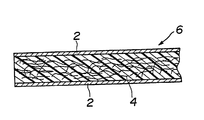
- the accompanying drawing shows a cross section illustrating a typical and exemplary laminated board obtained in accordance with the present invention.
- the reaction of the bis-imide (A) with the diamine (B) is understood to proceed with addition of the -NH 2 group of the diamine (B) to the carbon-carbon double bond of the bis-imide (A) and the consequent formation of a linkage (wherein R stands for a substituent on the relevant carbon atom) and, thus, to produce a linearly polymerized polyamino-bis-imide resin.
- the polyamino-bis-imide resin which is produced by this method has been found to be soluble in any ordinary low-boiling point organic solvent and the resin dissolved in this solvent, on curing, has been found to acquire outstanding thermal properties.
- the bis-imides (A) which are usable for the purpose of this invention are represented by the aforementioned general formula I.
- R 1 stands for a divalent organic group having a carbon-carbon double bond.
- Typical examples of this divalent organic group are alkylenes including cyclo- alkenylenes (which include bicycloalkenylenes), such as and derivatives resulting from the substitution of hydrogen atoms in these organic groups by an alkyl group or a halogen atom.
- R 2 stands for a divalent aromatic organic group having 1 to 3 benzene rings.
- This divalent aromatic organic group may be wherein Y stands for one member selected from 0, S, SO 2 , CH 2 , CO, COO, C(CH 3 ) 2 , CF 2 and C(CF 3 ) 2 , providing that the two Y's may be identical to or different from each other and the hydrogen atoms attached to the benzene rings may be substituted by an inactive group or atom for example, an alkyl group, a perfluoroalkyl group or a halogen atom.
- unsaturated bis-imides are N,N'-m-phenylene-bis-maleimide, N,N'-p-phenylene-bis-maleimide, N,N'-4,4'-diphenylether-bis-maleimide, N,N'-4,4'-diphenylthioether-bis-maleimide, N,N'-4,4'-diphenylsulphon-bis-maleimide, N,N'-4,4-diphenylmethane-bis-maleimide, N,N'-4,4'-diphenyipropane- bis-maleimide, N,N'-[4,4'-diphenoxy-1,4-benzene]-bis-maleimide, N,N'-4,4'-diphenylmethane-bis-tetrahydrophthalimide and N,N'-4,4-didiphenylpropane-bis-endomethylenetetrahydrophthalimide.
- the diamines (B) which are usable for the purpose of the fourth aspect of this invention are represented by the general formula II.
- Examples of these diamines are 4,4'-di-(p-aminophenoxy)-diphenyl sulphone, 4,4'-di-(m-aminophenoxy)-diphenyl sulphone, 4,4'-di-(p-aminophenoxy)-diphenyl ether, 4,4'-di-(m-aminophenoxy)-diphenyl ether, 4,4-di-(p-aminophenoxy)-diphenylmethane, 4,4'-di-(m-amino- phenoxy)-diphenylmethane, 4,4'-di-(p-aminophenoxy)-dipheny)propane, 4,4'-di-(m-aminophenoxy)-diphenylpropane, 4,4'-di-(m-aminophenoxy
- Japanese Unexamined Patent Application Disclosure SHO 57(1982)-40462 discloses a combination of N,N'-4,4'-di-(p-aminophenoxy)-diphenylpropane-bis-endo- methylene-tetrahydrophthlimide (a bis-imide having four benzene rings in the portion corresponding to R 2 ) with N,N'-4,4'-di-(p-aminophenoxy)-diphenyl propane. Because of the large number of benzene rings, however, the combination has a low glass transition point and has serious economic disadvantages.
- the molar mixing ratio of a bis-imide (A) to a diamine (B) is in the first to third aspects of the invention in the range of from 1:0.1 to 1:1, preferably from 1:0.25 to 1:0.8. In the fourth aspect, these ranges constitute preferred embodiments. If the amount of the diamine (B) to be mixed with 1 mole of the bis- imide (A) is less than 0.1 mole, the solubility of the resulting resin may be insufficient. If the amount of the diamine (B) to be mixed with 1 mole of the bis-imide (A) exceeds 1 mole, the molecule may lack the double bond at its terminal and, therefore, be incapable of crosslinking.
- the temperature of the reaction of the bis- imide (A) with the diamine (B) is preferably in the range of 100° to 200°C, preferably 120° to 150°C. If the temperature is below 100°C, then the reaction may not proceed smoothly. If the temperature exceeds 200°C, there is a possibility of gelation being induced.
- the duration of the reaction of the bis-imide (A) with the diamine (B) varies with the reactivity of the particular reactants involved in the reaction. But if the reaction time is too short, then a large portion of the bis-imide (A) remains unreacted and the resultant resin, in consequence, exhibits insufficient solubility. If the reaction time is too long, the polymerization proceeds too far and the resin tends to be insufficiently soluble.
- the duration of this reaction is generally in the range of 5 to 480 minutes, preferably 10 to 120 minutes.
- the reaction of the bis-imide (A) with the diamine (B) can be carried out in the absence of a solvent when the reactants are heated at a temperature exceeding the melting point of either of the two reactants. It may be carried out thermally in an organic solvent whose boiling point (at 760 mmHg) is in the range of 100° to 170°C, preferably 120° to 150°C.
- organic solvents satisfying this condition are 2-methoxyethanol and 2-ethoxyethanol, 2-(methoxymethoxy)-ethanol and 2-isopropoxy-ethanol.
- the polyamino-bis-imide resin produced may be precipitated by adding, in a large excess, a poor solvent for the polyamino-bis-imide resin such as, for example, water or methanol. Then, the polyamino-bis-imide resin can be obtained in a solid state by separating the precipitate by filtration and drying the separated precipitate. Also the reaction mixture may be used as a solution without precipitating the solid resin.
- a poor solvent for the polyamino-bis-imide resin such as, for example, water or methanol.
- the polyamino-bis- imide resin therefore, can be used conventionally in the form of a solution obtained by dissolving the resin in a concentration of 20 to 70% by weight, preferably 40 to 60% by weight, in an organic solvent having a boiling point in the range of 70° to 160°C, preferably 80° to 140°C, for the production of laminated boards, for example.
- the conventional polyamino-bis-imide resin dissolves only in such special and expensive high-boiling point solvents as N-methyl-2-pyrrolidone (boiling point 202°C).
- the solvent contained in the resin as produced cannot sufficiently be removed from the resin during a solvent removal treatment involving the application of heat.
- the polyamino-bis-imide resin of the present invention can be dissolved in an inexpensive ordinary low boiling point solvent, the removal of the solvent in the resin by the application of heat can easily be accomplished. Thus, far less solvent persists in a shaped article formed of the resin.
- a curable polyamino-bis-imide resin obtained in accordance with this invention can be converted into a thermally stable cross-linked resin by being thermoset at a temperature of 170° to 300°C, preferably 180° to 220°C, for a period of 0.5 to 48 hours, preferably 1 to 4 hours.
- a radical reaction initiator may be used as a catalyst.
- radical reaction initiators usable advantageously in this reaction are organic peroxide such as tert-butyl peroxypropylcarbonate, dicumyl peroxide, tert-butyl peroxyacetate, tert-butyl peroxybenzoate and di-tert-butyl peroxide and tert-butyl cumyl peroxide.
- Such reinforcing fibres as glass-fibres and carbon fibres and such fillers as fused silica and calcium carbonate, for example, can be incorporated into a polyamino-bis-imide in accordance with the invention, or into a solution of such a resin in an organic solvent.
- Curable polyamino-bis-imide resin in accordance with the invention can be moulded in any desired shape such as a board by, for example, compression moulding, transfer moulding or injection moulding.
- a copper clad laminated board 6 having a cross section as illustrated in the accompanying drawing is obtained by incorporating a reinforcing material for example, glass cloth into a resin of the invention and superposing a layer of the reinforced resin 4 between copper foils 2 and 2. This copper clad laminated board 6 is most useful as a substrate for various circuits.
- a polyamino-bis-imide resin was synthesized by following the procedure of Example 1, except that 4,4'-di-(m-aminophenoxy)-diphenyl sulphone was used in the place of 4,4'-di-(p-aminophenoxy)-diphenyl-sulphone.
- the solution resulting from the thermal reaction (concentration 50% by weight) was placed under observation for change in transparency due to occurrence of suspended matter. The solution, even at the end of seven days' standing, showed no sign of loss of transparency.
- a polyamino-bis-imide resin was synthesized by following the procedure of Example 1, except that 4,4'-di-(p-aminophenoxy)-diphenylpropane was used in a varying amount (parts by weight) indicated in Table 1 in the place of 4,4'-di-(p-amino- phenoxy)-diphenyl sulphone and 2-methoxyethanol was used in an amount such that the resultant solution had a concentration of 50% by weight. None of the solutions thus obtained showed any sign of loss of transparency due to occurrence of suspended matter even at the end of 7 days' standing.
- the solid polyamino-bis-imide resin was moulded in a metal die at 190°C for one-hour under pressure (40 kg f/cm 2 , 3.9 x 10 s N/m 2 ) and further subjected to post-curing at 250°C for 24 hours.
- the glass transition point (Tg) of the resultant cured resin was found from the point of curvature in the thermal expansion coefficient curve to be 302°C. It was thus shown to possess very high thermal resistance.
- a polyamino-bis-imide resin was synthesized by following the procedure of Example 1, except that 4,4-diaminodiphenylmethane was used in the various amounts (parts by weight) indicated in Table 1 in the place of 4,4'-di-(p-amino- phenoxy)-diphenyl sulphone and 2-methoxy-ethanol was used in an amount such that the resultant solution had a concentration of 50% by weight.
- Control 1 became turbid after seven days' standing.
- the solutions of Controls 2-4 became turbid after one day's standing.
- the polyamino-bis-imide resin of Control 1 was cured by following the procedure of Preparation 1 to yield a board of cured resin. This board was found by experiment to have a Tg of 325°C.
- the polyamino-bis-imide resin solution was impregnated into a glass cloth having 0.2 mm of thickness (G-9020-BY52, manufactured by Nitto Boseki Kabushiki Kaisha), and dried at a temperature of 170°C for 3 minutes to obtain a prepreg.
- the prepreg thus obtained showed no varnish sagging.
- FC-TAI-35 35 pm thick copper foil
- FC-TAI-35 35 pm thick copper foil
- a polyamino-bis-imide resin produced according to the present invention is soluble in such inexpensive low-boiling point ordinary solvents as methylethyl ketone, 2 methoxyethanol, 2-ethoxyethanol and 2-isopropoxyethanol and the cured resin derived therefrom possesses outstanding thermal stability.
- Such resins are commercially valuable.
- the copper clad laminated board had superior heat resistance properties and measling did not occur, even in a soldering test after severe moisture treating.
Landscapes
- Chemical & Material Sciences (AREA)
- Health & Medical Sciences (AREA)
- Chemical Kinetics & Catalysis (AREA)
- Medicinal Chemistry (AREA)
- Polymers & Plastics (AREA)
- Organic Chemistry (AREA)
- Macromolecular Compounds Obtained By Forming Nitrogen-Containing Linkages In General (AREA)
- Polymers With Sulfur, Phosphorus Or Metals In The Main Chain (AREA)
Claims (10)


Applications Claiming Priority (2)
| Application Number | Priority Date | Filing Date | Title |
|---|---|---|---|
| JP57156046A JPS5945322A (ja) | 1982-09-08 | 1982-09-08 | ポリアミノビスイミド樹脂の製造方法 |
| JP156046/82 | 1982-09-08 |
Publications (2)
| Publication Number | Publication Date |
|---|---|
| EP0107897A1 EP0107897A1 (de) | 1984-05-09 |
| EP0107897B1 true EP0107897B1 (de) | 1987-04-01 |
Family
ID=15619130
Family Applications (1)
| Application Number | Title | Priority Date | Filing Date |
|---|---|---|---|
| EP19830305250 Expired EP0107897B1 (de) | 1982-09-08 | 1983-09-08 | Polyamino-bis-imid-Harz |
Country Status (4)
| Country | Link |
|---|---|
| US (1) | US4526838A (de) |
| EP (1) | EP0107897B1 (de) |
| JP (1) | JPS5945322A (de) |
| DE (1) | DE3370635D1 (de) |
Families Citing this family (46)
| Publication number | Priority date | Publication date | Assignee | Title |
|---|---|---|---|---|
| US5516876A (en) | 1983-09-27 | 1996-05-14 | The Boeing Company | Polyimide oligomers and blends |
| US5512676A (en) | 1987-09-03 | 1996-04-30 | The Boeing Company | Extended amideimide hub for multidimensional oligomers |
| US5705598A (en) | 1985-04-23 | 1998-01-06 | The Boeing Company | Polyester sulfone oligomers and blends |
| US5693741A (en) | 1988-03-15 | 1997-12-02 | The Boeing Company | Liquid molding compounds |
| US5210213A (en) | 1983-06-17 | 1993-05-11 | The Boeing Company | Dimensional, crosslinkable oligomers |
| US5969079A (en) | 1985-09-05 | 1999-10-19 | The Boeing Company | Oligomers with multiple chemically functional end caps |
| US5159055A (en) * | 1983-06-17 | 1992-10-27 | The Boeing Company | Coreactive oligomer blends |
| US5115087A (en) * | 1988-03-29 | 1992-05-19 | The Boeing Company | Coreactive imido oligomer blends |
| US4603061A (en) * | 1984-08-23 | 1986-07-29 | The United States Of America As Represented By The National Aeronautics And Space Administration | Process for preparing highly optically transparent/colorless aromatic polyimide film |
| US4696994A (en) * | 1984-12-14 | 1987-09-29 | Ube Industries, Ltd. | Transparent aromatic polyimide |
| US5618907A (en) | 1985-04-23 | 1997-04-08 | The Boeing Company | Thallium catalyzed multidimensional ester oligomers |
| US5610317A (en) | 1985-09-05 | 1997-03-11 | The Boeing Company | Multiple chemically functional end cap monomers |
| JPS62270624A (ja) * | 1985-12-19 | 1987-11-25 | Matsushita Electric Works Ltd | 付加型イミド樹脂組成物 |
| AT386415B (de) * | 1986-05-16 | 1988-08-25 | Greber Gerd | Verfahren zur herstellung von neuen loeslichen und/oder schmelzbaren polyimiden und polyamidimiden |
| JPH0749484B2 (ja) * | 1986-08-15 | 1995-05-31 | 三井東圧化学株式会社 | 熱硬化性樹脂組成物 |
| CA1270998A (en) * | 1986-07-15 | 1990-06-26 | Akihiro Yamaguchi | Thermosetting resin composition |
| US4769439A (en) * | 1986-09-29 | 1988-09-06 | General Electric Company | Polyimides and method for making |
| US5023366A (en) * | 1986-11-05 | 1991-06-11 | Mitsui Toatsu Chemicals, Incorporated | Salicylic acid copolymers and their metal salts, production process thereof, color-developing agents comprising metal salts of the copolymers, and color-developing sheets employing the agents |
| JP2585552B2 (ja) * | 1986-11-19 | 1997-02-26 | 三井東圧化学株式会社 | ポリイミド |
| JPS63130637A (ja) * | 1986-11-21 | 1988-06-02 | Shin Kobe Electric Mach Co Ltd | ポリイミド成形材料の製造法 |
| US4816512A (en) * | 1986-12-18 | 1989-03-28 | Monsanto Company | Maleimide resin composition comprising polyamine, maleimide and maleamic acid |
| US4832808A (en) * | 1987-01-02 | 1989-05-23 | International Business Machines Corporation | Polyimides reaction products and use in electrophoretic deposition |
| EP0288251B1 (de) * | 1987-04-22 | 1992-11-25 | MITSUI TOATSU CHEMICALS, Inc. | Hitzehärtbare Harzzusammensetzung |
| DE3874223T2 (de) * | 1987-05-06 | 1993-04-08 | Mitsui Toatsu Chemicals | Waermehaertbare harzzubereitung. |
| CA1317056C (en) * | 1987-05-06 | 1993-04-27 | Akihiro Yamaguchi | Thermosetting resin composition |
| DE3724055A1 (de) * | 1987-07-21 | 1989-02-02 | Basf Ag | Bismaleinimid-harze |
| DE3738457A1 (de) * | 1987-11-12 | 1989-05-24 | Lentia Gmbh | Neue loesliche und/oder schmelzbare polyimide und polyamidimide |
| JP2511480B2 (ja) * | 1987-11-13 | 1996-06-26 | 三井石油化学工業株式会社 | ポリアミノビスイミド系樹脂組成物 |
| US4870155A (en) * | 1987-12-02 | 1989-09-26 | Amoco Corporation | Novel poly (etherimide) compositions |
| JPH01174527A (ja) * | 1987-12-28 | 1989-07-11 | Mitsui Petrochem Ind Ltd | イミド系プレポリマー |
| US5314988A (en) * | 1988-02-16 | 1994-05-24 | Academy Of Applied Science, Inc. | Thermally stable highly sensitive resists and the like |
| US5817744A (en) | 1988-03-14 | 1998-10-06 | The Boeing Company | Phenylethynyl capped imides |
| JPH01151309U (de) * | 1988-04-11 | 1989-10-19 | ||
| US4906730A (en) * | 1988-05-06 | 1990-03-06 | General Electric Company | Polyetherimide blends, and molding method |
| JPH0258540A (ja) * | 1988-05-16 | 1990-02-27 | Mitsui Petrochem Ind Ltd | イミド系プレポリマーの製造方法およびこのイミド系プレポリマーを用いたワニス |
| US4987207A (en) * | 1988-05-17 | 1991-01-22 | Mitsui Toatsu Chemicals, Inc. | Thermosetting resin compositions |
| EP0361040B1 (de) * | 1988-08-15 | 1994-12-07 | MITSUI TOATSU CHEMICALS, Inc. | Geruchlose von polyvalenten Metallen modifizierte Salizylsäurecopolymere, deren Herstellungsverfahren und ihre Verwendung als Farbentwicklungsmittel für druckempfindliche Aufzeichnungspapierschichten |
| US4983705A (en) * | 1989-01-17 | 1991-01-08 | Dayco Products, Inc. | Thermoplastic elastomeric polyimide linked by oligomeric thio chain |
| US5032668A (en) * | 1989-02-21 | 1991-07-16 | Hoechst Celanese Corp. | Thermosetting polyimide prepolymers |
| EP0390565A3 (de) * | 1989-03-31 | 1992-02-26 | Mitsui Petrochemical Industries, Ltd. | Imidvorpolymere, Härtungsprodukte, Verfahren zu deren Herstellung, Laminatherstellung und Einkapselungszusammensetzungen |
| JPH0757803B2 (ja) * | 1989-07-12 | 1995-06-21 | 松下電工株式会社 | 付加型イミド樹脂プレポリマーの製造方法、プリプレグおよび積層板 |
| CA2028312C (en) * | 1990-04-11 | 1996-03-12 | Norimasa Yamaya | Thermosetting resin forming composition and process for preparing same |
| US5371173A (en) * | 1992-11-25 | 1994-12-06 | Northwestern University | Poled polymeric nonlinear optical materials |
| JP2006090343A (ja) | 2004-09-21 | 2006-04-06 | Hitachi Ltd | プロペラシャフトのボルト支持構造 |
| KR101613388B1 (ko) * | 2012-03-30 | 2016-04-18 | 히타치가세이가부시끼가이샤 | 다층 배선판 |
| FR3029684A1 (fr) | 2014-12-04 | 2016-06-10 | Valeo Equip Electr Moteur | Procede d'encapsulation de composants electroniques |
Family Cites Families (12)
| Publication number | Priority date | Publication date | Assignee | Title |
|---|---|---|---|---|
| US29316A (en) * | 1860-07-24 | Water-metek | ||
| FR1537135A (fr) * | 1967-07-12 | 1968-08-23 | Rhone Poulenc Sa | Nouveaux polyimides réticulés |
| USRE29316E (en) | 1967-07-13 | 1977-07-19 | Rhone-Poulenc S.A. | Cross-linked resins |
| FR1597952A (de) * | 1968-12-19 | 1970-06-29 | ||
| US4064192A (en) * | 1971-02-24 | 1977-12-20 | Rhone-Poulenc S.A. | Heat-stable polyimide resins |
| JPS5230319A (en) * | 1975-09-04 | 1977-03-08 | Nippon Hoso Kyokai <Nhk> | Compensation circuit of digital type gamma |
| US4116937A (en) * | 1976-08-25 | 1978-09-26 | Trw Inc. | Compliant maleimide based plastics |
| FR2405964A1 (fr) * | 1977-10-14 | 1979-05-11 | Rhone Poulenc Ind | Polymeres a groupements imide |
| JPS5534233A (en) * | 1978-08-31 | 1980-03-10 | Hitachi Chem Co Ltd | Preparation of thermosetting maleimide prepolymer |
| JPS5628215A (en) * | 1979-08-17 | 1981-03-19 | Hitachi Chem Co Ltd | Preparation of imide prepolymer |
| JPS5740462A (en) * | 1980-08-25 | 1982-03-06 | Hitachi Ltd | Etherimide compound and its preparation |
| JPS5749621A (en) * | 1980-09-09 | 1982-03-23 | Hitachi Ltd | Preparation of heat-resistant resin |
-
1982
- 1982-09-08 JP JP57156046A patent/JPS5945322A/ja active Pending
-
1983
- 1983-09-06 US US06/529,554 patent/US4526838A/en not_active Expired - Lifetime
- 1983-09-08 DE DE8383305250T patent/DE3370635D1/de not_active Expired
- 1983-09-08 EP EP19830305250 patent/EP0107897B1/de not_active Expired
Also Published As
| Publication number | Publication date |
|---|---|
| DE3370635D1 (de) | 1987-05-07 |
| JPS5945322A (ja) | 1984-03-14 |
| EP0107897A1 (de) | 1984-05-09 |
| US4526838A (en) | 1985-07-02 |
Similar Documents
| Publication | Publication Date | Title |
|---|---|---|
| EP0107897A1 (de) | Polyamino-bis-imid-Harz | |
| US4745215A (en) | Fluorine containing dicyanate resins | |
| EP0230741B1 (de) | Härtbare Harze | |
| CA1263495A (en) | Bis-maleimide resin composition | |
| JPS6312898B2 (de) | ||
| KR950000704B1 (ko) | 실록산 비스말레이미드를 포함하는 말레이미드를 주성분으로 한 열-안정성 중합체 및 그의 제조방법 | |
| GB2056470A (en) | Process for preparing imide type prepolymers | |
| EP0480543B1 (de) | Härtbare Harzzusammensetzung | |
| JPS6026494B2 (ja) | 硬化性樹脂組成物 | |
| US5003017A (en) | Heat-curable bismaleimide-alkenyl heterocyclic molding material | |
| JP2597914B2 (ja) | ヒンダードジアミンから製造したイミド基含有ポリマー製造用混合物 | |
| EP0456515A1 (de) | Polyimide und diese enthaltende wärmehärtbare Harzzusammensetzungen | |
| US5189128A (en) | Solution stable polyimide resin systems | |
| CA2042863A1 (en) | Hardenable compositions | |
| US4975506A (en) | Bismaleimide resin from bis(maleimido phenoxy)benzene | |
| US5637387A (en) | Storage-stable advanced polymaleimide compositions | |
| CA2028364C (en) | Thermosetting resin composition | |
| AU2017362594B2 (en) | Asymmetrically substituted bis-alkenyl diphenyl ethers, their preparation and use | |
| AU2016321618B2 (en) | [(2-ethoxy-5-trans-1-propen-1-yl)-phenoxyl]-terminated compounds | |
| JPH04227912A (ja) | 新規硬化性組成物 | |
| JPS6140322A (ja) | 硬化可能なポリアミノビスイミド樹脂の製造方法 | |
| JPH05222186A (ja) | 改良された加工特性を備える貯蔵安定なポリイミドプレプレグ | |
| KR900004221B1 (ko) | 변성비스말레이미드 수지의 제조방법 | |
| JPH0794554B2 (ja) | 含フッ素ポリイミドの製造方法 | |
| KR100204326B1 (ko) | 난연성 폴리이미드 조성물 |
Legal Events
| Date | Code | Title | Description |
|---|---|---|---|
| PUAI | Public reference made under article 153(3) epc to a published international application that has entered the european phase |
Free format text: ORIGINAL CODE: 0009012 |
|
| AK | Designated contracting states |
Designated state(s): DE FR GB |
|
| 17P | Request for examination filed |
Effective date: 19840829 |
|
| GRAA | (expected) grant |
Free format text: ORIGINAL CODE: 0009210 |
|
| AK | Designated contracting states |
Kind code of ref document: B1 Designated state(s): DE FR GB |
|
| REF | Corresponds to: |
Ref document number: 3370635 Country of ref document: DE Date of ref document: 19870507 |
|
| ET | Fr: translation filed | ||
| PLBE | No opposition filed within time limit |
Free format text: ORIGINAL CODE: 0009261 |
|
| STAA | Information on the status of an ep patent application or granted ep patent |
Free format text: STATUS: NO OPPOSITION FILED WITHIN TIME LIMIT |
|
| 26N | No opposition filed | ||
| PGFP | Annual fee paid to national office [announced via postgrant information from national office to epo] |
Ref country code: FR Payment date: 19980909 Year of fee payment: 16 |
|
| PGFP | Annual fee paid to national office [announced via postgrant information from national office to epo] |
Ref country code: DE Payment date: 19980914 Year of fee payment: 16 |
|
| PGFP | Annual fee paid to national office [announced via postgrant information from national office to epo] |
Ref country code: GB Payment date: 19981001 Year of fee payment: 16 |
|
| PG25 | Lapsed in a contracting state [announced via postgrant information from national office to epo] |
Ref country code: GB Free format text: LAPSE BECAUSE OF NON-PAYMENT OF DUE FEES Effective date: 19990908 |
|
| GBPC | Gb: european patent ceased through non-payment of renewal fee |
Effective date: 19990908 |
|
| PG25 | Lapsed in a contracting state [announced via postgrant information from national office to epo] |
Ref country code: FR Free format text: LAPSE BECAUSE OF NON-PAYMENT OF DUE FEES Effective date: 20000531 |
|
| PG25 | Lapsed in a contracting state [announced via postgrant information from national office to epo] |
Ref country code: DE Free format text: LAPSE BECAUSE OF NON-PAYMENT OF DUE FEES Effective date: 20000701 |
|
| REG | Reference to a national code |
Ref country code: FR Ref legal event code: ST |