EP0108968A1 - Procédé pour la production d'oxyde d'aluminium actif - Google Patents
Procédé pour la production d'oxyde d'aluminium actif Download PDFInfo
- Publication number
- EP0108968A1 EP0108968A1 EP83110653A EP83110653A EP0108968A1 EP 0108968 A1 EP0108968 A1 EP 0108968A1 EP 83110653 A EP83110653 A EP 83110653A EP 83110653 A EP83110653 A EP 83110653A EP 0108968 A1 EP0108968 A1 EP 0108968A1
- Authority
- EP
- European Patent Office
- Prior art keywords
- aluminum
- electrolyte
- ions
- cell
- cells
- Prior art date
- Legal status (The legal status is an assumption and is not a legal conclusion. Google has not performed a legal analysis and makes no representation as to the accuracy of the status listed.)
- Granted
Links
- 238000000034 method Methods 0.000 title claims abstract description 23
- 238000004519 manufacturing process Methods 0.000 title abstract description 12
- PNEYBMLMFCGWSK-UHFFFAOYSA-N Alumina Chemical compound [O-2].[O-2].[O-2].[Al+3].[Al+3] PNEYBMLMFCGWSK-UHFFFAOYSA-N 0.000 title abstract description 10
- XAGFODPZIPBFFR-UHFFFAOYSA-N aluminium Chemical compound [Al] XAGFODPZIPBFFR-UHFFFAOYSA-N 0.000 claims abstract description 37
- 229910052782 aluminium Inorganic materials 0.000 claims abstract description 36
- 239000003792 electrolyte Substances 0.000 claims abstract description 13
- 239000000243 solution Substances 0.000 claims abstract description 13
- -1 mercury ions Chemical class 0.000 claims abstract description 11
- 239000000017 hydrogel Substances 0.000 claims abstract description 10
- OKTJSMMVPCPJKN-UHFFFAOYSA-N Carbon Chemical compound [C] OKTJSMMVPCPJKN-UHFFFAOYSA-N 0.000 claims abstract description 8
- 229910002804 graphite Inorganic materials 0.000 claims abstract description 8
- 239000010439 graphite Substances 0.000 claims abstract description 8
- 229910052753 mercury Inorganic materials 0.000 claims abstract description 8
- 238000004090 dissolution Methods 0.000 claims abstract description 5
- 229910000831 Steel Inorganic materials 0.000 claims abstract description 4
- 239000010959 steel Substances 0.000 claims abstract description 4
- 239000000499 gel Substances 0.000 claims description 23
- GRYLNZFGIOXLOG-UHFFFAOYSA-N Nitric acid Chemical compound O[N+]([O-])=O GRYLNZFGIOXLOG-UHFFFAOYSA-N 0.000 claims description 13
- 229910017604 nitric acid Inorganic materials 0.000 claims description 13
- TWNQGVIAIRXVLR-UHFFFAOYSA-N oxo(oxoalumanyloxy)alumane Chemical compound O=[Al]O[Al]=O TWNQGVIAIRXVLR-UHFFFAOYSA-N 0.000 claims description 11
- BNGXYYYYKUGPPF-UHFFFAOYSA-M (3-methylphenyl)methyl-triphenylphosphanium;chloride Chemical compound [Cl-].CC1=CC=CC(C[P+](C=2C=CC=CC=2)(C=2C=CC=CC=2)C=2C=CC=CC=2)=C1 BNGXYYYYKUGPPF-UHFFFAOYSA-M 0.000 claims description 8
- 229910002651 NO3 Inorganic materials 0.000 claims description 6
- 238000005979 thermal decomposition reaction Methods 0.000 claims description 5
- UFHFLCQGNIYNRP-UHFFFAOYSA-N Hydrogen Chemical compound [H][H] UFHFLCQGNIYNRP-UHFFFAOYSA-N 0.000 claims description 3
- 239000004020 conductor Substances 0.000 claims description 3
- 229910052739 hydrogen Inorganic materials 0.000 claims description 3
- 239000001257 hydrogen Substances 0.000 claims description 3
- NHNBFGGVMKEFGY-UHFFFAOYSA-N Nitrate Chemical compound [O-][N+]([O-])=O NHNBFGGVMKEFGY-UHFFFAOYSA-N 0.000 claims description 2
- 238000011049 filling Methods 0.000 claims description 2
- 238000002360 preparation method Methods 0.000 claims description 2
- 239000007864 aqueous solution Substances 0.000 claims 1
- 229910000497 Amalgam Inorganic materials 0.000 abstract description 4
- 238000007654 immersion Methods 0.000 abstract description 2
- 239000004411 aluminium Substances 0.000 abstract 4
- 239000011244 liquid electrolyte Substances 0.000 abstract 1
- XLYOFNOQVPJJNP-UHFFFAOYSA-M hydroxide Chemical compound [OH-] XLYOFNOQVPJJNP-UHFFFAOYSA-M 0.000 description 11
- 150000002500 ions Chemical class 0.000 description 11
- 239000003054 catalyst Substances 0.000 description 7
- 238000005260 corrosion Methods 0.000 description 7
- 230000007797 corrosion Effects 0.000 description 7
- 239000000126 substance Substances 0.000 description 5
- 150000002730 mercury Chemical class 0.000 description 4
- QSHDDOUJBYECFT-UHFFFAOYSA-N mercury Chemical compound [Hg] QSHDDOUJBYECFT-UHFFFAOYSA-N 0.000 description 4
- 229910018072 Al 2 O 3 Inorganic materials 0.000 description 3
- VEXZGXHMUGYJMC-UHFFFAOYSA-M Chloride anion Chemical compound [Cl-] VEXZGXHMUGYJMC-UHFFFAOYSA-M 0.000 description 3
- LFQSCWFLJHTTHZ-UHFFFAOYSA-N Ethanol Chemical compound CCO LFQSCWFLJHTTHZ-UHFFFAOYSA-N 0.000 description 3
- KFZMGEQAYNKOFK-UHFFFAOYSA-N Isopropanol Chemical compound CC(C)O KFZMGEQAYNKOFK-UHFFFAOYSA-N 0.000 description 3
- 239000002253 acid Substances 0.000 description 3
- 230000004913 activation Effects 0.000 description 3
- 229940024546 aluminum hydroxide gel Drugs 0.000 description 3
- SMYKVLBUSSNXMV-UHFFFAOYSA-K aluminum;trihydroxide;hydrate Chemical compound O.[OH-].[OH-].[OH-].[Al+3] SMYKVLBUSSNXMV-UHFFFAOYSA-K 0.000 description 3
- 230000015572 biosynthetic process Effects 0.000 description 3
- 238000006243 chemical reaction Methods 0.000 description 3
- 230000007423 decrease Effects 0.000 description 3
- 239000000203 mixture Substances 0.000 description 3
- XLYOFNOQVPJJNP-UHFFFAOYSA-N water Substances O XLYOFNOQVPJJNP-UHFFFAOYSA-N 0.000 description 3
- 238000004140 cleaning Methods 0.000 description 2
- 239000006185 dispersion Substances 0.000 description 2
- 239000008151 electrolyte solution Substances 0.000 description 2
- 230000002349 favourable effect Effects 0.000 description 2
- UKWHYYKOEPRTIC-UHFFFAOYSA-N mercury(ii) oxide Chemical compound [Hg]=O UKWHYYKOEPRTIC-UHFFFAOYSA-N 0.000 description 2
- 238000002161 passivation Methods 0.000 description 2
- 238000005406 washing Methods 0.000 description 2
- 229910000761 Aluminium amalgam Inorganic materials 0.000 description 1
- 238000009825 accumulation Methods 0.000 description 1
- 230000002411 adverse Effects 0.000 description 1
- 230000032683 aging Effects 0.000 description 1
- 229910045601 alloy Inorganic materials 0.000 description 1
- 239000000956 alloy Substances 0.000 description 1
- AZDRQVAHHNSJOQ-UHFFFAOYSA-N alumane Chemical class [AlH3] AZDRQVAHHNSJOQ-UHFFFAOYSA-N 0.000 description 1
- WNROFYMDJYEPJX-UHFFFAOYSA-K aluminium hydroxide Chemical compound [OH-].[OH-].[OH-].[Al+3] WNROFYMDJYEPJX-UHFFFAOYSA-K 0.000 description 1
- 229940024545 aluminum hydroxide Drugs 0.000 description 1
- 239000011230 binding agent Substances 0.000 description 1
- 238000001354 calcination Methods 0.000 description 1
- 238000005119 centrifugation Methods 0.000 description 1
- 239000002131 composite material Substances 0.000 description 1
- 238000001816 cooling Methods 0.000 description 1
- 239000013078 crystal Substances 0.000 description 1
- 230000002999 depolarising effect Effects 0.000 description 1
- 238000000502 dialysis Methods 0.000 description 1
- 238000009792 diffusion process Methods 0.000 description 1
- 238000009826 distribution Methods 0.000 description 1
- 238000005868 electrolysis reaction Methods 0.000 description 1
- 125000001495 ethyl group Chemical group [H]C([H])([H])C([H])([H])* 0.000 description 1
- 125000002887 hydroxy group Chemical group [H]O* 0.000 description 1
- 239000007788 liquid Substances 0.000 description 1
- 230000028161 membrane depolarization Effects 0.000 description 1
- 229910000474 mercury oxide Inorganic materials 0.000 description 1
- VRJVVIKEWDDYOG-UHFFFAOYSA-N mercury;nitric acid Chemical compound [Hg].O[N+]([O-])=O VRJVVIKEWDDYOG-UHFFFAOYSA-N 0.000 description 1
- 238000012986 modification Methods 0.000 description 1
- 230000004048 modification Effects 0.000 description 1
- 239000002245 particle Substances 0.000 description 1
- 235000010603 pastilles Nutrition 0.000 description 1
- 239000011148 porous material Substances 0.000 description 1
- 238000001556 precipitation Methods 0.000 description 1
- 230000001105 regulatory effect Effects 0.000 description 1
- 239000011347 resin Substances 0.000 description 1
- 229920005989 resin Polymers 0.000 description 1
- 238000007493 shaping process Methods 0.000 description 1
- 230000006641 stabilisation Effects 0.000 description 1
- 238000011105 stabilization Methods 0.000 description 1
- 239000011550 stock solution Substances 0.000 description 1
- 238000006467 substitution reaction Methods 0.000 description 1
- 238000010792 warming Methods 0.000 description 1
Images

Classifications
-
- C—CHEMISTRY; METALLURGY
- C01—INORGANIC CHEMISTRY
- C01F—COMPOUNDS OF THE METALS BERYLLIUM, MAGNESIUM, ALUMINIUM, CALCIUM, STRONTIUM, BARIUM, RADIUM, THORIUM, OR OF THE RARE-EARTH METALS
- C01F7/00—Compounds of aluminium
- C01F7/02—Aluminium oxide; Aluminium hydroxide; Aluminates
- C01F7/42—Preparation of aluminium oxide or hydroxide from metallic aluminium, e.g. by oxidation
- C01F7/428—Preparation of aluminium oxide or hydroxide from metallic aluminium, e.g. by oxidation by oxidation in an aqueous solution
-
- B—PERFORMING OPERATIONS; TRANSPORTING
- B01—PHYSICAL OR CHEMICAL PROCESSES OR APPARATUS IN GENERAL
- B01J—CHEMICAL OR PHYSICAL PROCESSES, e.g. CATALYSIS OR COLLOID CHEMISTRY; THEIR RELEVANT APPARATUS
- B01J21/00—Catalysts comprising the elements, oxides, or hydroxides of magnesium, boron, aluminium, carbon, silicon, titanium, zirconium, or hafnium
- B01J21/02—Boron or aluminium; Oxides or hydroxides thereof
- B01J21/04—Alumina
-
- C—CHEMISTRY; METALLURGY
- C01—INORGANIC CHEMISTRY
- C01P—INDEXING SCHEME RELATING TO STRUCTURAL AND PHYSICAL ASPECTS OF SOLID INORGANIC COMPOUNDS
- C01P2006/00—Physical properties of inorganic compounds
- C01P2006/10—Solid density
-
- C—CHEMISTRY; METALLURGY
- C01—INORGANIC CHEMISTRY
- C01P—INDEXING SCHEME RELATING TO STRUCTURAL AND PHYSICAL ASPECTS OF SOLID INORGANIC COMPOUNDS
- C01P2006/00—Physical properties of inorganic compounds
- C01P2006/12—Surface area
-
- C—CHEMISTRY; METALLURGY
- C01—INORGANIC CHEMISTRY
- C01P—INDEXING SCHEME RELATING TO STRUCTURAL AND PHYSICAL ASPECTS OF SOLID INORGANIC COMPOUNDS
- C01P2006/00—Physical properties of inorganic compounds
- C01P2006/14—Pore volume
-
- C—CHEMISTRY; METALLURGY
- C01—INORGANIC CHEMISTRY
- C01P—INDEXING SCHEME RELATING TO STRUCTURAL AND PHYSICAL ASPECTS OF SOLID INORGANIC COMPOUNDS
- C01P2006/00—Physical properties of inorganic compounds
- C01P2006/80—Compositional purity
Definitions
- the invention relates to a process for the production of active aluminum oxide by internal electrolysis of metallic aluminum, i.e. by its anodic dissolution and thermal decomposition of the resulting highly disperse basic aluminum hydrogel without external power source.
- the active aluminum oxide obtained is suitable, inter alia, as a catalyst and as a catalyst support.
- the aluminum oxides used as catalyst or catalyst support are structurally crystalline ⁇ or ⁇ modifications, porous, disperse substances with a large specific surface, which are preferably in extruded form, used as pastilles or balls.
- the aluminum oxide intended for this purpose has very strict requirements, both in terms of the physical-mechanical properties and in terms of its chemical composition.
- a high-purity active # -alumina can be characterized, for example, by the following data:
- the production of such an active aluminum oxide consists of the following steps: production of an aluminum hydroxide gel of suitable quality, shaping of the hydroxide gel and finally its thermal decomposition, in which the active ⁇ or ⁇ -Al 2 O 3 structure is formed.
- the solution must also contain mercury ions, because otherwise the passivation of the aluminum would stop the reaction even in concentrated nitric acid.
- the presence of chloride ions accelerates the dissolving process (although mercury salt is also required in the presence of chloride), but the chloride ions adversely affect the structure of the gel, reduce its active area and thus also that of the active aluminum oxide produced from it.
- the invention is based on the knowledge that a continuous anodic dissolution of the aluminum and thereby the production of a hydroxyl gel with favorable properties is also possible without an external power source, ie without energy expenditure, if the aluminum to be dissolved is used as the anode of a galvanic Element used.
- the electrolyte of the galvanic element contains aluminum ions, preferably in addition to nitrate anions.
- the galvanic elements described are connected in parallel with one another, and the cells are filled with electrolyte, preferably nitric acid, and the cells are emptied or the hydroxide gel formed is not removed simultaneously in all cells, but with one certain time shift.
- electrolyte preferably nitric acid
- the cell working with the fresher electrolyte solution has a depolarizing effect on the whole of the system and thereby prevents the electrode processes from slowing down, which would otherwise necessarily occur as a result of the drop in the acid concentration.
- the freshly filled cells activate the cells that have been working for a long time and contain less acid.
- Another important finding according to the invention is that no mercury salt has to be metered into the cells in the process according to the invention, but that it is sufficient to immerse the aluminum bodies (for example plates, rods) working as anode before immersing them in the cell by immersing them in an acid bath containing mercury salt activate.
- the amalgam film that adheres well to the surface of the aluminum is sufficient to prevent passivation. This measure firstly reduces the need for mercury salts, and secondly, neither the electrolyte nor the product is contaminated with mercury.
- nitric acid mercury solution is prepared by dissolving mercury or mercury (II) oxide in small portions in concentrated nitric acid and then using this stock solution of known concentration and composition to dilute the activation bath.
- the corrosion of the aluminum is due to the fact that the firmly adhering aluminum oxide closing layer cannot form on the aluminum amalgam surface, which gives the aluminum and its alloys their generally known corrosion resistance.
- the aim is not to corrode the aluminum in any form, but to produce a hydroxide gel that has the specified physicochemical properties.
- the corrosion product with the desired properties does not form, and there is currently no known aftertreatment process with which the undefined composite corrosion product of aluminum could be converted into a hydroxide gel from which high-quality ⁇ -Al 2 O 3 can be obtained. For this reason, no method is currently conceivable that would be cheaper than the one according to the invention.
- the gel which can be produced according to the invention is preferably a basic aluminum nitrate hydrogel, ie it contains NO 3 - ions in molecular dispersion. It is known that hydrogel produced in another way mixed or kneaded with a bit of nitric acid before forming, ie produces basic aluminum nitrate from part of the aluminum hydroxide, because the hydroxide or oxide hydroxide which is formed from basic aluminum nitrate during thermal decomposition is an excellent binder for the elementary crystals and gives the finished catalyst or catalyst support the necessary mechanical strength . It was recognized that the basic aluminum nitrate hydrogel containing the NO 3 - ions in molecular dispersion is particularly suitable for the thermal decomposition of active aluminum oxide-controlled surface and pore structure.
- the invention further relates to a device suitable for carrying out the method according to the invention.
- a preferred embodiment of this device is shown in FIG. 1.
- the cathodes 1 made of graphite or acid-proof steel form a common pole, as do the aluminum anodes 2 suspended between them.
- the electrolyte solution 3 which preferably contains nitrate ions, the galvanic corrosion of the anodes 2 and thus also an accumulation of hydrate gel take place continuously.
- the hydrate gel is removed discontinuously, preferably by suction.
- the electrolyte and the resulting gel are located in the cell vessel 4, which is preferably made of plastic.
- the flowing galvanic current is regulated with the resistor 5 and displayed on the ammeter 6.
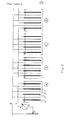
- FIG. 2 The parallel connection of several of the galvanic cells shown in FIG. 1 is shown in FIG. 2.
- the cathodes 1 and the anodes 2 of the identically constructed galvanic cells A, B, C and D are all connected to the common cathode busbar 7 and anode busbar 8, respectively.
- Filling the Cell vessels with fresh electrolyte and the suction of the gel formed are carried out discontinuously, but shifted in time with respect to one another. This always ensures that there is relatively fresh electrolyte in a cell at all times during operation and that the potential of all electrodes is thereby shifted in a favorable direction, ie depolarization occurs. This also stimulates the function of those cells in which gel formation has already progressed.
- the cell is initially filled with 2 molar nitric acid: first, demineralized water is poured into the barrel using an exchange resin, and the calculated amount of nitric acid is added to it.
- the liquid The mirror must not reach the connection point of the flexible cables to the electrodes. Accordingly, the volume of the cell solution is 80 liters.
- the circuit of the cell assembled in this way is closed with a sliding resistor of high power (a so-called starting resistance) and an ammeter with a measuring range up to 200 A.
- a sliding resistor of high power a so-called starting resistance
- an ammeter with a measuring range up to 200 A.
- the current supplied by the rapidly warming cell is kept below 100 A so that the solution in the cell does not start to boil.
- the stabilization of the pH value the current intensity - if the resistance is completely removed - adjusts to around 15 A, and the contents of the cell cool down to ambient temperature.
- the gel accumulated under the solution is removed by suction and the cell is refilled with fresh nitric acid. This cycle is repeated until the aluminum anodes are used up and thin enough that they have to be replaced. The process is continued after new, preactivated anodes have been inserted. The anode residues that have become thin are melted in a manner known per se and cast again to form anodes.
- Example 1 The cell type described in Example 1 is used, but six cells are operated simultaneously in order to intensify the process.
- the cathodes of all cells are connected to the cathode bus bar and all anodes to the anode bus bar.
- the solution is renewed in 2 cells every 8 hours, after 8 hours in two others, and after another 8 hours in the last two cells. In this way it is achieved that the gel is aspirated once a day in each cell and the solution is renewed.
- productivity is compared to the procedure according to Example 1 about tripled; the emptying, which is otherwise due every three days, can be carried out after just one day.
- the hydrogel obtained is worked up to high-purity aluminum oxide in the manner described in Example 1, the quality parameters of which are given in Table 1.
Landscapes
- Chemical & Material Sciences (AREA)
- Organic Chemistry (AREA)
- Materials Engineering (AREA)
- Inorganic Chemistry (AREA)
- Geology (AREA)
- Engineering & Computer Science (AREA)
- Life Sciences & Earth Sciences (AREA)
- Chemical Kinetics & Catalysis (AREA)
- Compounds Of Alkaline-Earth Elements, Aluminum Or Rare-Earth Metals (AREA)
- Water Treatment By Electricity Or Magnetism (AREA)
- Compositions Of Oxide Ceramics (AREA)
- Electrolytic Production Of Non-Metals, Compounds, Apparatuses Therefor (AREA)
- Catalysts (AREA)
Applications Claiming Priority (2)
| Application Number | Priority Date | Filing Date | Title |
|---|---|---|---|
| HU360282 | 1982-11-09 | ||
| HU823602A HU189188B (en) | 1982-11-09 | 1982-11-09 | Process for producing active aluminium-oxid |
Publications (2)
| Publication Number | Publication Date |
|---|---|
| EP0108968A1 true EP0108968A1 (fr) | 1984-05-23 |
| EP0108968B1 EP0108968B1 (fr) | 1988-01-20 |
Family
ID=10964743
Family Applications (1)
| Application Number | Title | Priority Date | Filing Date |
|---|---|---|---|
| EP83110653A Expired EP0108968B1 (fr) | 1982-11-09 | 1983-10-25 | Procédé pour la production d'oxyde d'aluminium actif |
Country Status (6)
| Country | Link |
|---|---|
| EP (1) | EP0108968B1 (fr) |
| AT (1) | ATE32106T1 (fr) |
| DD (1) | DD230885A1 (fr) |
| DE (1) | DE3375407D1 (fr) |
| HU (1) | HU189188B (fr) |
| SU (1) | SU1355120A3 (fr) |
Cited By (9)
| Publication number | Priority date | Publication date | Assignee | Title |
|---|---|---|---|---|
| US7531161B2 (en) | 2002-04-19 | 2009-05-12 | Saint-Gobain Ceramics & Plastics, Inc. | Boehmite and polymer materials incorporating same |
| US7582277B2 (en) | 2002-04-19 | 2009-09-01 | Saint-Gobain Ceramics & Plastics, Inc. | Seeded boehmite particulate material and methods for forming same |
| US7863369B2 (en) | 2005-11-08 | 2011-01-04 | Saint-Gobain Ceramics & Plastics, Inc. | Pigments and polymer composites formed thereof |
| US8088355B2 (en) | 2004-11-18 | 2012-01-03 | Saint-Gobain Ceramics & Plastics, Inc. | Transitional alumina particulate materials having controlled morphology and processing for forming same |
| US8173099B2 (en) | 2007-12-19 | 2012-05-08 | Saint-Gobain Ceramics & Plastics, Inc. | Method of forming a porous aluminous material |
| RU2466937C2 (ru) * | 2010-12-21 | 2012-11-20 | Андрей Павлович Лысенко | Способ получения оксида алюминия, пригодного для производства искусственных кристаллов корунда |
| US8394880B2 (en) | 2002-04-19 | 2013-03-12 | Saint-Gobain Ceramics & Plastics, Inc. | Flame retardant composites |
| US8460768B2 (en) | 2008-12-17 | 2013-06-11 | Saint-Gobain Ceramics & Plastics, Inc. | Applications of shaped nano alumina hydrate in inkjet paper |
| RU2742575C1 (ru) * | 2020-10-14 | 2021-02-08 | Общество с ограниченной ответственностью "Империус Групп" | Способ получения альфа-оксида алюминия для последующего выращивания монокристаллического сапфира |
Families Citing this family (2)
| Publication number | Priority date | Publication date | Assignee | Title |
|---|---|---|---|---|
| RU2361669C1 (ru) * | 2007-12-26 | 2009-07-20 | Открытое акционерное общество "Новомосковский институт азотной промышленности" | Способ получения катализатора для синтеза меламина из карбамида |
| RU2664135C1 (ru) * | 2017-07-17 | 2018-08-15 | Федеральное государственное бюджетное учреждение науки Институт химии высокочистых веществ им. Г.Г. Девятых Российской академии наук (ИХВВ РАН) | Способ электрохимического получения порошков оксида алюминия |
Citations (1)
| Publication number | Priority date | Publication date | Assignee | Title |
|---|---|---|---|---|
| DE2555876A1 (de) * | 1974-12-23 | 1976-06-24 | Dow Chemical Co | Aluminiumlegierung fuer anoden |
-
1982
- 1982-11-09 HU HU823602A patent/HU189188B/hu unknown
-
1983
- 1983-10-25 EP EP83110653A patent/EP0108968B1/fr not_active Expired
- 1983-10-25 DE DE8383110653T patent/DE3375407D1/de not_active Expired
- 1983-10-25 AT AT83110653T patent/ATE32106T1/de not_active IP Right Cessation
- 1983-11-04 SU SU833658449A patent/SU1355120A3/ru active
- 1983-11-08 DD DD83256453A patent/DD230885A1/de not_active IP Right Cessation
Patent Citations (1)
| Publication number | Priority date | Publication date | Assignee | Title |
|---|---|---|---|---|
| DE2555876A1 (de) * | 1974-12-23 | 1976-06-24 | Dow Chemical Co | Aluminiumlegierung fuer anoden |
Non-Patent Citations (1)
| Title |
|---|
| GMELINS HANDBUCH DER ANORGANISCHEN CHEMIE, 8. Auflage, 1934 System-nr. 35; "Aluminium, Teil B, Die Verbindngen des Aluminiums" VERLAG CHEMIE, G.M.B.H., Berlin Seiten 100, 101 * |
Cited By (9)
| Publication number | Priority date | Publication date | Assignee | Title |
|---|---|---|---|---|
| US7531161B2 (en) | 2002-04-19 | 2009-05-12 | Saint-Gobain Ceramics & Plastics, Inc. | Boehmite and polymer materials incorporating same |
| US7582277B2 (en) | 2002-04-19 | 2009-09-01 | Saint-Gobain Ceramics & Plastics, Inc. | Seeded boehmite particulate material and methods for forming same |
| US8394880B2 (en) | 2002-04-19 | 2013-03-12 | Saint-Gobain Ceramics & Plastics, Inc. | Flame retardant composites |
| US8088355B2 (en) | 2004-11-18 | 2012-01-03 | Saint-Gobain Ceramics & Plastics, Inc. | Transitional alumina particulate materials having controlled morphology and processing for forming same |
| US7863369B2 (en) | 2005-11-08 | 2011-01-04 | Saint-Gobain Ceramics & Plastics, Inc. | Pigments and polymer composites formed thereof |
| US8173099B2 (en) | 2007-12-19 | 2012-05-08 | Saint-Gobain Ceramics & Plastics, Inc. | Method of forming a porous aluminous material |
| US8460768B2 (en) | 2008-12-17 | 2013-06-11 | Saint-Gobain Ceramics & Plastics, Inc. | Applications of shaped nano alumina hydrate in inkjet paper |
| RU2466937C2 (ru) * | 2010-12-21 | 2012-11-20 | Андрей Павлович Лысенко | Способ получения оксида алюминия, пригодного для производства искусственных кристаллов корунда |
| RU2742575C1 (ru) * | 2020-10-14 | 2021-02-08 | Общество с ограниченной ответственностью "Империус Групп" | Способ получения альфа-оксида алюминия для последующего выращивания монокристаллического сапфира |
Also Published As
| Publication number | Publication date |
|---|---|
| SU1355120A3 (ru) | 1987-11-23 |
| HU189188B (en) | 1986-06-30 |
| DD230885A1 (de) | 1985-12-11 |
| DE3375407D1 (en) | 1988-02-25 |
| EP0108968B1 (fr) | 1988-01-20 |
| ATE32106T1 (de) | 1988-02-15 |
Similar Documents
| Publication | Publication Date | Title |
|---|---|---|
| EP0108968B1 (fr) | Procédé pour la production d'oxyde d'aluminium actif | |
| DE2818971A1 (de) | Verbesserte vorrichtung und verbessertes verfahren zur abtrennung eines metalles aus einem salz | |
| DE60107239T2 (de) | Kathode für die elektrochemische regenerierung einer permanganat-ätzlösung | |
| DE2907739A1 (de) | Verfahren zur verwendung von eisen (ii)sulfat bei der herstellung von titandioxid von pigmentqualitaet nach dem schwefelsaeureprozess | |
| DE2146262A1 (de) | Verfahren und vorrichtung zur elektrolytischen reduktion von verbindungen kernphysikalisch spaltbarer elemente | |
| EP0599136B1 (fr) | Procédé de production d'hydroxide de nickel pur et son utilisation | |
| DE1903858B2 (de) | Verfahren zur herstellung der nickelelektroden fuer galvanische akkumulatoren, bei welchem die poren elektrisch leitender platten mit metalloxid bzw. -hydroxid gefuellt werden | |
| DE2240731C3 (de) | Verfahren zur Herstellung von Glyoxylsäure | |
| DE2713236B2 (de) | Verfahren zur Herstellung basischer Aluminiumchloride | |
| DE1298087B (de) | Vorrichtung zur Durchfuehrung elektrochemischer Reaktionen | |
| DE2060066C3 (de) | Verfahren zur Herstellung von Magnesiumhydroxid und Chlorgas durch Elektrolyse von wäßrigen Elektrolyten, die in der Hauptmenge Magnesiumchlorid sowie Alkalichlorid gelöst enthalten | |
| DE2602031C2 (de) | Verfahren zur Herstellung von Zinnll-sulfat | |
| EP0426649B1 (fr) | Procédé pour la purification étagée de solutions aqueuses contenant du sulfate alcalin et installation pour la mise en oeuvre de ce procédé | |
| EP0445516B1 (fr) | Procédé et dispositif pour la production de nitrate d'argent | |
| DE593669C (de) | Verfahren und Vorrichtung zur Herstellung von AEthylen aus Acetylen | |
| DE2441036C2 (de) | Verfahren zur elektrochemischen Hydrodimerisation von Acrylnitril | |
| EP0713928B1 (fr) | Procédé et dispositif pour la préparation de nitrite de sodium | |
| DE869195C (de) | Verfahren und Vorrichtung zur elektrolytischen Gewinnung von Fluor | |
| DE1592217C3 (de) | Verfahren zur Herstellung von pharmazeutischem Bismuthylnitrat | |
| DE707394C (de) | Verfahren zur Aufarbeitung von metallischen Stoffen | |
| DE406079C (de) | Verfahren zur Herstellung von Alkalikarbonat aus Sulfaten | |
| DE848816C (de) | Verfahren zur Herstellung von Dihydrostreptomycin und dessen Derivaten | |
| DE2642496A1 (de) | Verfahren zur herstellung von p-hydroxymethylbenzoesaeure | |
| DE664201C (de) | Verfahren zum elektrolytischen Beizen von Werkstuecken aus Metallen und Metallegierungen, besonders Eisen und Eisenlegierungen | |
| DE2016207A1 (en) | Alkali amalgam prodn in electrolytic cell |
Legal Events
| Date | Code | Title | Description |
|---|---|---|---|
| PUAI | Public reference made under article 153(3) epc to a published international application that has entered the european phase |
Free format text: ORIGINAL CODE: 0009012 |
|
| AK | Designated contracting states |
Designated state(s): AT BE CH DE FR GB IT LI NL SE |
|
| 17P | Request for examination filed |
Effective date: 19841109 |
|
| GRAA | (expected) grant |
Free format text: ORIGINAL CODE: 0009210 |
|
| AK | Designated contracting states |
Kind code of ref document: B1 Designated state(s): AT BE CH DE FR GB IT LI NL SE |
|
| REF | Corresponds to: |
Ref document number: 32106 Country of ref document: AT Date of ref document: 19880215 Kind code of ref document: T |
|
| REF | Corresponds to: |
Ref document number: 3375407 Country of ref document: DE Date of ref document: 19880225 |
|
| ET | Fr: translation filed | ||
| GBT | Gb: translation of ep patent filed (gb section 77(6)(a)/1977) | ||
| ITF | It: translation for a ep patent filed | ||
| PLBE | No opposition filed within time limit |
Free format text: ORIGINAL CODE: 0009261 |
|
| STAA | Information on the status of an ep patent application or granted ep patent |
Free format text: STATUS: NO OPPOSITION FILED WITHIN TIME LIMIT |
|
| 26N | No opposition filed | ||
| PGFP | Annual fee paid to national office [announced via postgrant information from national office to epo] |
Ref country code: GB Payment date: 19900907 Year of fee payment: 8 |
|
| PGFP | Annual fee paid to national office [announced via postgrant information from national office to epo] |
Ref country code: AT Payment date: 19900912 Year of fee payment: 8 |
|
| PGFP | Annual fee paid to national office [announced via postgrant information from national office to epo] |
Ref country code: SE Payment date: 19901016 Year of fee payment: 8 |
|
| PGFP | Annual fee paid to national office [announced via postgrant information from national office to epo] |
Ref country code: FR Payment date: 19901023 Year of fee payment: 8 |
|
| PGFP | Annual fee paid to national office [announced via postgrant information from national office to epo] |
Ref country code: CH Payment date: 19901026 Year of fee payment: 8 |
|
| ITTA | It: last paid annual fee | ||
| PGFP | Annual fee paid to national office [announced via postgrant information from national office to epo] |
Ref country code: NL Payment date: 19901031 Year of fee payment: 8 |
|
| PGFP | Annual fee paid to national office [announced via postgrant information from national office to epo] |
Ref country code: BE Payment date: 19901114 Year of fee payment: 8 |
|
| PGFP | Annual fee paid to national office [announced via postgrant information from national office to epo] |
Ref country code: DE Payment date: 19901228 Year of fee payment: 8 |
|
| PG25 | Lapsed in a contracting state [announced via postgrant information from national office to epo] |
Ref country code: GB Effective date: 19911025 Ref country code: AT Effective date: 19911025 |
|
| PG25 | Lapsed in a contracting state [announced via postgrant information from national office to epo] |
Ref country code: SE Effective date: 19911026 |
|
| PG25 | Lapsed in a contracting state [announced via postgrant information from national office to epo] |
Ref country code: LI Effective date: 19911031 Ref country code: CH Effective date: 19911031 Ref country code: BE Effective date: 19911031 |
|
| BERE | Be: lapsed |
Owner name: KOPORC ELEKTRONIKAI ALKATRESZ ES MUSZAKI KERAMIAG Effective date: 19911031 Owner name: MAGYAR SZENHIDROGENIPARI KUTATO-FEJLESZTO INTEZET Effective date: 19911031 |
|
| PG25 | Lapsed in a contracting state [announced via postgrant information from national office to epo] |
Ref country code: NL Effective date: 19920501 |
|
| NLV4 | Nl: lapsed or anulled due to non-payment of the annual fee | ||
| GBPC | Gb: european patent ceased through non-payment of renewal fee | ||
| PG25 | Lapsed in a contracting state [announced via postgrant information from national office to epo] |
Ref country code: FR Effective date: 19920630 |
|
| REG | Reference to a national code |
Ref country code: CH Ref legal event code: PL |
|
| PG25 | Lapsed in a contracting state [announced via postgrant information from national office to epo] |
Ref country code: DE Effective date: 19920701 |
|
| REG | Reference to a national code |
Ref country code: FR Ref legal event code: ST |
|
| EUG | Se: european patent has lapsed |
Ref document number: 83110653.9 Effective date: 19920510 |