EP0110176B1 - Matériau de contact pour interrupteur à vide - Google Patents
Matériau de contact pour interrupteur à vide Download PDFInfo
- Publication number
- EP0110176B1 EP0110176B1 EP83110920A EP83110920A EP0110176B1 EP 0110176 B1 EP0110176 B1 EP 0110176B1 EP 83110920 A EP83110920 A EP 83110920A EP 83110920 A EP83110920 A EP 83110920A EP 0110176 B1 EP0110176 B1 EP 0110176B1
- Authority
- EP
- European Patent Office
- Prior art keywords
- weight
- alloy
- contact material
- current breaking
- tantalum
- Prior art date
- Legal status (The legal status is an assumption and is not a legal conclusion. Google has not performed a legal analysis and makes no representation as to the accuracy of the status listed.)
- Expired
Links
Images


Classifications
-
- H—ELECTRICITY
- H01—ELECTRIC ELEMENTS
- H01H—ELECTRIC SWITCHES; RELAYS; SELECTORS; EMERGENCY PROTECTIVE DEVICES
- H01H1/00—Contacts
- H01H1/02—Contacts characterised by the material thereof
- H01H1/0203—Contacts characterised by the material thereof specially adapted for vacuum switches
- H01H1/0206—Contacts characterised by the material thereof specially adapted for vacuum switches containing as major components Cu and Cr
Definitions
- This invention relates to a contact material for a vacuum circuit breaker which contains copper as the basic component and chromium.
- the vacuum circuit breaker has various advantages such that is free from maintenance, does not bring about public pollution, is excellent in its current breaking property, and other parameters, hence the extent of its applications has become widened very rapidly. With this expansion in its utility, demands for higher voltage withstand property and larger current breaking capability of the vacuum circuit breaker have become increasingly high. On the other hand, the performance of the vacuum circuit breaker depends to a large extent on the elements of the contact material placed within a vacuum container for the vacuum circuit breaker.
- an alloy material such as Cu-Cr, excellent in the vacuum voltage withstand and Cu excellent in the electrical conductivity in combination, is superior in its current breaking and voltage withstand capabilities, though somewhat inferior to the contact material containing the low melting point metal as to its anti-welding capability, hence it has been well utilized in the high voltage and large current region.
- the Cu-Cr alloy has its own limitation in the current breaking capability, on account of which efforts have been made as to increasing the current breaking capability by contriving the shape of the contact and manipulating the current path at the contact part to generate the magnetic field and compulsorily drive the large current arc with the force of the magnetic field.
- the present inventors experimentally prepared the contact materials, in which various sorts of metals, alloys and intermetallic compounds were added to copper and each of these contact materials was assembled in the vacuum circuit breaker to conduct various experiments.
- the results of the experiments revealed that those contact materials, in which copper, chromium and tantalum are distributed in the base material as a single substance or at least one kind of an alloy of these three metals, alloys of two of these metals, an intermetallic compound of these three metals, intermetallic compounds of two of these metals, and a composite body of these are very excellent in the current breaking capability.
- the contact material also indicates very excellent current breaking capability and favorable voltage withstand capability, even when the quantity of tantalum, a generally expensive material, is reduced in the contact material made up of Cu, Cr and Ta as the principal constituents and Ti or AI or Zr is added thereto in a small quantity so as to save such expensive metal as much as possible and to improve effectively the current breaking capability.
- a contact material for a vacuum circuit breaker as described in the first claim 1 comprises 5-35% by weight of chromium and 1-50% by weight of tantalum, the total quantity of chromium and tantalum in said contact material being 10% by weight or above.
- a contact material for a vacuum circuit breaker which consists essentially of copper as the basic component and, as other components, 10 to 35% by weight of chromium and 1-20% by weight of tantalum and, as additives in a small quantity, 5% by weight or below of titanium, or 3% by weight or below of aluminum, or 2% by weight or below of zirconium.
- Figure 1 showing the first embodiment of the present invention, which is a construction of a vacuum switch tube, wherein electrodes 4 and 5 are disposed at one end of respective electrode rods 6 and 7 in a manner to be opposed each other in the interior of a container formed by a vacuum insulative vessel 1 and end plates 2 and 3 for closing both ends of the vacuum insulative vessel 1.
- the electrode rod 7 is joined with the end plate 3 through a bellow 8 in a manner not to impair the hermetic sealing of the container and to be capable of its axial movement.
- Shields 9 and 10 cover the inner surface of the vacuum insulative vessel 1 and the bellow 8 so as not to be contaminated with vapor produced by the electric arc.
- Figure 2 illustrates the construction of the electrodes 4 and 5.
- the electrode 5 is soldered on its back surface to the electrode rod 7 with a soldering material 51.
- the electrodes 4 and 5 are made of a contact material of Cu-Cr-Ta series alloy according to the present invention.
- the binary alloy of Cu and Cr for the contact material has proved to be very excellent in its various capabilities, when the contact of Cr therein is in a range of from 20 to 30% by weight.
- Figures 6 to 9 show variations in those characteristics of the alloy for the contact material, wherein the weight ratio between Cu and Cr is maintained at a constant and fixed ratio (75:25) and the amount of Ta to be added thereto is made variable.
- Figure 6 shows a relationship between the electrical conductivity and the amount of Ta added to the alloy, wherein the weight ratio between Cu and Cr is fixed at 75:25. From the graphical representation, it is seen that the electrical conductivity lowers with increase in the amount of Ta added.
- the adding quantity of Ta may be varied depending on the purpose of use of the alloy, although, in particular, the amount should desirably be up to 30% by weight.
- the ordinate in the graph of Figure 6 denotes a ratio when the electrical conductivity of a conventional alloy (Cu-25 wt.% Cr) is made 1, and the abscissa denotes the adding quantity of Ta.
- Figure 7 shows a relationship between the contact resistance and a quantity of Ta added to the alloy for the contact material, wherein the weight ratio between Cu and Cr is fixed at 75:25.
- the graph shows a similar tendency to the electrical conductivity.
- the ordinate in the graph of Figure 7 denotes a ratio when the electrical conductivity value of a conventional alloy a consisting of Cu and 25% by weight of Cr is made 1.
- Figure 8 indicates a relationship between the current breaking capacity and an amount of Ta added to the alloy, in which the weight ratio between Cu and Cr is fixed at 75:25. It is seen from this graphical representation that the alloy added with Ta has a remarkably increased current breaking capability in comparison with the conventional alloy (Cu-25% by weight Cr).
- the ordinate in the graph of Figure 8 shows a ratio when the electrical conductivity value of the conventional alloy a consisting of Cu and 25 wt.% Cr is made 1.
- the current breaking capacity of the alloy augments. It reaches 1.7 times as high as that of the conventional alloy with the added quantity of Ta of 10% by weight, and reaches the peak at the added Ta quantity of 15% by weight.
- the current breaking capacity decreases conversely.
- any further increase in the quantity of Ta and Cr in the alloy causes decrease in the amount of Cu having good electrical conductivity to lower the electrical conductivity and heat conductivity of the alloy, thereby making it difficult to quickly dissipate the heat input due to electric arc and deteriorating the current breaking capability inversely.
- Figure 9 shows a relationship between the voltage withstand capability and the adding quantity of Ta.
- the difference in the voltage withstand capability of the alloy of the invention and the conventional alloy a is slight with the added Ta quantity of 5% by weight and below.
- the voltage withstand capability is seen to rise.
- the voltage withstand capability tends to improve.
- Figure 10 indicates a relationship between the electrical conductivity and the weight ratio of Cr to Cu.
- Figure 11 shows a relationship between the current breaking capability and the weight ratio of Cr, when the adding quantity of Ta to the alloy is fixed at 0, 1, 3, 5, 7, 10, 15, 30, 40, 50 and 60% by weight, respectively, and the weight ratio of Cr to Cu is varied in each alloy of the abovementioned Ta content.
- the ordinate represents a ratio when the current breaking capacity value of the conventional alloy a (Cu-25 wt.% Cr) is made 1, and the abscissa denotes the weight ratio of Cr to Cu.
- the conventional alloy a (Cu-Cr binary alloy) indicates a peak in its current breaking capacity with the Cr content being in a range of from 20 to 30% by weight.
- Figure 12 shows a relationship between the electrical conductivity and the Ta content in the binary alloy of Cu and Ta
- Figure 13 indicates a relationship between the electrical conductivity and the Cr content in the binary alloy of Cu and Cr.
- the alloy of this figure of the Ta content is difficult to be realized for the practical purpose, except for the circuit breaker of a particular use, because such alloy is difficult to be obtained by an ordinary sintering method and, as is apparent from Figure 12, with the Ta content of 50% by weight and above, the electrical conductivity becomes low and the contact resistance becomes high.
- the alloy showed its effect of the current breaking- capability with the total content of Cr and Ta being 10% by weight or above with respect to the whole contact material. With the total content of less than 10% by weight, there could be observed no improvement in the current breaking capability.
- the graphical representation in Figure 11 when the total content of Cr and Ta with respect to whole contact material becomes gradually increased, the manufacture of the alloy becomes difficult, and, with the total content of 65% by weight and above, satisfactory current breaking capability can no longer be expected though depending on the manufacturing method.
- the Cu-Cr-Ta alloy obtained by mixing the same constituent elements at the same ratio as mentioned above, shaping the mixture, and sintering the shaped material is excellent in its current breaking capability, if the intermetallic compound of Cr and Ta has been formed in it.
- the contact material according to this first embodiment of the present invention is characterized by containing copper and, as the other components, 5-35% by weight of chromium and 1-50% by weight of tantalum, the total content of chromium and tantalum being in a range of 10% by weight and above, the alloy composition of which exhibits excellent current breaking capability ' and high voltage withstand capability.
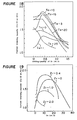
- Figure 14 indicates a relationship between the current breaking capacity and the Ti content added to the alloy for the contact material, wherein the Cr content is fixed at 25% by weight, and the Ta content is fixed at 0, 1, 5, 10, 15, 20 and 25% by weight, respectively.
- the ordinate represents a ratio when the current breaking capacity of the conventional alloy (consisting of Cu-25 Cr) is made 1, and the abscissa denotes the adding quantity of Ti.
- a reference letter A indicates the current breaking capacity of the conventional alloy (consisting of Cu-25 Cr).
- the Ta content becomes 20% by weight and above, the effect of Ti diminishes, and, rather, decrease in current breaking capability takes place. Further, the effect to be derived from addition of Ti is remarkable as the Ta content is small. More concretely, when 0.5% by weight of Ti is added with respect to 1% by weight of Ta, the alloy exhibits its current breaking capacity of 1.5 times as large as that of the conventional alloy (consisting of Cu-25 wt.% Cr). Also, when the Ta content is 10% by weight, the alloy attains its current breaking capacity of 1.9 times as high as that of the conventional alloy by addition of 0.5% by weight of Ti.
- the Ta content when the Ta content is relatively small, alloy and compound to be produced by appropriate reaction between Ti and other elements disperse uniformly and minutely to remarkably increase the current breaking capability, and yet the Cu content is sufficient to maintain the electrical conductivity and heat conductivity without lowering them, so that the heat input due to electric arc can be quickly dissipated.
- the Cu content decreases inevitably, so that, even if the compound itself to be produced by the reaction- between Cu and Ti has a function of increasing the current breaking capability, its adverse effect of lowering the electrical conductivity and heat conductivity becomes overwhelming, whereby the factors for improving the current breaking capability to be brought about by the reaction between Ti and other elements are overcome and, as a whole, the current breaking capability does not appear to improve.
- the adding quantity of Ti should most preferably be 0.5% by weight for the respective Ta contents.
- the Cu-Cr-Ta-Ti alloy used in this experiment was obtained by shaping and sintering a mixture powder of Cu, Cr, Ta and Ti at a required quantity for each of them.
- Figure 15 indicates a relationship between the current breaking capacity and the Ta content added to the alloy for the contact material, wherein the Cr content is fixed at 25% by weight, and the Ti content is fixed at 0, 0.5, 1.0, 1.5, 3 and 5% by weight, respectively.
- the ordinate denotes a ratio when the current breaking capacity of the conventional alloy (consisting of Cu-25 wt.% Cr) is made 1
- the abscissa denotes the adding quantity of Ta.
- it is with 20% by weight or below of Ta added that the increased effect in the current breaking capacity can be observed by the addition of Ti at a rate of 0.5% by weight.
- the adding quantity of Ti may still be effective in a range of 5% by weight or below, in case where the Ta content is very small (1% by weight).
- the contact resistance tends to increase, hence its adding quantity should preferably be 3% by weight or below depending on the conditions of use of the alloy. It is also in a range of 5% by weight or below of the Ta content that the desired effect can be observed when the Ti content is 1.0% by weight, and it is in a range of 3% by weight or below of the Ta content that the desired effect can be observed with the Ti content of 1.5% by weight.
- the Ti content exceeds 2% by weight, the effect of the current breaking capability can be observed, only when the Ta content is 1% by weight or so. In contrast to these, with the Ti content being in a range of 0.5% by weight or below, there emerges an improved effect in the current breaking capability over the broadest range of the Ta content, i.e., a range of 20% by weight or below.
- ranges of 0.8% by weight or below of Ti and 3.5 to 18% by weight of Ta are preferably for further improvement in the current breaking capability of the ternary alloy of Cu-Cr-Ta by addition of Ti thereto. Further, as the condition for obtaining the excellent current breaking capability by reducing the adding quantity of Ta as much as possible, a range of the Ta content of 15% by weight or below is desirable.
- the present inventors conducted experiments as shown in Figures 14 and 15 by varying the Cr content. With the Cr content in a range of from 10 to 35% by weight, there could be observed improvement in the current breaking capability due to addition of Ti, while, with the Cr content in a range of 10% by weight or less, there took place no change in the current breaking capability even by addition of Ti. Conversely, when the Cr content exceeds 35% by weight, there takes place lowering of the current breaking capability.
- the contact material made of the Cu-Cr-Ta-Ti series alloy containing Cr in a range of from 10 to 35% by weight, Ta in a range of 20% by weight or less, and Ti in a range of 5% by weight or less is not inferior in its contact resistance to the conventional alloy (consisting of Cu-25 wt.% Cr) and is also satisfactory in its voltage withstand capability, which, though not shown in the drawing, have been verified from various experiments.
- the current breaking property can be effectively increased in the same manner as in the above-described embodiments even in the contact material for a low chopping, vacuum circuit breaker made of an alloy added with 20% by weight or less of at least one kind of the low melting point metals such as Bi, Te, Sb, TI, Pb, Se, Ce and Ca, and at least one kind of their alloys, their intermetallic compounds, and their oxides.
- the low melting point metals such as Bi, Te, Sb, TI, Pb, Se, Ce and Ca
- the current breaking capability of the alloy decreased remarkably.
- the low melting point metal being Ce or Ca
- the characteristics of the alloy are somewhat inferior.
- the second embodiment of the present invention is characterized in that the alloy for the contact material consists essentially of copper, 10 to 35% by weight of chromium, 20% by weight or below of tantalum, and 5% by weight or below of titanium. Therefore, the invention has its effect such that the contact material for the vacuum circuit breaker excellent in its current breaking capability and having satisfactory voltage withstand capability can be obtained even if the Ta content is reduced. Furthermore, when the Ta content is limited to a range of from 3.5 to 18% by weight, and the Ti content to a range of 0.8% by weight or below, the current breaking capability improves much more than in the case where no Ti is added.
- Figure 16 indicates a relationship between the current breaking capacity and the AI content added to the alloy, in which the Cr content is fixed at 25% by weight and the Ta content is fixed at 0, 1, 5, 10, 15, 20 and 25% by weight, respectively.
- the ordinate denotes a ratio when the current breaking capacity of conventional alloy (Cu-25 wt.% Cr) is made 1
- the abscissa denotes the adding quantity of Al
- a reference letter A represents the current breaking capacity of the conventional alloy (Cu-25 wt.% Cr).
- the effect to be derived from addition of AI becomes much more effective as the quantity of Ta is smaller.
- the current breaking capacity becomes 1.35 times as high as that of the conventional alloy.
- the quantity of Ta is 10% by weight, there can be obtained the current breaking capacity of 1.85 times or more as high as that of the conventional alloy by addition of 0.6% by weight of AI thereto.
- the adding quantity of AI should most preferably be 0.6% by weight for the respective quantities of Ta. It should be noted that the Cu-Cr-Ta-AI alloy used in this experiment was obtained by shaping and sintering a mixture of powders of Cu, Cr, Ta and AI at a required quantity for each of them.
- the ordinate in the graphical representation of Figure 16 represents a ratio when the current breaking capacity of the conventional alloy (Cu-25 wt.% Cr) is made 1, and the abscissa thereof represents the adding quantity of Al.
- a reference letter A indicates the current breaking capacity of the conventional alloy (Cu-25 wt.% Cr).
- Figure 17 indicates a relationship between the current breaking capacity and the quantity of Ta, when the Cr content in the alloy for the contact material is fixed at 25% by weight and the AI content is fixed at 0, 0.6, 1.0, 1.5 and 3.0% by weight, respectively.
- the ordinate denotes a ratio when the current breaking capacity of the conventional alloy (consisting of Cu-25 wt.% Cr) is made 1, then the abscissa denotes the adding quantity of Ta. As seen from Figure 17, it is with 20% by weight or below of the quantity of Ta added that the increased effect in the current breaking capacity can be observed over the broadest range by addition of Ta when the quantity of AI is 0.6% by weight.
- the adding quantity of AI may still be effective in a range of 3% by weight or below, when the quantity of Ta is very small (2% by weight or below). However, when it exceeds 3% by weight, the current breaking capability, the contact resistance, and other parameters undesirably decrease.
- AI be in a range of 0.8% by weight or below
- the quantity of Ta be in a range of from 5 to 18% by weight for further improvement in the current breaking capability of the ternary alloy of Cu-Cr-Ta by addition of AI thereto.
- the quantity of Ta should desirably be in a range of 15% by weight or below.
- the present inventors conducted experiments as shown in Figures 16 and 17 by varying the quantity of Cr. With the quantity of Cr being in a range of from 10 to 35% by weight, there could be observed improvement in the current breaking capability due to addition of Al. With the quantity of Cr being in a range of 10% by weight or below, there took place no change in the current breaking capability even by addition of Al. Conversely, when the quantity of Cr exceeds 35% by weight, there takes place lowering of the current breaking capability.
- the contact material made of the Cu-Cr-Ta-AI series alloy containing Cr in a range of from 10 to 35% by weight, Ta in a range of 20% by weight or below, and AI in a range of 3% by weight or below is not inferior in its contact resistance to the conventional alloy (consisting of Cu-25 wt.% Cr) and has as good a voltage withstand capability as that of the conventional alloy, which has been verified from various experiments, though not shown in the drawing.
- the current breaking property can be effectively increased in the same manner as in the above-described embodiments even in the contact material for a low chopping, vacuum circuit breaker made of an alloy added with 20% by weight or below or at least one kind of the low melting point metals such as Bi, Te, Sb, TI, Pb, Se, Ce and Ca, and at least one kind of their alloys, their intermetallic compounds, and their oxides.
- the low melting point metals such as Bi, Te, Sb, TI, Pb, Se, Ce and Ca
- the current breaking capability of the alloy decreased remarkably.
- the low melting point metal being Ce or Ca
- the characteristics of the alloy are somewhat inferior.
- the third embodiment of the present invention is characterized in that the alloy for the contact material consists essentially of copper, 10 to 35% by weight of chromium, 20% by weight or below of tantalum, and 3% by weight or below of aluminum. Therefore, the present invention has its effect such that the contact material for the vacuum circuit breaker excellent in its current breaking capability and having satisfactory voltage withstand capability can be obtained even if the quantity of Ta is reduced. Furthermore, when the quantity of Ta is limited to a range of from 5 to 18% by weight, and the quantity of Ti to a range of 0.8% by weight or below, the current breaking capability improves much more than in the case where no Ti is added.
- Figure 18 indicates a relationship between the current breaking capacity and the Zr content added to the alloy, in which the Cr content is fixed at 25% by weight and the quantity of Ta is fixed at 0, 1, 5, 10, 15, 20 and 25% by weight, respectively.
- the ordinate represents a ratio when the current breaking capacity of a conventional alloy (Cu-25 wt.% Cr) is made 1, and the abscissa denotes the adding quantity of Zr.
- a reference letter A indicates the current breaking capacity of the conventional alloy (Cu-25 wt.% Cr).
- the adding quantity of Zr should most preferably be 0.4% by weight for the respective quantities of Ta.
- the Cu-Cr-Ta-Zr alloy used in this experiment was obtained by shaping and sintering a mixture powder of Cu, Cr, Ta and Zr at a required quantity for each of them.
- the ordinate in the graphical representation of Figure 18 denotes a ratio when the current breaking capacity of the conventional alloy (Cu-25 wt.% Cr) is made 1, and the abscissa denotes the adding quantity of Zr.
- a reference letter A indicates the current breaking capacity of the conventional alloy (Cu-25 wt.% Cr).
- Figure 19 shows a relationship between the current breaking capacity and the quantity of Ta, when the Cr content in the alloy for the contact material is fixed at 25% by weight and the Zr content is fixed at 0, 0.4, 1.0 and 2.0% by weight, respectively.
- the ordinate represents a ratio when the current breaking capacity of the conventional alloy (consisting of Cu-25 wt.% Cr) is made 1
- the abscissa represents the adding quantity of Ta.
- it is with 20% by weight or below of the quantity of Ta added that the increased effect in the current breaking capacity can be observed most eminently by addition of Zr, when the quantity of Zr is 0.4% by weight.
- the adding quantity of Zr may still be effective in a range of 2% by weight, when the quantity of Ta is very small (2% by weight or below). However, when it exceeds 2% by weight, the current breaking capability, the contact resistance, and so forth unfavorably decrease.
- the quantity of Zr be in a range of 0.65% by weight or below and the quantity of Ta be in a range of from 4.5 to 18% by weight for further improvement in the current breaking capability of the ternary alloy of Cu-Cr-Ta by addition of Ti thereto.
- the quantity of Ta should desirably be in a range of 15% by weight or below.
- the present inventors conducted experiments as shown in Figures 18 and 19 by varying the quantity of Cr. With the quantity of Cr being in a range of 10 to 35% by weight, there could be observed improvement in the current breaking capability by the addition of Ti. However, with the quantity.of Cr being in a range of 10% by weight or below, there could be seen no change in the current breaking capability even by addition of Ti. Conversely, when the quantity of Cr exceeds 35% by weight, there takes place lowering of the current breaking capability.
- the contact material made of the Cu-Cr-Ta-Zr series alloy containing Cr in a range of from 10 to 35% by weight, Ta in a range of 20% by weight or below, and Zr in a range of 2% by weight or below is not inferior in its contact resistance to the conventional alloy (consisting of Cu-25 wt.% Cr) and has as good a voltage withstand capability as that of the conventional alloy, which have been verified from various experiments, though not shown in the drawing.
- the current breaking property can be effectively increased in the same manner as in the above-described embodiments even in the contact material for a low chopping, vacuum circuit breaker made of an alloy added with 20% by weight or below of at least one kind of the low melting point metals such as Bi, Te, Sb, TI, Pb, Se, Ce and Ca, and at least one kind of their alloys, their intermetallic compounds and their oxides.
- the low melting point metals such as Bi, Te, Sb, TI, Pb, Se, Ce and Ca
- the current breaking capability of the alloy decreased remarkably.
- the low melting point metal being Ce or Ca
- the characteristics of the alloy are somewhat inferior.
- the fourth embodiment of the present invention is characterized in that the alloy for the contact material consists essentially of copper, 10 to 35% by weight of chromium, 20% by weight or below of tantalum, and 2% by weight or below of zirconium. Therefore, the present invention has its effect such that the contact material for the vacuum circuit breaker excellent in its current breaking capability and having satisfactory voltage withstand capability can be obtained, even if the quantity of Ta is reduced. Furthermore, when the quantity of Ta is limited to a range of from 4.5 to 18% by weight, and the quantity of Zr to a range of 0.65% by weight or below, the current breaking capability improves much more than in the case where no Ti is added.
Landscapes
- High-Tension Arc-Extinguishing Switches Without Spraying Means (AREA)
- Contacts (AREA)
Claims (12)
Applications Claiming Priority (8)
| Application Number | Priority Date | Filing Date | Title |
|---|---|---|---|
| JP192785/82 | 1982-11-01 | ||
| JP19278582A JPS5981816A (ja) | 1982-11-01 | 1982-11-01 | 真空しや断器用接点材料 |
| JP7661683A JPS59201332A (ja) | 1983-04-28 | 1983-04-28 | 真空しや断器用接点材料 |
| JP76617/83 | 1983-04-28 | ||
| JP76616/83 | 1983-04-28 | ||
| JP7661783A JPS59201333A (ja) | 1983-04-28 | 1983-04-28 | 真空しや断器用接点材料 |
| JP76615/83 | 1983-04-28 | ||
| JP7661583A JPS59201331A (ja) | 1983-04-28 | 1983-04-28 | 真空しや断器用接点材料 |
Publications (3)
| Publication Number | Publication Date |
|---|---|
| EP0110176A2 EP0110176A2 (fr) | 1984-06-13 |
| EP0110176A3 EP0110176A3 (en) | 1987-01-21 |
| EP0110176B1 true EP0110176B1 (fr) | 1988-09-21 |
Family
ID=27465961
Family Applications (1)
| Application Number | Title | Priority Date | Filing Date |
|---|---|---|---|
| EP83110920A Expired EP0110176B1 (fr) | 1982-11-01 | 1983-11-02 | Matériau de contact pour interrupteur à vide |
Country Status (3)
| Country | Link |
|---|---|
| US (1) | US4517033A (fr) |
| EP (1) | EP0110176B1 (fr) |
| DE (1) | DE3378088D1 (fr) |
Families Citing this family (20)
| Publication number | Priority date | Publication date | Assignee | Title |
|---|---|---|---|---|
| JPS60172116A (ja) * | 1984-02-16 | 1985-09-05 | 三菱電機株式会社 | 真空しや断器用接点 |
| DE3575234D1 (de) * | 1984-10-30 | 1990-02-08 | Mitsubishi Electric Corp | Kontaktmaterial fuer vakuumschalter. |
| CN1003329B (zh) * | 1984-12-13 | 1989-02-15 | 三菱电机有限公司 | 真空断路器用触头 |
| US4784829A (en) * | 1985-04-30 | 1988-11-15 | Mitsubishi Denki Kabushiki Kaisha | Contact material for vacuum circuit breaker |
| KR900001613B1 (ko) * | 1986-01-10 | 1990-03-17 | 미쯔비시 덴끼 가부시기가이샤 | 진공차단기용 접점재료 |
| DE3915155A1 (de) * | 1989-05-09 | 1990-12-20 | Siemens Ag | Verfahren zur herstellung von schmelzwerkstoffen aus kupfer, chrom und wenigstens einer sauerstoffaffinen komponente sowie abschmelzelektrode zur verwendung bei einem derartigen verfahren |
| JP2766441B2 (ja) * | 1993-02-02 | 1998-06-18 | 株式会社東芝 | 真空バルブ用接点材料 |
| JP3597544B2 (ja) * | 1993-02-05 | 2004-12-08 | 株式会社東芝 | 真空バルブ用接点材料及びその製造方法 |
| TW320728B (fr) * | 1994-02-21 | 1997-11-21 | Toshiba Co Ltd | |
| CN1064862C (zh) * | 1994-11-09 | 2001-04-25 | 中国石油化工总公司 | 一种加氢裂化催化剂 |
| US5653827A (en) * | 1995-06-06 | 1997-08-05 | Starline Mfg. Co., Inc. | Brass alloys |
| DE69705671T2 (de) * | 1996-05-06 | 2001-10-31 | Ford Motor Co. Ltd., Brentwood | Verfahren zur Verwendung von Kupfer-Basis-Elektroden für das Punktschweissen von Aluminium |
| JPH10209156A (ja) * | 1997-01-21 | 1998-08-07 | Sony Corp | 半導体装置及びその形成方法 |
| DE19714654A1 (de) * | 1997-04-09 | 1998-10-15 | Abb Patent Gmbh | Vakuumschaltkammer mit einem festen und einem beweglichen Kontaktstück und/oder einem Schirm von denen wenigstens die Kontaktstücke wenigstens teilweise aus Cu/Cr, Cu/CrX oder Cu/CrXY bestehen |
| DE19903619C1 (de) * | 1999-01-29 | 2000-06-08 | Louis Renner Gmbh | Pulvermetallurgisch hergestellter Verbundwerkstoff und Verfahren zu dessen Herstellung sowie dessen Verwendung |
| HUP0001984A3 (en) * | 2000-05-23 | 2002-05-28 | Kourganov Konstantin | Copper-base contact material, contact stud and method for producing contact stud |
| JP6253494B2 (ja) * | 2014-04-21 | 2017-12-27 | 三菱電機株式会社 | 真空バルブ用接点材料及び真空バルブ |
| US10843333B2 (en) | 2018-03-05 | 2020-11-24 | Berkshire Grey, Inc. | Systems and methods for processing objects, including automated re-circulating processing stations |
| WO2020263942A1 (fr) | 2019-06-24 | 2020-12-30 | Berkshire Grey, Inc. | Systèmes et procédés de fourniture d'expédition de commandes dans un centre d'exécution de commandes |
| CN114934208B (zh) * | 2022-07-25 | 2022-10-28 | 西安稀有金属材料研究院有限公司 | 一种抗高温蠕变高热稳定性的铜基复合材料及其制备方法 |
Family Cites Families (12)
| Publication number | Priority date | Publication date | Assignee | Title |
|---|---|---|---|---|
| US2281691A (en) * | 1934-03-08 | 1942-05-05 | Westinghouse Electric & Mfg Co | Process for heat treating copper alloys |
| US2218073A (en) * | 1936-11-12 | 1940-10-15 | American Electro Metal Corp | Alloy, particularly adapted for electrical purposes |
| FR1429965A (fr) * | 1964-04-21 | 1966-02-25 | English Electric Co Ltd | Contact ou électrode pour interrupteurs ou éclateurs sous vide |
| GB1194674A (en) * | 1966-05-27 | 1970-06-10 | English Electric Co Ltd | Vacuum Type Electric Circuit Interrupting Devices |
| GB1200064A (en) * | 1967-12-12 | 1970-07-29 | Ass Elect Ind | Improvements relating to electrical contact material |
| DE1808810A1 (de) * | 1968-11-14 | 1970-06-04 | Duerrwaechter E Dr Doduco | Kontaktwerkstoff fuer Vakuumschalter hoher Leistung |
| GB1346758A (en) * | 1970-02-24 | 1974-02-13 | Ass Elect Ind | Vacuum interrupter contacts |
| JPS5110989B2 (fr) * | 1972-05-12 | 1976-04-08 | ||
| US4007039A (en) * | 1975-03-17 | 1977-02-08 | Olin Corporation | Copper base alloys with high strength and high electrical conductivity |
| US4008081A (en) * | 1975-06-24 | 1977-02-15 | Westinghouse Electric Corporation | Method of making vacuum interrupter contact materials |
| JPS5822345A (ja) * | 1981-08-04 | 1983-02-09 | Tanaka Kikinzoku Kogyo Kk | 封入用電気接点材料 |
| JPS5848323A (ja) * | 1981-09-16 | 1983-03-22 | 三菱電機株式会社 | 真空開閉器用接点 |
-
1983
- 1983-10-31 US US06/547,218 patent/US4517033A/en not_active Expired - Lifetime
- 1983-11-02 EP EP83110920A patent/EP0110176B1/fr not_active Expired
- 1983-11-02 DE DE8383110920T patent/DE3378088D1/de not_active Expired
Also Published As
| Publication number | Publication date |
|---|---|
| EP0110176A2 (fr) | 1984-06-13 |
| EP0110176A3 (en) | 1987-01-21 |
| US4517033A (en) | 1985-05-14 |
| DE3378088D1 (en) | 1988-10-27 |
Similar Documents
| Publication | Publication Date | Title |
|---|---|---|
| US4517033A (en) | Contact material for vacuum circuit breaker | |
| EP0109088B1 (fr) | Matériau de contact pour interrupteurs sous vide | |
| US4486631A (en) | Contact for vacuum circuit breaker | |
| US4853184A (en) | Contact material for vacuum interrupter | |
| EP0610018B1 (fr) | Matériau de contact pour un interrupteur à vide | |
| US5489412A (en) | Electrode material | |
| CN1133646A (zh) | 银基触头材料和这类材料在能源技术的开关设备中的应用以及这类触头材料的制备方法 | |
| EP0126347B2 (fr) | Matériau de contact pour interrupteur sous vide, membre de contact de ce matériau, interrupteur sous vide et utilisation de ce matériau | |
| JPH0133011B2 (fr) | ||
| JPS6336089B2 (fr) | ||
| JPS6336090B2 (fr) | ||
| JPS59201334A (ja) | 真空しや断器用接点材料 | |
| KR900001613B1 (ko) | 진공차단기용 접점재료 | |
| JPS59214121A (ja) | 真空しや断器用接点材料 | |
| JPS6336092B2 (fr) | ||
| JPH0313295B2 (fr) | ||
| JPH0449734B2 (fr) | ||
| JPH0347931A (ja) | 真空バルブ用接点材料 | |
| JPH0449733B2 (fr) | ||
| JPS60170122A (ja) | 真空しや断器用接点材料 | |
| JPS59201336A (ja) | 真空しや断器用接点材料 | |
| JPS59201335A (ja) | 真空しや断器用接点材料 | |
| JPS59167925A (ja) | 真空しや断器用接点材料 | |
| JPH0241572B2 (fr) | ||
| JPH0241571B2 (fr) |
Legal Events
| Date | Code | Title | Description |
|---|---|---|---|
| PUAI | Public reference made under article 153(3) epc to a published international application that has entered the european phase |
Free format text: ORIGINAL CODE: 0009012 |
|
| AK | Designated contracting states |
Designated state(s): DE FR GB SE |
|
| PUAL | Search report despatched |
Free format text: ORIGINAL CODE: 0009013 |
|
| AK | Designated contracting states |
Kind code of ref document: A3 Designated state(s): DE FR GB SE |
|
| 17P | Request for examination filed |
Effective date: 19870122 |
|
| 17Q | First examination report despatched |
Effective date: 19870624 |
|
| GRAA | (expected) grant |
Free format text: ORIGINAL CODE: 0009210 |
|
| AK | Designated contracting states |
Kind code of ref document: B1 Designated state(s): DE FR GB SE |
|
| REF | Corresponds to: |
Ref document number: 3378088 Country of ref document: DE Date of ref document: 19881027 |
|
| ET | Fr: translation filed | ||
| PLBI | Opposition filed |
Free format text: ORIGINAL CODE: 0009260 |
|
| 26 | Opposition filed |
Opponent name: SIEMENS AKTIENGESELLSCHAFT, BERLIN UND MUENCHEN Effective date: 19890621 |
|
| PLBN | Opposition rejected |
Free format text: ORIGINAL CODE: 0009273 |
|
| STAA | Information on the status of an ep patent application or granted ep patent |
Free format text: STATUS: OPPOSITION REJECTED |
|
| 27O | Opposition rejected |
Effective date: 19900824 |
|
| EAL | Se: european patent in force in sweden |
Ref document number: 83110920.2 |
|
| PGFP | Annual fee paid to national office [announced via postgrant information from national office to epo] |
Ref country code: SE Payment date: 19951116 Year of fee payment: 13 |
|
| REG | Reference to a national code |
Ref country code: GB Ref legal event code: 746 Effective date: 19951026 |
|
| REG | Reference to a national code |
Ref country code: FR Ref legal event code: D6 |
|
| PG25 | Lapsed in a contracting state [announced via postgrant information from national office to epo] |
Ref country code: SE Effective date: 19961103 |
|
| EUG | Se: european patent has lapsed |
Ref document number: 83110920.2 |
|
| PGFP | Annual fee paid to national office [announced via postgrant information from national office to epo] |
Ref country code: GB Payment date: 20011031 Year of fee payment: 19 |
|
| PGFP | Annual fee paid to national office [announced via postgrant information from national office to epo] |
Ref country code: FR Payment date: 20011113 Year of fee payment: 19 |
|
| PGFP | Annual fee paid to national office [announced via postgrant information from national office to epo] |
Ref country code: DE Payment date: 20011119 Year of fee payment: 19 |
|
| REG | Reference to a national code |
Ref country code: GB Ref legal event code: IF02 |
|
| PG25 | Lapsed in a contracting state [announced via postgrant information from national office to epo] |
Ref country code: GB Free format text: LAPSE BECAUSE OF NON-PAYMENT OF DUE FEES Effective date: 20021102 |
|
| PG25 | Lapsed in a contracting state [announced via postgrant information from national office to epo] |
Ref country code: DE Free format text: LAPSE BECAUSE OF NON-PAYMENT OF DUE FEES Effective date: 20030603 |
|
| GBPC | Gb: european patent ceased through non-payment of renewal fee | ||
| PG25 | Lapsed in a contracting state [announced via postgrant information from national office to epo] |
Ref country code: FR Free format text: LAPSE BECAUSE OF NON-PAYMENT OF DUE FEES Effective date: 20030731 |
|
| REG | Reference to a national code |
Ref country code: FR Ref legal event code: ST |