EP0110732A2 - Procédé de préparation de dicarbamates de diphénylméthane - Google Patents
Procédé de préparation de dicarbamates de diphénylméthane Download PDFInfo
- Publication number
- EP0110732A2 EP0110732A2 EP83307445A EP83307445A EP0110732A2 EP 0110732 A2 EP0110732 A2 EP 0110732A2 EP 83307445 A EP83307445 A EP 83307445A EP 83307445 A EP83307445 A EP 83307445A EP 0110732 A2 EP0110732 A2 EP 0110732A2
- Authority
- EP
- European Patent Office
- Prior art keywords
- acid
- reaction
- phenylcarbamate
- aqueous solution
- reaction mixture
- Prior art date
- Legal status (The legal status is an assumption and is not a legal conclusion. Google has not performed a legal analysis and makes no representation as to the accuracy of the status listed.)
- Granted
Links
- 238000000034 method Methods 0.000 title claims abstract description 79
- 230000008569 process Effects 0.000 title claims abstract description 58
- OTSJRHVZRARHBC-UHFFFAOYSA-N benzylbenzene;carbamic acid Chemical class NC(O)=O.NC(O)=O.C=1C=CC=CC=1CC1=CC=CC=C1 OTSJRHVZRARHBC-UHFFFAOYSA-N 0.000 title claims abstract description 47
- 239000011541 reaction mixture Substances 0.000 claims abstract description 61
- PWXJULSLLONQHY-UHFFFAOYSA-N phenylcarbamic acid Chemical compound OC(=O)NC1=CC=CC=C1 PWXJULSLLONQHY-UHFFFAOYSA-N 0.000 claims abstract description 53
- 239000003795 chemical substances by application Substances 0.000 claims abstract description 43
- 238000006243 chemical reaction Methods 0.000 claims description 172
- 150000001875 compounds Chemical class 0.000 claims description 75
- WSFSSNUMVMOOMR-UHFFFAOYSA-N Formaldehyde Chemical compound O=C WSFSSNUMVMOOMR-UHFFFAOYSA-N 0.000 claims description 60
- 150000007522 mineralic acids Chemical class 0.000 claims description 54
- 239000002253 acid Substances 0.000 claims description 46
- 239000007864 aqueous solution Substances 0.000 claims description 45
- QAOWNCQODCNURD-UHFFFAOYSA-N Sulfuric acid Chemical compound OS(O)(=O)=O QAOWNCQODCNURD-UHFFFAOYSA-N 0.000 claims description 42
- 238000000926 separation method Methods 0.000 claims description 39
- LQNUZADURLCDLV-UHFFFAOYSA-N nitrobenzene Chemical compound [O-][N+](=O)C1=CC=CC=C1 LQNUZADURLCDLV-UHFFFAOYSA-N 0.000 claims description 36
- DTQVDTLACAAQTR-UHFFFAOYSA-N Trifluoroacetic acid Chemical compound OC(=O)C(F)(F)F DTQVDTLACAAQTR-UHFFFAOYSA-N 0.000 claims description 32
- 239000011973 solid acid Substances 0.000 claims description 30
- XLYOFNOQVPJJNP-UHFFFAOYSA-N water Substances O XLYOFNOQVPJJNP-UHFFFAOYSA-N 0.000 claims description 30
- 239000012074 organic phase Substances 0.000 claims description 27
- 239000000203 mixture Substances 0.000 claims description 25
- 150000001735 carboxylic acids Chemical class 0.000 claims description 22
- 239000003960 organic solvent Substances 0.000 claims description 21
- 230000002378 acidificating effect Effects 0.000 claims description 16
- 125000001570 methylene group Chemical group [H]C([H])([*:1])[*:2] 0.000 claims description 13
- 238000006276 transfer reaction Methods 0.000 claims description 12
- 125000003709 fluoroalkyl group Chemical group 0.000 claims description 10
- 125000001424 substituent group Chemical group 0.000 claims description 9
- 150000001491 aromatic compounds Chemical group 0.000 claims description 8
- 125000003178 carboxy group Chemical group [H]OC(*)=O 0.000 claims description 8
- 125000000542 sulfonic acid group Chemical group 0.000 claims description 8
- 229910021536 Zeolite Inorganic materials 0.000 claims description 7
- 239000003729 cation exchange resin Substances 0.000 claims description 7
- MVPPADPHJFYWMZ-UHFFFAOYSA-N chlorobenzene Chemical compound ClC1=CC=CC=C1 MVPPADPHJFYWMZ-UHFFFAOYSA-N 0.000 claims description 7
- HNPSIPDUKPIQMN-UHFFFAOYSA-N dioxosilane;oxo(oxoalumanyloxy)alumane Chemical compound O=[Si]=O.O=[Al]O[Al]=O HNPSIPDUKPIQMN-UHFFFAOYSA-N 0.000 claims description 7
- 239000010457 zeolite Substances 0.000 claims description 7
- 239000002734 clay mineral Substances 0.000 claims description 6
- 238000010438 heat treatment Methods 0.000 claims description 6
- 229910052809 inorganic oxide Inorganic materials 0.000 claims description 6
- 239000007791 liquid phase Substances 0.000 claims description 6
- 229940023913 cation exchange resins Drugs 0.000 claims description 5
- 150000001767 cationic compounds Chemical class 0.000 claims description 5
- 125000005843 halogen group Chemical group 0.000 claims description 5
- 229910001411 inorganic cation Inorganic materials 0.000 claims description 5
- 125000000449 nitro group Chemical group [O-][N+](*)=O 0.000 claims description 5
- BGJSXRVXTHVRSN-UHFFFAOYSA-N 1,3,5-trioxane Chemical compound C1OCOCO1 BGJSXRVXTHVRSN-UHFFFAOYSA-N 0.000 claims description 4
- OCJBOOLMMGQPQU-UHFFFAOYSA-N 1,4-dichlorobenzene Chemical compound ClC1=CC=C(Cl)C=C1 OCJBOOLMMGQPQU-UHFFFAOYSA-N 0.000 claims description 4
- ZAMOUSCENKQFHK-UHFFFAOYSA-N Chlorine atom Chemical compound [Cl] ZAMOUSCENKQFHK-UHFFFAOYSA-N 0.000 claims description 4
- 229930040373 Paraformaldehyde Natural products 0.000 claims description 4
- 238000009835 boiling Methods 0.000 claims description 4
- 239000000460 chlorine Substances 0.000 claims description 4
- 229910052801 chlorine Inorganic materials 0.000 claims description 4
- 229940117389 dichlorobenzene Drugs 0.000 claims description 4
- 229910052736 halogen Inorganic materials 0.000 claims description 4
- 150000002367 halogens Chemical class 0.000 claims description 4
- WSFSSNUMVMOOMR-NJFSPNSNSA-N methanone Chemical compound O=[14CH2] WSFSSNUMVMOOMR-NJFSPNSNSA-N 0.000 claims description 4
- 229920002866 paraformaldehyde Polymers 0.000 claims description 4
- 230000005588 protonation Effects 0.000 claims description 4
- 230000000717 retained effect Effects 0.000 claims description 4
- 239000007787 solid Substances 0.000 claims description 4
- 239000011343 solid material Substances 0.000 claims description 4
- PXGOKWXKJXAPGV-UHFFFAOYSA-N Fluorine Chemical compound FF PXGOKWXKJXAPGV-UHFFFAOYSA-N 0.000 claims description 3
- 229910019142 PO4 Inorganic materials 0.000 claims description 3
- 229910052731 fluorine Inorganic materials 0.000 claims description 3
- 239000011737 fluorine Substances 0.000 claims description 3
- 229910044991 metal oxide Inorganic materials 0.000 claims description 3
- 150000004706 metal oxides Chemical class 0.000 claims description 3
- 229910003455 mixed metal oxide Inorganic materials 0.000 claims description 3
- 150000002823 nitrates Chemical class 0.000 claims description 3
- 150000002892 organic cations Chemical group 0.000 claims description 3
- 235000021317 phosphate Nutrition 0.000 claims description 3
- 150000003013 phosphoric acid derivatives Chemical class 0.000 claims description 3
- 150000003467 sulfuric acid derivatives Chemical class 0.000 claims description 3
- CZZYITDELCSZES-UHFFFAOYSA-N diphenylmethane Chemical compound C=1C=CC=CC=1CC1=CC=CC=C1 CZZYITDELCSZES-UHFFFAOYSA-N 0.000 claims description 2
- 239000000463 material Substances 0.000 claims description 2
- 125000000962 organic group Chemical group 0.000 claims description 2
- 239000012071 phase Substances 0.000 claims description 2
- NWUYHJFMYQTDRP-UHFFFAOYSA-N 1,2-bis(ethenyl)benzene;1-ethenyl-2-ethylbenzene;styrene Chemical compound C=CC1=CC=CC=C1.CCC1=CC=CC=C1C=C.C=CC1=CC=CC=C1C=C NWUYHJFMYQTDRP-UHFFFAOYSA-N 0.000 claims 2
- 239000003377 acid catalyst Substances 0.000 abstract description 11
- 239000003054 catalyst Substances 0.000 abstract description 6
- 230000000694 effects Effects 0.000 abstract description 3
- -1 polymethylene Polymers 0.000 description 39
- LBKPGNUOUPTQKA-UHFFFAOYSA-N ethyl n-phenylcarbamate Chemical compound CCOC(=O)NC1=CC=CC=C1 LBKPGNUOUPTQKA-UHFFFAOYSA-N 0.000 description 23
- 239000007859 condensation product Substances 0.000 description 22
- VYPSYNLAJGMNEJ-UHFFFAOYSA-N Silicium dioxide Chemical compound O=[Si]=O VYPSYNLAJGMNEJ-UHFFFAOYSA-N 0.000 description 21
- 239000012044 organic layer Substances 0.000 description 18
- 150000001732 carboxylic acid derivatives Chemical class 0.000 description 17
- 239000007795 chemical reaction product Substances 0.000 description 14
- 125000004177 diethyl group Chemical group [H]C([H])([H])C([H])([H])* 0.000 description 14
- 239000000243 solution Substances 0.000 description 13
- 125000000217 alkyl group Chemical group 0.000 description 11
- PNEYBMLMFCGWSK-UHFFFAOYSA-N aluminium oxide Inorganic materials [O-2].[O-2].[O-2].[Al+3].[Al+3] PNEYBMLMFCGWSK-UHFFFAOYSA-N 0.000 description 11
- 238000004821 distillation Methods 0.000 description 11
- 239000000377 silicon dioxide Substances 0.000 description 11
- 150000007513 acids Chemical class 0.000 description 10
- 239000012948 isocyanate Substances 0.000 description 10
- 150000002513 isocyanates Chemical class 0.000 description 10
- 239000000047 product Substances 0.000 description 10
- 239000011347 resin Substances 0.000 description 10
- 229920005989 resin Polymers 0.000 description 10
- QTBSBXVTEAMEQO-UHFFFAOYSA-N Acetic acid Chemical compound CC(O)=O QTBSBXVTEAMEQO-UHFFFAOYSA-N 0.000 description 9
- OKKJLVBELUTLKV-UHFFFAOYSA-N Methanol Chemical compound OC OKKJLVBELUTLKV-UHFFFAOYSA-N 0.000 description 9
- GWEVSGVZZGPLCZ-UHFFFAOYSA-N Titan oxide Chemical compound O=[Ti]=O GWEVSGVZZGPLCZ-UHFFFAOYSA-N 0.000 description 9
- MCMNRKCIXSYSNV-UHFFFAOYSA-N ZrO2 Inorganic materials O=[Zr]=O MCMNRKCIXSYSNV-UHFFFAOYSA-N 0.000 description 9
- 125000004432 carbon atom Chemical group C* 0.000 description 9
- 238000004519 manufacturing process Methods 0.000 description 9
- 238000009833 condensation Methods 0.000 description 8
- 230000005494 condensation Effects 0.000 description 8
- IAGUPODHENSJEZ-UHFFFAOYSA-N methyl n-phenylcarbamate Chemical compound COC(=O)NC1=CC=CC=C1 IAGUPODHENSJEZ-UHFFFAOYSA-N 0.000 description 8
- 239000007858 starting material Substances 0.000 description 8
- 125000001495 ethyl group Chemical group [H]C([H])([H])C([H])([H])* 0.000 description 7
- 239000010410 layer Substances 0.000 description 7
- VNWKTOKETHGBQD-UHFFFAOYSA-N methane Chemical compound C VNWKTOKETHGBQD-UHFFFAOYSA-N 0.000 description 7
- 125000002496 methyl group Chemical group [H]C([H])([H])* 0.000 description 7
- 239000002904 solvent Substances 0.000 description 7
- VEXZGXHMUGYJMC-UHFFFAOYSA-N Hydrochloric acid Chemical compound Cl VEXZGXHMUGYJMC-UHFFFAOYSA-N 0.000 description 6
- YXFVVABEGXRONW-UHFFFAOYSA-N Toluene Chemical compound CC1=CC=CC=C1 YXFVVABEGXRONW-UHFFFAOYSA-N 0.000 description 6
- 238000006462 rearrangement reaction Methods 0.000 description 6
- XNRBLQMJVXSCAJ-UHFFFAOYSA-N (2-chlorophenyl) carbamate Chemical compound NC(=O)OC1=CC=CC=C1Cl XNRBLQMJVXSCAJ-UHFFFAOYSA-N 0.000 description 5
- OFRDLTRRNSVEDK-UHFFFAOYSA-N (2-methylphenyl) carbamate Chemical compound CC1=CC=CC=C1OC(N)=O OFRDLTRRNSVEDK-UHFFFAOYSA-N 0.000 description 5
- 125000004206 2,2,2-trifluoroethyl group Chemical group [H]C([H])(*)C(F)(F)F 0.000 description 5
- UPMLOUAZCHDJJD-UHFFFAOYSA-N 4,4'-Diphenylmethane Diisocyanate Chemical compound C1=CC(N=C=O)=CC=C1CC1=CC=C(N=C=O)C=C1 UPMLOUAZCHDJJD-UHFFFAOYSA-N 0.000 description 5
- NBIIXXVUZAFLBC-UHFFFAOYSA-N Phosphoric acid Chemical compound OP(O)(O)=O NBIIXXVUZAFLBC-UHFFFAOYSA-N 0.000 description 5
- 125000002723 alicyclic group Chemical group 0.000 description 5
- 125000000484 butyl group Chemical group [H]C([*])([H])C([H])([H])C([H])([H])C([H])([H])[H] 0.000 description 5
- 239000011521 glass Substances 0.000 description 5
- 239000007788 liquid Substances 0.000 description 5
- 125000001436 propyl group Chemical group [H]C([*])([H])C([H])([H])C([H])([H])[H] 0.000 description 5
- 150000003460 sulfonic acids Chemical class 0.000 description 5
- YNJBWRMUSHSURL-UHFFFAOYSA-N trichloroacetic acid Chemical compound OC(=O)C(Cl)(Cl)Cl YNJBWRMUSHSURL-UHFFFAOYSA-N 0.000 description 5
- 235000011054 acetic acid Nutrition 0.000 description 4
- 150000007933 aliphatic carboxylic acids Chemical class 0.000 description 4
- 239000008346 aqueous phase Substances 0.000 description 4
- 125000003118 aryl group Chemical group 0.000 description 4
- 239000006227 byproduct Substances 0.000 description 4
- JXTHNDFMNIQAHM-UHFFFAOYSA-N dichloroacetic acid Chemical compound OC(=O)C(Cl)Cl JXTHNDFMNIQAHM-UHFFFAOYSA-N 0.000 description 4
- RTZKZFJDLAIYFH-UHFFFAOYSA-N ether Substances CCOCC RTZKZFJDLAIYFH-UHFFFAOYSA-N 0.000 description 4
- PAYKNTKJSJCLPI-UHFFFAOYSA-N ethyl n-[(n-ethoxycarbonylanilino)methyl]-n-phenylcarbamate Chemical compound C=1C=CC=CC=1N(C(=O)OCC)CN(C(=O)OCC)C1=CC=CC=C1 PAYKNTKJSJCLPI-UHFFFAOYSA-N 0.000 description 4
- 238000001914 filtration Methods 0.000 description 4
- 239000002245 particle Substances 0.000 description 4
- 238000005191 phase separation Methods 0.000 description 4
- 239000002243 precursor Substances 0.000 description 4
- 238000005979 thermal decomposition reaction Methods 0.000 description 4
- UHOVQNZJYSORNB-UHFFFAOYSA-N Benzene Chemical compound C1=CC=CC=C1 UHOVQNZJYSORNB-UHFFFAOYSA-N 0.000 description 3
- OKTJSMMVPCPJKN-UHFFFAOYSA-N Carbon Chemical compound [C] OKTJSMMVPCPJKN-UHFFFAOYSA-N 0.000 description 3
- LFQSCWFLJHTTHZ-UHFFFAOYSA-N Ethanol Chemical compound CCO LFQSCWFLJHTTHZ-UHFFFAOYSA-N 0.000 description 3
- XEKOWRVHYACXOJ-UHFFFAOYSA-N Ethyl acetate Chemical compound CCOC(C)=O XEKOWRVHYACXOJ-UHFFFAOYSA-N 0.000 description 3
- OFOBLEOULBTSOW-UHFFFAOYSA-N Malonic acid Chemical compound OC(=O)CC(O)=O OFOBLEOULBTSOW-UHFFFAOYSA-N 0.000 description 3
- MUBZPKHOEPUJKR-UHFFFAOYSA-N Oxalic acid Chemical compound OC(=O)C(O)=O MUBZPKHOEPUJKR-UHFFFAOYSA-N 0.000 description 3
- 229920000538 Poly[(phenyl isocyanate)-co-formaldehyde] Polymers 0.000 description 3
- 125000003545 alkoxy group Chemical group 0.000 description 3
- DIZPMCHEQGEION-UHFFFAOYSA-H aluminium sulfate (anhydrous) Chemical compound [Al+3].[Al+3].[O-]S([O-])(=O)=O.[O-]S([O-])(=O)=O.[O-]S([O-])(=O)=O DIZPMCHEQGEION-UHFFFAOYSA-H 0.000 description 3
- 238000004458 analytical method Methods 0.000 description 3
- 239000011260 aqueous acid Substances 0.000 description 3
- 238000010533 azeotropic distillation Methods 0.000 description 3
- KRKNYBCHXYNGOX-UHFFFAOYSA-N citric acid Chemical compound OC(=O)CC(O)(C(O)=O)CC(O)=O KRKNYBCHXYNGOX-UHFFFAOYSA-N 0.000 description 3
- 239000004927 clay Substances 0.000 description 3
- 238000006482 condensation reaction Methods 0.000 description 3
- 238000007796 conventional method Methods 0.000 description 3
- 125000004093 cyano group Chemical group *C#N 0.000 description 3
- 125000000118 dimethyl group Chemical group [H]C([H])([H])* 0.000 description 3
- 229910052739 hydrogen Inorganic materials 0.000 description 3
- 239000001257 hydrogen Substances 0.000 description 3
- 125000004435 hydrogen atom Chemical group [H]* 0.000 description 3
- 235000011090 malic acid Nutrition 0.000 description 3
- VLKZOEOYAKHREP-UHFFFAOYSA-N n-Hexane Chemical compound CCCCCC VLKZOEOYAKHREP-UHFFFAOYSA-N 0.000 description 3
- 150000002902 organometallic compounds Chemical group 0.000 description 3
- 125000001997 phenyl group Chemical group [H]C1=C([H])C([H])=C(*)C([H])=C1[H] 0.000 description 3
- 239000000376 reactant Substances 0.000 description 3
- 238000007086 side reaction Methods 0.000 description 3
- 238000003756 stirring Methods 0.000 description 3
- 239000000126 substance Substances 0.000 description 3
- 238000005406 washing Methods 0.000 description 3
- QPFMBZIOSGYJDE-UHFFFAOYSA-N 1,1,2,2-tetrachloroethane Chemical compound ClC(Cl)C(Cl)Cl QPFMBZIOSGYJDE-UHFFFAOYSA-N 0.000 description 2
- MYRTYDVEIRVNKP-UHFFFAOYSA-N 1,2-Divinylbenzene Chemical compound C=CC1=CC=CC=C1C=C MYRTYDVEIRVNKP-UHFFFAOYSA-N 0.000 description 2
- RFFLAFLAYFXFSW-UHFFFAOYSA-N 1,2-dichlorobenzene Chemical compound ClC1=CC=CC=C1Cl RFFLAFLAYFXFSW-UHFFFAOYSA-N 0.000 description 2
- WQADWIOXOXRPLN-UHFFFAOYSA-N 1,3-dithiane Chemical compound C1CSCSC1 WQADWIOXOXRPLN-UHFFFAOYSA-N 0.000 description 2
- DLKQHBOKULLWDQ-UHFFFAOYSA-N 1-bromonaphthalene Chemical compound C1=CC=C2C(Br)=CC=CC2=C1 DLKQHBOKULLWDQ-UHFFFAOYSA-N 0.000 description 2
- BQAMFNQVNXPFFH-UHFFFAOYSA-N 2,2-diiodoacetic acid Chemical compound OC(=O)C(I)I BQAMFNQVNXPFFH-UHFFFAOYSA-N 0.000 description 2
- WKBOTKDWSSQWDR-UHFFFAOYSA-N Bromine atom Chemical compound [Br] WKBOTKDWSSQWDR-UHFFFAOYSA-N 0.000 description 2
- VTYYLEPIZMXCLO-UHFFFAOYSA-L Calcium carbonate Chemical compound [Ca+2].[O-]C([O-])=O VTYYLEPIZMXCLO-UHFFFAOYSA-L 0.000 description 2
- KXDHJXZQYSOELW-UHFFFAOYSA-M Carbamate Chemical compound NC([O-])=O KXDHJXZQYSOELW-UHFFFAOYSA-M 0.000 description 2
- HEDRZPFGACZZDS-UHFFFAOYSA-N Chloroform Chemical compound ClC(Cl)Cl HEDRZPFGACZZDS-UHFFFAOYSA-N 0.000 description 2
- RGSFGYAAUTVSQA-UHFFFAOYSA-N Cyclopentane Chemical compound C1CCCC1 RGSFGYAAUTVSQA-UHFFFAOYSA-N 0.000 description 2
- YZGQDNOIGFBYKF-UHFFFAOYSA-N Ethoxyacetic acid Chemical compound CCOCC(O)=O YZGQDNOIGFBYKF-UHFFFAOYSA-N 0.000 description 2
- YNQLUTRBYVCPMQ-UHFFFAOYSA-N Ethylbenzene Chemical compound CCC1=CC=CC=C1 YNQLUTRBYVCPMQ-UHFFFAOYSA-N 0.000 description 2
- KRHYYFGTRYWZRS-UHFFFAOYSA-N Fluorane Chemical compound F KRHYYFGTRYWZRS-UHFFFAOYSA-N 0.000 description 2
- VZCYOOQTPOCHFL-OWOJBTEDSA-N Fumaric acid Chemical compound OC(=O)\C=C\C(O)=O VZCYOOQTPOCHFL-OWOJBTEDSA-N 0.000 description 2
- AEMRFAOFKBGASW-UHFFFAOYSA-N Glycolic acid Chemical compound OCC(O)=O AEMRFAOFKBGASW-UHFFFAOYSA-N 0.000 description 2
- 239000005909 Kieselgur Substances 0.000 description 2
- 239000002841 Lewis acid Substances 0.000 description 2
- CPLXHLVBOLITMK-UHFFFAOYSA-N Magnesium oxide Chemical compound [Mg]=O CPLXHLVBOLITMK-UHFFFAOYSA-N 0.000 description 2
- LRHPLDYGYMQRHN-UHFFFAOYSA-N N-Butanol Chemical compound CCCCO LRHPLDYGYMQRHN-UHFFFAOYSA-N 0.000 description 2
- IMNFDUFMRHMDMM-UHFFFAOYSA-N N-Heptane Chemical compound CCCCCCC IMNFDUFMRHMDMM-UHFFFAOYSA-N 0.000 description 2
- DLRCBCAVPUWHOY-UHFFFAOYSA-N NC(O)=O.NC(O)=O.C=1C=CC=CC=1C(CC)(CC)C1=CC=CC=C1 Chemical class NC(O)=O.NC(O)=O.C=1C=CC=CC=1C(CC)(CC)C1=CC=CC=C1 DLRCBCAVPUWHOY-UHFFFAOYSA-N 0.000 description 2
- OFBQJSOFQDEBGM-UHFFFAOYSA-N Pentane Chemical compound CCCCC OFBQJSOFQDEBGM-UHFFFAOYSA-N 0.000 description 2
- 229910006069 SO3H Inorganic materials 0.000 description 2
- PPBRXRYQALVLMV-UHFFFAOYSA-N Styrene Chemical compound C=CC1=CC=CC=C1 PPBRXRYQALVLMV-UHFFFAOYSA-N 0.000 description 2
- WYURNTSHIVDZCO-UHFFFAOYSA-N Tetrahydrofuran Chemical compound C1CCOC1 WYURNTSHIVDZCO-UHFFFAOYSA-N 0.000 description 2
- XLOMVQKBTHCTTD-UHFFFAOYSA-N Zinc monoxide Chemical compound [Zn]=O XLOMVQKBTHCTTD-UHFFFAOYSA-N 0.000 description 2
- 150000001243 acetic acids Chemical class 0.000 description 2
- 125000001931 aliphatic group Chemical group 0.000 description 2
- 125000004453 alkoxycarbonyl group Chemical group 0.000 description 2
- BJEPYKJPYRNKOW-UHFFFAOYSA-N alpha-hydroxysuccinic acid Natural products OC(=O)C(O)CC(O)=O BJEPYKJPYRNKOW-UHFFFAOYSA-N 0.000 description 2
- 229910000147 aluminium phosphate Inorganic materials 0.000 description 2
- TZCXTZWJZNENPQ-UHFFFAOYSA-L barium sulfate Chemical compound [Ba+2].[O-]S([O-])(=O)=O TZCXTZWJZNENPQ-UHFFFAOYSA-L 0.000 description 2
- 239000000440 bentonite Substances 0.000 description 2
- 229910000278 bentonite Inorganic materials 0.000 description 2
- SVPXDRXYRYOSEX-UHFFFAOYSA-N bentoquatam Chemical compound O.O=[Si]=O.O=[Al]O[Al]=O SVPXDRXYRYOSEX-UHFFFAOYSA-N 0.000 description 2
- 150000001555 benzenes Chemical class 0.000 description 2
- 150000001559 benzoic acids Chemical class 0.000 description 2
- HIFVAOIJYDXIJG-UHFFFAOYSA-N benzylbenzene;isocyanic acid Chemical class N=C=O.N=C=O.C=1C=CC=CC=1CC1=CC=CC=C1 HIFVAOIJYDXIJG-UHFFFAOYSA-N 0.000 description 2
- GDTBXPJZTBHREO-UHFFFAOYSA-N bromine Substances BrBr GDTBXPJZTBHREO-UHFFFAOYSA-N 0.000 description 2
- 229910052794 bromium Inorganic materials 0.000 description 2
- QARVLSVVCXYDNA-UHFFFAOYSA-N bromobenzene Chemical compound BrC1=CC=CC=C1 QARVLSVVCXYDNA-UHFFFAOYSA-N 0.000 description 2
- 150000004657 carbamic acid derivatives Chemical class 0.000 description 2
- 229910052799 carbon Inorganic materials 0.000 description 2
- 239000000969 carrier Substances 0.000 description 2
- FOCAUTSVDIKZOP-UHFFFAOYSA-N chloroacetic acid Chemical compound OC(=O)CCl FOCAUTSVDIKZOP-UHFFFAOYSA-N 0.000 description 2
- PHFQLYPOURZARY-UHFFFAOYSA-N chromium trinitrate Chemical compound [Cr+3].[O-][N+]([O-])=O.[O-][N+]([O-])=O.[O-][N+]([O-])=O PHFQLYPOURZARY-UHFFFAOYSA-N 0.000 description 2
- 238000001816 cooling Methods 0.000 description 2
- MLIREBYILWEBDM-UHFFFAOYSA-N cyanoacetic acid Chemical compound OC(=O)CC#N MLIREBYILWEBDM-UHFFFAOYSA-N 0.000 description 2
- 230000007547 defect Effects 0.000 description 2
- 238000010586 diagram Methods 0.000 description 2
- SIEILFNCEFEENQ-UHFFFAOYSA-N dibromoacetic acid Chemical compound OC(=O)C(Br)Br SIEILFNCEFEENQ-UHFFFAOYSA-N 0.000 description 2
- 229960005215 dichloroacetic acid Drugs 0.000 description 2
- NKDDWNXOKDWJAK-UHFFFAOYSA-N dimethoxymethane Chemical compound COCOC NKDDWNXOKDWJAK-UHFFFAOYSA-N 0.000 description 2
- XBDQKXXYIPTUBI-UHFFFAOYSA-N dimethylselenoniopropionate Natural products CCC(O)=O XBDQKXXYIPTUBI-UHFFFAOYSA-N 0.000 description 2
- 239000006185 dispersion Substances 0.000 description 2
- 239000012153 distilled water Substances 0.000 description 2
- QEWYKACRFQMRMB-UHFFFAOYSA-N fluoroacetic acid Chemical compound OC(=O)CF QEWYKACRFQMRMB-UHFFFAOYSA-N 0.000 description 2
- DCAYPVUWAIABOU-UHFFFAOYSA-N hexadecane Chemical compound CCCCCCCCCCCCCCCC DCAYPVUWAIABOU-UHFFFAOYSA-N 0.000 description 2
- VKYKSIONXSXAKP-UHFFFAOYSA-N hexamethylenetetramine Chemical compound C1N(C2)CN3CN1CN2C3 VKYKSIONXSXAKP-UHFFFAOYSA-N 0.000 description 2
- 150000002430 hydrocarbons Chemical group 0.000 description 2
- XLYOFNOQVPJJNP-UHFFFAOYSA-M hydroxide Chemical compound [OH-] XLYOFNOQVPJJNP-UHFFFAOYSA-M 0.000 description 2
- 125000002887 hydroxy group Chemical group [H]O* 0.000 description 2
- JVTAAEKCZFNVCJ-UHFFFAOYSA-N lactic acid Chemical compound CC(O)C(O)=O JVTAAEKCZFNVCJ-UHFFFAOYSA-N 0.000 description 2
- 150000007517 lewis acids Chemical class 0.000 description 2
- 239000001630 malic acid Substances 0.000 description 2
- 150000002691 malonic acids Chemical class 0.000 description 2
- BDAGIHXWWSANSR-UHFFFAOYSA-N methanoic acid Natural products OC=O BDAGIHXWWSANSR-UHFFFAOYSA-N 0.000 description 2
- TZIHFWKZFHZASV-UHFFFAOYSA-N methyl formate Chemical compound COC=O TZIHFWKZFHZASV-UHFFFAOYSA-N 0.000 description 2
- LQNUZADURLCDLV-IDEBNGHGSA-N nitrobenzene Chemical group [O-][N+](=O)[13C]1=[13CH][13CH]=[13CH][13CH]=[13CH]1 LQNUZADURLCDLV-IDEBNGHGSA-N 0.000 description 2
- 150000005181 nitrobenzenes Chemical class 0.000 description 2
- 229910052757 nitrogen Inorganic materials 0.000 description 2
- 239000012299 nitrogen atmosphere Substances 0.000 description 2
- 125000004433 nitrogen atom Chemical group N* 0.000 description 2
- CMOAHYOGLLEOGO-UHFFFAOYSA-N oxozirconium;dihydrochloride Chemical compound Cl.Cl.[Zr]=O CMOAHYOGLLEOGO-UHFFFAOYSA-N 0.000 description 2
- VLTRZXGMWDSKGL-UHFFFAOYSA-N perchloric acid Chemical compound OCl(=O)(=O)=O VLTRZXGMWDSKGL-UHFFFAOYSA-N 0.000 description 2
- XNGIFLGASWRNHJ-UHFFFAOYSA-N phthalic acid Chemical compound OC(=O)C1=CC=CC=C1C(O)=O XNGIFLGASWRNHJ-UHFFFAOYSA-N 0.000 description 2
- 150000003022 phthalic acids Chemical class 0.000 description 2
- 238000002360 preparation method Methods 0.000 description 2
- 125000002924 primary amino group Chemical group [H]N([H])* 0.000 description 2
- 230000035484 reaction time Effects 0.000 description 2
- 238000011084 recovery Methods 0.000 description 2
- 238000010992 reflux Methods 0.000 description 2
- YGSDEFSMJLZEOE-UHFFFAOYSA-N salicylic acid Chemical compound OC(=O)C1=CC=CC=C1O YGSDEFSMJLZEOE-UHFFFAOYSA-N 0.000 description 2
- GEHJYWRUCIMESM-UHFFFAOYSA-L sodium sulfite Chemical compound [Na+].[Na+].[O-]S([O-])=O GEHJYWRUCIMESM-UHFFFAOYSA-L 0.000 description 2
- AGGIJOLULBJGTQ-UHFFFAOYSA-N sulfoacetic acid Chemical class OC(=O)CS(O)(=O)=O AGGIJOLULBJGTQ-UHFFFAOYSA-N 0.000 description 2
- HXJUTPCZVOIRIF-UHFFFAOYSA-N sulfolane Chemical class O=S1(=O)CCCC1 HXJUTPCZVOIRIF-UHFFFAOYSA-N 0.000 description 2
- 229920001897 terpolymer Polymers 0.000 description 2
- VZGDMQKNWNREIO-UHFFFAOYSA-N tetrachloromethane Chemical compound ClC(Cl)(Cl)Cl VZGDMQKNWNREIO-UHFFFAOYSA-N 0.000 description 2
- VZCYOOQTPOCHFL-UHFFFAOYSA-N trans-butenedioic acid Natural products OC(=O)C=CC(O)=O VZCYOOQTPOCHFL-UHFFFAOYSA-N 0.000 description 2
- QBYIENPQHBMVBV-HFEGYEGKSA-N (2R)-2-hydroxy-2-phenylacetic acid Chemical compound O[C@@H](C(O)=O)c1ccccc1.O[C@@H](C(O)=O)c1ccccc1 QBYIENPQHBMVBV-HFEGYEGKSA-N 0.000 description 1
- BJEPYKJPYRNKOW-REOHCLBHSA-N (S)-malic acid Chemical compound OC(=O)[C@@H](O)CC(O)=O BJEPYKJPYRNKOW-REOHCLBHSA-N 0.000 description 1
- UOCLXMDMGBRAIB-UHFFFAOYSA-N 1,1,1-trichloroethane Chemical compound CC(Cl)(Cl)Cl UOCLXMDMGBRAIB-UHFFFAOYSA-N 0.000 description 1
- SCYULBFZEHDVBN-UHFFFAOYSA-N 1,1-Dichloroethane Chemical compound CC(Cl)Cl SCYULBFZEHDVBN-UHFFFAOYSA-N 0.000 description 1
- GMVJKSNPLYBFSO-UHFFFAOYSA-N 1,2,3-tribromobenzene Chemical compound BrC1=CC=CC(Br)=C1Br GMVJKSNPLYBFSO-UHFFFAOYSA-N 0.000 description 1
- RELMFMZEBKVZJC-UHFFFAOYSA-N 1,2,3-trichlorobenzene Chemical compound ClC1=CC=CC(Cl)=C1Cl RELMFMZEBKVZJC-UHFFFAOYSA-N 0.000 description 1
- UYVWNPAMKCDKRB-UHFFFAOYSA-N 1,2,4,5-tetraoxane Chemical compound C1OOCOO1 UYVWNPAMKCDKRB-UHFFFAOYSA-N 0.000 description 1
- WSLDOOZREJYCGB-UHFFFAOYSA-N 1,2-Dichloroethane Chemical compound ClCCCl WSLDOOZREJYCGB-UHFFFAOYSA-N 0.000 description 1
- WQONPSCCEXUXTQ-UHFFFAOYSA-N 1,2-dibromobenzene Chemical compound BrC1=CC=CC=C1Br WQONPSCCEXUXTQ-UHFFFAOYSA-N 0.000 description 1
- FVHAWXWFPBPFOS-UHFFFAOYSA-N 1,2-dimethyl-3-nitrobenzene Chemical group CC1=CC=CC([N+]([O-])=O)=C1C FVHAWXWFPBPFOS-UHFFFAOYSA-N 0.000 description 1
- SCEKDQTVGHRSNS-UHFFFAOYSA-N 1,3,5-trimethyl-2-nitrobenzene Chemical group CC1=CC(C)=C([N+]([O-])=O)C(C)=C1 SCEKDQTVGHRSNS-UHFFFAOYSA-N 0.000 description 1
- AMCBMCWLCDERHY-UHFFFAOYSA-N 1,3-dichloronaphthalene Chemical compound C1=CC=CC2=CC(Cl)=CC(Cl)=C21 AMCBMCWLCDERHY-UHFFFAOYSA-N 0.000 description 1
- VDFVNEFVBPFDSB-UHFFFAOYSA-N 1,3-dioxane Chemical compound C1COCOC1 VDFVNEFVBPFDSB-UHFFFAOYSA-N 0.000 description 1
- WNXJIVFYUVYPPR-UHFFFAOYSA-N 1,3-dioxolane Chemical compound C1COCO1 WNXJIVFYUVYPPR-UHFFFAOYSA-N 0.000 description 1
- QVFHFKPGBODJJB-UHFFFAOYSA-N 1,3-oxathiane Chemical compound C1COCSC1 QVFHFKPGBODJJB-UHFFFAOYSA-N 0.000 description 1
- RYHBNJHYFVUHQT-UHFFFAOYSA-N 1,4-Dioxane Chemical compound C1COCCO1 RYHBNJHYFVUHQT-UHFFFAOYSA-N 0.000 description 1
- HOMDJHGZAAKUQV-UHFFFAOYSA-N 1-(propoxymethoxy)propane Chemical compound CCCOCOCCC HOMDJHGZAAKUQV-UHFFFAOYSA-N 0.000 description 1
- WLPXNBYWDDYJTN-UHFFFAOYSA-N 1-bromo-2,3-dimethylbenzene Chemical group CC1=CC=CC(Br)=C1C WLPXNBYWDDYJTN-UHFFFAOYSA-N 0.000 description 1
- QSSXJPIWXQTSIX-UHFFFAOYSA-N 1-bromo-2-methylbenzene Chemical compound CC1=CC=CC=C1Br QSSXJPIWXQTSIX-UHFFFAOYSA-N 0.000 description 1
- ORPVVAKYSXQCJI-UHFFFAOYSA-N 1-bromo-2-nitrobenzene Chemical compound [O-][N+](=O)C1=CC=CC=C1Br ORPVVAKYSXQCJI-UHFFFAOYSA-N 0.000 description 1
- NVLHGZIXTRYOKT-UHFFFAOYSA-N 1-chloro-2,3-dimethylbenzene Chemical group CC1=CC=CC(Cl)=C1C NVLHGZIXTRYOKT-UHFFFAOYSA-N 0.000 description 1
- BFCFYVKQTRLZHA-UHFFFAOYSA-N 1-chloro-2-nitrobenzene Chemical compound [O-][N+](=O)C1=CC=CC=C1Cl BFCFYVKQTRLZHA-UHFFFAOYSA-N 0.000 description 1
- JTPNRXUCIXHOKM-UHFFFAOYSA-N 1-chloronaphthalene Chemical compound C1=CC=C2C(Cl)=CC=CC2=C1 JTPNRXUCIXHOKM-UHFFFAOYSA-N 0.000 description 1
- 125000000453 2,2,2-trichloroethyl group Chemical group [H]C([H])(*)C(Cl)(Cl)Cl 0.000 description 1
- PAVDVFNMTYTIEG-UHFFFAOYSA-N 2,2,2-trichloroethyl n-phenylcarbamate Chemical compound ClC(Cl)(Cl)COC(=O)NC1=CC=CC=C1 PAVDVFNMTYTIEG-UHFFFAOYSA-N 0.000 description 1
- DWYDJEHECXADHP-UHFFFAOYSA-N 2,2,2-trifluoroethyl n-phenylcarbamate Chemical compound FC(F)(F)COC(=O)NC1=CC=CC=C1 DWYDJEHECXADHP-UHFFFAOYSA-N 0.000 description 1
- WWHZZMHPRRFPGP-UHFFFAOYSA-N 2,2,2-triiodoacetic acid Chemical compound OC(=O)C(I)(I)I WWHZZMHPRRFPGP-UHFFFAOYSA-N 0.000 description 1
- LIZCTYVUVWUZMN-UHFFFAOYSA-N 2,2,3,3-tetrachlorobutanedioic acid Chemical compound OC(=O)C(Cl)(Cl)C(Cl)(Cl)C(O)=O LIZCTYVUVWUZMN-UHFFFAOYSA-N 0.000 description 1
- YUDUFRYTKFGQCL-UHFFFAOYSA-N 2,2,3,3-tetrafluorobutanedioic acid Chemical compound OC(=O)C(F)(F)C(F)(F)C(O)=O YUDUFRYTKFGQCL-UHFFFAOYSA-N 0.000 description 1
- XHWHHMNORMIBBB-UHFFFAOYSA-N 2,2,3,3-tetrahydroxybutanedioic acid Chemical compound OC(=O)C(O)(O)C(O)(O)C(O)=O XHWHHMNORMIBBB-UHFFFAOYSA-N 0.000 description 1
- PNJJKWLRMWJONM-UHFFFAOYSA-N 2,2,3-trihydroxybutanedioic acid Chemical compound OC(=O)C(O)C(O)(O)C(O)=O PNJJKWLRMWJONM-UHFFFAOYSA-N 0.000 description 1
- DUKLUIAXHKCMQI-UHFFFAOYSA-N 2,2-dichloropropanedioic acid Chemical compound OC(=O)C(Cl)(Cl)C(O)=O DUKLUIAXHKCMQI-UHFFFAOYSA-N 0.000 description 1
- YIBFJCKIOIVKIU-UHFFFAOYSA-N 2,2-difluoro-2-sulfoacetic acid Chemical compound OC(=O)C(F)(F)S(O)(=O)=O YIBFJCKIOIVKIU-UHFFFAOYSA-N 0.000 description 1
- LIHVFFFGWFBSAT-UHFFFAOYSA-N 2,2-difluoropropanedioic acid Chemical compound OC(=O)C(F)(F)C(O)=O LIHVFFFGWFBSAT-UHFFFAOYSA-N 0.000 description 1
- BRRSNXCXLSVPFC-UHFFFAOYSA-N 2,3,4-Trihydroxybenzoic acid Chemical compound OC(=O)C1=CC=C(O)C(O)=C1O BRRSNXCXLSVPFC-UHFFFAOYSA-N 0.000 description 1
- ALLSOOQIDPLIER-UHFFFAOYSA-N 2,3,4-trichlorobenzoic acid Chemical compound OC(=O)C1=CC=C(Cl)C(Cl)=C1Cl ALLSOOQIDPLIER-UHFFFAOYSA-N 0.000 description 1
- JLZVIWSFUPLSOR-UHFFFAOYSA-N 2,3-difluorobenzoic acid Chemical compound OC(=O)C1=CC=CC(F)=C1F JLZVIWSFUPLSOR-UHFFFAOYSA-N 0.000 description 1
- CPLWWXZZFYHPJY-UHFFFAOYSA-N 2,3-dihydroxy-2,3-dimethylbutanedioic acid Chemical compound OC(=O)C(O)(C)C(C)(O)C(O)=O CPLWWXZZFYHPJY-UHFFFAOYSA-N 0.000 description 1
- WKFQMDFSDQFAIC-UHFFFAOYSA-N 2,4-dimethylthiolane 1,1-dioxide Chemical compound CC1CC(C)S(=O)(=O)C1 WKFQMDFSDQFAIC-UHFFFAOYSA-N 0.000 description 1
- WXTMDXOMEHJXQO-UHFFFAOYSA-N 2,5-dihydroxybenzoic acid Chemical compound OC(=O)C1=CC(O)=CC=C1O WXTMDXOMEHJXQO-UHFFFAOYSA-N 0.000 description 1
- XRXMNWGCKISMOH-UHFFFAOYSA-N 2-bromobenzoic acid Chemical compound OC(=O)C1=CC=CC=C1Br XRXMNWGCKISMOH-UHFFFAOYSA-N 0.000 description 1
- HABAPWZXRLIZDL-UHFFFAOYSA-N 2-chloro-2-phenoxyacetic acid Chemical compound OC(=O)C(Cl)OC1=CC=CC=C1 HABAPWZXRLIZDL-UHFFFAOYSA-N 0.000 description 1
- IKCLCGXPQILATA-UHFFFAOYSA-N 2-chlorobenzoic acid Chemical compound OC(=O)C1=CC=CC=C1Cl IKCLCGXPQILATA-UHFFFAOYSA-N 0.000 description 1
- RVBUZBPJAGZHSQ-UHFFFAOYSA-N 2-chlorobutanoic acid Chemical compound CCC(Cl)C(O)=O RVBUZBPJAGZHSQ-UHFFFAOYSA-N 0.000 description 1
- MNNZINNZIQVULG-UHFFFAOYSA-N 2-chloroethylbenzene Chemical compound ClCCC1=CC=CC=C1 MNNZINNZIQVULG-UHFFFAOYSA-N 0.000 description 1
- GAWAYYRQGQZKCR-UHFFFAOYSA-N 2-chloropropionic acid Chemical compound CC(Cl)C(O)=O GAWAYYRQGQZKCR-UHFFFAOYSA-N 0.000 description 1
- NSTREUWFTAOOKS-UHFFFAOYSA-N 2-fluorobenzoic acid Chemical compound OC(=O)C1=CC=CC=C1F NSTREUWFTAOOKS-UHFFFAOYSA-N 0.000 description 1
- GCSPSGQVZXMPKU-UHFFFAOYSA-N 2-fluorobutanoic acid Chemical compound CCC(F)C(O)=O GCSPSGQVZXMPKU-UHFFFAOYSA-N 0.000 description 1
- SMNDYUVBFMFKNZ-UHFFFAOYSA-N 2-furoic acid Chemical class OC(=O)C1=CC=CO1 SMNDYUVBFMFKNZ-UHFFFAOYSA-N 0.000 description 1
- SLAMLWHELXOEJZ-UHFFFAOYSA-N 2-nitrobenzoic acid Chemical compound OC(=O)C1=CC=CC=C1[N+]([O-])=O SLAMLWHELXOEJZ-UHFFFAOYSA-N 0.000 description 1
- XAWCLWKTUKMCMO-UHFFFAOYSA-N 2-nitroethylbenzene Chemical compound [O-][N+](=O)CCC1=CC=CC=C1 XAWCLWKTUKMCMO-UHFFFAOYSA-N 0.000 description 1
- PLAZTCDQAHEYBI-UHFFFAOYSA-N 2-nitrotoluene Chemical compound CC1=CC=CC=C1[N+]([O-])=O PLAZTCDQAHEYBI-UHFFFAOYSA-N 0.000 description 1
- VYWYYJYRVSBHJQ-UHFFFAOYSA-N 3,5-dinitrobenzoic acid Chemical compound OC(=O)C1=CC([N+]([O-])=O)=CC([N+]([O-])=O)=C1 VYWYYJYRVSBHJQ-UHFFFAOYSA-N 0.000 description 1
- HLHNOIAOWQFNGW-UHFFFAOYSA-N 3-bromo-4-hydroxybenzonitrile Chemical compound OC1=CC=C(C#N)C=C1Br HLHNOIAOWQFNGW-UHFFFAOYSA-N 0.000 description 1
- OXYZDRAJMHGSMW-UHFFFAOYSA-N 3-chloropropyl(trimethoxy)silane Chemical compound CO[Si](OC)(OC)CCCCl OXYZDRAJMHGSMW-UHFFFAOYSA-N 0.000 description 1
- CMJLMPKFQPJDKP-UHFFFAOYSA-N 3-methylthiolane 1,1-dioxide Chemical compound CC1CCS(=O)(=O)C1 CMJLMPKFQPJDKP-UHFFFAOYSA-N 0.000 description 1
- QZYHIOPPLUPUJF-UHFFFAOYSA-N 3-nitrotoluene Chemical compound CC1=CC=CC([N+]([O-])=O)=C1 QZYHIOPPLUPUJF-UHFFFAOYSA-N 0.000 description 1
- LTMXQBYDTUQJGE-UHFFFAOYSA-N 3-phenylpentan-3-ylbenzene Chemical compound C=1C=CC=CC=1C(CC)(CC)C1=CC=CC=C1 LTMXQBYDTUQJGE-UHFFFAOYSA-N 0.000 description 1
- AYIXBWGVAXLWHS-UHFFFAOYSA-N 4,4-dichloro-3-oxobutanoic acid Chemical compound OC(=O)CC(=O)C(Cl)Cl AYIXBWGVAXLWHS-UHFFFAOYSA-N 0.000 description 1
- OSWFIVFLDKOXQC-UHFFFAOYSA-N 4-(3-methoxyphenyl)aniline Chemical compound COC1=CC=CC(C=2C=CC(N)=CC=2)=C1 OSWFIVFLDKOXQC-UHFFFAOYSA-N 0.000 description 1
- ZPTVNYMJQHSSEA-UHFFFAOYSA-N 4-nitrotoluene Chemical compound CC1=CC=C([N+]([O-])=O)C=C1 ZPTVNYMJQHSSEA-UHFFFAOYSA-N 0.000 description 1
- WDJHALXBUFZDSR-UHFFFAOYSA-N Acetoacetic acid Natural products CC(=O)CC(O)=O WDJHALXBUFZDSR-UHFFFAOYSA-N 0.000 description 1
- 239000005995 Aluminium silicate Substances 0.000 description 1
- VHUUQVKOLVNVRT-UHFFFAOYSA-N Ammonium hydroxide Chemical compound [NH4+].[OH-] VHUUQVKOLVNVRT-UHFFFAOYSA-N 0.000 description 1
- 229910021630 Antimony pentafluoride Inorganic materials 0.000 description 1
- CAHQGWAXKLQREW-UHFFFAOYSA-N Benzal chloride Chemical compound ClC(Cl)C1=CC=CC=C1 CAHQGWAXKLQREW-UHFFFAOYSA-N 0.000 description 1
- LSNNMFCWUKXFEE-UHFFFAOYSA-M Bisulfite Chemical compound OS([O-])=O LSNNMFCWUKXFEE-UHFFFAOYSA-M 0.000 description 1
- KXDHJXZQYSOELW-UHFFFAOYSA-N Carbamic acid Chemical group NC(O)=O KXDHJXZQYSOELW-UHFFFAOYSA-N 0.000 description 1
- GXGJIOMUZAGVEH-UHFFFAOYSA-N Chamazulene Chemical group CCC1=CC=C(C)C2=CC=C(C)C2=C1 GXGJIOMUZAGVEH-UHFFFAOYSA-N 0.000 description 1
- XDTMQSROBMDMFD-UHFFFAOYSA-N Cyclohexane Chemical compound C1CCCCC1 XDTMQSROBMDMFD-UHFFFAOYSA-N 0.000 description 1
- NDUPDOJHUQKPAG-UHFFFAOYSA-N Dalapon Chemical compound CC(Cl)(Cl)C(O)=O NDUPDOJHUQKPAG-UHFFFAOYSA-N 0.000 description 1
- UFHFLCQGNIYNRP-UHFFFAOYSA-N Hydrogen Chemical compound [H][H] UFHFLCQGNIYNRP-UHFFFAOYSA-N 0.000 description 1
- PMBYRVDPGLTDTD-UHFFFAOYSA-N NC(O)=O.NC(O)=O.C=1C=CC=CC=1C(C)(C)C1=CC=CC=C1 Chemical compound NC(O)=O.NC(O)=O.C=1C=CC=CC=1C(C)(C)C1=CC=CC=C1 PMBYRVDPGLTDTD-UHFFFAOYSA-N 0.000 description 1
- GRYLNZFGIOXLOG-UHFFFAOYSA-N Nitric acid Chemical compound O[N+]([O-])=O GRYLNZFGIOXLOG-UHFFFAOYSA-N 0.000 description 1
- CTQNGGLPUBDAKN-UHFFFAOYSA-N O-Xylene Chemical compound CC1=CC=CC=C1C CTQNGGLPUBDAKN-UHFFFAOYSA-N 0.000 description 1
- YGYAWVDWMABLBF-UHFFFAOYSA-N Phosgene Chemical class ClC(Cl)=O YGYAWVDWMABLBF-UHFFFAOYSA-N 0.000 description 1
- 241001310793 Podium Species 0.000 description 1
- XBDQKXXYIPTUBI-UHFFFAOYSA-M Propionate Chemical compound CCC([O-])=O XBDQKXXYIPTUBI-UHFFFAOYSA-M 0.000 description 1
- IWYDHOAUDWTVEP-UHFFFAOYSA-N R-2-phenyl-2-hydroxyacetic acid Natural products OC(=O)C(O)C1=CC=CC=C1 IWYDHOAUDWTVEP-UHFFFAOYSA-N 0.000 description 1
- XUIMIQQOPSSXEZ-UHFFFAOYSA-N Silicon Chemical group [Si] XUIMIQQOPSSXEZ-UHFFFAOYSA-N 0.000 description 1
- 238000000944 Soxhlet extraction Methods 0.000 description 1
- 229920002334 Spandex Polymers 0.000 description 1
- QAOWNCQODCNURD-UHFFFAOYSA-L Sulfate Chemical compound [O-]S([O-])(=O)=O QAOWNCQODCNURD-UHFFFAOYSA-L 0.000 description 1
- NINIDFKCEFEMDL-UHFFFAOYSA-N Sulfur Chemical compound [S] NINIDFKCEFEMDL-UHFFFAOYSA-N 0.000 description 1
- LSNNMFCWUKXFEE-UHFFFAOYSA-N Sulfurous acid Chemical class OS(O)=O LSNNMFCWUKXFEE-UHFFFAOYSA-N 0.000 description 1
- FEWJPZIEWOKRBE-UHFFFAOYSA-N Tartaric Acid Chemical class [H+].[H+].[O-]C(=O)C(O)C(O)C([O-])=O FEWJPZIEWOKRBE-UHFFFAOYSA-N 0.000 description 1
- KXKVLQRXCPHEJC-UHFFFAOYSA-N acetic acid trimethyl ester Natural products COC(C)=O KXKVLQRXCPHEJC-UHFFFAOYSA-N 0.000 description 1
- BPGDAMSIGCZZLK-UHFFFAOYSA-N acetyloxymethyl acetate Chemical group CC(=O)OCOC(C)=O BPGDAMSIGCZZLK-UHFFFAOYSA-N 0.000 description 1
- 150000008065 acid anhydrides Chemical class 0.000 description 1
- 125000004423 acyloxy group Chemical group 0.000 description 1
- 150000001298 alcohols Chemical class 0.000 description 1
- 125000005370 alkoxysilyl group Chemical group 0.000 description 1
- ILRRQNADMUWWFW-UHFFFAOYSA-K aluminium phosphate Chemical compound O1[Al]2OP1(=O)O2 ILRRQNADMUWWFW-UHFFFAOYSA-K 0.000 description 1
- 235000012211 aluminium silicate Nutrition 0.000 description 1
- 235000011114 ammonium hydroxide Nutrition 0.000 description 1
- 150000003863 ammonium salts Chemical class 0.000 description 1
- 229910000410 antimony oxide Inorganic materials 0.000 description 1
- VBVBHWZYQGJZLR-UHFFFAOYSA-I antimony pentafluoride Chemical compound F[Sb](F)(F)(F)F VBVBHWZYQGJZLR-UHFFFAOYSA-I 0.000 description 1
- 125000002029 aromatic hydrocarbon group Chemical group 0.000 description 1
- 125000003710 aryl alkyl group Chemical group 0.000 description 1
- 125000004104 aryloxy group Chemical group 0.000 description 1
- 239000010425 asbestos Substances 0.000 description 1
- 239000011324 bead Substances 0.000 description 1
- 235000010233 benzoic acid Nutrition 0.000 description 1
- KCXMKQUNVWSEMD-UHFFFAOYSA-N benzyl chloride Chemical compound ClCC1=CC=CC=C1 KCXMKQUNVWSEMD-UHFFFAOYSA-N 0.000 description 1
- YWPQBYSVWNVBQZ-UHFFFAOYSA-N benzylbenzene;carbamic acid Chemical compound NC(O)=O.C=1C=CC=CC=1CC1=CC=CC=C1 YWPQBYSVWNVBQZ-UHFFFAOYSA-N 0.000 description 1
- KGBXLFKZBHKPEV-UHFFFAOYSA-N boric acid Chemical compound OB(O)O KGBXLFKZBHKPEV-UHFFFAOYSA-N 0.000 description 1
- 239000004327 boric acid Substances 0.000 description 1
- ZTIMKJROOYMUMU-UHFFFAOYSA-N butyl n-phenylcarbamate Chemical compound CCCCOC(=O)NC1=CC=CC=C1 ZTIMKJROOYMUMU-UHFFFAOYSA-N 0.000 description 1
- 238000001354 calcination Methods 0.000 description 1
- 229910000019 calcium carbonate Inorganic materials 0.000 description 1
- 229940106681 chloroacetic acid Drugs 0.000 description 1
- 238000000576 coating method Methods 0.000 description 1
- 238000004440 column chromatography Methods 0.000 description 1
- 238000010960 commercial process Methods 0.000 description 1
- 238000010276 construction Methods 0.000 description 1
- 238000007334 copolymerization reaction Methods 0.000 description 1
- 239000013078 crystal Substances 0.000 description 1
- 125000000113 cyclohexyl group Chemical group [H]C1([H])C([H])([H])C([H])([H])C([H])(*)C([H])([H])C1([H])[H] 0.000 description 1
- CEUNIYVZFAQQSI-UHFFFAOYSA-N cyclohexyl n-phenylcarbamate Chemical compound C1CCCCC1OC(=O)NC1=CC=CC=C1 CEUNIYVZFAQQSI-UHFFFAOYSA-N 0.000 description 1
- 125000001511 cyclopentyl group Chemical group [H]C1([H])C([H])([H])C([H])([H])C([H])(*)C1([H])[H] 0.000 description 1
- MXIRHCBUSWBUKI-UHFFFAOYSA-N decane Chemical compound CCCCCCCCC[CH2+] MXIRHCBUSWBUKI-UHFFFAOYSA-N 0.000 description 1
- 230000018044 dehydration Effects 0.000 description 1
- 238000006297 dehydration reaction Methods 0.000 description 1
- 239000008367 deionised water Substances 0.000 description 1
- 229910021641 deionized water Inorganic materials 0.000 description 1
- 230000006866 deterioration Effects 0.000 description 1
- WOWBFOBYOAGEEA-UHFFFAOYSA-N diafenthiuron Chemical compound CC(C)C1=C(NC(=S)NC(C)(C)C)C(C(C)C)=CC(OC=2C=CC=CC=2)=C1 WOWBFOBYOAGEEA-UHFFFAOYSA-N 0.000 description 1
- GUJOJGAPFQRJSV-UHFFFAOYSA-N dialuminum;dioxosilane;oxygen(2-);hydrate Chemical compound O.[O-2].[O-2].[O-2].[Al+3].[Al+3].O=[Si]=O.O=[Si]=O.O=[Si]=O.O=[Si]=O GUJOJGAPFQRJSV-UHFFFAOYSA-N 0.000 description 1
- PBWZKZYHONABLN-UHFFFAOYSA-N difluoroacetic acid Chemical compound OC(=O)C(F)F PBWZKZYHONABLN-UHFFFAOYSA-N 0.000 description 1
- 125000005442 diisocyanate group Chemical group 0.000 description 1
- OREAFAJWWJHCOT-UHFFFAOYSA-N dimethylmalonic acid Chemical compound OC(=O)C(C)(C)C(O)=O OREAFAJWWJHCOT-UHFFFAOYSA-N 0.000 description 1
- 238000001035 drying Methods 0.000 description 1
- 238000007336 electrophilic substitution reaction Methods 0.000 description 1
- 150000002148 esters Chemical class 0.000 description 1
- 150000002170 ethers Chemical class 0.000 description 1
- KLKFAASOGCDTDT-UHFFFAOYSA-N ethoxymethoxyethane Chemical compound CCOCOCC KLKFAASOGCDTDT-UHFFFAOYSA-N 0.000 description 1
- WBJINCZRORDGAQ-UHFFFAOYSA-N ethyl formate Chemical compound CCOC=O WBJINCZRORDGAQ-UHFFFAOYSA-N 0.000 description 1
- LBKPGNUOUPTQKA-RVRFMXCPSA-N ethyl n-phenylcarbamate Chemical group CCO[11C](=O)NC1=CC=CC=C1 LBKPGNUOUPTQKA-RVRFMXCPSA-N 0.000 description 1
- 239000000835 fiber Substances 0.000 description 1
- 239000012467 final product Substances 0.000 description 1
- 235000019253 formic acid Nutrition 0.000 description 1
- 239000001530 fumaric acid Substances 0.000 description 1
- 239000010439 graphite Substances 0.000 description 1
- 229910002804 graphite Inorganic materials 0.000 description 1
- 150000008282 halocarbons Chemical class 0.000 description 1
- DMEGYFMYUHOHGS-UHFFFAOYSA-N heptamethylene Natural products C1CCCCCC1 DMEGYFMYUHOHGS-UHFFFAOYSA-N 0.000 description 1
- 125000000623 heterocyclic group Chemical group 0.000 description 1
- 239000011964 heteropoly acid Substances 0.000 description 1
- 239000004312 hexamethylene tetramine Substances 0.000 description 1
- 235000010299 hexamethylene tetramine Nutrition 0.000 description 1
- 125000004051 hexyl group Chemical group [H]C([H])([H])C([H])([H])C([H])([H])C([H])([H])C([H])([H])C([H])([H])* 0.000 description 1
- HNEGSWZZYCZACE-UHFFFAOYSA-N hexyl n-phenylcarbamate Chemical compound CCCCCCOC(=O)NC1=CC=CC=C1 HNEGSWZZYCZACE-UHFFFAOYSA-N 0.000 description 1
- 238000004128 high performance liquid chromatography Methods 0.000 description 1
- 229930195733 hydrocarbon Natural products 0.000 description 1
- 230000007062 hydrolysis Effects 0.000 description 1
- 238000006460 hydrolysis reaction Methods 0.000 description 1
- RXPAJWPEYBDXOG-UHFFFAOYSA-N hydron;methyl 4-methoxypyridine-2-carboxylate;chloride Chemical compound Cl.COC(=O)C1=CC(OC)=CC=N1 RXPAJWPEYBDXOG-UHFFFAOYSA-N 0.000 description 1
- 150000005165 hydroxybenzoic acids Chemical class 0.000 description 1
- 230000001771 impaired effect Effects 0.000 description 1
- 229910052500 inorganic mineral Inorganic materials 0.000 description 1
- JDNTWHVOXJZDSN-UHFFFAOYSA-N iodoacetic acid Chemical compound OC(=O)CI JDNTWHVOXJZDSN-UHFFFAOYSA-N 0.000 description 1
- 238000005342 ion exchange Methods 0.000 description 1
- 239000003456 ion exchange resin Substances 0.000 description 1
- 229920003303 ion-exchange polymer Polymers 0.000 description 1
- 229910000358 iron sulfate Inorganic materials 0.000 description 1
- BAUYGSIQEAFULO-UHFFFAOYSA-L iron(2+) sulfate (anhydrous) Chemical compound [Fe+2].[O-]S([O-])(=O)=O BAUYGSIQEAFULO-UHFFFAOYSA-L 0.000 description 1
- NLYAJNPCOHFWQQ-UHFFFAOYSA-N kaolin Chemical compound O.O.O=[Al]O[Si](=O)O[Si](=O)O[Al]=O NLYAJNPCOHFWQQ-UHFFFAOYSA-N 0.000 description 1
- 239000004310 lactic acid Substances 0.000 description 1
- 235000014655 lactic acid Nutrition 0.000 description 1
- 239000002649 leather substitute Substances 0.000 description 1
- 239000000395 magnesium oxide Substances 0.000 description 1
- VZCYOOQTPOCHFL-UPHRSURJSA-N maleic acid Chemical compound OC(=O)\C=C/C(O)=O VZCYOOQTPOCHFL-UPHRSURJSA-N 0.000 description 1
- 239000011976 maleic acid Substances 0.000 description 1
- 229960002510 mandelic acid Drugs 0.000 description 1
- 229910052751 metal Inorganic materials 0.000 description 1
- RMIODHQZRUFFFF-UHFFFAOYSA-N methoxyacetic acid Chemical compound COCC(O)=O RMIODHQZRUFFFF-UHFFFAOYSA-N 0.000 description 1
- CNFSVGBXMCZHQF-UHFFFAOYSA-N methyl n-[(n-methoxycarbonylanilino)methyl]-n-phenylcarbamate Chemical compound C=1C=CC=CC=1N(C(=O)OC)CN(C(=O)OC)C1=CC=CC=C1 CNFSVGBXMCZHQF-UHFFFAOYSA-N 0.000 description 1
- 239000011707 mineral Substances 0.000 description 1
- 230000004048 modification Effects 0.000 description 1
- 238000012986 modification Methods 0.000 description 1
- 229910052901 montmorillonite Inorganic materials 0.000 description 1
- DIOQZVSQGTUSAI-UHFFFAOYSA-N n-butylhexane Natural products CCCCCCCCCC DIOQZVSQGTUSAI-UHFFFAOYSA-N 0.000 description 1
- 150000002790 naphthalenes Chemical class 0.000 description 1
- 125000001624 naphthyl group Chemical group 0.000 description 1
- LGQLOGILCSXPEA-UHFFFAOYSA-L nickel sulfate Chemical compound [Ni+2].[O-]S([O-])(=O)=O LGQLOGILCSXPEA-UHFFFAOYSA-L 0.000 description 1
- 229910000363 nickel(II) sulfate Inorganic materials 0.000 description 1
- 229910017604 nitric acid Inorganic materials 0.000 description 1
- 150000002825 nitriles Chemical class 0.000 description 1
- VLZLOWPYUQHHCG-UHFFFAOYSA-N nitromethylbenzene Chemical compound [O-][N+](=O)CC1=CC=CC=C1 VLZLOWPYUQHHCG-UHFFFAOYSA-N 0.000 description 1
- FDJSESZWPWMLEC-UHFFFAOYSA-N nonane Chemical compound CCCCCCCC[CH2+] FDJSESZWPWMLEC-UHFFFAOYSA-N 0.000 description 1
- BKIMMITUMNQMOS-UHFFFAOYSA-N normal nonane Natural products CCCCCCCCC BKIMMITUMNQMOS-UHFFFAOYSA-N 0.000 description 1
- NOUWNNABOUGTDQ-UHFFFAOYSA-N octane Chemical compound CCCCCCC[CH2+] NOUWNNABOUGTDQ-UHFFFAOYSA-N 0.000 description 1
- 150000003961 organosilicon compounds Chemical group 0.000 description 1
- 235000006408 oxalic acid Nutrition 0.000 description 1
- VTRUBDSFZJNXHI-UHFFFAOYSA-N oxoantimony Chemical compound [Sb]=O VTRUBDSFZJNXHI-UHFFFAOYSA-N 0.000 description 1
- FJKROLUGYXJWQN-UHFFFAOYSA-N papa-hydroxy-benzoic acid Natural products OC(=O)C1=CC=C(O)C=C1 FJKROLUGYXJWQN-UHFFFAOYSA-N 0.000 description 1
- 125000001147 pentyl group Chemical group C(CCCC)* 0.000 description 1
- BIYXGLPPMRDUNY-UHFFFAOYSA-N pentyl n-phenylcarbamate Chemical compound CCCCCOC(=O)NC1=CC=CC=C1 BIYXGLPPMRDUNY-UHFFFAOYSA-N 0.000 description 1
- LCPDWSOZIOUXRV-UHFFFAOYSA-N phenoxyacetic acid Chemical class OC(=O)COC1=CC=CC=C1 LCPDWSOZIOUXRV-UHFFFAOYSA-N 0.000 description 1
- BSCCSDNZEIHXOK-UHFFFAOYSA-N phenyl carbamate Chemical compound NC(=O)OC1=CC=CC=C1 BSCCSDNZEIHXOK-UHFFFAOYSA-N 0.000 description 1
- PDDXOPNEMCREGN-UHFFFAOYSA-N phosphoric acid;trioxomolybdenum;hydrate Chemical compound O.O=[Mo](=O)=O.O=[Mo](=O)=O.O=[Mo](=O)=O.O=[Mo](=O)=O.O=[Mo](=O)=O.O=[Mo](=O)=O.O=[Mo](=O)=O.O=[Mo](=O)=O.O=[Mo](=O)=O.O=[Mo](=O)=O.O=[Mo](=O)=O.O=[Mo](=O)=O.OP(O)(O)=O PDDXOPNEMCREGN-UHFFFAOYSA-N 0.000 description 1
- IYDGMDWEHDFVQI-UHFFFAOYSA-N phosphoric acid;trioxotungsten Chemical compound O=[W](=O)=O.O=[W](=O)=O.O=[W](=O)=O.O=[W](=O)=O.O=[W](=O)=O.O=[W](=O)=O.O=[W](=O)=O.O=[W](=O)=O.O=[W](=O)=O.O=[W](=O)=O.O=[W](=O)=O.O=[W](=O)=O.OP(O)(O)=O IYDGMDWEHDFVQI-UHFFFAOYSA-N 0.000 description 1
- 229920006389 polyphenyl polymer Polymers 0.000 description 1
- 229920000137 polyphosphoric acid Polymers 0.000 description 1
- 229920003225 polyurethane elastomer Polymers 0.000 description 1
- 239000005373 porous glass Substances 0.000 description 1
- 239000000843 powder Substances 0.000 description 1
- 239000002244 precipitate Substances 0.000 description 1
- 230000001376 precipitating effect Effects 0.000 description 1
- BDERNNFJNOPAEC-UHFFFAOYSA-N propan-1-ol Chemical compound CCCO BDERNNFJNOPAEC-UHFFFAOYSA-N 0.000 description 1
- 235000019260 propionic acid Nutrition 0.000 description 1
- QDZXCXBFZLLQFT-UHFFFAOYSA-N propyl n-phenylcarbamate Chemical compound CCCOC(=O)NC1=CC=CC=C1 QDZXCXBFZLLQFT-UHFFFAOYSA-N 0.000 description 1
- KOUKXHPPRFNWPP-UHFFFAOYSA-N pyrazine-2,5-dicarboxylic acid;hydrate Chemical compound O.OC(=O)C1=CN=C(C(O)=O)C=N1 KOUKXHPPRFNWPP-UHFFFAOYSA-N 0.000 description 1
- IUVKMZGDUIUOCP-BTNSXGMBSA-N quinbolone Chemical compound O([C@H]1CC[C@H]2[C@H]3[C@@H]([C@]4(C=CC(=O)C=C4CC3)C)CC[C@@]21C)C1=CCCC1 IUVKMZGDUIUOCP-BTNSXGMBSA-N 0.000 description 1
- 229910052761 rare earth metal Inorganic materials 0.000 description 1
- 239000002994 raw material Substances 0.000 description 1
- 239000012429 reaction media Substances 0.000 description 1
- 230000009257 reactivity Effects 0.000 description 1
- 230000008707 rearrangement Effects 0.000 description 1
- 229910052895 riebeckite Inorganic materials 0.000 description 1
- 229960004889 salicylic acid Drugs 0.000 description 1
- 229920006395 saturated elastomer Polymers 0.000 description 1
- RMAQACBXLXPBSY-UHFFFAOYSA-N silicic acid Chemical compound O[Si](O)(O)O RMAQACBXLXPBSY-UHFFFAOYSA-N 0.000 description 1
- 229910052710 silicon Inorganic materials 0.000 description 1
- 235000010265 sodium sulphite Nutrition 0.000 description 1
- 239000007790 solid phase Substances 0.000 description 1
- 239000004759 spandex Substances 0.000 description 1
- 229910001220 stainless steel Inorganic materials 0.000 description 1
- 239000010935 stainless steel Substances 0.000 description 1
- 150000003444 succinic acids Chemical class 0.000 description 1
- BDHFUVZGWQCTTF-UHFFFAOYSA-M sulfonate Chemical compound [O-]S(=O)=O BDHFUVZGWQCTTF-UHFFFAOYSA-M 0.000 description 1
- 229910052717 sulfur Inorganic materials 0.000 description 1
- 239000011593 sulfur Substances 0.000 description 1
- 239000000725 suspension Substances 0.000 description 1
- 235000002906 tartaric acid Nutrition 0.000 description 1
- BFKJFAAPBSQJPD-UHFFFAOYSA-N tetrafluoroethene Chemical group FC(F)=C(F)F BFKJFAAPBSQJPD-UHFFFAOYSA-N 0.000 description 1
- YLQBMQCUIZJEEH-UHFFFAOYSA-N tetrahydrofuran Natural products C=1C=COC=1 YLQBMQCUIZJEEH-UHFFFAOYSA-N 0.000 description 1
- JOXIMZWYDAKGHI-UHFFFAOYSA-N toluene-4-sulfonic acid Chemical compound CC1=CC=C(S(O)(=O)=O)C=C1 JOXIMZWYDAKGHI-UHFFFAOYSA-N 0.000 description 1
- 229960004319 trichloroacetic acid Drugs 0.000 description 1
- 125000003866 trichloromethyl group Chemical group ClC(Cl)(Cl)* 0.000 description 1
- 125000002023 trifluoromethyl group Chemical group FC(F)(F)* 0.000 description 1
- JOYRKODLDBILNP-UHFFFAOYSA-N urethane group Chemical group NC(=O)OCC JOYRKODLDBILNP-UHFFFAOYSA-N 0.000 description 1
- 239000008096 xylene Substances 0.000 description 1
- 239000011787 zinc oxide Substances 0.000 description 1
- 229910021512 zirconium (IV) hydroxide Inorganic materials 0.000 description 1
- 229910000166 zirconium phosphate Inorganic materials 0.000 description 1
- LEHFSLREWWMLPU-UHFFFAOYSA-B zirconium(4+);tetraphosphate Chemical compound [Zr+4].[Zr+4].[Zr+4].[O-]P([O-])([O-])=O.[O-]P([O-])([O-])=O.[O-]P([O-])([O-])=O.[O-]P([O-])([O-])=O LEHFSLREWWMLPU-UHFFFAOYSA-B 0.000 description 1
Images

Classifications
-
- C—CHEMISTRY; METALLURGY
- C07—ORGANIC CHEMISTRY
- C07C—ACYCLIC OR CARBOCYCLIC COMPOUNDS
- C07C271/00—Derivatives of carbamic acids, i.e. compounds containing any of the groups, the nitrogen atom not being part of nitro or nitroso groups
- C07C271/06—Esters of carbamic acids
Definitions
- the present invention relates to a method of condensing N-phenylcarbamates, and more particularly, to an industrially advantageous method of producing dinuclear diphenylmethane dicarbamates in high selectivity by condensation of N-phenylcarbamates with a methylenating agent (i.e., an agent for introducing a methylene group by way of a methylene group.
- a methylenating agent i.e., an agent for introducing a methylene group by way of a methylene group.
- Diphenylmethane dicarbamates are useful precursors for the preparation of diphenylmethane diisocyanates (MDI) without using phosgenes.
- MDI diphenylmethane diisocyanates
- Their derivative in 4,4'-form, namely, 4,4'- dinhenyLmechane diisocyanate, which is generally known as pure MDI is an advantageous starting material for the production of polyurethane elastomers, spandex fibers and artificial leather coatings.
- pure MDI There has been a rapid increase in demand for pure MDI. Therefore, there is a need to develop a commercial process for producing diphenylmethane dicarbamates from which the pure- MDI can be manufactured.
- these diphenylmethane dicarbamates are produced by reacting N-phenylcarbamates with a condensing agent such as formaldehyde, paraformaldehyde, methylal or trioxane in the presence of an acid such as a mineral acid or organic sulfonic acid.
- a condensing agent such as formaldehyde, paraformaldehyde, methylal or trioxane
- an acid such as a mineral acid or organic sulfonic acid.
- the isocyanates derived from the carbamates such as diphenylmethane dicarbamates enter into various side reactions with the isocyanates derived from the carbamates such as diphenylmethane dicarbamates, and in consequence, the yields of the desired isocyanates are reduced.
- the resulting byproducts cannot be easily separated from the desired isocyanates, uarticularly, the polynuclear polymethylene polyphenyl isocyanates, and they are in all cases present in the final product generally referred to as a polymeric isocyanate, and properties of the product are impaired.
- Japanese Patent (OPI) No. 7749/81 and Chemical Abstracts, 94 209480s propose a method for producing polymethylene polyphenylcarbamate by heating only bis(N-carboalkoxyanilino) methane, which is a compound having the methylene-amino bond,in the presence of an acid catalyst.
- this method is not ideal for selective production of the diphenylmethane dicarbamate because it causes not only the desired rearrangement reaction but also the undesired condensation reaction, and trinuclear and other polynuclear polymethylene polyphenylcarbamates are formed as byproducts in addition to the desired diphenylmethane dicarbamate.
- the reaction is slow and the rearrangement reaction is not completed without leaving the residual bis(N-carboalkoxyanilino)methane in the reaction product.
- the present inventors have therefore made extensive studies to develop an industrially advantageous condensation process capable of producing dinuclear diphenylmethane dicarbamates in high selectivity without the defects of the conventional techniques.
- this object can be attained by condensing an N-phenylcarbamate in two steps using a combination of two different types of acid catalysts that can exhibit their catalyzing effects to the utmost extent and which yet can be readily separated from the reaction mixture.
- the present invention relates to a process for producing a diphenylmethane dicarbamate.by reacting an N-phenylcarbamate with a methylenating agent, the process comprising:
- the present invention also relates to a process for producing a diphenylmethane dicarbamate by reacting an N-phenylcarbamate with a methylenating agent, the process comprising;
- the present invention further relates to a process for producing a diphenylmethane dicarbamate by reacting an N-phenylcarbamate with a methylenating agent, the process comprising:
- One object of the present invention is to provide a commercially feasible process for producing from an N-phenylcarbamate and a methylenating agent a condensation product that mainly consists of a diphenylmethane dicarbamate, and optionally contains its higher homolog polymethylene polyphenylcarbamates, that is a suitable raw material for the production of the isocyanates by thermal decomposition which isocyanates mainly consist of diphenylmethane diisocyanate (MDI), and optionally contain its higher homologs polymethylene polyphenyl isocyanate (PMPPI).
- MDI diphenylmethane diisocyanate
- PMPPI polymethylene polyphenyl isocyanate
- Another object of the present invention is to provide a process for producing-dinuclear diphenylmethane dicarbamates in high selectivity.
- a further object of the present invention is to provide a process for producing dinuclear diphenylmethane dicarbamates wherein the acid catalysts used can be easilv separated and recovered from the reaction mixture and can be readily put to another use.
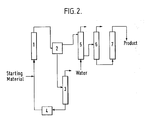
- the first reaction step, the first separation step, the second reaction step to convert the intermediate compounds having the methylene-amino bond to the diphenylmethane dicarbamates by the intermolecular transfer reaction, and the second separation step defined above be combined.
- the reactor 1 for the first reaction step (A) is shown at the beginning of the reaction.
- the flow sheet then continues to at the separator 2 where the first separation step (B) is carried out.
- the process may continue to the concentrator 3 for concentrating the aqueous solution of an inorganic acid and then continue to the tank 4 of the aqueous solution of inorganic acid.
- the process may then proceed to an extractor 5 for substantially removing the inorganic acid slightly contained in the organic-phase reaction solution, dehydrator 6, and a reactor 7 for the second reaction (C).
- the process may proceed to a distillation column 8 for separating the carboxylic acid from the condesation product for use in the second reaction step and the carboxylic acid tank 9.
- N-phenylcarbamates used in the process of the present invention are the compounds represented by formula (I) : wherein R is an alkyl group having from 1 to 20 carbon atoms, preferably from 1 to 10 carbon atoms, aromatic group or an alicyclic group having 3 to 30 carbon atoms, preferably from 5 to 18 carbon atoms; R' is hydrogen or a substituent such as an alkyl group having from 1 to 20 carbon atoms, halogen atom, nitro group, cyano group, alkoxy group having from 1 to 20 carbon atoms or alicyclic group having from 3 to 20 carbon atoms, provided that these substituents are bonded at the ortho- or meta-position to the urethane group; r is an integer of 0 to 4; when r is 2 or more, R' may represent the same or different substituents; and at least one hydrogen in R may be substituted by any of the substituents listed above.
- R is an alkyl group having from 1 to 20 carbon atoms, preferably
- R examples include alkyl groups such as methyl, ethyl, 2,2,2-trichloroethyl, 2,2,2-trifluoroethyl, propyl (n- or iso-), butyl (n- and various isomers), pentyl (n- and various isomers) and hexyl (n- and various isomers), alicyclic groups such as cyclopentyl and cyclohexyl and aromatic groups such as phenyl and naphthyl; and" preferred examples of R' include hydrogen, the alkyl groups and alicyclic groups listed above, halogens such as fluorine, chlorine, bromine and iodine, nitro groups, cyano groups and alkoxy groups having the alkyl moieties listed above.
- N-phenylcarbamates represented by formula (I) include methyl N-phenylcarbamate, ethyl N-phenylcarbamate, propyl N-phenylcarbamate (its isomers), butyl N-phenylcarbamate (its isomers), pentyl N-phenylcarbamate (its isomers), hexyl N-phenylcarbamate (its isomers), cyclohexyl N-phenylcarbamate, 2,2,2-trichloroethyl N-phenylcarbamate, 2,2,2-trifluoroethyl N-phenylcarbamate, methyl N-o- (or m-)tolylcarbamate, ethyl N-o- (or m-)tolylcarbamate, 2,2,2-trifluoroethyl N-o- (or m-)tolylcarbamate, propyl N-o- (or m-)to
- Illustrative methylenating agents that can be used in the present invention include formaldehyde, paraformaldehyde, trioxane, tetraoxane, dialkoxymethane, diacyloxymethane, 1,3-dioxolane, 1,3-dioxane, 1,3-dithiane, 1,3-oxathiane, and hexamethylenetetramine.
- Preferred compounds are formaldehyde, paraformaldehyde, trioxane and dialkoxymethanes having the lower alkyl groups of 1 to 6 carbon atoms such as dimethoxymethane, diethoxymethane, dipropoxymethane, dipentanoxymethane and dihexylox y methane, as well as diacyloxymethanes having the lower acyloxy groups such as diacetoxymethane and dipropioxymethane.
- These methylenating agents may be used either alone or in combination.
- a particularly preferred methylenating agent is an aqueous solution of formaldehyde.
- One feature of the present invention is its ability to produce diphenylmethane dicarbamates in high selectivity using the least expensive methylenating agent such as an aqueous formaldehyde.
- the N-phenylcarbamate is reacted with the methylenating agent in the presence of a catalyst comprising an aqueous solution of an inorganic acid.
- suitable inorganic acids include hydrochloric acid, sulfuric acid, phosphoric acid, polyphosphoric acid, heteropolyacid and boric acid. Sulfuric acid is particularly preferred.
- the concentration of the inorganic acid in its aqueous solution preferably ranges from 20 to 70 wt%, and the range of 30 to 60 wt% is particularly preferred. The most preferred is an aqueous solution containing 40 to 60 wt% of sulfuric acid.
- the concentration of the inorganic acid exceeds 70 wt%, the N-phenylcarbamate and the condensation products are hydrolyzed to form the corresponding amino compounds.
- These amino compounds are not desirable since it causes various bad side reactions when the diphenylmethane dicarbamate produced is subsequently converted to an isocyanate by thermal decomposition.
- a highly concentrated acid solution dissolves a significant amount of the starting materials and the reaction product therein, so that the separation of the organic phase from the mixture is performed only with complicated procedures.
- the concentration of the inorganic acid is less than 20 wt%, the reaction is too slow to suit practical purposes.
- the first reaction step at least 2 mols, preferably 2.2 to 10 mols, more preferably 2.5 to 6 mols, of the N-phenylcarbamate is used per mol equivalent of the methylene group of the methylenating agent.
- the aqueous solution of inorganic acid is used in such an amount that it preferably contains 0.01 to 20 mol equivalents, more preferably 0.05 to 15 mol equivalents, most preferably 0.1 to 10 mol equivalents, of the inorganic acid per mol equivalent of the N-phenylcarbamate.
- the first reaction step of the present invention may be performed in a two-component dispersion made of organic and aqueous phases using water as the reaction medium.
- the reaction may be performed in a two-component dispersion made of an aqueous phase and an organic phase using an organic solvent.
- Preferred organic solvents are those which have boiling points of not higher than 300°C at atmospheric pressure and which have a mutual solubility with water of not more than 10% at room temperature.
- organic solvents having a mutual solubility with water of not more than 10% are used, the organic phase containing the diphenylmethane dicarbamate and other condensates can be readily separated from the aqueous phase containing the inorganic acid by simple means such as phase separation after the first reaction. If, on the other hand, organic solvents having boiling points of not higher than 300°C at atmospheric pressure are used, these solvents can be separated from the organic-phase reaction mixture by simple means such as distillation.
- Preferred organic solvents include aromatic compounds having electron attracting substituents or halogen atoms. Suitable electron attracting substituents include nitro, cyano, alkoxycarbonyl, sulfonate, trifluoromethyl and trichloromethyl groups. These aromatic compounds are substantially inert to the electrophilic substitution of the methylene group under the conditions used for the first reaction step. Furthermore, these aromatic compounds have great ability to dissolve not only the N-phenylcarbamates (used as one of the starting materials) but also the diphenylmethane dicarbamates finally produced.
- a particularly preferred electron attracting group is a nitro group.
- Preferred examples of the aromatic compounds having a nitro group or a halogen atom or both include nitrobenzene and lower alkyl substituted nitrobenzenes such as nitrotoluene (its isomers), nitroxylene (its isomers), nitromesitylene and nitroethylbenzene (its isomers); halogen substituted nitrobenzenes such as chloronitrobenzene (its isomers) and bromonitrobenzene (its isomers); halogenated benzenes such as chlorobenzene, dichlorobenzene (its isomers), trichlorobenzene (its isomers), bromobenzene, dibromobenzene (its isomers) and tribromobenzene (its isomers); halogenated naphthalenes such as chloronaphthalene (its isomers), dichlorona p h
- the reaction is carried out at a temperature in the range of 40 to 150°C, preferably 60 to 130°C, more preferably 70 to 110°C.
- the pressure used herein is in the range of 0.5 to 20 kg/cm 2 , preferably 0.8 to 10 kg/cm 2 .
- the reaction is carried out under atmospheric pressure or under a low pressure.
- the reaction period varies with the type, the concentration and the amount of the aqueous solution of inorganic acid and the reaction temperature. The reaction period also depends on whether any organic solvent is used, or on the type of the reactor used. Since it is preferred that the smallest possible amount of the methylenating agent is left in the reaction mixture coming out of the first reaction step, the duration of the first reaction generally ranges from several minutes to several hours.
- the reaction may be performed either batchwise or continuously.
- the reaction mixture obtained in the first reaction step is then fed to the first separation step (B) where it is separated into the aqueous solution of inorganic acid and an organic-phase reaction mixture substantially free from the inorganic acid, and the resulting aqueous solution of inorganic acid is returned to the first reaction step either immediately or after the adjustment of the aqueous solution of inorganic acid to the predetermined concentration if necessary.
- phase-separation technique can be used for the purpose under the conditions specified for the present invention.
- the following phase-separation methods may be used: according to one method, the reaction mixture is cooled, without using an organic solvent, to a temperature close to or lower than room temperature, and in this case, the organic-phase reaction mixture forms a solid phase and can be readily separated from the aqueous solution of inorganic acid by simple means such as filtration.
- the reaction mixture is dissolved in the organic solvent described above or heated to a temperature over 50 - 60°C, and in this case, two immiscible liquid phases (organic phase and aqueous phase) form and can readily be separated from each other.
- the organic-phase reaction mixture thus separated from the ,aqueous solution of inorganic acid may sometimes contain a small amount of the inorganic acid, which is preferably removed by a suitable method such as washing with water. If the inorganic acid remains unremoved from the final condensation product, it causes the undesired side reactions or corrodes the reactor during the subsequent thermal decomposition of the condensation product for producing the isocyanates.
- the concentration of the inorganic acid in its aqueous solution that has been separated from the organic-phase reaction mixture in the first separation step is generally lower than the initial value because water is produced in the first reaction step if a formaldehyde is used as the methylenating agent, and if an aqueous solution of formaldehyde is used, there also is a corresponding increase in the water content. Therefore, if one wants to perform the first reaction under constant conditions, the concentration of the inorganic acid must be increased to a predetermined level for re-use.
- the preferred concentration of the inorganic acid solution used in the first reaction step ranges from 20 to 70 wt%, and a particularly preferred range is from 30 to 60 wt%.
- the concentration of this acid is relatively low, the concentration can be readily attained by dehydration with less efforts than are required for concentrating a diluted acid solution to a highly concentrated acid.- Needless to say, the aqueous solution of inorganic acid that is obtained in the first separation step mav be immediately returned to the first reaction step if the concentration of the inorganic acid is within the range described above.
- the reaction is preferably carried out in the presence of minimum water because water has bad influence on the reactivity of the reactants and the reaction rate.
- Water is particularly undesired if a carboxylic acid is used as the catalyst because this must be finally separated from water. Therefore, it is desired that as much water as possible should be removed from the organic-phase reaction mixture obtained in the first separation step.
- One method for attaining this object is by azeotropic distillation in the presence of an azeotropic agent. If an organic solvent is used in the first reaction step, distillation of water can be achieved simultaneously with the distillation of a portion of or all of this organic solvent.
- the reaction is preferably performed in the substantial absence of a methylenating agent. If the organic-phase reaction mixture that has been subjected to phase separation and optional washing with water still contains a methylenating agent, the methylenating agent is preferably removed simultaneously with the removal of water from the mixture. However, if formaldehyde or its precursor which generates formaldehyde in the reaction system is used as a methylenatin g agent, it seldom occurs that such a methvlenating agent is left in the organic-phase reaction mixture because formaldehyde or its precursor is in most cases water-soluble.
- the organic-phase reaction mixture thus obtained is substantially free from the methylenating agent, but it does contain the intermediate compounds with the methylene-amino bond (-CH 2 -N ⁇ ), for example, bis(N- carboalkoxyanilino) methane and (N- carboalkoxyanilinomethyl)phenylcarbamate.
- the purpose of the second reaction step is to convert these compounds to diphenylmethane dicarbamates by an easy and simple method, and it is essential that in this second reaction step, the reaction must be carried out in the presence of N-phenylcarbamates. This object can be achieved by carrying out the intermolecular transfer reaction of the intermediate compounds with an N-phenylcarbamate, which reaction has been found for the first time by the present inventors.
- the compounds having the methylene-amino bond are subjected to an intermolecular transfer reaction with an N-phenylcarbamate which may be the same as or different from the N-phenylcarbamate used as the starting material. Therefore, the process of the present invention does not require the use of an acid as strong as what is used in the conventional method that depends on intramolecular rearrangement reaction of the compounds having the methylene-amino bond. Instead, the present invention uses a much weaker carboxylic acid having a pKa of not more than 4, preferably from 3 to -4, more preferably from 2.5 to -4, in an aqueous solution at 25°C or solid acid. Even in the presence of this weak acid, the process of the present invention permits the intended reaction to proceed quantitatively at a fast rate, and the desired diphenylmethane dicarbamates can be obtained with high selectivity. This is one great feature of the present invention.
- trinuclear and other polynuclear compounds having the methylene-amino bond can be converted to diphenylmethane dicarbamates as illustrated below. or or
- the N-phenylcarbamate is preferably present during the intermolecular transfer reaction in an amount greater than one equivalent of the methylene-amino bond in the intermediate. If the amount of the N-phenylcarbamate remaining unreacted in the organic-phase reaction mixture is not sufficient for this purpose, an additional amount of the N-phenylcarbamate may preferably be incorporated in the second reaction'step.
- N-phenylcarbamate is preferably present in an amount of from 1 to 200 mol equivalents, more preferably from 5 to 100 mol equivalents, per equivalent of the methylene-amino bond.
- the greatest feature of the second reaction step is to use at least one catalyst selected from the group consisting of a carboxylic acid which has a pKa of not more than 4 in an aqueous solution at 25°C, and a solid acid.
- Suitable carboxylic acids meeting this requirement include formic acid; halogenated acetic acids such as fluoroacetic acid, difluoroacetic acid, trifluoroacetic acid, chloroacetic acid, dichloroacetic acid, trichloroacetic acid, bromoacetic acid, dibromoacetic acid, tribromoacetic acid, iodoacetic acid, diiodoacetic acid and triiodoacetic acid; a-halogenated and ⁇ , ⁇ -dihalogenated aliphatic carboxylic acids such as a-fluoropropionic acid, ⁇ , ⁇ -difluoropropionic acid, ⁇ -chloropropionic acid, ⁇ , ⁇ -dichloro
- halogenated acetic acids a-halogenated and a,a-dihalogenated aliphatic carboxylic acids are preferred, with halogenated carboxylic acids wherein the halogen is chlorine or fluorine being particularly preferred.
- Fluorinated carboxylic acids are more preferred, and trifluoroacetic acid is most preferred.
- solid acidic clay minerals and inorganic cation exchangers such as acid clay, bentonite, kaolin, zeolite and montmorillonite; these acidic clay minerals and inorganic cation exchangers that have been treated with inorganic acids such as hydrofluoric acid, hydrochloric acid, perchloric acid and sulfuric acid, or ammonium salts of these acidic clay minerals and inorganic cation exchangers which have been subjected to protonation treatment by calcination; the solidified acids that are prepared by supporting liquid acids such as sulfuric acid, phosphoric acid, organic carboxylic acids and organic sulfonic acids or the heteropoly-acids such as dodecamolybdo p hos p horic acid, dodecamolybdosilicic acid, dodecatungstophosphoric acid, dodecatungstosilicilic acid and tungstomolybdophosphoric acid on carriers such as
- the inorganic oxides having -R"'-SO 3 H or -R"'-COOH bound thereto those having a divalent organic residual group or organometallic compound residue as R"' and having not more than 30, especially not more than 20, carbon atoms are preferred.
- Suitable examples of the organic residual group include aliphatic hydrocarbon groups, aromatic hydrocarbon groups, aralkyl hydrocarbon groups, and fluoroalkyl groups, as well as those which have an ether bond, thioether bond, sulfone bond, carbonyl bond, ester bond, amido bond, imido bond or heterocyclic portion at terminal or in the backbone of these hydrocarbon groups.
- organometallic compound residues include those which have a metallic element bound to the terminal or backbone of the organic residual groups listed above.
- Organosilicon compound residues having a silicon atom at terminal for example, those having a halosilyl or alkoxysilyl group bound to the terminal are advantageous because they are easy to prepare and form a stable bond with inorganic oxides.
- organic residual groups or organometallic compound residues listed above may have part of the hydrogen atoms present replaced by a halogen atom such as florine, chlorine or bromine, or substituents such as alkyl, alkoxy, aryl, aryloxy, hydroxyl, nitrile, alkoxycarbonyl, carboxyl and sulfonic acid groups.
- Advantageous inorganic oxides include those having a hydroxyl group on the surface such as silica, silica-alumina, alumina, titania, zirconia, magnesia, zeolite, diatomaceous earth, clay materials, glass, titania-alumina, silica-titania and silica-zirconia.
- Silica, porous glass and silica-alumina are particularly preferred.
- the solid acids include acidic clay minerals and inorganic cation exchangers, or these acidic solid materials that have been subjected to acid or protonation treatment; acidic metal oxides and mixed metal oxides,"or these acidic solid materials that have been subjected to acid or protonation treatment; organic cation exchange resins having either a fluoroalkyl sulfonic acid groups or fluoroalkyl carboxyl groups or both; and inorganic oxides having an organic group bound thereto having either a sulfonic acid group or a carboxyl group or both.
- Particularly preferred solid acids are cation exchange resins having fluoroalkyl sulfonic acid resins and zeolite.
- these carboxylic acids and solid acids may be used either alone or in combination. There is no particular limitation on the amount in which these carboxylic acids and solid acids are used. If the reaction is carried out batchwise or if carboxylic acids are used in the flow process, the acids are preferably used in an amount of 10 -3 to 10 4 equivalents, more preferably 10 -2 to 10 2 equivalents, per equivalent of the methylene-amino group in the compounds having the methylene-amino bond.
- the flow rate of the compound having the methylene-amino group preferably ranges from 10 -3 to 10 4 equivalents, more preferably from 10 -2 to 10 3 equivalents, per hour per liter of the solid acid.
- the carboxylic acid may be used in an excess amount so that it may also serve as a solvent.
- the reaction, temperature for the second reaction step generally ranges from 40 to 200°C, preferably from 60 to 180 ° C, and more preferably from 70 to 160°C.
- the reaction pressure generally ranges from 0.1 to 20 kg/cm 2 , preferably from 0.5 to 10 kg/cm 2 and more preferably from 0.8 to 5 kg/cm 2 .
- the reaction period varies with the type and amount of the acid catalyst used, the reaction temperature, the amount of the compound present having the methylene-amino bond, the amount of the N-phenylcarbamate present, and the nature of the specific reaction process (whether batchwise, continuous or flow process). Usually, the reaction continues for a period of several minutes to several hours, but in almost all cases, the reaction in the second reaction step can be completed within one hour.
- the reaction may be performed batchwise or in a continuous manner. If the acid catalyst consists of only a carboxylic acid, the reaction liquor may simply be passed through a flow reactor held at a predetermined temperature. If the acid catalyst consists of a solid acid, either the batchwise or flow process may be employed, and in either case, the 'solid acid is preferably retained within the reactor, or the solid acid is separated by a solid-liquid separator that immediately follows the reactor and is then returned to the reactor.
- the solid acid may be retained within the reactor by either fluidizing the acid within the reaction liquor or by fixing a catalyst bed of the acid in the reactor. Whichever reaction process is used, the solid acid permits a very easy separation from the reaction solution. Therefore, if the solid acid is used, the second reaction step can be combined with the second separation step into. practically a single step, and the desired diphenylmethane dicarbamate can be directly obtained from the second reaction step.
- the reaction in the second reaction step may be performed without solvents, but if desired, it may be carried out in the presence of a suitable solvent.
- suitable solvents include aliphatic or alicyclic hydrocarbons such as pentane, hexane, heptane, octane, nonane, decane, n-hexadecane, cyclopentane and cyclohexane; halogenated hydrocarbons such as chloroform, ethylene chloride, carbon tetrachloride, dichloroethane, trichloroethane and tetrachloroethane; alcohols such as methanol, ethanol, propanol and butanol; aromatic compounds such as benzene, toluene, xylene, ethylbenzene, monochlorobenzene, dichlorobenzene, bromonaphthalene, nitrobenzene, and o-, m- or p-
- aliphatic carboxylic acids such as acetic acid and propionic acid
- halogenated aliphatic carboxylic acids such as monochloroacetic acid, dichloroacetic acid, trichloroacetic acid and trifluoroacetic acid. Acid anhydrides -of these carboxylic acids may also be used. If an organic solvent is used in the first reaction step, it may also be used in the second reaction step.
- a carboxylic acid is used in the second reaction step, it is separated from the reaction mixture in the subsequent second separation step, and a condensation product containing the desired diphenylmethane dicarbamate and sometimes a small amount of its higher homolog (i.e., polymethylene polyphenylcarbamate) is obtained.
- This ease of separation of the carboxylic acid is another great feature of the present invention.
- ⁇ -halogenated carboxylic acids are preferred carboxylic acids, and of the a-halogenated carboxylic acids, trichloroacetic acid and trifluoroacetic acid are particularly preferred.
- the acid catalyst used in the second reaction step whether it is a solid acid or carboxylic acid, can be separated very easily from the reaction solution.
- solvents other than the carboxylic acids listed above may optionally be separated by distillation, preferably under 200°C, so as to obtain the desired product. If necessary, any N-phenylcarbamates that remain unreacted in the reaction mixture can also be separated from the latter by a suitable method such as distillation, preferably under 200°C.
- the so-obtained condensation product' of N-phenylcarbamates mainly consists of the dinuclear diphenylmethane dicarbamate and contains little or no trinuclear dimethylene triphenylcarbamates.
- the selectivity for the desired diphenylmethane dicarbamate is over 80%.
- the present invention ensures an industrially advantageous methods for the production of diphenylmethane dicarbamates with extremely high selectivity from N-phenylcarbamates. These compounds are highly suitable for use as starting materials for the production of diphenylmethane dissocyanates by thermal decomposition.
- a 100-ml glass flask was charged with 50 wt% sulfuric acid (60 g), ethyl N-phenylcarbamate (19 g) and 37% aqueous formaldehyde (1.9 g).
- the mixture was heated at 90°C for 2 hours with vigorous stirring. Thereafter, the reaction mixture - was transferred into a separating funnel to be separated into an organic layer and an aqueous layer.
- the organic layer was washed with warm water and then the small amount of water contained was removed by a rotary evaporator. The washings were combined with the previously separated aqueous layer, and then the predetermined amount of water was removed from the mixture by a rotary evaporator so as to recover 50 wt% sulfuric acid (60 g).
- the condensation product had the following selectivities: 87.5% for diethyl 4,4'-diphenylmethane dicarbamate, 10.7 % for diethyl 2,4'-diphenylmethane dicarbamate, and 1.8% for triethyl dimethylenetriphenylcarbamate.
- the total selectivity for the dinuclear diethyl diphenylmethane dicarbamates was therefore 98.2%.
- Example 1 14.95 g of trifluoroacetic acid was separated by distillation and could be immediately put to another use.
- a 400-ml glass reactor was charged with 45 wt% sulfuric acid (200 g), methyl N-phenylcarbamate (50 g), 37% aqueous formaldehyde (5.5 g) and nitrobenzene (50 g: solvent). The mixture was heated at 90°C for 2 hours with vigorous stirring. Thereafter, the reaction-mixture was separated into an organic layer and an aqueous layer. The organic layer was washed with warm water to remove the small amount of residual sulfuric acid, and subsequently, the small amount of water was removed by azeotropic distillation with part of nitrobenzene.
- Trifluoroacetic acid 40 g was added to the organic layer and the resulting solution was passed through the bottom of a reactor (ID: 10 mm; height: 30 cm; temp.: 80°C) at a rate of 1 ml/min.
- the reaction liquor was freed of trifluoroacetic acid and nitrobenzene by distillation under reduced pressure at a temperature lower than 150°C.
- the resulting reaction mixture contained 58 wt% of methyl N-phenylcarbamate, 37.6 wt% of dimethyl 4,4'-diphenylmethane dicarbamate and 4.4 wt% of dimethyl 2,4'-diphenylmethane dicarbamate.
- no trinuclear compound i.e., trimethyl dimethylenetriphenylcarbamate was present.
- a mixture of ethyl N-phenylcarbamate (16 wt%), formaldehyde (0.6 wt%), sulfuric acid (33 wt%), nitrobenzene (17 wt%) and water (33.4 wt%) was fed through a continuous reactor (for its construction, see Fig. 1) in order to carry out condensation of the ethyl N-phenylcarbamate.
- the reaction. was performed at 90°C in the first reaction step, and at 80°C in the second reaction step.
- trifluoroacetic acid was added so that its content in the liquid reaction mixture was 28 wt%.
- the residence time was 3 hours for the first reaction step and 15 minutes for the second reaction step.
- the resulting condensation product had the following selectivities: 88% for diethyl 4,4'-diphenylmethane dicarbamate, 10% for diethyl 2,4'-diphenylmethane dicarbamate, and 2% for the trinuclear compound (i.e., triethyl dimethylenetriphenylcarbamate).
- Ethyl N-phenylcarbamate was condensed through the first reaction and separation steps as in Example 1.
- the resulting reaction mixture had the same composition as in Example 1.
- the mixture was incorporated with nitrobenzene (30 g) and beads of fluorinated sulfonic acid resin (2 g) having the following repeating unit: The mixture was then stirred for 10 minutes at 110°C. The fluorinated sulfonic acid resin was separated from the reaction mixture by filtration. The reaction mixture no longer contained a compound having the methylene-amino bond.
- the condensation product had the following selectivities: 88.5% for diethyl 4,4'-diphenylmethane dicarbamate, 10.4% for diethyl 2,4'-diphenylmethane dicarbamate and 1.1% for the trinuclear compound (i.e., triethyl dimethylenetriphenyl carbamate). Therefore, the total selectivity for the di- nuclear compounds (i.e., diethyl diphenylmethane dicar bamates) was 98.9%.
- the fluorinated sulfonic acid resin separated by filtration could be immediately put to another cycle of the second reaction; with the results being almost the same as in the first cycle.
- Methyl N-phenylcarbamate was condensed through the first reaction and separation steps as in Example 2.
- the resulting reaction had the same composition as in Example 2.
- the mixture was continuously fed through the bottom of a reactor (120°C) at a rate of 0.5 ml/min.
- the reactor was made of a stainless steel tube (ID: 10 mm; height: 30 cm) and filled with SK-500 (Y type zeolite produced by Union Carbide Corporation that was partially ion-exchanged by rare earth elements).
- the reaction liquor drawn from the top of the reactor did not contain any compound having the methylene-amino bond. It was then freed of nitrobenzene by distillation under reduced pressure at a temperature lower than 150°C.
- the resulting reaction mixture contained 57 wt% of methyl N-phenylcarbamate, 38 wt% of dimethyl 4,4'-diphenylmethane dicarbamate and 5 wt% of dimethyl 2,4'- diphenylmethane dicarbamate. No trinuclear compound (i.e., trimethyl dimethylenetriphenyl carbamate) was present.
- a feed mixture having the same composition as used in Example 3 was subjected to condensation in a continuous reactor of the type shown in Fig. 2.
- the reaction temperature was 9 0 °C for the first reaction step and 120°C for the second reaction step.
- a reaction tube filled with a carboxyl- containing fluorinated sulfonic acid resin having the following repeating unit was used: This resin was prepared by forming a terpolymer from tetrafluoroethylene, a compound having the formula: and a compound having the formula: then reacting the terpolymer with a mixture of methanol, podium hydroxide and water, and finally ion exchanging the reaction product with hydrochloric acid.
- the residence time was 2 hours for the first reaction step and 15 minutes for the second reaction step.
- the finally obtained condensation product had the following selectivities: 89% for diethyl 4,4'-diphenylmethane dicarbamate, 9% for diethyl 2,4'-diphenylmethane dicarbamate, and 2 % for the trinuclear compound (i.e., triethyl dimethylenetriphenylcarbamate).
- a 400-ml glass flask was charged with 50 wt% sulfuric acid (77 g), ethyl N-phenylcarbamate (64.8 g), 37% aqueous formaldehyde (10.6 g) and nitrobenzene (130 g).
- the reactants were heated at 90°C for 2 hours with vigorous stirring. Therefore, the reaction mixture was separated into an organic layer and an aqueous layer.
- the organic layer was washed with warm water to remove the small amount of residual sulfuric acid. Then, the small amount of water was removed from the organic layer by azeotropic distillation with a portion of the nitrobenzene.
- Trifluoroacetic acid 65 g was added to the organic layer and the mixture was passed through the second reaction and separation steps as in Example 2.
- the percent conversion of the ethyl N-phenylcarbamate increased to 47%, and the selectivities for diethyl 4,4'- and 2,4'-diphenylmethane dicarbamates to 87.2% and 8.6%, respectively, whereas the selectivity for the trinuclear compounds dropped to 4.2%.
- dinuclear nor trinuclear compound having the methylene-amino bond was present.
- Ethyl N-phenylcarbamate was passed through the first reaction and separation steps as in Example 7 except that nitrobenzene was replaced by 130 g of o-dichlorobenzene and the amount of 37% aqueous formaldehyde was increased to 15.9 g.
- the conversion of the ethyl N-phenylcarbamate was 47.6%, and the reaction product had the following selectivities: 65.2% and 6.2% for diethyl 4,4'-and 2,4'-diphenylmethane dicarbamates, respectively, 18.1% for ethyl (N-carboethoxyanilinomethyl)phenyl carbamate and 10.5% for trinuclear compounds containing the one having the methylene-amino bond.
- Trifluoroacetic acid 50 g was added to the reaction product and the mixture was passed through the second reaction and separation steps as in Example 2.
- the conversion of ethyl N-phenylcarbamate increased to 62.6%, and the selectivities for diethyl 4,4'- and 2,4'-diphenylmethane dicarbamates to 83.2% and 8.3%, respectively, whereas the selectivity for the trinuclear compounds dropped to 8.5%.
- dinuclear nor trinuclear compounds having the methylene-amino bond were present.
- Ethyl N-phenylcarbamate was passed through the first reaction and separation steps as well as the second reaction and separation steps as in Example 7 except that nitrobenzene was replaced by 13 0 g of chlorobenzene and the amount of 37% aqueous formaldehyde was reduced to 8 g.
- the conversion of the ethyl N-phenylcarbamate was 42%, and the final reaction product had the following selectivities: 88.2% and 8.7% for diethyl 4,4'-and 2,4'-diphenylmethane dicarbamates and 3.1% for the trinuclear compounds.
- a feed mixture consisting of ethyl N-phenylcarbamate (23 wt%), formaldehyde (1.4 wt%), sulfuric acid (13.6 wt%), nitrobenzene (46 wt%) and water (16 wt%) was subjected to condensation reaction in a continuous reactor of the type shown in Fig. 1.
- the reaction was carried out at 90°C in the first reaction step, and at 80°C in the second reaction step.
- trifluoroacetic acid was added so that its content in the reaction liquor was 25 wt%.
- the residence time was 2 hours for the first reaction step and 15 minutes for the second reaction step.
- the conversion of the ethyl N-phenylcarbamate was 45%.
- the resulting condensation product had the following selectivities: 87% for diethyl 4,4'-diphenylmethane dicarbamate, 8% for diethyl 2,4'-diphenylmethane dicarbamate and 5% for a trinuclear compound (i.e, triethyl dimethylenetriphenylcarbamate).
- Ethyl N-phenylcarbamate was passed through the first reaction and separation steps as in Example 1.
- trichloroacetic acid 21 g was added and stirred at 80°C for 1 hour.
- the condensation product obtained by distilling off the trichloroacetic acid under reduced pressure at a temperature lower than 150°C had the following selectivities: 86.8% for diethyl 4,4'-diphenylmethane dicarbamate, 11.5% for diethyl 2,4'-diphenylmethane dicarbamate, and 1.7% for trinuclear compounds.
- Ethyl N-phenylcarbamate was passed through the first reaction and separation steps as in Example 1.
- nitrobenzene (40 g) and aluminum sulfate powder (5 g) were added and stirred for 40 minutes at 150°C.
- the nitrobenzene was distilled off under reduced pressure at a temperature lower than 150°C.
- the final condensation product had the following selectivities: 81.5% for diethyl 4,4'-diphenylmethane dicarbamate, 13.3% for diethyl 2,4'-diphenylmethane dicarbamate and 5.2% for trinuclear compounds.
- silica (100 g) was suspended in toluene (300 ml), and 3-chloropropyltrimethoxy silane (80 ml) was added to the suspension. The resulting mixture was stirred for 5 hours at the refluxing temperature in a nitrogen atmosphere. The reaction product was filtered, subjected to Soxhlet extraction with methanol for 15 hours, and vacuum-dried. The resulting chloropropyl silica was mixed with a saturated aqueous solution of sodium sulfite (1,000 ml) and the mixture was stirred for 24 hours under reflux in a nitrogen atmosphere. After cooling, the silica product was separated out and washed with distilled water to remove the residual sulfite salt. The silica product was then treated with IN nitric acid, washed with distilled water and vacuum-dried. The silica product hereinafter referred to as sulfopropyl silica contained 0.9 wt% of sulfur.
- a feed liquor having the same composition as used in Example 10 was subjected to condensation in a reactor of the type shown in Fig. 2 that included a vessel for the second reaction step filled with the sulfopropyl silica.
- the reaction temperature was 90°C for the first reaction step and 120°C for the second reaction step.
- the residence time was 2.5 hours for the first reaction and 20 minutes for the second reaction.
- the final condensation product had selectivities which were substantially the same as those achieved in Example 10.
- Zirconium oxychloride (ZrOCl 2 ) was hydrolyzed with 28% ammonia water, and the resulting precipitate was thoroughly washed with deionized water and dried at 100°C for 24 hours to provide Zr(OH) 4 .
- the hydroxide was ground into particles. After placing the particles on a sheet of filter paper, IN sulfuric acid (30 ml) was poured over the particles and left to stand for a certain period. After drying with air, the particles were collected from the filter paper and calcined at 650°C for 3 hours in air, thereby producing a solid acid (SO 4 2- /ZrO 2 ) having sulfate ions.
- Ethyl N-phenylcarbamate was subjected to condensation as -in Example 12 except that the above prepared solid acid was used as a catalyst in the second reaction step.
- the final condensation product had selectivities which were substantially the same as those attained in Example 12.
- Ethyl N-phenylcarbamate was passed through the first reaction and separation steps as in Example 1.
- the intermediate compounds consisting of bis-(N-carboethoxyanilino)methane (2 g) and ethyl (N-carboethoxyanilinomethyl)phenylcarbamate (2.5 g) were separated by a column chromatography.
- a 100-ml glass flask was charged with these intermediate compounds (4.5 g), trifluoroacetic acid (5 g), methyl N-phenylcarbamate (5 g), and nitrobenzene (30 ml). The mixture was stirred at 75°C for 15 minutes.
- the resulting reaction mixture consisted of diphenylmethane dicarbamate having both ethyl and methyl groups (3.15 g, slectivity of 73%), diethyl diphenylmethane dicarbamate (0.86 g, selectivity of 19%), dimethyl diphenylmethane dicarbamate (0.33 g, selectivity of 8%), methyl N-phenylcarbamate (3.23 g), and ethyl N-phenylcarbamate (1.93 g).
- the intermediate compounds and polynuclear compounds other than dinuclear compounds were not detected.
Landscapes
- Chemical & Material Sciences (AREA)
- Organic Chemistry (AREA)
- Organic Low-Molecular-Weight Compounds And Preparation Thereof (AREA)
Applications Claiming Priority (4)
| Application Number | Priority Date | Filing Date | Title |
|---|---|---|---|
| JP213424/82 | 1982-12-07 | ||
| JP57213424A JPS59104354A (ja) | 1982-12-07 | 1982-12-07 | ジフエニルメタンジカルバメ−ト類の製造方法 |
| JP57215911A JPS59106453A (ja) | 1982-12-09 | 1982-12-09 | N−フエニルカルバメ−ト類の縮合方法 |
| JP215911/82 | 1982-12-09 |
Publications (3)
| Publication Number | Publication Date |
|---|---|
| EP0110732A2 true EP0110732A2 (fr) | 1984-06-13 |
| EP0110732A3 EP0110732A3 (en) | 1984-07-11 |
| EP0110732B1 EP0110732B1 (fr) | 1987-03-11 |
Family
ID=26519799
Family Applications (1)
| Application Number | Title | Priority Date | Filing Date |
|---|---|---|---|
| EP83307445A Expired EP0110732B1 (fr) | 1982-12-07 | 1983-12-07 | Procédé de préparation de dicarbamates de diphénylméthane |
Country Status (3)
| Country | Link |
|---|---|
| US (1) | US4552974A (fr) |
| EP (1) | EP0110732B1 (fr) |
| DE (1) | DE3370152D1 (fr) |
Cited By (4)
| Publication number | Priority date | Publication date | Assignee | Title |
|---|---|---|---|---|
| EP0216273A3 (en) * | 1985-09-18 | 1987-12-16 | Nippon Kokan Kabushiki Kaisha | Method of manufacturing diphenylmethane dicarbamic acid esters |
| EP0406129A1 (fr) * | 1989-06-29 | 1991-01-02 | Rhone-Poulenc Chimie | Procédé de préparation de méthylène di(phényluréthane) |
| EP1219422A1 (fr) | 2000-12-29 | 2002-07-03 | Eastman Kodak Company | Incorportation de ponts de silicium dans les canaux d'encre d'une tête jet d'encre intégrée cmos/mems et procédé de fabrication |
| KR101231830B1 (ko) * | 2005-05-27 | 2013-02-08 | 알레그로 마이크로시스템스 인코포레이티드 | 전류 센서 |
Families Citing this family (7)
| Publication number | Priority date | Publication date | Assignee | Title |
|---|---|---|---|---|
| JP2664405B2 (ja) * | 1988-04-13 | 1997-10-15 | ポリプラスチックス 株式会社 | 溶融時に光学的異方性を示すポリエステル樹脂及び樹脂組成物 |
| US4987248A (en) * | 1989-08-02 | 1991-01-22 | E. I. Du Pont De Nemours And Company | Acid catalyzed formation of carbamates from olefins |
| US20020042128A1 (en) * | 2000-09-01 | 2002-04-11 | Bowlin Gary L. | Electroprocessed fibrin-based matrices and tissues |
| US7022871B2 (en) | 1999-12-27 | 2006-04-04 | Huntsman International Llc | Process for the synthesis of polycarbamates |
| US8268046B2 (en) | 2008-05-16 | 2012-09-18 | Matheson Tri-Gas | Removal of impurities from hydrogen-containing materials |
| KR102084044B1 (ko) * | 2018-12-24 | 2020-03-03 | 주식회사 세미부스터 | 인산용액 중의 실리콘 농도 분석방법 |
| CN116617993A (zh) * | 2023-07-26 | 2023-08-22 | 中国科学院过程工程研究所 | 一种制备多亚甲基多苯基多氨基甲酸甲酯的装置及方法 |
Family Cites Families (5)
| Publication number | Priority date | Publication date | Assignee | Title |
|---|---|---|---|---|
| US4146727A (en) * | 1977-10-03 | 1979-03-27 | Atlantic Richfield Company | Process for the preparation of diphenylmethane mono and dicarbamates and polymethylene polyphenyl carbamates by the acid rearrangement of an (alkoxycarbonyl) phenylaminomethylphenyl compound |
| IT1126563B (it) * | 1978-12-14 | 1986-05-21 | Mitsui Toatsu Chemicals | Processo per preparare polimetilen polifenil policarbammati |
| DE2904917A1 (de) * | 1979-02-09 | 1980-08-21 | Basf Ag | Verfahren zur herstellung von methylenbis-(4-phenylcarbaminsaeureester) |
| JPS5612357A (en) * | 1979-07-09 | 1981-02-06 | Mitsui Toatsu Chem Inc | Production of polymethylenepolyphenylpolycarbamate |
| DE2942137A1 (de) * | 1979-10-18 | 1981-04-30 | Basf Ag, 6700 Ludwigshafen | Verfahren zur herstellung von methylen-bis-phenylcarbaminsaeureestern und polymethylen-polyphenylcarbaminsaeureestern |
-
1983
- 1983-12-07 EP EP83307445A patent/EP0110732B1/fr not_active Expired
- 1983-12-07 DE DE8383307445T patent/DE3370152D1/de not_active Expired
- 1983-12-07 US US06/559,114 patent/US4552974A/en not_active Expired - Lifetime
Cited By (5)
| Publication number | Priority date | Publication date | Assignee | Title |
|---|---|---|---|---|
| EP0216273A3 (en) * | 1985-09-18 | 1987-12-16 | Nippon Kokan Kabushiki Kaisha | Method of manufacturing diphenylmethane dicarbamic acid esters |
| EP0406129A1 (fr) * | 1989-06-29 | 1991-01-02 | Rhone-Poulenc Chimie | Procédé de préparation de méthylène di(phényluréthane) |
| FR2649104A1 (fr) * | 1989-06-29 | 1991-01-04 | Rhone Poulenc Chimie | |
| EP1219422A1 (fr) | 2000-12-29 | 2002-07-03 | Eastman Kodak Company | Incorportation de ponts de silicium dans les canaux d'encre d'une tête jet d'encre intégrée cmos/mems et procédé de fabrication |
| KR101231830B1 (ko) * | 2005-05-27 | 2013-02-08 | 알레그로 마이크로시스템스 인코포레이티드 | 전류 센서 |
Also Published As
| Publication number | Publication date |
|---|---|
| EP0110732A3 (en) | 1984-07-11 |
| US4552974A (en) | 1985-11-12 |
| EP0110732B1 (fr) | 1987-03-11 |
| DE3370152D1 (en) | 1987-04-16 |
Similar Documents
| Publication | Publication Date | Title |
|---|---|---|
| CA1116177A (fr) | Procede pour la preparation de diphenylmethane dicarbamates et de polymethylene polyphenyl carbamates | |
| US4552974A (en) | Process for producing diphenylmethane dicarbamates | |
| US4547322A (en) | Method for manufacture of diphenylmethane diisocyanates | |
| US4146727A (en) | Process for the preparation of diphenylmethane mono and dicarbamates and polymethylene polyphenyl carbamates by the acid rearrangement of an (alkoxycarbonyl) phenylaminomethylphenyl compound | |
| JPS5829943B2 (ja) | ジフエニルメタンジカルバメ−トおよびポリメチレンポリフエニルカルバメ−トの製造法 | |
| US3192263A (en) | Production of dinitrophenyl and diaminophenyl ethers | |
| EP0014482B1 (fr) | Préparation de dicarbamates de diphénylméthane et de carbamates de polyphénylméthylène; les catalyseurs utilisés sont des acides de Lewis incorporés dans du graphite | |
| JPS6242896B2 (fr) | ||
| NL8000621A (nl) | Werkwijze voor het bereiden van cycloalifatische aminomethylverbindingen uit aromatische nitrillen. | |
| CA1224493A (fr) | Fabrication de nitrodiarylamines | |
| JPS6320221B2 (fr) | ||
| JPS647070B2 (fr) | ||
| JPH0329785B2 (fr) | ||
| JPS647071B2 (fr) | ||
| JPH0687816A (ja) | 4,4’−メチレン−ビス−(n−フェニルカルバミン酸アルキル)の選択的製造方法 | |
| JPS60172957A (ja) | ジフエニルメタンジカルバメ−ト類の製法 | |
| KR950012535B1 (ko) | 4,4-메틸렌-비스-(n-페닐알킬카바메이트)의 선택적 제조방법 | |
| JPS6125705B2 (fr) | ||
| JPS6319507B2 (fr) | ||
| JPH0565263A (ja) | イソシアネート化合物の製造方法 | |
| JPH0518822B2 (fr) | ||
| JPS5883658A (ja) | ジフエニルメタン系列のジアミンの製造法 | |
| KR910004667B1 (ko) | 4-니트로디페닐아민의 제조방법 | |
| JPH0543537A (ja) | 4,4′−メチレンジフエニルカルバメート類とポリメチレンポリフエニルカルバメート類の製造方法 | |
| JPS6365067B2 (fr) |
Legal Events
| Date | Code | Title | Description |
|---|---|---|---|
| PUAI | Public reference made under article 153(3) epc to a published international application that has entered the european phase |
Free format text: ORIGINAL CODE: 0009012 |
|
| PUAL | Search report despatched |
Free format text: ORIGINAL CODE: 0009013 |
|
| AK | Designated contracting states |
Designated state(s): BE DE FR GB IT NL |
|
| AK | Designated contracting states |
Designated state(s): BE DE FR GB IT NL |
|
| 17P | Request for examination filed |
Effective date: 19840703 |
|
| GRAA | (expected) grant |
Free format text: ORIGINAL CODE: 0009210 |
|
| AK | Designated contracting states |
Kind code of ref document: B1 Designated state(s): BE DE FR GB IT NL |
|
| REF | Corresponds to: |
Ref document number: 3370152 Country of ref document: DE Date of ref document: 19870416 |
|
| ITF | It: translation for a ep patent filed | ||
| ET | Fr: translation filed | ||
| PLBE | No opposition filed within time limit |
Free format text: ORIGINAL CODE: 0009261 |
|
| STAA | Information on the status of an ep patent application or granted ep patent |
Free format text: STATUS: NO OPPOSITION FILED WITHIN TIME LIMIT |
|
| 26N | No opposition filed | ||
| ITTA | It: last paid annual fee | ||
| PGFP | Annual fee paid to national office [announced via postgrant information from national office to epo] |
Ref country code: GB Payment date: 19961128 Year of fee payment: 14 |
|
| PGFP | Annual fee paid to national office [announced via postgrant information from national office to epo] |
Ref country code: FR Payment date: 19961211 Year of fee payment: 14 |
|
| PGFP | Annual fee paid to national office [announced via postgrant information from national office to epo] |
Ref country code: DE Payment date: 19961216 Year of fee payment: 14 |
|
| PGFP | Annual fee paid to national office [announced via postgrant information from national office to epo] |
Ref country code: NL Payment date: 19961231 Year of fee payment: 14 |
|
| PGFP | Annual fee paid to national office [announced via postgrant information from national office to epo] |
Ref country code: BE Payment date: 19970214 Year of fee payment: 14 |
|
| PG25 | Lapsed in a contracting state [announced via postgrant information from national office to epo] |
Ref country code: GB Free format text: LAPSE BECAUSE OF NON-PAYMENT OF DUE FEES Effective date: 19971207 |
|
| PG25 | Lapsed in a contracting state [announced via postgrant information from national office to epo] |
Ref country code: FR Free format text: THE PATENT HAS BEEN ANNULLED BY A DECISION OF A NATIONAL AUTHORITY Effective date: 19971231 Ref country code: BE Free format text: LAPSE BECAUSE OF NON-PAYMENT OF DUE FEES Effective date: 19971231 |
|
| BERE | Be: lapsed |
Owner name: ASAHI KASEI KOGYO K.K. Effective date: 19971231 |
|
| PG25 | Lapsed in a contracting state [announced via postgrant information from national office to epo] |
Ref country code: NL Free format text: LAPSE BECAUSE OF NON-PAYMENT OF DUE FEES Effective date: 19980701 |
|
| GBPC | Gb: european patent ceased through non-payment of renewal fee |
Effective date: 19971207 |
|
| NLV4 | Nl: lapsed or anulled due to non-payment of the annual fee |
Effective date: 19980701 |
|
| PG25 | Lapsed in a contracting state [announced via postgrant information from national office to epo] |
Ref country code: DE Free format text: LAPSE BECAUSE OF NON-PAYMENT OF DUE FEES Effective date: 19980901 |
|
| REG | Reference to a national code |
Ref country code: FR Ref legal event code: ST |