EP0111338A2 - Beschichtungsverfahren unter Verwendung von oberflächenaktiven Verbindungen - Google Patents
Beschichtungsverfahren unter Verwendung von oberflächenaktiven Verbindungen Download PDFInfo
- Publication number
- EP0111338A2 EP0111338A2 EP83112452A EP83112452A EP0111338A2 EP 0111338 A2 EP0111338 A2 EP 0111338A2 EP 83112452 A EP83112452 A EP 83112452A EP 83112452 A EP83112452 A EP 83112452A EP 0111338 A2 EP0111338 A2 EP 0111338A2
- Authority
- EP
- European Patent Office
- Prior art keywords
- coating
- emulsion
- surfactant
- standing wave
- silver halide
- Prior art date
- Legal status (The legal status is an assumption and is not a legal conclusion. Google has not performed a legal analysis and makes no representation as to the accuracy of the status listed.)
- Granted
Links
Images

Classifications
-
- G—PHYSICS
- G03—PHOTOGRAPHY; CINEMATOGRAPHY; ANALOGOUS TECHNIQUES USING WAVES OTHER THAN OPTICAL WAVES; ELECTROGRAPHY; HOLOGRAPHY
- G03C—PHOTOSENSITIVE MATERIALS FOR PHOTOGRAPHIC PURPOSES; PHOTOGRAPHIC PROCESSES, e.g. CINE, X-RAY, COLOUR, STEREO-PHOTOGRAPHIC PROCESSES; AUXILIARY PROCESSES IN PHOTOGRAPHY
- G03C1/00—Photosensitive materials
- G03C1/005—Silver halide emulsions; Preparation thereof; Physical treatment thereof; Incorporation of additives therein
- G03C1/06—Silver halide emulsions; Preparation thereof; Physical treatment thereof; Incorporation of additives therein with non-macromolecular additives
- G03C1/38—Dispersants; Agents facilitating spreading
- G03C1/385—Dispersants; Agents facilitating spreading containing fluorine
-
- B—PERFORMING OPERATIONS; TRANSPORTING
- B05—SPRAYING OR ATOMISING IN GENERAL; APPLYING FLUENT MATERIALS TO SURFACES, IN GENERAL
- B05C—APPARATUS FOR APPLYING FLUENT MATERIALS TO SURFACES, IN GENERAL
- B05C5/00—Apparatus in which liquid or other fluent material is projected, poured or allowed to flow on to the surface of the work
- B05C5/007—Slide-hopper coaters, i.e. apparatus in which the liquid or other fluent material flows freely on an inclined surface before contacting the work
-
- G—PHYSICS
- G03—PHOTOGRAPHY; CINEMATOGRAPHY; ANALOGOUS TECHNIQUES USING WAVES OTHER THAN OPTICAL WAVES; ELECTROGRAPHY; HOLOGRAPHY
- G03C—PHOTOSENSITIVE MATERIALS FOR PHOTOGRAPHIC PURPOSES; PHOTOGRAPHIC PROCESSES, e.g. CINE, X-RAY, COLOUR, STEREO-PHOTOGRAPHIC PROCESSES; AUXILIARY PROCESSES IN PHOTOGRAPHY
- G03C1/00—Photosensitive materials
- G03C1/74—Applying photosensitive compositions to the base; Drying processes therefor
-
- B—PERFORMING OPERATIONS; TRANSPORTING
- B05—SPRAYING OR ATOMISING IN GENERAL; APPLYING FLUENT MATERIALS TO SURFACES, IN GENERAL
- B05C—APPARATUS FOR APPLYING FLUENT MATERIALS TO SURFACES, IN GENERAL
- B05C9/00—Apparatus or plant for applying liquid or other fluent material to surfaces by means not covered by any preceding group, or in which the means of applying the liquid or other fluent material is not important
- B05C9/06—Apparatus or plant for applying liquid or other fluent material to surfaces by means not covered by any preceding group, or in which the means of applying the liquid or other fluent material is not important for applying two different liquids or other fluent materials, or the same liquid or other fluent material twice, to the same side of the work
-
- G—PHYSICS
- G03—PHOTOGRAPHY; CINEMATOGRAPHY; ANALOGOUS TECHNIQUES USING WAVES OTHER THAN OPTICAL WAVES; ELECTROGRAPHY; HOLOGRAPHY
- G03C—PHOTOSENSITIVE MATERIALS FOR PHOTOGRAPHIC PURPOSES; PHOTOGRAPHIC PROCESSES, e.g. CINE, X-RAY, COLOUR, STEREO-PHOTOGRAPHIC PROCESSES; AUXILIARY PROCESSES IN PHOTOGRAPHY
- G03C1/00—Photosensitive materials
- G03C1/74—Applying photosensitive compositions to the base; Drying processes therefor
- G03C2001/7411—Beads or bead coating
Definitions
- the present invention relates to a process for coating a conveyed long, flexible support (hereinafter referred to as "a web" when applicable) with a liquid-type coating compound.
- a coating apparatus which has been extensively employed to coat a liquid-type coating compound (hereinafter referred to as "a coating liquid" when applicable) onto a web
- a coating liquid a liquid-type coating compound
- a coating liquid a liquid-type coating compound
- U.S. Pat. No. 2,761,791, Russell et al a plurality of coating liquids flow down the slide surface, and, at the lower end, strike against a conveyed web so as to form a bead, from which the coating liquids are applied to the web. Accordingly, in this coating apparatus it is essential to maintain the bead stable in order to successfully apply the coating liquids to the web. However, as the coating speed is increased, it becomes more difficult to maintain the bead stable.
- this coating apparatus is unsuitable because the permissible increase in coating speed is not more than about 10%. Even that increase is possible only where the flow rate of coating liquid is relatively high. If the flow rate is relatively low, the permissible increase is sometimes lower than that of the Russell et al coating apparatus.
- An object of this invention is to provide a coating apparatus in which all of the above-described difficulties accompanying a conventional coating apparatus have been eliminated and the coating speed can be greatly increased, especially in the case where the flow rate of coating liquid is relatively low.
- it is directed to the reduction of coating defects associated with a standing wave in the coating of a silver halide emulsion upon a support.
- the present invention is directed to a process of slide flow coating a layer of silver halide emulsion upon a moving support or web such as polyethylene terephthalate, in which process a stream of emulsion (and optionally one or more other coating liquids) flows onto the moving support, and wherein the stream of emulsion exhibits a standing wave just prior to contacting the moving support, which causes nonuniform coating, ribbing or streaking as defects which are apparent in both developed and undeveloped coating samples, wherein the improvement comprises reducing said standing wave by incorporating in the emulsion a hydrocarbon surfactant such as octylphenoxy polyethoxy ethanol, and an anionic, nonionic or amphoteric fluorocarbon surfactant such as fluorinated alkyl polyoxethylene ethanol.
- a hydrocarbon surfactant such as octylphenoxy polyethoxy ethanol
- an anionic, nonionic or amphoteric fluorocarbon surfactant such as fluor
- a particularly useful embodiment of the invention involves coating silver halide emulsions and auxiliary layers on a web at speeds above 100 meters per minute.
- FIG. 1 depicts the coatability range as a function of vacuum pressure and coating speed.
- the solid lines 3, 4 illustrate prior art coatings minus the surfactant combination of the present invention. While the range is limited at very low coating speeds there is much greater latitude in the middle speed ranges. As high coating speeds are reached, the vacuum range in which satisfactory coating can be obtained narrows down considerably.
- the dotted lines 1, 2 represent comparative results with the present invention. As higher coating speeds are reached, the present invention shows a wider range of operability than the prior art, and the experimental data can be projected to maintain the advantage at even higher speeds than those measured.
- FIG. 2 illustrates the standing wave problem.
- a moving.web support 6 driven by roller 7 picks up liquids which have been pumped through slots in a coating bar 9 and flow down to a point where the pressure of vacuum 11 holds the bead 18 so as to enable the web to be uniformly coated.
- a silver halide emulsion 8 is introduced by EP (Emulsion Pump) 10 and an antiabrasion solution 12 is introduced by AP (Abrasion Pump) 14.
- EP Emsion Pump
- AP Abrasion Pump
- While the liquids flow down the bar surface the system dynamics of the moving liquids, moving web, vacuum pressure, and surface tensions all interact to create a liquid standing wave 16 as illustrated.
- This standing wave .acts as a disruptive force on the quality of the coating formed on the surface of the moving web.
- the standing wave can disrupt the bead 18 being held by the vacuum pressure exerted by vacuum-forming means.
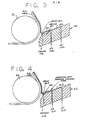
- FIG. 3 illustrates the use of the apparatus invention of U.S. Pat. No. 4,299,188 in dealing with the standing wave problem.
- the groove 20 cut into the front portion of the coating bar 9a can fill 'with a volume of liquid which would otherwise be piled up as shown in FIG. 2.
- the flow of the emulsion 8a and antiabrasion solution 12a, supplied by EP 10a and AP 14a respectively, and subjected to vacuum lla is relatively smooth and the liquids can be coated on the moving web 6a driven by roller 7a without the disruptive effect of a standing wave.
- the groove 20 in FIG. 3 is of the correct size to accommodate the standing-wave 16 illustrated in FIG. 2. This size groove would not be satisfactory for a larger or smaller standing wave.
- the invention would require a different apparatus to be used for different coating compositions and even for different coating speeds, since the standing wave is a function of the system dynamics.
- FIG. 4 illustrates how the standing wave of FIG. 2 is reduced by incorporating the combination of a hydrocarbon and a fluorocarbon surfactant in the silver halide emulsion 8b and antiabrasion solution 12b; associated elements 9b, lOb, llb, and 12b require no description.
- the point of FIG. 4 is that without the disturbance of the standing wave the coatings are applied to the moving web 6b, driven by roller 7b, in a uniform manner without disruption of the bead 18b.
- the process of the present invention utilizes the superior dynamic surface tension properties of a fluorocarbon surfactant in combination with the solubilizing properties of a hydrocarbon surfactant in providing the advance shown here and in FIG. 1.
- the fluorocarbon surfactant possesses the ability to lower static and dynamic surface tension better than other surfactants, and it is this property which enables one to control the standing wave.
- a silver halide emulsion containing hydrocarbon surfactant is limited to a low value of about 28 dynes per cm for static surface tension, whereas with a fluorocarbon surfactant the surface tension can go as low as 20 dynes per cm.
- the fluorocarbon surfactant can provide silver halide emulsions with lower static surface tension than any hydrocarbon surfactant and this has been found to correlate with .dynamic surface tension. The importance of this surface tension advantage is evidenced in the superior properties illustrated in FIG..1 and FIG. 4 under dynamic coating conditions.
- the process of the present invention would not be complete without the incorporation of a hydrocarbon surfactant to trap dirt particles.
- the hydrocarbon surfactant functions as a detergent to solubilize particles which would otherwise cause coating defects.
- the fluorocarbon surfactant is essential to counteract the standing wave, whereas the hydrocarbon surfactant prevents defects which would result from dirt.
- the surfactants To be useful in the process of coating a photographic emulsion, it is essential that the surfactants not have an adverse effect on the photographic properties of either the liquid emulsion or the final coated film.
- the surfactants used must not only be satisfactory in terms of surface tension or solubilizing action, but they must be compatible with the emulsion and other auxiliary layers and be sensitometrically inert. That is to say, the surfactant addition must not adversely affect the speed, fog, gradient or aging properties.
- the process of the present invention demands that the surfactant additions permit simultaneous coating of two or more liquid layers onto a support at speeds of over 100 meters per minute.
- Two other fluorocarbon surfactants were not satisfactory, one because of repellents and static when used in a photographic emulsion (Zonyl®FSA), and one which was found to be photographically active (Zonyl®FSB). It is envisioned, however, that excepting cationic surfactants which are known to give coagulation in photographic emulsions, there are other anionic, nonionic or amphoteric fluorocarbon surfactants which could be employed in the present invention
- Other hydrocarbon surfactants which are also useful for the practice of the present invention are: Standapol®ES-40, available from Henkel Inc., a sodium myreth sulfate of the formula: and Merpol®SH, available from E. I. du Pont de Nemours and Company, an ethylene oxide condensate of the formula:
- a useful range is 0.02 to 2.0 g fluorocarbon surfactant, preferably 0.3-0.8 g, per 1.5 mole of silver halide.
- the corresponding range for the . hydrocarbon surfactant is from 0.05 to 1 g surfactant per 1.5 mole of silver halide.
- the flurocarbon surfactant is effective in a range from 0.1 to 2 g, preferably 1-2 g, surfactant per 200 g of gelatin, while the range for the hydrocarbon surfactant is from 1 to 5 g per 200 g of gelatin.
- a vacuum is applied to the underside of the coating bead to stabilize the bead and obtain good coating quality.
- the upper limit is usually referred to as the maximum vacuum pressure and corresponds to a gross failure characterized by regularly spaced "vacuum" streaks.
- the lower limit, or minimum vacuum pressure the edge of the bead breaks, followed by catastrophic failure of the entire bead. In other words, when the vacuum pressure is too great the coating is cut into ribbons, and when the vacuum pressure is too low the liquid will not make satisfactory contact with the moving support or web.
- the measurement of the maximum vacuum pressure is reproducible and depends primarily on web speed, web to bar gap, coating thickness, and fluid properties.
- the minimum vacuum pressure is much less sensitive to these variables. Measurement of the minimum vacuum pressure is more variable because of variations in bar design and system setup which can influence the amount of leakage and edge pressure.
- the present invention deals with the dynamics of a coating process.
- the fluids are elongated by a factor of ten in passing from the bar to the web. This means that a large amount of fresh surface is created at both the upper and lower meniscus of the bead in a very short time (milliseconds).
- the effective surface tension in bar coating depends on the time required for the surfactant molecules to migrate to and orient at the interface. This response, in which surfactant molecules may be required to break from a micelle in the bulk of the coating fluid and move to fill in voids in the newly generated surface in a matter of milliseconds, involves dynamic surface tension.
- Surfactant additions were made to the twenty emulsions and twenty antiabrasion solutions to correspond to the compositions indicated in Table 1.
- Chemical identifications for surfactant names given in the Table are: Triton ® X100: octylphenoxy polyethoxy ethanol, Triton ® X200: sodium salt of polyether sulfonate, Standapol O ES-40: sodium myreth sulfate, Merpol ® SH: alkyl polyethoxy ethanol, DuPonol®WAQE: sodium lauryl sulfate, Coneo ® AAS35: sodium dodecyl benzene sulfonate, Duponol ® SP: sodium alcohol sulfate, Alkanol®XC: sodium alkyl naphthalene sulfate, Duponol®WN: sodium salts of mixed long chain alcohol sulfate esters.
- the emulsion and gelatin overcoat were deaereated to eliminate bubble streaks during bar coating.
- the emulsions had a measured silver analysis of from 9.7 to 10% and the gelatin analyses for the antiabrasion solutions were all approximately 6%.
- Table 2 contains data for the measured viscosities and surface tensions made prior to coating.
- the coating bar Prior to each test the coating bar was cleaned to avoid cross contamination from other surfactants, and the bar-to-web gap was set at 0.015 cm.
- each emulsion and antiabrasion solution was bar coated at three different speeds.' During these coatings the vacuum pressure was varied until unsatisfactory coating was obtained. The difference in vacuum gauge reading between the low value where failure occurred and the high value where failure occurred is the vacuum pressure range which is given in Table 3.
- Example 1 A test comparison was run similar to tests 2 and 12 of Example 1 except that Zonyl®FSN was replaced with FC-170C, a fluorocarbon surfactant available from the 3M Co.
- the amounts of saponin and T riton O- X-100 remained the same as in Example 1 while the emulsion contained FC170C at 0.123 g per 1.5 mole silver halide and the antiabrasion solution contained FC170C at 0.167 g per 200 grams of gelatin.
- the control gave a vacuum range of .35 whereas the fluorocarbon and hydrocarbon surfactant combination of the present invention gave a vacuum range of 0.65, or almost double that of the prior art.
- the sensitometric tests of films containing FC-170C demonstrated utility for photographic purposes.
- the silver halide emulsions can comprise for example, silver chloride, silver bromide, silver bromoiodide, silver chlorobromide, silver chloroiodide, silver chlorobromoiodide crystals or mixtures thereof.
- the emulsions may be coarse or fine grain emulsions and prepared by any of the well-known techniques.
- the photographic emulsions and layers prepared in accordance with the invention described herein may be coated on a wide variety of supports. Typical supports include cellulose nitrate film, cellulose ester film, poly(vinyl acetal.) film, polystyrene film, poly(ethylene terephthalate) film, polycarbonate film and related films or resinous materials.
- the photographic emulsions produced in accordance with the practice of this invention may contain the normal addenda useful in photographic silver halides.
- Typical addenda which may be added are chemical sensitizers, development modifiers, antifoggants and stabilizers, developing agents, hardeners, spectral sensitizers and the like.
Landscapes
- Physics & Mathematics (AREA)
- Chemical & Material Sciences (AREA)
- Engineering & Computer Science (AREA)
- Materials Engineering (AREA)
- General Physics & Mathematics (AREA)
- Spectroscopy & Molecular Physics (AREA)
- Chemical Kinetics & Catalysis (AREA)
- Application Of Or Painting With Fluid Materials (AREA)
- Emulsifying, Dispersing, Foam-Producing Or Wetting Agents (AREA)
- Laminated Bodies (AREA)
Applications Claiming Priority (2)
| Application Number | Priority Date | Filing Date | Title |
|---|---|---|---|
| US06/449,744 US4508764A (en) | 1982-12-14 | 1982-12-14 | Coating process employs surfactants |
| US449744 | 2003-05-30 |
Publications (3)
| Publication Number | Publication Date |
|---|---|
| EP0111338A2 true EP0111338A2 (de) | 1984-06-20 |
| EP0111338A3 EP0111338A3 (en) | 1985-11-06 |
| EP0111338B1 EP0111338B1 (de) | 1987-11-25 |
Family
ID=23785311
Family Applications (1)
| Application Number | Title | Priority Date | Filing Date |
|---|---|---|---|
| EP83112452A Expired EP0111338B1 (de) | 1982-12-14 | 1983-12-10 | Beschichtungsverfahren unter Verwendung von oberflächenaktiven Verbindungen |
Country Status (5)
| Country | Link |
|---|---|
| US (1) | US4508764A (de) |
| EP (1) | EP0111338B1 (de) |
| JP (2) | JPS59139968A (de) |
| CA (1) | CA1214354A (de) |
| DE (1) | DE3374718D1 (de) |
Cited By (12)
| Publication number | Priority date | Publication date | Assignee | Title |
|---|---|---|---|---|
| EP0230995A3 (en) * | 1986-01-23 | 1988-10-26 | Fuji Photo Film Co., Ltd. | Light-sensitive composition |
| EP0267019A3 (en) * | 1986-11-04 | 1989-07-19 | Konica Corporation | Silver halide photographic light-sensitive material capable of super-rapid processing |
| EP0353993A3 (de) * | 1988-08-01 | 1991-11-13 | Chemfab Corporation | Verfahren zur Herstellung von gegossenen Folien aus Fluorpolymeren mit hoher Produktivität |
| WO1991018321A1 (en) * | 1990-05-16 | 1991-11-28 | Kodak Limited | Hydrophilic colloid composition for a photographic material |
| WO1991018325A1 (en) * | 1990-05-23 | 1991-11-28 | Eastman Kodak Company | Protective overcoat compositions and photographic elements containing same |
| WO1991018324A1 (en) * | 1990-05-23 | 1991-11-28 | Eastman Kodak Company | Protective overcoat compositions and photographic elements containing same |
| EP0552618A1 (de) * | 1992-01-22 | 1993-07-28 | Konica Corporation | Beschichtungsverfahren |
| WO1995029763A1 (en) * | 1994-04-29 | 1995-11-09 | Minnesota Mining And Manufacturing Company | Multiple layer and slide die coating method and apparatus |
| EP0690338A1 (de) * | 1994-06-30 | 1996-01-03 | Minnesota Mining And Manufacturing Company | Photographisches Silberhalogenidmaterial mit antistatischen Eigenschaften |
| US5541049A (en) * | 1994-06-30 | 1996-07-30 | Minnesota Mining And Manufacturing Company | Silver halide photographic material having improved antistatic properties |
| US5741549A (en) * | 1994-04-29 | 1998-04-21 | Maier; Gary W. | Slide die coating method and apparatus with improved die lip |
| US5792515A (en) * | 1995-09-29 | 1998-08-11 | Eastman Kodak Company | Coating processes |
Families Citing this family (10)
| Publication number | Priority date | Publication date | Assignee | Title |
|---|---|---|---|---|
| JPS6080849A (ja) * | 1983-10-07 | 1985-05-08 | Fuji Photo Film Co Ltd | ハロゲン化銀写真感光材料 |
| JPS62109044A (ja) * | 1985-11-08 | 1987-05-20 | Fuji Photo Film Co Ltd | ハロゲン化銀写真感光材料 |
| JPS6319647A (ja) * | 1986-07-11 | 1988-01-27 | Konica Corp | 耐接着性、耐傷性等が改良された写真感光材料 |
| JPH02216139A (ja) * | 1989-02-17 | 1990-08-29 | Konica Corp | 写真感光材料の製造方法 |
| DE3938573A1 (de) * | 1989-11-21 | 1991-05-23 | Du Pont Deutschland | Verfahren zum entwickeln photographischer silberhalogenidaufzeichnungsmaterialien |
| JPH0573987U (ja) * | 1992-03-06 | 1993-10-08 | 日本電気株式会社 | 電子機器の取付構造 |
| US5268263A (en) * | 1993-02-22 | 1993-12-07 | E. I. Du Pont De Nemours And Company | Photographic elements with improved coating layers |
| US5607726A (en) * | 1994-10-17 | 1997-03-04 | E. I. Du Pont De Nemours And Company | Process for the preparation of composite coatings with variable thickness |
| US6506806B2 (en) * | 2000-06-08 | 2003-01-14 | E. I. Du Pont De Nemours And Company | Reduction of surface tension |
| US20080166530A1 (en) * | 2006-12-27 | 2008-07-10 | Fujifilm Corporation | Multi-layer coating method, and planographic printing plate and manufacturing method thereof |
Family Cites Families (28)
| Publication number | Priority date | Publication date | Assignee | Title |
|---|---|---|---|---|
| US29255A (en) * | 1860-07-24 | William ebbitt | ||
| BE513714A (de) * | 1951-08-23 | 1900-01-01 | ||
| CA557259A (en) * | 1955-02-23 | 1958-05-13 | Canadian Kodak Co. Limited | Multiple layer hopper for multiply coating a web |
| US3005440A (en) * | 1959-01-08 | 1961-10-24 | Eastman Kodak Co | Multiple coating apparatus |
| CH506093A (de) * | 1968-09-24 | 1971-04-15 | Ciba Geigy Ag | Verwendung aliphatischer Fluorverbindungen als Netzmittel in gelatinehaltigen Giesslösungen für photographische Zwecke |
| USRE29255E (en) | 1968-10-16 | 1977-06-07 | E. I. Du Pont De Nemours And Company | Photographic layers containing perfluoro compounds and coating thereof |
| BE742680A (de) * | 1968-12-09 | 1970-06-05 | ||
| GB1293189A (en) * | 1970-06-04 | 1972-10-18 | Agfa Gevaert | Photographic silver halide element |
| BE789556A (fr) * | 1971-10-01 | 1973-03-29 | Union Carbide Corp | Element alcain de pile au zinc |
| US3775126A (en) * | 1972-02-29 | 1973-11-27 | Eastman Kodak Co | Light-sensitive element comprising a coating layer containing a mixture of a cationic perfluorinated alkyl and an alkylphenoxypoly(propylene oxide) |
| JPS5225087B2 (de) * | 1972-05-27 | 1977-07-05 | ||
| US3928678A (en) * | 1973-01-26 | 1975-12-23 | Eastman Kodak Co | Method and apparatus for coating a substrate |
| JPS589408B2 (ja) * | 1974-02-13 | 1983-02-21 | 富士写真フイルム株式会社 | 写真感光材料 |
| JPS5158437A (en) * | 1974-11-11 | 1976-05-21 | Eastman Kodak Co | Tsugime noaru uebuo kooteingu suru hoho |
| JPS5729691B2 (de) * | 1975-03-15 | 1982-06-24 | ||
| JPS51151125A (en) * | 1975-06-20 | 1976-12-25 | Asahi Denka Kogyo Kk | Photographic coating fluids |
| US4113903A (en) * | 1977-05-27 | 1978-09-12 | Polaroid Corporation | Method of multilayer coating |
| JPS5931690B2 (ja) * | 1978-02-20 | 1984-08-03 | 旭硝子株式会社 | 写真用塗布液の塗布方法 |
| JPS5927232B2 (ja) * | 1978-06-26 | 1984-07-04 | 富士写真フイルム株式会社 | 塗布方法 |
| JPS5836894B2 (ja) * | 1978-07-03 | 1983-08-12 | 富士写真フイルム株式会社 | 写真感光材料 |
| JPS5822266B2 (ja) * | 1978-12-19 | 1983-05-07 | 富士写真フイルム株式会社 | 塗布方法 |
| JPS5835105B2 (ja) * | 1978-12-25 | 1983-07-30 | 富士写真フイルム株式会社 | 塗布装置 |
| CA1132397A (en) * | 1979-02-28 | 1982-09-28 | Hendrik E. Kokelenberg | Fluorine-containing surfactants and their use in hydrophilic colloid coating compositions and light-sensitive silver halide materials |
| JPS55149938A (en) * | 1979-05-11 | 1980-11-21 | Konishiroku Photo Ind Co Ltd | Photographic coating fluid |
| JPS5652746A (en) * | 1979-10-06 | 1981-05-12 | Mitsubishi Paper Mills Ltd | Manufacture of silver halide photographic material |
| JPS56109336A (en) * | 1980-02-01 | 1981-08-29 | Konishiroku Photo Ind Co Ltd | Silver halide photographic sensitive material |
| JPS5711341A (en) * | 1980-06-25 | 1982-01-21 | Fuji Photo Film Co Ltd | Photographic sensitive material |
| JPS57103165U (de) * | 1980-12-18 | 1982-06-25 |
-
1982
- 1982-12-14 US US06/449,744 patent/US4508764A/en not_active Expired - Lifetime
-
1983
- 1983-12-10 DE DE8383112452T patent/DE3374718D1/de not_active Expired
- 1983-12-10 EP EP83112452A patent/EP0111338B1/de not_active Expired
- 1983-12-13 JP JP58233770A patent/JPS59139968A/ja active Granted
- 1983-12-13 CA CA000443204A patent/CA1214354A/en not_active Expired
-
1986
- 1986-12-08 JP JP61290643A patent/JPS62187840A/ja active Pending
Cited By (14)
| Publication number | Priority date | Publication date | Assignee | Title |
|---|---|---|---|---|
| EP0230995A3 (en) * | 1986-01-23 | 1988-10-26 | Fuji Photo Film Co., Ltd. | Light-sensitive composition |
| EP0267019A3 (en) * | 1986-11-04 | 1989-07-19 | Konica Corporation | Silver halide photographic light-sensitive material capable of super-rapid processing |
| EP0353993A3 (de) * | 1988-08-01 | 1991-11-13 | Chemfab Corporation | Verfahren zur Herstellung von gegossenen Folien aus Fluorpolymeren mit hoher Produktivität |
| US5474889A (en) * | 1990-05-16 | 1995-12-12 | Eastman Kodak Company | Hydrophilic colloid composition for a photographic material |
| US5366857A (en) * | 1990-05-16 | 1994-11-22 | Eastman Kodak Company | Hydrophilic colloid composition for a photographic material |
| WO1991018321A1 (en) * | 1990-05-16 | 1991-11-28 | Kodak Limited | Hydrophilic colloid composition for a photographic material |
| WO1991018325A1 (en) * | 1990-05-23 | 1991-11-28 | Eastman Kodak Company | Protective overcoat compositions and photographic elements containing same |
| WO1991018324A1 (en) * | 1990-05-23 | 1991-11-28 | Eastman Kodak Company | Protective overcoat compositions and photographic elements containing same |
| EP0552618A1 (de) * | 1992-01-22 | 1993-07-28 | Konica Corporation | Beschichtungsverfahren |
| WO1995029763A1 (en) * | 1994-04-29 | 1995-11-09 | Minnesota Mining And Manufacturing Company | Multiple layer and slide die coating method and apparatus |
| US5741549A (en) * | 1994-04-29 | 1998-04-21 | Maier; Gary W. | Slide die coating method and apparatus with improved die lip |
| EP0690338A1 (de) * | 1994-06-30 | 1996-01-03 | Minnesota Mining And Manufacturing Company | Photographisches Silberhalogenidmaterial mit antistatischen Eigenschaften |
| US5541049A (en) * | 1994-06-30 | 1996-07-30 | Minnesota Mining And Manufacturing Company | Silver halide photographic material having improved antistatic properties |
| US5792515A (en) * | 1995-09-29 | 1998-08-11 | Eastman Kodak Company | Coating processes |
Also Published As
| Publication number | Publication date |
|---|---|
| CA1214354A (en) | 1986-11-25 |
| DE3374718D1 (en) | 1988-01-07 |
| JPS59139968A (ja) | 1984-08-11 |
| EP0111338B1 (de) | 1987-11-25 |
| US4508764A (en) | 1985-04-02 |
| EP0111338A3 (en) | 1985-11-06 |
| JPS62187840A (ja) | 1987-08-17 |
| JPS6221584B2 (de) | 1987-05-13 |
Similar Documents
| Publication | Publication Date | Title |
|---|---|---|
| US4508764A (en) | Coating process employs surfactants | |
| US4001024A (en) | Method of multi-layer coating | |
| US4113903A (en) | Method of multilayer coating | |
| US3666478A (en) | Photographic material containing aliphatic perfluoro compounds | |
| US3928678A (en) | Method and apparatus for coating a substrate | |
| EP0390774A1 (de) | Verfahren und vorrichtung zum schnellbeschichten nach dem vorhangsverfahren. | |
| DE2610485A1 (de) | Verfahren zur herstellung eines photographischen materials | |
| US3573965A (en) | Multilayer coating method | |
| Valentini et al. | Role of dynamic surface tension in slide coating | |
| JPS63151944A (ja) | 現像処理方法 | |
| US5310637A (en) | Minimization of ripple by controlling gelatin concentration | |
| Hwang | Hydrodynamic analyses of blade coaters | |
| JP2858136B2 (ja) | 塗布方法 | |
| US5928845A (en) | Method of fixing a photographic product | |
| JPS63206750A (ja) | ハロゲン化銀写真感光材料の現像処理方法 | |
| JP3409210B2 (ja) | 塗布方法 | |
| EP0516809B1 (de) | Verfahren zur Beschichtung photographischer Mehrschichtmaterialien | |
| US5411844A (en) | Photographic element and coating composition therefor | |
| JPH1039461A (ja) | 現像活性化剤水溶液及び露光済写真製品の現像方法 | |
| EP0439172A2 (de) | Mehrfachbeschichtungsverfahren für lichtempfindliches Farbmaterial | |
| US5418128A (en) | Photographic element and coating composition therefor | |
| US6174654B1 (en) | Method for processing silver halide photographic light-sensitive material | |
| JPH02245267A (ja) | 塗布方法 | |
| JP2670612B2 (ja) | 多層同時塗布方法 | |
| JPH01206332A (ja) | 塗布方法及び装置 |
Legal Events
| Date | Code | Title | Description |
|---|---|---|---|
| PUAI | Public reference made under article 153(3) epc to a published international application that has entered the european phase |
Free format text: ORIGINAL CODE: 0009012 |
|
| AK | Designated contracting states |
Designated state(s): BE DE FR GB IT |
|
| PUAL | Search report despatched |
Free format text: ORIGINAL CODE: 0009013 |
|
| AK | Designated contracting states |
Designated state(s): BE DE FR GB IT |
|
| 17P | Request for examination filed |
Effective date: 19860123 |
|
| 17Q | First examination report despatched |
Effective date: 19861113 |
|
| GRAA | (expected) grant |
Free format text: ORIGINAL CODE: 0009210 |
|
| AK | Designated contracting states |
Kind code of ref document: B1 Designated state(s): BE DE FR GB IT |
|
| ITF | It: translation for a ep patent filed | ||
| REF | Corresponds to: |
Ref document number: 3374718 Country of ref document: DE Date of ref document: 19880107 |
|
| ET | Fr: translation filed | ||
| PLBE | No opposition filed within time limit |
Free format text: ORIGINAL CODE: 0009261 |
|
| STAA | Information on the status of an ep patent application or granted ep patent |
Free format text: STATUS: NO OPPOSITION FILED WITHIN TIME LIMIT |
|
| 26N | No opposition filed | ||
| PGFP | Annual fee paid to national office [announced via postgrant information from national office to epo] |
Ref country code: BE Payment date: 19911003 Year of fee payment: 9 |
|
| ITTA | It: last paid annual fee | ||
| PG25 | Lapsed in a contracting state [announced via postgrant information from national office to epo] |
Ref country code: BE Effective date: 19921231 |
|
| BERE | Be: lapsed |
Owner name: E.I. DU PONT DE NEMOURS AND CY Effective date: 19921231 |
|
| REG | Reference to a national code |
Ref country code: GB Ref legal event code: 732E |
|
| REG | Reference to a national code |
Ref country code: FR Ref legal event code: TP |
|
| PGFP | Annual fee paid to national office [announced via postgrant information from national office to epo] |
Ref country code: GB Payment date: 19961202 Year of fee payment: 14 |
|
| PGFP | Annual fee paid to national office [announced via postgrant information from national office to epo] |
Ref country code: FR Payment date: 19961211 Year of fee payment: 14 |
|
| PGFP | Annual fee paid to national office [announced via postgrant information from national office to epo] |
Ref country code: DE Payment date: 19961216 Year of fee payment: 14 |
|
| PG25 | Lapsed in a contracting state [announced via postgrant information from national office to epo] |
Ref country code: GB Free format text: LAPSE BECAUSE OF NON-PAYMENT OF DUE FEES Effective date: 19971210 |
|
| PG25 | Lapsed in a contracting state [announced via postgrant information from national office to epo] |
Ref country code: FR Free format text: THE PATENT HAS BEEN ANNULLED BY A DECISION OF A NATIONAL AUTHORITY Effective date: 19971231 |
|
| GBPC | Gb: european patent ceased through non-payment of renewal fee |
Effective date: 19971210 |
|
| PG25 | Lapsed in a contracting state [announced via postgrant information from national office to epo] |
Ref country code: DE Free format text: LAPSE BECAUSE OF NON-PAYMENT OF DUE FEES Effective date: 19980901 |
|
| REG | Reference to a national code |
Ref country code: FR Ref legal event code: ST |