EP0112587A2 - 4-(1-(Phenyl)-1-(hydroxy)-prop-1-yl)-resorcinderivate, Verfahren zu ihrer Herstellung und diese Verbindungen enthaltende Arzneimittel - Google Patents
4-(1-(Phenyl)-1-(hydroxy)-prop-1-yl)-resorcinderivate, Verfahren zu ihrer Herstellung und diese Verbindungen enthaltende Arzneimittel Download PDFInfo
- Publication number
- EP0112587A2 EP0112587A2 EP83113174A EP83113174A EP0112587A2 EP 0112587 A2 EP0112587 A2 EP 0112587A2 EP 83113174 A EP83113174 A EP 83113174A EP 83113174 A EP83113174 A EP 83113174A EP 0112587 A2 EP0112587 A2 EP 0112587A2
- Authority
- EP
- European Patent Office
- Prior art keywords
- resorcinol
- hydroxypropyl
- phenyl
- hydroxy
- prop
- Prior art date
- Legal status (The legal status is an assumption and is not a legal conclusion. Google has not performed a legal analysis and makes no representation as to the accuracy of the status listed.)
- Granted
Links
- 150000001875 compounds Chemical class 0.000 title claims abstract description 36
- 238000000034 method Methods 0.000 title claims abstract description 14
- 238000002360 preparation method Methods 0.000 title claims abstract description 8
- 239000003814 drug Substances 0.000 title claims abstract description 4
- 229940079593 drug Drugs 0.000 title 1
- -1 trihalomethyl radicals Chemical class 0.000 claims abstract description 29
- NFYIGVWKBCCKHC-UHFFFAOYSA-N 4-(1-hydroxy-1-phenylpropyl)benzene-1,3-diol Chemical class C=1C=C(O)C=C(O)C=1C(O)(CC)C1=CC=CC=C1 NFYIGVWKBCCKHC-UHFFFAOYSA-N 0.000 claims abstract description 10
- 125000005843 halogen group Chemical group 0.000 claims abstract description 8
- 125000000217 alkyl group Chemical group 0.000 claims abstract description 5
- 125000004432 carbon atom Chemical group C* 0.000 claims abstract description 5
- 125000004435 hydrogen atom Chemical group [H]* 0.000 claims abstract description 3
- 239000004480 active ingredient Substances 0.000 claims description 13
- LLBBBYLDTDJMNU-UHFFFAOYSA-N 1-(2,4-dihydroxyphenyl)propan-1-one Chemical compound CCC(=O)C1=CC=C(O)C=C1O LLBBBYLDTDJMNU-UHFFFAOYSA-N 0.000 claims description 8
- 239000000460 chlorine Substances 0.000 claims description 7
- 150000002902 organometallic compounds Chemical class 0.000 claims description 7
- XBBDJLWIOFFVDL-UHFFFAOYSA-N 4-[1-hydroxy-1-[3-(trifluoromethyl)phenyl]propyl]benzene-1,3-diol Chemical compound C=1C=C(O)C=C(O)C=1C(O)(CC)C1=CC=CC(C(F)(F)F)=C1 XBBDJLWIOFFVDL-UHFFFAOYSA-N 0.000 claims description 6
- 239000003795 chemical substances by application Substances 0.000 claims description 5
- 125000001997 phenyl group Chemical group [H]C1=C([H])C([H])=C(*)C([H])=C1[H] 0.000 claims description 5
- WHXSMMKQMYFTQS-UHFFFAOYSA-N Lithium Chemical compound [Li] WHXSMMKQMYFTQS-UHFFFAOYSA-N 0.000 claims description 4
- BLHLJVCOVBYQQS-UHFFFAOYSA-N ethyllithium Chemical compound [Li]CC BLHLJVCOVBYQQS-UHFFFAOYSA-N 0.000 claims description 4
- ZXDDPOHVAMWLBH-UHFFFAOYSA-N 2,4-Dihydroxybenzophenone Chemical class OC1=CC(O)=CC=C1C(=O)C1=CC=CC=C1 ZXDDPOHVAMWLBH-UHFFFAOYSA-N 0.000 claims description 3
- ZSNAMYIUFCEEPQ-UHFFFAOYSA-N 4-[1-(2,5-dimethylphenyl)-1-hydroxypropyl]benzene-1,3-diol Chemical compound C=1C=C(O)C=C(O)C=1C(O)(CC)C1=CC(C)=CC=C1C ZSNAMYIUFCEEPQ-UHFFFAOYSA-N 0.000 claims description 3
- CZLPAPDXLFYBEB-UHFFFAOYSA-N 4-[1-(4-chlorophenyl)-1-hydroxypropyl]benzene-1,3-diol Chemical compound C=1C=C(O)C=C(O)C=1C(O)(CC)C1=CC=C(Cl)C=C1 CZLPAPDXLFYBEB-UHFFFAOYSA-N 0.000 claims description 3
- JFRQWJJDBZAJFH-UHFFFAOYSA-N 4-[1-(4-fluorophenyl)-1-hydroxypropyl]benzene-1,3-diol Chemical compound C=1C=C(O)C=C(O)C=1C(O)(CC)C1=CC=C(F)C=C1 JFRQWJJDBZAJFH-UHFFFAOYSA-N 0.000 claims description 3
- RVHRXTNMOUMBEJ-UHFFFAOYSA-N 4-[1-hydroxy-1-[4-(trifluoromethyl)phenyl]propyl]benzene-1,3-diol Chemical compound C=1C=C(O)C=C(O)C=1C(O)(CC)C1=CC=C(C(F)(F)F)C=C1 RVHRXTNMOUMBEJ-UHFFFAOYSA-N 0.000 claims description 3
- KZBUYRJDOAKODT-UHFFFAOYSA-N Chlorine Chemical compound ClCl KZBUYRJDOAKODT-UHFFFAOYSA-N 0.000 claims description 3
- 229910052799 carbon Inorganic materials 0.000 claims description 3
- 229910052801 chlorine Inorganic materials 0.000 claims description 3
- 125000001495 ethyl group Chemical group [H]C([H])([H])C([H])([H])* 0.000 claims description 3
- 229910052731 fluorine Inorganic materials 0.000 claims description 3
- 229910052744 lithium Inorganic materials 0.000 claims description 3
- QKXWWALJDCHQLO-UHFFFAOYSA-N 4-[1-(3-chlorophenyl)-1-hydroxypropyl]benzene-1,3-diol Chemical compound C=1C=C(O)C=C(O)C=1C(O)(CC)C1=CC=CC(Cl)=C1 QKXWWALJDCHQLO-UHFFFAOYSA-N 0.000 claims description 2
- OYDFKGJMNGNHJO-UHFFFAOYSA-N 4-[1-hydroxy-1-(2-methoxyphenyl)propyl]benzene-1,3-diol Chemical compound C=1C=CC=C(OC)C=1C(O)(CC)C1=CC=C(O)C=C1O OYDFKGJMNGNHJO-UHFFFAOYSA-N 0.000 claims description 2
- WKBOTKDWSSQWDR-UHFFFAOYSA-N Bromine atom Chemical group [Br] WKBOTKDWSSQWDR-UHFFFAOYSA-N 0.000 claims description 2
- WZKSXHQDXQKIQJ-UHFFFAOYSA-N F[C](F)F Chemical compound F[C](F)F WZKSXHQDXQKIQJ-UHFFFAOYSA-N 0.000 claims description 2
- PXGOKWXKJXAPGV-UHFFFAOYSA-N Fluorine Chemical compound FF PXGOKWXKJXAPGV-UHFFFAOYSA-N 0.000 claims description 2
- DGAQECJNVWCQMB-PUAWFVPOSA-M Ilexoside XXIX Chemical compound C[C@@H]1CC[C@@]2(CC[C@@]3(C(=CC[C@H]4[C@]3(CC[C@@H]5[C@@]4(CC[C@@H](C5(C)C)OS(=O)(=O)[O-])C)C)[C@@H]2[C@]1(C)O)C)C(=O)O[C@H]6[C@@H]([C@H]([C@@H]([C@H](O6)CO)O)O)O.[Na+] DGAQECJNVWCQMB-PUAWFVPOSA-M 0.000 claims description 2
- ZLMJMSJWJFRBEC-UHFFFAOYSA-N Potassium Chemical group [K] ZLMJMSJWJFRBEC-UHFFFAOYSA-N 0.000 claims description 2
- 229910052783 alkali metal Inorganic materials 0.000 claims description 2
- 150000001340 alkali metals Chemical group 0.000 claims description 2
- 239000011737 fluorine Substances 0.000 claims description 2
- RUZLIIJDZBWWSA-INIZCTEOSA-N methyl 2-[[(1s)-1-(7-methyl-2-morpholin-4-yl-4-oxopyrido[1,2-a]pyrimidin-9-yl)ethyl]amino]benzoate Chemical compound COC(=O)C1=CC=CC=C1N[C@@H](C)C1=CC(C)=CN2C(=O)C=C(N3CCOCC3)N=C12 RUZLIIJDZBWWSA-INIZCTEOSA-N 0.000 claims description 2
- 239000011734 sodium Substances 0.000 claims description 2
- 229910052708 sodium Inorganic materials 0.000 claims description 2
- ZBZJXHCVGLJWFG-UHFFFAOYSA-N trichloromethyl(.) Chemical compound Cl[C](Cl)Cl ZBZJXHCVGLJWFG-UHFFFAOYSA-N 0.000 claims description 2
- 230000001154 acute effect Effects 0.000 abstract description 4
- 206010001605 Alcohol poisoning Diseases 0.000 abstract description 3
- LFQSCWFLJHTTHZ-UHFFFAOYSA-N Ethanol Chemical compound CCO LFQSCWFLJHTTHZ-UHFFFAOYSA-N 0.000 description 30
- 239000000203 mixture Substances 0.000 description 21
- 239000000243 solution Substances 0.000 description 21
- RTZKZFJDLAIYFH-UHFFFAOYSA-N Diethyl ether Chemical compound CCOCC RTZKZFJDLAIYFH-UHFFFAOYSA-N 0.000 description 18
- 241001465754 Metazoa Species 0.000 description 13
- 239000002904 solvent Substances 0.000 description 13
- NLXLAEXVIDQMFP-UHFFFAOYSA-N Ammonia chloride Chemical compound [NH4+].[Cl-] NLXLAEXVIDQMFP-UHFFFAOYSA-N 0.000 description 12
- XEKOWRVHYACXOJ-UHFFFAOYSA-N Ethyl acetate Chemical compound CCOC(C)=O XEKOWRVHYACXOJ-UHFFFAOYSA-N 0.000 description 12
- WYURNTSHIVDZCO-UHFFFAOYSA-N Tetrahydrofuran Chemical compound C1CCOC1 WYURNTSHIVDZCO-UHFFFAOYSA-N 0.000 description 12
- VLKZOEOYAKHREP-UHFFFAOYSA-N n-Hexane Chemical compound CCCCCC VLKZOEOYAKHREP-UHFFFAOYSA-N 0.000 description 11
- XUJNEKJLAYXESH-REOHCLBHSA-N L-Cysteine Chemical compound SC[C@H](N)C(O)=O XUJNEKJLAYXESH-REOHCLBHSA-N 0.000 description 9
- 238000000921 elemental analysis Methods 0.000 description 9
- UHOVQNZJYSORNB-UHFFFAOYSA-N Benzene Chemical compound C1=CC=CC=C1 UHOVQNZJYSORNB-UHFFFAOYSA-N 0.000 description 8
- XLYOFNOQVPJJNP-UHFFFAOYSA-N water Substances O XLYOFNOQVPJJNP-UHFFFAOYSA-N 0.000 description 8
- OKTJSMMVPCPJKN-UHFFFAOYSA-N Carbon Chemical compound [C] OKTJSMMVPCPJKN-UHFFFAOYSA-N 0.000 description 6
- YMWUJEATGCHHMB-UHFFFAOYSA-N Dichloromethane Chemical compound ClCCl YMWUJEATGCHHMB-UHFFFAOYSA-N 0.000 description 6
- YXFVVABEGXRONW-UHFFFAOYSA-N Toluene Chemical compound CC1=CC=CC=C1 YXFVVABEGXRONW-UHFFFAOYSA-N 0.000 description 6
- 235000019270 ammonium chloride Nutrition 0.000 description 6
- 239000000155 melt Substances 0.000 description 6
- 239000000126 substance Substances 0.000 description 6
- 239000000829 suppository Substances 0.000 description 6
- YLQBMQCUIZJEEH-UHFFFAOYSA-N tetrahydrofuran Natural products C=1C=COC=1 YLQBMQCUIZJEEH-UHFFFAOYSA-N 0.000 description 6
- 206010003591 Ataxia Diseases 0.000 description 5
- 239000002775 capsule Substances 0.000 description 5
- 210000003169 central nervous system Anatomy 0.000 description 5
- 238000006243 chemical reaction Methods 0.000 description 5
- 239000012074 organic phase Substances 0.000 description 5
- CSNNHWWHGAXBCP-UHFFFAOYSA-L Magnesium sulfate Chemical compound [Mg+2].[O-][S+2]([O-])([O-])[O-] CSNNHWWHGAXBCP-UHFFFAOYSA-L 0.000 description 4
- 208000005392 Spasm Diseases 0.000 description 4
- 239000008346 aqueous phase Substances 0.000 description 4
- 239000012153 distilled water Substances 0.000 description 4
- 208000013403 hyperactivity Diseases 0.000 description 4
- 230000006742 locomotor activity Effects 0.000 description 4
- 238000002844 melting Methods 0.000 description 4
- 230000008018 melting Effects 0.000 description 4
- 239000003960 organic solvent Substances 0.000 description 4
- 239000000902 placebo Substances 0.000 description 4
- 229940068196 placebo Drugs 0.000 description 4
- 239000000047 product Substances 0.000 description 4
- 239000011541 reaction mixture Substances 0.000 description 4
- GHMLBKRAJCXXBS-UHFFFAOYSA-N resorcinol Chemical compound OC1=CC=CC(O)=C1 GHMLBKRAJCXXBS-UHFFFAOYSA-N 0.000 description 4
- QTBSBXVTEAMEQO-UHFFFAOYSA-N Acetic acid Chemical compound CC(O)=O QTBSBXVTEAMEQO-UHFFFAOYSA-N 0.000 description 3
- WSFSSNUMVMOOMR-UHFFFAOYSA-N Formaldehyde Chemical compound O=C WSFSSNUMVMOOMR-UHFFFAOYSA-N 0.000 description 3
- 239000004201 L-cysteine Substances 0.000 description 3
- 235000013878 L-cysteine Nutrition 0.000 description 3
- GUBGYTABKSRVRQ-QKKXKWKRSA-N Lactose Chemical compound OC[C@H]1O[C@@H](O[C@H]2[C@H](O)[C@@H](O)C(O)O[C@@H]2CO)[C@H](O)[C@@H](O)[C@H]1O GUBGYTABKSRVRQ-QKKXKWKRSA-N 0.000 description 3
- OKKJLVBELUTLKV-UHFFFAOYSA-N Methanol Chemical compound OC OKKJLVBELUTLKV-UHFFFAOYSA-N 0.000 description 3
- 241000699670 Mus sp. Species 0.000 description 3
- HEMHJVSKTPXQMS-UHFFFAOYSA-M Sodium hydroxide Chemical compound [OH-].[Na+] HEMHJVSKTPXQMS-UHFFFAOYSA-M 0.000 description 3
- 238000009835 boiling Methods 0.000 description 3
- KRKNYBCHXYNGOX-UHFFFAOYSA-N citric acid Chemical compound OC(=O)CC(O)(C(O)=O)CC(O)=O KRKNYBCHXYNGOX-UHFFFAOYSA-N 0.000 description 3
- 238000001816 cooling Methods 0.000 description 3
- 239000007884 disintegrant Substances 0.000 description 3
- 230000000694 effects Effects 0.000 description 3
- 239000011777 magnesium Substances 0.000 description 3
- 229910052749 magnesium Inorganic materials 0.000 description 3
- 230000007935 neutral effect Effects 0.000 description 3
- 239000012071 phase Substances 0.000 description 3
- 238000003825 pressing Methods 0.000 description 3
- 238000001953 recrystallisation Methods 0.000 description 3
- 239000007787 solid Substances 0.000 description 3
- 230000002269 spontaneous effect Effects 0.000 description 3
- 238000012360 testing method Methods 0.000 description 3
- RYHBNJHYFVUHQT-UHFFFAOYSA-N 1,4-Dioxane Chemical compound C1COCCO1 RYHBNJHYFVUHQT-UHFFFAOYSA-N 0.000 description 2
- NHBKXEKEPDILRR-UHFFFAOYSA-N 2,3-bis(butanoylsulfanyl)propyl butanoate Chemical compound CCCC(=O)OCC(SC(=O)CCC)CSC(=O)CCC NHBKXEKEPDILRR-UHFFFAOYSA-N 0.000 description 2
- 206010002091 Anaesthesia Diseases 0.000 description 2
- XKRFYHLGVUSROY-UHFFFAOYSA-N Argon Chemical compound [Ar] XKRFYHLGVUSROY-UHFFFAOYSA-N 0.000 description 2
- IJGRMHOSHXDMSA-UHFFFAOYSA-N Atomic nitrogen Chemical compound N#N IJGRMHOSHXDMSA-UHFFFAOYSA-N 0.000 description 2
- VTYYLEPIZMXCLO-UHFFFAOYSA-L Calcium carbonate Chemical compound [Ca+2].[O-]C([O-])=O VTYYLEPIZMXCLO-UHFFFAOYSA-L 0.000 description 2
- IAZDPXIOMUYVGZ-UHFFFAOYSA-N Dimethylsulphoxide Chemical compound CS(C)=O IAZDPXIOMUYVGZ-UHFFFAOYSA-N 0.000 description 2
- 238000005727 Friedel-Crafts reaction Methods 0.000 description 2
- 239000007818 Grignard reagent Substances 0.000 description 2
- FYYHWMGAXLPEAU-UHFFFAOYSA-N Magnesium Chemical compound [Mg] FYYHWMGAXLPEAU-UHFFFAOYSA-N 0.000 description 2
- MZRVEZGGRBJDDB-UHFFFAOYSA-N N-Butyllithium Chemical compound [Li]CCCC MZRVEZGGRBJDDB-UHFFFAOYSA-N 0.000 description 2
- CTQNGGLPUBDAKN-UHFFFAOYSA-N O-Xylene Chemical compound CC1=CC=CC=C1C CTQNGGLPUBDAKN-UHFFFAOYSA-N 0.000 description 2
- VYPSYNLAJGMNEJ-UHFFFAOYSA-N Silicium dioxide Chemical compound O=[Si]=O VYPSYNLAJGMNEJ-UHFFFAOYSA-N 0.000 description 2
- FAPWRFPIFSIZLT-UHFFFAOYSA-M Sodium chloride Chemical compound [Na+].[Cl-] FAPWRFPIFSIZLT-UHFFFAOYSA-M 0.000 description 2
- 229920002472 Starch Polymers 0.000 description 2
- CDKFWIMBZAUBRS-UHFFFAOYSA-M [I-].CC[Mg+] Chemical compound [I-].CC[Mg+] CDKFWIMBZAUBRS-UHFFFAOYSA-M 0.000 description 2
- DPXJVFZANSGRMM-UHFFFAOYSA-N acetic acid;2,3,4,5,6-pentahydroxyhexanal;sodium Chemical compound [Na].CC(O)=O.OCC(O)C(O)C(O)C(O)C=O DPXJVFZANSGRMM-UHFFFAOYSA-N 0.000 description 2
- 150000001338 aliphatic hydrocarbons Chemical class 0.000 description 2
- 230000037005 anaesthesia Effects 0.000 description 2
- 230000003444 anaesthetic effect Effects 0.000 description 2
- 239000000010 aprotic solvent Substances 0.000 description 2
- 150000004945 aromatic hydrocarbons Chemical class 0.000 description 2
- RYYVLZVUVIJVGH-UHFFFAOYSA-N caffeine Chemical compound CN1C(=O)N(C)C(=O)C2=C1N=CN2C RYYVLZVUVIJVGH-UHFFFAOYSA-N 0.000 description 2
- 238000004587 chromatography analysis Methods 0.000 description 2
- 230000003001 depressive effect Effects 0.000 description 2
- 239000000945 filler Substances 0.000 description 2
- 238000011049 filling Methods 0.000 description 2
- 238000001914 filtration Methods 0.000 description 2
- 239000000796 flavoring agent Substances 0.000 description 2
- 239000000576 food coloring agent Substances 0.000 description 2
- 239000008187 granular material Substances 0.000 description 2
- 150000004795 grignard reagents Chemical class 0.000 description 2
- 238000002347 injection Methods 0.000 description 2
- 239000007924 injection Substances 0.000 description 2
- 238000007912 intraperitoneal administration Methods 0.000 description 2
- 231100000225 lethality Toxicity 0.000 description 2
- 239000003589 local anesthetic agent Substances 0.000 description 2
- 229960005015 local anesthetics Drugs 0.000 description 2
- 239000000314 lubricant Substances 0.000 description 2
- 239000000825 pharmaceutical preparation Substances 0.000 description 2
- 229920000036 polyvinylpyrrolidone Polymers 0.000 description 2
- 239000001267 polyvinylpyrrolidone Substances 0.000 description 2
- 235000013855 polyvinylpyrrolidone Nutrition 0.000 description 2
- 239000013558 reference substance Substances 0.000 description 2
- 230000004622 sleep time Effects 0.000 description 2
- 239000008107 starch Substances 0.000 description 2
- 235000019698 starch Nutrition 0.000 description 2
- 239000007858 starting material Substances 0.000 description 2
- 230000004936 stimulating effect Effects 0.000 description 2
- 238000003756 stirring Methods 0.000 description 2
- 239000000725 suspension Substances 0.000 description 2
- 239000000454 talc Substances 0.000 description 2
- 229910052623 talc Inorganic materials 0.000 description 2
- 238000005550 wet granulation Methods 0.000 description 2
- 239000008096 xylene Substances 0.000 description 2
- SNICXCGAKADSCV-JTQLQIEISA-N (-)-Nicotine Chemical compound CN1CCC[C@H]1C1=CC=CN=C1 SNICXCGAKADSCV-JTQLQIEISA-N 0.000 description 1
- DEQUKPCANKRTPZ-UHFFFAOYSA-N (2,3-dihydroxyphenyl)-phenylmethanone Chemical class OC1=CC=CC(C(=O)C=2C=CC=CC=2)=C1O DEQUKPCANKRTPZ-UHFFFAOYSA-N 0.000 description 1
- ZAPDKBIMAJSFOM-UHFFFAOYSA-N (2,4-dihydroxyphenyl)-(4-fluorophenyl)methanone Chemical compound OC1=CC(O)=CC=C1C(=O)C1=CC=C(F)C=C1 ZAPDKBIMAJSFOM-UHFFFAOYSA-N 0.000 description 1
- KWTSXDURSIMDCE-QMMMGPOBSA-N (S)-amphetamine Chemical compound C[C@H](N)CC1=CC=CC=C1 KWTSXDURSIMDCE-QMMMGPOBSA-N 0.000 description 1
- RWXUNIMBRXGNEP-UHFFFAOYSA-N 1-bromo-2-(trifluoromethyl)benzene Chemical compound FC(F)(F)C1=CC=CC=C1Br RWXUNIMBRXGNEP-UHFFFAOYSA-N 0.000 description 1
- VBICKXHEKHSIBG-UHFFFAOYSA-N 1-monostearoylglycerol Chemical compound CCCCCCCCCCCCCCCCCC(=O)OCC(O)CO VBICKXHEKHSIBG-UHFFFAOYSA-N 0.000 description 1
- SGOADQLYEWPBIM-UHFFFAOYSA-N 4-[1-hydroxy-1-[2-(trifluoromethyl)phenyl]propyl]benzene-1,3-diol Chemical compound C=1C=CC=C(C(F)(F)F)C=1C(O)(CC)C1=CC=C(O)C=C1O SGOADQLYEWPBIM-UHFFFAOYSA-N 0.000 description 1
- 208000005584 Alcoholic Intoxication Diseases 0.000 description 1
- 206010010947 Coordination abnormal Diseases 0.000 description 1
- FBPFZTCFMRRESA-FSIIMWSLSA-N D-Glucitol Natural products OC[C@H](O)[C@H](O)[C@@H](O)[C@H](O)CO FBPFZTCFMRRESA-FSIIMWSLSA-N 0.000 description 1
- KCXVZYZYPLLWCC-UHFFFAOYSA-N EDTA Chemical compound OC(=O)CN(CC(O)=O)CCN(CC(O)=O)CC(O)=O KCXVZYZYPLLWCC-UHFFFAOYSA-N 0.000 description 1
- 239000001856 Ethyl cellulose Substances 0.000 description 1
- ZZSNKZQZMQGXPY-UHFFFAOYSA-N Ethyl cellulose Chemical compound CCOCC1OC(OC)C(OCC)C(OCC)C1OC1C(O)C(O)C(OC)C(CO)O1 ZZSNKZQZMQGXPY-UHFFFAOYSA-N 0.000 description 1
- 239000004606 Fillers/Extenders Substances 0.000 description 1
- 238000005618 Fries rearrangement reaction Methods 0.000 description 1
- 108010010803 Gelatin Proteins 0.000 description 1
- DCXXMTOCNZCJGO-UHFFFAOYSA-N Glycerol trioctadecanoate Natural products CCCCCCCCCCCCCCCCCC(=O)OCC(OC(=O)CCCCCCCCCCCCCCCCC)COC(=O)CCCCCCCCCCCCCCCCC DCXXMTOCNZCJGO-UHFFFAOYSA-N 0.000 description 1
- 238000003747 Grignard reaction Methods 0.000 description 1
- LPHGQDQBBGAPDZ-UHFFFAOYSA-N Isocaffeine Natural products CN1C(=O)N(C)C(=O)C2=C1N(C)C=N2 LPHGQDQBBGAPDZ-UHFFFAOYSA-N 0.000 description 1
- 229920000168 Microcrystalline cellulose Polymers 0.000 description 1
- CWRVKFFCRWGWCS-UHFFFAOYSA-N Pentrazole Chemical compound C1CCCCC2=NN=NN21 CWRVKFFCRWGWCS-UHFFFAOYSA-N 0.000 description 1
- PIJVFDBKTWXHHD-UHFFFAOYSA-N Physostigmine Natural products C12=CC(OC(=O)NC)=CC=C2N(C)C2C1(C)CCN2C PIJVFDBKTWXHHD-UHFFFAOYSA-N 0.000 description 1
- 208000005374 Poisoning Diseases 0.000 description 1
- 229920003171 Poly (ethylene oxide) Polymers 0.000 description 1
- 229920001214 Polysorbate 60 Polymers 0.000 description 1
- 241000700159 Rattus Species 0.000 description 1
- 241000700157 Rattus norvegicus Species 0.000 description 1
- 240000007651 Rubus glaucus Species 0.000 description 1
- 235000011034 Rubus glaucus Nutrition 0.000 description 1
- 235000009122 Rubus idaeus Nutrition 0.000 description 1
- 208000032140 Sleepiness Diseases 0.000 description 1
- 229920002125 Sokalan® Polymers 0.000 description 1
- 206010041349 Somnolence Diseases 0.000 description 1
- 208000006011 Stroke Diseases 0.000 description 1
- BLGXFZZNTVWLAY-CCZXDCJGSA-N Yohimbine Natural products C1=CC=C2C(CCN3C[C@@H]4CC[C@@H](O)[C@H]([C@H]4C[C@H]33)C(=O)OC)=C3NC2=C1 BLGXFZZNTVWLAY-CCZXDCJGSA-N 0.000 description 1
- 239000002253 acid Substances 0.000 description 1
- 150000007513 acids Chemical class 0.000 description 1
- 239000013543 active substance Substances 0.000 description 1
- 230000007059 acute toxicity Effects 0.000 description 1
- 231100000403 acute toxicity Toxicity 0.000 description 1
- 230000001476 alcoholic effect Effects 0.000 description 1
- 229940025084 amphetamine Drugs 0.000 description 1
- 230000000202 analgesic effect Effects 0.000 description 1
- 238000004458 analytical method Methods 0.000 description 1
- 239000000729 antidote Substances 0.000 description 1
- 239000007864 aqueous solution Substances 0.000 description 1
- 229910052786 argon Inorganic materials 0.000 description 1
- 239000012300 argon atmosphere Substances 0.000 description 1
- 150000004792 aryl magnesium halides Chemical class 0.000 description 1
- 239000002585 base Substances 0.000 description 1
- 235000013871 bee wax Nutrition 0.000 description 1
- 239000012166 beeswax Substances 0.000 description 1
- 229960000686 benzalkonium chloride Drugs 0.000 description 1
- 239000012965 benzophenone Substances 0.000 description 1
- 150000008366 benzophenones Chemical class 0.000 description 1
- CADWTSSKOVRVJC-UHFFFAOYSA-N benzyl(dimethyl)azanium;chloride Chemical compound [Cl-].C[NH+](C)CC1=CC=CC=C1 CADWTSSKOVRVJC-UHFFFAOYSA-N 0.000 description 1
- BLGXFZZNTVWLAY-UHFFFAOYSA-N beta-Yohimbin Natural products C1=CC=C2C(CCN3CC4CCC(O)C(C4CC33)C(=O)OC)=C3NC2=C1 BLGXFZZNTVWLAY-UHFFFAOYSA-N 0.000 description 1
- 239000011230 binding agent Substances 0.000 description 1
- 230000015572 biosynthetic process Effects 0.000 description 1
- 201000008247 brain infarction Diseases 0.000 description 1
- RDHPKYGYEGBMSE-UHFFFAOYSA-N bromoethane Chemical compound CCBr RDHPKYGYEGBMSE-UHFFFAOYSA-N 0.000 description 1
- 229960001948 caffeine Drugs 0.000 description 1
- VJEONQKOZGKCAK-UHFFFAOYSA-N caffeine Natural products CN1C(=O)N(C)C(=O)C2=C1C=CN2C VJEONQKOZGKCAK-UHFFFAOYSA-N 0.000 description 1
- 239000011575 calcium Substances 0.000 description 1
- 229910052791 calcium Inorganic materials 0.000 description 1
- 229910000019 calcium carbonate Inorganic materials 0.000 description 1
- 235000010216 calcium carbonate Nutrition 0.000 description 1
- 239000001506 calcium phosphate Substances 0.000 description 1
- 229910000389 calcium phosphate Inorganic materials 0.000 description 1
- 235000011010 calcium phosphates Nutrition 0.000 description 1
- 150000001721 carbon Chemical group 0.000 description 1
- 239000001768 carboxy methyl cellulose Substances 0.000 description 1
- 229920003123 carboxymethyl cellulose sodium Polymers 0.000 description 1
- 229940063834 carboxymethylcellulose sodium Drugs 0.000 description 1
- 239000004203 carnauba wax Substances 0.000 description 1
- 235000013869 carnauba wax Nutrition 0.000 description 1
- 239000000969 carrier Substances 0.000 description 1
- 239000005018 casein Substances 0.000 description 1
- BECPQYXYKAMYBN-UHFFFAOYSA-N casein, tech. Chemical compound NCCCCC(C(O)=O)N=C(O)C(CC(O)=O)N=C(O)C(CCC(O)=N)N=C(O)C(CC(C)C)N=C(O)C(CCC(O)=O)N=C(O)C(CC(O)=O)N=C(O)C(CCC(O)=O)N=C(O)C(C(C)O)N=C(O)C(CCC(O)=N)N=C(O)C(CCC(O)=N)N=C(O)C(CCC(O)=N)N=C(O)C(CCC(O)=O)N=C(O)C(CCC(O)=O)N=C(O)C(COP(O)(O)=O)N=C(O)C(CCC(O)=N)N=C(O)C(N)CC1=CC=CC=C1 BECPQYXYKAMYBN-UHFFFAOYSA-N 0.000 description 1
- 235000021240 caseins Nutrition 0.000 description 1
- 239000001913 cellulose Substances 0.000 description 1
- 229920002678 cellulose Polymers 0.000 description 1
- 235000010980 cellulose Nutrition 0.000 description 1
- 206010008118 cerebral infarction Diseases 0.000 description 1
- 239000003153 chemical reaction reagent Substances 0.000 description 1
- 238000005352 clarification Methods 0.000 description 1
- 239000011248 coating agent Substances 0.000 description 1
- 238000000576 coating method Methods 0.000 description 1
- 239000008119 colloidal silica Substances 0.000 description 1
- 239000000084 colloidal system Substances 0.000 description 1
- 239000003086 colorant Substances 0.000 description 1
- 239000008139 complexing agent Substances 0.000 description 1
- 239000012043 crude product Substances 0.000 description 1
- 238000002425 crystallisation Methods 0.000 description 1
- 230000008025 crystallization Effects 0.000 description 1
- XUJNEKJLAYXESH-UHFFFAOYSA-N cysteine Natural products SCC(N)C(O)=O XUJNEKJLAYXESH-UHFFFAOYSA-N 0.000 description 1
- 235000018417 cysteine Nutrition 0.000 description 1
- 230000001419 dependent effect Effects 0.000 description 1
- 230000000881 depressing effect Effects 0.000 description 1
- 235000014113 dietary fatty acids Nutrition 0.000 description 1
- SBZXBUIDTXKZTM-UHFFFAOYSA-N diglyme Chemical compound COCCOCCOC SBZXBUIDTXKZTM-UHFFFAOYSA-N 0.000 description 1
- POLCUAVZOMRGSN-UHFFFAOYSA-N dipropyl ether Chemical compound CCCOCCC POLCUAVZOMRGSN-UHFFFAOYSA-N 0.000 description 1
- 239000003480 eluent Substances 0.000 description 1
- 150000002170 ethers Chemical class 0.000 description 1
- 235000019325 ethyl cellulose Nutrition 0.000 description 1
- 229920001249 ethyl cellulose Polymers 0.000 description 1
- LYCAIKOWRPUZTN-UHFFFAOYSA-N ethylene glycol Natural products OCCO LYCAIKOWRPUZTN-UHFFFAOYSA-N 0.000 description 1
- 238000002474 experimental method Methods 0.000 description 1
- 239000000194 fatty acid Substances 0.000 description 1
- 229930195729 fatty acid Natural products 0.000 description 1
- 150000004665 fatty acids Chemical class 0.000 description 1
- 230000002349 favourable effect Effects 0.000 description 1
- 125000001153 fluoro group Chemical group F* 0.000 description 1
- 235000002864 food coloring agent Nutrition 0.000 description 1
- 235000013355 food flavoring agent Nutrition 0.000 description 1
- 239000008273 gelatin Substances 0.000 description 1
- 229920000159 gelatin Polymers 0.000 description 1
- 239000007903 gelatin capsule Substances 0.000 description 1
- 235000019322 gelatine Nutrition 0.000 description 1
- 235000011852 gelatine desserts Nutrition 0.000 description 1
- 239000003349 gelling agent Substances 0.000 description 1
- GNOIPBMMFNIUFM-UHFFFAOYSA-N hexamethylphosphoric triamide Chemical compound CN(C)P(=O)(N(C)C)N(C)C GNOIPBMMFNIUFM-UHFFFAOYSA-N 0.000 description 1
- WGCNASOHLSPBMP-UHFFFAOYSA-N hydroxyacetaldehyde Natural products OCC=O WGCNASOHLSPBMP-UHFFFAOYSA-N 0.000 description 1
- 208000016290 incoordination Diseases 0.000 description 1
- 239000011261 inert gas Substances 0.000 description 1
- 229910052500 inorganic mineral Inorganic materials 0.000 description 1
- 231100000566 intoxication Toxicity 0.000 description 1
- 230000035987 intoxication Effects 0.000 description 1
- HVTICUPFWKNHNG-UHFFFAOYSA-N iodoethane Chemical compound CCI HVTICUPFWKNHNG-UHFFFAOYSA-N 0.000 description 1
- 239000001034 iron oxide pigment Substances 0.000 description 1
- 230000000302 ischemic effect Effects 0.000 description 1
- 150000002576 ketones Chemical class 0.000 description 1
- 239000004922 lacquer Substances 0.000 description 1
- 239000008101 lactose Substances 0.000 description 1
- KUHXNRINBJMEDI-UHFFFAOYSA-N lithium;trifluoromethylbenzene Chemical compound [Li+].FC(F)(F)C1=CC=CC=[C-]1 KUHXNRINBJMEDI-UHFFFAOYSA-N 0.000 description 1
- 230000003137 locomotive effect Effects 0.000 description 1
- 235000011147 magnesium chloride Nutrition 0.000 description 1
- FRIJBUGBVQZNTB-UHFFFAOYSA-M magnesium;ethane;bromide Chemical compound [Mg+2].[Br-].[CH2-]C FRIJBUGBVQZNTB-UHFFFAOYSA-M 0.000 description 1
- 238000004519 manufacturing process Methods 0.000 description 1
- 229910052751 metal Inorganic materials 0.000 description 1
- 239000002184 metal Substances 0.000 description 1
- 229920000609 methyl cellulose Polymers 0.000 description 1
- 125000002496 methyl group Chemical group [H]C([H])([H])* 0.000 description 1
- 239000001923 methylcellulose Substances 0.000 description 1
- 235000010981 methylcellulose Nutrition 0.000 description 1
- LXCFILQKKLGQFO-UHFFFAOYSA-N methylparaben Chemical compound COC(=O)C1=CC=C(O)C=C1 LXCFILQKKLGQFO-UHFFFAOYSA-N 0.000 description 1
- 235000019813 microcrystalline cellulose Nutrition 0.000 description 1
- 239000008108 microcrystalline cellulose Substances 0.000 description 1
- 229940016286 microcrystalline cellulose Drugs 0.000 description 1
- 239000011707 mineral Substances 0.000 description 1
- 235000010755 mineral Nutrition 0.000 description 1
- 150000007522 mineralic acids Chemical class 0.000 description 1
- 230000004973 motor coordination Effects 0.000 description 1
- 210000003205 muscle Anatomy 0.000 description 1
- 229960002715 nicotine Drugs 0.000 description 1
- SNICXCGAKADSCV-UHFFFAOYSA-N nicotine Natural products CN1CCCC1C1=CC=CN=C1 SNICXCGAKADSCV-UHFFFAOYSA-N 0.000 description 1
- 229910052757 nitrogen Inorganic materials 0.000 description 1
- QIQXTHQIDYTFRH-UHFFFAOYSA-N octadecanoic acid Chemical compound CCCCCCCCCCCCCCCCCC(O)=O QIQXTHQIDYTFRH-UHFFFAOYSA-N 0.000 description 1
- 150000007524 organic acids Chemical class 0.000 description 1
- 125000002524 organometallic group Chemical group 0.000 description 1
- 230000001151 other effect Effects 0.000 description 1
- 230000001769 paralizing effect Effects 0.000 description 1
- 238000007911 parenteral administration Methods 0.000 description 1
- 230000001575 pathological effect Effects 0.000 description 1
- 230000004526 pharmaceutical effect Effects 0.000 description 1
- 239000000546 pharmaceutical excipient Substances 0.000 description 1
- NHKJPPKXDNZFBJ-UHFFFAOYSA-N phenyllithium Chemical class [Li]C1=CC=CC=C1 NHKJPPKXDNZFBJ-UHFFFAOYSA-N 0.000 description 1
- PIJVFDBKTWXHHD-HIFRSBDPSA-N physostigmine Chemical compound C12=CC(OC(=O)NC)=CC=C2N(C)[C@@H]2[C@@]1(C)CCN2C PIJVFDBKTWXHHD-HIFRSBDPSA-N 0.000 description 1
- 229960001697 physostigmine Drugs 0.000 description 1
- 235000010482 polyoxyethylene sorbitan monooleate Nutrition 0.000 description 1
- 229920000136 polysorbate Polymers 0.000 description 1
- 229920000053 polysorbate 80 Polymers 0.000 description 1
- 229920001592 potato starch Polymers 0.000 description 1
- 230000003389 potentiating effect Effects 0.000 description 1
- 239000003755 preservative agent Substances 0.000 description 1
- 230000002035 prolonged effect Effects 0.000 description 1
- 125000001436 propyl group Chemical group [H]C([*])([H])C([H])([H])C([H])([H])[H] 0.000 description 1
- 239000003223 protective agent Substances 0.000 description 1
- 230000001681 protective effect Effects 0.000 description 1
- 230000028527 righting reflex Effects 0.000 description 1
- 229920006395 saturated elastomer Polymers 0.000 description 1
- 239000000741 silica gel Substances 0.000 description 1
- 229910002027 silica gel Inorganic materials 0.000 description 1
- 235000019812 sodium carboxymethyl cellulose Nutrition 0.000 description 1
- 229920001027 sodium carboxymethylcellulose Polymers 0.000 description 1
- 239000011780 sodium chloride Substances 0.000 description 1
- 239000000600 sorbitol Substances 0.000 description 1
- 239000000021 stimulant Substances 0.000 description 1
- 230000000638 stimulation Effects 0.000 description 1
- 238000003786 synthesis reaction Methods 0.000 description 1
- 230000001225 therapeutic effect Effects 0.000 description 1
- 231100000331 toxic Toxicity 0.000 description 1
- 230000002588 toxic effect Effects 0.000 description 1
- 231100000419 toxicity Toxicity 0.000 description 1
- 230000001988 toxicity Effects 0.000 description 1
- QORWJWZARLRLPR-UHFFFAOYSA-H tricalcium bis(phosphate) Chemical compound [Ca+2].[Ca+2].[Ca+2].[O-]P([O-])([O-])=O.[O-]P([O-])([O-])=O QORWJWZARLRLPR-UHFFFAOYSA-H 0.000 description 1
- 230000001960 triggered effect Effects 0.000 description 1
- 235000015112 vegetable and seed oil Nutrition 0.000 description 1
- 235000019871 vegetable fat Nutrition 0.000 description 1
- 239000008158 vegetable oil Substances 0.000 description 1
- 238000005303 weighing Methods 0.000 description 1
- GQDDNDAYOVNZPG-SCYLSFHTSA-N yohimbine Chemical compound C1=CC=C[C]2C(CCN3C[C@@H]4CC[C@H](O)[C@@H]([C@H]4C[C@H]33)C(=O)OC)=C3N=C21 GQDDNDAYOVNZPG-SCYLSFHTSA-N 0.000 description 1
- 229960000317 yohimbine Drugs 0.000 description 1
- AADVZSXPNRLYLV-UHFFFAOYSA-N yohimbine carboxylic acid Natural products C1=CC=C2C(CCN3CC4CCC(C(C4CC33)C(O)=O)O)=C3NC2=C1 AADVZSXPNRLYLV-UHFFFAOYSA-N 0.000 description 1
Classifications
-
- C—CHEMISTRY; METALLURGY
- C07—ORGANIC CHEMISTRY
- C07C—ACYCLIC OR CARBOCYCLIC COMPOUNDS
- C07C39/00—Compounds having at least one hydroxy or O-metal group bound to a carbon atom of a six-membered aromatic ring
- C07C39/12—Compounds having at least one hydroxy or O-metal group bound to a carbon atom of a six-membered aromatic ring polycyclic with no unsaturation outside the aromatic rings
-
- A—HUMAN NECESSITIES
- A61—MEDICAL OR VETERINARY SCIENCE; HYGIENE
- A61P—SPECIFIC THERAPEUTIC ACTIVITY OF CHEMICAL COMPOUNDS OR MEDICINAL PREPARATIONS
- A61P25/00—Drugs for disorders of the nervous system
- A61P25/30—Drugs for disorders of the nervous system for treating abuse or dependence
-
- C—CHEMISTRY; METALLURGY
- C07—ORGANIC CHEMISTRY
- C07C—ACYCLIC OR CARBOCYCLIC COMPOUNDS
- C07C37/00—Preparation of compounds having hydroxy or O-metal groups bound to a carbon atom of a six-membered aromatic ring
- C07C37/11—Preparation of compounds having hydroxy or O-metal groups bound to a carbon atom of a six-membered aromatic ring by reactions increasing the number of carbon atoms
- C07C37/20—Preparation of compounds having hydroxy or O-metal groups bound to a carbon atom of a six-membered aromatic ring by reactions increasing the number of carbon atoms using aldehydes or ketones
-
- C—CHEMISTRY; METALLURGY
- C07—ORGANIC CHEMISTRY
- C07C—ACYCLIC OR CARBOCYCLIC COMPOUNDS
- C07C39/00—Compounds having at least one hydroxy or O-metal group bound to a carbon atom of a six-membered aromatic ring
- C07C39/24—Halogenated derivatives
- C07C39/367—Halogenated derivatives polycyclic non-condensed, containing only six-membered aromatic rings as cyclic parts, e.g. halogenated poly-hydroxyphenylalkanes
-
- C—CHEMISTRY; METALLURGY
- C07—ORGANIC CHEMISTRY
- C07C—ACYCLIC OR CARBOCYCLIC COMPOUNDS
- C07C41/00—Preparation of ethers; Preparation of compounds having groups, groups or groups
- C07C41/01—Preparation of ethers
- C07C41/18—Preparation of ethers by reactions not forming ether-oxygen bonds
- C07C41/30—Preparation of ethers by reactions not forming ether-oxygen bonds by increasing the number of carbon atoms, e.g. by oligomerisation
-
- C—CHEMISTRY; METALLURGY
- C07—ORGANIC CHEMISTRY
- C07C—ACYCLIC OR CARBOCYCLIC COMPOUNDS
- C07C43/00—Ethers; Compounds having groups, groups or groups
- C07C43/02—Ethers
- C07C43/20—Ethers having an ether-oxygen atom bound to a carbon atom of a six-membered aromatic ring
- C07C43/23—Ethers having an ether-oxygen atom bound to a carbon atom of a six-membered aromatic ring containing hydroxy or O-metal groups
Definitions
- the invention relates to new 4- [1- (phenyl) -1- (hydroxy) prop-1-yl] resorcinol derivatives, a process for their preparation and medicaments containing these compounds.
- the invention relates to 4- [1- (phenyl) -1 - (hydroxy) prop-1-yl] resorcinol derivatives of the general formula wherein R 1 and R 2 , which may be the same or different, represent hydrogen atoms, halogen atoms, trihalomethyl radicals or alkyl or: alkoxy radicals each having 1 to 3 carbon atoms.
- the halogen atom (s) for which R 1 and / or R 2 can or can be are [a] chlorine, fluorine and / or bromine atom (s), in particular [a] chlorine and / or fluorine atom (s).
- the trihalomethyl radical (s) for which R 1 and / or R 2 can represent can be a trifluoromethyl radical (s) and / or trichloromethyl radical (s), in particular the former (n), is or are.
- Particularly preferred 4- [1- (phenyl) -1- (hydroxy) prop-1-yl] resorcinol derivatives according to the invention are 4- [1- (3-trifluoromethylpheny1) -1-hydroxy-propyl-resorcinol, 4 [1- (2-trifluoromethylphenyl) -1-hydroxypropyl] resorcinol, 4- [1- (4-fluorophenyl) -1-hydroxypropyl] resorcinol, 4- [1- (2-methoxyphenyl) -1-hydroxypropyl] resorcinol, 4- [1- (4-chlorophenyl) -1-hydroxypropyl] resorcinol, 4- [1- (4-trifluoromethyl-phanyl) -1-hydroxypropyl resorcinol , 4- [1- (3-chlorophenyl) -1-hydroxypropyl] resorcinol and 4- [1- (2,5-dimethylphenyl)
- the 4- [1- (phenyl) -1- (hydroxy) prop-1-yl] resorcinol derivatives according to the invention can also be prepared by other known processes.
- the starting materials are known or can be prepared by processes known from the literature.
- the starting compounds of the general formula (II) can be obtained, for example, by using appropriately substituted phenyl halides in a manner known per se, for example by the method of M.S. Kharash et al. (Grignard reactions of nonmetallic substances, Ed. Prentioe-Hall Inc. / 1954 /, pp. 5-90), which prepares the Grignard reagent.
- organometallic compounds of the general formula (III) can be prepared, for example, according to Houben-Weyl: Methods of Organic Chemistry, Vol. XIII / 1, pp. 134-159 (1970).
- the dihydroxybenzophenones of the general formula (IV) can be obtained, for example, by Friedel-Crafts ketone synthesis or the Fries reaction (GA Olah: Friedel-Crafts and related reactions, Vol. III / 1, Ed .: Intersaience Publishers, p. 1 -63 and 499-511 / 1964 /).
- the 2,4-dihydroxypropiophenone is reacted in a water-free organic solvent with aryl magnesium halides, preferably aryl magnesium chlorides, of the general formula (II).
- aryl magnesium halides preferably aryl magnesium chlorides, of the general formula (II).
- the Grignard reagent is used in at least three times the equivalent amount.
- aprotic solvent suitable examples are: aliphatic ethers, such as diethyl ether, di-n-propyl ether, diethylene glycol dimethyl ether, alicyolic ethers, for example tetrahydrofuran and dioxane, aliphatic or aromatic hydrocarbons, for example ligroin, Benzene, toluene, xylene or mixtures of the solvents listed.
- the implementation is carried out at Tem temperatures between -30 ° C and the boiling point of the solvent, preferably between -10 and 100 ° C.
- the Grignard complex is decomposed with dilute mineral acids, for example acetic acid, but preferably with aqueous ammonium chloride solution, and the compound of the general formula (I) formed is isolated.
- dilute mineral acids for example acetic acid, but preferably with aqueous ammonium chloride solution
- the compound of the general formula (I) formed is isolated.
- the product can be purified by recrystallization.
- the 2,4-dihydroxypropiophenone is reacted in the absence of water with the organometallic compounds of the general formula (III), preferably the correspondingly substituted phenyllithium, in an inert organic solvent.
- the compound of general formula (III) is used in at least three times the equimolar amount.
- Aprotic solvents are used as solvents, for example: "ether, such as tetrahydrofuran or dioxane, also benzene, toluene, xylene, hexane, dimethyl sulfoxide, hexamethylphosphoramide or mixtures of the solvents listed.
- the reaction temperature can vary within wide limits and is between -60 and 100 ° C., preferably -40 and 80 ° C.
- the reaction mixture is worked up in the manner already described under a)
- the product can be purified, for example, by chromatography and / or by recrystallization.
- the benzophenones of the general formula (IV) are reacted in a water-free organic solvent with preferably ethyl magnesium bromide or ethyl magnesium iodide or ethyl lithium.
- the organometallic compound containing ethyl groups is used in at least three times the equimolar amount.
- Preferred solvents are ether, aliphatic and aromatic hydrocarbons or Ge Misone this solvent into consideration.
- the reaction is carried out at temperatures between -60 ° C and the boiling point of the solvent, preferably between -40 and 100 ° C.
- the organometallic complex is decomposed with a dilute inorganic or organic acid, but preferably with aqueous ammonium chloride solution, and the compound of the general formula (I) formed is isolated.
- the product can be purified by treating with a solvent, by boiling out, triturating, reprecipitating, chromatography, recrystallization or combinations of these methods.
- the process variants a) - o) are preferably carried out under an inert gas, for example nitrogen or argon.
- the compounds of the general formula (I) are suitable for the treatment of acute ethanol intoxication and can be used extensively for this purpose.
- Acute alcohol intoxication is mainly characterized by eurphory, general stimulation, ataxia, somnolence and paralytic conditions. The dangers of this toxic, pathological condition are known and should not be neglected.
- the intoxicated person endangers their environment (e.g. drunk driving) and themselves.
- Control sleep time 99.6 ⁇ 6.55 (x ⁇ S.E.)
- Min A 4- [1- (3-trifluoromethylphenyl) -1-hydroxypropyl] resorcinol
- the effect exerted by the compounds according to the invention on alcohol-induced ataxia and on the change in muscle tone was investigated on the torsion bar.
- Trained and selected BALB / c mice of both sexes (weight 16-18 g) were treated orally with 40 mg / kg of the test compounds, one hour before the intraperitoneal application of 2.5 g / kg alcohol.
- the time that the animals were able to stay on the torsion bar was measured 60, 90 and 120 minutes after the administration of the alcohol.
- Each treatment was done on a group of 10 animals. The results are summarized in Table 3 below.
- the acute toxicity of the compounds according to the invention was determined on male Hann. Wistar rats weighing 160-180 g. From the percentage of animals that died, probit analysis was used to calculate which dose caused 50% iga lethality. The animals were observed for 14 days. The LD 50 values are given in Table 1.
- the results can be said that the compounds according to the invention have a favorable influence on the amounts altered by alcohol.
- the stimulating and depressing effects exerted by alcohol on the central nervous system are compensated for, the sobering-up time is shortened; the toxicity of the compounds is low and their therapeutic range is wide.
- the compounds according to the invention can be prepared into pharmaceutical preparations.
- the preparations can be administered orally, rectally and / or parenterally. Tablets, coated tablets or capsules can be prepared for oral administration.
- Milk sugar or starch for example, are used as extenders in the manufacture of orally administrable forms.
- Gelling agents are, for example, gelatin, sodium carboxymethyl cellulose, methyloellulose, polyvinylpyrrolidone or starch paste.
- Potato starch or microcrystalline cellulose are primarily added as disintegrants, but for example ultraamylopectin or formaldehyde casein can also be used. As non-stick agents and lubricants such.
- B. talc colloidal silica, stearin, Ca and Mg stearate in question.
- the tablets can be produced, for example, by wet granulation and subsequent pressing.
- the mixture of active ingredient and fillers and, if appropriate, part of the disintegrant are granulated with the aqueous, alcoholic or aqueous-alcoholic solution of the binders in a suitable device, and the granules are dried.
- the remainder of the disintegrant, the non-stick agents and the lubricant are added to the dry granules, and the mixture is pressed into tablets.
- the tablets can be provided with division markings to facilitate dosing.
- the tablets can also be produced directly by pressing a mixture of the active ingredient and suitable auxiliaries.
- the fablettes can be prepared using the protective, flavoring and coloring agents customary in the pharmaceutical industry, for example sugar, cellulose derivatives, such as methyl or ethyl cellulose or carboxymethyl cellulose sodium, polyvinyl pyrrolidone, calcium phosphate, calcium carbonate, food coloring agents, food coloring lacquers, flavoring agents and iron oxide pigments the usual way to be coated.
- protective, flavoring and coloring agents customary in the pharmaceutical industry, for example sugar, cellulose derivatives, such as methyl or ethyl cellulose or carboxymethyl cellulose sodium, polyvinyl pyrrolidone, calcium phosphate, calcium carbonate, food coloring agents, food coloring lacquers, flavoring agents and iron oxide pigments the usual way to be coated.
- the mixture of active ingredient and fillers is filled into capsules.
- Suppositories are made for rectal use.
- these contain a carrier mass, the so-called adeps per suppositori.
- vegetable fats for example hardened vegetable oils, the triglyoerida of fatty acids with 12-18 carbon atoms, preferably the carriers of the brand name Witepsol®, come into consideration.
- the active ingredient is homogeneously distributed in the molten carrier mass and the mixture obtained is poured into suppositories.
- preparations are made in solution for injection.
- the active ingredients are dissolved in distilled water and / or different organic solvents, for example glycol ethers, if appropriate in the presence of solubilizers, such as polyoxyethylene sobitol monolaurate, monooleate or monostearate (Tween 2®, Tween 60®, Tween 80®)
- solubilizers such as polyoxyethylene sobitol monolaurate, monooleate or monostearate (Tween 2®, Tween 60®, Tween 80®)
- Various auxiliaries for example preservatives, such as benzene alcohol, methyl or propyl p-oxybenzoate, benzalkonium chloride or phenyl mercuriborate, for binding metal traces, complexing agents, ethylenediamine tetraacetic acid, buffer substances or substances for adjusting the pH and optionally local anesthetics, such as local anesthetics, may also be used.
- the daily dose is, depending on the condition of the patient, 0.1-300 mg / kg, preferably 2.0-160 mg / kg, and is expediently administered in smaller individual doses.
- composition of a tablet is Composition of a tablet:
- Active ingredient 4- [1- (3-trifluoromethylphenyl) -1-hydroxypropyl] resorcinol
- the tablets obtained in the manner described are provided in a manner known per se with a coating consisting of sugar and talc and then polished with a mixture of beeswax and carnauba wax.
- Weight of a coated tablet 500.0 mg
- composition of the filling of a capsule Composition of the filling of a capsule:
- the active ingredient is thoroughly mixed with the excipients, the mixture is sieved through a sieve with a mesh size of 0.32 mm and then filled into hard gelatin capsules (size 4).
- Active ingredient 4- [1- (3-trifluoromethylphenyl) -1-hydroxypropyl] resorcinol
- composition of a suppository Composition of a suppository:
- the base is melted and the melt is cooled to 35 ° C.
- the active ingredient is thoroughly mixed with the lactose and the mixture is homogenized with the melt in a homogenizer.
- the resulting mixture is poured into chilled suppository molds.
- Active ingredient 4- [1- (3-trifluoromethylphenyl) -1-hydroxypropyl] resorcinol
- the Nipagin® and the citric acid are dissolved in 20 ml of distilled water.
- the Carbopol® is added to the solution in small portions, with intensive stirring, and the solution is then left to stand for 10-12 hours.
- the solution of sodium hydroxide prepared with 1 ml of distilled water, then the aqueous solution of sorbitol and finally the ethanolic solution of the raspberry aroma are added.
- the active substance is added to the carrier substance prepared in this way in small portions and the whole is homogenized with a mixer.
- the suspension is made up to 100 ml with distilled water and homogenized in a colloid mill.
- Active ingredient 4- [1- (3-trifluoromethylphenyl) -1-hydroxypropyl] resorcinol
Landscapes
- Chemical & Material Sciences (AREA)
- Organic Chemistry (AREA)
- Chemical Kinetics & Catalysis (AREA)
- Health & Medical Sciences (AREA)
- Pharmacology & Pharmacy (AREA)
- Life Sciences & Earth Sciences (AREA)
- Neurology (AREA)
- Neurosurgery (AREA)
- Bioinformatics & Cheminformatics (AREA)
- Engineering & Computer Science (AREA)
- General Chemical & Material Sciences (AREA)
- Medicinal Chemistry (AREA)
- Nuclear Medicine, Radiotherapy & Molecular Imaging (AREA)
- Psychiatry (AREA)
- Addiction (AREA)
- Biomedical Technology (AREA)
- Animal Behavior & Ethology (AREA)
- General Health & Medical Sciences (AREA)
- Public Health (AREA)
- Veterinary Medicine (AREA)
- Organic Low-Molecular-Weight Compounds And Preparation Thereof (AREA)
- Acyclic And Carbocyclic Compounds In Medicinal Compositions (AREA)
- Pharmaceuticals Containing Other Organic And Inorganic Compounds (AREA)
- Saccharide Compounds (AREA)
- Preparation Of Compounds By Using Micro-Organisms (AREA)
- Hydrogenated Pyridines (AREA)
- Diaphragms For Electromechanical Transducers (AREA)
- Measuring Or Testing Involving Enzymes Or Micro-Organisms (AREA)
Abstract

Description
- Die Erfindung betrifft neue 4-[1-(Phenyl)-1-(hydroxy)--prop-1-yl]-resorcinderivate, ein Verfahren zu ihrer Herstellung und diese Verbindungen enthaltende Arzneimittel.
- Gegenstand der Erfindung sind 4-[1-(Phenyl)-1--(hydroxy)-prop-1-yl]-resorcinderivate der allgemeinen Formel

- Die Herstellung von Verbindungen ähnlicher Struktur ist in den folgenden Literaturstellen beschrieben: C.A. 22, 4101; 35, 17812; 40, 47125; 42, P 1015 g; 47, 9548 e; 50, 12390 o; 50, 2509 1; 55, 17915 e; 55, 15413 b; 75, P 103682 b; 76, P. 119921 k; 82, 16477 g, 90, 86082 g; 92, 52927 b, es wird jedoch nirgends erwähnt, daß die hergestellten Verbindungen eine pharmazeutische Wirkung haben.
- Vorzugsweise ist beziehungsweise sind das beziehungsweise die Halogenatom(e), für das beziehungsweise die R1 und/oder R2 stehen kann beziehungsweise können, [ein] Chlor-, Fluor- und/oder Bromatom(e), insbesondere [ein] Chlor- und/oder Fluoratom(e).
- Es ist auch bevorzugt, daß der beziehungsweise die Trihalogenmethylrest(e), für den beziehungsweise die R1 und/oder R2 stehen kann beziehungsweise können, [ein] Trifluormethylrest(e) und/oder Trichlormethylrest(e), insbesondere der beziehungsweise die erstere(n), ist beziehungsweise sind.
- Ferner ist es bevorzugt, daß der beziehungsweise die Alkyl- und/oder Alkoxyrest(e), für den beziehungsweise die R1 und/oder R2 stehen kann beziehungsweise können, ein solcher beziehungsweise solche mit 1 oder 2, insbesondere 1, Kohlenstoffatom(en) ist beziehungsweise sind.
- Besonders bevorzugte erfindungsgemäße 4-[1-(Phenyl)--1-(hydroxy)-prop-1-yl]-resorcinderivate sind 4-[1-(3-Trifluormethyl-pheny1)-1-hydroxy-propyl-resorcin, 4[1-(2-Trifluormethyl-phenyl)-1-hydroxy-propyl]-resorcin, 4-[1-(4-Fluorphenyl)-1-hydroxy-propyl]-resorcin, 4-[1-(2-Methoxyphenyl)-1-hydroxy-propyl]-resorcin, 4-[1-(4-Chlorphenyl)-1-hydroxy-propyl]-resorcin, 4-[1-(4-Trifluormethyl-phanyl)-1-hydroxy-propyll-resorcin, 4-[1-(3-Chlorphenyl)-1-hydroxy-propyl]-resorcin und 4-[1-(2,5-Dimethylphenyl)-1-hydroxy-propyl]-resorcin.
- Gegenstand der Erfindung ist auch ein Verfahren zur Herstellung der erfindungsgemäßen Verbindungen, welches dadurch gekennzeichnet ist, daß
- a) 2,4-Dihydroxypropiophenon mit eine Phenylgruppe aufweisenden Grignard-Verbindungen der allgemeinen Formel
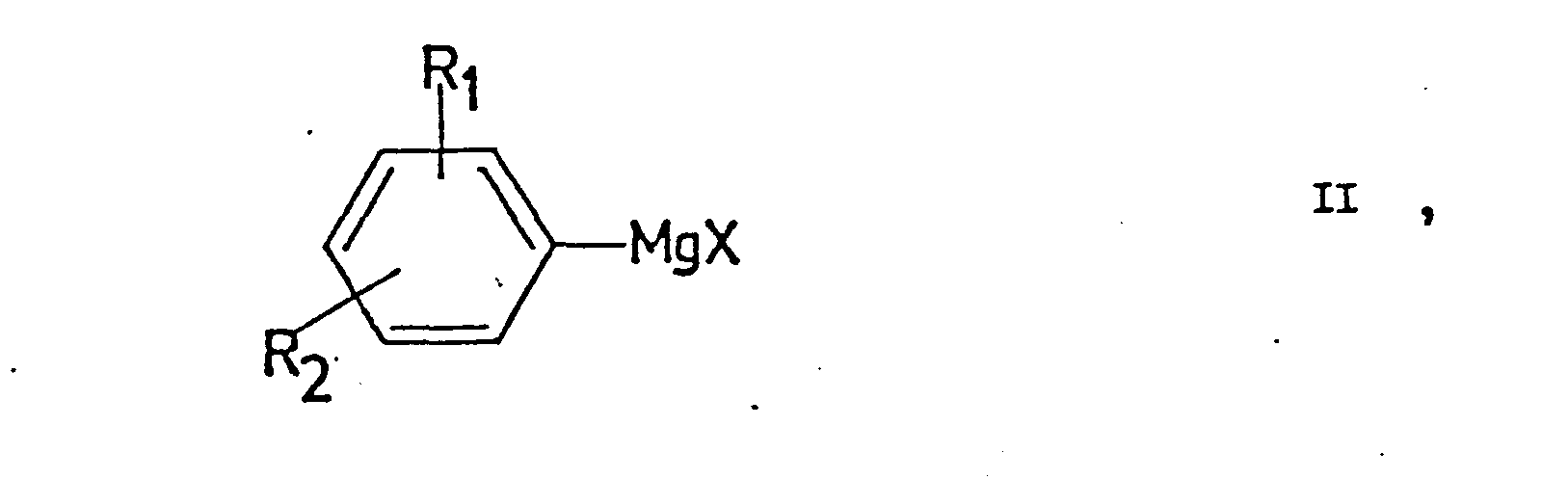
- R1 und R2 wie oben festgelegt sind und
- X für ein Halogenatom steht,
umgesetzt werden oder - b) 2,4-Dihydroxypropiophenon mit eine Phenylgruppe aufweisenden metallorganischen Verbindungen der allgemeinen Formel

- R1 und R2 wie oben festgelegt sind und
- M für ein Alkalimetallatom, vorzugsweise Lithium-, Natriu-oder Kaliumatom, steht
umgesetzt werden oder - c) 2,4-Dihydroxybenzophenone der allgemeinen Formel

- Die erfindungsgemäßen 4-[1-(Phenyl)-1-(hydroxy)--prop-1-yl]-resorcinderivate können auch durch andere bekannte Verfahren hergestellt werden.
- Die Ausgangsstoffe sind bekannt beziehungsweise können nach literaturbekannten Verfahren hergestellt werden. Die Ausgangsverbindungen der allgemeinen Formel (II) sind zum Beispiel erhältlich, indem man aus entsprechend substituierten Phenylhalogeniden in an sich bekannter Weise, zum Beispiel nach der Methode von M.S. Kharash u.a. (Grignard reactions of nonmetallic substances, Ed. Prentioe-Hall Inc. /1954/, S. 5-90), das Grignard-Reagens bereitet.
- Die metallorganischen Verbindungen der allgemeinen Formel (III) können zum Beispiel nach Houben-Weyl: Methoden der organischen Chemie, Bd. XIII/1, S. 134-159 (1970) hergestellt werden.
- Die Dihydroxybenzophenone der allgemeinen Formel (IV) sind zum Beispiel durch die Friedel-Crafts-Ketonsynthese oder die Fries-Reaktion erhältlich (G.A. Olah: Friedel-Crafts and related reaotions, Bd. III/1, Ed.: Intersaience Publishers, S. 1-63 u. 499-511 /1964/).
- Gemäß einer bevorzugten Ausführungsform der Variante a) des Verfahrens wird das 2,4-Dihydroxypropiophenon in einem wassrefreien organischen Lösungsmittel mit Arylmagnesiumhalogeniden, vorzugsweise Arylmagnesiumchloriden, der allgemeinen Formel (II) umgesetzt. Das Grignard-Reagens wird im mindestens Dreifachen der äquivalenten Menge eingesetzt. Die Umsetzung wird zweckmäßig in einem aprotischen Lösungsmittel vorge- nommen, geeignet sind zum Beispiel: aliphatische Ather, wie Diäthyläther, Di-n-propyläther, Diäthylenglykoldimethyln äther, alicyolische Ather, zum Beispiel Tetrahydrofuran und Dioxan, aliphatische oder aromatische Kohlenwasserstoffe, zum Beispiel Ligroin, Benzol, Toluol, Xylol oder Gemische der aufgeführten Lösungsmittel. Die Umsetzung wird bei Temperaturen zwischen -30 °C und dem Siedepunkt des Lösungsmittels, vorzugsweise zwischen -10 und 100 °C, vorgenommen.
- Nach Ablauf der Reaktion wird der Grignard-Komplex mit verdünnten Mineralsäuren, zum Beispiel Essigsäure, vorzugswaise jedoch mit wäßriger Ammoniumchloridlösung zersetzt und die entstandene Verbindung der allgemeinen Formel (I) isoliert. Das Produkt kann zum Beispiel durch Umkristallisieren gereinigt werden.
- Gemäß der Verfahrensvariante b) wird das 2,4-Dihydroxypropiophenon in Abwesenheit von Wasser mit den metallorganisohen Verbindungen der allgemeinen Formel (III), vorzugsweise dem entsprechend substituierten Phenyllithium, in einem inerten organischen Lösungsmittel umgesetzt. Die Verbindung der allgemeinen Formel (III) wird im mindestens Dreifachen der äquimolaren Menge verwendet. Als Lösungsmittel werden aprotische Lösungsmittel eingesetzt, zum Beispiel: "Ather, wie Tetrahydrofuran oder Dioxan, ferner Benzol, Toluol, Xylol, Hexan, Dimethylsulfoxid, Hexamethylphosphoramid oder Gemische der aufgeführten Lösungsmittel. Die Reaktionstemperatur kann innerhalb weiter Grenzen variieren und liegt zwischen -60 und 100 °C, vorzugsweise -40 und 80 °C. Das Reaktionsgemisch wird auf die unter a) bereits beschriebene Weise aufgearbeitet. Das Produkt kann zum Beispiel chromatographisch und/oder durch Umkristallisieren gereinigt werden.
- Zur Durchlührung der Verfahrensvariante c) werden die Benzophenone der allgemeinen Formel (IV) in einem wasser- freien organischen Lösungsmittel mit vorzugsweise Athyl- magnesiumbromid oder Athylmagnesiumjodid oder Athyllithium umgesetzt. Dabei wird die äthylgruppenhaltige metallorganische Verbindung im wenigstens Dreifachen der äquimolaren Menge eingesetzt. Als Zösungsmittel kommen bevorzugt Ather, aliphatische und aromatische Kohlenwasserstoffe oder Gemisone dieser Losungsmittel in Betracht. Die umsetzung wird bei Temperaturen zwischen -60 °C und dem Siedepunkt des Lösungsmittels, vorzugsweise zwischen -40 und 100 °C, vorgenommen.
- Der metallorganische Komplex wird mit einer verdünnten anorganischen oder organischen Säure, vorzugsweise jedoch mit wäßriger Ammoniumchloridlösung zersetzt und die gebildete Verbindung der allgemeinen Formel (I) isoliert. Das Produkt kann zum Beispiel durch Behndeln mit einen Lösungsmittel, durch Auskochen, Verreiben, Umfällen, Chromatographie, Umkristallisieren oder Kombinationen dieser Methoden gereinigt werden.
- Die Verfahrens varianten a) - o) werden vorzugsweise unter Schutzgas, zum Beispiel Stickstoff oder Argon, ausgeführt.
- Die Verbindungen der allgemeinen Formel (I) sind zur n Behandlung akuter Athanolintoxikation geeignet und für diesen Zweck ausgedehnt verwendbar. Die akute Alkoholintoxikation ist vor allem durch Eurphorie, allgemeine Stimuliertheit, Ataxie, Somnolenz und paralytische Zustände charakterisiert. Die Gefahren dieses toxischen, krankhaften Zustandes sind bekannt und nicht zu vernachlässigen. Die intoxierte Person gefährdet ihre Umgebung (z.B. Trunkenheit am Steuer) und sich selbst.
- Die akute Alkoholintoxikation ist für den ischämischen Gehirninfarkt ein bedeutender Risikofaktor (Hillbom, M. u.a.: Lancet 2, 1181 /1978/; Stroke 12, 422 /1981/). Für den alkoholintoxierten Zustand gibt es kein geeignetes Antidotum. Die durch Alkohol ausgelöste lokomotorisohe Hyperaktivität wird an Mäusen durch α-Methyl-para-thyrosin in einem Dosisbereich normalisiert, in dem die Verbindung die spontane lokomotorische Aktivität der Tiere beeinträchtigt (Carlsson, A. u.a.: Psychopharm. 26, 307 /1972/). Die narkotisierende Wirkung des Alkohols wird durch Stimulantien (Coffein, Amphetamin) verringert, die motorische Inkoordination (Ataxie) jedoch gleichzeitig prolongiert (Wallagsen, H. u.a.: Aotions of alcohol, Amsterdam, Elsevier, 1970; Rech, R.H. u.a.:
- Ann. N.Y. Acad. Soi. 28, 426, 1976; Todzy, I. u.a.t Psychopharm. 59, 143, 1978). Die alkoholische Intoxikation, die Narkose wird durch L-Cystein verkürzt (Sprince, H. u.a.: Agents and Actions 4, 125, 1974; Nagasawa, H.T. u.a.: Life Soi. 17, 707, 1975). L-Cyatein wurde zu den folgenden Versuchen über Schlaf unter Alkoholeinfluß als Referenzsubstanz verwendet.
- Zur Messung der Anderung der Zeitspanne der durch Athanol hervorgerufenen Narkose wurden 16 Stunden lang ausgehungerte, 160-180 g schwere Hann.-Wistar-Ratten beiderlei Geschlechts verwendet. Jede Gruppe bestand aus 10 Tieren, die mit entsprechenden Dosen der Versuohaverbindungen oral behandelt wurden. Eine Stunde nach der Behandlung wurde den Tieren in einer Dosis von 3,5 g/kg intraperitoneal Athanol appliziert. Die Schlafdauer wurde vom Ausfall des Aufcichtreflexes (righting Reflexes) bis zur sponbanen Korrektur der Köpenhalting gemessen. Für jede Gruppe wurde die durchschnittliche Schlafzeit, die Standardabweichung und das Ergebnis in Prozent der Kontrolle berechnet. Die Kontrolle erhielt Placebo und ebenfalls 3,5 g/kg Alkohol. Die Ergebnisse sind in der folgenden Tabelle 1 angegeben, in der x ±S.E. Durchschnittswert ± Standardabweichung bedeutet.
- Schlafdauer der Kontrolle: 99,6 ± 6,55 (x ±S.E.) min A = 4-[1-(3-Trifluormethyl-phenyl)-1-hydroxy-propyl]-resorcin
- Aus den Daten der Tabelle ist ersichtlich, daß die Verbindung der allgemeinen Formel (I) die auf das Zentralnervensystem ausgeübte deprimierende Wirkung bedeutend vermindert und die Dauer der Narkose dosisabhängig wesentlich verkürzt. Zum Erreichen der gleichen Wirkung ist von der Referenzsubstenz L-Cystein das 500fache erforderlich; in einer dem hundertsten Teil der Cystein-Dosis entsprechenden Dosis übertreffen die erfindungsgemäßen Verbindungen die Wirkung des L-Cysteins bei weitem.

- Infolge seiner stimulierenden Wirkung löst Alkohol neben der Deprimierang des Zentralnervensystems auch eine von der Dosis abhängige Hyperaktivität aus. Die von den erfindungsgemäßen Verbindungen auf die durch Alkohol ausgelöste Hyperaktivität ausgeübte Wirkung wurde an 16-18 g schweren BALB/o Mäusen beiderlei Geschlechts untersucht. Jede Gruppe bestand aus 15 Tieren. Die Testsubstanzen wurden in einer Dosis von 40 mg/kg oral verabreicht, eine Stunde vor der intraperitonealen Applikation von Placebo beziehungsweise 2 g/kg Athanol. Die Kontrolle wurde mit Placebo behandelt. Die lokomotorische Aktivität der Tiere wurde mit dem Motimeter Animex BSE 2 Stunden lang gemessen. Die für die Gesamtzahl der Bewegungen gemessenen Werte sind in der folgenden Tabelle 2 in Prozent der Kontrolle ausgedrückt.

- Aus der Tabelle 2 ist ersichtlich, daß die erfindungs- gemäße Verbindung die durch Athanol ausgelöste Hyperaktivität normalisiert; die lokomotorisohe Aktivität der mit Teatverbindung + Alkohol behandelten Tiere weicht nicht von der mit Placebo behandelten Kontrolle ab. Die spontane lokomotorische Aktivität der Tiere wird durch die erfindungsgemäßen Verbindung nicht verändert.
- Die von den erfindungsgemäßen Verbindungen auf die durch Alkohol verursachte Ataxie und auf die Änderung des Muskeltonus ausgeübte Wirkung wurde am Drehstab untersucht. Trainierte und ausgewählte BALB/c-Mäuse beiderlei Geschlechts (Gewicht 16-18 g) wurden mit 40 mg/kg der Testverbindungen oral behandelt, eine Stunde vor der intraperitonealen Applikation von 2,5 g/kg Alkohol. Die Zeit, die die Tiere auf dem Drehstab zu verbleiben vermochten, wurde 60, 90 und 120 Minuten nach der Verabreichung des Alkohols gemessen. Die Tiere, deren Koordination intakt war, blieben 120 Sekunden auf dem Drehstab. Jede Behandlung wurde an einer aus 10 Tieren bestehenden Gruppe vorgenommen. Die Ergebnisse sind in der folgenden Tabelle 3 zusammengestellt.

- Aus der Tabelle 3 jst ersichtlich, daß die erfindungsgemäßen Verbindungen, an sich verabreicht, in einer von 40 mg/kg die motorische Koordination der Tiere nicht beeinflussen, gleichzeitig jedoch die durch Alkohol ausgelöste Ataxie bedeutend verringern und die auf das Zentralnervensystem ausgeübte deprimierende Wirkung des Alkohols kompensieren.
- Durch Untersuchungen auf die im folgenden angegebene Weise wurde festgestellt, daß die Verbindungen keinerlei sonstige Wirkungen auf das Zentralnervensystem ausüben:
- Elektrosohock (Swinyard, E.A., Brown, W.C., Goodman, L.S.: J. Pharmacol. Exp. Ther. 106, 319 /1952/), Metrazolkrampf (Everett, G.M., Richards, R.K.: J. Pharmaool. Exp. Ther. 81, 402-/1944/), Thiosemioarbazidkrampf (Da Vanzo, J.P., Greig, M.E., Cormin, M.A.: Amer. J. Physiol. 201, 833 /1961/), Stryohninkrampf (Kerley, T.L., Richards, A,G., Begley, R.W., Abreu, B.B., Wesver, L.C.: J. Pharmacol. Exp. Ther. 132, 360 /1961/), Nikotinkrampf (Stone, C.A., Mecklenburg, K.L., Torhans, M.L.: Arch. Int.Pharmacodyn. 117, 419 /1958/), Drehstab (Kinnard, W.J., Carr, C.J.: J, Pharmacol. Exp. Ther. 121, 354 /1957/), Physostigminletalität (Nose, T. und Kojima, M.: Europ. J. Pharmacol. 10, 83 /1970/), yohimbinpotenzierende Wirkung (Quinton, R.M.: Brit. J. Pharmacol. 21, 51 /1963/), schmerzstillende Wirkung (Bianchi, C., Franceschini, J.: Brit. J. Pharm. Chemother. 9, 280 /1954/).
- Die akute Toxizität der erfindungsgemäßen Verbindungen wurde an 160-180 g schweren männlichen Hann.-Wistar-Ratten bestimmt. Aus dem Prozentsatz der verendeten Tiere wurde mittels Probitanalyse berechnet, welche Dosis 50 %iga Letalität verursacht. Die Tiere wurden 14 Tage lang beobachtet. Die LD50-werte sind in der Tabelle 1 angegeben.
- Die Ergebnisse zusammenfassend kann man sagen, daß die erfindungsgemäßen Verbindungen die durch Alkohol alterierten Betragensformen in günstiger Richtung beeinflussen. Die von Alkohol auf das Zentralnervensystem ausgeübte stimulierende und deprimierende Wirkung wird kompensiert, die Ausnüchterungszeit wird verkürzt; die Toxizität der Verbindungen ist niedrig, ihre therapeutische Breite groß.
- Die erfindungsgemäßen Verbindungen können zu Arzneimittelpräparaten zubereitet werden. Die Präparate können oral, rektal und/oder parenteral verabreicht werden. Zur oralen Darreichung können Tabletten, Dragees oder Kapseln hergestellt werden. Bei der Herstellung von oral verabreichbaren Formen werden als Streckmittel zum Beispiel Milchzucker oder Stärke verwendet. Als Binde- und Granuliermittel kommen zum Beispiel Gelatine, Carboxymethylcellulose-natrium, Methyloellulose, Polyvinylpyrrolidon oder Stärkekleister in Frage. Als Sprengmittel werden in erster Linie Kartoffelstärke oder mikrokristalline Cellulose zugesetzt, jedoch können beispielsweise auch Ultraamylopektin oder Formaldehydcasein verwendet werden. Als Antihaftmittel und Gleitmittel kommen z. B. Talk, kolloidale Kieselsäure, Stearin, Ca- und Mg-Stearat in Frage.
- Die Tabletten können zum Beispiel durch Naßgranulieren und anschließendes Pressen hergestellt werden. Das Gemisch aus Wirkstoff und Füllstoffen sowie gegebenenfalls ein Teil des Sprengmittels werden mit der wäßrigen, alkoholischen oder wäßrig-alkoholischen Lösung der Bindemittel in einer geeigneten Vorrichtung granuliert, und das Granulat wird getrocknet. Zu dem trockenen Granulat werden der Rest des Sprengmittels, ferner die Antihaftmittel und das Gleitmittel gegeben, und das Gemisch wird zu Tabletten gepreßt. Gegebenenfalls können die Tabletten zur Erleichterung der Dosierung mit Teilungsmarkierungen versehen werden. Die Tabletten können auch unmittelbar durch Pressen eines Gemisches aus dem Wirkstoff und geeigneten Hilfsstoffen hergestellt werden.
- Die fabletten können gegebenenfalls unter Verwendung der in der Arzneimittelindustrie üblichen Schutz-, Geschmacks- und Farbstoffe, zum Beispiel Zucker, Cellubsederivate, wie Methyl- oder Athylcellulose oder Carboxymethylcellulose-natrium, Polyvinylpyrrolidon, Calciumphosphat, Calciumcarbonat, Lebensmittelfarbstoffe, Lebensmittelfarblacke, Aromastoffe und Eisenoxydpigmente, auf die übliche Weise dragiert werden.
- Zur Herstellung von Kapseln wird das Gemisch aus Wirkstoff und Füllstoffen in Kapseln gefüllt.
- Zur rektalen Anwendung werden Suppositorien hergestellt. Diese enthalten außer dem Wirkstoff eine Trägermasse, das sog. Adeps pro suppositori. Als solches kommen Pflanzenfette, zum Beispiel gehärtete Pflanzenöle, die Triglyoerida von Fettsäuren mit 12-18 Kohlenstoffatomen, vorzugsweise die Trägerstoffe der Markenbezeichnung Witepsol®, in Betracht. Der Wirkstoff wird in der geschmolzenen Trägermasse homogen verteilt und das erhaltene Gemisch zu Suppositorien vergossen.
- Zur parenteralen Verabreichung werden Präparate in Injektionslösur sungsform hergetellt. Dazu werden die Wirkstoffe, gegebenenfalls in Gegenwart von Lösungsvermittlern,wie Polyoayäthylensobitmonolaurat, -monooleat oder -monostearat (Tween 2®, Tween 60® , Tween 80®, in destilliertem Wasser und/oder unterschiedlichen organischen Lösungsmitteln, zum Beispiel Glykoläthern, gelöst. Die Injektionslösungen können ferner verschiedene Hilfsstoffe, zum Beispiel Konservierungsatoffe, wie Benealkohol, p-Oxybenzoesäuremethyl- oder -propylester, Benzalkoniumchlorid oder Phenylmercuriborat, zum Binden von Metallspuren Komplexbildner, Athylendiamin-tetraessigsäure, Puffersubstanzen oder Stoffe zum Einstellen des pH-Wertes sowie gegebenenfalls Lokalanästhetika,wie Lidocain,enthalten. Die Injektionslösungen werden vor dem Abfüllen filtriert und, nachdem sie in Ampullen gefüllt wurden, sterilisiert.
- Die Tagesdosis beträgt, abhängend vom Zustand des Kranken, 0,1-300 mg/kg, vorzugsweise 2,0-160 mg/kg, und wird zweckmäßig in kleineren Einzeldosen verabreicht.
- Die Erfindung wird an Hand der folgenden Beispiele näher erläutert.
- Zu dem aus 14,6 g Magnesiumspänen und 135 g 3-2 trifluormethyl-brombenzol in 330 ml Tetrahydrofuran bereiteten Grignard-Reagens wird bei 50 C tropfenweise die Lösung von 16,6 g 2,4-Dihydroxypropiophenon in 83 ml Tetrahydrofuran gegeben und das Gemisch bei der angegebenen Temperatur 30 Minuten lang gerührt. Nach dem Abkühlen wird das Gemisch unter Rühren in kalte, 20 %ige wäßrige Ammoniumchloridlösung eingegossen. Die Phasen werden voneinander getrennt, und die wäßrige Phase wird mit Tetrahydrofuran extrahiert. Die vereinigten organischen Phasen werden mit gesättigter wäßriger Kochsalzlösung gewaschen, über wasserfreiem Magnesiumsulfat getrocknet und im Vakuum vom Lösungsmittel befreit. Der Rückstand wird in Methanol gelöst, die Lösung mit Aktivkohle geklärt und nach dem Filtrieren unter vermindertem Druck eingedampft. Notwendigenfalls wird das Produkt durch Kristallisieren aus einem Athylacetat/n-Hexan-Gemisch gereinigt. Kan erhält 26,6 g der Titelverbindung, die bei 137-138 °C schmilzt. Elementaranalyse für die Summenformel C16H15F3O3 berechnet, %: C 61,53 H 4,84 F 18,25 gefunden, %: C 61,71 H-4,97 F 18,51
- Zu dem aus 18,9 g n-Butyllithium und 65,2 g 2-(Trifluormethyl)-brombenzol in 480 ml wasserfreiem Äther hergestellten 2-Trifluormethylphenyllithium wird unter Rühren bei einer Temperatur zwischen 0 und -5 °C tropfenweise die Lösung von 8,3 g 2,4-Dihydroxypropiophenon in 85 ml wasserfreiem Äther gegeben. Das Reaktionsgemisch wird bei Raumtemperatur 2 Stunden lang gerührt, dann abgekühlt und in eiskalte 10 % ige wäßrige Ammoniumchloridlösung gegossen. Die Phasen werden voneinander getrennt,und die wäßrige Phase wird mit Äther extrahiert. Die organische Phase wird mit Wasser neutral gewaschen, über wasserfreiem Magnesiumsulfat getrocknet, mit Aktivkohle geklärt, filtriert und das Lösungsmittel unter vermindertem Druck abdestilliert. Man erhält 15 g eines öligen Rohproduktes. Dieses wird mit Dichlormethan als Eluiermittel an einer Silikagelsäule ohromatographiert. Das Dichlormethan wird unter vermindertem Druck abdestilliert und der feste Rückstand aus einem n-Hexan/Athylacetat-Gemisoh umkristallisiert. Man erhält 6,9 g der Titelverbindung, die bei 143-144 °C schmilzt.
- Elementaranalyse für die Summenformel C 16 H 15 F 3 0 3 berechnet, %: C 61,53 H 4,84 F 18,25
- gefunden, %: C 61,75 H 5,02 ? 18,33.
- Aus 4,8 g Magnesiumspänen und 31,2 g Athyljodid wird in 80 ml wasserfreiem Ather Athylmagnesiumjodid bereitet. Zu der gekühlten Lösung der Grignard-Verbindung wird tropfenweise die Lösung von 7,9 g 4-Fluor-2',4'-di- hydroxy-benzophenon in 80 ml wasserfreiem Ather gegeben, wobei darauf zu achten ist, daß die Temperatur nicht über -5 °C ansteigt. Das Reaktionsgemisch wird 30 Minuten lang bei 0 °C, dann eine Stunde lang unter Kochen am Rückfluß gerührt und nach dem Abkühlen in eine eiskalte Ammoniumchloridlösung gegossen. Die ätherische Phase wird abgetrennt und die wäßrige Phase mit Äther extrahiert. Die organischen Phasen werden vereinigt, mit Wasser neutral gewaschen, über wasserfreiem Magnesiumsulfat getrocknet und nach dem Filtrieren unter vermindertem Druck vom Lösungsmittel befreit. Der feste Rückstand wird aus einem n-Hexan/Athylacetat-Gemisch kristallisiert. Man erhält 5,1 g der Titelverbindung, die bei 126 °C schmilzt. Elementaranalyse für die Summenformel C15H15FO3 berechnet, %: C 68,69 H 5,76 F 7,24 gefunden, %: C 68,85 H 5,93 F 7,44.
- Zu der auf -10 °C gekühlten Lösung von aus 29,4 g Athylbromid und 3,7 g metallischem Lithium unter Argon- atmosphäre in 330 ml wasserfreiem Äther bereitetem Athyllithium wird tropfenweise die Lösung von 11 g 2-Methoxy-2',4'-dihydroxy-benzophenon in 60 ml wasserfreiem Tetrahydrofuran gegeben, wobei darauf zu achten ist, daß die Temperatur nicht über -5 °C ansteigt. Das Reaktionsgemisch wird 30 Minuten lang bei 0 °C und dann 2 Stunden lang bei Raumtemperatur gerührt. Das Gemisch wird unter Kühlen in 10 %ige wäßrige Ammoniumchloridlösung gegossen, die organische Phase abgetrennt, und die wäßrige Phase mit Ather extrahiert. Die organischen Phasen werden vereinigt, mit Wasser neutral gewaschen, über wasserfreiem Magnesiumsulfat getrocknet und nach Klären mit Aktivkohle im Vakuum vom Lösungsmittel be- freit. Der feste Rückstand wird aus einem n-Hexan/Athylaoetat-Gemisch umkristallisiert. Man erhält 8,3 g der Titelverbindung, die bei 141-142 °C schmilzt. Elementaranalyse für die Summenformel C16H18O4 berechnet, %: C 70,05 H 6,61 gefunden, %: C 70,21 H 6,76
- Durch entsprechende Wahl der Ausgangsvorbindungen können auf die in den Beispielen beschriebene Weise die folgenden Verbindungen hergestellt werden.
- 4-[1-(4-Chlorphenyl)-1-hydroxy-propyl]-resorcin Sohmelzpunkt: 88 °C
- Elementaranalyse für die Summenformel C15H15ClO3 berechnet, %: C 64,63 H 5,42 Cl 12,72
- gefunden, %: C 64,42 H 5,54 Cl 12,88
- 4-[1-(4-Trifluormethyl-phenyl)-1-hydroxy-propyl]-resorcin Elementaranalyse für die Summenformel C16H15F3O3 bereohnet, %: C 61,53 H 4,84 F 18,25
- gefunden, %: C 61,63 H 4,78 F 18
- 4-[1-(3-Chlorphenyl)-1-hydroxy-propyl-resorcin Schmelzpunkt: 144-145 °C
- Elementaranalyse für die Summenformel C15H15ClO3 berechnet, %: C 64,63 H 5,42 Cl 12,72
- gefunden, %: C 64,51 H 5,60 Cl 12,95
- 4-[1-(2,5-Dimethylphenyl)-1-hydroxy-propyl]-resorcin-Schmelzpunkt: 110 °C
- Elementaranalyse für C17H20O3
- berechnet, %: C 74,97 H 7,40
- gefunden, %: C 75,10 H 7,33
- 4-[1-(4-Trifluormethyl-phenyl)-1-hydroxy-propyl]-resorcin Schmelzpunkt: 141-142 °C
- Elementaranalyse für die Summenformel O16H15F3O3 berechnet, %: C 61,53 H 4,84 F 18,25
- gefunden, %: C 61,58 H 4,90 F 18,21
- Aus den erfindungsgemäßen Verbindungen können zum Beispiel die folgenden Arzneimittelpräparste hergestellt werden.
- Zusammensetzung einer Tablette:

- Durch Naßgranulieren und Pressen werden aus den angegebenen Stoffen Tabletten von 400 mg Gewicht hergestellt.
- Wirkstoff: 4-[1-(3-Trifluormethyl-phenyl)-1-hydroxy-propyl]-resorcin
- Die auf die beschriebene Weise erhaltenen Tabletten werden in an sich bekannter Weise mit einem aus Zucker und Talk bestehenden Überzug versehen und dann mit einem Gemisch aus Bienenwachs und Carnaubawachs poliert. Gewicht eines Dragees: 500,0 mg
-

-

- Gewicht eines Suppositoriums: 2000 mg
- Wirkstoff: 4-[1-(3-Trifluormethyl-phenyl)-1-hydroxy-propyl]-- resorcin
-


- Das Nipagin®und die Citronensäure werden in 20 ml destilliertem Wasser gelöst. Zu der Lösung gibt man in kleinen Portionen, unter intensivem Rühren das Carbopol® und läßt die Lösung dann 10-12 Stunden stehen. Anschließend werden die mit 1 ml destilliertem Wasser bereitete Lösung des Natriumhydroxyds, dann die wäßrige Lösung des Sorbits und schließlich die äthanolische Lösung des Himbeeraromas zugegeben. Zu der auf diese Weise bereiteten Trägersubstanz gibt man in kleinen Portionen den Wirkstoff und homogenisiert das Ganze mit einem Mixer. Die Suspension wird mit destilliertem Wasser auf 100 ml aufgefüllt und in einer Kolloidmühle homogenisiert.
- Wirkstoff: 4-[1-(3-Trifluormethyl-phenyl)-1-hydroxy-propyl]-resorcin
Claims (7)


umsetzt oder

umsetzt oder

Priority Applications (1)
| Application Number | Priority Date | Filing Date | Title |
|---|---|---|---|
| AT83113174T ATE56696T1 (de) | 1982-12-28 | 1983-12-28 | 4-(1-(phenyl)-1-(hydroxy)-prop-1-yl)resorcinderivate, verfahren zu ihrer herstellung und diese verbindungen enthaltende arzneimittel. |
Applications Claiming Priority (2)
| Application Number | Priority Date | Filing Date | Title |
|---|---|---|---|
| HU824189A HU188239B (en) | 1982-12-28 | 1982-12-28 | Process for the production of new resorcinol-derivatives and of therapeutic preparations containing them |
| HU418982 | 1982-12-28 |
Publications (3)
| Publication Number | Publication Date |
|---|---|
| EP0112587A2 true EP0112587A2 (de) | 1984-07-04 |
| EP0112587A3 EP0112587A3 (en) | 1986-03-12 |
| EP0112587B1 EP0112587B1 (de) | 1990-09-19 |
Family
ID=10967263
Family Applications (1)
| Application Number | Title | Priority Date | Filing Date |
|---|---|---|---|
| EP83113174A Expired - Lifetime EP0112587B1 (de) | 1982-12-28 | 1983-12-28 | 4-(1-(Phenyl)-1-(hydroxy)-prop-1-yl)-resorcinderivate, Verfahren zu ihrer Herstellung und diese Verbindungen enthaltende Arzneimittel |
Country Status (14)
| Country | Link |
|---|---|
| US (1) | US4510338A (de) |
| EP (1) | EP0112587B1 (de) |
| JP (1) | JPS59134741A (de) |
| AT (1) | ATE56696T1 (de) |
| AU (1) | AU558203B2 (de) |
| CA (1) | CA1198741A (de) |
| DE (1) | DE3381892D1 (de) |
| DK (1) | DK159769C (de) |
| ES (2) | ES8604083A1 (de) |
| FI (1) | FI77840C (de) |
| GR (1) | GR79147B (de) |
| HU (1) | HU188239B (de) |
| IL (1) | IL70557A (de) |
| ZA (1) | ZA839617B (de) |
Cited By (3)
| Publication number | Priority date | Publication date | Assignee | Title |
|---|---|---|---|---|
| AU618737B2 (en) * | 1987-06-09 | 1992-01-09 | Takeda Chemical Industries Ltd. | Phenol derivatives, their production and use |
| WO1998039279A1 (en) * | 1997-03-06 | 1998-09-11 | Lg Chemical Ltd. | Novel 1,3-diphenylpropane derivatives having inhibitory activity against tyrosinase and process for preparation thereof |
| KR19990069212A (ko) * | 1998-02-05 | 1999-09-06 | 성재갑 | 타이로시나제 저해활성을 갖는 신규 폴리하이드록시-디페닐메탄유도체 및 그의 제조방법 |
Families Citing this family (2)
| Publication number | Priority date | Publication date | Assignee | Title |
|---|---|---|---|---|
| US7233316B2 (en) | 2003-05-01 | 2007-06-19 | Thomson Licensing | Multimedia user interface |
| WO2023106973A1 (ru) * | 2021-12-10 | 2023-06-15 | Общество С Ограниченной Ответственностью "Валента-Интеллект" | Новые гепатопротекторные средства |
Family Cites Families (5)
| Publication number | Priority date | Publication date | Assignee | Title |
|---|---|---|---|---|
| US2247404A (en) * | 1939-03-24 | 1941-07-01 | Dow Chemical Co | Aralkyl polyhydric phenol |
| US2719866A (en) * | 1951-08-04 | 1955-10-04 | Lilly Co Eli | Substituted resorcinols |
| FR2121446B1 (de) * | 1971-01-14 | 1974-03-22 | Pechiney Ugine Kuhlmann | |
| DE2260138A1 (de) * | 1972-12-08 | 1974-06-12 | Hoechst Ag | Stoffwechselwirksame bisphenolalkanderivate |
| US4094908A (en) * | 1973-08-15 | 1978-06-13 | Richter Gedeon Vegyeszeti Gyar Rt. | Alpha-substituted benzhydrol derivatives |
-
1982
- 1982-12-28 HU HU824189A patent/HU188239B/hu not_active IP Right Cessation
-
1983
- 1983-12-23 CA CA000444247A patent/CA1198741A/en not_active Expired
- 1983-12-23 AU AU22912/83A patent/AU558203B2/en not_active Ceased
- 1983-12-27 ES ES528459A patent/ES8604083A1/es not_active Expired
- 1983-12-27 JP JP58244949A patent/JPS59134741A/ja active Granted
- 1983-12-27 ZA ZA839617A patent/ZA839617B/xx unknown
- 1983-12-27 US US06/565,839 patent/US4510338A/en not_active Expired - Fee Related
- 1983-12-27 FI FI834797A patent/FI77840C/fi not_active IP Right Cessation
- 1983-12-27 IL IL70557A patent/IL70557A/xx unknown
- 1983-12-27 DK DK601783A patent/DK159769C/da not_active IP Right Cessation
- 1983-12-28 DE DE8383113174T patent/DE3381892D1/de not_active Expired - Lifetime
- 1983-12-28 EP EP83113174A patent/EP0112587B1/de not_active Expired - Lifetime
- 1983-12-28 GR GR73361A patent/GR79147B/el unknown
- 1983-12-28 AT AT83113174T patent/ATE56696T1/de not_active IP Right Cessation
-
1985
- 1985-06-01 ES ES543799A patent/ES543799A0/es active Granted
Cited By (4)
| Publication number | Priority date | Publication date | Assignee | Title |
|---|---|---|---|---|
| AU618737B2 (en) * | 1987-06-09 | 1992-01-09 | Takeda Chemical Industries Ltd. | Phenol derivatives, their production and use |
| WO1998039279A1 (en) * | 1997-03-06 | 1998-09-11 | Lg Chemical Ltd. | Novel 1,3-diphenylpropane derivatives having inhibitory activity against tyrosinase and process for preparation thereof |
| US6093836A (en) * | 1997-03-06 | 2000-07-25 | Lg Chemical Ltd. | 1,3-diphenylpropane derivatives having inhibitory activity against tyrosinase and process for preparation thereof |
| KR19990069212A (ko) * | 1998-02-05 | 1999-09-06 | 성재갑 | 타이로시나제 저해활성을 갖는 신규 폴리하이드록시-디페닐메탄유도체 및 그의 제조방법 |
Also Published As
| Publication number | Publication date |
|---|---|
| DK601783D0 (da) | 1983-12-27 |
| FI834797A0 (fi) | 1983-12-27 |
| DK159769C (da) | 1991-04-22 |
| AU558203B2 (en) | 1987-01-22 |
| FI77840B (fi) | 1989-01-31 |
| ES8603802A1 (es) | 1986-01-01 |
| DK159769B (da) | 1990-12-03 |
| HUT34945A (en) | 1985-05-28 |
| DE3381892D1 (de) | 1990-10-25 |
| ES528459A0 (es) | 1986-01-16 |
| CA1198741A (en) | 1985-12-31 |
| IL70557A0 (en) | 1984-03-30 |
| EP0112587B1 (de) | 1990-09-19 |
| DK601783A (da) | 1984-06-29 |
| ES543799A0 (es) | 1986-01-01 |
| FI834797L (fi) | 1984-06-29 |
| FI77840C (fi) | 1989-05-10 |
| AU2291283A (en) | 1984-07-05 |
| GR79147B (de) | 1984-10-02 |
| JPH0237900B2 (de) | 1990-08-28 |
| ZA839617B (en) | 1984-08-29 |
| IL70557A (en) | 1987-11-30 |
| HU188239B (en) | 1986-03-28 |
| EP0112587A3 (en) | 1986-03-12 |
| ES8604083A1 (es) | 1986-01-16 |
| US4510338A (en) | 1985-04-09 |
| JPS59134741A (ja) | 1984-08-02 |
| ATE56696T1 (de) | 1990-10-15 |
Similar Documents
| Publication | Publication Date | Title |
|---|---|---|
| DE60030574T2 (de) | Fünfgliedrige derivate von heterozyklen und ihre verwendung als monoaminoxidase-inhibitoren | |
| DE3785312T2 (de) | Substituierte tetrahydropyridinoxime und ihre verwendung als cholinergische heilmittel. | |
| DE69623631T2 (de) | 4-aryl-1-phenylalkyl-1,2,3,6-tetrahydropyridine als neurothophe und neuroprotektive wirkstoffe | |
| DE69332559T2 (de) | 2,3,4,5-tetrahydro-1h-3-benzazepinen mit anti-psychotisch wirkung, und synthese von alfa-substituierten-arylacetamiden | |
| EP0054168A1 (de) | 1,1,2-Triphenyl-but-1-en-Derivate sowie Verfahren zu ihrer Herstellung und ihre Verwendung als Arzneimittel | |
| DE3881439T2 (de) | Tetrahydropyridin-oxime, verfahren zu ihrer herstellung und ihre verwendung als cholinergische mittel. | |
| DE68913762T2 (de) | Diarylverbindungen als antiatherosklerotische Mittel. | |
| DE69014008T2 (de) | 1-Oxa-2-oxo-3,8-diazaspiro[4,5]decanderivate, Verfahren zu ihrer Herstellung und diese enthaltende pharmazeutische Zubereitungen. | |
| DE2411382B2 (de) | 2-Tetrahydrofurfuryl-6,7-benzomorphane, Verfahren zur Herstellung und deren Verwendung | |
| DE2163911C3 (de) | 2-Aminomethyl-phenole, Verfahren zur Herstellung derselben und diese enthaltende Arzneimittel | |
| DD202715A5 (de) | Verfahren zur herstellung von substituierten derivaten des pyridazin | |
| EP0115080B1 (de) | (Omega-(Diäthylamino)-alkoxy)-alpha-(äthyl)-benzhydrolderivate, ihre Säureadditionssalze und quaternären Salze, Verfahren zu ihrer Herstellung und diese Verbindungen enthaltende Arzneimittel | |
| EP0243904A1 (de) | Gegebenenfalls substituierte, 1-(2'-[bis-(Phenyl)-methoxy]-äthyl)-4-(3'-[bis-(phenyl)-methoxy]-propyl)-piperazine, Verfahren zu ihrer Herstellung und diese enthaltende Arzneimittel | |
| DE69614407T2 (de) | Pharmazeutische zusammensetzungen | |
| CH626344A5 (de) | ||
| EP0114410B1 (de) | Substituierte alpha-(Äthyl)-alpha-(phenyl)-(omega-(dialkylamino)-alkoxy)-benzylalkohole, ihre Säureadditionssalze und quaternären Salze, Verfahren zu ihrer Herstellung sowie diese Verbindungen enthaltende Arzneimittel | |
| DE3402060A1 (de) | Substituierte 5,11-dihydro-6h-dibenz(b,e)azepin-6-one, verfahren zu ihrer herstellung und diese verbindungen enthaltende arzneimittel | |
| DE102005028845A1 (de) | Substituierte Heterocyclen, ihre Verwendung als Medikament sowie enthaltende pharmazeutische Zubereitungen | |
| EP0112587B1 (de) | 4-(1-(Phenyl)-1-(hydroxy)-prop-1-yl)-resorcinderivate, Verfahren zu ihrer Herstellung und diese Verbindungen enthaltende Arzneimittel | |
| EP0029247A1 (de) | Alkenyl-thienyl-alkancarbonsäuren und ihre Derivate, Verfahren zu deren Herstellung und diese enthaltende Arzneimittel | |
| DE2724994A1 (de) | 5,6-cis- und 5,6-trans-10,19-dihydrovitamin d-derivate, verfahren zu deren herstellung und diese enthaltende arzneimittel | |
| DE69608891T2 (de) | Tetraline mit einem phenylsubstituenten am aromatischen ring und ihre verwendung in der behandlung von epilepsie, schlaganfall und gehirn- oder rückenmarkstrauma | |
| DE3629929A1 (de) | Neue sulfonamido-aethylverbindungen, diese verbindungen enthaltende arzneimittel und verfahren zu ihrer herstellung | |
| EP0112588B1 (de) | 4-Hydroxy-alpha-äthyl-benzhydrole, Verfahren zu ihrer Herstellung und diese Verbindungen enthaltende Arzneimittel | |
| DE69705429T2 (de) | 1-phenylalkyl-1,2,3,6-tetrahydropyridine zur behandlung von alzheimerkrankheit |
Legal Events
| Date | Code | Title | Description |
|---|---|---|---|
| PUAI | Public reference made under article 153(3) epc to a published international application that has entered the european phase |
Free format text: ORIGINAL CODE: 0009012 |
|
| AK | Designated contracting states |
Designated state(s): AT BE CH DE FR GB IT LI LU NL SE |
|
| 17P | Request for examination filed |
Effective date: 19841228 |
|
| PUAL | Search report despatched |
Free format text: ORIGINAL CODE: 0009013 |
|
| AK | Designated contracting states |
Kind code of ref document: A3 Designated state(s): AT BE CH DE FR GB IT LI LU NL SE |
|
| 17Q | First examination report despatched |
Effective date: 19890724 |
|
| GRAA | (expected) grant |
Free format text: ORIGINAL CODE: 0009210 |
|
| AK | Designated contracting states |
Kind code of ref document: B1 Designated state(s): AT BE CH DE FR GB IT LI LU NL SE |
|
| REF | Corresponds to: |
Ref document number: 56696 Country of ref document: AT Date of ref document: 19901015 Kind code of ref document: T |
|
| GBT | Gb: translation of ep patent filed (gb section 77(6)(a)/1977) | ||
| REF | Corresponds to: |
Ref document number: 3381892 Country of ref document: DE Date of ref document: 19901025 |
|
| ET | Fr: translation filed | ||
| ITF | It: translation for a ep patent filed | ||
| ITTA | It: last paid annual fee | ||
| PLBE | No opposition filed within time limit |
Free format text: ORIGINAL CODE: 0009261 |
|
| STAA | Information on the status of an ep patent application or granted ep patent |
Free format text: STATUS: NO OPPOSITION FILED WITHIN TIME LIMIT |
|
| 26N | No opposition filed | ||
| PGFP | Annual fee paid to national office [announced via postgrant information from national office to epo] |
Ref country code: GB Payment date: 19921215 Year of fee payment: 10 Ref country code: AT Payment date: 19921215 Year of fee payment: 10 |
|
| PGFP | Annual fee paid to national office [announced via postgrant information from national office to epo] |
Ref country code: LU Payment date: 19921222 Year of fee payment: 10 Ref country code: CH Payment date: 19921222 Year of fee payment: 10 |
|
| PGFP | Annual fee paid to national office [announced via postgrant information from national office to epo] |
Ref country code: SE Payment date: 19921223 Year of fee payment: 10 |
|
| PGFP | Annual fee paid to national office [announced via postgrant information from national office to epo] |
Ref country code: FR Payment date: 19921224 Year of fee payment: 10 |
|
| PGFP | Annual fee paid to national office [announced via postgrant information from national office to epo] |
Ref country code: BE Payment date: 19921230 Year of fee payment: 10 |
|
| PGFP | Annual fee paid to national office [announced via postgrant information from national office to epo] |
Ref country code: NL Payment date: 19921231 Year of fee payment: 10 |
|
| PGFP | Annual fee paid to national office [announced via postgrant information from national office to epo] |
Ref country code: DE Payment date: 19930226 Year of fee payment: 10 |
|
| EPTA | Lu: last paid annual fee | ||
| PG25 | Lapsed in a contracting state [announced via postgrant information from national office to epo] |
Ref country code: LU Free format text: LAPSE BECAUSE OF NON-PAYMENT OF DUE FEES Effective date: 19931228 Ref country code: GB Effective date: 19931228 Ref country code: AT Effective date: 19931228 |
|
| PG25 | Lapsed in a contracting state [announced via postgrant information from national office to epo] |
Ref country code: SE Effective date: 19931229 |
|
| PG25 | Lapsed in a contracting state [announced via postgrant information from national office to epo] |
Ref country code: LI Effective date: 19931231 Ref country code: CH Effective date: 19931231 Ref country code: BE Effective date: 19931231 |
|
| BERE | Be: lapsed |
Owner name: RICHTER GEDEON VEGYESZETI GYAR R.T. Effective date: 19931231 |
|
| PG25 | Lapsed in a contracting state [announced via postgrant information from national office to epo] |
Ref country code: NL Effective date: 19940701 |
|
| NLV4 | Nl: lapsed or anulled due to non-payment of the annual fee | ||
| GBPC | Gb: european patent ceased through non-payment of renewal fee |
Effective date: 19931228 |
|
| PG25 | Lapsed in a contracting state [announced via postgrant information from national office to epo] |
Ref country code: FR Effective date: 19940831 |
|
| REG | Reference to a national code |
Ref country code: CH Ref legal event code: PL |
|
| PG25 | Lapsed in a contracting state [announced via postgrant information from national office to epo] |
Ref country code: DE Effective date: 19940901 |
|
| REG | Reference to a national code |
Ref country code: FR Ref legal event code: ST |
|
| EUG | Se: european patent has lapsed |
Ref document number: 83113174.3 Effective date: 19940710 |