EP0119095A2 - Vorrichtung und Verfahren zum Metallisieren der inneren Oberflächen von Metallkörpern wie etwa Rohre - Google Patents
Vorrichtung und Verfahren zum Metallisieren der inneren Oberflächen von Metallkörpern wie etwa Rohre Download PDFInfo
- Publication number
- EP0119095A2 EP0119095A2 EP84301690A EP84301690A EP0119095A2 EP 0119095 A2 EP0119095 A2 EP 0119095A2 EP 84301690 A EP84301690 A EP 84301690A EP 84301690 A EP84301690 A EP 84301690A EP 0119095 A2 EP0119095 A2 EP 0119095A2
- Authority
- EP
- European Patent Office
- Prior art keywords
- metalizing
- pipe
- tube
- heat
- fluidized
- Prior art date
- Legal status (The legal status is an assumption and is not a legal conclusion. Google has not performed a legal analysis and makes no representation as to the accuracy of the status listed.)
- Withdrawn
Links
Images
Classifications
-
- C—CHEMISTRY; METALLURGY
- C23—COATING METALLIC MATERIAL; COATING MATERIAL WITH METALLIC MATERIAL; CHEMICAL SURFACE TREATMENT; DIFFUSION TREATMENT OF METALLIC MATERIAL; COATING BY VACUUM EVAPORATION, BY SPUTTERING, BY ION IMPLANTATION OR BY CHEMICAL VAPOUR DEPOSITION, IN GENERAL; INHIBITING CORROSION OF METALLIC MATERIAL OR INCRUSTATION IN GENERAL
- C23C—COATING METALLIC MATERIAL; COATING MATERIAL WITH METALLIC MATERIAL; SURFACE TREATMENT OF METALLIC MATERIAL BY DIFFUSION INTO THE SURFACE, BY CHEMICAL CONVERSION OR SUBSTITUTION; COATING BY VACUUM EVAPORATION, BY SPUTTERING, BY ION IMPLANTATION OR BY CHEMICAL VAPOUR DEPOSITION, IN GENERAL
- C23C24/00—Coating starting from inorganic powder
- C23C24/08—Coating starting from inorganic powder by application of heat or pressure and heat
- C23C24/10—Coating starting from inorganic powder by application of heat or pressure and heat with intermediate formation of a liquid phase in the layer
Definitions
- This invention relates to the metalizing of the interior of tubular metal bodies, such as pipes and tubes, so as to produce interiorly metalized articles, such as chrome plated pipes, tubes, and segments thereof, for such ultimate uses as interiorly protected pipes, tubes, bearing, sleeves or collars.
- parts such as the interior of pipes or tubes, used to convey therethrough corrosive or abrasive fluids, liquids, slurries and the like, and bearings, sleeve segments, or collars are frequently required to provide thereon an interior, or concaved, metalized surface of chromium, or chrome, or other special metal or.metal alloy, that will either resist wear or will provide a good bearing surface.
- chromium, or chrome, or other special metal or.metal alloy that will either resist wear or will provide a good bearing surface.
- chromium for example, is a relatively expensive material, and chromium's use in various chemical baths means, by which chrome plating may be effected, is enviromentally undesirable and/or difficult and expensive to control. Also, it is technically difficult to deposit a metalizing layer of any substantial thickness onto the interior surface of tubes or pipes, or segments thereof, that are to serve as the bearing surface of a bearing or journal element.
- the problems with said prior technique for metalizing exterior surfaces are that there is both lack of accurate control of the thickness of the layer of the surface application material to the underlying body, and resultant lack of uniformity of the thickness of the layer that is applied by open torch heat. Furthermore, the minimum thickness of the layer of applied material usually obtained by metalizing with an open flame torch, working with powdered metal, is about .008 inches, and maximum thickness of layer of applied metal is about .015 inches, both of which thickness values are frequently much greater than the thickness of the applied material layer required to be supplied to meet the performance specifications for the metalized part, and this substantially increases the cost of manufacture.
- a further problem is that when using fine particles of metalizing materials to form a fused surface on an underlying body, the torch heat intensity is frequently so great that it vaporizes, or burns away, a substantial quantity of the finest particles of the metalizing material, resulting in loss of material and economic waste. Still another problem is that, in the event a thick layer of metalizing is required to be deposited, there is insufficient control over the thickness of metal being deposited, and therefore maintaining of concentricity of the inner surface of a metalized sleeve, or journal is difficult, and machining or other expensive finishing operations must be resorted to in order to obtain a high degree of concentricity of the innermost surface of an arcuate part that has been metalized.
- One object of this invention is to provide an improved method for metalizing the interior surface of metal pipes and tubes.
- Another object of this invention is to provide an improved method of creating a novel and improved product, and the improved product itself, wherein the product is a sleeve, or segment of a sleeve, consisting of a tube or pipe of a base metal with an interior annulus of expensive metal or metal alloy laminated to the inside of the original tube or pipe to metalize the pipe.
- a further object this invention is to provide an internally metalized tube or pipe wherein the thickness of the metalized layer, may be made to almost any desired thickness and may be accurately controlled so as to provide an innermost surface of very precise and concentric nature.
- Another object of this invention is to provide an improved apparatus for, and method of, metalizing the interior surface of hollow, or tubular, bodies with a metalizing powder in a manner that substantially reduces burn-up, or burn-away loss, of the metalizing powder material.
- a further object of this invention is to provide an apparatus and method for metalizing the interior surface of base metal tubular bodies with relatively expensive metalizing alloys or materials, such as chrome powder, in a manner to provide an accurate control of the thickness of the metalizing layer applied, while simultaneously avoiding economic loss of the metalizing powder through undesired vaporization or burning away of the powder material.
- Still another object of this inventions is to provide a new and inexpensive method of forming a sleeve journal or bearing.
- Yet another object of this invention is to use the effects of both tangential drag imparted by the inner surface of the rotating tube or pipe, and centrifugal force, upon powdered metalizing material that has been changed by heat into at least semi-molten, or fluidized, form, to achieve a metalized surface that is laminated onto the interior of a tubular member, and that is characterized by one or more of the following advantageous features: surprisingly and unusual uniformity of the inner surface concentricity of the layer deposited despite substantial thickness of the deposited layer; unusual hardness of the deposited metalizing layer; excellent bond between the metalizing layer and the base tubular body or substrate; and improved concentricity of the innermost surface of the metalizing layer as compared with the interior periphery of the base tube onto which the metalizing layer is deposited.
- a first induction heating coil is used to provide, as part of a first step, the heating of a portion of an axially moving and rapidly rotating tubular body, such as a pipe or tube, to a first selected pre-heat temperature, then introducing into the pre-heated, rotating, first tube portion a powdered metalizing material that partakes of the pre-heat and becomes at least semi-molten or fluidized, to the end that the rotating tube applies a tangential, or shear, force to the fluidized material causing development of spiral lamination within the body of fluidized material, and in a manner so that the radially outermost layer, or lamina, of fluidized particles of metalizing material adheres, to the inner, generally cylindrical, surface of the tubular body, and with the other and additional spiral or substantially cylindrical, laminae of molten or semi-molten particles of metalizing material operating to tend to move outwardly against adjacent outer laminae of molten or semi-molten particles, under centrifugal force deriv
- the powdered metalizing material becomes at least semi-fluidized, being molten or semi-molten, so that as the tubular body is rotated, preferably at a relatively high rpm, the semi-fluidized metalizing material, under centrifugal force, acts to apply substantial pressure onto outer, or surrounding, lamina of the metalizing layer, including the lamina that lies immediately adjacent the tubular body, thereby contributing to and effecting compacting of the metalizing material and excellent adhesion of an annulus of metalizing material to the base metal of the tubular body when the metalized body is cooled, and simultaneously contributing to a fluidized concentricity of the radial innermost surface of the metalizing material that, when solidified and measured, reflects that the innermost concave surface of the metalized layer is unexpectedly more accurately centered and concentric relative to the axis of rotation than the original concentricity of the base tube which is being metalized.
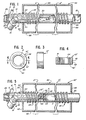
- Fig. 1 shows in vertical, cross-sectional view, one form of apparatus for practice of the invention upon a length of steel pipe, or tube, 10.
- the pipe or tube 10 may have a substantial length, as suggested by the indefinite-length break illustrated at 11.
- a portion of the pipe is both supported and rotated by a pipe-rotating means 12 that is well known in the art.
- a pipe-rotating means 12 that is well known in the art.
- rotating means 12 Although only one set of rotating means 12 is shown adjacent the left hand end of Fig. 1, it is understood that similar support and rolling means are to be provided at the right hand end of Fig. 1, but these have been omitted from the drawing as they will be understood from the following description of means 12.
- the means 12 includes a pair of pipe engaging drive rollers 14, located on opposite sides of pipe 10 and frictionally engaging pipe 10 and being located in part below the mid-height of pipe 10 so that the rollers' engagement with pipe 10 also serves as a support.
- the rollers 14 are driven by any convenient or well-known means, such as electric drive motors 16, by means of which high speed and selective control of speed may be effected as well-known in the art.
- the direction of rotation of the drive rollers, indicated by arrow 18, brings about rotation of pipe 10, and simultaneous axial movement of pipe 10 as indicated generally by the spiral, or helical, arrow 20 shown associated with pipe 10.
- pipe 10 Since a substantial length of pipe or tube 10, hereinafter also "pipe/tube", is to have its interior surface metalized, the pipe 10 is first arranged in a telescoping relation to an elongated internal spindel or mandrel means 22, shown only in fragment in Fig. 1.
- the mandrel can be made of as great an axial length as desired, or necessary, depending upon the length of pipe 10 that is to be metalized, with the only limitation being that the maximum diameter of mandrel means 22 is less than the diameter of the pipe/tube's lumen, or bore, so as to permit easy telescoping of pipe 10 thereonto.
- the mandrel means 22 is shown in the form of an elongated tube, or pipe, 24 whose end most proximate the left hand end of a metalizing station shown in Fig. 1, includes an annular transverse end wall 26 with a centrally located opening 28 therethrough.
- Fig. 1 indicates that the right hand end of pipe 10 may have a similar telescoping relation with a right hand support, or mandrel (not shown), the suggestion being by way of the indication of the presence of a downstream, transverse, end wall 26', whose peripheral dimension is such as to clear the inner periphery of the pipe 10 and any metalizing layer M that has been applied to said inner periphery of the pipe as seen in Figs. 2 and 4.
- the downstream end wall 26° may be provided along its outer circular periphery with a flexible skirt, or flange, that inhibits backflow of reduced-temperature gas or of air upstream of wall 26°, or permits pressurized gas to empty therepast downstream, or may be provided with a center bore 28° as needed, to permit downstream escape of pressurized gas therethrough.
- a cantilevered boom, or supply-support tube, 30 through which metalizing powder, entrained in a stream that includes a pressurized, non-oxidizing, gas, is delivered in the form of a spray or shower S from a nozzle 32 in the interior of pipe 10 at a station located laterally, or axially of pipe 10, between two electrical, induction heating, coil means, namely a first such induction heating means 34 and a second induction heating means 36.
- the first induction heating means 34 is in the form of a helical coil and is arranged, constructed, and positioned relative to pipe 10 so as to heat the portion of the pipe or tube, hereinafter also pipe/tube, that is surrounded by coil 34 to a first elevated temperature, so that not only the adjacent surrounded segment of pipe/tube 10, but also the interior of pipe/tube 10 and its contents partakes of said first elevated temperature.
- the heat delivered and maintained adjacent first induction heating means 34 is adopted to cause the metalizing powder, after it leaves nozzle 32, to become molten, or semi-molten, so as to in effect convert the powdered metalizing material into a fluidized bed, or pool-like layer, of metalizing material.
- the spray S from nozzle 32 should preferably be pre-heated, to a temperature approximating the pre-heated temperature developed by coil means 34, by the heated non-oxidizing carrier, or entraining, gas that is pumped under pressure through supply-support tube 30 and nozzle 32, although in the experiment described hereinafter, the nitrogen was not pre-heated.
- nitrogen gas as the non-oxidizing carrier gas, but other non-oxidizing gases, such as any of the series of rare gases, such as neon, argon, etc., could be used, the gas serving primarily as a non-oxidizing fluid carrier for moving the metalizing material particles from a supply (not shown) through tube 30 and nozzle 32 to a point where the metalizing material will perform as disclosed herein.
- supply-support tube 30 that is shown connected to end wall 26, may be fed by a separate tube (not shown); or may open to the interior of tube 24 which could serve as a supply conduit for supplying support tube 30 with a flow of gas-entrained metalizing particles.
- the central opening 28 in end wall 26 serves as an additional means for supplying, to the interior of pipe 10, a flow of metalizing particles entrained in a non-oxidizing gas.
- the spray of metalizing particles S from spray nozzle 32, and the entrained gas and metalizing particles entering pipe 10 through opening 28 in end plate 26, is converted by the induction heat from first coil 34, to at least a semi-molten state, thereby providing a pool, P, or fluidized bed, of metalizing powder in the pipe 10.
- the pipe 10 is to be rotated at a relatively high rpm. Therefore, the pool, or fluidized bed, of the deposited powder, at least in a semi-molten state, is then subjected to two forces that have been known to occur in classical fluid flow systems.
- the inner wall surface of the rotating pipe 10 develops a tangential drag force on the fluidized particles immediately adjacent thereto, and because of the nature of the system, it is believed that a classical laminar flow is imparted to the rotating fluidized pool or bed, and thus operates to arrange the particles of at least semi-molten metalizing material into either a spiral, or substantially concentric laminae.
- the centrifugal forces acting on each particle whether it still be somewhat solid, or has become at least semi-molten, exist. If there are heavier particles, or particles of greater mass, there would be greater centrifugal force developed on that particle than on lighter, or smaller-mass, particles.
- the forces developed, and the arrangement of laminae is believed to be such that the greater mass, or heavier, particles move radially outwardly, and the lighter particles and impurities are thereby displaced and forced radially inwardly of the annular band of laminae of the fluidized bed.
- the centrifugal force and, it is believed, the said development of substantially concentric laminae of at least semi-molten metalizing material, cooperate to cause the following to occur: the greater mass, or larger and heavier, particles are forced radially outwardly against the inner surface of pipe 10; the smaller mass, or lighter, particles of metalizing material and impurities are thereby displaced radially inwardly of the fluidized bed; and the innermost surface of the fluidized bed or annulus, through the combination of forces, is automatically forced to adopt a concentricity, or circularity, that is most precisely centered about the axis of rotation of the pipe.
- the pipe and fluidized bed therein is, as shown in Fig. 1, moving to the right where it is then subjected to a second, and higher, temperature developed by induction heating coil 36.
- This second temperature is substantially higher than the first temperature at which the metalizing particles are made at least semi-molten, or fully molten, and the nature of the fluidized material is such that at the higher temperature the fluidized metalizing material fuses into an annulus, with the outermost lamina fusing to the inner wall of pipe 10 and the other laminae fusing to adjacent laminae.
- cooling of pine/tube 10 at it leaves the region of heating coil 36, passing to the right as seen in Fig. 1, operates to solidify the metalizing material into a hardened annulus, whose innermost surface is substantially precisely centered about the axis of rotation of pipe 10.
- Figs. 2-4 illustrate a product that has been produced by the process and apparatus as disclosed in Fig. 1.
- the pipe was sliced, or cut transversely to the pipe's axis, to provide an annular member 10' as shown in Figs. 2-4.
- the segment 10' the original pipe 10 that was treated as described hereinabove, with certain additional details set out hereinafter, was found to have on the inner periphery thereof, an annular layer of metalizing material deposited thereon.
- the pipe segment 10' has an outer periphery 40, and an original inner periphery 42.
- the annulus of metalizing material M has an outer periphery 42' which is fused to and is bonded tightly to the pipe'.s inner periphery 42.
- the inner periphery of the layer of metalizing material is designated 44.
- a light machining operation on the inner periphery 44 will operate to reduce and polish off any impurities or irregularities that will have solidified at said inner periphery 44.
- the ring member 46 seen in Figs. 2-4 can then be used as a bearing, or bearing sleeve. If cut through diametrically, and polished at the cut faces, the annular product would then provide two open sided, . semi-cylindrical, journals, or bearing pillows, for a shaft, or the like.
- the powder used was No. 63 Colmonoy, with a melting point of 1875°F (1025°C) and having a Rockwell hardness (C Scale) of 58-63 and a specific gravity of 7.8.
- Other alloy numbers available from Colmonoy have greater values and higher melting point temperatures to a maximum of about 2250° F.
- the average particle size of the No. 63 Colmonoy was 250-325 microns.
- the pipe/tube 10 had an O.D., 40, of 1-5/8" and I.D., 42, of 1-1/4", so that the wall thickness was about 3/16".
- the average thickness of the deposited metalizing layer was 1/8".
- the pipe/tube 10 was rotated at 1750 rpm, and its axial speed was about 3 feet per minute.
- the I.D. of the metalized tube, 44 had a dimension slightly less than 1".
- pressurized, non-oxidizing gas to entrain and move the metalizing particles through tube 30 and nozzle 32
- the pressurized gas escapes, or discharges, through the limited size orifice of nozzle 32 to the greater diameter interior of pipe 10
- the gas expands and thereby absorbs heat locally, thereby providing a cooling effect locally at nozzle 32 which, through conduction affects some length of nozzle 32 and its associated tube 30.
- This local cooling does not adversely affect the induction heating of pipe 10 from first heating coil 34, but it served to keep the copper tube that I used at a reasonable temperature without adversely affecting the flow of metalizing material therethrough or therefrom.
- the powdered material comes from the manufacturer in fluxed condition.
- the pure alloy is forced by centrifugal force outwardly toward the pipe 10, and the slag that includes flux is forced by displacement to the inner surface 44 of the metalizing layer.
- the coating in the finished product of Figs. 2-4 was found to be very dense and very hard.
- the outer pipe of 4140 steel was easily cut through with a metallurgical abrasive saw, but the saw stalled when it encountered the annulus of metalizing material.
- the Rockwell hardness of the desposited metalizing material provided a reading of 56-58.
- a measurement of concentricity of the I.D. of the metalizing ring reflected all points to be within .001 inches from the center of the body, while measurement of concentricity of the inner wall of original pipe/tube 10 reflected that concentricity varied by about .005 inches.
- the coil means 34 was a 4- turn coil with an internal diameter (I.D.) of the 1-7/8", designed to provide a pre-heating of the portion of pipe/tube 10 surrounded by coil means 34, and also its interior, to an initial temperature of about 900°F.
- the second heating coil means 36 was designed to provide an induction heating of the portion surrounded thereby to a chrome-fusing temperature of approximately 1800°F or more, as required, using a 6-turn coil with a 1-3/4" I.D.
- the power consumed by the two heating coil means 34 and 36 is about 100 kilowatts at a frequency of 10 khz.
- the temperature developed by an induction heater is a function of the number of turns of the coil heater and its closeness to the body being heated.
- the outer diameter of the downstream end wall 26' is selected to be such as to accommodate passage of the annulus of metalizing material M therepast.
- the wall 26' may be supported from a structure (not shown) similar to the pipe structure 24 shown at the left of Fig. 1.
- the two end walls 26 and 26' may serve as anchors, or supports, for the ends of an elongated support bar (not shown) that bridges the space between end walls 26 and 26', and the tube for delivering the powdered metalizing material at its point of discharge, upstream of coil 36', or such as at the position illustrated by the location of spray nozzle 32 in Fig. 1, can be supported from the support bar.
- This arrangement would provide flexibility to the means for locating the discharge nozzle 32, or its equivalent, at any desired location along the support bar as disclosed in this alternate form of construction.
- Fig. 5 illustrates the use of an elongated auger tube and concentric auger for delivering metalizing powder to a desired point of discharge between first coil 34' and second coil 36'.
- the supply of metalizing powder is moved through an auger tube 50, whose length is indefinite as indicated by the upright break line 11'.
- a downstream break line 11" (shown in both Figs. I and 5) indicates that the axial length of the pi p e/tube and apparatus is indefinite, as it may be that the process herein described will be used with pipe/tube lengths of almost any size, considering that standard mill lengths could be of lengths up to 30 feet long or greater.
- the auger tube could be supported at its left hand end by any appropriate means (not shown) and could have it right hand end provided with a trolley or roller support T, shielded by spaced end plates 46, which keeps the auger tube 50 centered within pipe/tube 10 and provides for rotation of the pipe/tube relative to the feed auger.
- An elongated auger member 52 is concentric within tube 50 and can be caused to rotate at a preselected speed to deliver the desired amount of metalizing material 54, at a controllable rate to the portion of pipe/tube 10-located between heating coils 34' and 36'.
- a treating chamber which serves to confine and preserve the heat generated by the heaters, 34-36 of Fig. 1 or 34' - 36' of Fig. 5, and which serves to isolate the portion of the tube/pipe 10 being acted upon by the heaters from the vagaries of drafts in a factory, and also serves as a protection for the apparatus.
- a treating chamber 60 comprising two laterally spaced end walls 62 and 64 and appropriate longitudinal walls 66 which serve to surrounded and enclose the interior of the treating chamber.
- the end walls 62 and 64 respectively have therein aligned first opening 63 and second opening 65 through which the pipe/tube 10 is caused to pass as it moves axially under the drive of rollers 14.
- a pipe/tube 10 to be treated has its leading, or first end, enter through first opening 63 moving axially, and being rotated by rollers 14 at high speed to be treated as described above, and then to have said first end move outwardly from the treating chamber 60 through second opening 65.
Landscapes
- Chemical & Material Sciences (AREA)
- Chemical Kinetics & Catalysis (AREA)
- Engineering & Computer Science (AREA)
- Materials Engineering (AREA)
- Mechanical Engineering (AREA)
- Metallurgy (AREA)
- Organic Chemistry (AREA)
- Other Surface Treatments For Metallic Materials (AREA)
- Powder Metallurgy (AREA)
- Pressure Welding/Diffusion-Bonding (AREA)
Applications Claiming Priority (2)
| Application Number | Priority Date | Filing Date | Title |
|---|---|---|---|
| US06/475,383 US4490411A (en) | 1983-03-14 | 1983-03-14 | Apparatus for and method of metalizing internal surfaces of metal bodies such as tubes and pipes |
| US475383 | 1983-03-14 |
Publications (2)
| Publication Number | Publication Date |
|---|---|
| EP0119095A2 true EP0119095A2 (de) | 1984-09-19 |
| EP0119095A3 EP0119095A3 (de) | 1985-01-23 |
Family
ID=23887347
Family Applications (1)
| Application Number | Title | Priority Date | Filing Date |
|---|---|---|---|
| EP84301690A Withdrawn EP0119095A3 (de) | 1983-03-14 | 1984-03-13 | Vorrichtung und Verfahren zum Metallisieren der inneren Oberflächen von Metallkörpern wie etwa Rohre |
Country Status (6)
| Country | Link |
|---|---|
| US (1) | US4490411A (de) |
| EP (1) | EP0119095A3 (de) |
| JP (1) | JPS605884A (de) |
| AU (1) | AU2551484A (de) |
| IL (1) | IL71219A (de) |
| ZA (1) | ZA841869B (de) |
Cited By (3)
| Publication number | Priority date | Publication date | Assignee | Title |
|---|---|---|---|---|
| WO2013108036A3 (en) * | 2012-01-18 | 2013-11-21 | Gemini Corrosion Services Limited | Apparatus and method for surface treating a pipe |
| CN105050739A (zh) * | 2012-11-26 | 2015-11-11 | 应用光技术股份有限公司 | 用于通过金属合金给管加衬里的方法 |
| CN110124957A (zh) * | 2019-06-24 | 2019-08-16 | 中国石油大学(华东) | 一种管道内壁高频感应熔覆的装置及方法 |
Families Citing this family (44)
| Publication number | Priority date | Publication date | Assignee | Title |
|---|---|---|---|---|
| JPS6123772A (ja) * | 1984-07-09 | 1986-02-01 | Dai Ichi High Frequency Co Ltd | 金属管等の内面に金属ライニングを施す方法 |
| JPS6223997A (ja) * | 1985-07-23 | 1987-01-31 | Nippon Steel Corp | 高耐食性Sn系メツキ鋼板とその製造法 |
| JPS6230896A (ja) * | 1985-08-01 | 1987-02-09 | Nippon Steel Corp | 高耐食性Sn系被覆鋼板とその製造法 |
| AU565129B2 (en) * | 1985-07-23 | 1987-09-03 | Nippon Steel Corporation | Steel sheet with ni and sn coatings for improved corrosion protection |
| US5139814A (en) * | 1987-07-11 | 1992-08-18 | Usui Kokusai Sangyo Kaisha | Method of manufacturing metal pipes coated with tin or tin based alloys |
| JP2727450B2 (ja) * | 1987-10-06 | 1998-03-11 | 第一高周波工業株式会社 | 内外面金属ライニング管の製造方法 |
| CN1018292B (zh) * | 1989-10-17 | 1992-09-16 | 王理泉 | 一种复合防腐管道及其制造方法 |
| US5059453A (en) * | 1990-03-08 | 1991-10-22 | Inductametals Corporation | Method and apparatus for metalizing internal surfaces of metal bodies such as tubes and pipes |
| US5413638A (en) * | 1990-10-03 | 1995-05-09 | Bernstein, Jr.; Philip | Apparatus for metalizing internal surfaces of tubular metal bodies |
| US5310344A (en) * | 1990-11-01 | 1994-05-10 | Arthur Vassiliadis | Dental laser system |
| US5202160A (en) * | 1991-05-24 | 1993-04-13 | Inductametals Corporation | Holdback control in apparatus for coating the internal surfaces of metal tubes |
| US5468295A (en) * | 1993-12-17 | 1995-11-21 | Flame-Spray Industries, Inc. | Apparatus and method for thermal spray coating interior surfaces |
| US5618591A (en) * | 1995-05-15 | 1997-04-08 | Fuse Co. | Method of coating an inside of a pipe or tube |
| WO1997004949A1 (en) * | 1995-07-28 | 1997-02-13 | Ico, Inc. | Metallized layer corrosion protection system for pipe or tubing |
| DE19614147B4 (de) * | 1996-04-10 | 2005-01-20 | Robert Bosch Gmbh | Verfahren zum bahnförmigen Aufbringen von Material auf einen keramischen Träger, insbesondere zur Herstellung von Elektroden von Abgassensoren, und Verwendung des Verfahrens, insbesondere zur Herstellung einer Lambdasonde |
| DE19710294C2 (de) * | 1997-03-13 | 2001-04-05 | Wieland Werke Ag | Verfahren zur Herstellung eines korrosionsbeständigen Rohres |
| DE69728451T2 (de) * | 1997-11-18 | 2004-08-12 | Dresser-Shaw Co., Calgary | Verfahren zum kühlen eines beschichteten rohres |
| DE19842608A1 (de) * | 1998-09-17 | 2000-03-23 | Ks Aluminium Technologie Ag | Verfahren zum Herstellen einer Verschleißschicht bei Zylinderlaufbahnen |
| CA2367264C (en) * | 2001-01-19 | 2006-03-14 | Illinois Tool Works Inc. | Coated film forming method and apparatus therefor |
| FR2822727A1 (fr) * | 2001-04-03 | 2002-10-04 | Gesal Ind | Procede d'application d'un revetement resistant aux hautes temperatures, dispositif pour la mise en oeuvre de ce procede et objet pourvu dudit revetement |
| US6635317B1 (en) | 2002-07-02 | 2003-10-21 | Kenneth Casner, Sr. | Method for coating metallic tubes with corrosion-resistant alloys |
| JP4105516B2 (ja) * | 2002-09-27 | 2008-06-25 | 大同メタル工業株式会社 | 軸受の内面への被膜形成装置 |
| US6843105B1 (en) * | 2003-06-30 | 2005-01-18 | Robert Bosch Corporation | Contact pin for exhaust gas sensor |
| US7404883B2 (en) * | 2004-04-12 | 2008-07-29 | Robert Bosch Gmbh | Insulation bushing assembly for an exhaust gas sensor |
| FR2888309B1 (fr) * | 2005-07-05 | 2007-10-12 | Saipem S A Sa | Piece de raccordement de conduites comportant une chemise interne, procede de revetement et procede d'assemblage |
| JP4866860B2 (ja) | 2004-12-15 | 2012-02-01 | デロロ・ステライト・ホールディングズ・コーポレイション | 内燃エンジン用部品への耐高温劣化性の付与 |
| US20060228495A1 (en) * | 2005-04-12 | 2006-10-12 | Robert Bosch Gmbh | Method of manufacturing an exhaust gas sensor |
| US20080102291A1 (en) * | 2006-10-31 | 2008-05-01 | Caterpillar Inc. | Method for coating a substrate |
| US20080299306A1 (en) * | 2007-05-30 | 2008-12-04 | Caterpillar Inc. | Multi-layer substrate and method of fabrication |
| AT506960B1 (de) * | 2008-08-18 | 2010-01-15 | Alvatec Alkali Vacuum Technolo | Verfahren zur herstellung einer gettereinrichtung |
| US20100175854A1 (en) * | 2009-01-15 | 2010-07-15 | Luca Joseph Gratton | Method and apparatus for multi-functional capillary-tube interface unit for evaporation, humidification, heat exchange, pressure or thrust generation, beam diffraction or collimation using multi-phase fluid |
| US8344299B1 (en) | 2009-11-20 | 2013-01-01 | Novatech Holdings Corp. | Cylinder heater |
| CA2692995C (en) | 2010-02-01 | 2016-06-28 | Kudu Industries Inc. | A system and method for induction heating a helical rotor using a coil |
| US8555965B2 (en) * | 2010-05-06 | 2013-10-15 | Schlumberger Technology Corporation | High frequency surface treatment methods and apparatus to extend downhole tool survivability |
| EA201391270A1 (ru) * | 2011-03-10 | 2014-08-29 | Месокоут, Инк. | Способ и устройство для плакирования металлических изделий |
| CN102560476A (zh) * | 2011-12-31 | 2012-07-11 | 席生岐 | 一种金属管内壁涂层感应加热熔结方法 |
| CN102560477A (zh) * | 2012-01-12 | 2012-07-11 | 自贡市巨光硬面材料有限公司 | 具有耐腐耐磨内壁的管件制造工艺 |
| KR20150127719A (ko) | 2013-03-15 | 2015-11-17 | 메소코트, 인코포레이티드 | 3원 세라믹 용사 분말 및 코팅 방법 |
| US10323489B2 (en) * | 2014-06-04 | 2019-06-18 | Schlumberger Canada Limited | Apparatus and methods for treating a wellbore screen |
| DE102015211901B4 (de) * | 2015-06-26 | 2019-12-05 | Aktiebolaget Skf | Induktor für eine Induktionshärteanlage |
| FR3059573B1 (fr) * | 2016-12-02 | 2019-01-25 | Aptar France Sas | Tete de distribution de produit fluide |
| CN111748812A (zh) * | 2019-03-26 | 2020-10-09 | 临沂华庚新材料科技有限公司 | 一种制造复合钢管的方法 |
| WO2021090064A1 (en) * | 2019-11-06 | 2021-05-14 | AmpClad Coating Technologies Inc. | Vitreous coating application by induction heating and integration with induction kinetic weld joining |
| AT523427B1 (de) * | 2020-02-12 | 2021-08-15 | Miba Sinter Austria Gmbh | Verfahren zur Herstellung eines Wärmerohres |
Family Cites Families (11)
| Publication number | Priority date | Publication date | Assignee | Title |
|---|---|---|---|---|
| US2803559A (en) * | 1954-03-25 | 1957-08-20 | Coast Metals Inc | Method and apparatus for applying powdered hard surfacing alloy with induction heating |
| FR1244133A (fr) * | 1958-12-31 | 1960-10-21 | Bundy Tubing Co | Procédé et appareil d'enduisage intérieur des tubes |
| US3007810A (en) * | 1958-12-31 | 1961-11-07 | Bundy Tubing Co | Method and apparatus for coating a tube interior |
| CH451665A (de) * | 1966-03-24 | 1968-05-15 | Nussbaum & Co Gmbh Geb | Verfahren und vorrichtung zum Innenplattieren von metallischen Hohlkörpern, insbesondere von Rohren, und Anwendung des Verfahrens zum Herstellen von Gewinden |
| US3814616A (en) * | 1968-10-08 | 1974-06-04 | Kansai Paint Co Ltd | Method for coating the inner surface of metal pipes |
| US3654895A (en) * | 1969-08-15 | 1972-04-11 | Texas Instruments Inc | Apparatus for forming a refractory coating on the inner periphery of a tubular object |
| JPS4958123A (de) * | 1972-10-06 | 1974-06-05 | ||
| US4243699A (en) * | 1977-12-20 | 1981-01-06 | Gibson Jack Edward | Method of powder coating the inside of pipes with a continuous film of plastic material |
| DE2739356C2 (de) * | 1977-09-01 | 1984-09-27 | Audi Nsu Auto Union Ag, 7107 Neckarsulm | Verfahren zum Auftragen von Metall-Spritzschichten auf die Innenfläche eines Hohlkörpers |
| US4197336A (en) * | 1978-12-21 | 1980-04-08 | Ukrainsky Nauchno-Issledovatelsky Institut Spetsialnykh Stalei, Splavov I Ferrosplavov | Method for applying protective coating to metal pipes |
| EP0094759A3 (de) * | 1982-05-03 | 1984-03-28 | Inductalloy Corporation | Vorrichtung und Verfahren zum Metallisieren von metallischen Gegenständen |
-
1983
- 1983-03-14 US US06/475,383 patent/US4490411A/en not_active Expired - Fee Related
-
1984
- 1984-03-12 IL IL71219A patent/IL71219A/xx not_active IP Right Cessation
- 1984-03-12 AU AU25514/84A patent/AU2551484A/en not_active Abandoned
- 1984-03-13 EP EP84301690A patent/EP0119095A3/de not_active Withdrawn
- 1984-03-13 ZA ZA841869A patent/ZA841869B/xx unknown
- 1984-03-14 JP JP59048955A patent/JPS605884A/ja active Granted
Cited By (3)
| Publication number | Priority date | Publication date | Assignee | Title |
|---|---|---|---|---|
| WO2013108036A3 (en) * | 2012-01-18 | 2013-11-21 | Gemini Corrosion Services Limited | Apparatus and method for surface treating a pipe |
| CN105050739A (zh) * | 2012-11-26 | 2015-11-11 | 应用光技术股份有限公司 | 用于通过金属合金给管加衬里的方法 |
| CN110124957A (zh) * | 2019-06-24 | 2019-08-16 | 中国石油大学(华东) | 一种管道内壁高频感应熔覆的装置及方法 |
Also Published As
| Publication number | Publication date |
|---|---|
| EP0119095A3 (de) | 1985-01-23 |
| JPH0434627B2 (de) | 1992-06-08 |
| IL71219A0 (en) | 1984-06-29 |
| IL71219A (en) | 1987-09-16 |
| JPS605884A (ja) | 1985-01-12 |
| US4490411A (en) | 1984-12-25 |
| ZA841869B (en) | 1984-10-31 |
| AU2551484A (en) | 1984-09-20 |
Similar Documents
| Publication | Publication Date | Title |
|---|---|---|
| US4490411A (en) | Apparatus for and method of metalizing internal surfaces of metal bodies such as tubes and pipes | |
| US6861612B2 (en) | Methods for using a laser beam to apply wear-reducing material to tool joints | |
| US5738725A (en) | Cooling system for apparatus of coating an inside of a pipe or tube | |
| KR20140066728A (ko) | 포개어진 층 구조를 갖는 통로 또는 파이프를 갖춘 압연기 코일-형성 레잉 헤드 | |
| US5413638A (en) | Apparatus for metalizing internal surfaces of tubular metal bodies | |
| KR20010012957A (ko) | 내마모성 표면을 갖는 소결된 기계적 부품 및 그 제조방법 | |
| US5059453A (en) | Method and apparatus for metalizing internal surfaces of metal bodies such as tubes and pipes | |
| EP1064414A1 (de) | Verfahren zur herstellung einer gleitlagerbeschichtung | |
| CA1086575A (en) | Method and apparatus for applying a metal coating to a metal substrate | |
| US5202160A (en) | Holdback control in apparatus for coating the internal surfaces of metal tubes | |
| US2803559A (en) | Method and apparatus for applying powdered hard surfacing alloy with induction heating | |
| AU5633090A (en) | Manufacture of poppet valves by spray deposition | |
| JPS62177183A (ja) | 金属管等の内面に金属ライニングを施す方法 | |
| US20080069715A1 (en) | Process for hardfacing a progressing cavity pump/motor rotor | |
| CA2997159A1 (en) | Method of hardbanding drill string components and related drill string components thereof | |
| JPH0693409A (ja) | ピストンリングの溶射被膜の形成方法 | |
| US20030192613A1 (en) | Pipe and method for resisting erosion, abrasion and corrosion | |
| EP1937862A2 (de) | Verfahren zum auftragsschweissen eines rotors von exzenterschneckenpumpen/-motoren | |
| US12320011B2 (en) | Vitreous coating application by induction heating and integration with induction kinetic weld joining | |
| US2341006A (en) | Method of making composite metal articles | |
| JPS62248553A (ja) | 二層中空筒体の製造方法 | |
| US5460850A (en) | Hold-down device in apparatus for metalizing internal surfaces of metal bodies | |
| JPH1046355A (ja) | 金属管の表面処理法 | |
| CN116021239B (zh) | 耐磨管的制备方法以及耐磨管 | |
| JP2000120939A (ja) | 耐摩耗性金属管及びその製造方法 |
Legal Events
| Date | Code | Title | Description |
|---|---|---|---|
| PUAI | Public reference made under article 153(3) epc to a published international application that has entered the european phase |
Free format text: ORIGINAL CODE: 0009012 |
|
| AK | Designated contracting states |
Designated state(s): BE DE FR GB IT NL SE |
|
| PUAL | Search report despatched |
Free format text: ORIGINAL CODE: 0009013 |
|
| AK | Designated contracting states |
Designated state(s): BE DE FR GB IT NL SE |
|
| 16A | New documents despatched to applicant after publication of the search report | ||
| STAA | Information on the status of an ep patent application or granted ep patent |
Free format text: STATUS: THE APPLICATION IS DEEMED TO BE WITHDRAWN |
|
| 18D | Application deemed to be withdrawn |
Effective date: 19850923 |
|
| RIN1 | Information on inventor provided before grant (corrected) |
Inventor name: FEDER, DARRYL |