EP0119167A2 - Verfahren und Einrichtung, insbesondere tauglich für Motorfahrzeuge zur selektiven Abbildung von identischen Informationen in unterschiedlichen Sprachen - Google Patents
Verfahren und Einrichtung, insbesondere tauglich für Motorfahrzeuge zur selektiven Abbildung von identischen Informationen in unterschiedlichen Sprachen Download PDFInfo
- Publication number
- EP0119167A2 EP0119167A2 EP84830023A EP84830023A EP0119167A2 EP 0119167 A2 EP0119167 A2 EP 0119167A2 EP 84830023 A EP84830023 A EP 84830023A EP 84830023 A EP84830023 A EP 84830023A EP 0119167 A2 EP0119167 A2 EP 0119167A2
- Authority
- EP
- European Patent Office
- Prior art keywords
- message
- segments
- presentation
- sub
- lines
- Prior art date
- Legal status (The legal status is an assumption and is not a legal conclusion. Google has not performed a legal analysis and makes no representation as to the accuracy of the status listed.)
- Granted
Links
Images



Classifications
-
- G—PHYSICS
- G09—EDUCATION; CRYPTOGRAPHY; DISPLAY; ADVERTISING; SEALS
- G09G—ARRANGEMENTS OR CIRCUITS FOR CONTROL OF INDICATING DEVICES USING STATIC MEANS TO PRESENT VARIABLE INFORMATION
- G09G3/00—Control arrangements or circuits, of interest only in connection with visual indicators other than cathode-ray tubes
- G09G3/04—Control arrangements or circuits, of interest only in connection with visual indicators other than cathode-ray tubes for presentation of a single character by selection from a plurality of characters, or by composing the character by combination of individual elements, e.g. segments using a combination of such display devices for composing words, rows or the like, in a frame with fixed character positions
Definitions
- the present invention relates to the presentation of -informative messages on a device for visually displaying alpha-numeric characters using surface segments each of which can be switched individually and selectively between two operational states one of which corresponds to visual perceptibility of the segment itself.
- Typical examples of such devices are light emitting diodes (L.E.D.), devices , vacuum fluorescent (V.F.) devices, and liquid crystal devices (L.C.D.).
- the invention relates more particularly to the selective presentation of the same informative message in different languages and in particular, but not exclusively,to the presentation of this informative message in a motor vehicle.
- Electronic translators are known in the art, these devices being usually made in pocket-calculator form and allowing the same word or the same ideomatic phrase to be presented in two or more languages on a light emitting diode or liquid crystal display unit.
- Such devices normally include a miniaturised processing circuit with associated read-only memories in which the translated vocabulary is stored.
- the invention overcomes these disadvantages by virtue of a method for selectively presenting the same informative message in different languages on an alpha-numeric visual display device that uses surface segments each of which can be switched selectively between two operational states, one of which corresponds to visual perceptibility of the segment itself, characterised in that it includes the steps of:
- the invention allows the economic and reliable presentation, particularly in a motor vehicle, of predetermined informative messages in a presentation language chosen by the user from a group made up of the najor languages.
- a device for visually displaying alpha-numeric characters is generally indicated 1 and includes a screen on which there are a plurality of surface segments arranged in a periodic structure.
- Each surface segment can be switched individually and selectively between two operational states one of which corresponds to visual perceptibility of the segment itself.
- the device 1 may be made by any of the technologies currently used for the manufacture of visual display units such as, for example, light emitting diode technology (L.E.D.), vacuum fluorescent technology (V.F.) or liquid crystal technology (L.C.D.).
- L.E.D. light emitting diode technology
- V.F. vacuum fluorescent technology
- L.C.D. liquid crystal technology
- connection to a voltage supply causes a variation in the refractive index of the entire segment which takes on a clear colour clearly contrasting riththe semi-opacity of the rest of the screen or vice versa.
- the present invention does not relate exclusively to such a visual display device but can also be applied to any nulti-segment visual display device.
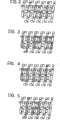
- each group of segments indicated by a series adjacent numbers is intended to visually display an individual alphabet character in connection with the presentation of the same verbal message in four languages that is, in Italian (I), English (GB), French (F) and German (D).
- a comparison of Figures 2 to 5, shows that the group of segments 10 to 24 (first character) is used for the presentation of the message in English, French and German.
- the group of segments 30 to 44 (second character) is used for the presentation of the message in all four languages considered.
- the group of segments 50 to 64 (third character) is used for the presentation of the message in Italian, English and French, but not for the presentation of the message in German.
- the segment 39 of the second character is used during presentation of the message in all four languages.
- the segment 32 is however used during presentation of the message in Italian, in English and in French but not during the presentation in German.
- the segments 30, 31 and 35 are used during presentation of the message in Italian, English and German while the segment 38 is used during presentation of the message in Italian, French and German.
- the segments 34 and 36 are used during the presentation of the message in English, French and German, but not during presentation of the message in Italian.
- segments 50, 51, 55, 58, 59 are used solely during presentation of the message in English, while the segments 56 and 63 are used during presentation of the message both in Italian and in French.
- the segment 52 is used for the presentation of the message in Italian, in English and in French.
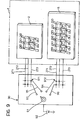
- references 71 to 85 indicate fifteen conductive strips applied to one of the faces of the screen of the Figure 1 device.
- the strips 71 to 85 may be formed on one of the faces of the screen of the device 1 by the technology normally used for the manufacture of printed circuits, the number of strips being equal to the number of sub-sets of the languages of presentation listed in the left hand column of Figure 6.
- Each conductive strip 71 to 85 is thus uniquely. indicative of one of these sub-sets.
- a connecting track also obtained by the technology normally used for printed circuits and integrated circuits.
- Each of these tracks connects one of the strips 71 to 85 to all the segments that are only required to be switched to their states of perceptibility during the presentation of the informative message in each and every language included in the sub-set of which this strip is indicative.
- the line 79 which is indicative of the sub-set constituted by the languages English and French, is connected by means of a connecting track 791 to the segments 12, 16 and 19.
- the line 80 indicative of the sub- set formed by the languages English and German is connected through a connecting track 801 to the segments 20, 21.
- the line 85 indicative of the sub- set formed by the languages English, French and German is connected through a connecting track 851 to the segments 14 and 18.
- the strip 71 indicative of the sub- set formed by all four languages of presentation, is connected through a track 711 to the segment 39.
- the strip 82 indicative of the sub- set formed by Italian, English and French, is connected through a track 821 to the segment 32.
- a track 831 connects the segments 30, 31 and 35 to the strip 83 indicative of the sub- set formed by Italian, English and German.
- a track 841 connects the segment 38 to the strip 84, indicative of the sub- set formed by Italian, French and German.
- the strip 85 is indicative of the sub- set formed by English, French and German and is connected through a track 852 to the segments 34 and 36.
- the segments 50, 51, 55, 58 and 59 are connected through a single track 731 to the strip 73 indicative of the sub- set formed by the single language English.
- a further track , indicated 771 connects the segments 56 and 63 with the strip 77 indicative of the sub-set formed by the language Italian and by the language French.
- a track 822 connects the segment 52 with the strip 82 which, as indicated above is indicative of the sub-set formed by Italian, English and French.
- the strips 71 to 85 and the connecting tracks which terminate thereat, are intended to enable the selective switching of the segments 10 to 24, 20 to 44 and 50 to 64 to their states of visual perceptibility.
- the switching of the segments to their states of perceptibility corresponds to the application of a bias voltage across the semi-conductor junctions associates with the segments themselves.
- a selector device generally indicated 90 includes a rotatable control member 91 which can be disposed in four positions each of which corresponds to the selection of a language in which the message is to be presented.
- the rotatable member 91 When the apparatus of the invention is used in a motor vehicle to achieve the visual display of messages indicative of the conditions of use of the motor vehicle, the rotatable member 91 could be operated by a knob located on the dashboard in reach of the driver. Alternatively the rotatable member 91 could be located in a position not directly accessible to the driver or to the purchaser of the vehicle so that the selection of the language of presentation can only be effected at sales outlets and service centres.
- the rotatable member 91 serves to connect a voltage source 92 to one of the four connection lines indicated 93, 94, 95 and 96 respectively, each of which corresponds to one of the four languages of message presentation.
- Each line 93 to 96 terminates at an interconnection matrix generally indicated 97 to which the conductive strips 71 to 85 are connected.
- each line 93 to 96 is connected to all and only those strips 71 to 85 indicative of sub-sets including the respective language of presentation.
- the line 93 indicative of the selection of the Italian language is connected to the strips 71, 72, 76, 77, 78, 82, 83 and 84.
- the line 94 indicative of the selection of the English language is connected, as well as to the strip 71, also to the strips 73, 76, 79, 80, 82, 83 and 85.
- the line 95 indicative of the selection of the language German is connected to the strips 71, 75, 78, 80, 81, 83, 84 and 85.
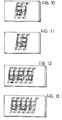
- selector device 90 may be set to cause presentation of the messages "yes" and "ja" in the English language and in the German language.
- the invention is based upon the observation that the order of complexity of the problem inherent in the presentation of the same message in different languages is defined solely by the number of the languages from which it is wished to choose the language of presentation. Fifteen connecting lines (conductive strips) thus suffice to allow the presentation of any message in four different languages. The factor that changes on variation of the message and its length, is the connection arrangement of these connecting lines to the segments of the visual display device. This connection arrangement is defined when deciding on the message it is desired to present and may easily be reproduced during the production phase of each visual display device 1.
- each visual display device when it is wished to present a series of different messages in the same language, possibly simultaneously, on the dashboard of a motor vehicle, it will suffice to provide a connection arrangement, formed according to the invention, on each visual display device intended to present one of these messages.
- the segments of each visual display device will be externally operable by controlling the same predetermined number of connection lines for each visual display device , this number being equal to fifteen when it is wished to choose the language of presentation from four languages.
- connection lines of the various visual display devices can be connected together and connected to the selector device 90.
- the invention allows the problem of the presentation of informative messages in a language chosen from several languages in dependence on the requirement of the user to be solved in a particularly economical, reliable and efficient manner.
- Figure 8 illustrates, with reference to the segments 30 to 44 for presenting the second character of the message indicated in Figures 2 to 5, a possible variant of the invention.
- the conductive elements such as metallisations applied to the two faces of the substrates have been indicated by numerals corresponding to the numerals indicative of the segments with the addition of the letter suffixes a and b .
- each corresponding pair of elements for example the elements 36a and 36b,together enclose a respective segment, for example the segment 36.
- the conductive elements located on opposite faces in the substrates are intended to apply a polarisation voltage to the two opposite faces of the segment enclosed therebetween to achieve the switching of the segment itself to a state of visual perceptibility.
- a typical example of this arrangement is a liquid crystal (L.C.D.) display device in which each segment assumes a uniformly clear colour contrasting with the overall opaque appearance of the substrate S as a result of a voltage applied through the screen S itself by means of two electrodes located on opposite faces of the screen.
- L.C.D. liquid crystal
- connection lines 71 to 85 are indicated by the numbers 101, 102, 103 and 10.4.
- the lines on the other face are indicated by the numerals 201, 203 and 204.
- the lines 101 to 104 and 201 to 204 are intended to form a matrix-like arrangement connecting the segments of the device 1 to the connecting lines 71 to 85.
- each connecting line 71 to 85 is connected to a pair of the lines 101 to 104, 201 to 204 so that, on connection of one of the lines 71 to 85 to the source 92, a voltage difference is correspondingly applied across the conductive elements associated with the segments of the device 1 connected to this connecting line.
- references 301 to 307 indicate respective logic OR gates.
- References 308 to 312 however indicate respective inverter stages.
- the arrangement described is such that the switching of the segment 39 to a state of visual perceptibility is controlled from the line 71 through the lines 101 and 201 which terminate at the conductive elements 39a and 39b respectively.
- the voltage signal produced by the source 92 is applied to the line 71, then by virtue of the action of the inverter 308, a voltage difference is established between the elements 39a and 39b which causes switching of the segment 39 lying therebetween to its state of perceptibility.
- the line 82 allows the segment 32 to be switched to its state of visual perceptibility through the lines 104 and 203.
- the switching of the segments 30, 31, 34, 35, 36 and 38 is controlled by the lines 83, 84 and 85 through the line 204 common to all the segments and through the lines 101, 102 and 103.
- the conductive elements 30b, 31b, 34b, 35b, 36b and 38b, all connected to the line 204 may be connected directly together with a considerable simplification in the connection arrangement on one of the faces of the screen S.
- the application of the voltage signal produced by the source 92 to the lines 83, 84 and 85, causes, in a manner entirely analogous to that described above with reference to the lines 71 and 82, the activation of the corresponding segments 30, 31, 35,of the segment 38,and of the segments 34 and 36.
- the device 1 includes two distinct units indicated 2 and 3, each of which has a screen with a plurality of surface segments arranged in identical groups and defining a periodic structure.
- each of the units 2 and 3 is used for the presentation of the message in only two languages.
- the number of supply lines converging on each of these units is thus reduced to three.
- the supply of the unit 2 may in fact be achieved by means of a first strip 271 (to which the segments which are activated both during the presentation of the message in Italian and during the presentation of the message in German are connected), of a second strip 272 (to which the segments used only during. presentation in Italian are connected) and a third strip 274 (to which the segments used only during presentation in German are connected).
- three strips indicated 371, 372 and 373 are used in order to supply the unit 3 (visual display in English and French), these strips being connected respectively to the segments used during presentation of the message in English and during presentation of the message in French, to the segments used during presentation solely in English, and to the segments, used during presentation solely in French.
- connection of the lines 271, 272, 273 and 371, 372, 373 to the segments of the respective units 2 and 3 may be achieved both in the manner described with reference to Figure 7 and according to the variant illustrated.in Figure 8 or in an equivalent manner, for example that illustrated in the Utility Model Application mentioned above.
- circuitry simplification described above derives from the observation of the fact that the sum of the number of sub-sets (three) of each of the two sub-sets formed by the languages (two) in which the message is presented on each of the units 2, 3 is less than the number of sub-sets (fifteen) of the complete'set formed by all four languages of message presentation.
- the method of dividing the original complete set of four languages of presentation described above into two sub-sets can obviously be generalised to any different number of languages and to any different scheme of division.
- connection matrix 97 of the selector device 90 of Figure 7 The simplification of the connection arrangement of the device 1 results in a corresponding simplification of the connection matrix 97 of the selector device 90 of Figure 7.
- the selector device 90 includes two connection matrices 971 and 972, the complexity of which is cumulatively less than the complexity of the matrix 97, of Figure 7.
- a further circuit simplification may be achieved by modifying the rotatable element 91 and the lines 93 to 96 so as to obtain presentation of the message in two languages simultaneously, for example, in Italian on the unit 2 and in English on the unit 3 with the rotatable element 91 in one position,and in German on the unit 2 and in French on the unit 3 with the rotatable element 91 in another position.
Landscapes
- Engineering & Computer Science (AREA)
- Physics & Mathematics (AREA)
- Computer Hardware Design (AREA)
- General Physics & Mathematics (AREA)
- Theoretical Computer Science (AREA)
- Control Of Indicators Other Than Cathode Ray Tubes (AREA)
- Digital Computer Display Output (AREA)
- Machine Translation (AREA)
- Displays For Variable Information Using Movable Means (AREA)
Applications Claiming Priority (2)
| Application Number | Priority Date | Filing Date | Title |
|---|---|---|---|
| IT6716283 | 1983-02-14 | ||
| IT67162/83A IT1162824B (it) | 1983-02-14 | 1983-02-14 | Procedimento ed apparecchiatura per la presentazione selettiva in lingue diverse di un identico messaggio informativo particolarmente a bordo di autoveicoli |
Publications (3)
| Publication Number | Publication Date |
|---|---|
| EP0119167A2 true EP0119167A2 (de) | 1984-09-19 |
| EP0119167A3 EP0119167A3 (en) | 1986-12-30 |
| EP0119167B1 EP0119167B1 (de) | 1990-04-25 |
Family
ID=11300109
Family Applications (1)
| Application Number | Title | Priority Date | Filing Date |
|---|---|---|---|
| EP84830023A Expired EP0119167B1 (de) | 1983-02-14 | 1984-02-02 | Verfahren und Einrichtung, insbesondere tauglich für Motorfahrzeuge zur selektiven Abbildung von identischen Informationen in unterschiedlichen Sprachen |
Country Status (6)
| Country | Link |
|---|---|
| US (1) | US4901065A (de) |
| EP (1) | EP0119167B1 (de) |
| JP (1) | JPS59157770A (de) |
| DE (1) | DE3482066D1 (de) |
| ES (1) | ES8500488A1 (de) |
| IT (1) | IT1162824B (de) |
Families Citing this family (6)
| Publication number | Priority date | Publication date | Assignee | Title |
|---|---|---|---|---|
| JP2712268B2 (ja) * | 1988-04-14 | 1998-02-10 | 株式会社豊田自動織機製作所 | 車両における表示制御装置 |
| US5717387A (en) * | 1990-01-19 | 1998-02-10 | Prince Corporation | Remote vehicle programming system |
| JPH11311538A (ja) * | 1998-04-28 | 1999-11-09 | Honda Motor Co Ltd | 車両共用システム |
| US20020156902A1 (en) * | 2001-04-13 | 2002-10-24 | Crandall John Christopher | Language and culture interface protocol |
| US20050211547A1 (en) * | 2004-03-26 | 2005-09-29 | Applied Materials, Inc. | Reactive sputter deposition plasma reactor and process using plural ion shower grids |
| US9763394B2 (en) | 2014-07-17 | 2017-09-19 | Rain Bird Corporation | Multi-language irrigation controller and method of programming |
Family Cites Families (18)
| Publication number | Priority date | Publication date | Assignee | Title |
|---|---|---|---|---|
| US3323121A (en) * | 1964-04-10 | 1967-05-30 | Monitron Mfg Corp | Digital code selector unit |
| US3444319A (en) * | 1966-07-26 | 1969-05-13 | Rca Corp | Character generator |
| US3594777A (en) * | 1968-11-19 | 1971-07-20 | Johnny E Blair | Quick-change electric sign |
| US3573791A (en) * | 1969-01-07 | 1971-04-06 | Ibm | Miltiple use indicator |
| GB1512342A (en) * | 1975-02-20 | 1978-06-01 | Omron Tateisi Electronics Co | Apparatus for displaying numerical value information |
| JPS5282044A (en) * | 1975-11-25 | 1977-07-08 | Okubo Masao | Electronic calculator |
| US4109245A (en) * | 1976-02-17 | 1978-08-22 | Hedin Robert A | Programmable electronic sign |
| DE2739817A1 (de) * | 1977-07-15 | 1979-01-25 | Bbc Brown Boveri & Cie | Anzeigevorrichtung |
| AU499808B1 (en) * | 1978-05-18 | 1979-05-03 | Ypsilantis, John | Alphanumeric display |
| US4237459A (en) * | 1978-12-21 | 1980-12-02 | Eric F. Burtis | Visual display with illuminable elements arranged in vertically aligned sections |
| JPS5587084A (en) * | 1978-12-25 | 1980-07-01 | Casio Comput Co Ltd | Electronic watch |
| US4261126A (en) * | 1979-03-05 | 1981-04-14 | Bezjian Krikor A | Numeric display |
| US4291307A (en) * | 1979-03-19 | 1981-09-22 | International Telephone And Telegraph Corp. | Planar alphanumeric display |
| JPS55147762A (en) * | 1979-05-08 | 1980-11-17 | Canon Inc | Electronic dictionary |
| GB2071386B (en) * | 1980-03-07 | 1983-09-21 | Crawley R | Multi-segment display |
| US4394651A (en) * | 1980-06-09 | 1983-07-19 | Michael Frankston | Eastern Arabic number display |
| US4361828A (en) * | 1980-07-18 | 1982-11-30 | Hose Wanda H | Automotive communication |
| GB2084777B (en) * | 1980-09-17 | 1984-04-11 | Eurosil Gmbh | Oriental number-display arrangement |
-
1983
- 1983-02-14 IT IT67162/83A patent/IT1162824B/it active
-
1984
- 1984-02-02 EP EP84830023A patent/EP0119167B1/de not_active Expired
- 1984-02-02 DE DE8484830023T patent/DE3482066D1/de not_active Expired - Fee Related
- 1984-02-13 JP JP59025936A patent/JPS59157770A/ja active Granted
- 1984-02-13 ES ES529673A patent/ES8500488A1/es not_active Expired
-
1988
- 1988-10-07 US US07/256,101 patent/US4901065A/en not_active Expired - Fee Related
Also Published As
| Publication number | Publication date |
|---|---|
| US4901065A (en) | 1990-02-13 |
| IT1162824B (it) | 1987-04-01 |
| DE3482066D1 (de) | 1990-05-31 |
| EP0119167A3 (en) | 1986-12-30 |
| ES529673A0 (es) | 1984-11-01 |
| JPS59157770A (ja) | 1984-09-07 |
| IT8367162A1 (it) | 1984-08-14 |
| JPH0374414B2 (de) | 1991-11-26 |
| IT8367162A0 (it) | 1983-02-14 |
| EP0119167B1 (de) | 1990-04-25 |
| ES8500488A1 (es) | 1984-11-01 |
Similar Documents
| Publication | Publication Date | Title |
|---|---|---|
| CA1292534C (en) | Keyboard with alterable configuration | |
| US4771274A (en) | Variable color digital display device | |
| US3934247A (en) | Alphanumeric display means for computer-linked typewriter consoles using a matrix array of light-emitting diodes (led's) | |
| EP0867854A3 (de) | Steuerung für eine Anzeige mit einem planaren optischen Wellenleiter | |
| KR830005618A (ko) | 디스플레이장치 | |
| CA2177167A1 (en) | Display device | |
| US4901065A (en) | Apparatus for selectively presenting, particularly in motor vehicles, the same information message in different languages | |
| US4384763A (en) | Double layer liquid crystal device for a dot matrix display | |
| US6317110B1 (en) | Method for representing variable information by combination of liquid crystal displays of different switching times | |
| GB2062952A (en) | Cathodoluminescent opto-electronic display devices | |
| EP0116522B1 (de) | Anzeigevorrichtung zur sichtbaren Darstellung alphanumerischer Zeichen insbesondere für Motorfahrzeuge | |
| GB2167218A (en) | Computer key and keyboard | |
| US20170305572A1 (en) | Oled lighting for avionic keypanels | |
| US4283659A (en) | Display system utilizing incandescent lamp multiplexing | |
| EP3259150B1 (de) | Bedienkonsole in einem kraftfahrzeug | |
| GB2052825A (en) | Alpha-numeric display device for large and small characters | |
| US20080224993A1 (en) | In-Plane Switching Display Devices | |
| EP0164152A2 (de) | Elektrooptische Anzeigevorrichtung | |
| WO1987001848A1 (en) | Multi-coloured illuminated dynamic display | |
| US4488772A (en) | Electro-optic indicating device | |
| EP0109713A2 (de) | Alphanumerische Anzeigevorrichtung und Sichtanzeigeanordnung mit solchen Anzeigevorrichtungen | |
| JPS6411949B2 (de) | ||
| KR100250413B1 (ko) | 멀티플랙서를 이용한 전계방출형 디스플레이 구동 회로 | |
| WO1987007395A1 (en) | Method and device for enhancing the visual contrast in matrix liquid crystal displays | |
| JPH035784A (ja) | 時刻表表示装置 |
Legal Events
| Date | Code | Title | Description |
|---|---|---|---|
| PUAI | Public reference made under article 153(3) epc to a published international application that has entered the european phase |
Free format text: ORIGINAL CODE: 0009012 |
|
| AK | Designated contracting states |
Designated state(s): CH DE FR GB LI NL SE |
|
| PUAL | Search report despatched |
Free format text: ORIGINAL CODE: 0009013 |
|
| AK | Designated contracting states |
Kind code of ref document: A3 Designated state(s): CH DE FR GB LI NL SE |
|
| 17P | Request for examination filed |
Effective date: 19870114 |
|
| 17Q | First examination report despatched |
Effective date: 19890217 |
|
| GRAA | (expected) grant |
Free format text: ORIGINAL CODE: 0009210 |
|
| AK | Designated contracting states |
Kind code of ref document: B1 Designated state(s): CH DE FR GB LI NL SE |
|
| REF | Corresponds to: |
Ref document number: 3482066 Country of ref document: DE Date of ref document: 19900531 |
|
| ET | Fr: translation filed | ||
| PLBE | No opposition filed within time limit |
Free format text: ORIGINAL CODE: 0009261 |
|
| STAA | Information on the status of an ep patent application or granted ep patent |
Free format text: STATUS: NO OPPOSITION FILED WITHIN TIME LIMIT |
|
| 26N | No opposition filed | ||
| PGFP | Annual fee paid to national office [announced via postgrant information from national office to epo] |
Ref country code: GB Payment date: 19930119 Year of fee payment: 10 |
|
| PGFP | Annual fee paid to national office [announced via postgrant information from national office to epo] |
Ref country code: CH Payment date: 19940114 Year of fee payment: 11 |
|
| PGFP | Annual fee paid to national office [announced via postgrant information from national office to epo] |
Ref country code: SE Payment date: 19940119 Year of fee payment: 11 Ref country code: DE Payment date: 19940119 Year of fee payment: 11 |
|
| PG25 | Lapsed in a contracting state [announced via postgrant information from national office to epo] |
Ref country code: GB Effective date: 19940202 |
|
| PGFP | Annual fee paid to national office [announced via postgrant information from national office to epo] |
Ref country code: NL Payment date: 19940228 Year of fee payment: 11 Ref country code: FR Payment date: 19940228 Year of fee payment: 11 |
|
| GBPC | Gb: european patent ceased through non-payment of renewal fee |
Effective date: 19940202 |
|
| EAL | Se: european patent in force in sweden |
Ref document number: 84830023.2 |
|
| PG25 | Lapsed in a contracting state [announced via postgrant information from national office to epo] |
Ref country code: SE Effective date: 19950203 |
|
| PG25 | Lapsed in a contracting state [announced via postgrant information from national office to epo] |
Ref country code: LI Effective date: 19950228 Ref country code: CH Effective date: 19950228 |
|
| PG25 | Lapsed in a contracting state [announced via postgrant information from national office to epo] |
Ref country code: NL Effective date: 19950901 |
|
| PG25 | Lapsed in a contracting state [announced via postgrant information from national office to epo] |
Ref country code: FR Effective date: 19951031 |
|
| NLV4 | Nl: lapsed or anulled due to non-payment of the annual fee |
Effective date: 19950901 |
|
| PG25 | Lapsed in a contracting state [announced via postgrant information from national office to epo] |
Ref country code: DE Effective date: 19951101 |
|
| EUG | Se: european patent has lapsed |
Ref document number: 84830023.2 |
|
| REG | Reference to a national code |
Ref country code: FR Ref legal event code: ST |