EP0119178A1 - A method for separating solutions - Google Patents
A method for separating solutions Download PDFInfo
- Publication number
- EP0119178A1 EP0119178A1 EP19840850080 EP84850080A EP0119178A1 EP 0119178 A1 EP0119178 A1 EP 0119178A1 EP 19840850080 EP19840850080 EP 19840850080 EP 84850080 A EP84850080 A EP 84850080A EP 0119178 A1 EP0119178 A1 EP 0119178A1
- Authority
- EP
- European Patent Office
- Prior art keywords
- solution
- vessel
- solvent
- cooling elements
- dissolved substance
- Prior art date
- Legal status (The legal status is an assumption and is not a legal conclusion. Google has not performed a legal analysis and makes no representation as to the accuracy of the status listed.)
- Withdrawn
Links
- 238000000034 method Methods 0.000 title claims abstract description 32
- 239000000243 solution Substances 0.000 claims abstract description 78
- 238000001816 cooling Methods 0.000 claims abstract description 40
- 239000002904 solvent Substances 0.000 claims abstract description 22
- 229910052751 metal Inorganic materials 0.000 claims abstract description 19
- 239000002184 metal Substances 0.000 claims abstract description 19
- 239000000126 substance Substances 0.000 claims abstract description 13
- 239000000155 melt Substances 0.000 claims abstract description 9
- 238000002844 melting Methods 0.000 claims abstract description 8
- 230000008018 melting Effects 0.000 claims abstract description 8
- 239000007864 aqueous solution Substances 0.000 claims abstract description 5
- 239000011248 coating agent Substances 0.000 claims abstract description 5
- 238000000576 coating method Methods 0.000 claims abstract description 5
- 229910001092 metal group alloy Inorganic materials 0.000 claims abstract description 3
- XLYOFNOQVPJJNP-UHFFFAOYSA-N water Substances O XLYOFNOQVPJJNP-UHFFFAOYSA-N 0.000 claims abstract description 3
- 239000013078 crystal Substances 0.000 claims description 28
- 239000002826 coolant Substances 0.000 claims description 4
- 238000010079 rubber tapping Methods 0.000 claims description 2
- 239000000203 mixture Substances 0.000 description 12
- 229910052709 silver Inorganic materials 0.000 description 12
- BQCADISMDOOEFD-UHFFFAOYSA-N Silver Chemical compound [Ag] BQCADISMDOOEFD-UHFFFAOYSA-N 0.000 description 11
- 239000004332 silver Substances 0.000 description 11
- 230000005496 eutectics Effects 0.000 description 10
- 238000005275 alloying Methods 0.000 description 5
- 238000000926 separation method Methods 0.000 description 5
- RYGMFSIKBFXOCR-UHFFFAOYSA-N Copper Chemical compound [Cu] RYGMFSIKBFXOCR-UHFFFAOYSA-N 0.000 description 4
- XEEYBQQBJWHFJM-UHFFFAOYSA-N Iron Chemical compound [Fe] XEEYBQQBJWHFJM-UHFFFAOYSA-N 0.000 description 4
- 229910045601 alloy Inorganic materials 0.000 description 4
- 239000000956 alloy Substances 0.000 description 4
- 239000010953 base metal Substances 0.000 description 4
- 229910052802 copper Inorganic materials 0.000 description 4
- 239000010949 copper Substances 0.000 description 4
- 150000002739 metals Chemical class 0.000 description 4
- 238000010587 phase diagram Methods 0.000 description 4
- XUIMIQQOPSSXEZ-UHFFFAOYSA-N Silicon Chemical compound [Si] XUIMIQQOPSSXEZ-UHFFFAOYSA-N 0.000 description 3
- 238000009792 diffusion process Methods 0.000 description 3
- 238000007670 refining Methods 0.000 description 3
- 229910052710 silicon Inorganic materials 0.000 description 3
- 239000010703 silicon Substances 0.000 description 3
- IJGRMHOSHXDMSA-UHFFFAOYSA-N Atomic nitrogen Chemical compound N#N IJGRMHOSHXDMSA-UHFFFAOYSA-N 0.000 description 2
- VYPSYNLAJGMNEJ-UHFFFAOYSA-N Silicium dioxide Chemical compound O=[Si]=O VYPSYNLAJGMNEJ-UHFFFAOYSA-N 0.000 description 2
- HCHKCACWOHOZIP-UHFFFAOYSA-N Zinc Chemical compound [Zn] HCHKCACWOHOZIP-UHFFFAOYSA-N 0.000 description 2
- 239000004411 aluminium Substances 0.000 description 2
- 229910052782 aluminium Inorganic materials 0.000 description 2
- XAGFODPZIPBFFR-UHFFFAOYSA-N aluminium Chemical compound [Al] XAGFODPZIPBFFR-UHFFFAOYSA-N 0.000 description 2
- 239000012141 concentrate Substances 0.000 description 2
- 229910052742 iron Inorganic materials 0.000 description 2
- 239000007788 liquid Substances 0.000 description 2
- 238000000746 purification Methods 0.000 description 2
- 229910052725 zinc Inorganic materials 0.000 description 2
- 239000011701 zinc Substances 0.000 description 2
- 229910001316 Ag alloy Inorganic materials 0.000 description 1
- OKTJSMMVPCPJKN-UHFFFAOYSA-N Carbon Chemical compound [C] OKTJSMMVPCPJKN-UHFFFAOYSA-N 0.000 description 1
- 229910001209 Low-carbon steel Inorganic materials 0.000 description 1
- 229910000831 Steel Inorganic materials 0.000 description 1
- OMOVVBIIQSXZSZ-UHFFFAOYSA-N [6-(4-acetyloxy-5,9a-dimethyl-2,7-dioxo-4,5a,6,9-tetrahydro-3h-pyrano[3,4-b]oxepin-5-yl)-5-formyloxy-3-(furan-3-yl)-3a-methyl-7-methylidene-1a,2,3,4,5,6-hexahydroindeno[1,7a-b]oxiren-4-yl] 2-hydroxy-3-methylpentanoate Chemical compound CC12C(OC(=O)C(O)C(C)CC)C(OC=O)C(C3(C)C(CC(=O)OC4(C)COC(=O)CC43)OC(C)=O)C(=C)C32OC3CC1C=1C=COC=1 OMOVVBIIQSXZSZ-UHFFFAOYSA-N 0.000 description 1
- 229910052797 bismuth Inorganic materials 0.000 description 1
- JCXGWMGPZLAOME-UHFFFAOYSA-N bismuth atom Chemical compound [Bi] JCXGWMGPZLAOME-UHFFFAOYSA-N 0.000 description 1
- 229910052793 cadmium Inorganic materials 0.000 description 1
- BDOSMKKIYDKNTQ-UHFFFAOYSA-N cadmium atom Chemical compound [Cd] BDOSMKKIYDKNTQ-UHFFFAOYSA-N 0.000 description 1
- 238000006243 chemical reaction Methods 0.000 description 1
- 238000004891 communication Methods 0.000 description 1
- 238000010612 desalination reaction Methods 0.000 description 1
- 230000000694 effects Effects 0.000 description 1
- 230000002708 enhancing effect Effects 0.000 description 1
- -1 ferrous metals Chemical class 0.000 description 1
- 230000004927 fusion Effects 0.000 description 1
- 239000007789 gas Substances 0.000 description 1
- 229910002804 graphite Inorganic materials 0.000 description 1
- 239000010439 graphite Substances 0.000 description 1
- 239000011261 inert gas Substances 0.000 description 1
- LWUVWAREOOAHDW-UHFFFAOYSA-N lead silver Chemical compound [Ag].[Pb] LWUVWAREOOAHDW-UHFFFAOYSA-N 0.000 description 1
- 229910052757 nitrogen Inorganic materials 0.000 description 1
- 239000003960 organic solvent Substances 0.000 description 1
- 230000003647 oxidation Effects 0.000 description 1
- 238000007254 oxidation reaction Methods 0.000 description 1
- 239000001301 oxygen Substances 0.000 description 1
- 229910052760 oxygen Inorganic materials 0.000 description 1
- 239000010970 precious metal Substances 0.000 description 1
- 238000001953 recrystallisation Methods 0.000 description 1
- 239000013535 sea water Substances 0.000 description 1
- 239000000377 silicon dioxide Substances 0.000 description 1
- 239000007790 solid phase Substances 0.000 description 1
- 239000007858 starting material Substances 0.000 description 1
- 239000010959 steel Substances 0.000 description 1
Images


Classifications
-
- C—CHEMISTRY; METALLURGY
- C22—METALLURGY; FERROUS OR NON-FERROUS ALLOYS; TREATMENT OF ALLOYS OR NON-FERROUS METALS
- C22B—PRODUCTION AND REFINING OF METALS; PRETREATMENT OF RAW MATERIALS
- C22B13/00—Obtaining lead
- C22B13/06—Refining
- C22B13/10—Separating metals from lead by crystallising, e.g. by Pattison process
-
- B—PERFORMING OPERATIONS; TRANSPORTING
- B01—PHYSICAL OR CHEMICAL PROCESSES OR APPARATUS IN GENERAL
- B01D—SEPARATION
- B01D9/00—Crystallisation
- B01D9/0004—Crystallisation cooling by heat exchange
- B01D9/0013—Crystallisation cooling by heat exchange by indirect heat exchange
-
- B—PERFORMING OPERATIONS; TRANSPORTING
- B01—PHYSICAL OR CHEMICAL PROCESSES OR APPARATUS IN GENERAL
- B01D—SEPARATION
- B01D9/00—Crystallisation
- B01D9/004—Fractional crystallisation; Fractionating or rectifying columns
-
- C—CHEMISTRY; METALLURGY
- C22—METALLURGY; FERROUS OR NON-FERROUS ALLOYS; TREATMENT OF ALLOYS OR NON-FERROUS METALS
- C22B—PRODUCTION AND REFINING OF METALS; PRETREATMENT OF RAW MATERIALS
- C22B7/00—Working up raw materials other than ores, e.g. scrap, to produce non-ferrous metals and compounds thereof; Methods of a general interest or applied to the winning of more than two metals
- C22B7/001—Dry processes
- C22B7/004—Dry processes separating two or more metals by melting out (liquation), i.e. heating above the temperature of the lower melting metal component(s); by fractional crystallisation (controlled freezing)
-
- C—CHEMISTRY; METALLURGY
- C22—METALLURGY; FERROUS OR NON-FERROUS ALLOYS; TREATMENT OF ALLOYS OR NON-FERROUS METALS
- C22B—PRODUCTION AND REFINING OF METALS; PRETREATMENT OF RAW MATERIALS
- C22B9/00—General processes of refining or remelting of metals; Apparatus for electroslag or arc remelting of metals
- C22B9/02—Refining by liquating, filtering, centrifuging, distilling, or supersonic wave action including acoustic waves
-
- B—PERFORMING OPERATIONS; TRANSPORTING
- B01—PHYSICAL OR CHEMICAL PROCESSES OR APPARATUS IN GENERAL
- B01D—SEPARATION
- B01D9/00—Crystallisation
- B01D9/0072—Crystallisation in microfluidic devices
-
- Y—GENERAL TAGGING OF NEW TECHNOLOGICAL DEVELOPMENTS; GENERAL TAGGING OF CROSS-SECTIONAL TECHNOLOGIES SPANNING OVER SEVERAL SECTIONS OF THE IPC; TECHNICAL SUBJECTS COVERED BY FORMER USPC CROSS-REFERENCE ART COLLECTIONS [XRACs] AND DIGESTS
- Y02—TECHNOLOGIES OR APPLICATIONS FOR MITIGATION OR ADAPTATION AGAINST CLIMATE CHANGE
- Y02P—CLIMATE CHANGE MITIGATION TECHNOLOGIES IN THE PRODUCTION OR PROCESSING OF GOODS
- Y02P10/00—Technologies related to metal processing
- Y02P10/20—Recycling
Definitions
- the present invention relates to a method of continuously separating a hypoeutectic solution into two parts, of which parts, one is a practically pure solvent and the other is a solution having a higher content of the dissolved substance than the original solution.
- the invention can be applied for separating hypoeutectic solutions of a substance B in a solvent A.
- the origin of the invention lies within its applications in the metallurgical field, and particularly in the refinement through separation of a contaminated melt, or the division of an alloy in order to concentrate the alloying metal in a small part of the base metal present, the invention will be described, at least initially, with particular reference to metallic solution systems.
- the method according to the invention can be applied for refining metals with respect to elements which are more noble than the actual metal itself, these elements, together with the metal, forming a eutectic and being present in the starting material in amounts smaller than those corresponding to the composition of the eutectic.
- Elements of a more noble nature cannot be separated from metals by selective reaction processes, such as oxidation, which is otherwise a simple, conventional separation method when refining both iron/steel and non-ferrous metals. Consequently, in order to separate out the more noble elements, it is necessary to develop other, more sophisticated refining methods, when desiring to refine metals with respect to these elements.
- the crystals separated from a hypoeutectic melt of a metal alloy contain a lower content of the alloying metal, and thus afford the possibility of purifying the base metal or of concentrating the alloying metal in a melt of up to eutectic composition.
- Pattison method in which method a lead bath which contains silver is allowed to solidify partially, therewith to separate out the lead in a purer form, while the silver is concentrated in the molten residue.
- the process is reliant upon a maintained temperature differential between the bath and the cooling elements, and also on a not-readily controlled diffusion within the solid phase, and is consequently not particularly attractive, except in the case of special applications, when it is desired to approach the eutectic composition of the molten bath in which the alloying element is concentrated.
- An object of the present invention is to provide a method of the aforedescribed kind which although the Pattison principle is applied, does not have the disadvantages hitherto associated with such processes, and which can also be applied to all hypoeutectic solutions.
- the invention is characterized by the steps set forth in the following claims.
- the solution in the vessel is held at mutually different concentrations in respective areas of said vessel.
- the pure end At one end of the vessel, referred to as the pure end, there is practically no B in the solution, while at the other end of the vessel, the so-called impure end, the solution contains a relatively large amount of B, although this amount lies beneath the eutectic composition.
- the concentration gradient is maintained in a manner hereinafter made apparent.
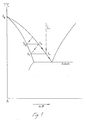
- the composition 1 1 of the solution is in accordance with the phase diagram of Figure 1.
- a cooling element By lowering a cooling element into this given location of the vessel, crystals of composition s l will freeze onto said element.
- the cooling element with the crystals frozen thereon is moved slowly towards the pure end of the vessel, during which movement the crystals melt from said element and form a melt of composition I 2 .
- a further cooling element onto which crystals of composition s 2 now freeze, whereafter the described sequence can be repeated a number of times further up the vessel, with further cooling elements nearer the pure end.
- the bath will adopt the desired composition gradient, with a practically pure solution at one end thereof and at the other end a solution which contains more of the dissolved substance than did the original solution, and the gradient can be maintained despite a tendency towards equilibrium, through natural diffusion processes.
- the solution to be separated out may now continually float into the horizontal, preferably elongate vessel at the location where the solution has a corresponding composition.
- the temperature of the input solution should be held at the same temperature as the solution in the vessel.
- a given part of the practically pure solvent A, roughly half, transported to the pure end of the vessel can be removed continuously therefrom, while a quantity of solution enriched in B and corresponding to the amount of pure A-solution removed can be tapped from the impure end of the vessel.
- Not all the amount of A transported to the pure end should be removed therefrom, since sufficient liquid should be left to flow back to the impure end of said vessel, in order to sustain a uniform flow of liquid in counter-flow to the crystals transported on the cooling elements.
- cooling elements which may be tubular or flat, are caused to move slowly along the whole length of the vessel, towards the so- called pure end thereof.
- the cooling elements are alternately cooled and heated, for example by means of a medium which flows through said elements, so as to cause crystals to form on said elements and to subsequently melt therefrom.
- the simplest method of cooling the elements is to blow a gas therethrough, and the elements can be heated by taking heat from the bath.
- At least two systems of cooling elements are provided, which effect a separate heat-exchange and between which a temperature differential is maintained, so as to enable crystals from the solution formed when melting crystals from the cooling elements of one system, to be formed on a nearby cooling element belonging to another system.
- said cooling elements are lifted from the solution and returned, externally of the vessel, to the impure end thereof, to then pass again through said vessel.
- the cooling elements can also be arranged to move forwards and backwards in the solution, said elements first moving forwards in a cool state with crystals frozen thereon, and then in a warmer state with the crystals melting therefrom, until reaching the pure end of the bath, whereupon the cooling elements are returned in the opposite direction.
- a single system of cooling elements is sufficient. With this embodiment however, there is a risk of turbulence in the solution, and if turbulence does occur, it is more difficult to maintain the concentration differentials in the various parts of the vessel.
- the cooling elements from which all crystals have melted can also be returned to the impure end of the vessel externally thereof, and in both embodiments the vessel may advantageously have the form of a trough, either in a straight form or a curved form, e.g. a circular form.
- the cooling elements comprise slowly rotating, substantially vertical members, which are immersed to almost half their height into the bath and which in Figures 2 and 3 are shown to be cylindrical discs.
- the discs are arranged to rotate so that that part thereof immersed in the bath moves towards the pure end of the vessel.
- the reference 1 identifies an elongate trough which contains a molten bath 2.
- Two cylindrical discs 3 are shown partially immersed in the bath.
- the discs 3 are carried on shafts 4 and are arranged to rotate on the shafts, at the centres 5 of the discs, as shown by the arrows R.
- That part 6 of a disc 3 protruding above the surface of the bath 2 is cooled by a gaseous cooling medium, to a temperature such that a layer 7 of metal crystals will freeze onto said part when it is rotated down into the bath 2.
- a gaseous cooling medium such that a layer 7 of metal crystals will freeze onto said part when it is rotated down into the bath 2.
- this freezing-out of crystals will cease, and the crystals will soon thereafter melt from the cooling elements, under the influence of the somewhat warmer ambient melt.
- the disc 3 has moved towards the pure end 8 of the trough 1, and the intended transport of the base metal to the pure end of the vessel has been accomplished.
- the speed at which the upper part 6 of the disc 3 rotates and the temperature to which it is chilled are adapted so that all crystals have fully melted from the disc just as it is about to leave the bath 2.
- the discs 3 may be provided with apertures, thereby to improve communication with the molten solution on different sides of the discs, and to increase the specific contact surface-area thereof.
- the melt to be purified is supplied to the trough at a temperature equal to the temperature of the bath 2 at that trough location at which the composition of the melt is the same as that of the melt supplied.
- this introduction of the melt to be purified is indicated by the arrow 12.
- the discs 3 may, to advantage, be arranged in groups, one group on a respective horizontal shaft, with all discs parallel with one another, so as to fill the entire trough 1.
- the top plan view of Figure 3 only shows the trough filled to half its length.
- the discs of one group overlap the discs of an adjacent group, so that the metal crystals which have melted from the discs of one group immediately come into contact with a cold disc in the next following group, and are able to form thereon the intended purer crystal coating. Since all the discs rotate in the same direction, the base metal is conveyed to the pure end 8 of the trough 1 as intended.
- the thermal capacity of the discs can be increased by making the discs thicker, thereby enhancing the ability of the discs to take the requisite solidifying temperature, it is possible that heat will be conducted away tangentially from discs of pronounced thickness, which is not to be desired. Consequently, it may be advantageous to replace the discs with other rotatable members, having rods or tubes which extend radially from a centre hub, as with a rimless spoked wheel.
- the cooling elements and the coolant are chosen respectively with respect to the nature of the melt and of the solution, such that when processing molten copper or aluminium for example, the cooling elements may be made of graphite while circulating, for example, an inert gas, such as nitrogen, as the coolant. In the case of silicon refinement, the cooling elements may be made of silica.
- the invention can also be applied to advantage for separating out for example, an aqueous solution into water and a more concentrated solution, e.g. for the desalination of sea water, all within the scope of the claims.
- organic solutions i.e. solutions containing an organic solvent
- This embodiment of the invention can therewith be applied for the purification by recrystallization, a methodology which is of particular interest within the technical fields of pharmacology and petro- chemistry.
- the method according to the invention was carried out in practice with the use of rotatable discs, in accordance with the Figure 3 embodiment.
- the trough had a length of 6 metres, a width of 0.65 m and a bath depth of 0.25 m.
- the discs were made of low-carbon steel and were 0.6 m in diameter.
- the discs were placed in groups of eight, and there was a total of sixteen groups.
- the discs were parallel to one another and were rotated at a speed of 1 r.p.m.
- the process concerned the separation of silver-containing lead having a silver content of 857 g/ton, into its component parts.
- the temperature of the trough was 331°C. Air was blown onto the upper parts of the discs, so as to cool the same to a temperature at which a layer of metal froze to said upper disc parts, to a thickness of about 2.5 mm, this frozen layer melting from the discs in the bath. It was calculated that about 45 kg of pure lead was transported each minute, of which quantity half was tapped off at the pure end of the vessel, said lead having a silver content of about 1.5 g/ton, while a silver-rich lead containing 10270 g/ton Ag was tapped off at the impure end of the vessel. For each ton of alloy, there was removed 923 kg of de-silvered lead and 77 kg of lead rich in silver. The plant had a capacity of 1.35 tons per hour, and 76 kWh energy were consumed per ton of input alloy.
Landscapes
- Chemical & Material Sciences (AREA)
- Engineering & Computer Science (AREA)
- Metallurgy (AREA)
- Physics & Mathematics (AREA)
- Organic Chemistry (AREA)
- Manufacturing & Machinery (AREA)
- Materials Engineering (AREA)
- Mechanical Engineering (AREA)
- Crystallography & Structural Chemistry (AREA)
- Thermal Sciences (AREA)
- Chemical Kinetics & Catalysis (AREA)
- Acoustics & Sound (AREA)
- Life Sciences & Earth Sciences (AREA)
- Environmental & Geological Engineering (AREA)
- General Life Sciences & Earth Sciences (AREA)
- Geology (AREA)
- Manufacture And Refinement Of Metals (AREA)
- Extraction Or Liquid Replacement (AREA)
- Organic Low-Molecular-Weight Compounds And Preparation Thereof (AREA)
Applications Claiming Priority (2)
| Application Number | Priority Date | Filing Date | Title |
|---|---|---|---|
| SE8301416 | 1983-03-15 | ||
| SE8301416A SE452026B (sv) | 1983-03-15 | 1983-03-15 | Forfarande for att separera losningar |
Publications (1)
| Publication Number | Publication Date |
|---|---|
| EP0119178A1 true EP0119178A1 (en) | 1984-09-19 |
Family
ID=20350380
Family Applications (1)
| Application Number | Title | Priority Date | Filing Date |
|---|---|---|---|
| EP19840850080 Withdrawn EP0119178A1 (en) | 1983-03-15 | 1984-03-12 | A method for separating solutions |
Country Status (5)
| Country | Link |
|---|---|
| US (1) | US4529444A (da) |
| EP (1) | EP0119178A1 (da) |
| AU (1) | AU2476484A (da) |
| DK (1) | DK78784A (da) |
| SE (1) | SE452026B (da) |
Cited By (1)
| Publication number | Priority date | Publication date | Assignee | Title |
|---|---|---|---|---|
| CN116555570A (zh) * | 2023-06-19 | 2023-08-08 | 湖南埃索凯未来能源研究院有限公司 | 一种低温低酸条件下从三元黑粉中浸出有价金属的方法 |
Families Citing this family (4)
| Publication number | Priority date | Publication date | Assignee | Title |
|---|---|---|---|---|
| DE19536827A1 (de) * | 1995-10-02 | 1997-04-03 | Basf Ag | Verfahren und Vorrichtung zur Trennung flüssiger eutektischer Mischungen durch Kristallisation an Kühlflächen |
| NL1023009C2 (nl) * | 2003-03-25 | 2004-09-30 | Univ Delft Tech | Werkwijze voor het winnen van een metaal uit een mengsel. |
| RU2307182C2 (ru) * | 2005-10-31 | 2007-09-27 | Институт физики прочности и материаловедения Сибирское отделение Российской академии наук (ИФПМ СО РАН) | Способ разделения циркония и гафния |
| US20100012597A1 (en) * | 2008-06-02 | 2010-01-21 | David Magdiel S | Frigid-reactance grease/oil removal system |
Citations (10)
| Publication number | Priority date | Publication date | Assignee | Title |
|---|---|---|---|---|
| DE413833C (de) * | 1923-06-04 | 1925-05-16 | Douglas Rider | Vorrichtung zur Waermebehandlung von Stoffen durch Beruehrung mit geschmolzenem Metall |
| DE712215C (de) * | 1938-01-13 | 1941-10-17 | Eduardo Michele Salerni | Vorrichtung zur Destillation oder zur Behandlung von Fluessigkeiten mit Gasen, und umgekehrt |
| US2739046A (en) * | 1952-08-06 | 1956-03-20 | Bell Telephone Labor Inc | Continuous process for separating fusible materials |
| US3449087A (en) * | 1966-06-27 | 1969-06-10 | Commerce Usa | Purification by selective crystallization and remelt |
| US3501275A (en) * | 1967-05-26 | 1970-03-17 | Inventa Ag | Apparatus for continuously separating mixtures of substances by multistage rectifying column crystallization |
| US3660043A (en) * | 1968-01-31 | 1972-05-02 | Herman Schildknecht | Method and device for feeding crystals and melts |
| US4043802A (en) * | 1974-09-30 | 1977-08-23 | Commonwealth Scientific And Industrial Research Organization | Continuous reflux refining of metals |
| US4133517A (en) * | 1974-09-30 | 1979-01-09 | Commonwealth Scientific And Industrial Research Organization | Continuous reflux refining of metals |
| US4138247A (en) * | 1976-07-19 | 1979-02-06 | Commonwealth Scientific And Industrial Research Organization | Method for promoting solids-liquid flow |
| EP0091386A1 (fr) * | 1982-03-30 | 1983-10-12 | Aluminium Pechiney | Procédé de purification de métaux par ségrégation |
Family Cites Families (4)
| Publication number | Priority date | Publication date | Assignee | Title |
|---|---|---|---|---|
| US2750262A (en) * | 1952-07-12 | 1956-06-12 | Bell Telephone Labor Inc | Process for separating components of a fusible material |
| US3239899A (en) * | 1962-05-04 | 1966-03-15 | Arthur F Johnson | Separating metals from alloys |
| US3400548A (en) * | 1965-06-25 | 1968-09-10 | Marathon Oil Co | Crystal separation of dimethylnaphthalene |
| US4231757A (en) * | 1978-06-02 | 1980-11-04 | The Lubrizol Corporation | Nitro phenol-amine condensates, methods of making same, fuels and additive concentrates containing them |
-
1983
- 1983-03-15 SE SE8301416A patent/SE452026B/sv not_active IP Right Cessation
-
1984
- 1984-02-17 US US06/581,193 patent/US4529444A/en not_active Expired - Fee Related
- 1984-02-20 DK DK78784A patent/DK78784A/da not_active Application Discontinuation
- 1984-02-21 AU AU24764/84A patent/AU2476484A/en not_active Abandoned
- 1984-03-12 EP EP19840850080 patent/EP0119178A1/en not_active Withdrawn
Patent Citations (10)
| Publication number | Priority date | Publication date | Assignee | Title |
|---|---|---|---|---|
| DE413833C (de) * | 1923-06-04 | 1925-05-16 | Douglas Rider | Vorrichtung zur Waermebehandlung von Stoffen durch Beruehrung mit geschmolzenem Metall |
| DE712215C (de) * | 1938-01-13 | 1941-10-17 | Eduardo Michele Salerni | Vorrichtung zur Destillation oder zur Behandlung von Fluessigkeiten mit Gasen, und umgekehrt |
| US2739046A (en) * | 1952-08-06 | 1956-03-20 | Bell Telephone Labor Inc | Continuous process for separating fusible materials |
| US3449087A (en) * | 1966-06-27 | 1969-06-10 | Commerce Usa | Purification by selective crystallization and remelt |
| US3501275A (en) * | 1967-05-26 | 1970-03-17 | Inventa Ag | Apparatus for continuously separating mixtures of substances by multistage rectifying column crystallization |
| US3660043A (en) * | 1968-01-31 | 1972-05-02 | Herman Schildknecht | Method and device for feeding crystals and melts |
| US4043802A (en) * | 1974-09-30 | 1977-08-23 | Commonwealth Scientific And Industrial Research Organization | Continuous reflux refining of metals |
| US4133517A (en) * | 1974-09-30 | 1979-01-09 | Commonwealth Scientific And Industrial Research Organization | Continuous reflux refining of metals |
| US4138247A (en) * | 1976-07-19 | 1979-02-06 | Commonwealth Scientific And Industrial Research Organization | Method for promoting solids-liquid flow |
| EP0091386A1 (fr) * | 1982-03-30 | 1983-10-12 | Aluminium Pechiney | Procédé de purification de métaux par ségrégation |
Cited By (1)
| Publication number | Priority date | Publication date | Assignee | Title |
|---|---|---|---|---|
| CN116555570A (zh) * | 2023-06-19 | 2023-08-08 | 湖南埃索凯未来能源研究院有限公司 | 一种低温低酸条件下从三元黑粉中浸出有价金属的方法 |
Also Published As
| Publication number | Publication date |
|---|---|
| DK78784A (da) | 1984-09-16 |
| SE8301416L (sv) | 1984-09-16 |
| AU2476484A (en) | 1984-09-20 |
| DK78784D0 (da) | 1984-02-20 |
| US4529444A (en) | 1985-07-16 |
| SE452026B (sv) | 1987-11-09 |
| SE8301416D0 (sv) | 1983-03-15 |
Similar Documents
| Publication | Publication Date | Title |
|---|---|---|
| KR101247666B1 (ko) | 실리콘 결정을 얻기 위한 실리콘 분말의 가공 방법 | |
| EP2212249B1 (en) | Process for the production of medium and high purity silicon from metallurgical grade silicon | |
| JPH04317423A (ja) | 白金族金属回収方法 | |
| JP4484699B2 (ja) | 溶融金属の結晶分別方法 | |
| CN101484596B (zh) | 从金属母液如铝液中提纯分离纯化金属的方法和装置 | |
| US4529444A (en) | Method for separating solutions | |
| JPH07206420A (ja) | 高純度ケイ素の製造方法 | |
| CN103667744A (zh) | 一种含Sn99.99%等级锡的生产方法 | |
| US7648559B2 (en) | Method for fractional crystallisation of a metal | |
| JP2553082B2 (ja) | 銅の精製方法 | |
| US2750262A (en) | Process for separating components of a fusible material | |
| JPH01306529A (ja) | 金属の連続精製法 | |
| WO1997003922A1 (en) | Process for producing high-purity silicon | |
| JPS5896829A (ja) | 金属の純化方法 | |
| EP0083615A1 (en) | A method for separating metals from alloys | |
| JPH0754062A (ja) | アルミニウムスクラップの精製方法 | |
| JPS5945739B2 (ja) | アルミニウムの精製方法 | |
| AU594784B2 (en) | Recovery of copper from copper/lead alloys | |
| Dunworth | Some Theoretical Factors in the Zone Melting Process | |
| CN118441155A (zh) | 一种区域熔炼提纯装置和方法 | |
| JPH0565549A (ja) | 金属の純化方法 | |
| Koike et al. | A Study on the Refining of Soft Solder. II. Removal of Antimony and Copper From Soft Solder by Addition of Al--Mg Alloy | |
| Kazachkov | An Investigation of the Process of Crystallization of Electroslag Remelted Bimetallic Ingots | |
| JPS59169908A (ja) | テルルの精製方法 | |
| JPH0723514B2 (ja) | 金属の純化装置 |
Legal Events
| Date | Code | Title | Description |
|---|---|---|---|
| PUAI | Public reference made under article 153(3) epc to a published international application that has entered the european phase |
Free format text: ORIGINAL CODE: 0009012 |
|
| AK | Designated contracting states |
Designated state(s): AT BE CH DE FR GB IT LI LU NL |
|
| STAA | Information on the status of an ep patent application or granted ep patent |
Free format text: STATUS: THE APPLICATION IS DEEMED TO BE WITHDRAWN |
|
| 17P | Request for examination filed |
Effective date: 19850402 |
|
| 18D | Application deemed to be withdrawn |
Effective date: 19870403 |
|
| RIN1 | Information on inventor provided before grant (corrected) |
Inventor name: LINDKVIST, GOERAN Inventor name: BJOERLING, KARL GOTTHARD EMANUEL |