EP0119573A1 - Procédé et dispositif de distribution de micro-gouttes - Google Patents
Procédé et dispositif de distribution de micro-gouttes Download PDFInfo
- Publication number
- EP0119573A1 EP0119573A1 EP84102658A EP84102658A EP0119573A1 EP 0119573 A1 EP0119573 A1 EP 0119573A1 EP 84102658 A EP84102658 A EP 84102658A EP 84102658 A EP84102658 A EP 84102658A EP 0119573 A1 EP0119573 A1 EP 0119573A1
- Authority
- EP
- European Patent Office
- Prior art keywords
- liquid
- pump
- pump element
- dispensed
- outlet orifice
- Prior art date
- Legal status (The legal status is an assumption and is not a legal conclusion. Google has not performed a legal analysis and makes no representation as to the accuracy of the status listed.)
- Withdrawn
Links
- 238000000034 method Methods 0.000 title claims abstract description 18
- 239000007788 liquid Substances 0.000 claims abstract description 88
- 229920001817 Agar Polymers 0.000 claims description 7
- 239000008272 agar Substances 0.000 claims description 7
- 238000010256 biochemical assay Methods 0.000 claims description 5
- 230000003252 repetitive effect Effects 0.000 claims description 2
- 238000003079 width control Methods 0.000 claims description 2
- 244000182067 Fraxinus ornus Species 0.000 claims 1
- 238000002306 biochemical method Methods 0.000 abstract description 2
- 239000002054 inoculum Substances 0.000 description 10
- 239000003153 chemical reaction reagent Substances 0.000 description 6
- 239000000463 material Substances 0.000 description 6
- 238000007641 inkjet printing Methods 0.000 description 5
- 230000005499 meniscus Effects 0.000 description 4
- 230000035939 shock Effects 0.000 description 4
- 230000000295 complement effect Effects 0.000 description 3
- 230000008021 deposition Effects 0.000 description 3
- 239000012530 fluid Substances 0.000 description 3
- -1 specimen Substances 0.000 description 3
- 229920002554 vinyl polymer Polymers 0.000 description 3
- 230000000712 assembly Effects 0.000 description 2
- 238000000429 assembly Methods 0.000 description 2
- 230000015572 biosynthetic process Effects 0.000 description 2
- HGAZMNJKRQFZKS-UHFFFAOYSA-N chloroethene;ethenyl acetate Chemical compound ClC=C.CC(=O)OC=C HGAZMNJKRQFZKS-UHFFFAOYSA-N 0.000 description 2
- 238000010586 diagram Methods 0.000 description 2
- 238000009472 formulation Methods 0.000 description 2
- 239000000203 mixture Substances 0.000 description 2
- 238000007639 printing Methods 0.000 description 2
- 238000011084 recovery Methods 0.000 description 2
- 238000007789 sealing Methods 0.000 description 2
- 239000004698 Polyethylene Substances 0.000 description 1
- 238000004458 analytical method Methods 0.000 description 1
- 238000004873 anchoring Methods 0.000 description 1
- 239000008280 blood Substances 0.000 description 1
- 210000004369 blood Anatomy 0.000 description 1
- 238000007906 compression Methods 0.000 description 1
- 230000006835 compression Effects 0.000 description 1
- 238000004590 computer program Methods 0.000 description 1
- 238000010276 construction Methods 0.000 description 1
- 238000013461 design Methods 0.000 description 1
- 238000011161 development Methods 0.000 description 1
- 230000018109 developmental process Effects 0.000 description 1
- 238000007599 discharging Methods 0.000 description 1
- 238000006073 displacement reaction Methods 0.000 description 1
- 239000011521 glass Substances 0.000 description 1
- 230000005484 gravity Effects 0.000 description 1
- 238000010348 incorporation Methods 0.000 description 1
- 238000011081 inoculation Methods 0.000 description 1
- 230000014759 maintenance of location Effects 0.000 description 1
- 230000003340 mental effect Effects 0.000 description 1
- 239000002184 metal Substances 0.000 description 1
- 210000003739 neck Anatomy 0.000 description 1
- 230000001717 pathogenic effect Effects 0.000 description 1
- 230000002093 peripheral effect Effects 0.000 description 1
- 229920000573 polyethylene Polymers 0.000 description 1
- 238000005086 pumping Methods 0.000 description 1
- 239000012858 resilient material Substances 0.000 description 1
- 238000012552 review Methods 0.000 description 1
- 210000002966 serum Anatomy 0.000 description 1
- 210000002700 urine Anatomy 0.000 description 1
- XLYOFNOQVPJJNP-UHFFFAOYSA-N water Substances O XLYOFNOQVPJJNP-UHFFFAOYSA-N 0.000 description 1
Images


Classifications
-
- B—PERFORMING OPERATIONS; TRANSPORTING
- B01—PHYSICAL OR CHEMICAL PROCESSES OR APPARATUS IN GENERAL
- B01L—CHEMICAL OR PHYSICAL LABORATORY APPARATUS FOR GENERAL USE
- B01L3/00—Containers or dishes for laboratory use, e.g. laboratory glassware; Droppers
- B01L3/02—Burettes; Pipettes
- B01L3/0241—Drop counters; Drop formers
- B01L3/0268—Drop counters; Drop formers using pulse dispensing or spraying, eg. inkjet type, piezo actuated ejection of droplets from capillaries
-
- G—PHYSICS
- G01—MEASURING; TESTING
- G01N—INVESTIGATING OR ANALYSING MATERIALS BY DETERMINING THEIR CHEMICAL OR PHYSICAL PROPERTIES
- G01N1/00—Sampling; Preparing specimens for investigation
- G01N1/28—Preparing specimens for investigation including physical details of (bio-)chemical methods covered elsewhere, e.g. G01N33/50, C12Q
- G01N1/2813—Producing thin layers of samples on a substrate, e.g. smearing, spinning-on
- G01N2001/282—Producing thin layers of samples on a substrate, e.g. smearing, spinning-on with mapping; Identification of areas; Spatial correlated pattern
-
- G—PHYSICS
- G01—MEASURING; TESTING
- G01N—INVESTIGATING OR ANALYSING MATERIALS BY DETERMINING THEIR CHEMICAL OR PHYSICAL PROPERTIES
- G01N35/00—Automatic analysis not limited to methods or materials provided for in any single one of groups G01N1/00 - G01N33/00; Handling materials therefor
- G01N35/10—Devices for transferring samples or any liquids to, in, or from, the analysis apparatus, e.g. suction devices, injection devices
- G01N2035/1027—General features of the devices
- G01N2035/1034—Transferring microquantities of liquid
- G01N2035/1041—Ink-jet like dispensers
Definitions
- This invention relates in general to the field of biochemistry and more particularly to an improved apparatus useful in biochemical applications for dispensing microdroplets of liquid reagent, specimen, inoculant, or other liquid.
- Apparatus capable of directing micro quantities of liquid ejected from an orifice toward a precise impact point on a target member spaced several centimeters away from the orifice has been developed in the ink jet printing art.
- a review of ink jet printing developments entitled "The Quiet Revolution in Ink Jet Printing", by Dr. E.V.W. Zschau can be found in the September 1978 issue of Digital Design, page 22 et seq. Kyser et al U.S. Patent No. 4,216,483 issued August 5, 1980 and Christou U.S. Patent No. 4,131,899 issued December 26, 1978 disclose examples of the drop-on-demand type of ink jet printing apparatus.
- the apparatus of the present invention is particularly well adapted for use in biochemical applications by virtue of the incorporation therein of a removably mounted disposable pump element providing a receptacle for the liquid to be dispensed.
- the pump element can conveniently function as a sample handling container for a liquid specimen to be dispensed therefrom, such as a sample of urine, serum, or blood.
- the pump element can be marketed with a selected liquid to be dispensed therefrom, such as a liquid reagent or inoculant, prepackaged therein and ready for use.
- the pump element is a low cost item which is disposed of after use, and the apparatus has actuating means cooperable . with the pump element when the latter is placed in operative position, but which does not come in contact with the liquid being dispensed.
- the apparatus is provided with means for mounting a receptacle or target member, such as a petri dish or other target member, for movement along linear coplanar paths normal to each other.
- a receptacle or target member such as a petri dish or other target member
- This permits, for example, inoculation of discrete surface portions of an agar medium in a petri dish with preselected microquantities of liquid reagent, inoculant or specimen. This is done by dispensing onto each such surface portion the number of microdroplets of the liquid required to provide the quantity thereof preselected for the respective surface portion.
- the apparatus is adapted for use with a variety of biochemical methods which can involve dispensing of a variety of different liquids in a variety of different microquantities, depending upon the method practiced.
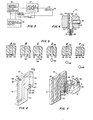
- the major elements of the microdroplet dispenser illustrated therein are a removably mounted pump element 10, pump actuating means 11, and movable mounting means 12 for a petri dish or other target member 13.
- the dispenser of Figure 1 is provided with a base member 14 having a generally planar upper surface and on which is mounted an upstanding vertical support member 15.
- a cantilevered horizontal supporting bar 16 Suitably fixed at one end to the upper end of the support member 15 is a cantilevered horizontal supporting bar 16 which is formed with a longitudinally extending slot 17.
- Fixed to the other end of the bar 16, as by screws 18, is a clamp body member 19 formed in its outer vertical face with a vertical semicylindrical goove 20, best shown in Figure 4.
- the member 19 is also formed with a horizontal bore 21 which radially intersects the semicylindrical groove 20 as shown in Figures 2 and 4.
- a clamping member 22 which is removably fixed thereto, as by screws 23.
- the inner vertical face of the clamping member 22 is forced with a vertical semicylindrical groove 24 which is complemental to the semicylindrical groove 20 in the clamp body 19.
- the pump element 10 shown in Figures 1 and 2 comprises a generally U-shaped main body member 25 having generally vertically extending legs 26 and 27.
- the pump element 10 is held in the operative position shown by virtue of the leg 26 extending through the cylindrical bore formed by the comple mental semicylindrical grooves 20 and 24 in clamp body 19 and clamping member 22, respectively,
- the leg 26 is clamped adjacent its lower end, and a minor portion thereof projects below the clamp body 19 and clamping member 22 as shown.
- Telescopically fitted within the lower end of the leg 26 is a cylindrical outlet orifice member 28 formed with a restricted coaxial bore or outlet orifice 29.
- the pump element 10 is provided with a deformable resilient wall portion which, in the form of the invention illustrated in Figures 1 and 3, is provided in the portion of the leg 26 clamped between the clamp body 19 and clamping member 22.
- the illustrated member 25 is formed of an extent of resilient deformable tubing, for example, tubing made of organoplastic material such as plasticized polyvinyl cloride tubing; however, it will be understood that the portions of the member 25 not clamped between the clamp body 19 and clamping member 22 can be formed of rigid material, for example rigid organoplastic, glass or other suitable material.
- One form of pump element 10 which has been found to work satisfactorily has a main body member 25 formed of a length of plasticised polyvinyl cloride tubing in the U-shaped configuration illustrated in Figures 1 and 2.
- the tubing used in member 25 was Tygon ® formulation R-3603 available from the Norton Company, Worcester, Mass.10606. This tubing has a nominal inside diameter of .0625 inch and a nominal outside diameter of .125 inch.
- the outlet orifice member 28 is formed of a cylindrical extent of Tygon @ vinyl tubing manufactured by the Norton Company for Technicon Corporation, Tarrytown, Y.Y. 10591 and is available from the latter as Part No. 116-0536-01.
- the member 28 has a length of .187 inch, an outside diameter of .072 inch, and a bore or restricted outlet orifice 29 having a diameter of .0025 to .007 inch.
- the outlet orifice member 28 is telescopically press-fitted within the lower end of the leg 26 of main body member 25; however, it will be understood that any other suitable means for connecting the member 28 to the lower end of the leg 26 may be utilized to join the member 28 to said leg.
- the pump actuating means 11 takes the form of an electromagnetic solenoid assembly. More specifically, an adjustably mounted base plate or carriage member 30 is carried by and suitably secured to the horizontal supporting bar 16, for example by a pair of screws (not shown) which extend from the underside of the bar 16 through the slot 17 and are threaded into the carriage member 30.
- a generally U-shaped metal frame member 31 is fixedly mounted on carriage member 30 and has spaced parallel upstanding flange portions 32 and 33, the flange 32 being apertured to receive a horizontally extending sleeve bearing 34 press-fitted therein.
- a solenoid coil 35 is interposed between the flanges 32 and 33 coaxially with the sleeve bearing 34, and a solenoid armature or pump element engaging member 36 extends through the coil 35 and sleeve bearing 34 and also projects outwardly through an aperture (not shown) in the flange 33.
- the armature 36 is cylindrical in shape and at its forward end slidably extends into the horizontal bore 21 in the clamp body member 19. Adjacent it rear end the armature 36 has a washer 37 fixed thereon, and a helical compression spring 38 surrounds the armature 36, abutting the flange 33 at one end and the washer 37 at its other end.
- the spring 38 biases the armature 36 rearwardly, i.e., toward the right, as viewed in Figures 1 and 2.
- An adjustably mounted stop member 39 in the form of an upstanding bar is suitably secured to the horizontal supporting bar 16, for example by a pair of screws (not shown) extending upwardly from the underside of bar 16 through the slot 17 and threaded into the member 39.
- the rear end of the armature 36 is biased into engagement with the stop member 39 by the spring 38 to thereby define the retracted position of the armature.
- An adjustment screw 40 is threaded through an internally threaded horizontal bore in the stop member 39 and abuts an upstanding flange portion 41 formed on the carriage 30.
- the armature 36 is moved axially forward against the bias of the spring 38 by energization of the solenoid coil 25, and the projected position of the armature is defined by abutment with the inner end of the sleeve bearing 34 of a shoulder (not shown) formed on the armature 36.
- Adjustment of the projected position of the armature 36 can be effected by loosening the screws (not shown) threaded into the carriage member 30, turning the adjustment screw 40 to a new position, with corresponding movement of the carriage member 30 as necessary to maintain contact of the flange 41 with the screw 40, and then fixing the carriage member 30 in the new position of adjustment by means of the securing screws (not shown) aforementioned.
- the retracted position of the solenoid armature 36 is defined by abutment of the rear end thereof with the adjustable stop member 39.
- Such retracted position can be adjusted by loosening the screws (not shown) anchoring the stop member 39 to the bar 16 and moving the member 39 in the selected direction along the supporting bar 16 toward or away from the solenoid 11, while at the same time turning the adjustment screw 40 as necessary to permit such movement.
- the stop member 39 is then reanchored to the bar 16 in its new position by means of the securing screws (not shown) aforementioned.
- the adjustable mounting means 12 for the petri dish or other target member 13 comprises a pair of spaced parallel rail members 42 and 43 mounted on the base member 14. Slidably mounted on the rail members 42 and 43 for movement longitudinally thereof is a first carriage member 44.
- An upstanding boss 45 is formed on the upper surface of the base member 14 and is formed with an internally threaded horizontal bore 46, the axis of which is generally parallel to the rails 42 and 43 and to the path of movement of carriage 44.
- a lead screw 47 which may have a manually engageable knurled head 48 at its outer end is threaded through the bore 46 in boss 45. At its inner end the lead screw 47 is preferably rotatably anchored to the carriage 44 so that rotation of the screw 47 in one direction moves the carriage away from the boss 45, and rotation thereof in the opposite direction moves the carriage 44 toward the boss 45.
- the upper surface of the carriage 44 is formed with a transverse groove 49 which provides a slideway for a second carriage member 50 slidable therein in a horizontal direction normal to the direction of slidable movement of the carriage 44.
- Fixed on the carriage 44 at one end of the slideway 49 is an upstanding boss 52 which is formed with a horizontal internally threaded bore 52 having a lead screw 53 threaded therethrough.
- the lead screw 53 may be formed at its outer end with a manually engagable knurled head 54, and at its inner end is preferably rotatably anchored to the carriage 50.
- Figure 3 illustrates in block diagram typical electrical circuitry for energization of the solenoid coil 35 and resultant forward or projectile movement of the armature 36 against the bias of the helical return spring 38.
- the circuit in Figure 3 comprises a variable direct current voltage power supply 55, a variable frequency pulse generator 56, and a variable pulse width control 57.
- variable frequency pulse generator 56 selectively provides for a single energizing pulse or a selected series of repetitive energizing pulses having a selected repetition rate.
- Figure 4 illustrates on an enlarged scale the projected position to which the forward end of the armature 36 is moved in response to an energizing electrical pulse supplied to the coil 35.
- the velocity of its projectile movement is such that when its forward end strikes the adjacent wall portion of the tubular pump element leg 26 at the shock mode point illustrated, it cause impactual inward deformation thereof in an amount of about .002 to .003 inch, as illustrated in an exaggerated form in Figure 4.
- the armature 36 Upon cessation of the energizing pulse, the armature 36 is returned to its retracted position by the spring 38, and upon such return movement, the resiliency of the material from which the pump leg 26 is made returns the inwardly deformed wall portion to its normal unstressed condition, i.e., the inwardly deformed tubing wall portion returns to its normal cylindrical configuration.
- the liquid to be dispensed is loaded into the pump element 10. This can be accomplished, for example, by inserting the tip of a pipette containing the liquid into the open end of the leg 27, and while holding the pump element 10 such that the outlet orifice member 28 is slightly above the aforementioned end of the leg 27, discharging the contents of the pipette into the pump element, displacing the contained air without causing any air bubble inclusions in the entering liquid.
- An amount of liquid somewhat less than the total volume of the pump element 10 is introduced, for example 250 microliters of liquid, and the end of the leg 27 is then raised above the level of the outlet orifice member 28 to permit gravity to cause the liquid to flow to the outlet orifice 29. Capillary forces in the outlet orifice 29 prevent the liquid from flowing out of the orifice.
- the pump element 10 After loading with liquid, the pump element 10 is clamped in the operative or dispensing position thereof illustrated in Figures 1 and 2. In this position the end of the pump element leg 27 projects somewhat below the level of the outlet orifice member 28, and the shock mode point at which the axis of the solenoid plunger 36 intersects leg 26 is about .406 inch above the outer end of the orifice 29.
- the pump element 10 thus provides a chamber or rece p t-acle for accomodation of the liquid to be dispensed, and it also provides a siphon-type connection between the liquid adjacent the outlet orifice member 28 and that within the leg 27, such that a slight negative pressure in the liquid is created at the outlet of orifice 29, and a negative meniscus is produced at said outlet.
- the solenoid coil 35 may be energized with a single pulse of energy from the power supply 55, for example, a direct current pulse having an amplitude of 5 volts and a width of 16 milliseconds.
- a direct current pulse having an amplitude of 5 volts and a width of 16 milliseconds.
- This causes the armature 36 to be thrust toward the leg 26 of the pump element 10 to the position thereof shown in Figure 4 which illustrates the resulting inward impactual deformation of the wall portion at the shock mode point shown.
- This impactual deformation produces a pressure pulse within the liquid in the pump element 10 at an empirically determined mode.
- the liquid displacement caused by this pressure pulse results in liqid flow toward the orifice 29, as well as in the opposite direction.
- Fluid flow impedance toward the orifice end is a function of the viscosity of the liquid, the orifice diameter, and the liquid mass inertia. Fluid flow impedance in the opposite direction is a function of the liquid viscosity, the tube diameter and the liquid mass inertia.
- the liquid flow toward the orifice 29 is effective to cause high velocity emission of single microdroplet of liquid from the orifice 29, and deposition thereof on a target member therebelow, for example on the surface of a layer of agar in the petri dish 13.
- the diameter of the orifice 29 is the predominant factor affecting the size of the emitted microdroplet.
- the diameter of the emitted microdroplet approximates the diameter of the orifice 29 but is also influenced by other factors such as orifice wettability, liquid viscosity, temperature, internal pressure, and the rheological characteristics of the liquid. It has been calculated that for the apparatus thus far described, when the diameter of the orifice 29 is .0027 inch and the liquid being dispensed it water, the volume of the emitted microdroplet is 3 x 10⁻⁹ liter, i.e., 3 billionths of a liter.
- Figure 5 illustrates the formation and emission from the orifice 29 of a microdroplet.
- Views A through F illustrate the sequence of events observed by illuminating the orifice with a stroboscopic light and viewing the events with a steroscopic microscope.
- View A illustrates the system at rest, wherein liquid 66 has a concave meniscus 55 at the outer end of orifice 29, due at least in part to the negative internal pressure thereat aforementioned, the surface tension forces acting on the liquid at the meniscus preventing backflow.
- the solenoid plunger 36 Upon impact of the solenoid plunger 36 with the tubular leg 26 of the pump member 10, the resultant impactual wall deformation and pressure pulse in the liquid causes projection of a microquantity stream of liquid 66 from the orifice 29 as shown in View B.
- the projected liquid stream is very unstable and necks, as shown at 67 in View C, due to surface tension, ultimately forming a free microdroplet 68 as shown in View D.
- the energizing pulse is of short duration, and upon termination thereof the solenoid plunger 36 is returned to its retracted position, allowing the deformed wall portion of the leg 26 to return to its original cylindrical configuration.
- This causes the liquid 66 to be momentarily drawn back into the orifice 29 as shown in View E, while at the same time the free microdroplet 68 becomes more round due to surface tension forces, assuming a slightly elongated raindrop shape in free trajectory due to aerodynamic influence.
- Capillary attraction and meniscus surface tension at this point overcome the negative internal pressure, causing the liquid 66 to flow back down toward the outer end of the orifice 29 as shown in View F, replacing the microquantity of the droplet 68 emitted and thereby completing the micro- droplet emitting cycle.
- any selected number of droplets can be dispensed.
- the maximum dispensing rate achieved was 35 microdroplets per second.
- the maximum dispensing rate is determined by the elastic recovery time of the tubing used in the pump element 10. By using in the pump element 10 less resilient materials having a more rapid elastic recovery time, for example polyethylene, the microdroplet dispensing rate can be increased.
- the apparatus thus far described is particularly well adapted for use in biochemical assay procedures. More particularly, the apparatus makes possible improved methods in which discreet surface portions of an agar medium or the like are inoculated with preselected micro quantities of liquid by deposition onto each of such surface portions the number of micro droplets of liquid required to provide the quantity thereof preselected for the respective surface portion. For example, a row or series of rectilinearly aligned discrete surface portions on an agar layer in the dish 13 can be separately inoculated by placing the first surface portion in the row underneath the outlet orifice 29 and dispensing the desired number of micro droplets of inoculant thereon.
- the petri dish 13 can be moved either to the left or to the right, as viewed in Figure 1, so that another row of rectilinearly aligned discrete surface portions whose alignment is parallel with that of the axis of the lead screw 47 can be inoculated by repeating the procedure described for the first series.
- the operation of the lead screws 47 and 53 can, if desired, be connected for operation by suitable drive means coordinated with the energization of the solenoid coil 35 under computer control so that parallel rows of discrete surface portions of an agar medium in the dish 13 can be inoculated in a controlled manner on an x-y axis in accordance with the program of the controlling computer.
- suitable drive means coordinated with the energization of the solenoid coil 35 under computer control so that parallel rows of discrete surface portions of an agar medium in the dish 13 can be inoculated in a controlled manner on an x-y axis in accordance with the program of the controlling computer.
- the pump element 10 is of such simple construction and low material cost that it readily can be a one time use, disposable item.
- the pump element 10 could readily be marketed with a reagent, inoculant, or other liquid to be dispensed therefrom prepackaged therein, in which case suitable readily removable sealing means (not shown) would be provided for retention of the contained liquid within the pump element until it is about to be placed in operative position in the dispensing apparatus. At that time the removable sealing means is removed. After dispensing of the liquid from the elanent 10, it can be disposed of and replaced by another having the appropriate liquid therein.
- Figures 6 and 7 illustrate a modified form of disposable pump element 10'.
- Figure 7 shows the element 10' in vertical section and mounted in operative position on the dispensing apparatus of Figures 1 and 2.
- the illustrated element 10' has a body which is generally rectangular in shape and has a cutaway portion defining a vertical edge surface 59 and a horizontal edge surface 60.
- the element 10' is also formed with a vertical reservoir 61 having a top opening 62 and with a vertical bore 63 communicating with the horizontal edge surface 60. Connecting the upper end of the bore 63 with the lower end of the reservoir 61 is a generally U-shaped passageway or conduit 64.
- An extent of resilient deformable tubing 26' has its upper end telescopically sealed within the bore 63 and has press-fitted into its lower end a cylindrical outlet orifice member 28' having a coaxial bore or restricted outlet orifice 29'.
- the extent of tubing 26' and outlet orifice member 28' may be,the same as the portion of the leg 26 and outlet orifice member 28 shown in Figure 4.
- the body of the pump element 10' may be molded of organoplastic material in two complementary halves, one half of which is shown in Figure 7. Such complementary halves are suitably joined together to form the single body unit of the pump element 10' shown in Figure 6.
- the liquid to be dispensed is placed in the reservoir 61, and the element 10' is tipped to cause the liquid to flow to the orifice 29'.
- the element 10' is then placed in the operative or dispensing position wherein the tube 26' is clamped between the clamp body member 19 and the clampling member 22 as shown in Figure 7.
- the horizontal edge surface 60 provides shoulder means which overlies and cooperates with the upper surfaces of the clamp members 19 and 22 to define the vertical position of the lower end of the restricted outlet orifice 29' with respect to the axis of the solenoid plunger 36.
- each pump element 10' when placed in operative position, has the tube portion 26' thereof subject to impact by the solenoid plunger 36 at a shock mode point which is located at a'predetermined distance from the lower end of the outlet orifice 29'.
- the pumping action of the pump element 10' and the dispensing of microdroplets of liquid from the outlet orifice 29' thereof are similar to those of the pump element 10.
- Figure 8 illustrates another embodiment of the micro- droplet dispenser of the present invention wherein parts indicated by primed reference characters correspond to similar parts indicated by the same reference characters unprimed in previously referred to figures of the drawings.
- the movable mounting means 12' for a petri dish or other target member 13' is the same as the movable mounting means 12 for the petri dish 13 in Figure 1.
- the horizontal supporting bar 16 of Figure 1 is replaced in Figure 8 by a rotatably mounted table 16' formed with an annular upstanding peripheral rim portion 69 which has formed thereon a plurality of spaced, radially outwardly projecting boss portions 19' corresponding to the clamp body member 19 of Figure 1, as well as a corresponding number of spaced, radial bores 21' therethrough.
- the bosses 19' are provided with a complementary clamping members 22', corresponding to the clamping member 22 in Figure 1, removably secured thereto by means of screws 23' which correspond to the screws 23 in Figure 1. It will be observed that the bosses 19' and clampling members 22 are formed with comple- , mentary semicylindrical grooves 20' and 24' corresponding to grooves 20 and 24 shown in Figures 1, 2, and 4.
- the disposable pump elements 10' shown in Figure 8 are the same as the pump element 10' shown in Figures 6 and 7, and are mounted on the table 16' in the same manner that the element 10' is mounted in Figure 7. It will be observed that the table 16' illustrated in Figure 8 is built to accommodate a plurality of pump elements 10'.
- a pair of solenoid assemblies 11' are shown in Figure 8, and these correspond to the solenoid assembly 11 in Figure 1, differing therefrom in minor respects. While only two solenoid assemblies 11' are illustrated, it is understood that a separate solenoid assembly 11' may be employed at each boss 19' and cooperating clamping member 22', each set of the latter being adapted to clampingly mount a separate pump element 10' in operative position on table 16'.
- a plurality of pump elements 10' which may contain the same or different inoculants or other liquids to be dispensed therefrom, can, by rotation of the table 16', selectively be brought into position for dispensing of microdroplets of liquid therefrom onto the petri dish or other target member 13' carried by the adjustable mounting 12'.
- the apparatus of the present invention makes possible the practice of a variety of biochemical assay procedures not possible heretofore.
- a method can be practiced in which the same liquid is applied to a number of surface portions in a given row or series of surface portions on an agar medium contained in the petri dish, and the microquantity of such liquid applied to adjacent pairs of said surface portions can be the same or different.
- the method practiced may involve application to one surface portion in a given row of a liquid which is different from that applied to a next adjacent surface portion, and which is applied in the same or a different microquantity.
- the method practiced may involve application to one row of surface portions of a liquid which is the same as or different from that applied to the surface portions in a next adjacent spaced parallel row, and which is applied to a given surface portion in a microquantity which is the same as or different from that applied to a next adjacent surface portion in the same row or series.
- the means for actuating the pump element engaging member 36 of the pump actuating means is electroresponsive and more particularly electromagnetic.
- the invention contemplates the use of other suitable forms of actuating means.
- the pump element engaging member can, if desired, be actuated by fluid pressure operated means, such as a pneumatic ram, or by electroacoustic means, such as a piezoelectric transducer.
Landscapes
- Health & Medical Sciences (AREA)
- Clinical Laboratory Science (AREA)
- Chemical & Material Sciences (AREA)
- Chemical Kinetics & Catalysis (AREA)
- Automatic Analysis And Handling Materials Therefor (AREA)
- Ink Jet (AREA)
- Sampling And Sample Adjustment (AREA)
Applications Claiming Priority (2)
| Application Number | Priority Date | Filing Date | Title |
|---|---|---|---|
| US47732983A | 1983-03-21 | 1983-03-21 | |
| US477329 | 1983-03-21 |
Publications (1)
| Publication Number | Publication Date |
|---|---|
| EP0119573A1 true EP0119573A1 (fr) | 1984-09-26 |
Family
ID=23895464
Family Applications (1)
| Application Number | Title | Priority Date | Filing Date |
|---|---|---|---|
| EP84102658A Withdrawn EP0119573A1 (fr) | 1983-03-21 | 1984-03-12 | Procédé et dispositif de distribution de micro-gouttes |
Country Status (3)
| Country | Link |
|---|---|
| EP (1) | EP0119573A1 (fr) |
| JP (1) | JPS59188539A (fr) |
| AU (1) | AU2519184A (fr) |
Cited By (34)
| Publication number | Priority date | Publication date | Assignee | Title |
|---|---|---|---|---|
| EP0219177A3 (en) * | 1985-10-18 | 1987-10-07 | Philips Patentverwaltung Gmbh | Method and apparatus for applying droplets of adhesive to a surface |
| JPS63139253A (ja) * | 1986-11-17 | 1988-06-11 | アボット・ラボラトリーズ | 試薬液の調合及びプリントのための装置及び方法 |
| WO1989010192A1 (fr) * | 1988-04-22 | 1989-11-02 | Sohrab Darougar | Appareil de depot |
| EP0421406A3 (en) * | 1989-10-04 | 1992-01-15 | Canon Kabushiki Kaisha | Apparatus and method for separating or measuring particles to be examined in a sample fluid |
| EP0469444A1 (fr) * | 1990-08-02 | 1992-02-05 | Roche Diagnostics GmbH | Procédé et dispositif pour appliquer des doses de réactifs biochimiques sur un support |
| WO1992018608A1 (fr) * | 1991-04-16 | 1992-10-29 | Amersham International Plc | Procede de formation d'un groupement de particules biologiques |
| WO1993001485A1 (fr) * | 1991-07-12 | 1993-01-21 | Graseby Dynamics Limited | Systeme d'echantillonnage de fluide |
| US5275787A (en) * | 1989-10-04 | 1994-01-04 | Canon Kabushiki Kaisha | Apparatus for separating or measuring particles to be examined in a sample fluid |
| FR2694570A1 (fr) * | 1992-08-06 | 1994-02-11 | Jalenques Francois | Procédé et appareil d'ensemencement de solutions sur un milieu de culture possédant des possibilités de programmation du type de dépôt de la solution. |
| US5356034A (en) * | 1992-01-30 | 1994-10-18 | Boehringer Mannheim Gmbh | Apparatus for the proportioned feeding of an analysis fluid |
| US5378638A (en) * | 1990-08-02 | 1995-01-03 | Boehringer Mannheim Gmbh | Analysis element and process for its manufacture |
| US5424220A (en) * | 1992-01-31 | 1995-06-13 | Boehringer Mannheim Gmbh | Analysis element and method for determination of an analyte in a liquid sample |
| WO1997001085A1 (fr) * | 1995-06-21 | 1997-01-09 | Pharmacia Biotech Ab | Cellule d'echantillonnage a ecoulement continu et son utilisation |
| WO1997016251A1 (fr) * | 1995-11-01 | 1997-05-09 | Tecan Ag | Pipettage automatise de petits volumes |
| US5763170A (en) * | 1991-04-16 | 1998-06-09 | Amersham International Plc | Method for forming an array of biological particles |
| WO1998036833A1 (fr) * | 1997-02-24 | 1998-08-27 | Roche Diagnostics Gmbh | Systeme de fabrication d'elements multiples pour tests de diagnostic |
| US5927547A (en) * | 1996-05-31 | 1999-07-27 | Packard Instrument Company | System for dispensing microvolume quantities of liquids |
| US6203759B1 (en) | 1996-05-31 | 2001-03-20 | Packard Instrument Company | Microvolume liquid handling system |
| US6277334B1 (en) * | 1994-09-21 | 2001-08-21 | Isis Pharmaceuticals, Inc. | Chemical synthesis apparatus employing a droplet generator |
| WO2002065121A1 (fr) * | 2001-02-14 | 2002-08-22 | Evotec Oai Ag | Dispositif de distribution |
| US6465190B1 (en) | 1999-10-22 | 2002-10-15 | Ngk Insulators, Ltd. | Method for producing DNA chip |
| US6521187B1 (en) | 1996-05-31 | 2003-02-18 | Packard Instrument Company | Dispensing liquid drops onto porous brittle substrates |
| US6537817B1 (en) | 1993-05-31 | 2003-03-25 | Packard Instrument Company | Piezoelectric-drop-on-demand technology |
| EP1405672A3 (fr) * | 2000-08-24 | 2004-10-20 | Roland Prof. Dr. Zengerle | Dispositif et procede pour deposer sans contact des microgouttelettes sur un substrat |
| WO2006048643A1 (fr) * | 2004-11-03 | 2006-05-11 | Norgren Limited | Systeme de distribution de liquide |
| CN100428998C (zh) * | 2003-08-14 | 2008-10-29 | 赫尔曼·桑德迈尔 | 微计量装置和用于液体的计量分配的方法 |
| US7811751B2 (en) | 1988-05-03 | 2010-10-12 | Oxford Gene Technology Limited | Analysing polynucleotide sequences |
| US7888494B2 (en) | 1988-05-03 | 2011-02-15 | Oxford Gene Therapy Limited | Analysing polynucleotide sequences |
| WO2011141357A1 (fr) * | 2010-05-12 | 2011-11-17 | Tecan Trading Ag | Distributeur et procédé pour la distribution de matériaux fluides ou coulants |
| DE102013224453A1 (de) * | 2013-11-28 | 2015-05-28 | Marco Systemanalyse Und Entwicklung Gmbh | Ventil zur Dosierung von Medien im Kleinstmengenbereich |
| EP3450020A1 (fr) | 2017-09-01 | 2019-03-06 | Eppendorf AG | Dispositif de microdosage permettant le dosage de plus petits échantillons de fluide |
| EP3485974A1 (fr) | 2017-11-17 | 2019-05-22 | Eppendorf AG | Dispositif de microdosage permettant le dosage de plus petits échantillons de fluide |
| CN111423976A (zh) * | 2020-04-10 | 2020-07-17 | 太原师范学院 | 一种微生物无菌接种装置 |
| CN113426635A (zh) * | 2021-08-26 | 2021-09-24 | 常州铭赛机器人科技股份有限公司 | 可微量出胶的挤压阀 |
Families Citing this family (1)
| Publication number | Priority date | Publication date | Assignee | Title |
|---|---|---|---|---|
| US9416776B2 (en) * | 2013-03-15 | 2016-08-16 | Siemens Healthcare Diagnostics Inc. | Microfluidic distributing device |
Citations (3)
| Publication number | Priority date | Publication date | Assignee | Title |
|---|---|---|---|---|
| US3250130A (en) * | 1963-12-02 | 1966-05-10 | Lozano Federico Martinez | Liquid sampler |
| DE2037427A1 (en) * | 1969-07-28 | 1971-03-04 | Nat Res Dev | Automatic sample dropper |
| FR2299625A1 (fr) * | 1975-01-08 | 1976-08-27 | Eastman Kodak Co | Recipient, appare |
Family Cites Families (5)
| Publication number | Priority date | Publication date | Assignee | Title |
|---|---|---|---|---|
| JPS5543780Y2 (fr) * | 1976-07-08 | 1980-10-15 | ||
| US4159123A (en) * | 1977-08-18 | 1979-06-26 | Petty Preston L | Motorcycle braking mechanism including means for controlling telescoping action of the front fork means |
| JPS5841094B2 (ja) * | 1980-07-28 | 1983-09-09 | コニカ株式会社 | 液体計量供給装置 |
| FR2544127B1 (fr) * | 1983-04-06 | 1985-12-13 | Thomson Csf | Canon a electrons pour generateurs d'ondes radioelectriques pour hyperfrequences |
| JPS611399U (ja) * | 1984-06-12 | 1986-01-07 | 澄雄 愛敬 | 豆腐スライス用器具 |
-
1984
- 1984-03-01 AU AU25191/84A patent/AU2519184A/en not_active Abandoned
- 1984-03-12 EP EP84102658A patent/EP0119573A1/fr not_active Withdrawn
- 1984-03-16 JP JP4939584A patent/JPS59188539A/ja active Pending
Patent Citations (3)
| Publication number | Priority date | Publication date | Assignee | Title |
|---|---|---|---|---|
| US3250130A (en) * | 1963-12-02 | 1966-05-10 | Lozano Federico Martinez | Liquid sampler |
| DE2037427A1 (en) * | 1969-07-28 | 1971-03-04 | Nat Res Dev | Automatic sample dropper |
| FR2299625A1 (fr) * | 1975-01-08 | 1976-08-27 | Eastman Kodak Co | Recipient, appare |
Non-Patent Citations (1)
| Title |
|---|
| PATENTS ABSTRACTS OF JAPAN, vol. 6, no. 8(P-98)(886), 19th January 1982; & JP - A - 56 135 160 (HITACHI SEISAKUSHO K.K.) 22-10-1981 * |
Cited By (50)
| Publication number | Priority date | Publication date | Assignee | Title |
|---|---|---|---|---|
| EP0219177A3 (en) * | 1985-10-18 | 1987-10-07 | Philips Patentverwaltung Gmbh | Method and apparatus for applying droplets of adhesive to a surface |
| JPS63139253A (ja) * | 1986-11-17 | 1988-06-11 | アボット・ラボラトリーズ | 試薬液の調合及びプリントのための装置及び方法 |
| EP0268237A3 (en) * | 1986-11-17 | 1988-11-30 | Abbott Laboratories | Apparatus and process for reagent fluid dispensing and printing |
| AU603617B2 (en) * | 1986-11-17 | 1990-11-22 | Abbott Laboratories | Apparatus and process for reagent fluid dispensing and printing |
| WO1989010192A1 (fr) * | 1988-04-22 | 1989-11-02 | Sohrab Darougar | Appareil de depot |
| US7811751B2 (en) | 1988-05-03 | 2010-10-12 | Oxford Gene Technology Limited | Analysing polynucleotide sequences |
| US7888494B2 (en) | 1988-05-03 | 2011-02-15 | Oxford Gene Therapy Limited | Analysing polynucleotide sequences |
| US5275787A (en) * | 1989-10-04 | 1994-01-04 | Canon Kabushiki Kaisha | Apparatus for separating or measuring particles to be examined in a sample fluid |
| EP0421406A3 (en) * | 1989-10-04 | 1992-01-15 | Canon Kabushiki Kaisha | Apparatus and method for separating or measuring particles to be examined in a sample fluid |
| EP0469444A1 (fr) * | 1990-08-02 | 1992-02-05 | Roche Diagnostics GmbH | Procédé et dispositif pour appliquer des doses de réactifs biochimiques sur un support |
| US5378638A (en) * | 1990-08-02 | 1995-01-03 | Boehringer Mannheim Gmbh | Analysis element and process for its manufacture |
| US5338688A (en) * | 1990-08-02 | 1994-08-16 | Boehringer Mannheim Gmbh | Method for the metered application of a biochemical analytical liquid to a target |
| WO1992018608A1 (fr) * | 1991-04-16 | 1992-10-29 | Amersham International Plc | Procede de formation d'un groupement de particules biologiques |
| US5763170A (en) * | 1991-04-16 | 1998-06-09 | Amersham International Plc | Method for forming an array of biological particles |
| WO1993001485A1 (fr) * | 1991-07-12 | 1993-01-21 | Graseby Dynamics Limited | Systeme d'echantillonnage de fluide |
| US6073498A (en) * | 1991-07-12 | 2000-06-13 | Graseby Dynamics Limited | Fluid sampling system |
| US5356034A (en) * | 1992-01-30 | 1994-10-18 | Boehringer Mannheim Gmbh | Apparatus for the proportioned feeding of an analysis fluid |
| US5424220A (en) * | 1992-01-31 | 1995-06-13 | Boehringer Mannheim Gmbh | Analysis element and method for determination of an analyte in a liquid sample |
| FR2694570A1 (fr) * | 1992-08-06 | 1994-02-11 | Jalenques Francois | Procédé et appareil d'ensemencement de solutions sur un milieu de culture possédant des possibilités de programmation du type de dépôt de la solution. |
| US6537817B1 (en) | 1993-05-31 | 2003-03-25 | Packard Instrument Company | Piezoelectric-drop-on-demand technology |
| US6277334B1 (en) * | 1994-09-21 | 2001-08-21 | Isis Pharmaceuticals, Inc. | Chemical synthesis apparatus employing a droplet generator |
| WO1997001085A1 (fr) * | 1995-06-21 | 1997-01-09 | Pharmacia Biotech Ab | Cellule d'echantillonnage a ecoulement continu et son utilisation |
| US6192768B1 (en) | 1995-06-21 | 2001-02-27 | Pharmacia Biotech Ab | Flow-through sampling cell and use thereof |
| WO1997016251A1 (fr) * | 1995-11-01 | 1997-05-09 | Tecan Ag | Pipettage automatise de petits volumes |
| US6112605A (en) * | 1996-05-31 | 2000-09-05 | Packard Instrument Company | Method for dispensing and determining a microvolume of sample liquid |
| US5927547A (en) * | 1996-05-31 | 1999-07-27 | Packard Instrument Company | System for dispensing microvolume quantities of liquids |
| US6083762A (en) * | 1996-05-31 | 2000-07-04 | Packard Instruments Company | Microvolume liquid handling system |
| US6422431B2 (en) | 1996-05-31 | 2002-07-23 | Packard Instrument Company, Inc. | Microvolume liquid handling system |
| US6203759B1 (en) | 1996-05-31 | 2001-03-20 | Packard Instrument Company | Microvolume liquid handling system |
| US6521187B1 (en) | 1996-05-31 | 2003-02-18 | Packard Instrument Company | Dispensing liquid drops onto porous brittle substrates |
| US6079283A (en) * | 1996-05-31 | 2000-06-27 | Packard Instruments Comapny | Method for aspirating sample liquid into a dispenser tip and thereafter ejecting droplets therethrough |
| US6592825B2 (en) | 1996-05-31 | 2003-07-15 | Packard Instrument Company, Inc. | Microvolume liquid handling system |
| WO1998036833A1 (fr) * | 1997-02-24 | 1998-08-27 | Roche Diagnostics Gmbh | Systeme de fabrication d'elements multiples pour tests de diagnostic |
| US6544796B1 (en) | 1997-02-24 | 2003-04-08 | Roche Diagnostics Gmbh | System for producing multiple diagnostic test elements |
| US6776960B2 (en) | 1999-10-22 | 2004-08-17 | Ngk Insulators, Ltd. | Method for producing DNA chip |
| US6465190B1 (en) | 1999-10-22 | 2002-10-15 | Ngk Insulators, Ltd. | Method for producing DNA chip |
| EP1405672A3 (fr) * | 2000-08-24 | 2004-10-20 | Roland Prof. Dr. Zengerle | Dispositif et procede pour deposer sans contact des microgouttelettes sur un substrat |
| WO2002065121A1 (fr) * | 2001-02-14 | 2002-08-22 | Evotec Oai Ag | Dispositif de distribution |
| CN100428998C (zh) * | 2003-08-14 | 2008-10-29 | 赫尔曼·桑德迈尔 | 微计量装置和用于液体的计量分配的方法 |
| US7900850B2 (en) | 2003-08-14 | 2011-03-08 | Roland Zengerle | Microdosing apparatus and method for dosed dispensing of liquids |
| WO2006048643A1 (fr) * | 2004-11-03 | 2006-05-11 | Norgren Limited | Systeme de distribution de liquide |
| WO2011141357A1 (fr) * | 2010-05-12 | 2011-11-17 | Tecan Trading Ag | Distributeur et procédé pour la distribution de matériaux fluides ou coulants |
| CN102985180A (zh) * | 2010-05-12 | 2013-03-20 | 泰肯贸易股份公司 | 用于释放可流动的材料的分配器和方法 |
| DE102013224453A1 (de) * | 2013-11-28 | 2015-05-28 | Marco Systemanalyse Und Entwicklung Gmbh | Ventil zur Dosierung von Medien im Kleinstmengenbereich |
| EP3450020A1 (fr) | 2017-09-01 | 2019-03-06 | Eppendorf AG | Dispositif de microdosage permettant le dosage de plus petits échantillons de fluide |
| WO2019043159A1 (fr) | 2017-09-01 | 2019-03-07 | Eppendorf Ag | Dispositif de microdosage pour le dosage de micro-échantillons de fluide |
| EP3485974A1 (fr) | 2017-11-17 | 2019-05-22 | Eppendorf AG | Dispositif de microdosage permettant le dosage de plus petits échantillons de fluide |
| WO2019096993A1 (fr) | 2017-11-17 | 2019-05-23 | Eppendorf Ag | Dispositif de microdosage pour le dosage de micro-échantillons de fluide |
| CN111423976A (zh) * | 2020-04-10 | 2020-07-17 | 太原师范学院 | 一种微生物无菌接种装置 |
| CN113426635A (zh) * | 2021-08-26 | 2021-09-24 | 常州铭赛机器人科技股份有限公司 | 可微量出胶的挤压阀 |
Also Published As
| Publication number | Publication date |
|---|---|
| JPS59188539A (ja) | 1984-10-25 |
| AU2519184A (en) | 1984-09-27 |
Similar Documents
| Publication | Publication Date | Title |
|---|---|---|
| JPS59188539A (ja) | 微小液滴分与機、その使い捨てポンプ要素及び既定微小液滴量を与える方法 | |
| US5743960A (en) | Precision metered solenoid valve dispenser | |
| US7467751B2 (en) | Methods and apparata for precisely dispensing microvolumes of fluids | |
| US7541068B2 (en) | Method for dispensing reagent onto a substrate | |
| US7900850B2 (en) | Microdosing apparatus and method for dosed dispensing of liquids | |
| USRE38281E1 (en) | Dispensing apparatus having improved dynamic range | |
| EP0912253B1 (fr) | Distributeur a plage dynamique amelioree | |
| EP1444043B1 (fr) | Systeme robotique dote de sondes multiples a position reglable | |
| EP0268237B1 (fr) | Procédé et dispositif de distribution et d'application de réactif liquide | |
| US6503454B1 (en) | Multi-ejector system for ejecting biofluids | |
| EP1099484B1 (fr) | Procédé et appareil de distribution de gouttes | |
| US4492322A (en) | Device for the accurate dispensing of small volumes of liquid samples | |
| US6017392A (en) | Liquid dispensing system with multiple cartridges | |
| US7470547B2 (en) | Methods and systems for dispensing sub-microfluidic drops | |
| EP0876219B1 (fr) | Pipettage automatise de petits volumes | |
| US20050032242A1 (en) | Fluid dispenser and dispensing methods | |
| US4142656A (en) | Drop former utilizing gas pressure | |
| US20090104078A1 (en) | Apparatus and method for dispensing small volume liquid samples | |
| EP1274508B1 (fr) | Dispositif de distribution de petites doses de liquide tres precises | |
| JPH1096735A (ja) | 空中吐出式分注装置 | |
| US4342407A (en) | Liquid dispensing apparatus | |
| US6740530B1 (en) | Testing method and configurations for multi-ejector system | |
| JPH09173911A (ja) | 微小定量吐出装置 | |
| HK1022861A (en) | Dispensing apparatus having improved dynamic range | |
| MXPA99000806A (en) | Dispensing apparatus having improved dynamic range |
Legal Events
| Date | Code | Title | Description |
|---|---|---|---|
| PUAI | Public reference made under article 153(3) epc to a published international application that has entered the european phase |
Free format text: ORIGINAL CODE: 0009012 |
|
| 17P | Request for examination filed |
Effective date: 19840312 |
|
| AK | Designated contracting states |
Designated state(s): DE FR GB IT SE |
|
| STAA | Information on the status of an ep patent application or granted ep patent |
Free format text: STATUS: THE APPLICATION HAS BEEN WITHDRAWN |
|
| 18W | Application withdrawn |
Withdrawal date: 19850920 |
|
| RIN1 | Information on inventor provided before grant (corrected) |
Inventor name: JOHNSON, LEIGHTON C. |