EP0120560B1 - Flüssigkristallmaterialien und dafür geeignete, eine (2,2,2) Bicyclooctan-Struktur enthaltende Zusatzstoffe - Google Patents
Flüssigkristallmaterialien und dafür geeignete, eine (2,2,2) Bicyclooctan-Struktur enthaltende Zusatzstoffe Download PDFInfo
- Publication number
- EP0120560B1 EP0120560B1 EP84300479A EP84300479A EP0120560B1 EP 0120560 B1 EP0120560 B1 EP 0120560B1 EP 84300479 A EP84300479 A EP 84300479A EP 84300479 A EP84300479 A EP 84300479A EP 0120560 B1 EP0120560 B1 EP 0120560B1
- Authority
- EP
- European Patent Office
- Prior art keywords
- compounds
- liquid crystal
- composition
- compound
- formula
- Prior art date
- Legal status (The legal status is an assumption and is not a legal conclusion. Google has not performed a legal analysis and makes no representation as to the accuracy of the status listed.)
- Expired
Links
- 150000001875 compounds Chemical class 0.000 title claims description 86
- 239000000463 material Substances 0.000 title claims description 86
- 239000004973 liquid crystal related substance Substances 0.000 title claims description 55
- 239000000654 additive Substances 0.000 title claims description 18
- 230000000996 additive effect Effects 0.000 title claims description 11
- TVMXDCGIABBOFY-UHFFFAOYSA-N octane Chemical group CCCCCCCC TVMXDCGIABBOFY-UHFFFAOYSA-N 0.000 title description 4
- 239000000203 mixture Substances 0.000 claims description 56
- -1 1,4-disubstituted bicyclo(2,2,2)octane ring Chemical group 0.000 claims description 13
- 125000004432 carbon atom Chemical group C* 0.000 claims description 9
- 125000000217 alkyl group Chemical group 0.000 claims description 7
- 239000004988 Nematic liquid crystal Substances 0.000 claims description 4
- 229910052739 hydrogen Inorganic materials 0.000 claims description 3
- 239000001257 hydrogen Substances 0.000 claims description 3
- 238000002844 melting Methods 0.000 claims description 3
- 230000008018 melting Effects 0.000 claims description 3
- UFHFLCQGNIYNRP-UHFFFAOYSA-N Hydrogen Chemical compound [H][H] UFHFLCQGNIYNRP-UHFFFAOYSA-N 0.000 claims description 2
- 125000003545 alkoxy group Chemical group 0.000 claims description 2
- 230000001747 exhibiting effect Effects 0.000 claims description 2
- 239000004986 Cholesteric liquid crystals (ChLC) Substances 0.000 claims 1
- RTZKZFJDLAIYFH-UHFFFAOYSA-N Diethyl ether Chemical compound CCOCC RTZKZFJDLAIYFH-UHFFFAOYSA-N 0.000 description 36
- 230000000694 effects Effects 0.000 description 28
- 239000000047 product Substances 0.000 description 25
- 239000012071 phase Substances 0.000 description 20
- 238000005160 1H NMR spectroscopy Methods 0.000 description 16
- XLYOFNOQVPJJNP-UHFFFAOYSA-N water Substances O XLYOFNOQVPJJNP-UHFFFAOYSA-N 0.000 description 14
- KWYUFKZDYYNOTN-UHFFFAOYSA-M Potassium hydroxide Chemical compound [OH-].[K+] KWYUFKZDYYNOTN-UHFFFAOYSA-M 0.000 description 12
- 239000011541 reaction mixture Substances 0.000 description 12
- 238000009835 boiling Methods 0.000 description 11
- 230000005684 electric field Effects 0.000 description 11
- 239000010410 layer Substances 0.000 description 11
- 238000002360 preparation method Methods 0.000 description 11
- 230000008859 change Effects 0.000 description 10
- 239000011521 glass Substances 0.000 description 10
- UHOVQNZJYSORNB-UHFFFAOYSA-N Benzene Chemical compound C1=CC=CC=C1 UHOVQNZJYSORNB-UHFFFAOYSA-N 0.000 description 9
- 239000000975 dye Substances 0.000 description 9
- 238000000034 method Methods 0.000 description 9
- 230000003098 cholesteric effect Effects 0.000 description 8
- MTHSVFCYNBDYFN-UHFFFAOYSA-N diethylene glycol Chemical compound OCCOCCO MTHSVFCYNBDYFN-UHFFFAOYSA-N 0.000 description 6
- 229910052943 magnesium sulfate Inorganic materials 0.000 description 6
- 239000007788 liquid Substances 0.000 description 5
- 230000007704 transition Effects 0.000 description 5
- NWZSZGALRFJKBT-KNIFDHDWSA-N (2s)-2,6-diaminohexanoic acid;(2s)-2-hydroxybutanedioic acid Chemical compound OC(=O)[C@@H](O)CC(O)=O.NCCCC[C@H](N)C(O)=O NWZSZGALRFJKBT-KNIFDHDWSA-N 0.000 description 4
- IKDUDTNKRLTJSI-UHFFFAOYSA-N hydrazine monohydrate Substances O.NN IKDUDTNKRLTJSI-UHFFFAOYSA-N 0.000 description 4
- 238000005259 measurement Methods 0.000 description 4
- 238000000526 short-path distillation Methods 0.000 description 4
- 239000002904 solvent Substances 0.000 description 4
- 238000003756 stirring Methods 0.000 description 4
- 239000000758 substrate Substances 0.000 description 4
- KMXNMSICMSEMGP-UHFFFAOYSA-N 1,4-dipentylbicyclo[2.2.2]octane Chemical compound C1CC2(CCCCC)CCC1(CCCCC)CC2 KMXNMSICMSEMGP-UHFFFAOYSA-N 0.000 description 3
- IIZPXYDJLKNOIY-JXPKJXOSSA-N 1-palmitoyl-2-arachidonoyl-sn-glycero-3-phosphocholine Chemical compound CCCCCCCCCCCCCCCC(=O)OC[C@H](COP([O-])(=O)OCC[N+](C)(C)C)OC(=O)CCC\C=C/C\C=C/C\C=C/C\C=C/CCCCC IIZPXYDJLKNOIY-JXPKJXOSSA-N 0.000 description 3
- ZMANZCXQSJIPKH-UHFFFAOYSA-N Triethylamine Chemical compound CCN(CC)CC ZMANZCXQSJIPKH-UHFFFAOYSA-N 0.000 description 3
- PNEYBMLMFCGWSK-UHFFFAOYSA-N aluminium oxide Inorganic materials [O-2].[O-2].[O-2].[Al+3].[Al+3] PNEYBMLMFCGWSK-UHFFFAOYSA-N 0.000 description 3
- 238000006243 chemical reaction Methods 0.000 description 3
- 239000011248 coating agent Substances 0.000 description 3
- 238000000576 coating method Methods 0.000 description 3
- 238000013213 extrapolation Methods 0.000 description 3
- 239000000787 lecithin Substances 0.000 description 3
- 229940067606 lecithin Drugs 0.000 description 3
- 235000010445 lecithin Nutrition 0.000 description 3
- 229910052744 lithium Inorganic materials 0.000 description 3
- 230000007935 neutral effect Effects 0.000 description 3
- 239000003208 petroleum Substances 0.000 description 3
- KXXLOATXDWGPTJ-UHFFFAOYSA-N 1-(1-pentyl-4-bicyclo[2.2.2]octanyl)pentan-1-one Chemical compound C1CC2(C(=O)CCCC)CCC1(CCCCC)CC2 KXXLOATXDWGPTJ-UHFFFAOYSA-N 0.000 description 2
- HIIWSDIYTLLOGI-UHFFFAOYSA-N 1-butoxy-4-propylbicyclo[2.2.2]octan-3-one Chemical compound C1CC2(CCC)CCC1(OCCCC)CC2=O HIIWSDIYTLLOGI-UHFFFAOYSA-N 0.000 description 2
- HLAQOEWIVZEJNG-UHFFFAOYSA-N 4-butoxy-1-propylbicyclo[2.2.2]octane Chemical compound C1CC2(CCC)CCC1(OCCCC)CC2 HLAQOEWIVZEJNG-UHFFFAOYSA-N 0.000 description 2
- IGNIUSSEBDNNNP-UHFFFAOYSA-N 4-pentyl-1-propylbicyclo[2.2.2]octane Chemical compound C1CC2(CCC)CCC1(CCCCC)CC2 IGNIUSSEBDNNNP-UHFFFAOYSA-N 0.000 description 2
- LRHPLDYGYMQRHN-UHFFFAOYSA-N N-Butanol Chemical compound CCCCO LRHPLDYGYMQRHN-UHFFFAOYSA-N 0.000 description 2
- 239000004372 Polyvinyl alcohol Substances 0.000 description 2
- CDBYLPFSWZWCQE-UHFFFAOYSA-L Sodium Carbonate Chemical compound [Na+].[Na+].[O-]C([O-])=O CDBYLPFSWZWCQE-UHFFFAOYSA-L 0.000 description 2
- DKGAVHZHDRPRBM-UHFFFAOYSA-N Tert-Butanol Chemical compound CC(C)(C)O DKGAVHZHDRPRBM-UHFFFAOYSA-N 0.000 description 2
- 238000004821 distillation Methods 0.000 description 2
- 239000003480 eluent Substances 0.000 description 2
- 229910052731 fluorine Chemical group 0.000 description 2
- VEXZGXHMUGYJMC-UHFFFAOYSA-N hydrochloric acid Substances Cl VEXZGXHMUGYJMC-UHFFFAOYSA-N 0.000 description 2
- 239000007791 liquid phase Substances 0.000 description 2
- 230000003287 optical effect Effects 0.000 description 2
- 239000012044 organic layer Substances 0.000 description 2
- 229920002451 polyvinyl alcohol Polymers 0.000 description 2
- 229940068984 polyvinyl alcohol Drugs 0.000 description 2
- 235000019422 polyvinyl alcohol Nutrition 0.000 description 2
- 238000010992 reflux Methods 0.000 description 2
- 230000004044 response Effects 0.000 description 2
- 125000006850 spacer group Chemical group 0.000 description 2
- DYLIWHYUXAJDOJ-OWOJBTEDSA-N (e)-4-(6-aminopurin-9-yl)but-2-en-1-ol Chemical compound NC1=NC=NC2=C1N=CN2C\C=C\CO DYLIWHYUXAJDOJ-OWOJBTEDSA-N 0.000 description 1
- 125000001140 1,4-phenylene group Chemical group [H]C1=C([H])C([*:2])=C([H])C([H])=C1[*:1] 0.000 description 1
- SGJBIFUEFLWXJY-UHFFFAOYSA-N 1-(dibutoxymethoxy)butane Chemical compound CCCCOC(OCCCC)OCCCC SGJBIFUEFLWXJY-UHFFFAOYSA-N 0.000 description 1
- MPPPKRYCTPRNTB-UHFFFAOYSA-N 1-bromobutane Chemical compound CCCCBr MPPPKRYCTPRNTB-UHFFFAOYSA-N 0.000 description 1
- WDTZPTKXWWJBCE-UHFFFAOYSA-N 1-ethyl-4-propylbicyclo[2.2.2]octane Chemical compound C1CC2(CC)CCC1(CCC)CC2 WDTZPTKXWWJBCE-UHFFFAOYSA-N 0.000 description 1
- JPNKTLJFRPLUKD-UHFFFAOYSA-N 1-methyl-4-pentylbicyclo[2.2.2]octane Chemical compound C1CC2(C)CCC1(CCCCC)CC2 JPNKTLJFRPLUKD-UHFFFAOYSA-N 0.000 description 1
- 238000001644 13C nuclear magnetic resonance spectroscopy Methods 0.000 description 1
- ZMNXFGRHDZGPQV-UHFFFAOYSA-N 4-(chloromethyl)-1-pentylbicyclo[2.2.2]octane Chemical compound C1CC2(CCl)CCC1(CCCCC)CC2 ZMNXFGRHDZGPQV-UHFFFAOYSA-N 0.000 description 1
- JPCWHJLFXWFUSL-UHFFFAOYSA-N 4-acetyl-4-propylcyclohexan-1-one Chemical compound CCCC1(C(C)=O)CCC(=O)CC1 JPCWHJLFXWFUSL-UHFFFAOYSA-N 0.000 description 1
- LQFKHBHZZXHNCM-UHFFFAOYSA-N 4-bromo-1-pentylbicyclo[2.2.2]octane Chemical compound C1CC2(Br)CCC1(CCCCC)CC2 LQFKHBHZZXHNCM-UHFFFAOYSA-N 0.000 description 1
- BIPMYQNIKATCJG-UHFFFAOYSA-N 4-butoxy-1-heptylbicyclo[2.2.2]octane Chemical compound C1CC2(OCCCC)CCC1(CCCCCCC)CC2 BIPMYQNIKATCJG-UHFFFAOYSA-N 0.000 description 1
- NWARYSHXCVPQHM-UHFFFAOYSA-N 4-butoxy-1-pentylbicyclo[2.2.2]octane Chemical compound C1CC2(OCCCC)CCC1(CCCCC)CC2 NWARYSHXCVPQHM-UHFFFAOYSA-N 0.000 description 1
- DDTJJNNLQQMMRM-UHFFFAOYSA-N 4-ethoxy-1-propylbicyclo[2.2.2]octane Chemical compound C1CC2(OCC)CCC1(CCC)CC2 DDTJJNNLQQMMRM-UHFFFAOYSA-N 0.000 description 1
- ZVKFDMNVUDWLLQ-UHFFFAOYSA-N 4-heptyl-1-pentylbicyclo[2.2.2]octane Chemical compound C1CC2(CCCCC)CCC1(CCCCCCC)CC2 ZVKFDMNVUDWLLQ-UHFFFAOYSA-N 0.000 description 1
- BBDCZTXYLIEMBT-UHFFFAOYSA-N 4-pentylbicyclo[2.2.2]octane Chemical compound C1CC2CCC1(CCCCC)CC2 BBDCZTXYLIEMBT-UHFFFAOYSA-N 0.000 description 1
- 229940126062 Compound A Drugs 0.000 description 1
- PXGOKWXKJXAPGV-UHFFFAOYSA-N Fluorine Chemical group FF PXGOKWXKJXAPGV-UHFFFAOYSA-N 0.000 description 1
- NLDMNSXOCDLTTB-UHFFFAOYSA-N Heterophylliin A Natural products O1C2COC(=O)C3=CC(O)=C(O)C(O)=C3C3=C(O)C(O)=C(O)C=C3C(=O)OC2C(OC(=O)C=2C=C(O)C(O)=C(O)C=2)C(O)C1OC(=O)C1=CC(O)=C(O)C(O)=C1 NLDMNSXOCDLTTB-UHFFFAOYSA-N 0.000 description 1
- FYYHWMGAXLPEAU-UHFFFAOYSA-N Magnesium Chemical compound [Mg] FYYHWMGAXLPEAU-UHFFFAOYSA-N 0.000 description 1
- 238000010521 absorption reaction Methods 0.000 description 1
- 125000002723 alicyclic group Chemical group 0.000 description 1
- 125000003118 aryl group Chemical group 0.000 description 1
- 125000004429 atom Chemical group 0.000 description 1
- 239000011203 carbon fibre reinforced carbon Substances 0.000 description 1
- 239000000470 constituent Substances 0.000 description 1
- 238000010276 construction Methods 0.000 description 1
- 238000001816 cooling Methods 0.000 description 1
- 125000004093 cyano group Chemical group *C#N 0.000 description 1
- 230000001419 dependent effect Effects 0.000 description 1
- ZUOUZKKEUPVFJK-UHFFFAOYSA-N diphenyl Chemical class C1=CC=CC=C1C1=CC=CC=C1 ZUOUZKKEUPVFJK-UHFFFAOYSA-N 0.000 description 1
- 239000003822 epoxy resin Substances 0.000 description 1
- 150000002148 esters Chemical class 0.000 description 1
- 239000000706 filtrate Substances 0.000 description 1
- 239000011737 fluorine Chemical group 0.000 description 1
- 125000001153 fluoro group Chemical group F* 0.000 description 1
- 239000003292 glue Substances 0.000 description 1
- 229910052736 halogen Inorganic materials 0.000 description 1
- 125000005843 halogen group Chemical group 0.000 description 1
- 150000002367 halogens Chemical class 0.000 description 1
- 238000010438 heat treatment Methods 0.000 description 1
- 125000004435 hydrogen atom Chemical group [H]* 0.000 description 1
- 230000006872 improvement Effects 0.000 description 1
- 239000011777 magnesium Substances 0.000 description 1
- 229910052749 magnesium Inorganic materials 0.000 description 1
- NTBKSSNQCZEXPP-UHFFFAOYSA-N methyl 1-pentylbicyclo[2.2.2]octane-4-carboxylate Chemical compound C1CC2(C(=O)OC)CCC1(CCCCC)CC2 NTBKSSNQCZEXPP-UHFFFAOYSA-N 0.000 description 1
- 230000005693 optoelectronics Effects 0.000 description 1
- KJIFKLIQANRMOU-UHFFFAOYSA-N oxidanium;4-methylbenzenesulfonate Chemical compound O.CC1=CC=C(S(O)(=O)=O)C=C1 KJIFKLIQANRMOU-UHFFFAOYSA-N 0.000 description 1
- 125000001997 phenyl group Chemical group [H]C1=C([H])C([H])=C(*)C([H])=C1[H] 0.000 description 1
- 229920000647 polyepoxide Polymers 0.000 description 1
- 230000000750 progressive effect Effects 0.000 description 1
- 230000009467 reduction Effects 0.000 description 1
- 229910000029 sodium carbonate Inorganic materials 0.000 description 1
- 210000004872 soft tissue Anatomy 0.000 description 1
- 239000007787 solid Substances 0.000 description 1
- 230000003595 spectral effect Effects 0.000 description 1
- 238000004381 surface treatment Methods 0.000 description 1
- XOLBLPGZBRYERU-UHFFFAOYSA-N tin dioxide Chemical compound O=[Sn]=O XOLBLPGZBRYERU-UHFFFAOYSA-N 0.000 description 1
- 229910001887 tin oxide Inorganic materials 0.000 description 1
- 238000005406 washing Methods 0.000 description 1
Images


Classifications
-
- C—CHEMISTRY; METALLURGY
- C09—DYES; PAINTS; POLISHES; NATURAL RESINS; ADHESIVES; COMPOSITIONS NOT OTHERWISE PROVIDED FOR; APPLICATIONS OF MATERIALS NOT OTHERWISE PROVIDED FOR
- C09K—MATERIALS FOR MISCELLANEOUS APPLICATIONS, NOT PROVIDED FOR ELSEWHERE
- C09K19/00—Liquid crystal materials
- C09K19/04—Liquid crystal materials characterised by the chemical structure of the liquid crystal components, e.g. by a specific unit
- C09K19/42—Mixtures of liquid crystal compounds covered by two or more of the preceding groups C09K19/06 - C09K19/40
-
- C—CHEMISTRY; METALLURGY
- C07—ORGANIC CHEMISTRY
- C07C—ACYCLIC OR CARBOCYCLIC COMPOUNDS
- C07C1/00—Preparation of hydrocarbons from one or more compounds, none of them being a hydrocarbon
- C07C1/20—Preparation of hydrocarbons from one or more compounds, none of them being a hydrocarbon starting from organic compounds containing only oxygen atoms as heteroatoms
- C07C1/22—Preparation of hydrocarbons from one or more compounds, none of them being a hydrocarbon starting from organic compounds containing only oxygen atoms as heteroatoms by reduction
-
- C—CHEMISTRY; METALLURGY
- C07—ORGANIC CHEMISTRY
- C07C—ACYCLIC OR CARBOCYCLIC COMPOUNDS
- C07C13/00—Cyclic hydrocarbons containing rings other than, or in addition to, six-membered aromatic rings
- C07C13/28—Polycyclic hydrocarbons or acyclic hydrocarbon derivatives thereof
- C07C13/32—Polycyclic hydrocarbons or acyclic hydrocarbon derivatives thereof with condensed rings
- C07C13/44—Polycyclic hydrocarbons or acyclic hydrocarbon derivatives thereof with condensed rings with a bicyclo ring system containing eight carbon atoms
-
- C—CHEMISTRY; METALLURGY
- C07—ORGANIC CHEMISTRY
- C07C—ACYCLIC OR CARBOCYCLIC COMPOUNDS
- C07C43/00—Ethers; Compounds having groups, groups or groups
- C07C43/02—Ethers
- C07C43/18—Ethers having an ether-oxygen atom bound to a carbon atom of a ring other than a six-membered aromatic ring
-
- C—CHEMISTRY; METALLURGY
- C07—ORGANIC CHEMISTRY
- C07C—ACYCLIC OR CARBOCYCLIC COMPOUNDS
- C07C45/00—Preparation of compounds having >C = O groups bound only to carbon or hydrogen atoms; Preparation of chelates of such compounds
- C07C45/004—Preparation of compounds having >C = O groups bound only to carbon or hydrogen atoms; Preparation of chelates of such compounds by reaction with organometalhalides
-
- C—CHEMISTRY; METALLURGY
- C07—ORGANIC CHEMISTRY
- C07C—ACYCLIC OR CARBOCYCLIC COMPOUNDS
- C07C45/00—Preparation of compounds having >C = O groups bound only to carbon or hydrogen atoms; Preparation of chelates of such compounds
- C07C45/61—Preparation of compounds having >C = O groups bound only to carbon or hydrogen atoms; Preparation of chelates of such compounds by reactions not involving the formation of >C = O groups
- C07C45/67—Preparation of compounds having >C = O groups bound only to carbon or hydrogen atoms; Preparation of chelates of such compounds by reactions not involving the formation of >C = O groups by isomerisation; by change of size of the carbon skeleton
- C07C45/68—Preparation of compounds having >C = O groups bound only to carbon or hydrogen atoms; Preparation of chelates of such compounds by reactions not involving the formation of >C = O groups by isomerisation; by change of size of the carbon skeleton by increase in the number of carbon atoms
-
- C—CHEMISTRY; METALLURGY
- C07—ORGANIC CHEMISTRY
- C07C—ACYCLIC OR CARBOCYCLIC COMPOUNDS
- C07C49/00—Ketones; Ketenes; Dimeric ketenes; Ketonic chelates
- C07C49/29—Saturated compounds containing keto groups bound to rings
- C07C49/313—Saturated compounds containing keto groups bound to rings polycyclic
- C07C49/323—Saturated compounds containing keto groups bound to rings polycyclic having keto groups bound to condensed ring systems
-
- C—CHEMISTRY; METALLURGY
- C07—ORGANIC CHEMISTRY
- C07C—ACYCLIC OR CARBOCYCLIC COMPOUNDS
- C07C49/00—Ketones; Ketenes; Dimeric ketenes; Ketonic chelates
- C07C49/385—Saturated compounds containing a keto group being part of a ring
- C07C49/517—Saturated compounds containing a keto group being part of a ring containing ether groups, groups, groups, or groups
-
- C—CHEMISTRY; METALLURGY
- C09—DYES; PAINTS; POLISHES; NATURAL RESINS; ADHESIVES; COMPOSITIONS NOT OTHERWISE PROVIDED FOR; APPLICATIONS OF MATERIALS NOT OTHERWISE PROVIDED FOR
- C09K—MATERIALS FOR MISCELLANEOUS APPLICATIONS, NOT PROVIDED FOR ELSEWHERE
- C09K19/00—Liquid crystal materials
- C09K19/04—Liquid crystal materials characterised by the chemical structure of the liquid crystal components, e.g. by a specific unit
- C09K19/06—Non-steroidal liquid crystal compounds
- C09K19/32—Non-steroidal liquid crystal compounds containing condensed ring systems, i.e. fused, bridged or spiro ring systems
- C09K19/321—Compounds containing a bicyclo [2,2,2] octane ring
Definitions
- the present invention relates to liquid crystal materials and additives for use in them.
- liquid crystal materials to exhibit electro-optical effects in display devices such as digital calculators, watches, meters and simple word displays.
- liquid crystal materials are not ideal in all respects and a considerable amount of work is currently being carried out in the art to improve their properties.
- Liquid crystal materials normally consist of mixtures of compounds and improved materials are obtained by forming new mixtures having an improved combination of properties.
- liquid crystal materials normally consist mainly of compounds which exhibit a liquid crystal phase by themselves the materials may contain components which do not exhibit such a phase.
- Compounds forming such components exhibit a virtual or monotropic liquid crystal to isotropic liquid transition (clearing point) at a temperature below their melting point.
- monotropic or virtual transitions may be detected respectively by rapid cooling of the liquid phase or by dissolving the compound in a material exhibiting a liquid crystal phase, observing the change in the transition to the isotropic liquid phase of the material by the addition and calculating the virtual transition temperature by extrapolation of the data from a series of such mixtures of known composition.
- Compounds which do not exhibit a liquid crystal phase by themselves are useful as additives to liquid crystal materials, e.g. to improve the liquid crystal temperature range (i.e. the range over which the material exhibits a liquid crystal phase) and/or to improve the viscosity of the liquid crystal material.
- the liquid crystal temperature range of a material is important because it determines the operating temperature range of the display device. This range is desirably as great as possible.
- the viscosity of a liquid crystal material is important because it determines the speed of response of the display device, i.e. the times required to switch the display from the off state to the on state and vice versa.
- the viscosity is desirably as low as possible.
- the viscosity of a mixture of compounds forming a liquid crystal material is determined by the viscosity of the individual compounds.
- viscosity as used in this specification is to be understood to mean the flow aligned coefficient in the nematic liquid crystal phase (mesophase) unless otherwise specified.
- Formula A normally applies to such compounds whether or not they exhibit a liquid crystal phase by themselves.
- the groups X and X' may for example include a 1,4-disubstituted benzene ring, a trans-1,4- disubstituted cyclohexane ring, or a 1,4-disubstituted bicyclo(2,2,2)octane ring.
- Known compounds of the type which include a bicyclo(2,2,2)octane ring include known compounds of formulae B and C as follows: where R and R' are alkyl groups and Q is hydrogen or fluorine. Compounds of formulae B and C are described in published UK Patent Application Nos. 2027027A and 2063250A for example.
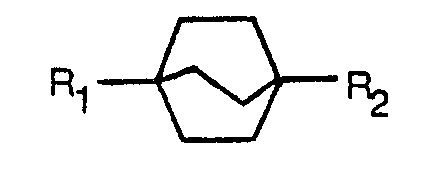
- a liquid crystal material which comprises a mixture of compounds and which includes at least one additive compound characterised in that the material includes one or more additive compounds of Formula I as follows: wherein R, represents an alkyl group, R 2 represents an alkyl or alkoxy group or hydrogen and represents a 1,4-disubstituted bicyclo(2,2,2)octane ring.
- R, and R 2 each contain not more than twelve carbon atoms.
- a compound of formula I suitable for use in a liquid crystal material wherein R 1 is an n-alkyl group having from 1 to 8 carbon atoms inclusive and R 2 is an n-alkyl or n-alkoxy group having from 1 to 8 carbon atoms inclusive.
- R 2 in Formula I is n-alkyl having from 3 to 8 carbon atoms.
- Compounds of Formula I can provide very attractive low viscosity additives to liquid crystal material and may show aspects of superiority compared with known low viscosity additives.
- compounds of Formula I can show a similar reduction in viscosity but a smaller depression of clearing point (liquid crystal-to-isotropic liquid transition temperature) than the additives of formula D as follows: where R is n-alkyl, when added to the same host liquid crystal material.
- R is n-alkyl
- the compounds of formula I may be prepared by routes in which the individual procedures are known, the overall routes being new. For example the following routes may be used.
- the compounds of Formula (I) have a small dielectric anisotropy (when added to liquid crystal materials) and may be added to liquid crystal materials of positive or negative dielectric anisotropy, known and referred to herein respectively as "positive” or “negative” materials, without significantly affecting the dielectric anisotropy of such materials.
- the dielectric anisotropy of the liquid crystal material is necessary to give electro-optical operation and its sign (for a given frequency) is chosen according to the kind of electro-optical device in which the material is to be used.
- the liquid crystal material in which the compound of Formula (I) is contained will comprise a host material which comprises one or more liquid crystal compounds having a low melting point ( ⁇ 80°C) which preferably together with the additive(s) show a liquid crystal phase (preferably nematic or chiral nematic) at room temperature (20°C) together with one or more additives, e.g. to reduce viscosity and/or enhance liquid crystal temperature range, the additive(s) including at least one compound of Formula I.
- a host material which comprises one or more liquid crystal compounds having a low melting point ( ⁇ 80°C) which preferably together with the additive(s) show a liquid crystal phase (preferably nematic or chiral nematic) at room temperature (20°C) together with one or more additives, e.g. to reduce viscosity and/or enhance liquid crystal temperature range, the additive(s) including at least one compound of Formula I.
- the upper limit of the percentage by weight which the compound(s) of Formula I constitute in the mixture with the host material will depend on the host material but typically the compound(s) will form between 2 and 50% by weight in total, for example between 5 and 30% by weight inclusive in total.
- the host material to which the compound(s) of Formula I is added may be one of the following materials:
- the host material to which one or more compounds of Formula I are added may itself be a mixture of two or more compounds selected for the particular device application.
- cholesteric to nematic phase change effect negative contrast type
- Freedericksz effect positive nematic type
- the material preferably contains one or more compounds selected from the following families to give a liquid crystal phase at room temperature as well as a positive dielectric anisotropy.
- the various groups R are the same or different alkyl groups (preferably n-alkyl having up to 10 carbon atoms).
- the material may also contain one or more high (>100°C) clearing point compounds (typically up to about 35% by weight) of the following classes to extend the liquid crystal temperature range of the material at its upper end: where R is as defined above.
- high (>100°C) clearing point compounds typically up to about 35% by weight
- the compounds of Formula I are particularly suitable for use in liquid crystal materials which may be used in multiplexed twisted nematic effect devices.
- a strongly positive host material e.g. consisting of biphenyl compounds of Formula (Illa) and/or the PCH compounds of Formula (illb), together with one or more high clearing point compounds selected from the classes of Formulae (lVa to h)
- a component of low dielectric anisotropy This improvement is believed to be brought about by the disruption of anti-parallel pairing of the molecules of the cyano compounds caused by introduction of the material of low dielectric anisotropy.
- a multiplexed twisted nematic device may also contain a small amount, e.g. up to about 2% by weight, of a chiral additive, e.g. the BDH compound C15.
- a liquid crystal material suitable for a multiplexed twisted nematic effect device embodying the present invention preferably comprises the components in Table 1 as follows:
- the compound(s) of Formula (I) preferably constitute from 5 to 30% by weight of the overall material composition.
- the compound(s) of Formula (I) not only help to reduce the viscosity and extend the temperature range of the nematic liquid crystal phase of the mixture at the lower end but also help to improve the multiplexibility of the mixture.
- Liquid crystal mixtures including compounds of Formula (I) may be formed in a known way, e.g. simply by heating the constituent compounds to form an overall isotropic liquid, stirring the liquid for a short period, e.g. about 10 minutes, and allowing it to cool.
- At least one compound according to Formula (I) above may be mixed together with one or more compounds in any one or more of the following known families for use in one or more of the applications given above (the actual application(s) depending on the mixture's properties): where is a trans-1,4-disubstituted cyclohexane ring, is a 1,4-disubstituted bicyclo(2,2,2)octane ring, X is a 1,4 phenylene group a 4,4'-biphenylyl group a 2,6-naphthyl group or a trans-1,4-disubstituted cyclohexane ring, and Y, is CN, or R' or CO.O ⁇ X ⁇ Y 1 where Y' is CN, or R' or OR'; where R and R' are alkyl groups; or a derivative of one of these wherein H is replaced by a halogen,
- the compound(s) of Formula (I) comprises between 5 and 30% by weight of the mixture.
- a liquid crystal device in a second aspect includes two dielectric substrates at least one of which is optically transparent, a layer of liquid crystal material sandwiched between the substrates and electrodes on the inner surfaces of the substrates to enable an electric field to be applied across the layer of liquid crystal material to provide an electro-optic effect therein, characterised in that the liquid crystal material consists of or includes a compound according to Formula (I) above.
- the device according to the second aspect may be a twisted nematic effect device; which may or may not be operated in a multiplexed fashion, a cholesteric-to-nematic phase change effect device, a Freedericksz effect device or a two-frequency switching effect device, all constructed in a known manner or any of the other devices mentioned above.
- a twisted nematic effect device which may or may not be operated in a multiplexed fashion
- a cholesteric-to-nematic phase change effect device a Freedericksz effect device or a two-frequency switching effect device, all constructed in a known manner or any of the other devices mentioned above.
- Step A 1 Preparation of 1-pentanoyl-4-n-pentylbicyclo(2,2,2)octane
- the ice bath was removed and the reaction mixture was left stirring at room temperature for 4 h, and the progress of the reaction was followed by glc until the ester peak had almost disappeared.
- the reaction mixture was diluted with water and the organic layer was washed with 4N-hydrochloric acid (3 x 50 ml).
- the aqueous layer was washed with ether (3 x 50 ml) and the ether layers were combined with the organic layer and washed with water (3 x 50 ml) and dried (MgS0 4 ).
- the ether was removed and the residue dried in vacuo and used directly to make the required compound.
- Step B1 Preparation of 1,4-di-n-pentylbicyclo(2,2,2)octane
- reaction mixture and the distillate were cooled separately, diluted with water and washed with ether (3 x 50 ml).
- ether layers were combined, washed with water (2 x 50 ml) and then dried (MgS0 4 ).
- the boiling point of the product was 120-140°C/0.5 mm Hg.
- 1-n-Pentyl-4-n-propylbicyclo(2,2,2)octane was prepared by a procedure analogous to that of Example 1. This product was obtained in a yield of 38% and had a boiling point of 158-162°C (15 mm Hg). The product was confirmed by 1 H NMR, IR and Ms measurements.
- 1-n-Heptyl-4-n-pentylbicyclo(2,2,2)octane was prepared by a procedure analogous to that of Example 1. This product had a boiling point of 120-124°C (0.15 mm Hg) and was obtained in a yield of 45%. The product was confirmed by 1 H NMR, IR and Ms measurements.
- the boiling point of the product was 100-110°C (15 mm Hg).
- the product also showed the following v max .
- Step A3 Preparation of 4-n-butoxy-1-n-propylbicyclo(2,2,2)octane-2-one
- Ether was removed and the residue was chromatographed on a neutral alumina column (1.5 x 30 cm) using light petroleum (bp, 40 ⁇ 60°C) as eluent. Five fractions were collected (20 ml each) and combined. The solvent was removed and the residue was distilled in a short-path distillation apparatus to give the required compound.
- the boiling point of the product of Step A3 was 105 ⁇ 115°C (0.15 mm Hg).
- Step 83 The preparation of 1-n-butoxy-4-n-propylbicyclo(2,2,2)octane
- the reaction mixture was cooled and the residue and the distillate were separately diluted with water, washed with ether (3 x 50 ml). All the ether washings were combined and washed with water (2 x 50 ml), dilute hydrochloric acid (2 x 50 ml) and water (2 x 50 ml).
- the ether solution was dried (MgS0 4 ) and ether was removed to give a residue which was chromatographed on a neutral alumina column (1.5 x 30 cm) using light petroleum (bp 40-60°C) as eluent. Four fractions were collected (20 ml each) the solvent was removed to leave a residue which was distilled in a short-path distillation apparatus under reduced pressure to give the required compound.
- the boiling point of the product was 142-146°C (15 mm Hg).
- This product which was obtained in a yield of 47% had a boiling point of 118-124°C (15 mm Hg).
- Lithium metal in small pieces (0.6865 g, 0.1 g.at.) was added to a mixture of 1-bromo-4-pentylbicyclo-(2,2,2)octane (2.6043 g, 0.01 mol) in dry THF (75 ml).
- the reaction mixture was stirred and warmed at 60°C for 4 h and the progress of the reaction was followed by glc.
- the reaction mixture was then cooled, the lithium metal was filtered off and the filtrate was diluted with water (180 ml) and washed with ether (3 x 70 ml).
- the Mixture A used was as defined in Table 5:
- Table 6 demonstrates that compounds X 1 , X 2 and X 3 show mixture viscosities similar to those shown by compound Y but, beneficially, compounds X 1 , X 2 , X 3 shows a mixture T N - I depression not as great as that shown by compound Y.
- the display of Figures 1 to 4 comprises a cell 1, formed of two, front and back, glass slides 2, 3 respectively, spaced about 7 ⁇ m apart by a spacer 4 all held together by an epoxy resin glue.
- a liquid crystal material 12 fills the gap between the slides 2, 3 and the spacer 4.
- a front polariser 5 arranged with its axis of polarisation axis horizontal.
- a reflector 7 is arranged behind the slide 3.
- a rear polariser 6 or analyser is arranged between the slide 3 and reflector 7.
- Electrodes 8, 9 of tin oxide typically 100 A (10- 8 cm) thick are deposited on the inner faces of the slides 2, as a complete layer and etched to the shapes shown in Figures 3, 4.
- the display has seven bars per digit 10 plus a decimal point 11 between each digit.
- the rear electrode structure is formed into three electrodes x 1 , x 2 , x 3 .
- the front electrode structure is formed into three electrodes per digit and decimal point y i , y 2 , y3 . Examination of the six electrodes per digit shows that each of the eight elements can independently have a voltage applied thereto by application of suitable voltage to appropriate x, y electrodes.
- the slides 2 Prior to assembly the slides 2, bearing the electrodes are cleaned then dipped in a solution of 0.2% by weight of poly-vinyl alcohol (PVA) in water.
- PVA poly-vinyl alcohol
- the slides are rubbed in a single direction with a soft tissue then assembled with the rubbing directions orthogonal to one another and parallel to the optical axis of the respective adjacent polarisers, i.e. so that the polarisers are crossed.
- the nematic liquid crystal material 12 is introduced between the slides 2, 3 the molecules at the slide surfaces lie along the respective rubbing directions with a progressive twist between the slides.
- Voltages are applied as follows as shown in Figures 5, 6 and 7 for three successive time intervals in a linescan fashion.
- An electrical potential of 3V/2 is applied to, i.e. scanned down, each x electrode in turn whilst -V/2 is applied to the remaining x electrodes.
- -3V/2 or V/2 is applied to the y electrodes.
- a coincidence of 3V/2 and -3V/2 at an intersection results in a voltage 3V across the liquid crystal layer 12.
- Elsewhere the voltage is V or -V.
- the electric voltage V is an ac signal of e.g. 100 Hz square wave, and the sign indicates the phase.
- a material embodying the second aspect of the invention which is suitable for use as the material 12 in the above device is Mixture A (73% by weight) together with 27% by weight of Compound X, defined above.
- Suitable cholesteric materials are:
- pleochroic dye may be added to enhance the display contrast, e.g. one of the anthroquinone dyes described in UK Patent Specification No. 2011940A. One polariser is removed in this case.
- mixtures embodying the second aspect of the invention may be used in a Freedericksz effect cell.
- a Freedericksz effect cell Such a cell may be constructed by sandwiching the liquid crystal material between glass slides having electrode films deposited on their inner surfaces as in the above device.
- the polarisers are not necessary; the glass slide inner surfaces are treated with a coating of lecithin and the liquid crystal material is a negative material whose molecules are aligned in the OFF state perpendicular to the slide substrate (homeotropic texture) by the lecithin coating.
- Application of an appropriate electric field across the material in the ON state re-arranges the molecules parallel to the slide surfaces (homogeneous texture).
- a pleochroic dye may be incorporated in the liquid crystal material to enhance the contrast between the ON and OFF states.
- a Freedericksz effect cell made in the above way may incorporate Mixture 3 below, the cell spacing being 10 ⁇ m. may optionally be added to Mixture 3 (up to 3% by weight of Mixture 3) as a negative additive.
- Compound A The preparation of Compound A is described in published UK Patent Application No. 2061256A. About 1% by weight of a known pleochroic dye e.g. 1,5-bis-4'-n-butylphenylaminoanthraquinone may be added to Mixture 3 to give a dyed mixture. (Mixture 3A).
- a known pleochroic dye e.g. 1,5-bis-4'-n-butylphenylaminoanthraquinone may be added to Mixture 3 to give a dyed mixture. (Mixture 3A).
- the colour When a voltage is applied across the cell, the colour changes from a weakly absorbing state to a strongly absorbing state.
- a (cholesteric-to-nematic) phase change effect device incorporates a material as defined above.
- a cell is prepared containing a long helical pitch cholesteric material sandwiched between electrode- bearing glass slides as in the twisted nematic cell described above.
- the polarisers and surface preparations for homogeneous alignment e.g. treatment of the glass slide surfaces with SiO, are not used in this case.
- the liquid crystal material is in a twisted focal conic molecular texture in the OFF state which scatters light.
- the effect of an electric field applied between a pair of electrodes on the respective inner surface of the glass slides is to convert the region of liquid crystal material between the electrodes into the ON state which is a homeotropic nematic texture which is less scattering than the OFF state. This is a 'negative contrast' type of phase change effect device.
- the inner glass slide surfaces are treated, e.g. with a coating of lecithin, to give alignment perpendicular to those surfaces, and the liquid crystal material has As negative the material in the OFF state is in a homeotropic texture which has little scattering effect on incident light. If an electric field is applied between a pair of electrodes on the respective inner surfaces of the glass slides the region of liquid crystal material between the electrodes is converted to a twisted homogeneous texture which scatters light (the ON state). This is a 'positive contrast' type of phase change effect device.
- the contrast between the two states in each case may be enhanced by the addition of a small amount of a suitable pleochroic dye (e.g. 1% by weight of 1,5-bis-4'n-butylphenylaminoanthraquinone in the case where As is positive) to the liquid crystal material.
- a suitable pleochroic dye e.g. 1% by weight of 1,5-bis-4'n-butylphenylaminoanthraquinone in the case where As is positive
- a suitable positive dielectric anisotropy material, Mixture 4, embodying the invention for use in a phase change effect (negative contrast type) device is:
- a suitable negative dielectric anisotropy material embodying the invention for use in a phase change effect (positive contrast type) device, Mixture 5, is as follows:
Landscapes
- Chemical & Material Sciences (AREA)
- Organic Chemistry (AREA)
- Chemical Kinetics & Catalysis (AREA)
- Crystallography & Structural Chemistry (AREA)
- Engineering & Computer Science (AREA)
- Materials Engineering (AREA)
- Liquid Crystal Substances (AREA)
- Organic Low-Molecular-Weight Compounds And Preparation Thereof (AREA)
Claims (8)


Applications Claiming Priority (2)
| Application Number | Priority Date | Filing Date | Title |
|---|---|---|---|
| GB838302395A GB8302395D0 (en) | 1983-01-28 | 1983-01-28 | Liquid crystal materials |
| GB8302395 | 1983-01-28 |
Publications (3)
| Publication Number | Publication Date |
|---|---|
| EP0120560A2 EP0120560A2 (de) | 1984-10-03 |
| EP0120560A3 EP0120560A3 (en) | 1985-11-06 |
| EP0120560B1 true EP0120560B1 (de) | 1987-08-19 |
Family
ID=10537097
Family Applications (1)
| Application Number | Title | Priority Date | Filing Date |
|---|---|---|---|
| EP84300479A Expired EP0120560B1 (de) | 1983-01-28 | 1984-01-26 | Flüssigkristallmaterialien und dafür geeignete, eine (2,2,2) Bicyclooctan-Struktur enthaltende Zusatzstoffe |
Country Status (5)
| Country | Link |
|---|---|
| US (1) | US4544497A (de) |
| EP (1) | EP0120560B1 (de) |
| JP (1) | JPS59187075A (de) |
| DE (1) | DE3465493D1 (de) |
| GB (1) | GB8302395D0 (de) |
Families Citing this family (4)
| Publication number | Priority date | Publication date | Assignee | Title |
|---|---|---|---|---|
| DE3566901D1 (en) * | 1984-04-07 | 1989-01-26 | Merck Patent Gmbh | Liquid crystal phase |
| JPS61233635A (ja) * | 1985-03-22 | 1986-10-17 | メルク・パテント・ゲゼルシヤフト・ミツト・ベシユレンクテル・ハフツング | ビシクロオクタン誘導体 |
| US6172720B1 (en) * | 1997-05-23 | 2001-01-09 | Kent Displays Incorporated | Low viscosity liquid crystal material |
| JP5678615B2 (ja) * | 2010-11-30 | 2015-03-04 | Dic株式会社 | フッ素化されたビシクロオクタン構造をもつ化合物およびその液晶組成物 |
Family Cites Families (15)
| Publication number | Priority date | Publication date | Assignee | Title |
|---|---|---|---|---|
| DE2548360C2 (de) * | 1975-10-29 | 1983-12-08 | Merck Patent Gmbh, 6100 Darmstadt | Flüssigkristalline Materialien mit verminderter Viskosität |
| NL7701750A (nl) * | 1976-02-26 | 1977-08-30 | Hoffmann La Roche | Mengsels van vloeibare kristallen. |
| DE2636684C3 (de) * | 1976-08-14 | 1980-06-19 | Merck Patent Gmbh, 6100 Darmstadt | Phenylcyclohexanderivate und ihre Verwendung in flüssigkristallinen Dielektrika |
| US4198130A (en) * | 1977-06-03 | 1980-04-15 | Hoffmann-La Roche Inc. | Liquid crystal mixtures |
| JPS5616582A (en) * | 1979-07-18 | 1981-02-17 | Hitachi Ltd | Low-viscosity nematic liquid crystal composition |
| US4219256A (en) * | 1979-08-01 | 1980-08-26 | The Secretary Of State For Defence In Her Britannic Majesty's Government Of The United Kingdom Of Great Britain And Northern Ireland | Liquid crystal compounds and materials and devices containing them |
| JPS5636568A (en) * | 1979-09-03 | 1981-04-09 | Hitachi Ltd | Low-viscosity menatic liquid crystal composition |
| GB2065104B (en) * | 1979-10-26 | 1983-11-30 | Secr Defence | Liquid crystal bicyclo-octane compounds |
| JPS57118526A (en) * | 1981-01-14 | 1982-07-23 | Dainippon Ink & Chem Inc | Dicyclohexylethane derivative |
| DE3201721A1 (de) * | 1981-01-30 | 1982-08-19 | F. Hoffmann-La Roche & Co. AG, 4002 Basel | Disubstituierte aethane |
| DE3268468D1 (en) * | 1981-02-13 | 1986-02-27 | Secr Defence Brit | Liquid crystal compounds exhibiting a small dielectric anisotropy and liquid crystal materials and devices incorporating such compounds |
| CH651025A5 (de) * | 1982-05-14 | 1985-08-30 | Hoffmann La Roche | Pyridazine und ihre verwendung als komponenten fluessigkristalliner gemische. |
| US4482472A (en) * | 1981-08-06 | 1984-11-13 | The Secretary Of State For Defence In Her Britannic Majesty's Government Of The United Kingdom Of Great Britian And Northern Ireland | Liquid crystal materials |
| FR2511798A1 (fr) * | 1981-08-21 | 1983-02-25 | Thomson Csf | Dispositif de visualisation a cristal liquide smectique |
| GB2121406B (en) * | 1982-05-11 | 1986-01-02 | Secr Defence | Liquid crystal cyanophenylethanes |
-
1983
- 1983-01-28 GB GB838302395A patent/GB8302395D0/en active Pending
-
1984
- 1984-01-25 US US06/573,716 patent/US4544497A/en not_active Expired - Fee Related
- 1984-01-26 DE DE8484300479T patent/DE3465493D1/de not_active Expired
- 1984-01-26 EP EP84300479A patent/EP0120560B1/de not_active Expired
- 1984-01-27 JP JP59013228A patent/JPS59187075A/ja active Pending
Also Published As
| Publication number | Publication date |
|---|---|
| DE3465493D1 (en) | 1987-09-24 |
| JPS59187075A (ja) | 1984-10-24 |
| US4544497A (en) | 1985-10-01 |
| EP0120560A3 (en) | 1985-11-06 |
| GB8302395D0 (en) | 1983-03-02 |
| EP0120560A2 (de) | 1984-10-03 |
Similar Documents
| Publication | Publication Date | Title |
|---|---|---|
| EP0058512B1 (de) | Flüssigkristallverbindungen, die geringe dielektrische Anisokopie aufweisen, und Flüssigkristallzusammensetzungen sowie Vorrichtungen, die diese Verbindungen enthalten | |
| EP0132377B1 (de) | Verbindungen, die Fluorbiphenylylgruppen enthalten und deren Verwendung in Flüssigkristallmaterialien und -vorrichtungen | |
| EP0072204B1 (de) | Zusatzstoffe für Flüssigkristallmaterialien | |
| EP0097033B1 (de) | Flüssigkristallzusammensetzungen | |
| EP0126601B1 (de) | Disubstituierte Äthane und ihre Verwendung in flüssigkristallinen Materialien | |
| EP0152697B1 (de) | Heterocyclisch substituierte Äthane und deren Verwendung in flüssig-kristallinen Materialien und Vorrichtung | |
| US4542230A (en) | Liquid crystals esters | |
| US4261652A (en) | Liquid crystal compounds and materials and devices containing them | |
| US4357078A (en) | Liquid crystal compounds containing an alicyclic ring and exhibiting a low dielectric anisotropy and liquid crystal materials and devices incorporating such compounds | |
| EP0442266B1 (de) | Tolanderivate, sie enthaltende flüssigkristalline Zusammensetzungen und sie verwendende Flüssigkristallelemente | |
| GB2071649A (en) | Liquid Crystal Bicyclo-octane Carboxylic Esters | |
| US4400061A (en) | Liquid crystal ester compounds exhibiting a low or negative dielectric anisotropy and liquid crystal materials and devices incorporating such compounds | |
| JPH01126394A (ja) | 液晶組成物 | |
| GB2121406A (en) | Liquid crystal cyanophenylethanes | |
| US4544497A (en) | Liquid crystal materials containing substituted bicyclo(2,2,2)octanes | |
| GB2065104A (en) | Liquid Crystal Bicyclo-octane Compounds | |
| GB2081707A (en) | Liquid Crystal Aromatic Nitrile Ethers | |
| GB2134535A (en) | Liquid crystal compositions containing a bicyclo(2,2,2)octane derivative | |
| JPH09208503A (ja) | 新規液晶化合物、ネマチック液晶組成物及びこれを用いた液晶表示装置 | |
| EP0008188B1 (de) | Flüssigkristallzusammensetzungen und dieselben enthaltende Vorrichtungen und Materialien | |
| JPH11255675A (ja) | 光学活性化合物、それを含有する液晶組成物および液晶電気表示素子 | |
| GB2061256A (en) | Liquid crystal ester compounds exhibiting a negative dielectric anisotropy and liquid crystal materials and devices containing such compounds | |
| GB2079275A (en) | Liquid Crystal Bicyclo[2.2.2] Octane Esters | |
| GB2089345A (en) | Liquid crystal 4-(4'-alkyl or -alkoxy-benzyloxy) Alkoxybenzenes | |
| JPS6348259B2 (de) |
Legal Events
| Date | Code | Title | Description |
|---|---|---|---|
| PUAI | Public reference made under article 153(3) epc to a published international application that has entered the european phase |
Free format text: ORIGINAL CODE: 0009012 |
|
| AK | Designated contracting states |
Designated state(s): CH DE FR GB LI |
|
| PUAL | Search report despatched |
Free format text: ORIGINAL CODE: 0009013 |
|
| RHK1 | Main classification (correction) |
Ipc: C09K 19/30 |
|
| AK | Designated contracting states |
Designated state(s): CH DE FR GB LI |
|
| 17P | Request for examination filed |
Effective date: 19860418 |
|
| 17Q | First examination report despatched |
Effective date: 19860926 |
|
| GRAA | (expected) grant |
Free format text: ORIGINAL CODE: 0009210 |
|
| AK | Designated contracting states |
Kind code of ref document: B1 Designated state(s): CH DE FR GB LI |
|
| REF | Corresponds to: |
Ref document number: 3465493 Country of ref document: DE Date of ref document: 19870924 |
|
| ET | Fr: translation filed | ||
| PLBE | No opposition filed within time limit |
Free format text: ORIGINAL CODE: 0009261 |
|
| STAA | Information on the status of an ep patent application or granted ep patent |
Free format text: STATUS: NO OPPOSITION FILED WITHIN TIME LIMIT |
|
| 26N | No opposition filed | ||
| PG25 | Lapsed in a contracting state [announced via postgrant information from national office to epo] |
Ref country code: GB Effective date: 19890126 |
|
| PG25 | Lapsed in a contracting state [announced via postgrant information from national office to epo] |
Ref country code: LI Effective date: 19890131 Ref country code: CH Effective date: 19890131 |
|
| GBPC | Gb: european patent ceased through non-payment of renewal fee | ||
| PG25 | Lapsed in a contracting state [announced via postgrant information from national office to epo] |
Ref country code: FR Free format text: LAPSE BECAUSE OF NON-PAYMENT OF DUE FEES Effective date: 19890929 |
|
| REG | Reference to a national code |
Ref country code: CH Ref legal event code: PL |
|
| PG25 | Lapsed in a contracting state [announced via postgrant information from national office to epo] |
Ref country code: DE Effective date: 19891003 |
|
| REG | Reference to a national code |
Ref country code: FR Ref legal event code: ST |