EP0120814B1 - Urées N-phénylsulfonyl-N'-pyrimidinyl- et -triazinyl - Google Patents
Urées N-phénylsulfonyl-N'-pyrimidinyl- et -triazinyl Download PDFInfo
- Publication number
- EP0120814B1 EP0120814B1 EP84810135A EP84810135A EP0120814B1 EP 0120814 B1 EP0120814 B1 EP 0120814B1 EP 84810135 A EP84810135 A EP 84810135A EP 84810135 A EP84810135 A EP 84810135A EP 0120814 B1 EP0120814 B1 EP 0120814B1
- Authority
- EP
- European Patent Office
- Prior art keywords
- formula
- hydrogen
- composition according
- alkyl
- phenylsulfonyl
- Prior art date
- Legal status (The legal status is an assumption and is not a legal conclusion. Google has not performed a legal analysis and makes no representation as to the accuracy of the status listed.)
- Expired
Links
- 0 CC(C)(C)*NC(*)C=C Chemical compound CC(C)(C)*NC(*)C=C 0.000 description 5
Classifications
-
- C—CHEMISTRY; METALLURGY
- C07—ORGANIC CHEMISTRY
- C07C—ACYCLIC OR CARBOCYCLIC COMPOUNDS
- C07C309/00—Sulfonic acids; Halides, esters, or anhydrides thereof
- C07C309/78—Halides of sulfonic acids
- C07C309/86—Halides of sulfonic acids having halosulfonyl groups bound to carbon atoms of six-membered aromatic rings of a carbon skeleton
-
- A—HUMAN NECESSITIES
- A01—AGRICULTURE; FORESTRY; ANIMAL HUSBANDRY; HUNTING; TRAPPING; FISHING
- A01N—PRESERVATION OF BODIES OF HUMANS OR ANIMALS OR PLANTS OR PARTS THEREOF; BIOCIDES, e.g. AS DISINFECTANTS, AS PESTICIDES OR AS HERBICIDES; PEST REPELLANTS OR ATTRACTANTS; PLANT GROWTH REGULATORS
- A01N47/00—Biocides, pest repellants or attractants, or plant growth regulators containing organic compounds containing a carbon atom not being member of a ring and having no bond to a carbon or hydrogen atom, e.g. derivatives of carbonic acid
- A01N47/08—Biocides, pest repellants or attractants, or plant growth regulators containing organic compounds containing a carbon atom not being member of a ring and having no bond to a carbon or hydrogen atom, e.g. derivatives of carbonic acid the carbon atom having one or more single bonds to nitrogen atoms
- A01N47/28—Ureas or thioureas containing the groups >N—CO—N< or >N—CS—N<
- A01N47/36—Ureas or thioureas containing the groups >N—CO—N< or >N—CS—N< containing the group >N—CO—N< directly attached to at least one heterocyclic ring; Thio analogues thereof
-
- C—CHEMISTRY; METALLURGY
- C07—ORGANIC CHEMISTRY
- C07C—ACYCLIC OR CARBOCYCLIC COMPOUNDS
- C07C311/00—Amides of sulfonic acids, i.e. compounds having singly-bound oxygen atoms of sulfo groups replaced by nitrogen atoms, not being part of nitro or nitroso groups
- C07C311/65—N-sulfonylisocyanates
-
- C—CHEMISTRY; METALLURGY
- C07—ORGANIC CHEMISTRY
- C07D—HETEROCYCLIC COMPOUNDS
- C07D521/00—Heterocyclic compounds containing unspecified hetero rings
Definitions
- the present invention relates to new, herbicidally active and plant growth-regulating N-phenylsulfonyl-N'-pyrimidinyl- and -triazinylureas, processes for their preparation, agents containing them as active ingredients, and their use for controlling weeds, especially selectively in crops or for regulating and inhibiting plant growth.
- Urea compounds, triazine compounds and pyrimidine compounds with herbicidal activity are generally known. Recently, sulfonylurea compounds with herbicidal and plant growth-regulating activity have been described, for example, in European Patent Publications Nos. 44209, 44210, 44807, 44808, 44809, 72347 and 106512.
- alkyl is to be understood as straight-chain or branched alkyl, e.g. B.: methyl, ethyl, n-propyl, i-propyl, the four isomeric butyl, n-amyl, i-amyl, 2-amyl, 3-amyl, n-hexyl or i-hexyl. Methyl and ethyl are preferred.
- Alkoxy is understood to mean: methoxy, ethoxy, n-propoxy, i-propoxy and the four isomeric butoxy radicals, but especially methoxy, ethoxy or i-propoxy.
- alkylthio examples include methylthio, ethylthio, n-propylthio, i-propylthio and n-butylthio, but especially methylthio and ethylthio.
- alkylsulfinyl examples include methylsulfinyl, ethylsulfinyl, n-propylsulfinyl and n-butylsulfinyl, but especially methylsulfinyl and ethylsulfinyl.
- alkylsulfonyl examples include methylsulfonyl, ethylsulfonyl, n-propylsulfonyl and n-butylsulfonyl, but especially methylsulfonyl and ethylsulfonyl.
- Halogen in the definitions and in haloalkyl, alkoxy, alkylsulfinyl, alkylsulfonyl and alkylthio are to be understood as fluorine, chlorine and bromine, but preferably fluorine and chlorine.
- haloalkyl or haloalkyl parts of substituents R 'to R 13 defined above are to be understood, for example: chloromethyl, fluoromethyl, difluoromethyl, trifluoromethyl, 2-chloroethyl, 2,2,2-trifluoroethyl, 1,1,2,2-tetrafluoroethyl, Pentafluoroethyl, 1,1,2-trifluoro-2-chloroethyl, 2,2,2-trifulor-1,1-dichloroethyl, pentachloroethyl, 3,3,3-trifluoropropyl, 2,3-dichloropropyl, 1,1,2, 3,3,3-hexafluoropropyl, but especially fluoromethyl, chloromethyl, difluoromethyl and trifluoromethyl.
- substituent A includes, for example, the following haloalkyl radicals: fluoromethyl, difluoromethyl, trichloromethyl, dibromomethyl, chlorofluoromethyl, bromofluoromethyl, 1,2-difluoroethyl, 1,2-dibromoethyl, 1,2-dichloropropyl, 1,2-dichloro-3, 3,3-trifluoropropyl, 1,2-dibromopropyl, 1,2-dibromo-3,3,3-trifluoropropyl, 3,3,3-trifluoropropyl, 3,3,4,4,5,5,5-heptafluoropentyl, 4,4,4-trifluoro-2-trifluoromethyl-butyl, 3,3-difluorobutyl, 3-chloropropyl, 3-fluoropropyl, 1,2-dichloroethyl, pentafluoroethyl, 1,1,2,2-tetrafluor
- the substituents A preferably contain at least one fluorine atom such as. B. 3,3,3-trifluoropropyl, fluoromethyl, difluoromethyl, 3,3,4,4,5,5,5-heptafluoropentyl, 4,4,4-trifluoro-2-trifluoromethylbutyl, chlorofluoromethyl, bromofluoromethyl, 3,3- Difluorobutyl or 3-fluoropropyl, but especially 3,3,4,4,5,5,5-heptafluoropentyl, 4,4,4-trifluoro-2-trifluoromethyl-butyl, 3,3-difluorobutyl or 3,3,3- Trifluoropropyl.
- fluorine atom such as. B. 3,3,3-trifluoropropyl, fluoromethyl, difluoromethyl, 3,3,4,4,5,5,5-heptafluoropentyl, 4,4,4-trifluoro-2-trifluoromethylbutyl, 3,3-
- the invention also encompasses the salts which the compounds of the formula I can form with amines, alkali metal and alkaline earth metal bases or quaternary ammonium bases.
- alkali and alkaline earth metal hydroxides as salt formers, the hydroxides of lithium, sodium, potassium, magnesium or calcium are particularly noteworthy, but especially those of sodium or potassium.
- amines suitable for salt formation are primary, secondary and tertiary aliphatic and aromatic amines such as methylamine, ethylamine, propylamine, i-propylamine, the four isomeric butylamines, dimethylamine, diethylamine, diethanolamine, dipropylamine, diisopropylamine.
- Examples of quaternary ammonium bases are in general the cations of halogen ammonium salts, e.g. B. the tetramethylammonium cation, the trimethylbenzylammonium cation, the triethylbenzylammonium cation, the tetraethylammonium cation, the trimethylethylammonium cation, but also the ammonium cation.
- halogen ammonium salts e.g. B. the tetramethylammonium cation, the trimethylbenzylammonium cation, the triethylbenzylammonium cation, the tetraethylammonium cation, the trimethylethylammonium cation, but also the ammonium cation.
- a particularly noteworthy group of active ingredients contains compounds of the formula I in which R 1 , R 2 and R 5 are hydrogen and Z are oxygen, R 3 and R 4 together contain at most 4 carbon atoms and the radical A is the 2-position of the phenyl ring occupied and contains at least one fluorine atom.
- A is a radical from the group 3,3,3-trifulorpropyl, fluoromethyl, difluoromethyl, 3,3,4,4,5,5,5-heptafluoropentyl, 4 , 4,4-trifluoro-2-trifluoromethyl-butyl, chlorofluoromethyl, bromofluoromethyl, 3,3-difluorobutyl or 3-fluoropropyl.
- the compounds of the formula I are prepared in an inert, organic solvent.
- the compounds of formula I are obtained by using a phenylsulfonamide of formula II wherein A, R 'and R 2 have the meaning given under formula, in the presence of a base with an N-pyrimidinyl or triazinyl carbamate of the formula III wherein E, R 3 , R 4 , R 5 and Z have the meaning given under formula and R represents phenyl, alkyl or substituted phenyl.
- a second process gives compounds of the formula I by using a phenylsulfonyl isocyanate or isothiocyanate of the formula IV wherein A, R 1 , R 2 and Z have the meaning given under formula I, optionally in the presence of a base, with an amine of formula V. wherein E, R 3 , R 4 and R 5 have the meaning given under formula I.
- the compounds of the formula I in which R 5 is hydrogen are prepared by, if appropriate, a sulfonamide of the formula II given above in the presence of a base with an isocyanate or isothiocyanate of the formula VI wherein E, R 3 , R 4 , R 5 and Z have the meaning given under formula I.
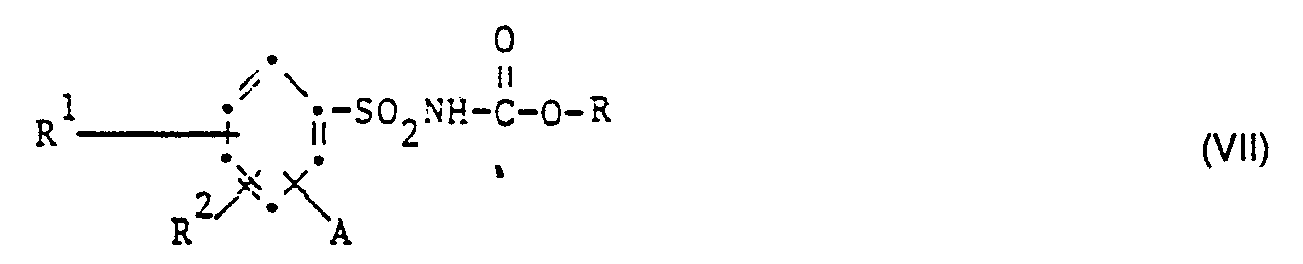
- the compounds of the formula I can also be obtained by using an N-phenylsulfonylcarbamate of the formula VII wherein A, R 1 and R 2 have the meaning given under formula I and R represents phenyl, alkyl or substituted phenyl, with an amine of the formula V given above.
- the compounds of the formula I in which AC 2 -C 6 is haloalkyl are prepared by using a sulfonylurea of the formula VIII wherein R 1 , R 2 , R 3 , R 4 , R 5 , E and Z have the meaning given under formula I and G represents an unsaturated C 2 -C 6 haloalkenyl radical, hydrogenated or halogenated to saturation.
- the compounds of the formula I in which AC 2 -C 6 is haloalkyl are also prepared by using a sulfonylurea of the formula IX wherein R ', R 2 , R 3 , R 4 , R 5 , E and Z have the meaning given under formula I and L is an unsaturated C 2 -C 6 alkenyl radical, halogenated to saturation.
- the ureas of the formula I obtained can be converted into addition salts using amines, alkali metal or alkaline earth metal hydroxides or quaternary ammonium bases. This is done, for example, by reaction with the equimolar amount of base and evaporation of the solvent.
- aprotic, inert organic solvents are hydrocarbons such as benzene, toluene, xylene or cyclohexane, chlorinated hydrocarbons such as methylene chloride, chloroform, carbon tetrachloride, or chlorobenzene, ethers such as diethyl ether, ethylene glycol dimethyl ether. Diethylene glycol dimethyl ether, tetrahydrofuran or dioxane, nitriles such as acetonitrile or propionitrile, amides such as dimethylformamide, diethylformamide or N-methylpyrrolidinone.
- hydrocarbons such as benzene, toluene, xylene or cyclohexane
- chlorinated hydrocarbons such as methylene chloride, chloroform, carbon tetrachloride, or chlorobenzene
- ethers such as diethyl ether, ethylene glycol dimethyl ether.
- the reaction temperatures are preferably between -20 ° and + 120 ° C.
- the reactions of the coupling processes are generally slightly exothermic and can be carried out at room temperature.
- the mixture is expediently warmed up briefly to the boiling point of the reaction mixture.
- the reaction times can also be shortened by adding a few drops of base or isocyanate as the reaction catalyst.
- Bases are, in particular, tertiary amines such as trimethylamine, triethylamine, quinuclidine, 1,4-diazabicyclo- (2,2,2) -octane. 1,5-diazabicyclo (4,3,0) non-5-ene or 1,5-diazabicyclo (5,4,3) undec-7-ene.
- the halogenation processes are carried out at temperatures between 0 ° -100 ° C of the reaction mixture. Irradiation of the reaction solution with light or the addition of a radical chain reaction starter such as dibenzoyl peroxide or ⁇ , ⁇ '-azoisobutyronitrile and the use of a chlorinated hydrocarbon such as methylene chloride sometimes prove advantageous here. Chloroform or carbon tetrachloride as a solvent.
- the hydrogenation process is generally carried out in an inert solvent such as carboxylic acids, alcohols, esters or hydrocarbons under a hydrogen atmosphere in the presence of hydrogenation catalysts such as Raney nickel, palladium or platinum catalysts.
- the end products of formula I can be isolated by concentrating and / or evaporating the solvent and can be purified by recrystallization or trituration of the solid residue in solvents in which they do not dissolve well, such as ethers, aromatic hydrocarbons or chlorinated hydrocarbons.
- the starting materials 111, V and VI are known from the literature or can be prepared by known methods.
- compounds of the formulas III and VI can be obtained from the compounds of the formula V by known methods.
- the new intermediates of formula II can be produced in various ways.
- the compounds of the formula 11 are thus obtained by using anilines of the formula X wherein R 1 , R 2 and A have the meaning given under formula I, diazotized and the diazo group exchanged with sulfur dioxide in the presence of a catalyst such as copper-I-chloride in hydrochloric acid or acetic acid and the phenylsulfonyl chloride formed is reacted with ammonium hydroxide solution.
- the compounds of the formula II can also be obtained by using a phenylsulfonic acid of the formula XI wherein R 1 , R 2 and A have the meaning given under formula I, by treatment with a chlorinating agent such as PCI 5 , POCI 3 , COCI 2 or SOCI 2 in the corresponding phenylsulfonyl chloride transferred and this is reacted with ammonium hydroxide solution.
- a chlorinating agent such as PCI 5 , POCI 3 , COCI 2 or SOCI 2
- the compounds of formula II can be obtained by using a benzyl thioether of formula XII wherein R 1 , R 2 and A have the meaning given under formula I, by treatment with chlorine in the resulting phenylsulfonyl chloride with ammonium hydroxide solution.
- the compounds of formula II in which A is C 2 -C 6 haloalkyl can also be prepared by using a phenylsulfonamide of the formula XIII wherein R 1 , R 2 and G have the meaning given under formula VIII, hydrogenated or saturated to saturation.
- the compounds of the formula II in which A is C 2 -C 6 haloalkyl can also be prepared by using a phenylsulfonamide of the formula XIV wherein R 1 , R 2 and L have the meaning given under formula IX, halogenated to saturation.
- the likewise new phenylsulfonyl isocyanates of the formula IV can be obtained, for example, by reacting the sulfonamides of the formula II with phosgene in the presence of butyl isocyanate in a chlorinated hydrocarbon as solvent, at the reflux temperature. Similar representations are described in "Newer Methods in Preparative Organic Chemistry", Volume IV, 211-229, Verlag Chemie, Weinheim, 1970.
- the isothiocyanates of the formula IV are obtained by treating the sulfonamides of the formula II with carbon disulphide and potassium hydroxide and then reacting the dipotassium salt with phosgene. Such methods are described in Arch. Pharm. 299, 174 (1966).
- N-phenylsulfonylcarbamates of the formula VII are obtained by reacting the sulfonamides of the formula II with diphenyl carbonate in the presence of a base. Similar processes are mentioned in Japanese Patent 61 169.
- the starting materials of the formulas X, XI and XII are generally known or they can be prepared by known processes.
- the active ingredients of formula I are stable compounds. No precautionary measures are required to handle them.
- the compounds of formula 1 are characterized by good selective growth-inhibiting and selective herbicidal properties which make them excellent for use in crops of useful plants, in particular in sugar cane, cereals, cotton, soybeans, corn and rice. Weeds are sometimes damaged, which previously could only be dealt with with total herbicides.
- the compounds of the formula I also have strong plant growth-regulating properties, which can result in an increase in the yield of crops or crops. Many compounds of formula 1 also show a concentration-dependent plant growth-inhibiting effect. Both monocots and dicots are impaired in their growth.
- So z For example, the growth of legumes planted in agriculture in tropical regions as cover crops is selectively inhibited by the compounds of formula I, so that soil erosion between crops is prevented, but cover crops are not Can become competition for culture.
- An inhibition of vegetative growth allows a denser cultivation of the crop in many crop plants, so that an increased yield, based on the soil area, can be achieved.
- Another mechanism of increasing yield with growth inhibitors is based on the fact that the nutrients benefit the bloom and fruit formation to a greater extent, while vegetative growth is restricted.
- growth regulators it is also important to use growth regulators to inhibit the growth in length of cereals, because shortening the stalk reduces or completely eliminates the risk of the plants twisting ("storing") before harvesting.
- growth regulators can be eliminated or eliminated entirely.
- growth regulators in cereals can cause stalk reinforcement, which also counteracts storage.
- the compounds of the formula I are also suitable for preventing the germination of stored potatoes.
- germs often develop, which result in shrinkage, weight loss and rot.
- the invention also relates to herbicidal and plant growth regulating compositions which contain a new active ingredient of the formula 1, and to processes for pre- and post-emergent weed control and for inhibiting the growth of monocotyledonous and dicotyledonous plants, in particular grasses, tropical soil coverers and tobacco avarice shoots.
- the compounds of formula I are used in unchanged form or, preferably, as agents together with the auxiliaries customary in formulation technology and are therefore used, for.
- the formulations i.e. the agents, preparations or compositions containing the active ingredient of formula I and optionally a solid or liquid additive are prepared in a known manner, for. B. by intimately mixing and / or grinding the active ingredients with extenders, such as. B. with solvents, solid carriers, and optionally surface-active compounds (surfactants).
- extenders such as. B. with solvents, solid carriers, and optionally surface-active compounds (surfactants).
- Aromatic hydrocarbons preferably fractions C 8 to C, 2 such as.
- solid carriers e.g. B. for dusts and dispersible powders, natural rock flours are usually used, such as calcite, talc, kaolin, montmorillonite or attapulgite.
- highly disperse silica or highly disperse absorbent polymers can also be added.
- adsorptive granulate carriers come porous types such.
- pumice broken brick, sepiolite or bentonite, as non-sorptive support materials such.
- B. calcite or sand in question.
- a large number of pregranulated materials of inorganic or organic nature such as, in particular, dolomite or comminuted plant residues can be used.
- suitable surface-active compounds are nonionic, cationic and / or anionic surfactants with good emulsifying, dispersing and wetting properties.
- surfactants are also to be understood as mixtures of surfactants.
- Suitable anionic surfactants can be both so-called water-soluble soaps and water-soluble synthetic surface-active compounds.
- soaps are the alkali, alkaline earth or optionally substituted ammonium salts of higher fatty acids (C 10 -C 22 ), such as. B. the Na or K salts of oleic or stearic acid, or of natural fatty acid mixtures which, for. B. can be obtained from coconut or tallow oil.
- the fatty acid methyl taurine salts should also be mentioned.
- so-called synthetic surfactants are often used, in particular fatty sulfonates, fatty sulfates, sulfonated benzimidazole derivatives or alkylarylsulfonates.
- the fatty sulfonates or sulfates are usually present as alkali, alkaline earth or optionally substituted ammonium salts and have an alkyl radical having 8 to 22 carbon atoms, alkyl also including the alkyl part of acyl radicals, for.
- This subheading also includes the salts of sulfuric acid esters and sulfonic acids from fatty alcohol / ethylene oxide adducts.
- the sulfonated benzimidazole derivatives preferably contain 2-sulfonic acid groups and a fatty acid residue with 8-22 carbon atoms.
- Alkylarylsulfonates are e.g. B. the Na, Ca or triethanolamine salts of dodecylbenzenesulfonic acid, dibutylnaphthalenesulfonic acid or a naphthalenesulfonic acid-formaldehyde condensation product.
- Corresponding phosphates such as. B. salts of the phosphoric acid ester of a p-nonylphenol (4-14) ethylene oxide adduct and phospholipids in question.
- Suitable nonionic surfactants are primarily polyglycol ether derivatives of aliphatic or cycloaliphatic alcohols, saturated or unsaturated fatty acids and alkylphenols, which can contain 3 to 30 glycol ether groups and 8 to 20 carbon atoms in the (aliphatic) hydrocarbon radical and 6 to 18 carbon atoms in the alkyl radical of the alkylphenols .
- nonionic surfactants are the water-soluble polyethylene oxide adducts containing 20 to 250 ethylene glycol ether groups and 10 to 100 propylene glycol ether groups with polypropylene glycol, ethylene diaminopolypropylene glycol and alkyl polypropylene glycol with 1 to 10 carbon atoms in the alkyl chain.
- the compounds mentioned usually contain 1 to 5 ethylene glycol units per propylene glycol unit.
- nonionic surfactants are nonylphenol polyethoxyethanols, castor oil polyglycol ethers, polypropylene-polyethylene oxide adducts, tributylphenoxypolyethoxyethanol, polyethylene glycol and octylphenoxypolyethoxyethanol.
- Fatty acid esters of polyoxyethylene sorbitan such as polyoxyethylene sorbitan trioleate, are also suitable.
- the cationic surfactants are primarily quaternary ammonium salts which contain at least one alkyl radical having 8 to 22 carbon atoms as N substituents and have low, optionally halogenated alkyl, benzyl or low hydroxyalkyl radicals as further substituents.
- the salts are preferably in the form of halides, methyl sulfates or ethyl sulfates, e.g. B. the stearyltrimethylammonium chloride or the benzyldi (2-chloroethyl) ethylammonium bromide.
- the pesticidal preparations generally contain 0.1 to 95%, in particular 0.1 to 80%, active ingredient of the formula I, 1 to 99.9% of a solid or liquid additive and 0 to 25%, in particular 0.1 to 25 % of a surfactant.
- the use forms can be diluted down to 0.001% of active ingredient.
- the application rates are generally 0.001 to 10 kg / ha, preferably 0.025 to 5 kg / ha.
- the agents can also contain other additives such as stabilizers, defoamers, viscosity regulators, binders, adhesives and fertilizers or other active ingredients to achieve special effects.
- temperatures are in degrees Celsius, the pressures in millibars mb.
- Example H1 N- [2- (3,3,3-trifluoropropyl) phenylsulfonyl] -N '- (4,6-dimethoxy-1,3,5-triazin-2-yl) urea
- a mixture of 50.2 g of 2- (3,3,3-trifluoro-1-prop-enyl) -phenylsulfonamide, 500 ml of ethyl acetate and 5 g of a 5% Pd / C catalyst is for 0.5 hours under a Hydrogen atmosphere shaken at 20-25 °.
- a Hydrogen atmosphere shaken shaken at 20-25 °.
- By filtering off the catalyst, evaporating and crystallizing the residue from a mixture of methylene chloride and ether, 49.6 g of 2- (3,3,3-trifluoropropyl) phenylsulfonamide with a melting point of 148-149 ° C. are obtained.
- Example H2 N- [2- (3,3,3-trifluoropropyl) phenylsulfonyl [-N '- (4-dimethylamino-6-methoxypyrimidin-2-yl) urea
- Example H3 N- [2- (3,3,3-trifluoropropyl) phenylsulfonyl] -N '- (4-methoxy-6-methyl-1,3,5-triazin-2-ylj-urea
- the active ingredient is mixed well with the additives and ground well in a suitable mill.
- Spray powder is obtained which can be diluted with water to form suspensions of any desired concentration.
- Emulsions of any desired concentration can be prepared from this concentrate by dilution with water.
- Ready-to-use dusts are obtained by mixing the active ingredient with the carrier and grinding it in a suitable mill.
- the active ingredient is mixed with the additives, ground and moistened with water. This mixture is extruded and then dried in an air stream.
- the finely ground active ingredient is applied evenly in a mixer to the kaolin moistened with polyethylene glycol. In this way, dust-free coating granules are obtained.
- the finely ground active ingredient is intimately mixed with the additives. You get one Suspension concentrate from which suspensions of any desired concentration can be prepared by dilution with water.
- Example B2 Detection of the selective herbicidal action before emergence of the plants
- Example B3 Growth inhibition in tropical ground cover legumes (cover crops)
- test plants centrosema plumieri and centrosema pubescens
- the test plants are grown to the fully grown stage and cut back to a height of 60 cm.
- the active ingredient is injected as an aqueous emulsion.
- the test plants are kept at 70% relative air humidity and 6,000 lux artificial light, 14 hours a day, at temperatures of 27 ° during the day and 21 ° C at night.
- the test is evaluated 4 weeks after the application.
- the new growth compared to the control is estimated and weighed and the phytotoxicity is assessed.
- the plants treated with the active compounds of the formula I showed a significant reduction in new growth (less than 20% of the new growth in untreated control plants) without the test plants being damaged in the process.
- “Hark” soybeans are sown in plastic containers with a 6: 3: 1 soil-peat-sand mixture and placed in a climatic chamber. Through optimal temperature selection, lighting, adding fertilizer and irrigation, the plants develop after about 5 weeks until the 5-6 trifolia leaf stage. At this point, the plants are sprayed with the aqueous broth of an active ingredient of the formula until thoroughly wetted. The active ingredient concentration is up to 100 g ai / ha. The evaluation takes place about 5 weeks after application of the active ingredient. In comparison to untreated control plants, the active compounds of formula 1 according to the invention bring about a noticeable increase in the number and weight of the pods in the main shoot.
- Example B5 Growth inhibition in cereals
- the cereals Hordeum vulgare (summer barley) and Secale (summer rye) are sown in plastic pots with sterilized soil in the greenhouse and watered as required.
- the sprouts are sprayed about 21 days after sowing with the aqueous spray mixture of an active ingredient of the formula 1.
- the amount of active ingredient is up to 100 g active ingredient per hectare.
- the growth of the grain is assessed 21 days after application. Compared to untreated controls, the treated plants show a reduction in new growth (60-90% of the control), and in some cases an increase in stem diameter.
- Example B6 Inhibition of growth in grasses
- the grasses Lolium perenne, Poa pratensis, Festuca ovina, Dactylis glomerate and Cynodon dactylon are sown in plastic trays with a soil-peat-sand mixture (6: 3: 1) in the greenhouse and watered as required.
- the accumulated grasses are cut back weekly to a height of 4 cm and sprayed with the aqueous spray mixture of an active ingredient of the formula about 50 days after sowing and one day after the last cut.
- the amount of active ingredient is equivalent to up to 100 g of active ingredient per hectare.
- the growth of the grass is assessed 21 days after application.
- the compounds of formula I bring about a 10-30% reduction in new growth compared to the untreated control.
Landscapes
- Chemical & Material Sciences (AREA)
- Organic Chemistry (AREA)
- Life Sciences & Earth Sciences (AREA)
- Dentistry (AREA)
- Pest Control & Pesticides (AREA)
- Plant Pathology (AREA)
- Health & Medical Sciences (AREA)
- Engineering & Computer Science (AREA)
- Agronomy & Crop Science (AREA)
- General Health & Medical Sciences (AREA)
- Wood Science & Technology (AREA)
- Zoology (AREA)
- Environmental Sciences (AREA)
- Agricultural Chemicals And Associated Chemicals (AREA)
- Organic Low-Molecular-Weight Compounds And Preparation Thereof (AREA)
- Plural Heterocyclic Compounds (AREA)
Claims (35)







Priority Applications (1)
| Application Number | Priority Date | Filing Date | Title |
|---|---|---|---|
| AT84810135T ATE35888T1 (de) | 1983-03-28 | 1984-03-22 | N-phenylsulfonyl-n'-pyrimidinyl- und triazinylharnstoffe. |
Applications Claiming Priority (4)
| Application Number | Priority Date | Filing Date | Title |
|---|---|---|---|
| CH1677/83 | 1983-03-28 | ||
| CH167783 | 1983-03-28 | ||
| CH439383 | 1983-08-11 | ||
| CH4393/83 | 1983-08-11 |
Publications (3)
| Publication Number | Publication Date |
|---|---|
| EP0120814A2 EP0120814A2 (fr) | 1984-10-03 |
| EP0120814A3 EP0120814A3 (en) | 1985-08-07 |
| EP0120814B1 true EP0120814B1 (fr) | 1988-07-27 |
Family
ID=25688357
Family Applications (1)
| Application Number | Title | Priority Date | Filing Date |
|---|---|---|---|
| EP84810135A Expired EP0120814B1 (fr) | 1983-03-28 | 1984-03-22 | Urées N-phénylsulfonyl-N'-pyrimidinyl- et -triazinyl |
Country Status (15)
| Country | Link |
|---|---|
| US (4) | US4671819A (fr) |
| EP (1) | EP0120814B1 (fr) |
| JP (2) | JPH0688980B2 (fr) |
| AR (1) | AR242027A1 (fr) |
| AT (1) | ATE35888T1 (fr) |
| AU (2) | AU570037B2 (fr) |
| BG (1) | BG61517B2 (fr) |
| BR (1) | BR8401404A (fr) |
| CA (1) | CA1223589A (fr) |
| CY (1) | CY1577A (fr) |
| DE (1) | DE3472881D1 (fr) |
| DO (1) | DOP1992004859A (fr) |
| ES (1) | ES530999A0 (fr) |
| IL (3) | IL82460A (fr) |
| PH (1) | PH21379A (fr) |
Cited By (2)
| Publication number | Priority date | Publication date | Assignee | Title |
|---|---|---|---|---|
| CN103283759A (zh) * | 2013-06-26 | 2013-09-11 | 联保作物科技有限公司 | 一种玉米田除草组合物及其制剂 |
| US10544426B2 (en) | 2010-10-15 | 2020-01-28 | Bayer Intellectual Property Gmbh | Methods of using ALS inhibitor herbicides for control of unwanted vegetation in ALS inhibitor herbicide tolerant beta vulgaris plants |
Families Citing this family (42)
| Publication number | Priority date | Publication date | Assignee | Title |
|---|---|---|---|---|
| CA1221689A (fr) * | 1982-09-10 | 1987-05-12 | Mark E. Thompson | Derives de substitution ortho-alcoyle et ortho- alcenyle de benzenesulfonamides, herbicides |
| AU585761B2 (en) * | 1984-03-07 | 1989-06-22 | E.I. Du Pont De Nemours And Company | Herbicidal fluoroethoxy triazines |
| US4849010A (en) * | 1985-04-10 | 1989-07-18 | E. I. Dupont De Nemours And Company | Herbicidal sulfonamides |
| EP0169815B1 (fr) * | 1984-07-26 | 1988-11-02 | Ciba-Geigy Ag | N-arylsulfonyl-N'-triazinyl- et -pyrimidinyl urée |
| DE3431917A1 (de) * | 1984-08-30 | 1986-03-13 | Bayer Ag, 5090 Leverkusen | 1-(2-trifluormethoxy-phenylsulfonyl)-3- heteroaryl-(thio)-harnstoffe |
| US4802906A (en) * | 1985-02-21 | 1989-02-07 | E. I. Du Pont De Nemours And Company | Herbicidal ortho-sulfonamide benzenesulfonylureas |
| CA1230120A (fr) * | 1985-05-10 | 1987-12-08 | Gerald E. Lepone | Herbicides d'urec o-carbomethoxysulfonyle |
| US4678498A (en) * | 1985-06-12 | 1987-07-07 | E. I. Du Pont De Nemours And Company | Herbicidal sulfonamides |
| CA1230119A (fr) | 1985-11-22 | 1987-12-08 | Craig L. Hillemann | Les composes d'urec n-2-carboxyphenylsonyl-n'- pyrimidine-2-yle ou d'uree triazine-2-yle |
| US4956005A (en) * | 1985-12-23 | 1990-09-11 | E. I. Du Pont De Nemours And Company | Herbicidal orthosulfonamide benzene sulfonylureas |
| US5108487A (en) * | 1986-10-17 | 1992-04-28 | E. I. Du Pont De Nemours And Company | Herbicidal sulfonamides |
| US4927453A (en) * | 1986-10-17 | 1990-05-22 | E. I. Du Pont De Nemours And Company | Herbicidal sulfonamides |
| FR2617167B1 (fr) * | 1987-06-25 | 1989-11-24 | Rhone Poulenc Agrochimie | Herbicides de type sulfonyluree, leur preparation, les compositions les contenant et leur utilisation |
| FR2628427A2 (fr) * | 1987-06-25 | 1989-09-15 | Rhone Poulenc Agrochimie | Herbicides de type sulfonyluree, leur preparation, les compositions les contenant et leur utilisation |
| US5215570A (en) * | 1988-10-20 | 1993-06-01 | Ciba-Geigy Corporation | Sulfamoylphenylureas |
| DE3842177A1 (de) * | 1988-12-15 | 1990-06-21 | Basf Ag | Substituierte sulfonylharnstoffe |
| EP0378508B1 (fr) * | 1989-01-11 | 1995-03-01 | Ciba-Geigy Ag | Antidotes pour modifier la comptabilité des plantes de culture envers les agents agrochimiques |
| MY136106A (en) * | 1990-09-06 | 2008-08-29 | Novartis Ag | Synergistic composition comprising a sulfonylurea anda thiadiazolo (3,4-a)pyridazine and method of selective weed control. |
| ES2073271T3 (es) * | 1991-05-06 | 1995-08-01 | Ciba Geigy Ag | Procedimiento para la fabricacion de benzolsulfonamidas. |
| ATE155797T1 (de) * | 1991-12-12 | 1997-08-15 | Ciba Geigy Ag | Monoklonale antikörper gegen sulfonylharnstoffherbiziden und ihre verwendung zum nachweis |
| BR9305922A (pt) | 1992-02-21 | 1997-08-26 | Ciba Geigy Ag | Sulfoniluréias usadas como herbicidas |
| EP0558448A1 (fr) * | 1992-02-26 | 1993-09-01 | Ciba-Geigy Ag | Dérivés de 1,5-diphénylpyrazole-3-acide carboxylique comme antidotes pour les herbicides de sulfonylurée |
| US6017851A (en) * | 1992-05-06 | 2000-01-25 | Novartis Corp. | Synergistic composition and process for selective weed control |
| AU661620B2 (en) * | 1992-05-06 | 1995-07-27 | Syngenta Participations Ag | Synergistic composition and process for selective weed control |
| US5508402A (en) * | 1992-08-18 | 1996-04-16 | Ciba-Geigy Corporation | Process for the preparation of N,N'-substituted ureas |
| TW232682B (fr) * | 1992-08-18 | 1994-10-21 | Ciba Geigy | |
| LT3943B (en) | 1993-12-23 | 1996-05-27 | Ciba Geigy Ag | Remedy for cultured plants protection, use of sulphamoyl-phenyl-carbamides for cultured plant protection, herbicidal preparation, process for preparing sulphamoyl-phenyl-carbamides |
| EP0739164A1 (fr) | 1994-01-10 | 1996-10-30 | Novartis AG | Formulations de poudre mouillable pour herbicides |
| US5962371A (en) * | 1995-02-13 | 1999-10-05 | Novartis Crop Protection, Inc. | Herbicidal composition and method of controlling weeds |
| JP3548299B2 (ja) * | 1995-08-28 | 2004-07-28 | ジヤトコ株式会社 | 変速機の回転体支持構造 |
| US6586367B2 (en) | 1996-09-05 | 2003-07-01 | Syngenta Crop Protection, Inc. | Process for the control of weeds |
| HU230844B1 (en) | 1998-08-13 | 2018-08-28 | Bayer Ip Gmbh | Herbicides for tolerant or resistant corn cultures |
| DE19836659A1 (de) | 1998-08-13 | 2000-02-17 | Hoechst Schering Agrevo Gmbh | Herbizide Mittel für tolerante oder resistente Baumwollkulturen |
| DE19836660A1 (de) | 1998-08-13 | 2000-02-17 | Hoechst Schering Agrevo Gmbh | Herbizide Mittel für tolerante oder resistente Sojakulturen |
| EP2052606A1 (fr) | 2007-10-24 | 2009-04-29 | Bayer CropScience AG | Combinaison d'herbicide |
| EP2052604A1 (fr) | 2007-10-24 | 2009-04-29 | Bayer CropScience AG | Sel du 2-lodo-N-[(4-methoxy-6-methyl-1,3,5-triazin-2-yl)carbamoyl] benzolsulfonamide, son procédé de fabrication, et son utilisation en tant qu'herbicide et régulateurs de croissance |
| CN101597246B (zh) * | 2008-06-04 | 2013-07-17 | 江苏省农用激素工程技术研究中心有限公司 | 2-(3,3,3-三氟丙烷基)苯磺酰胺(i)及其中间体制备方法 |
| DE102008037620A1 (de) | 2008-08-14 | 2010-02-18 | Bayer Crop Science Ag | Herbizid-Kombination mit Dimethoxytriazinyl-substituierten Difluormethansulfonylaniliden |
| AU2012251597B2 (en) | 2011-05-04 | 2015-11-05 | Bayer Intellectual Property Gmbh | Use of ALS inhibitor herbicides for control of unwanted vegetation in ALS inhibitor herbicide tolerant Brassica, such as B. napus, plants |
| RS57806B2 (sr) | 2012-12-13 | 2022-07-29 | Bayer Cropscience Ag | Upotreba als inhibitora herbicida za kontrolu neželjene vegetacije kod beta vulgaris biljaka tolerantnih na als inhibitore herbicida |
| CN108947873A (zh) * | 2018-08-28 | 2018-12-07 | 江苏省农用激素工程技术研究中心有限公司 | 2-(3,3,3-三氟丙基)苯磺酰胺的制备方法 |
| US20240401073A1 (en) | 2021-10-15 | 2024-12-05 | KWS SAAT SE & Co. KGaA | Als inhibitor herbicide tolerant beta vulgaris mutants |
Citations (1)
| Publication number | Priority date | Publication date | Assignee | Title |
|---|---|---|---|---|
| EP0072347A1 (fr) * | 1981-08-06 | 1983-02-16 | Ciba-Geigy Ag | N-Phénylsulfonyl-N'-pyrimidinyl- et -triazinyl-urées |
Family Cites Families (15)
| Publication number | Priority date | Publication date | Assignee | Title |
|---|---|---|---|---|
| DE1251753B (de) * | 1964-03-21 | 1967-10-12 | Farbwerke Hoechst Aktiengesellschaft vormals Meister Lucius &. Brunmg, Frankfurt/M | Verfahren zur Herstellung von Benzolsulfonylharnstoffen |
| US4169719A (en) * | 1976-04-07 | 1979-10-02 | E. I. Du Pont De Nemours And Co. | Herbicidal sulfonamides |
| CA1082189A (fr) * | 1976-04-07 | 1980-07-22 | George Levitt | Sulfamides herbicides |
| US4348219A (en) * | 1980-07-11 | 1982-09-07 | E. I. Du Pont De Nemours And Company | Herbicidal sulfonamides |
| ZA814658B (en) * | 1980-07-11 | 1983-02-23 | Du Pont | Herbicidal sulfonamides |
| US4332611A (en) * | 1980-07-11 | 1982-06-01 | E. I. Du Pont De Nemours And Company | Herbicidal sulfonamides |
| US4486589A (en) * | 1980-07-11 | 1984-12-04 | E. I. Du Pont De Nemours And Company | Herbicidal N-(heterocyclicaminocarbonyl)-ortho-haloalkylbenzenesulfonamides |
| CH657849A5 (en) * | 1980-07-17 | 1986-09-30 | Ciba Geigy Ag | N-Phenylsulfonyl-N'-pyrimidinyl- and -triazinyl ureas |
| CA1221689A (fr) * | 1982-09-10 | 1987-05-12 | Mark E. Thompson | Derives de substitution ortho-alcoyle et ortho- alcenyle de benzenesulfonamides, herbicides |
| US4515626A (en) * | 1982-10-06 | 1985-05-07 | Ciba Geigy Corporation | N-(Cyclopropyl-triazinyl-n'-(arylsulfonyl) ureas having herbicidal activity |
| US4515624A (en) * | 1983-03-23 | 1985-05-07 | E. I. Du Pont De Nemours And Company | Herbicidal sulfonamides |
| AU571869B2 (en) * | 1983-05-09 | 1988-04-28 | E.I. Du Pont De Nemours And Company | Pyridyl- and pyrimidyl- sulphonamides |
| CA1229086A (fr) * | 1984-05-09 | 1987-11-10 | Hugh M. Brown | Halopyrimidines herbicides |
| DE3422824A1 (de) * | 1984-06-20 | 1986-01-02 | Celamerck Gmbh & Co Kg, 6507 Ingelheim | Neue herbizid wirksame sulfonylharnstoffe |
| JPH0433178A (ja) * | 1990-05-30 | 1992-02-04 | Nec Corp | 画像情報処理方式 |
-
1984
- 1984-03-22 DE DE8484810135T patent/DE3472881D1/de not_active Expired
- 1984-03-22 EP EP84810135A patent/EP0120814B1/fr not_active Expired
- 1984-03-22 AT AT84810135T patent/ATE35888T1/de not_active IP Right Cessation
- 1984-03-26 AR AR84296110A patent/AR242027A1/es active
- 1984-03-26 CA CA000450456A patent/CA1223589A/fr not_active Expired
- 1984-03-26 IL IL82460A patent/IL82460A/xx not_active IP Right Cessation
- 1984-03-26 IL IL71346A patent/IL71346A/xx not_active IP Right Cessation
- 1984-03-27 PH PH30444A patent/PH21379A/en unknown
- 1984-03-27 BR BR8401404A patent/BR8401404A/pt not_active IP Right Cessation
- 1984-03-27 AU AU26122/84A patent/AU570037B2/en not_active Expired
- 1984-03-27 ES ES530999A patent/ES530999A0/es active Granted
- 1984-03-27 JP JP59057495A patent/JPH0688980B2/ja not_active Expired - Lifetime
-
1985
- 1985-12-17 US US06/810,010 patent/US4671819A/en not_active Expired - Lifetime
-
1987
- 1987-03-27 US US07/030,529 patent/US4759793A/en not_active Expired - Lifetime
- 1987-05-08 IL IL82460A patent/IL82460A0/xx unknown
- 1987-12-29 AU AU83116/87A patent/AU600331B2/en not_active Expired
-
1988
- 1988-04-08 US US07/179,339 patent/US4908467A/en not_active Expired - Lifetime
-
1989
- 1989-11-21 US US07/440,004 patent/US4952726A/en not_active Expired - Lifetime
-
1991
- 1991-12-20 CY CY1577A patent/CY1577A/xx unknown
-
1992
- 1992-01-20 DO DO1992004859A patent/DOP1992004859A/es unknown
- 1992-06-15 BG BG096471A patent/BG61517B2/bg unknown
-
1993
- 1993-05-14 JP JP5135165A patent/JPH0694454B2/ja not_active Expired - Lifetime
Patent Citations (1)
| Publication number | Priority date | Publication date | Assignee | Title |
|---|---|---|---|---|
| EP0072347A1 (fr) * | 1981-08-06 | 1983-02-16 | Ciba-Geigy Ag | N-Phénylsulfonyl-N'-pyrimidinyl- et -triazinyl-urées |
Cited By (4)
| Publication number | Priority date | Publication date | Assignee | Title |
|---|---|---|---|---|
| US10544426B2 (en) | 2010-10-15 | 2020-01-28 | Bayer Intellectual Property Gmbh | Methods of using ALS inhibitor herbicides for control of unwanted vegetation in ALS inhibitor herbicide tolerant beta vulgaris plants |
| US11371057B2 (en) | 2010-10-15 | 2022-06-28 | Bayer Intellectual Property Gmbh | Methods of using ALS inhibitor herbicides for control of unwanted vegetation in ALS inhibitor herbicide tolerant beta vulgaris plants |
| CN103283759A (zh) * | 2013-06-26 | 2013-09-11 | 联保作物科技有限公司 | 一种玉米田除草组合物及其制剂 |
| CN103283759B (zh) * | 2013-06-26 | 2015-10-28 | 联保作物科技有限公司 | 一种玉米田除草组合物及其制剂 |
Also Published As
| Publication number | Publication date |
|---|---|
| AR242027A1 (es) | 1993-02-26 |
| AU2612284A (en) | 1984-10-04 |
| IL82460A0 (en) | 1987-11-30 |
| US4952726A (en) | 1990-08-28 |
| PH21379A (en) | 1987-10-15 |
| IL71346A (en) | 1988-05-31 |
| EP0120814A3 (en) | 1985-08-07 |
| CA1223589A (fr) | 1987-06-30 |
| DE3472881D1 (de) | 1988-09-01 |
| JPH0694454B2 (ja) | 1994-11-24 |
| CY1577A (en) | 1991-12-20 |
| EP0120814A2 (fr) | 1984-10-03 |
| JPH06145137A (ja) | 1994-05-24 |
| BR8401404A (pt) | 1984-11-06 |
| BG61517B2 (bg) | 1997-10-31 |
| AU570037B2 (en) | 1988-03-03 |
| US4671819A (en) | 1987-06-09 |
| ATE35888T1 (de) | 1988-08-15 |
| JPS59181252A (ja) | 1984-10-15 |
| AU8311687A (en) | 1988-04-14 |
| US4759793A (en) | 1988-07-26 |
| AU600331B2 (en) | 1990-08-09 |
| ES8601920A1 (es) | 1985-11-16 |
| ES530999A0 (es) | 1985-11-16 |
| IL71346A0 (en) | 1984-06-29 |
| DOP1992004859A (es) | 1999-05-05 |
| JPH0688980B2 (ja) | 1994-11-09 |
| IL82460A (en) | 1988-05-31 |
| US4908467A (en) | 1990-03-13 |
Similar Documents
| Publication | Publication Date | Title |
|---|---|---|
| EP0099339B1 (fr) | N-Phénylsulfonyl-N'-pyrimidinyl- et -triazinylurées condensées | |
| EP0084020B1 (fr) | Urées N-arylsulfonyle-N'-pyrimidinyle | |
| EP0116518B1 (fr) | Urées N-phénylsulfonyl-N'-pyrimidinyl- et -triazinyl | |
| EP0044808B1 (fr) | N-Phénylsulfonyl-N'-pyrimidinyl- et -triazinyl urées | |
| EP0120814A2 (fr) | Urées N-phénylsulfonyl-N'-pyrimidinyl- et -triazinyl | |
| EP0070802B1 (fr) | N-Phénylsulfonyl-N'-pyrimidinyl- et -triazinyl-urées | |
| EP0103543B1 (fr) | Solfonylurées | |
| EP0102925B1 (fr) | N-phénylsulfonyl-N'-pyrimidinyl- et -triazinylurées | |
| EP0097122B1 (fr) | Urées N-hétérocyclosulfonyl-N'-pyrimidinyl- et -triazinyl | |
| EP0072347B1 (fr) | N-Phénylsulfonyl-N'-pyrimidinyl- et -triazinyl-urées | |
| EP0126711B1 (fr) | Dérivés de pyrimidine actifs comme herbicides et régulateurs de croissance des plantes, leur préparation et leur usage | |
| EP0262096A1 (fr) | Aminopyrazinones et aminotriazinones | |
| EP0085028A2 (fr) | Urées N-phénylsulfonyle-N'-pyrimidinyle- et -triazinyle | |
| EP0141777A2 (fr) | Sulfonylurées herbicides | |
| EP0161211B1 (fr) | N-hétérocyclosulfonyl N'-pyrimidinyl et triazinylurées | |
| EP0082108B1 (fr) | N-phénylsulfonyl-N'-pyrimidinyl- et -triazinylurées | |
| EP0128116B1 (fr) | N-Phénylsulfonyl-N'-pyrimidinyl- et -triazinyl urées condensé | |
| EP0112803A2 (fr) | N-phénylsulfonyl-N'-pyrimidinyl-et triazinyl- urées contenant du phosphore | |
| EP0125205A1 (fr) | Urées N-phénylsulfonyl-N'-pyrimidinyl et triazinyl | |
| EP0145664B1 (fr) | Sulfonylurées herbicides | |
| EP0169815B1 (fr) | N-arylsulfonyl-N'-triazinyl- et -pyrimidinyl urée | |
| EP0206995B1 (fr) | N-hétérocyclosulfonyl N'-pyrimidinyl, N'-triazolyl et N'-triazinylurées | |
| EP0102924B1 (fr) | N-azidophénylsulfonyl-N'-pyrimidinyl- et -triazinylurées | |
| EP0159966B1 (fr) | Sulfonylurées | |
| EP0273860A1 (fr) | N-Hétérocyclosulfonyl-N'-pyrimidyl-, N'-triazolyl- et N'-triazinylurées |
Legal Events
| Date | Code | Title | Description |
|---|---|---|---|
| PUAI | Public reference made under article 153(3) epc to a published international application that has entered the european phase |
Free format text: ORIGINAL CODE: 0009012 |
|
| 17P | Request for examination filed |
Effective date: 19840324 |
|
| AK | Designated contracting states |
Designated state(s): AT BE CH DE FR GB IT LI NL |
|
| PUAL | Search report despatched |
Free format text: ORIGINAL CODE: 0009013 |
|
| AK | Designated contracting states |
Designated state(s): AT BE CH DE FR GB IT LI NL |
|
| 17Q | First examination report despatched |
Effective date: 19861121 |
|
| GRAA | (expected) grant |
Free format text: ORIGINAL CODE: 0009210 |
|
| AK | Designated contracting states |
Kind code of ref document: B1 Designated state(s): AT BE CH DE FR GB IT LI NL |
|
| REF | Corresponds to: |
Ref document number: 35888 Country of ref document: AT Date of ref document: 19880815 Kind code of ref document: T |
|
| REF | Corresponds to: |
Ref document number: 3472881 Country of ref document: DE Date of ref document: 19880901 |
|
| ITF | It: translation for a ep patent filed | ||
| ET | Fr: translation filed | ||
| GBT | Gb: translation of ep patent filed (gb section 77(6)(a)/1977) | ||
| PLBE | No opposition filed within time limit |
Free format text: ORIGINAL CODE: 0009261 |
|
| STAA | Information on the status of an ep patent application or granted ep patent |
Free format text: STATUS: NO OPPOSITION FILED WITHIN TIME LIMIT |
|
| 26N | No opposition filed | ||
| ITTA | It: last paid annual fee | ||
| REG | Reference to a national code |
Ref country code: CH Ref legal event code: PFA Free format text: CIBA-GEIGY AG TRANSFER- NOVARTIS AG |
|
| NLS | Nl: assignments of ep-patents |
Owner name: NOVARTIS AG |
|
| REG | Reference to a national code |
Ref country code: FR Ref legal event code: TP |
|
| REG | Reference to a national code |
Ref country code: GB Ref legal event code: 732E |
|
| REG | Reference to a national code |
Ref country code: GB Ref legal event code: CTFF Free format text: GBCTFFSPC/GB98/014, 980227 |
|
| FIT | It: supplementary protection certificate for herbicidal products: no action taken |
Free format text: CCPF 61, 19980326; NOVARTIS AG. * CCPF 62, 19980326; NOVARTIS AG. |
|
| REG | Reference to a national code |
Ref country code: FR Ref legal event code: C1 Free format text: FRC1 98C0013, 980518 |
|
| REG | Reference to a national code |
Ref country code: GB Ref legal event code: CTFG Free format text: GBCTFGSPC/GB98/014: 20010904, EXPIRES: 20090101 |
|
| REG | Reference to a national code |
Ref country code: GB Ref legal event code: IF02 |
|
| REG | Reference to a national code |
Ref country code: AT Ref legal event code: ESZA Free format text: PRODUCT NAME: PROSULFURON UND BROMOXYNIL Spc suppl protection certif: SZ 30/1999 Filing date: 19990730 |
|
| REG | Reference to a national code |
Ref country code: FR Ref legal event code: CP |
|
| REG | Reference to a national code |
Ref country code: FR Ref legal event code: CY Free format text: FRCY 98C0013, 19980518, EXPIRES: 20090321 |
|
| PGFP | Annual fee paid to national office [announced via postgrant information from national office to epo] |
Ref country code: FR Payment date: 20030310 Year of fee payment: 20 |
|
| PGFP | Annual fee paid to national office [announced via postgrant information from national office to epo] |
Ref country code: AT Payment date: 20030312 Year of fee payment: 20 |
|
| PGFP | Annual fee paid to national office [announced via postgrant information from national office to epo] |
Ref country code: GB Payment date: 20030319 Year of fee payment: 20 |
|
| PGFP | Annual fee paid to national office [announced via postgrant information from national office to epo] |
Ref country code: NL Payment date: 20030327 Year of fee payment: 20 |
|
| REG | Reference to a national code |
Ref country code: CH Ref legal event code: PUE Owner name: SYNGENTA PARTICIPATIONS AG Free format text: NOVARTIS AG#SCHWARZWALDALLEE 215#4058 BASEL (CH) -TRANSFER TO- SYNGENTA PARTICIPATIONS AG#SCHWARZWALDALLEE 215#4058 BASEL (CH) |
|
| PGFP | Annual fee paid to national office [announced via postgrant information from national office to epo] |
Ref country code: CH Payment date: 20030331 Year of fee payment: 20 |
|
| PGFP | Annual fee paid to national office [announced via postgrant information from national office to epo] |
Ref country code: DE Payment date: 20030403 Year of fee payment: 20 |
|
| PGFP | Annual fee paid to national office [announced via postgrant information from national office to epo] |
Ref country code: BE Payment date: 20030514 Year of fee payment: 20 |
|
| REG | Reference to a national code |
Ref country code: AT Ref legal event code: ESZZ Spc suppl protection certif: SZ 30/1999 Filing date: 19990730 |
|
| NLS | Nl: assignments of ep-patents |
Owner name: SYNGENTA PARTICIPATIONS AG |
|
| PG25 | Lapsed in a contracting state [announced via postgrant information from national office to epo] |
Ref country code: CH Free format text: LAPSE BECAUSE OF EXPIRATION OF PROTECTION Effective date: 20040321 Ref country code: GB Free format text: LAPSE BECAUSE OF EXPIRATION OF PROTECTION Effective date: 20040321 Ref country code: LI Free format text: LAPSE BECAUSE OF EXPIRATION OF PROTECTION Effective date: 20040321 |
|
| PG25 | Lapsed in a contracting state [announced via postgrant information from national office to epo] |
Ref country code: NL Free format text: LAPSE BECAUSE OF EXPIRATION OF PROTECTION Effective date: 20040322 Ref country code: AT Free format text: LAPSE BECAUSE OF EXPIRATION OF PROTECTION Effective date: 20040322 |
|
| BE20 | Be: patent expired |
Owner name: *SYNGENTA PARTICIPATIONS A.G. Effective date: 20040322 |
|
| REG | Reference to a national code |
Ref country code: GB Ref legal event code: PE20 |
|
| REG | Reference to a national code |
Ref country code: CH Ref legal event code: PL |
|
| NLV7 | Nl: ceased due to reaching the maximum lifetime of a patent |
Effective date: 20040322 |
|
| REG | Reference to a national code |
Ref country code: GB Ref legal event code: CTFL Free format text: SPC/GB98/014: 20040922 Spc suppl protection certif: SPC/GB98/014 Filing date: 20040922 |
|
| REG | Reference to a national code |
Ref country code: FR Ref legal event code: TP Ref country code: FR Ref legal event code: TP Spc suppl protection certif: 98C0013 |